By Colonel Peter Murphy and Major Gerard Fogarty, Australian Army Psychology Corps.
I
t is generally accepted that soldiers need to be mentally prepared to perform well on operations. But there is little agreement on how commanders can best prepare the individual soldier and the unit for deployment. This article examines the antecedents of psychological readiness in several Australian military units at the time of Operations WArDEN and TANAGEr. The interrelationships among human factors that predict individual and group psychological readiness are explored. These factors include operational experience, health behaviours, morale, cohesion, the behaviour of the immediate commander, and perceptions of leadership effectiveness. Initially, a review of the construct of psychological readiness is provided.defining readiness
individual readiness. There are broad definitions of psychological readiness that encompass factors such as physical and mental fitness, unit cohesion, commitment to the organisation, self-reported preparedness
to deploy, and assessed technical competence (both job-related and broader military skills). However, this article has adopted a simple definition: Individual readiness is the “extent to which an individual is prepared, able, and motivated to perform his or her job as part of the larger military mission” (Harris, Blair, & O’Neill, 199, p. iii).
collective readiness. There is a second critical dimension of psychological readiness: collective readiness. Just because the individual soldier may feel ready for operations dos not mean that he or she will feel the unit is ready — and vice versa. Collective readiness refers to the individual soldier’s beliefs about the ability of his or her work group or unit to be effective on operations.
It is assumed often that the individual soldier’s sense of his or her own operational readiness will predict or strongly influence their impression of the unit’s readiness to deploy. However, there is evidence that perceptions of collective readiness are more likely to influence the soldier’s own sense of readiness than the other way around.
good to go?
The human dimensions of mission readiness
General Yigal Allon, The Making of Israel’s Army, 1970
Battle is more than a
combination of fire and
movement. It is the
integration of fire, movement, and consciousness. The
commander, therefore, cannot rest content with guiding
the fire and directing the
movement; he must guide the soldier’s mental reactions to battle. Hence the commander is responsible for the mental preparation of his men no less than for their physical and technical training and their being brought to battle. Well, it’s a funny thing actually. You kind of want to go very
much but then you think about all the rest of it and then you have your doubts (about) one thing after another — what you’ll do and how you’ll perform. The greatest battle I think the soldier has to perform is actually waiting to go. It is a queer thing to say, but the thing that’s always in the soldier’s mind is: “how will I go?”
And it doesn’t matter where or how or what distance in between actions; it always comes back to the night before — the first shot, how will they go in this, will they stand up, or will they do something silly or something like that? Let your mate down or something. You don’t know and that’s always in the soldier’s mind, I think, and it’s a question that every soldier, big, small, indifferent, has to answer. And he can’t answer that until he fronts up. He can’t say I proved meself there or I proved meself there. He can’t prove himself until the time comes and it’s always in the back of his head is that question, how will I go? And that’s it.
Ted Kenna, VC, Infantry, New Guinea, WWII Voices of War, 2006
On 15 May 1945, PTE Kenna was involved in an action near Wewak, New Guinea, during which he exposed himself to heavy fire, killing a Japanese machine gun crew and making it possible for his company’s attack to succeed. For this he was awarded the Victoria Cross. Three weeks later he was shot in the mouth and spent more than a year in hospital before being discharged from the AIF in December 1946.
AWM ART 22226
e
a
d
in
e
s
Airborne regiment in Somalia is compelling reading (Winslow, 1997).
COMMAnd LeSSOn 3:
An inaccurate understanding of unit climate factors such as psychological readiness for operations can result in unexpected and adverse mission outcomes.
modelling readiness
An early model of military readiness from the Canadian Forces (Wild, 1988) postulated that the human components of operational readiness rested on several psychological components, including confidence, proficiency (achieved through training and experience), and understanding of and motivation toward combat missions.
Each of these components was presumed to be influenced by aspects of leadership, such as leadership behaviours, perceptions of leadership competence, and perceptions of genuine concern by leaders for personnel under their command. The model provided a means to predict operational effectiveness using individual- and group-level factors (see Figure 1).
Fostering readiness
Bartone and Kirkland (1991) distilled three themes from the literature regarding command approaches to promoting psychological readiness. These themes were:
demonstrated care for subordinates by superiors,
the fostering of trust and other emotional bonds across ranks to enhance cohesion, and
the empowerment of subordinates in order to nurture initiative when confronted with the unexpected or novel challenges which commonly occur during the ‘fog of war’ (i.e., the uncertainty typically surrounding the conduct of actual operations).
The military literature suggests that the priorities, values and behaviour of 1.
2.
3.
commanders have a strong influence on the psychological readiness of subordinates. Outcomes from leadership studies in the civilian sector have suggested that proximal leadership (the commander immediately above in the chain of command) is normally the most important influence on subordinate behaviour.
However, in the context of the military, the most influential level of leadership in relation to readiness perceptions does not appear to have been consistently identified. It seems that in certain circumstances, senior leadership can be just as — or more — influential.
Readiness and effectiveness
The premise that psychological readiness is important to operational effectiveness was examined by Kirkland, Bartone and Marlowe (1993). In their study, leader behaviour was considered an expression of command priorities. leader behaviour was postulated to have the potential to affect the self-esteem and commitment of
subordinates by promoting a positive psychological climate of trust and concern.
The overall impact of such responses to command was presumed to constitute the elements of psychological readiness and other human factors within a unit. Psychological readiness, along with factors such as morale and cohesion, in turn, would impact on military performance. A flowchart of these postulated relationships is shown in Figure 2.
Readiness and
morale
A number of studies have regarded psychological readiness as an important
component of morale. Shamir et al. (2000) believed that the individual soldier’s sense of combat readiness was based on his or her beliefs about the ability of the group or unit to be effective on operations.
If the soldier held strong and positive beliefs about his team or unit’s operational effectiveness, this presumably would influence their attitudes and behaviour; including how much effort is put into group tasks and the degree of persistence that occurs when group efforts do not deliver expected outcomes. Most definitions of morale contain these specific behaviours (ie., effort (motivation) and
persistence (commitment) to group goals).
Command
Command
Subordinate
Increased
Increased
priorities
behaviour
perceptions
subordinate
psychological
regarding
to execute
of a caring,
self-esteem,
readiness,
human
priorities
trusting
organisational
morale and
[image:2.1191.628.1137.53.129.2]dimensions
leader
commitment
cohesion
Figure 2. Flowchart of the relationship between command priorities and human dimensions outcomes in subordinates. (Adapted from Kirkland, Bartone and Marlowe (1993)) If soldiers are convinced that their team or unit
would perform well on operations, this appears to bolster their own sense of readiness, increase how much effort is put into group tasks, and augment the degree of persistence when group efforts do not deliver expected outcomes.
COMMAnd LeSSOn 1:
A sense of collective readiness in the team or unit is likely to promote higher levels of individual readiness.
In an Israeli Defence Force study (Shamir, Brainin, Zakay, & Popper, 2000), beliefs about collective readiness in combat units were examined. Out of a range of variables (soldier experience levels, leader tenure in the current unit, leader confidence in the unit, soldier confidence in leadership, unit discipline levels, and identification with the unit) the strongest predictor of perceived combat readiness was identification with the unit. unit identification has been called variously ‘vertical cohesiveness’, ‘vertical bonding’ and ‘organisational cohesion’, but most commonly in the military it is known as
esprit de corps.
COMMAnd LeSSOn 2:
There is evidence that Esprit de Corps is a powerful predictor of collective readiness for combat.
measuring readiness
Military organisations have well-established procedures for gauging the preparedness of units
for deployed operations. Such readiness evaluations typically include assessments of unit-level tactical proficiency, equipment serviceability checks, manning levels, audits of logistic stocks and supply processes, and reviews of each unit member’s individual readiness status (typically medical, dental, and weapons test compliance).
Yet, despite recognition by military leaders throughout history that the human dimensions of capability are crucial to operational effectiveness, formal assessments of the psychological aspects of readiness appear to be the exception rather than the norm in today’s military forces. This neglect may be explained partly by the uncertainty surrounding which factors impact upon psychological readiness and how they influence one another. In short, how do we measure psychological readiness and what best predicts it?
The importance of assessing readiness at different levels in the military was demonstrated by Shamir, Brainin, Zakay, and Popper (2000), who found that perceptions of readiness at the soldier level were only modestly correlated with perceptions at the level of instructional staff. The authors concluded that the two groups employed different standards to assess the combat readiness of units.
The danger of different perceptions of readiness operating across levels of an organisation has been tragically demonstrated by incidents of indiscipline and atrocious behaviour on the part of deployed military personnel. Donna Winslow’s socio-cultural analysis of the behaviour of the Canadian Bert Ferres and Bill
Walmsley were acutely aware that at long last they might be able to see some of the action that they had so long been
hungering for. They had
engaged in heavy training for nearly a year now, felt ready to handle the Germans’ best punches and throw a few of their own, and they wanted it to be now. Bert, though
he felt confident in his own
right, knew big Bill was as game as a bull ant, and drew added strength from the fact that, if it came to
it, they would be fighting
shoulder to shoulder. Real soldiers — not just pretend ones who had only training without ever
actually fighting.
Figure 1. Wild’s Human Dimensions of Combat Readiness Schema.
Aptitude Level
Professional Knowledge
Professional Skill
Physical Skills
Evaluation of Enemy Knowledge
of Mission
Cooperation Stability Cohesion Small Group
Morale Ideology Professional
Morale Personal
Morale
Intent
Individual
Environment
Small Group Environment
Systemic
Environment
Leadership
Mediating Variable Antecedent Variables
Aptitude Combat
Proficiency Understandingof Task EnvironmentMotivational Motivation
Peter Fitzsimons, Tobruk, 2006
e
a
d
in
e
s
Inconsistent findings exist with respect to the impact of personal/ operational tempo on outcomes such as performance, family well-being, and readiness. In addition, psychological readiness has been found to differ at the individual level compared to the collective level (Shamir et al., 2000).
an australian army
study
The results that follow are drawn from the Human Dimensions of Operations project designed and coordinated by the Defence Force Psychology Organisation. The five units represented were surveyed before or during deployment to East Timor as part of Operation WArDEN (there were three predeployment
samples and two deployed samples). These units were comprised mainly of combat arms employment categories; hence females were not proportionally represented. ‘Individual readiness’ and ‘Collective readiness’ were measured using multiple items drawn from a broader measure of unit climate (Murphy, 2008). The items used for these variables are contained in Table 1.
does military experience
predict readiness?
Military experience did not prove to be a useful measure of individual readiness. Although Years of Service was significantly correlated with Individual readiness (r = .127, p<.0), a subsequent regression model showed that this was of little practical significance because only a small amount (2. per cent) of variation in Individual readiness scores was explained. The lack of influence of Operational Experience was probably due to the restricted response range for this variable for this sample – over 90 per cent of respondents had either no or one previous tour. We therefore refain from making inference about the role of military experience in other contexts.
COMMAnd LeSSOn 7:
On its own, depending on the background of the sample, military experience may not be a useful predictor of individual readiness.
do psychological and physical
health predict individual
readiness?
A second research question looked at whether higher levels of self-reported
psychological and physical health would predict higher individual readiness. Four measures of psychological and physical health were examined. These were ‘Medical Visits’ — the number of medical visits in the preceding 6 weeks, ‘Sleep hours/day’ — average number of hours per day of sleep over the previous seven days, number of ‘Exercise sessions in the previous week’, and a total scale score for self-reported ‘Health Symptoms.’
In light of uS findings that married soldiers reported significantly more positive experiences in their work and family lives, ‘Marital Status’ was also examined. Finally, in recognition of the significant body of research showing gender differences in health and wellness behaviours and health outcomes, gender was also examined.
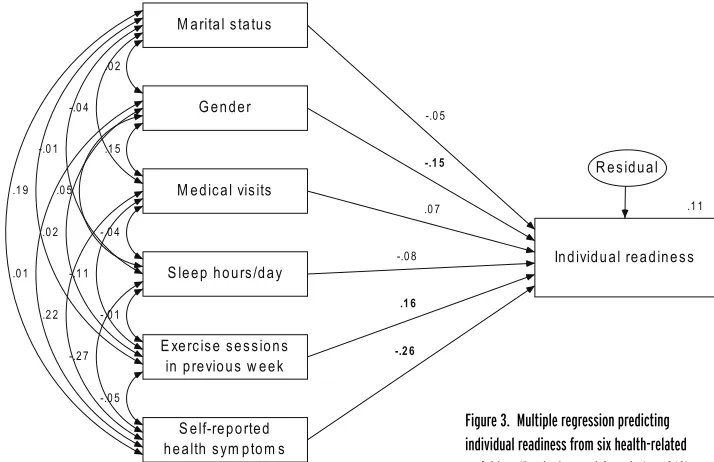
Three of these variables proved to be significantly correlated with readiness; and the same three emerged as significant predictors in regression analyses. Most notably, lower levels of self-reported health symptoms were associated with higher individual readiness. Secondly, higher reported frequency of physical exercise predicted higher levels of readiness. Gender was also predictive, with males reporting higher levels of readiness than females (the reasons for this gender difference remain unexplained; and the small proportion of females in this predeployment sample (.8 per cent) means this result must be regarded tentatively).
The regression analyses explained about 11 per cent of the variation in Individual readiness scores in the two samples examined (one predeployment, one during deployment). The outcome for the
regression analysis with a predeployment sample is shown in Figure 3. The figures on the six pathways from the health-related variables at left to the predicted variable of individual readiness at right show the strength of the relationship (which can range from –1.0 to + 1.0), with boldface font indicating a statistically significant relationship. The curved paths on the left between the health-related variables show correlation coefficients. The figure above the ‘Individual readiness’ variable shows the amount of explained variance.
That frequency of exercise was associated with higher individual readiness is not unexpected. Physical fitness is considered an important component of military performance. Having exercise as a part of one’s daily routine may reflect the degree of commitment one has to the broad ideals of military service, and in turn, one’s perceptions of readiness for operational service.
COMMAnd LeSSOn 8:
Health-related variables, particularly health symptoms and frequency of exercise, are useful predictors of readiness at the individual level.
unit climate factors as
predictors of individual
readiness
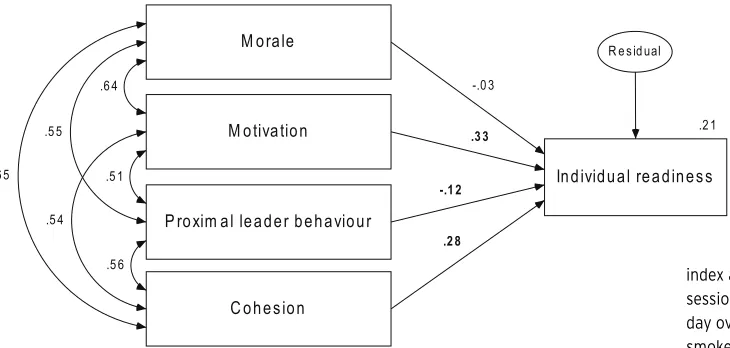
The unit climate constructs of Morale, Cohesion, Motivation, and Proximal leader Behaviour (i.e., the respondent’s immediate leader, or next in the chain of command) were used next to predict Individual readiness. All were significantly correlated with Individual readiness. A regression
,QGLYLGXDOUHDGLQHVV 0 HGLFDOYLVLWV
6OHHSKRXUVGD\
([HUFLVHVHVVLRQV LQSUHYLRXVZ HHN
5HVLGXDO
6HOIUHSRUWHG KHDOWKV\P SWRP V
*HQGHU
0 DULWDOVWDWXV
[image:3.1191.779.1136.44.275.2]
Figure 3. Multiple regression predicting individual readiness from six health-related variables. (Predeployment Sample 1, n=369) Kirkland, Bartone and
Marlowe (1993) also featured morale in their research into psychological readiness. They examined command priorities in u.S. Army units. By comparing soldier perceptions in units distinguished by low or high command priority with respect to fostering morale, significant correlations were found with six soldier readiness variables: commitment to the company, vertical bonding, confidence in leadership, general well-being, confidence in both self and weapons, and work satisfaction.
In their study, other command priorities (combat skills, discipline, decisiveness, control, horizontal bonding
(cohesion), and vertical bonding (esprit)) had almost no relationship with readiness variables. It was concluded that the fostering and maintenance of morale are associated with high scores on a number of human dimension outcomes, particularly psychological readiness.
COMMAnd LeSSOn 4:
Units with the highest sense of readiness for operations are likely to have commanders who put a high priority on issues of subordinate morale.
Readiness and tempo
Another approach to understanding psychological readiness was taken by Castro and Adler (2000); wherein soldier readiness to perform was posited to be associated with the pace or tempo of military operations. It was argued that a high operational tempo would lead to issues related to chronic fatigue and preclude adequate respite to enable military personnel to be adequately prepared — mentally or physically — “for some experience or action” (p. ).
This research showed that the context of military activity had important implications for understanding the relationships between factors affecting psychological readiness. For instance, both training and deployment environments typically produce an increase in workload and hours of work for military personnel. While soldiers assessed during deployment reported, as a group, decreased military readiness; soldiers assessed in
training environments typically reported increased military readiness. This distinction was subsequently explained by the high role ambiguity — “role overload” — associated with actual operations but normally absent from training scenarios (Thomas, Adler, & Castro, 200).
Other studies have examined the impact on readiness of the type of military operations undertaken. For example, special forces personnel have reported decreases in readiness following non-combat duties such as embassy support. rumsey (2002) concluded that peacekeeping duties were associated with tangible reductions in readiness for conventional operations.
Excessive time on particular tasks such as training exercises and equipment
inspections has also been associated with degraded readiness (Fossen, Hanser, & Stillion, 1997). It should be noted that the construct of readiness in these studies was related to system-level factors such as disruptions to immediate work team composition, equipment wear and tear, and lack of training for certain military skills; rather than related to psychological readiness per se.
Not all studies have found that psychological readiness is impaired by factors such as operational tempo. For example, Adlerks (1998) found a neutral association between time away from garrison for training and perceptions of individual or unit readiness. More significantly, several studies have found positive associations between operational/ personal tempo and perceptions of
individual readiness (e.g., Castro & Adler, 2001; ramsberger & Wetzel, 1998).
While Castro and Adler (2001) found that sustained operational tempo can lead to an increase in operational readiness, they noted that this apparently positive outcome came at a cost — that of decreased family well-being. This decline in “family readiness” was presumably due to the extended absence of the Service member from home.
COMMAnd LeSSOn 5:
High operational tempo/deployment workload have inconsistent impacts on readiness; possibly due to differences in leadership, levels of fatigue and degree of clarity about one’s operational role.
COMMAnd LeSSOn 6:
Operational readiness can be inversely related to family satisfaction — finding the balance is important because family well-being is a major retention factor.
In summary, numerous social and psychological variables have been postulated, or have been found, to predict psychological readiness. These variables include deployment appraisals and expectations, morale, cohesion, immediate leader behaviour, perceptions of leadership effectiveness, trust in leadership,
commitment to the unit, esprit de corps, general well-being, level of military experience, and individual coping ability (Thompson & Pastò, 2003).
individual Readiness
Factor items
collective or group
Readiness Factor items
I am ready to perform effectively if
sent to war.
The members of my workteam/section/
patrol are ready to deploy on operations
other than war.
I am ready to deal with any demand
or situation that may arise during
operational service.
My unit is ready for deployment on
operations other than war.
I am prepared to risk my life for the
members of my workteam.
The members of my workteam/section/
patrol are ready to go to war.
[image:3.1191.175.563.71.267.2]My unit is ready for its wartime role.
Table 1. Items used to derive the Individual and Collective Readiness Factors.
e
a
d
in
e
s
including a higher order ‘unit Climate’ variable designed to capture what the three human factors variables had in common.
In structural equation modelling (SEM) terms, this component is referred to as a “measurement model”. The rest of the figure is called the “structural model” and is equivalent to regression where one is interested in prediction. The measurement model and the structural model can be tested separately or together, in which case good fit implies that both components are supported. We used the one-step approach. Outcomes for the modified model are shown as Figure 5. The statistical fit of the model was acceptable. The amount of variance in readiness scores explained by the model was a reasonable 22 per cent. This outcome provided strong support for the higher order ‘unit Climate’ factor shown in Figure 5 (the measurement model) and also for the other pathways shown (the structural model).
The model also fitted data from a deployment sample. Considerably more variance was explained in Individual readiness (43 per cent compared with 22 per cent). For the deployment sample, the direct effect of Military Experience on Individual readiness was not significant (p = .24) but the direct effect of the unit Climate variable was much stronger (path
coefficient .64 compared with .36 for the predeployment sample).
collective readiness
The influence of the same human factors on collective readiness was examined next. Because it was reasoned that the military experience and healthy behaviours variables from the preceding model would not influence perceptions of group readiness, these individual biographic variables were omitted. The higher order unit Climate variable (derived from Morale, Cohesion and Proximal leader Behaviour variables) was again used, and it accounted for 74 per cent of the variance in Collective readiness — an impressive outcome. It would appear that human factors are even better predictors of perceptions of readiness of the respondent’s workteam and unit.
COMMAnd LeSSOn 10:
Unit climate (as measured by cohesion, morale and immediate leadership) is a powerful predictor of soldier
perceptions of the readiness of their workteam and unit for deployment.
group perceptions of
readiness for deployment
A final set of analyses was conducted using human factors derived from group-level responses to the unit Climate Profile — rather than responses from individuals. These factors were designed to measure
how military groups — such as platoons — perceived the climate in their untis. The variables used were Ethos, Team Climate, Senior leadership Effectiveness and SNCO/ WO Effectiveness. The latter two variables were intended to represent perceptions of higher-level leader effectiveness in the unit. Ethos was intended to measure
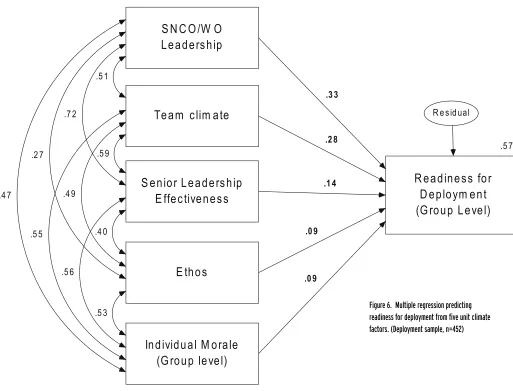
organisational cohesion or Esprit de Corps. Given the presumed importance of morale to collective military performance, a morale factor was also included. A group-level measure of readiness — called ‘readiness for Deployment’ — combined all items listed in Table 1.
The model is shown in Figure 6. Five samples were used in separate regression analyses. The combination of human dimensions variables explained between 48.1 and 6.6 per cent of the variation in readiness scores across the samples. There was remarkable consistency in the salience of the predictor variables. For instance, Team Climate made the strongest unique contribution in four of the five samples and was the second strongest predictor in the other sample (the one shown in Figure 6). Both Ethos and SNCO/WO leadership variables were significant predictors in all but one (predeployment) sample. Senior leader Effectiveness and Individual Morale were less consistent predictors; significant in two samples each. It is noteworthy that
,QGLYLGXDOUHDGLQHVV 3UR[LP DOOHDGHUEHKDYLRXU
&RKHVLRQ
5 HVLGXDO
0 RWLYDWLRQ
0 RUDOH
,1' ,9,' 8 $/ 5($',1(66
0 25 $/(
&2+(6,21 0 ,/,7 $ 5 < (;3(5 ,(1&(
+ HDOWK\ %HKDYLRXUV
352;,0 $//' 5 %(+$9,285
81,7 &/,0 $7(
Figure 5. Model with higher order Unit Climate factor examining the influence of military experience, health behaviours, and human factors on Individual Readiness (n=363).
analysis (shown in Figure 4) revealed that the human factor variables explained an impressive 20.7 per cent of the variation in Individual readiness scores. Interestingly, in the presence of the other human factors variables, Morale did not contribute significantly to explaining the variance in Individual readiness. Such outcomes are common when the independent variables in a regression equation are themselves correlated. In practical terms, these regression results are telling us that if we could measure just three of these four variables, Motivation, Proximal leader Behaviour, and Cohesion are the ones to use.
The same regression model was used with the two other predeployment samples and the variance explained in Individual readiness was even better: 49.1 per cent and 32.6 per cent respectively. The pattern of relationships among the variables varied, for example, for the second predeployment sample, Motivation made the largest unique contribution towards explaining Individual readiness, with Proximal leadership emerging as the other significant predictor. For the third sample, Motivation and Cohesion each significantly contributed to the prediction of psychological readiness.
We can see that the relative contribution of each of the three human factors variables changed over the three samples but this “shuffling of the pack” is more a function of the instability of regression coefficients when the input variables are correlated, as they are here. The important point is that these three variables consistently predicted a substantial proportion of readiness.
COMMAnd LeSSOn 9:
Human factors such as cohesion, motivation and immediate leadership were consistent and strong
predictors of individual psychological readiness among ARA soldiers poised for deployment.
What of the role of morale? Morale did not influence readiness in any sample but this again is a function of the correlations among morale, motivation, cohesion, and proximal leadership. We know from the correlation coefficients, which are not reported here, that morale is related to readiness and that in two of the samples readiness was actually more strongly related to morale than to proximal leadership. Sometimes it is important to separate the theoretical and practical aims of research. From a theoretical point of view, our research has shown that all four of these human factors variables are related to readiness. From a practical point of view, we have shown that to predict the proportion of readiness accounted for in our analyses, you need to measure only three of them. To improve prediction, new variables must be introduced, or new techniques applied, as we will demonstrate in the remainder of this article.
modelling individual
Readiness
[image:4.1191.59.424.60.234.2]The broad constructs from the preceding analyses — military experience, health behaviours, and human dimensions factors — were combined into a model that examined their influence on individual readiness. In this model, military experience comprised three items: age, operational experience, and years of service; and a health behaviours Figure 4. Multiple regression predicting individual readiness from morale, motivation, proximal leader behaviour, and cohesion. (Predeployment Sample 1, n=369)
index also comprised three items: exercise sessions per week, average working hours per day over the preceding week, and smoker/non-smoker status.
The Health Symptoms variable was excluded because it was considered to represent a health outcome rather than a health-related
behaviour. Examination of correlations
suggested that morale and motivation appeared to be measuring the same construct, and because motivation was of secondary interest, it was removed from the model. Making use of our knowledge that the other three human factors variables were also correlated in all three samples (see comments above), we modelled this shared variance by
e
a
d
in
e
s
the workteam/unit level were the most compelling. This finding that collective readiness could be better accounted for than individual readiness suggests that psychological readiness is more than just a sense of confidence in one’s own military skills (self-efficacy). It would appear that soldiers can and do distinguish multiple levels of readiness (e.g., individual, team, and unit); reflecting the importance of individual and collective performance in the military.
Self-reported psychological and physical health also showed considerable promise as useful predictors of an individual’s sense of preparedness for deployment.
The practical implications of these findings are that psychological readiness can be modelled meaningfully using constructs derived from the Human Dimensions of Operations project, particularly the psychological climate constructs measured by the unit Climate Profile.
Finally, it was clear that distinct patterns in how unit climate variables affected readiness were evident across different units. This outcome appears to support current practice of conducting climate assessments on a unit basis in order to develop tailored information to optimise the human factors
underpinning capability and operational effectiveness in those units.
It would appear that there is no consistent ‘Holy Grail’ of antecedent factors that will ensure each unit will be optimally prepared in a psychological sense for deployment. Psychological climate is a multifaceted attribute that is a function of perceptual, cognitive and emotional processes at multiple levels in the
organisation.
An understanding of multilevel psychological climate information should enable commanders to enhance the human factors contributing to individual and unit readiness and effectiveness. Therefore, it is recom-mended that units routinely undertake a climate assessment in the lead-up to deployment (as well as during deployment). In this way, the unique constella-tion of human factors in that unit, at that time, can be assessed in order to inform command decision-making.
References and further reading
Adlerks, C. E. (1998). PERSTEMPO: Its effects on soldier’s attitudes (ArI Study report 98-02). Alexandria, VA: u.S. Army research Institute for the Behavioral and Social Sciences.
Bartone, P. T., & Kirkland, F. r. (1991). Optimal leadership in small Army units. In r. Gal & A. D. Mangelsdorff (Eds.), Handbook of military psychology (pp. 393-409). New York: John Wiley.
Castro, C. A., & Adler, A. B. (2000).
Working in the zone: Maintaining optimal readiness in U.S. soldiers. Paper presented at the 36th International Applied Military Psychology Symposium, Split, Croatia.
Castro, C. A., & Adler, A. B. (2001).
OpTempo and PersTempo Study: The influence of leadership at the local level for improving soldier and unit readiness in a high OpTempo environment (uSArEur/7A). Heidelberg, Germany: united States Army Medical research unit – Europe, Walter reid Army Institute of research.
Fossen, T., Hanser, l. M., & Stillion, J. (1997). What helps and what hurts: How ten activities affect readiness and quality of life at three 8AF wings (DB-223-AF). Santa Monica, CA: rAND Corporation.
Harris, J. H., Blair, M. D., & O’Neill, H. M. (199). MWR programs and readiness links. Fairfax, VA: Caliber Associates.
Kirkland, F. r., Bartone, P. T., & Marlowe, D. H. (1993). Commanders’ priorities and psychological readiness.
Armed Forces & Society, 19, 79-98. Murphy, P. J. (2008). Readiness, resilience and readjustment: A psychological investigation of human factors across the deployment cycle of contemporary peace support operations. unpublished doctoral
dissertation, university of Adelaide, Adelaide.
ramsberger, r., & Wetzel, E. (1998).
Personnel tempo impact study (Fr-WATSD-98-1). Alexandria, VA: Human resources research Organization.
rumsey, M. G. (2002). What we know about rotation policies in the Army
(Information Paper). Alexandria, VA: u.S. Army research Institute for the Behavioral and Social Sciences.
Shamir, B., Brainin, E., Zakay, E., & Popper, M. (2000). Perceived combat readiness as collective efficacy: Individual- and group-level analysis.
Military Psychology, 12, 10-119.
Thomas, J. l., Adler, A. B., & Castro, C. A. (200). Measuring operations tempo and relating it to military performance. Military Psychology, 17, 137-16.
Thompson, M. M., & Pastò, l. (2003). Psychological interventions in Peace Support Operations: Current practices and future challenges. In T. W. A. Britt, A. B. (Ed.), The psychology of the peacekeeper: Lessons from the field (pp. 223-242). london: Praeger.
Wild, W. (1988). Proposal for studying the human dimension of combat readiness
(Technical Note /88). Willowdale, Ontario: Canadian Forces Personnel Applied research unit, Department of National Defence.
Winslow, D. (1997). The Canadian Airborne Regiment in Somalia: A socio-cultural inquiry. Ottawa, Ontario: Public Works & Government Services Canada.
Russian Novelist Ivan Turgener
If we wait for the moment when everything, absolutely everything is ready, we shall never begin.
Senior leader Effectiveness was significant only in the two deployment samples. A plausible explanation for this outcome is that members of the senior leadership generally are busy planning behind the scenes in the lead-up to deployment; but their role and influence are more apparent and accepted in the deployment context where their major focus is on day-to-day operations.
A supplementary explanation draws attention to the point we have made before in this article: these regression outcomes emphasise relative rather than absolute contributions. The correlation between senior leadership and collective readiness was still robust in the pre-deployment samples, but in the pre-deployment context its influence was overshadowed by Team Climate and SNCO/WO leadership.
The same comment applies to morale, which was inconsistent with respect to its influence as a predictor of psychological readiness, in this case readiness measured at the group level. We hasten to point out
that this finding does not lead to the conclusion that morale is unimportant. As was the case in the individual level analyses, morale was consistently related to readiness, so the theoretical links were supported.
From a practical viewpoint, however, morale in this case did not add to the prediction of readiness when leadership and climate factors were also taken into consideration. Our research shows that they are better predictors of readiness than morale. Teasing out the role of morale will take more space than we have available here. We will address this question in a future volume of this series.
COMMAnd LeSSOn 11:
Group-level unit climate variables (Ethos, Team Climate, Senior Leadership Effectiveness and SNCO/ WO Effectiveness) were effective predictors of readiness to deploy.
COMMAnd LeSSOn 12:
Team Climate (horizontal cohesion) was the strongest and most consistent predictor of predeployment readiness; while Senior Leadership variables were strongly predictive of psychological readiness during the deployment phase.
conclusions
The study of Australian Army personnel from the Human Dimensions of Operations project showed that there were consistent, positive associations between psychological readiness and military experience, health and unit climate. The human dimensions of unit climate were easily the most influential factors when trying to predict individual and collective readiness. Overall, measures of horizontal cohesion (Cohesion and Team Climate) were the strongest and most consistent predictors of psychological readiness.
Associations between unit climate constructs and perceptions of readiness at
5HDGLQHVVIRU
'HSOR\P HQW
*URXS/HYHO
61&2: 2
/HDGHUVKLS
7HDP FOLP DWH
5 HVLGXDO6HQLRU/HDGHUVKLS
(IIHFWLYHQHVV
(WKRV
,QGLYLGXDO0 RUDOH
*URXSOHYHO
[image:5.1191.46.559.54.445.2]
Figure 6. Multiple regression predicting readiness for deployment from five unit climate factors. (Deployment sample, n=452)
e
a
d
in
e
s