THE 2
:
1 RESONANT EXOPLANETARY SYSTEM ORBITING HD 73526
1 C. G. Tinney,2R. Paul Butler,3Geoffrey W. Marcy,4, 5Hugh R. A. Jones,6 Gregory Laughlin,7Brad D. Carter,8Jeremy A. Bailey,9and Simon O’Toole2Received 2005 December 6; accepted 2006 February 20
ABSTRACT
We report the detection of a second exoplanet orbiting the G6 V dwarf HD 73526. This second planet has an orbital period of 377 days, putting it in a 2:1 resonance with the previously known exoplanet, the orbital period for which is updated to 188 days. Dynamical modeling of the combined system allows solution for a self-consistent set of orbital elements for both components. HD 73526 is the fourth exoplanetary system (of a total of 18 systems with two or more
components currently known) to have components detected in 2:1 resonance. Finding such a large fraction of
multiple planets (more than 20%) in 2:1 resonance strongly suggests that orbital migration, halted by stabilization in a trapping resonance, plays an important role in the evolution of exoplanets in multiple planet systems.
Subject headinggs:planetary systems — stars: individual ( HD 73526)
1. INTRODUCTION
The Anglo-Australian Planet Search (AAPS ) began taking data in 1998 January on the nearest and brightest Sun-like stars. Results from this program ( Tinney et al. 2001, 2002a, 2003, 2005; Butler et al. 2001, 2002; Jones et al. 2002a, 2002b, 2003; Carter et al. 2003; McCarthy et al. 2004) have demonstrated long-term velocity precisions of 3 m s1or better, for suitably quiescent Sun-like stars. The AAPS, together with programs using similar techniques on the Lick 3 m and Keck 10 m tele-scopes ( Fischer et al. 2001; Vogt et al. 2000), provides all-sky planet search coverage for inactive F, G, K , and M dwarfs out to distances of 50 pc. For recent reviews of the progress in exoplan-etary detection and the Doppler technique, the interested reader is referred to Marcy et al. (2005b) and Mayor et al. (2005), and ref-erences therein.
The AAPS is being carried out on the 3.9 m Anglo-Australian Telescope (AAT ), using the University College London Echelle
Spectrograph ( UCLES ) and an I2 absorption cell. UCLES is
operated in its 31 lines mm1mode. Prior to 2001 September it
was used with a MIT/LL 2048;4096 15m pixel CCD, and
since then has been used with an EEV 2048;4096 13.5m pixel CCD. AAPS currently observes on 32 nights per year. The survey initially targeted 200 F, G, K, and M stars with <20 and
V<7:5. Where age/activity information was available from
RHK0 indices (see, e.g., Henry et al. 1996; Tinney et al. 2002b), we required target stars to have logRHK0 >4:5, corresponding to ages greater than 3 Gyr.
In addition to the primary sample, a small subsample of
twenty fainter dwarfs with uvby photometry suggesting metal
enrichment over solar was added in 1999 October ( Tinney et al. 2003). These dwarfs haveV<9 and were added to examine sug-gestions that metal-enriched stars preferentially host planets (see e.g., Laughlin 2000 and references therein). HD 73526 (the pri-mary focus of this paper) was one of these stars. A further eight M dwarfs extending as faint asV<11 were also included in the program. In 2002, AAPS further expanded the scope of its sur-vey, increasing from 20 to 32 nights yr1. Sixty new stars were then added to the target list, and those stars found since their initial inclusion to haveRHK0 activity levels inconsistent with high-precision velocity measurement (i.e., logRHK0 <4:5; Tinney et al. 2002b; Jenkins et al. 2006) were culled. The resulting AAPS target sample currently includes 253 stars. Our observing procedure and data analysis continue to substantially follow that described in Butler et al. (1996) and Butler et al. (2001), although over the last 24 months significant improvements have been made to the spectral extraction component of the analysis package ( Tinney et al. 2005). A signal-to-noise ratio of at least 200 per pixel is now standard for all stars. The detection of a first extrasolar planet orbiting the star HD 73526 was presented in Tinney et al. (2003). This planet ( here-after HD 73526b) was estimated to have an orbital period
P¼190:53:0 days, eccentricitye¼0:340:08, and ampli-tudeK ¼1088 m s1, leading to a minimum mass estimate of
Msini¼(3:00:3)MJ.
2. THE STAR HD 73526
The characteristics of the host star HD 73526 are summarized in Table 1; please refer to the table notes for references. HD
73526 ( HIP 42282, SAO 220191) is a G6 V dwarf. No RHK0
estimate is currently available.Hipparcos(High-Precision Par-allax CollectingSatellite) finds it to be photometrically stable. HD 73526 was initially added to our AAPS target sample based on a Stro¨mgrenuvbyphotometry suggestion of metal enrichment over solar, based on which Tinney et al. (2003) estimated a metal-licity in the range½Fe / H ¼0:10 0:16 (see also Nordstrom et al. 2004 and references therein). Several independent detailed spec-troscopic analyses have now been performed for this star leading to metallicity estimates of½Fe / H ¼ þ0:250:03 ( Fischer & Valenti 2005), +0:270:06 (Santos et al. 2004), and +0:110:07 ( Bond et al. 2006). From these we conclude that the metallicity 1 Based on observations obtained at the Anglo-Australian Telescope, Siding
Spring, Australia.
2 Anglo-Australian Observatory, P.O. Box 296, Epping 1710, Australia;
3 Carnegie Institution of Washington, Department of Terrestrial Magnetism,
5241 Broad Branch Road NW, Washington, DC 20015-1305. 4
Department of Astronomy, University of California, Berkeley, CA, 94720. 5 Department of Physics and Astronomy, San Francisco State University, San
Francisco, CA 94132.
6 Centre for Astrophysics Research, University of Hertfordshire, Hatfield
AL10 9AB, UK.
7 University of California Observatories / Lick Observatory, University of
California at Santa Cruz, Santa Cruz, CA 95064.
8 Faculty of Sciences, University of Southern Queensland, Toowoomba,
4350, Australia. 9
Australian Centre for Astrobiology, Macquarie University, 2109, Australia.
of this star is somewhat higher than that derived from Stro¨mgren photometry and assume a metallicity of½Fe / H ¼ þ0:25. The ef-fective temperatures estimated by these various studies range from 5470 to 5700 K, and we have assumed a median value of 5590 K. Both Santos et al. (2004) and Fischer & Valenti (2005) have used isochrone interpolation to estimate a mass for this star, and they derive 1.05 and 1.08M(respectively). We have adopted a mass of 1.08M, giving more weight to the Fischer & Valenti (2005) estimate, which is based on more recent isochrones. These param-eters are not significantly different from those assumed by Tinney et al. (2003) and continue to suggest that HD 73526 is beginning its evolution off the main sequence.
3. KINEMATIC ORBITAL SOLUTIONS
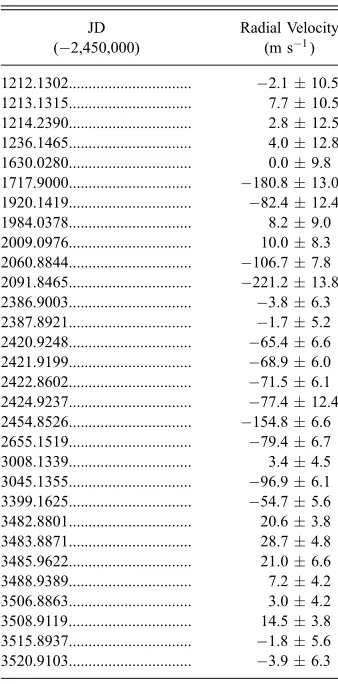
Thirty observations of HD 73526 are listed in Table 2. The velocity uncertainty given is produced by the least-squares fit-ting procedure. This fit simultaneously determines the Doppler shift and the spectrograph point-spread function ( PSF ) for each observation made through the iodine cell, given an iodine ab-sorption spectrum and an ‘‘iodine-free’’ template spectrum of the object ( Butler et al. 1996). The uncertainty is derived for each measurement by taking the mean of 400 useful spectral regions
(each 28long) from each exposure. This uncertainty includes
the effects of photon-counting uncertainties, residual errors in the spectrograph PSF model, and variation in the underlying spec-trum between the template and ‘‘iodine’’ epochs. Since the in-ternal velocity uncertainties produced by the least-squares fitting procedure do not reflect the likely intrinsic variability or ‘‘jitter’’ of HD 73526, a nominal 3.3 m s1jitter uncertainty is added in quadrature to these internal velocity uncertainties to use in generating the reduced2
. All velocities are measured relative to
the zero point defined by the template observation.
In Tinney et al. (2003) it was noted that the rms residuals of 18 m s1about the best Keplerian fit to the HD 73526 velocity
data were significantly higher than usually seen from AAPS data, even when the relative faintness of this star is taken into account. Indeed, the velocity uncertainties produced by our least-squares fitting process were typically at half this level, and the2
¼1:63
[image:2.612.361.530.86.428.2]for this fit was significantly above the expected value of 1.0. Figure 1 shows a power spectrum generated from the veloc-ities in Table 2, indicating the presence of a strong peak in ob-served power near the 190 day period first detected by Tinney et al. (2003) and additional peaks (at increasing false-alarm prob-abilities) near 380 and 128 days. Figure 2 shows the results for a best-fit single Keplerian period near 190 days. As suggested by the large residuals in our initial fit to the earlier set of data, this single-planet fit is clearly inadequate to correctly model this data,
leading us to conclude that a multiple-Keplerian fit is required. This situation led Gregory (2005), in an independent reanalysis of the 18 epochs published by Tinney et al. (2003), to suggest the likelihood of other periodicities near 128 and 376 days in that data.
TABLE1
Stellar Parameters for HD 73526
Parameter Value References
Hipparcos Nobs... 137 1 Hipparcos... 0.02 1 Hipparcos(mas) ... 10.61.0 1 MV... 4.10.2 1 MBol... 3.70.2 2 Spectral type ... G6 V 3 [ Fe / H ] (spectroscopic) ... +0.250.05 4 Teff( K) ... 5590 4 Mass (M)... 1.080.05 5
References.—(1) Perryman et al. 1997; (2) Cox 2000; (3) Houck 1978; (4) Santos et al. 2004, Fischer & Valenti 2005, Bond et al. 2006, see text; (5) Santos et al. 2004, Fischer & Valenti 2005, see text.
TABLE2
Velocities for HD 73526
JD (2,450,000)
Radial Velocity (m s1)
1212.1302... 2.110.5 1213.1315... 7.710.5 1214.2390... 2.812.5 1236.1465... 4.012.8 1630.0280... 0.09.8 1717.9000... 180.813.0 1920.1419... 82.412.4 1984.0378... 8.29.0 2009.0976... 10.08.3 2060.8844... 106.77.8 2091.8465... 221.213.8 2386.9003... 3.86.3 2387.8921... 1.75.2 2420.9248... 65.46.6 2421.9199... 68.96.0 2422.8602... 71.56.1 2424.9237... 77.412.4 2454.8526... 154.86.6 2655.1519... 79.46.7 3008.1339... 3.44.5 3045.1355... 96.96.1 3399.1625... 54.75.6 3482.8801... 20.63.8 3483.8871... 28.74.8 3485.9622... 21.06.6 3488.9389... 7.24.2 3506.8863... 3.04.2 3508.9119... 14.53.8 3515.8937... 1.85.6 3520.9103... 3.96.3
Notes.—Julian dates (JD) are barycentric. Radial velocities are barycentric, but have an arbitrary zero point determined by the radial velocity of the template.
[image:2.612.46.296.87.206.2] [image:2.612.323.568.542.727.2]Adopting the set of parameters fit for a single Keplerian near the dominant 190 day period as a likely neighborhood for the orbital parameters of a first planet, the data were searched for a subse-quent planet by performing dual Keplerian fits to the data with these first planet parameters and a period for the second planet selected as (1) the four highest peaks in the periodogram of the residuals to the first planet model model; (2) 20 orbital periods spaced in equal logarithmic intervals, with 10 being less than and 10 being greater than the period of the first planet; and (3) three periods that are 2, 3, and 4 times the highest periods found in (1) and (2), as trials for a planet with a period much longer than the duration of observations. For each of these 27 guesses for the period of the second planet, a search of the vicinity is done to find
a minimum of2
. The use of periodogram peaks and the
loga-rithmic spacing of trial periods will catch second planets as a
minimum in2
. This process revealed that a 190 day + 380 day
system clearly demonstrated a minimal 2
. To reinforce this
conclusion, we show in Table 3 the2for dual Keplerian fits to all the data epochs, using starting periods at pairwise choices from the three dominant periodogram peaks: 190, 380, and 128 days.
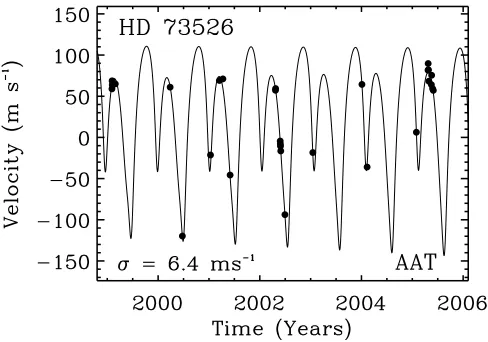
Figure 3 shows our best-fitting dual Keplerian model. The orbital parameters of this solution are listed in Table 4. Only ep-ochs from Table 2 with internal uncertainty less than twice the value of the median internal uncertainty are included. The uncer-tainties in the kinematic orbital parameters are derived from sim-ulations as follows ( Marcy et al. 2005b). The set of residuals about the best-fit Keplerian orbits is treated as a population of random deviations with a distribution characteristic of the noise in the data. We then randomly redistributed this ‘‘noise’’ onto velocities calculated from the best-fit solution at the observation epochs and refit to redetermine the orbital parameters. The
un-certainties reported in Table 4 are the standard deviations for each parameter that result from repeating this procedure 50 times.
This fit suggests that the system is in a 2:1 resonance with periods of 187.5 and 377 days. It should be noted, however, that due to the similarity of the period of HD 73526c to the orbital period of the Earth (and the consequent annual lack of phase cov-erage when HD 73526 passes behind the Sun), there is some degeneracy between eccentricity and amplitude in our detailed solution for the orbits of this system. This degeneracy is not reflected in the uncertainties quoted in the table, which uses our observation epochs as a basic assumption. While we can be con-fident of the orbital periods of HD 73526’s two planets, equally valid solutions (as measured by2) can be derived with eccen-tricities and amplitudes ranging from (eb;ec)¼(0:12;0:33) and
(Kb;Kc)¼(141;96) to (eb;ec)¼(0:36;0:38) and (Kb;Kc)¼
(76;67) (where the families of solutions trade off lower eccen-tricities for large amplitudes). This state of affairs will change as monitoring of this system continues, although it will take some years for full phase coverage to be accessible with HD 73526c’s orbital phase advancing at just 12 days / 376 days¼3:2% per year.
4. DYNAMICAL ANALYSIS
The parameters listed in Table 4 were derived under the ap-proximation that the orbits are fixed Keplerian ellipses. In reality, Fig.2.— Measured velocities of HD 73526. A single Keplerian fit to the data
with a period of 187.5 days is plotted over the data. The rms residuals to this fit (26.4 m s1) are very large, which suggests that this fit does not adequately param-eterize the system. (Only epochs from Table 2 with internal uncertainty less than twice the value of the median internal uncertainty are included.)
TABLE3
HD 73526b,cPossible Dual Keplerian Orbits
Starting Periods
(days) Fit Period 1 Fit Period 2 Reduced2 rms (m s1)
128 + 190... 125.70.1 186.10.2 2.7 9.7 128 + 380... 125.30.2 384.52.1 2.4 8.9 190 + 380... 187.30.5 376.81.2 1.07 7.3
Fig.3.— Measured velocities of HD 73526. A double Keplerian fit to the data with periods of 187.5 and 376.9 days and the parameters shown in Table 4 is plotted over the data. The rms residuals to this fit are 6.4 m s1, and the reduced 2¼1:09, indicating that the residuals about the fit are consistent with mea-surement uncertainties. (Only epochs from Table 2 with internal uncertainty less than twice the value of the median internal uncertainty are included.)
TABLE4
HD 73526b,cKinematic Orbital Parameters
Parameter HD 73526b HD 73526c
Orbital periodP(days) ... 187.50.3 376.90.9 Velocity amplitudeK(m s1)... 765 674 Eccentricitye... 0.390.05 0.400.05 !(deg) ... 17211 18330 a1sini( km) ... (1804);103 (3188);103 Periastron time (JD2,450,000) ... 3715 18433 Msini(MJ) ... 2.070.16 2.300.17 a(AU ) ... 0.660.05 1.050.08 2
... 1.09
[image:3.612.45.291.61.240.2] [image:3.612.319.563.62.233.2] [image:3.612.316.567.636.762.2] [image:3.612.42.293.698.764.2]the star and the two planets constitute an interacting three-body system. If one interprets the Keplerian parameters as osculat-ing orbital elements correspondosculat-ing to a particular epoch, there is no guarantee that the resulting configuration of masses is either dynamically stable or consistent with the radial velocity data set. Indeed, in this particular case, when the dual Keplerian orbital elements listed in Table 4 are integrated forward in time, the sys-tem becomes unstable within a few thousand years. Furthermore, when the system is integrated from JD 2,451,212.1302, the epoch of the first radial velocity data point, the2
for the fit increases
from2
¼1:4 to
2
¼68:9, and the rms scatter increases from
7.3 to 35.6 m s1. ( In these fits and in the following dynamical analysis, all data epochs are used and the uncertainties used are the straight internal uncertainties from Table 2 without additional jitter terms being used, which is why the dynamical values of2
are all slightly higher than their kinematic equivalents.) To date, this situation, in which Keplerian orbits with a near two-to-one period ratio provide an excellent fit to the radial ve-locity data and yet correspond to initial conditions that are either dynamically inconsistent and/or dynamically unstable, has arisen for three other published radial velocity data sets. The most dra-matic example is the GJ 876 system (Marcy et al. 2001) in which the outer 2.5MJplanet has orbited more than 50 times since the
beginning of observations of the system with the Keck telescope ( Rivera et al. 2005). As has been shown by a number of authors, starting with Laughlin & Chambers (2001) and Rivera & Lissauer (2001), dynamical fits to the GJ 876 system indicate that the outer two planets are participating in a 2:1 resonance in which the critical angles, 1¼2k2k1$1 and 2¼2k2k1$2,
both librate with small amplitudes of1max5and2max20.
The other two stars that appear to harbor planetary com-panions participating in the 2:1 resonance are HD 128311 with
M1sin (i)¼2:6MJ, M2sin (i)¼3:2MJ, P1¼449 days, P2¼
920 days,K1 ¼85 m s1, andK2¼80 m s1( Vogt et al. 2005)
and HD 82943 withM1sin (i)¼1:85MJ,M2sin (i)¼1:84MJ,
P1¼221:6 days,P2¼444 days,K1¼67 m s1, and K2¼
46 m s1( Mayor et al. 2004; Ferraz-Mello et al. 2005; Lee et al. 2006). While the HD 73526 system is broadly similar to the HD 82943 system, it bears a strikingly close outward resemblance to the HD 128311 system. Both systems have pairs of near-equal
msin (i)2MJ companions and periods in theP1200 days,
P2400 days range, although the total radial velocity
semi-amplitude is larger for HD 73526, and the period is shorter. This means that aside from GJ 876, the HD 73526 system has the best potential for exhibiting non-Keplerian dynamics over timescales accessible to radial velocity observations.
In anticipation of the potential future importance of the HD 73526 system, we have carried out a self-consistent three-body dynamical fit to the observed velocities (see Laughlin et al. 2005).
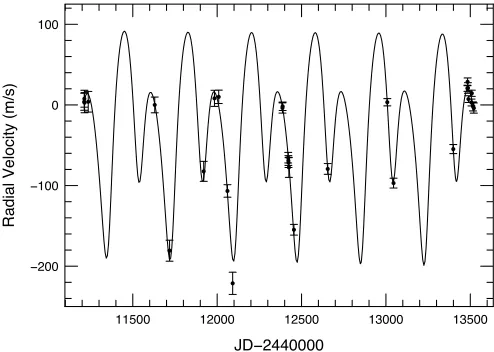
The fitting procedure employs the dual Keplerian model listed in Table 4 as an initial guess and uses a Levenberg-Marquardt al-gorithm (similar to that described by Press et al. 1992) to obtain osculating orbital elements (defined at JD 2,451,212.1302) that give a stellar reflex velocity that minimizes2. The orbits are assumed to be coplanar and edge-on. The resulting fit is listed in Table 5 and plotted in Figure 4.
The system implied by this fit is dynamically stable over a 1 Myr test integration. It is evidently protected by a 2:1 mean motion resonance in which1 librates with width1max¼95.
The resonant argument2, however, is circulating, indicating that
the apsidal lines for the orbits precess relative to one another. The system is subject to the competing influences of both the 2:1 reso-nant interaction, which forces1to librate, as well as the
Laplace-Lagrange secular interaction, which drives$2$1through the
full 2range (see Murray & Dermott 1999).
In order to derive the quoted uncertainties in the orbital ele-ments of the dynamical fit, we have adopted the procedure de-scribed in Vogt et al. (2005). We take the self-consistent two-planet fit listed in Table 5 and apply a Monte Carlo algorithm in which alternate radial velocity data sets are generated by scrambling the residuals to the fit and then adding them to the model velocities. We then use the Levenberg-Marquardt algorithm to generate a self-consistent fit to each of the Monte Carlo–generated data
sets, adopting an unbiased initial guess withP1¼188 days,
P2¼377 days,M1 ¼M2¼0,e1¼e2¼0, m1¼2MJ, and
m2 ¼3MJ.
When a trial has converged, the resulting system is integrated for 104yr, and the maximum eccentricity attained by each planet during the integration is noted. Orbital instability is generally indicated when the eccentricity of either planet approaches unity. We also monitor the maximum excursions of1and2, in order
to determine whether each individual fit is in 2:1 resonance for the entire 104yr. In 500 such trials, we obtain 268 unstable
sys-tems. Among the remaining systems, 159 have1librating and
2circulating, and 49 haveboth1and2librating. The
remain-ing 24 systems have both resonant arguments circulatremain-ing. In-tegrations of these 24 systems to times longer than 104yr have
shown instability in every case that has been tested so far. We note that, as for dual Keplerian fitting, the aliasing is also problematic for our dynamical fits. This results in a degeneracy between our ability to determineeand planet mass. The resulting
TABLE5
HD 73526b,cDynamical Orbit Fit
Parameter HD 73526b HD 73526c
Orbital periodP(days) ... 188.30.9 377.82.4 Mean anomaly (deg)... 8613 8227 Mass (MJ)... 2.90.2 2.50.3 Eccentricitye... 0.190.05 0.140.09 $... 2039 1376 Velocity offset (m s1)... 29.96
Epoch (JD) ... 2,451, 212.1302 2
... 1.57
rms (m s1) ... 7.9
Fig.4.—Dynamical reflex velocity fit of Table 5 with measured velocities. The rms residuals to this fit are 7.9 m s1, and the reduced2
¼1:57. (This fit
uses all data epochs and measures2
relative to the internal uncertainties of
Table 2, which is why the rms and2
appear higher than those reported for the
[image:4.612.322.569.63.239.2] [image:4.612.45.297.87.206.2]uncertainty in these parameters is of a similar scale to that seen in our purely kinematic Keplerian fits. Nonetheless, the period de-terminations (again as for our kinematic fits) are well determined, as is the conclusion of 2:1 resonance.
The configuration listed in Table 5 is strongly reminiscent of the dynamical fit to the HD 128311 radial velocity data set re-ported by Vogt et al. (2005), although the orbital eccentricities (einner¼0:38,eouter¼0:21) were higher in that case than they
are here. It will be very interesting if the planets in these systems are indeed trapped in dynamical states in which the 2:1 resonance argument 1 librates while 2 circulates. Librating-circulating
configurations are not observed to arise from the coplanar migra-tion scenarios that have been studied by Lee and collaborators ( Lee & Peale 2002; Lee 2004; Lee et al. 2006), which have been successfully applied to model the origin of the GJ 876 and HD 82943 systems. In the Lee et al. migration scenarios, the planets invariably wind up having both arguments in libration. Config-urations such as the one given in Table 5 would have to arise either (1) through migration with initial planetary eccentricities, (2) via migration that occurred very rapidly, or (3) as a result of a dynamical scattering event. Work is currently underway to study these three possibilities.
The unusual best-fit dynamical configuration for HD 73526, in which the planets participate in 2:1 resonance with only1
li-brating, is apparently not an accessible state of the coplanar disk migration scenarios investigated by Lee (2004). It may be pos-sible, however, for capture into a1-librating,2-circulating state
to occur via fast migration, or migration with initial eccentricities, or migration with significant initial mutual inclination (M. H. Lee 2005, private communication). In theory, the dynamical inter-actions between planets b and c should allow the mutual incli-nation of the planets to be obtained via dynamical fitting to radial velocities. In practice, however, such a determination will be dif-ficult to carry out. Even the much more extensive, higher signal-to-noise ratio GJ 876 data set is not yet sufficient to allow a definitive measurement of mutual inclination (Rivera et al. 2005). It has been suggested by Goz´dziewski & Konacki (2005) that the radial velocity variations in the HD 128311 and HD 82943 sys-tems are caused not by 2:1 resonant configurations, but rather by pairs of planets in 1:1 resonances that resemble high-eccentricity retrograde satellite configurations (see Laughlin & Chambers 2001). We have searched for dynamical fits to the HD 73526 data set that involve pairs of planets in 1:1 resonance, but were not able to find satisfactory coplanar,i¼90fits. The dearth of such fits likely arises from the fact that the osculating orbital eccen-tricities of the HD 73526 planets are smaller than in either the HD 128311 or HD 82943 systems.
5. CONCLUSION
The HD 73526 resonant system joins a growing list of exo-planetary multiples in resonant configurations; if it is added to the 17 multiple planets published or in press as at 2005 Sep-tember ( Marcy et al. 2005a), we have eight of 18 planetary systems containing at least one resonance, and four of 18 plan-etary systems (Gl 876, HD 82943, HD 1128311, and HD 73526) containing a 2:1 resonance. Given the difficulties imposed by the detection of multiple planetary systems (it takes many more observations to detect a multiple than it does to detect the largest velocity signature in a system) and the tendency for resonances to be masked by aliasing and window function effects, these numbers are almost certainly lower limits.
The core-accretion paradigm for planetary formation predicts gas giant planets to form in circular orbits beyond 3–5 AU. However, planets orbiting beyond 0.1 AU (i.e., not circularized by the host star) are seen to have a median eccentricity of 0.25 ( Marcy et al. 2005a), so exoplanets in circular orbits are the ex-ception, rather than the rule. Interactions between forming plan-ets and their gaseous disk are thought to dampen, rather than excite, eccentricities (Tanaka & Ward 2004). This suggests that orbital eccentricities ariseaftermajor gas accretion and that the observed orbital eccentricities are the result of subsequent in-teractions between planets and their disk, or between planets as they migrate. Certainly, the significant number of gas giants found on small orbits suggests that orbital migration for such gas giants must be common, if not almost ubiquitous. If this is indeed the case, then the detection of a large number of planetary sys-tems trapped into stabilizing resonances (more than a third at present) would arise as a logical consequence.
The Anglo-Australian Planet Search team would like to gratefully acknowledge the superb technical support that has been received throughout the program from AAT staff, in par-ticular, R. Patterson, D. Stafford, J. Collins, S. Lee, J. Pogson, G. Kitley, J. Stevenson, and S. James. We further acknowledge support by the partners of the Anglo-Australian Telescope Agree-ment (C. G. T., J. A. B., B. D. C., and H. R. A. J.), NASA grant NAG5-8299 and NSF grant AST 95-20443 (G. W. M.), NSF grant AST 99-88087 (R. P. B.), and NASA grant NNG04G191G (G. L.). NSO (National Solar Observatory) Kitt Peak FTS (Fourier Transform Spectrometer) data used here were produced by NSF NOAO. This research has made use of the SIMBAD database, operated at CDS, Strasbourg, France, and NASA’s Astrophysics Data System.
REFERENCES Bond, J., et al. 2006, MNRAS, in press
Butler, R. P., Marcy, G. W., Williams, E., McCarthy, C., & Dosanjh, P. 1996, PASP, 108, 500
Butler, R. P., Tinney, C. G., Marcy, G. W., Jones, H. R. A., Penny, A. J., & Apps, K. 2001, ApJ, 555, 410
Butler, R. P., et al. 2002, ApJ, 578, 565
Carter, B. D., Butler, R. P., Tinney, C. G., Jones, H. R. A., Marcy, G. W., McCarthy, C., Fischer, D. A., & Penny, A. J. 2003, ApJ, 593, L43 Cox, A. N., ed. 2000, Allen’s Astrophysical Quantities (4th ed.; New York: Springer) Ferraz-Mello, S., Michtchenko, T. A., & Beauge´, C. 2005, ApJ, 621, 473 Fischer, D. A., Marcy, G. W., Butler, R. P., Vogt, S. S., Frink, S., & Apps, K.
2001, ApJ, 551, 1107
Fischer, D. A., & Valenti, J. 2005, ApJ, 622, 1102 Goz´dziewski, K., & Konacki, M. 2005, ApJ, 622, 1136 Gregory, P. C. 2005, ApJ, 631, 1198
Henry, T. J., Soderblom, D. R., Donahue, R. A., & Baliunas, S. L. 1996, AJ, 111, 439
Houck, N. 1978, Michigan Catalogue of Two-Dimensional Spectral Types for the HD Stars, Vol. 2 (Ann Arbor: Michigan Spectral Survey)
Jenkins, J., Tinney, C. G., Jones, H. R. A., Butler, R. P., Marcy, G. W., & Carter, B. D. 2006, MNRAS, submitted
Jones, H. R. A., Butler, R. P., Marcy, G. W., Tinney, C. G., Penny, A. J., McCarthy, C., & Carter, B. D. 2002a, MNRAS, 333, 871
———. 2002b, MNRAS, 337, 1170
Jones, H. R. A., Butler, R. P., Marcy, G. W., Tinney, C. G., Penny, A. J., McCarthy, C., Carter, B. D., & Pourbaix, D. 2003, MNRAS, 341, 948 Laughlin, G. 2000, ApJ, 545, 1064
Laughlin, G., Butler, R. P., Fischer, D. A., Marcy, G. W., Vogt, S. S., & Wolf, A. S. 2005, ApJ, 622, 1182
Laughlin, G., & Chambers, J. E. 2001, ApJ, 551, L109 Lee, M. H. 2004, ApJ, 611, 517
Lee, M. H., Butler, R. P., Fischer, D. A., Marcy, G. W., & Vogt, S. S. 2006, ApJ, 641, 1178
Marcy, G. W., Butler, R. P., Fischer, D. A., Vogt, S. S., Lissauer, J.J, & River, E. J. 2001, ApJ, 556, 296
Marcy, G. W., Butler, R. P., Fischer, D. A., Vogt, S. S., Wright, J. T., Tinney, C. G., & Jones, H. R. A. 2005a, Prog. Theor. Phys. Suppl., 158, 24 Marcy, G. W., et al. 2005b, ApJ, 619, 570
Mayor, M., Pont, F., & Vidal-Madjar, A. 2005, Prog. Theor. Phys. Suppl., 158, 43 Mayor, M., Udry, S., Naef, D., Pepe, F., Queloz, D., Santos, N. C., & Burnet, M.
2004, A&A, 415, 391
McCarthy, C., et al. 2004, ApJ, 617, 575
Murray, C. D., & Dermott, S. F. 1999, Solar System Dynamics (Cambridge: Cambridge Univ. Press)
Nordstrom, B., et al. 2004, A&A, 418, 989
Perryman, M. A. C., et al. 1997, TheHipparcosand Tycho Catalogues ( ESA SP-1200; Noordwijk: ESA)
Press, W. H., Teukolsky, S. A., Vetterling, W. T., & Flannery, B. P. 1992, Numerical Recipes in Fortran: The Art of Scientific Computing (2nd ed.; Cambridge: Cambridge Univ. Press)
Rivera, E. J., & Lissauer, J. L. 2001, ApJ, 558, 392 Rivera, E. J., et al. 2005, ApJ, 634, 625
Santos, N. C., Israelian, G., & Mayor, M. 2004, A&A, 415, 1153 Tanaka, H., & Ward, W. R. 2004, ApJ, 602, 388
Tinney, C. G., Butler, R. P., Marcy, G. W., Jones, H. R. A., Penny, A. J., McCarthy, C., & Carter, B. D. 2002a, ApJ, 571, 528
Tinney, C. G., Butler, R. P., Marcy, G. W., Jones, H. R. A., Penny, A. J., McCarthy, C., Carter, B. D., & Bond, J. 2003, ApJ, 587, 423
Tinney, C. G., Butler, R. P., Marcy, G. W., Jones, H. R. A., Penny, A. J., McCarthy, C., Carter, B. D., & Fischer, D. A. 2005, ApJ, 623, 1171 Tinney, C. G., Butler, R. P., Marcy, G. W., Jones, H. R. A., Penny, A. J., Vogt,
S. S., Apps, K., & Henry, G. W. 2001, ApJ, 551, 507
Tinney, C. G., McCarthy, C., Jones, H. R. A., Butler, R. P., Carter, B. D., Marcy, G. W., & Penny, A. J. 2002b, MNRAS, 332, 759
Vogt, S. S., Butler, R. P., Marcy, G. W., Fischer, D. A., Henry, G. W., Laughlin, G., Wright, J. T., & Johnson, J. A. 2005, ApJ, 632, 638