1
Regional differences among employed nurses:
a Queensland Study
Tim Henwood
The University of Queensland, Research and Practice Development Centre, School of Nursing and Midwifery and Blue Care
Robert Eley
University of Southern Queensland, Centre for Rural and Remote Health Deborah Parker
The University of Queensland, Research and Practice Development Centre, School of Nursing and Midwifery and Blue Care
Anthony Tuckett
The University of Queensland, Research and Practice Development Centre, School of Nursing and Midwifery and Blue Care
Desley Hegney
2 ABSTRACT
Objective: To ascertain differences in the working lives of geographically dispersed nurses. Design: cross sectional.
Setting: Registered, enrolled and assistants-in-nursing members of the Queensland Nurses’ Union employed in nursing in Queensland, Australia.
Participants: 3000 members of the Union, equally stratified by sector (public, private, aged care). 1192 responded and 1039 suppled postcodes matching the Australian Standard
Geographical Classification.
Main outcome measures(s): Statistically significant differences in working lives of nurses employed in different geographical locations.
Results: Nurses in outer regional/remote/very remote localities are more likely to be employed as permanent full-time staff and self-report higher levels of work stress. These levels could be explained by: lack of replacement staff for leave; longer working and on-call hours; and lack of support for new staff. Distance remains a major barrier to accessing continuing professional education. However, outer regional/remote/very remote nurses were more likely to be provided employer support for professional education. Inner regional nurses were more likely to work part-time and would work more hours if offered. They were more likely to have taken a break from nursing due to family commitments.
Conclusions: The data confirm that current policies are not addressing the differences in the working lives of geographically dispersed nurses. Policies addressing orientation, mentoring and workloads should be implemented to address these issues.
Key Words: nursing, regional, rural, remote, working lives 1. What is already known on this subject?
Rural and remote area nurses have a different scope of practice to nurses employed in
metropolitan areas, mainly due to low population densities which impact on the economics of health service delivery.
Australian Institute of Health and Welfare report that inner regional, outer regional, remote and very remote area employed nurses have different working hours.
2. What does this study add?
3 High self reported levels of work stress in outer regional and remote areas would be
compounded by: the lack of replacement staff when taking leave; longer working hours; the time spent on call; and the lack of support for new graduates and new employees.
While distance is a major barrier to accessing continuing professional education (CPE), nurses in outer regional/remote/very remote areas are more likely to be fully or partially supported by their employer.
4 INTRODUCTION
In 2005, 37.5% of the 244,360 registered and enrolled nurses in Australia were employed outside major cities (MC). (1) The scope of nursing practice of rural and remote area nurses differs to nurses working in metropolitan areas. (2-5) In addition to longer working hours, (1) rural and remote differences are attributed to the generalist nature of this nursing work, and the lack of on-site medical and allied health support. (4, 6) However, little data are available investigating differences in the working lives of these nurses.
In 2007 the Queensland Nurses’ Union (QNU) conducted a survey to investigate key factors impacting upon the working lives of their members. This data collection provided an opportunity to answer the research question: “What is the impact of geographical location upon the working life of nurses”? This study reports the findings, analysed using the postcode of the participant’s main nursing job and the Australian Standard Geographical Classification (ASGC). (7)
METHOD
Procedure and participants
This prospective cross sectional designed study involved a questionnaire posted to registered, enrolled and assistant-in-nursing members of the QNU in October, 2007. Following stratification by sector (public, private, aged care), 1000 nurses per sector were randomly selected and invited to participate (n =3000). Of the 1192 respondents, 1039 supplied postcodes that matched the ASGC classification with 555 (53.9%), 313 (30.1%) and 171 (16.5%)
individuals based in MC, Inner Regional (IR) and outer regional/remote/very remote (ORR) respectively (due to small numbers nurses classified as ORR were collapsed into one
category).(7)
To ensure confidentiality, coded surveys were posted by the QNU to the participants, with completed surveys returned direct to the research team. The research team had no access to individual participant information and the QNU had no access to identifiable data. All data were scanned in by the software program Verity TeleForm (v9.0 Verity Inc, Sunnyvale, Ca, USA).
The study was approved by the University of Queensland’s and University of Southern Queensland’s Human Research and Ethics Committees.
The survey instrument
5 Data analysis
Data were extensively reviewed and anomalies logged, checked and corrected, which included the elimination of outliers. All data were analysed using Version 16 SPSS (SPSS Inc., Chicago, IL, USA). Primarily, all comparisons were undertaken on an item-by-item basis and differences assessed by chi-squared (2) testing. Where appropriate, a secondary analysis was undertaken using analysis of variance and Bonferroni post-hoc procedures to identify mean differences and their source. An alpha level of 0.05 was required for significance.
Limitations
Individual data were pooled by postcode as per the ASGC. Unfortunately, some postcodes cross ASGC regions. Within these, the ASGC provides data on proportions of
individuals in the major classification. To avoid misclassification, data were carefully scrutinized and a possible 196 individuals were identified as affected. When these were assessed by the associated ASGC ratio it was estimated that fewer than 10 individuals per region would be affected, thus any effect would be minimal. A limitation of all surveys is whether respondents are representative. The study response rate was 39.7% and comparison of the demographics of the respondents with those of the QNU members gives no evidence for bias. Furthermore, the number of respondents in each group is more than sufficient for a reliable statistical power of analysis.
RESULTS
Current employment
The majority of respondents were employed as Registered Nurses level one (43.2% MC, 36.3% IR and 35.2% ORR) (2 = 31.378, degrees of freedom [df] = 16, p = 0.012).
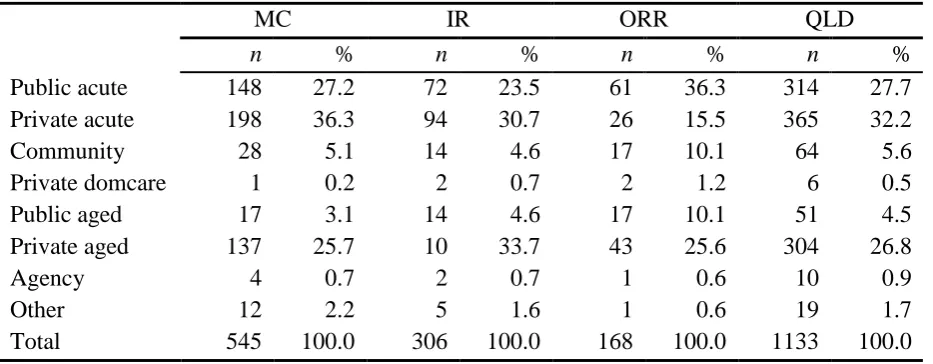
Differences in employment sector were apparent with MC nurses more likely to work in the private acute sector (2 = 54.742, df = 14, p < 0.001) (Table 1). ORR nurses were more likely to be employed in the public sector.
Work commitment
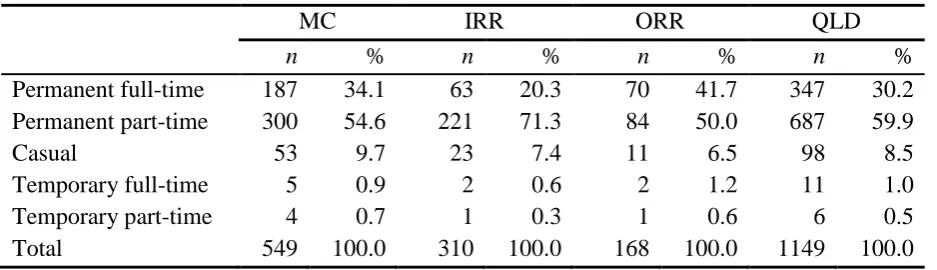
ORR nurses were more likely to be permanently full-time employees (2 = 34.136, df = 8, p < 0.001). In contrast, IR nurses were most likely to be permanent part-time employees (Table 2). This latter cohort indicated a preference to work more shifts (2 = 11.411, df = 4, p = 0.022).
On average, respondents undertook 31.0 ± 8.8 hours of work per week. While a
difference in mean working hours approached significance (F = 2.872, p = 0.057), ORR nurses had the longest average working week (32.6 ± 8.6, 30.8 ± 9.0 and 30.4 ± 8.5 hours, ORR, MC and IR respectively) and were most likely to work greater than 37 hours per week (2 = 24.152, df = 6, p < 0.001) (Table 3).
6 respectively), ORR nurses were most likely to work between 400 and 600 minutes in a minimum shift, with the majority of nurses having minimal shifts between 200 and 600 minutes long (90.2% MC, 86.9% IR and 92.7% ORR). For maximum length of shift, 25.5 % (n = 119) of MC nurses reported shift lengths greater than 600 minutes. Between group analysis of the means revealed ORR nurses had significantly longer total minimum shifts than both MC and IR nurses (F = 5.980, p = 0.003). In contrast, MC nurses had greater total maximum shifts (F = 10.725, p < 0.001) (Table 4).
When asked how many times over the previous four weeks had they been on call and called out, significant regional differences were observed, (2 = 60.496, df = 40, p =0.020 and 2 = 46.580, df = 28 p =0.015, respectively). ORR nurses were on call significantly more than MC nurses (F = 4.121, p = 0.017) and were predominantly on call two or four to six times during the previous four weeks.
Working conditions
Significant regional differences appeared for staff replacement for; long service leave (2 = 16.010, df = 8, p = 0.042), training/study leave (2 = 19.560, df = 8, p = 0.012), time off in-lieu (2 = 15.574, df = 8, p = 0.049) and professional development leave (2 = 17.475, df = 8, p = 0.026). Overall, ORR nurses were least likely to report staff “always” replaced.
Professional development
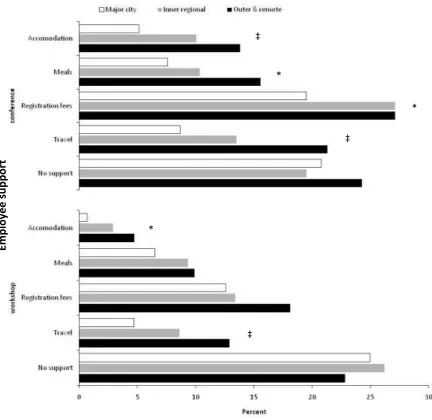
ORR nurses were most likely to identify distance as a barrier to continued professional development (CPE) (2 = 46.457, df = 2, p < 0.001), but least likely to suggest that they could not afford the fees (2 = 7.401, df = 2, p = 0.025). Additionally, ORR nurses were more likely to receive some employer support for attendance for CPE (2 ≤ 20.442, df = 2, p < 0.050 and 2 ≤ 14.388, df = 2, p < 0.050) (Figure 1).
There was a strong difference across regions as to whether graduate nurses (2 = 20.454, df = 6, p = 0.002) and nurses commencing in a new clinical area (2 = 24.112, df = 8, p = 0.002) received sufficient workplace support. Overall, less than half of the respondents believed there was adequate support for new graduates (44.7% MC, 40.6% IR and 36.3% ORR) and orientation to new clinical areas (39.3% MC, 29.0% IR and 24.6% ORR).
In response to the opposing statement “work stress is high/work stress is low” the majority of nurses believed work stress was “extremely or quite” high (2
= 27.593, df = 12, p = 0.006), with ORR nurses being most effected (82.0% ORR, 73.5% IR and 68.3% MC).
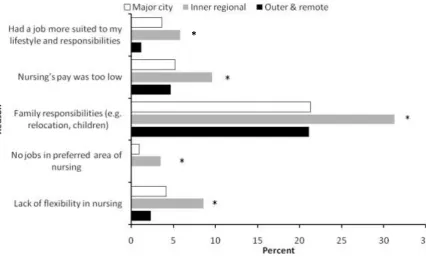
Regional differences existed for those who had taken a break from nursing (2 = 6.413, df = 2, p = 0.041), with IR nurses significantly more likely to have taken a break than MC nurses (F =3.234, p = 0.040). When specific reasons were given for taking a break, further regional
7 The results are consistent with AIHW nursing labour force data (1) and with previous work on the rural and remote nursing workforce in Queensland. (12, 13) As the major provider of health services in ORR is Queensland Health, nurses working in ORR areas are more likely to be employed in the public sector.
The data indicate that ORR nurses are more likely to work longer hours, be “on-call” and be called out. This may provide one explanation of why ORR nurses were more likely to report work stress as “high” than other nurses. (14) Compounding this issue is the lack of replacement for ORR nurses who take leave, thus contributing to high levels of work stress and eventually burn out. (12, 14) If nurses are not replaced when on leave, then work is not undertaken. This has occupational health and safety implications for the nurse who has an increased workload on return to work (15), and will contribute to high turnover and decreased workplace tolerance. (14, 16) Moreover, the lack of replacement staff also has implications for health service delivery within the community. If nurses are not replaced when on leave, then continuity of care declines. (17)
Nurses in ORR areas reported distance as a major barrier to accessing CPE. (12, 13, 18) The higher level of employer support for ORR nurses’ CPE activities could be explained by the higher proportion of nurses employed in the public sector and the changes within this sector’s award that have increased funding for CPE. This finding is new and requires exploration in other Australian States/Territories.
Lack of preparation for the role, including adequate orientation to rural and remote nursing practice, has been the subject of many studies. (14, 19, 20) There have been several programs (e.g. mentoring) established to increase the support for student nurses, (21) newly graduated nurses and nurses commencing for the first time in rural or remote areas. (22) The data suggest that support is still inadequate. Novice nurses who are not supported in their workplace are more likely to leave, thus increasing the cycle of recruitment, lack of retention and need for further recruitment. (19, 23, 24)
Nursing is a predominately female workforce and many of the respondents have taken a break from nursing due to family commitments. Nurses from IR areas were more likely to have taken a break and state that this break was for family reasons. The higher level of part-time nurses in IR areas may be explained by those who indicated they wished to work more hours, and that there were “no jobs in their preferred area of nursing”.
8 about half of the workforce and the data may be viewed in that light. Nevertheless, the high level of self-reported work stress and difficulties experienced warrants broader investigation of the entire workforce to better identify specific causes in the ORR environment.
CONCLUSION
These data indicate differences in the working lives of nurses in geographically dispersed areas. The investigation highlight that ORR nurses work longer hours, are more likely to be on-call and be on-called out, see distance as a major barrier to CPE and are less likely to be replaced when they take leave. It is not surprising that these nurses report higher levels of work stress. It is apparent that Queensland Health and other employers need to review their workplace workload policies especially the provision of locum support. One positive in the data is the higher level of employer support for CPE activities provided to ORR nurses. These findings may suggest that the recently introduced funding for CPE activities in the Queensland industrial award has had some effect, albeit with local differences rather than an overall improvement. The data also indicate that preparation for practice in ORR areas remains inadequate, suggesting a need for strengthening orientation/mentoring programs for newly employed rural and remote area nursesIn times of workforce shortages, data that indicate nurses would work greater hours if offered are significant.
ACKNOWLEDGEMENTS
This study was funded by the Queensland Nurses’ Union. We wish to thank the Queensland Nurses’ Union members who participated in the study.
REFERENCES
1. Australian Institute of Health and Welfare 2008. Nursing and Midwifery Labour Force 2005. National Health Labour Force Series no. 39. Cat. no. HWL 40. Canberra: AIHW. 2. Kruske S, Lenthall S, Kildea S, Knight S, Mackay B, Hegney D. Rural and remote area
nursing. In: Brown D, Edwards H, editors. Lewis's medical-surgical nursing: assessment and management of clinical problems. 2nd ed. Sydney: Mosby Elsevier; 2008. p. 200 -14. 3. Hegney D. Defining rural and rural nursing. In: Siegloff L, editor. Rural Nursing in the
Australian Context. Canberra: Royal College of Nursing Australia; 1997. p. 25 - 44. 4. Mills J, Francis K, Bonner A. Live my work: rural nurses and their multiple perspectives
of self. Journal of Advanced Nursing. 2007;59(6):583-90.
5. Bushy A. International Perspectives on Rural Nursing: Australia, Canada, USA. Australian Journal of Rural Health. 2002;10:104-11.
6. Senate Community Affairs Committee 2002. The patient profession: time for action. Report on the inquiry into nursing. Canberra: Commonwealth of Australia.
7. Australian Institute of Health and Welfare 2004. Rural, regional and remote health - a guide to remoteness classifications. Rural Health no. 4. Cat. no PHE 53. Canberra: AIHW.
9 9. Hegney D, Eley R, Plank A, Buikstra E, Parker V. Workforce Issues in Nursing in
Queensland, Australia: 2001 and 2004. Journal of Clinical Nursing. 2006;15(12):1521 - 30.
10. Eley R, Buikstra E, Plank A, Hegney D, Parker V. Tenure, Mobility and Retention of nurses in Queensland, Australia: 2001 and 2004. The Journal of Nursing Management. 2007;15:285-93.
11. Parker D, Tuckett A, Eley R, Hegney D. Psychometric properties of the Practice Environment Scale of the Nursing Work Index (PES-NWI) for Queensland Nurses. Research in Nursing and Health. (under review).
12. Hegney D, McCarthy A, Rogers-Clark C, Gorman D. Wy nurses are resigning from rural
and remote Queensland health facilities. Collegian. 2003;9:33-9.
13. Courtney M, Yacopetti J, James C, Walsh A, Finlayson K. Comparisons of roles and professional development needs of nurse executives working in metropolitan, provincial, rural or remote settings in Queensland. Australian Journal of Rural Health. 2002;10:202 - 8.
14. Dowd T, Johnson S. Remote area nurses - on the cutting edge. Collegian. 1995;2:36-40. 15. McKeon CM, Fogarty GJ, Hegney D. Organisational factors: impact on administration
violations in rural nursing. Journal of Advanced Nursing. 2006;55:115-23.
16. Weymouth S, Davey C, Wright JI, Nieuwoudt LA, Barclay L, Belton S, et al. What are the effects of distance management on the retention of remote area nurses in Australia? Rural and Remote Health. 2007;7(3):652.
17. Minore B, Boone M, Katt M, Kinch P, Birch S, Musquash C. The effects of nursing turnover on continuing of care in isolated First Nation communities. Canadian Journal of Nursing Research. 2005;37(1):87-100.
18. Penz K, D'Arcy C, Stewart N, Kosteniuk J, al e. Barriers to participation in continuing education activities among rural and remote nurses. . The Journal of Continuing Education in Nursing, . 2007;38(2):58-67.
19. Kenny A, Carter L, Martin S, Williams S. Why 4 years when 3 will do? Enhanced knowledge for rural nursing practice. Nursing Inquiry. 2004;11:108-16.
20. Hegney D, Pearson A, McCarthy A. The role and function of the rural nurse in Australia. Canberra: Royal College of Nursing; 1997.
21. Gum LF. Studying nursing in a rural setting: are students adequately supported and prepared for rural practice? A pilot study. Rural and Remote Health. 2007;7:628.
22. Mills J, Lennon D, Francis K. Mentoring matters: developing rural nurses knowledge and skills. Collegian. 2006;13:32-6.
23. Kenny A, Duckett S. Educating for rural nursing practice. Journal of Advanced Nursing. 2003;44:613 - 22.
24. Lee J, Cruikshank MT. The experience of new graduates nurses in rural practice in New South Wales. Rural and Remote Health. 2007;7.
10 Table 1. Regional nurses by place of employment.
MC IR ORR QLD
n % n % n % n %
Public acute 148 27.2 72 23.5 61 36.3 314 27.7
Private acute 198 36.3 94 30.7 26 15.5 365 32.2
Community 28 5.1 14 4.6 17 10.1 64 5.6
Private domcare 1 0.2 2 0.7 2 1.2 6 0.5
Public aged 17 3.1 14 4.6 17 10.1 51 4.5
Private aged 137 25.7 10 33.7 43 25.6 304 26.8
Agency 4 0.7 2 0.7 1 0.6 10 0.9
Other 12 2.2 5 1.6 1 0.6 19 1.7
Total 545 100.0 306 100.0 168 100.0 1133 100.0
n – Number, % - As a percentage of the region.
MC = major city
IR = inner regional
ORR = outer regional, remote, very remote
11 Table 2. Employment status of nurses by region.
MC IRR ORR QLD
n % n % n % n %
Permanent full-time 187 34.1 63 20.3 70 41.7 347 30.2
Permanent part-time 300 54.6 221 71.3 84 50.0 687 59.9
Casual 53 9.7 23 7.4 11 6.5 98 8.5
Temporary full-time 5 0.9 2 0.6 2 1.2 11 1.0
Temporary part-time 4 0.7 1 0.3 1 0.6 6 0.5
Total 549 100.0 310 100.0 168 100.0 1149 100.0
n – Number, % - As a percentage of the region.
MC = major city
IR = inner regional
ORR = outer regional, remote, very remote
12 Table 3. Average paid ordinary working hours per week by region.
MC IR ORR
n % n % n %
1 – 12 hours 14 3.3 3 1.3 5 3.9
13 – 24 hours 109 25.6 58 25.2 17 13.3
25 – 36 hours 147 34.6 107 46.5 47 36.7
> 37 hours 155 35.5 62 27.0 59 46.1
Total 425 100.0 230 100.0 128 100.0
n – Number, % - As a percentage of the region.
MC = major city
IR = inner regional
ORR = outer regional, remote, very remote
Table 4. Minimum and maximum shift lengths by hour and total minutes in nurses by region.
MC IR ORR QLD
n minutes n minutes n minutes n minutes
Minimum (total) 432 372.1 ± 5.8 235 358.1 ± 7.9 131 402.6 ± 9.0 798 373.0 ± 0.1 Maximum (total) 463 576.0 ± 5.8 254 548.8 ± 6.3 144 528.7 ± 9.7 861 560.1 ± 4.0
Data are mean ± standard error.
n – Number,
MC = major city
IR = inner regional
ORR = outer regional, remote, very remote
[image:12.595.67.532.353.416.2]13 Figure 1. Figure 1. Employee support by region for nurses undertaking continued education.
Values are 2 between group difference * p < 0.050, ‡p < 0.001.
‡ *
*
* ‡
Empl
oye
e
su
p
p
or
t
14 Figure 2. Reason for taking a break from nursing that returned regional significance.