DEVELOPMENT OF ENVIRONMENTALLY FRIENDLY AND
STRUCTURAL ENHANCED PERMEABLE CONCRETE PAVEMENT
MATERIAL
Zhuge, Y., PhD, MIE
Faculty of Engineering and Surveying, University of Southern Queensland, Brisbane, Queensland,
Australia
Lian, C.
School of Natural and Built Environments, University of South Australia, Adelaide, South Australia,
Australia
ABSTRACT
Presently natural resources are increasingly consumed due to rapid urbanization, so that various strategies are being investigated by engineers to protect and restore natural ecosystems all over the world. Permeable pavement, due to its high porosity and permeability, is considered as an alternative to traditional impervious hard pavements for controlling stormwater in an economical and friendly environmental way. Permeable concrete pavement normally made of single sized aggregate bound together by Portland cement, uses restrictedly as a pavement material for low traffic roads, due to its insufficient structural strength. Aimed at developing a new type of permeable concrete pavement with enhanced structural strength, various mix designs were attempted and their effects on the compressive strength and permeability of permeable concrete were investigated in this research. The optimum aggregate and mix components design were consequently recommended for structural enhanced permeable concrete.
1. INTRODUCTION
Presently natural resources are increasingly consumed due to rapid urbanization and thereafter human construction activities, so that various strategies are being investigated by engineers to protect and restore natural ecosystems all over the world. Urbanization results in the conversion of pervious spaces, such as vegetated and open forested areas, to areas of impervious (paved) surface. This has a major impact on the water quality, the health of the environment and the natural ecosystem. During storms, large volumes of water are channelled into streams and rivers, creating flood control and erosion problems further downstream. As population density increases, so does the need for costly engineered water control systems that can take up valuable land area. Pollution from rainwater runoff is another concern, especially in urban areas. Storm water is not typically channelled to treatment facilities, but eventually flows directly into streams, rivers, and lakes.
A sustainable solution to this problem is to use permeable pavements which only began to find application in Australia recently (Argue and Pezzaniti 2002; Shackel and Pearson 2003). These pavements commonly comprise
and segmental paving have been studied. There is still a gap of optimizing the surface materials for permeable pavements.
Since cement paste in permeable concrete is very thin to bond coarse aggregate together, porous concrete tends to fail at the binder interface between the aggregates and results in the low compressive strength (Yang and Jiang 2003). Therefore, currently the permeable concrete pavement is only capable of tolerating the light traffic loadings, with the biggest use in carparks, footpaths and bicycle trails (Ferguson 2005).
This study aims to improve the compressive strength of porous concrete without losing permeability so that it could be adoptable for supporting higher volume traffic. As it is noticed that not only the size of aggregate, but also the gradation and amount of aggregate will affect the compressive strength and static modulus of elasticity on porous concrete, this research will firstly investigate the effect of various types of aggregate to establish the best local resource and then proceed to the design of optimal mix with various additives.
2. EXPERIMENTAL INVESTIGATION
2.1 Materials
At the first stage, three different kinds of coarse aggregate were used without fine aggregate and other admixtures. Sands and silica fume were applied to enhance the strength of porous concrete at the second stage based on the results of stage one.
2.1.1 Aggregate
Coarse aggregate was used as a primary ingredient in making the permeable concrete. Three types of coarse aggregate were obtained from local quarry: quartzite, dolomite and limestone. Dolomite was a sedimentary carbonate rock, composed of the mineral dolomite, also contained impurities such as calcite, quartz and feldspar. Dolomite formed in groups of rhombohedral crystals with curved, saddle-like faces. Limestone was also sedimentary rock. Although some limestones were nearly pure calcite, there were often varying amounts of clay, silt and sand. Quartzite was a dense, hard metamorphic rock. The quartzites obtained from local quarry were red due to a large amount of iron oxide. In order to explore the optimum aggregate for making porous concrete, these three types of coarse aggregate were investigated and compared at
the first stage. The geological and mechanical properties of aggregate were tested and the results were given in Table 1.
Aggreg ate
Flakin ess Index
Mean water absorpt ion
Los Angeles Abrasion Value
Dry strength
% % % KN
Type A 21 2.8 27 163
Type B 35 0.8 15 225
Type C 15 0.3 38 74
Type A: Quartzite Type B: Dolomite Type C: Limestone
Table 1. Engineering properties of aggregates In addition, considering the smaller size aggregate will result in the increase of the specific surface and the binding area between cement and aggregate, which is beneficial to the strength and durability of concrete, fine aggregate was used at the second stage. 2.1.2 Admixtures
The results of previous research (Kobayashi 1998; Rossignolo 2009) indicated that mineral additives could lead to the improvement of concrete properties such as mechanical strength and concrete durability, since the mineral composite reduced the thickness of the interfacial transition zone (ITZ) between the aggregate and the cement matrix. Therefore, silica fume, namely Microsilica 920-u, was tried to seek adequate strength of porous concrete at the second stage of testing.
Besides, a new generation superplasticiser was incorporated as the chemical intensifier in this study. It is based on a unique carboxylic ether polymer with long lateral chains, which greatly improves the cement dispersion. It is called hyperplasticiser.
2.2 Sample Preparation and Testing Procedures
2.2.1 Sieving and compaction
All of the raw 10mm aggregates from quarries were sieved and separated into different groups using standard sieves. Specific gradations were then obtained by recombining small fractions of separated aggregates.
research (Zhuge 2008), one was using compaction hammer and the other was using vibration table. Although the hammer compaction packed the aggregate particles together more tightly, the density of porous concrete samples increased with the loss of permeability. As the impaction strength of a falling hammer was so strong to crush the weak aggregate and create weak layers, the vibration method seemed to be more suitable for majority of aggregates, such as limestone and dolomite. However, for the sake of achieving the maximum cohesion between aggregate particles, a combined compaction method was attempted, that was, not only applied the standard rodding compaction method, but also incorporated a static compactor in the consequent vibrating procedure. This compaction effort allowed most of the coarse aggregate not deformed under compacting whilst increase the contact surface and alignment of aggregate particles, which was believed a substantial aspect to increase the strength of porous concrete.
2.2.2 Testing procedures
The casted cylinders were demoulded after 24 hours, labelled and weighted for various testing. Then the samples were cured in a lime bath at 23±2°C, according to AS 1012.8.1-2000. For each batch, two samples were prepared for permeability testing and others were for compression, three tested at 7 days and 28 days respectively. The results showing up in this paper were all average values.
The testing conducted include: unconfined compressive strength (UCS), water permeability and porosity.
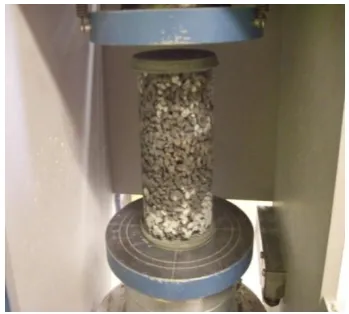
The unconfined compressive strength (UCS) testing of concrete specimens was carried out in the lab according to AS1012.9-1999. Prior to loading process, caps were placed on the ends of samples. Type of capping used depended on surface condition of the concrete samples. Rubber capping was usually used for conventional concrete with smooth top and bottom surface; and sulphur capping was used for samples with rough surface like porous concrete. The study by Harber (2005) showed that sulphur capping eliminated the problem of tilting and failing which was caused by the dislodging edge aggregate. It also concluded that the compressive strength of the porous concrete would increase dramatically through by use of the sulphur capping, as this capping
[image:3.595.343.518.115.272.2]restrained the aggregates on the top effectively (Fig.1). Thus, sulphur capping was adopted for all samples in this study.
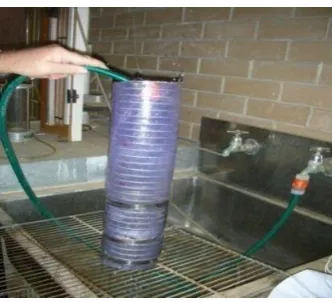
Figure 1. Compressive strength testing rig Permeability as a unique ability for water to penetrate through porous concrete was expressed in millimetres per second (mm/s). Since porous concrete generally owns a much higher permeability compared to the normal dense concrete, the permeability test method for the latter one was not suitable for testing porous concrete. As there is no Australian Standards for such testing, a testing method which was similar to the falling head test method for soil (AS 1289.6.7.2 2001) was adopted in this research. The testing apparatus has been gradually improved from our previous research (Zhuge 2008). Instead of using a rigid perspex tube as previous testing, the cylindrical plastic pipe was used in this test. With inline steel wire and adjustable steel tie, the pipe was tight to inhibit water leakage along the sides of the sample (Fig.2). Moreover, the tiny gap between the specimen and the pipe at the bottom was sealed with processed plasticines to prevent water infiltration through the edge of pipe, which will affect the accuracy of the permeability coefficient. Subsequently, the water permeability rate of porous concrete was calculated by equation (1).
2 1
ln
h
h
At
aL
k
(1)Where k is the permeability coefficient (mm/s), a
Figure 2. Permeability testing rig
The porosity test was carried out at 28 day of age. The open porosity was measured as the percentage of pore volume or void space within the concrete that can contain water. The sample was oven dried at 110°C firstly and was left to cool for measurement. The dimensions of the sample were measured in dry condition and the total volume of sample (VT) including the solid
and void component was determined. Then the sample was sunk into a bucket filled with sufficient water to cover the whole sample and the water level was marked. After 24 hours, the sample was moved out from the bucket and the water was refilled up to the marked level. The weight of water added was read by the scale and the magnitude of this reading was equal to the changed volume (VC), using the concept of 1
gram=1cm3 for water. The open porosity of the concrete sample was calculated with equation (2):
%
100
(%)
T C T
v
v
v
P
(2)Where P is the open porosity (%), VT is the total volume of specimen (mm3), “VT-VC” is the
volume of void space (mm3).
3. TESTING RESULTS AND DISCUSSION
3.1 Effect of Aggregate
The testing results on compressive strength at 7 and 28 days for different kinds of aggregate were illustrated in Table 2. For single-sized aggregate (type1), Dolomite B1 yielded the highest compressive strength at both 7 and 28 days, followed by limestone, quartzite achieved the lowest strength. This indicated that the type of coarse aggregate affects the strength of porous concrete even though the aggregates were in the same size and gradation. This may be attributed to the difference of dry strength, particle shapes and textures of aggregate. In light of the highest dry strength among three types, dolomite produced the highest
compressive strength. However, limestone, which had the lowest dry strength, did not produce the lowest compressive strength. This was possibly caused by two factors. Firstly, the shape of aggregate was judged according to AS1141.15-1999 rather than only by vision. The flakiness index of aggregate was examined to distinguish different shapes. The result (Table 1) presented limestone was more rounded than quartzite, the flaky quartzite particles were more likely to be oriented in one plane under compaction force, not handling the loaded strength identically in three dimensions. Therefore, it was brittle to resist higher compressive strength. Secondly, as shown in Table 1, quartzite particles absorbed more water compared to limestone in mixtures, which would make the cement paste around it less viscous to develop as high adhesive strength as around limestone. Thus, the quartzite showed the worst compressive strength rather than limestone. But comparing with dolomite, although the flaky index of dolomite was also higher than that of limestone, the advantage arouse by dry strength could not be cancelled out by this drawbacks. In addition, its water absorption rate was not as high as quartzite. It still can yield the biggest compressive strength for porous concrete. Hence, dolomite would be regarded as the best aggregate for making permeable concrete. Curing
time
Compressive strength (MPa)
(days) Quartzite Dolomite Limestone
A1 A2 B1 B2 B3 C1 C2
7 11.6 13.0 15.0 16.0 14.3 14.3 13.5
[image:4.595.104.272.60.211.2]28 11.8 15.5 15.8 19.0 15.5 15.5 14.0
Table 2. Compressive strength using different aggregates
The permeability measurement was conducted after 28 days curing time. The permeability coefficients were given in Table 3. It can be seen that the smaller aggregate size will lead to a lower permeability of porous concrete except for that made with limestone. However, three types of aggregates all showed a good permeability so some filler materials could be used to further enhance the strength of porous concrete based on this gradation.
Permeability (mm/s)
Quartzite Dolomite Limestone
A1 A2 B1 B2 B3 C1 C2
27.5 13.7 19.9 8.51 14.8 13.3 16.0
3.2 Effect of Admixtures
The second stage of this research involved using chemical additives and fine aggregates to improve the strength of porous concrete. Dolomite was collected as coarse aggregate based on the testing results at stage one. Table 4 showed that samples made with additives (B4 to B7) exhibited higher strengths than the one without (B2). Silica fume exerted positive influence on compressive strength of porous concrete as it functioned on normal concrete. Technically speaking, when the silica fume is added, more water is demanded for wetting the large specific surface area of silica fume particles in a concrete mixture to keep its workability. Thus, if the same water/cement ratio was used for samples with and without silica fume, the one with silica fume normally experienced problem. As it was observed during the testing, some silica fume particles concentrated over a small region where the sediment and segregation were easily seen. Therefore, the benefit of using silica fume was not achieved without other chemical admixtures. Through a series of trial and error exercises, it was found that by adding a small amount of superplasticiser to the mixtures containing silica fume, both the workmanship and the compressive strength of the samples were improved extensively. This was proven by the delicate change of slump of fresh porous concrete. As shown in Table 4, the compressive strength of B4 (10% of silica fume only) was just slightly higher than that of B2. However, using additional 0.8% superplasticiser, sample B6 performed much better without losing the permeability.
With assistance of silica fume and superplasticizer simultaneously, fine aggregate could be utilized to achieve a higher strength. As shown in Table 4, both B6 and B7 achieved higher compressive strength than B5. In the mean time, after 28 days curing, B7 with quarry sand performed better than B6, which made with fine dolomite particles of 4.75 mm to 2.36 mm. The quarry sand could promote the development of cement hydration product, which would reduce the capillary pores in cement matrix during the 28-day curing and then achieved a dense microstructure, showing a higher compressive strength. In contrast, the smaller sized dolomite particles could not bridge the crystallized hydrated cement to form more paste to increase the bonding strength. Therefore, the use of quarry sand was more effective than that of fine dolomite particles. As it is shown, the strength was increased and the permeability
was maintained as an acceptable level in mix B7. So this combination will be adopted.
3.3 Effect of Water to Cement Ratio
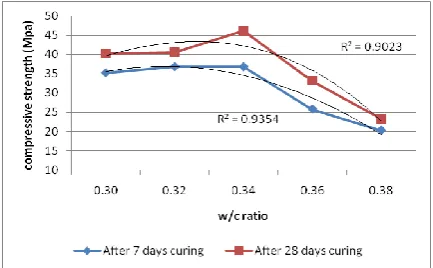
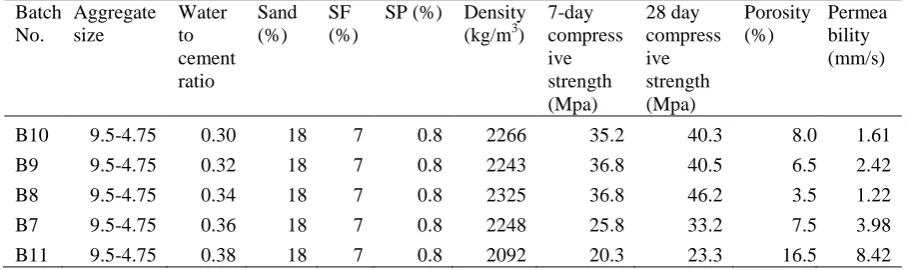
[image:5.595.322.539.473.607.2]Take into account the significant influence of water proportion on the properties of concrete, the water content was adjusted gently to explore the optimum mix design of porous concrete. The variations of compressive strength with respect to water/cement ratio are shown in Table 5. The water to cement (w/c) ratio ranging from 0.30 to 0.38 was used while other compositions were kept identical (aggregate to cement ratio was kept the same as 4.5/1). It can be seen from Figure 3 that the mix B8 with water to cement ratio of 0.34 yielded the highest compressive strength after both 7 and 28 days curing. It reached 36.8MPa and 46.2MPa respectively. In addition, the relationship between w/c ratio and compressive strength of porous concrete did not go through a simple linear path. The presence of the turning point at 0.34 (B8) divided the whole trendline into two different stages. When the w/c ratio less than 0.34 the compressive strength was slightly increased along with the increase of w/c ratio; when it was more than 0.34, the compressive strength was steeply declined with increasing water content. The mix B11 with water to cement ratio of 0.38 produced the lowest compressive strength of 20.3MPa and 23.3MPa at 7 days and 28 days respectively.
Figure 3. Relationship between w/c ratio and compressive strength
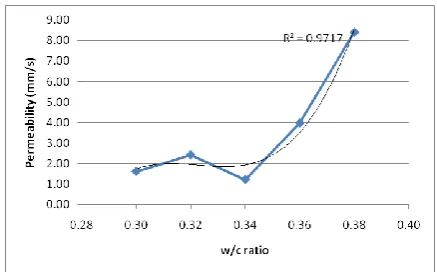
8.42mm/s by B11; while when it was below this threshold, the permeability did not bounce back. As shown in Figure 4, the permeability of B9 was higher than that of B8, but B10 had a lower one than B9, It was observed in the mixing of B10, when the water content reduced to a ratio of 0.30, the sand and silica fume particles were very hard to combine with cement uniformly. After vibration, some of these tiny particles within fresh mixture were even separated to the surface of sample and thereafter different dense layer was prone to form in the sample. More pores were probably generated in the middle part of the sample, but the surface had been sealed with these particles, affecting the permeable coefficient adversely. Hence, the water to cement ratio less than 0.30 is not recommended.
Figure 4. . Relationship between w/c ratio and permeability coefficient
Correlated with the variations of compressive strength for porous concrete, it can be concluded that in terms of water to cement ratio, relative higher permeability could be obtained in range of 0.34 to 0.38, but the large amount of water would intensify the shrinkage of porous concrete during the curing days, resulting in a great percentage of pore voids in the hardened concrete and then the compressive strength of porous concrete will be decreased tremendously. On the contrary, higher strength could be gained in range of 0.30 to 0.34, whereas the low content of water in mixture is not able to hydrate cement with mineral ingredient (such as Silica fume) to form sufficient cement mortar wrapping all of the ambient aggregates, so that weaken the bonding strength and induced the local clogging within the sample. However, due to these changes occurred gradually during the adjustment, optimum water ratio could be collected. As the acceptable flow rates for water through pervious concrete are typically from 2 mm/s 5.4 mm/s (Ferguson 2005; Haselbach et.al. 2006), B9 with w/c ratio of 0.32 seemed to perform best as shown in Figure 3 and Figure 4, reaching a high
compressive strength and a satisfied permeability as well.
4. CONCLUSIONS AND RECOMMENDATIONS
This paper presents the results of experimental investigations on the influential factors on the strengths and permeability of porous concrete. As two important characteristics, the strength is inversely proportional to the permeability, a series of experiments have been conducted and the findings obtained through this study can be concluded as follows:
The effect of three most common types of aggregate from Australian local quarries was investigated and compared via laboratory testing. In addition to achieve the higher compressive strength, dolomite was also suggested more resistant to abrasion for porous concrete, this character should be considered when the porous concrete is expected to use as a pavement material in road construction. Moreover, although the quartzite showed a lower flakiness index and a better permeability than dolomite, the clay contamination and impurities such as a large amount of iron oxide covered on the surface of quartzite cannot be omitted for gaining a good bond in concrete mixtures. Therefore, dolomite is believed as the best aggregates among them to make porous concrete.
service time, a higher water to cement ratio of 0.36 could be used.
The testing method of porosity in this study was not accurate driven by human errors inevitably. Therefore, further research is required to investigate the relationship between pore structure and strength and permeability for permeable concrete.
5. REFERENCES
Argue, J. and Pezzaniti, D. (2002), „Research into effective life of permeable pavement source control installations‟, Urban Water Research Centre, University of South Australia, Final rpt., Project 07 67680.
Ferguson BK. (2005), „Porous pavements‟, Boca Raton, Florida: CRC Press LLC.
Harber PJ. (2005), „Applicability of No-fines concrete as a road pavement‟, University of Southern Queensland Faculty of Engineering and Surveying.
Haselbach LM, Valavala S, Montes F. (2006), „Permeability predictions for sand-clogged
Portland cement pervious concrete pavement systems‟, J Envir Manage; 81(1):42-49.
Kobayashi K, Hattori A, Miyagawa T. (1998), „Characters of interfacial transition zone cement with admixtures‟, In: Katz A et al., editors. The interfacial transition zone in cementitius composites. London: E&FN SPON, p. 311-317. Rossignolo JA, (2009), „Interfacial interactions in concretes with silica fume and SBR latex‟,
Constr Build Mater; 23(2):817-821.
Shackel, B. and Pearson, A. (2003), „Permeable concrete eco-paving as best management practice in Australian urban road Engineering‟,
Proc. – Conf. Australian Road Research Board, Cairns, Australia, V. 21, 409-420.
Yang J, Jiang G. (2003), „Experimental study on properties of pervious concrete pavement materials‟, Cem Con Res; 33(3): 381-386. Zhuge Y. (2008), „Comparing the performance of recycled and quarry aggregate and their effect on the strength of permeable concrete‟, 20th Australasian Conference on the Mechanics of Structures and Materials, Australia: Toowoomba, p. 215-221.
Batch No.
Aggregate size
Water to cement ratio
Fine aggre gate
SF (%)
SP (%)
Density
(kg/m3)
7-day compressive strength (Mpa)
28 day compressive strength (Mpa)
Porosity (%)
Permeability (mm/s)
B2 9.5-4.75 0.36 0 0 0 1926 16.0 19.0 16.6 8.51
B4 9.5-4.75 0.36 0 10 0 2012 17.0 22.0 13.2 6.13
B5 9.5-4.75 0.28 0 7 0.8 2079 22.0 24.3 16.0 12.64
B6 9.5-4.75 0.32 S1 7 0.8 2140 28.5 30.0 9.0 5.39
B7 9.5-4.75 0.36 S2 7 0.8 2248 25.8 33.2 7.50 3.98
[image:7.595.78.532.608.743.2]S1: fine dolomite particles S2: quarry sand
Table 4. Properties of porous concrete made with and without additives
Batch No.
Aggregate size
Water to cement ratio
Sand (%)
SF (%)
SP (%) Density
(kg/m3)
7-day compress ive strength (Mpa)
28 day compress ive strength (Mpa)
Porosity (%)
Permea bility (mm/s)
B10 9.5-4.75 0.30 18 7 0.8 2266 35.2 40.3 8.0 1.61
B9 9.5-4.75 0.32 18 7 0.8 2243 36.8 40.5 6.5 2.42
B8 9.5-4.75 0.34 18 7 0.8 2325 36.8 46.2 3.5 1.22
B7 9.5-4.75 0.36 18 7 0.8 2248 25.8 33.2 7.5 3.98
B11 9.5-4.75 0.38 18 7 0.8 2092 20.3 23.3 16.5 8.42