Complete Citation: Fallon, Anthony Bruce and Groves, Kim and Tehan, Gerald (1999). Phonological similarity and trace degradation in the serial recall task: when CAT helps RAT, but not MAN. International Journal of Psychology, 34 (5/6), 301-307. ISSN 0020-7594.
Accessed from USQ ePrints http://eprints.usq.edu.au
Running Head: PHONOLOGICAL SIMILARITY
Phonological similarity and Trace Degradation in the Serial Recall Task: When CAT helps RAT, but not MAN
Anthony B. Fallon Northern Territory University
Kim Groves
Northern Territory University
Gerald Tehan
University of Southern Queensland
Word Count: 4963
Gerry Tehan
Department of Psychology
University of Southern Queensland Toowoomba, Q. 4350
Australia
Abstract
Phonological similarity is observed to detrimentally affect serial recall when correct-in-position scoring is used. Two experiments investigated the role of item and
Lists of words that sound similar to one another are harder to remember on an immediate serial recall task than lists of words that contain phonologically dissimilar items (Baddeley, 1966; Conrad & Hull, 1964). Most current models of immediate serial recall (Baddeley, 1986; Brown & Hulme, 1995; Burgess & Hitch, 1992; Nairne, 1990; Schweickert, 1993) assert that serial order is harder to maintain when all items in the list are phonologically similar to one another.
In phonological similarity research, recall has most often been scored in terms of the number of items recalled in correct serial position. However, alternative
scoring procedures are available. Item recall is usually scored by counting the number of list items recalled, regardless of the order in which they are recalled (e.g. Watkins, Watkins, & Crowder, 1974; Crowder, 1979). The second procedure scores position accuracy, which can be more complicated. Simply counting the number of
transpositions is not acceptable if there are differences in item recall. One solution is to score the number of items recalled in correct position as a proportion of the number of items recalled regardless of position (Wickelgren, 1965; Poirier & Saint-Aubin, 1995; Saint-Aubin & Poirier, in press).
There are important reasons for thinking about immediate serial recall in terms of item and position accuracy scoring. For example, the absence of
accuracy scoring. That is, it is possible that similarity might facilitate item recall but lead to an increase in transposition errors. Thus, under suppression or a delay, the absence of similarity effects could be due to a beneficial effect of similarity at the item level masking a detrimental effect at the accuracy level.
This second scenario might occur if rhyme categories result in a category cuing effect (Crowder, 1979; Huttenlocher & Newcombe, 1976; Poirier & Saint-Aubin, 1995). In both the long-term memory literature (Tulving & Pearlstone, 1966) and-term memory literature (Huttenlocher & Newcombe, 1976; Poirier & Saint-Aubin, 1995; Saint-Aubin & Poirier, in press) taxonomic category membership acts as an effective retrieval cue to facilitate recall. In the short-term domain this
advantage is limited to item recall (Huttenlocher & Newcombe, 1976; Poirier & Saint-Aubin, 1995; Saint-Aubin & Poirier, in press). If taxonomic categories can serve as a retrieval cue, rhyme categories might also improve item recall in phonologically similar lists.
In spite of the fundamental importance of the phonological similarity effect, only six studies have investigated phonological similarity effects at the item level. The results from these studies are equivocal. Sometimes a beneficial effect is observed (Gathercole, Gardiner, & Gregg, 1982; Wickelgren, 1965), sometimes, no effect is observed (Poirier & Saint-Aubin, 1996; Watkins et al., 1974); and some studies show a detrimental effect (Coltheart, 1993; Drewnowski, 1980)
The dimension that appears most relevant for discriminating between these studies is the operationalisation of phonological similarity. The studies that
demonstrated beneficial effects operationalised phonological similarity in terms of items from rhyme categories. Those that demonstrated a detrimental effect
(Watkins et al., 1974) that demonstrated a null effect used a mixture of rhyming and non-rhyming items in their similar lists. Given these findings, one might conclude that a beneficial effect of phonological similarity only occurs when rhyming items are used.
In the following studies we investigated item and accuracy scoring of phonological similarity where similarity was operationalised in two distinct ways; either items from rhyme categories or items that had high phonemic overlap but did not come from any single rhyme category. The expectation was that phonological similarity effects would differ for the two types of lists. We expected that there would be differences in item recall between the two types of similar lists and that this would have an impact upon correct-in-position effects. We were not certain about
differential order errors but expected both types of similarity to produce transposition errors.
Experiment 1 Method
Participants. Thirty-six undergraduates from the Northern Territory
University volunteered to participate in this experiment. The participants represented a mix of students from a variety of disciplines, tertiary levels, and age groups.
These two sets were used to create eight dissimilar, eight similar non-rhyming, and eight rhyming six-word lists that were sampled from the appropriate pool without replacement. Thus the words from the similar pool were sampled twice such that each word appeared in one similar and one rhyming list. A requirement of construction of the similar non-rhyming lists was that no items share a final
consonant. Similarly, following random sampling, dissimilar items were rearranged across lists so that each list contained the minimum number of words that shared the same start or stop consonant. Essentially, these two sampling constraints were intended to maintain a relatively constant level of similarity and dissimilarity across conditions.
The lists were presented in three blocks of eight trials. The order of the items within each list, the order of the trials within each block, and the order of the blocks within the experiment session were counterbalanced.
Procedure. All subjects were individually tested, and assigned to the between-subject conditions randomly such that 18 participants were assigned to each of the study conditions. Each trial began with a warning tone. Six words were then presented individually in the centre of a computer screen at the rate of one word per second. Immediately following the presentation of the last list item, a row of question marks was displayed as a recall prompt. Strict serial recall instructions were used: Participants were required to write the words in the order they were presented, in columns numbered one to six and to put a dash if they could not recall an item.
The study conditions for each list differed for the two sets of participants. Half were required to articulate "the" as quickly as possible during presentation of list items. The other half remained silent during item presentation. Everyone attempted to recall the items under silent conditions.
Table 1 summarises performance for similar non-rhyming, rhyming, and dissimilar trials in silent and suppressed conditions, collapsed across serial position for the three scoring procedures. 3*2 mixed-design analyses of variance (ANOVAs) were used to analyse the three sets of data. In this and all subsequent analyses, an alpha level of .05 was selected, unless specified otherwise.
Correct-in-position performance was better in the silent than the suppression condition, F = (1,34), = 9.21, MSE = .08. A main effect of phonological similarity was also observed, F (2,68) = 16.02, MSE = .09. Post-hoc repeated-measures t-tests with sequential Bonferroni adjustments revealed that dissimilar lists were better recall than the similar non-rhyming lists, t (35) = 6.37, but there was no difference between the dissimilar and rhyming lists, t (34) = 1.33. Phonological similarity did not interact with the articulatory suppression, F (2,68) <1, MSE = .09.
For item scoring an item was recalled as correct if it was produced anywhere in the output. Item recall was higher in the silent condition than the suppression condition, F (1,34) = 10.90, MSE = .06. A main effect was also observed for
phonological similarity, F (2,68) = 67.49. MSE = .01. Bonferroni adjusted, post-hoc comparisons indicated that performance was higher in the rhyming condition than the dissimilar condition, t (35) = 5.15. Performance in the dissimilar condition was higher than performance in the similar non-rhyming condition, t (35) = 6.52. Phonological similarity did not interact with articulatory suppression, F (2,68)<1, MSE = .01.
The measure we use to reflect order accuracy involves dividing the correct-in-position score by the item score. This produces the proportion of items in correct position as a function of items correctly recalled; the greater the number of
effect of phonological similarity was observed, F (2, 68) = 29.91, MSE = .01. Bonferroni adjusted comparisons revealed better performance in the dissimilar condition than either the rhyming condition, t (35) = 7.21, or the similar non-rhyming condition, t (35) = 2.34. In addition, better performance emerged in the similar non-rhyming condition than the non-rhyming condition, t (35) = 4.74. There was no interaction between phonological similarity and articulatory suppression, F (2,66)<1, MSE = .01. Discussion
With the correct-in-position scoring under silent conditions we replicate the detrimental effect of phonological similarity with the non-rhyming similar material. However, unlike previous research the phonological similarity effect was not attenuated under suppression for either type of list. We are not sure why this
happened, but it may be a function of suppression being a between-subjects variable, rather than a within-subjects variable as it usually is.
With item scoring, recall was best when the items in the list all rhymed. It looks as though membership of a rhyme category can act as a retrieval cue to
facilitate item recall. Furthermore, when similar items do not rhyme, similarity has a detrimental effect upon item recall.
Not only are the dissimilar lists well recalled, they are recalled accurately. This is not the case with both types of similar lists where a high number of
In comparing recall of the two similar conditions to that of the dissimilar conditions, we are in a position to evaluate our original proposition that phonological similarity effects under item scoring depend upon the way in which phonological similarity is operationalised. In the current study the comparison between the dissimilar and the similar non-rhyming conditions represent a close replication of Coltheart’s experiment. She found that with these materials there was a similarity decrement. We replicate these results. However, when we take the same set of words but reorganise them into their rhyme categories, we find a facilitatory effect of similarity, as have others who have used lists of rhyming items (Gathercole et al., 1982; Wickelgren, 1965). It would seem that we have some evidence to explain the differences in similarity effects that have been observed in prior research.
The absence of phonological similarity effects under silent conditions with the correct-in-position measure for the rhyming lists can be viewed as an item advantage for the rhyming lists being offset by an increased propensity for transpositions. With the non-rhyming similar lists we have a disadvantage for item recall coupled with increases in transpositions which translates into the phonological similarity
decrement. The effects under suppression appear to emerge in much the same way. Both types of similar lists produce transposition errors, rhyming lists have an item advantage, and similar non-rhyming lists do not. Thus, similarity effects in correct-in-position scores appear critically dependent upon item recall. Additionally, these results imply that phonemic influences are still strong under suppression conditions. Consequently, those who have argued that suppression prevents a phonemic trace from being formed (Baddeley, 1986) may well be in error.
Re-analysis of Tehan & Humphreys (1995; Experiment 1)
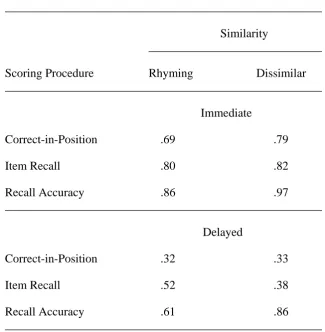
Humphreys, 1995, Experiment 1) had their subjects study 4-item rhyming or dissimilar lists. Recall was tested immediately or after a 2-s retention interval filled with a verbal shadowing task. With the correct-in-position measure they found the usual detrimental effect of phonological similarity on an immediate test, but no difference in recall between rhyming and dissimilar lists on the delayed test. They suggested that the trace became degraded during the two-second interval such that it no longer supported recall. If this argument is correct, one would expect to find no differences on item or accuracy measures between rhyming and dissimilar lists. However, if the results of Experiment 1 are an indication, it is possible that effects under delayed conditions reflect a trade-off between item and order scoring. In Table 2 we present the original correct-in-position scores and a re-scoring of their data using the item and position accuracy procedures that were used in Experiment 1.
An analysis of item scores indicated no similarity effect on an immediate test, F (1,19) = 2.02, MSE = .002, but on the delayed test, the rhyming words were much better recalled than the dissimilar words, F (1,19) = 13.84; MSE = .014. For the position accuracy measure, dissimilar words were more likely to be recalled in position than rhyming words on both immediate and delayed tests, F (1,19) = 21.95; MSE = .005, and F (1,19) = 30.26; MSE = .002, respectively. In short, our re-analysis of the Tehan and Humphreys (1995) data indicates that their interpretation of the delayed correct-in-position results was incorrect. The attenuation of the phonological similarity effect under delayed testing is the result of a cuing advantage for the
rhyming lists in item recall offsetting the deleterious effects of increased transposition errors.
dissimilar lists but item recall is better in the rhyming lists than the dissimilar lists. However, in silent conditions, the similarity advantage in item scoring in Experiment 1 is absent in the Tehan and Humphreys experiment. Absolute levels of item recall are higher in the Tehan and Humphreys experiment in which 4-word lists were studied, than was the case in Experiment 1 where 6-word lists were studied. One possibility is that more forgetting might occur during recall of the long lists than the short lists (Cowan, 1993), such that substantial trace degradation is present for some items in the longer lists. Thus, similarity may facilitate item information with the longer lists in the same way that it does with suppression or a filled retention interval. To bridge the gap between 4-word and 6-word lists, in the next experiment we use 5-word lists.
Experiment 2
In this experiment we again studied serial recall of dissimilar, rhyming and similar non-rhyming lists. Recall was tested immediately or after a brief filled retention interval. Experiment 1 (and Tehan and Humphreys) used open word pools to construct the study lists. We wondered what effect a closed word pool might have on item and transposition effects. To this extent, we took Baddeley's (1966) materials that consist of two 8-item word pools: one containing dissimilar items and the other containing non-rhyming similar items. To this we added another 8-item word pool which consisted of eight items from a single rhyme category. Thus all trials in the experiment were constructed from these three word pools. Obviously, with such small word pools, items appeared more than once throughout the experiment. Our
Subjects. Forty introductory level students from the University of Southern Queensland participated for course credit. Half the subjects were tested immediately and half were tested after a brief delay.
Materials. Baddeley's (1966) materials were used to construct the dissimilar and non-rhyming similar lists. The word pool for dissimilar lists consisted of the words: cow day bar few hot pit pen sup. The non-rhyming similar pool was can mad cap man cad cat map mat. The rhyming similar pool was lip hip tip sip dip zip rip
pip.
For each participant, 33 5-item trials were created by randomly sampling each word pool 11 times. One trial of each type served a practice trial and these three trials represented the first trials that each participant saw. The remaining 30 trials consisted of 10 dissimilar, 10 non-rhyming similar and 10 rhyming trials. The order of these trials was randomised for each participant.
Procedure. On each trial the five words in the list were presented at a rate of one word per second. Half the participants were tested immediately after the fifth item in each list. For the remaining participants recall was tested after a 2-s filled retention interval. Following the fifth word in the list, two two-digit numbers were presented at the same rate as the words. Participants were required to read each digit string as it appeared on the computer screen. After the second digit string had been shadowed, recall of the word list was attempted.
Results
immediate test, dissimilar lists were better recalled than rhyming lists, F (1,19) = 35.70; MSE = .009, and non-rhyming similar lists, F (1,19) = 58.32; MSE = .015. Dissimilar lists were also better recalled than rhyming lists, F (1,19) = 8.85; MSE = .011, and non-rhyming similar lists, F (1,19) = 22.22; MSE = .013, on the delayed test. Furthermore, rhyming lists were better than non-rhyming similar lists on
immediate and delayed tests, F (1,19) = 8.79; MSE = .014, and F (1,19) = 6.51; MSE = .008, respectively.
For item recall, there were main effects for similarity, F (2,72) = 32.51; MSE = .008, and retention interval, F (1,38) = 35.19; MSE = .034, and the interaction was significant, F (2,72) = 5.17; MSE = .008. Planned comparisons indicated that on an immediate test, dissimilar lists were better recalled than non-rhyming similar lists, F (1,19) = 38.77; MSE = .008, but there was no difference between dissimilar and rhyming lists, F (1,19) = 1.98; MSE = .007. On the delayed test, dissimilar lists were also better recalled than non-rhyming similar lists, F (1,19) = 5.76; MSE = .009, but rhyming lists were better recalled than dissimilar lists, F (1,19) = 4.82; MSE = .012. Furthermore, rhyming lists were better recalled than similar non-rhyming lists on both an immediate and delayed tests, F (1,19) = 47.29; MSE = .006 , and F (1,19) = 40.07; MSE = .006, respectively.
For position accuracy, there were main effects for similarity, F (2,72) = 38.73; MSE = .012 , and retention interval, F (1,38) = 35.04; MSE = .034, but the interaction was not significant, F (2,72) < 1; MSE = .012. Planned comparisons indicated that on an immediate test, the proportion of correctly positioned items on dissimilar lists was greater than that for similar lists, F (1,19) = 48.95; MSE = .007, and rhyming lists, F (1,19) = 63.69; MSE = .006. The proportion of correctly positioned items on
Furthermore, the proportion of correctly positioned items was equivalent for rhyming and similar lists on immediate and delayed tests, F (1,19) <1; MSE = .015, and F (1,19) = 2.94; MSE = .014, respectively.
Discussion
It seems that using a closed word pool does not have an overly large impact on patterns of performance, in that we replicate many of the features of Experiment 1. The differences between the dissimilar lists and non-rhyming similar lists are
identical for all three scoring procedures. The differences between similar and rhyming lists were also quite similar in that the rhyming lists provided better item information than the similar lists.
There are differences, however, between the dissimilar and rhyming lists across the two experiments. For the correct-in-position measure, detrimental effects of phonological similarity are observed in the immediate condition in this experiment whereas they were not observed in the equivalent condition of Experiment 1. This appears attributable in large part to the fact that rhyming lists produce better item information than dissimilar lists in Experiment 1, whereas with the closed pool in this experiment, item information is equivalent for the two types of lists. The dominance of item information for the rhyming lists in the delayed condition in this experiment is similar to that observed in Experiment 1 where articulatory suppression was used to degrade the trace. Correct positioning of items is better in dissimilar lists than in both types of similar lists and this is true for both retention intervals.
General Discussion
similarity effects using item measures that have been reported in other studies could be attributed to a cuing effect; and whether the attenuation of the phonological similarity effect under degraded conditions indicated that phonemic codes no longer supported recall. The results of the current experiments provide fairly unambiguous answers to all three issues.
The results of Experiments 1 and 2 clearly indicate that the way in which phonological similarity is operationalised has a large bearing on performance. Using item measures, rhyming lists produce better recall than the non-rhyming similar lists under all conditions. The clearest explanation for this advantage is in terms of a cuing effect; evidence coming from Experiment 1 where the same set of items was used to construct the similar non-rhyming and rhyming lists. All that varied was the
organisation of the items within each list. The rhyme ending appears to provide a retrieval cue that enhances item recall. We have indicated elsewhere how retrieval cues might facilitate short-term recall (Tehan & Fallon, in press) and Nairne and his colleagues have made similar suggestions (Nairne, 1990; Nairne & Kelley, in press).
words are repeated frequently throughout the experiment. Both these factors appear to promote item availability for dissimilar items to a point where item recall is as good as that for rhyming lists. The results of these experiments clearly suggest that the discrepancies in similarity effects at the item level that were noted in the introduction can be attributed to the way in which similarity is operationalised
References
Baddeley, A. D. (1966). Short-term memory for word sequences as a function of acoustic, semantic, or formal similarity. Quarterly Journal of Experimental
Psychology, 18, 362-365.
Baddeley, A. D. (1986). Working memory. London: Oxford University Press. Brown, G. D. A, & Hulme, C. (1995). Modeling item length effects in
memory span: No rehearsal needed? Journal of Memory and Language, 34, 594-621. Burgess, N., & Hitch, G. J. (1992). Toward a network model of the
articulatory loop. Journal of Memory and Language, 31, 429-460.
Coltheart, V. (1993). Effects of phonological similarity and concurrent irrelevant articulation on short-term-memory recall of repeated and novel word lists. Memory and Cognition, 4, 539-545.
Conrad, R., & Hull, A. J. (1964). Information, acoustic confusion and memory span. British Journal of Psychology, 55, 429-432.
Cowan, N. (1993). Activation, attention, and short-term memory. Memory and Cognition, 21, 162-167.
Crowder, R. G. (1979). Similarity and order in memory. In G. H. Bower (Ed.), The psychology of learning and motivation: Advances in research and theory (Vol. 13, pp. 319-353). New York: Academic Press.
Drewnowski, A., (1980). Attributes and priorities in short-term recall: A new model of memory span. Journal of Experimental Psychology: General, 109, 208-250.
Gathercole, S. E., Gardiner, J. M., & Gregg, V. H. (1982). Modality and phonologiacal similarity effects in serial recall: Does one's own voice play a role? Memory and Cognition, 10, 176-180.
Nairne, J. S. (1990). A feature model of immediate memory. Memory and Cognition, 18, 251-269.
Nairne, J. S., & Kelley, M. R. (in press). Reversing the phonological similarity effect. Memory and Cognition.
Poirier, M., & Saint-Aubin, J. (1995). Memory for related and unrelated words: Further evidence on the influence of semantic factors in immediate serial recall. Quarterly Journal of Experimental Psychology, 48A, 384-404.
Poirier, M., & Saint-Aubin, J. (1996). Immediate serial recall, word frequency, item identity, and item position. Canadian Journal of Experimental Psychology, 50, 408-412.
Saint-Aubin, J., & Poirier, M. (in press). Semantic similarity and immediate serial recall: Is there a detrimental effect on order information? Canadian Journal of Psychology.
Schweikert, R. (1993). A multinomial processing tree model for degradation and redintegration in immediate recall. Memory and Cognition, 21, 168-175.
Tehan, G., & Fallon, A. B. (in press). A connectionist model of short-term cued recall. Proceedings of the 1994 Australian Cognitive Science Conference.
Tehan, G., & Humphreys, M. S. (1995). Transient phonemic codes and immunity to proactive interference. Memory and Cognition, 23, 181-191.
Tulving, E., & Pearlstone, Z. (1966). Availability versus accessibility of information in memory for words. Journal of Verbal Learning and Verbal Behavior, 5, 381-391.
Table 1
Mean Proportions Correct for Rhyming, Similar and Dissimilar Trials. Similarity
______________________________________ Scoring Procedure Rhyming Similar Dissimilar ______________________________________________________________
Silent
Correct-in-Position .57 .45 .59
Item Recall .76 .52 .65
Recall Accuracy .71 .84 .90
______________________________________________________________
Suppressed
Correct-in-Position .38 .32 .42
Item Recall .60 .39 .49
Recall Accuracy .62 .81 .84
Table 2
Mean Proportions Correct for Rhyming and Dissimilar Trials. _____________________________________________________
Similarity
_____________________________ Scoring Procedure Rhyming Dissimilar _____________________________________________________
Immediate
Correct-in-Position .69 .79
Item Recall .80 .82
Recall Accuracy .86 .97
_____________________________________________________
Delayed
Correct-in-Position .32 .33
Item Recall .52 .38
Recall Accuracy .61 .86
Table 3
Mean Proportions Correct for Rhyming, Similar Non-Rhyme and Dissimilar Trials.
Similarity
______________________________________
Scoring Procedure Rhyming Similar Dissimilar
______________________________________________________________ Immediate
Correct-in-Position .59 .48 .78
Item Recall .82 .67 .86
Recall Accuracy .71 .71 .90
______________________________________________________________
Delayed
Correct-in-Position .32 .24 .42
Item Recall .66 .50 .58
Recall Accuracy .48 .48 .70