FIFTH GENERATION DIS TANCE EDUCATION
Professor Jim Taylor Deputy Vice-Chancellor (Global Learning Services)
The University of Southern Queensland Toowoomba, Queensland, Australia 4350
E-mail: [email protected]
Introduction
Over the past twenty years, the transformation of a relatively simple computer network used by a few researchers into a global Internet, involving hundreds of millions of people and generating a new economic order, took government, business and education, by surprise. Given the well-established tendency for people to underestimate the extent and rate of technological change, it seems reasonable to suggest that the extent to which the Internet created economic and social upheaval in the past ten years is likely to pale into insignificance by comparison with the changes occurring in the next decade. The next few years will encompass the significant impact of broadband, wireless, smart cars, smart fridges, streaming media, voice recognition and the inevitable growth of new Internet applications. In the present context, change is the only constant!
How might institutions of higher education respond to such a dynamic external environment? The need for institutions to not only do things differently, but to do different things was encapsulated by Dolence and Norris (1995), who argued that to survive the transition from the Industrial to the Information Age organisations would need to change from rigid, formula driven entities to organisations that were “fast, flexible and fluid”- adjectives not typically used to describe the salient features of universities! Given the predilection of educational institutions in general, and universities in particular, to either wait and see and do nothing for the moment, or to add something new to an already overcrowded program of activities, it could well be that institutions of higher education could become a threatened species. This is a somewhat surprising consideration, since universities are overflowing with clever, innovative students and staff, yet as organizations, universities are often considered to be primarily moribund. The traditional inertia of long-established institutions is reflected in the well-known cliché, “Trying to change a university is like trying to move a graveyard – it is extremely complex, and you don’t get much internal support!”
As Katz and Oblinger (2000) highlighted when reviewing the potential impact of e-business on higher education, “The dominant issues facing the leaders of today’s colleges and universities are what aspects to change and how fast can they be changed?” (p.xvi). Further, as Schlender (2000) recently pointed out, the Internet has already “ …reached a stage that isn’t so much about vis ion and proprietary innovation as about execution and competition “ (p. 90). This emphasis on execution and competition is a particular challenge to the typically slowly evolving institutions of higher education, which need to find the means to “e-volve” rather more rapidly in the Internet Age. Indeed, many universities are still struggling to come to terms with the imminent challenges posed by competition for online students through the emergence of the global lifelong learning economy. Universities with a significant role in distance education, however, are different: they have always been, and will always be, in the vanguard of innovation and institutional change.
Fifth Generation Distance Education
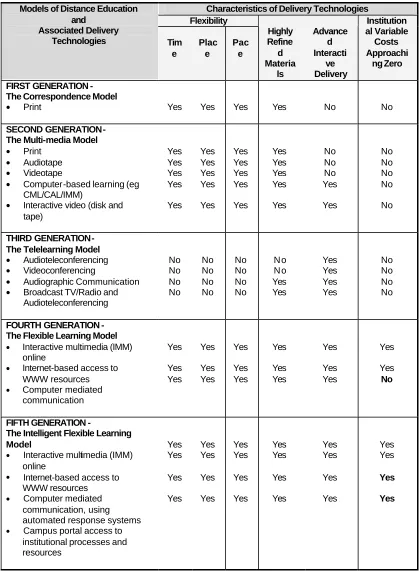
Table 1 : Models of Distance Education - A Conceptual Framework
Characteristics of Delivery Technologies Flexibility
Models of Distance Education and Associated Delivery Technologies Tim e Plac e Pac e Highly Refine d Materia ls Advance d Interacti ve Delivery Institution al Variable Costs Approachi ng Zero
FIRST GENERATION - The Correspondence Model
• Print Yes Yes Yes Yes No No
SECOND GENERATION - The Multi-media Model
• Audiotape
• Videotape
• Computer-based learning (eg CML/CAL/IMM)
• Interactive video (disk and tape) Yes Yes Yes Yes Yes Yes Yes Yes Yes Yes Yes Yes Yes Yes Yes Yes Yes Yes Yes Yes No No No Yes Yes No No No No No
THIRD GENERATION - The Telelearning Model
• Audioteleconferencing
• Videoconferencing
• Audiographic Communication
• Broadcast TV/Radio and Audioteleconferencing No No No No No No No No No No No No N o N o Yes Yes Yes Yes Yes Yes No No No No
FOURTH GENERATION - The Flexible Learning Model
• Interactive multimedia (IMM) online
• Internet-based access to WWW resources
• Computer mediated communication Yes Yes Yes Yes Yes Yes Yes Yes Yes Yes Yes Yes Yes Yes Yes Yes Yes No
FIFTH GENERATION -
The Intelligent Flexible Learning Model
• Interactive multimedia (IMM) online
• Internet-based access to WWW resources
• Computer mediated communication, using automated response systems
Although a detailed cost analysis of various technology/pedagogy interfaces is beyond the scope of the present paper, it is worth noting that prior to the advent of online delivery, variable costs tended to increase or decrease directly (often linearly) with fluctuations in the volume of activity. For example, in second generation distance education delivery, the distribution of packages of self-instructional materials (printed study guides, audiota pes, videotapes, etc) is a variable cost, which varies in direct proportion to the number of students enrolled. In contrast, fifth generation distance education has the potential to decrease significantly the costs associated with providing access to institutional processes and online tuition. Through the development and implementation of: automated courseware production systems, automated pedagogical advice systems, and automated business systems, the fifth generation of distance education has the potential to deliver a quantum leap in economies of scale and associated cost-effectiveness. Further, effective implementation of fifth generation distance education technology is likely not only to transform distance education, but also to transform the experience of on campus students.
The Emerging e-University: A Case Study
Consistent with Schendler’s (2000) proposed emphasis on execution and competition, the fifth generation model will not be presented solely as a set of abstract principles, but will be illustrated by an overview of the e-University Project, which has been planned thoroughly and is now in the early phases of implementation at the University of Southern Queensland (USQ). It is worth noting that USQ was the joint winner of the Good Universities Guides’ Australian University of the Year 2000-2001 for criteria focused on developing the e-university. The Award, presented by the Prime Minister at Parliament House in Canberra, focused on the preparation of graduates of both undergraduate and postgraduate courses and the university as a whole for the emerging ‘e-world’, with the following specific areas considered.
Area 1: Opportunities for students to access information and
communications technologies.
Area 2: Tools for life as a student: the routine use of information and
communications technology in administrative dealings with students.
Area 3: Tools for learning: using information and communications
technologies in core educational processes.
Area 4: Opportunities for students to learn about information and
communications technologies and their implications in the student’s area(s) of specialisation.
Area 5: The introduction of courses/specialisations in aspects of the
Area 6: Thinking through the use and implications of information and communications technologies in strategic planning and resource allocation.
URL: http://www.usq.edu.au/Visitors/vc/vcGUG.htm
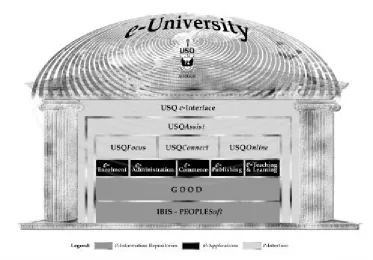
[image:5.612.112.485.238.498.2]USQ’s e-University Project was conceptualized in terms of three fundamental foci: the Information repositories, a variety of Applications and the e-Interface respectively. A graphic overview of USQ’s e-University Project is presented in Figure 1.
Figure 1: Overview of USQ’s e-University Project.
Prior to the implementation of PeopleSoft 8.0, the existing system will provide an essential source of e-information in conjunction with the e-content management system at the heart of the Generic Online Offline Delivery (GOOD) Project, an application developed locally at USQ.
In essence, the e-content management system incorporated in the GOOD Project enables cross-media publishing from a single document source. This means that USQ is able to make courseware available to students in a variety of delivery modes (print, online, CD, DVD, etc.) from a single document source. At the core of the GOOD cross-media production system is a content management system, which provides an integrated document management, workflow and content editing environment. Further, the cross-media publishing process has been automated through the use of standard markup languages. The GOOD project has enabled USQ to replace its resource intensive proprietary production system for courseware with a single document source system based on the XML (eXtensible Markup Language) standard. XML-tagged courseware documents are structured within consistent, comprehensive parameters with the substantive content and structure able to be treated discretely from layout and presentation. The document layout is generated by applying XSLT (eXtensible Style Sheet Language:Transformations) to the XML-tagged content. XSLT is a language for transforming XML documents into their target formats (for example HTML for Web delivery). The GOOD cross-media production system uses XSLT to simplify and fully automate the task of publishing content in multiple formats. The GOOD “rendering engine” is capable of automatically converting XML content into PostScript and PDF for print delivery, and into HTML for web delivery. The GOOD system also enables academic content specialists to edit their XML documents, and to generate HTML, PDF and PostScript outputs on demand. While initially focusing on the cross-media production of courseware, in time, the GOOD system will be made available for numerous other applications across practically every section of the University, including the cross-media publication of the Handbook, Course Information, Admissions and Enrolment documentation and the like.
Automating e-Learning
At USQ, the essential features of a fourth generation e-Learning environment support a learning process that is interactive, non-linear and collaborative. These features include the use of an interactive study chart as a basic navigational tool, which sets the broad parameters of the subject matter content to be investigated, and lists a number of exemplary references. References are electronic and hot linked via specific URLs. Additionally, the students are free to surf the Net for supplementary teaching-learning resources that meet their specific needs. They are also able to upload and download assignments, with those of sufficient quality being added to the teaching-learning resources database for reference by future students. The interaction with courseware materials is, however, only one element of the interactivity built into the USQ pedagogical approach. Interaction with other students, teaching staff and other experts, who act as mentors, is achieved through the use of Computer Mediated Communication (CMC), primarily through the deployment of asynchronous discussion groups. Students are encouraged, and in many cases required, to communicate through various electronic discussion groups, established for specific content areas as well as for informal social interaction.
e-Learning: From Cottage Industry to Mass Global Access
The effective use of CMC is presently constrained in an important way. It is still a function of what Daniel (1999) recently referred to as the “cottage-industry model”, which entails the traditional working practices of universities, wherein the same academic staff member usually does everything, including teaching, providing academic support and assessment for a group of students. In effect, the current applications of fourth generation Internet-based delivery tend to generate resource allocation models similar to tutorial-based on campus teaching. Indeed, it is still a fear of many academics initiating an online teaching program that they will be overwhelmed by email requesting support from individual students. While such fears can be allayed by the use of “one-to-many” communication systems such as bulletin boards, mailing lists and threaded discussions, the underlying resource model is not significantly different from conventional on campus teaching, with a staff member being necessary to manage groups of approximately 20 students to maintain a reasonable quality of interaction and academic support. In contrast, the fifth generation Intelligent Flexible Learning Model has the potential to deliver major economies of scale in managing teaching and academic support through the exploitation of automated response systems.
Our work at USQ has reached the point, where we have developed prototypes of what we refer to as intelligent object databases, which can be searched by pre-specified key words. Upon receipt of an electronic query from a student, the search engine seeks an appropriate match with a previously asked question, which if successful, triggers a personalized response to the current question without concurrent human intervention. At this stage of development, a tutor must check the validity of the match between the current question and the answers generated automatically from the database before forwarding to the students following a quick scan and with a single “click”. Such a quality control mechanism may become redundant in the future. If no appropriate match is discovered in the database of previously answered questions, the query is automatically routed to the relevant tutor for an appropriate response, which is then added to the database with a single point and click. Depending on the pedagogical design of the course, these responses can be directed to the whole cohort of students, to groups of students, or to individuals. The system has the advantage of providing more -or-less immediate pedagogical advice to students, a significant increase in institutional responsiveness, at minimal variable cost. The use of automated response systems is also being integrated into e-Administration systems through the implementation of USQAssist.
e-Learner Relationship Management
The USQAssist initiative is deploying tracking and automation tools to manage the interaction between the University and both its existing and prospective students. As USQ already has a need to provide global learning services to students enrolled in more than 60 countries, the University has to face the challenge of being responsive to client needs 24 hours per day, 7 days per week. The most efficient, cost–effective way to manage the 24 x 7 challenge is to deploy effective automation tools, as opposed to running three shift student service desks or employing online tutors in different continents (although USQ already does the latter). The aim of such a system is to provide effective and efficient service to existing and prospective students at minimal variable cost.
Using structured, intelligent databases, the knowledge generated by solving student problems/enquiries is being progressively stored and made available so that, wherever possible, students with equivalent or similar problems can have their enquiries dealt with immediately through the self-help, automated response capacity of the USQAssist system, thereby facilitating effective first point of contact resolution.
As the intelligent object databases become more comprehensive, enabling personalized, immediate responsiveness to an increasing number of student queries, the institutional variable costs for the provision of effective student support will tend towards zero. The effective use of such technology not only improves the responsiveness of the institution, but also frees up student support personnel to provide personal assistance via email dialogue or telephone as necessary. Further, every interaction is tracked from initiation to resolution, including flexible routing of enquiries based on explicit rules -based escalation protocols to ensure timely and successful responsiveness, and subsequent statistical reporting of system performance. Tracking interactions with prospective students enables the collation of the effectiveness of institutional marketing strategies, an increasingly important strategic issue for universities in the emerging global learning economy, which demands a highly effective public e –Interface with the University.
A central feature of the fifth generation model is the development of a customizable e-Interface, a campus portal thro ugh which students, staff and other stakeholders can engage with the university in a highly interactive and compelling manner. In Norris’ (2000) terms, a well designed campus portal will engender “pervasive, perpetual interactivity “(p.6), which will enable universities to provide such efficient service to students that it is likely to build effective, enduring relationships that could last a lifetime. To be successful in the emerging global lifelong learning market, a university needs to create a campus portal that will achieve a degree of interactivity, user friendliness and personalization that does not exist in the vast majority of campus web sites today.
In the near future, wireless access will also be available through such devices as LG Electronics’ Web Pad, In tel’s Web Slate or Qubit’s Web Tablet, which are soon to be released. This freedom to have access to the Internet from virtually anywhere on campus is a key feature of providing access to online courseware and services to all students whether on or off campus. The key to the success of such initiatives is, of course, detailed execution and associated, institution-wide organizational development strategies to enable the necessary institutional change.
Organisational Development
Apart from creating a new senior management portfolio, Vice-President (Global Learning Services) to provide institution-wide leadership of the e-University Project, USQ also allocated resources to create a small team of specialists to facilitate the integration of the aforementioned e-systems through the design and development of the e-Interface, the campus portal, which is being managed under the auspices of what is known locally as the Building for Enterprise and Teaching with Technology Enhanced Responsiveness (BETTER) Project.
The goal of the BETTER Project is the functional integration and interoperability of the constituent components of the e-University project, including Peoplesoft, GOOD, USQAssist, USQ’s existing Intranet systems (USQConnect and USQFocus) and the University’s commercial initiative with NextEd Pty Ltd, USQOnline. This integration is to be achieved through the development of an e-Interface, entailing a complete re -conceptualization of the USQ web site. It is hoped that the benefits will be better service to students and more efficient workflows within the University. The public face of the University experienced through this campus portal will be a sophisticated e-Interface that will provide a gateway to all USQ's information and services that will respond in a personalised way to user profiles and individual needs.
The BETTER team was created by seconding the University Librarian to lead the project, with the support of her Executive Assistant, an e-Policy Development Officer (new part-time appointee, who works three days per week) and the e-Systems Designer, the key local expert, who formerly managed the USQ Distance Education Centre’s Network Services. Although relatively few in number, this core team has extensive expertise and has considerable access to the various teams managing the constituent projects. Apart from the staffing budget for the BETTER team, the e-University Project has access to A$2.5 million over the 2001-2002 period from the University’s capital development funds, which can be expended not only on bricks and mortar, but also on technology-clicks and mortar!
While the major focus of the BETTER team is the redesign of the USQ web site to enable a single gateway to the seamless integration of the underlying e-infrastructure and component projects, it is also the key focus for associated e-policy development, interoperability considerations, metadata and related standards’ issues, as well as for the development and implementation of a communications strategy to keep all staff members up to date with developments. The pathway of the BETTER Project to the formal institutional decision making structure of the University, including the President’s Consultative Committee and the Academic Board, is through the Information Infrastructure and Services Committee. The e-University Project is clearly central to USQ’s strategic planning, with the associated commitment of human and financial resources to sustain the necessary proactive approach to change management aimed at facilitating institutional transformation on a corporate scale.
Conclusion
In many universities the development of web-based initiatives is not systemic, but is often the result of random acts of innovation initiated by risk-taking individual academics. In contrast, the implementation of the e-University Project at USQ is strategically planned, systematically integrated and institutionally comprehensive. At USQ, the move to the online environment was a natural step for an institution with a history of almost 25 years of commitment to innovation in distance education. The increasingly central role of web-enabled information and communications technologies in USQ operations is supported by an organizational culture capable of sustaining innovation on a corporate, rather than individual, basis. USQ’s institution-wide approach reflects one element of the corporate mission statement: “To be a leader in flexible learning and the use of information and communications technologies”. Or, as the USQ President, Professor Peter Swannell, prefers to express it in public statements to the wider community, “The University’s guiding philosophy is to give people: what they want, where they want it, when they want it. WWW is purely incidental!”
References
Daniel, J (1999). “Distance learning in the era of networks: What are the key technologies?” Paper presented at the Pan Commonwealth Forum on Open Learning, Brunei, 1 -5 March.
Dolence, MG & Norris, DM (1995). “Transforming Higher Education: A Vision for Learning in the 21st Century”. Society for College and University Planning (SCUP), Ann Arbor, MI.
Garrison, R (1997). “Computer conferencing: The post-industrial age of distance education”. Open Learning, 12, 2, 3-11.
Katz, RN & Oblinger, DG (Eds) (2000). The “E” is for everything: e-Commerce, e-Business and e-Learning in the future of higher education. San Francisco: Jossey-Bass.
Milliron, MD & Miles, CL (2000). “Education in a digital democracy: Leading the change for learning about, with, and beyond technology.” Educause
Review, November/December.
Norris, DM (2000). “E-Business and Higher Education Marketplaces”. Strategic Initiatives, Inc.
Schlender, B (2000). “Their reign is over”. Fortune, 142, 9, 89-90.
Taylor, JC (1995). ‘Distance education technologies: The fourth generation’. Australian Journal of Educational Technology, 11, 2, 1-7.