Lessons Learned from Renewable Electricity Marketing Attempts: A Case Study1
Dr. Sharyn Rundle-Thiele* Associate Professor (Marketing)
Faculty of Business, School of Management and Marketing USQ Springfield Campus, PO Box 4196,
Springfield, Queensland, 4300, Australia Telephone: +61 7 3470 4539
Fax: +61 7 3470 4500 Email: [email protected]
Dr. Angela Paladino Department of Management
University of Melbourne Level 4, Alan Gilbert Building
VIC 3010 Australia Telephone: +61 3 8344 1916
Fax: + 61 3 9348 1921 Email: [email protected]
Sergio Antonio G. Apostol, Jr.
Department of Marketing, Griffith Business School N50. Room 2.45
Griffith University, Nathan Campus Nathan Qld 4111
Australia
* Author for correspondence
ABSTRACT
The choice of subscribing to renewable electricity has been available to households for more than a decade yet consumer uptake remains low for some green marketers. This case study uses a retailer’s perspective to examine the implementation of a green marketing program for a
renewable electricity retailer. Based on interviews, internal company documentation and
secondary research, findings show that effective differentiation for renewable energy is required to increase consumer involvement levels and the likelihood of consideration. While consumers lack understanding of, and interest in, renewable energy the marketing program relied on customers to seek information. It was apparent the success of green marketing programs
depends on the integration of education into a carefully targeted marketing program emphasising functional and emotional values to differentiate renewable energy and simplify consumer
decision-making processes.
Lessons Learned from Renewable Electricity Marketing Attempts: A Case Study
RENEWABLE ELECTRICITY MARKETING
The importance of “clean” electricity has increased globally with the continued rise in consumer apprehension about climate change and mounting oil prices. Forecasts depict annual increases to business within the clean energy sector of between 20-30%, illustrating the significance of this area to economic growth (Anonymous, 2006). Environmental consciousness has evolved into a societal norm as both consumers and firms aim to take responsibility for the consequences of consumption. As a result, an increasing number of consumers now actively seek to purchase “green products”. In the area of utilities, generators and retailers of electric power have also examined their green options, albeit at a slower pace, setting-up power plants that use renewable sources of power. Renewable electricity alternatives including wind, solar, hydro, and biomass respond both to the growing ecologically-concerned market and increasing government
regulations.
years after its introduction. Customer waiting lists for the Toyota Prius hybrid for instance, is up to six months in the US and four months in Australia (Toyota, 2005, 2006).
Growth of the renewable electricity industry relies on consumer uptake of the service. Marketers of this service face an uphill battle as “energy use lacks visibility and requires a low level of interaction, obscuring the need for energy efficiency and reducing feedback in energy efficiency behaviours” (Ball, Cullen & Gan, 1999, p. 122). Despite this, the adoption of green energy provides significant societal benefits including reductions in greenhouse emissions, improved air quality and a suite of long-term benefits including the curbing of environmental degradation. This places an obligation on marketers and government who must inform and convince consumers of the benefits of renewable electricity. Marketing renewable power is a challenge. Firstly, consumers are unaware of the types of electricity harnessed and how the power is utilized. Secondly, consumers have little trust in the power retailers (Ottman, 1997;
Wohlgemuth, Getzner & Park, 1999). Finally, many consumers areunwilling to pay a premium for green goods in general.
Renewable electricity marketing has been tackled by several agencies tasked to monitor global progress. However, the uptake and retention of renewable electricity services by consumers has not yet been as extensively researched in the management and marketing literature. The
Attitudinal research shows that norms and knowledge are critical in the formation of consumer attitudes (Ajzen and Fishbein, 1980). The formation of green attitudes is certainly no different. In fact, preliminary research demonstrates that norms are critical to increase the sense of
responsibility in society. By the same token, knowledge arms consumers with choices and is a critical component in attitude formation. A number of green marketing studies have focused on green products and services but the lack of literature on marketing renewable electricity is quite evident. An understanding of the green power consumer and requisite purchase behaviours is particularly urgent. In this study we take a case study approach to examine why the adoption of renewable electricity is low.
INFLUENCES ON RENEWABLE ELECTRICITY MARKETING
Renewable electricity marketing is defined as the advocacy of providing electricity generated through environmentally friendly or sustainable means, which includes solar, wind, hydro, and bioenergy or biomass. For the purposes of this study customers are deemed to be household customers. The renewable electricity industry has published studies that focus on conflicts within the industry that have led to poor uptake (eg, National Green Power Accreditation Program Quarterly, 2004). These studies have investigated the issues of consumer uptake of green products such as renewable electricity. The limited research that exists in this area also points to the relevance of understanding the theory of diffusion, as pioneered by Rogers (1976) in
Faiers & Neame, 2006; Rowlands & Parker, 2002; Straughan & Roberts, 1999) and government policy (Passey & Watt, 2002). We now examine these most urgent issues in turn.
Characteristics of Potential Customers
The nature of the green consumer must be understood to be able to introduce valuable incentives to increase consumer uptake. Knowledge of the consumer should be the focal point of all
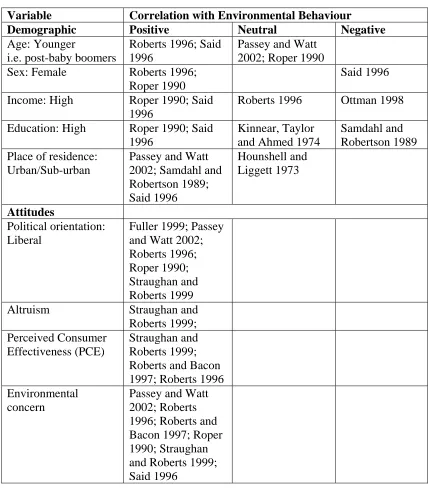
marketing action (Bell & Emory, 1971). Studies have been conducted which address the characteristics of green consumers. These studies have identified qualities of people who are likely to exhibit Ecologically Concerned Consumer Behaviour (ECCB) (eg, Fuller, 1999; Hine & Gifford, 1991; Hounshell & Liggett, 1973; Kinnear, Taylor & Ahmed, 1974; Samdahl &
Robertson, 1989; Passey & Watt, 2002; Roberts, 1996; Roberts & Bacon, 1997; Roper, 1990; Said, 1996; Straughan & Roberts, 1999). These consumer characteristics centre on (a)
demographics including age, sex, income, education, and place of residence and (b)
psychographics including political orientation, altruism, perceived consumer effectiveness and environmental concern. Psychographic characteristics tend to exhibit less erratic results as compared to demographics. However, the findings have been inconsistent, with some reporting positive relationships while others report negative or neutral relationships (eg, Said, 1996; Passey & Watt, 2002).
Once green consumers are identified, strategies can be formulated to target each group
Roberts & Bacon, 1997; Said, 1996; Straughan & Roberts, 1999). Individuals who believe that they can effectively counter-act environmental devastation through pro-environmental choices will seek tangible benefits linked to their actions (Straughan & Roberts, 1999). Thus, a firm must be perceived to be helping the environment through its products, services, and through its very operation and existence to attract green consumers (Ottman, 1998). Income may not be as important as the feeling of empowerment that PCE gives an individual. Thus, education
campaigns may be more effective than lowering cost as a strategy to access people with low SES (Roper, 1990).
Moreover, such consumers tend to be analogous to innovators and early adopters. These customers will tolerate inconvenience, product complexity or performance deficiencies to reap the long-term benefits attributed to the innovation (Faiers & Neame, 2006). The early majority are attracted to innovations when “they originate from an established manufacturer, have a recognizable quality and fit within a supporting infrastructure of products and services” (Faiers & Neame, 2006, p. 1799). These consumers are challenging to satisfy but are critical to the sustained success of an innovation.
Awareness and Knowledge
While numerous consumers suggest that they would support environmental initiatives, many fail to follow through their intentions with the requisite behaviours. Indeed, of the 73% of
respondents who stated that they would support renewable electricity programs in the Batley et al (2001) study, only 13% registered to participate in them. While these discrepancies may be attributable to local scheme effects, social status and income (Batley, Colbourne & Urwin 2001), the absence of knowledge has played a significant role. In fact, those that are more aware of electricity and its environmental effects are more likely to respond to marketing efforts (Batley, Colbourne, Fleming & Urwin, 2001).
Consumer Education
It is essential that marketers educate consumers. Renewable electricity customers need to understand the details of program specifications, including economic consequences. Marketers must clear misconceptions about renewable electricity such as assuring customers that they will still have power if sun does not shine or the wind does not blow. These are essential components of service quality (Cronin & Taylor, 1994). Research suggests that electricity aware consumers are more likely to respond to marketing efforts (e.g. Batley, Colbourne, Fleming & Urwin, 2001). The success of green marketing depends on integrating education into marketing strategy, utilizing the ecological and strategic dimensions of information technology and maximizing customer value through a portfolio of products (Wohlgemuth & Getzner, 1999). If education and awareness is increased in different target segments, then marketing efforts may be more
gauge most of their information firstly from retailers and secondly from the Internet (Essential Services Commission, 2005).
Consumers must be educated to realize that their personal action can make a difference in stopping environmental deterioration (Straughan &Roberts, 1999). Perceived consumer
effectiveness (PCE) and green consumer altruism points to the need for credibility in delivering renewable electricity (Ottman, 1998; Straughan & Roberts, 1999). Thus, if a firm is perceived to be associated with conventional power generation, such as coal fire plants, creating a subsidiary with a new image may be in order (Ottman, 1997; 1998).
The success of green marketing is contingent on aligning prices with a consumer’s reference price (for low involvement goods) or with perceived value for those of higher involvement (Laurent & Kapfer, 1985). While conventional electricity is viewed as a low involvement
purchase for some, renewable electricity represents a higher involvement purchase to the average consumer.
Renewable electricity sales rely on the consumers’ WTP, as it remains costly to produce relative to conventional power generation methods (Rowlands & Parker, 2002). There are different reasons for why consumers are willing to pay a premium including (a) the warm glow effect attributed to social pressures that consumers feel to behave ecologically, (b) purchase moral satisfaction, where a consumers feels a sense of achievement when helping the environment and (3) altruism and paternalism – these are possible motives for a general concern for others
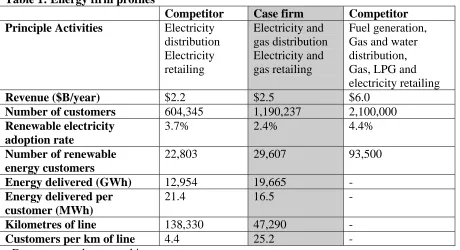
emotive factors. It is critical that consumers are also driven by utilitarian factors to ensure that they make fully informed decisions. Knowledge and information are essential precursors to this. Table 1 provides a summary profile of the case firm and two key competitors and the following text section presents the major findings from the case study. The exposition highlights key oversights made by the renewable electricity marketers in the case firm and the implications for green marketers are highlighted.
Insert table 1 and box 1 about here
IMPEDIMENTS TO ADOPTION
In-depth interviews with marketers in the case firm revealed three main impediments to the adoption of renewable electricity by consumers. Impediments to adoption were a failure to
segment the market, low consumer awareness and knowledge and a failure to educate customers.
Failure to Segment the Market
Renewable electricity services were introduced without investigating the characteristics of the consumers who would be more willing to purchase the services. The interviews clearly showed that a mass-market approach was adopted:
“All information … is made available to anyone on the Internet.”
Despite the marketers awareness that
“Different customers have different levels of commitments or commitedness to the
Green marketers should use consumer segments to frame their thinking using a range of
initiatives to appeal to varying consumer commitment levels. Green marketers should emphasize the tangible benefits of green products using proven consumer-focused marketing techniques.
Low Awareness
Marketing executives indicated that a mere one in five households were aware of renewable electricity.
“Not many consumers know or want to know about green electricity. The electricity
bill is all they want and most don’t even want that.”
Customer awareness is required for more non-tangible forms of renewable energy generation such as biomass and wind. Without awareness it is nigh on impossible to increase the relevance of non-tangible forms of renewable electricity to consumer’s thereby increasing motivation to search for information.
“Green electricity is not a high priority. When [customers] do find out about it they
look into it or ask us about our programs.”
The firm studied relied on consumers to seek information on renewable electricity.
“Information about [our program] is available on our web site and we had an ad
campaign to launch the program back in 1998. Also, we have a newsletter that we
distribute to customers who have signed up for [our program].”
“[We communicate to our consumers] through our web advertisements. You can sign
up for the program on the web.
“The obvious benefit is reduction of greenhouse emissions.”
A marketing program relying on consumers to seek information on renewable electricity adoption is fraught with problems in an environment where only 1 in 5 households are even aware of renewable electricity. Furthermore, with only 70% (ABS, 2005) of households
accessing the Internet the marketing efforts employed by this electricity retailer are only capable of reaching just over 2/3 of the target population. Such a myopic approach limits the availability
of knowledge and is highly dependent on these consumers to firstly seek this knowledge and then act as opinion leaders to peers. This does not do enough to ensure that information is widely disseminated to householders to allow them to make an informed choice. This therefore inhibits knowledge and the subsequent formation of favourable attitudes towards renewable power and ultimately corresponding behaviours.
Failure to Educate Consumers
The absence of dedicated consumer education programs was notable. When prompted about programs beyond making information available on the Internet marketers commented on initiatives that had been put in place for corporate reputation reporting:
“We have other environmental programs that are not solely dedicated to green
energy. We annually release the sustainability report and the … environment
report”. Their release is not however widely communicated to consumers.
concerning renewable electricity within its other programs. Empowerment schemes that could counteract the effects of income and positively affect PCE (Ottman, 1997; 1998, Straughan & Roberts, 1991) were also absent.
This is a considerable oversight as consumer behaviour studies have demonstrated the
significance of knowledge in the formation of attitudes and subsequent behaviours on numerous occasions (Bagozzi, 1981; Vining & Ebreo, 1990). It is well established that an absence of knowledge will lead to consumer uncertainty and confusion, which inadvertently increases the risk attributed to a purchase (Foxall & Goldsmith, 1985). Consumers generally view electricity as a low involvement product.
“We can do more for promoting green electricity … at the end of the day people
don’t think about where electricity comes from.”
Involved customers are more likely to seek information and process larger volumes of
information (Shao, Baker & Wagner, 2004). Effective differentiation for renewable energy by marketers is required for consumers to increase involvement levels. Marketers were aware that differentiation is necessary:
“We have to differentiate the different types of green energy that we offer.”
Yet marketing communications were not even distinguishing between renewable electricity and conventional electricity forms:
[Insert Figure 1 About Here]
Without effective differentiation renewable energy would only be considered as a worthy alternative for highly environmentally conscious customers (Paladino, 2005).
LESSONS LEARNED
Perceptions and attitudes have been shown to impact behaviours and innovation adoption. “Understanding consumers’ attitudes towards an innovative product provides two key benefits. First, strengths and weaknesses in the innovation attributes can be identified and managed effectively. Second, more control can be imposed on the marketing strategy in order that the innovation is made attractive to the most receptive audience” (Faiers & Neame, 2006, p. 1800).
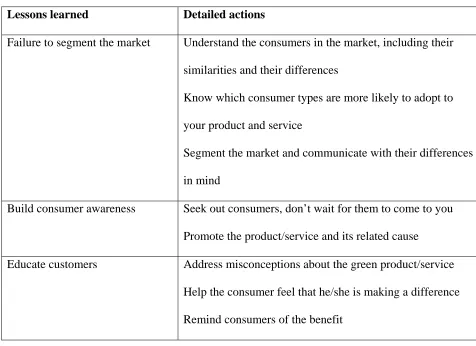
green products and services. Three lessons have emerged, as outlined in Table 2, as enablers for successful green product/service adoption.
[Take in Table 2 about here]
Comparable to the financial services firms, electricity retailers have largely ignored consumer knowledge and involvement in electricity. Such firms have rarely placed the customer at the forefront of decisions and it is highly likely that some of these firms have not been managed as marketing organizations. This represents a considerable challenge and opportunity for the electricity retailer (de Chernatony & Dall’Olmo Riley, 1999).
Segment the market
The apparent lack of segmentation by the firm provides a window of opportunity for it to more effectively communicate with the customers. A deep understanding of the characteristics of the consumers in the renewable electricity market would have led to the design of a marketing program that better addressed the specific needs of the consumers by overcoming objections such as initial set up costs. Although the portfolio of services offered covers a wide range of consumer needs there is room for improvement. Renewable electricity services in this case were introduced before segmenting the market, leading to the dismal adoption rates. There is a
Build consumer awareness
Quite simply, if potential customers do not know about a green product or service, they will not purchase it. Therefore, one of the pre-eminent goals of any green marketer should be to build brand awareness, albeit in as cost-effective manner as possible. To build awareness the marketing program must seek out consumers. Consumers tend to make purchasing decisions based on peer recommendations and direct experience, as well as traditional advertising methods. At times when weather patterns are extreme, e.g. droughts, record temperatures, water shortages, consumer awareness of the environment is heightened and green marketers are presented with the opportunity to highlight how their products and services can make a difference. Green
marketers do not need to work alone when their products and services are capable of contributing to a cleaner and greener world. For example, green marketers can work with media to jointly promote how green products and services can contribute to minimising the impact on the environment when compared to conventional forms.
Educate consumers
Roberts, 2001) therefore reducing the negative effect of the premium costs for renewable electricity. This is consistent with attitudinal studies that have consistently found knowledge to be a key driver of attitude formation and subsequent corresponding behaviours.
The success of green marketing depends on integrating education into marketing strategy, utilizing the ecological and strategic dimensions of information technology and maximizing customer value through a portfolio of products (Wohlgemuth et al. 1999). Consumer education is the key to awareness and the uptake of renewable electricity services. Marketers can design programs to address queries and misconceptions about renewable power. Customers currently discontinue the renewable energy subscription program citing cost and a lack of perceived benefit. Empowering consumers with knowledge also helps the consumer feel that he/she is making a difference and thus encouraging consumers to continue contributions to schemes that support renewable power. For example, renewable electricity marketers can remind consumers with average medium homes adopting renewable electricity that they have effectively removed 1.2 cars from the road for a twelve month period on their bill statement (see
www.originenergy.com.au ). No additional costs are incurred for an initiative that is able to remind consumers that they are making a difference.
PCE can be increased through consumer education programs that explain the benefits of
renewable energy and thus justifying the premium price for the service. This reiterates the need for education programs as part of the strategy (Ottman 1997; 1998).
It is important to note that “consumers act in response to a wide range of influences and change their behaviour without changes in prices or other monetary aspects of adoption. Non-financial measures can be more cost effective in changing … behaviour[s] and less economically
damaging than price decreases” (Ball, Cullen & Gan, p. 117). While policy initiatives by governments have often “stressed the importance of creating infrastructure conducive to a rapid spread of awareness and knowledge of innovations … it is generally realised that policy
initiatives have largely bypassed opportunities to improve the diffusion process” (Stoneman & Diederen, 1994: 918). Government could also implement standards to reduce risk taking within an industry or implement policies to itself carry some of the burden of risk of new technology introduction (Stoneman & Diederen, 1994).
REFERENCES
Anonymous (2006). Tilting at the windmills. The Economist, November 18, 72-74.
Australian Bureau of Statistics. (2005). Internet Activity, Australia. Catalogue Number 8153.0 Ajzen, I. and Fishbein, M. (1980). Understanding attitudes and predicting social behavior. New Jersy: Prentice-Hall.
Bagozzi, R. (1981) Attitudes, intentions and behaviour: A test of some key hypotheses. Journal of Personality and Social Psychology, 1981; 41 (4), 607-627.
Ball, R., Cullen, R. and Gan, C. (1999). The Diffusion of Energy Efficiency Innovations Among Residential Energy Consumers. New Zealand Economic Papers, 33(1), 115-135.
Batley, S. L., D. Colbourne, P.D. Fleming and Urwin, P. (2001). Citizens versus consumer: challenges in the UK green power market. Energy Policy, 29, 479-487.
Bell, M. I. and Emory, C.W. (1971). The faltering Marketing Concept. Journal of Marketing, 35 (4), 37-41.
Bessant, M. (2006) Australia plays catch up in the world’s fastest growing agricultural industry,
Retail World: Organics Guide 2006-2007, p. 5.
Bird, L., Wüstenhagen, R. And Aabakken (2002). Green Power Marketing Abroad: Recent Trends. Golden, Colorado, National Renewable Energy Laboratory.
Cronin, J. J. and Taylor, S.A. (1994). SERVPERF versus SERVQUAL: Reconciling performance -based and perceptions-minus-expectations measurement of service quality. Journal of Marketing, 58, 125-131.
Dubois A. and L.E. Gadde. (2002). Systematic Combining: an abductive approach to case research. Journal of Business Research, 55, 553-560.
Eisenhardt, K. (1989) Building Theories from Case Studies. Academy of Management Review,
14 (4), 532-550.
Essential Services Commission. (2005) Publication of Price and Service Information by Energy Retailers, July.
Faiers, A. and Neame, C. (2006). Consumer attitudes towards domestic solar power systems
Energy Policy, 34, 1797–1806.
Foxell, G. and Goldsmith, R.E.. (1994) Consumer Psychology for Marketing. USA, Routledge. Fuller, D. (1999). Sustainable Marketing: managerial-ecological issues. London, Sage Publications.
Gabbott, M. and Hogg, G. (1999). Consumer Involvement in Services: A replication and extension. Journal of Business Research, 46, 159-166.
Greenaway, D. (1994). Policy Forum: The Diffusion of New Technology: Editorial Note. The Economic Journal, 104 (425), 916-917.
Hine, D. W. and Gifford, R. (1991). Fear Appeals, Individual Differences and Environmental Concern. The Journal of Environmental Education, 23 (1), 36-41.
Hounshell, P. and Liggett, L. (1973). Assessing the Effectiveness of Environmental Education.
The Journal of Environmental Education, 5 (2), 28-30.
Kinnear, T. C., J. R. Taylor, and Ahmed, S.A. (1974). Ecologically Concerned Consumers: Who Are They? Journal of Marketing, 38, 20-24.
Macdonald, E.K. and Sharp, B.M. Brand Awareness Effects on Consumer Decision Making for a Common, Repeat Purchase Product: A Replication, Journal of Business Research, 48 (1), 5-15. National Green Power Steering Group (2004) National Green Power Accreditation Program Quarterly Report. October 1 to December 30.
Ottman, J. (1997) Renewable energy: Ultimate Marketing Challenge. Marketing News 31 (9), 5. Ottman, J. (1998) Green Marketing: Opportunity for Innovation. Chicago, NTC Business Books. Paladino, A. (2005). Understanding the green consumer: An empirical analysis. Journal of Customer Behaviour, 4, 69-102.
Passey, R. and Watt, M. (2002). Review of Australian Green Power Schemes, Australian CRC for Renewable Energy Ltd.
Roberts, J. A. (1996). Green Consumers in the 1990s: Profile and Implications for Advertising.
Journal of Business Research, 36 (3), 217-231.
Roberts, J. A. and Bacon, D. R. (1997). Exploring the Subtle Relationships Between Environmental Concern and Ecologically Conscious Consumer Behaviour. Journal of Business Research, 40 (1), 78-89.
Rogers, E.M. (1976). New Product Adoption and Diffusion. The Journal of Consumer Research, 2(4), 290-301.
Roper Organization (1990). The Environment: Public Attitudes and Individual Behaviour.
Rowlands, I. H., and Parker, P. (2002). Consumer Perceptions of Green Power. The Journal of Consumer Marketing, 19 (2/3), 112-130.
Samdahl, D. M. and Robertson, R. (1989). Social Determinants of Environmental Concern: Specification and Test of the Model. Environment and Behaviour, 21 (1), 57-81.
Shao, C.Y., Baker, J. and Wagner, J.A. (2004). The effects of appropriateness of service contact personnel dress on customer expectations of service quality and purchase intention: The
moderating influences of involvement and gender. Journal of Business Research, 57, 1164-1176. Stoneman, P. and Diederen, P. (1994). Technology Diffusion and Public Policy. The Economic Journal, 104(425), 918-930.
Straughan, R. D. and Roberts, J. A. (1999). Environmental Segmentation Alternatives: a Look at Green Consumer Behaviour in the New Millennium. Journal of Consumer Marketing, 16 (6), 558-575.
Toyota Motor Corporation (2005). Environment and Community Report 2005. Toyota Motor Corporation (2006). Environment and Community Report 2006.
Vining, J. and Ebreo, A. (1990). What makes a recycler? A comparison of recyclers and nonrecyclers. Environment and Behaviour, 22 (1), 55-73.
Wohlgemuth, N., and Getzner, M. (1999). Green Power: Designing a Green Electricity Marketing Strategy. In: M. Charter and M. J. Polonsky, editor. Greener Marketing: a global perspective on greening marketing practice. Sheffield, UK, Greenleaf Publishing Limited, pp. 362-380.
Figure 1: Internet communication
[The company] makes it easy and affordable for customers to improve the health of the environment through its
green energy program.
Currently, 90 percent of electricity comes from coal-fired power, mostly because
green energy is much more expensive to produce. As demand for green energy
grows, more alternative energy generators will be developed making it more accessible and affordable for all.
With your help, [the company] can facilitate the development of more renewable energy generators.
Now you can choose how much you'd like to contribute per energy bill, according to set levels. To demonstrate
Table 1: Energy firm profiles
Competitor Case firm Competitor Principle Activities Electricity
distribution Electricity retailing
Electricity and gas distribution Electricity and gas retailing
Fuel generation, Gas and water distribution, Gas, LPG and electricity retailing
Revenue ($B/year) $2.2 $2.5 $6.0
Number of customers 604,345 1,190,237 2,100,000
Renewable electricity adoption rate
3.7% 2.4% 4.4%
Number of renewable energy customers
22,803 29,607 93,500
Energy delivered (GWh) 12,954 19,665 -
Energy delivered per customer (MWh)
21.4 16.5 -
Kilometres of line 138,330 47,290 -
Customers per km of line 4.4 25.2 -
Table 2: Implications for green marketers
Lessons learned Detailed actions
Failure to segment the market Understand the consumers in the market, including their similarities and their differences
Know which consumer types are more likely to adopt to your product and service
Segment the market and communicate with their differences in mind
Build consumer awareness Seek out consumers, don’t wait for them to come to you Promote the product/service and its related cause
Table 1: Segmentation variables and links to Environmental Behaviour* Variable Correlation with Environmental Behaviour
Demographic Positive Neutral Negative
Age: Younger
i.e. post-baby boomers
Roberts 1996; Said 1996
Passey and Watt 2002; Roper 1990 Sex: Female Roberts 1996;
Roper 1990
Said 1996
Income: High Roper 1990; Said 1996
Roberts 1996 Ottman 1998 Education: High Roper 1990; Said
1996
Kinnear, Taylor and Ahmed 1974
Samdahl and Robertson 1989 Place of residence:
Urban/Sub-urban
Passey and Watt 2002; Samdahl and Robertson 1989; Said 1996 Hounshell and Liggett 1973 Attitudes Political orientation: Liberal
Fuller 1999; Passey and Watt 2002; Roberts 1996; Roper 1990; Straughan and Roberts 1999
Altruism Straughan and
Roberts 1999; Perceived Consumer
Effectiveness (PCE)
Straughan and Roberts 1999; Roberts and Bacon 1997; Roberts 1996 Environmental
concern
Box 1: How the case study was conducted
The targeted firm for this case study was selected from twelve retailers competing in the
electricity industry. One of the leading suppliers was chosen because this company is yet to see the same results for the adoption of renewable energy when compared to many of its
competitors (Passey and Watt, 2002). Case study research was used to explore why the adoption of renewable electricity was particularly low for this firm. The case study
methodology permits evaluation of a case to help renewable electricity retailers to change. This retailer offers a green electricity program that allows customers to voluntarily contribute
towards the purchase of green electricity in each bill payment. Following the recommendations of Yin (2003), Dubois and Gadde (2002), and Eisenhardt (1989), data for this investigation was collected from a variety of sources, including secondary sources (e.g. company documents, press articles and government reports), and interviews.