ICT Governance – Radical Restructure
Aileen Cater-Steel Mark Toleman
Dept of Information Systems University of Southern Queensland
[email protected]; [email protected]
Brian Kissell Rob Chown Division of ICT Services University of Southern Queensland
[email protected]; [email protected]
Abstract
Acting upon the recommendations of a review of Information and Communications Technology (ICT) governance and services at USQ, a major restructure was effected merging ICT units previously scattered across the university. The new Division of ICT Services embodies both CobiT and ITIL principles and comprises three sections: performance measurement and investment management; service delivery; and infrastructure and systems. To ensure the radical change was managed professionally, a change manager from the HR department was seconded to the project. With the new structure now in place, a single service desk has been implemented and service level agreements are being formulated with faculties and departments.
This paper describes the new reporting structure of the Division of ICT Services, the internal structure, the goals of the Division and how they align with the corporate goals. To benchmark services, surveys of students and academic and general staff were conducted and are reported. Innovative arrangements include the use of student ‘daemons’ to supplement ICT support capabilities, as well as two part-time positions of principal advisors: learning and teaching, and research. Care was taken to ensure that the new ICT structure was logical and conducive to operational effectiveness, efficiency and sound ICT governance. The new structure provides pathways and opportunities for career progression, reflects a client focus and provides role delineation and functional accountability.
Key Words: ICT Governance, organisational structure, federal model, CobiT, ITIL.
1. INTRODUCTION
and focussing on corporate governance (Peterson, 2003). Organisations are establishing IT governance to ensure that IT is aligned with the objectives of the organisation (Sledgianowski, Luftman, & Reilly, 2006). Recently, poor IT governance was blamed for three failed Australian IT projects at OneTel, Sydney Water and RMIT (Avison, Gregor, & Wilson, 2006). IT governance includes leadership, organisational structures and processes to ensure that the organisation’s IT sustains and extends the organisation’s strategy (Sallé, 2004). A sustainable IT governance implementation framework is proposed by De Haes and Van Grembergen (2005) focusing on structures, processes and relational mechanisms where structures involve the existence of responsible functions such as IT executives and a diversity of IT committees. Processes refer to strategic decision making and monitoring using tools such as the IT balanced scorecard. The relational mechanisms include business/IT participation, strategic dialogue, shared learning and proper communication.
The importance of having the correct organisational structure has been stressed by many researchers (for example Csaszar & Clemons, 2006). It is important to decide which structure is the most effective: centralised, federal, or decentralised (Peterson, 2003). Peterson claims the federal model offers the ‘best of both worlds’ but can be difficult to implement as it “challenges managers in local business units to surrender control over certain business-specific IT domains for the well-being of the enterprise” (Peterson, 2003, p. 47).
Sustainable ICT governance also relies on effective communication and knowledge sharing which can be achieved by a good participative collaborative relationship between business and the IT department (Van Grembergen, De Haes, & Guldentops, 2003). Furthermore, it is vital to align the ICT strategies, investments and activities with the objectives of the organisation (Luftman, 2004).
The aim of this paper is to provide a detailed account of the changes brought about in a large organisation to improve ICT governance. This paper firstly provides background information related to the University of Southern Queensland (USQ) and its ICT resources, and the findings of a recent ICT review. The review resulted in major changes which are then described. The outcomes and results to date are then summarised. The final section identifies future directions and provides a conclusion focussing on the critical success factors of the restructure.
2. BACKGROUND
In 2005, USQ reported a total number of 25,378 student enrolments contributing to 12,092 equivalent full-time student load (EFTSL). Of these, 19,510 studied externally and 5,868 studied on-campus. In total, 315 programs of study were offered. All students have access to online study materials and learning management systems. Enterprise Resource Planning systems include the Peoplesoft modules for Student Administration, Human Resources and Finance. In addition to the main Toowoomba campus, the University operates integrated satellite campuses at Springfield (Brisbane) and Wide Bay. The complex network infrastructure operates on a high speed optic fibre backbone, servicing approximately 2600 PCs and 200 Macintosh staff and student laboratory computers from 250 servers, via 190 network devices.
assets management were not practiced; the funding and procurement processes for ICT were seriously flawed; siloing, duplication and general inefficiencies were clearly evident; and the relationship between some ICT staff in different sections of the University was strained.
Based on its extensive analysis, the ICT Review Committee made a large number of recommendations (53) aimed at establishing a sound ICT governance framework for USQ and reforming ICT services and practice. Many of the recommendations carried with them resource implications. As ICT expenditure represents at least ten percent of USQ’s overall expenditure and ICT staffing costs represent around ten percent of USQ’s total salary budget, the negative impact of USQ lacking an effective ICT governance framework, in terms of financial returns, operational efficiency and staff morale, is immense. The benefits of correcting this situation warranted the degree of change proposed.
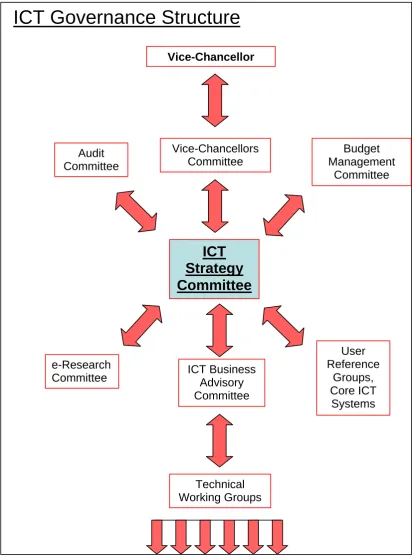
Peterson defines IT Governance architecture as “the manner in which responsibilities and accountabilities for the IT portfolio are organised and integrated” (2003, p. 61). As shown in figure 1, the ICT Strategy Committee is at the heart of USQ’s ICT governance architecture, performing the role of steering committee. Previous research by Karimi et al. (2000) indicates that IT management capability is enhanced by steering committees. They found that as well as giving visibility of IT initiatives, steering committees provide strategic direction, leadership and control of IT operations and management, resolve resource allocation decisions, and ensure top management support for IT activities.
USQ’s ICT Strategy Committee is responsible for providing the strategic direction of information and communication technology (ICT) within the University, and ensuring the alignment of ICT and the University Strategic Plan. This committee coordinated and monitored the implementation of the recommendations of the ICT Review process, ensures the establishment of good ICT strategic planning processes to secure alignment with the University’s strategic directions. It regularly monitors the alignment of the ICT Strategic Plan with the University Strategic Plan and provides advice, on an annual basis, to the Vice-Chancellor on the funding for core ICT services to be allocated ‘off the top’ of the University budget. The ICT Strategy Committee is chaired by the Vice-Chancellor, effectively the CEO of the organisation. Raghunathan (1992) found that the CEO participation on the IT steering committee improves alignment with organisational plans, the perceived importance of IT, and its effectiveness. Other members of the ICT Strategy Committee include the most senior ranking executives of the University: Chief Information Officer (CIO), Deputy Vice-Chancellor (Scholarship), Pro-Vice-Chancellor (Learning and Teaching), Pro-Vice-Chancellor (Planning and Quality), Pro-Vice-Chancellor (Research), General Manager University Services, Group Manager Finance and Facilities, Chief Technology Officer (CTO), a nominee from industry with ICT expertise.
ICT
Strategy
Committee
ICT Governance Structure
Vice-Chancellors Committee
User Reference
Groups, Core ICT
Systems Budget Management
Committee
Technical Working Groups e-Research
Committee Audit Committee
ICT Business Advisory Committee
[image:4.595.113.528.69.628.2]Vice-Chancellor
Figure 1: ICT Governance Structure
A commitment was made by the University that there would be no direct job losses or redundancies resulting from the change process. The timetable for change had to be appropriately paced; requiring sustained effort over a three-to-five-year period to be fully realised.
Key recommendations of the review included the creation of a common reporting structure for all core ICT staff through the establishment of a Division of ICT Services and the implementation of a formal ICT governance framework based around Control objectives for information and related Technology (CobiT) and the Information Technology Infrastructure Library (ITIL). A formal change management process based on the principles of inclusion, consultation and openness commenced in August 2005.
The USQ ICT Strategic Plan 2005 -2009 set the following key goals for ICT systems and services aligned to the USQ Strategic direction statement:
Goal 1: To ensure ICT systems and services align with the University’s strategic and operational directions.
Goal 2: To integrate ICT, in a strategically planned, systematically integrated and institutionally comprehensive manner, into all aspects of the learning and teaching environment.
Goal 3: To support research activity via the use of ICT.
Goal 4: To improve access to information via flexible, personalised and user-friendly ICT systems for staff, students and the wider community.
Goal 5: To maintain and develop infrastructure and connectivity across all campuses and centres to ensure constant, robust and efficient access to ICT systems and services for all students and staff, irrespective of their location.
Goal 6: To enhance the University’s role in the economic, social and cultural development of its communities and regions through ICT-based activities. Goal 7: To assist the University to ensure that corporate knowledge is managed
effectively, via the development and implementation of ICT-enabled systems which assist in the collection, maintenance and sharing of the organisation’s intellectual capital.
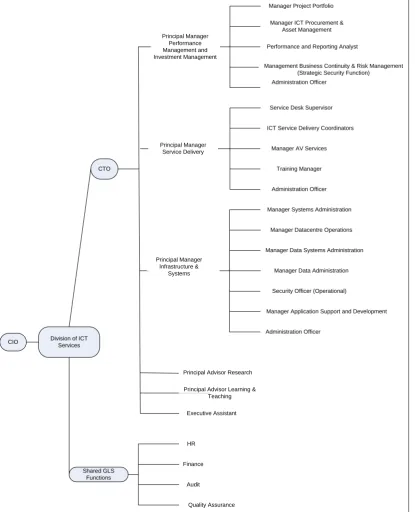
A consultation document outlining a proposed structure for the Division of ICT Services was released to the University community in November 2005. The structure proposed the functional alignment of ICT disciplines to achieve client focused service delivery. This included establishment of virtual support teams and their alignment with ICT products and services, levels of cross unit accountability and delegation (matrix management), establishment of service level agreements and the formalisation of existing project team environments within a formal project management framework. The proposed structure (figure 2) was subsequently endorsed by the ICT Strategy Committee and the Vice-Chancellors Committee in December 2005.
The CTO reports to the Chief Information Officer whose role has been integrated with the DVC Global Learning Services role to converge and encapsulate the information focus relating to the provision of ICT Infrastructure and support, Library and the Distance Education Centre (DeC). In mid 2006 the Library and DeC were merged into a single business unit called the Division of Academic Information Services.
Management Business Continuity & Risk Management (Strategic Security Function)
Division of ICT Services CIO
Shared GLS Functions
Principal Manager Performance Management and Investment Management
Manager ICT Procurement & Asset Management
Performance and Reporting Analyst
Administration Officer
Principal Advisor Research
Principal Advisor Learning & Teaching
Manager Systems Administration
HR
Quality Assurance Audit
Finance Executive Assistant
Administration Officer Principal Manager
Infrastructure & Systems
Service Desk Supervisor
ICT Service Delivery Coordinators
Manager AV Services
Training Manager
Administration Officer Principal Manager
Service Delivery
Manager Datacentre Operations
Manager Data Systems Administration
Manager Data Administration
Security Officer (Operational)
Manager Application Support and Development CTO
[image:6.595.115.531.161.674.2]Manager Project Portfolio
Figure 2: Management Positions Division of ICT Services Organisational Structure
3. ACTIONS TAKEN
To implement the ICT charter, USQ adopted a federal ICT management model bringing about significant cultural and organisational change. Barriers and technology silos have been broken down; ICT service delivery harmonised; the ICT service and support paradigm has been changed to one recognising the value and personal contributions of staff; service management is proactive, not reactive, self assessing and constantly seeking opportunities for improvement; effective communication has been achieved, strengthening and maintaining partnerships. The end result is that client focus is the mantra and service delivery is aligned with business. This section details the actions taken to implement the new federal structure and the new measurement and management processes used.
3.1 Implementation of New Structure
An ICT Communications Advisory Group was established to enable effective communication of information about the change process to staff. The group included representation from faculties and organisational units identified in the ICT Review, along with union representatives. Separate meetings were held with union representatives and on-campus delegates from the NTEU, ASU, CPSU; with the Chief Technology Officer (CTO), Change Manager and Human Resources actively involved in ensuring all parties remained informed throughout the change process.
A series of four planning workshops were held to involve staff in the planning process. The workshops, attended by 116 staff, included the identification of values and attributes for the new Division, and the establishment of an outline of the functional service and system alignment required. A further two planning sessions were held with a smaller group of staff to progress development of the organisational structure for the Division.
A single University-wide Service Desk was established in May 2006 for ICT support adopting a highly visible ‘Information Commons’ approach. The Service Desk provides the first line of staff and student help desk support (face-to-face, telephone, email and web) for ICT related problems or queries. A number of staff from within the Division of ICT Services are now located in faculties and operational units across the Toowoomba, Wide Bay and Springfield campuses with ‘dotted line’ reporting to respective faculty and organisational unit managers to ensure user expectation is managed and service levels are met. An innovative approach sees third year undergraduate ICT students employed as ‘ICT Support Daemons’ to assist ICT Support Officers in ensuring the operational capability of computing laboratories and student access computers is maintained.
To ensure stakeholder involvement from the academic community, the new Divisional structure includes two Principal Advisor positions reporting to the Chief Technology Officer. These are academic positions that are fractional and funded from within the ICT Divisional budget. One position focuses on research computing while the other will focus on the learning and teaching environment. These positions are filled on a fixed-term basis via secondments from within the University. Principal Advisors participate in Divisional planning exercises and assist the Chief Technology Officer to develop strategies for the effective deployment of ICT within the research, and learning and teaching environments at USQ.
3.2 Measurement
A capability maturity model assessment using the CobiT methodology was carried out in late 2005 and resulted in USQ assessing itself at level 1 or 2 in most criteria. Estimates were made using a “lowest common denominator” or “weakest link” approach. Various control objectives are almost at the next level and in many cases it will not require a great deal of effort to improve the maturity by one or two levels, hence equalling or bettering the international benchmark averages.
The Performance Reporting and Investment Management Unit is now providing a strategic planning, performance analysis and monitoring, risk management, audit compliance and reporting function, along with ensuring the return on investment of ICT is maximised through effective procurement processes and lifecycle management. A dedicated Performance and Reporting Analyst position has been created within the unit to effectively analyse, monitor and report against all aspects of operational performance of the Division. This includes operational and financial performance, compliance with service level agreements and establishing activity-based cost models and total cost of ownership for ICT functions, services and infrastructure. A project-based research function is also proposed within this area and this is expected to be filled by a postgraduate student or an academic.
The USQ staff performance planning and review system (BUILD) was implemented within the Division of ICT Services and commenced in March 2006 in concert with the appointment of staff to key management positions.
Three surveys were conducted during October and November 2005. A student ICT satisfaction online survey was conducted to give students an opportunity to rate their satisfaction with ICT services and provide an overall picture of ICT service provision and performance. This first survey will be used as a benchmark for future surveys to allow a process of continuous improvement in ICT at the university. In total, 953 responses were received, representing eight percent of the student population of 12,000 EFTSU. A staff ICT Satisfaction Survey was also carried out during this period. 371 usable responses were received, representing 26.5 percent of staff FTE population of 1400. A self assessment Skills Review Survey was conducted with 135 surveys submitted by staff identified in the Review as having ICT responsibilities. This information was used to inform the change process and to identify professional development requirements.
In addition to the two academic advisor positions established within the Division of ICT Services a student reference group is being established that will provide advice to the Chief Technology Officer. A focus group will be formed during 2006 and comprise undergraduate and postgraduate students with representation from on campus and off campus students (national and international) providing student input into ICT planning and a direct feedback mechanism for user satisfaction. In 2007 the focus group will transition into a formal reference group under the auspice of the Dean of Students.
3.3 Management Structure
necessitated transitional arrangements including adopting a phased approach to the integration of ICT support staff located in faculties, sections and in project roles.
Direct reporting relationships have been established for each position with the aim of a maximum of six direct operational ICT reporting relationships to each line management position (excluding secretarial and administrative roles). Where there are a large number of operational support staff within a functional business unit, teams have been established with Team Leaders or Senior Support positions.
The virtual team approach adopted within the proposed structure offers the capability to develop a number of common position descriptions for roles including Analyst Programmer and ICT Support Officer. This enables horizontal position portability across the structure and reduces the management workload associated with maintaining a large volume of individual position descriptions.
The ICT support function replaced the former desktop support model within ITS which segmented staff and student support environments. ICT Support Officers now provide a single resource pool of ICT staff to support the computing environment for staff and students. ICT support staff located within faculties and operational units can be backfilled and further supported when required from the central resource pool. ICT Support Officers are progressively rotated to ensure knowledge transfer of local environments. Responsibility for maintaining agreed service levels and coordination of service delivery is managed by dedicated ICT Service Delivery Coordinators.
The former Technical Services team in the Distance and e-Learning Centre was an integral component to delivery of audio visual support services to lecture theatres, training and meeting rooms across USQ campuses. ICT support staff within ITS and at remote campuses carried out various aspects of these services and also supported the computing, networking and video conferencing capabilities within each environment. The new structure merged the Technical Services team into the Division of ICT Services, integrating and aligning service delivery functions within the Client Services Unit.
The Application Support and Development Unit operates as a virtual team of ICT support resources located across the Toowoomba, Springfield and Wide Bay campuses, supporting core ICT applications across the University enterprise environment and participating in application development activities as members of formal project teams.
4. OUTCOMES AND RESULTS
As at the 2nd October 2006, all management positions within the Division had been filled and the majority of staff had moved into their new roles. Service Level Agreements (SLAs) have been signed with the Faculties of Arts, Sciences, Engineering and Surveying, and the Division of Information and Academic Services.
Substantial progress has been achieved in a relatively short time frame:
¾ An Executive Management Team comprising the Principal Managers and Chief Technology Officer has been established and meets on a weekly basis. An ICT Management Team comprising line managers meets on a monthly basis and has participated in a weekend management teambuilding retreat.
¾ The positions of Principal Advisor Learning and Teaching and Principal Advisor Research Computing have been filled.
¾ The Service Desk has been co-located into a “One Stop Shop” with the Distance Education Centre, Switchboard and Customer Relationship Management Centre. ¾ Client Service training has been carried out for staff within the Service Desk and an
¾ An internal marketing campaign has been initiated to raise the profile of the Division of ICT Services and initiatives such as the inaugural Indigenous Intensive ICT workshop successfully facilitated.
¾ A formal ICT project management methodology has been developed and implemented, with the University using this as the basis for a whole of University project management methodology.
¾ ITIL Foundations training was completed by 97 ICT staff from across the
University. 17 Senior Managers of the University attended a half day overview of the ITIL framework. An additional 29 staff who had ICT related jobs attended a one day overview of ITIL.
¾ The ICT Procurement and Asset management unit is in place and operational, assisting with the development and implementation of a new procurement model for USQ.
¾ The ICT Governance framework has progressed to the point where User Reference Groups for core ICT systems are operational. Relationship Managers are being identified within the Division to function as the key liaison between faculties and departments as part of the implementation of SLAs.
¾ As shown in figure 1, the ICT Business Advisory Committee has been established with technical working groups progressing; a University Email solution, printing strategy, Standard Operating Environment (SOE) for hardware and software, Video Conferencing and Internet Collaboration. Technology roadmaps are being developed for core ICT systems and services.
¾ The USQ ICT Strategic Plan has been updated for 2007 to 2011 and funding models implemented for infrastructure refresh programs and to meet recurrent expenditure associated with the non-salary component of core ICT systems.
5. FUTURE DIRECTIONS
New Service Desk options are being investigated that are aligned to the aims and objectives of the new Division of ICT Services, and will enable ICT to address the ITIL components of Incident Management, Integrated Service Level Management, Asset and Configuration Management, Change Management, and Problem Management. A Products and Services Catalogue is in the process of being finalised. The Products and Services Catalogue is the starting point for configuration management and the further development of Service Level Agreements between the Division and its clients. Service Level Agreements are being progressively developed with generic SLA templates for products and services, faculties and departments, campuses (Wide Bay or Springfield), global services (voice and data networks, email etc.) and external clients.
In faculties and divisions where there is no existing ICT presence, a ‘Hot Desk’ model is being negotiated. Desk space (full or part-time) is being established in client areas, with ICT support staff operating from the shared ‘Hot Desk’ when working in the local environment to ensure regular presence and visibility. A number of student cadet positions are identified within the structure with one of these reserved for an indigenous student. It is proposed to commence the cadetship program in 2007 and to investigate creative funding models in partnership with the community and industry. Satisfaction surveys of staff and students will again be undertaken at the end of 2006 to identify areas that have improved and to again prioritise efforts for improvement.
single University training calendar, consistent course registration, certification and recording of completed training.
An assessment of the operational effectiveness of the structure will be carried out after twelve months to validate the alignment of functional units and operational effectiveness. Where inefficiencies or opportunities for improvement are identified a realignment of service delivery functions will occur. A second assessment and realignment will occur at twenty-four months. A formal review of the structure will be carried out after three years to assess the operational effectiveness and functional efficiency of the model and to ensure that service delivery remains aligned with University’s direction, and faculty and operational unit requirements. The CobiT maturity assessment will be re-run in early 2007 against CobiT version 3, prior to moving to CobiT version 4 and implementing ValIT for value
management.
6. CONCLUSIONS
In summary, an extensive review of ICT at USQ identified significant areas for improvement across the whole range of ICT functions and personnel. Radical changes were required and have now been implemented. However, the transformation to a federal model of management of ICT has not been without some difficulties. Nevertheless, critical factors that contributed to progress with the implementation were commitment from the senior executive, organisational change management involving HR and unions, extensive communication about changes with ICT staff in USQ, governance guidance from CobiT and ITIL, and in particular, strong leadership from the CTO. Evaluation of satisfaction with the change is now due but anecdotal evidence would suggest the perception will be positive both from within the ICT Division as well as the staff and students served.
7. REFERENCES
Avison, D. E., Gregor, S., & Wilson, D. (2006). Managerial IT unconsciousness.
Communications of the ACM, 49(7), 89-93.
Csaszar, F., & Clemons, E. (2006). Governance of the IT Function: Valuing Agility and Quality of Training, Cooperation and Communications. Paper presented at the 39th Hawaii International Conference on System Sciences, Hawaii.
De Haes, S., & Van Grembergen, W. (2005). IT Governance Structures, Processes and Relational Mechanisms: Achieving IT/Business Alignment in a Major Belgian Financial Group. Paper presented at the 38th Hawaii International Conference on System Sciences, Hawaii.
Holloway, D. A. (2004). Corporate Governance Disasters and Developments: Implications for University Governing Bodies. Australian University Review, 46(2), 23-30. Karimi, J., Bhattacherjee, A., Gupta, Y. P., & Somers, T. M. (2000). The effect of MIS
steering committees. Journal of Management Information Systems, 17(2), 207-239. Luftman. (2004). Managing the Information Technology Resource: Leadership in the
Information Age. Upper Saddle River: Pearson Prentice Hall.
Peterson, R. (2003). Integration strategies and tactics for information technology
governance. In Strategies for Information Technology Governance (pp. 37-80): Idea Group Publishing.
Raghunathan, T. S. (1992). Impact of CEO's participation on IS steering committees. Journal of Management Information Systems, 8(4), 83-96.
Sallé, M. (2004). IT Service Management and IT Governance: review, comparative analysis and their impact on utility computing: Hewlett-Packard Company.
Sledgianowski, D., Luftman, J. N., & Reilly, R. R. (2006). Development and validation of an instrument to measure maturity of IT business strategic alignment mechanisms.