Copyright © 2002, American Society for Microbiology. All Rights Reserved.
Requirement of Multiple
cis
-Acting Elements in the Human
Cytomegalovirus Major Immediate-Early Distal Enhancer
for Viral Gene Expression and Replication
Jeffery L. Meier,
1,2* Michael J. Keller,
1and James J. McCoy
1Department of Internal Medicine and the Helen C. Levitt Center for Viral Pathogenesis and Disease,
University of Iowa College of Medicine, Iowa City, Iowa, 52242,1and Department of
Veterans Affairs Medical Center, Iowa City, Iowa 522462
Received 10 July 2001/Accepted 25 September 2001
We have shown previously that the human cytomegalovirus (HCMV) major immediate-early (MIE) distal enhancer is needed for MIE promoter-dependent transcription and viral replication at low multiplicities of infection (MOI). To understand how this region works, we constructed and analyzed a series of HCMVs with various distal enhancer mutations. We show that the distal enhancer is composed of at least two parts that function independently to coordinately activate MIE promoter-dependent transcription and viral replication. One such part is contained in a 47-bp segment that has consensus binding sites for CREB/ATF, SP1, and YY1. At low MOI, these working parts likely function incisto directly activate MIE gene expression, thus allowing viral replication to ensue. Three findings support the view that these working parts are likely cis-acting elements. (i) Deletion of either part of a bisegmented distal enhancer only slightly alters MIE gene transcrip-tion and viral replicatranscrip-tion. (ii) Reversing the distal enhancer’s orientatranscrip-tion largely preserves MIE gene tran-scription and viral replication. (iii) Placement of stop codons atⴚ300 orⴚ345 in all reading frames does not impair MIE gene transcription and viral replication. Lastly, we show that these working parts are dispensable at high MOI, partly because of compensatory stimulation of MIE promoter activity and viral replication that is induced by a virion-associated component(s) present at a high viral particle/cell ratio. We conclude that the distal enhancer is a complex multicomponentcis-acting region that is required to augment both MIE promoter-dependent transcription and HCMV replication.
The human cytomegalovirus (HCMV) major immediate-early (MIE) gene products, IE1 p72 and IE2 p86, are required for initiating viral replication (10, 16, 21, 30). Their transcrip-tion is controlled by the MIE regulatory region, which is com-posed of a promoter, enhancer, unique region, and modulator (reviewed in references 25 and 29). The 485-bp enhancer seg-ment spans base positions⫺65 to⫺550 with respect to the⫹1 start site of MIE RNAs (25). The enhancer is recognized for its vigor in reliably activating transcription from MIE promoter constructs when put into widely diverse in vitro, transfection, and transgenic animal systems (25). However, enhancer strength depends on cell type, degree of cellular differentia-tion, and activity of certain signal transduction pathways (25, 28). This variable functioning is a result of changes in the amounts or activities of assorted cellular and viral proteins that act on the enhancer. Examples of several distinct sets of cel-lular transcription factors that bind to and stimulate the en-hancer include NF-B/rel, CREB/ATF, AP-1, SP-1, serum re-sponse factor, ELK-1, and liganded retinoic acid receptor (7, 25, 28). Some of these (NF-B/rel, CREB/ATF, SP-1, and retinoic acid receptor) bind to multiple cognate sites, suggest-ing that they may interact cooperatively to influence enhancer function. Viral proteins pp71 and IE1 p72 can also act through
cis-acting sites to augment enhancer activity (8, 18, 19, 39).
While our understanding of the functional interplay between these transcription factors is quite limited, such interplay is likely complex and a distinguishing feature of this enhancer.
Only recently has the functional role of the MIE enhancer been examined in the natural setting of infection. For murine CMV (MCMV), deletion of the enhancer greatly impairs viral replication in culture but is rescued by expression of the MCMV MIE gene products from a separate vector (2). Re-placement of MCMV’s enhancer with the paralogous HCMV enhancer does not appreciably alter viral replication in mouse livers and cultured fibroblasts (2, 12), although the enhancer change coincides with a decreased likelihood of infection at extrahepatic sites in mice (12). Rat CMV is less able to repli-cate in cultured rat fibroblasts and to establish infection of salivary tissue when its MIE enhancer is replaced with the paralogous murine enhancer (35). By analogy, the MIE en-hancer of HCMV has likely evolved to ensure optimal MIE gene expression and viral replication in humans. The func-tional importance of HCMV’s enhancer in human cells is fur-ther supported by the findings of two recent studies. The first study showed that in HCMV-infected human embryonal NTera2 cells, enhancer silencing is linked to a block in both MIE gene transcription and viral replication, whereas reacti-vation of the enhancer by trichostatin A reverses the block (22). In the second study, the selective removal of the distal segment of the enhancer (⫺300 to⫺580) was found to greatly decrease both MIE gene transcription and viral replication in human fibroblasts at low multiplicities of infection (MOI) but not at high MOI (23). This finding was a surprise, given that
* Corresponding author. Mailing address: Department of Internal Medicine, University of Iowa College of Medicine, 3–750 Bowen Sci-ence Building, 51 Newton Rd., Iowa City, IA 52242. Phone: (319) 356-7055. Fax: (319) 335-9006. E-mail: [email protected].
313
on November 8, 2019 by guest
http://jvi.asm.org/
transient transfection analyses of comparable enhancer seg-ments in reporter plasmids revealed that such a mutation does not cause an appreciable decrease in MIE promoter activity in various differentiated cell types (17, 42). The reason for these contrasting findings is unknown, but the results underscore the importance of examining regulatory elements in the context of the viral genome.
The mechanism by which the 280-bp distal enhancer aug-ments MIE transcription and viral replication at low MOI is open to question. One possibility is that removal of one or more specificcis-acting sites in the distal enhancer (e.g., serum response factor, ELK-1, NF-B/rel, CREB/ATF, SP-1, YY-1, and/or retinoic acid receptor binding sites) directly impairs transcriptional activation of the MIE genes and, consequently, viral replication. Another possibility is that the distal enhancer deletion unexpectedly disrupts regulatory elements or coding regions of overlapping or neighboring genes that indirectly affect MIE gene expression or viral replication. The latter consideration is also plausible given that viral RNAs of low abundance cross the distal enhancer during lytic infection and a distal enhancer deletion lessens transcription of the distantly located viral immediate-early (IE) kinetic-class US3 gene (23). Thus, the distal enhancer could conceivably operate in acis- or
trans-acting manner.
In this report, we describe the initial characterization of the mechanisms underlying MIE distal enhancer function and elu-cidate the compensatory role of supernumerary viral particles in rendering the distal enhancer dispensable.
MATERIALS AND METHODS
Cells, viruses, and infections.Primary human foreskin fibroblast (HFF) cells were isolated and grown as described previously (24). Hypoxanthine-guanine phosporibosyltransferase (HGPRT)-deficient fibroblasts (GM02291) were ob-tained from Coriell Institute for Medical Research (Coriell Cell Repositories, Camden, N.J.) and grown in Eagle’s minimal essential medium supplemented with 5% newborn bovine serum and 5% fetal bovine serum. HCMVs (Towne strain) were propagated, harvested, and titered as described previously (23, 24). Titers of HCMVs with distal enhancer mutations cannot be accurately deter-mined by plaque assay. Therefore, titers of these viruses were normalized to known titers of replication-competent viruses on the basis of cytopathic effect (CPE) in HFF cells at 24 h postinfection (p.i.) and amount of viral DNA in HFF cells prior to viral replication (4 to 5 h p.i.) (23). For comparative studies, the viruses were propagated, harvested, and titered in parallel. Viral stocks with titers differing less than threefold were studied after adjustment by dilution with growth medium.
For inactivation of HCMV by UV light, extracellular HCMV particles were first isolated according to the method of Stinski (40, 41). Briefly, the growth medium overlying infected HFF cells at 100% CPE was centrifuged at 7,000⫻ gfor 10 min, the resultant supernatant was centrifuged through a 20%D-sorbital
cushion (17,500⫻g) in 1⫻phosphate-buffered saline, and the viral pellet was resuspended in 4 ml of Eagle’s minimal essential medium. Two milliliters of viral suspension (⬃108PFU/ml) was placed in a lidless 30-mm2cell culture dish and irradiated with UV light at a wavelength of 260 nm (13) for 60 to 70 min by use of a Mineralight Lamp model UVSL-25 (UVP, Inc., San Gabriel, Calif.) mounted 4.5 cm above the bottom of the culture dish. The minimum duration of UV irradiation needed to completely inactivate HCMV replication was deter-mined by standard viral plaque assay and by monitoring for green fluorescent protein (GFP) expression from recombinant r⌬-582/-1108Egfp or r⌬ -300/-1108Egfp(22) as a marker of viral lytic life cycle activity.
Plasmids.Plasmids p1.6 and pIE1 have been reported previously (23). p⌬ -300/-579, p⌬-521/-579, and p⌬-347/-579 were derived from pIE1 by multistep cloning. Briefly, a synthetic duplex oligonucleotide (5⬘-CTAGCCCGGGCCTA GG-3⬘) was inserted into theSpeI site of the HCMV MIE regulatory region contained in an intermediate shuttle vector to yield plasmid pLC12. This oligo-nucleotide insertion containsAvrII andSmaI sites. To construct p⌬-300/-579, p⌬-521/-579, and p⌬-347/-579, respectively, theBstN1 (blunted with Klenow
fragment)-to-SmaI,BstUI-to-SmaI, andNdeI (blunted with Klenow fragment)-to-SmaI fragments of pLC12 were deleted. From each of the three resultant constructs, theEagI-to-BsrGI fragment was isolated and subcloned into corre-sponding sites in pIE1 to yield p⌬-300/-579, p⌬-521/-579, and p⌬-347/-579. All of these constructs contain anAvrII site at the site of the deletion. p⌬-300/-347 was derived from p⌬-300/-579 by deletion of theSmaI-to-NdeI fragment and inser-tion of a duplex oligonucleotide (5⬘-GGGCCTAGACCTAGCTACA-3⬘) con-taining anNheI site. pIE1.AvrII contains an AvrII site at⫺300 of pIE1. This was constructed by subcloning a PCR-generated fragment spanning nucleotides
⫺300 to⫺640 of the MIE regulatory region into theAvrII (⫺300)-to-BsrGI (⫺640) sites of p⌬-300/-579, while maintaining anAvrII site at⫺300. A duplex oligonucleotide (5⬘-CTAGGTAGCTAGCTAGCTAC-3⬘) containing stop co-dons in all open reading frames (ORFs) was inserted into theAvrII site of pIE1.AvrII to yield pIE1.AvrII.stop. p-579/-300 was constructed by subcloning theAvrII-to-SpeI fragment of pIE1.AvrII into theAvrII site of p⌬-300/-579. All plasmids were sequenced to confirm the presence of the desired mutations.
HCMV recombination.Recombinant HCMVs r⌬-300/-579, r⌬-521/-579, r⌬ -347/-579, r⌬-300/-347, r-579/-300, r-300.A, and r-300.AS were derived from r⌬MSVgptby homologous recombination with p⌬-300/-579, p⌬-521/-579, p⌬ -347/-579, p⌬-300/-343, p-580/-300, pIE1.AvrII, and pIE1.AvrII.stop, respectively (23). The method of cotransfection of plasmid (5g) and r⌬MSVgpt(20 to 50
g) DNAs has been detailed previously (23, 24). Recombinant viruses were selected in HGPRT-deficient fibroblasts (MOI, 0.3 to 0.5) exposed to 6-thiogua-nine (50 g/ml) as described previously (23). All recombinant viruses were subjected to at least two rounds of plaque isolation. Genomes of plaque-purified viruses were analyzed by restriction endonuclease and Southern blot analyses. Two recombinant virus clones were obtained from independent transfection-recombination procedures to control for spurious genomic mutations.
DNA analysis.HCMV genomic DNA was isolated as described previously (24). Viral genomes were digested with each of theEcoRI,PstI, andBamHI enzymes and fractionated on a 0.7% agarose gel. Ethidium bromide-stained restriction enzyme fragment profiles were analyzed prior to Southern blot anal-ysis and autoradiography, as described previously (24). Probes were generated by either multiprime32P labeling of indicated double-stranded DNA fragments or 32P end labeling of indicated oligonucleotides. Blots were stripped of probes by boiling in 0.2% sodium dodecyl sulfate prior to reuse.
HCMV DNA replication was analyzed by using the methods described previ-ously (23, 24). Briefly, after virus absorption for 1.5 h, cells were exposed for 1 min to citrate buffer (50 mM sodium citrate and 4 mM KCl [pH 3]) to inactivate extracellular virus and were then washed three times with Hanks’ balanced salt solution without calcium and magnesium. Infected cell DNA was isolated, di-gested withHindIII, fractionated electrophoretically on a 0.5% agarose gel, and subjected to Southern blot analysis. Lambda DNA (2g) was added to each cell lysate sample to control for variation in processing, endonuclease digestion, and loading. Southern hybridization was carried out with a probe that is complemen-tary to HCMV genomic termini containing TRLor IRL. This probe, termed T probe, was generated by multiprime32P labeling of the 1.6-kbpBamHI-HindIII fragment of plasmid p1.6 (23). Hybridization signals were quantitated by image acquisition analysis (Hewlett-Packard Instant Imager).
Multiplex RT-PCR.Whole-cell RNA was isolated according to the method of Chomczynski and Sacchi (9). SUPERSCRIPT II RNase H-negative reverse transcriptase (RT) (Life Technologies, Gaithersburg, Md.) was used according to the manufacturer’s directions to generate cDNA from 4g of RNA and 250 ng of random hexamers (Invitrogen, Carlsbad, Calif.) in a final volume of 20l. Thereafter, samples were heat inactivated at 70°C for 15 min and then diluted 1:5 with H2O. Multiplex real-time PCR was performed using the ABI PRISM 7700 Sequence Detection System (Perkin-Elmer [PE] Applied Biosystems, Foster City, Calif.) according to the manufacturer’s directions for simultaneous detec-tion of probes containing 6-carboxyfluorescein (FAM) and VIC reporter fluoro-phores. Amplifications were performed in a final volume of 25l of the PLAT-INUM Quantitative PCR SUPERMIX-UDG cocktail (Life Technologies) prepared according to the manufacturer’s directions. Each reaction mixture contained 2l of the test sample, 5 mM MgCl, 500 nM each MIE primer, 250 nM MIE probe, 12.5 nM each 18S primer, and 50 nM 18S probe. MIE primer sequences 5⬘-GCATTGGAACGCGGATTC-3⬘and 5⬘-CAGGATTATCAGGG TCCATCTTTC-3⬘(Life Technologies) are located in MIE exons 1 (forward) and 2 (reverse), respectively, which are separated by the 827-bp intron A. The MIE reporter probe, 5⬘-FAM-AGTGACTCACCGTCCTTGACACGATGG-tet ramethyl rhodamine (TAMRA)-3⬘(IDT, Coralville, Iowa), straddles the junc-tion of MIE exons 1 and 2. Cellular 18S rRNA served as the endogenous control. The primers used to amplify the intronless ribosomal 18S cDNA and the VIC-labeled probe used for detecting this amplicon were obtained from PE Applied Biosystems. Thermal cycling conditions were an initial 50°C for 2 min and 95°C
on November 8, 2019 by guest
http://jvi.asm.org/
for 2 min, followed by 40 cycles of 95°C for 15 s and 60°C for 1 min. Primer and template concentrations were chosen based on results of relative standard curves and validation experiments, as detailed by PE Applied Biosystems. Each exper-iment was performed in parallel with a relative standard curve and validation experiment, corroborating the use of the comparative threshold cycle (CT) method for relative quantitation of MIE RNA. AverageCTvalues were simul-taneously determined for MIE and 18S RNAs, and the difference between them is⌬CT. Standard deviations of the MIE and 18SCTvalues (SDMIEand SD18S, respectively) were also determined. The relative difference among samples,
⌬⌬CT, is⌬CT⫺ ⌬CT,x, where the⌬CT,xvalue is that of the comparator (x). The standard deviation of the⌬⌬CTvalue (SD) is equal to (SDMIE2⫹SD18S2)1/2. The average quantity of MIE RNA normalized to 18S RNA and relative to comparator RNA is equal to 2⫺⌬⌬CT, and the SD determines the values of the error bars (2⫺⌬⌬CT⫹SDand 2⫺⌬⌬CT⫺SD).C
Tvalues of samples not treated with RT, but analyzed in parallel to the RT-treated samples, did not appreciably differ from the baseline.
RESULTS
The distal enhancer is composed of at least two functional parts that independently activate HCMV replication. Our prior findings using a replacement mutagenesis strategy re-vealed that the distal enhancer segment from⫺300 to⫺582 possessed activity for augmenting MIE gene transcription and viral replication at low MOI. To determine whether the distal enhancer is composed of a single or multiple functional units, we subjected this region to sequential deletion analysis. Site-directed deletions were introduced into the HCMV genome by homologous recombination in fibroblasts, as described in Ma-terials and Methods. We began by creating deletions of in-creasing size at the 5⬘end of the distal enhancer. As depicted in Fig. 1A, the deletions are located at positions⫺521 to⫺579, ⫺347 to ⫺579, and ⫺300 to ⫺579 in recombinant viruses r⌬-521/-579, r⌬-347/-579, and r⌬-300/-579, respectively. These recombinant HCMVs differ from wild-type HCMV (WT) only by their respective deletions. Two distinct isolates of each recombinant type derived from independent recombination procedures were studied to control for spurious mutations. All of the recombinant viral genomes were analyzed in comparison to WT for restriction fragment length polymorphism (RFLP) by using three separate endonucleases (see Materials and Methods). Findings of Southern blot analyses ofPstI RFLPs are shown in Fig. 1B for a representative set of viruses.
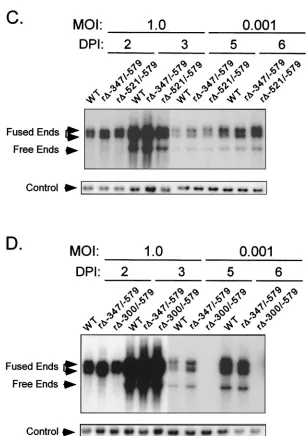
The recombinant viruses were first examined for their abil-ities to replicate in HFF cells at high and low MOI (1.0 and 0.001, respectively). Two independent methods were used to normalize input viral titers (see Materials and Methods). DNA from infected cells was isolated at the indicated times p.i. and subjected toHindIII digestion and Southern blot analysis. As shown in Fig. 1C, all of the recombinant viruses replicate DNA at high MOI at rates comparable to that of WT. However, only r⌬-300/-579 is substantially impaired in its ability to replicate viral DNA at low MOI compared to r⌬-521/-579, r⌬-347/-579, or WT (Fig. 1D).
Based on these findings, we determined whether the remain-ing short segment from⫺300 to⫺347 of the distal enhancer had the functional activity needed for normal replication at low MOI. Therefore, recombinant r⌬-300/-347, lacking the⫺300 to⫺347 segment but with a genome otherwise matching that of WT, was made (Fig. 2A). This virus’s genome structure was verified by RFLP and Southern blot analyses (Fig. 2B). The replication rates of r⌬-300/-347 at high and low MOI (1.0 and 0.005, respectively) were compared to those of WT, r⌬
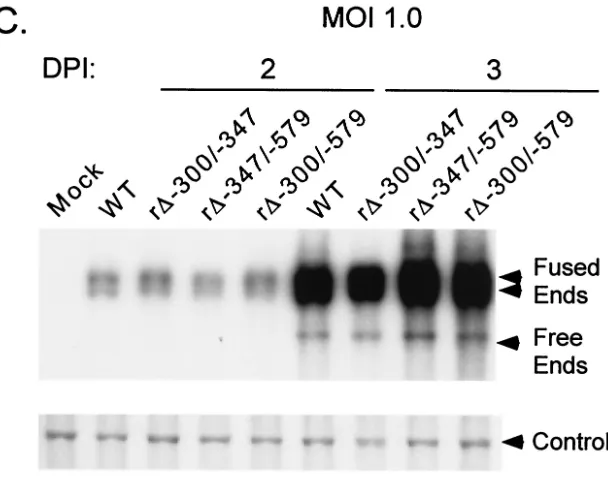
-347/-579, and r⌬-300/-579 by using the same viral DNA replication assay described for Fig. 1. As expected, the viruses exhibited similar rates of viral DNA replication at high MOI (Fig. 2C). Remarkably, only r⌬-300/-579’s DNA replication rate was sub-stantially impaired at the low MOI (five- to sixfold difference) in comparison to those of the other viruses (Fig. 2D). Thus, neither deletion of the⫺300 to⫺347 segment nor deletion of the⫺347 to⫺579 segment greatly lowers the replication rate of HCMV at low MOI. This finding indicates that the distal enhancer (⫺300 to⫺579) is made of at least two working parts that need not all be present to sufficiently stimulate HCMV replication at low MOI.
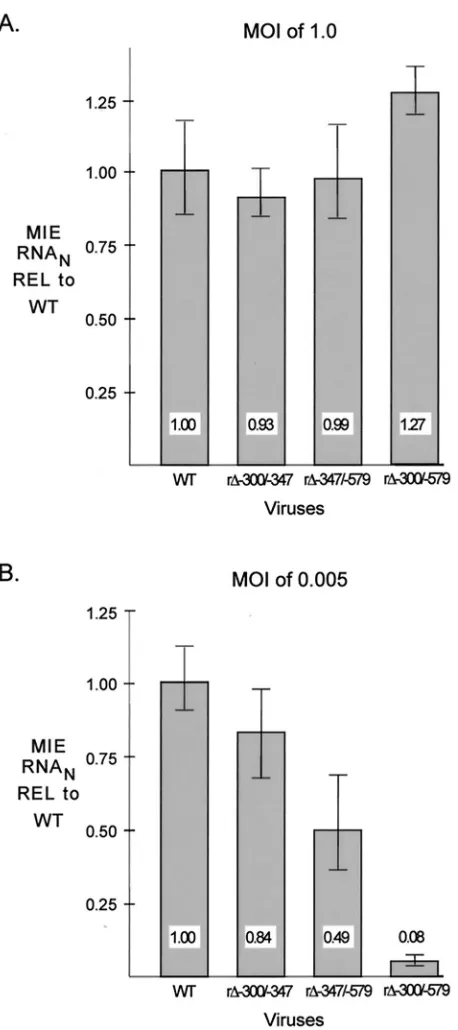
The same working parts may be involved in activating MIE promoter-dependent transcription. We determined whether the distal enhancer parts involved in stimulating HCMV rep-lication are linked to transcriptional activation of the MIE promoter. Amounts of viral MIE RNAs produced by WT, r⌬-300/-347, r⌬-347/-579, and r⌬-300/-579 in HFF cells were determined at 6 h p.i. for both MOI of 1.0 and 0.005, using a multiplex real-time RT-PCR assay. Concomitant measurement of cellular 18S rRNA controlled for sample-to-sample varia-tion. Input viral titers were normalized by methods described in Materials and Methods. The findings depicted in Fig. 3A reveal that WT, r⌬-300/-347, r⌬-347/-579, and r⌬-300/-579 make similar amounts of MIE RNAs at a high MOI; the mean amounts vary less than 28%. In contrast, r⌬-300/-579 produces 12.5-fold less MIE RNA at a low MOI than WT, whereas r⌬-300/-347 and r⌬-347/-579 yield only slightly less MIE RNA than WT (⬍2.1-fold difference). The results of this analytical method were verified by additional findings indicating that the abundance of IE1 protein and spliced exon 3/4 MIE RNA produced by r⌬-300/-579 was also markedly lower than that of WT at low MOI, but not at high MOI, when analyzed by semiquantitative Western blotting and RT-PCR methods, re-spectively (data not shown). Thus, the distal enhancer is com-posed of at least two working parts that function independently to activate MIE promoter-dependent transcription. The same working parts may be involved in activating both MIE promot-er-dependent transcription and viral replication.
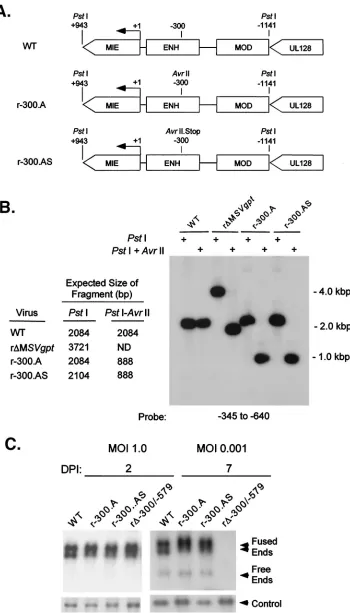
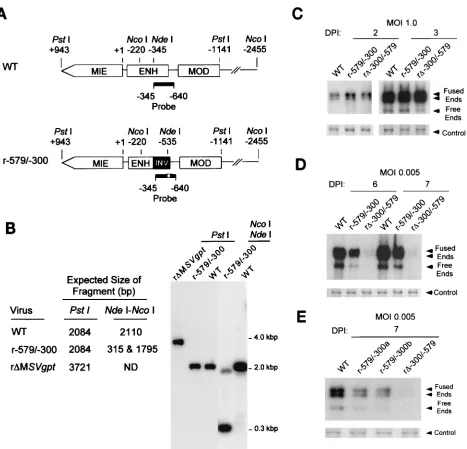
The distal enhancer is acis-acting region that can operate in reverse orientation.To further determine whether the distal enhancer operates in acis- ortrans-acting manner, the distal enhancer was subjected to insertion mutagenesis to disrupt overlapping hypothetical ORFs. Two types of insertions were introduced at position⫺300 of the distal enhancer to make recombinant viruses r-300.A and r-300.AS. This specific site was first targeted because it was ideally situated in two different hypothetical ORFs containing motifs showing limited homol-ogies with those in a cellular tyrosine phosphatase and a G protein-coupled receptor. The insertion mutation of r-300.A adds a newAvrII site that disrupts the reading frames, whereas the insertion mutation of r-300.AS creates stop codons in all reading frames coded by each DNA strand (Fig. 4A and B). The DNA replication rates of these mutated viruses were an-alyzed at MOI of 1.0 and 0.001 on days 2 and 7 p.i., respec-tively. As shown in Fig. 4C, the rate of viral DNA synthesis is unaltered by either insertion mutation located at⫺300 in the distal enhancer. These mutations also had no appreciable ef-fect on MIE promoter-dependent transcription under the same growth conditions (data not shown). Insertion mutations
on November 8, 2019 by guest
http://jvi.asm.org/
on November 8, 2019 by guest
http://jvi.asm.org/
were also introduced at⫺345 of the distal enhancer, and they too did not impair viral replication at high or low MOI (data not shown). Thus, disruption of hypothetical ORFs overlap-ping the distal enhancer does not hinder viral transcription and replication, unlike a distal enhancer deletion.
We next determined whether the distal enhancer could func-tion in reverse orientafunc-tion. A virus, designated r-579/-300, was made in which the distal enhancer (⫺300 to ⫺579) was
[image:5.587.137.445.65.501.2]in-verted at its original location in the MIE regulatory region (Fig. 5A and B). Two viruses derived independently from separate transfection-recombination procedures were sub-sequently studied. Their DNA replication rates at MOI of 1.0 and 0.005 were compared to those of WT and r⌬-300/-579. Figure 5C shows that r-579/-300, r⌬-300/-579, and WT exhib-ited similar replication rates at high MOI. At low MOI, both isolates of r-579/-300 replicated much better than r⌬-300/-579
FIG. 1. Effects on viral DNA replication of successively larger 5⬘-subsegmental distal enhancer deletions. (A) Schematic diagram of deleted distal enhancer segments in recombinant HCMVs r⌬-300/-579, r⌬-347/-579, and r⌬-521/-579. Base positions of deletions andPstI sites are depicted relative to the⫹1 RNA start-site of the MIE promoter. Predicted sizes ofPstI RFLPs are shown. MIE, MIE transcription unit; ENH, enhancer; MOD, modulator; UL128, putative UL128 gene. (B) Southern blot analyses ofPstI RFLPs of WT, r⌬-300/-579, r⌬-347/-579, r⌬-521/-579, and r⌬MSVgpt. r⌬-300/-579, r⌬-347/-579, and r⌬-521/-579 were derived from r⌬MSVgpt. Probe coordinates are given in base positions relative to the RNA start-site of the MIE promoter. (C) Abundances of WT, r⌬-347/-579, and r⌬-521/-579 genomes in HFF cells at MOI of 1.0 and 0.001. Infections were performed in parallel with equivalent input viral titers (see Materials and Methods). On the indicated day p.i. (DPI), infected-cell DNA was isolated, digested withHindIII, fractionated by gel electrophoresis, and subjected to Southern blot analysis. The32P-labeled probe
hybridizes to HCMV genomic fragments containing either the terminal repeat-long (TRL) or the internal repeat-long (IRL) region (23). The IRL
is fused (Fused End) to the short genome segment, which is contained in the 17.2- and 13-kb fragments. The TRLis not fused (Free End) to the
short genome segment and is contained in the 9.7-kb fragment. The blot was stripped and rehybridized to a-specific,32P-labeled probe for
detection of the lambda DNA internal control (Control). (D) Abundances of WT, r⌬-347/-579, and r⌬-300/-579 genomes in HFF cells at MOI of 1.0 and 0.001. The analysis was performed as described for Fig. 1C.
on November 8, 2019 by guest
http://jvi.asm.org/
[image:5.587.139.439.293.501.2]FIG. 2. Multiple distal enhancer parts are involved in augmenting viral DNA replication. (A) Schematic diagram of deleted distal enhancer segments in HCMVs r⌬-347/-579 and r⌬-300/-347. Base positions of deletions andPstI sites are depicted relative to the RNA start site of the MIE promoter. Predicted sizes ofPstI RFLPs are shown. (B) Southern blot analyses ofPstI RFLPs of WT, r⌬-347/-579, r⌬-300/-347, and r⌬MSVgpt. Probe coordinates are given relative to the RNA start site of the MIE promoter. (C) Abundances of WT, r⌬-300/-347, r⌬-347/-579, and r⌬-300/-579 genomes in HFF cells at an MOI of 1.0 on days 2 and 3 p.i. (DPI 2 and 3). (D) Abundances of WT, r⌬-300/-347, r⌬-347/-579, and r⌬-300/-579 genomes in HFF cells at an MOI of 0.005 on days 6 and 8 p.i.. Infections for which results are shown in panels C and D were performed in parallel, using methods described in the legend to Fig 1C.
on November 8, 2019 by guest
http://jvi.asm.org/
(25- to 30-fold) but somewhat less well than WT (3- to 5-fold) (Fig. 5D and E). Hence, a distal enhancer in reverse orienta-tion substantially compensates for the replicaorienta-tion abnormality created by a distal enhancer deletion.
We examined whether the inverted distal enhancer yielded a level of MIE promoter-dependent transcription that is com-mensurate with viral replication. The amount of MIE RNA produced by r-579/-300 in HFF cells at 6 h p.i. was compared to that of WT and r⌬-300/-579 by the multiplex real-time RT-PCR method. Viral stocks tested in the experiments for which results are shown in Fig. 5C and D were used in these studies
to confirm that input viral titers were equivalent. Figure 6A reveals that all three viruses produced similar amounts of IE1 RNA at high MOI. In contrast, r-579/-300 made 5.5-fold more MIE RNA than r⌬-300/-579 and 3-fold less MIE RNA than WT (Fig. 6B). Again, the amount of MIE RNA produced by WT was more than 12-fold that produced by r⌬-300/-579 for the infections carried out at an MOI of 0.005. The inverted distal enhancer replacement yields comparable levels of MIE-dependent transcription and viral replication, although neither of these viral activities is fully restored.
[image:7.587.141.445.73.313.2]Taken together, the findings support acis-acting, but not a
FIG. 2—Continued.
on November 8, 2019 by guest
http://jvi.asm.org/
trans-acting, role of the distal enhancer in stimulating MIE promoter-dependent transcription. This transcriptional regu-latory activity is concordantly linked to viral replication.
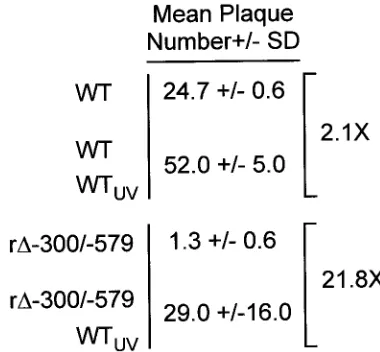
Addition of UV-inactivated HCMV virions at a high viral-particle/cell ratio compensates for an absent distal enhancer at low MOI.Because a distal enhancer deletion does not im-pair HCMV replication at high MOI, we determined whether the application of inactivated purified HCMV particles in numbers simulating a high MOI would compensate for a miss-ing distal enhancer in a virus grown at a low MOI. The mini-mum amount of UV irradiation needed to fully inactivate HCMV particles isolated from extracellular medium was first determined using HCMV r⌬-582/-1108Egfpbecause GFP ex-pression served as a convenient marker of lytic viral gene expression (22) (see Materials and Methods). This UV dose was then used to inactivate isolated WT particles (WTUV). HFF cells were infected in parallel with WT or r⌬-300/-579 at an MOI of 0.001 in the presence or absence of WTUVat a high viral-particle/cell ratio (⬃3 to 5 PFU/cell prior to UV irradia-tion), and the viral plaques that formed were enumerated. Figure 7 shows the representative results of one of five exper-iments. Exposure of HFF cells to WTUValone did not yield viral plaques. The combination of WTUVand r⌬-300/-579 pro-duced 21.8-fold more plaques than r⌬-300/-579 alone. In con-trast, WTUVwas less able to increase the number of plaques produced by WT than to increase the number produced by r⌬-300/-579 (2.1- versus 21.8-fold, respectively), suggesting that a virus missing the distal enhancer benefits most from the stimulation. r⌬-300/-579’s ability to form plaques at low MOI was also greatly increased by addition of UV-inactivated r⌬ -300/-579 but was not increased by addition of growth medium of infected cells that was cleared of viral particles (data not shown).
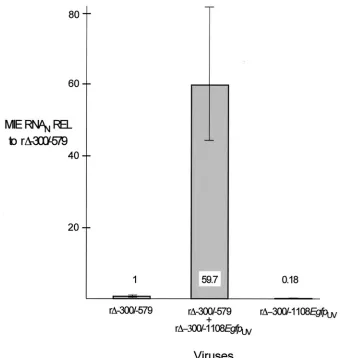
To determine whether an MIE promoter lacking a distal enhancer responds to stimulation provided by virion compo-nents, we applied UV-inactivated virions at a high viral-parti-cle/cell ratio (⬃5 PFU/cell prior to UV irradiation) to HFF cells infected with r⌬-300/-579 at an MOI of 0.005. For these studies, we inactivated recombinant r⌬-300/-1108Egfpbecause this virus’s MIE distal enhancer is replaced with an adenovirus E1b TATA box and GFP cassette that function with IE-class kinetics (22). The requisite demonstration that inactivated r⌬-300/-1108Egfp (r⌬-300/-1108EgfpUV) did not yield viral plaques or GFP fluorescence in exposed cells was assurance that HCMV lytic gene expression was successfully prevented. HFF cells were either mock infected or infected with r⌬ -300/-579 in the presence or absence of r⌬-300/-1108EgfpUV. The rela-tive MIE RNA abundance at 6 h p.i. was determined using mul-tiplex real-time RT-PCR. As shown in Fig. 8, addition of the inactivated viral-particle preparation increased r⌬-300/-579 MIE RNA abundance 59.7-fold. A very small amount of MIE RNA was detected in cells exposed only to r⌬-300/-1108EgfpUV, a finding consistent with the recent report that HCMV particles themselves contain MIE RNAs (11). Such virion-associated RNAs would be anticipated to be detectable by the PCR-based method despite their inactivation by UV irradiation.
[image:8.587.51.280.86.601.2]Thus, the findings indicate that hyperexposure to virion-associated factors largely compensates for the distal enhancer’s absence at low MOI. These findings may partly explain why WT and a virus lacking a distal enhancer are similar at high
FIG. 3. Multiple distal enhancer parts are involved in augmenting MIE promoter-dependent transcription. Relative quantitation of WT, r⌬-300/-347, r⌬-347/-579, and r⌬-300/-579 MIE RNAs at 6 h p.i. in HFF cells was performed for quadruplicate samples by multiplex real-time RT-PCR, using theCTmethod and validation experiments
according to the manufacturer’s specifications. Viral MIE RNA abun-dance was normalized to cellular 18S RNA (MIE RNAN) and
ex-pressed relative (REL) to that of WT at an MOI of 1.0 (A) or 0.005 (B). Shown are means and standard deviations. Parallel determina-tions of CT values of corresponding samples lacking RT and of
mock-infected samples revealed no appreciable difference from the baseline.
on November 8, 2019 by guest
http://jvi.asm.org/
FIG. 4. Stop codons inserted into the distal enhancer do not alter viral DNA replication. (A) Schematic diagram of HCMVs r-300.A and r⌬-300.AS. (B) Southern blot analyses ofPstI RFLPs of WT, r–300.A, r⌬-300.AS, and r⌬MSVgpt. Probe coordinates relative to the RNA start site of the MIE promoter and predicted sizes ofPstI RFLPs are given. (C) Abundances of WT, r-300.A, r⌬-300.AS, and r⌬-300/-579 genomes in HFF cells at MOI of 1.0 and 0.001 on days 2 and 7 p.i. (DPI 2 and 7). Infections were performed in parallel by methods described in the legend to Fig. 1C.
on November 8, 2019 by guest
http://jvi.asm.org/
MOI with regard to both viral MIE RNA production and DNA replication.
DISCUSSION
The requirement by HCMV of an MIE distal enhancer to activate both MIE gene expression and viral replication at a low MOI was shown previously (23), but the mechanism by which this 280-bp genome region confers these activities was
[image:10.587.61.528.68.517.2]unknown. In this report, we have shown that the distal en-hancer is composed of at least two working parts that operate independently to activate MIE promoter-dependent transcrip-tion and viral replicatranscrip-tion. These parts likely functranscrip-tion incisto directly activate the MIE promoter, based on three sets of findings observed at low MOI. (i) Deletion of either part of a divided distal enhancer minimally alters viral MIE gene tran-scription and DNA replication (Fig. 1, 2, and 3). (ii) Reversing the distal enhancer’s orientation largely preserves MIE gene
FIG. 5. An inverted distal enhancer augments viral DNA replication. (A) Schematic diagram of WT and r-579/-300. Base positions ofPstI,NdeI, andNcoI sites and probe (solid bar) coordinates are given relative to the RNA start site of the MIE promoter. INV, inverted distal enhancer. (B) Southern blot analyses ofPstI and combinedNdeI andNcoI RFLPs of WT, r-579/-300, and r⌬MSVgpt. Predicted sizes of RFLPs are shown. (C) Abundances of WT, r-579/-300, and r⌬-300/-579 genomes in HFF cells at an MOI of 1.0 on days 2 and 3 p.i. (DPI 2 and 3). (D) DNA replication rates of WT, r-579/-300, and r⌬-300/-579 genomes in HFF cells at an MOI of 0.005 on days 6 and 7 p.i. Infections for which results are shown in panels C and D were performed in parallel by methods described in the legend to Fig. 1C. (E) Abundances of WT, r-579/-300a, r-579/-300b, and r⌬-300/-579 genomes in HFF cells at an MOI of 0.005 on day 7 p.i. Viruses r-579/-300a and r-579/-300b were derived from independent transfection-recombination procedures. The abundances of viral genomes at 4 h, 2 days, and 3 days p.i. at an MOI of 1 were equivalent for all four viruses (data not shown). Analysis was performed as described in the legend to Fig. 1C.
on November 8, 2019 by guest
http://jvi.asm.org/
transcription and viral replication (Fig. 5 and 6). (iii) Insertion of stop codons in all potential reading frames at position⫺300 or⫺345 of the distal enhancer does not impair viral replication (Fig. 4) or MIE gene expression (data not shown).
[image:11.587.323.513.73.249.2]Our results indicated that at least one of thecis-acting ele-ments is located in a 47-bp segment (Fig. 1, 2, and 3) that has consensus-binding sites for CREB/ATF, SP1, and YY1 (25). Therefore, one or a combination of these specific cellular tran-scription factor binding sites may be needed to activate MIE gene transcription at low MOI, although we cannot exclude the possibility of an unrecognized binding site conferring the acti-vation. Notably, each of the CREB/ATF, SP1, and YY1 rec-ognition motifs is present in three copies distributed through-out the distal enhancer, and two additional CREB/ATF sites are located in the proximal enhancer (25). The distal enhancer also has binding sites for serum response factor, ELK-1, reti-noic acid receptor, and NF-B/rel, whereas the proximal en-hancer has additional binding sites for AP-1, retinoic acid receptor, and NF-B/rel (7, 25). Given the extent and variety of possible transcription factors that act on the enhancer, why should deletion of the entire 279-bp distal enhancer, but not its subsegments, have such a dramatic effect? The answer to this query is likely to be complex. It is conceivable that activation of MIE gene expression and viral replication at low MOI requires at least onecis-acting element in the distal enhancer in order to achieve a synergistic interaction that involves other regula-tory elements located in neighboring regions. The synergism may derive from the coordinate assembly of multiple tran-scription factors on these different elements. Such a para-digm would resemble the multicomponent enhanceosome that forms to synergistically trans-activate the cellular beta interferon promoter (20, 31). This analogy may also apply to other viruses. The human T-cell leukemia virus type 1 (HTLV-1) enhancer of the long terminal repeat (LTR) promoter is one example. This enhancer contains three 21-bp repeats that are
FIG. 6. An inverted distal enhancer augments MIE promoter-de-pendent transcription. Relative quantitation of WT, r-579/-300, and r⌬-300/-579 MIE RNAs at 6 h p.i. in HFF cells was performed for quadruplicate samples by multiplex real-time RT-PCR, using theCT
method and validation experiments according to the manufacturer’s specifications. The standard curve method was also used in parallel to validate results. Comparative input viral titers are shown in Fig. 5C and D. Viral MIE RNA abundance was normalized to that of cellular 18S RNA (MIE RNAN) and expressed relative (REL) to WT at an MOI of
1.0 (A) or 0.005 (B). Shown are means and standard deviations. Par-allel determinations ofCTvalues of corresponding samples lacking RT
and of mock-infected samples revealed no appreciable difference from the baseline.
FIG. 7. UV-inactivated HCMV virions applied at a high viral-par-ticle/cell ratio greatly increase the ability of r⌬-300/-579 to produce plaques at low MOI. Purified WTUV(3 to 5 PFU/cell prior to UV
inactivation) was applied at the time of infection of HFF cells with WT or r⌬-300/-579 at an MOI of 0.001. After viral absorption, cells were washed and covered with agarose. Viral plaques were visualized by light microscopy and enumerated. Mean plaque numbers and SDs were derived from triplicate experiments performed in parallel.
on November 8, 2019 by guest
http://jvi.asm.org/
called TAX-responsive elements (TxREs) because they confer
trans-activation by the viral TAX protein (26). CREB/ATF
binds to each TxRE and is also required for its function. How-ever, a single TxRE only weakly activates transcription, where-as two or three TxREs greatly activate the promoter (36). Thus, the synergistic or cooperative interaction between regu-latory elements is important for activation of the HTLV-1 LTR promoter. Notably, the multiple CREB/ATF sites located in both proximal and distal portions of the HCMV MIE enhancer are functionally responsive to signaling induced by virion-as-sociated components, mitogens, catecholamines, membrane depolarization, or forskolin when assayed in transfected or transduced cells (15, 33, 38, 42, 43). Whether these or other regulatory elements in the proximal and distal MIE enhancer regions (e.g., CREB/ATF sites) interact in a synergistic man-ner awaits the findings of future studies.
The effects of a distal enhancer deletion on MIE gene ex-pression and viral replication have been validated previously using HCMVs in which the distal enhancer was replaced with
heterologous sequence and subsequently reverted to WT (23). While the findings of several short subsegmental distal en-hancer deletions have not been validated in this fashion, we believe it unlikely that the findings reflect artifactual idiosyn-crasies of the viral construction. Nonetheless, additional mu-tagenesis of this complex region will be required in the future to identify and fully characterize the functional role of the
cis-acting elements. Our studies have not discounted the pos-sibility that distal enhancer regulatory elements may also have unanticipated effects on the expression of neighboring genes in a manner that could alter viral replication. There is at present no evidence to support this notion for HCMV, although swap-ping the MIE enhancer of rat CMV for the paralogous murine enhancer impairs rat CMV replication without altering MIE gene transcription for reasons that are unknown (35). In con-trast, compelling evidence is mounting to support the idea that HCMV or MCMV replication requires sufficient activation of MIE gene expression (1, 2, 10, 16, 21–23, 30).
[image:12.587.121.463.71.429.2]Another interesting characteristic of the distal enhancer’s
FIG. 8. Augmentation of r⌬-300/-579 MIE promoter-dependent transcription by r⌬-300/-1108EgfpUVat a high viral-particle/cell ratio. HFF
cells were infected with r⌬-300/-579 at an MOI of 0.005, and r⌬-300/-1108EgfpUV(MOI of 3 prior to UV inactivation) was added concomitantly
to or omitted from the infection. Relative quantitation of viral MIE and cellular 18S RNAs was performed on quadruplicate samples by multiplex real-time RT-PCR, using theCTmethod and validation experiments according to the manufacturer’s specifications. Viral MIE RNA abundance
was normalized to that of 18S RNA (MIE RNAN) and expressed relative (REL) to that of r⌬-300/-579 in the absence of r⌬-300/-1108EgfpUV.
Shown are means and standard deviations. Parallel determinations ofCTvalues of corresponding samples lacking RT and of mock-infected samples
revealed no appreciable difference from the baseline.
on November 8, 2019 by guest
http://jvi.asm.org/
cis-acting elements is that they are dispensable at high MOI. We have shown that UV-inactivated HCMV virions applied at a high viral-particle/cell ratio can largely offset the loss of a distal enhancer in a virus grown at a low MOI. This finding may explain why the distal enhancer is not needed at an MOI of 1 when the average infected cell may be exposed concomitantly to as many as 100 noninfectious or defective viral particles (41). We surmise that heightened exposure to a component(s) of the virion preparation functionally compensates for removal of these regulatory elements, since infected cell culture super-natant cleared of virus fails to restore function. Earlier studies showing trans-activation of transiently or stably transfected MIE promoter-enhancer segments by HCMV infection in the presence of protein synthesis inhibitors first suggested the role of virion-associated components in augmenting MIE gene ex-pression (18, 37, 42). Transfection experiments have revealed that virion tegument proteins, such as UL82 (pp71) (18), UL69 (44), and TRS1/IRS1 (34) are able to augment MIE promoter activity. UL82 was also shown to activate an HCMV MIE promoter implanted in the herpes simplex virus genome (14) and to enhance the infectivity of HCMV DNA (3). Recently, Bresnahan and Shenk used a recombinant HCMV lacking UL82 to confirm the idea that virion-associated UL82 has an important role in activating MIE gene transcription from within the HCMV genome (6). The mechanism by which UL82 functions is poorly understood, although Liu and Stinski have found that this protein activates the MIE promoter-enhancer through CREB/ATF and AP-1 elements when assayed in a transient transfection system (18). Perhaps large numbers of UL82-containing virions can further stimulate remaining CREB/ATF and AP-1 elements located in the proximal en-hancer to help compensate for the distal enen-hancer deletion.
We do not exclude the possibility that other virion compo-nents may be involved in activation of MIE gene expression. For example, viral gB and gH activate signal transduction path-ways via ligand-receptor engagement to increase the binding of
NF-B trans-activators at multiple cognate sites in the MIE
enhancer (4, 45). The virion also carries kinases and serine/ threonine protein phosphatases that may regulate viral or cel-lular gene expression by modifying signal transduction path-ways and activities of transcription factors (27). In addition, the virus has been reported to package the MIE gene product, IE1 p72 (45), but this association has not been detected by others (32). If IE1 p72 is provided by the virion, it would be predicted to stimulate MIE promoter activity and/or viral replication based on prior findings of transient transfection assays (8, 19, 39) and HCMVs lacking IE1 p72 (10, 30). Finally, an effect caused by a copurification contaminant or the translation of incompletely inactivated virion-associated RNA of viral or cel-lular origin (5, 11) is unlikely given the findings with our ex-perimental controls. Notably, the inhibition of protein synthe-sis also restores activity to an MIE promoter lacking the distal enhancer (J. L. Meier, unpublished data), so that virion-medi-ated effects in the absence of de novo protein synthesis cannot be accurately discerned.
We infer from these studies that the MIE distal enhancer is complex and likely to contain multiplecis-acting elements that function together with other elements in the MIE regulatory region to confer promoter-dependent transcription. The piv-otal role of these regulatory elements in HCMV lytic
replica-tion underscores the need to further determine their identity and mechanism of action.
ACKNOWLEDGMENTS
We are grateful to Mark Stinski for critical reading of the manu-script. We thank members of the Stinski laboratory and Arnold Rab-son for helpful discussions of this work. We also thank Kevin KnudtRab-son of the DNA Core Facility for generously providing advice and help in performing the real-time PCR assays.
This work was supported by the National Institutes of Health (AI-40130), an American Cancer Society institutional research grant (IN-122R), and the March of Dimes (FY99-549).
REFERENCES
1.Angulo, A., P. Ghazal, and M. Messerle.2000. The major immediate-early gene IE3 of mouse cytomegalovirus is essential for viral growth. J. Virol.
74:11129–11136.
2.Angulo, A., M. Messerle, U. H. Koszinowski, and P. Ghazal.1998. Enhancer requirement for murine cytomegalovirus growth and genetic complementa-tion by the human cytomegalovirus enhancer. J. Virol.72:8502–8509. 3.Baldick, C. J., A. Marchini, C. E. Patterson, and T. Shenk.1997. Human
cytomegalovirus tegument protein pp71 (ppUL82) enhances the infectivity of viral DNA and accelerates the infectious cycle. J. Virol.71:4400–4408. 4.Boyle, K. A., R. L. Pietropaolo, and T. Compton.1999. Engagement of the
cellular receptor for glycoprotein B of human cytomegalovirus activates the interferon-responsive pathway. Mol. Cell. Biol.19:3607–3613.
5.Bresnahan, W. A., and T. Shenk.2000. A subset of viral transcripts packaged within the human cytomegalovirus particles. Science288:2373–2376. 6.Bresnahan, W. A., and T. E. Shenk.2000. UL82 virion protein activates
expression of immediate-early genes in human cytomegalovirus infected cells. Proc. Natl. Acad. Sci. USA97:14506–14511.
7.Chan, Y.-J., C.-J. Chiou, Q. Huang, and G. S. Hayward.1996. Synergistic interactions between overlapping binding sites for the serum response factor and ELK-1 proteins mediate both basal enhancement and phorbol ester responsiveness or primate cytomegalovirus major immediate-early promot-ers in monocyte and T-lymphocyte cell types. J. Virol.70:8590–8605. 8.Cherrington, J. M., and E. S. Mocarski.1989. Human cytomegalovirusie1
transactivates the␣promoter-enhancer via an 18-base-pair repeat element. J. Virol.63:1435–1440.
9.Chomczynski, P., and N. Sacchi.1987. Single-step method of RNA isolation by acid guanidinium thiocyanate-phenol-chloroform extraction. Anal. Bio-chem.162:156–159.
10.Greaves, R. F., and E. S. Mocarski.1998. Defective growth correlates with reduced accumulation of a viral DNA replication protein after low-multi-plicity infection by a human cytomegalovirusie1mutant. J. Virol72:366–379. 11.Greijer, A. E., C. A. J. Dekkers, and J. M. Middeldorp. 2000. Human cytomegalovirus virions differentially incorporate viral and host cell RNA during assembly process. J. Virol.74:9078–9082.
12.Grzimek, N. K. A., J. Podlech, H. P. Steffens, R. Holtappels, S. Schmalz, and M. J. Reddehase.1999. In vivo replication of recombinant murine cytomeg-alovirus driven by the paralogous major immediate-early promoter-enhancer of human cytomegalovirus. J. Virol.73:5043–5055.
13.Hirsch, A. J., and T. Shenk.1999. Human cytomegalovirus inhibits transcrip-tion of the CC chemokine MCP-1 gene. J. Virol.73:404–410.
14.Homer, E. G., A. Rinaldi, M. J. Nicholl, and C. M. Preston.1999. Activation of herpesvirus gene expression by the human cytomegalovirus protein pp71. J. Virol.73:8512–8518.
15.Hunninghake, G. W., M. M. Monick, B. Liu, and M. F. Stinski.1989. The promoter-regulatory region of the major immediate-early gene of human cytomegalovirus responds to T-lymphocyte stimulation and contains func-tional cyclic AMP response elements. J. Virol.63:3026–3033.
16.Iskenderian, A. C., L. Huang, A. Reilly, R. M. Stenberg, and D. G. Anders.
1996. Four of eleven loci required for transient complementation of human cytomegalovirus DNA replication cooperate to activate expression of repli-cation genes. J. Virol.70:383–392.
17.Kothari, S., J. Baillie, J. G. Sissons, and J. H. Sinclair.1991. The 21-bp repeat element of the human cytomegalovirus major immediate early en-hancer is a negative regulator of gene expression in undifferentiated cells. Nucleic Acids Res.19:1767–1771.
18.Liu, B., and M. F. Stinski.1992. Human cytomegalovirus contains a tegu-ment protein that enhances transcription from promoters with upstream ATF and AP-1cis-acting elements. J. Virol.66:4434–4444.
19.Malone, C. L., D. H. Vesole, and M. F. Stinski.1990. Transactivation of a human cytomegalovirus early promoter by gene products from the immedi-ate-early gene IE2 and augmentation by IE1: mutational analysis of the viral proteins. J. Virol.64:1498–1505.
20.Maniatis, T., J. V. Falvo, T. H. Kim, T. K. Kim, C. H. Lin, B. S. Parekh, and M. G. Wathelet.1998. Structure and function of the interferon-beta enhan-ceosome. Cold Spring Harbor Symp. Quant. Biol.63:609–620.
on November 8, 2019 by guest
http://jvi.asm.org/
21.Marchini, A., H. Liu, and H. Zhu.2001. Human cytomegalovirus with IE-2 deleted fails to express early lytic genes. J. Virol.75:1870–1878.
22.Meier, J. L.2001. Reactivation of the human cytomegalovirus major imme-diate-early regulatory region and viral replication in embryonal NTera2 cells: role of trichostatin A, retinoic acid, and deletion of the 21-base-pair repeats and modulator. J. Virol.75:1581–1593.
23.Meier, J. L., and J. Pruessner.2000. The human cytomegalovirus major immediate-early distal enhancer region is required for efficient viral replica-tion and immediate-early gene expression. J. Virol.74:1602–1613. 24.Meier, J. L., and M. F. Stinski.1997. Effect of a modulator deletion on
transcription of the human cytomegalovirus major immediate-early genes in infected undifferentiated and differentiated cells. J. Virol.71:1246–1255. 25.Meier, J. L., and M. F. Stinski.1996. Regulation of cytomegalovirus
imme-diate early genes. Intervirology39:331–342.
26.Mesnard, J. M., and C. Devaux.1999. Multiple control levels of cell prolif-eration by human T-cell leukemia virus type 1 TAX protein. Virology257:
277–284.
27.Michelson, S., P. Turowski, L. Picard, J. Goris, M. P. Landini, A. Topliko, B. Hemmings, C. Bessia, A. Garcia, and J. L. Virelizier.1996. Human cyto-megalovirus carries serine/threonine protein phosphatases PP1 and host cell-derived PP2A. J. Virol.70:1415–1423.
28.Mocarski, E., and C. Tan Courcelle.2001. Cytomegaloviruses and their replication, p 2629–2674.InD. M. Knipe and P. M. Howley (ed.), Fields virology. Lippincott-Raven Publishers, Philadelphia, Pa.
29.Mocarski, E. J.1988. Biology and replication of cytomegalovirus. Transfus. Med. Rev.2:229–234.
30.Mocarski, E. S., G. Kemble, J. Lyle, and R. F. Greaves.1996. A deletion mutant in the human cytomegalovirus gene encoding IE1 (491 aa) is repli-cation defective due to a failure in autoregulation. Proc. Natl. Acad. Sci. USA93:11321–11326.
31.Munishi, N., J. Yie, M. Merika, K. Senger, S. Lomvardas, T. Agalioti, and D. Thanos.1999. The IFN-enhancer: a paradigm for understanding activation and repression of inducible gene expression. Cold Spring Harbor Symp. Quant. Biol.64:149–159.
32.Plachter, B., W. Britt, R. Vornhagen, T. Stamminger, and G. Jahn.1993. Analysis of proteins encoded by IE regions 1 and 2 of human cytomegalo-virus using monoclonal antibodies generated against recombinant antigens. Virology193:642–652.
33.Prosch, S., C. E. C. Wendt, P. Reinke, C. Priemer, M. Oppert, D. H. Kruger, H. D. Volk, and W. D. Docke.2000. A novel link between stress and human cytomegalovirus (HCMV) infection: sympathetic hyperactivity stimulates
HCMV activation. Virology272:357–365.
34.Romanowski, M. J., E. Garrido-Guerrero, and T. Shenk.1997. pIRS1 and pTRS1 are present in human cytomegalovirus virions. J. Virol.71:5703–5705. 35.Sanford, G. R., L. E. Brock, S. Voight, C. M. Forester, and W. H. Burns.
2001. Rat cytomegalovirus major immediate-early enhancer switching results in altered growth characteristics. J. Virol.75:5076–5083.
36.Shimotohono, K., M. Takano, T. Teruuchi, and M. Miwa.1986. Require-ment of multiple copies of a 21-nucleotide sequence in the U3 regions of human T-cell leukemia virus type I and type II long terminal repeats for
trans-acting activation of transcription. Proc. Natl. Acad. Sci. USA83:8112– 8116.
37.Spaete, R. R., and E. S. Mocarski.1985. Regulation of cytomegalovirus gene expression:␣andpromoters aretrans-activated by viral functions in per-missive human fibroblasts. J. Virol.56:135–143.
38.Stamminger, T., H. Fickenscher, and B. Fleckenstein.1990. The cell type-specific induction of the major immediate-early enhancer of human cyto-megalovirus by cAMP. J. Gen. Virol.71:105–113.
39.Stenberg, R. M., J. Fortney, S. W. Barlow, B. P. Magrane, J. A. Nelson, and P. Ghazal.1990. Promoter-specifictrans-activation and repression by human cytomegalovirus immediate-early proteins involve common and unique pro-tein domains. J. Virol.64:1556–1565.
40.Stinski, M. F.1976. Human cytomegalovirus: glycoproteins associated with virions and dense bodies. J. Virol.19:594–609.
41.Stinski, M. F., E. S. Mocarski, and D. R. Thomsen.1979. DNA of human cytomegalovirus: size heterogeneity and defectiveness resulting from serial undiluted passage. J. Virol.31:231–239.
42.Stinski, M. F., and T. J. Roehr.1985. Activation of the major immediate-early gene of human cytomegalovirus bycis-acting elements in the promoter-regulatory sequence and by virus-specifictrans-acting components. J. Virol.
55:431–441.
43.Wheeler, D. G., and E. Cooper.2001. Depolarization strongly induces human cytomegalovirus major immediate-early promoter/enhancer activity in neu-rons. J. Biol. Chem.276:31978–31985.
44.Winkler, M., and T. Stamminger.1996. A specific subform of the human cytomegalovirus transactivator protein pUL69 is contained within the tegu-ment of virus particles. J. Virol.70:8984–8987.
45.Yurochko, A. D., E.-S. Hwang, L. Rasmussen, S. Keay, L. Pereira, and E.-S. Huang.1997. The human cytomegalovirus UL55 (gB) and UL75 (gH) gly-coprotein ligands initiate the rapid activation of SP1 and NF-B during infection. J. Virol.71:5051–5059.