______________________________________________________________________________
THE DEVELOPMENT OF THE DYNAMIC WEB INTERFACE BETWEEN THE ONLINE E-CUSTOMER AND THE E-BUSINESS
John Hamilton
James Cook University, PO Box 6811 School of Business
McGreggor Road, Smithfield Cairns, Queensland Phone: 61 7 40 421091
Fax : 61 7 40 421280 e-mail: [email protected]
and Willem Selen
Macquarie Graduate School of Management Macquarie University
Sydney, NSW (as of June 2002)
______________________________________________________________________________
THE DEVELOPMENT OF THE DYNAMIC WEB INTERFACE BETWEEN THE ONLINE E-CUSTOMER AND THE E-BUSINESS
ABSTRACT
The Internet and the World Wide Web have opened the door to new models linking the online customer (customer) to the online business (business). The key to this relationship is the business’s Web site. The personal computer (PC) screen images or Web interfaces seen by the e-customer hold the key to enhancing this relationship. These Web interfaces can be dynamically manipulated to enhance user friendliness and satisfaction. From the e-business viewpoint this requires supply chain integration, knowledge management, intelligent agent software, the
measurement of Web interface effectiveness and the ability to upgrade the Web site dynamically. The e-customer provides another dimension to this equation. Customer demographics must be captured and linked into the knowledge management, business intelligence systems and the supply chain. These equations then respond to the e-customer in a dynamic manner, providing an enhanced ‘one-on-one’ relationship between the e-customer and the e-business.
______________________________________________________________________________
THE DEVELOPMENT OF THE DYNAMIC WEB INTERFACE BETWEEN THE ONLINE E-CUSTOMER AND THE E-BUSINESS
The application of various traditional marketing theories based on the customers’ behaviour have been analysed to test these theories and their application to the new Web environment (Carson et al, 1996). These theories do not fit the e-customer in an e-business online interaction context.
In the online context, the e-customer may be considered both a purchaser of goods and a user of information technology (Cumming, 2001). The e-customer actively exchanges information across the communication medium. The active attitude (Cho & Park, 2001) in controlling lots of initiatives (Schwartz, 1997) is an important customer characteristic. Each contact with the e-customer should add this active information to the e-business’s repository or information data storage warehouse. The e-business’s e-customer information (data profile) is then mined, scanned, interpreted and applied to provide an improved and more detailed understanding of the e-customer. If this new knowledge is then applied to the Web site, and the site is modified for subsequent e-customer visits, it is possible to create additional satisfaction for the e-customer. This, in turn creates most loyalty (Limehouse, 1999). Thus, the provision of the right
information, at the right time, on the right personal computer (PC), laptop, or wireless application protocol (WAP) device is one vital key to a successful Web interface interaction with the e-customer.
However, e-customers are dynamic, ever-changing individuals (Cumming, 2001), and depending on their comfort level with the Web, and how far they have progressed along the adoption
process – awareness, to interest, to evaluation, to trial and finally through to adoption (Walker & Walker, 1996), these individuals may respond differently to what the Web site has to offer. In addition they may seek different things. Lewis and Lewis (1997) identified five kinds of Web visitors, each with different need and wants – direct information seekers (search for specific information), undirected information seekers (browsers), bargain hunters (deals and extra benefits), entertainment seekers (interact with the Web site), and directed buyers (buy a specific item online). This classification is just one of many attempts to segment (or ‘cybersegment’) e-customers. Many papers tackle aspects of Web site design, some link these to customer
behaviour. Chen and Wells (1999) have developed a scale to quantify the ‘attitude toward the Web site’. One of their findings indicates ‘complexity’ in the Web site has a negative effect on ad effectiveness. The Web site interface is often cluttered with data but it often lacks user specific information.
______________________________________________________________________________
this customer information within its repository in the most appropriate manner. This
e-customer information is usually based on Web server log files. It provides a weak data set, as it does not consider the dynamic nature of the e-customer.
Log files track the customer’s ‘clickstream’ (mouse click trail) through the site. The e-customer ‘feels’ the site and responds accordingly. The e-business gathers and deduces
information from Web server log files including: e-customer entrance, e-customer path through the site, pages where most time and least time is spent, highest rating search words, links
most/least used, what occurs when the Web site is changed, and the like (Nicholas et al, 1999).
Additional data on the e-customer is collected using e-customer registration, cookies,
promotional feedback, complaints, contact centres, password applications, questionnaires, etc. The e-customer needs are thus qualified and quantified. However, this is only a part of the interaction equation with the e-customer. It does not account for the users’ encounter with, or the ‘feel’ for, the e-business homepage and subsequent inner Web interface pages.
The e-business should respond to the e-customer in a concise, coherent, dynamic way. It should use its Web interface to target each customer and their respective needs or wants. The business should ‘mine’ its database and related repository information. It should compare e-customer profiles, purchase or order details, sales details, promotional response details, complaint details, etc., and thoroughly analyse this information. It should draw upon its supply chain
partners, and other networks to enhance the repository data it can provide. It should use this acquired data to provide additional benefits to the e-customer.
Intelligent agents (software) provide another means to assist e-customers - for example, to find the cheapest price, to access frequently asked question responses (FAQ’s), or to prioritise searches. By recognising differences between e-customers, individuals with similar
characteristics are grouped or segmented, and then treated as separate market groups. Online products or services are ‘customised’ using pricing, features, style, communications and Web design to suit these segments. Some e-businesses segment via geographical, demographic, lifestyle, and/or behaviour approaches, and then further segment these groups horizontally (or broadly) - by brand, product, service, or site or vertically (as a narrow, compact group) - by interests, passions or personal interests (Cumming, 2001).
To win additional e-customers, some e-business Web sites provide quality feedback systems that demonstrate they believe in the e-customer. These do not just feedback standard email solutions to FAQ’s. They indicate to the e-customer how and when they will respond. This helps to prioritise or focus the e-business. It defines the segments that add considerable long-term value. It also allows the e-business to delete or refine segments that add little value. Thus, e-customer focussed e-business incorporates data mining and business intelligence techniques that enable analysis of trends and prioritisation of features. This focused e-business can then focus on new kinds of e-customers, chase additional sales by marketing more effectively, and/or designing new or improved products or services. Over 165 commercial software packages (Soliman, 2000) are now available to assist the business, some good examples include: WebTrends (tracking e-customers), HNC Software (statistical models, e-customer analysis, marketing campaigns) and Data Distilleries (e-customer relationship management (CRM) and data mining).
______________________________________________________________________________
The current e-customer segmentation or ‘cybersegmentation’, strategy is limited in several ways. Firstly, there is a real and potential inaccuracy using Web server log files. E-customers may have multiple email addresses, multiple IP addresses, false names, etc. In addition, the current IP address system (IPv4) normally allows Internet service providers (ISP’s) to allocate addresses to private individuals as ‘dynamic IP addresses’. These are not permanent addresses, and are not unique to the e-customer. This means the next time an e-customer accesses the e-business Web site they will appear to come from a different location (different IP address). Hence decisions regarding the e-business Web site e-customer base may be incorrect. Cookies are used to overcome this problem.
Cookies store information for later retrieval. They are sent, in response to an e-customer request by an business active server page (ASP) or another similar technology and then reside on the e-customer’s PC. The cookie normally expires when the browsing ceases. However, if the cookie has a ‘maximum’ age it remains and upon the next Web site visit it is returned to the e-business server, hence the e-business can track its e-customers. This system is not foolproof. The user can delete the cookies from their computer when the browsing cession ceases, or after a period of time. Hence, the e-customer connection can be lost.
The next generation of Internet protocol – IP version 6 (IPv6) (Commer, 1995) will provide a more extensive and stable uniform address system. A household may be allocated several permanent IP addresses, and a common secure communication channel for transactions. This then allows marketers to segment in a similar way to using postcodes, geographical information systems (GIS), and phone numbers. To keep various information blocks separate a separate permanent IP address will probably be needed for each transaction system – including: remote-billing systems (phone, water), video on demand, security services, and the like. Major operating systems providers like IBM and Microsoft are preparing software to support this new IPv6 protocol.
Secondly, the data mining techniques often depend on log files (although other additional techniques reduce this error). These techniques are further limited by the extent of data collection, and the software analysis tools applied to sift, sort and analyse this information, the data storage/retrieval systems, and the demographic accuracy/linking associated with this stored information.
Thirdly, the profiling of the e-business e-customer is further complicated by the availability of non-PC devices including WAP enabled mobile phones, voice and recognition activated devices, personal digital assistants (PDA’s), etc.
Fourthly, the profiling that classifies e-customers into segments has inherent flaws. In reality, the online e-customer is an ever-changing individual, often using the Web for a range of purposes or activities. This may be due to the individual’s changing technology skills, access, and time availability for online activities.
Fifthly, the Web interface is generally standard for all users. Attempts to segment users and offer alternatives are fairly basic and usually consist of alternate standard sites for different user
______________________________________________________________________________
Hence, managing the e-business, its Web site, and its interactive online e-customers, is complex, difficult, and it is an ever-changing process.
E-CUSTOMER BEHAVIOUR IN THE E-BUSINESS ENVIRONMENT
The e-customer’s decision to purchase, and the act of purchasing is the key to any marketing strategy. In the context of the Web, the time and place of the decision to commit to a purchase (behavioural intention (BI)), and to actually purchase (behaviour (B)) are factors of paramount importance. Fishbein and Ajzen (1975, 1977) state that the correlation between BI and B deteriorates as the time between the measurement of BI and the actual purchase increases. This arises because unanticipated situational factors intervene to reduce the probability of the purchase act occurring (thus weakening intention). Provided there is a high situational correspondence in both time and place between the consumer’s intention to purchase and the purchase act, Fishbein and Ajzen (1975, 1977) suggest there is a strong chance of the purchase going ahead. Pechmann and Stewart (1990) showed that time spent on a site was integrally linked to purchase behaviour. Thus the ability of Web interface pages to hold e-customer attention and to lead the e-customer rapidly towards the purchase act is vital to the likely success of the purchase.
According to psychologists, people are able to deal with five to nine concepts at a time. This is often referred to as ‘7 +/- 2’ (Miller, 1956). The time a user will wait to understand a point or concept on the Web can be as brief as seven seconds (Cumming, 2001). Thus to maximise the success rate of the e-business transaction, the Web interface must meet the consumer’s needs. It must provide minimal, brief, concise, key concepts that rapidly lead to the purchase act.
THE DYNAMIC WEB INTERFACE
Before developing a suitable Web site, the e-business should define its ‘uniqueness’ (points of difference), and then benchmark itself against relevant global competitors to understand, develop and maintain its competitive advantage (Codling 1996). Benchmarking tools may assist,
capture, create and manage information in the performance improvement area (Welch and Mann, 2001).
The Web homepage is the most important Web page (Spyridakis, 2000). It must be ‘balanced’ and ‘self contained’ (Geissler, 2001). Each subsequent internal Web page should have concise, specific information; one full page per screen; minimal graphics; minimal load time; minimal ‘clutter’; minimal animation and/or sound (Geissler 2001) and should attract the attention of the specific consumer group targeted (Breitenbach, 1998). The site should be easily comprehensible, with minimal clearly defined hyperlinks (Ambler, 2001; Ruffini, 2000; Spyridakis, 2000), and presented on a simple fast loading background (Stevenson et al, 2000).
However, e-customer needs must harmonise with the e-business via Web interface interactions, and must add value to this organisation and its related demand chain. The added value must apply to each and every demand chain member, and a measurable benefit such as increased sales and increased profit, must be generated. Consequently, the entire supply chain must benefit from the Web interface interaction with the e-customer. For example, in the real estate industry, Web tools can be leveraged to create a personalised value experience for the e-customer. The
______________________________________________________________________________
integrated using knowledge management and business intelligence systems, provided the entire chain of supply perceives added value. The resulting framework serves as an enabler for turning Web-based and Web-supported real estate agencies into partnering demand chains (Hamilton and Selen, 2002; 2002a).
Despite the plethora of articles and books on how to build “effective” Web sites, very little actual research has examined the impact of Web site browsing and purchase behaviour. A Quality Function Deployment (QFD) framework can be used as a starting tool to develop a base e-business Web site (Hamilton & Selen, 2002b). Here, the linking of the marketing features of the product or service (to be promoted (sold) to each different market segment), to core
functionalities of the Web interface (that is to promote the product or service), and the further translation of these Web interface functionalities into technical Web design features and Web design functions (to effectively promote the product, and hence induce more sales) provides the mechanism to develop an initial Web site. Furthermore, this resulting framework provides a research tool for leveraging ‘one-on-one’ marketing, through the use of varying Website design interfaces, and to determining how Web browsing may affect purchase behaviour on the Internet.
‘One-on-one’ marketing is direct scenario for the e-business. The e-customer focused e-business, and each of its customers, develops a close, almost personal, relationship (loyalty), thereby greatly increasing the chance of additional transactions. The e-customer seeks information, products, services, and so forth, while the e-business learns of e-customer desires, and then responds. Today’s intelligent e-business applications make great efforts to develop a unique approach that is individually targeted. It segments its information down into highly specific, targeted relevant, material that should meet the e-customer’s specific needs or displayed patterns. It draws from all sources within its repository and supply chain network.
The online customer is often impatient and wants maximum value for time spent within the e-business Web site, hence Web site interface interaction time must be minimised by delivering what the e-customer wants (not everything the company offers), and in the process leading them rapidly to the purchase point. For the real estate industry, for example, where the customer is not expected to purchase online, this relates to the online value creation process in making the
preliminary search process increasingly relevant as the search is deepened. Allen and Fjermestad (2001) assert the Internet can serve as a platform for new product innovations, and where
companies use direct access to consumers to collect information products can be adapted and customised for local markets (Klein & Quelch, 1996). According to Evans and Wurster (1999) more navigational Web sites will allow small niche producers easier access to e-markets. They will be able to skip over parts of the value chain that traditional suppliers have relied on for competitive advantage. So, by providing e-customers with their desired pieces of information, products, services, and the like, the e-business can enhance its business opportunities.
CURRENT RESEARCH
______________________________________________________________________________
requirements by the e-business, future visits by the e-customer generate a dynamic change to their observed e-business Web site. Factors deemed most important based on the previous visit(s) are prioritised and displayed early on the Web interface. Thus the e-customer is able to reduce their cycle time to reach a particular area of the Web site, and has a concentrated barrage of relevant information displayed. Indications are that this induces a greater tendency to interact with the e-business and/or to purchase an item or service. The e-customer demographics are captured, mapped and logged within the e-business’s knowledge management repository,
whereas the programmed business intelligence system analyses the data. It sources additional or new knowledge from the supply chain and other networks, decides which mode of display is most appropriate for this e-customer, and adds the relevant information into the relevant information block on the Web interface. It also organises which information is displayed on which page inside the Web site. Thus a dynamic, meaningful, interactive, e-customer targeted Web site is obtained, where a maximum opportunity to interact or purchase is provided.
This research incorporates contributions to current performance metrics work (Gunasekaran et al, 2001; De Toni & Tonchia, 2001; Neely et al, 2000; Choi et al, 2001; Grabowski, 2001, and others), and develops pathways (and tools) to measure factors that may impinge upon the success of the Web site as a dynamic front-end for the e-business. It makes the Web interface a dynamic e-customer focused tool. This research moves away from the traditional old business models as discussed by Quinn et al (1996), and focuses on spontaneous self-organization using aggregate information. Thus, the e-business will reorganise around different attractors, set by the
developed software and/or the information systems administrators, and driven by user e-customer points of contact and requests, particularly across the Web interface. The physical sciences have come wholly to accept uncertainty, but management science has not (Palmer & Parker, 2001). We aim to re-align our e-business model incorporating knowledge based on uncertainty, and to use a more scientific approach. Individual measurement is always unknowable at a precise level (Palmer & Parker, 2001). However, by collecting the individual measures, we can aggregate this information, and determine the inputs and outputs that are most relevant to the data available within the e-business, and its supply chain. We can provide an indication of the element’s relative importance by establishing an order of magnitude of the user links, relative to other elements within the system, and linked to the programmed business intelligence system. We use this information to help map the e-customer’s view of the e-business’s Web interface.
Louvieris and Driver (2001) support the authors’ overall view regarding the importance of the e-business Web interface and its use in the segmentation of customers. They believe the next generation of Internet e-customer segmentation or ‘cybersegmentation’ (based on IPv6 technology) will drive the Web site focus more onto the e-customer dialogue and buyer
behaviour. This will make the data collection easier but it will not sustain competitive advantage. We believe our approach is the key to winning a competitive position. We believe that using our integrated approaches (under the current IPv4 technologies), quality ‘cybersegmentation’,
approaching the ‘one-on-one’ e-marketing level, is achievable.
PRODUCT LIFE CYCLE
______________________________________________________________________________
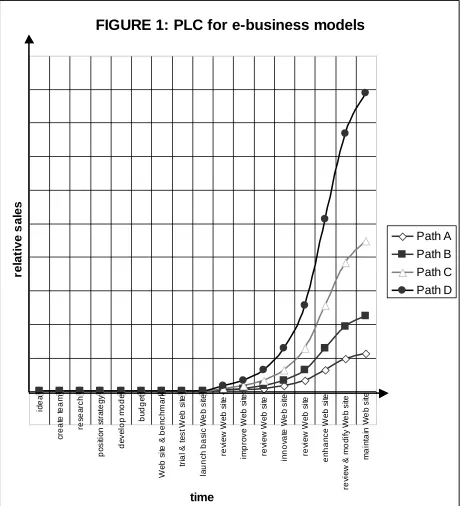
Insert Figure 1 about here
Path A is the e-business model operating as per normal – develop a Web interface, add it to the world-wide-web and make improvements as sales increase. Path B models the e-business adding current log files and data mining to improve its world-wide-web presence and some supply chain access. Path C models the authors’ research using dynamic Web interfaces incorporating ‘one-on-one’ marketing techniques to respond to the e-customer’s demands and supply chain integration. Here the knowledge management, business intelligence tools, and value added supply chain partnerships are integrally linked. Path D shows a possible future model using IPv6, incorporating the ‘one-on-one’ Path C approach and new technologies including natural speech recognition and processing.
The authors’ ‘one-on-one’ Web site design approach provides a means to increase the
effectiveness of the Web as an business tool. This approach dynamically adds value to the e-business / customer relationship. It provides a fundamental key to gaining and maintaining a strong competitive position.
CONCLUSION
The creation of the dynamic Web interface between the online e-customer and e-business is achievable under current IPv4 technologies. The development and application of the dynamic Web interface (by the e-business) has an impact on the e-customer, the loyalty of the e-customer, the tendency to purchase, and the e-customer satisfaction level.
The dynamic Web interface provides value to the e-customer focused e-business, as it creates a new dimension to competitive positioning, and takes the Web site to a different level of
interactivity. This ongoing development of dynamically changing interfaces also applies to the design(s) of the card interfaces for WAP devices. It provides a new strategy for chasing
competitive advantage, and will enable the e-business to move forward towards its aim of ‘one-on-one’ marketing.
REFERENCES
Allen, E., & Fjermestad, J. 2001. E-commerce marketing strategies: an integrated framework and case analysis. Logistics Information Management, 14(1/2): 14--23.
Ambler, S. W. 2001. Designing Web-Based User Interfaces. Journal of Software Development, 9(3): 61--63.
Breitenbach, C. S., & Van Doren, D. C. 1998. Value added marketing in the digital domain: Enhancing the utility of the Internet. Journal of Consumer Marketing, 15(6): 558--575. Carson, S. J., Peck, J. J., & Childers, T. L. 1996. Preliminary results on the determinants of technology assisted shopping (TAS): A model measure development and validation. Proceedings of AMA Educators’ Conference, American Marketing Association.
Chen, Q., & Wells, W. 1999. Attitude toward the site, Journal of Advertising Research, September/October 39(5): 27--37
______________________________________________________________________________
Cho, N., & Park, S. 2001. Development of electronic commerce user-consumer satisfaction index (ECUSI) for internet shopping. Industrial Management & Data Systems, 1(8): 400--405.
Choi, T. Y., Dooley, K. J., & Rungtusanatham, M. 2001. Supply networks and complex adaptive systems: Control versus emergence, Journal of Operations Management, 19(3): 351--366.
Cronin, M. J. 1997. The internet strategy handbook. Boston, MA: Harvard Business School Press.
Comer, D. E. 1995. Internetworking with TCP/IP volume 1: Principles, protocols, and architecture. Englewood Cliffs, NJ: Prentice-Hall.
Cumming, T. 2001. Little e, big commerce. London: Virgin Pub. Ltd.
De Toni, A., & Tonchia, S. 2001. Performance systems models characteristics and measures, International Journal of Operations & Production Management, 21(1/2): 46--70.
Dietel, H. M. Dietel, P. J. & Steinbuhler, K. 2001. E-business and e-commerce for managers. NJ: Prentice Hall.
Evans, P., & Wurster, T. S. 1999. Getting real about virtual commerce. Harvard Business Review, November: 84--94.
Fishbein, M., & Ajzen, I. 1995. Beliefs, attitude, intention and behaviour: An introduction to theory and research. Reading, MA: Addison-Wesley.
Geissler, G. L. (2001). Building customer relationships online: The web site designer’s perspective. Journal of Consumer Marketing, 18(6): 488--502.
Grabowski, M. 2001. Evaluation of embedded intelligent real-time systems, Decision Sciences, 32(1): 95--123.
Gunasekaran, A., Patel, C., & Tirtiroglu, E. 2001. Performance measures and metrics in a supply chain environment, International Journal of Operations & Production Management, 21(1/2): 71--87.
Hamilton, J., & Selen, W. 2002a. A demand chain management framework for the real estate industry using personalised Web interfaces. International Journal of Operations & Production Management (under review).
Hamilton, J., & Selen, W. 2002b. E-business enabled demand chain management for the real estate industry using personalised web interfaces. EurOMA 9th International Annual Conference, Copenhagen (under review).
Hamilton, J., & Selen, W. 2002c. Integrating web site design features for one-on-one marketing: A QFD framework. 7th International Conference on ISO9000 & TQM, Melbourne (under
review).
Klein, L., & Quelch, J. A. 1996. The internet and international marketing. Sloan Management Review, 37(3): 60--75.
Lewis, H. G., & Lewis, R. D. 1997. Give your customers what they want. Selling on the Net, Executive Book Summaries, March 19(3).
Limehouse, D. 1999. Know your customer. Work Study, 48(3): 100--102.
Louvieris, P., and Driver, J. 2001. New frontiers in cybersegmentation: Marketing success in cyberspace depends on IP address. Qualitative Market Research: An International Journal, 4(3): 169--181.
Miller, G. A., 1956. The magical number seven plus or minus two: Some limits to our capacity for processing information. Psychology Review, 64: 81--97.
______________________________________________________________________________
Nicholas, D., Huntington, P., Lievesley, N., & Withey, R. 1999. Cracking the code: Web log analysis. Online & CD ROM Review, 23(5): 263--269.
Palmer, E., & Parker, D. 2001. Understanding performance measurement systems using phycical science uncertainty principles, International Journal of Operations & Production Management, 21(7): 981--999.
Pechmann, C., & Stewart, D. W. 1990. The effects of comparative advertising on attention, memory and purchase intentions. Journal of Consumer Research, September 17: 180--191. Quinn, R. E., Faerman, S. R., Thompson, M. P., &McGrath, M. 1996. Becoming a master manager: A competency framework, New York: John Wiley & Sons.
Raymond, L. 2001. Determinants of web site implementation in small businesses. Internet Research: Electronic Networking Applications and Policy, 11(5): 411-422.
Ruffini, M. F. 2001. Blueprint to develop a great web site. T.H.E. Journal, 28(8): 64--73. Schwartz, E. I. 1997. Webonomics, NY: Nicholas Ellison.
Soliman, F. 2000, Identification of Knowledge Management (Transfer) Tools, UTS working paper, October.
Spyridakis, J. 2000. Guidelines for authoring comprehensible web pages and evaluating their success. Technical Communication, August 47(3): 359--382.
Stevensen, J., Bruner 2nd, G., & Kumar, A. 2000. Webpage background and viewer attitudes. Journal of Advertising Research, 40(1/2): 29--34.
Walker, B., & Walker, L. 1996. Marketing strategy: Planning and implementation (2nd ed.). Boston, MA: Richard D Irwin.
______________________________________________________________________________
[image:12.612.75.536.143.649.2](FIGURE 1 – insert the figure below on page 8 of this article)