An Effective System for Electronic Peer Review
MICHAEL DE RAADT
Department of Mathematics and Computing and
Centre of Research on Transformational Pedagogies
The University of Southern Queensland
Toowoomba, Queensland, Australia
MARK TOLEMAN
Department of Information Systems and
Centre of Research on Transformational Pedagogies
The University of Southern Queensland
Toowoomba, Queensland, Australia
RICHARD WATSON
Department of Mathematics and Computing
The University of Southern Queensland
Toowoomba, Queensland, Australia
Electronic peer review can empower instructors of large courses to produce rapid feedback, promote social interaction and encourage higher order learning by students. But what are the payoffs for educators? Do students recognise the benefits of such a system? Foundation Computing is one of the largest courses at the University of Southern Queensland. A system of electronic submission and peer reviewing with instructor moderation is now being used in this course. This system is innovative and unique and delivers benefits to students, instructors and the University. This system has been evaluated, proven successful and is being considered for wider use.
Introduction
Peer review, online or in the classroom, is not a new pedagogical practice. Much peer review literature relates to assessing peers' contribution to work completed in a group. The system presented in this paper is different since it creates peer review relationships for each assessment item. This allows students to give reflective feedback immediately after submission of their own work and reduces the delay from submission to feedback receipt. In online peer-review research the focus is often on online discussion with involvement in discussion as a means of assessment (Prins et al, 2005). Kurhila et al (2003) present a system which allows students to create HTML documents which are peer-reviewed but not peer-assessed, whereas student reviews in produced by the system presented in this paper are used, with instructor moderation, for assessment purposes. The Calibrated Peer Review (CRP) system (Chapman, 2006) is a tool which encourages higher order thinking and offers reduced marking load through peer review; these same benefits are sought from the system presented here. CPR is limited to essays where system reported here allows students to submit and review documents of differing formats related to the various applications that are studied during the course. CPR requires an initial training of students in an attempt to calibrate the peer reviews they produce. The peer reviews created under the CPR system are subjective and not guaranteed to be reliable or reproducible. The system presented here requires no student training and uses objective criteria and instructor moderation to ensure validity of marks gained through peer review.
Aims and Research Questions
In the previous incarnation of the course, two paper assignments were assessed. The paper based process could take six weeks from submission to feedback receipt. Management and marking created a great cost burden for the University. Paper assignments were handled in two areas of the University before being logged to markers and returned by the reverse route. It is estimated that introducing electronic submission can be seen as saving the equivalent of at least one person for one day per week when considering up to 600 students can be enrolled in a single semester.
The course was altered with the intention of delivering improved outcomes for students. Such aims lead to research questions examined in this paper.
• Regular assignments and rapid feedback
Using electronic means, submission and feedback delivery is almost instantaneous. An electronic peer reviewing system with moderation allows students to receive feedback, from multiple sources, in greatly reduced time. It is therefore possible to offer eight regular assignments consisting of focussed, learner-centred tasks. This raises research questions: Do electronic submissions and rapid feedback benefit students with limited study time? (RQ1) Do they provide flexibility for highly motivated students by allowing them to work ahead and still receive feedback within a reasonable time? (RQ1) Do students see these benefits? (RQ3)
• Authentic and personal tasks
Focussed tasks can force students to discover how the real world of computing affects them personally. Such tasks include designing a resume or hypnotically building a computer for their needs. Do students appreciate such tasks? (RQ4)
• Higher Order Thinking
Higher order thinking can be encouraged through synthesising finished works and evaluating the works of others (Bloom, 1956). If students are required to complete reviews of other students' submissions do they achieve higher order thinking? (RQ5)
• Social interaction
answered. Students electronically review other students' work and give feedback using a purpose-built system. Do these aspects establish an online community of learning, reducing student isolation and further encouraging higher-order thinking (Brook and Oliver, 2003)? (RQ6)
• Shift workload from
marking to teaching
The electronic submission and review systems, which replaces the previous paper based assignment approach, greatly reduces cost of managing
assignments, both in time and people-power. This benefits teaching staff, freeing them to focus on
[image:4.595.273.507.164.378.2]other tasks such as consultation. But does the system allow marking staff to be applied in other forms of teaching? (RQ7)
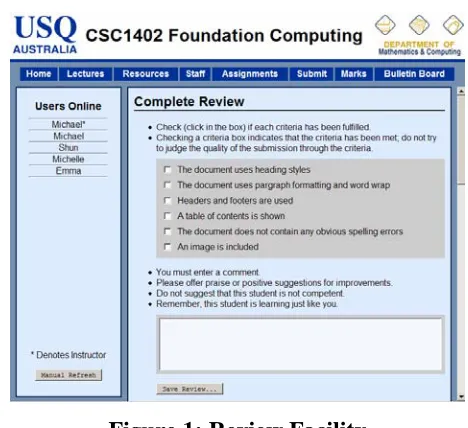
Figure 1: Review Facility
Description of the Innovation
Students submit eight assignments over the semester, seven of which are peer reviewed. During the semester students create word processing documents,
spreadsheet documents, presentations and HTML documents. Students are introduced
[image:4.595.93.509.542.734.2]to an application then use that application to explore theoretical parts of the course. Students submit assignments electronically through a Web facility. To prevent incorrect submission, students must submit assignments in order. As students will see other students' solutions when completing reviews, only one submission is permitted per assignment. Students can (repeatedly) practice using the submission and review systems with a pseudo-assignment to build confidence before actual submission and reviewing. As deadlines are regular and frequent, heavy late penalties apply and late assignments are only accepted for five days after the due date. Students can work ahead by submitting early. Some students have completed all assignments during the first half of the course.
After submission, students are automatically allocated two other students' works to review. The allocation algorithm is sufficiently complicated so students cannot anticipate who will review their work. Students are awarded marks for completing reviews. The first four students to submit must wait for other assignments to be submitted before they can review. The system then notifies these students by email when reviewing is possible.
Each student downloads and anonymously reviews the work of two other students based on set criteria using the facility shown in Figure 1. Students are required to give a comment and are encouraged to give praise and constructive criticism. Student reviews are used as the basis for marking. The success of the system relies on students being able to make consistent and fair reviews. To achieve this, criteria must be objective and easily discerned. Students must be able to correctly recognise whether criteria have been met in the work of a peer, even if they have failed to meet the criteria in their own work. Criteria focus on completeness of task rather than judgement of quality; this reduces ambiguity and increases consistency among reviewers. Students are asked to make encouraging observations and suggest improvements in comments that accompany the review. Students are made aware of the criteria in the assignment specification, so they know how they will be reviewed before they submit.
reviews are also moderated. If a student is unhappy about the review they received, they can flag it for instructor moderation. Instructors utilize the same form students use for completing reviews, but employ a tabular interface to launch the moderation process as shown in Figure 2. Instructors performing moderation have access to a large pool of information about each submission, the student who submitted it and the students who reviewed it. This aids in detecting plagiarism and checking for possible collusion. Over the semester about half of all submissions are moderated. The number of instructor moderations is tracked so that students who have not been moderated previously can be targeted.
Outcomes and Evaluation
The system was piloted during the summer semester (November to February) 2004-2005 with 160 externally enrolled students. One of the most pleasing results was the speed with which students received their first feedback (usually a peer review). Half of all submissions received feedback in 1hr 21min or less. There were exceptions as some students submitted well in advance of the deadline
and at least three submissions must accumulate before any reviewing can commence.
Table 1:Time from
submission to first feedback
Min 3min 1st Quartile 34min
Median 1hr 21min
3rd Quartile 4hrs 19min
90% 14hr 11min
using this system. Participants had the opportunity to add comments which are examined in de Raadt, Toleman and Watson (2005).
Demographics
<25 26-35 36-45 46-55 >56
Ages
0 10 20 30 40
No use Irregular use Weekly use Use every few days Daily use
Computer Use
0 10 20 30 40
No use Irregular use Weekly use Use every few days Daily use
Web Use
[image:7.595.72.523.144.238.2]0 10 20 30 40
Figure 3: Age and Computer Experience
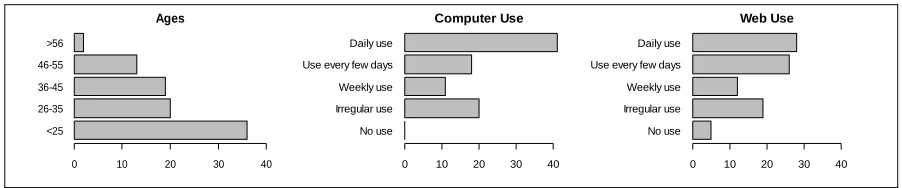
Three quarters of the participants were female and one quarter was male, which
was representative of the students enrolled in the course. Figure 3 shows number of
student responses to questions of age range and level of computer and Web use prior
to commencement of the course. Students who participated in the survey covered a
wide age range; 40% of participants were 25 or under, the remaining participants
could be considered as 'mature aged'. All participants had used a computer prior to
starting the course. Very few participants had not used the World Wide Web before
studying in the course.
Each of the 24 survey statements is shown below with a summary of responses.
Possible levels of agreement were strongly agree (SA), agree (A), neutral (N),
disagree (D), or strongly disagree (SD). In summaries the number of responses to
each level of agreement is revealed in the bar chart on the right. On the left of this the
distribution of responses is exhibited using a box and whisker plot with a mean
response indicated by the horizontal middle line of the box, a single standard
deviation shown by the box around this and two standard deviations shown by
Ease of Use
1. The process of uploading assignments was easy to follow.
SA A N D SD
0 10 20 30 40 50
2. I felt limited by only being able to submit each assignment once. (Negative)
SA A N D SD
0 10 20 30 40 50
3. Submitting assignments electronically requires less effort than submitting an assignment on paper.
SA A N D SD
0 10 20 30 40 50
4. The process of reviewing other students' assignment submissions was easy to follow.
SA A N D SD
0 10 20 30 40 50
5. The review criteria were objective which made reviewing simple.
SA A N D SD
0 10 20 30 40 50
Participants indicated the process of submitting and the process of reviewing and
applying review criteria (in statements 1, 4 and 5 respectively with agreement SA+A
over 83% in each) were easy to follow. This indicates that the facility was well
designed and implemented. The vast majority of participants recognised that there
was less effort in submitting electronic assignments compared to a paper submission
(statement 3, SA+A=89%). A neutral response was given about being limited by one
submission per assignment (negative statement 2, D+SD=49%, N=31%,
SA+A=21%). There was a mechanism for dealing with accidentally submitting
incorrect documents, which required instructor intervention, but students were not
Benefits to Learning
6. The assignments required me to reflect on my use and understanding of computers. SA A N D SD
0 10 20 30 40 50
7. The assignments forced me to research and learn beyond the materials provided. SA A N D SD
0 10 20 30 40 50
8. I did not receive enough support to complete the assignments. (Negative) SA A N D SD
0 10 20 30 40 50
9. Completing regular assignments forced me into a regular pattern of study.
SA A N D SD
0 10 20 30 40 50
10.The assignments were too big and took too much time to complete. (Negative) SA A N D SD
0 10 20 30 40 50
11.When I saw other students'
submissions I compared them to my own work.
SA A N D SD
0 10 20 30 40 50
12.Through completing reviews of other students' work I developed a better understanding of the concepts covered in each assignment. SA A N D SD
0 10 20 30 40 50
13.The feedback I received from my peers through reviews was useful to my understanding of each assignment.
SA A N D SD
0 10 20 30 40 50
Without prompting most participants saw the system's learning benefits. The
assignments caused the greater majority to reflect on their computer use (statement 6,
SA+A=88%). Completing regular assignments forced students into a regular pattern
of study; most participants recognised this (statement 9, SA+A=79%, N=11%,
D+SD=10%). A strong correlation was found between students with little prior
computer/web use and those who reported being forced into a regular pattern of study
(Pearson r=0.39, p<0.05). This may be because they were forced to use a computer
more regularly to complete assignments, submit and review. The same group was
also correlated to a strong response in reflecting on their understanding of computers
(Pearson r=0.28, p<0.05). Participants indicated completing reviews caused them to
compare their own work with their peers' (statement 11, SA+A=89%) and through
completing reviews, most students developed better understanding of concepts
(statement 12, SA+A=70%, N=19%, D+SD=11%). The assignments were successful
in forcing most participants to learn beyond the materials (statement 7, SA+A=71%,
N=13%, D+SD=16%). Participants were not prompted to suggest if they felt this was
a positive or negative aspect of the course. Many participants were neutral about
whether there was enough support provided to complete assignments (negative
statement 8, D+SD=57%, N=30%, SA+A=13%). The assignments were designed to
assistance was provided through several means, but this response may indicate that many students expected a more prescriptive teaching approach. Participants indicated the assignments were not too large (negative statement 10, D+SD=68%, N=20%, SA+A=12%), however there were a reasonable proportion who did feel the assignments were too large. It is difficult to determine if these participants were responding from a learning perspective or from a workload perspective. One aspect which became apparent was that many participants were neutral about, or gave little value to, the reviews of their work conducted by peers (statement 13, SA+A=48%, N=33%, D+SD=19%). This may be because students felt the assessment of their work by peers carried little expertise (as indicated by some student comments) or that the amount of feedback or aspects reviewed were not sufficient using the review system.
Time
14.I worked ahead through the semester to get my
assignments in early.
SA A N D SD
0 10 20 30 40 50
15.Feedback about my submissions came rapidly from peers and instructors.
SA A N D SD
0 10 20 30 40 50
Some students did work ahead; most submitted on the due date. In comments from
students, some said they liked the idea of being able to work ahead, but did not take
advantage of it. Of course, working ahead was not required, but from students'
comments, some participants misconstrued this statement as suggesting they should
have been working ahead and were expressing that this was not required. The vast
majority recognised the response time benefits (statement 15, SA+A=82%, N=17%,
Quality
16.Feedback on my submission was as good or better than what I would expect on paper based assignments marked by hand by an instructor. SA A N D SD
0 10 20 30 40 50
17.The reviews I received were fair
and consistent. SA
A N D SD
0 10 20 30 40 50
18.I would rather receive marks from instructors only. (Negative) SA A N D SD
0 10 20 30 40 50
19.Help was available if I had trouble using
the system. SA
A N D SD
0 10 20 30 40 50
20.I would be happy to use the same submission and review facilities in other courses. SA A N D SD
0 10 20 30 40 50
Participants expressed varied opinions on whether feedback they received was
superior to assignments hand-marked by an instructor (statement 16, SA+A=41%,
N=37%, D+SD=22%). While the system delivers rapid feedback from more sources
and other learning benefits through reflection, it does not necessarily deliver better
feedback than a hand-marked paper assignment. One goal of the system is to match
the feedback quality possible with hand-marking. Part of this feedback quality relies
on students providing accurate reviews. Participant's responses varied widely about
peer feedback compared to instructor-only feedback (negative statement 18,
D+SD=38%, N=37%, SA+A=26%). It was noted during moderation that some
students did not give useful comments or made errors during reviews. It is possible
for a student to complete a review without viewing the submitted document by blindly
checking all criteria boxes and leaving a comment such as, "Well done." Instances of
this were discovered due to conflicting student reviews. One student had reviewing
marks removed where it was obvious they had not made an effort to review their
peer's work.
Most participants felt the reviews they had received were fair and consistent
indicating the set criteria were objective and easily discerned (statement 17,
SA+A=76%, N=17%, D+SD=8%). Most students felt there was help available if
few students requested assistance during the initial running of the system. This approving response is perhaps also indicative of the system's perceived ease of use.
Perhaps the biggest endorsement of this approach is most participants agreeing that they would like to use the same facilities in other courses (statement 20, SA+A=76%, N=9%, D+SD=16%). Some participants commented that this should definitely happen.
Interaction
21.Interacting with peers through reviewing motivated me to produce better assignments. SA A N D SD
0 10 20 30 40 50
22.Communicating with peers through reviewing gave me the sense I was not alone in my studies.
SA A N D SD
0 10 20 30 40 50
23.Seeing other students using these facilities encouraged
me to use them also. SA
A N D SD
0 10 20 30 40 50
24.Completing reviews anonymously allowed me to give feedback without bias. SA A N D SD
0 10 20 30 40 50
One aspect of general technology adoption (commonly applied to business and
industry settings) involves potential adopters witnessing colleagues, especially
superiors, using the proposed technology. A majority of participating students in this
study felt encouraged by seeing their peers use the system, but there was a large group
who were ambivalent (as suggested by statement 23, SA+A=54%, N=32%,
D+SD=13%). This may be because all participants were studying externally, not
having face-to-face contact with their peers. This may also be an indicator of an
approach to study that differs from an industrial/business setting or it may indicate
that participants did not see their student peers as superiors. One might think that a
student, knowing their peers would be reviewing their assignment, might be motivated
to produce a better assignment submission. Again a majority indicated they were
motivated by this, however there was a large group who were neutral or not motivated
(statement 21, SA+A=53%, N=28%, D+SD=19%). Perhaps participants were
indicating that they would have produced assignments of high quality if only an
instructor was marking them.
In order to encourage fair and unbiased reviews it is important that anonymity be
to deny marks or provide criticism where appropriate. The system did not identify reviewees to reviewers or vice-versa, however, in several cases, even though submission of anonymous work was encouraged, students identified themselves within the documents they submitted. Despite this, most students acknowledged they felt free to give comments without bias (statement 24, SA+A=81%, N=16%, D+SD=3%).
Participant responses showed it is possible to create a community in the setting described here (statement 22, SA+A=71%, N=19%, D+SD=10%). A feeling of community is essential to avoid effects of isolation that a student can feel when studying independently at a distance.
Conclusions
Electronic peer-reviewing can deliver benefits to students, instructors and the University.
Students benefit by:
• receiving rapid feedback from multiple sources (RQ1),
• being free to work ahead and still receiving timely feedback (RQ2),
• practicing skills relevant to them personally (RQ4),
• evaluating other students' work and reflecting on their own work thus achieving higher order thinking (RQ5),
• learning how to share documents,
• gaining experience in using online computerised facilities, and
• perhaps most importantly, becoming more involved in the course, feeling less
isolated and potentially further encouraging higher order thinking (RQ6).
Most students recognise the benefits of electronic peer reviewing (RQ3).
The University benefits through reduced manual management of assignments at various levels. This could potentially reduce costs for the University.
Feedback from participants showed students found the system easy to use. Electronic submission requires less effort than submitting paper assignments. Regular assignments can force students into a regular pattern of study, particularly those with little previous experience in the content area. By providing clear and objective criteria, fair and consistent peer-reviews can be achieved. Peer reviewing can contribute to a community focussed environment and help to lessen isolation of students studying at distance. Most students would happily adopt this approach in other courses. Using the system does place constraints on students. For example, only a single submission is possible. Students need to feel comfortable about the submission and review processes. Students need to be assured that when problems arise they can be resolved by an instructor easily and without penalty. The reviews and comments made by peers are not valued highly by many students. Encouraging greater accuracy may raise this value. Students must feel they are being assessed regularly by course instructors, even if it is not apparent for all assignments. Students are not likely to be motivated by what their peers think when determining their willingness to use such a system.
The benefits of the facilities and assessment approach discussed here are not apparent to all students. It is incumbent on instructors to explain the benefits of the peer-review process to students. Examiners should admit that reducing marking load is a motivation for using peer-review and assessment systems. It is then possible to claim that time saved can be applied to more productive teaching. The benefits to the student from reviewing such as evaluation, rapid feedback and other aspects of the approach could be explained to students so they are more aware of why such systems are used.
increased from 40% to 56%. The peer-review system shown here is being considered for use in other courses, including an introductory programming course. The next phase of system development is to modify the system so it can be applied to new courses rapidly.
References
Bloom, B.S. (Ed) (1956) Taxonomy of Educational Objectives Handbook 1: Cognitive Domain. New York: Longman, Green & Co.
Brook, C. & Oliver, R. (2003) Online learning communities: Investigating a design framework. Australian Journal of Educational Technology, 19(2), 139-160.
Chapman, O.L (2006) The White Paper: A Description of CPR. Available online at http://cpr.molsci.ucla.edu/cpr/resources/documents/misc/CPR_White_Paper.pdf (Accessed 23rd Feb, 2006).
de Raadt, M, Toleman, M & Watson, R (2005). Electronic Peer Review: A large cohort teaching themselves? Proceedings of the 22nd Annual Conference of the Australasian Society for Computers in Learning in Tertiary Education
(ASCILITE2005). Brisbane, 4-7 December, 2005.
Kurhila, J., Miettinen, M., Nokelainen, P., Floreen, P. & Tirri, H. (2003) Peer-to-Peer Learning with Open-Ended Writable Web, Proceedings of the 8th Annual Conference on Innovation and Technology in Computer Science Education, 173-178, ACM Press.
Prins, F.J., Sluijsmans, D.M.A., Kirschner, P.A. & Strijbos, J. (2005) Formative peer assessment in a CSCL environment: a case study, Assessment & Evaluation in Higher Education, 30(4), 417-444.