Page - 1
ARE EQUIPMENT SIMULATORS EFFECTIVE WHEN USED FOR TECHNOLOGY-BASED TRAINING?
P. Gibbings K. McDougall
Faculty of Engineering and Surveying University of Southern Queensland
TOOWOOMBA QLD 4350
Peter.Gibbings @usq.edu.au [email protected]
ABSTRACT
Formal technology-based training can be costly for all concerned. Efficient and effective alternatives to face-to-face training need to be found. One option is to use equipment simulators before undertaking formal training so that hands-on training can be conducted at a more advanced level and thereby increase efficiency.
INTRODUCTION
Learning does not stop with the completion of a high school certificate or a higher education qualification. Our world is constantly changing and both universities and industry are now adopting strategies to integrate both education and training to support life-long learning (Eden et al., 1996). With the growing influence of technology, many professionals, encouraged by their professional associations, have adopted the principles of continuing professional development (CPD) and life-long learning to maintain their continuing professional competence throughout their careers. As well as those professional bodies that encourage CPD, corporations are also discovering that training can lead to a positive return on investment. For example, Motorola estimates that every dollar spent on training will return thirty dollars in increased productivity over three years (Elkner, 2001).
However, the delivery of effective technology-based training requires the dedication of significant resources. There are substantial costs involved in the training activity itself; time is required to undertake the training, travel and accommodation costs can be substantial, and having to travel to a distant venue to undertake the training is often inconvenient.
There is also a perception that training in the use of equipment in technology-based areas requires expensive resources and hands-on training to be effective. This paper tests the hypothesis that equipment simulators can be an effective and efficient alternative to hands-on training in the use of sophisticated field equipment. Although GPS is used as a case study, it is believed the information is relevant to any general technical training, and is not limited just to surveying/geomatics training.
LEARNING AND SIMULATION
An understanding of the user needs, effectiveness of different training mechanisms and the limitations of simulations are essential in delivering pedagogically sound training. The mode of delivery and the instructional approach also impact on simulated technology training. Existing literature on learning styles, delivery modes, problem based learning and simulation are reviewed to provide a framework for this research.
Learning Styles
There are a variety of different approaches to learning (Ramsden, 1992). The so-called deep approaches are associated with a higher quality of learning. For example, if someone tells you something, you hear it, if they show you something, you remember it, but if you discover it yourself, you understand it (Gilbert, 1996).
Kolb (1984) suggests that some people can best learn by using concrete experiences such as touching, feeling, seeing and hearing, whilst others learn best by abstract means such as mental or visual conceptualisation. He suggests that once information is perceived, it is processed either by: active experimentation (doing something with the information), or reflective observation (thinking about it). This led to his identification of the four learning styles of: Concrete Experience, Reflective Observation, Abstract Conceptualisation and Active Experimentation. Kolb is only one of many researchers (e.g. Ballantyne and Packer, 1996; Daniels and Fleming, 1996; Faire and Cosgrove, 1990) to develop similar models that differentiate between the mental (thoughts, objectives, concepts), relational (organising, assessing, connecting) and the physical (doing, producing, action) dimensions of learning.
This research suggests that any technical training involving simulators should contain a combination of elements of each mode of learning and should include:
• Demonstrations, simulated field-work and observation procedures (Kolb’s concrete experience); and
Page - 3
A common problem in teaching practical concepts is the lack of real-life experience of the concepts being taught. For this reason interactive delivery modes and the use of equipment simulations are seen as useful tools for technical education and training. Delivery mode is an important consideration for education because research indicates that to achieve effective understanding, trainees may need to process information in more than one mode (Fleming, 2002; Kolb, 1984). Other researchers (Bell and Fogler, 1995; Fleming, 2002; Gibbings, 2003) have reported that the majority of trainees prefer a multi-modal approach to learning.
The VARK (Fleming, 2002) modal system is an approach to understanding people’s preferences to learning methods. VARK is an acronym for:
• Visual (a preference for graphics);
• Aural (a preference for voice and hearing);
• Read/Write (a preference for written information); and
• Kinaesthetic (a preference for learning by experience and practice).
Research using the VARK model indicates a high percentage of trainees prefer a combination of these delivery modes. This implies that technical training that makes use of simulators should include practical exercises that facilitate experience, reflection and feedback (kinaesthetic).
Laurillard (2002) supports the view that interactive simulations in computer-based courseware can promote sound understanding of a subject area and support the concept of experiential learning.
Simulation and Problem Based Learning
Simulations enable complex theory to be understood through the use of realistic computer generated animations (Laurillard, 2002; Shortis et al., 2002). They are recognised as an efficient and effective way of teaching complex dynamic systems (Parush et al., 2002) and can provide multiple perspectives on knowledge (Davies, 2002). Simulation environments encourage learners to manipulate parameters and to visualise results (Rose et al., 1998). The use of simulations for teaching and learning are widespread in the sciences, engineering and geomatics (Bell and Fogler, 1995; Cole and Tooker, 1996; Davies, 2002; Nahvi, 1996; Rose et al., 1998; Shortis et al., 2002).
In academic settings, the emphasis is generally on development of concepts (Nahvi, 1996) and enhancement of lectures and tutorials. In industry, simulators are proving to be a cost effective training tool (Rose et al., 1998). Simulators may be divided into two basic groups: inanimate (off-line) simulators and live (on-line, real-time) simulators (Nahvi, 1996). Inanimate simulators provide powerful computational engines for analysis and design but allow limited user interaction or real-time capability. On the other hand, live simulators either require or encourage a high degree of interaction and attempt to closely simulate real-time results. Virtual reality (VR) is an emerging simulation interface characterised by immersion technologies that makes the user believe they are within the computer-generated environment (Bell and Fogler, 1995).
Finnegan (2005) suggests that the use of problem/project based learning (PBL), and associated experimentation and interactivity with equipment simulators, will foster deep learning. PBL is a specific instructional approach that was first implemented by Howard Barrows in medical education in the early 1970s and has continued to be developed and refined (Barrows, 1994). The approach encourages the learner to become involved in activities that simulate real life and follow specific problems that are structured to develop the learning process. Many instructional models across a range of disciplines have adopted a PBL approach (Funicane et al., 2001; Gibbings and Morgan (in press); Johnston et al., 2000; Ping et al., 2001; Struijker-Boudier and Smits, 2002; Woods, 1985).
Shortis (2000) reported the development of a problem-based presentation on the web for teaching plane surveying. In this case the problem-based approach concentrated on design and analysis, and gave less emphasis to issues such as the fine details of instrument handling and field procedures. This approach provided trainees the benefit of being able to concentrate on learning general field procedures through simulations and animations without the intimidating effects of having to use complex instruments. As a consequence of this work, the benefits of simulated field-work have been demonstrated for both spatial science and other disciplines (Shortis, 2000).
Although this work provides some evidence to support the proposition that equipment simulations and animations can be an effective training tool when used in a PBL context, a better understanding of the effectiveness of equipment simulators is required.
RESEARCH METHODS
Evaluation and validation of GPS simulators was conducted by a survey methodology with a sample group of trainees completing a number of questionnaires throughout GPS training that utilised simulators. The target audience consisted of small groups of university students and participants from industry. It is noted that, although the trainees represented a wide cross section of experience levels, the small sample sizes limit conclusions that can be drawn.
The participants’ core skill level before and after training with the simulators was used as the basis of comparison. Initially an assessment was made of the knowledge levels and core attributes the users had before undertaking training using simulators. After the training an assessment was made as to whether or not the learning objectives were actually achieved as a result of the training. Thus, perceived and actual changes in the knowledge levels and core skill attributes of the participants were measured. The inference was that any gains in skill levels would be as a result of the training undertaken using equipment simulators.
Two different tests using simulators were undertaken. Evaluation A examined the effectiveness of interactive simulators through demonstration in a workshop environment. Evaluation B examined the effectiveness of interactive simulators used by trainees themselves.
Testing Procedure for EvaluationA
The effectiveness of training materials was assessed by presenting the materials to the sample groups in a face-to-face environment. Each training session comprised a PowerPoint presentation, discussion by the presenter and handout information. For this test, the use of a GPS controller/data collector was demonstrated with the aid of a fully functional simulator.
Figure 1. TSC1 Controller (left) and Simulator (right). (Source: Trimble Certified Training material and TSC1 simulator 2002)
Fifteen participants in three separate groups were evaluated by a three stage questionnaire. Participants were asked to complete the first part of a questionnaire before they started the classroom session, the second section after the classroom session in which the simulator was used to demonstrate the equipment, and the last section after completing the field exercises in which they used the GPS controller in the field. The first part of the questionnaire examined the participant’s experience with respect to surveying, GPS technology and the specific equipment. The second part of the questionnaire investigated the participant’s perceptions about the quality and effectiveness of the training materials. The last part of the questionnaire related to determining the participant’s actual ability to use the equipment in the field.
Testing Procedure for Evaluation B
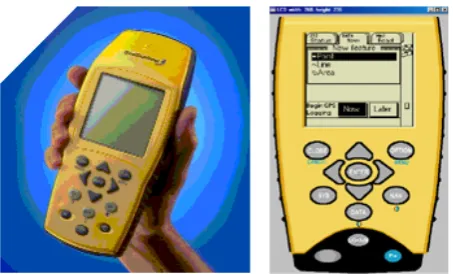
The effectiveness of having trainees use the simulator themselves was evaluated by having them utilise the manufacturer’s interactive CD, which provides instruction on the use of the GeoExplorer 3 mapping GPS (Figure 2). In this case, the participants themselves used the simulators. The GeoExplorer 3 is a hand held GPS receiver designed for geographic information systems (GIS) and mapping applications.
Figure 2. GeoExplorer 3 (left) and Simulator (right). (Source: Trimble’s Certified Training Materials and GeoExplorer 3 simulator 2002)
The interactive multimedia CD contains a tutorial showing how to use the GeoExplorer 3 and is designed to help trainees learn how to use the system to collect and update data in the field.
[image:5.595.196.421.86.271.2] [image:5.595.187.414.540.677.2]This is achieved by stepping through a simulation project dealing with all stages of a real life project (a strategy supported by researchers such as Laurillard (2002) and Shortis et al. (2002).
The interactivity involved participants making several responses on the simulation screen when prompted by audio commands. Figure 3 illustrates how this interactivity and instruction is achieved.
Figure 3. GeoExplorer 3 CD instructions. (Source: Trimble’s GeoExplorer 3 System Product Overview CD 2001)
Ten trainees were evaluated using a three stage questionnaire similar to the Evaluation A. The first part of the questionnaire was completed before they started the training, the second part was completed after training using the interactive CD, and the third and final part was completed after completing a field exercise using the GeoExplorer 3. The first part of the questionnaire evaluated the participant’s experience with respect to surveying, GPS technology in general and the GeoExplorer 3 system. The second part of the questionnaire related to investigating the participant’s perceptions about the quality and effectiveness of the training. The last part of the questionnaire related to assessing the participant’s actual ability to use the equipment in the field and to perform specific tasks with the equipment. The responses were then used to gauge the effectiveness of both the PBL presentation and the interactivity with the equipment simulator in meeting learning objectives.
RESULTS Evaluation A
The main focus of the assessment was to identify changes in the skill and knowledge levels the trainees possessed before and after the training. Any change was then assumed to be as a direct result of the training.
Figure 4. Experience with TSC1 Data Collector
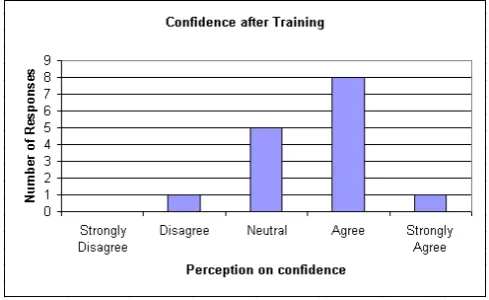
After the workshop demonstrations of the simulator, trainees were asked if they were now confident that they would be able to use the data collector and software in the field. Responses are shown in Figure 5.
Figure 5. Perception on confidence level after training with simulator
Responses indicate that, after the workshop demonstrations of the simulator, only 60 percent expressed some confidence that they would be able to effectively use the equipment in the field (Figure 5). Only one participant indicated that they were not confident and this participant had no prior experience with the data collector. The confidence of participants was statistically correlated with both previous experience (r = 0.68), and their satisfaction with the training materials (r = 0.55).
It is interesting to compare the results on participants’ confidence levels shown in Figure 5 with their actual ability in the field. Subsequent to a field exercise that required the use of the data collector, participants were asked if they were able to use the controller and software effectively in the field during the field exercise. Responses are shown in Figure 6.
[image:7.595.175.420.307.457.2]Figure 6. Ability to use TSC1 after field exercise
[image:8.595.179.421.70.219.2]Concerns of the 40 percent who did not express some confidence that they would be able to effectively use the equipment (Figure 5) proved unfounded since all of the participants reported being able to effectively use the equipment in the field except one who was neutral (Figure 6). It was concluded that confidence levels themselves are not necessarily a reliable indicator of actual ability.
Although some participants lacked confidence, 14 out of the 15 respondents agreed or strongly agreed that they could, in fact, effectively use the data collector in the field. The remaining respondent was neutral on this aspect. It was concluded that the simulator had been effective in teaching participants how to use the data collector even though the equipment had not been used in the field during the initial training.
Most importantly, the results suggest that it is possible to conduct effective training in the use of field equipment through the use of simulators alone. Using the equipment only served to add to the user’s confidence in their ability. This has important implications for technical training, PBL and CPD.
Evaluation B
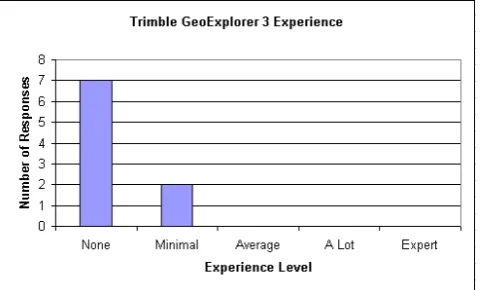
The group in the second evaluation represented a wide cross section of experience levels. Three of the participants indicated that they had less than one years surveying experience, whilst four of the participants indicated that they had greater than ten years surveying experience. All trainees had less than five years general experience with GIS. All of the trainees reported less than average experience with the GeoExplorer 3 (Figure 7), and seven of the nine trainees reported never having used one before.
[image:8.595.179.420.556.701.2]Figure 8 indicates that 100 percent of participants agreed or strongly agreed with the suggestion that the interactive CD explained the concepts and communicated information clearly.
Figure 8. Interactive Training Explained Concepts and Communicated Information Clearly
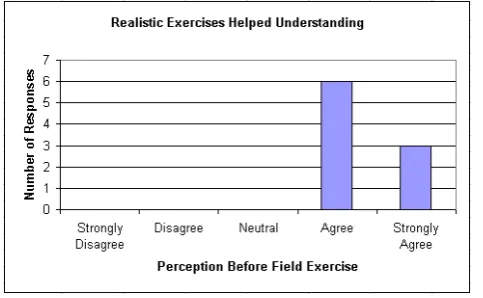
When asked if the interactivity (with equipment simulator) helped them understand the operation of the GeoExplorer, 100 percent of participants agreed or strongly agreed that it had helped their understanding. This is a strong indication that the interactivity with the equipment simulator was effective in teaching the use of the equipment without actually having to demonstrate the equipment itself in the field. All of the participants agreed or strongly agreed to the suggestion that the presentation of the information in several exercises in a realistic project helped them understand it. Figure 9 summarises the results to this question.
Figure 9. Realistic Exercises Helped Understanding
This reinforces findings from the theory that the use of interactivity with equipment simulators, particularly presented in a PBL environment, is an effective way of delivering GPS training.
Responses to questions indicate that the interactivity with equipment simulators was also effective in giving participants confidence in their ability to use the equipment. This understanding of the operation of the equipment was achieved by using the interactive equipment simulators: no participant had access to the equipment at this stage.
Page - 9
[image:9.595.179.421.420.569.2]Figure 10. Could the same ability have been achieved by using Interactivity and the Simulator on the Internet?
The respondents who disagreed with this suggestion had some experience with GPS and GIS before the training course. One had more than ten years surveying experience and the other had no surveying experience. Neither had any experience with the GeoExplorer before the training. Therefore, it is considered likely that the need for some level of hands-on training may be more of a personal issue than being related to the pre-existing level of experience. These findings indicate that some level of hands-on training (or training by some other mode) may be needed regardless of how confident participants are in using the equipment after any interactive training.
All participants agreed or strongly agreed that they were able to use the GeoExplorer and software effectively in the field. Figure 11 provides a summary of responses to this question. Note that this high level of competence was achieved from training with the interactive equipment simulator alone.
Figure 11. Could use the GeoExplorer 3 effectively in the field?
Nine core areas of competence were identified to determine if the training with the interactive equipment simulator was effective. Participants were asked after the field exercise if they could:
• Turn the instrument on • Check the battery status • Check the GPS status
• Identify if real time corrections were being used • Identify if GPS data was being logged
[image:10.595.180.419.83.229.2] [image:10.595.180.419.448.592.2]• Log area information
• Attach Data Dictionary and Attribute information to logged GPS data.
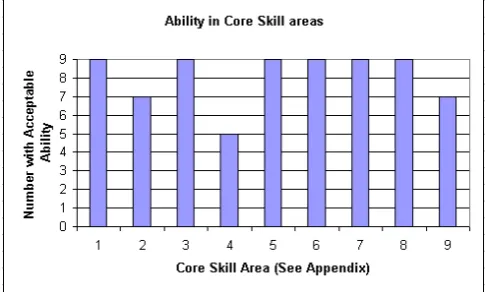
Of the nine main areas of competence identified in the questionnaire, 100 percent believed they had achieved six of them, 78 percent believed they had achieved eight, while 56 percent believed they had achieved all nine. Results are summarised in Figure 12.
Figure 12. Ability in core skill areas after the training and field exercise
It is considered that this is a strong indicator that learning objectives had indeed been achieved by training with the interactive simulator alone.
These results indicate that interactive GPS training using equipment simulators presented in a suitable environment can be effective in teaching operations of field equipment. The success of the simulators implies that effective training can be carried out without having to take the equipment into the field for training. However, the results also indicate that this is not the case for all people, and some at least will still need some hands-on training with the equipment to reach an acceptable level of competence and confidence. From this analysis it can be concluded that the interactivity with equipment simulators was a critical component of the learning process.
There is also evidence that those who gained a sound general understanding of the GeoExplorer 3 concepts from the interactive training did so in several (or all) areas of its operation including downloading and field data processing. This indicates that interactivity with equipment simulators can be effective for different types of applications other than training for field operations.
DISCUSSION
Great difficulty was experienced in getting large numbers of respondents to the questionnaires since the evaluations were conducted before, during and after formal commercial training. The sample sizes were small because the time required to undertake the testing was considerable, and in some cases also involved considerable financial expense for the participants. Therefore, in some instances, extrapolation of these figures has occurred from less than optimal sample numbers. Nevertheless, because the samples were considered representative of young surveyors across a wide range of the profession, the results are considered valid and in each case are adequate for the purposes of this research.
The results indicate that interactivity with equipment simulators in a workshop environment can be very effective as a learning tool. The case studies also show that it is possible to effectively train people in both fundamentals and operation of complicated field equipment without actually using the equipment itself in the field.
[image:11.595.197.440.163.309.2]The studies indicated that confidence levels themselves are not a reliable indicator of actual ability. Using the equipment after appropriate training only served to increase confidence levels. It was shown that the trainee’s skill and ability could be brought to an adequate level by training, in an appropriate manner, with interactive equipment simulators alone, and that this could be done regardless of what their initial confidence indicated.
It is recognised that the success of the training delivered in a face-to-face environment is a function of both the effectiveness of the materials, and the competence of the trainer. It is therefore recommended that an attempt be made to estimate the impact of these two elements to determine to what extent conclusions drawn from testing in the face-to-face mode can be extrapolated to web-based delivery.
The Internet has the pedagogical (and perhaps economic) advantage of being able to combine several delivery modes in a single user interface. This is important as research suggests that a multimedia approach will be most effective for the delivery of training in technical areas. Nonetheless, indications are from other research (McDougall et al., 2003) that, for a small minority, the web may not be the most appropriate or effective technology to use for the delivery of training and alternative strategies may need to be put in place. Furthermore, it has been suggested that students learn best when a variety of teaching methods are used (Bell and Fogler, 1995). It should also be recognised that the efficiency gains from web-based training can easily be negated if the quality of the learning materials is poor (Psaromiligkos and Retalis, 2003). As well as these pedagogical reasons, it may also be inconvenient to present training on the Internet because of issues such as download times, feedback, response times and maintenance.
However, the media used for existing or new training in the use of equipment may change from the face-to-face approach that has traditionally been used. Interactivity and PBL were identified as critical elements in the design of effective technical training when simulators are used. This may mean some consequential changes to the design and development of training materials. The findings of these case studies are useful for the design and development of training using a PBL approach in general and may impact on how teaching is carried out in the future.
Although the sample sizes in the evaluations are less than optimal, there is a strong indication that training using equipment simulators has been effective, and may be able to replace some, or all, of the practical component of equipment training. At the very least, using simulators for technical training should make any hands-on training that might be required much easier and more efficient to conduct because of the prior exposure to techniques and methods. Therefore, the training can concentrate on practical aspects only, thereby saving considerable time at the training sessions. The practical training could also be conducted at a more advanced level because there would be an expectation that participants at these field sessions would have already reached an advanced level of knowledge and understanding.
Page - 13 CONCLUSION
An understanding of the user needs, effectiveness of different training mechanisms and the limitations of equipment simulators are essential in delivering pedagogically sound training in technologically advanced areas.
The results of this research indicate that, if developed appropriately, technology-based training using equipment simulators can be effective in meeting the learning objectives of trainees in a technical environment. The use of equipment simulators is in harmony with the emerging paradigm in professional education that recognises the need to produce graduates with the skills necessary to cope with constantly changing technology. Interactivity and PBL were identified as important elements in the design of effective technical training when simulators are used.
This paper has demonstrates that use of equipment simulators for technical training can be an effective strategy in training for the use of complex equipment and in meeting the learning objectives of trainees. If training is appropriately designed, developed and presented, it may take the place of at least some of the traditional face-to-face and hands-on instruction with equipment that has been considered essential in the past. Simulators can be used by trainees before attending formal training, such as workshops and practical field exercises, enabling subsequent hands-on training sessions to be conducted at a more advanced level. This may lead to significant savings for both the trainees and the trainers, which has ramifications for educators and CPD providers.
REFERENCES
Ballantyne, R. and Packer, J. (1996) Making Connections - Using Student Journals as a Teaching/Learning Aid, HERDSA, Canberra, pp. 5-7.
Barrows, H.S. (1994) Practice-Based Learning: Problem-Based Learning Applied to Medical Education, South Illinois University School of Medicine, Springfield, EL, pp. 1-3.
Bell, J.T. and Fogler, S. (1995) The investigation and application of virtual reality as an educational tool, Proceedings of American Society for Engineering Education 1995 Annual Conference, Anaheim, CA, June, pp. 2-3.
Cole, R.W. and Tooker, S.C. (1996) Physics to go: web-based tutorials for CoLoS physics simulations, Proceedings of 1996 Frontiers in Education of the IEEE and ASEE, Salt Lake City, Utah, 6-9 November, pp. 1-3.
Daniels, D. and Fleming, K. (1996) Curriculum studies in science and technology: an
innovative approach, Proceedings of 1996 Australian Teacher Education Conference, Launceston, Tasmania, July, pp. 1-2.
Davies, C.H.J. (2002) Student engagement with simulations: a case study. Computers and Education, vol. 39, no. 3, pp. 271-82.
Eden, H., Eisenberg, M., Fischer, G. and Repenning, A. (1996) Making learning part of life, Communications of the ACM, vol. 39, no. 4, pp. 40-2.
Faire, J. and Cosgrove, M. (1990) Teaching Primary Science, Waikato Education Centre, Hamilton.
Finnegan, D.M. (2005) Keep 'Learning' in E-Learning, viewed April 2005,
<http://www.clomedia.com/content/templates/clo_article.asp?articleid=853&zoneid= 162>
Fleming, N.D. (2002) The Active Learning Site - VARK, viewed March 2004, <http://www.vark-learn.com/english/index.asp>.
Funicane, P., Nicholas, T. and Prideaux, D. (2001) The new medical curriculum at Flinders University, South Australia: from concept to reality, Medical Teacher, vol. 23, no. 1, pp. 76-9.
Gibbings, P.D. (2003) The Design of Interactive Web-based GPS Training, Masters thesis, University of Southern Queensland.
Gibbings, P.D. and Morgan, M. (in press) A guide for entry level PBL courses in engineering, International Journal of Continuing Engineering Education and Lifelong Learning.
Gilbert, C. (1996) Teaching and Learning on the web at Queensland University of Technology, AUSWEB99, viewed March 2004,
<http://ausweb.scu.edu.au/aw96/educn/gilbert/paper.htm>.
Johnston, C.G., James, R.H., Lye, J.N. and McDonald, I.M. (2000) An evaluation of collaborative problem solving for learning economics, Journal of Economic Education, vol. 31, no. 1, pp. 13-29.
Kolb, D.A. (1984) Experiential learning : experience as the source of learning and development, Prentice-Hall, New Jersey.
Laurillard, D. (2002), Rethinking University Teaching: a conversational framework for the effective use of learning technologies, 2nd edn, Routledge Falmer, London.
McDougall, K., Young, F.R. and Apan, A. (2003) Operational infrastructure for quality distance and online geospatial programs, Cartography, vol. 32, no. 1, pp. 25-37.
Nahvi, M. (1996) Dynamics of student-computer interaction in a simulation environment: Reflections on curricular issues, Proceedings of Frontiers in Education ’96, IEEE, Salt Lake City, Utah.
Parush, A., Hamm, H. and Shtub, A. (2002) Learning histories in simulation-based teaching: the effects on self-learning and transfer, Computers and Education, vol. 39, no. 4, pp. 319-32.
Ping, C.L., Chee, S.T. and Klimas, J. (2001) A problem-based approach to web-based corporate learning, Journal of Instructional Science and Technology, vol. 4, no. 1.
Psaromiligkos, Y. and Retalis, S. (2003) Re-evaluating the effectiveness of web-based learning system: a comparative case study, Journal of Educational Multimedia and Hypermedia, vol. 12, no. 1, pp. 5-20.
Page - 15
Rose, A., Eckard, D. and Rubloff, G.W. (1998) An Application Framework for Creating Simulation-Based Learning Environments, University of Maryland.
Shortis, M. (2000) Virtual learning. Measure and Map, vol. 9, July-August, pp. 41-5.
Shortis, M. and Cartwright, W. (2002) Enhanced teaching and learning in spatial science courses, Proceedings of ISPRS Commission VI Symposium 2002, Sao Jose' dos Campus, Brazil, September.
Shortis, M., Leahy, F., Ogleby, C., Kealy, A. and Ellis, F. (2002) The use of simulation and visual feedback in learning spatial design and analysis concepts, Proceedings of FIG XXII International Congress, Washington DC, USA, April 19-26.
Struijker-Boudier, H.A. and Smits, J.F. (2002) Problem-based learning the Maastricht experience, Trends in Pharmacological Sciences, vol. 23, no. 4, p. 164.
Woods, D. (1985) based Learning and Problem Solving, in D Boud (ed.), Problem-Based Learning in Education for the Professions, Herdsa, pp. 19-40.
Yeh, Y-C. (2004) Nurturing reflective teaching during critical-thinking instruction in a computer simulation program, Computers and Education, vol. 42, no. 2, pp. 181-94.