ISSN 0252-8266
%
eurostat
EUROSTATISTIK
Daten zur Konjunkturanalyse
EUROSTATISTICS
Data for short-term economic analysis
EUROSTATISTIQUES
Données pour l'analyse de la conjoncture
Monatlich D Monthly D Mensuel
6 D 1994
i
Theme / Thème
eurostat
OFICINA ESTADÍSTICA DE LAS COMUNIDADES EUROPEAS
DE EUROPÆISKE FÆLLESSKABERS STATISTISKE KONTOR
STATISTISCHES AMT DER EUROPÄISCHEN GEMEINSCHAFTEN
ΣΤΑΤΙΣΤΙΚΗ ΥΠΗΡΕΣΙΑ ΤΩΝ
ΕΥΡΩΠΑΪΚΩΝ ΚΟΙΝΟΤΗΤΩΝ
STATISTICAL OFFICE OF THE EUROPEAN COMMUNITIES
OFFICE STATISTIQUE DES
COMMUNAUTÉS EUROPÉENNES
ISTITUTO STATISTICO DELLE COMUNITÀ EUROPEE
BUREAU VOOR DE STATISTIEK DER EUROPESE GEMEENSCHAPPEN
SERVIÇO DE ESTATÍSTICA DAS COMUNIDADES EUROPEIAS
L2920 Luxembourg Tél. 43 011 Télex COMEUR LU 3423
B1049 Bruxelles, rue de la Loi 200 Tél. 299 11 11
Las publicaciones de Eurostat están clasificadas por temas y por series. La clasificación se encuentra al final de
la obra. Para mayor información sobre las publicaciones, rogamos se pongan en contacto con Eurostat.
Para los^ pedidos, diríjanse a las oficinas de venta cuyas direcciones figuran en la página interior de la
contracubierta.
Eurostats publikationer er klassificeret efter emne og serie. En oversigt herover findes bag i hæftet. Yderligere
oplysninger om publikationerne kan fås ved henvendelse til Eurostat.
Bestilling kan afgives til de salgssteder, der er anført på omslagets side 3.
Die Veröffentlichungen von Eurostat sind nach Themenkreisen und Reihen gegliedert. Die Gliederung ist hinten in
jedem Band aufgeführt. Genauere Auskünfte über die Veröffentlichungen erteilt Eurostat.
Ihre Bestellungen richten Sie bitte an die Verkaufsbüros, deren Anschriften jeweils auf der dritten Umschlagseite
der Veröffentlichungen zu finden sind.
Οι
εκδόσεις της Eurostat ταξινομούνται κατά θέμα και κατά σειρά. Η ακριβής ταξινόμηση αναφέρεται στο
τέλος κάθε έκδοσης. Για λεπτομερέστερες πληροφορίες σχετικά με τις εκδόσεις, μπορείτε να
απευθύ-νεσθε στην Eurostat.
Για τις παραγγελίες μπορείτε να απευθύνεσθε στα γραφεία πώλησης, των οποίων οι διευθύνσεις
αναγράφονται στη σελίδα 3 του εξωφύλλου.
Eurostat's publications are classified according to themes and series. This classification is indicated at the end of
the publication. For more detailed information on publications, contact Eurostat.
Orders are obtainable from the sales offices mentioned on the inside back cover.
Les publications d'Eurostat sont
classées par thème et par série. Cette classification est précisée à la fin
de l'ouvrage. Pour des informations plus détaillées sur les publications, contactez Eurostat.
Pour les commandes, adressez-vous aux bureaux de vente dont les adresses sont indiquées à la page 3
de la couverture.
Le pubblicazioni dell'Eurostat sono classificate per tema e per serie. Tale classificazione è precisata alla fine
dell'opera. Per informazioni più dettagliate sulle pubblicazioni rivolgersi all'Eurostat.
Per eventuali ordinazioni rivolgersi a uno degli uffici di vendita i cui indirizzi figurano nella 3a pagina della
copertina.
De publikaties van Eurostat zijn ingedeeld naar onderwerp en serie. Deze indeling is achter in het boek
opgenomen. Voor nadere informatie over de publikaties kunt u sich wenden tot Eurostat.
Gelieve bestellingen op te geven bij de verkoopbureaus, waarvan de adressen op bladzijde 3 van de omslag zijn
vermeld.
As publicações do Eurostat estão classificadas por tema e por série. Esta classificação está indicada no firn da
obra. Para mais informações sobre as publicações é favor contactar Eurostat.
EUROSTATISTIK
Daten zur Konjunkturanalyse
EUROSTATISTICS
Data for short-term economic analysis
EUROSTATISTIQUES
Données pour l'analyse de la conjoncture
Luxembourg: Office des publications officielles des Communautés européennes, 1994
© EGKS-EG-EAG, Brüssel · Luxemburg, 1994
Nachdruck — ausgenommen zu kommerziellen Zwecken — mit Quellenangabe gestattet.
© ECSC-EC-EAEC, Brussels · Luxembourg, 1994
Reproduction is authorized, except for commercial purposes, provided the source is acknowledged.
© CECA-CE-CEEA, Bruxelles · Luxembourg, 1994
Reproduction autorisée, sauf à des fins commerciales, moyennant mention de la source.
Vorwort
Mit der monatlich erscheinenden Veröffentlichung
Eurostatistik - Daten zur
Konjunkturanalyse
werden innerhalb kürzester Frist die neuesten statistischen Daten
über die Europäische Gemeinschaft als Ganzes (EUR12), über jedes Mitgliedsland
sowie über die Vereinigten Staaten und Japan bekanntgegeben.
Eurostatistik
enthält nicht die Gesamtheit des bei Eurostat verfügbaren statistischen
Materials, sondern eine Auswahl der relevantesten Reihen über die konjunkturelle
Entwicklung.
Schnelligkeit und Pünktlichkeit sind die wichtigsten Vorzüge dieser Veröffentlichung.
Aus diesem Grunde wurde sie im Umfang bewußt klein gehalten und enthält keine
Anmerkungen zur Methodik, die im übrigen in den spezialisierten Veröffentlichungen
von Eurostat zu finden sind.
Die in
Eurostatistik
veröffentlichten Daten stammen aus dem ICG -Bereich der
On-line-Datenbank Cronos von Eurostat.
Wer Zugang zu Cronos besitzt, kann jederzeit die Tabellen dieser Veröffentlichung
abfragen, wobei die Daten täglich auf den neuesten Stand gebracht werden (Hinweise
zur On-line -Benutzung finden sich auf der letzten Seite). Darüber hinaus sind die
Daten in der Datenbank Eurocron verfügbar, die vom Host Eurobases der
Kommission angeboten wird.
Weitere Informationen über Eurostat und seine Produkte können bei folgender Stelle
angefordert werden:
Eurostat - Informationsbüro Data Shop
L-2920 LUXEMBURG 121, rue Joseph II
Telephon: (352) 4301 34567 Büro 3/235
Telefax: (352) 43 64 04 B-1049 Bruxelles
Inhaltsverzeichnis
Zeichen und Abkürzungen
KURZ NOTIERT
5
KONJUNKTURDATEN
1. Volkswirtschaftliche Gesamtrechnungen . . 35
2. Beschäftigung
39
3. Arbeitslosigkeit
44
4. Industrielle Produktion
49
5. Meinungsumfrage in der Industrie
59
6. Industrieerzeugnisse
65
7. Einzelhandel
70
8. Landwirtschaftliche Erzeugnisse
72
9. Außenhandel
75
10. Verbraucherpreise
106
11. Landwirtschaftliche Erzeugerpreise . . . . 111
12. Löhne und Gehälter
113
13. Finanzstatistiken
114
14. Zahlungsbilanz
121
Anmerkung betreffend Grafiken und Tabellen:
( ) Die Daten beziehen sich auf das Gebiet der
Bundesrepublik Deutschland vor dem
3.10.1990 einschließlich WestBerlin.
πτ1%
πτ4%
πτ12%
BALANCE%
1985=100
EUR 12=100
1000
MIO
MRD
Τ
TJ(GCV)
GWH
USD
ECU
SZR
ESVG
NACE
SITC
EUR
UEBL
ACP
Weniger als die Hälfte der verwendeten
Einheit
Prozent
Prozentualer Zuwachs eines
Vierteljahres gegenüber dem vorher
gehenden Vergleichszeitraum
(Monat.Vierteljahr.Jahr)
Prozentualer Zuwachs eines
Vierteljahres gegenüber dem
entsprechenden Vierteljahr des
Vorjahres
Prozentualer Zuwachs eines Monats
gegenüber dem entsprechenden Monat
des Vorjahres
Saldo zwischen den positiven
Antworten (Zunahme.Verbesserung der
Situation)und den negativen Antworten
(Abnahme,Verschlechterung der
Situation)der Konjunkturumfrage bei
den Unternehmern in der Gemeinschaft
Basisjahr
Gemeinschaft der 10 oder 12 (=100)
in 1000
Million
Milliarde
Metrische Tonne
Terajoule = 109KJ
Gigawattstunde = 106kWh
USDollar
Europäische Währungseinheit
Sonderziehungsrechte
Europäisches System
Volkwirtschaftlicher Gesamtrechnungen
Allgemeine Systematik der
Wirtschaftszweige in den Europäischen
Gemeinschaften
Standard International Trade
Classification
Mitgliedstaaten insgesamt
BelgischLuxemburgische
Wirtschaftsunion
EUROSTATISTIK: kurz notiert
MÊÈÈ
Soweit nicht anders angegeben, beziehen sich die Angaben auf den Gebietsstand der Bundesrepublik Deutschland vor dem 3.10.1990; sie schließen Berlin (West) ein.
WECHSELKURSE: Erste Erhöhung der amerikanischen Leitzinsen seit
fünf Jahren; Dollarkurs erholt sich nicht
Am 17. Mai erhöhte die amerikanische Notenbank erstmals seit Februar 1989 die Leitzinsen und setzte den Diskontsatz um 0,5% auf 3,5% herauf. Gleichzeitig senkte sie die Zielvorgabe für den Tagesgeldsatz um etwa den gleichen Betrag auf 4,25 %.
Die Bundesbank hatte die deutschen Leitzinsen bereits am 12. Mai erneut um einen halben Prozentpunkt gesenkt, so daß der Diskontsatz bei 4,5 % und der Lombard satz bei 6 % lag. Ebenfalls zurückgenommen, und zwar viermal, wurde im Mai der Zinssatz für Wertpapierpensionsgeschäfte; er betrug am 25. Mai 5,20 %. Zusammengenommen hatten diese Zinsänderungen zur Folge, daß der Unterschied zwischen dem amerikanischen und dem deutschen Diskontsatz nunmehr lediglich 1 Prozentpunkt beträgt, gegenüber einem Zinsgefälle von gut 5 Prozentpunkten Ende 1992. Wenngleich an den Devisenmärkten im Zuge der zunehmenden Konvergenz zwischen den amerikanischen und den deutschen Zinsen seit Monaten eine Erholung des USDollar erwartet worden war, reagierte der Dollarkurs kaum auf die Senkung der amerikanischen Zinsen und lag am 19. Mai bei 1,6551 DM. Das sind rund 4 % weniger als zu Beginn des Jahres 1994, als das Zinsgefälle zwischen den beiden Volkswirtschaften noch 2,75 % betragen hatte. Auftrieb erhielt der Dollarkurs nicht einmal durch die Veröffentlichung der USHandelsdaten für den Monat März, denen zufolge das Handelsbilanzdefizit gegenüber dem Vormonat um knapp 20 % zurück gegangen ist. Gegen Ende des Monats festigte sich der Dollarkurs etwas und lag am 27. Mai bei 1,6444 DM.
Ungefähr zeitgleich mit der deutschen Zinssenkung wurden in allen anderen EGLändern mit Ausnahme Griechenlands und des Vereinigten Königreichs verschie dene kurzfristige Leitzinssätze gesenkt. In einigen Fällen wurden Zinssätze mehrfach zurückgenommen, ohne daß die Kurse der betroffenen Währungen maßgeblich nachgaben. Auch in Österreich, Schweden und der Schweiz wurden die Zinsen gesenkt.
Infolge des zunehmenden Drucks auf die Drachme hob die griechische Regierung Mitte Mai = d.h. sechs Wochen früher als geplant = sämtliche noch bestehende Kapitalverkehrskontrollen auf. In der Vorwoche hatte die griechische Zentralbank große Mengen an Devisen auf die Stützung der Drachme verwendet.
Wenngleich die griechische Währung nicht am Wechselkursmechanismus teilnimmt, beabsichtigt die griechische Zentralbank mit ihrer Politik der „harten" Drachme, den Wertverlust ihrer Währung gegenüber anderen EUWährungen im Jahr 1994 auf 7 % zu beschränken. Nach dem Wegfall der Kapitalverkehrskontrollen stiegen die kurzfristigen Zinsen auf Rekordhöhe an. Die griechische Zentralbank setzte ihren Tagesgeldsatz, der seit Oktober 1993 unverändert bei 30 % gelegen hatte, auf 33 % herauf; zusätzlich wird ein Zinsaufschlag von 0,4 % pro Tag gewährt, wodurch sich der Jahreszins auf über 180 % erhöht. Die DreiMonatsInterbankrate betrug am 17. Mai knapp 80%, für Monatsgeld wurde ein Zinssatz von etwas mehr als 100% gezahlt.
In der letzten Maiwoche, als sich ausländischen Anlegern aufgrund von Staatspapie remissionen, die an den Ecu oder den USDollar gekoppelt sind, attraktive Anlagemöglichkeiten boten, war eine leichte Erholung der griechischen Währung zu beobachten, wenngleich sich die kurzfristigen Zinsen weiterhin auf einem hohen Niveau hielten.
RENDITEN VON STAATSANLEIHEN: Renditen weiterhin steigend
Der in den vorangegangenen drei Monaten zu beobachtende Aufwärtstrend der Renditen von Staatsanleihen setzte sich im April in vielen Ländern fort. In allen EGLändern, für die Daten vorliegen, stiegen die Renditen an, wenn auch in manchen Fällen nur geringfügig. In den Vereinigten Staaten war ebenfalls ein Anstieg der Renditen um 0,3 % zu verzeichnen. Mit Ausnahme Deutschlands, Luxemburgs und der Niederlande werden nunmehr in allen EGLändern Renditen von über 7 % erzielt.
Im Gegensatz zur Situation in Europa, wo die kurzfristigen Leitzinsen weiterhin rückläufig waren, steht der Anstieg der amerikanischen Renditen in Einklang mit den jüngsten Erhöhungen der kurzfristigen Zinsen. Weltweit wurden die Märkte für Staatspapiere stark von den steigenden kurzfristigen Zinsen in Amerika beeinflußt.
GELDVOLUMEN: M3Wachstum in Irland verlangsamt sich
Nachdem sich die irische Geldmenge M3 elf Monate lang um über 20 % ausgeweitet hatte, verlangsamte sich die Wachstumsrate im ersten Quartal 1994 und betrug für die zwölf Monate bis März knapp 10%. Wie bereits in einem früheren Bericht erwähnt, schlägt sich darin das Nachlassen der Wirkung bestimmter struktureller Änderungen auf das Geldmengenwachstum nieder. Bei einer dieser struktureller Änderungen handelt es sich um die Einführung einer Steuer auf Spareinlagen, die zu einer Verlagerung der (nicht in M3 enthaltenen) Spareinlagen zu anderen Anlagefor men geführt hatte, die in M3 enthalten sind.
In Spanien war auch weiterhin ein verlangsamtes Wachstum der Geldmenge ALP zu beobachten, die sich auf ein Jahr umgerechnet im Februar um 7,7 % ausweitete, gegenüber 10,3% im Dezember 1993. Auch in Italien verlangsamte sich das Geldmengenwachstum. M2 weitete sich in den zwölf Monaten bis März 1994 um rund 6,8 % aus, verglichen mit einer Zuwachsrate von 7,8 % im Jahr 1993. Nach der Neuorganisation der Erhebung von Geldmengen und Bankenstatistiken liegen nunmehr die Geldmengendaten für Belgien für das Jahr 1993 insgesamt vor. Die M2Wachstumsrate betrug 1993 beinahe 13 %.
AMTLICHE WÄHRUNGSRESERVEN: 1993 Anstieg der EUR ^ W ä h rungsreserven um 3,4 %
Die Währungsreserven ohne Goldreserven der zwölf EGLänder erhöhten sich 1993 um 3,4 % auf ungefähr 260 Mrd. ECU, gegenüber 250 Mrd. ECU im Jahr 1992. Die EULänder hielten damit 1993 28% der gesamten weltweiten Währungsreserven, von denen 7 % auf die USA, 9 % auf Japan, 6 % auf die OPECLänder und 8 % auf Taiwan entfielen.
Der größte Teil der Währungsreserven der Europäischen Union wird von Deutsch land gehalten (24 %, verglichen mit 31 % Ende 1992), gefolgt von Spanien (14 %) und dem Vereinigten Königreich (13%).
PREISE: Jahresinflation der EU unverändert bei 3.2% im April.
Die Jahresinflationsrate der EU — gemessen mit dem Verbraucherpreisindex — blieb unverändert bei 3.2 % zwischen März und April. Der Monatsindex für EUR12 stieg während dieses Zeitraums um 0.5 %, vor allem durch einen scharfen Anstieg des griechischen Index (1.5%) — als Folge von starken Preissteigerungen für Nahrung, Wohnung, Gesundheitspflege und Freizeit — und des Index des Vereinig ten Königreichs (1.2%), verursacht durch Preisteigerungen für Lebensmittel, Wohnung, Heizung, Beleuchtung, privater Transport und Freizeit. Schwach bis gemässigt war der Preisanstieg in Luxemburg (0.1 %), in Belgien, Dänemark, Deutschland und den Niederlanden (0.2 %), in Frankreich und Italien (0.3 %), in Spanien (0.4 %) und bedeutender dagegen in Portugal (0.6 %).
Zur Zeit liegt die Jahresinflationsrate in 8 der 12 Mitgliedstaaten unter dem EU Durchschnitt von 3.2 %; nur Italien, Spanien, Portugal und Griechenland verzeichnen höhere Raten. In aufsteigender Reihenfolge nach der derzeitigen Inflation geordnet sind die Raten für die angegebenen Zeiträume wie folgt:
Frankreich Irland" Dänemark Luxemburg Belgien
April '94 April '93 1.7 %p 1.7% 1.8 %E 2.1 % 2.4 %p Ver. Königreich 2.6 %
April '93 April '92 2.1 % 1.9% 1.1 % 3.8 % 2.9 % 1.3%
Niederlande Deutschland Italien Spanien Portugal Griechenland
April '94 April '93 2.8 % *3.1 % 4.1 %p 4.9 % 6.0 % 10.4%
April '93 April '92 2.4 % 4.3 % 4.4 % 4.5 % 6.2 % 16.2% Der Verbraucherpreisindex der Bundesrepublik Deutschland bezieht sieb weiterbin auf den Gebietsstand vor dem 3.10.90.
** Februar'94/Februar '93 und Februar'93/Februar'92 ρ vorläufig
E Eurostat Schätzung
Die Jahresinflationsraten der Beitrittskandidaten liegen alle unter dem EU Durchschnitt: Finnland 0.2% (2.6%), Norwegen 0.9% (2.6%), Schweden 1.7% (5.1 %) und Oesterreich (März) 3.1 % (3.9 %). Die entsprechenden Raten für einige weitere Länder sind: Vereinigte Staaten 2.4 % (3.2 %), Japan 0.7 % (0.9 %), Kanada (März) 0.2 % (1.8 %) und Schweiz 1.0 % (3.8 %).
ARBEITSLOSIGKEIT IN DER EUROPÄISCHEN UNION April 1994
Eurostat schätzt die saisonbereinigte Arbeitslosenquote In der Europäischen Union für April 1994 auf 11,0 %, unverändert im Vergleich zum Vormonat und gestiegen um +0,6% im Vergleich zum Monat April 1993.
Am stärksten zugenommen hat die Arbeitslosigkeit im Verlauf des letzten Jahres in Spanien (+1,8 Prozentpunkte), den Niederlanden (+1,6 Prozentpunkte) und in Portugal (+1,2 Prozentpunkte). Leicht zurückgegangen ist die Arbeitslosigkeit in Irland (0,5 Prozentpukte) und im Vereinigten Königreich (0,4 Prozentpunkte). Die Arbeitslosenquote der unter 25jährigen scheint noch nicht stabilisiert in Portugal, in Luxemburg und in Italien, hingegen ist sie rückläufig in Irland, im Vereinigten Königreich und in Dänemark.
Diese Schätzung der Arbeitslosenquoten und der Zahl der Arbeitslosen schaltet Unterschiede in den nationalen Methoden zur Erfassung der Arbeitslosigkeit weitgehend aus.
Die Einbeziehung der neuesten verfügbaren Angaben aus der Arbeitskräfteerhebung in Spanien (1. Vierteljahr 1994) führt zu Revisionen früher veröffentlichter Daten. Die Arbeitslosenquoten werden geschätzt durch Extrapolation der 1991er Ergebnisse der EUArbeitskräfteerhebung in allen Mitgliedstaaten. Die Einbeziehung der 1992er Ergebnisse, sobald verfügbar, kann zu Revisionen der Schätzungen führen.
AUSSENHANDEL Ergebnisse für November 1993
Die Differenz zwischen der Veränderungsrate der Ausfuhren und der der Einfuhren betrug zwischen den ersten elf Monaten 1992 und dem gleichen Zeitraum 1993 für die Europäische Union +10 Prozentpunkte, für die Vereinigten Staaten 7 Prozent punkte und für Japan +3 Prozentpunkte.
Das Handelsbilanzdefizit der Europäischen Union belief sich für die ersten elf Monate des Jahres 1993 auf beinahe 10 Mrd. ECU gegenüber fast 50 Mrd. ECU für den entsprechenden Zeitraum 1992. Die Einfuhren der Europäischen Union aus Drittlän dern gingen im Zeitraum JanuarNovember 1993 gegenüber demselben Zeit raum 1992 geringfügig zurück (0,2 %), während ihre Ausfuhren eindeutig gestie
Die Handelsbilanz der Vereinigten Staaten schloß für den Zeitraum Januar-November 1993 mit einem Defizit in Höhe von 110,8 Mrd. ECU ab, was eine Verschlechterung gegenüber den entsprechenden Monaten 1992 um etwa 37 Mrd. bedeutet. Die Einfuhren der Vereinigten Staaten nahmen in den ersten elf Monaten 1993 gegen-über demselben Zeitraum 1992 gerechnet in Ecu um 21,1 % und gerechnet in Dollar um 9 % zu. Die Ausfuhren der Vereinigten Staaten stiegen in Ecu um 14,1 % und in Dollar um 3 %.
Im November 1993 erreichte der Handelsbilanzüberschuß Japans kumuliert seit Januar 1993 fast 93 Mrd. ECU, was einer Steigerung gegenüber Januar-Novem-ber 1992 um 18 Mrd. ECU entspricht. Die Ausfuhren Japans stiegen In Ecu um 17,2 % und in Dollar um 6 % und sanken in Yen um 6 %. Die Einfuhren Japans, die gerechnet in Ecu um 14,1 % und in Dollar um 3 % stiegen, verringerten sich gerechnet in Yen um fast 5 %.
Im Handel mit Drittländern verzeichneten Deutschland und Italien in der Zeit von Januar bis November 1993 die stärksten Überschüsse und gegenüber dem entspre-chenden Zeitraum 1992 die deutlichsten Verbesserungen.
Deutschland und Italien erzielten in den ersten elf Monaten des Jahres 1993 die höchsten Überschüsse im Handel mit Drittländern, ihre Bilanzen beliefen sich auf 15,9 Mrd. ECU bzw. 8,7 Mrd. ECU. Der italienische Saldo lag um 11,6 Mrd. ECU über dem Stand von Januar-November 1992. Die italienischen Ausfuhren stiegen in den ersten elf Monaten 1993 gegenüber dem Vergleichszeitraum 1992 um 15,8 %. Die Einfuhren Italiens sanken in dieser Zeit um 6 %.
Der Handelsbilanzüberschuß Deutschlands stieg um 8,7 Mrd. ECU. Die Ausfuhren Deutschlands nach Drittländern nahmen um 6,4 % zu, während die Einfuhren stagnierten.
Das Handelsbilanzdefizit Spaniens, der Niederlande und der BLWU verringerte sich in den ersten elf Monaten 1993 gegenüber dem Vergleichszeitraum 1992 um 6,8, 5,1 bzw. 4,9 Mrd. ECU. Die Ausfuhren dieser Länder nahmen um ungefähr 18 % zu. Die Einfuhren Spaniens gingen um 15 % zurück, während die der Niederlande und der BLWU um fast 3 % rückläufig waren.
Das Vereinigte Königreich und Frankreich erzielten eine Verbesserung ihrer Handels-bilanz mit Drittländern um jeweils 1,4 Mrd. ECU. Die Ausfuhren des Vereinigten Königreichs stiegen um 15%, die Einfuhren um 9%. Die Handelsströme Frank-reichs unterlagen weniger starken Veränderungen; +0,2 % bei den Ausfuhren und - 2 % bei den Einfuhren.
Die Salden Dänemarks, Irlands und Portugals verbesserten sich gegenüber den Ergebnissen von Januar-November 1992 um weniger als 0,2 Mrd. ECU. Die Einfuh-ren Dänemarks gingen um 1,3% zurück, die AusfuhEinfuh-ren stiegen um 1,5%. Irland verzeichnete eine Zunahme der Einfuhren um 38 % und der Ausfuhren um 36 %. Portugal meldete eine Verringerung der Einfuhren aus Drittländern um 3,5 % und der Ausfuhren nach Drittländern um 4,3 %.
Foreword
Eurostatistics - data for short-term economic analysis
is a monthly publication aimed
at providing, as rapidly as possible, the latest statistical data on the European
Community as a whole (EUR 12), each Member State, the United States and Japan.
Eurostatistics
does not present all the statistics held by Eurostat, but a selection of the
most relevant series on the economic situation.
Speed of publication and punctuality are the main features of this publication; that is
why it is deliberately streamlined and does not contain any methodological notes,
which are given in Eurostat's specialized publications.
The data published in
Eurostatistics
are taken from the ICG domain of Eurostat's
on-line database, Cronos (instructions regarding on-on-line consultation may be found at the
end of this publication). They are also available via the Commission host Eurobases in
the Eurocron database.
Further information on Eurostat and its products can be obtained from the following
addresses:
Eurostat - Information Office Data Shop
L-2920 Luxembourg 121, Rue Joseph II
Tel. : (352) 4301 -34567 Office 3/235
Fax: (352) 43 64 04 B-1049 Bruxelles
Contents
Symbols and abbreviations
IN BRIEF
9
SHORT-TERM TRENDS
1
.
National accounts
35
2. Employment
39
3. Unemployment
44
4. Industrial production
49
5. Opinions in industry
59
6. Industrial products
65
7. Retail sales
70
8. Agricultural products
72
9. External trade
75
10. Consumer prices
106
11. Producer prices of agricultural products.
.111
12. Wages and salaries
113
13. Financial statistics
114
14. Balance of payments
121
Note concerning graphs and tables:
Π Data for the Federal Republic of Germany,
including West-Berlin, as constituted prior to
3 October 1990.
0
%
T/T-1
%
πτ-4%
T/T-12%
BALANCE%
1985=100
EUR12=100
1000
MIO
MRD
Τ
TJ(GCV)
GWH
USD
ECU
ESA
SDR
NACE
SITC
EUR
UEBL
ACP
Data less than the unit used
Percent
Percentage increase of one period
(month, quarter, year) on the
corresponding previous period
Percentage increase on the
corresponding quarter of the previous
year
Percentage increase on the
corresponding month of the previous
year
Balance between positive replies
(increase, improvement in the situation)
and negative replies (reduction,
worsening of the situation) in the
short-term-trends enquiry conducted among
heads of enterprises in the Community
Reference year
Data for countries expressed as a
percentage of the Community of 12
(=100)
Thousand
Million
Thousand million
Tonne
Terajoule=109kj
Gigawatt hour (= 106kWh)
US dollar
European currency unit
European system of integrated
economic accounts
Special drawing right
General industrial classification of
economic activities within the European
Communities
Standard international trade
classification
EUROSTATISTICS : in brief
Unless otherwise stated, data for the Federal Republic of Germany, including West Berlin, as constituted prior to 3 October 1990.
EXCHANGE RATES: first increase in official US interest rates for five
years; dollar does not strengthen
On May 17 the Federal Reserve announced that its discount rate would be increased by 0.5% to 3.5%, the first increase in official rates since February 1989. At the same time a similar reduction in its target for the level of the Fed Funds rate was also announced, to 4.25%.
There had already been a further reduction in German official interest rates on May 12 when the Bundesbank announced a half point cut in its discount and Lombard rates, to 4.5% and 6% respectively. The Bundesbank's repo rate was also reduced four times during May, to stand at 5.20% on May 25.
The combination of these rate changes means that the American and German discount rates are now only 1% point apart, as compared with a differential of over 5% at the end of 1992. The US dollar, which for many months has been expected to strengthen with the convergence of US and German rates, hardly reacted to the announcement of the American reduction, and on May 19 stood at DM 1.6551, some 4% lower than its level at the start of 1994 at which point the differential in interest rates between the two economies was 2.75%. The dollar was not even helped by the release on May 19 of the US trade figures for March, which indicated a trade deficit almost 20% down on the figure for February. Towards the end of May the dollar stabilised slightly, to stand at DM 1.6444 on May 27.
At around the same time as the reduction in German rates various official short-term Interest rates were also reduced in all other EC economies with the exception of Greece and the United Kingdom. In some cases there was more than one reduction, which led to little or no weakening of the currencies concerned. Rates were also reduced in Austria, Sweden and Switzerland.
Following mounting pressure on the drachma, in mid-May the Greek government announced that all Greece's remaining capital controls were to be lifted, six weeks earlier than the final deadline of July 1. The previous week the Bank of Greece had spent large amounts of foreign exchange in supporting the currency.
Although the drachma is not a member of the ERM, the Bank of Greece's "hard drachma" policy is aimed at limiting the currency's depreciation against other EU currencies to 7% in 1994. Following the removal of capital controls, short-term interest rates rose to record levels: the Bank of Greece Increased its overnight borrowing rate from 30%, the level at which it had stood since October 1993, to 33%, with the additional imposition of a surcharge of 0.4% daily, equating to a annual rate of over 180%. Three-month interbank rates stood at almost 80% on 17 May, with one-month rates at over 100%.
The currency strengthened slightly in the last week of May, with international investors attracted to the issue of ecu-linked and US dollar-linked government bonds, although short-term interest rates remained high.
GOVERNMENT BOND YIELDS: continuation of rising yields
The trend of increasing government bond yields that has been apparent in the last three months continued in many countries in April, with yields rising, albeit in many cases slightly, in all EC countries for which data are available. Yields also rose by 0.3% in the US. Yields now stand at above 7% in all EC countries with the exception of Germany, Luxembourg and the Netherlands.
The increase in American bond yields is in tune with their recent Increases in short-term interest rates, in contrast to the situation in Europe, where short-term official interest rates have continued to decline. However, world government bond markets have been strongly affected by the increases in American short-term interest rates.
MONEY SUPPLY: Ireland's M3 growth slows
After 11 months of monetary growth of over 20%, Ireland's M3 grew more slowly in the first quarter of 1994, reaching a rate of just under 10% in the 12 months to March. As previously mentioned, this is a reflection of a slowdown in the effect certain structural changes have had on monetary growth. One of these structural changes related to the implementation of a tax on savings deposits which caused a shift from savings deposits (not included in M3) to deposits which are Included In M3.
ALP growth in Spain confines to slow: in the 12 months to February it grew by 7.7%, compared to 10.3% in the year to December 1993. Growth slowed too in Italy, where M2 grew by around 6.8% in the year to March 1994, compared to an outturn of 7.8% in 1993.
Monetary data are now available for the whole of 1993 for Belgium, following a re-organisation of the collection of monetary and banking statistics. The outturn for the growth rate of M2 in 1993 was close to 13%.
FOREIGN OFFICIAL RESERVES: EUR12's reserves up by 3.4% in
1994
EUR12's reserves excluding gold increased by 3.4% in 1993, to stand at almost 260 thousand million ecu, up from 250 thousand million ecu in 1992. The 1993 figure represents 28% of the world's total, with 7% being held by the USA, 9% by Japan, 6% by the OPEC countries and 8% by Taiwan.
Of the European Union countries, Germany holds the largest proportion of reserves (24%), down from 31% at the end of 1992, followed by Spain (14%) and the United Kingdom (13%).
PRICES : EU annual inflation unchanged at 3.2% in April.
The annual inflation rate for the EU — as measured by the CPI — remained unchanged from March to April at a level of 3.2%. The monthly EUR-12 index rose by 0.5% mainly due to a big increase in the Index of Greece (1.5%)-resulting from sharp price rises for food, housing, health care and recreation-and in that of the UK (1.2%) caused by price rises for food, housing, motoring costs, fuel, light and leisure services. Increases were low to moderate in Luxembourg (0.1%), Belgium, Denmark, Germany and the Netherlands (all 0.2%), France and Spain (0.3%) and ltaly.(0.4%) and substantial in Portugal (0.6%).
At present in 8 out the 12 Member States inflation is below the EU average of 3.2%, only Italy, Spain, Portugal and Greece show higher rates. In ascending order of current inflation these rates and those a year ago are as follows:
France Ireland** Denmark Luxembourg Belgium United Kingdc
Apr. '94 Apr. '93 1.7%p 1.7% 1.8%E 2.1% 2.4% m 2.6%
Apr. '93 Apr. '92 2.1% 1.9% 1.1% 3.8% 2.9% 1.3%
Netherlands Germany * Italy Spain Portugal Greece
Apr. '94 Apr.'93
2.8% 3.1% 4.1 %p 4.9% 6.0% 10.4%
Apr. '93 Apr.'92 2.4% 4.3% 4.4% 4.5% 6.2% 16.2%
* The CPI for the Federal Republic of Germany continues to reflect borders prior to 3 October 1990.
** February '94/February '93 and February '93/February '92 ρ Provisional
E Eurostat estimate
Inflation rates for the applicant Member States are all lower than the EU average: Finland 0.2% (2.6%), Norway 0.9% (2.6%), Sweden 1.7% (5.1%) and Austria (March) 3.1% (3.9%). The corresponding rates for some other countries are: USA 2.4% (3.2%), Japan 0.7% (0.9%), Canada (March) 0.2% (1.8%) and Switzerland 1.0% (3.8%).
UNEMPLOYMENT IN THE EUROPEAN UNION April 1994
Eurostat estimates that the seasonally-adjusted unemployment rate in the European Union for the month of April 1994 was 11.0%, which represents no change in comparison with the month of March 1994 but an increase of +0.6% in comparison with the month of April 1993.
The greatest annual increases of unemployment have taken place in Spain (+1.8 points), in the Netherlands (+1.6 points) and in Portugal (+1.2 points), while a slight fall was detected in Ireland (-0.5 points) and in the United Kingdom (-0.4 points).
The unemployment of young persons under 25 does not yet seem to have stabilized in Portugal, in Luxembourg and in Italy, but it has fallen in Ireland, in the United Kingdom and in Denmark.
The unemployment rate and the number of unemployed persons are estimated after taking account of the differences between national methods of recording unemployment
The inclusion of the most recently available data from the labour force survey in Spain (first quarter of 1994) has resulted in the revision of the results published previously.
The rate of unemployment is estimated by extrapolating the 1991 results of the labour force surveys for all the Member States. The introduction of the 1992 results, when available, will probably lead to a revision of the estimates.
EXTERNAL TRADE September 1993
Compared with the same period of 1992, exports in the first eleven months of 1993 rose faster than imports by 10 points in the European Union and 3 points in Japan, while in the United States the rate of increase for exports was 7 points lower than for Imports.
The European Union's trade deficit for the first eleven months of 1993 was almost ECU10 billion, against close to ECU 50 billion for the same period in 1992. Extra-EU imports declined slightly between January and November 1992 and 1993 (-0.2%), whereas exports outside the Union showed a marked increase of 9.9%. The United States recorded a trade deficit of ECU 110.8 billion for the period January-November 1993, an increase of some ECU 37 billion over the correspon ding period in 1992. US imports were up by 21.1% in ecus and 9% in dollars; exports were up by 14.1% in ecus and 3% in dollars.
In November 1993, Japan's cumulative trade surplus since January 1993 approa ched ECU93 billion, ECU 18 billion more than in the equivalent period in 1992. Japan's exports were up 17.2% in ecus and 6% in dollars, but down by 6% In yen. Imports were up by 14.1% in ecus and 3% In dollars, but almost 5% down in yen.
Germany and Italy had the highest extra-EU surpluses in January-November 1993 and showed the greatest improvements compared with the equivalent period in 1992.
Germany and Italy recorded the highest extra-EU trade surpluses for the first eleven months of 1993, at ECU 15.9 billion and ECU 8.7 billion respectively. The Italian surplus was up ECU 11.6 billion over the same period the previous year. Exports grew by 15.8%, while imports fell by 6%.
The German surplus rose by ECU 8.7 billion. Germany's extra-EU exports moved ahead by 6.4%, while imports stagnated.
compared with the same period the previous year. Exports were up by some 18% in each case; Spanish imports fell by 15%, those of the Netherlands and the BLEU by almost 3%.
The United Kingdom and France each saw their extra-EU trade balances improve by ECU1.4 billion. UK exports rose by 15%, imports by 9%. The results for France were
ore lacklustre: exports up 0.2%, imports down 2%.
The trade balances of Denmark, Ireland and Portugal improved by less than ECU0.2billion compared with their January-November 1992 levels. Danish imports were down by 1.3%, exports up by 1.5%. Irish imports grew by 38%, exports by 36%. Portugal's extra-EU imports fell by 3.5%, exports by 4.3%.
The Greek trade deficit was the only one to deteriorate (by ECU 0.4 billion): exports were up sharply (21.1%), much more than imports (16.6%).
Avant-propos
Eurostatistiques - Données pour l'analyse de la conjoncture
est une publication
mensuelle qui a pour but de fournir dans les meilleurs délais les données statistiques
les plus récentes pour la Communauté européenne en tant qu'ensemble (EUR 12),
pour les pays membres ainsi que pour leurs principaux partenaires
extra-communautaires (États-Unis d'Amérique et Japon).
Eurostatistiques
ne publie pas d'une manière exhaustive toutes les statistiques
disponibles auprès d'Eurostat, mais les plus importantes parmi celles-ci.
Cette publication se veut rapide et facilement maniable. Pour cette raison, elle ne
comporte pas de notes méthodologiques, qui sont par ailleurs disponibles dans les
publications spécialisées d'Eurostat.
Les données publiées dans
Eurostatistiques
proviennent du domaine ICG de la base
de données Cronos (les instructions pour le mode de consultation on-line se trouvent
à la fin de cette publication). Ces données sont aussi disponibles dans la base de
données Eurocron, accessible par l'intermédiaire du serveur Eurobases de la
Commission.
De plus amples informations concernant Eurostat et ses produits peuvent être
obtenues aux adresses suivantes:
Eurostat - Bureau d'information Data Shop
L-2920 Luxembourg 121, Rue Joseph II
Tél. : (352) 4301 -34567 Bureau 3/235
Fax : (352) 43 64 04 B-1049 Bruxelles
Tél. : (02) 299 66 66
Fax: (02) 295 01 25
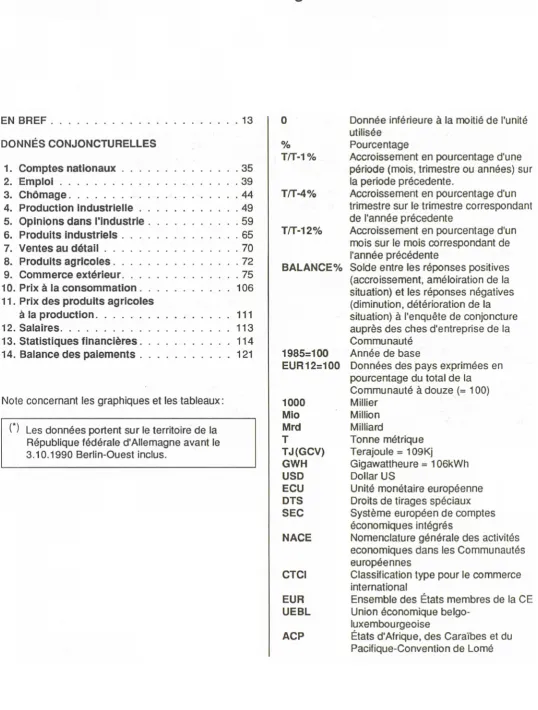
Table des matières
Signes et abréviations
EN BREF
13
DONNÉS CONJONCTURELLES
1. Comptes nationaux
35
2. Emploi
39
3. Chômage
44
4. Production Industrielle
49
5. Opinions dans l'industrie
59
6. Produits industriels
65
7. Ventes au détail
70
8. Produits agricoles
72
9. Commerce extérieur
75
10. Prix à la consommation
106
11. Prix des produits agricoles
à la production
111
12. Salaires
113
13. Statistiques financières
114
14. Balance des paiements
121
Note concernant les graphiques et les tableaux:
(*) Les données portent sur le territoire de la
République fédérale d'Allemagne avant le
3.10.1990 BerlinOuest inclus.
0
%
T/T1 %
T/T4%
T/T12%
BALANCE%
1985=100
EUR12=100
1000
Mio
Mrd
Τ
TJ(GCV)
GWH
USD
ECU
DTS
SEC
NACE
CTCI
EUR
UEBL
ACP
Donnée inférieure à la moitié de l'unité
utilisée
Pourcentage
Accroissement en pourcentage d'une
période (mois, trimestre ou années) sur
la periode précédente.
Accroissement en pourcentage d'un
trimestre sur le trimestre correspondant
de l'année précédente
Accroissement en pourcentage d'un
mois sur le mois correspondant de
l'année précédente
Solde entre les réponses positives
(accroissement, améloiration de la
situation) et les réponses négatives
(diminution, détérioration de la
situation) à l'enquête de conjoncture
auprès des ches d'entreprise de la
Communauté
Année de base
Données des pays exprimées en
pourcentage du total de la
Communauté à douze (= 100)
Millier
Million
Milliard
Tonne métrique
Terajoule = 109Kj
Gigawattheure = 106kWh
Dollar US
Unité monétaire européenne
Droits de tirages spéciaux
Système européen de comptes
économiques intégrés
Nomenclature générale des activités
économiques dans les Communautés
européennes
Classification type pour le commerce
international
Ensemble des États membres de la CE
Union économique belgo
luxembourgeoise
États d'Afrique, des Caraïbes et du
PacifiqueConvention de Lomé
EUROSTATISTIQUES: en bref
■
Sauf indications contraires, les données portent sur le territoire de la République fédérale d'Allemagne avant le 3.10.1990, BerlinOuest inclus.
TAUX DE CHANGE: première hausse des taux officiels US depuis cinq
ans; le dollar ne se raffermit pas
Le 17 mai, fa Réserve fédérale a annoncé qu'elle augmentait son taux d'escompte de 0,5 % pour le porter à 3,5 %. Il s'agitlà du premier relèvement des taux officiels depuis février 1989. Cette nouvelle a été de pair avec l'annonce d'une réduction à 4,5 % du taux objectif pour les fonds fédéraux.
Cinq jours auparavant, les taux officiels allemands avaient enregistré une nouvelle réduction, la Bundesbank ayant annoncé une baisse d'un demipoint de ses taux d'escompte et Lombard, respectivement à 4,5 et 6 %. Au cours du mois de mai, le taux des avances au jour le jour pratiqué par la Bundesbank a également baissé à quatre reprises, pour atteindre 5,20 % le 25 du mois.
Conséquence de ces mouvements, les taux américains et allemands ne sont aujourd'hui plus séparés que de 1 %, contre plus de 5 % à la fin de l'année 1992. Le billet vert, qui aurait dû se raffermir avec la convergence des taux américains et allemands, n'a guère réagi à l'annonce de la baisse des taux US et le 19 mai, il s'échangeait à 1,6551 DM, soit 4 % de moins qu'au début de l'année lorsque le différentiel des taux d'intérêt entre les deux économies se situait à 2,75 %. Le dollar n'a pas non plus bénéficié de la publication le 19 mai des chiffres du commerce américain pour le mois de mars, chiffres qui indiquent une réduction de 20 % du déficit par rapport au mois précédent. A la fols du mois de mai, le dollar s'est quelque peu stabilisé, s'établissant le 27 à 1,6444 DM.
Quasiment en même temps que les taux allemands, les taux officiels à court terme ont également diminué dans tous les Etats membres de la CE, à l'exception de la Grèce et du RoyaumeUni. Certains pays ont même connu plusieurs réductions successives, qui n'ont cependant pas affaibli les monnaies concernées, ou seule ment dans une très faible mesure. A noter que les taux ont également diminué en Autriche, en Suède et en Suisse.
Face aux pressions exercées sur la drachme, le gouvernement grec a annoncé à la mimai la levée de toutes les mesures encore encore en vigueur en matière de contrôle des capitaux, et ce six semaines avant la datebutoir du 1er juillet où cela aurait dû se faire. La semaine précédente, la Banque de Grèce avait dû consacrer une partie importante de ses réserves de change au soutien de sa monnaie. Bien que la drachme ne participe pas au MTC, la politique «de la drachme forte» poursuivie par la Banque de Grèce a pour objectif de limiter sa dépréciation par rapport aux autres monnaies européennes à 7 % sur l'ensemble de l'année 1994. A la suite de la levée du contrôle des capitaux, les taux à court terme se sont hissés à des nivaux record. La Banque de Grèce a fait passer son taux des avances au jour le jo, ' 30 %, niveau auquel ¡I se situait depuis octobre 1993, à 33 %, hausse assorti, une surcharge supplémentaire de 0,4 % par jour, équivalant à un taux annuel de plus de 180%. Le 17 mai, les taux interbancaires à trois mois s itabllssaient à pratiquement 80 % et ceux à un mois à plus de 100 %. L ι monnaie grecque s'est légèrement renforcée au cours de la dernière semaine du mois de mai, les investisseurs internationaux étant attirés par l'émission d'obliga tions d'Etat au rendement lié à l'écu et au dollar US; toutefois, les taux d'intérêt à court terme restent élevés.
RENDEMENT DES OBLIGATIONS D'ETAT: tendance toujours à la
hausse
La tendance à la hausse des rendements des obligations d'Etat qui s'était dessinée au cours des trois mois précédents s'est poursuivie dans de nombreux pays en avril, les rendements augmentant, quoique parfois très légèrement, dans tous les pays de la CE pour lesquels les données sont disponibles. Les rendements ont également progressé de 0,3 % aux EtatsUnis. Dans tous les Etats membres de la CE, à l'exception de l'Allemagne, du Luxembourg et des PaysBas, Ils dépassent aujourd'hui les 7 %.
La hausse des rendements américains s'inscrit dans la logique des augmentations récentes des taux à court terme; cela n'est pas le cas en Europe où les taux officiels à court terme ont continué à baisser. Toutefois, les marchés mondiaux des obligations d'Etat ont été fortement influencés par les hausses des taux US à court terme.
MASSE MONETAIRE: lente croissance de M3 en Irlande
Après avoir connu une croissance de plus de 20% pendant les onze mois précédents, M3 a crû de façon beaucoup plus lente en Irlande au cours du premier trimestre 1994, le taux enregistré pour la période mars 1993mars 1994 étant légèrement Inférieur à 10%. Comme cela a déjà été indiqué précédemment, il s'agitlà d'une conséquence d'un ralentissement observé dans les effets qu'ont eu certains changements structurels sur la croissance monétaire. Pour rappel, un de ces changements structurels concerne l'introduction d'une taxe sur les dépôts d'épargne qui a provoqué un glissement de ces derniers (qui ne font pas partie de M3) vers des dépôts faisant partie eux de cet agrégat monétaire.
En Espagne, la croissance de l'agrégat ALP a continué à se ralentir. Pour la période février 1993février 1994, elle s'est établie à 7,7%, contre 10,3% pour l'année 1993. Un ralentissement a également été observé en Italie où M2 a crû de quelque 6,8 % entre mars 1993 et mars 1994, contre 7,8 % sur l'année 1993.
Les données monétaires belges sont maintenant disponibles pour 1993, et ce à la suite d'une réorganisation de la collecte des statistiques monétaires et bancaires. Pour cette année, le taux de croissance de M2 a approché 13 %.
RESERVES DE CHANGE: hausse de 3,4 % des réserves
EUR
12 en
1993
Les réserves EUR12, à l'exception de l'or, ont crû de 3,4 % en 1993 pour s'établir à quasiment 260 milliards d'écus contre 250 milliards l'année précédente. En 1993, le total EUR12 représentait 28 % du total mondial, contre 7 % pour les EtatsUnis, 9 % pour le Japon, 6 % pour les pays de ΓΟΡΕΡ et 8 % pour Taïwan.
Parmis les pays de l'Union européenne, c'est l'Allemagne qui détient la plus large part des réserves (24 %) — elle en détenait 31 % à la fin de 1992 — suivie par l'Espagne (14 %) et le RoyaumeUni (13 %).
PRIX: l'inflation annuelle de l'EU se maintient à 3.2 % en avril
Le taux d'inflation annuelle pour l'UE — mesuré par l'IPC — est resté inchangé entre mars et avril au niveau de 3.2 %. La progression de l'indice mensuel EUR12 a été de 0.5 %, principalement due à une hausse sensible de l'Indice grec (1.5 %) — suite à des fortes augmentations des prix de l'alimentation, du logement, des soins médicaux et des loisirs — ainsi que de celui du RoyaumeUni (1.2 %), surtout à cause des accroissements des prix de l'alimentation, du logement, chauffage et éclairage, du transport privé et des loisirs. L'accroissement a été faible à modéré au Luxembourg (0.1 %), en Belgique, au Danemark, en Allemagne et aux PaysBas (tous 0.2 %), en France et en Italie (0.3 %), en Espagne (0.4 %) et substantiel au Portugal (0.6 %).
Actuellement le taux d'inflation annuelle est inférieur à la moyenne communautaire de 3.2 % dans 8 des 12 Etats membres. Seuls l'Italie, l'Espagne, le Portugal et la Grèce montrent des taux plus élevés. Dans l'ordre croissant de l'inflation courante ces taux et ceux d'il y a un an sont les suivants:
France Irlande" Danemark Luxembourg Belgique RoyaumeUni
Avril '94 Avril '93 1.7 %p 1.7% 1.8 %E 2.1 % 2.4 % 2.6 %
Avril '93 Avril '92 2.1 % 1.9% 1.1 % 3.8 % 2.9 % 1.3%
PaysBas Allemagne* Italie Espagne Portugal Grèce
Avril '94 Avril '93 2.8 % 3.1 % 4.1 %p 4.9 % 6.0 % 10.4%
Avril '93 Avril '92 2.4 % 4.3 % 4.4 % 4.5 % 6.2 % 16.2 % L'IPC pour la R.F. d'Allemagne continue à se rapporter à la situation territoriale d'avant le 3 octobre 1990.
** Février '94/féwier '93 et février '93/février '92 ρ Provisoire
E Estimation Eurostat
Les taux d'inflation annuelle des Etats candidats à l'adhésion sont tous inférieurs à la moyenne communautaire: Finlande 0.2 % (2.6 %), Norvège 0.9 % (2.6 %), Suède 1.7% (5.1 %) et Autriche (mars) 3.1 % (3.9%). Les taux correspondants de quelques autres pays sont: EtatsUnis 2.4 % (3.2 %), Japon 0.7 % (0.9 %), Canada (mars) 0.2 % (1.8 %) et Suisse 1.0 % (3.8 %).
LE CHOMAGE DANS L'UNION EUROPEENNE Avril 1994
Dans l'Union Europénne, le taux de chômage corrigé des variations saisonnières atteint 11,0 % au mois d'avril 1994 selon Eurostat; il est stable par rapport au mois précédent et en hausse de +0,6 % par rapport au mois d'avril 1993.
Les plus fortes hausses annuelles du chômage se sont produites en Espagne (+1,8 points), aux PaysBas (+1,6 points) et au Portugal (+1,2 points), tandis qu'une légère diminution a eu lieu en Irlande (0,5 points) et au RoyaumeUni (0,4 points).
Le chômage des jeunes de moins de 25 ans ne semble pas encore stabilisé notamment au Portugal, au Luxembourg et en Italie, alors qu'il diminue en Irlande, au RoyaumeUni et au Danemark.
Le taux de chômage et le nombre de chômeurs sont estimés après élimination des différences dans les méthodes nationales de recensement du chômage. L'introduction des dernières données disponibles de l'Enquête sur les forces du travail (1er trimestrel 994) en Espagne a entraîné la révision des résultats publiés les mois précédents.
Le taux de chômage est estimé en extrapolant les résultats 1991 des enquêtes sur les forces de travail pour tous les Etats membres. L'introduction des résultats de l'année 1992, dès qu'ils seront disponibles, entraînera probablement une révision des estimations.
COMMERCE EXTERIEUR
Résultats de novembre
1993
L'écart entre taux d'évolution des exportations et des importations entre les onze premiers mois de 1992 et de 1993 est de +10 points pour l'Union Européenne, de 7 points pour les EtatsUnis, de +3 points pour le Japon.
Le déficit commercial de l'Union Européenne pour les onze premiers mois de 1993 est proche de 10 Mrds d'écus, contre près de 50 Mrds pour la période correspondante de 1992. Les importations extraUE baissent faiblement entre janviernovembre 1992 et 1993 (0,2%), les flux exportés hors de l'Union Européenne sont en progrès net: 9,9 %.
Les échanges des EtatsUnis se soldent par un déficit de 110,8 Mrds d'écus en janviernovembre 1993, alourdi de quelque 37 Mrds par rapport aux mois correspondants de 1992. Les flux importés par les EtatsUnis croissent de 21,1 % en écus entre les onze premiers mois de 1992 et de 1993, de 9 % en dollars. Les exportations des EtatsUnis progressent de 14,1 % en termes d'écus, et de 3 % en dollars.
En novembre 1993 l'excédent commercial du Japon cumulé depuis janvier 1993 approche 93 Mrds d'écus, marquant une augmentation de 18 Mrds d'écus par rapport à janvier-novembre 1992. Les exportations du Jason augmentent de 17,2 % en écus, de 6 % en dollars et se replient de 6 % en yens. Les flux importés au Japon, en progrès de 14,1 % en écus, de 3 % en dollars, marquent une baisse de près de 5 % en yens.
Les excédents extra-UE de L'Allemagne et de l'Italie ont les niveaux les plus forts en janvier-novembre 1993, et affichent les améliorations les plus nettes par rapport à la période correspondante de 1992.
L'Allemagne et l'Italie dégagent les excédents les plus élevés pour le commerce extra-UE aux onze premiers mois de 1993, avec des bilans respectifs de 15,9 Mrds d'écus et 8,7 Mrds d'écus. Le solde italien est supérieur de 11,6 Mrds d'écus à son niveau de janvier-novembre 1992. Les exportations Italiennes croissent de 15,8 % entre les onze premiers mois de 1992 et de 1993. Les flux Importés par l'Italie se creusent de 6 % entre ces deux périodes.
L'excédent de l'Allemagne croît de 8,7 Mrds d'écus. Les exportations extra-UE de l'Allemagne progressent de 6,4 %, tandis que les importations de ce pays stagnent.
Les déficits commerciaux de l'Espagne, des Pays-Bas et de l'UEBL se comblent de 6,8, 5,1 et 4,9 Mrds d'écus entre les onze premiers mois de 1992 et de 1993. Les flux exportés par ces pays progressent de quelque 18%. Les importations de l'Espagne chutent de 15 %, tandis que celles des Pays-Bas et de l'UEBL se replient de près de 3 %.
Le Royaume-Uni et la France volent leurs bilans extra-UE s'améliorer de 1,4 Mrd d'écus chacun. Les exportations du Royaume-Uni croissent de 15%, contre 9 % pour les Importations de ce pays. Les flux échangés par la France connaissent des évolutions plus ternes: +0,2 % pour les exportations et -2 % pour les importa-tions.
Les soldes du Danemark, de l'Irlande, du Portugal sont en progrès de moins de 0,2 Mrd d'écus par rapport à leurs niveaux de janvier-novembre 1992. Les importations du Danemark s'infléchissent à la baisse de 1,3 %, les exportations marquent 1,5 %. Les flux échangés par l'Irlande croissent de 38 % en Importation et 36 % en exportation. Le commerce extra-UE du Portugal marque un repli de 3,5 % en importation, de 4,3 % en exportation.
Le déficit grec est le seul à se creuser ( de 0,4 Mrds d'écus). Les exportations de ce pays progressent vivement (21,1 %), plus vite que les importations (16,6 %).
11
10
9
8
7
6
5
4
3
2
1
_
*'~
_ _ . . · ■ '
I I
ARBEITSLOSENQUOTEN
SAISONBEREINIGT
^
s~
'-
· · .
Ι ι ι Ι ι ι Ι ι ι
I 1EUR
_ ^ " *
-UNEMPLOYMENT RATES
SEASONALLY ADJUSTED
"~ "
> >^ — —
ι 1 < ι
UÛA
_,
ι ι Ι ι ι Ι ι ι Ι ι ι
TAUX D E CHOMAGE
DESAISONNALISE
JAPAN
~».
ι ι Ι ι ι Ι ι ι Ι ι
—
—
—
—
1
1991
1992
1993
1994
ARBEITSLOSENQUOTEN
^ - ^ - MSGESABr/SAISONBEREMGT
— — — MAENNER/SAISONBEREMIGT
FRAUEN/SAISONBEREINIGT
ι ι I ι Ι ι ι I
1991
UNEMPLOYMENT RATES
EUR
TOTAL/SEASONALLY ADJUSTED
ION/SEASONALLY ADJUSTED
VOIÍEN/SEASONAILY ADJUSTED
_ i ι I ι ι I ι _
1992
TAUX DE CHOMAGE
TOTAVDESAISONNAUSE
HOIUÜS/DESAISONNALISE
FEIOÍES/DESAISONHAUSE
J I I I I I I I I I I I I I L
1993
J I I I I I I 1 I I L
1994
15
— 14
— 13
— 12
11
10
ARBEITSLOSENQUOTEN
SAISONBEREINIGT
UNEMPLOYMENT RATES
SEASONALLY ADJUSTED
%
TAUX DE CHOMAGE
DESAISONNALISE
-IRL
-I
1991
1992
1993
1994
F
. . I , , I I .
■DK
~'
I . . _ 1 1 I 1 I L
— I 12
— 11
10
— 7
1991
1992
1993
1994
1991
1992
1993
1994
ARBEITSLOSENQUOTEN
SAISONBEREINIGT
UNEMPLOYMENT RATES
SEASONALLY ADJUSTED
TAUX DE CHOMAGE
DESAISONNALISE
40 Γ
30
20
BELGIQUE - BELGIË
η , , l i , l i , l u l , , [ , , I , i l , i l , i l , i l l i l l
1991
1992
1993
1994
DANMARK
40
30
20
10'.
Q I I I I I I I I I I l , l u
1991
1992
1993
1994
DEUTSCHLAND I
40
30
20
10
Ί Ι ι Ι Ι Ι Ι Ι Ι Μ Ί "
Ι Ι Ι Ι Ί Ι l u n i I '
0u ^
1991 1992 1993 1994
ESPANA
40 Γ
30
20
10
0 ^ i h , l i , l u l l i i n i l u l u l l 40
30
20
10
FRANCE IRELAND
1991 1992 1993 1994
n Ι . , Ι ι ι Ι I I l , , I I , I , l i n i ,
1991 1992 1993 1994
40
30
20
IO
0 ^
1991 1992 1993 1994
ITALIA
40
30
20
10
Q I I I I I I I I I I I I I I I I I I I I I I I I I I I I I I I
1991 1992 1993 1994
NEDERLAND
40 Γ
30-20
10
0u ^ l i ' l ' i l ' i l i i l Ι ι Ί ι I ι
1991 1992 1993 1994
4030
20-PORTUGAL
10
ι l i , 1 , i l i i l n l i i l i i l . i l n I n I n I I n I,
1991 1992 1993 1994
UNITED HNGDOM
40
30
20-10
I n i i i l n l i i l n l i i l n l i
1991 1992 1993 1994
40
30
20
10
USA
Q ι I ι ΐ ι ι ΐ ι ι ΐ ι ι l i n i ,
1991 1992 1993 1994
lioins de 25 ons
INDUSTRIELLE PRODUKTION
TENDENZ 1985=100
INDUSTRIAL PRODUCTION
TREND 1985=100
PRODUCTION INDUSTRIELLE
TENDANCE 1985=100
NACE 1-4
EUR
130 —
125
120
115
110
105
100
USA
_l l_l I I I I L j I ι ι I ι ι Ι ι ι Ι ι ι Ι ι ι Ι ι ι Ι ι
JAPAN
J I I I l_J I I I I I I I L
130
125
120
115
110
— 105
100
1991
HmCH-LOGARITHiaSCHE SKALA
1992
1993
SOfl-LOGARITHinC SCALE
1994
ECHKUI SEU-LOGARITffiKlUZ
EUR
130
125
120
115
110
105
-ι
_ — _ _
^ /
_ ^
INDUSTRIE NACE 1 - 4 INDUSTRY NACE 1 - 4
GRUNDST. U. PRODUKTIONSGUETER DITERMEDUTE GOODS
INVESTITIONSGUETER CAPITAL GOODS
VERBRAUCHSGUETER CONSUMER GOODS
^ î ^ - j
^ ^ —
ι Ι ι ι Ι ι ι Ι ι ι
—-^
— \
^ ^ ^
\^.
^
Λ
ι ι Ι ι ι Ι ι ι Ι ι ι
^
-ι ι Ι ι ι Ι ι ι Ι ι ι
INDUSTRIE NACE 1 - 4
BIENS INTERMEDIAIRES
BIENS D'INVESTISSEMENT
BIENS DE CONSOMMATION
ι ι Ι ι ι Ι ι ι
—
—
—
—
—
I 1
130
— 125
120
— 115
1991
1992
1993
1994
110
105
100
UNTACH-LOfiARITHinSCHI SEAU snfl-LOGAHTHKIC SCALI ICBXLLC SBfl-LOGAKTHUQUÏ
150
140
130
120
110
100
-INDUSTRIELLE PRODUKTION
BELGIQUE - BELGlt
90 ' I n i I ι ' " ' l u i n
150
140
130
120
110
100
INDUSTRIAL PRODUCTION
NACE 1-4 1985=100
DANMARK
^s*\*v
1991 1992 1993 1994
„n I I ' I l l l l l l I l
1991 1992 1993 1994 150
140
130
120
110
100
-PRODUCTION INDUSTRIELLE
DEUTSCHLAND (·
90 I n i l i , I n i I n i l i , l i 1991 1992 1993 1994
ELLADA ESPANA FRANCE
150
140
130
120
110
100
90 η Ί ■ ' n ' ■ ' I ■■ ' n ' n ' η Ι n ' n l i ■ ' η Ι n I '■ ' '■ ' ■ ι
150 140 130 120 110 100
-1991
1992 1993 1994
90■ I n i I i l , l i n i I n i l i
1991
1992 1993 1994
150 140 130 120 110 100
90 '■ι Ι ' Ί 'I i l i i l i
1991 1992 1993 1994
180 170 160 -150 k 140
130
120
110
IRELAND ITALIA
100 Ί ι Ί ' Ί ι Ί " Ι'Ί' I
150
140
130
120
110
-100
1991 1992 1993 1994
90I Ι ι , Ι ' Ί , , Ι , , Ι M. 150
140
130
120
110
lUO
LUXEMBOURG
Ä ^ V V A
I n i I n i ' , I I I n i "
1991
1992 1993 1994
1991
1992 1993 1994
150
140
130
120
110
100
90
NEDERLAND PORTUGAL UNITED KINGDOM
■ ' " I I n i ' . I I
1991
1992 1993 1994
1991
1992 1993 1994
150
140
130
120
110
100
90 I Ί I· ■'■
1991
1992 1993 1994
nmCH-LOGARnaOSCHI SKAU SZU-LOGABTBMtC SCALI I C H m i sna-LOGAEnHMHOI
MEINUNGSUMFRAGE
IN DER INDUSTRIE (NACE 1-4)
SALDO %
E
1-4)
PRODUKTIONSAUSSICHTEN AUFTRAGSBESTAND LAGERBESTAENDE AN
FERTIGERZEUGNISSEN
OPINIONS
IN INDUSTRY (NACE 1-4)
BALANCE %
EUR
PRODUCTION EXPECTATIONS ORDER BOOKS
STOCKS OF FINISHED PRODUCTS
OPINIONS
DANS L'INDUSTRIE (NACE 1-4)
SOLDE %
PERSPECTIVES DE PRODUCTION CARNETS DE COMMANDES STOCKS DE PRODUITS FINIS
30
20
10
0
-10
-20
-30
-40
- 5 0
- 6 0 ι Ι ι ι Ι ι ι I j I ι ι I ι ι I ι ι I ι ι I ι ι I ι ι I ι ι I ι ι Ι ι ι Ι ι ι L 30
20
10
0
- 1 0
- 2 0
- 3 0
- 4 0
- 5 0
- 6 0
1991
1992
1993
1994
VERTRAUENSINDIKATOR
IN DER INDUSTRIE
SALDO %CONFIDENCE INDICATOR
IN INDUSTRY
BALANCE %INDICATEUR DE CONFIANCE
DANS L'INDUSTRIE
SOLDE %10
-10
-20
-30
-40
10
1991
1992
1993
1994
-io
-20
-30
-40