This is a repository copy of
On the nature of cracks and voids in nuclear graphite
.
White Rose Research Online URL for this paper:
http://eprints.whiterose.ac.uk/99603/
Version: Accepted Version
Article:
Freeman, HM, Jones, AN, Ward, MB et al. (5 more authors) (2016) On the nature of cracks
and voids in nuclear graphite. Carbon, 103. pp. 45-55. ISSN 0008-6223
https://doi.org/10.1016/j.carbon.2016.03.011
© 2016. This manuscript version is made available under the CC-BY-NC-ND 4.0 license
http://creativecommons.org/licenses/by-nc-nd/4.0/
[email protected] https://eprints.whiterose.ac.uk/
Reuse
Unless indicated otherwise, fulltext items are protected by copyright with all rights reserved. The copyright exception in section 29 of the Copyright, Designs and Patents Act 1988 allows the making of a single copy solely for the purpose of non-commercial research or private study within the limits of fair dealing. The publisher or other rights-holder may allow further reproduction and re-use of this version - refer to the White Rose Research Online record for this item. Where records identify the publisher as the copyright holder, users can verify any specific terms of use on the publisher’s website.
Takedown
If you consider content in White Rose Research Online to be in breach of UK law, please notify us by
1
On the nature of cracks and voids in nuclear graphite
H.M. Freeman1, A.N. Jones2, M.B. Ward1, F. S. Hage3, N. Tzelepi4, Q.M. Ramasse3, A.J.
Scott1, R.M.D. Brydson1, 3
1 Institute for Materials Research, School of Chemical and Process Engineering, Univ. Leeds, LS2 9JT
2 Nuclear Graphite Research Group, Materials Performance Centre, Univ. Manchester, M13 9PL
3 SuperSTEM Laboratory, SciTech Daresbury Laboratories, Daresbury, WA4 4AD
4 National Nuclear Laboratory, Central Laboratory, Sellafield, CA20 1PG
Abstract
Microcracks in neutron-irradiated nuclear grade graphite have been examined in detail for the first time using a combination of transmission electron microscopy (TEM), electron energy loss spectroscopy (EELS), energy dispersive X-ray (EDX), and energy filtered TEM (EFTEM). Filler particles from both unirradiated Pile Grade A (PGA) and three irradiated British Experimental Pile ‘O’ (BEPO) graphite specimens were investigated with received doses ranging from 0.4 to 1.44 displacements per atom (dpa) and an irradiation temperature of between 20-120°C. We suggest that the concentration and potentially the size of microcracks increase with increasing neutron irradiation and show that disordered carbon material is present in a range of microcracks (of varying size and shape) in all specimens including unirradiated material. EFTEM and EELS data showed that these cracks contained carbon material of lower density and graphitic character than that of the surrounding bulk graphite. The presence of partially filled microcracks has potentially significant implications for the development of microstructural models for the prediction of radiation-induced dimensional and property changes in nuclear graphite.
1. Introduction
The majority of the UK’s operating nuclear reactors contain significant levels of graphite which not only moderates the energies of fast neutrons due to the high scattering cross section, but provides structural support, accommodates fuel and control rods, and allows for coolant flow. High levels of neutron irradiation and temperature result in chemical and physical property changes which consequently affect the structural integrity and functionality of the channel which would affect the safe running of the reactor. The reactor lifetime is therefore limited by the condition of the irreplaceable graphite, so an understanding of its behaviour is essential for plant safety and maximised power output.
2
the extrusion direction. The removal of volatiles during the manufacturing process produces gas-escape pores which are open and do not accommodate thermal expansion due to their larger dimension [1]; however they do affect properties such as strength, thermal conductivity and Young’s modulus, particularly under radiolytic oxidation during reactor operation [2]. Gas-escape pores have therefore not been considered in this study.
During almost every step in the high temperature graphitisation process associated with the manufacture of nuclear graphite and also during reactor operation, cracks arise due to a number of factors. Firstly, as a result of gradients in both temperature (during manufacture and operation) and neutron flux (during operation) and, secondly, as a result of the anisotropy of the coefficient of thermal expansion (CTE) in crystallites and the consequent generation of internal stresses beyond the elastic limit of graphite crystals [3–5]. The internal stresses act on both the carbon bonds between crystallites and on the Van der Waals forces between basal planes; to relieve this stress cracks form, more usually between the weaker bound basal planes. Since the CTE is higher in the crystallographic c-direction (ca. 20 – 40 x 10-6 K-1 compared to < 1.5 x 10⁻⁶ K-1 in the a-direction), lenticular cleavage cracks between
basal planes, known as Mrozowski (micro)cracks, are observed to form lying approximately perpendicular to the crystallographic c-direction as a result of anisotropic contraction following post graphitization cooling during manufacture [2–4] .
The basic understanding of irradiation-induced dimensional change in a perfect graphite crystal involves growth in the c-axis and contraction in the a-axis. This is presumed to arise from the formation of interstitial and vacancy defects during neutron bombardment which can accumulate as clusters. However the microstructure of nuclear graphite is complex and at low doses, it is suggested that c-axis expansion is accommodated by the microcracks [3,6] leaving solely to shrinkage along the a-axis which leads to the observed net volume shrinkage. With increasing dose during reactor operation, the rate of contraction or shrinkage reduces and eventually the cracks are presumed to close and c-axis expansion is no longer accommodated producing net volume expansion, the critical point at which this reversal occurs is known as “turnaround” which can vary with operating temperature [7].
Microcracks can be classified into two categories: intra and inter-granular, where the former are found within crystallites and lie perpendicular to the crystallographic c-direction (e.g. Mrozowski cracks [2,4]). The latter lie between crystallites at grain boundaries with, in principle, no specific orientation with respect to neighbouring basal planes, unless crystallites are aligned as a result of mesophase development. Within thermally anisotropic filler particles, (closed) calcination cracks form due to volumetric shrinkage during the 1300°C calcination stage in the manufacturing process [3].
3
crack type; it has been proposed that microcracks in Pile Grade A, Gilsocarbon, baked carbon [6], and highly ordered pyrolytic graphite (HOPG) [6,8] contain low density disordered carbon perhaps arising from interstitial atoms migrating from the bulk following irradiation and sintering-induced diffusion. However, limited research has been carried out to characterise this material in both non-irradiated and irradiated graphite, which could better the understanding of the mechanisms involved in crack expansion and contraction [2,8], and hence their influence on macroscopic properties such as CTE and elastic modulus during reactor operation.
Delannay et al. [5] used crystal plasticity finite element modelling to predict irradiation-induced dimensional change and variations in CTE at a variety of reactor temperatures. Predictions were in agreement with experimental data showing bulk material shrinkage with irradiation and turnaround after crack closure. All cracks in this model were empty; extending the model to 3D and including a proportion of filled cracks could be of interest in relation to the results subsequently described in this paper.
The investigation of a variety of microcracks in non-irradiated nuclear graphite and HOPG has been undertaken by Wen et al. [6] who showed the presence of lenticular cracks of up to 10 m long and up to 100nm wide in Pile Grade A (PGA) nuclear graphite; a fine structure of smaller cracks was also observed with crack lengths down to 10nm. Both empty and filled microcracks were identified in non-irradiated and electron non-irradiated material; cracks in the latter were suggested to contain low density, amorphous material. Via a comparison of transmission electron microscope (TEM) samples produced by both ion beam thinning and microtome sectioning techniques, it was confirmed that this amorphous material observed within the cracks was not a result of TEM sample preparation. In-situ heating of samples to 800°C under a 200kV electron beam showed a gradual closure of cracks along the c-axis. Electron beam exposure without in-situ heating also caused cracks to close; after 15 minutes a 60nm crack was observed to reduce in width to 6nm, and in some areas to close completely.
4
structure was preserved. Noise filtering of lattice images was used to highlight extended interlayer defects and prismatic dislocations, similar to those found following electron irradiation [10,11].
This paper extends this work and presents a study of microcracks in irradiated graphite samples removed from the British Experimental Pile ‘O’ (BEPO) reactor as well as in non-irradiated Pile Grade A (PGA) graphite for comparative purposes. Using TEM, energy dispersive X-ray spectroscopy (EDX), electron energy loss spectroscopy (EELS) and energy filtered TEM (EFTEM), the material within a variety of cracks is characterised in detail and suggestions are made regarding its origin and importance for understanding radiation-induced property changes in these materials. The material investigated in this work has also been studied using Raman spectroscopy by Krishna et al. [12], and the present results are correlated with their findings.
2. Experimental procedure and sample preparation
The nuclear graphite grades examined were BEPO and PGA; three BEPO samples of varying received dose were used from the same trepanned column. BEPO1 was farthest from the reactor core and received a dose of 0.4 dpa (≈3.1 x 10²⁰ n cm-2), BEPO16 was in the middle of the channel and
received a dose of 1.27 dpa (≈9.8 x 10²⁰ n cm-2), whilst BEPO20 was closest to the core and received a
dose of 1.44 dpa (≈1.1 x 10²¹ n cm-2). The irradiation temperature during operation (in air) was between
5
General TEM observations were carried out on an FEI Tecnai TF20 operated at 200kV. To avoid significant electron beam damage, images were focused away from the area of interest; the sample area was then moved to the site of interest and data then captured swiftly. EFTEM data was collected on a Philips CM200 operated at 200kV and fitted with a Gatan Imaging Filter (GIF) 200. The energy resolution was 0.7eV. EFTEM image acquisition was performed with a window width of 3eV (smallest available for plasmon mapping) and a collection angle defined by the objective aperture of 10.9mrad. The dose rate for experiments was of the order 104 electrons nm-2 s-1. Images and spectra were captured
with the 1 megapixel slow scan CCD array of the GIF. Data from the array were processed using Gatan’s Digital Micrograph software. STEM/EDX measurements were carried out using an Oxford Instruments INCA 350 EDX system (probe size 5-10nm). EELS data was collected at SuperSTEM (the UK national facility for aberration corrected scanning TEM) using a Nion UltraSTEM100 equipped with a Gatan Enfina Spectrometer, operated at an acceleration voltage 60kV. The choice of operating voltage was made with the aim to minimize beam induced irradiation damage. The energy resolution in best conditions was 0.45eV and the convergence semi-angle was ca. 30mrad.
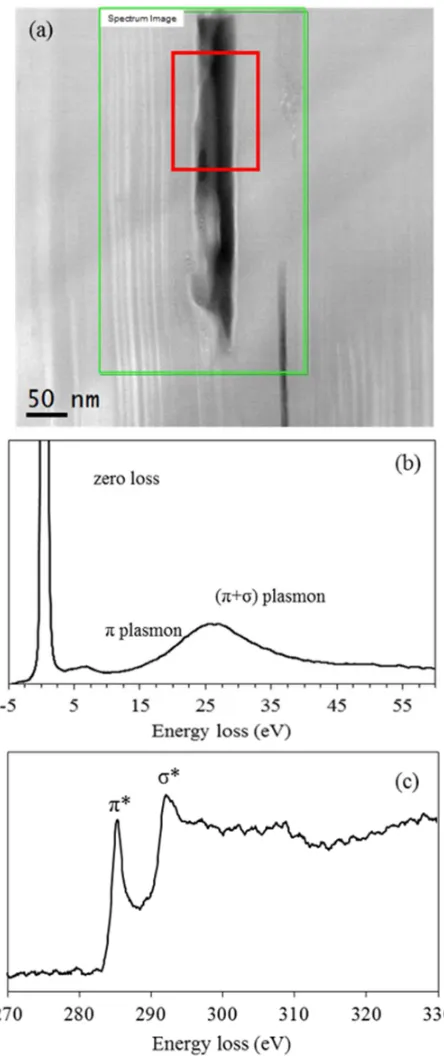
In order to measure and compare the density and graphitic nature of material within a microcrack to those of the bulk, EEL spectra were collected from several regions: within a microcrack, on the edge of a microcrack and in the neighbouring graphite bulk. Quoted energies from EEL spectra were determined by taking a first derivative to define the edge onset or peak position. Within the low loss region of a graphitic EEL spectrum, the π plasmon, around 6eV, provides information about the graphitic character, crystallinity and the degree of π bonding, and the (π+σ) plasmon peak, at 26-27eV, is related to the valence electron density which can be related to the bulk density [16].
6
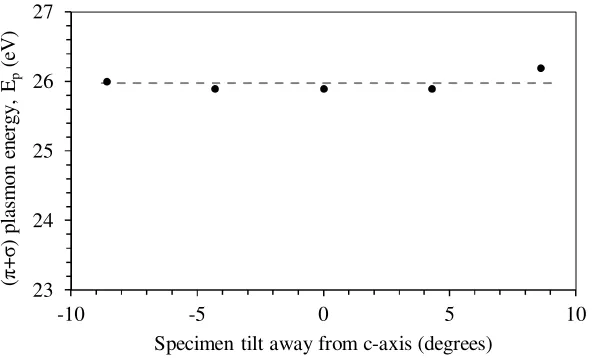
Figure 1 Change in (π+σ) plasmon peak position with specimen tilt (β = 3.7mrad) for an operating voltage of 60kV.
Preliminary EELS calibration studies showed that the (π+σ) plasmon peak energy position increased with increasing collection semi-angle (controlled by changing the camera length in diffraction mode) up to a limiting value of 26.5eV for a collection semi-angle of 3.4mrad at 60kV accelerating voltage; corresponding values for 80kV and 200kV were 4.0mrad and 7.6mrad respectively. For example, Figure 1 shows there is no significant variation in the (π+σ) plasmon peak energy with sample orientation for a collection semi-angle of 3.7mrad for 60kV over an angular (tilt) range of ca. 15 degrees similar to the results of Daniels et al. at 200kV [17]. Therefore, operating at a collection angle of > 3.7mrad at 60kV during EEL spectroscopy ensures a consistency in plasmon peak position, where any changes are a direct result of varying density. The objective aperture used in the EFTEM plasmon ratio imaging at 200kV gives a collection angle of 10.9mrad and therefore satisfies the above condition that β > 7.6mrad for 200kV. In the carbon K-edge core loss EEL spectra information about the planar sp2 content and
graphitic nature of the material can be determined from the π* and σ* peaks, around 285eV and 290eV respectively. In addition to the primary π* peak at 285eV, the spectral intensity around 287eV gives information about hetero-atom content (deemed to be negligible in this case due to the high graphitization temperatures) and what we term as non-planar sp2 carbon (non six membered rings which
induce curvature in the basal planes) [11,18,19].
3. Results and discussion
Figure 2 shows TEM images of the FIB sections from the non-irradiated PGA and all three irradiated BEPO specimens. Image analysis of TEM micrographs showed that with increasing dose the (areal) concentration, width and periodicity of cracks appears to increase significantly and that all specimens (both non-irradiated and irradiated) contained both filled and empty cracks; the latter are evident in Figure 2(a-d) as regions of high intensity. This increase in the proportion of cracks within the material
23 24 25 26 27
-10 -5 0 5 10
( π + σ ) pl as m on e ne rg y, Ep (e V )
7
reflects the fragmentation of the graphite microstructure with increasing neutron irradiation as has been observed in [20–22]. The periodicity (in cracks/ m) and areal concentration (in % area) varied from: 4.5 and 1.5% in non-irradiated PGA; to 0.21 and 1.0% in BEPO1; 0.56 and 4.4% in BEPO16 and 1.70 and 9.6% in BEPO20, respectively. PGA showed many long narrow cracks which were ca. 10 nm wide and up to 1µ m long. BEPO1 showed slightly wider cracks (ca. 50-300nm), BEPO16 showed considerably wider cracks, whilst BEPO20 showed a mixture of long thin lenticular cracks and larger wide cracks. Despite all specimens being selected from filler regions, we appreciate that such observations and semi-quantitative analysis must be interpreted with caution owing to the heterogeneous nature of nuclear grade graphite.
8
Figure 2 TEM images of a FIB section of filler from each sample: (a) non-irradiated PGA, (b) BEPO1, (c) BEPO16 and (d) BEPO20.
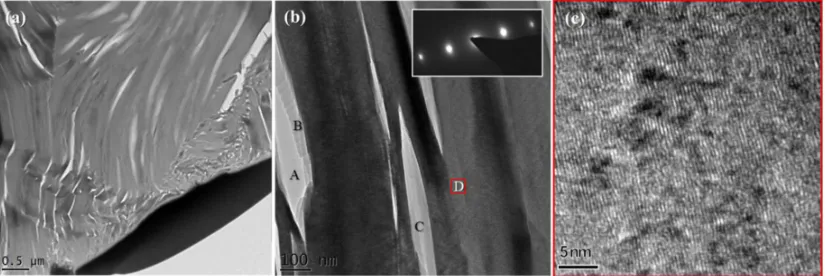
Figure 3 (a) relatively low magnification and (b) medium magnification TEM images of intra-granular microcracks within the FIB section of specimen BEPO20. Labels in (b): A - no material within the crack; B - material at the crack interface; C - a completely filled crack; D - graphitic bulk material. Electron diffraction pattern of the area shown in micrograph (b) is presented in the top right corner. (c) shows a high magnification TEM image of region D to verify the basal plane orientation is parallel to cracks.
[image:9.612.97.510.107.245.2]9
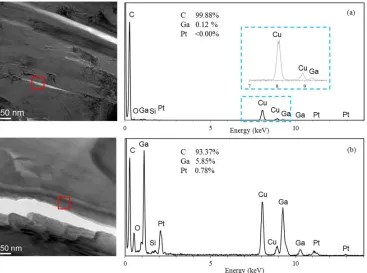
Figure 4 Examples of EDX spectra over a crack in BEPO1 showing (a) negligible Ga content (0.12%) and (b) significant Ga content (5.85%). Both spectra were normalised to the carbon peak at 0.2774keV.
EFTEM images were also used to assess the graphitic nature of the material within a microcrack. Following the procedure outlined in Daniels et al. [17], two filtered images were used to produce an I27eV/I22eV plasmon ratio map to remove diffraction contrast and thickness effects; a 3eV window
centered at 27eV representing the position of the plasmon peak for graphite and a 3eV window centered at 22eV representing the position of the plasmon peak for non-graphitized material. Ratio maps were calibrated to 0.8 ≤ I27eV/I22eV ≤ 1.8 following measurements by [17] so that high intensity reflects
graphitic material and low intensity non-graphitic material.
10
occurs for sample thicknesses over ca. 200nm. The thickness of each area was therefore determined (using EELS) to ensure this criterion was satisfied.
Figure 5 (a) TEM image of HOPG and amorphous carbon film (as labelled) showing thickness contrast on the left hand side of the region of HOPG. (b) EFTEM I27eV/I22eV plasmon map showing a removal of significant thickness contrast. Intensity profiles of each image are shown below to illustrate the change in contrast (following the white intersections in the micrographs). TEM operating voltage 80kV in order to minimize beam damage.
[image:11.612.145.477.106.378.2]11
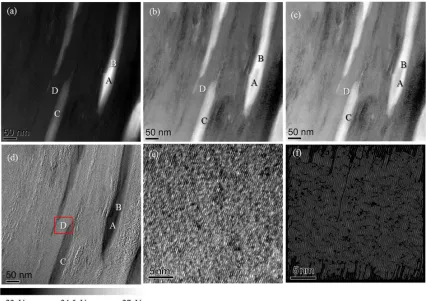
Figure 6 Representative EFTEM images for microcracks (A,B,C) in BEPO20. (a) zero loss filtered EFTEM, (b) 22eV filtered EFTEM, (c) 27eV filtered EFTEM, (d) I27eV/I22eV plasmon ratio map with calibrated intensity scale below, (e) region of interest D in (d) showing graphitic material in the bulk between two cracks where the crack length and a-direction (002) are parallel,
and (f) presents (002) fringe analysis of region of interest D.
12
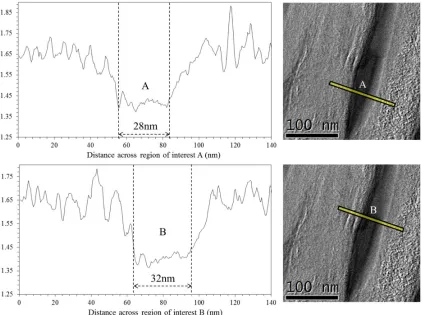
In Figure 6(a) the dark features in the zero loss EFTEM image represent thicker material whereas the inverse is the case for the 22eV and 27eV filtered images in (b) and (c). However in the plasmon ratio map (Figure 6(d)), the removal of thickness contrast means that bright features now represent regions of high graphitic character (27eV) and dark features reflect either a hole or a region of low graphitic character (22eV). Intensity profiles can be used to quantify interpretations (Figure 7). When comparing the zero loss EFTEM image (Figure 6(a)) to the plasmon ratio map (Figure 6(d)), regions A, B, and C clearly differ. In the zero loss EFTEM, the crack at region A shows a high intensity. This is mirrored in the plasmon ratio map, where a relatively low intensity is recorded (ca. 1.35 calibrated intensity units or 25.5eV). For region B in the same crack, the zero loss EFTEM image shows a slightly lower intensity which is matched with a higher intensity in the plasmon ratio map (ca. 1.45 calibrated intensity units or 26.3eV). The differences in plasmon ratio map intensities are shown in more detail in Figure 7 and particularly highlight the effects of thickness contrast. In the zero loss image, one might assume region A was a hole. However upon closer inspection in the plasmon ratio map both regions A and B contain low density graphitic material. The intensity and corresponding plasmon energy over different cracks in all EFTEM plasmon ratio maps were measured. The average plasmon intensity was 25.4eV; the lowest value was found over a crack in BEPO20 measuring 23.7eV and the highest over a crack in BEPO1 measuring 26.7eV.
13
assuming a commonly used vacancy occurrence rate of 100/second and a defect vibrational frequency of 1014Hz [27,28]. This analysis implies that a vacancy migration energy of 1.1 eV would correspond
to a temperature of approximately 180°C. The low basal surface energy barrier (1.06 meVÅ-2 [30]) and
[image:14.612.111.533.167.482.2]the increase in nanocrystallinity following irradiation may create more possibilities for surface and grain boundary diffusion which would be expected to occur at much lower temperatures.
Figure 7 Intensity profiles across regions A and B from Figure 6 (d) plasmon ratio map to highlight differences in graphitic nature.
14
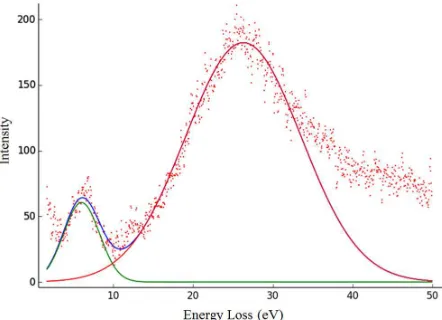
- π plasmon Gaussian centred at ca. 6.25eV (with a constraint on the FWHM (β): 0.25eV ≤ β ≤ 6eV);
[image:15.612.199.421.129.657.2]- (π+σ) plasmon Gaussian centred at ca. 25eV (10eV ≤β ≤ 17eV).
15
[image:16.612.200.421.123.283.2]outlined by the green rectangle and the low loss and core loss EELS spectrum images were analysed from the region within the red box. Vertically integrated EEL spectra from the bulk are plotted in (b) for low loss and in (c) for background subtracted core loss.
16
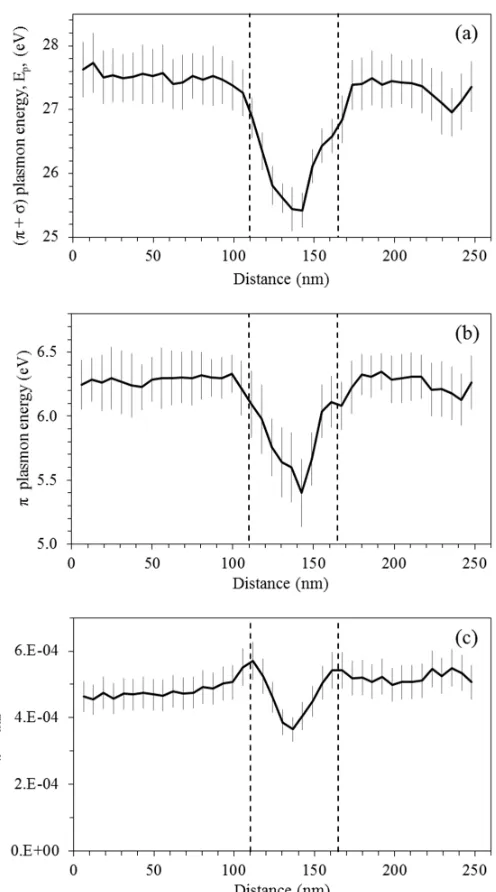
Figure 10 Extracted data from the low loss EEL spectra from the region of interest outlined in red in Figure 8(a). (a) Change in (π+σ) plasmon energy with distance across crack; (b) change in π plasmon energy with distance across crack; (c) Change in π plasmon intensity with distance across crack, normalised to total low loss (inc. elastic peak). The vertical dotted lines represent the crack boundaries. Error bars represent the standard deviations of the vertically integrated horizontal line scans.
17
the plasmon energy was measured to be 21.5eV at the crack centre; on average the plasmon energy over a microcrack decreased to ca. 23.8eV. For comparison the value for amorphous carbon is ca. 22eV [33,34]. These results show slightly lower values for (π+σ) plasmon energy than those found from EFTEM data, which could be due to the differing collection angles, however the trends are the same. In addition, the possibility of a change in relative sample thickness would also slightly affect the measured plasmon peak energies. The (π+σ) plasmon energy (Ep) is related to the density (N) by:
5 . 0 0 0 2
2
=
ε
π
m
Ne
h
E
pso that the observed reduction in (π+σ) plasmon energy across a crack represents a reduced density of material within the cracks [35] (h: Plank’s constant, e: electron charge; m0: electron rest mass, ε0:
vacuum permittivity). This reduction in density is not seen in bulk irradiated graphite [11] which implies that the contents of the crack are a result of atomic diffusion into the crack and not the remains of an ordered graphite structure.
The π plasmon peak energy also reduced in value across the crack in all areas examined. In the bulk, the π plasmon energy was measured to be between 6.0eV and 6.3eV which is again characteristic of near-perfect graphite [32,33]. In all cases, the reduction in π plasmon energy was to ca. 5 ± 0.5eV suggesting a reduction in crystallinity and density possibly due to sub 10nm crystallite sizes [36]. The normalised intensity of the π plasmon peak was also measured; a π plasmon window from 4.5eV to 8eV and total intensity window from -3eV to 50eV were used. The intensity was found to reduce by an average of 40% relative to the bulk, which indicates a reduction in the degree of π bonding. These results are in line with those from polycrystalline graphite in [36] where a correlation between π plasmon energy and relative intensity was also found; and with results from a graphitization series in [18] where EELS spectra from pre-graphitized material show a π plasmon intensity of ca. 50% of that in the graphitized product.
In the core loss region, the π* and σ* peaks, and the Gaussian associated with changes in intensity of the high energy shoulder of the π* peak (at ca. 287eV) were analysed using HyperSpy [31]. Both these measured fitted peak intensities were normalised to the total carbon K-edge intensity (integrating over a ca. 20 eV window). A fitting of a typical carbon K-edge using Gaussian peaks (G1 to G5, as labelled) is shown in Figure 11. All five core loss Gaussians were fitted using the following constraints:
- G1 centred at ca. 284.5eV (with a constraint on the FWHM (β): 0.25eV ≤ β ≤ 2eV); - G2 centred at ca. 286.45eV (0.2eV ≤β ≤ 4.0eV)
- G3 centred at ca. 288.25eV (0.2eV ≤β ≤ 4.0eV).
18
- G5 centred at ca. 296.75eV (11.2eV ≤ β ≤ 13.1eV).
Full details of this analysis method can be found in [11]. However, briefly, the relative intensity under G1 is assumed to represent the proportion of planar sp2 bonded carbon, as found in pristine
graphite, whereas the combined relative areas under G2 and G3 represent the proportion of non-planar sp2 bonded carbon, similar to that found in fullerenes. In previous studies [11,18,19] these relative
intensities have been normalised to reference materials, such as HOPG and crystalline C60, in order to
obtain absolute values. However in this case we simply report the relative change in Gaussian peak areas as the STEM probe traverses the region of interest, from bulk to crack. These results are displayed in Figure 12 which shows evidence for the direct replacement of planar sp2 bonding by non-planar sp2
(through the introduction of non-hexagonal rings and the fragmentation of basal planes) in the disordered graphitic material found within a crack. This is demonstrated by the fact that across all regions examined for both BEPO16 and BEPO20, within the crack the planar sp2 content decreased by
an average of ca. 33% ( ̅ = 18%) while the non-planar sp2 content increased by an average of ca. 30%
[image:19.612.195.434.330.499.2]( ̅ = 15%) relative to the surrounding bulk material.
19
Figure 12 Extracted data from the core loss EEL spectra from the region of interest outlined in red in Figure 8(a). (a) Change in relative area under G1 (associated with planar sp2 content) with distance across crack. (b) Change in relative area under G2 + G3 (associated with non-planar sp2 content) with distance across crack. The vertical dotted lines represent the crack
boundaries. Error bars represent the standard deviations of the vertically integrated horizontal line scans.
4. Discussion and Conclusions
TEM imaging of a set of nuclear graphites irradiated at different doses (but low temperatures) has shown the number of microcracks within the material increased with increasing dose, fragmenting the crystalline microstructure into smaller nanocrystalline regions. This is in agreement with the Raman spectroscopy data for these samples, measured by Krishna et al. [12] who observed that the ratio between the intensities of the D and G Raman peaks (ID/IG ratio) and the width of the G peak both
increased with increasing neutron dose. The change in ID/IG ratio was attributed to a change in crystallite
dimension, La, which was calculated to be 60% smaller in BEPO20 as compared to the low dose BEPO1
specimen using the relationship of Tuinstra and Koeing [37]. HRTEM image analysis showed that in irradiated specimens, the graphite basal planes in the bulk material appeared to be shorter in length and of an increased tortuosity, but with no observed relation to received dose. This is in agreement with the Raman data, where analysis of the broadening G peak was related to an increase in the degree of turbulence and disordering of basal planes [12].
20
al. [9] on irradiated nuclear graphite materials. From EELS and EDX measurements we found this material to be composed of low density carbon and of reduced graphitic character. Comparing the surrounding bulk material to the material within the cracks in irradiated specimens, EELS revealed a reduction in the volume plasmon energy within the microcracks consistent with a lower density material, together with a 30% reduction in planar sp2 bonded carbon which was replaced by non-planar sp2 bonded carbon. The degree of structural change of the bulk material was not observed to vary with respect to received dose. In material surrounding the microcracks in irradiated specimens, EFTEM measurements revealed a ca. 8nm periodic change in graphitic character, which was tentatively assigned to the beginnings of microcrack formation, where a region of low graphitic character will widen to form a microcrack containing disordered carbon.
The presence of disordered graphitic material within microcracks before irradiation potentially has implications for the evolution of the material within these microcracks and also the mechanisms behind dimensional change around microcracks during neutron irradiation. The accommodation by microcracks of c-axis expansion of graphite crystals during irradiation, discussed in the introduction, could be significantly affected by the presence of lower density material within the crack preventing crack closure either partially or totally.
The origin of disordered material within cracks of unirradiated specimens is not addressed in the literature, although it is possible that the material be a result of incomplete graphitization or the presence of quinolone-insolubles (QI) (which are higher in coal-tar pitches as opposed to petroleum based pitches [9]). However Karthik reports QI occurs as particles within the binder regions of the nuclear graphite microstructure [9], but that is not to say this disordered material is not mobile. Note that it is not expected that the low temperature annealing (ca. 230°C) of the BEPO graphite would cause significant restructuring of either the bulk graphite or the material within the cracks. An alternative explanation could be that the cleavage microcracks, created as a result of anisotropic thermal expansion/contraction, act as sinks for irradiation induced defects – filling with disordered carbon as defects cluster and segregate at these low energy sites. However, the migration energy of a single vacancy is such that it only becomes mobile above an irradiation temperature of 180°C, and this is predicted to be even higher for a single interstitial defect [28]. This initially suggests that the disordered material observed within the cracks does not accumulate as a direct result of migration of irradiation-induced defects, however as discussed previously, the low basal surface energy barrier and the irradiation-induced fragmentation of the microstructure creates increased possibilities for fast diffusion pathways via surfaces and grain boundaries.
21
no direct evidence for the total amount of disordered carbon material similarly increasing. Admittedly the increase in the Raman ID/IG ratio could be due (at least partially) to an increase in the total amount of disordered material in cracks, as well as the result of a decrease in crystallite size due to fragmentation of the microstructure.
In order to resolve this discussion, a further much more quantitative and detailed analysis of the in-crack material within non-irradiated specimens and irradiated specimens at a range of temperatures is required. In-crack material structure and behaviour following high temperature (>2000°C) annealing would also be of interest. Notwithstanding, the presence of low density material within microcracks has implications for the understanding of radiation-induced dimensional change and the associated changes in properties of nuclear graphite during service life. The characterisation technique could be extended beyond nuclear graphite and applied to a wide range of carbon materials.
Acknowledgments
Funding was provided by the National Nuclear Laboratory and EPSRC (EP/J502042/1, EP/I003169/1). We gratefully acknowledge the Leeds EPSRC Nanoscience and Nanotechnology Facility (grant EP/K023853/1) for TEM and SAED. We thank Jean-Pierre Da Costa and the late Patrick Weisbecker for provision of the HRTEM analysis software through the program ‘‘PyroMaN’’ (grant ANR-BLAN-2010-0929) supported by the ANR agency. Fred S. Hage would like to acknowledge Magnus Kristofer Nord (Norwegian University of Science and Technology, Trondheim, Norway) for assistance and useful discussions when setting up the carbon low loss and carbon-K edge fitting procedures in HyperSpy (freely available from http://hyperspy.org/). SuperSTEM is the UK Engineering and Physical Sciences Research Council (EPSRC) National Facility for aberration-corrected STEM. The views expressed are those of the authors and do not necessarily represent those of the funding bodies.
References
[1]
Yan P, Delannay L, Payne JFB, Tzelepi A. A Micromechanistic Crystal Plasticity
Model for Graphite. 4th EDF Energy Nucl. Graph. Symp. Eng. Challenges Assoc. with
Life Graph. React. Cores, EMAS Publishing; 2014.
22
[3]
Hacker PJ, Neighbour GB, McEnaney B. The coefficient of thermal expansion of
nuclear graphite with increasing thermal oxidation. JPhys D ApplPhys 2000;33:991–8.
doi:0022-3727/00/080991+08.
[4]
Mrozowski S. Mechanical Strength, Thermal Expansion and Structure of Cokes and
Carbons. Proc Conf Carbon 1954:31.
[5]
Delannay L, Yan P, Payne JFB, Tzelepi A. Predictions of inter-granular cracking and
dimensional changes of irradiated polycrystalline graphite under plane strain. Comput
Mater Sci 2014;87:129–37. doi:10.1016/j.commatsci.2014.02.008.
[6]
Wen K, Marrow J, Marsden B. Microcracks in nuclear graphite and highly oriented
pyrolytic graphite (HOPG). J Nucl Mater 2008;381:199–203.
doi:10.1016/j.jnucmat.2008.07.012.
[7]
Hall G, Marsden BJ, Fok SL. The microstructural modelling of nuclear grade graphite.
J Nucl Mater 2006;353:12–8. doi:10.1016/j.jnucmat.2006.02.082.
[8]
Hinks JA, Jones AN, Theodosiou A, van den Berg JA, Donnelly SE. Transmission
Electron Microscopy Study of Graphite under in situ Ion Irradiation. J Phys Conf Ser
2012;371:012046. doi:10.1088/1742-6596/371/1/012046.
[9]
Karthik C, Kane J, Butt DP, Windes WE, Ubic R. Neutron irradiation induced
microstructural changes in NBG-18 and IG-110 nuclear graphites. Carbon N Y
2015;86:124–31. doi:10.1016/j.carbon.2015.01.036.
[10] Karthik C, Kane J, Butt DP, Windes WE, Ubic R. In situ transmission electron
microscopy of electron-beam induced damage process in nuclear grade graphite. J
Nucl Mater 2011;412:321–6. doi:10.1016/j.jnucmat.2011.03.024.
[11] Mironov BE, Freeman HM, Brown AP, Hage FS, Scott AJ, Westwood AVK, et al.
Electron irradiation of nuclear graphite studied by transmission electron microscopy
and electron energy loss spectroscopy. Carbon N Y 2015;83:106–17.
23
[12] Krishna R, Jones AN, Mcdermott L, Marsden BJ. Neutron irradiation damage of
nuclear graphite studied by high-resolution transmission electron microscopy and
Raman spectroscopy. J Nucl Mater 2015;467:557–65.
doi:10.1016/j.jnucmat.2015.10.027.
[13] Bell JC, Bridge H, Cottrell AH, Greenough GB, Reynolds WN, Simmons JHW. Stored
Energy in the Graphite of Power-Producing Reactors. Philos Trans R Soc A Math Phys
Eng Sci 1962;254:361–95. doi:10.1098/rsta.1962.0002.
[14] Huntingdon S, Ormerod P, Mowles S. Characterisation of Oxidised and Irradiated
Magnox Core Graphite. 2002.
[15] Wise M. Management of UKAEA graphite liabilities. Harwell, Didcot, Oxfordshire:
2001. doi:IAEA-NGWM/CD--01.
[16] Brydson R. Electron Energy Loss Spectroscopy. Oxford, UK: Royal Microscopical
Society Microscopic Handbooks Volume 48. BIOS Scientific Publishers Ltd; 2001.
[17] Daniels HR, Brydson R, Brown A, Rand B. Quantitative valence plasmon mapping in
the TEM: viewing physical properties at the nanoscale. Ultramicroscopy 2003;96:547–
58. doi:10.1016/S0304-3991(03)00115-3.
[18] Daniels H, Brydson R, Rand B, Brown A. Investigating carbonization and
graphitization using electron energy loss spectroscopy (EELS) in the transmission
electron microscope (TEM). Philos Mag 2007;87:4073–92.
doi:10.1080/14786430701394041.
[19] Zhang Z, Brydson R, Aslam Z, Reddy S, Brown A, Westwood A, et al. Investigating
the structure of non-graphitising carbons using electron energy loss spectroscopy in the
transmission electron microscope. Carbon N Y 2011;49:5049–63.
doi:10.1016/j.carbon.2011.07.023.
24
[21] Muto S, Tanabe T. Temperature effect of electron-irradiation-induced structural
modification in graphite. J Nucl Mater 2000;283-287:917–21.
doi:10.1016/S0022-3115(00)00117-3.
[22] Gallego NC, Meisner RA, Burchell TD. Annealing Studies of Irradiated HOPG using
X-ray Measurements. Present. Int. Nucl. Graph. Spec. Meet., Seattle: Oak Ridge
National Laboratory; 2013.
[23] Schaffer M, Schaffer B, Ramasse Q. Sample preparation for atomic-resolution STEM
at low voltages by FIB. Ultramicroscopy 2012;114:62–71.
doi:10.1016/j.ultramic.2012.01.005.
[24] DaCosta JP, Weisbecker P, Farbos B, Leyssale J-M, Vignoles GL, Germain C.
Investigating carbon materials nanostructure using image orientation statistics. Carbon
N Y 2015;84:160–73. doi:10.1016/j.carbon.2014.11.048.
[25] DaCosta JP, Germain C, Baylou P. Spectral characterization of orientation data along
curvilinear structures. ICPR2, 2004.
[26] Thrower PA, Mayer RM. Point defects and self-diffusion in graphite. Phys Status
Solidi 1978;47:11–37. doi:10.1002/pssa.2210470102.
[27] Gulans A, Krasheninnikov A, Puska M, Nieminen R. Bound and free self-interstitial
defects in graphite and bilayer graphene: A computational study. Phys Rev B
2011;84:1–6. doi:10.1103/PhysRevB.84.024114.
[28] Trevethan T, Dyulgerova P, Latham CD, Heggie MI, Seabourne CR, Scott AJ, et al.
Extended Interplanar Linking in Graphite Formed from Vacancy Aggregates. Phys
Rev Lett 2013;111:095501. doi:10.1103/PhysRevLett.111.095501.
[29] Zhang H, Zhao M, Yang X, Xia H, Liu X, Xia Y. Diffusion and coalescence of
vacancies and interstitials in graphite: A first-principles study. Diam Relat Mater
2010;19:1240–4. doi:10.1016/j.diamond.2010.06.010.
25