This is a repository copy of
Energy Efficient IoT Virtualization Framework with Passive
Optical Access Networks
.
White Rose Research Online URL for this paper:
http://eprints.whiterose.ac.uk/101028/
Version: Accepted Version
Proceedings Paper:
Al-Azez, ZTS, Lawey, AQ, El-Gorashi, TEH et al. (1 more author) (2016) Energy Efficient
IoT Virtualization Framework with Passive Optical Access Networks. In: 18th International
Conference on Transparent Optical Networks (ICTON 2016). ICTON 2016, 10-14 Jul 2016,
Trento, Italy. IEEE . ISBN 9781509014675
https://doi.org/10.1109/ICTON.2016.7550472
(c) 2016, IEEE. Personal use of this material is permitted. Permission from IEEE must be
obtained for all other uses, in any current or future media, including reprinting/republishing
this material for advertising or promotional purposes, creating new collective works, for
resale or redistribution to servers or lists, or reuse of any copyrighted component of this
work in other works.
[email protected] https://eprints.whiterose.ac.uk/ Reuse
Unless indicated otherwise, fulltext items are protected by copyright with all rights reserved. The copyright exception in section 29 of the Copyright, Designs and Patents Act 1988 allows the making of a single copy solely for the purpose of non-commercial research or private study within the limits of fair dealing. The publisher or other rights-holder may allow further reproduction and re-use of this version - refer to the White Rose Research Online record for this item. Where records identify the publisher as the copyright holder, users can verify any specific terms of use on the publisher’s website.
Takedown
If you consider content in White Rose Research Online to be in breach of UK law, please notify us by
Energy Efficient IoT Virtualization Framework with Passive Optical
Access Networks
Zaineb T. Al-Azez, Ahmed Q. Lawey, Taisir E.H. El-Gorashi, Jaafar M.H. Elmirghani
School of Electronic & Electrical Engineering University of Leeds
Leeds, United Kingdom
ABSTRACT
In this paper we design a framework for an energy efficient cloud computing platform for Internet of things (IoT) accompanied by a passive optical access network (PON). The design is evaluated using a Mixed Integer Linear Programming (MILP) model. IoT network consists of four layers. The first layer represents IoT objects and the three other layers host relays, the coordinator and the gateway, respectively. PON consists of two layers hosting the Optical Network Units (ONUs) and the Optical Line Terminal (OLT), respectively. Equipment at all layers, except the object layer, can aggregate and process the traffic generated by IoT objects. The processing is performed using distributed mini clouds that host different types of Virtual Machines (VMs). These mini clouds can be located at the three upper layers of the IoT network and the PON two layers. We aim to reduce the total power consumption resulting from the traffic delivery and data processing at the different layers. The energy efficiency can be achieved by optimizing the placement and number of the mini clouds and VMs and utilizing energy efficient routes. Our results indicate that up to 21% of total power can be saved utilizing energy efficient PONs and serving heterogeneous VMs.
Keywords – IoT; PON; access network; cloud computing; energy efficiency; virtualization
1. INTRODUCITON
The exponential growing need for connecting the real world to the internet speeds up the development of IoT networks. It is predicted that the number of IoT devices to reach 50 billion in the next few years [1]. Having such a vast number of interconnected devices paved the way for futuristic smart applications in manufacturing, smart transportation, agriculture …etc. [2]. At the same time, this dramatic growth results in the creation of many challenges that are faced by IoT deployment such as scalability, interoperability, reliability and security [3]. In addition, the energy efficiency is one of the most important challenges that should be tackled by IoT networks architects [3]. One of main investigated approaches to address the energy efficiency challenge in networks and data centres is cloud computing [4]-[8].
We have shown in our previous work [9] that considerable power can be saved by hosting tiny virtual machines in mini clouds at the different levels of IoT networks to process collected data and produce useful information at lower data rate. The extracted information can then be transferred to upper layers for further processing or storage. We formulated the problem as a MILP model to address the energy efficiency issue in a single IoT network supported by cloud computing. However, the work in [9] considered only the typical four layers of IoT networks and did not include access network that is necessary to collect and transfer the traffic from IoT network toward the final data centres at the core network. In this paper, we extend our previous work by adding a passive optical access network (PON). The PON connects two separate IoT networks and participates in traffic aggregation and processing. We have selected PON as it’s an energy efficient form of access networks. Due to the paper length limitation, we omit writing the MILP equations.
The remainder of this paper is organized as follows: In section 2, we describe our energy efficient model. Section 3 discuss the model results. Finally, in section 4 we give our conclusions.
2. ENERGY EFFICIENT MILP FOR VIRTUALIZATION IN IOT NETWORKS WITH PON
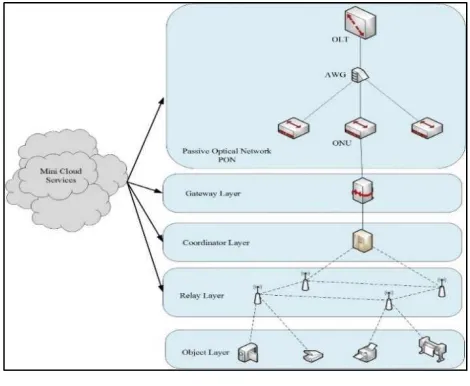
last layer in IoT network consists of one gateway element. The task of the gateway is to aggregate the coordinator traffic and upload it to the access network (PON). The access network consists of two layers. The ONU layer that hosts two ONU entities and the OLT layer that hosts one OLT entity. Each ONU is connected to one of the IoT networks. ONUs aggregate and deliver IoT networks traffic to the OLT that in turn transports the traffic to the core network.
In our framework, the capability of hosting VMs is allowed at each IoT element in the three upper layers of the IoT network in addition to the PON access network layers. Hosting VMs in IoT elements and PON entities gives them the capability of processing the aggregated traffic. We
model different VM types that correspond to different applications. Each IoT object demands one VM type. By processing the incoming raw data, VMs reduce the traffic at different percentages to generate useful information. The objective of our MILP is to minimize the total power consumption. Actually, there are two basic components of the total power consumption, the power consumption due to traffic in all IoT and PON layers and the power consumption due to VMs processing in the three upper layers of the IoT network and the two layers of the PON. The MILP is subject to several constraints. These constraints are concerned with the optimal VMs placement, mini clouds placement, controlling traffic direction and the flow conservation for unprocessed and processed IoT traffic.
3. MILP EVALUATION AND RESULTS
As mentioned earlier, we considered two separated IoT networks connected to a PON access network. Each IoT network consisted of 50 IoT objects, 25 relays, one coordinator and one gateway. In addition, each IoT network connected to an ONU, both ONUs are connected to one OLT. The IoT objects, relay elements and the coordinator in each IoT network are distributed through 30m×30m area. The gateway is placed 100m away from the coordinator. The distribution of IoT objects is random and uniform while the position of each relay element is at every 6m distance. All devices in the IoT network communicate through using the Zigbee protocol. On the other hand, the gateway is connected to the ONU through Gigabit Ethernet link and the ONU is connected to the OLT through an optical fiber. We only consider uplink direction as it carries the highest amount of traffic. Consequently we do not allow the traffic to pass from one IoT network to another through the OLT. Our model accounts for the traffic induced power consumption in PON entities as well as in the receiving and transmitting components of the IoT network (including propagation losses and the power amplification) [10]. VMs in different layers are hosted by a CPU with an average power consumption of 5.5W [11]. The CPU utilization of the VMs belonging to a certain type is assumed to be independent of both the number of served IoT objects and the different traffic reduction percentages.
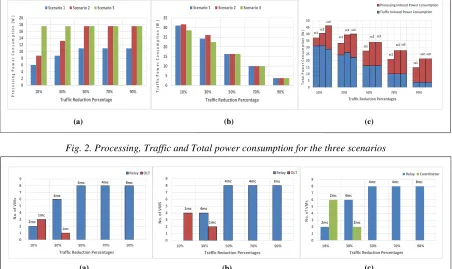
We considered three scenarios. In the first scenario, we considered four VM types with heterogeneous VMs CPU demands ranging from 10% to 40% CPU utilization. The second scenario considered four VM types with high homogeneous CPU requirements of 40%. Finally, the third scenario considered four VM types with homogeneous CPU requirements of 40%, similar to scenario 2, however the OLT was equipped with lower energy efficient CPU (11W). This setting allows us to assess the framework at different CPU demands and energy efficiency levels. Fig .2 shows the three scenarios processing, traffic and total power consumption, while Fig. 3 shows the VMs placement for the three scenarios.
[image:3.595.289.524.74.267.2]Scenario 1 produces the lowest processing induced power consumption at low reduction percentages (10% and 30%, Fig. 2(a)) as it evaluates heterogeneous VMs and is able to place some of these VMs in the OLT (10% and 30%, Fig. 3(a)). This placement reduces the total number of needed VM copies as placing VMs in any other layer duplicates them because the two IoT networks are not allowed to pass traffic between them due to the downlink restriction. Scenario 2 places more VMs at the OLT as it evaluates VMs with high and homogeneous
CPU utilization at low reduction percentages (10% and 30%, Fig. 3(b)), however, it still consumes higher CPU induced power consumption compared to scenario 1 as all VMs consumes high power consumption (10% and 30%, Fig. 2(a)). Scenario 3 consumes the highest CPU induced power consumption at low reduction percentages (10% and 30%, Fig. 2(a)) as the OLT is equipped with energy inefficient CPU, resulting in placing the VMs in the lower layers as shown (10% and 30%, Fig. 3(c)). Note that all scenarios place VMs at the relay layer for both IoT networks at high reduction percentages (50% - 90%, Fig. 3) as this leads to the minimum traffic induced power consumption at upper layers. As Scenario 1 evaluates heterogeneous VMs, it continues to produce the lowest CPU induced power consumption compared to the other two scenarios which have similar CPU induced power consumption (50% - 90%, Fig. 2(a)) as both serve VMs with similar CPU utilization of 40% at the relay element.
[image:4.595.72.523.446.586.2]As shown in Fig. 2(b), we notice a general trend toward lower network power consumption with higher reduction percentages as lower traffic is pushed in the network as useful extracted knowledge has lower data rate compared to raw unprocessed traffic. Scenario 3 produces the lowest traffic induced power consumption at low reduction percentages (10% and 30%, Fig. 2(b)) as it is able to place more VMs at the coordinator, allowing less knowledge traffic to pass though the upper layers. However, this saving in network induced power consumption is masked by the increase in CPU induced power consumption at low reduction percentages, leading to an overall high power consumption for scenario 3 compare to the other two scenarios (10% and 30% Fig 2(c)). Scenario 1 comes next in traffic induced power consumption at low reduction percentages (10% and 30%, Fig. 2(b)) as it is able to place some VMs at lower layers (10% and 30%, Fig. 3(a)) compared to scenario 2 which prefers to place most VMs at the OLT layer (10% and 30%, Fig. 3(b)) resulting in the highest traffic induced power consumption (10% and 30%, Fig. 2(b)). Note that all scenarios consumed the same traffic-induced power for 50%, 70% and 90% traffic reduction percentages as shown in Fig. 2(b). This is influenced by the similar distribution of VMs copies for all these cases as shown in Fig. 3. This identical distribution results from high reduction in traffic after processing by VMs, thus, the VMs were placed in relay elements as close as possible to the IoT objects. However, scenario 1 is the most energy efficient scenario considering total power consumption at all reduction percentages (Fig. 2(c)) as it has the lowest processing induced power consumption compared to the other two scenarios which compensates for the lower traffic energy efficiency. This results in about 18% and 21% of power saving for scenario 1 compared to scenario 2 and 3, respectively.
[image:4.595.72.524.454.723.2]Fig. 2. Processing, Traffic and Total power consumption for the three scenarios
Fig. 3. VMs placement in different mini-clouds (mc)
0 2 4 6 8 10 12 14 16 18 20
10% 30% 50% 70% 90%
P r o c e s s in g P o w e r C o n s u m p t io n (W )
Traffic Reduction Percentage Scenario 1 Scenario 2 Scenario 3
0 5 10 15 20 25 30 35
10% 30% 50% 70% 90%
T ra ff ic P o w e r C o n s u m p ti o n (W )
Traffic Reduction Percentage Scenario 1 Scenario 2 Scenario 3
sc1sc2 sc3 sc1 sc2 sc3 sc1 sc2 sc3 sc1 sc2 sc3 sc1 sc2 sc3 0 5 10 15 20 25 30 35 40 45 50 T o ta l P o w e r C o n su m p ti o n (W )
Traffic Reduction Percentages
Processing Induced Power Consumption
Traffic Induced Power Consumption
(a) (b) (c)
(b) (c)
2mc 4mc
4mc 4mc 8mc
1mc 1mc 0 1 2 3 4 5 6 7 8 9 N o . o f V M s
Traffic Reduction Percentages
Relay OLT
4mc
4mc 4mc 8mc
1mc 1mc 0 1 2 3 4 5 6 7 8 9 N o . o f V M S
Traffic Reduction Percentages
Relay OLT
2mc 4mc
4mc 4mc 8mc
2mc 2mc 0 1 2 3 4 5 6 7 8 9 N o . o f V M s
Traffic Reduction Percentages
Relay Coordinator
4. CONCLUSION
In this paper we introduced results for a MILP model that evaluates the energy efficiency of cloud computing platform for IoT networks connected to a PON. The energy efficiency is achieved by optimizing the placement and number of the mini clouds and VMs and utilizing energy efficient routes. Our results indicate that concentrating the VMs placement at the OLT connecting several IoT networks can help in saving power consumption when VMs process raw data at low reduction percentage. On the other hand, VM are to be placed in lower layer relays at high reduction rates. Results show that up to 21% of total power can be saved utilizing energy efficient CPUs in the OLTs while serving heterogeneous VMs.
ACKNOWLEDGEMENT
The authors would like to acknowledge funding from the Engineering and Physical Sciences Research Council (EPSRC), INTERNET (EP/H040536/1) and STAR (EP/K016873/1. In addition, Mrs. Zaineb Al-Azez would like to thank Mr. Ahmed Al-Quzweeni for many helpful discussions and the Higher Committee for Education Development in Iraq (HCED) for funding her PhD scholarship.
REFERENCESS
[1] F. Ganz,et al.: A Practical Evaluation of Information Processing and Abstraction Techniques for the Internet of Things,IEEE INTERNET OF THINGS J., VOL. 2. NO. 4. pp. 340-354, AUGUST 2015.
[2] A. Al-Fuqaha,et al.: Internet of Things: A Survey on Enabling Technologies, Protocols, and Applications,
IEEE COMMUNICATION SURVEYS & TUTORIALS, VOL. 17. NO. 4. pp. 2347-2376, FOURTH QUARTER 2015.
[3] R. Khan, et al.: Future Internet: The Internet of Things Architecture, Possible Applications and Key Challenges,10th International Conference on Frontiers of Information Technology, pp. 257-260, 2012.
[4] A.Q. Lawey, T. E. H. El-Gorashi and J. M. H. Elmirghani: Distributed energy efficient clouds over core networks,IEEE/OSA j. Lightwave technol., Vol. 32. No. 7. pp. 1261-1281, 2014.
[5] L. Nonde, T. E. H. El-Gorashi, and J. M. H. Elmirghani: Energy efficient virtual network embedding for cloud networks,IEEE/OSA j. Lightwave technology, Vol. 33. No. 9. pp. 1828-1849, 2015.
[6] A.Q. Lawey, T. E. H. El-Gorashi and J. M. H. Elmirghani: BitTorrent content distribution in optical networks,IEEE/OSA j. Lightwave technology, Vol. 32. No. 21. pp. 4209-4225, 2014.
[7] X. Dong, T. E. H. El-Gorashi and J. M. H. Elmirghani: Green IP over WDM networks with data centers,
IEEE/OSA j. Lightwave technol., Vol. 29. No. 12. pp. 1861-1880, 2011.
[8] X. Dong, T. E. H. El-Gorashi and J. M. H. Elmirghani: On the energy efficiency of physical topology design for IP over WDM networks,IEEE/OSA j. Lightwave technol., Vol. 30. No. 12. pp. 1931-1942, 2012.
[9] Z. T. Al-Azez, et al.: Virtualization framework for energy efficient IoT networks,Cloud Networking (CloudNet), 2015 IEEE 4th International Conference on, Niagara Falls, ON, 2015, pp. 74-77.
[10] W. Feng and J. M. H. Elmirghani: Lifetime evaluation in energy-efficient rectangular ad hoc wireless networks,Int. J. Commun. Sys.. Vol. 23. No. 12. pp. 1500-1520, 2010.