This is a repository copy of Perpetual Learning Framework based on Type-2 Fuzzy Logic
System for a Complex Manufacturing Process.
White Rose Research Online URL for this paper:
http://eprints.whiterose.ac.uk/110092/
Version: Accepted Version
Proceedings Paper:
Baraka, A., Panoutsos, G. and Cater, S. (2016) Perpetual Learning Framework based on
Type-2 Fuzzy Logic System for a Complex Manufacturing Process. In:
IFAC-PapersOnLine. 17th IFAC Symposium on Control, Optimization and Automation in
Mining, Mineral and Metal Processing MMM 2016, 31 August—2 September 2016, Vienna,
Austria. , pp. 143-148.
https://doi.org/10.1016/j.ifacol.2016.10.111
[email protected] https://eprints.whiterose.ac.uk/
Reuse
This article is distributed under the terms of the Creative Commons Attribution-NonCommercial-NoDerivs (CC BY-NC-ND) licence. This licence only allows you to download this work and share it with others as long as you credit the authors, but you can’t change the article in any way or use it commercially. More
information and the full terms of the licence here: https://creativecommons.org/licenses/
Takedown
If you consider content in White Rose Research Online to be in breach of UK law, please notify us by
Ali Baraka*, George Panoutsos*, Stephen Cater**
*Department of Automatic Control and Systems Engineering, The University of Sheffield, Mappin Street, Sheffield, S1 3JD, UK (Tel: (+44) (0)114 222 5130; e-mail: [email protected], [email protected])
**The Welding Institute (TWI Ltd.), Wallis Way, Catcliffe, Rotherham, S60 5TZ, UK (e-mail:[email protected])
Abstract: This paper introduces a perpetual type-2 Neuro-Fuzzy modelling structure for continuous learning and its application to the complex thermo-mechanical metal process of steel Friction Stir Welding (FSW). The ‘perpetual’ property refers to the capability of the proposed system to continuously learn from new process data, in an incremental learning fashion. This is particularly important in industrial/manufacturing processes, as it eliminates the need to retrain the model in the presence of new data, or in the case of any process drift. The proposed structure evolves through incremental, hybrid (supervised/unsupervised) learning, and accommodates new sample data in a continuous fashion. The human-like information capture paradigm of granular computing is used along with an interval type-2 neural-fuzzy system to develop a modelling structure that is tolerant to the uncertainty in the manufacturing data (common challenge in industrial/manufacturing data). The proposed method relies on the creation of new fuzzy rules which are updated and optimised during the incremental learning process. An iterative pruning strategy in the model is then employed to remove any redundant rules, as a result of the incremental learning process. The rule growing/pruning strategy is used to guarantee that the proposed structure can be used in a perpetual learning mode. It is demonstrated that the proposed structure can effectively learn complex dynamics of input-output data in an adaptive way and maintain good predictive performance in the metal processing case study of steel FSW using real manufacturing data.
Keywords: perpetual learning, incremental learning, fuzzy neural networks, granular computing, type-2 fuzzy systems, friction stir welding, metal processing.
1. INTRODUCTION
Data-driven computational intelligence (DDCI) models have gathered much pace and popularity due to the rapid growth in computing power and the availability of extensive data and information in modern industrial processes. Common DDCI paradigms that are often employed to describe complex processes and solve engineering problems include, but not limited to, neural networks (NN) (Bishop, 2006), fuzzy rule-based systems (FRBS) (Jang and Sun, 1996), and evolutionary and genetic algorithms (GAs) (Yang et al., 2003). In contrast to other DDCI methodologies, fuzzy rule-based systems offer good level of transparency and simplicity in their structure. Recently, studies on type-2 fuzzy logic systems (FLSs) have attracted much attention (Bustince Sola et al., 2015; Mendel, 2015) due to their capacity to capture uncertainty in the input linguistic variables (an extra degree of freedom compared to Type-1 sets). In addition, Type-2 FLSs appear to be more promising compared to their type-1 counterparts in handling uncertainties such as those associated with noisy data and different word meanings. Thus, type-2 fuzzy sets allow for better capture of uncertainties in rule-based systems.
The development of a type-2 FLS generally involves two learning phases, the structure learning phase and the
parameter learning phase. These two phases are often carried out sequentially; the structure learning phase is used to construct the initial structure of fuzzy rules and then the parameter learning phase is used to tune the parameters of each rule. One characteristic of this modelling scheme is that it is suitable when sufficient amount of data is collected and used to train the model. From the two learning phases, the constructed rule-based system has a fixed structure with the desired accuracy. However, the model with a fixed structure cannot always perform well each time new data become available due to different characteristics of a complex system under different input conditions. This is often found in industrial/manufacturing processes, where when new data are available one has to redevelop and retrain the model, to accommodate the new data/information. To improve the performance of a model when new data are available, there are two general strategies. The first strategy is to develop an entirely new modelling paradigm considering the specific features of the new data, which are not considered by the
two-step strategy: expanding the structure of the existing model by generating new rules to accommodate the new data without significantly disrupting the existing model and in the second step further fine-tune and/or prune the model.
In this paper, the research study is focused on the idea of offline incremental learning in which additional knowledge is added to the model based on the second strategy. In the proposed learning strategy, the modelling structure is designed to learn from an initial database (via an appropriate learning/optimisation algorithm) but at the same time incrementally adapt to new data when these are available without deteriorating the core model knowledge acquired
from the initial database. Additional system’s features include the system’s ability to interact with the environment in a perpetual mode and having an open structure in which the system has the ability to add and remove rules (knowledge maintenance). Several methods have been developed so far to demonstrate some of the aspects of incremental learning (Kasabov, 2015; Kasabov and Song, 2002; Panoutsos and Mahfouf, 2008). However, all of them use type-1 fuzzy logic systems. In the field of type-2 fuzzy logic systems, several models have been proposed to incrementally optimise the parameters of the model (Juang and Chen, 2014; Juang and Tsao, 2008; Lin et al., 2014). However, all these models are used for online structure learning for time varying data. To our knowledge, no pervious incremental type-2 neural fuzzy systems for offline learning have been reported. In this study, we present a new perpetual (incremental) learning framework that is based on granular computing interval type-2 neural fuzzy systems (GrC-IT2-FLSs). By using such a modelling framework, it is possible to achieve good modelling performance and at the same time good system transparency (interpretability). An iterative rule pruning mechanism is used as the main feature that removes the redundant fuzzy rules after each incremental step, which allows the model to be used in a lifelong learning mode. The proposed methodology is tested against a real-industrial problem. The prediction of spindle peak torque of Friction Stir Welding of steel is investigated. Such manufacturing process involves highly complex databases, containing data with high uncertainty (measurement noise, operator errors, etc.) and non-linear dynamics (complex thermo-mechanical behaviour) as well as sparse data (due to constraints on the process conditions).
The rest of the paper is organised as follows: Section 2 presents the theoretical background of the systematic modelling framework of Interval type-2 Neural-Fuzzy (NF) systems developed via an information granulation process, and the process under investigation. Section 3, the main contribution of this paper: the perpetual learning framework based on rule growing and pruning strategies that are proposed to be used in the learning architecture. In Section 4, a case study is presented based on the complex manufacturing process of FSW. Finally, conclusions with respect to the whole research study are drawn in Section 5.
2. BACKGROUND THEORY AND PROCESS UNDER INVESTIGATION
2.1 Interval Type-2 Radial Basis Function Neural Network
Type2-Fuzzy Logic System (T2-FLSs) are similar to a Type1-Fuzzy Logic Systems (T1-FLSs), which are characterised by linguistic IF…THEN rules, however their premise and consequent sets are Type-2 Fuzzy Sets.A type-2 fuzzy set (T2-FSs) has a membership function (MF) that is itself a fuzzy set in [0, 1], unlike a normal fuzzy set (T1-FS) where the membership function includes a crisp number in [0, 1]. T2-FLSs take advantage of the extra degree of freedom to better handle uncertainties associated in the input space (Mendel, 2007). In this paper, we use IT2-FLSs to minimise the computational effort and produce a real-time capable system (Mendel, 2001).
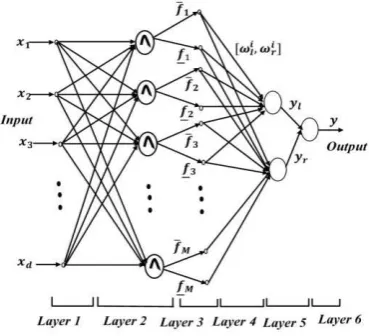
The Interval Type-2 Radial Basis Function Neural Network (IT2-RBF-NN) proposed in this study has a similar structure to the structure used in (Baraka et al., 2015; Rubio-Solis and Panoutsos, 2015) (as shown in Fig. 1), however, the initial structure of the network is taken from type-2 fuzzy Gaussian mixture model (Zeng et al., 2008). The consequent part of each fuzzy rule is of the Mamdani type model, each of which has the following linguistic IF...THEN form:
Where , are the input vectors, are the
[image:3.595.336.521.475.643.2]interval type-2 fuzzy sets, , is the number of rules, is the index of the rules. The mathematical description of the IT2-RBF-NN is provided below:
Fig. 1. IT2-RBF-NN general structure
The first layer only transmits the current input values , to the next layer directly without performing any computation. The second layer uses an interval type-2 MF to perform the fuzzification process in order to produce the upper and lower intervals .
With the choice of a Gaussian primary MF having fixed mean and uncertain standard deviation that the value in
Where is the fuzzy set in input variable . It is clear that the IT2-FS is bounded by the upper MF and
lower MF (footprint of uncertainty - FOU). The third
layer performs an algebraic operation to acquire the firing strength of each rule. The fourth layer defines the consequences of the rule nodes. In the fifth layer, the outputs and are calculated via the Karnik-Mendel iterative type-reduction algorithm (Karnik and Mendel, 2001) and finally the sixth layer computes the defuzzified output by the average of and . The parameters and associated with the Gaussian membership functions are to be determined by process data. In this study, the heuristic method described in (Zeng et al., 2008) was used to define the parameters of the lower and upper membership functions.
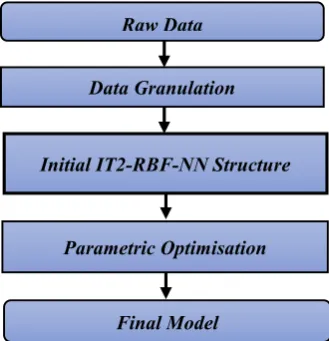
Here a hybrid approach is applied, which combines IT2-RBF-NN, a human-like information capture in Granular Computing (GrC) (Bargiela and Pedrycz, 2003) for the structural optimisation of the system and adaptive error propagation (EP) for the parametric optimisation. The proposed modelling framework applies the GrC algorithm to initialise the IT2-RBF structure (i.e. initial data granulation for the estimation of membership functions). Its parameters are subsequently optimised using adaptive error-propagation as detailed in (Mendel, 2004). In manufacturing systems, such as the ones involving steel processing, one of the challenges is the identification of new process behaviours resulting in unexpected process performance (such as process drift). This involves the identification of new behaviours that have not been previously encountered (‘seen’) by the model. In such case, the model cannot adapt itself to include the new dataset (new knowledge), hence model retraining is needed to
avoid large errors in the model’s forecasting performance.
[image:4.595.90.255.564.735.2]The general framework of the proposed GrC-IT2-RBF-NN modelling approach is summarised in the flow chart shown in Fig. 2.
Fig. 2. IT2-RBF modelling framework based on granular computing
2.2 Steel Friction Stir Welding
Friction Stir Welding (FSW) is a solid-state joining technique that is recognised in manufacturing for its versatility, for being environmentally friendly, energy and time efficient, and most importantly provides very good performance for metals such as aluminium alloys (Mishra and Ma, 2005). The FSW process consists of a non-consumable rotating tool with a pin and a shoulder, the tool is inserted into butting edges of two rigidly clamped plates of the material being welded (He et al., 2014). The joining of steel using FSW is more challenging, compared to aluminium, due to the complex thermo-mechanical behaviour of steel and associated phase transformations of its microstructure. Hence process modelling in steel FSW would help the optimisation of the process. Steel FSW is a multi-input multi-output process that is very challenging to model for the following reasons:
(a) The process is characterised by the presence of uncertainty (measurement noise, operator errors, complex thermo-mechanical behaviour);
(b) Constraints on the quality and quantity of real industrial data (mainly due to cost and or weldability issues);
(c) A number of factors that influence the process cannot be measured for practical reasons (for example continuous tool tip temperature).
For the FSW of steel, three main process parameters are utilised to control the welding process: the tool rotational speed, welding speed along the joint line, and the tool plunge depth into the parent material. In order to design a practical and safe FSW of steel, it is vital to establish relationships between the main process parameters and internal process variables such as torque, traverse force, downwards force and internal process temperatures. Knowledge and ability to predict such parameters in real time is paramount in avoiding overheating problems and issues related to tool wear leading to poor weld quality. The use of NF modelling techniques have been recently applied to describe the performance of the process and predict its behaviour in (Baraka et al., 2014). In the following section, we describe the creation of an incremental learning framework that identifies novelty in the FSW data and expands the model structure to capture and learn the new data/information.
3. METHODOLOGY
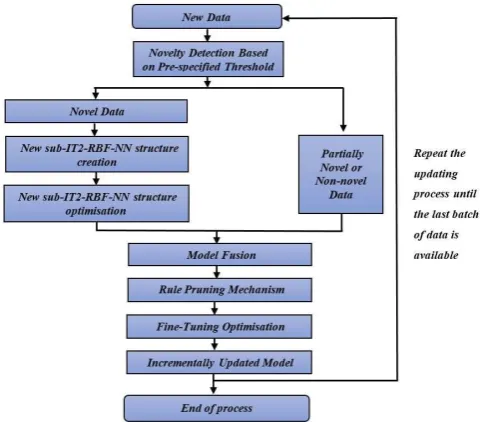
In this section, the perpetual learning framework based on interval type-2 fuzzy radial basis function is presented in detail. Perpetual learningis the ability of the model to modify its existing structure to accommodate the new data without compromising already existing learned patterns. Fig. 3 illustrates the overall perpetual learning methodology.
When new data are available to the model, they pass through a novelty detection filter before they are fed to the incremental learning process. Novelty detection is the process of identifying new or partially new or unknown data that are not included in the model’s existing rule-base. Several statistical and neural network-based approaches can be used to estimate whether test samples comes from the same Data Granulation
Parametric Optimisation Raw Data
Final Model
distribution or not (Markou and Singh, 2003). In this study, we use a simple novelty detection approach based on multidimensional Euclidean distance where the novelty is assessed by measuring the distance of each data sample from the cluster centres of a previously elicited model (Webb, 2003). The new data are then further categorised into two subsets (namely: ‘newdata’ and ‘partially new’ data) based on a predefined threshold. The new data consist of datasets that belong to a new input space compared to the original data, while the partially new data consist of datasets that have some similarity to the original dataset, however are not fully covered by the existing knowledgebase; this includes data that have large similarity to the exiting knowledgebase (not new data).
Fig. 3. Perpetual learning framework
Depending on the type of novelty in the data, the proposed perpetual learning framework has two different incremental learning algorithms as shown in Fig. 3. The performance of the existing model, following a computer simulation using the partially new data is assessed; if the model’s performance on the partially new data is acceptable, then the existing model structure is not modified. Otherwise, the existing rule-base is fine-tuned without disturbing the existing structure (constrained optimisation) aiming to improve the performance of the model on the partially new data. Since the input space of the partially new/not new data is mostly covered by the existing rule-base (by one or more rules), there is no need to generate new rules and fine-tuning the existing structure is sufficient. The dataset classed as ‘new data’ is utilised to generate a number of new rules to cover the input space of the new knowledge; this is achieved using the GrC-IT2-RBF knowledge capture and modelling procedure. The new set of rules is added to the existing rule-base to form a new IT2-RBF-NN model.
Following the incremental learning process (new knowledge is added to the existing one) the new model structure includes rules to be able to predict both new and old datasets. However, each time the incremental learning process is repeated the model structure expands, which is not
sustainable towards a perpetual learning mechanism. An ever-expanding rule-base may result in an unnecessary complex system that is difficult to optimise, and its predictive performance may deteriorate. To address this issue, we propose the use of an iterative rule pruning mechanism in order to identify and remove insignificant and redundant rules, thus resulting in a self-maintaining system structure. The rule-pruning task can be achieved using a four-stage operation, including: 1) removing redundant fuzzy sets, 2) merging similar fuzzy sets, 3) removing redundant fuzzy rules, and 4) merging similar fuzzy rules. These four stages are controlled by 4 threshold parameters. To measure the degree of overlap between two fuzzy sets, a similarity measure is generally used. Although quite extensive research has been carried out in the area of type-1 fuzzy sets similarity measures (Cross and Sudkamp, 2002), only a few similarity measures for type-2 fuzzy sets have appeared to date (Wu and Mendel, 2009). For two interval type-2 fuzzy sets and , computation of their similarity degree is much more complex than for that of type-1 fuzzy sets counterparts, particularly for those with primary Gaussian MFs. In this
study, the Jaccard’s similarity measure is used to measure the
similarity between two type-2 FSs. More details about how to
calculate the Jaccards’s similarity measure can be found in (Wu and Mendel, 2009). Finally, the updated NF model is fine-tuned via the gradient descent method (Mendel, 2004).
4. SIMULATION RESULTS
A number of experimental trials for FSW of steel DH 36 were conducted at TWI Ltd. (South Yorkshire, UK) to obtain the optimum welding parameters by varying the levels of the rotational speed and welding speed. The proposed modelling framework is applied to predict the spindle peak torque of the process. The process dataset (in total 55 data samples) has been split as follows for the purpose of modelling:
a) Initial dataset (36 data points) which has been divided into 36 (75%) data points for training the model and 9 (25%) data points for testing the generalisation capability of the trained modelling structure;
b)
New dataset (19 data points), which has been used to test the incremental modelling structure.4.1 Initial Model Performance
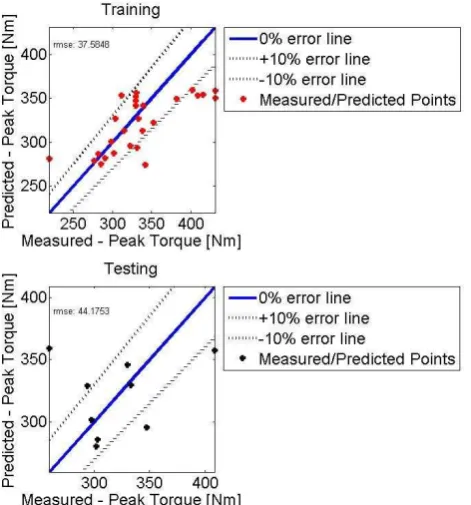
The initial training data set is compressed into 5 information granules by using the Granular Computing (GrC) process. The extracted information granules are mapped into linguistic IT2-FL rules that form the initial rule-base of the system. After obtaining the initial structure of the IT2-FL rule-base (5 fuzzy rules), the neural-fuzzy structure is optimised using the adaptive error-propagation algorithm.
illustrates the measured/ predicted fitness plots within the 10% error band for the training and testing performance respectively.
Fig. 4. Performance of the initial model
4.2 Incremental Learning Model Performance
The new data set (19 data points) is divided into two subsets (training and testing). The new training set is then presented to the incremental learning structure. The IL structure classifies the training data into novel and partially novel data set. The latter is used to fine-tune the initial model via the adaptive error-propagation algorithm and the former is used to generate new fuzzy rules that represent the new dataset. 4 new rules are obtained from the granular computing algorithm (i.e. optimal number of rules to cover the new dataset). The new fuzzy rules are trained via the same algorithmic procedure as the initial IT2-RBF model. Subsequently, the newly generated fuzzy rules are combined with the rest of the fuzzy rules in the modelling structure.
Following the rule-pruning process, two rules are removed based on a pre-defined similarity threshold; the resulting rule-base is further optimised (fine-tuned) as described in Section 3.
[image:6.595.50.286.113.366.2]The resulting model is tested for its performance on the initial dataset as well as new dataset (training and testing). The results are shown in Fig. 5. The prediction performance achieved by the 7-rule model is: Mean Absolute Error (MAE) = 8.61% and 9.84% for training and testing respectively. As illustrated in the model fit plot for the training data set, the IL structure is able to maintain a good performance, in fact it is able to correctly construct input-output mappings similar to the original model. Similar behaviour is observed for the testing data set for old and new data sets. The model is able to predict correctly the new – unseen – input patterns.
Fig. 5. Performance of the incrementally updated model on the old/new data
5. CONCLUSION
In this paper, a perpetual learning framework for data-driven modelling is presented, based on Granular Computing and Interval Type-2 Neural-Fuzzy system structure, with continuous rule growing and pruning. The proposed IL framework is successfully applied for the first time to a manufacturing case study related to the predication of peak toque in Friction Stir Welding of steel; this is a manufacturing process that is known for its highly non-linear behaviour, and often complex but limited data. The modelling simulation results show an achieved predictive performance of more than 90% in predicting the spindle torque based on the process conditions (inputs) of welding speed and tool rotational speed. Inherent system
interpretability exists in the form of the system’s Fuzzy Logic rule-base; this can be beneficial to the process expert who may use the linguistic rules to gain a better understanding of the effects of the process conditions on the internal process variables as well as help the process operators in making effective decisions on the optimal process conditions. It was also shown that the proposed structure incrementally updates the model by adding and removing rules in the model to accommodate new data/knowledge. Crucially, the performance of the new model on the original dataset is maintained; the performance of the incrementally updated model on the new data set is comparable to the overall original performance.
ACKNOWLEDGEMENTS
REFERENCES
Baraka, A., Panoutsos, G., and Cater, S. (2015). A real-time quality monitoring framework for steel friction stir welding using computational intelligence. Journal of Manufacturing Processes, 20, 137-148.
Baraka, A., Panoutsos, G., Mahfouf, M., and Cater, S. (2014). A shannon entropy-based conflict measure for enhancing granular computing-based information processing. Paper presented at the 2014 IEEE International Conference on Granular Computing (GrC), Noboribetsu, Japan.
Bargiela, A., and Pedrycz, W. (2003). Granular computing: An introduction: Springer.
Bishop, C. M. (2006). Pattern recognition and machine learning (Vol. 4): springer New York.
Bustince Sola, H., Fernandez, J., Hagras, H., Herrera, F., Pagola, M., and Barrenechea, E. (2015). Interval type-2 fuzzy sets are generalization of interval-valued fuzzy sets: Toward a wider view on their relationship. Fuzzy Systems, IEEE Transactions on, 23(5), 1876-1882.
Cross, V. V., and Sudkamp, T. A. (2002). Similarity and compatibility in fuzzy set theory: Assessment and applications (Vol. 93): Springer Science & Business Media.
He, X., Gu, F., & Ball, A. (2014). A review of numerical analysis of friction stir welding. Progress in Materials Science, 65, 1-66.
Jang, J.-S. R., and Sun, C.-T. (1996). Neuro-fuzzy and soft computing: A computational approach to learning and machine intelligence: Prentice-Hall, Inc.
Juang, C.-F., and Chen, C.-Y. (2014). An interval type-2 neural fuzzy chip with on-chip incremental learning ability for time-varying data sequence prediction and system control. Neural Networks and Learning Systems, IEEE Transactions on, 25(1), 216-228.
Juang, C.-F., and Tsao, Y.-W. (2008). A self-evolving interval type-2 fuzzy neural network with online structure and parameter learning. Fuzzy Systems, IEEE Transactions on, 16(6), 1411-1424.
Karnik, N. N., and Mendel, J. M. (2001). Centroid of a type-2 fuzzy set. Information Sciences, 132(1), 195-220.
Kasabov, N. K. (2015). Evolving connectionist systems for adaptive learning and knowledge discovery: Trends and directions. Knowledge-Based Systems, 80, 24-33.
Kasabov, N. K., and Song, Q. (2002). Denfis: Dynamic evolving neural-fuzzy inference system and its application for time-series prediction. Fuzzy Systems, IEEE Transactions on, 10(2), 144-154.
Lin, Y.-Y., Chang, J.-Y., and Lin, C.-T. (2014). A tsk-type-based self-evolving compensatory interval type-2 fuzzy neural network (tscit2fnn) and its applications. Industrial Electronics, IEEE Transactions on, 61(1), 447-459.
Markou, M., and Singh, S. (2003). Novelty detection: A review—part 1: Statistical approaches. Signal processing, 83(12), 2481-2497.
Mendel, J. M. (2001). Uncertain rule-based fuzzy logic system: Introduction and new directions. Upper Saddle River, NJ: Prentice-Hall.
Mendel, J. M. (2004). Computing derivatives in interval type-2 fuzzy logic systems. IEEE Transactions on Fuzzy Systems, 12(1), 84-98.
Mendel, J. M. (2007). Type-2 fuzzy sets and systems: An overview. Computational Intelligence Magazine, IEEE, 2(1), 20-29.
Mendel, J. M. (2015). A comparison of three approaches for estimating (synthesizing) an interval type-2 fuzzy set model of a linguistic term for computing with words. Granular Computing, 1-11.
Mishra, R. S., and Ma, Z. (2005). Friction stir welding and processing. Materials Science and Engineering: R: Reports, 50(1), 1-78.
Panoutsos, G., and Mahfouf, M. (2008). An incremental learning structure using granular computing and model fusion with application to materials processing Intelligent techniques and tools for novel system architectures (pp. 139-153): Springer.
Rubio-Solis, A., and Panoutsos, G. (2015). Interval type-2 radial basis function neural network: A modeling framework. Fuzzy Systems, IEEE Transactions on, 23(2), 457-473.
Webb, A. R. (2003). Statistical pattern recognition: John Wiley & Sons.
Wu, D., and Mendel, J. M. (2009). A comparative study of ranking methods, similarity measures and uncertainty measures for interval type-2 fuzzy sets. Information Sciences, 179(8), 1169-1192.
Yang, Y., Linkens, D., and Mahfouf, M. (2003). Genetic algorithms and hybrid neural network modelling for aluminium stress—strain prediction. Proceedings of the Institution of Mechanical Engineers, Part I: Journal of Systems and Control Engineering, 217(1), 7-21.