This is a repository copy of
Effects of interactions on the relaxation processes in magnetic
nanostructures
.
White Rose Research Online URL for this paper:
http://eprints.whiterose.ac.uk/111324/
Version: Accepted Version
Article:
Atkinson, Lewis J., Ostler, Thomas A. orcid.org/0000-0002-1328-1839, Hovorka, O. et al.
(7 more authors) (2016) Effects of interactions on the relaxation processes in magnetic
nanostructures. Physical review B. 134431. pp. 1-8. ISSN 2469-9969
https://doi.org/10.1103/PhysRevB.94.134431
[email protected] https://eprints.whiterose.ac.uk/
Reuse
Items deposited in White Rose Research Online are protected by copyright, with all rights reserved unless indicated otherwise. They may be downloaded and/or printed for private study, or other acts as permitted by national copyright laws. The publisher or other rights holders may allow further reproduction and re-use of the full text version. This is indicated by the licence information on the White Rose Research Online record for the item.
Takedown
If you consider content in White Rose Research Online to be in breach of UK law, please notify us by
Lewis J. Atkinson1†∗, Thomas A. Ostler2†‡, O. Hovorka3, K.K Wang4, B. Lu4,
G.P Ju4, J. Hohlfeld5, B. Bergman6, B. Koopmans6 and Roy W. Chantrell1
1
Department of Physics, University of York, Heslington, York YO105DD United Kingdom. 2
Département de Physique, Universitè de Liége (B5), B-4000 Liége, Belgium 3
Engineering and the Environment, University of Southampton, Southampton SO16 7QF, United Kingdom 4
Seagate Technology, 47010 Kato Road, Fremont, CA 94538, USA 5
Seagate Technology, 7801 Computer Avenue, Bloomington, MN 55435, USA 6
Department of Applied Physics, Technische Universiteit Eindhoven, P.O. Box 513, 5600 MB Eindhoven, NL
†These authors contributed equally to this work ∗e-mail: [email protected] and ‡email: [email protected]
Controlling the relaxation of magnetisation in magnetic nanostructures is key to optimizing magnetic storage device performance. This relaxation is governed by both intrinsic and extrinsic relaxation mechanisms and with the latter strongly dependent on the interactions between the nanostructures. In the present work we investigate laser induced magnetization dynamics in a broad band optical resonance type experiment revealing the role of interactions between nanostructures on the relaxation processes of granular magnetic structures. The results are corroborated by constructing a temperature dependent numerical micromagnetic model of magnetization dynamics based on the Landau-Lifshitz-Bloch equation. The model predicts a strong dependence of damping on the key material properties of coupled granular nanostructures in good agreement with the experimental data. We show that the intergranular magnetostatic and exchange interactions provide a large extrinsic contribution to the damping. Finally we show that the mechanism can be attributed to an increase in spinwave degeneracy with the ferromagnetic resonance mode as revealed by semi-analytical spinwave calculations.
I. INTRODUCTION
Over the last few decades the demand for information storage has increased at unprecedented rates. This has driven forward huge advances in the areal density of hard disk drives (HDD) based on magnetic storage. These increases have led to hard drive (granular) media containing much smaller grains located in smaller areas. In an ideal scenario the ability to control the magnetic orientation of individual grains would be possible without the eects of interactions between them. However, in structured magnetic materials at the nanoscale this ideal can never be reached. In reality the nanostructures are coupled. This coupling can arise from a number of mechanisms; the long-ranged dipole-dipole eld; direct exchange between grains through magnetic impurities across the interstitial region1; or via superexchange via
oxides in the interstitial boundary layer. The role of interactions in relaxation processes in magnetic materials has long been studied26in magnetic materials, though it
is often very dicult to determine individual mechanisms by which the system relaxes.
The key measurable quantity that governs the relaxation of the magnetization is the eective damping. This parameter determines the dynamics of the magnetization after an external stimulus and, importantly for granular magnetic media, it governs the speed at which a bit can be reversed. A large value of damping is desirable to speed up the writing process and reduce transition noise in Perpendicular Magnetic Recording (PMR) and
to reduce the dc noise arising from back-switching during the Heat Assisted Magnetic Recording (HAMR) process. Although its eect on recording performance is signicant, the origin of damping is poorly understood. Mo et. al.6 carried out a detailed analysis of FMR data
on CoCrPt perpendicular media, concluding that the intrinsic damping from magnon-electron scattering was as low as 0.004, over an order of magnitude smaller than the values usually obtained for the total damping. Mo et al ascribe the major contribution to the damping as arising from inhomogeneity line broadening and grain boundary two-magnon scattering. However, another extrinsic candidate contribution to damping arises from the eects of intergranular interactions. In the present work we investigate the eects of magnetostatic and exchange interactions on the eective damping of perpendicular media. It is shown that the interactions give rise to an increase in damping which is due to the presence of long-ranged dipole-dipole spin wave modes. The introduction of exchange interaction results in a stiening of the magnetization and a consequent reduction in damping, demonstrated experimentally for a series of CoCrPt granular media, and veried by micromagnetic modelling. We furthermore use a simplied model of spinwaves2to show that the interplay
2
II. EXPERIMENTAL RESULTS
To determine the damping from the numerical model and experimentally we use an optical ferromagnetic resonance (FMR) method. In an optical FMR experiment, a magnetic eld is used to force the magnetic moments away from their equilibrium. An optical pulse is applied, heating the sample, and thus leading to a new equilibrium position for the magnetization. The initial/new equilibrium conguration arises due to the minimisation of the competing anisotropy, exchange, demagnetising and Zeeman energies at the starting/nal temperature. The rapid increase in temperature caused by the laser induces precession of those moments around a new position due to thermally induced changes in the energy contributions. The resulting dynamics can then be analysed to determine eective parameters governing the relaxation process. This technique has been applied to a wide range of materials and structures710. In
particular optical FMR is the preferred method for measuring the damping and resonance frequencies in materials with a strong magnetocrystalline anisotropy11,
due to the high elds required to drive the system to resonance in a typical ferromagnetic resonance experiment12. Interestingly, the two methods were shown
to give the same values of the damping by Clinton and co-workers in Ref. 7.
-15 -10 -5 0 5 10 15
-1.0 -0.5 0.0 0.5 1.0
Mp
e
rp
/M
s
Applied Field (kOe) 7B
20B 17B 14B 11B
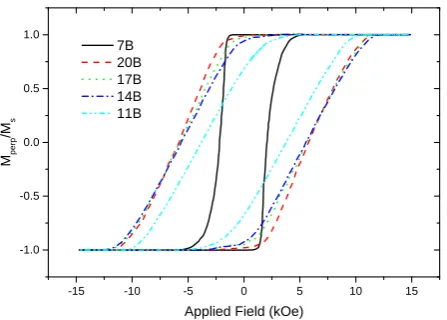
Figure 1. (Color online) Hysteresis loops for the series of CoPt with variable exchange. Increasing exchange leads to increasingly square loops as expected.
We have carried out measurements on a series of CoPt perpendicular media in which the exchange coupling was varied by changing the oxygen content in the intergranular layers. The applied eld is applied perpendicular to the sample plane (in the z-direction). The variation of the exchange coupling is immediately apparent in the measured hysteresis loops as shown in Fig. 1, where it can be seen that increasing oxygen
content gives rise to increasingly sheared loops as the intergranular exchange is reduced, due to the distribution of switching elds and the fact that the reduced exchange leads to a less coherent reversal mechanism.
From the hysteresis properties we determine the exchange eld usingN∗4πMs−Hint, where N is a demagnetizing
factor, usually anywhere between 0.75 to 0.85 Ref. 13, and Hint is the mean interaction eld measured using
FORC14.
We have carried out measurements of the eective damping constant using the optically pumped FMR technique15 in order to investigate the dependence of
the eective damping constant on the exchange. The magnetic moments are forced away from the equilibrium position using a 0.8kOe eld at a 45 degree angle from the out of plane anisotropy axis. A 10.8mW laser is used to heat the media and excite the magnetisation into precession. An example of the time resolved magnetisation data obtained is given in gure 2 which includes an example (inset) of the t to the data that was used to determine the damping of the system.
0 50 100 150 200 250 300
1 2 3 4 5 6
0 20 40 60 80 100 120 140
1.3 1.4 1.5 1.6 1.7 1.8 1.9
∆θk
[a
.u
]
Time (ps) 7B
17B 14B 11B ∆θ
k
[a
.u
]
[image:3.595.329.546.336.485.2]Time (ps)
Figure 2. (Color online) A example of a time resolved magnetisation trace determined experimentally. Also showing in the inset an example of the t to data that was used to extract the damping, where the raw data is shown as points and tted function is shown as a line.
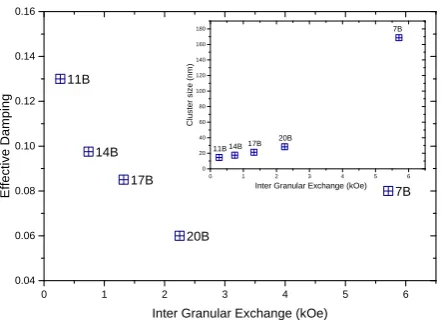
The results are shown in g. 3, which shows the dependence of the measured Gilbert damping constant on the exchange eld. The values of the damping are calculated by tting the transverse magnetisation components to a decaying oscillating function, my(t) =
Acos(ωt) exp(−t/τ), where the tting parameters are;
A, the amplitude;ω, the resonance frequency; andτ, the relaxation rate. The damping is thenα= 1/τ ω.
A non-monotonic dependence of α on Hex is clear.
[image:3.595.61.285.395.555.2]0 1 2 3 4 5 6 0.04
0.06 0.08 0.10 0.12 0.14 0.16
0 1 2 3 4 5 6
0 20 40 60 80 100 120 140 160 180
7B
20B 17B 14B 11B
7B
20B 17B 14B 11B
E
ff
e
c
ti
v
e
D
a
m
p
in
g
Inter Granular Exchange (kOe)
Inter Granular Exchange (kOe)
C
lu
s
te
r
s
iz
e
(
n
m
)
Figure 3. (Color online) Dependence of the measured Gilbert damping constant on the exchange eld. A non-monotonic dependence of α on Hex is clear. (Inset) Variation of the
cluster size with exchange eld determined using the method given in Ref. 13 and described in the text.
The results are given in the inset of Fig. 3. Importantly, it is found that for the sample with the highest exchange coupling there is a large increase in the correlation length. This is consistent with the form of the hysteresis loop shown in Fig. 1, where the sample exhibits a very square loop consistent with magnetization by nucleation and propagation of quasi-domains.
III. NUMERICAL MODEL
To corroborate the eects of increasing intergranular exchange we have constructed a dynamic numerical model of granular media using the Landau-Lifshitz-Bloch (LLB) equation16 combined with a voronoi
construction of the grains typical for magnetic media. The interactions between the grains are calculated based on the interaction distances and lengths between the grains and included into the LLB model, both of which we describe in the following.
A. Landau-Lifshitz-Bloch Model
The LLB equation of motion describes the time evolution of a magnetic macrospin. The equation allows for longitudinal relaxation of the magnetization, and was derived by Garanin16within a Mean Field approximation
from the classical Fokker-Planck equation for atomic spins interacting with a heat bath. Models based on the resulting expressions have been shown to be
consistent with atomistic spin dynamics simulations17, as
well as comparisons with experimental observations, for example, in laser induced demagnetization18and domain
wall mobility measurements in Yttrium Iron Garnet crystals close to the Curie point19 (T
c). The equation is
similar to the Landau-Lifshitz-Gilbert (LLG) equation20,
with precessional and relaxation terms, but with an extra term that deals with changes in the magnitude of the magnetization:
˙
mi=−γ[mi×Heff
i ] +
γαk
m2
i
mi·Heff
i
m
i
−γα⊥ m2
i
m
i×mi×Heffi
, (1)
where mi is a spin polarisation. The spin polarisation tends towards equilibrium, me, which is a temperature
dependent input parameter (discussed below). αk
and α⊥ are dimensionless longitudinal and transverse
damping parameters. γ is the gyromagnetic ratio taken to be the free electron value. The LLB equation is valid for nite temperatures and even aboveTc, though
the damping parameters and eective elds are dierent below and above Tc. For the transverse damping
parameter:
α⊥=
(
λ1− T
3Tc
T < Tc
λ2T
3Tc T ≥Tc
(2)
and for the longitudinal:
αk=λ 2T
3Tc
for allT. (3)
For a single particle the eective eld Heff
i = −
1
M0 s
δf δmi
with free energy densityf,
fi=−Ms(0)B·mi+
Ms(0) 2 ˜χ⊥
(m2
i,x+m2i,y)
+ Ms(0) 8 ˜χi,km2i,e
(m2i −m
2
i,e)
2
−Ms(0)2
X
j,i6=j
ViVj
3(mi·eij)(mj·eij)−mi·mj
r3
ij
,
(4)
[image:4.595.63.285.68.228.2]4
Heff
i =B+HA,i+ 1
2 ˜χi,k
1− m
2
i
m2
i,e
!
mi+He,i+Hdip,i
(5) where B represents an external magnetic eld,Hdip,i is the dipolar eld and HA,i = −(mx
iexi +m y ie
y
i)/χ˜⊥ an
anisotropy eld. Ms(0) is the saturation magnetisation
(magnetisation at 0K),Virepresents the volume of grain
i. Here, the susceptibilities χ˜l are dened by χ˜l =
∂ml/∂Hl. He is the (intergranular) exchange eld,
which we assume is based on the contact area between the grains, arising from the Voronoi construction, as discussed below. In these equations, λ is a microscopic parameter which characterizes the coupling of the individual, atomistic spins with the heat bath (the intrinsic damping). We choose the value ofλto be 0.05 for this work. It is worth pointing out that we expect the results and conclusions presented here to be qualitatively the same for all values of the damping. The calculation of the dipolar eld is truncated at 8 grain diameters to reduce the N2 calculation over all pairwise interactions.
The long-ranged contribution is then treated within a mean-eld approximation.
For application of the LLB equation one has to know the spontaneous equilibrium magnetisation me(T), the
per-pendicular (χ˜⊥(T)) and parallel (χ˜k(T)) susceptibilities
beforehand. In this work, the input functions are based on that of Ref. 17 for FePt and scaled to give the correct Curie temperature. For the transverse susceptibility (that determines the anisotropy) the function is scaled to give an anisotropy constant of 13.5×10⁶erg/cc. The
functions are scaled in the same manner as that of Ref. 21:
Ms(T) =
Ms(0)
MFePt
s (0)
MsFePt
TFePt
C
TC
T, (6)
χk(T) =
Ms(0)
MFePt
s (0)
χFePt k
TFePt
C
TC
T, (7)
χ⊥(T) =
Ms(0)
2K(0)χ FePt ⊥
TFePt
C
TC
T. (8)
B. Granular Model
The model of the magnetic nanostructures is based on a Voronoi construction which creates structures and grain size dispersions similar to those produced in magnetic hard disk drives (see Fig. 5). The seed points for the Voronoi algorithm are based on a 2D hexagonal structure with the points moved by a random value, linearly, to generate structural disorder. This results in a log-normal distribution of grain volumes,Vi, as seen experimentally.
The average grain diameter in our numerical simulations is 8nm with a thickness of 8nm. The standard deviation in the grain diameter is 2.63nm. In the present work we assume no dispersion in the anisotropy easy axes of the grains and we numerically simulate a system approximately 700nm×700nm laterally, corresponding to 7558 grains. Furthermore, we do not assume a spatial variation of the anisotropy strength per grain, though the voronoi construction gives a volume distribution giving rise to a variation of energy barrier, KV. This means that to rst order the extrinsic contributions, from anisotropy, to the damping are zero to rst order2.
The IGE is formulated on the basis of the contact area between grains as was implemented in Ref. 22. Considering neighbouring grainsk andl. The exchange energy between them can be written
Ekl
exch=−NklJklˆsk·ˆsl, (9)
where Nkl is the number of atoms in the contact area
between(k, l). Assuming a lm of uniform thickness t, Nkl =Lklt/a2, where Lkl is the contact length between
the grains and a is the lattice constant. The exchange eld on grainkdue to lis therefore
Hkl
e =−
∂Ekl exch
∂µk
= LklJkl
a2M
sAk
ˆsl. (10)
Ak is the area of the face of graink in the plane of thin
lm andLkl is the contact length between grainsk and
l. In addition, we allow for some dispersion in theJklby
generating a normal distribution with a given width. We now write Eq. 10 in terms of reduced parameters (relative to the median valuesLm, Am, Jm)
Hkl
e =Hexch
J
kl
Jm
Lkl
Lm
Am
Ak
ˆsl, (11) where Hexch = JmLm/(a2MsAm). In practice Hexch
is set by the requirement that the average exchange at saturation has a certain value Hsat
exch, which is the more
accessible value experimentally, that is
Hsat
exch=N−1Hexch
X
k X
l∈n.n
J
kl
Jm
Lkl
Lm
Am
Ak
.
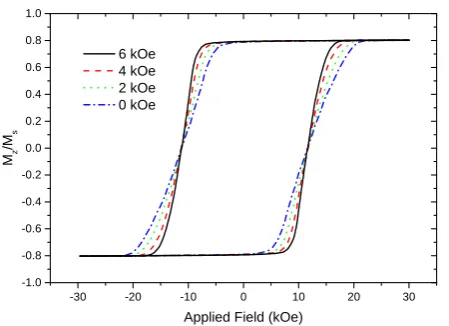
(12) We have veried that the model gives consistent static results by initially simulating hysteresis loops for a range of intergranular exchange. Qualitatively Fig. 4 shows increasingly square loops with increasing intergranular exchange.
-30 -20 -10 0 10 20 30 -1.0
-0.8 -0.6 -0.4 -0.2 0.0 0.2 0.4 0.6 0.8 1.0
Mz
/M
s
Applied Field (kOe) 6 kOe
4 kOe 2 kOe 0 kOe
Figure 4. (Color online) Numerically calculated hysteresis curves for a range of intergranular exchange constants in good qualitative agreement with the experimental hysteresis loops (Fig. 1).
Furthermore, the numerical simulations do not take into account the detailed variations in the experimental structure, saturation magnetization, anisotropy or grain size variations. Not taking these specic aspects into account allows us to use the numerical model to interpret the experimental results without these extra degrees of freedom.
During the simulations of optically induced FMR we apply a magnetic eld in the x-z plane at an angleθwhich we take to be at 45◦from thezaxis of magnitude 10kOe.
The anisotropy is assumed to be uniaxial and points out of the plane of the sample. The large angle at which we apply the eld gives rise to large amplitude precession giving excellent ts to the magnetisation (discussed below). Even in the presence of the eld at 45◦, the large
anisotropy ensures that the magnetisation lies strongly out-of-plane. In our optical FMR approach we assume a square pulse in temperature rising from ambient to 600K for 400ps, returning to ambient after the pulse. In a real optical FMR experiment on the picosecond timescale the laser generates a hot electron distribution that can reach temperatures of thousands of Kelvin23. Subsequently,
the hot electrons reach a quasi-equilibrium state with the phonons at the same temperature. Depending on the relaxation time of the magnetic system the spin system will reach equilibrium with this quasi-equilibrium at around 0.1-1 picoseconds24, though this can be
considerably longer for pure rare earth metals25. For
metallic ferromagnets, the changes in the magnitude of the magnetisation occur on a much faster timescale than the resulting precession (see inset of Fig. 6, thus we probe the dynamics at the temperature after the pulse. Experimentally the long cooling-time to the initial temperature occurs by transfer of energy out of the
z y
x
H
kle
L
klM
M
0B
=
Figure 5. (Color online) Schematic of the set-up of the simulations. The anisotropy is perpendicular to the plane with the applied eld at an angle θ to the plane. The
magnetization equilibrates to M before the laser pulse
is applied. The laser pulse results in relaxation of the magnetization by precession to the new orientation,M′.
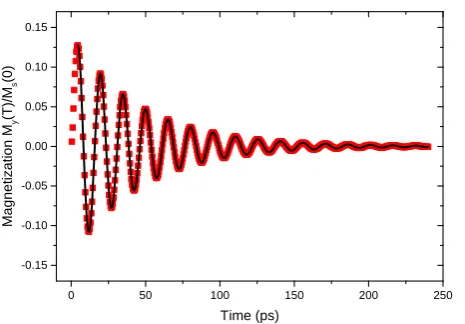
magnetic material to the substrate and the surroundings via phonon processes on the nanosecond time-scale. Using the LLB model, we have investigated the eects of varying the saturation magnetisation and IGE on the damping of our granular material after excitation with a heat pulse. As discussed above, the change in temperature alters the equilibrium position, which causes the magnetization to precess back the initial state. An example of the resulting dynamics within the LLB model is shown in Fig. 6 (points). On the picosecond timescale the magnetization is quickly reduced, in agreement with experimental2628and numerical results2830so that the
quenching and recovery of the anisotropy eld is much faster than the timescale of the precessional dynamics. Using the numerical model we rst calculate the damping as a function of the saturation magnetization, as presented in Fig. 7, for a range of values of the IGE. The values for the damping are calculated as with the experimental data.
Figure 7 shows a strong variation and a subtle combination of contributions from magnetostatic and exchange interactions. Consider rst the caseHsat
exch= 0.
From Fig. 7 it can be seen that there is a very strong dependence of eective damping on Ms, specically an
increase of around a factor of 2.5 forMs values around
those of Co and Fe. For low values of Ms the damping
for all values of IGE converge to the value of the input damping due to the very low contribution from the demagnetizing elds.
[image:6.595.323.564.50.191.2] [image:6.595.60.285.67.230.2]6
0 50 100 150 200 250
-0.15 -0.10 -0.05 0.00 0.05 0.10 0.15
M
a
g
n
e
ti
z
a
ti
o
n
M
y
(T
)/
Ms
(0
)
Time (ps)
Figure 6. (Color online) Example of the transverse magnetization dynamics after a heat pulse (points) with a t to the dynamics (lines).
400 600 800 1000 1200
0.04 0.06 0.08 0.10 0.12 0.14 0.16
E
ff
e
c
ti
v
e
D
a
m
p
in
g
Saturation Magnetisation Ms (emu/cc)
0 kOe 5 kOe 10 kOe 15 kOe 20 kOe
Figure 7. (Color online) Damping as a function of saturation magnetization for a range of values of the intergranular exchange,Hsat
exch.
for the intrinsic damping used for the calculations. For larger values of Ms there is a much larger variation
with IGE where there is a strong interplay between the demagnetizing energy and the IGE.
Overall, the numerical simulations are consistent with the experimental data for small exchange elds, where the eective damping is seen to decrease with Hex.
However, the model does not reproduce the increase in damping for the sample with the largest exchange (see Fig. 3). This is likely related to the dramatic increase in the measured cluster size for this particular sample as shown in the inset of Fig. 3. For this sample, the oxide concentration was reduced to zero, and it is
0 5 10 15 20 25
0.04 0.06 0.08 0.10 0.12 0.14 0.16
E
ff
e
c
ti
v
e
D
a
m
p
in
g
Inter Granular Exchanage (kOe) 100 emu/cc 400 emu/cc 600 emu/cc 800 emu/cc 1000 emu/cc 1200 emu/cc
Figure 8. (Color online) Damping as a function of intergranular exchange for a range of values of saturation magnetization. For low values ofMsthe value of the damping
varies very little and remains around the value of the input damping parameter. As Ms increases, the variation with
intergranular exchange becomes much greater as the interplay between the demagnetizing elds and exchange becomes important.
possible that the determined exchange eld is an under-estimate. The large cluster size and the form of the hysteresis loop for this sample is indicative of a change to a nucleation/propagation mechanism which is not observed in the model calculations for values ofHex up
to 5kOe. For a very strongly exchange coupled sample it is likely that additional damping mechanisms will arise from interaction of the domain walls with defects and impurities resulting in the increase in Gilbert damping at large exchange elds.
IV. SEMI-ANALYTICAL SPINWAVE MODEL
[image:7.595.57.290.68.230.2]magnon and the creation of a nonzero-wavenumber magnon. The consequence of this process is that the magnetization precession undergoes rapid relaxation (damping)31. Reducing this degeneracy will then result
in a reduced damping. We conclude that the reduction of two-magnon scattering processes is dominating the reduction in damping due to increased intergranular exchange. To elucidate this we follow the method of McMichael2,3,32.
In the present work we only briey outline the method of determining the frequencies of the spinwave modes. In Refs. 2, 3, and 32 the Landau-Lifshitz-Gilbert equation is linearised. The resulting linearised components of the magnetization and elds are written in Fourier space through:
b(r) =
Z dk
(2π)2b(k) exp(ik·r) (13)
where b represents the magnetization or the elds. The eective eld has contributions from the Zeeman, demagnetising, anisotropy and exchange terms and is written in terms of a sum over the magnetization multiplied with a kernel, G and is translationally invariant. Due to the r−r′ term, on-site terms would
be represented by delta functions multiplied by a scalar. The Fourier components of the eld are then written:
Hef f(r) =
Z
dr′G(r−r′)m(r′). (14)
where hk are the elements of the normalized stiness
tensor:
hθθ,k=Ms0
−1
Hi+Dk2
+Ms0(1−Nk) sin2(θk) (15a)
hφφ,k=Ms0
−1
Hi+Dk2+Ms0Nkcos2(φ)
+M0
s(1−Nk) sin2(φ) cos2(θk) (15b)
hθφ,k=Ms0
−1
M0
s(1−Nk) cos(θk)
×sin(θk) sin(φ)
(15c)
hφθ,k=hθφ,k (15d)
where Dk2 = (2A/µ
0Ms)k2 is the exchange eld
for a spinwave with wavevector k, assuming that the wavelengths of interest are much larger than the lattice spacing. Ais the exchange stiness and Hi=Bcos(φ−
φH)−(Ms0−Hk) sin2(φ)is the internal eld consisting
of the component of; the applied eld B (at an angle φH to the plane) parallel to the magnetization, which
is at an angle, φ, to the plane; the static part of the demagnetization eld; and the anisotropy eld Hk.
The k-dependent demagnetization factor for a lm of thicknessdis given by:
Nk= 1−e
−kd
kd (16)
The susceptibility tensor, χk(ω), can be obtained from
the linearised LLG equations of motion. For an applied eld with spatial frequencyk and angular frequency ω, the transverse susceptibility tensor is given by:
χk(ω) = 1
Zk "
hφφ,k+iαωωM −hθφ,k+iαωωM
−hφθ,k−iαωωM hθθ,k+ iαω ωM
#
(17a)
Zk=hθθ,khφφ,k−hθφ,khφθ,k−(1 +α2)
ω
ωM
2
+iα ω ωM
(hθθ,k+hφφ,k), (17b)
where ωM =γMs0. The dispersion relation is obtained
by noting that|Zk | is minimum and the susceptibility
is in resonance when ω=ωk= √ωM
1 +α2
hθθ,khφφ,k−hθφ,khφθ,k
1/2
. (18)
To make a consistent comparison between the LLB numerical model and the spinwave model we use the values of Ms, anisotropy, thickness (d), applied eld
and applied eld angle that are the same in both cases. Furthermore, the angles of the magnetization (φ) from the lm plane are taken directly from the numerical simulations at equilibrium after the pulse (from the end of the numerical simulation). Using the physical parameters that enter into the LLB model we have calculated the spinwave properties of the numerically simulated samples using equations 15, 16, 17 and 18 and determined the degeneracy of those modes with the k=0 mode. This plays an important role in the damping arising from inhomogeneities2 due to non-uniformities
that are present in granular media. We note that the value of the exchange stiness that enters into the equations is in the correct range4 for granular media but
it is not trivial to relate the intergranular exchange eld in the LLB with the long-wavelength exchange, A used in the spinwave model. We note here that the presented form of the semi-analytical spinwave model does not take into account inhomogeneous line broadening eects, thus contains contributions only from inhomogeneities which arise in the LLB model from the distribution of the grain volumes. The results of the semi-analytical spinwave model are shown in Fig. 9 and show a decreasing trend with increasing exchange stiness.
8
0.0 2.0x10⁻⁷
4.0x10⁻⁷
6.0x10⁻⁷
8.0x10⁻⁷ 0
1x10⁶ 2x10⁶ 3x10⁶
D
e
g
e
n
e
ra
c
y
(
c
m
-1)
Exchange Stiffness (ergs/cm) Ms = 400 600 800 1000
f0
Degeneracy
Figure 9. (Color online) Spinwave degeneracy as a function of exchange stiness for a range of values of saturation magnetisation. There is clearly a direct correlation between the degeneracy and the damping shown in Fig. 3 and a similar trend for xed exchange stiness and varying Ms.
scattering due to slight dispersions in the anisotropy axes is zero in our LLB model as we assume perfectly aligned anisotropy axes. Similarly, we assume that our grains are uniform single macrospins and therefore grain-boundary scattering cannot contribute to this two-magnon scattering process. In terms of a macrospin picture, the decreased damping can be explained by a stiening of the system resulting in a more coherent precession so that demagnetizing eects become less important and the system as a whole acts more like a single macrospin.
V. CONCLUSION
In summary we have carried out an investigation of the eects of intergranular interactions on the eective damping constant of perpendicular media. Experiments show a non-monotonic variation of of the damping with
increasing exchange strength. 'Contributions to the experimental damping constant due to inhomogeneous line broadening cannot be ruled out, however, these are expected to be consistent between samples; the major eect of reducing the thickness of the grain boundaries is the variation in the exchange coupling as shown in the hysteresis behavior. We have constructed a realistic model of granular media using the Landau-Lifshitz-Bloch model. By simulating the optical FMR technique to probe relaxation processes we have determined how the damping is aected by the key parameters governing the interactions (exchange and saturation magnetisation). The model calculations show a decrease of eective damping with increasing exchange, consistent with the experimental data for small exchange. It is argued that the increase in damping for the largest exchange eld, arising in a lm without exchange coupling, is due to the onset of a dierent reversal mechanisms involving domain nucleation and propagation. For practical perpendicular recording media, which are more exchanged decoupled, the decrease in damping with exchange strength predicted by the model calculations is the most likely scenario. Further investigations of the phenomenon using spin wave theory provide further insight and ascribe the reduction in damping due to increasing intergranular exchange as arising from a reduction in the degeneracy of nite k-vectors with the frequency of the k=0 (ferromagnetic resonance) mode. These calculations show a direct correlation between the degeneracy and the damping shown by the numerical model with a similar trend for xed exchange stiness and varying Ms. Our numerical
calculations do not include extrinsic contributions to damping due to variations in on-site quantities, such as anisotropy or saturation magnetisation, thus we have shown that it is possible to describe the decrease in damping with intergranular exchange based on the eects of intergranular exchange and demagnetising elds, thus we conclude that their contribution is large.
This work was supported by the European Commission under contract No. 281043, Femtospin. The nancial support of the Advanced Storage Technology Consortium is gratefully acknowledged. T. A. Ostler gratefully ac-knowledges the Marie Curie incoming BeIPD-COFUND fellowship program at the University of Liège.
1 V. Sokalski, D. E. Laughlin, and J.-G. Zhu, Applied
Physics Letters 95, 102507 (2009).
2 R. D. McMichael, Journal of Applied Physics 95, 7001
(2004).
3 R. McMichael and P. Krivosik, IEEE Transactions on
Magnetics 40, 2 (2004).
4 P. Krone, M. Albrecht, and T. Schre, Journal of
Magnetism and Magnetic Materials 323, 432 (2011).
5 A. Butera, The European Physical Journal B 52, 297
(2006).
6 N. Mo, J. Hohlfeld, M. ul Islam, C. S. Brown, E. Girt,
P. Krivosik, W. Tong, A. Rebei, and C. E. Patton, Applied Physics Letters 92, 022506 (2008).
7 T. W. Clinton, N. Benatmane, J. Hohlfeld, and E. Girt,
Journal of Applied Physics 103, 075546 (2008).
8 S. Kalarickal, N. Mo, P. Krivosik, and C. Patton, Physical
Review B 79, 094427 (2009).
9 A. Mekonnen, M. Cormier, A. V. Kimel, A. Kirilyuk,
[image:9.595.57.294.70.231.2]10 X. Zou, J. Wu, P. K. J. Wong, Y. B. Xu, R. Zhang, Y. Zhai,
C. Bunce, and R. W. Chantrell, Journal of Applied Physics 109, 07D341 (2011).
11 J. Becker, O. Mosendz, D. Weller, A. Kirilyuk, J. C. Maan,
P. C. M. Christianen, T. Rasing, and A. Kimel, Applied Physics Letters 104, 152412 (2014).
12 T. A. Ostler, M. O. A. Ellis, D. Hinzke, and U. Nowak,
Physical Review B 90, 094402 (2014), arXiv:1407.1174.
13 H. Nemoto, I. Takekuma, H. Nakagawa, T. Ichihara, A. R.,
and H. Y., J Magn. Magn. Mater. 320, 3144 (2008).
14 C. R. Pike, A. P. Roberts, and K. L. Verosub, J. Appl.
Phys. 85 (1999).
15 M. van Kampen, C. Jozsa, J. T. Kohlhepp, P. LeClair,
L. Lagae, W. J. M. de Jonge, and B. Koopmans, Physical Review Letters 88, 227201 (2002).
16 D. A. Garanin, Physical Review B 55, 3050 (1997). 17 N. Kazantseva, D. Hinzke, U. Nowak, R. Chantrell,
U. Atxitia, and O. Chubykalo-Fesenko, Physical Review B 77, 184428 (2008).
18 J. Mendil, P. Nieves, O. Chubykalo-Fesenko, J. Walowski,
T. Santos, S. Pisana, and M. Münzenberg, Scientic reports 4, 3980 (2014), arXiv:1306.3112.
19 J. Kötzler, D. Garanin, M. Hartl, and L. Jahn, Physical
Review Letters 71, 177 (1993).
20 T. Gilbert, IEEE Transactions on Magnetics 40, 3443
(2004).
21 K. M. Lebecki and U. Nowak, Journal of Applied Physics
113, 023906 (2013).
22 Y. Peng, X. W. Wu, J. Pressesky, G. P. Ju, W. Scholz, and
R. W. Chantrell, Journal of Applied Physics 109, 123907 (2011).
23 J. Chen, D. Tzou, and J. Beraun, International Journal of
Heat and Mass Transfer 49, 307 (2006).
24 I. Radu, C. Stamm, A. Eschenlohr, F. Radu, R. Abrudan,
K. Vahaplar, T. Kachel, N. Pontius, R. Mitzner, K. Holldack, A. Föhlisch, T. A. Ostler, J. Mentink, R. Evans, R. W. Chantrell, A. Tsukamoto, A. Itoh, A. Kirilyuk, A. Kimel, and T. Rasing, SPIN 5, 1550004 (2015).
25 B. Koopmans, G. Malinowski, F. Dalla Longa, D. Steiauf,
M. Fähnle, T. Roth, M. Cinchetti, and M. Aeschlimann, Nature materials 9, 259 (2010).
26 E. Beaurepaire, J.-C. Merle, A. Daunois, and J.-Y. Bigot,
Physical Review Letters 76, 4250 (1996).
27 I. Radu, K. Vahaplar, C. Stamm, T. Kachel, N. Pontius,
H. A. Dürr, T. A. Ostler, J. Barker, R. F. L. Evans, R. W. Chantrell, A. Tsukamoto, A. Itoh, A. Kirilyuk, T. Rasing, A. V. Kimel, and H. a. Dürr, Nature 472, 205 (2011).
28 K. Vahaplar, A. Kalashnikova, A. V. Kimel, D. Hinzke,
U. Nowak, R. Chantrell, A. Tsukamoto, A. Itoh, A. Kirilyuk, and T. Rasing, Physical Review Letters 103, 117201 (2009).
29 T. A. Ostler, J. Barker, R. F. L. Evans, R. W. Chantrell,
U. Atxitia, O. Chubykalo-Fesenko, S. El Moussaoui, L. Le Guyader, E. Mengotti, L. J. Heyderman, F. Nolting, A. Tsukamoto, A. Itoh, D. Afanasiev, B. A. Ivanov, A. M. Kalashnikova, K. Vahaplar, J. Mentink, A. Kirilyuk, T. Rasing, and A. V. Kimel, Nature communications 3, 666 (2012).
30 U. Atxitia, J. Barker, R. W. Chantrell, and O.
Chubykalo-Fesenko, Physical Review B - Condensed Matter and Mate-rials Physics 89, 224421 (2014), arXiv:arXiv:1308.0993v1.
31 L. Lu, Z. Wang, G. Mead, C. Kaiser, Q. Leng, and M. Wu,
Applied Physics Letters 105, 012405 (2014).
32 R. D. McMichael, D. J. Twisselmann, and A. Kunz,