Submitted to: TARK 2015
c
K. Apt, D. Grossi & W. van der Hoek This work is licensed under the
Creative Commons Attribution License. Krzysztof R. Apt
Centrum Wiskunde Informatica Amsterdam, The Netherlands
Davide Grossi Wiebe van der Hoek University of Liverpool
Liverpool, UK
[email protected] [email protected]
Gossip protocols aim at arriving, by means of point-to-point or group communications, at a situation in which all the agents know each other’s secrets. We consider distributed gossip protocols which are expressed by means of epistemic logic. We provide an operational semantics of such protocols and set up an appropriate framework to argue about their correctness. Then we analyze specific protocols for complete graphs and for directed rings.
1
Introduction
In the gossip problem ([18, 4], see also [10] for an overview) a numbernof agents, each one knowing a piece of information (asecret) unknown to the others, communicate by one-to-one interactions (e.g., telephone calls). The result of each call is that the two agents involved in it learn all secrets the other agent knows at the time of the call. The problem consists in finding a sequence of calls which disseminates all the secrets among the agents in the group. It sparked a large literature in the 70s and 80s [18, 4, 9, 5, 17] typically focusing on establishing—in the above and other variants of the problem—the minimum number of calls to achieve dissemination of all the secrets. This number has been proven to be 2n−4, wheren, the number of agents, is at least 4.
The above literature assumes a centralized perspective on the gossip problem: a planner schedules agents’ calls. In this paper we pursue a line of research first put forth in [3] by developing a decentralized theory of the gossip problem, where agents perform calls not according to a centralized schedule, but following individual epistemic protocols they run in a distributed fashion. These protocols tell the agents which calls to execute depending on what they know, or do not know, about the information state of the agents in the group. We call the resulting distributed programs(epistemic) gossip protocols.
Contribution of the paper and outline The paper introduces a formal framework for specifying epis-temic gossip protocols and for studying their computations in terms of correctness, termination, and fair termination (Section 2). It then defines and studies two natural protocols in which the interactions are unconstrained (Section 3) and four example gossip protocols in which agents are positioned on a directed ring and calls can happen only between neighbours (Section 4). Proofs are collected in the appendix.
From a methodological point of view, the paper integrates concepts and techniques from the dis-tributed computing, see, e.g., [1, Chapter 11] and the epistemic logic literature [8, 15] in the tradition of [16, 14, 7].
2
Gossip protocols
2.1 Syntax
We loosely use the syntax of the language CSP (Communicating Sequential Processes) of [11] that extends the guarded command language of [6] by disjoint parallel composition and commands for syn-chronous communication. CSP was realized in the distributed programming language OCCAM (see INMOS [12]).
The main difference is that we use as guards epistemic formulas and as communication primitives calls that do not require synchronization. Also, the syntax of our distributed programs is very limited. In order to define gossip protocols we introduce in turn calls and epistemic guards.
Throughout the paper we assume a fixed finite setAof at least threeagents. We assume that each agent holds exactly onesecretand that there exists a bijection between the set of agents and the set of secrets. We denote byP the set of all secrets (forpropositions). Furthermore, it is assumed that each secret carries information identifying the agent to whom that secret belongs.
2.1.1 Calls
Eachcallconcerns two agents, thecaller(abelow) and theagent called(b). We distinguish threemodes of communicationof a call:
push-pull, written asab or(a,b). During this call the caller and the called agent learn each other’s secrets,
push, written asa.b. After this call the called agent learns all the secrets held by the caller,
pull, written asa/b. After this call the caller learns all the secrets held by the called agent.
Variables for calls are denoted byc,d. Abusing notation we writea∈cto denote that agentais one of the two agents involved in the callc(e.g., forc:=abwe havea∈candb∈c). Calls in which agentais involved are denoted byca.
2.1.2 Epistemic guards
Epistemic guards are defined as formulas in a simple modal language with the following grammar:
φ::=Fap| ¬φ|φ∧φ|Kaφ,
wherep∈Panda∈A. Each secret is viewed as a distinct symbol. We denote the secret of agentabyA, the secret of agentbbyBand so on. We denote the set of so defined formulas byL and we refer to its members as epistemic formulas or epistemic guards. We readFapas ‘agentais familiar with the secret
p’ (or ‘pbelongs to the set of secretsaknows about’) andKaφ as ‘agentaknows that formulaφis true’.
So this language is an epistemic language where atoms consist of ‘knowing whether’ statements about propositional atoms, if we view secrets as Boolean variables.
Atomic expressions inL concern only who knows what secrets. As a consequence the language cannot express formally the truth of a secretp. This level of abstraction suffices for the purposes of the current paper. However, expressionsFapcould be given a more explicit epistemic reading in terms of
2.1.3 Gossip protocols
Before specifying what a program for agentais, let us first define the languageLawith the following
grammar:
ψ::=Kaφ| ¬ψ |ψ∧ψ
withφ∈L.1
By acomponent program, in short aprogram, for an agentawe mean a statement of the form
∗[[]mj=1ψj→cj],
wherem>0 and eachψj→cjis such thatψj∈Laandais the caller incj.
Given an epistemic formulaψ∈Laand a callc, we call the constructψ→caruleand refer in this
context toψas aguard.
We denote the set of rules{ψ1→c1, . . .,ψk→ck}as[[]kj=1 ψj →cj]and abbreviate a set of rules
{ψ1→c, . . .,ψk→c}with the same call to a single ruleWki=1ψi→c.
Intuitively, ∗ denotes a repeated execution of the rules, one at a time, where each time a rule is selected whose guard is true.
Finally, by a distributed epistemic gossip protocol, in short a gossip protocol, we mean a parallel composition of component programs, one for each agent. In order not to complicate matters we assume that each gossip protocol uses only one mode of communication.
Of special interest for this paper are gossip protocols that are symmetric. By this we mean that the protocol is a composition of the component programs that are identical modulo the names of the agents. Formally, consider a statementπ(x), wherexis a variable ranging over the setAof agents and such that for each agenta∈A, π(a)is a component program for agenta. Then the parallel composition of the
π(a)programs, wherea∈A, is called asymmetric gossip protocol.
Gossip protocols are syntactically extremely simple. Therefore it would seem that little can be ex-pressed using them. However, this is not the case. In Sections 3 and 4 we consider gossip protocols that can exhibit complex behaviour.
2.2 Semantics
We now move on to provide a formal semantics of epistemic guards, and then describe the computations of gossip protocols.
2.2.1 Gossip situations and calls
Agossip situationis a sequences= (Qa)a∈A, whereQa⊆Pfor each agenta. Intuitively,Qa is the set
of secretsais familiar with in situations. Theinitial gossip situationis the one in which eachQaequals
{A}and is denoted byroot. The set of all gossip situations is denoted byS. We say that an agentais an
expertin a gossip situationsif he is familiar inswith all the secrets, i.e., ifQa=P. The initial gossip
situation reflects the fact that initially each agent is familiar only with his own secret, although it is not assumed this is common knowledge among the agents. In fact, in the introduced language we have no means to express the concept of common knowledge.
1Alternatively,L
We will use the following concise notation for gossip situations. Sets of secrets will be written down as lists. e.g., the set{A,B,C}will be written asABC. Gossip situations will be written down as lists of lists of secrets separated by dots. E.g., if there are three agents,root=A.B.Cand the situation
({A,B},{A,B},{C}) will be written asAB.AB.C.
Each call transforms the current gossip situation by modifying the set of secrets the agents involved in the call are familiar with. More precisely, the application of a call to a situation is defined as follows.
Definition 2.1 (Effects of calls) A call is a functionc:S−→S, so defined, fors:= (Qa)a∈A:
c=ab c(s) = (Q0a)a∈A, whereQ0a=Q0b=Qa∪Qb,Q
0
c=Qc, for c6=a,b;
c=a.b c(s) = (Qa0)a∈A, whereQ0b=Qa∪Qb,Q0a=Qa,Q0c=Qc, for c6=a,b;
c=a/b c(s) = (Qa0)a∈A, whereQ0a=Qa∪Qb,Q0b=Qb,Q0c=Qc, for c6=a,b.
The definition formalizes the modes of communications we introduced earlier. Depending on the mode, secrets are either shared between caller and callee (ab), they are pushed from the caller to the callee (a.b), or they are retrieved by the caller from the callee (a/b).
2.2.2 Call sequences
Acall sequenceis a (possibly infinite) sequence of calls, in symbols(c1,c2, . . . ,cn, . . .), all being of the
same communication mode. The empty sequence is denoted byε. We usecto denote a call sequence
andCto denote the set of all call sequences. The set of all finite call sequences is denotedC<ω. Given a
finite call sequencecand a callcwe denote byc.cthe prepending ofcwithc, and byc.cthe postpending ofcwithc.
The result of applying a call sequence to a situationsis defined by induction using Definition 2.1, as follows:
[Base]ε(s):=s,
[Step](c.c)(s):=c(c(s)).
Example 2.2 Let the set of agents be{a,b,c}.
ab ca ab
A.B.C AB.AB.C ABC.AB.ABC ABC.ABC.ABC
The top row lists the call sequence(ab,ca,ab), while the bottom row lists the successive gossip situations obtained from the initial situationA.B.Cby applying the calls in the sequence: firstab, thencaand finally
ab. 2
By applying an infinite call sequence c = (c1,c2, . . . ,cn, . . .) to a gossip situation s one obtains
therefore an infinite sequencec0(s),c1(s), . . . ,cn(s), . . .of gossip situations, where eachck is sequence
c1,c2, . . . ,ck. A call sequencec is said toconvergeif for all input gossip situationss the generated
se-quence of gossip situations reaches a limit, that is, there existsn<ω such that for allm≥n cm(s) =
cm+1(s). Since the set of secrets is finite and calls never make agents forget secrets they are familiar with, it is easy to see the following.
Fact 2.3 All infinite call sequences converge.
2.2.3 Gossip models
The setSof all gossip situations is the set of all possible combinations of secret distributions among the agents. As calls progress in sequence from the initial situation, agents may be uncertain about which one of such secrets distributions is the actual one. This uncertainty is precisely the object of the epistemic language for guards we introduced earlier.
Definition 2.4 Agossip model(for a given setA) is a tupleM = (C<ω,{∼
a}a∈A), where each∼a⊆
C<ω×C<ω is the smallest relation satisfying the following inductive conditions (assume the mode of
communication is push-pull): [Base]ε∼aε;
[Step]Supposec∼ad.
(i) If a6∈c, thenc.c∼adandc∼ad.c.
(ii) If there exists b∈Aandc,d∈ {ab,ba}such thatc.c(root)a=d.d(root)a, thenc.c∼ad.d.
A gossip model with a designated finite call sequence is called apointed gossip model.
For the push, respectively pull, modes of communication clause (ii) needs to be modified by requiring that for some b∈A,c=d=a.b orc=d=a/b, respectively.
For instance, by(i)we haveab,bc∼aab,bd. But we do not havebc,ab∼abd,absince(bc,ab)(root)a =ABC6=ABD= (bd,ab)(root)a.
Let us flesh out the intuitions behind the above definition. Gossip models are needed in order to inter-pret the epistemic guards of gossip protocols. Since such guards are relevant only after finite sequences of calls, the domain of a gossip model is taken to consist only of finite sequences. Intuitively, those are the finite sequences that can be generated by a gossip protocol. Let us turn now to the∼arelation. This
is defined with the following intuitions in mind. First of all, no agent can distinguish the empty call sequence from itself—this is the base of the induction. Next, if two call sequences are indistinguishable fora, then the same is the case if(i)we extend one of these sequences by a call in whichais not involved or if(ii)we extend each of these sequences by a call ofawith the same agent (agentamay be the caller or the callee), providedais familiar with exactly the same secrets after each of the new sequences has taken place—this is the induction step.2
The above intuitions are based on the following assumptions on the form of communication we presuppose: (i) At the initial situation, as communication starts, each agent knows only her own secret but considers it possible that the others may be familiar with all other secrets. In other words there is no such thing as common knowledge of the fact that ‘everybody knows exactly her own secret’. (ii) In general, each agent always considers it possible that call sequences (of any length) take place that do not involve her. These assumptions are weaker than the ones analyzed in [3].
We state without proof the following simple fact. Fact 2.5
(i) Each∼ais an equivalence relation;
(ii) For allc,d∈Cifc∼ad, thenc(root)a=d(root)a, but not vice versa.
This prompts us to note also that according to Definition 2.4 sequences which make alearn the same set of secrets may well be distinguishable fora, such as, for instance,ab,bc,abandab,bc,ac. In the first oneacomes to know thatbknowsais familiar with all secrets, while in the second one, she comes to know thatcknows ais familiar with all secrets. Relation∼a is so defined as to capture this sort of
‘higher-order’ knowledge.
2.2.4 Truth conditions for epistemic guards
Everything is now in place to define the truth of the considered formulas.
Definition 2.6 Let(M,c)be a pointed gossip model withM= (C<ω,(∼a)a
∈A)andc∈C<ω. We define
the satisfaction relation|=inductively as follows (clauses for Boolean connectives are omitted):
(M,c)|=Fap iff p∈c(root)a,
(M,c)|=Kaφ iff ∀ds.t. c∼ad,(M,d)|=φ.
So formulaFapis true (in a pointed gossip model) whenever secretpbelongs to the set of secrets agent
ais familiar with in the situation generated by the designated call sequencecapplied to the initial situa-tionroot. The knowledge operator is interpreted as customary in epistemic logic using the equivalence relations∼a.
2.2.5 Computations
Assume a gossip protocolPthat is a parallel composition of the component programs∗[[]ma
j=1ψaj →caj],
one for each agenta∈A.
Given the gossip modelM = (C<ω,{∼
a}a∈A)we define thecomputation treeCP⊆C<ω ofPas
the smallest set of sequences satisfying the following inductive conditions:
[Base]ε∈CP;
[Step] Ifc∈CPand(M,c)|=ψaj thenc.caj ∈CP. In this case we say that atransitionhas taken place
betweencandc.caj, in symbols,c→c.caj.
SoCPis a (possibly infinite) set of finite call sequences that is iteratively obtained by performing a ‘legal’
call (according to protocolP) from a ‘legal’ (according to protocolP) call sequence.
Apathin the computation tree ofPis a (possibly infinite) sequence of elements ofCP, denoted by ξ= (c0,c1, . . . ,cn, . . .), wherec0=εand eachci+1=ci.cfor some callcandi≥0. AcomputationofP
is a maximal rooted path in the computation tree ofP.3
The above definition implies that a call sequencecis a leaf of the computation tree if and only if
(M,c)|= ^
a∈A
ma
^
j=1
¬ψaj.
We call the formula
^
a∈A
ma
^
j=1 ¬ψaj
theexit conditionof the gossip protocolP.
Obviously computation trees can be infinite, though they are always finitely branching. Further, note that this semantics for gossip protocols abstracts away from some implementation details of the calls. More specifically, we assume that the caller always succeeds in his call and does not require to synchronize with the called agent. In reality, the called agent might be busy, being engaged in another
call. To take care of this one could modify each call by replacing it by a ‘call protocol’ that implements the actual call using some lower level primitives. We do not elaborate further on this topic.
Let us fix some more terminology. Forc∈CP, an agentaisenabledincif(M,c)|=Wma
j=1 ψ
a
j and
isdisabled otherwise. So an agent is enabled if it can perform a call. An agentaisselectedincif it is the caller in the call that for somec0 determines the transitionc→c0 inξ. Finally, a computationξ is
called afair computationif it is finite or each agent that is enabled in infinitely many sequences inξ is
selected in infinitely many sequences inξ.
We note in passing that various alternative definitions of fairness are possible; we just focus on one of them. An interested reader may consult [2], where several fairness definitions (for instance one focusing on actions and not on agents) for distributed programs were considered and compared.
We conclude this section by observing the following. Our definition of computation tree for protocol Ppresupposes that guardsψaj are interpreted over the gossip modelM = (C<ω,{∼a}a∈A). This means
that when evaluating guards, agents consider as possible call sequences that cannot be generated byP. In other words, agents do not know the protocol. To model common knowledge of the considered protocol in the gossip model one should take as the domain of the gossip modelM the underlying computation tree. However, the computation tree is defined by means of the underlying gossip model. To handle such a circularity an appropriate fixpoint definition is needed. We leave this topic for future work.
2.3 Correctness
We are interested in proving the correctness of gossip protocols. Assume a gossip protocolPthat is a parallel composition of the component programs∗[[]ma
j=1ψ
a
j →c
a j].
We say thatPispartially correct, in shortcorrect, if in all situations sequencescthat are leaves of the computation tree ofP, for each agenta
(M,c)|= ^
b∈A
FaB,
i.e., if for all situations sequencescthat are leaves of the computation tree ofP, each agent is an expert in the gossip situationc(root).
We say furthermore thatPterminatesif all its computations are finite and thatPfairly terminatesif all its fair computations are finite.
In the next section we provide examples showing that partial correctness and termination of the considered protocols can depend on the assumed mode of communication and on the number of agents. In what follows we study various gossip protocols and their correctness. We begin with the following obvious observation.
Fact 2.7 For each protocol P the following implications (⇒) hold, where TP(x)stands for its termination and FTP(x)for its fair termination in a communication mode x:
TP(x)⇒FTP(x).
Protocol R3 given in Section 4 shows that none of these implications can be reversed. Moreover, it is not the case either that for each protocolP:
TP(.)⇒TP(push-pull),
Example 2.8 LetA={a,b,c}and define the following expression:
A ⊂C := ^ I∈{A,B,C}
(FaI→FcI)∧
_
I∈{A,B,C}
(FcI∧ ¬FaI)
ExpressionB⊂C is defined analogously. Note that we denote by I the secret of agenti. Intuitively, A ⊂C means that agent c is familiar with all the secrets that agent a is familiar with, but not vice versa. Socis familiar with a strict superset of the secretsais familiar with. Further, letExpj stand for
V
I∈{A,B,C}FjI.
Consider now the following component programs:
• for agenta:∗[¬Ka(A ⊂C)∧ ¬KaExpa→a.c],
• for agentb:∗[¬Kb(B⊂C)∧ ¬KbExpb→b.c],
• for agentc:∗[¬KcExpa∧KcExpc→c.a[]¬KcExpb∧KcExpc→c.b].
This protocol is correct. Indeed, initially no agent is an expert, hence both guards ofcare false. On the other hand, we have(M,ε)|=¬(A ⊂C)and(M,ε)|=¬(B⊂C), so both(M,ε)|=¬Ka(A ⊂C)
and(M,ε)|=¬Kb(B⊂C). Consequently, initially bothaandbare enabled. If the first call is granted toa, this agent will callcyielding the gossip situationA.B.AC. Now the guard ofais false (sinceais still familiar only with his own secretA, whilecis familiar with at leastAandCandaknows this). The guard ofcis still false. So now onlybis enabled. After his call ofcthis yields the gossip situationA.B.ABC. At this stage, only agentcis enabled and after he calls bothaandball guards become false. Moreover, this protocol terminates. Indeed, the only computations are the ones in which first the callsa.candb.c take place, in any order, followed by the callsc.aandc.b, also performed in any order.
However, if we use the push-pull direction type instead of push, then the situation changes. Indeed, after an arbitrary number of callsacthe formula¬(A ⊂C)is still true and hence¬Ka(A ⊂C)is true, as well. Consequently, this call can be indefinitely repeated, so the protocol does not terminate. 2
3
Two symmetric protocols
In this section we consider protocols for the case when the agents form a complete graph. We study two protocols. We present them first for the communication mode push-pull. (Partial) correctness of the considered protocols does not depend on the assumed mode of communication.
Learn new secrets protocol (LNS) Consider the following program for agenti:
∗[[]j∈A¬FiJ→(i,j)].
Informally, agenticalls agent jifiis not familiar with j’s secret. Note that the guards of this protocol do not use the epistemic operatorKi, but they are equivalent to the ones that do, as¬FiJ is equivalent to
Ki¬FiJ.
This protocol was introduced in [3] and studied with respect to the push-pull mode, assuming asyn-chronous communication. As noted there this protocol is clearly correct. Also, it always terminates since after each call(i,j)the size of{(i,j)∈A×A| ¬FiJ}decreases. The same argument shows termination
if the communication mode is pull.
becomes an expert but nobody is familiar with his secret. So any extension of this sequence is an infinite computation.
Let us consider now the possible call sequences generated by the computations of this protocol. Assume that there are n≥4 agents. By the result mentioned in the introduction in each terminating computation at least 2n−4 calls are made.
The LNS protocol can generate such shortest sequences (among others). Indeed, letA={a,b,c,d, i1, . . .,in−4}be the set of agents. Then the following sequence of 2n−4 calls
(a,i1),(a,i2), . . .,(a,in−4),
(a,b),(c,d),(a,c),(b,d),
(i1,b),(i2,b), . . .,(in−4,b)
(1)
corresponds to a terminating computation.
The guards used in this protocol entail that after a call (i,j) neither the call(j,i) nor another call
(i,j)can take place, that is between each pair of agents at most one call can take place. Consequently, the longest possible sequence contains at mostn(n2−1)calls. Such a worst case can be generated by means of the following sequence of calls:
[2], [3],[4], . . .,[n],
where for a natural numberk,[k]stands for the sequence(1,k),(2,k), . . .,(k−1,k).4
Hear my secret protocol (HMS) Next, we consider a protocol with the following program for agenti:
∗[[]j∈A¬KiFjI→(i,j)].
Informally, agenticalls agent jif he (agent i) does not know whether jis familiar with his secret. To prove correctness of this protocol it suffices to note that its exit condition
^
i,j∈A
KiFjI
impliesV
i,j∈AFjI. To prove termination it suffices to note that after each call(i,j) the size of the set
{(i,j)| ¬KiFjI}decreases.
If the communication mode is push, then the termination argument remains valid, since after the call i.jagent jstill learns all the secrets agentiis familiar with.
However, if the communication mode is pull, then the protocol may fail to terminate, even fairly. To see it fix an agent jand consider the callsi/j, whereiranges overA\ {j}, arbitrarily ordered. Denote this sequence byc. Consider now an infinite sequence of calls resulting from repeatingcindefinitely. It is straightforward to check that such a sequence corresponds to a possible computation. Indeed, in this sequence agent jnever calls and hence never learns any new secret. So for eachi6=jthe formula¬KiFjI
remains true and hence each agenti6= jremains enabled. Moreover, after the calls from ctook place agent jis not anymore enabled. Hence the resulting infinite computation is fair.
4
Protocols over directed rings
In this section we consider the case when the agents are arranged in a directed ring, wheren≥3. For convenience we take the set of agents to be {1,2, . . .,n}. Fori∈ {1, . . .,n}, let i⊕1 and i 1 denote respectively the successor and predecessor of agenti. That is, fori∈ {1, . . .,n−1},i⊕1=i+1,n⊕1=
1, fori∈ {2, . . .,n},i 1=i−1, and 1 1=n. Fork>1 we definei⊕kandi kby induction in the expected way. Again, when reasoning about the protocols we denote the secret of agenti∈ {1, . . .,n} by I. We consider four different protocols and study them with respect to their correctness and (fair) termination.
In this set up, a call sequence over a directed ring is a (possibly infinite) sequence of calls, all being of the same communication mode, and all involving an agentiandi⊕1. As before, we usecto denote such a call sequence andCDRto denote the set of all call sequences over a directed ring. In this section, unless
stated otherwise, by a call sequence we mean a sequence over a directed ring. The set of all such finite call sequences is denotedC<ω
DR. A gossip model for a directed ring is a tupleMDR= (C<DRω,{∼a}a∈A),
where each∼a⊆C<DRω×C<DRω is as in Definition 2.4. The truth definition is as before, and the notion of a
computation tree for directed ringsCPDR⊆C<ω
DR of a ring protocolPis analogous to the notion defined
before. Note that by restricting the domain in MDR toC<DRω, the ring network—and hence who is the
successor of whom—becomes common knowledge.
When presenting the protocols we use the fact thatFiJ is equivalent toKiFiJ.
Ring protocol R1 Consider first a gossip protocol with the following program fori:
∗[ n
_
j=1
(FiJ∧Ki¬Fi⊕1J)→i3i⊕1],
where3denotes the mode of communication, so.,/or push-pull.
Informally, agenticalls his successor, agenti⊕1, ifiis familiar with some secret and he knows that his successor is not familiar with it.
Proposition 4.1 Let3=.. Protocol R1 terminates and is correct.
Termination and correctness do not both hold for the other communication modes. Consider first the pull communication mode, i.e.,3=/. Then the protocol does not always terminate. Indeed, each calli/i⊕1 can be repeated. Next, consider the push-pull communication mode. We show that then the protocol is not correct. Indeed, take
c= (1,2),(2,3), . . .,(n−1,n).
We claim that after the sequence of calls c the exit condition of the protocol is true. To this end we consider each agent in turn.
Afterceach agenti, wherei6=nis familiar the secrets of the agents 1,2, . . .,i+1. Moreover, because of the call(i,i+1)agentiknows that agenti+1 is familiar with these secrets. So the exit condition of agentiis true.
To deal with agentnnote thatc∼nc.(n−2,n−1).(n−3,n−2).. . .(2,3).(1,2). After the latter call
sequence agent 1 becomes an expert. So afterc agentn cannot know that agent 1 is not familiar with some secret. Consequently, aftercthe exit condition of agentnis true, as well. However, aftercagent 1 is not an expert, so the protocol is indeed not correct.
Ring protocol R2 Consider now a gossip protocol with the following program for agenti:
∗[¬KiFi⊕1I 1→(i,i⊕1)],
where (recall)I 1 denotes the secret of agenti 1. Informally, agent icalls his successor, which is agenti⊕1, ifidoes not know that his successor is familiar with the secret ofi’s predecessor, i.e., agent i 1.
Proposition 4.2 If|A| ∈ {3,4}then protocol R2 is correct.
However, this protocol is not correct for five or more agents. To see it consider the sequence of calls
(1,2), (2,3), . . .,(n−1,n), (n,1), (1,2)
wheren≥5. After it the exit condition of the protocol is true. However, agent 3 is not familiar with the secret of agent 5.
Note that the same argument shows that the protocol in which we use¬KiFi⊕1I∨ ¬KiFi⊕1I 1 instead of¬KiFi⊕1I 1 is incorrect, as well.
Moreover, this protocol does not always terminate. Indeed, one possible computation consists of an agentirepeatedly calling his successori⊕1.
Ring protocol R3 Next, consider the following modification of protocol R2 in which we use the fol-lowing program for agenti:
∗[(¬
n
^
j=1
FiJ)∨ ¬KiFi⊕1I 1→(i,i⊕1)].
Informally, agenticalls his successor, agenti⊕1, ifiis not familiar with all the secrets oridoes not know that his successor is familiar with the secret of his predecessor, agenti 1.
This gossip protocol is obviously correct thanks to the fact that Vn
i=1
Vn
j=1FiJ is part of the exit
condition. However, it does not always terminate for the same reason as the previous one. On the other hand, the following holds.
Proposition 4.3 Protocol R3 fairly terminates.
The same conclusions concerning non termination and fair termination can be drawn for the push and the pull modes of communication. Indeed, for push it suffices to consider the sequence of calls i.i⊕1, i⊕1.i⊕2, . . .,i 1.iafter which agenti 1 becomes disabled, and for pull the sequence of callsi/i⊕1, i 1/i, . . .,i⊕2/i⊕3 after which agenti⊕2 becomes disabled.
Ring protocol R4 Finally, we consider a protocol that is both correct and terminates for the push-pull mode. Consider the following program fori:
∗[ n
_
j=1
(FiJ∧ ¬KiFi⊕1J)→(i,i⊕1)].
Informally, agenticalls his successor, agenti⊕1, ifiis familiar with some secret and he does not know whether his successor is familiar with it. Note the similarity with protocol R1.
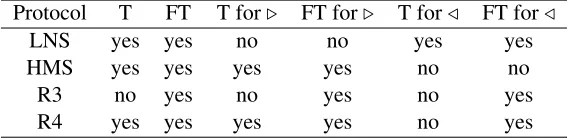
Protocol T FT T for. FT for. T for/ FT for/
LNS yes yes no no yes yes
HMS yes yes yes yes no no
R3 no yes no yes no yes
[image:12.612.164.448.71.140.2]R4 yes yes yes yes no yes
Table 1: Summary of termination results.
If the communication mode is push, then the termination argument remains valid, since after the calli.i⊕1 agenti⊕1 still learns all the secrets that agent iis familiar with and hence the above set {(i,j)| ¬KiFi⊕1J}decreases.
If the communication mode is pull, then the protocol may fail to terminate, because after the first calli/i⊕1 agenti⊕1 does not learn the secret of agentiand consequently the call can be repeated. However, the situation changes when fairness is assumed.
Proposition 4.5 For the pull communication mode protocol R4 fairly terminates.
Table 1 summarizes the termination properties of the protocols considered in the paper.
5
Conclusions
The aim of this paper was to introduce distributed gossip protocols, to set up a formal framework to reason about them, and to illustrate it by means of an analysis of selected protocols.
Our results open up several avenues for further research. First, our correctness arguments were given in plain English with occasional references to epistemic tautologies, such asKiφ→φ, but it should be
possible to formalize them in a customized epistemic logic. Such a logic should have a protocol inde-pendent component that would consist of the customary S5 axioms and a protocol deinde-pendent component that would provide axioms that depend on the mode of communication and the protocol in question. An example of such an axiom is the formulaKiFi⊕1I 1→FiI⊕1 that we used when reasoning about
protocol R2. To prove the validity of the latter axioms one would need to develop a proof system that allows us to compute the effect of the calls, much like the computation of the strongest postconditions in Hoare logics. Once such a logic is provided the next step will be to study formally its properties, including decidability. Then we could clarify whether the provided correctness proofs could be carried out automatically.
Finally, many assumptions of the current setup could be lifted. Different initial and final situations could be considered, for instance common knowledge of protocols could be assumed, or common knowl-edge of the familiarity of all agents with all the secrets upon termination could be required. Finally, to make the protocols more efficient passing of tokens could be allowed instead of just the transmission of secrets by means of calls.
Acknowledgments
We would like to thank Hans van Ditmarsch and the referees for helpful comments and Rahim Rameza-nian for useful comments about Example 2.8. This work resulted from a research visit by Krzysztof Apt to Davide Grossi and Wiebe van der Hoek, sponsored by the 2014 Visiting Fellowship Scheme of the De-partment of Computer Science of the University of Liverpool. The first author is also a Visiting Professor at the University of Warsaw. He was partially supported by the NCN grant nr 2014/13/B/ST6/01807.
References
[1] K. R. Apt, F. R. de Boer & E. R. Olderog (2009): Verification of Sequential and Concurrent Programs. Springer, doi:10.1007/978-1-84882-745-5.
[2] K. R. Apt, N. Francez & S. Katz (1988):Appraising fairness in distributed languages.Distributed Computing 2(4), pp. 226–241, doi:10.1007/BF01872848.
[3] M. Attamah, H. van Ditmarsch, D. Grossi & W. Van der Hoek (2014):Knowledge and gossip. In: Proceed-ings of ECAI’14, IOS Press, pp. 21–26.
[4] B. Baker & R. Shostak (1972): Gossips and Telephones. Discrete Mathematics 2, pp. 197–193, doi:10.1016/0012-365X(72)90001-5.
[5] R. Bumby (1981): A Problem with Telephones. SIAM Journal of Algorithms and Discrete Methods2, pp. 13–18, doi:10.1137/0602002.
[6] E. W. Dijkstra (1975): Guarded commands, nondeterminacy and formal derivation of programs. Communi-cations of the ACM18, pp. 453–457, doi:10.1145/360933.360975.
[7] R. Fagin, J. Halpern, Y. Moses & M. Vardi (1997):Knowledge-Based Programs.Distributed Computing10, pp. 199–225, doi:10.1007/s004460050038.
[8] Ronald Fagin, Joseph Y. Halpern, Yoram Moses & Moshe Y. Vardi (1995):Reasoning about knowledge. The MIT Press, Cambridge.
[9] A. Hajnal, E. C. Milner & E. Szemeredi (1972):A Cure for the Telephone Disease. Canadian Mathematical Bulletin15, pp. 447–450, doi:10.4153/CMB-1972-081-0.
[10] S. M. Hedetniemi, S. T. Hedetniemi & A. L. Liestman (1988): A survey of gossiping and broadcasting in communication networks.Networks18(4), pp. 319–349, doi:10.1002/net.3230180406.
[11] C. A. R. Hoare (1978):Communicating sequential processes.Communications of the ACM21, pp. 666–677, doi:10.1145/359576.359585.
[12] INMOS Limited (1984):Occam Programming Manual. Prentice-Hall International.
[13] M. O. Jackson (2008):Social and Economic Networks.Princeton University Press.
[14] R. Kurki-Suonio (1986):Towards programming with Knowledge Expressions. In:Proceedings of POPL’86, pp. 140–149, doi:10.1145/512644.512657.
[16] R. Parikh & R. Ramanujam (1985): Distributed Processing and the Logic of Knowledge. In: Logic of Programs, LNCS 193, Springer, pp. 256–268, doi:10.1007/3-540-15648-8. Similar toJoLLI12: 453–467, 2003.
[17] ´A Seress (1986):Quick Gossiping without Duplicate Transmissions.Graphs and Combinatorics2, pp. 363– 383, doi:10.1007/BF01788111.
[18] R. Tijdeman (1971):On a telephone problem.Nieuw Archief voor Wiskunde3(XIX), pp. 188–192.
Proof (of Proposition 4.1)
Termination Given a call sequencecdefine the set
Inf(c):={(i,j)|i,j∈ {1, . . .,n}and(MDR,c)|=FiJ}.
After each enabled calli.i⊕1 inc, the setInf(c)increases, which ensures termination since each set Inf(·)has at mostn2elements.
Correctness Consider a leaf of the computation tree. Then the exit condition
n
^
i=1
n
^
j=1
(¬FiJ∨ ¬Ki¬Fi⊕1J)
is true. We proceed by induction to show that then eachFiJis true, wherei,j∈ {1, . . .,n}, and where the
pairs(i,j)are ordered as follows:
(1,1),(2,1), . . .,(n,1),
(2,2),(3,2), . . .,(1,2),
. . .,
(n,n),(1,n), . . .,(n−1,n).
So theith row lists the pairs(j,i)with j∈ {1, . . .,n}ranging clockwise, starting ati.
Take a pair(i,j). Ifi=j, thenFiJis true by assumption. Ifi6=j, then consider the pair that precedes
it in the above ordering. It is then of the form(i1,j), wherei=i1⊕1. By the induction hypothesisFi1J
is true, so by the exit condition¬Ki1¬FiJis true.
Suppose now towards a contradiction that¬Fi1⊕1Jis true. Theni1⊕16= j. Hence by virtue of the
considered communication mode and Definition 2.4 it follows that agentii knows that¬Fi1⊕1J is true
since the only way fori1⊕1 to become familiar withJ is by means of a call fromi1. SoKi1¬FiJ is true.
This yields a contradiction. HenceFiJ is true.
So we showed, as desired, thatVn i=1
Vn
j=1FiJis true in the considered leaf.
Proof (of Proposition 4.2) To start with,Vn
i=1FiIis true in every node of the computation tree. Suppose
the exit conditionVn
i=1KiFi⊕1I 1 is true at a node of the computation tree (in short, true). It implies thatVn
i=1Fi⊕1I 1 is true. Fix i∈ {1, . . .,n}. By the above FiI 2 is true. Further, the implication
KiFi⊕1I 1→FiI 1 is true in every node of the computation tree (remember, the agents are positioned
on a directed ring). Ifn=3, this proves thatVn
j=1FiJ is true.
Ifn=4, we note thatKiFi⊕1I 1 implies that agenti⊕1 learnedI 1 through a call of agentiand hence the implicationKiFi⊕1I 1→FiI⊕1 is true in every node of the computation tree, as well (remember
that the mode is push-pull). We conclude thatVn
Proof (of Proposition 4.3) First, note that the following three statements are equivalent for each nodec of an arbitrary computationξ and each agenti:
• iis disabled atc,
• (MDR,c)|= (Vnj=1FiJ)∧KiFi⊕1I 1,
• a sequence of calls(i⊕2,i⊕3), (i⊕3,i⊕4), . . .,(i,i⊕1)(possibly interspersed with other calls) has taken place inξ beforec.
Suppose now towards a contradiction that an infinite fair computationξ exists. We proceed by case
distinction.
Case 1 Some agent becomes disabled inξ.
We claim that if an agentibecomes disabled inξ, then also agenti⊕1 becomes disabled inξ. Indeed,
otherwise by fairness at some point inξ after whichibecomes disabled, agenti⊕1 calls his successor, i⊕2, and by the above sequence of equivalences in turn becomes disabled.
We conclude by induction that at some point inξ all agents become disabled and henceξ terminates,
which yields a contradiction.
Case 2 No agent becomes disabled inξ.
By fairness each agent calls inξ infinitely often his successor. So for every agent ithere exists inξ
the sequence of calls(i⊕2,i⊕3),(i⊕3,i⊕4), . . .,(i,i⊕1)(possibly interspersed with other calls). By the above sequence of equivalences after this sequence of calls agentibecomes disabled, which yields a
contradiction.
Proof (of Proposition 4.4)
Termination It suffices to note that after each call(i,i⊕1)the size of the set
{(i,j)∈A×A| ¬KiFi⊕1J}
decreases.
Correctness Consider a leaf of the computation tree. Then the exit condition
n
^
i=1
n
^
j=1
(¬FiJ∨KiFi⊕1J)
is true. As in the case of protocol R1 we prove that it implies eachFiJ is true by induction on the pairs (i,j), wherei,j∈ {1, . . .,n}, ordered as follows:
(1,1),(2,1), . . .,(n,1),
(2,2),(3,2), . . .,(1,2),
. . .,
(n,n),(1,n), . . .,(n−1,n).
Take a pair(i,j). Ifi= j, thenFiJ is true by assumption. Ifi6= j, then consider the pair that precedes it
in the above ordering, so(i1,j), wherei=i1⊕1. By the induction hypothesisFi1Jis true, so by the exit
conditionKi1FiJis true and henceFiJis true.
Proof (of Proposition 4.5) Consider the following sequence of statements:
(ii) (MDR,c)|=Vnj=1(FiJ→KiFi⊕1J), (iii) (MDR,c)|=KiFi⊕1,
(iv) a sequence of callsi 1/i,i 2/i 1, . . .,i/i⊕1 (possibly interspersed with other calls) has taken place inξ beforec.
It is easy to verify that these statements are logically related in the following way:
(i)⇔(ii)⇒(iii)⇒(iv)⇒(ii)
for each nodecof an arbitrary computationξ and each agenti. They are therefore equivalent. Suppose
now towards a contradiction that an infinite fair computationξ exists. As in the proof of Proposition 4.3
we proceed by case distinction.
Case 1 Some agent becomes disabled inξ.
We claim that if an agent i becomes disabled in ξ, then also i 1 becomes disabled in ξ. Indeed,
otherwise by fairness at some point inξ after which jbecomes disabled, agenti 1 calls his successor, i, and by the above sequence of equivalences in turn becomes disabled.
We conclude by induction that at some point inξ all agents become disabled and henceξ terminates,
which yields a contradiction.
Case 2 No agent becomes disabled inξ.
By fairness each agent calls inξ infinitely often his successor. So for every agent ithere exists inξ
a sequence of calls i 1/i,i 2/i 1, . . .,i/i⊕1 (possibly interspersed with other calls). By the above sequence of equivalences, after this sequence of calls agentibecomes disabled, which yields a