This is a repository copy of Model Checking CTL is Almost Always Inherently Sequential.
White Rose Research Online URL for this paper:
http://eprints.whiterose.ac.uk/74808/
Proceedings Paper:
Beyersdorff, O, Meier, A, Thomas, M et al. (3 more authors) (2009) Model Checking CTL is
Almost Always Inherently Sequential. In: Lutz, C and Raskin, J-F, (eds.) 16th International
Symposium on Temporal Representation and Reasoning 2009. International Symposium
on Temporal Representation and Reasoning, 23 - 25 July 2009, Bressanone, Brixen, Italy.
IEEE , 21 - 28 . ISBN 978-0-7695-3727-6
https://doi.org/10.1109/TIME.2009.12
[email protected] https://eprints.whiterose.ac.uk/ Reuse
See Attached
Takedown
If you consider content in White Rose Research Online to be in breach of UK law, please notify us by
Model Checking CTL is Almost Always Inherently Sequential
∗Olaf Beyersdorff
Arne Meier
Michael Thomas
Heribert Vollmer
Theoretical Computer Science, University of Hannover, Germany
{
beyersdorff, meier, thomas, vollmer
}
@thi.uni-hannover.de
Martin Mundhenk
Computer Science, University of Jena, Germany
[email protected]
Thomas Schneider
Computer Science, University of Manchester, UK
[email protected]
Abstract
The model checking problem for CTL is known to be P-complete (Clarke, Emerson, and Sistla (1986), see Schnoe-belen (2002)). We consider fragments of CTL obtained by restricting the use of temporal modalities or the use of negations—restrictions already studied forLTLby Sistla and Clarke (1985) and Markey (2004). For all these fragments, except for the trivial case without any temporal operator, we systematically prove model checking to be either inherently sequential (P-complete) or very efficiently parallelizable (LOGCFL-complete). For most fragments, however, model checking forCTLis alreadyP-complete. Hence our results indicate that in most applications, approachingCTLmodel checking by parallelism will not result in the desired speed up.
We also completely determine the complexity of the model checking problem for all fragments of the extensionsECTL, CTL+, andECTL+.
1. Introduction
Temporal logic was introduced by Pnueli [12] as a formal-ism to specify and verify properties of concurrent programs. Computation Tree Logic (CTL), the logic of branching time, goes back to Emerson and Clarke [4] and contains tempo-ral operators for expressing that an event occurs at some time in the future (F), always in the future (G), in the next
point of time (X), always in the future until another event
holds (U), or as long as it is not released by the occurrence
∗Supported in part by grants DFG VO 630/6-1 and DAAD-ARC D/08/08881.
of another event (R), as well as path quantifiers (E,A) for
speaking about computation paths. The full language ob-tained by these operators and quantifiers is called CTL⋆[5]. In CTL, the interaction between the temporal operators and path quantifiers is restricted. The temporal operators in CTL are obtained by path quantifiers followed directly by any temporal operator, e.g.,AFandAUare CTL-operators.
Be-cause they start with the universal path quantifier, they are calleduniversalCTL-operators. Accordingly,EXandEG
are examples forexistentialCTL-operators.
Since properties are largely verified automatically, the computational complexity of reasoning tasks is of great in-terest. Model checking (MC)—the problem of verifying whether a given formula holds in a state of a given model— is one of the most important reasoning tasks [15]. It is in-tractable for CTL⋆(PSPACE-complete [6, 15]), but tractable for CTL (solvable in, and even hard for, polynomial time [3, 15]).
Although model checking for CTL is tractable, its P-hardness means that it is presumably not efficiently paral-lelizable. We therefore search for fragments of CTL with a model checking problem of lower complexity. We will consider all subsets of CTL-operators, and examine the com-plexity of the model checking problems for all resulting fragments of CTL. Further, we consider three additional restrictions affecting the use of negation and study the exten-sions ECTL, CTL+, and their combination ECTL+.
decision problems into NP-complete, coNP-complete, and PSPACE-complete. Further, [1] examined model checking for all fragments of LTL obtained by restricting the set of temporal and propositional operators. The resulting classi-fication separated cases where model checking is tractable from those where it is intractable.
Concerning CTL and its extension ECTL, our results in this paper show that most restricted versions of the model checking problem exhibit the same hardness as the general problem. More precisely, we show that apart from the trivial case where CTL-operators are completely absent, the com-plexity of CTL model checking is a dichotomy: it is either P-complete or LOGCFL-complete. Unfortunately, the latter case only occurs for a few rather weak fragments and hence there is not much hope that in practice, model checking can be sped up by using parallelism—it is inherently sequential.
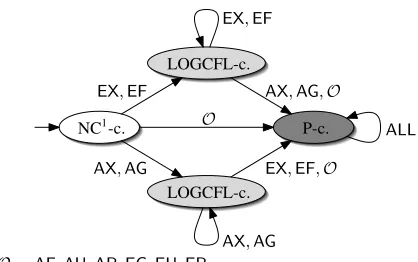
Put as a simple rule, model checking for CTL is P-complete for every fragment that allows to express a uni-versalandan existential CTL-operator. Only for fragments involving the operatorsEXandEF(or alternativelyAXand AG) model checking is LOGCFL-complete. This is
visual-ized in Fig. 2 in Sect. 5. Recall that LOGCFL is defined as the class of problems logspace-reducible to context-free languages, and NL ⊆ LOGCFL ⊆ NC2 ⊆ P. Hence, in contrast to inherently sequential P-hard tasks, problems in LOGCFL have very efficient parallel algorithms.
For the extensions CTL+ and ECTL+, the situation is more complex. In general, model checking CTL+ and ECTL+ is ∆p2-complete [8]. We show that for T ⊆
{A,E,X}, both model checking problems remain tractable,
while for T * {A,E,X}, both problems become ∆p2
-complete. Yet, for negation restricted fragments with only existential or only universal path quantifiers, we observe a complexity decrease to NP- resp. coNP-completeness.
This paper is organized as follows: Section 2 introduces CTL, its model checking problems, and the non-basics of complexity theory we use. Section 3 contains our main results, separated into upper and lower bounds. We also provide a refined analysis of the reductions between different model checking problems with restricted use of negation. The results are then generalized to extensions of CTL in Section 4. Finally, Section 5 concludes with a graphical overview of the results. For brevity, some proofs are omitted and will be included in the full version of this paper.
2. Preliminaries
2.1. Temporal Logic
We inductively define CTL⋆-formulae as follows. LetΦ
be a finite set of atomic propositions. The symbols used are the atomic propositions inΦ, the constant symbols⊤and
⊥, the Boolean connectives¬,∧, and∨, and the temporal operator symbolsA,E,X,F,G,U, andR.
AandEare called apath quantifiers, temporal operators aside fromAandEarepure temporal operators. The atomic
propositions and the constants⊤and⊥areatomic formulae. There are two kinds of formulae,state formulaeandpath formulae. Each atomic formula is a state formula, and each state formula is a path formula. Ifϕ, ψare state formulae and χ, π are path formulae, then¬ϕ, (ϕ∧ψ), (ϕ∨ψ),
Aχ,Eχare state formulae, and¬χ,(χ∧π),(χ∨π),Xχ, Fχ,Gχ, [χUπ], and[χRπ]are path formulae. The set of
CTL⋆-formulae (orformulae) consists of all state formulae. AKripke structureis a tripleK = (W, R, η), whereW
is a finite set of states,R⊆W×Wa total relation (i. e., for eachw∈W, there exists aw′such that(w, w′)∈R), and η:W →P(Φ)is a labelling function. Apathxis an infinite sequencex= (x1, x2, . . .)∈Wωsuch that(x
i, xi+1)∈R,
for alli≥1. For a pathx= (x1, x2, . . .)we denote byxi
the path(xi, xi+1, . . .).
LetK = (W, R, η)be a Kripke structure,w∈W be a state, andx= (x1, x2, . . .)∈ Wω
be a path. Further, let
ϕ, ψbe state formulae andχ, πbe path formulae. The truth of a CTL⋆-formula w. r. t.Kis inductively defined as:
K, w|=⊤ always,
K, w|=⊥ never,
K, w|=p iffp∈Φandp∈η(w),
K, w|=¬ϕ iffK, w6|=ϕ,
K, w|= (ϕ∧ψ)iffK, w|=ϕandK, w|=ψ,
K, w|= (ϕ∨ψ)iffK, w|=ϕorK, w|=ψ,
K, w|=Aχ iffK, x |=χfor all paths x= (x1, x2, . . .)withx1=w,
K, x |=ϕ iffK, x1|=ϕ,
K, x |=¬χ iffK, x 6|=χ,
K, x |= (χ∧π)iffK, x |=χandK, x|=π,
K, x |= (χ∨π)iffK, x |=χorK, x|=π,
K, x |=Xχ iffK, x2|=χ
K, x |= [χUπ] iff there existsk∈Nsuch that K, xi |=χfor1≤i < kand
K, xk |=π.
The semantics of the remaining temporal operators is defined via the equivalences: Eχ ≡ ¬A¬χ,Fχ ≡[⊤Uχ], Gχ≡ ¬F¬χ, and[χRπ]≡ ¬[¬χU¬π]. A state formulaϕ
issatisfied by a Kripke structureKif there existsw∈W
such thatK, w|=ϕ. We will also denoted this byK|=ϕ. A CTL-formulais a CTL⋆-formula in which each path quantifier is followed by exactly one pure temporal operator and each pure temporal operator is preceded by exactly one path quantifier. The set of CTL-formulae forms a strict sub-set of the sub-set of all CTL⋆-formulae. For example,AGEFpis
a CTL-formula, butA(GFp∧Fq)is not. Pairs of path
CTL-∅ AU
AF AX AG
AR AX,AF AF,AG AX,AG AX,AU
AX,AF,AG
AX,AR AG,AU
[image:4.612.87.250.73.273.2]AF,AR AX,AF,AR
Figure 1. The expressive power ofCTL(T).
operators, andEX,EF,EG,EU, andERareexistential
CTL-operators. Let ALL denote the set of all CTL-operators.
Note thatA[ψUχ]≡AFχ∧ ¬E[¬χU(¬ψ∧ ¬χ)], and thus E[ψRχ]≡EGχ∨E[χU(ψ∧χ)]. Hence{AX,AF,AR}is a
minimal set of CTL-operators for CTL (in presence of all Boolean connectives), whereas{AX,AG,AU}is not
com-plete for CTL [7].
By CTL(T)we denote the set of CTL-formulae using the connectives{∧,∨,¬}and the CTL-operators inT only. Figure 1 shows the structure of sets of CTL-operators with respect to their expressive power. Moreover, we define the following fragments of CTL(T):
• CTLpos(T)(positive): CTL-operators may not occur
in the scope of a negation,
• CTLa.n.(T)(atomic negation): negation signs appear
only directly in front of atomic propositions, • CTLmon(T)(monotone): no negation signs allowed.
This restricted use of negation was introduced and studied in the context of linear temporal logic, LTL, by Sistla and Clarke [17] and Markey [9]. Their original notation was e
L(T)for CTLa.n.(T)andL+(T)for CTLpos(T).
2.2. Model Checking
Now we define the model checking problems for the above mentioned fragments of CTL. LetLbe CTL, CTLmon,
CTLa.n., or CTLpos.
Problem: L-MC(T)
Input: A Kripke structureK= (W, R, η), a statew∈W, and anL(T)-formulaϕ. Question: DoesK, w|=ϕhold?
2.3. Complexity Theory
We assume familiarity with standard notions of complex-ity theory (cf. [11]). Next we will introduce the notions from circuit complexity that we use for our results. All reductions in this paper are≤cd-reductions defined as follows: A
lan-guageAisconstant-depth reducibletoB,A≤cdB, if there
is a logtime-uniform AC0-circuit family with oracle gates for
Bthat decides membership inA. That is, there is a circuit familyC= (C1, C2, C3, . . .)such that
• for everyn,Cncomputes the characteristic function of
Afor inputs of lengthn,
• there is a polynomialpand a constantdsuch that for all input lengthsn, the size ofCnis bounded byp(n)
and the depth ofCnis bounded byd,
• each circuitCnconsists of unbounded fan-in AND and
OR gates, negation gates, and gates that compute the characteristic function ofB(theoracle gates), • there is a linear-time Turing machineM that can check
the structure of the circuit family, i.e., given a tu-plehn, g, t, hiwhere n, g, hare binary numbers and
t ∈ {AND,OR,NOT,ORACLE},M accepts ifCn
contains a gategof typetwith predecessorh.
Circuit familiesCwith this last property are called logtime-uniform(the name stems from the fact that the time needed byMis linear in the length of its input tuple, hence logarith-mic inn). For background information we refer to [13, 18]. We easily obtain the following relations between model checking for fragments of CTL with restricted negation:
Lemma 2.1. For every setT ofCTL-operators, we have
CTLmon-MC(T)≤cd CTLa.n.-MC(T) ≤cd CTLpos-MC(T).
Further, for model checking, atomic negation can be eluded, i. e.,CTLa.n.-MC(T)≤cdCTLmon-MC(T).
In Sect. 3.3 we complete the picture by showing that also CTLpos-MC(T)≤cdCTLmon-MC(T).
The class P consists of all languages that have a polynomial-time decision algorithm. A problem is P-complete if it is in P and every other problem in P reduces to it. P-complete problems are sometimes referred to as inher-ently sequential, because P-complete problems most likely (formally: if P6=NC) do not possess NC-algorithms, that is, algorithms running in polylogarithmic time on a paral-lel computer with a polynomial number of processors. For-mally, NC contains all problems solvable by polynomial-size polylogarithmic-depth logtime-uniform families of circuits with bounded fan-in AND, OR, NOT gates.
refers to the original definition of the class in terms of logspace-reductions, however it is known that the class does not change if instead, as everywhere else in this paper, ≤cd-reductions are used). Hence, LOGCFL ⊆ NC (even
LOGCFL ⊆ NC2, the second level of the NC-hierarchy, where the depth of the occurring circuits is restricted to
O(log2n)). The class LOGCFL has a number of different maybe even somewhat surprising characterizations, e. g., languages in LOGCFL are those that can be decided by non-deterministic Turing machines operating in polynomial time that have a worktape of logarithmic size and additionally a stack whose size is not bounded.
More important for this paper is the characterization of LOGCFL as those problems computable by SAC1 circuit families, that is families of circuits that
• have polynomial size and logarithmic depth,
• consist of unbounded in OR gates and bounded fan-in AND gates and negation gates, but the latter are only allowed at the input-level,
• are logtime-uniform (as defined above).
Since the class LOGCFL is known to be closed under com-plementation, the second condition can equivalently be re-placed to allow unbounded fan-in AND gates and restrict the fan-in of OR gates to be bounded.
To summarize:
NC1⊆L⊆NL⊆LOGCFL=SAC1⊆NC2;
and problems in these classes possess very efficient paral-lel algorithms: they can be solved in timeO(log2n)on a parallel machine with a tractable number of processors. For more background on these and related complexity classes, we refer the reader to [18].
3. Model Checking CTL and CTL
posThis section contains our main results on the complex-ity of model checking for CTL and CTLpos. We defer the
analysis of the fragments CTLa.n.and CTLmonto Sect. 3.3
where we will see that their model-checking problems are computationally equivalent to model checking for CTLpos.
While model checking for CTL in general is known to be polynomial time solvable and in fact P-complete [3, 15], we improve the lower bound by showing that only one temporal operator is sufficient to obtain hardness for P.
Theorem 3.1. For each nonempty setT ofCTL-operators,
CTL-MC(T)isP-complete. IfT =∅, thenCTL-MC(T)is NC1-complete.
If we consider only formulae from CTLpos, where no
CTL-operators are allowed inside the scope of a negation, the situation changes and the complexity of model checking exhibits a dichotomous behavior. As long asEGorAFare
expressible the model checking problem remains P-complete. Otherwise, its complexity drops to LOGCFL.
Theorem 3.2. LetT be any set ofCTL-operators. Then
CTLpos-MC(T)is
• NC1-complete ifT =∅,
• LOGCFL-complete if∅ 6=T ⊆ {EX,EF}or∅ 6=T ⊆ {AX,AG}, and
• P-complete otherwise.
We split the proofs of Theorems 3.1 and 3.2 into the upper and lower bounds in the following two subsections.
3.1. Upper Bounds
In general, model checking for CTL is known to be solvable in P [3]. While this upper bound also applies to CTLpos-MC(T)(for everyT), we improve it for positive
CTL-formulae using onlyEXandEF, or onlyAXandAG.
Proposition 3.3. LetTbe a set ofCTL-operators such that
T ⊆ {EX,EF}orT ⊆ {AX,AG}. ThenCTLpos-MC(T)is
inLOGCFL.
Proof. First consider the caseT ⊆ {EX,EF}. We claim
that Algorithm 1 recursively decides whether the Kripke structureK = (W, R, η)satisfies the CTLpos(T)-formula ϕin statew0 ∈ W. There,S is a stack that stores pairs
(ϕ, w) ∈ CTLpos(T)×W and R⋆ denotes the transitive
closure ofR.
Algorithm 1 always terminates because each subformula ofϕis pushed to the stack S at most once. For correct-ness, an induction on the structure of formulae shows that Algorithm 1 returnsfalseif and only if for the most recently popped pair(ψ, w)fromS, we haveK, w6|=ψ. Thence, in particular, Algorithm 1 returnstrueiffK, w|=ϕ.
Algorithm 1 can be implemented on a nondeterminis-tic polynomial-time Turing machine that besides its (un-bounded) stack uses only logarithmic memory for the local variables. Thus CTLpos-MC(T)is in LOGCFL.
The caseT⊆ {AX,AG}is analogous and follows from
closure of LOGCFL under complementation.
Finally, for the trivial case where no CTL-operators are present, model checking CTL(∅)-formulae is equivalent to the problem of evaluating a propositional formula. This problem is known to be solvable in NC1[2].
3.2. Lower Bounds
The P-hardness of model checking for CTL is folklore in the model checking community (cf. [15]), but we could not find a formal proof.1 We improve this lower bound and
Algorithm 1Determine whetherK, w0|=ϕ.
Require: a Kripke structure K = (W, R, η), w0 ∈ W,
ϕ∈CTLpos(T)
1: push(S,(ϕ, w0))
2: whileSis not emptydo
3: (ϕ, w)←pop(S)
4: ifϕis a propositional formulathen
5: ifϕevaluates to false inwunderηthen
6: return false
7: end if
8: else ifϕ=α∧βthen
9: push(S,(β, w)) 10: push(S,(α, w))
11: else ifϕ=α∨βthen
12: nondet.push(S,(α, w))orpush(S,(β, w))
13: else ifϕ=EXαthen
14: nondet. choosew′∈ {w′|(w, w′)∈R}
15: push(S,(α, w′))
16: else ifϕ=EFαthen
17: nondet. choosew′∈ {w′|(w, w′)∈R⋆} 18: push(S,(α, w′))
19: end if
20: end while
21: return true
concentrate on the smallest fragments of monotone CTL— w. r. t. CTL-operators—with P-hard model checking.
Proposition 3.4. LetTdenote a set ofCTL-operators. Then
CTLmon-MC(T)isP-hard ifTcontains an existential and a
universalCTL-operator.
Proof. First, assume thatT ={AX,EX}. We give a generic
reduction from alternating Turing machines working in log-arithmic space. LetM be such a machine and letxbe an input toM. We may assume w. l. o. g. that each transition of
M leads from an existential to a universal configuration and vice versa. Further we may assume that each computation of
M ends after the same numberp(n)of steps, wherepis a polynomial andnis the length ofM’s input.
Letc1, . . . , cq(n)be an enumeration of all possible
con-figurations ofM on inputx, starting with the initial configu-rationc1and polynomialq. We construct a Kripke structure
K := (W, R, η)by defining the setW := {cji | 1 ≤i ≤
q(n),0≤j≤p(n)}and the relationR⊆W ×W as
R:=
(cji, c j+1
k )
Mciin one stepreaches configuration,0≤j < p(cnk)from
∪ {(cpi(n), c p(n)
i )
1≤i≤q(n)}.
The labelling functionηis defined asη(w) :={t}iffwis an accepting configuration, andη(w) =∅otherwise. Then it holds that
M acceptsx ⇐⇒ K, c01|=ψ1
ψ2 · · ·ψp(n)(t)
· · ·,
whereψi(x) :=AX(x)ifM’s configurations after theith
step are universal, and ψi(x) := EX(x) otherwise.
No-tice that the constructed CTL-formula does not contain any propositional operator. Sincep(n)andq(n)are polynomi-als, the size ofKandϕis polynomial in the size of(M, x). Moreover,Kandϕcan be constructed fromM andxusing AC0-circuits. Thus,A≤cdCTLmon-MC({AX,EX})for all A∈ALOGSPACE=P.
For T = {AF,EG} we take new atomic propositions d0, . . . , dp(n)and modify the above reduction by defining
the formulasηandψias follows:
η(w) :={dj |w=cji,1≤i≤q(n)} ∪
{t|wis an accepting configuration}
ψi(x) :=
AF(di+1∧x), ifM’s configurations in
stepiare universal,
EG(Di+1∨x), otherwise,
(1)
whereDi=Wi6=j∈{0,...,p(n)}dj.
For the combinations of T being one of {AF,EF},
{AF,EX},{AG,EG},{AG,EX},{AX,EF}, and{AX,EG},
the P-hardness of CTLmon-MC(T)is obtained using
analo-gous modifications toηand theψi’s.
For the remaining combinations involving the until or the release operator, observe that w. r. t. the Kripke structureK
as defined in (1),AF(di∧x)andEG(Di∨x)are equivalent
toA[di−1Ux]andE[di−1Ux], andRandUare duals.
In the presence of arbitrary negation, universal operators are definable by existential operators and vice versa. Hence, from Proposition 3.4 we obtain the following corollary.
Corollary 3.5. The model checking problemCTL-MC(T)
isP-hard for each nonempty setTofCTL-operators.
Returning to monotone CTL, in most cases even one operator suffices to make model checking P-hard:
Proposition 3.6. LetTdenote a set ofCTL-operators. Then
CTLmon-MC(T)isP-hard ifT contains at least one of the
operatorsEG,EU,ER,AF,AU, orAR.
The proof of this proposition proceeds similarly as the proof of Proposition 3.4, but is technically more involved. In essence, it shows that bothAXandEXcan be simulated
by using onlyEG.
By Lemma 2.1, CTLmon-MC(T) ≤cd CTLpos-MC(T)
and hence the above results directly translate to model checking for CTLpos: for any set T of temporal
opera-tors, CTLpos-MC(T) is P-hard if T * {EX,EF} or if T * {AX,AG}. These results cannot be improved w. r. t. T, as forT ⊆ {EX,EF}andT ⊆ {AX,AG}we obtain a
Proposition 3.7. For every nonempty set T of CTL -operators, the model checking problemCTLmon-MC(T)is
LOGCFL-hard.
Proof. As explained in Sect. 2.3, LOGCFL can be character-ized as the set of languages recognizable by logtime-uniform SAC1circuits, i. e., circuits of logarithmic depth and poly-nomial size consisting of ∨-gates with unbounded fan-in and∧-gates with fan-in2. For every single CTL-operator
O, we will show that CTLmon-MC(T)is LOGCFL-hard for
allT ⊇ {O}by giving a generic≤cd-reductionf from the
word problem for SAC1circuits to CTLmon-MC(T).
First, considerEX ∈ T. Let C be a logtime-uniform
SAC1 circuit of depth ℓ with n inputs and let x =
x1. . . xn ∈ {0,1}n. Assume w. l. o. g. that C is layered
into alternating layers of∧-gates and∨-gates and that the output gate ofCis an∨-gate. We number the layers bottom-up, that is, the layer containing (only) the output gate has level0, whereas the gates and negations of the input-gates are situated in layer ℓ. Denote the graph ofC by
G := (V, E), where V := Vin⊎V∧ ⊎V∨ is partitioned
into the sets corresponding to the (possibly negated) input-gates, the∧-gates, and the∨-gates, respectively.Gis acyclic and directed with paths leading from the input to the output gates. From(V, E), we construct a Kripke structure that allows to distinguish the two predecessors of an∧-gate from each other. This will be required to model proof trees using CTLmon({EX})-formulae.
Fori∈ {1,2}, letVi
in := {vi | v ∈ Vin},V∨i := {vi | v∈V∨}and defineVini,∨:=Vini ∪V∨i. Further define
E′:=(v, ui)∈V∧×Vini,∨|(u, v)∈Eanduis theith
predecessor ofv ∪(v, v)|v∈Vin1∪Vin2 ∪ [
i∈{1,2}
(vi, u)∈Vini,∨×V∧|(u, v)∈E ,
where the ordering of the predecessors is implicitly given in the encoding of C. We now define a Kripke structure
K := (V′, E′, η)with statesV′ := V1
in,∨∪Vin2,∨∪V∧,
relationE′, and labelling functionη:V′ →P({1,2, t}),
η(v) :=
{i, t}, ifv=vinj ∈V
i
inandxj= 1,
{i, t}, ifv=vinj ∈Vi
inandxj = 0,
{i}, ifv=vinj ∈V
i
inandxj= 0,
{i}, ifv=vinj ∈V
i
inandxj = 1,
{i}, ifv∈Vi
∨,
∅, otherwise,
where i = 1,2, j = 1, . . . , n and vin1, . . . , vinn,
vin1, . . . , vinnenumerate the input gates and their negations.
The formulaϕthat is to be evaluated onKwill consist of atomic propositions1,2andt, Boolean connectives∧and
∨, and the CTL-operatorEX. To constructϕwe recursively
define formulae(ϕi)0≤i≤ℓby
ϕi:=
t, ifi=ℓ,
EXϕi+1, ifiis even (∨-layers), V
i=1,2EX(i∧ϕi+1), ifiis odd (∧-layers).
We define the reduction functionfas the mapping(C, x)7→
(K, v0, ϕ), wherev0is the node corresponding to the output gate ofC andϕ := ϕ0. We stress that the size ofϕ is polynomial, for the depth ofCis logarithmic only. Clearly, each minimal accepting subtree (cf. [14] or [18, Definition 4.15]) ofCon inputxtranslates into a sub-structureK′of
Ksuch thatK′, v0|=ϕwhere
1. K′includesv0,
2. K′includes one successor for every node correspond-ing to an∨-gate, and
3. K′ includes the two successors of every node corre-sponding to an∧-gate.
AsC(x) = 1iff there exists a minimal accepting subtree ofConx, the LOGCFL-hardness of CTLmon-MC(T)for EX∈T follows.
Second, considerEF∈T. We have to extend our Kripke
structure to contain information about the depth of the corre-sponding gate. We may assume w. l. o. g. thatCis encoded such that each gate contains an additional counter holding the distance to the output gate (which is equal to the number of the layer it is contained in, cf. [18]). We extendη to include this distancei,1≤i≤ℓinto “depth-propositions”
dias in the proof of Proposition 3.4. Denote this modified
Kripke structure byK′. Further, we define(ϕ′i)0≤i≤ℓas
ϕ′i:=
dℓ∧t, ifi=ℓ,
EF(di+1∧ϕ′i
+1), ifiis even, V
i=1,2EF(di+1∧i∧ϕ′i+1), ifiis odd.
Redefining the reductionf as(C, x)7→(K′, v0, ϕ′0)yields
the LOGCFL-hardness of CTLmon-MC(T)forEF∈T.
Third, letAX∈T. Consider the reduction in case 1 for
CTLmon({EX})-formulae, and letf(C, x) = (K, v0, ϕ)be
the output of the reduction function. It holds thatC(x) = 1
iffK, v0|=ϕ, and equivalentlyC(x) = 0iffK, v0|=¬ϕ. Letϕ′be the formula obtained from¬ϕby multiplying the
negation into the formula. Then ϕ′ is a CTL
a.n.({AX})
-formula. Since LOGCFL is closed under complement, it follows that CTLa.n.-MC({AX})is LOGCFL-hard.
Us-ing Lemma 2.1, we obtain that CTLmon-MC({AX}) is
LOGCFL-hard, too.
An analogous argument can be used for the caseAG∈T.
Using Lemma 2.1 we obtain LOGCFL-hardness of CTLpos-MC(T)for all nonempty setsTof CTL-operators.
In the absence of CTL-operators, the lower bound for the model checking problem again follows from the lower bound for evaluating monotone propositional formulae. This problem is known to be hard for NC1[2, 16].
3.3. The Power of Negation
We will now show that model checking for the fragments CTLa.n.and CTLposis computationally equivalent to model
checking for CTLmon, for any setT of CTL-operators. Since
we consider cd-reductions, this is not immediate.
From Lemma 2.1 it follows that the hardness re-sults for CTLmon-MC(T) also hold for CTLa.n.-MC(T)
and CTLpos-MC(T). Moreover, the algorithms for
CTLpos-MC(T) also work for CTLmon-MC(T) and
CTLa.n.-MC(T)without using more computation resources.
Both observations together yield the same completeness re-sults for all CTL-fragments with restricted negations.
Theorem 3.8. Let T be any set ofCTL-operators. Then
CTLmon-MC(T),CTLa.n.-MC(T), andCTLpos-MC(T)are
• NC1-complete ifT is empty,
• LOGCFL-complete if∅ 6=T ⊆ {EX,EF}or∅ 6=T ⊆ {AX,AG},
• P-complete otherwise.
As all complete sets for a class are equivalent, we ob-tain reductions between the model checking problems for all negation-restricted fragments of CTL. This extends Lemma 2.1.
Corollary 3.9. For every setTofCTL-operators, the
prob-lemsCTLmon-MC(T),CTLa.n.-MC(T), andCTLpos-MC(T)
are equivalent w.r.t. cd-reducibility.
We remark that this equivalence is not straightforward. Simply applying de Morgan’s laws to transform one prob-lem into another requires counting the number of negations on top of∧- and∨-connectives. This counting cannot be achieved by an AC0-circuit and does not lead to the aspired reduction. Here we obtain equivalence of the problems as a consequence of our generic hardness proofs in Sect. 3.2.
4. Model Checking Extensions of CTL
What CTL lacks in practice is the ability to express fair-ness properties. To address this shortcoming, Emerson and Halpern introduced ECTL in [5]. ECTL extends CTL with theF
∞
-operator, which states that for every moment in the fu-ture, the enclosed formula will eventually be satisfied again:
for a Kripke structureK, a pathx = (x1, x2, . . .), and a path formulaχ
K, x|=F ∞
χ iff K, xi|=Fχ for alli∈N.
The dual operatorG ∞
is defined analogously. As for CTL, model checking for ECTL is known to be tractable. More-over, our next result shows that even for all fragments, model checking for ECTL is not harder than for CTL.
Theorem 4.1. Let T be a set of temporal
opera-tors. Then ECTL-MC(T) ≡cd CTL-MC(T′) and
ECTLpos-MC(T) ≡cd CTLpos-MC(T′), where T′ is
ob-tained fromTby substitutingF ∞
,G ∞
withF,G.
Another extension of CTL is CTL+where Boolean com-binations of pure temporal operators are allowed in the scope of path quantifiers. In contrast to CTL, model checking for CTL+is not tractable, but∆p2-complete [8]. Below we
clas-sify the complexity of model checking for both full and positive fragments of CTL+.
Theorem 4.2. LetT be a set of temporal operators. Then
CTL+-MC(T)is
• NC1-complete ifT ⊆ {A,E}orT ={X}, • P-complete if{X}(T ⊆ {A,E,X}, and • ∆p2-complete otherwise.
Theorem 4.3. LetT be a set of temporal operators. Then
CTL+pos-MC(T)is
• NC1-complete ifT ⊆ {A,E}orT ={X},
• LOGCFL-complete ifT ={A,X}orT ={E,X}, • P-complete ifT ={A,E,X},
• NP-complete ifE∈T,A6∈T, andTcontains a pure temporal operator aside fromX,
• coNP-complete if A ∈ T,E 6∈ T, andT contains a
pure temporal operator aside fromX, and
• ∆p2-complete otherwise.
Finally, ECTL+is the combination of ECTL and CTL+. For its model checking problem we obtain:
Corollary 4.4. Let T be a set of temporal
opera-tors. Then ECTL+-MC(T) ≡cd CTL+-MC(T′) and
ECTL+pos-MC(T) ≡cd CTL+pos-MC(T), where T′ is
ob-tained fromTby substitutingF ∞
,G ∞
withF,G.
5. Conclusion
NC1-c.
LOGCFL-c.
LOGCFL-c.
P-c. EX
,EF
AX
,AG
EX,EF
AX
,AG
O
AX
,AG,O
EX
,EF,O
ALL
O=AF
[image:9.612.66.275.72.203.2],AU,AR,EG,EU,ER
Figure 2. The complexity ofCTLpos-MC(T)for
all setsT ofCTL-operators (depicted as a “fi-nite automaton” where states indicate com-pleteness results and arrows indicate an in-crease of the set ofCTL-operators).
CTL. Only for some weak fragments, model checking be-comes easier: if T ⊆ {EX,EF}orT ⊆ {AX,AG}, then
CTLpos-MC(T)is LOGCFL-complete. In the case that no
CTL-operators are used, NC1-completeness of evaluating propositional formulae applies. As a direct consequence (Theorem 3.1), model checking for CTL(T)is P-complete for every nonemptyT. This shows that for the majority of interesting fragments, model checking CTL(T)is inherently sequential and cannot be sped up by using parallelism.
While all the results above can be transferred to ECTL (Theorem 4.1), CTL+and ECTL+exhibit different proper-ties. For both logics, the general model checking problem was shown to be complete for∆p2in [8]. Here we proved
that model checking fragments of CTL+(T)and ECTL+(T)
forT ⊆ {A,E,X}remains tractable, while the existential
and the universal fragments of CTL+pos(T)and ECTL + pos(T)
containing temporal operators other thanXare complete for
NP and coNP, respectively.
Instead of restricting only the use of negation as done in this paper, one might go one step further and restrict the allowed Boolean connectives in an arbitrary way. One might, e. g., allow the exclusive-OR as the only proposi-tional connective. This has been done for the case of lin-ear temporal logic LTL in [1], where the complexity of LTL-MC(T, B)for an arbitrary setT of temporal operators andBof propositional connectives was studied. We think that a corresponding study for CTL (or CTL⋆) is an interest-ing topic for further research. For example, restrictinterest-ing the Boolean connectives to only one of the functions AND or OR leads to many NL-complete fragments, but a full classi-fication is still open. The computational complexity of the corresponding satisfiability problems CTL-SAT(T, B)and CTL⋆-SAT(T, B)has been completely determined in [10].
References
[1] M. Bauland, M. Mundhenk, T. Schneider, H. Schnoor, I. Schnoor, and H. Vollmer. The tractability of model check-ing for LTL: the good, the bad, and the ugly fragments. In
Proc. Methods for Modalities 5, pages 125–140. ENS Cachan, 2007. Also at CoRR http://arxiv.org/abs/0805.0498. [2] S. R. Buss. The Boolean formula value problem is in
ALOG-TIME. InProc. 19th Symposium on Theory of Computing, pages 123–131. ACM Press, 1987.
[3] E. Clarke, E. A. Emerson, and A. Sistla. Automatic ver-ification of finite-state concurrent systems using temporal logic specifications. ACM Transactions on Programming Languages and Systems, 8(2):244–263, 1986.
[4] E. A. Emerson and E. M. Clarke. Using branching time tem-poral logic to synthesize synchronization skeletons.Science of Computer Programming, 2(3):241–266, 1982.
[5] E. A. Emerson and J. Y. Halpern. “Sometimes” and “not never” revisited: on branching versus linear time temporal logic.Journal of the ACM, 33(1):151–178, 1986.
[6] E. A. Emerson and C.-L. Lei. Modalities for model checking: Branching time logic strikes back. Science of Computer Programming, 8(3):275–306, 1987.
[7] F. Laroussinie. About the expressive power of CTL com-binators. Information Processing Letters, 54(6):343–345, 1995.
[8] F. Laroussinie, N. Markey, and P. Schnoebelen. Model Check-ing CTL+ and FCTL is Hard. InProc. Foundations of Soft-ware Science and Computation Structure (FOSSACS’2001), pages 318–331. Springer, 2001.
[9] N. Markey. Past is for free: on the complexity of verifying linear temporal properties with past.Acta Informatica, 40(6-7):431–458, 2004.
[10] A. Meier, M. Mundhenk, M. Thomas, and H. Vollmer. The complexity of satisfiability for fragments of CTL and CTL⋆.
InProc. 2nd Workshop on Reachability Problems in Compu-tational Models (RP 2008), pages 201–213, 2008.
[11] C. H. Papadimitriou.Computational Complexity. Addison-Wesley, Reading, MA, 1994.
[12] A. Pnueli. The temporal logic of programs. InProc. 18th Symposium on Foundations of Computer Science, pages 46– 57. IEEE Computer Society Press, 1977.
[13] K. Regan and H. Vollmer. Gap-languages and log-time com-plexity classes.Theoretical Computer Science, 188:101–116, 1997.
[14] W. L. Ruzzo. Tree-size bounded alternation. Journal of Computer and System Sciences, 21:218–235, 1980. [15] P. Schnoebelen. The complexity of temporal logic model
checking. InAdvances in Modal Logic, pages 393–436, 2002. [16] H. Schnoor. The complexity of the Boolean formula value problem. Technical report, Theoretical Computer Science, University of Hannover, 2005.
[17] A. Sistla and E. Clarke. The complexity of propositional linear temporal logics.Journal of the ACM, 32(3):733–749, 1985.