Rochester Institute of Technology
RIT Scholar Works
Theses Thesis/Dissertation Collections
Spring 2015
Architecture as Communication: A Study of the
role of Form, Function and Context in evoking
Meaning
Priyanka Sondhi
Follow this and additional works at:http://scholarworks.rit.edu/theses
This Thesis is brought to you for free and open access by the Thesis/Dissertation Collections at RIT Scholar Works. It has been accepted for inclusion in Theses by an authorized administrator of RIT Scholar Works. For more information, please [email protected].
Recommended Citation
R.I.T
ARCHITECTURE AS COMMUNICATION
A Study of the role of Form, Function and Context in evoking Meaning
BY
PRIYANKA SONDHI
A Thesis Submitted in Partial Fulfillment of the Requirements for the Degree of MASTER OF ARCHITECTURE
Committee Approval
Jules
Chiavaroli,
AIA
Date
Professor
Department of Architecture, RIT
Thesis Chair
James
Yarrington,
AIA
Date
Adjunct Professor,
Department of Architecture, RIT
Thesis Advisor
Richard
Napoli,
AIA
Date
Senior Architect
Acknowledgments
I
t is hard to be a part of the field of architecture without fully immersing oneself into its intricacies and depths. It cannot be helped. However, you can receive help, which I have, in abundance.I am grateful to the Department of Architecture and the Rochester Institute of Technology for permitting me this opportunity. I am especially grateful to the Architecture Head of Department, Architect Dennis Andrejko, all the professors who have taught me through the last 3 years and the sweet and patient Donna. I am thankful to my incredibly supportive committee members, Professor Jules Chiavaroli, Architect James Yarrington and Architect Richard Napoli.
Jules, thank you for not just taking the time to guide me through the thesis process, but also for being an advisor, educator and friend over my time at RIT. I could not have asked for better support.
James, your design expertise and passion for architecture are inspiring. Thank you for always pushing me and expecting more from my design capabilities. I have evolved into a more confident and wholesome designer under your tutelage.
Richard, words cannot express the gratitude I feel towards your guidance, help and selfless mentorship throughout my time in the United States. This thesis would not have come to fruition without your encouragement and tremendous support.
A big big note of gratitude to my partners-in-crime in the program. The late night discussions and
“ You have to have endurance in this profession (Architecture). You
start the project as a young person and at the end are another.”
Preface
Abstract
T
he aim of this thesis is to understand and design an architecture that includes as part of its program, the function of communication of a certain encoded idea(s) through the public’s everyday interaction with it. This thesis is divided into two parts - exploration and design project. The exploration part studies the methods and history of communicating meaning througharchitecture. Based on this study a design project was defined which included picking an appropriate site, identifying the meaning to be communicated for the site context, studying the context for such communication and designing a building program and form.
Rochester, being a place of much speculation over the past few years of the author’s academic duration, served as the perfect test-bed for applying this research. Rochester’s need for downtown revitalization became the starting point for the study and led to the search for semiotic expression of progressiveness for this specific instance. The building function was finalized to be a “Multi-Dimensional Business Incubation Center” and the site was picked to be supportive to both the building function and the communication. The function of this incubation center will be to help and promote start-ups and nascent entrepreneurial activities by supplying infrastructure and services needed by such firms, at a low price. The intent is to catalyze economic growth in Rochester, and thereby incentivize revitalization of downtown Rochester.
Through the process of designing the final product it was discovered that the process of
Table of Contents
Title Page Copyright Page Committee Approval Acknowledgments Preface AbstractTable of Contents
Project Introduction & Scope Literature Study
Incubator Literature Study and Feasibility Study Precedent Studies - Business Incubator
Site Analysis Building Program Code Analysis Parti (The Big Idea) Design Drawings Design Translations Sustainability
Denotation and Connotation Conclusion
Project Introduction & Scope
A
rchitecture is a public art. It has the potential for propaganda at a scale conceivably greater than the technological media.“It is one of the basic needs of man to experience his life situations
as meaningful, and the purpose of the work of art is to keep and transmit
meanings.”
1Every architectural gesture leads to interpretation by the users. These users are not just people actually inhabiting the building but also people who interact with the structure while walking past it, living around it, looking at the building from their office windows... among others. These interpretations are also subject to the physical form, location and functional importance of the building inasmuch as they are to the association of meaning by a user based on his or her personal lens. This thesis studies the potential behind such interpretations to signify more than the functional importance of the site and building. The goal is to attempt to lay down a framework for thinking about this topic, and use future explorations to delve deeper into this vast field - “Meaning in Architecture”.
Thus, the thesis is composed of two main parts - literature study and the design project. The aforementioned theoretical framework for the conveyance of meaning in architecture is applied to form an architecture project for the city of Rochester and subsequently, to the designing of the architectural form for this project. In light of the speculation in recent years related to the economic revitalization of Rochester, the architectural design project for this thesis was derived to relate to the idea of revitalizing Rochester’s economy. Thus through the derived function, context and form, a meaning has to be communicated to the user, or public conducive of progress in Rochester’s economy.
Since Rochester’s founding at the beginning of the nineteenth century, growth, entrepreneurial spirit and innovation have been the fabric of the city’s culture. This has resulted in the growth of a highly skilled work force in Rochester, while the continued augmentation of this work force is assured by the nine colleges and universities in the Rochester area. Consequently, the city of Rochester has
a large underutilized market in it’s entrepreneurial talent. It is possible to rejuvenate Rochester’s storied reputation as a research and manufacturing powerhouse through a new litany of small tech companies. This is the logic behind using the “business incubator” building program. It is practically and semiotically evocative of “progress”.
“ Using Architecture and the built environment to address
Rochester’s changing identity, from that of a manufacturing
hub to a university city, by communicating (non-verbally) its
acceptance and encouragement of progressive ideas.”
The final building solution is thus the sweet spot in these explorations that will not only functionally, but also physically, express the progressive nature of Rochester’s economy.
There are broader implications of such a gesture, as the “right” architecture can bring about profound change. A sensitive and long term urban design undertaking will most likely be needed for continuous and harmonious revitalization. Although that scale of analysis is beyond the scope a thesis investigation, the larger context of Rochester and the immediate urban-scape was studied in the design process. The intended learning outcomes from this Thesis are
- Meaning in Architecture – Understand how architecture can be used as a means to convey meaning (non-verbally) thereby empowering the architect and architecture alike with the tools to design more meaningfully.
Literature Study
A
rchitecture is a functional object, not meant for communication.1 However, with every line, molding, window, wall, door, passage among other building features, a meaning is generated for the building interactor (or user) and communication ensues. Whether intentional or accidental, meaning is generated through the creation of space. It is not only hard for architects, but impossible, to effect this communication in a way so as to convey universal meaning(s).For this thesis, it became important to understand the process by which communication happens. What is the cognitive and phenomenological process for communication? Looking at the realm of language as communication, many scholars have studied the conveyance of meaning not only through architecture but in the broader realm of meaning creation itself. Some of them are
Ferdinand de Sauccerre, Charles Morris, Umberto Eco, Christian-Norberg Schultz, Bernard Tschumi and Charles Jencks among others. Architecture has played the role of not only serving as a function but also as a symbol. Meaning was derived from the structure of the churches, mosques, temples, palaces and forts - as these were structures encoded with certain readings to be decoded by the user. This multi-functional nature of architecture is discussed in better detail later in this chapter.
Historically, communication linguistics and language itself was believed to be based on a system of beliefs. It was thought of as “mere vocal labels or communicational adjuncts superimposed upon an already given order of things”.2 In the beginning of the 20th century, a Swiss linguist and semiotician, Ferdinand de Saussure, laid down the foundation for the modern understanding of the systems of signs and communication using these signs. He approached language as a structural and formal system and explained the systems of signs as language structures.3 His theory of structural
linguistics was based on the idea of contrasts and equivalents. Language is considered to be made up of strings of linguists objects such as words and phonemes and morphemes. These objects are defined only thorough the fact that the contrast with other objects in the language system.
1. Umberto Eco. Function and Sign: the Semiotics of architecture. (Rethinking Architecture - a reader in Cultural theory. London. Routledge. 1997) p. 182.
2. Roy Harris. Language, Saussure and Wittgenstein : How to play games with words. (London, New York, Routledge, 1988). Web.
3. Ferdinand de Saussure’s ideas were collected in the famous book Cours de linguistique geńerale published posthumously in
Since mid 20th century the semiotic theory is applied to the field of architecture alongside the fields of philosophy and psychology among others. During this time the theoretical discourse in architecture started to look at the creation of meaning for an individual through his or
her interaction with an architectural object and lead to the development of theories such as structuralism, post structuralism, deconstruction and critical architecture.
Semiotics is concerned with the phenomena of signs in all their abundance and variety: letters, images, texts, acoustics, road signs, verbal signs, gestures, icons, symbols, allegories, corporate logos, indicies, hieroglyphs, drawings, natural signs,celestial signs and architectural objects among others. It involves the study of the duality of a signifier and a signified in the presence of a referent. The main concepts and conditions for communication of meaning in semiotics and semiology are:1,2
1. Sign (Signifier and Signified): A sign is made up of a signifier and signified. Signifier is the sounds or letters (visuals) used to denote a concept. Signified is the actual concept of the thing. For example, the hearing or reading of the word DOG means nothing until one assigns an image or idea of an actual dog to it. The actual reality of the concept, that is, an actual dog, is called a referent. A sign is a two sided psychological entity - one cannot exist without the other. They are two sides of the same coin.
2. Difference: Signs should stand out by comparison to different linguistic objects otherwise they will all merge into one single unit. Example Run, Ran, Running etc.
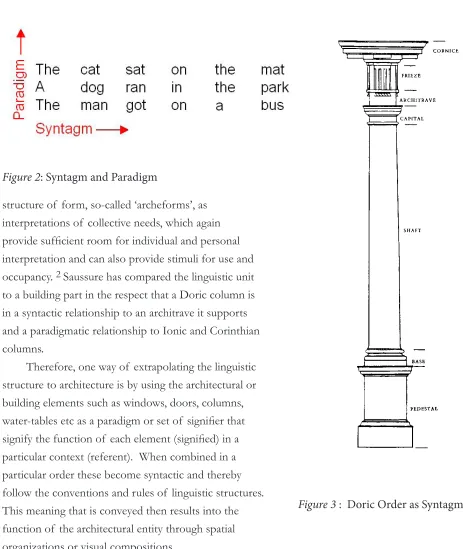
5. Syntagm: Syntagm is the linear pattern or sequence of linguistic objects. Thus the sign, once chosen, is then combined with other signs in a syntagm. Paradigm refers to a group of linguistic objects that can replace one another in a syntagm. Signs are chosen from a set of available options in the paradigm
Now that an understanding has been generated of the process of meaning creation, the question arises if this systematic and structural approach can indeed be applied to the field of architecture? Can we divide architectural elements into signs and referents? A traditional means of conferring meaning to architectural form is to turn architecture into a code. 1
[image:15.612.135.489.132.420.2]Language is a collective tool comprised of structure (grammar, syntax), which is interpreted individually through the act of speech. Similarly, architecture can give expression to an objective
Figure 1: Signifier, Signified and Referent
1. Clemens M. Plank. The Conscious User of Architecture. (Doctoral Dissertation submitted towards Doctor of Technical Sciences, to the Dept. of Architecture, University of Innsbruck, 2010). Pg. 39. Web.
structure of form, so-called ‘archeforms’, as interpretations of collective needs, which again provide sufficient room for individual and personal interpretation and can also provide stimuli for use and occupancy. 2 Saussure has compared the linguistic unit to a building part in the respect that a Doric column is in a syntactic relationship to an architrave it supports and a paradigmatic relationship to Ionic and Corinthian columns.
Therefore, one way of extrapolating the linguistic structure to architecture is by using the architectural or building elements such as windows, doors, columns, water-tables etc as a paradigm or set of signifier that
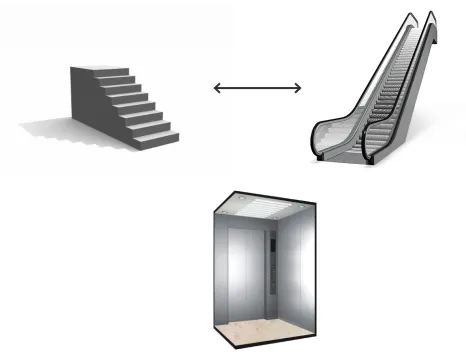
[image:16.612.71.534.110.659.2]However, the nature of signifier in architecture is complex. It is not an abstract sign anymore, but rather one that has a physicality to it and a pre-defined function. Consider the case of a staircase. A visual of a stair signifies the function that it is a method of going up or down, while the visual itself can be described as “an inclined progression of rigid horizontal surfaces upward in which the distance between successive surfaces in elevation, r, is set somewhere between 5 and 9 inches, in which the surfaces have a dimension in the direction of the progression in plan, t, set somewhere between 16 and 8 inches, and in which there is little or no distance between, or overlapping of, successive surfaces when projected orthographically on a horizontal plane, the sum total (or parts) falling somewhere between 17 and 48 degrees from horizontal”1. This is a universal meaning which is also culturally accepted. This “One of the first questions for semiotics to face, then, if it aims to provide keys to the cultural phenomena in this field, is whether it is possible to interpret functions as having something to do with communication; and the point of it is that seeing functions from the semiotic point of view might permit one to understand and define them better, precisely as functions, and thereby to discover other types of functionality, which are just as essential but which a straight functionalist interpretation keeps one from perceiving”.1
Furthermore, the physical presence of the sign leaves little room for Parole. The context for architectural interpretation is too complex. Umberto Eco, an Italian Semiotician, in his famous essay Function and Sign: Semiotics in Architecture proves that architecture is a particular challenge to Semiotics. According to him the link between architecture and semiotics is not obvious, given that most architectural objects do not communicate, but function. He proposed another way of using architecture as communication that is derived from Structural Linguistics, but tweaked to fit the agenda of architecture. It is the semiotic way of looking at architecture. A phenomenological consideration of our relationship with architectural objects tells us that we commonly do experience architecture as communication, even while recognizing its functionality. 1 Thus Eco proposes that architects design for primary functions (denoted) and secondary function (connotative), which are based on codes and sub-codes in architecture. This inclusion of codes for the purpose of
differentiating between denotation and connotation based on codes and conventions developed over time adds the desired cultural layering to the overall communicative aspect of architecture, thereby rendering the methodology more wholesome.
Primary Function (Denotation): Functionality that is literal to a sign or system.
Secondary Function (Connotation): Functionality that is symbolic and adds association to a given function.
An example of such a function is a throne. The primary function of the throne is to seat a person. However, a throne also adds the connotation of royalty and regalness. It is accompanied by a person sitting with an upright back, perhaps with a scepter in hand and a crown on the head. It may even be uncomfortable, in which case the secondary function (connotation) has taken significance over the denotation of the object. This significance is, thus, interchangeable, and architects need to bear this in mind.
But, Eco made another observation. He explains that, for effective communication, the signs should belong to a particular set of codes and sub-codes (mentioned above) to be recognizable. This is an essential element. Lets look at an example to understand this better.
Eco presents a set of steps that an architect identifies to bring new innovations. These are 1. A series of social needs
2. A system of functions that would satisfy the needs, and become the sign vehicle for these needs
[image:19.612.74.540.254.610.2]3. A system of forms that would correspond to the functions and that would become sign vehicles for those functions
Figure 4 : Stair, Escalator and Elevator - Significance of Architectural Codes
To accomplish the very first step then, an architect will need to step out of the shoes of an architect and adorn a new pair - those of a sociologist, anthropologist, artist, philosopher, psychologist etc. Only after studying society (or a community or a person) can the architect identify
the social exigencies1 and thereby prescribe a functional and formal code to address them. But the encoding must occur only after decoding the existing context and surroundings and then encoding the new architecture such that it can subsequently be understood in this particular surrounding and context, without the need of a proverbial translator.
In the past, public buildings expressed shared meaning through well-known conventions. Today these conventions seem to be superseded by commercial forces and the quest for instant fame. Public architecture is now required to be a surreal piece of sculpture as well as something that appeals to a diverse audience – at once provocative and practical yet without the context that once religion or ideology once provided. 1
When this knowledge is applied to the context of Rochester, a city I have come to understand better than any other in the United States, the social exigency that is identified is related to the economic upliftment of the city and it’s downtown revitalization. This inference is based on observation, research, “Sustainable Communities” course, conversations with local Rochester architects, planners as well as economists. Being a design based Architecture Thesis, the study intent is to develop a building program contextual to Rochester’s climate, urban-scape and economic needs and subsequently work on a building and site design.
The “how” and “why” of the communication is thus established. But “who” is the
communication for? This is an important question to answer as this defines the context and existing code for the purpose of this design exercise. The communication is defined for
1. Young Entrepreneurs - By providing a facility that is not only dedicated to the purpose of business incubation (denotation) but also acts as an asset and source of pride and motivation for the young entrepreneurs and researchers (connotation)
2. Community - Providing a facility that respects the existing codes and ideas (site selection) and designing the program and facility with a symbiotic relationship with the community in mind.
3. Everyone outside Rochester - by making a state of the art facility which symbolizes progress (for the present day and for the present context) and is encoded with some universally recognizable signifier of progress.
The idea is to encode the architecture with as many cross referencing meanings as possible as the intention is to communicate the meaning LOUD. Clarity and variety of meaning (connotation) will eventually depend upon people and their perception based on their preconditioned and filtered reality.
In the case of Rochester, paying homage to the river not only signifies that the city is, yet again, set to become a boomtown through the historical and cultural association with the Genesee river but also through a functional use (building program) of an important space (the site) for a function that attracts youth, bringing vitality and life to the city and urging the city towards another economic boom.
The architectural form and space of this building needs to be designed such that is supports the purpose of helping people derive their own interpretation that is synonymous with “progress”, “future” and “novel”. When this is done while holding true the cultural and functional significance of the building, the result can be evocative of prosperity and economic boom.
T
he function of a business incubation center will be to help and promote start-ups and nascent entrepreneurial activities by supplying infrastructure and services needed by such firms, at a low cost. The intent is to catalyze economic growth in Rochester, and thereby incentivize revitalization of downtown Rochester.Since Rochester’s founding at the beginning of the nineteenth century, growth, entrepreneurial spirit and innovation have been the fabric of the city’s culture. This has resulted in the growth of a highly skilled work force in Rochester, while the continued augmentation of this work force is assured by the nine colleges and universities in the Rochester area. Consequently, the city of Rochester has a large underutilized market in its entrepreneurial talent. It is possible to rejuvenate Rochester’s storied reputation as a research and manufacturing powerhouse through a new litany of small tech companies. This is the logic behind using the “business incubator” building program. It is practically and semantically evocative of “progress”.
There are many aspects to a project such as this – downtown revitalization, annotation and connotation in architecture, urban fabric, riparian development, meaning in architecture, incubator design to name a few. To get into an in-depth detail in all of these was impossible. I focused on the meaning of architecture and incubator design specifically and looked from a higher level at riparian design.
Rochester - Brief History and Economy
Rochester was one of America’s first “boomtowns”. From Charles Finny, to Fredrick Douglass to Susan B. Anthony, Rochester is famous for movements that helped society progress overall. Rochester has also been considered as one of the best places to live and one of the most innovative cities in America.
As mentioned earlier, today Rochester has a robust knowledge sector, innovative business leaders and superb quality of life. All of these are factors that should ideally retain youth.
It is important to also note that Rochester’s population has been dwindling since late 1970s. Perhaps the most alarming demographic is that the youth (ages 20 - 30 years) formed only 14% of the entire population of Rochester in 2010.1 It is imperative that Rochester provide its younger population that is graduating each year from its educational institutes a reason to stay in Rochester. This can translate into employment and housing provisions for them. Business incubators are programs designed to support the successful development of entrepreneurial companies by providing an array of business support resources and services, developed and orchestrated by incubator management and offered both in the incubator and through its network of contacts.
Indeed there is already recognition of this potential. Organizations like High Tech Rochester and Greater Rochester Enterprise work with local Rochester government and academia to train entrepreneurs and support new business ventures. Since 1996, 51 start-ups — 38 of which are still active — were created based on University of Rochester technologies alone.1 In 2010, the University of Rochester School of Medicine and Dentistry attracted $216.2 million dollars in NIH (National Institute of Health) funding to support its research programs. Also, the concentration of corporations and academic institutions involved in optical and image research and development resulted in the creation of the “Rochester Photonics Cluster” a not-for-profit organization founded to promote and enhance the New York State photonics, optics and imaging industry by fostering the cooperation of business, academia, and government.2 RIT too recently founded it’s Center of Urban Entrepreneurship (CUE). Interestingly enough, the formal concept of business incubation began in the USA in 1959 when Batavia Industrial Center was opened in Batavia (NY), a city only 30 miles west of Rochester.
As traditional M.B.A. industries like finance lose steam, schools are catering to candidates with entrepreneurial ambitions, loading up on business plan competitions, accelerators, incubators, classes and research centers devoted to entrepreneurship. These programs provide new entrepreneurs with mentorship, advice and practical training on technical, business and fundraising topics to help them get from idea to product to launch and beyond.
All these factors help us understand that Rochester’s real estate will present a demand for business incubators. The demands of such spaces are based on flexibility so it can be as user defined as possible. This thought is incorporated into the program of the incubator. Some additional benefits of incubators 3:
• Return on Investment:
– $1 public investment in incubator = $30 in local tax revenue
• Business Retention:
– 84% of graduates stay in community [NBIA]
• Increased likelihood of business success:
– 87% of incubator graduates stay in business [NBIA]
1. http://www.rochestergrowth.com
What kind of incubator?
A successful incubator is a part of the overall community economic development plan and gets support from community for missions and operations. As per the National Business Incubator Association [NBIA] and the Michigan Small Business and Technology Development Center
[MISBTDC] most of the incubator facilities plan to support a wide array of start-up opportunities, which would include general office space as well as specialized facilities for research. This affords a flexibility of facility space as per future demand of the region.
Examples of existing and thriving Rochester Business Incubators are High Tech
Rochester, Venture Creations, Rochester BioVenture Center and Smart Stream Technology and Commercialization center.
Manufacturing Service/Speciality
Technology
Another consideration to think of is the method of funding for the project. As a tool for promoting economic robustness in an area business incubators receive a lot of not-for-profit support from government and economic development organizations [Figure 6].
In Rochester, the Rochester Economic Development Corporation (a not-for-profit
development corporation) and Greater Rochester Enterprise are but two of the regional economic development organizations.
Figure 6: Incubator Program Funding [Source: Michigan Small Business and Technology Development Center (MISBTDC)
Economic Development Organizations
No Sponsor
Combination
Other
For Profit Academic
Institutions
FACILITIES - Physical Infrastructure and Objectives
During implementation of an incubator, those managing the institution have to cope with the challenges caused by the building in which it is sited. A business incubator is a program rather than just a building, however, constructing or refurbishing the right building plays an important role in the incubator’s daily operations and services.
According to the European Commission – in their final report Benchmarking of Business Incubators (2002), “the provision of workspace is central to the incubator model. Standard good practices now exist with regard to the most appropriate configuration of incubator space”. Some of
these are 1:
1. Based on the type of company to be incubated, the building characteristics of the incubator may vary in terms of the size of the workspace and services offered. To help determine the size of the incubator structure, try to identify the profile of the companies that will be incubated and attempt to identify the infrastructure they need. (iDISC Paper Incubator Infrastructure and Services).
2. Once the targeted market niche has been identified, a key step is to study already operating incubators with similar characteristics to those of the project in mind i.e. precedent study to help determine the program. These visits give the advantage of learning from the experience of other incubators in order and to avoid any problems they may have had. This helps to:
3. The next step is planning the operations of the incubator, particularly the services provided. This should not only indicate the facilities considered ideal but importantly those that can feasibly be made available by the incubator.
Rice & Matthews in Growing New Ventures, Creating New Jobs (1995)1 emphasize: “the right building can provide the basis for the financial self-sustainability of the incubator and an environment in which the entrepreneurs and incubator staff can work together to grow new businesses. The wrong building can lead to failure – and wrong buildings are one reason incubators have not met expectations”. They also suggest a set of questions that can be of help when choosing the right facility:
• Does it meet the size requirements of the financial model to enable the incubator to achieve self-sustainability?
• Are there any environmental hazards that will come back to preoccupy the incubator later?
• Can the facility be easily maintained?
• How much will it cost to operate the facility?
• Are the acquisition terms favorable or will the long-term costs cripple the incubator? • Can walls be moved and spaces reconfigured as companies grow?
• Are there enough common areas that can be shared, for example: conference rooms, a library, a kitchen and a business service center?
• Is the incubator building and surrounding area safe/secure so that entrepreneurs can work day or night?
• Is there adequate parking?
Based on the research through the aforementioned sources, some key issues to be addressed when selecting a site for a new business incubator are:
1. Renovation/Construction: there are advantages and disadvantages in choosing to adjust a building to the needs of the incubator or constructing a building specifically for the project. Sometimes refurbishing an unsuitable building is more expensive than the cost of acquiring a suitable one. Independently of whether the incubator building is built or adapted; the core aim is to create an atmosphere favorable for the development of business.
2. Size: What should the size of the incubator be? The decision about the ideal size of the incubator is essential to ensure its independence from external resources and its further self-sustainability. Sometimes a small building can make the incubator unfeasible, since costs could be high and there will be little to attract public and private investments. Disadvantages can also be found in large buildings, since a low occupancy rate could be viewed as a sign of project failure. The right incubator size is a challenge that a well-developed business plan can help overcome.
3. Surrounding Areas: the location of the building is important. The area surrounding the incubator must be assessed for transport facilities, parking space, the existence of postal and banking services and even the right type of neighborhood to avoid future problems.
Summary & Conclusion
Based on the research the following was established:
• Target Audience: Youth/recent graduates from a wide array of specializations. Local ethnic community is a good target for the culinary incubator space.
• Location of facility: Downtown Rochester or near. Facilities to look for close by would be postal and banking services, marketing facilities, public transportation, parking, restaurants etc. Within ready access by nearby universities and research centers.
• Size: It would take a very detailed and in-depth study of the market to get an accurate size, which is beyond the scope of this thesis. Based on data so far and some business incubators in cities that are demographically comparable to Rochester, a building program is developed for the purpose of this thesis.
• Type: Multi-sector (multi-dimensional) incubator
• Program Spaces: Appendix 1
• Assumptions made for the purpose of this thesis
- Government support and healthy and encouraging policies in the future.
Location: 3200 Market Street, Philadelphia, PA 19104 USA
Drexel University - Baiada Institute Business Incubator
[image:33.612.73.542.148.472.2]T
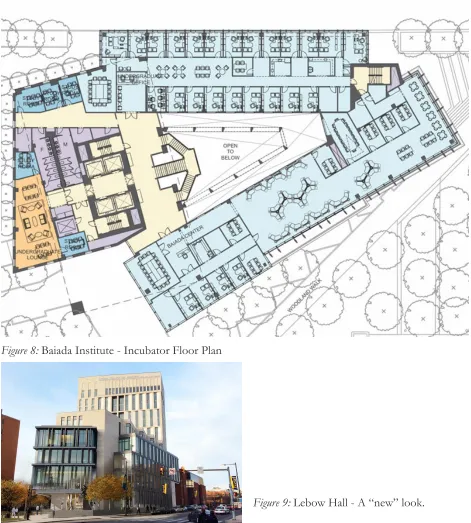
he Baiada Incubator Space is a venture of Drexel University’s Baiada Institute of Entrepreneurship in Philadelphia. As a part of the business school, this space provides state-of-the-art facilities to the students and alumni of the school to evolve their ideas from a nascent stage at a low and subsidized cost. The main facilities include physical infrastructure such as phones, desks, space, copier machines, wifi, video-conferencing, conference and meeting spaces among others, as well as funding and education resources.1Figure 7: Baiada Institute Business Incubator
Location: 890 Garrison Avenue, Bronx, NY 10474
Sunshine Suites - BXL Business Incubators
T
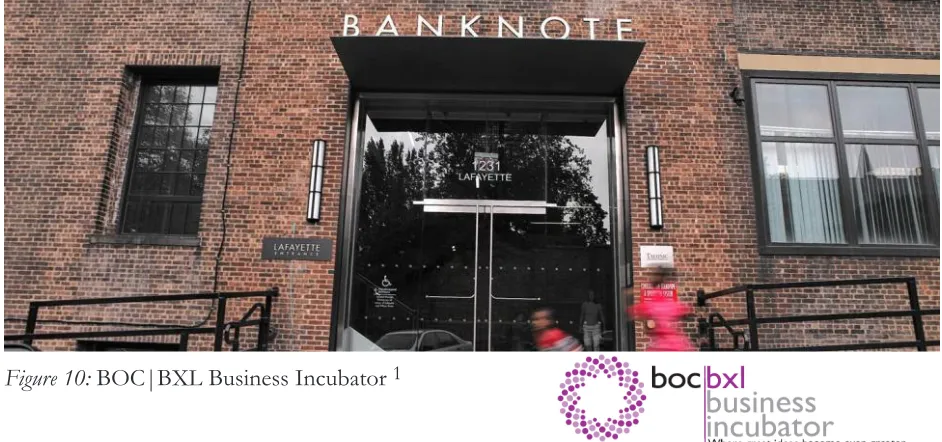
his incubator is the first New York City Economic Development Corp (NYCEDC) sponsored workspace. Located in the historical Banknote building, this is a renovation project. This incubator targets startups and new industries such as new media, technology,biomedicine, healthcare and professional services. Tenants lease space on a month by month basis.2
Facilities:
• 180 workspaces in 11000 sf. for 400 entrepreneurs.
• 10 year leases; short term leases also available.
• $99/month for virtual space and $275/month for a desk space.
• $100 for a 7-day weekly pass and $20 for a daily pass for the open event space, powered and networked work tables, lounge areas and LCD displays.
• 24/7 access to facilities
• Conference rooms to fit 10 people (per-furnished and equipped). These are available to non-members too at a fixed hourly rate ($100/hour)
[image:35.612.70.541.154.375.2]• Business counseling and networking
Figure 10: BOC|BXL Business Incubator 1
1. Victor Chu, “Bronx community debates new plan for historic BankNote building”. Accessed July 2014. http://www. nydailynews.com/new-york/bronx/bronx-community-debates-new-plan-historic-banknote-building-article-1.978765
Location: 2719 E. 10th St., Bloomington, IN 47408
Innovation Center - Indiana University
T
his is a 40,000 sf, two story incubator office building that is adjacent to Indian University’s Bloomington campus. It is intended to provide work and research space for science based business ventures. This is a multi-dimensional center and is LEED Silver rated. The space distribution for this incubator is as follows1:• Wet Labs – 22%
• Dry labs – 18%
• Offices – 8%
• Shared Spaces – 11%
• Corridors, Walls & Chases – 27%
Location: Lennox Tech Enterprise Center, 150 Lucius Gordon Drive, Suite 100 West Henrietta, New York 14586
High Tech Rochester & Rochester BioVenture Center
A
visit to High Tech Rochester was especially helpful as it provided the opportunity to interview Mr. Michael Reidlinger, Director at the BioVenture Center and as the High Tech Rochester Commercialization Manager. He possesses decades of experience in this field and was especially helpful in understanding the demand and need in Rochester.High Tech Rochester (HTR) currently houses 20 businesses and 300 people. Other data related to this incubator is
• Common Areas - Coffee & Kitchen, 5 conference rooms (conference facility leased out or used at an average of 2 - 3 times/week).
• More than 1/3rd of startup ventures move out to become “bigger” organizations
• 1 Business Support lecture/month which utilizes one large classroom space
• Weekly events at HTR include leadership round table meetings and lunch and learns.
• BioVenture, a Bio Tech incubator managed by HTR requires smaller but more specific infrastructure.
Some of the important ideas generated from this interview are:
• Kodak and Xerox have trained a lot of professionals who are now no longer part of the “new” generation. The younger crowd requires more interesting opportunities and feel the need to control their own destiny.
• Business Incubation is a multi-disciplinary activity and thrives on communication, contacts and networking.
• “Creative Collision” - Open and multi-dimensional spaces in incubators promote creative collision - figuratively speaking. As the time span of exposure between different entrepreneurs increases, the flow of creative ideas becomes clear. This can be seen in any situation were collaboration is encouraged. Therefore, the design must incorporate opportunities for such interactions. This is one of the reasons that the net to gross area ratio for incubators is low. Design spaces that promote such collisions could be
- Corridor Spaces with niches and alcoves at distances - Variety of spaces to “hang-out”
- Common dining area
• Resilient design for an incubator is important to offset future demand fluctuations. Thus providing a variety of incubation types (multi-dimensional programming) which includes spaces for labs, kitchens, tech and manufacturing, medical equipment, bakery food service, banking, farm and agro etc. is a good practice.
• A combination of open, cubicles and cubes for workspaces (200 - 500 sf for office modules)
• A linear floor plan is the most efficient floor plan for such spaces. It is the architect’s task to ensure a balance between efficiency and collaboration.
• Reaching out to the community and including them in the product and service showcase is an important step for successful business practice. This should be a consideration when implementing a building design.
• An average Business Incubator reaches full occupancy in 4 - 5 years of time. A phased development may be a good consideration.
Location: 230 Hay Street, Fayetteville, NC, 2830
CEED Culinary Incubator
A
culinary Incubator is a great way of providing support to low-income foodentrepreneurs. With health code demands it is otherwise next to impossible for these people to start a legitimate food businesses. There are some 200 culinary incubators in USA today compared to almost none in 2002. These spaces are licensed kitchens with complete equipment. The Center for Economic Empowerment and Development (CEED) provides “inspected kitchen spaces furnished with medium scale, semi-automated equipment alongside a broad range of technical and business services required to support start-up and expanded business”1.
Some of the target audience for such spaces are
• Licensing and certification necessary to produce food products;
• Provides technical support and business assistance; and
• Can provide packaging, product line expansion and marketing resources.
Figure 13: CEED Culinary Incubator
3336 SF EVENT 1600 SF DISH RECEPTION AREA EVENT PATIO SERVICE ROAD TENANT ENTRANCE A102 2 MAIN ENTRANCE 166'-10" 70'-0" 71'-4" 46'-10" 247'-0" 20'-1" 20'-4 3/4" GLUTEN FREE KITCHEN213 SF
ROOM
WOMEN
MEN
RETAIL BUILD TO SUIT
530 SF
Event Planning Office
4'-7" 4'-0" 4'-0" 4'-0" 4'-0" 3'-10" 4'-0" 5'-0" 3'-4" 4'-3" 3'-6" 13'-2" 48'-11" 30'-6" 10'-5" 6'-0" 4'-0" 19'-11" 5'-6" 6'-0" 26'-6" 18'-9" 14'-2" 17'-6" 14'-2" PREP AREA PREP AREA H o o d #2 Beverage Area A1
CEED Incubator Kitchen
Spatial distribution in the CEED incubator is as follows:
• Event Space / Cafeteria
• Event Planning Space
• Retail Space/Restaurant
• Kitchen Space (divided into smaller and specific spaces such as Gluten Free Food Prep, Bakery, Hoods etc)
• Dry and Wet Storage
• Lockers
• Managers office
“Not only does clean water have public health impacts but quality of life is interrelated to our access to recreation opportunities both passive and active, the availability of safe natural areas for personal reflection and solitude, and in creating a sense of belonging to a place resulting from a connection to a part of nature.”
- Friends of the Chicago River
T
he best ideas, often, come at the intersection of disciplines. Many aspiring entrepreneurs hail from B-schools that share campuses with medical or engineering programs. Thus looking for a site which is close to a university may be prudent. However, a larger considerationSite Analysis
Thus the site chosen for the purpose of this thesis is located at
COURT EXCHANGE BUILDING 144 Exchange Blvd.,
Rochester NY
Site History
The larger 6 story brick structure was constructed in 1881 for Samuel Stein. The
Richardsonian Romanesque structure was designed by architect Harvey Ellis for a local wooden casket manufacturer. In 1890 the National Casket company was formed and the site was used for the manufacturing, displaying and warehousing of caskets till 1984. It was added to the National Register of Historic Places in 1985. A smaller addition was design to the main building in late 1980s by renowned Rochester architecture firm, Handler and Grosso (Jim Yarrington was the project architect and is also as advisor in this thesis committee). When the Erie Canal was active, the site was a rest-stop for the canal bound ships and boats.
Site Study
This site sits in the central business district of Rochester and on the Western bank to the Genesee river. The mutual vista-like relationship between the downtown and the Court Exchange Building carries a high potential for semiotic development that is key to the intention behind my thesis. An addition to the existing 19th century brick structure can provide the right nudge that is important to the idea behind such a development.
Further site analysis [Figure 23] reinforces the following observations
1. Due to its location next to the river, the site is relatively open for an urban environment. This presents potential for harnessing wind energy.
2. The abutting power station needs access to it for operations and maintenance, which is currently done through the site, and will need to be maintained. This right-of-way will be an important consideration when planning building and site functions.
3. The relationship with the Arena opposite the Court street will be of importance when planning “public” functions on the street level.
4. The existing river-trail will need to be retained. Given the nature of the hypothetical undertaking, enhancing and respecting this trail as an important part of a Riparian city’s identity.
Figure 24: Original Building and Addition from the Corner of Court street and Exchange Blvd. Iconic Rochester Broad Street Bridge in the Background
Figure 25: River Trail and Dinosaur Bar-Be-Que across the River
Site - Immediate Context
Site - Climate Analysis
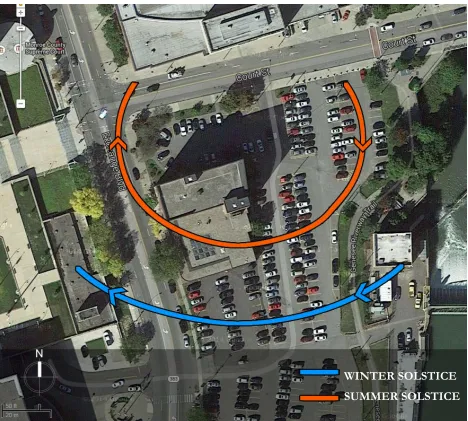
[image:54.612.86.529.224.643.2]Figure 29: Sun Path over Site
T
he building program was derived using a combination of data including case studies, literature study, Internet research, interviews with local experts in the field and architect’s data. The detail of the program can be found in the appendix. The spatial break-up of space is asBuilding Program
Incubator Space 71000 SF Shared Spaces and Amenities 38158 SF Building Services 9780 SF Circulation 42818 SF Incubator SpaceShared Spaces and Amenities Building Services
[image:57.612.135.491.241.466.2]Circulation
Figure 30: Spatial Distribution
follows:
A
ccording to the zoning code for Monroe County the site lies in Center City Base District [CCD -Base]. Details of zoning and the corresponding zoning map are attached in the appendix.The building classifies under Mixed-Use with a combination of Business, Assembly and Mercantile Uses. These do not correspond to prohibited used and therefore comply.
The building does not exceed maximum allowable height or maximum block width.
M
ixed use building with different occupancies and occupant loads. Refer to the appendix for a break-down of occupancy and egress analysis.T
he intention behind this project is to establish and demonstrate methods of communication in architecture. The thesis is thus titled:“Using Architecture and the built environment to address Rochester’s
changing identity, from that of a manufacturing hub to a university city,
by communicating (non-verbally) its acceptance and encouragement of
progressive ideas.”
This statement has established the big idea and end goal for design decisions in this project. The main design steps that demonstrate this are:
• Building on the Existing : The addition will be an “addition” to the strength and
personality of the existing structure. An accent to address the “Vanguard” Technology will address the modern nature of the design. Derive new building lines from available datum in existing structure.
[image:62.612.97.522.392.611.2]Figure 32: Scale Progression of the Site
• Hard to Soft; High to Low; Urban to Natural: The overall building complex is designed to address both the urban and natural scape and scale of the site.
• Community inclusive programming and spatial layout: Arrange Spaces to plan for public access into shared spaces while maintaining the entrepreneurs identity.
Climate responsive design is a must and has been incorporated in all the design aspects. Details of this design aspect can be found in the chapter on Sustainability in this document.
Site Plan
E X C H A N G E B L V D .
FUTURE EXPANSION LEGEND1. PLAZA
2. LANDSCAPING 3. WOOD DECK
4. ISOLATED SEATING 5. BIKE PARKING 6. BUS STOP
7. HANDICAPPED PARKING 8. LOADING DOCK
POWER STATION 3 1 2 4 5 6 5 5
S E R V I C E A C C E S S
8
7
G E N E S E E
R I V E R
[image:65.1224.70.966.99.693.2]C O U R T S T R E E T
9 25 27 8 28 6 11 12 3 5 26 23 21 4 24 13 14 7 16 17 10 6A
Department Legend
CIRCULATION CORE INCUBATOR PUBLIC SHAREDFIRST FLOOR ROOM SCHEDULE
ROOM
NUMBER NAME AREA
1 ATRIUM 2975 SF
2 LIBRARY 5129 SF
2A STORAGE 383 SF
3 PUBLIC ENTRANCE & LOBBY 4239 SF
4 CONF. 1 2432 SF
5 PRE-FUNCTION 772 SF
6 STORAGE 647 SF
6A LOADING DOCK 1111 SF
7 AUDI. STORAGE 381 SF
8 AUDITORIUM 4847 SF
9 SHOP 1986 SF
10 SHOP 1716 SF
11 SHOP 2338 SF
12 ENTREPRENEUR'S LOBBY 4277 SF
13 TOILET 525 SF
14 TOILET 475 SF
16 TRASH 92 SF
17 MECH. 908 SF
18 STORAGE 614 SF
19 ADMIN OFFICES 2354 SF
20 RESTAURANT 1386 SF
21 KITCHEN 940 SF
22 RESTAURANT & BAR 2670 SF
23 KITCHEN 918 SF
24 LOCKERS 596 SF
25 CULINARY INCUBATOR 1941 SF
26 COFFEE SHOP 828 SF
27 CAFETERIA 5174 SF
[image:66.1224.66.1164.65.699.2]SECOND FLOOR PLAN
DN 4A 12 11 4 3 13 6 7 10 8 9 1 5 2Department Legend
CIRCULATION CORE INCUBATOR SHARED0' 4' 8' 16' 32'
SECOND FLOOR ROOM SCHEDULE
ROOM
NUMBER NAME AREA
1 SHARED SERVICES 3467 SF
2 CIRCULATION 7597 SF
3 INCUBATOR SPACE 4442 SF
4 WORKSPACE 9508 SF
4A CLASSROOM 1036 SF
5 MEETING 783 SF
6 MEETING 863 SF
7 MECH. 708 SF
8 TOILET - MEN'S 525 SF
9 TOILET - WOMEN'S 475 SF
10 CIRCULATION 918 SF
11 TRASH 92 SF
12 MECHANICAL 145 SF
[image:67.1224.228.1055.101.666.2]13 DATA/ELEC 103 SF
THIRD FLOOR PLAN
4 9 8 5 3 1015 14 13
1 7 6 12 2
Department Legend
CIRCULATION CORE INCUBATOR LANDSCAPING SHARED 11THIRD FLOOR ROOM SCHEDULE
ROOM
NUMBER NAME AREA
1 SHARED SERVICES 3442 SF
2 CIRCULATION 10000 SF
3 PUBLIC SHARED WORK SPACE 5014 SF
4 WORK SPACE 13409 SF
5 ROOF GARDEN 4866 SF
6 MEETING 783 SF
7 MEETING 878 SF
8 ROOF GARDEN 5636 SF
9 LABORATORIES 13682 SF
10 TOILET - MEN'S 525 SF
11 TOILET - WOMEN'S 475 SF
12 SERVICE CORRIDOR 926 SF
13 DATA/ELEC. 110 SF
14 MECH 154 SF
[image:68.1224.729.1030.139.422.2]FOURTH & TYPICAL FLOOR PLAN
7 1
4 5 6
8
9
10
0' 4' 8' 16' 32'
Department Legend
CORE INCUBATOR LANDSCAPING 2 3FOURTH FLOOR ROOM SCHEDULE
ROOM
NUMBER NAME AREA
1 INCUBATOR FLOOR 5358 SF
2 TOILET - WOMEN'S 424 SF
3 TOILET - WOMEN'S 359 SF
4 TRASH 98 SF
5 MECH. 154 SF
6 DATA/ELEC. 110 SF
7 INCUBATOR 4301 SF
8 GREEN ROOF 14375 SF
9 MECH. FOR LABS. 2082 SF
[image:69.1224.729.1032.265.477.2]10 GREEN ROOF 24825 SF
BASEMENT PLAN
1 2
Department Legend
CORE
BASEMENT ROOM SCHEDULE
ROOM
NUMBER NAME AREA
1 TRASH 252 SF
2 MECHANICAL 1345 SF
3 STORAGE 363 SF
BUILDING ELEVATION - EXCHANGE BLVD.
Level 1 0' - 0" Level 2 14' - 0" Level 3 25' - 0" Level 4 37' - 0" Level 5
49' - 0" Level 6 61' - 0" ROOF 73' - 0"
[image:71.1224.78.1151.198.636.2]0' 4' 8' 16' 32'
BUILDING ELEVATION - COURT STREET
[image:72.1224.151.1132.196.669.2]BUILDING ELEVATION - RIVER SIDE
Level 1 0' - 0" Level 2 14' - 0" Level 3 25' - 0" Level 4 37' - 0" Level 5 49' - 0" Level 6 61' - 0" ROOF 73' - 0"
[image:73.1224.98.1105.186.599.2]0' 4' 8' 16' 32'
BUILDING ELEVATION - BRIDGE
[image:74.1224.105.1141.230.614.2]BUILDING SECTION - TRANSVERSE
Level 1 0' - 0" Level 2 14' - 0" Level 3 25' - 0" Level 4 37' - 0" Level 5 49' - 0" Level 6 61' - 0" ROOF 73' - 0"
Basement -11' - 0"
0' 4' 8' 16' 32'
WIND TURBINES
WIND TURBINES
LABORATORIES
INCUBATOR
[image:75.1224.55.1151.140.689.2]CIRCULATION
BUILDING VIEWS
[image:77.1224.95.764.194.571.2]Design Translations
T
he building has been designed while bearing in mind all the points mentioned above. The incorporated ideas range from the “communication” of meaning to the incubator space that allows “creative collision” to the community involvement. These points can be illustrated further as follows: [image:80.612.73.508.333.642.2]Building Materials: The building skin, with or without any cosmetic treatment expresses meanings. The formally regular repetition of smooth finished stone on a building facades connotes formality, power and richness. The same stone when finished rough can connote strength, resilience and playfulness. Thus, material usage is integral to the overall parti of this design. The following materials have been used in this design:
• Concrete: Raw finished pre-fabricated concrete sheets give the building a “nascent” look thereby taking away any connotation of a traditional civic or public building. At the same time the contrast of the concrete to the existing brick structure is deliberate. This provides a clearer demarcation between the old and new, thereby rendering that gesture intentional.
Figure 50: Concrete as the main structural envelop in contrast to the formally repetitive and colorful existing brick.
• Perforated Metal Sheets and Aluminum Metal Panels : A modern material paying direct homage to the existing while addressing the contemporary styles is important when designing to adaptively reuse an existing structure or when adding to one. The extension of the building towards the river provides an interesting opportunity to display the two materials side by side as a part of the same entity yet clearly belonging to different times. Thus the extension is clad with a color matched metal panel and glass infill.
Figure 53: Metal Panels and Perforated Metal Sheets from the world wide web
Figure 56: Glass used extensively on the first floor and building edge
Figure 57: Building Entrance - a visual relationship is forged between the viewer and the entrepreneurs
Figure 58: Collaboration Spaces - Variety and Views
Vanguard Accessible Technology: Nothing says progressive as well as a piece of state-of-the -art technology. Placing such an exhibit such that it surmounts the existing and the new is symbolic of the role of progressive ideas in a society.
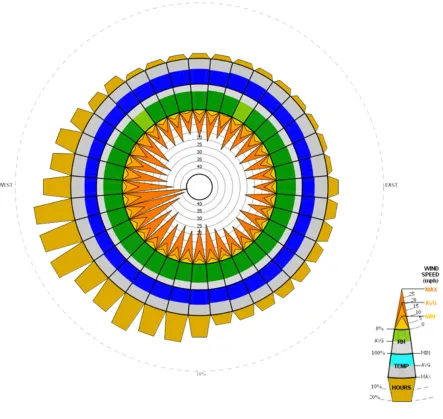
Urban Wind Turbines have been a subject of much speculation. However, constant research is underway to find ways to harvest wind energy. The location of the site is one of the best available in an urban location (other than perhaps atop skyscrapers) for installation of multi-directional wind turbines. This is so because of the proximity of the river which makes the overall area relatively open for an urban space. Additionally, the minimum required wind speed to produce energy through turbines is 8 mph1. As can be observed from the wind rose diagram this wind speed is achieved about 70% of the windy periods.
Mounting these atop a free-standing shear wall that exceeds the height of the existing building provides the desired effect - the symbolic and literal upliftment of progressive technology. Also, these arrays are
S
ustainability is perhaps the most progressive idea in the world today. It involves the conscious thought about future implications of decisions made today. It is a pre-requisite and an absolute necessity to think progressively when applying the concept of sustainability, be it environmental, economic or social. It is tantamount to the design parti of communication of progressive ideas.Thus throughout this project, thoughts of communication and sustainable development have been parallel to my consciousness. It is a task of much difficulty to separate design decisions into categories but some of the more obvious and evident sustainable design strategies are
Site Location - Urban infill & Infrastructure: Urban areas in America are well developed
and support the current need well, especially in a city like Rochester that is inclined towards downtown revitalization. Developing on existing infrastructure increases the usability of such resources, justifies future investments in a concentrated region and leads to a decrease in per capita resource consumption as well as carbon emissions.
LEED has introduced a whole new specialization based on Neighborhood Development. Living Building Challenge and Passivehaus too place a heavy emphasis in the form of pre-requisites towards sensible site selection. As mentioned above, an urban infill site is preferred for many reasons including the following:
1. It supports and benefits from surrounding density and diverse uses 2. Reduces parking footprint
3. Economic Development and robustness 4. Improved quality of life
Building Orientation and Climate Responsive Facades with Skylights : As can be seen from Figure 23 , the site is tightly defined by streets, river and right of ways on all sides. Rochester experiences more Heating Degree Days than it does Cooling Degree Days1. Thus solar exposure is
of utmost important. This is achieved through use of high performance glass with a high R- Value on the East, South and to a lesser extent, West facades (Refer to floor plans). Additionally when combined with thermal masses such as concrete floors these strategies are very helpful for energy conservation in Rochester.
A heavily transparent Western facade is not beneficial during the summer months. However the building function requires transparency. Thus vertical fins of tinted glass are used to cut the access of direct solar radiation during the summer month. This solution satisfies both the needs in a graceful manner.
1. Climate Consultant Software, UCLA Energy Design Tool. Web.
Wind Turbines: Urban locations are not considered to be the best locations for an investment into renewable energy sources that harvest wind energy. This is mostly due to the overall reduction in wind speed (due to building density) and the unpredictable wind directions. Additionally, there is concern of hurting human life due to the dynamic nature of wind turbines and they are feared to cause accidents when they break down.
These turbines are also mounted to a shear wall which hits the ground within the atrium space that serves as the main public entry to the building. This forges a more personal and deeper connection with the people thereby addressing the perception of sustainability through technology being out-of-reach. This has a very positive connotation and communicates the idea well. This phenomenon can be seen when people pay money to visit ice-cream factories or attend open-houses for processes (or products) of interest.
Green Roofs: Green roofs are an extremely potent sustainability strategy. They are comprised of native soil, seeds and vegetation. They have a huge bang-for-the-buck impact and are becoming more and more popular by the day. They are especially helpful in urban areas where environmental problems stem from the use of hard surfaces and reduction of green and open spaces. Green roofs provide the much needed “green” space atop roofs which help reduce not only the urban heat island effect but also problems stemming from rainwater runoff. Additionally they have great insulation properties and add to the thermal performance of the building shell. They also promote wildlife infiltration back into the urban environment by providing micro-habitats for rare spiders and beetles.
Socially Sustainable Approach to Planning: In the present day and age it is important to share the natural assets available to us and not confine them for the use of a few. Of course, this does not mean that the idea of ownership and economic development is faulty. It simply shows and encouragement of the equitable access and distribution of public spaces to the community.
T
he culmination of the literature research is this design project. To break down the exact moments when the research manifests itself into this process is next to impossible. The reason for this is that using architecture as communicating through the use of existing codes as conduit is amorphous. Additionally, the implication of design decisions which occur to the mind even for fleeting moments as lines are sketched on paper, have a strong impact on the end product.Having recognized that, I can find moments of communication that occur throughout the building design that support the desired denotations and connotations (albeit subjectively). Some of those are:
1. Wind Turbine Array- Denotes Clean Energy; Connotes Progressive thoughts: The turbines are obvious symbols of sustainable development and clean energy generation. In fact they are one of the two most commonly used ones even in regular communication (the other being solar cells). Thus the obvious denotation is that they are technological products that are used to harness energy from wind. The connotations to these are many but two of the strongest are - progressive technology thereby indicating advancement and open country (windmills from farms). Given the urban location and the smaller size, it is ways to see that the former connotation applies.
2. Upgrading the Existing (River Walk and Building)- Denotes renovation ; Connotes respect: Whenever building environments are upgraded, maintained or renovated they takes on a new “smell” which brings to mind construction and makes one immediately understand that the space is “new”. Similarly, when the community sees and experiences new and maintained public spaces a respect for the space and a feeling of pride and joy is
3. Spatial Organization - Denotes efficient system; Connotes openness and
collaboration: As has been mentioned earlier in this document, the architecture is a combination of form, function and context. The functional layout of the spaces (see figures 31 - 33) was analyzed and sketched from the first instance with the intention of making a welcoming statement to the public. At the same time the spatial organization needs to be as efficient as possible. This is achieved through many iterations of the floor plans. The end result, as can be seen from the traffic diagram, denotes efficiency and connotes openness, collaboration and invitation at the street level
4. Site Selection- Denotes efficient infrastructure, Connotes Hope and Faith: Why
Building Typology?
Every building has a typology. This is an extremely important part of the communication of meaning through a building. For example a bank’s facade when designed with pediments and majestic Greek columns communicates (and connotes) power and dignity. The original meaning communicated through this arrangement of specific building elements was actually religion and spirituality (Parthenon in Athens, Greece). So, not unlike language, meanings of signs change and evolve.
So what building elements and typology can be associated with a business incubator that serves many functions of mixed use spaces? In the present day and age, start-ups are utilizing a lot of industrial spaces and some people even recognize neighborhoods through this building typology as being inhabited by young artists, designers and entrepreneurs. This “feel” is retained in the building design by using raw and industrial materials with “low” finishes. Colors used are very vibrant and symbolic of playfulness. The use of glass in a manner not equivalent to either the traditional “office” or “civic” building is also creating a new typology.
Conclusion
T
he city of Rochester is at the verge of an evolution and break-through. The slightest nudge in the right direction will stimulate the economy in a way that it can potentially be restored to the previous glory when it was recognized as a “boom” town.Architecturehas a very public presence. The right combination of form, function and context can redefine an area’s image. This is especially true when the building’s communication is aligned to the architecture. Architect’s can impact this by adorning the required role(s) of psychologist, philosopher, anthropologist among many others, while thinking about the building design. Additionally, like language, the building can be decoded and encoded as desired to strengthen or weaken its communication.
Architecture as Communication | Priyanka Sondhi 98
Appendix 1 - Building Program
SPACE TOTAL AREA
sqft
Office Modules 21,000
Labs 15,000
Management Office / Security 20,000
Incubator Space (Including Restaurant
and Kitchen) 10,000
Restaurant + Kitchen space 5,000
La