This is a repository copy of Building Model-Driven Engineering Traceability.
White Rose Research Online URL for this paper:
http://eprints.whiterose.ac.uk/109242/
Version: Published Version
Proceedings Paper:
Paige, Richard Freeman orcid.org/0000-0002-1978-9852, Olsen, Gøran K, Kolovos,
Dimitris orcid.org/0000-0002-1724-6563 et al. (2 more authors) (2010) Building
Model-Driven Engineering Traceability. In: ECMDA Traceability Workshop (ECMDA-TW).
Sintef , p. 49.
[email protected] https://eprints.whiterose.ac.uk/ Reuse
Items deposited in White Rose Research Online are protected by copyright, with all rights reserved unless indicated otherwise. They may be downloaded and/or printed for private study, or other acts as permitted by national copyright laws. The publisher or other rights holders may allow further reproduction and re-use of the full text version. This is indicated by the licence information on the White Rose Research Online record for the item.
Takedown
If you consider content in White Rose Research Online to be in breach of UK law, please notify us by
Building Model-Driven Engineering Traceability
Classifications
Richard F. Paige, Gøran K. Olsen, Dimitrios S. Kolovos, Steffen Zschaler and Christopher Power
Department of Computer Science, University of York, UK. {paige, dkolovos, cpower}@cs.york.ac.uk SINTEF, Oslo, Norway. [email protected] TU Dresden, D-01062 Dresden, Germany. [email protected]
Abstract. Model-Driven Engineering involves the application of many
differ-ent model managemdiffer-ent operations, some automated, some manual. For devel-opers to stay in control of their models and codebase, trace information must be maintained by all model management operations. This leads to a large number of trace links, which themselves need to be managed, queried, and evaluated. Classifications of traceability and trace links are an essential capability required for understanding and managing trace links. We present a process for building traceability classifications for a variety of widely used and accepted operations (both automated and manual) and show the results of applying the process to a rich traceability context.
1. Introduction
Traceability is the ability to chronologically interrelate uniquely identifiable enti-ties in a way that matters. The IEEE Standard Glossary of Software Engineering Ter-minology [IEEE 2004] defines traceability as “the degree to which a relationship can
be established between two or more products of the development process, especially products having a predecessor-successor or master-subordinate relationship to one another; for example, the degree to which the requirements and design of a given software component match.” Thus, traceability refers to the capability for tracing
arte-facts along a set of chained operations, where these operations may be performed manually (e.g., crafting a software design for a set of software requirements) or with automated assistance (e.g., generating code from a set of abstract descriptions). In the context of Model Driven Engineering (MDE), many of the artefacts of interest are
models, conforming to a metamodel, and are constructed using a set of modelling
Generating and maintaining traceability information is important in order to help control the wealth of different artefacts in the development process: as systems come more complex, and as the application of MDE techniques within a process be-comes more in depth, the need for better management of MDE artefacts increases. Traceability helps us to understand the many dependencies that exist between MDE artefacts. If we are able to support end-to-end traceability—that is, between all arte-facts developed and generated in an MDE systems development process—then we can support a variety of different kinds of analysis; for example, showing that a re-quirement is fulfilled in implementation or showing that artefacts are up to date. In a realistic MDE context, it is likely that a large amount of traceability informa-tion will be generated or created; understanding and managing this informainforma-tion will therefore be challenging, and will require structure to be imposed in order to under-stand the most appropriate ways to manage it. Traceability information can be better understood and managed through the help of a traceability classification. Several classifications have been published (e.g., for requirements engineering) [Ramesh 2001, Limon 2005, Walderhaug 2006]; these vary from abstract, conceptual classifi-cations that help to systematise our understanding of the traceability problem domain, to concrete classifications (or traceability metamodels) that help to manage trace in-formation in an implementation. Our focus in this paper is on the process of building traceability classifications, and on using this to classify both manual and automated MDE operations, thus helping to enable the full vision of end-to-end traceability.
The structure of the rest of the paper is as follows. In Section 2 we briefly review related work. In Section 3 we sketch a simple process for building traceability classi-fications. In Section 4 we outline how we have applied the process to build a
trace-ability classification for the MODELPLEX1 project, encompassing both manual and
automated trace links.
2. Related Work
Different styles of traceability classifications have been presented in the literature. In particular, classifications given in terms of scenarios of use of traceability are postu-lated by [Olsen 2007, Walderhaug 2006]. Classifications in terms of specific domains have been produced by [Ramesh 2001] for requirements engineering, and for business applications [Rummler 2007].
Traceability classifications in MDE have been developed that emphasise different
attributes or characteristics of traceability. In particular, two categories of
classifica-tions can be identified in the literature: classificaclassifica-tions that focus on explicit trace links (which are captured directly in models themselves using a suitable concrete syntax), and implicit trace links where trace information is generated or arises due to applica-tion of one or more model management operaapplica-tions. The classificaapplica-tion we build in Section 4 includes both explicit and implicit trace links.
More generally, traceability has been identified as an important research issue. The European project AMPLE, focusing on Aspect-Oriented and Model-Driven product
line engineering aims to support traceability across software product lines [Rummler 2007]. The Grand Challenges in Traceability report [GCT 2006] identifies a number of challenges for managing and maintaining trace information, including evolution of trace information, trace link semantics, and eliciting trace knowledge.
Many trace tools have been developed for managing trace information. Some of the most well-known and widely used include Reqtify [ChiasTek 2007], RequisitePro [IBM 2007], and Acceleo Pro [Obeo 2007]. An approach to trace link generation has been presented by Egyed [Egyed 2003], who presents a trace tool that automatically derives traces from code through requirements. [Kolovos 2006] presents support for trace links where trace information is stored separate from the model; [Jouault 2005] outlines a loosely coupled trace scheme for model transformations.
3. A Traceability Classification Process
As suggested by the related work presented in Section 2, a number of traceability classifications have been presented, but there is little guidance yet on how to system-atically build and maintain them (ranging from conceptual models to concrete meta-models). A demonstrated process for building traceability classifications is useful for this, not only for building classifications in the first place, but for maintaining classi-fications as new MDE operations, new relationships between MDE artefacts, and new stakeholder requirements, arise. In order to support this, we first describe a very sim-ple process for building and maintaining traceability classifications, and then in the next section we use it to develop a classification for the stakeholder requirements of MODELPLEX.
The simple process is called the Traceability Elicitation and Analysis Process
(TEAP). It is derived from a process developed in [Chan 2005] for elicitation and
un-derstanding different forms of model-based contracts. The aim of TEAP is to elicit and analyse traceability relationships in order to determine how they fit into a trace-ability classification. While eliciting new tracetrace-ability relationships, we improve our understanding of the key attributes of these traceability relationships: the artefacts they involve, their semantics, and their domain of applicability.
When applying TEAP, we typically bootstrap from a simple traceability classifica-tion or metamodel, and iteratively and incrementally refine the classificaclassifica-tion through a number of TEAP cycles. Each cycle in the TEAP enriches the existing classification in terms of one or more key attributes of interest.
TEAP is a triggered process, in which there are three main activities in each itera-tion: Elicitation, Analysis, and Classification. In elicitation, we identify basic trace links and relationships. In the second phase, we extrapolate from these the key charac-teristics of traceability (based on our current understanding) and as a result of this analysis, identify constraints on relationships and any generalisations of relationships and trace links. In the third phase, we build a classification. From this, we can itera-tively enrich, refactor, and improve the classification, for example when customer requirements dictate.
useful in a variety of settings – however, it can and will be extended over the duration of MODELPLEX, and TEAP can be used to support this.
TEAP is derived from the spiral software development model, due to Boehm, and the spiral model in requirements engineering. The main difference is that TEAP pro-duces metamodels and classifications, rather than software or requirements. The ad-vantage of defining and using TEAP is that it gives extensibility to its product. This is essential in providing a generic, flexible framework for classifying and managing traceability. In other words, the traceability classification can be kept up-to-date by carrying out additional TEAP cycles.
As mentioned earlier, TEAP is a triggered process; we can identify when TEAP cycles should be executed. The triggers for executing TEAP cycles include:
• a new model management operation has been defined, in which case cycles
should be executed in order to refine the classification
• the system development process has changed; thus cycles should be executed
in order to refine how to handle sequences of model management operations.
• one or more modelling languages have changed to include new model
rela-tionships, artefacts, or changed model relarela-tionships, in which case cycles should be executed to refine and extend the explicit link classification.
• The existing classification does not capture all requirements for traceability
inherent in a domain or project context.
The TEAP process is meant to provide guidance, not to dictate the way in which the traceability classification must be extended and refined.
4. Example: Building the MODELPLEX Classification
In this section we outline how we used TEAP (from Section 3) to build a conceptual traceability classification for use in the MODELPLEX European project. We start with a very short overview of the traceability requirements for MODELPLEX, then summarise a few iterations of TEAP applied to these requirements.
4.1 MODELPLEX traceability requirements
MODELPLEX is a three-year integrated project funded by the European Commis-sion, with a mandate to improve productivity in the development of complex systems through use of MDE. The project is case-study driven, with four industrial partners - SAP, Telefonica, Western Geco, and Thales Information Systems - providing real complex system scenarios, to which MDE technology (e.g., architectural modelling, model transformation, performance analysis, simulation, model composition) is to be applied. Each case study has traceability requirements. These can be summarised as:
• the ability to record traceability information that results from applying model
management operations: model-to-model (M2M) transformations, model-to-text (M2T) transformations, compositions, simulations, and refinements;
• the ability to manually create trace links between MDE artefacts, e.g., between an
model. Manual creation of trace links can involve modelling tools, or the use of a textual domain-specific language tailored for one or more of the case studies;
• the ability to (typically manually) create trace links between MDE artefacts (e.g.,
models) and non-MDE artefacts (e.g., requirements stored in a MANTIS reposi-tory, PDF documents). This is a necessary requirement as some of the MODELPLEX partners do not currently use MDE technologies in their everyday practice; moreover, non-MDE artefacts will always play a substantial role in the MDE process, e.g., for early requirements elicitation and description.
• the ability to store and retrieve trace links and trace metadata from a repository.
We decided to initially produce a conceptual traceability classification that ad-dressed the basic information that needed to be recorded for the first three sets of re-quirements above. This would then be refined and implemented in a traceability tool, which also provided repository features.
4.2 Basis for TEAP iterations
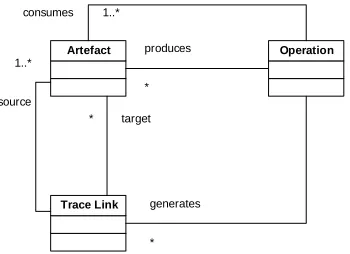
To apply TEAP, we initially constructed simple traceability infrastructure that would evolve over the TEAP iterations. This infrastructure is depicted in Fig. 1. It is, effec-tively, a very simple traceability metamodel that expresses the fundamental concepts of artefacts, trace links, and operations. We specialise this model in the following subsections. Artefacts may be both MDE artefacts (e.g., domain-specific models) and non-MDE artefacts (e.g., spreadsheets), and operations (either manual or automated) elaborate the traceability information to be recorded. Finally, the different kinds of trace links will be discussed in the following sections.
Artefact produces Operation
* consumes 1..*
Trace Link source
1..*
target *
generates
[image:6.595.207.382.455.582.2]*
Fig. 1: Basic traceability classification infrastructure
4.3 Adding explicit and implicit traceability relationships
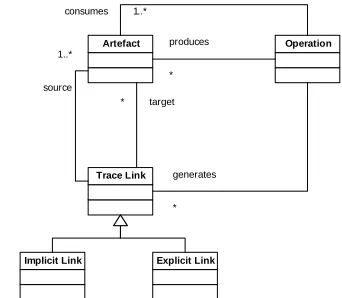
[image:7.595.197.368.292.441.2]We start to extend our simple traceability infrastructure by carrying out TEAP cycles. Our initial cycle was triggered by the obvious observation that the trace link model in Fig. 1 did not satisfy all MODELPLEX requirements for traceability. We thus carried out elicitation (what general kinds of trace links exist?), analysis (what information did these trace links require?), and built a simple classification. The cycle focused on the notions of implicit and explicit traceability. Implicit traceability involves trace links that are created and manipulated by application of MDE operations. Explicit traceability is defined in terms of trace links that are concretely represented in models. Therefore, our initial TEAP cycle was very simple and refines the traceability infra-structure to that shown in Fig. 2.
Artefact produces Operation
* consumes 1..*
Trace Link
source 1..*
target *
generates
*
Implicit Link Explicit Link
Fig. 2: Explicit and implicit trace link classification
4.4 Iterations for implicit trace link classification
The next cycle was triggered by two observations: the classification of implicit trace links was weak; and, by obtaining more precise requirements about the operations that were to be supported in MODELPLEX. We thus carried out a TEAP cycle for im-proving our classification of implicit trace links. As usual, there is elicitation (what kinds of MDE operations are relevant?), analysis (what information do operations require, and how should this information be constrained?), and classification.
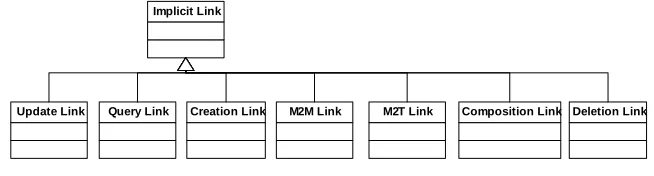
update (also called update-in-place), creation, deletion, model-to-text, and sequences
of operations. The resulting classification (focusing strictly on subclasses of Implicit Link from Fig. 2) is shown in Fig. 3. As well, new operations (subclasses of Opera-tion) are added for each, e.g., Query Operation, Delete Operation, etc.
Implicit Link
[image:8.595.132.459.197.285.2]Update Link Query Link Creation Link M2M Link M2T Link Composition Link Deletion Link
Fig. 3: Additions for implicit trace links
Examples of the well-formedness constraints elicited and produced in the analysis phase are shown below.
context QueryOperation inv:
self.consumes->forAll(a |
self.generates->exists(t | t.source->includes(a) and self.produces->includesAll( t.target )));
self.generates->forAll( t | t.oclIsTypeOf(QueryLink))
context CreationOperation inv:
self.consumes->isEmpty();
self.generates.target->includesAll(self.produces);
self.generates->forAll( t | t.oclIsTypeOf(CreationLink));
4.4 Iterations for explicit traceability relationships
We next carried out a TEAP cycle for improving our classification of explicit trace links. This cycle was triggered by refined MODELPLEX requirements for explicit representation of trace information in models and in domain-specific languages. Re-call that explicit trace links are explicitly defined between artefacts, using one or more languages. For example, a UML dependency constitutes a specific kind of explicit trace link. Obviously, there are many different kinds of explicit trace links, and many of them will be domain specific (and language specific). We illustrate the results of the TEAP process for MODELPLEX’s explicit trace links. As was the case for im-plicit trace links, we carry out elicitation (what kinds of exim-plicit trace links are rele-vant?), analysis (what information do these links require?), and classification.
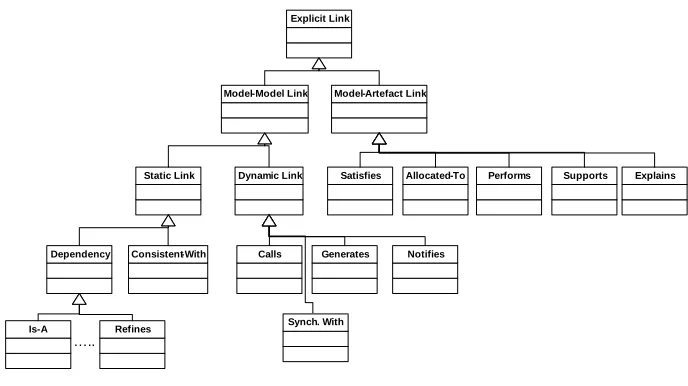
The initial elicitation and analysis identified two basic kinds of explicit trace links:
model-model links (e.g., the aforementioned UML dependency), and model-artefact
links (e.g., between a model and a spreadsheet). Trace links entirely between non-model artefacts were determined to be out of scope, and managed by other tools.
change over time. A variety of both static and dynamic links were collected from MODELPLEX’s requirements. Some examples of static model-model links are:
• consistent-with links, where two models must remain consistent with each
other, e.g., a sequence and class diagram.
• dependency links, where the structure and meaning of one model depends on a
second. Dependency links can be further subdivided into: is-a links (e.g., sub-typing), has-a links (e.g., references), part-of links, import and export links,
usage links (e.g., one component uses another’s services), refinement links
(e.g., where a component reduces non-determinism in a second component). Some examples of dynamic model-model links include: calls links (where one model calls behaviours provided by a second model), notifies links (where it is neces-sary to record information that cannot be handled automatically, such as changes that require human intervention). Furthermore, there are design-time relationships, such as
generates or builds links that indicate where information from one model is used to
produce or deduce the second model; and synchronized-with relationships, where be-haviours between models are synchronized. These usually apply when there is some kind of tracking mechanism introduced between models. A further example includes the consistent-with trace links that can exist between an early requirements specifica-tion such as those in i*, and models of funcspecifica-tional requirements [Alencar, 2000].
Model-artefact links are important in MODELPLEX, to support trace links
be-tween MDE artefacts (including UML models as well as domain-specific models) and non-MDE artefacts, particularly spreadsheets, requirements databases, and results of simulations. The scope of model-artefact links is broad, and we did not attempt to elicit all such links in our classification. We provide important links in MODELPLEX, while giving a classification that can be extended in the project.
The intent of most model-artefact links is to enable coverage checking, e.g., of re-quirements. This is the case in MODELPLEX. The trace links of interest in MODELPLEX were the following:
• satisfies links, to indicate that properties or requirements captured in an
arte-fact are satisfied by a model. Variants on satisfies links include verifies links (which involve a specific mechanism, such as testing) and certifies links (which also link to external standards and arguments for safety or security).
• allocated-to links, used when information in a non-model artefact is allocated
to a specific model that represents the information.
• performs links, indicating that a task described in an artefact is carried out by a
specified model
• explains and supports links, indicating that, e.g., a model is explained by a
non-model artefact (e.g., natural language documentation).
Explicit Link
Model-Artefact Link Model-Model Link
Static Link Dynamic Link Satisfies Allocated-To Performs Supports Explains
Dependency Consistent-With Calls
Synch. With
Notifies Generates
Is-A Refines
[image:10.595.123.467.146.339.2]…..
Fig. 4: Summary of explicit trace links
As this brief discussion suggests, the space of explicit trace links is rich and com-plicated, and encompasses many domain- and language-specific characteristics.
5. Conclusions
We have presented a lightweight process for building traceability classifications, and illustrated its application to a conceptual classification for the MODELPLEX process. The classification identifies basic categories of traceability – implicit and explicit – and populates these categories with trace links from different MDE operations (such as transformation and query) and from different modelling scenarios relevant to MODELPLEX. The classification developed above is a living document, and will be extended iteratively and incrementally over the course of the project. Furthermore, it will be refined from a conceptual classification to a concrete design that can be sup-ported in a trace tool that includes a repository and capabilities for retrieving, storing, and updating trace links.
TEAP has so far proved to be suitably lightweight, yet helpful in guiding the con-struction and the iterative improvement of traceability classifications. Since most, if not all, classifications must evolve with time, the value of an iterative and incremental process for evolving classifications is substantial.
Acknowledgments
This research has been co-funded by the European Commission within the 6th
References
[Alencar, 2000] F. Alencar, J. Castro, G. Cysneiros, J. Mylopoulos. From Early Re-quirements Modeled by the i* Technique to Later ReRe-quirements Modeled in Precise UML. In Proc. of Workshop de Engenharia de Requisitos 1ed. Brasil, Brazil, 2000.
[Aizenbud-Reshef 2005] N. Aizenbud-Reshef, R.F. Paige, J. Rubin, Y. Shaham-Gafni, and D.S. Kolovos. Operational semantics for traceability. In Proc Workshop on
Traceability 2005, Nuremberg, Germany, November 2005.
[Aizenbud-Reshef 2006] N. Aizenbud-Reshef, B. Nolan, J. Rubin, and Y. Shaham-Gafni. Model traceability. IBM Systems Journal 45(3), 2006: pp 515-526.
[Borland 2007] CaliberRM: http://www.borland.com.
[Chan 2005] Z.E. Chan and R.F. Paige. Designing a Domain-Specific Contract Lan-guage: a Metamodelling Approach, in Proc. EC-MDA 2005, LNCS 3748, Springer-Verlag, November 2005.
[Chiastek 2007] Chiastek, Reqtify: http://www.chiastek.com/products/reqtify.html
[Egyed 2003] A. Egyed, A Scenario-Driven Approach to Trace Dependency Analysis.
IEEE Transactions on Software Engineering, 2003. 29: p. 17.
[GCT 2006] Grand Challenges in Traceability, Center of Excellence for Traceability
http://www.traceabilitycenter.org/downloads/documents/GrandChallenges/
[IEEE 2004] IEEE Std 610.12-1990 IEEE Standard Glossary of Software Engineering Terminology, 2004.
[Jouault 2005] F. Jouault. Loosely Coupled Traceability for ATL. In Proc.
ECMDA-FA Workshop on Traceability, SINTEF Technical Report STF90, November 2005.
[Kolovos 2006c] D.S. Kolovos, R.F. Paige, and F.A.C. Polack On-Demand Merging of Traceability Links with Models. ECMDA 06 Traceability Workshop Bilbao, 2006.
[Limon 2005] A. Limon and J. Garbajosa. The Need for a Unifying Traceability Scheme. In Proc. Workshop on Traceability 2005, Nuremberg, November 2005.
[Obeo 2007] Acceleo Pro Traceability, http://www.acceleo.org
[Olsen 2007] G. Olsen and J. Oldevik. Scenarios of traceability in model to text trans-formations. In Proc. ECMDA-FA 2007, LNCS, Springer-Verlag, June 2007.