promoting access to White Rose research papers
Universities of Leeds, Sheffield and York
http://eprints.whiterose.ac.uk/
This is an author produced version of a paper published in Social Science & Medicine.
White Rose Research Online URL for this paper:
http://eprints.whiterose.ac.uk/43227/
Paper:
Prestwich, AJ, Ayres, K and Lawton, R (2008) Crossing two types of implementation intentions with a protection motivation intervention for the
reduction of saturated fat intake: A randomized trial. Social Science & Medicine, 67 (10). 1550 - 1558.
This is a preprint of an article whose final and definitive form has been published in Social Science & Medicine © [2008] [copyright Elsevier]. The final version of this manuscript is available at: http://dx.doi.org/10.1016/j.socscimed.2008.07.019
“Crossing two types of implementation intentions with a protection motivation intervention for the reduction of saturated fat intake: A
randomized trial”
Andrew Prestwich ([email protected]), Karen Ayres and Rebecca Lawton Institute of Psychological Sciences, University of Leeds, UK
Abstract
Implementation intentions, namely specific plans regarding when, where and how an individual will act, increase the likelihood of action. There is evidence that
implementation intentions should be particularly efficacious when combined with
Crossing two types of implementation intentions with a protection motivation
intervention for the reduction of saturated fat intake: A randomized trial
Consumption of bad fats (saturated fats, trans-fats) has been associated with increased risk of coronary heart disease (e.g., Hu, Stampfer, Rimm, Ascherio, Rosner, Spiegelman et al.; Willett, Stampfer, Manson, Colditz, Speizer, Rosner et al., 1993) and there has been widespread call for their intake to be restricted (e.g., Institute of Medicine, 2002). When young people join university, or begin a new career, they are often leaving the family environment for the first time and begin to take greater responsibility for purchasing and preparing their own meals. As such, targeting food intake within students and other young professionals is an important issue. By establishing healthy eating habits early, in this period of relative independence, the health benefits are maximized.
Behaviour change strategies need to be theoretically informed (e.g., Marteau, Dieppe, Foy, Kinmonth, & Schneiderman, 2006; Michie, Sheeran, & Rothman, 2007) to aid the identification of key variables that should be targeted by intervention and to allow an understanding of the mechanisms of change.
Past research has found that changing behaviour is difficult, and changing undesirable behaviour is the most difficult of all. This study used Protection Motivation Theory (Rogers, 1983) to help identify motivation as one source of the problem and to create a motivational message (for a review of interventions based on this theory, see Milne, Sheeran & Orbell, 2000) concerned with reducing saturated fat intake. However, improving motivation is not always sufficient to create large changes in behaviour (see Webb & Sheeran, 2006). This study, therefore, also incorporated implementation
and how they act. There is some evidence that combining motivational interventions with implementation intentions leads to more pronounced increases in the promotion of
healthy behaviours than using either strategy alone (e.g., Prestwich, Lawton, & Conner, 2003). The present study is the first to combine these two types of intervention for the reduction of unhealthy behaviour. It also tests whether a new version of implementation intentions, called reasoning implementation intentions, can be effective without an additional (motivation-based) intervention.
Protection Motivation Theory
Communications based on Protection Motivation Theory (Rogers, 1983) typically involve a threat to one‟s well-being, such as highlighting the risk of a particular illness
(e.g., coronary heart disease; assessed through perceived vulnerability, perceived severity and fear items), and information about a means to cope with such threat (e.g., avoid high fat foods; assessed through items measuring response efficacy, self-efficacy and response costs). An individual‟s appraisal of the threat and their evaluation of the recommended coping response influence one‟s intention to engage in the precautionary behaviour. This theory was selected as it lends itself to simple, theoretically-framed message-based interventions that have been shown to be effective in changing intentions (see Milne et al., 2000, for a review).
Implementation Intentions
It has long been argued that a person‟s intentions represent a direct precursor to
behaviour, and this has been reflected in a variety of models including Protection Motivation Theory. According to a recent review by Webb and Sheeran (2006),
change in behaviour (d = .36). Thus, even if one successfully changes a person‟s intentions towards avoiding foods that are high in saturated fat (and this change is medium to large) one should expect a smaller change in actual behaviour. This is supported by evidence that manipulating Protection Motivation Theory variables has greater impact on intentions than behaviour (see Milne et al., 2000). In order to generate more pronounced behaviour change, intentions must be successfully translated into action.
According to Sheeran, Milne, Webb, and Gollwitzer (2005), failing to articulate one‟s intentions (e.g., to avoid foods that are high in saturated fat) along with how (e.g.,
avoiding the chocolate, cheese and crisps aisles in supermarkets), when and where (e.g., every time one enters a supermarket) one can implement intentions, contributes to intention-behaviour discrepancies. Gollwitzer‟s (1993) implementation intentions deal directly with this issue by requiring individuals to decide in advance of action, when and where they will act.
Gollwitzer and Sheeran‟s (2006) meta-analysis, incorporating 94 independent
tests of implementation intention effects, showed an overall medium-to-large effect on goal achievement. It also provided some evidence that implementation intentions can change dietary behaviours. However, in the dietary studies, the intervention periods have been a week or less (e.g., Bamberg, 2002; Verplanken & Faes, 1999) and/or generated weak effects (e.g., Armitage, 2004; Bamberg, 2002). Moreover, within Gollwitzer and Sheeran‟s meta-analysis, only two of the published studies were concerned with the
Whether implementation intentions can reduce saturated fat intake is thus an unresolved issue.
There is theoretical (e.g., Model of Action Phases, Gollwitzer, 1990) and empirical evidence that combining motivational and implementation intention (or
planning)-based interventions should yield greater changes in behaviour than using either strategy alone. However, much of the empirical evidence is either fully (e.g., Abraham, Sheeran, Norman, Conner, De Vries & Otten, 1999; Jones, Abraham, Harris, Schulz & Chrispin, 2001; Norman & Conner, 2005; Wiedemann, Schüz, Sniehotta, Scholz & Schwarzer, in press) or partly (Sheeran, Webb, & Gollwitzer, 2005) correlational making causal inferences difficult. Few studies have directly manipulated both motivation and implementation intention use. Although the evidence suggests that combining both types of interventions promotes greater behaviour change (Milne, Orbell, & Sheeran, 2002; Prestwich, Lawton, & Conner, 2003; Sheeran, Milne et al., 2005), the goal has been to promote desirable behaviours rather than reduce undesirable behaviours. Therefore the overall objective of the present study was to manipulate motivation and implementation intentions to reduce unhealthy behaviour.
Reasoning Implementation Intentions
In addition to the standard implementation intentions, activating supportive cognitions in critical situations should help one to avoid performing the unhealthy behaviour. We term this new form of planning, reasoning implementation intentions. Specifically, they associate the critical situation with a reason that supports one‟s action (rather than the behaviour directly). As the strategy attempts to generate positive
strength of one‟s initial motivation. Additionally, this strategy might take advantage of
evidence that the self can be a powerful source of persuasion (cf. Nicholson, 2007) and combine the personalised advantages of tailoring and the efficiency of minimal
interventions. Consequently, in addition to the standard implementation intention, a reasoning implementation intention was manipulated in one group of participants to examine its effect on saturated fat intake.
Hypotheses
The following hypotheses were tested:
Hypothesis 1. Saturated fat intake will be reduced significantly more for the participants exposed to the protection motivation message than those not so exposed.
Hypothesis 2. Saturated fat will be reduced significantly more for the participants asked to form standard implementation intentions than those who were not asked to form implementation intentions.
Hypothesis 3. Standard implementation intentions will reduce saturated fat intake significantly more for those who read the protection motivation message than those who did not read the message.
Hypothesis 4. Saturated fat will be reduced significantly more for participants asked to form reasoning implementation intentions than those who did not form implementation intentions.
In the absence of studies comparing the efficacy of different types of implementation intentions, it was predicted that:
Hypothesis 6. Reasoning implementation intentions will reduce saturated fat intake equally for those who read the protection motivation message and those who did not read the message.
Methods
Recruitment
The study was conducted between February 2005 and December 2006 and employed three main waves of recruitment (February 2005-April, 2005; February, 2006-March, 2006; November, 2006-December, 2006), two methods of recruitment (email:
n=130, verbal advert within a lecture or workplace: n=80), three sites in the UK (Essex University: n=173; Leeds University: n=20; travel agency in Manchester: n=17); participants completed the measures either inside (n=93) or outside (n=117) the
laboratory. The sub-sample of young professionals (travel agents) enhances, albeit to a small extent, the generalisability of the study findings. There were no exclusion criteria. Participants were entered into a prize draw or received course credit.
Prior to recruitment, all participants were informed verbally (or in writing for those participants recruited via email), by one of the three authors, that the study
concerned people‟s healthy eating attitudes and behaviours. After recruitment, within the baseline questionnaire, participants were informed that the study concerned people‟s
fat, and given examples of foods high in saturated fat.Similar information was also presented at the beginning of the 1-month follow-up questionnaire.
Sample
Required sample sizes were calculated a-priori to detect a moderate sized
interaction effect at p < .05, with 80% power, allowing 25% drop-out. Two hundred and ten volunteers (191 students, 19 non-students; 50 men, 160 women; mean age=22.20 years, SD=5.68 years), therefore, were recruited following ethical approval.
Randomization
Participants were randomized to one of six groups based on a 3 (implementation intention: standard, reasoning, none) x 2 (protection motivation manipulation: yes/no) design and completed measures of food intake at baseline and 1-month follow-up. Those participants responding to the verbal advert were randomly allocated to condition via random distribution of questionnaires within a lecture or the workplace; those recruited via email were allocated to condition using a computer-generated randomization list. In each case, there was no restriction in who was allocated to each condition. The same person generated the allocation sequence (this applied to those completing the measures in the laboratory only; there was no allocation sequence for the lecture-based
Those administering the test were not optimally blinded to condition (e.g., by using sealed envelopes), thus there was some risk of bias. However, the method of distribution, particularly through random distribution of visually similar questionnaires within a lecture hall or workplace, made such bias less probable. Furthermore, the method of distribution (plus period of recruitment, method of recruitment and study site) did not moderate any of the effects of the interventions and thus these factors are not discussed further. To minimize the risk of contaminating the experimental manipulations, the need to refrain from communicating with other people about the study was stressed to all participants. Participants (by not discussing the trial with others), the person entering the data (by receiving only the dependent measures), and the data analyst (by receiving information regarding the study groups coded by number rather than name), were blinded to condition.
Manipulations (Interventions)
The control group received no messages.
The group receiving both protection motivation and standard or reasoning
implementation intention manipulations received the protection motivation manipulation first. Each manipulation was delivered to the participants as written material within the baseline questionnaire after the measure of food intake. The interventions were thus delivered indirectly (i.e. not face-to-face), individually, did not require training or
Protection Motivation. After completing a baseline measure of food intake, approximately half of the participants were exposed to the protection motivation manipulation. This was a threatening message concerned with severity of the
consequences of saturated fat intake and messages to increase response efficacy. For example, the information „When they (the arteries) become so narrow, coronary heart
disease (CHD) occurs and it can cause angina, which results in severe pain and distress and an inability to walk for even short distances‟ was some of the information used to manipulate perceived severity, while the statement, „Preventative action can be taken and the earlier in life it starts, the quicker the process of atherosclerosis will halt, and the lower the risk of CHD will be; reducing the intake of saturated fat has been shown to prevent CHD by decreasing the levels of cholesterol and fat in the bloodstream and lowering blood pressure‟was designed to increase response efficacy.1
Standard Implementation Intention. Participants in this condition were exposed to a manipulation, within a questionnaire, asking them to form a plan to help them to avoid buying foods that are high in saturated fat. They were informed that their plan should take the form: IF (I‟m in situation X) THEN (I will) NOT (do Y)- so that it a)
To aid fidelity, participants were then given a checklist of questions, requiring a yes or no response to ensure that their plans were sufficient („Does your plan identify all
of the situations in which you might buy foods that are high in saturated fat over the next month?‟) and accurately formed (e.g., „Do your plan(s) identify what you will do in the
situation so that you do NOT buy foods that are high in saturated fat?). They were asked to write further plans if they responded „no‟ to any of these questions.
Reasoning Implementation Intention. This manipulation was identical to the standard implementation intention manipulation with the following exceptions. First, the participants in this condition were informed that their plan should take the form: IF (I‟m in situation X) THEN I WILL SAY TO MYSELF (Y so that I do not buy foods that are high in saturated fat.). Second, after identifying the risky situations, they had to identify what they would say to themselves to motivate them not to buy foods that are high in saturated fat. Third, they were presented with different examples of suitable plans (e.g., „IF I‟m in the supermarket and tempted to buy a food that is high in saturated fat THEN I
WILL SAY TO MYSELF I don‟t want to die of a heart attack‟). As with the standard manipulation, participants in this condition were presented with a checklist of questions pertaining to the sufficiency of their plans, and space to write additional plans, if
necessary.
Measurement of Outcomes
Those participating within the laboratory did so in individual cubicles.
Participants who received the study materials in the lecture room were asked to complete the materials individually in their own time in a quiet location of their choice.
1-month follow-up. Some motivational measures (perceived severity, perceived
vulnerability, fear, and response efficacy) were assessed immediately after the protection motivation manipulation, and the remaining motivational measures (response costs, self-efficacy and intentions) were assessed immediately after the implementation intention manipulation, as manipulation checks.
Primary Outcome Measure. A validated self-report index of food intake (Margetts, Cade & Osmond, 1989) was used to measure saturated fat intake. The scale requires
participants to rate the frequency that they consumed 63 common foods over the previous month using a 6-point scale (two or more times per day; everyday; three to five times per week; one to two times per week; one to three times per month; rarely or never). The scale has good test-retest reliability (r(411)=.61; Armitage & Conner, 1999), convergent validity with 24-hour dietary records (e.g., Margetts et al., 1989) and 10-day weighed records (Thompson & Margetts, 1993), and construct validity (Armitage & Conner, 2001). Based on their responses to the 63 foods, a range of dietary scores were generated (Armitage, 2004)2. The proportion of energy from saturated fat intake wasthe primary outcome calculated at baseline and 1-month follow-up. It was calculated based on 1g
saturated fat providing 9kcal and using the following formula: grams of saturated fat x 900 / kcal derived from food.
Secondary Outcome Measures. Each psychological construct relevant to
reflect the behaviour (not buy foods that are high in saturated fat) and time frame (one month) in this study (rather than exercise and 1-week). Alphas are reported in Table 2.
Statistical Methods
Missing cells within the food intake measure at time 2 were replaced with
responses to equivalent items at time 1, and vice versa (i.e. treated as having no change), and the analyses are reported on this basis. Missing data were also treated using two alternative methods (replacing all missing values with the value 6- to denote rare/no consumption of the food; or leaving missing data blank). The results (and thus the conclusions) did not vary significantly according to the method of treating missing data.
ANOVAs examined differences between those completing the study and those who did not, baseline differences between the six conditions and the separate effects of the protection motivation and implementation intention manipulations on secondary outcomes. Chi-square compared the proportion of men and women randomly allocated to condition. ANCOVA tested the effects of the interventions on reducing the proportion of food energy derived from saturated fat during the intervention period, using as between-subjects variables implementation intention type (none, reasoning, standard
implementation intention) and protection motivation (yes, no), and the proportion of food energy derived from saturated fat at baseline as the covariate. Effect sizes d are also provided. The data are analysed on an intention-to-treat basis.
Results
There was no investigator-determined exclusion of participants through
participants deviated from the protocol. For example, 10 identified risky situations and stated that they would avoid high saturated fat foods but not specifically how they would do this. Thirty-six participants were lost to follow-up. There were no differences between those who dropped out of the study and those who did not on, total energy intake (F = .78), the proportion of food energy derived from saturated fat (F = .00), age (F = 1.50), fear (F = .09), or the protection motivation variables (response efficacy: F = 1.32;
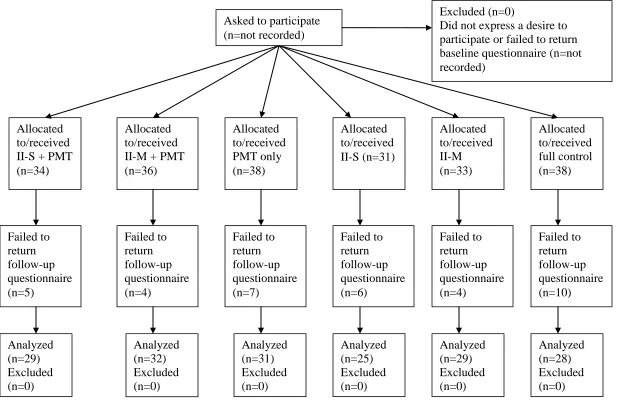
perceived severity items: both F < .07; response cost items: both F < 1.64; self-efficacy: F = .06; intention: F = .94, all p > .20). An exception was a trend for participants with lower perceived vulnerability to be more likely to dropout (F = 3.93, p = .05). The flow of the participants through each stage of the study is illustrated in Figure 1. Two-tailed p values are reported throughout.
Insert Figure 1 about here
Baseline characteristics of the sample
The baseline characteristics of the sample are summarized in Table 1. Across the six conditions at baseline, there were no significant differences in the proportion of food energy intake from saturated fat (F = 1.07), total energy intake (F = 1.09), age (F = 0.99), at baseline (all p > .36), proportion of men and women, χ2(5)=5.49, p = .36, or the
proportion of participants being entered into the prize draw or receiving course credit, χ2
(5)=1.29, p = .94.
Insert Table 1 about here
The protection motivation manipulation significantly increased most of the motivational variables expected to change as a result of the motivation manipulation (see Table 2).
Insert Table 2 about here
Change in energy intake from saturated fats
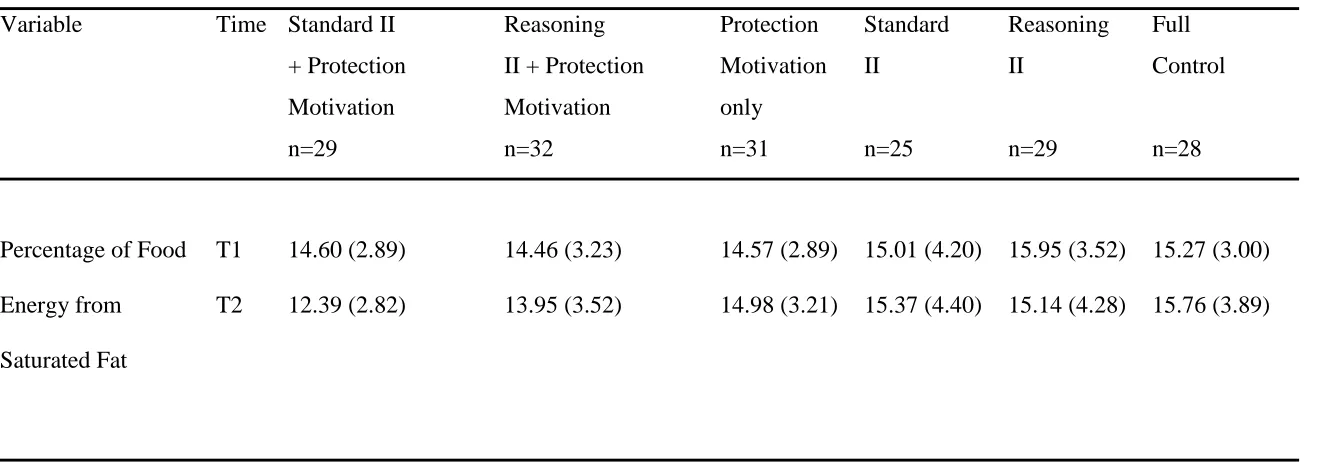
As shown in Table 3, those in the no-intervention control (mean change in the proportion of food energy intake derived from saturated fat +0.49%), protection motivation message only (+0.41%) and standard implementation intentions (no
protection motivation message) (+0.36%) conditions each reported deriving more food energy from saturated fat at follow up than baseline. Those asked to form reasoning implementation intentions, regardless of whether they received the protection motivation message (-0.51%) or not (-0.81%), reported a reduction in the proportion of food energy derived from saturated fat. Those forming standard implementation intentions after reading the protection motivation message reported the greatest reduction (-2.21%). The results of the ANCOVAs comparing the various interventions are summarized in Table 4.
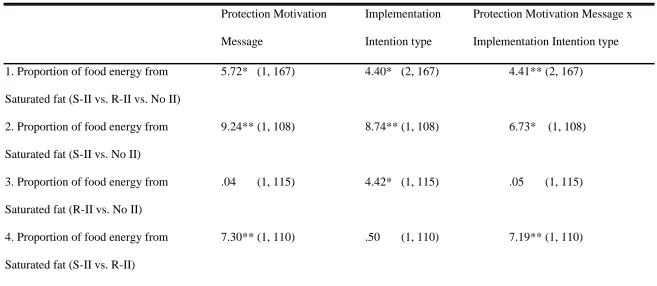
Insert Tables 3 and 4 about here
Hypotheses 1, 2, 4, 5: Reduction in fat intake after protection motivation message
and standard and reasoning implementation intentions.
The main effects of implementation intention type (ANCOVA 2-3) showed that those who were asked to form reasoning implementation intentions consumed
proportionally less saturated fat than those not asked to form implementation intentions (p = .04; d = .28); and those asked to form standard implementation intentions derived a significantly smaller proportion of food energy from saturated fat than those not asked to form implementation intentions (p = .004; d = .40). Hypotheses 2 and 4 were, therefore accepted. Hypothesis 5 was also accepted as the efficacy of the standard and reasoning implementation intentions did not differ (when exposure to the protection motivation message was controlled (p = .48; d = .10).
Hypotheses 3 & 6: Did the efficacy of the implementation intention manipulations
vary depending on whether they were paired with a motivational intervention, or not?
The significant two-way interaction in ANCOVA 1 showed that the efficacy of one of the implementation intention groups (standard, reasoning, or no implementation intention group) varied depending on whether or not they were asked to read the protection motivation message. The significant two-way interactions in ANCOVAs 2 (p=.01; d = .35) and 4 (p=.008; d = .36) revealed that the effects of standard
Secondary Outcomes
The implementation intention manipulation (standard, reasoning none) had no effect on intentions, F(2, 206)=1.84, p=.16, self-efficacy, F(2, 206)=0.13, p=.88, or response costs (item1: F(2, 206)=2.35, p=.10; item 2: F(2, 206)=1.04, p=.36). This indicates that the effects of the implementation intention strategies cannot be attributed to a within-session increase in motivation.
Discussion
The research findings show that combining standard implementation intentions and protection motivation manipulations was more effective in reducing saturated fat than manipulating either alone. Standard implementation intentions were ineffective without the protection motivation manipulation. The study also tested a new form of implementation intentions in which participants provided the reasons for their intention. This new variant of implementation intentions had a small, albeit significant, effect on reducing saturated fat intake. Its effects on saturated fat intake did not vary as a function of the protection motivation manipulation.
more predictive of behaviour when an individual has formed a concrete plan of action or implementation intention (e.g., Norman & Conner, 2005). It is also in line with
experimental work that has manipulated both motivation and implementation intentions (e.g., Prestwich et al., 2003). The study reported here is the first attempt to focus on combining implementation intentions with motivational manipulations for the reduction
of unhealthy behaviour rather than the promotion of desired behaviours. Failing to adopt such a combined approach might explain the weak effects of implementation intentions in previous diet studies (e.g., Armitage, 2004; Bamberg, 2002).
The research also presented initial evidence that reasoning implementation intentions can be successful in changing behaviour. They make salient one‟s reasons for (not) performing a particular action in a specific context rather than their behaviour (e.g., avoiding unhealthy foods) directly. Reasoning implementation intentions were
significantly more efficacious in reducing the proportion of food energy derived from saturated fat than having no implementation intentions, and their impact was not moderated by the protection motivation message. Explanations for the added effect of reasoning might entail generating motivation, or cueing intentions, within critical situations (e.g., when people are at risk of purchasing high-fat foods). People should become less likely to forget their intention and/or for it to be re-prioritized behind
competing goals. Dealing with issues related to forgetting or goal conflict should enhance the relationship between intentions and behaviour (Sheeran, Milne et al., 2005).
form implementation intentions), this figure should be put into context. A 1% reduction in the proportion of food intake from fats, when applied at a population level, could result in 10,000 lives saved in the US alone (cf. Armitage & Conner, 2001).
It is not known at this stage, however, how easily this intervention can be
employed for public health benefits as participants in our study were required to complete measures of cognitions (and received some sort of incentive- entry into a prize draw or course credit). The measurement and incentive effects (e.g., Greenwald, Carnot, Beach, & Young, 1987) could contribute (interactively) to the intervention effect, although it does not undermine that there were additional benefits of the interventions over the control group. Furthermore, given the size of the statistical effects obtained by the
reasoning implementation intention conditions, and that this represents the first test of the strategy, additional research is needed to establish their efficacy and to further examine whether its success varies depending on whether they are combined with a motivational intervention or not. There are other reasons why the findings from this research should be treated with some degree of caution.
require self-control (such as avoiding smoking) as self-control can be viewed as a limited resource (Baumeister, Bratlavsky, Muraven & Tice, 1998). Finally, the study was
powered to detect significant effects rather than to make strong conclusions regarding null effects. Consequently, the non-significant effects reported in this study (e.g., the lack of difference in the proportion of energy derived from saturated fat between standard and reasoning implementation intentions overall) should be treated with caution.
In summary, the study provides further evidence that standard implementation intention interventions should be paired with motivational techniques in order to maximise their efficacy. Participants asked to form standard implementation intentions targeted directly at behaviour change were successful in reducing the proportion of food energy derived from saturated fat only when they also read the protection motivation message. It also provides initial evidence that alternative implementation intentions targeting motivation can be similarly effective but their impact might not be dependent on the baseline strength of one‟s intentions.
References
Abraham, C., Sheeran, P., Norman, P., Conner, M., De Vries, N., & Otten, W. (1999). When good intentions are not enough: Modeling postdecisional cognitive
correlates of condom use. Journal of Applied Social Psychology, 29, 2591-2612. Armitage, C.J. (2004). Evidence that implementation intentions reduce dietary fat
Armitage, C.J., & Conner, M. (1999).The theory of planned behaviour: Assessment of predictive validity and “perceived control”. British Journal of Social Psychology,
38, 35-54.
Armitage, C.J. & Conner, M. (2001). Efficacy of a minimal intervention to reduce fat intake. Social Science & Medicine, 52, 1517-1524.
Bamberg, S. (2002). Implementation intentions versus monetary incentive comparing the effects of interventions to promote the purchase of organically produced food.
Journal of Economic Psychology, 23, 573-587.
Baumeister, R. F., Bratlavsky, E., Muraven, M., & Tice, D. M. (1998). Ego-depletion: Is the active self a limited resource? Journal of Personality and Social Psychology,
74, 1252-1265.
Gollwitzer, P.M. (1990). Action phases and mindsets. In E.T. Higgins and J.R. Sorrentino (Eds.), The handbook of motivation and cognition (Vol. 2, pp. 53-92). New York: Guilford.
Gollwitzer, P.M. (1993). Goal achievement: The role of intentions. In W. Stroebe and M. Hewstone (Eds.), European Review of Social Psychology, 4, 141-185. Chichester, England: Wiley.
Gollwitzer, P.M., & Sheeran, P. (2006). Implementation intentions and goal achievement: A meta-analysis of effects and processes. Advances in Experimental Social Psychology, 38, 249-268.
Greenwald, A.G., Carnot, C.G., Beach, R., & Young, B. (1987). Increasing voting behavior by asking people if they expect to vote. Journal of Applied Psychology,
Higgins, A., & Conner, M.T. (2003). Understanding adolescent smoking: The role of the Theory of Planned Behaviour and implementation intentions. Psychology, Health & Medicine, 8, 173-186.
Hu, F.B., Stampfer, M.J., Rimm, E., Ascherio, A., Rosner, B., Spiegelman, D., & Willett, W. (1999). Dietary fat and coronary heart disease: A comparison of approaches for adjusting for total energy intake and modeling repeated dietary measurements.
American Journal of Epidemiology, 149, 531-540.
Institute of Medicine (2002). Dietary reference intakes for energy, carbohydrates, fiber, fat, fatty acids, cholesterol, protein, and amino acids. Washington, DC: National Academies Press.
Jones, F., Abraham, C., Harris, P., Schulz, J., & Chrispin, C. (2001). From knowledge to action regulation: Modelling the cognitive prerequisites of sun screen use in Australian and UK samples. Psychology & Health, 16, 191-206.
Margetts, B. M., Cade, J. E., & Osmond, C. (1989). Comparison of a food frequency questionnaire with a diet record. International Journal of Epidemiology, 18, 868-873.
Marteau, T., Dieppe, P., Foy, R., Kinmonth, A., & Schneiderman, N. (2006). Behavioural medicine: Changing our behaviour. British Medical Journal, 332, 437-438. Michie, S., Sheeran, P., & Rothman, A. (2007). Advancing the science of behaviour
change. Invited editorial. Psychology & Health, 22, 249-253.
Milne, S., Sheeran, P., & Orbell, S. (2000). Prediction and intervention in health-related behaviour: A meta-analytic review of protection motivation theory. Journal of Applied Social Psychology, 30, 106-143.
Murgraff, V., White, D., & Phillips, K. (1996). Moderating binge drinking: It is possible to change behaviour if you plan it in advance. Alcohol & Alcoholism, 31, 577-582.
Nicholson, C. (2007). Framing Science: Advances in theory and technology are fueling a new era in the science of persuasion. APS Observer, 20, 17-21.
Norman, P. & Conner, M. (2005). The theory of planned behavior and exercise: Evidence for the mediating and moderating roles of planning on intention-behavior
relationships. Journal of Sport & Exercise Psychology, 27, 488-504.
Orbell, S., & Sheeran, P. (1998). Inclined abstainers: A problem for predicting health-related behaviour. British Journal of Social Psychology, 37, 151-165.
Prestwich, A., Lawton, R.J., & Conner, M.T. (2003). The use of implementation intentions and the decision balance sheet in promoting exercise behavior.
Psychology & Health, 18, 707-721.
Rogers, R.W. (1983). Cognitive and physiological processes in fear appeals and attitude change: A revised theory of protection motivation. In J. Cacioppo & R. Petty (Eds.), Social Psychophysiology. New York: Guilford Press.
Sheeran, P., Webb, T.L. & Gollwitzer, P.M. (2005). The interplay between goal intentions and implementation intentions. Personality and Social Psychology Bulletin, 31, 87-98.
Thompson, R.L., & Margetts, B.L. (1993). Comparison of a food frequency questionnaire with a 10-day weighed record in cigarette smokers. International Journal of Epidemiology, 22, 824-833.
Verplanken, B. & Faes, S. (1999). Good intentions, bad habits, and effects of forming implementation intentions on healthy eating. European Journal of Social Psychology, 29, 591-604.
Webb, T.L., & Sheeran, P. (2006). Does changing behavioral intentions engender behavior change? A meta-analysis of the experimental evidence. Psychological Bulletin, 132, 249-268.
Wiedemann, A.U., Schüz, B., Sniehotta, F.F., Scholz, U., & Schwarzer, R. (in press). Disentangling the Relation between Intentions, Planning, and Behavior: A Moderated Mediation Analysis. Psychology & Health.
Willett, W.C., Stampfer, M.J., Manson, J.E., Colditz, G.A., Speizer, F.E., Rosner, B.A. et al. (1993). Intake of trans fatty acids and risk of coronary heart disease among women. Lancet, 341, 581-585.
Endnotes
1
2
We would like to thank Chris Armitage for providing this syntax file.
3
Effect size d was calculated using the formula: d=2√((F(1-ρ2)(dfw-1)) / (N(dfw -2)), where ρ (.693) represents the correlation between the baseline and follow up
dependent variable scores and dfw represents the residual df. 4
In relation to multiplicity, similar effects emerged on the proportion of food energy derived from saturated fat measure using equivalent analyses (i.e. three-way implementation intention x protection motivation message x time ANOVAs). In addition, although we had a single primary outcome, it is possible to generate a measure
representing the proportion of energy derived from overall fat intake. Additional ANCOVAs on this measure revealed similar effects. Specifically, a main effect of implementation intention type (II-S; II-M; No II), F(2, 167)=5.05, p=.007, and an implementation intention type x protection motivation message interaction, F(2, 167)=4.56, p=.01, emerged. Follow-up ANCOVAs revealed that II-M showed a
marginally greater reduction in the proportion of food energy derived from fat compared to the controls, F(1, 115)=3.33, p=.07, while the II-S showed significant benefit over the controls, F(1, 108)=11.44, p=.001. Again, the efficacy of II-S was dependent on its pairing with the protection motivation message (with message: F(1, 57)=22.06, p<.0005; without message: F(1, 50)=0.08, p=.78).
5
Table 1: Mean (SD) of Baseline Characteristics of the Sample Across Implementation Intention and Protection Motivation conditions
Variable Standard II Reasoning Protection Standard Reasoning Full
+ Protection II + Protection Motivation II II Control
Motivation Motivation only
n=34 n=36 n=38 n=31 n=33 n=38
Age 23.29 (7.88) 20.47 (3.46) 22.74 (5.74) 22.13 (5.71) 22.39 (4.99) 22.18 (5.53) Total food energy intake
(kcal) 1720 (699) 1747 (726) 1672 (583) 1569 (407) 1599 (603) 1875 (671) Percentage of food energy
from saturated fat 14.60 (3.01) 14.49 (3.22) 14.58 (2.70) 14.77 (4.16) 15.90 (3.53) 15.47 (3.18)
Number of men/women 8/26 4/32 9/29 7/24 11/22 11/27
Table 2: Means (SD) of Motivation variables across groups and associated univariate F tests (N = 2085)
Protection Motivation No Protection Motivation F Estimated CI95
Message (n=106) Message (n=102) Between-group
____________________________________________________________________________________difference_______________
Intention (α=.88) 4.92 (1.46) 4.50 (1.56) 4.02* .42 .01-.83
Self-efficacy (α=.85) 4.97 (1.44) 4.69 (1.74) 1.67 .29 -.15-.72
Fear (α=.95) 5.06 (1.32) 4.63 (1.44) 5.21* .44 .06-.81
Perceived Severity (α=.08)
Item 1 5.69 (1.82) 5.06 (1.87) 6.07* .63 .13-1.13
Item 2 5.77 (1.28) 5.46 (1.38) 2.88 .31 -.05-.68
Perceived 3.93 (1.15) 3.55 (1.23) 5.28* .38 .05-.71
Vulnerability (α=.73)
Response efficacy (α=.71) 6.16 (0.90) 5.62 (1.13) 14.68** .54 .26-.82
Response costs (α=.38)
Item 1 5.72 (1.27) 5.32 (1.48) 4.25* .39 .02-.77
Item 2 5.18 (1.58) 5.25 (1.60) 0.09 .07 -.50-.37
Table 3: Pre- and Post-Intervention Primary Outcome Means (SD)
Variable Time Standard II Reasoning Protection Standard Reasoning Full + Protection II + Protection Motivation II II Control
Motivation Motivation only
n=29 n=32 n=31 n=25 n=29 n=28
Percentage of Food T1 14.60 (2.89) 14.46 (3.23) 14.57 (2.89) 15.01 (4.20) 15.95 (3.52) 15.27 (3.00) Energy from T2 12.39 (2.82) 13.95 (3.52) 14.98 (3.21) 15.37 (4.40) 15.14 (4.28) 15.76 (3.89) Saturated Fat
Table 4: ANCOVA F-values (df) comparing the proportion of food energy derived from saturated fat at follow-up across implementation intention and protection motivation message conditions (controlling for proportion of food energy derived from saturated fat at baseline).
Protection Motivation Implementation Protection Motivation Message x Message Intention type Implementation Intention type
1. Proportion of food energy from 5.72* (1, 167) 4.40* (2, 167) 4.41** (2, 167) Saturated fat (S-II vs. R-II vs. No II)
2. Proportion of food energy from 9.24** (1, 108) 8.74** (1, 108) 6.73* (1, 108) Saturated fat (S-II vs. No II)
3. Proportion of food energy from .04 (1, 115) 4.42* (1, 115) .05 (1, 115) Saturated fat (R-II vs. No II)
4. Proportion of food energy from 7.30** (1, 110) .50 (1, 110) 7.19** (1, 110) Saturated fat (S-II vs. R-II)
[image:30.792.67.724.171.457.2]Figure 1: Sampling Frame
Asked to participate (n=not recorded)
Excluded (n=0)
Did not express a desire to participate or failed to return baseline questionnaire (n=not recorded)
Allocated to/received II-S + PMT (n=34)