The development of way
fi
nding abilities in children: Learning routes
with and without landmarks
Jamie Lingwood
a,*, Mark Blades
a, Emily K. Farran
b, Yannick Courbois
c,
Danielle Matthews
aaDepartment of Psychology, University of Sheffield, UK
bDepartment of Psychology and Human Development, Institute of Education, UK
cDepartment of Psychology, Laboratoire PSITEC, EDL3, Universite Lille Nord de France, France
a r t i c l e i n f o
Article history:
Available online 22 November 2014
Keywords: Wayfinding Route learning Landmarks Virtual environments
a b s t r a c t
Young children experience wayfinding difficulties. A better understanding of the development of
way-finding abilities may inform strategies that can be used to improve these skills in children. The ability to learn and remember a route was assessed in 220 6-, 8-, and 10-year old children and adults. Participants were shown a route in a virtual environment, before they were asked to retrace this route until they had achieved two consecutive trials without error. The virtual environment contained (i) no landmarks (ii) landmarks or (iii) landmarks that were verbally labelled. Adults, 10-year-olds and most 8-year-olds learnt the route when landmarks were present, but not all the 6-year-olds were successful. All age groups of children improved when the landmarks were labelled. Children were much poorer when there were no landmarks. This is thefirst study to distinguish between route learning dependent on landmarks, and route learning without landmarks (i.e. dependent on directions).
Crown Copyright©2014 Published by Elsevier Ltd. This is an open access article under the CC BY license (http://creativecommons.org/licenses/by/3.0/).
1. Introduction
The development of spatial abilities have been of interest to psychologists for decades (Acredolo, 1977, 1978; Bullens, Igloi, Berthoz, Postma, & Rondi-Reig, 2010; Hermer & Spelke, 1994; Nardini, Thomas, Knowland,&Braddick, 2009). Spatial tasks such as the reorientation task have been used to explore the develop-mental trajectory of spatial abilities. Wayfinding is a spatial ability that is used by most people every day and refers to the ability to learn and remember a route through an environment. Wayfinding involves learning routes successfully and there are various strate-gies for encoding and retracing a route (Kitchin&Blades, 2001). The two most important ones are a landmark based strategy in which an individual learns that a particular landmark indicates a turn (e.g., turn left at the sweet shop), and a directional strategy, when an individual learns a route as a sequence of junctions (e.g., turn left, then left again and then turn right). Such strategies are not mutually exclusive but can be used together for effective route
learning. However, previous research has suggested that young children's route learning may be particularly dependent on recall-ing landmarks (Cohen&Schuepfer, 1980; Heth, Cornell,&Alberts, 1997). As discussed below there is much evidence that children rely on landmarks, but previous research has not been able to distin-guish performance based on learning landmarks and performance based on learning directions, and we do not know whether, in the absence of landmarks, children's wayfinding will be negatively affected. This has often been an assumption (Kitchin & Blades, 2001), but for the reasons explained below this is an assumption that has rarely been tested.
Landmarks are considered to be important for successful per-formance on spatial tasks such as the reorientation task (Lee, Shusterman,&Spelke, 2006; Nardini et al., 2009) and the ability to use landmarks has often been considered to be an essential foundation for children's successful wayfinding (Cornell, Heth,& Alberts, 1994; Courbois, Blades, Farran,&Sockeel, 2012). In one of thefirst theories of wayfinding,Siegel and White (1975) emphas-ised the importance of landmarks by arguing that landmarks were thefirst elements that children learnt visually when encoding a route. Only after learning the landmarks along a route did children relate the landmarks to particular turns. Finally, children could demonstrate an understanding of the relationship between *Corresponding author. Department of Psychology, University of Sheffield,
Sheffield, S10 1TP, UK. Tel.:þ44 0114 2226581.
E-mail address:[email protected](J. Lingwood).
Contents lists available atScienceDirect
Journal of Environmental Psychology
j o u r n a l h o m e p a g e :w w w . e l s e v i e r . c o m / l o c a t e / j e p
http://dx.doi.org/10.1016/j.jenvp.2014.11.008
different points of the route in a survey like representation of the environment (Siegel & White, 1975). Siegel and White (1975) emphasised how a landmark would cue a turn, so that when a child saw a specific landmark along a route he/she would know which turn to make next.
Previous research has demonstrated the importance of land-marks in the development of children's wayfinding (seeKitchin& Blades, 2001). For instance, Cohen and Schuepfer (1980)showed children and adults a route displayed on six consecutive slides, and once the participants had‘navigated’their way through the slides, they were presented with identical slides with no landmarks and asked to recall the appropriate landmarks that they had previously seen. Younger children (6- to 8-year olds) recalled fewer landmarks than older children (11-year olds) and adults. Other research has demonstrated that children are dependent on landmarks remain-ing exactly the same as when they were encoded, because changes in the appearance of a landmark disrupts younger children's ability to use them when retracing a route (Cornell et al., 1994; Heth et al., 1997).
Young children are more likely to rely on landmarks that are closely associated with a turn. Cornell, Heth, and Broda (1989) asked 6 and 12-year-olds to retrace a route through a University campus and told some children just to pay attention, some children to note landmarks that were near junctions, and other children were advised to remember distant landmarks that were not on the route itself but were visible from different parts of the route. The older children benefitted from advice about noting any landmark, but the performance of the younger ones only improved when their attention was drawn to landmarks very close to junctions. Young children's focus on landmarks near to choice points has been found when children have to name what they think are the best land-marks along a route (Allen, 1981), or when they are learning a route over a number of trials (Golledge, Smith, Pellegrino, Doherty, & Marshall, 1985). Taken together the past studies of children's wayfinding have demonstrated that young children are particularly dependent on landmarks closely associated with junctions/choice points.
Despite the evidence above, previous studies of children's wayfinding have all been limited because of the impossibility of distinguishing between wayfinding that is based on purely land-mark strategies (‘turn at the tree’) and wayfinding based on di-rections (‘first left, then right’). The routes used in previous experiments have been presented as slides, asfilms, or have been actual routes in real environments like towns, campuses or build-ings (Kitchin&Blades, 2001), and in all such environments chil-dren's performance could well be based on recalling specific landmarks along the route, but it could also be based on recalling the sequence of junctions. Alternatively, children's performance could be a combination of both strategiesefor example remem-bering that thefirst turn was a right turn, the second was by the shop, then the next was a left turn, the next was by a tree, and so on. Nothing in previous research excludes the possibility that even young children may rely on the sequence of turns (left, right) as well as on the presence of landmarks.
One of the aims of the present study was tofind out when children could learn a route in an environment with no landmarks, in other words in an environment where they were dependent on encoding just the turns. The route that children were asked to learn was through a maze in a VE. The maze was made of uniform and indistinguishable paths and brick walls so that the walls provided no wayfinding cues. In one condition we included salient land-marks at the junctions of the maze, and in another condition we removed all of the landmarks entirely. In the landmark condition children could learn the route through the maze by attending to the landmarks and/or by noting the sequence of the turns. In the
condition without landmarks children could only navigate by remembering the sequence of turns. Creating an environment without landmarks is only possible in a VE, because any real world environment includes numerous landmarks (buildings, signs, marks on the sidewalk) that can be used for wayfinding. Only by using a VE were we able to remove all cues from the environment. VEs are an effective way to study wayfinding because VEs can depict visual and spatial information from a 3D first person perspective (Jansen-Osmann, 2002; Richardson, Montello, & Hegarty, 1999) and successful route learning in VEs can transfer to real environments (Ruddle, Payne,&Jones, 1997). VEs have also been used to assess wayfinding by children (Farran, Courbois, Van Herwegen, & Blades, 2012), and are an efficient tool for improving route learning abilities (Farran, Courbois, Van Herwegen, Cruickshank,&Blades, 2012).
Jansen-Osmann and Fuchs (2006) compared how 7- and 11-year-olds learnt their way around a VE with and without land-marks and found that wayfinding performance was poorer without landmarks. However, in Jansen-Osmann and Fuchs children freely explored a whole maze (rather than learnt a specific route), and their knowledge of the maze was then measured by assessing how well they navigated between two places in the maze separated by just two turns. Therefore, Jansen-Osmann and Fuchs's procedure was different from the real world route learning studies described above which always involved participants leaning a specific route with several turns.
In a further study, Jansen-Osmann and Wiedenbauer (2004) used a VE to assess children's reliance on landmarks. The children freely explored a VE maze while attempting to reach a goal, and later they had tofind the goal again when the landmarks had been removed from the maze. 6- and 8-year-old children found this difficult, but 10-year-olds and older children were successful.
In the present study we wanted to extendJansen-Osmann and Wiedenbauer's (2004) findings. We asked 6-year olds, 8-year olds, 10-year olds and adults to learn a specific route through a VE, rather than asking participants to freely explore the VE. The route had six junctions with a choice of two directions at each junction. Participants were guided along the correct route once, and were then asked to retrace the route, from the start, on their own. Participants retraced the route until they achieved two consecutive completions without error. We used a between par-ticipants design (unlikeJansen-Osmann&Wiedenbauer, 2004) to eliminate the possibility that participants improved their perfor-mance due to practice effects. In condition 1, participants were tested along a route that included no landmarks (so that way-finding was dependent on learning the sequence of turns). In condition 2, participants were tested along a route that included landmarks (which could be used to identify turns). Given the pre-vious research (discussed above) that has indicated children's dependence on landmarks, we expected the children to learn the route better in condition 2 (with landmarks) than in condition 1 (without landmarks), but we expected that adults would be equally proficient at learning both the route with and the route without landmarks. The age when children can learn just a sequence of turns (without landmarks) has never been established before.
1.1. Hypotheses
10-year-olds would learn the route without landmarks, because this age group had been successful in Jansen-Osmann and Fuchs' study, albeit along a route with only 2 turns. We assumed that the adults would be able to learn the route in condition 1 without difficulty.
Condition 3 of the present experiment was included tofind out if a small amount of training would improve children's route learning. The VE in condition 3 (as in condition 2) had landmarks. When the children in condition 2 werefirst shown the route by the experimenter none of the landmarks were pointed out, but in condition 3 the landmarks at correct junctions were each named as the child was led by the experimenter. Studies have shown that children benefit from being told to attend to landmarks in real environments (Cornell et al., 1989). Therefore, for our second pre-diction we expected children would perform better when the landmarks had been named in condition 3 than when they had not been named in condition 2.
2. Method
2.1. Participants
Sixty 6-year olds (M¼6; 3, SD¼0.26), 60 8-year olds (M¼8; 5, SD ¼ 0.31), and 60 10-year olds (M ¼10; 4, SD ¼0.53), were recruited from a number of primary schools in the UK. Twenty of each age group (10 boys and 10 girls) were randomly allocated to condition 1, condition 2, and condition 3.
Forty adult participants (mainly postgraduate students) aged 20e37 years also took part (M¼25 years, 6 months, SD¼3 years, 8 months). Twenty adults (10 male and 10 female) were randomly allocated to condition 1 and condition 2. No adults took part in condition 3, because pilot data suggested that adults' performance was already near ceiling in condition 2 and so no further improvement would have been detected in condition 3.
Ethical approval was granted by the University of Sheffield Department of Psychology ethics committee.
2.2. Apparatus and materials
2.2.1. Virtual environments
Five different VEs were created using Vizard, a software pro-gram which uses python scripting. VEs were presented to partici-pants on a 17-inch Dell laptop that was placed on a desk. Participants sat in a chair at the desk and were approximately 50 cm from the screen. Participants navigated through the maze using the arrow keys on the keyboard.
2.2.2. Practice maze
One maze (maze A) was used as a practice maze to familiarise participants with moving in a VE. This maze was a similar but different layout to the test mazes. It did not contain any landmarks.
2.2.3. Test mazes
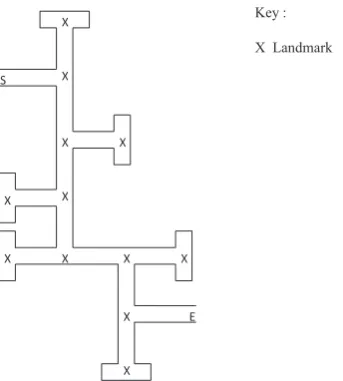
Four VE mazes (mazes 1e4) were used to test participants. Each maze was a brick wall maze (seeFig. 1) with six junctions. Each junction was a two-choice junction with a correct path and an incorrect path. The incorrect path ended in a cul-de-sac. From the junction the cul-de-sac looked like a T-junction rather than a dead-end. Therefore, participants could not tell that they had made an error until they had actually committed to walking along a chosen path. Of the six junctions in each maze, there were two right, two left and two straight ahead correct choices that were balanced with the same type and number of incorrect choices. All of the path lengths between junctions were equal. A white duck marked the start of the maze and a grey duck marked the end of the maze. When participants reached the grey duck, the maze disappeared indicating the end of the trial.
Maze 1 and maze 2 were used in condition 1. Maze 1 is illus-trated inFig. 2. Maze 2 was exactly the same design as maze 1 except that the start point of maze 2 was the end point of maze 1, and the end point of maze 2 was the start point of maze 1. Maze 1 and maze 2 were therefore equivalent, but each included a different sequence of left, right, and straight ahead correct choices. We included two mazes in condition 1 so that thefindings were not specific to a particular route. Half the participants in condition 1 received maze 1 and half received maze 2.
Maze 3 and maze 4 were used in condition 2. Maze 3 is illus-trated inFig. 3. Maze 3 was the same as maze 1 but included 12 landmarks. Maze 4 was the same as Maze 2 but included 12 landmarks. In both mazes, the landmarks were all objects that would be familiar to children: ball, bench, bus, bicycle, car, cow, playground slide, street lamp, traffic light, bin, tree and umbrella. There were 6 landmarks placed at path junctions on the correct route and 6 landmarks placed at dead-end junctions on the incorrect route.
[image:3.595.351.505.520.719.2]Maze 3 and maze 4 were also used in condition 3 (the training condition). Like condition 2 half of participants were tested in each maze.
[image:3.595.45.273.568.727.2]Fig. 1.Participant's view of maze.
2.3. Procedure
All participants were tested individually. Adults completed the experiment in a quiet office in a University Department. Informed consent was obtained prior to data collection. Children completed the experiment in a quiet room in their school. Informed consent was obtained from all the children's parents, and all the children were asked if they wanted to take part. No children refused to take part.
The participant sat at the desk facing a computer and the experimenter sat beside them. The experimenter spent 2 min talking to the participant informally to establish rapport. Partici-pants were asked for their age and birthdate.
The experimenter introduced the task by saying,‘This computer has got some mazes on it that we are going to use. First, we're going to practice using the computer to walk around a maze. I'll gofirst and show you how, and then you can have a turn.’The experi-menter then demonstrated how to navigate through the practice maze using the arrow keys. Participants were then given time to walk around the maze until they were confident in using the arrow keys to navigate, at which point the experimenter ended the practice phase by saying,‘Well done, I think you've had enough practice now, do you? Let's have a go at another maze now.’
All participants were given preliminary instructions for the test phase:‘Now I'm going to show you the way through a new maze. Somewhere in this maze there is a little grey duck tofind. I'll show you the way to the grey duck once, and then you can have a go.’The experimenter then demonstrated the correct route from the start to the end of the maze, giving verbal instructions that differed ac-cording to condition. In conditions 1 and 2, the experimenter used generic terms such as‘You go past here, then you turn this way, and then you turn this way’. In condition 3, the experimenter verbally labelled each landmark. For example,‘You go past the bench, turn this way at the traffic light, and then you turn this way at the bin’. In all conditions, the experimenter did not use any directional lan-guage, such as‘Turn right’. At the end of the demonstration, the experimenter exclaimed,‘Hooray, we've found the duck!’, and the screen went blank.
The participant was then asked to retrace the route they had been shown from the beginning of the maze and used the arrow keys to walk through the maze. The experimenter sat behind the participant and traced the exact route the participant took on a
paper copy of the maze, out of the participant's sight. The experi-menter timed how long it took the participant to complete the maze.
If, after 5 min, a participant had not reached the end of a maze on a particular trial, the experimenter ended the trial by saying, ‘Oops, it looks like you've got a bit lost. Not to worry, let's start back from the beginning, shall we?’ In practice, this happened infre-quently. A note was made that the trial was curtailed, and a new trial commenced. Participants did not receive any help infinding their way after the initial demonstration of the correct route. If a participant asked which way to go, the experimenter said,‘I want youto showmethe way to go. Just try your best.’If a participant returned to the start position but thought that they had reached the end, they were told,‘You're back at the beginning of the maze now. Let's turn around and try again to remember the way I showed you to the little grey duck.’ Again, in practice, this happened infrequently.
When the participant reached the end of the maze, the exper-imenter congratulated the participant, and asked them to walk the route again from the start. This procedure was repeated until the participant had walked the route to a criterion of two consecutive completions without error. At the end of thefinal trial, all partici-pants were thanked, and children, regardless of their performance, received a sticker.
If a participant had not walked the route with two consecutive completions after 20 min or after eight attempts, the experiment was stopped and the children were given a sticker.
3. Results
Successful learning was defined as two consecutive completions of the route without error. To achieve this criterion, participants had to walk the route without walking down any incorrect paths on two consecutive learning trials. Walking down an incorrect path was classed as an error. Looking down an incorrect path was not classed as an error. The total number of learning trials to reach criterion excluded the final two perfect trials. For example, if a participant made an error on trial 1, but then walked the route without error on trials 2 and 3, they would be scored as having required 1 trial to reach criterion. A lower score indicated better performance. If a participant never achieved the criterion, the number of learning trials was calculated as the number of trials that were completed. For example, if a participant completed 6 trials within the 20-min cut-off time, but did not complete 2 consecutive trials without error, they scored 6.
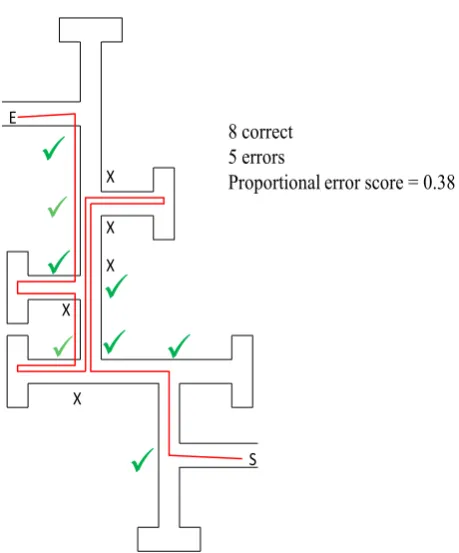
Participants received a mark of 1 for every error they made during a trial. On each trial a proportional error score was calcu-lated as the number of errors divided by the number of decisions made. For example,Fig. 4shows the route taken by one participant. This participant made 5 errors out of a total of 13 decisions, pro-ducing a proportional error score of 0.38. This scoring captured participants' wayfinding behaviour every time they made a deci-sion. This scoring method accounted for occasions when partici-pants doubled back and returned to the same junction more than once within a trial. Some participants who got lost did not reach the later junctions, so any junctions not reached were also scored as errors at decision points. A mean proportional error score was calculated for each participant across learning trials.
[image:4.595.86.258.63.254.2]The proportional error score captured all of a participant's behaviour on a trial. We note that alternative coding criteria pro-duced the same patterns of performance. For example, we coded just the decisions made thefirsttime a participant approached a junction in each trial. Participants scored 0 if they chose the correct path or 1 if they chose the incorrect path and any junctions not reached were counted as errors. Therefore 6 indicated the worse
performance, and 0 perfect performance. When this scoring was compared to the proportional error score (above), there were no differences in the results. Therefore, in the results section we report only the proportional error scores.
Independent sampledt-tests showed that there were no dif-ferences between performance on maze 1 and maze 2 or maze 3 and maze 4 for any of the dependent variables (allp-values>0.05). We explored whether there were any differences in perfor-mance at path junctions across the six landmarks. The assumption of sphericity could not be met (x2(14)¼164.20,p<0.001.) and so a geisser-greenhouse correction is reported instead (ε¼0.72). A one-way repeated measures ANOVA (6 levels: tree, bench, bike, um-brella, traffic light, bin) demonstrated a main effect of landmark type (F(3.957, 492.794)¼5.466,p<0.001,np2¼0.03). A Bonferoni corrected post-hoc test revealed that participants made fewer er-rors at the bench than at the bin (p<0.01) and at the bike than at the bin (p<0.001). Performance at all other choice point pairings were equal (all p-values >0.05). Both the bike and bench were straight ahead junctions and therefore at these junctions partici-pants did not have to remember to turn left or right. But at the bin, participants had to remember to turn either left or right. This may explain why there was a difference in performance at certain junctions in the maze.
3.1. Scoring method
To test our predictions relating to children's and adults' perfor-mance across the different conditions, we analysed three depen-dent variables: e (i) proportion of participants reaching the learning criterion, (ii) number of trials to reach learning criterion (for those who reached criterion) and (iii) proportion of errors. Chi-square analyses were used to explore the proportion of children and adults who reached learning criterion in the three different
maze conditions. ANOVA analyses were then conducted to explore number of trials to reach criterion and proportion of errors made by children and adults in the different maze conditions.
3.2. Proportion of participants reaching the learning criterion
Chi-square analyses were conducted to explore how many participants reached the learning criterion in the different maze conditions. In condition 1 (no landmarks) 10% of 6-year olds, 40% of 8-year olds, 80% of 10-year olds, and 100% of adults reached the criterion of 2 successive trials without error. In condition 1 there was a relationship between age and reaching the learning criterion (X2¼39.90, df¼3,p<0.001). Standardized residuals show that this was accounted for by adults whom were more likely to more likely to reach criterion than 6-year olds.
In condition 2 (with landmarks) 90% of 6-year olds, 95% of 8-year olds, 100% of 10-8-year olds, and 100% of adults reached the criterion. There was no significant relationship between age and reaching the learning criterion in condition 2 (X2¼3.81, df¼3, p>0.05).
In condition 3100% of 6-year olds, 100% of 8-year olds, 100% of 10-year olds, reached the criterion, so no statistical analyses could be conducted. Adults were not included in condition 3 because, as had been expected they were at 100% in condition 2.
3.3. Number of learning trials to reach criterion
In condition 1, for only those participants who reached criterion, 6-year olds required more trials (M¼5.00, SD¼0) than 8-year olds (M¼2.13, SD¼2.36), 10-year olds (M¼2.00, SD¼1.71) and adults (M¼0.30, SD¼0.73). As noted above many children did not reach the learning criterion (notably 6- and 8-year olds), so it was not appropriate to conduct any statistical analyses with such uneven groups.
In condition 2 (landmarks) for only those participants who reached criterion, 6-year olds required more trials (M ¼ 2.06, SD¼1.83) than 8-year olds (M¼1.21, SD¼1.90), 10-year olds (M¼0.25, SD¼0.55) and adults (M¼0.30, SD¼0.73). A one-way ANOVA was carried out with age (6 years, 8 years, 10 years, adults) on the number of learning trials to reach criterion. There was an effect of age (F (3, 76) ¼7.42, p< 0.001). Tukey post-hoc tests showed that in condition 2 the 6-year olds required more trials to reach criterion than the 10-year olds (p < 0.01) and adults (p<0.01). All other post-hoc tests were non-significant (p>0.05). In condition 3 the 6-year olds (M¼0.90, SD¼1.07) required more trials than the 8-year olds (M¼0.15, SD¼0.57) and 10-year olds (M¼0.05, SD¼0.22). Analysis of this condition is considered within the ANOVA below.
[image:5.595.44.274.58.335.2]To consider the data from the child groups across conditions (adults did not complete all condition 3), a 2 (condition 2, condition 3)3 (6, 8, 10 year olds) ANOVA was performed on the number of learning trials to reach criterion in each condition. Two 6-year olds and one 8-year old did not reach the learning criterion in condition 2 and therefore were not included. There was an effect of condition (F(1, 111)¼13.73,p<0.001,np2¼0.11) because children required fewer trials to reach criterion in condition 3 than condition 2. There was an effect of age (F(2, 111)¼12.56,p<0.001,np2¼0.19). As confirmed by Tukey pairwise comparisons, 6-year olds required more trials to learn the route than 8-year olds (p<0.05) and 10-year olds (p<0.001). Eight-year olds did not require more trials than 10-year olds (p¼0.13). These significant main effects support our second hypothesis that verbal labelling reduced the number of trials required to reach criterion. There was no interaction between maze condition and age group (F(2, 111)¼1.98,p¼0.14).
3.4. Proportional errors during the learning phase
In condition 1 the 6-year olds (M¼0.42, SD¼0.15) made more errors than the 8-year olds (M ¼0.23, SD¼0.18), 10-year olds (M¼0.14, SD¼0.13) and adults (M¼0.03, SD¼0.06). In con-dition 2 the 6-year olds (M¼0.12, SD¼0.14) made more errors than the 8-year olds (M¼0.06, SD¼0.08), 10-year olds (M¼0.01, SD¼0.02) and adults (M¼0.01, SD¼0.03). In condition 3 6-year olds (M ¼0.07, SD ¼0.08) made more errors than 8-year olds (M¼0.01, SD¼0.03), and 10-year olds (M¼0.01, SD¼0.01). We did not conduct a Maze (condition 1, condition 2, condition 3)Age (6-, 8-, 10-year old, adults) ANOVA, given that no adults took part in condition 3. Rather, we conducted two separate an-alyses: A Maze (condition 1, condition 2)Age (6-, 8-, 10-year olds, adults) ANOVA and to explore the effect of verbal labelling, a Maze (condition 2, condition 3) Age (6-, 8-, 10-year olds) ANOVA.
A 2 (condition 1, condition 2)3 (6-, 8-, 10-year olds) ANOVA was performed on the proportion of errors. There was an effect of maze (F(1, 114)¼70.26,p<0.001,np2¼0.38) because participants made proportionally more errors in condition 1 than condition 2. There was an effect of age (F(1, 2, 114)¼24.32,p<0.001,np2¼0.30). As confirmed by Tukey pairwise comparisons, 6-year olds made a higher proportion of errors than 8-year olds (p<0.001) and 10-year olds (p<0.001). The proportional of errors for 8-year olds and 10-year olds did not differ (p¼0.06). There was also an interaction between maze condition and age group (F(2, 114)¼4.43,p<0.05, np2¼0.07) as there was a greater age related improvement between 6- and 8-year olds than between 8- and 10-year olds in condition 1, but in contrast there was a greater age related improvement be-tween 8- and 10-year olds than bebe-tween 6- and 8-year olds in condition 2. This supported our first hypothesis that younger children (6- and 8-year olds) would make more errors when learning the route without landmarks than when learning the route with landmarks.
A 2 (condition 2, condition 3)3 (6, 8, 10 year olds) ANOVA was performed on the proportion of errors. There was an effect of condition (F(1, 114)¼6.88,p<0.05,np2¼0.06) because children made proportionally more errors in condition 2 than condition 3. There was also an effect of age (F (2, 114) ¼14.78, p < 0.001, np2¼0.21). As confirmed by Tukey pairwise comparisons, 6-year olds made more errors than 8-year olds (p< 0.01) and 10-year olds (p < 0.001). The proportional of errors for eight-year olds and 10-year olds did not differ (p¼0.20). These significant main effects supported our second hypothesis that verbal labelling reduced the number of errors made by participants. There was no interaction between maze condition and age group (F (2, 114)¼1.21,p¼0.30).
4. Discussion
The aim of the present study was to investigate the develop-ment of children's wayfinding strategies. As noted in the intro-duction there are two predominant strategies that can be used for learning and retracing a route (Kitchin&Blades, 2001). One is a strategy based on landmarks so that a child encodes a turn in relation to a particular landmark, and one is a directional strategy when a child learns a sequence of turns. From previous research we predicted that children would rely heavily on the presence of landmarks and that this would be particularly the case for the younger children (Cohen & Schuepfer, 1980; Jansen-Osmann & Wiedenbauer, 2004). Therefore we expected young children to encode a route much better in a maze with landmarks than they would in a maze without landmarks. In a maze without landmarks children are dependent on learning a sequence of turns and
therefore one aim was to establish if any of the age groups of children in the study could use this strategy when wayfinding.
Our results showed that only a quarter of the 6- and 8-year olds achieved the learning criterion in condition 1 when there were no landmarks available. In other words, without the presence of landmarks their route learning was poor, and they made a large number of errors. In contrast, four-fifths of the 10-year olds were able to learn the route even when there were no landmarks present. The latterfinding indicated that by the age of 10 years children can adopt a directional strategy and consider a route in terms of left, right and straight ahead directions. The 10-year olds were therefore mostly competent wayfinders even when they were unable to rely on landmarks. Though we note that the 10-year olds did not perform as well as the adult group, and therefore children's ability to use just directions for routefinding is still developing at the age of 10 years.
6 and 8-year olds found it difficult to find their way in the absence of landmarks. These children may have had a more limited memory capacity, and therefore might have had difficulty encoding six turns. However, this is unlikely because the results from con-dition 2 showed that nearly all the children could learn six turns when landmarks were present, and other research has shown that learning six turns is easily possible for these age groups (Farran, Courbois, Van Herwegen, & Blades, 2012; Farran, Courbois, Van Herwegen, Cruickshank, et al., 2012). Therefore the younger chil-dren's difficulty in the present experiment was probably due to their failure to employ a directional strategy (i.e. using left, right and straight ahead) tofind their way in the absence of landmarks. Young children may have difficulty using such a strategy because their use of spatial directions like left and right may not be fully developed until about the age of 10 years (Blades&Medlicott, 1992; Boone&Prescott, 1968; Ofte&Hugdahl, 2002).
When landmarks were available in the maze (in condition 2) 90% or more of each group learnt the route successfully. However, even when landmarks were available the 6-year-olds required more trials to reach criterion than the older children and adults. In other words, children can learn a route with landmarks, but how effectively they do so improves with age, and this corresponds to previousfindings (Cornell et al., 1989; Siegel&White, 1975).
The younger children might have required more trials than older children to learn the maze with landmarks for several reasons. Younger children could have less mature cognitive abilities, and/or their lack of wayfinding experience, because young children, especially 6-year olds rarely have to encode new routes for them-selves. We considered whether the children's poorer than optimal performance in condition 2 with the landmarks, was a reflection of difficulty with route learning or because the children who did poorly were less aware of appropriate wayfinding strategies. In condition 3 we pointed out and emphasised the landmarks during the children'sfirst walk through the maze. This in itself led to an improvement in the performance, because all the children reached criterion in condition 3 and all three age groups of children had fewer errors in condition 3 than in condition 2.
Tranter, 2010), possibly by triggering verbal recoding and suggests that this simple training technique can be very effective. We emphasise that in condition 3 we did not train the children by indicating the relationship between a landmark and the corre-sponding turn (which would have been an explicit wayfinding strategy), all we did was get the children to pay attention to the landmarks thefirst time they walked the route, and this was suf-ficient for children's route learning to improve. Therefore the lim-itations in young children's performance in condition 2 were probably due to lack of experience (in this case not realising the need to attend to all of the landmarks). Therefore, it seems likely that if adults make an effort to emphasise landmarks along new routes then the children's wayfinding will be improved, without the need for any more specific training.
Emphasising appropriate landmarks in real world contexts might be particularly important because the real environment can include a great many potential landmarks. Future research could manipulate the number and complexity of landmarks in a VE maze tofind out the effects of multiple landmarks at decision points along a route. Our cross sectional design only allowed us to examine a snapshot of how childrenfind their way at a certain age. Future research could also explore how children's wayfinding abilities develop longitudinally over time using controlled VEs which (unlike real environments) do not change over time.
Like previous research the present study has demonstrated that VEs can be an effective method for investigating how children learn a route (Farran, Courbois, Van Herwegen,&Blades, 2012; Jansen-Osmann, 2002;Jansen-Osmann&Fuchs, 2006), because a VE al-lows complete control of the environment and is a safe way to test young children's wayfinding. More importantly a VE allows the creation of routes (like the ones without landmarks in condition 1) that would be impossible in a real environment and this has led to novelfindings. However, unlike the real world participants were not immersed in the VE and nor did participants experience the same whole body kinaesthetic information. Therefore we recognise that there are limits to using desktop VEs to study wayfinding.
This is the first study to distinguish between route learning dependent on landmarks and route learning dependent on learning directions. Without the presence of landmarks, 6- and 8-year olds were much poorer at learning the route than when landmarks were present. This suggests that landmarks are crucial for children's route learning and that route learning based on directions does not develop until the age of 10. Ourfindings also showed that when landmarks were labelled this improved wayfinding performance for all children.
Acknowledgements
This research was funded by the ESRC (RES-062-33-0005). Special thanks go to the children and teachers of Bamford Primary School, Lydgate Infant School and St Marie's Catholic Primary School for enabling this research to take place.
References
Acredolo, L. P. (1977). Developmental changes in the ability to coordinate per-spectives of a large-scale space. Developmental Psychology, 13, 1e8.http:// dx.doi.org/10.1037/0012-1649.13.1.1.
Acredolo, L. P. (1978). Development of spatial orientation in infancy.Developmental
Psychology, 14, 224e234.http://dx.doi.org/10.1037/0012-1649.14.3.224.
Allen, G. L. (1981). A developmental perspective on the effects of subdividing macrospatial experience.Journal of Experimental Psychology: Human Learning
and Memory, 7, 120e132.http://dx.doi.org/10.1037/0278-7393.7.2.120.
Blades, M., & Medlicott, L. (1992). Developmental differences in the ability to give route directions from a map.Journal of Environmental Psychology, 12, 175e185. http://dx.doi.org/10.1016/S0272-4944(05)80069-6.
Boone, D. R., & Prescott, T. E. (1968). Development of left-right discrimination in normal children.Perceptual and Motor Skills, 26, 267e274.http://dx.doi.org/ 10.2466/pms.1968.26.1.267.
Bullens, J., Igloi, K., Berthoz, A., Postma, A., & Rondi-Reig, L. (2010). Developmental time course of the acquisition of sequential egocentric and allocentric naviga-tion strategies.Journal of Experimental Child Psychology, 107, 337e350.http:// dx.doi.org/10.1016/j.jecp.2010.05.010.
Bullens, J., Nardini, M., Doeller, C. F., Braddick, O., Postma, A., & Burgess, N. (2010). The role of landmarks and boundaries in the development of spatial memory.
Developmental Science, 13, 170e180.
http://dx.doi.org/10.1111/j.1467-7687.2009.00870.
Cohen, R., & Schuepfer, T. (1980). The representation of landmarks and routes.Child Development, 51, 1065e1071.
Cornell, E. H., Heth, C. D., & Alberts, D. M. (1994). Place recognition and wayfinding by children and adults.Memory and Cognition, 22, 633e643.http://dx.doi.org/ 10.3758/BF03209249.
Cornell, E. H., Heth, C. D., & Broda, L. S. (1989). Children's wayfinding: Response to instructions to use environmental landmarks.Developmental Psychology, 5, 755e764.http://dx.doi.org/10.1037/0012-1649.25.5.755.
Courbois, Y., Blades, M., Farran, E. K., & Sockeel, P. (2012). Do individuals with in-tellectual disability select appropriate objects as landmarks when learning a new route? Journal of Intellectual Disability Research, 57, 80e89. http:// dx.doi.org/10.1111/j.1365-2788.2011.01518.x.
Farran, E. K., Courbois, Y., Herwegen, J., & Blades, M. (2012). How useful are land-marks when learning a route in a virtual environment? Evidence from typical development and Williams syndrome.Journal of Experimental Child Psychology, 111, 571e586.http://dx.doi.org/10.1016/j.ecp.2011.10.009.
Farran, E. K., Courbois, Y., Herwegen, J., Cruickshank, A. G., & Blades, M. (2012). Colour as an environmental cue when learning a route in a virtual environ-ment: Typical and atypical development.Research in Developmental Disabilities, 33, 900e908.http://dx.doi.org/10.1016/j.ridd.2011.11.017.
Golledge, R. G., Smith, T. R., Pellegrino, J. W., Doherty, S., & Marshall, S. P. (1985). A conceptual model and empirical analysis of children's acquisition of spatial knowledge.Journal of Environmental Psychology, 5, 125e152.http://dx.doi.org/ 10.1016/S0272-4944(85)80014-1.
Hermer, L., & Spelke, E. S. (1994). A geometric process for spatial reorientation in young children.Nature, 370, 57e59.http://dx.doi.org/10.1038/370057a0. Heth, C. D., Cornell, E. H., & Alberts, D. M. (1997). Differential use of landmarks by
8-and 12-year-old children during route reversal navigation.Journal of
Environ-mental Psychology, 17, 199e213.http://dx.doi.org/10.1006/jevp.1997.0057.
Jansen-Osmann, P., & Fuchs, P. (2006). Wayfinding behaviour and spatial knowledge of adults and children in a virtual environment: The role of landmarks.
Exper-imental Psychology, 53, 171e181.http://dx.doi.org/10.1027/1618-3169.53.3.171.
Jansen-Osmann, P., & Wiedenbauer, G. (2004). The representation of landmarks and route in children and adults: A study in a virtual environment.Journal of
Environmental Psychology, 24, 347e357. http://dx.doi.org/10.1016/
j.jenvp.2004.08.003.
Kitchin, R., & Blades, M. (2001).The cognition of geographic space. London: IB Taurus. Lee, S. A., Shusterman, A., & Spelke, E. S. (2006). Reorientation and landmark-guided search by young children: Evidence for two systems.Psychological Science, 17, 577e582.http://dx.doi.org/10.1111/j.1467-9280.2006.01747.
Nardini, M., Jones, P., Bedford, R., & Braddick, O. (2008). Development of cue inte-gration in human navigation.Current Biology, 18, 689e693.http://dx.doi.org/ 10.1016/j.cub.2008.04.021.
Nardini, M., Thomas, R. L., Knowland, V. C. P., & Braddick, O. J. (2009). A viewpoint-independent process for spatial reorientation.Cognition, 112, 241e248.http:// dx.doi.org/10.1016/j.cognition.2009.05.003.
Ofte, S. H., & Hugdahl, K. (2002). Right-left discrimination in younger and older children measured with two tests containing stimuli on different abstraction levels. Perceptual and Motor Skills, 94, 707e719. http://dx.doi.org/10.2466/ pms.2002.94.3.707.
Richardson, A. R., Montello, D. R., & Hegarty, M. (1999). Spatial knowledge acqui-sition from maps, and from navigation in real and virtual environments.
Memory and Cognition, 27, 741e750.http://dx.doi.org/10.3758/BF03211566.
Ruddle, R. A., Payne, S. J., & Jones, D. M. (1997). Navigating buildings in‘desk-top’ virtual environments: Experimental investigations using extended navigational experience.Journal of Experimental Psychology: Applied, 3, 143e159. http:// dx.doi.org/10.1162/105474698565668.