"I hereby declare that I have read through this report entitle "Positioning Control of XY Table" and found that it has comply the partial fulfillment for awarding the degree of Bachelor of Electrical Engineering (Control, Instrumentation and Automation)"
Signature
...
~fl;r.
... .
Supervisor name Dr. Chong Shin Horng
Date
POSITIONING CONTROL OF XY TABLE
ONG YEE TENG
A report submitted in partial fulfillment of the requirements for the degree of Bachelor in Electrical Engineering (Control, Instrumentations and Instrumentations)
Faculty of Electrical Engineering
UNIVERSITI TEKNIKAL MALAYSIA MELAKA
2014
iii
I declare that this report entitle "Positioning Control of XY Table" is the result of my own research except as cited in references. The report has not been accepted for any degree and is not concurrently submitted in candidature of any other degree.
Signature
Name Ong Yee Teng
Date
...
!.~IY~.
1.'..
iv
ACKNOWLEDGEMENT
It would not have been possible to complete this final year project without the help and support of the kind people around me. Above all, I would like to thank my parents for their personal support and great patience at all times. My course mates have given me their unequivocal support throughout the whole production of this report too.
This thesis would not have been possible without the support and patience of my supervisor, Dr. Chong Shin Homg. I am very grateful to fellow seniors for providing valuable information and guidelines on how to write the report. It was particularly kind of them to allow me to refer to their previous research materials.
I would like to acknowledge the financial, academic and technical support of the Universiti Teknikal Malaysia Melaka and its staff The library facilities and computer facilities of the University have been indispensable.
v
ABSTRACT
In this project, the design of a two-degree-of-freedom (2-DOF) PID controller for an
AC Servo Ball Screw Driven XY table is considered. XY table is commonly used in CNC
machines and other industries which emphasizes motion control especially point-to-point (PTP)
and tracking positioning control. XY table has the advantage of being low cost and high
availability. Many types of controllers had been designed for positioning control of XY table.
The most common type of controller is 1-DOF conventional type PID controller. This
controller has satisfactory performance and simple structure. However, in most cases, 1-DOF
PID controller can only achieve either good set-point response or good disturbance response.
Thus, 2-DOF PID controller which is easy to design yet can achieve both good set-point
response and good disturbance response is introduced. A 2-DOF PID controller is designed in
this project for accurate tracking purpose. The effectiveness of 2-DOF PID controller is
validated at the end of project too. 2-DOF PID controller is controller that has two tuning
elements, which means more tuning parameters. The 2-DOF PID controller is designed using
two-steps-tuning-method. Disturbance response are optimized by tuning parameters of
Kp, Ti, and T0 using Ziegler-Nichols 2nd method, followed by optimization of set-point
response by tuning of 2-DOF parameters, a and
f3.
Tracking control performance of 2-DOFPID controller is evaluated by comparing with PI and 1-DOF PID controller. The effectiveness
of 2-DOF PID controller in tracking control is validated by examining sinusoidal inputs of
different frequency and amplitude in experiments. Maximum absolute error, sum of absolute
error, and mean square error are analyzed for all tracking performance of compensated system.
Result shows that tracking error compensation (set-point response) of l~DOF PID controller is
better than 2-DOF PID controller. However, this is due to tuning of a and
f3
parameters insimulation in this project. a and
f3
values should be tuned experimentally. Disturbanceresponse of 1-DOF PID and 2-DOF PID are almost similar due to same Kp, Ti, and T0 values
vi
ABSTRAK
Dalam projek ini, pengawal PID dengan dua darjah kebebasan telah direka untuk mesin jadual
XY yang didorong oleh mekanisme skru bola. Jadual XY biasanya digunakan dalam mesin
CNC dan industri Iain yang menekankan kawalan gerakan terutamanya dari point-to-point
(FTP) and tracking. Jadual XY mempunyai kelebihannya kerana berkos rendah dansenang
didapati dalam pasaran. Pelbagai jenis pengawal telah direka untuk mengawal kedudukan dan
gerakan mesin jadual XY. Jenis yang paling biasa digunakan ialah jenis konvensional
pengawal PID dengan satu darjah kebebasan. Pengawal ini mempunyai prestasi yang
memuaskan dan strnktur yang mudah . Waiau bagaimanapun ; dalam kebanyakan kes ; jenis
konvensional pengawal PID hanya boleh mencapai sama ada kawalan gerakan terhadap
arahan yang tepat atau kawalan gerakan terhadap gangguan yang tepat . Oleh itu, pengawal
PID dengan dua darjah kebebasan yang senang direka dan boleh mencapai prestasi baik bagi
kedua-dua kes telah diperkenalkan. Pengawal PID ini direka dalam projek ini untuk tujuan
tracking control sahaja. Keberkesanan pengawal PID dengan dua darjah kebebasan telah
disahkan pada akhir projek. pengawal PID dengan dua darjah kebebasan mempunyai dua
pemampas, iaitu lebih banyak parameter dalam pengawal untuk menambahbaikan prestasi
pengawal tersebut .. Pengawal PID dengan dua darjah kebebasan direka dengan menggunakan
dua langkah. Pertama, kawalan gerakan terhadap gangguan dioptimumkan oleh
parameter Kp, Ti, dan T0 dengan menggunakan kaedah dua Ziegler- Nichols. Seterusnya,
proses mengoptimumkan kawalan gerakan terhadap arahan dijalankan dengan penalaan dua
parameter,
a
dan (3. Prestasi kawalan pengawal PID dengan dua darjah kebebasan dinilaidengan membandingkannya dengan PI dan pengawal PID dengan satu darjah kebebasan.
Keberkesanan pengawal dalam tracking disahkan dengan memberi input bentuk sinus dengan
frekuensi dan amplitude yang berbeza dalam eksperimen. Ralat mak:simum mutlak:, jumlah
ralat mutlak, dan min kuasa dua ralat dianalisis. Analisis menunjukkan bahawa jenis
konvensional pengawal PID dengan satu darjah kebebasan mempunyai kawalan gerakan
vii
TABLE OF CONTENTS
CHAPTER TITLE PAGE
ACKNOWLEDGEMENT iv
ABSTRACT v
ABSTRAK vi
TABLE OF CONTENTS vii
LIST OF TABLES ix
LIST OF FIGURES x
LIST OF APPENDICES xiii
1 INTRODUCTION 1
1.1 Project Background 1
1.2 Problem Statement 3
1.3 Objectives 4
1.4 Scope 4
2 LITERATURE REVIEW 5
2.1 Type of controllers being proposed 5
2.2 Problem of one-degree-of-freedom Conventional PID controller 8 2.3 Two-degree-of-freedom (2-DOF) PID controllers 10
3 MA THEMA TI CAL MODELING AND CONTROLLER 14
DESIGN
3.1 Project Methodology 14
viii
3.3 Frequency Response 17
3. 4 Open Loop Response 18
3.5 Design of two-degree-of-freedom (2-DOF) PID Controller 19 3.5.1. Feedback type 2-DOF PID control system 19 3.5.2. Feedforward type 2-DOF PID control system 21
3.6 Two-Steps Tuning Method 22
3. 7 Tracking Positioning Performance 24
3. 7 .1 Test with sinusoidal inputs of different frequency 24
3. 8 Experimental Setup 26
4
PERFORMANCE EVALUATION 294.1 Effect of alpha, a parameter on the tracking error features 29 4.2 Effect of beta,~ parameter on the tracking error features 32 4.3 Effect of feedback/feedforward configuration on the tracking 36
error features
4. 4 Comparison of effectiveness between PI, 1-DOF PID, and 2- 39 DOF PID controllers (Simulation)
4.5 Comparison of effectiveness between 1- DOF PID and 2- DOF 49 PID controllers (Experiment)
4. 6 Tests with disturbance forces 55
5
CONCLUSION AND FUTURE WORKS59
5 .1 Conclusion 59
5.2 Recommendation 60
REFERENCES
61
ix
LIST OF TABLES
TABLE TITLE PAGE
3.1 Nominal Object Parameters 16
3.2 Controllers parameter obtained using Ziegler-Nichols Tuning 23
Method (12]
3.3 Different cases of controller parameters values that are tested 24
3.4 Set of experiments 25
3.5 Specification of GXY serial XY Table 26
LIST OF FIGURES
FIGURE TITLE PAGE
1.1 GXY series XY table used in this project 2
2.1 Proposed friction model at velocity reversal [ 19] 7
2.2 Conventional PID control system 8
2.3 Feedforward type 200F PID compensated system 11
2.4 Feedback type 2DOF PID compensated system 13
3.1 Simplified model for one-axis ball screw mechanism [19) 15
3.2 Open-loop block diagram of plant 16
3.3 Magnitude plot of simulation and experiment 17
3.4 Output of Open-loop uncompensated system 18
3.5 Feedback type 2 DOF PID control system 19
3.6 F eedforward type 2 DOF PID control system 21
3.7 Experimental Setup Drawing 27
3.8 Experimental Setup 28
4.1 (a) Tracking performance with different
a
values for 3 Hz and 10 mm 294.1 (b) Magnified plot of Figure 4.1 (a) 30
4.2 Maximum Absolute Error Analysis for different values of alpha,
a
30 4.3 Sum of Absolute Error Analysis for different values of alpha,a
31 4.4 Mean Square Error Analysis for different values of alpha,a
31 4.5 Figure 4.5: Tracking performance with differentJ3
values for 3 Hz 33and 10 mm
4.6 Maximum Absolute Error Analysis for different values of beta,
J3
34 4. 7 Sum of Absolute Error Analysis for different values of beta,J3
34 4.8 Mean Square Error Analysis for different values of beta,J3
35 4.9 Tracking performance with feedback and feedforward configuration 37for 5 Hz and 1 mm
xi
LIST OF FIGURES
FIGURE TITLE PAGE
4.10 Maximum Absolute Error Analysis for different configuration 38 4.11 Sum of Absolute Error Analysis for different configuration 38 4.12 Mean Square Error Analysis for different configuration 39 4.13 Tracking performance of PI, lDOF PID, and 2DOF PID for 0.1 Hz 41
and 1 mm
4.14 Tracking performance of PI, lDOF PID, and 2DOF PID for 0.1 Hz 42 and5 mm
4.15 Tracking performance of PI, lDOF PID, and 2DOF PID for 0.1 Hz 43 and 10 mm
4.16 Tracking performance of PI, lDOF PID, and 2DOF PID for 5 Hz 44 and 1 mm
4.17 Tracking performance of PI, lDOF PID, and 2DOF PID for 5 Hz 45 and 5 mm
4.18 Tracking performance of PI, lDOF PID, and 2DOF PID for 5 Hz 46 and 10 mm
4.19 Maximum Absolute Error Analysis for 1 DOF PID, 2 DOF PID, and 47 PI compensated system
4.20 Sum of Absolute Error Analysis for 1 DOF PID, 2 DOF PID, and PI 47 compensated system
4.21 Mean Square Error Analysis for 1 DOF PID, 2 DOF PID, and PI 48 compensated system
4.22 (a) Tracking performance of system with 1 DOF and 2 DOF PID 49 controller with different frequency (displacement= 1 mm)
xii
LIST OF FIGURES
FIGURE TITLE PAGE
4.23 Tracking performance of system with IDOF and 2DOF PID 51 controller with different frequency (displacement= 3 mm)
4.24 Tracking performance of system with I DOF and 2 DOF PID 52 controller with different frequency (displacement = 5 mm)
4.25 Maximum Absolute Error Analysis for 1 DOF PID and 2-DOF PID 53 compensated system (Experiment)
4.26 Sum of Absolute Error Analysis for I DOF PID and 2-DOF PID 53 compensated system (Experiment)
4.27 Mean Square Error Analysis for I DOF PID and 2-DOF PID 54 compensated system (Experiment)
4.28 Tracking error of 1 DOF PID and 2 DOF PID when step disturbance 56 is added (displacement= Imm, t = 0.01and2 sec)
4.29 Tracking error of I DOF PID and 2 DOF PID when step disturbance 56 is added (displacement= 5mm, t = 0.01and2 sec)
4.30 Tracking error of I DOF PID and 2 DOF PID when sine disturbance 57 is added (displacement= Imm, frequency= O. I Hz and 3 Hz)
xiii
LIST OF APPENDICES
APPENDIX TITLE PAGE
A Tracking performance of PI, 1-DOF PID, and 2-DOF PID 64 for frequency
=
I Hz and 3 Hz (Displacement=
I mm, 5mm, and 1 Omm)
B Tracking Error Table (Simulation)
70
c
Tracking Error Table (Experiment)75
D Gantt Chart
77
E Flow Chart of Designing 2 DOF PID controller
78
CHAPTERl INTRODUCTION
1.1. Project Background
XY table is used widely in many industries due to cheap cost, large stroke, availability and generality. Each axis of the XY table is linked to an AC Servo motor through a ball screw mechanism. This mechanism acts like a torsional spring. XY table is widely used in industries such as general machinery, pharmaceutical, manufacturing, semiconductor, material handling, and automation. In addition, XY table is also used in scientific research such as precision position control equipment research & development, and sometimes used in educational experiments.
2
[image:15.597.139.336.51.217.2]J_
Figure 1.1: GXY series XY table used in this project
Positioning control is major issue m vanous industrial applications such as CNC (Computerized Numerical Control) machines or robots, electronic manufacturing equipment or robots especially semiconductor manufacturing. There are two fundamental types in positioning control ofXY table. They are point-to-point (PTP) positioning which involves one position point to another point either in linear or angular position. The other is CP (Continuous-Path) positioning which is the control of movement for moving along a prescribed position trajectory or in other word, tracking control [2].
In all industries which focus on point-to-point positioning system, fast response, robust
and no/low overshoot is the main consideration for controller design [2]. However, the nonlinearities and uncertainties phenomena of the plant have been a major problem in point-to-point positioning system. Main nonlinearities in XY table are existence of friction and saturation of actuator and/or power amplifier. These nonlinearity causes steady-state error and slow transient response for the positioning output. Besides, they can also affect the stability of plant [ 1]. Nonlinear phenomena affect the positioning precision and tracking accuracy.
3
1.2. Problem statement
Positioning control of XY table is commonly applied in industries such as Printed Circuit Board, fixed length cutting, bending machine control and other related industries.
The most common controller, PID controller has simple design procedure but only a satisfactory positioning performance. This refers to the conventional one-degree-of-freedom PID. In conventional PID controller, there is only one-degree-of-freedom for the controller tuning. When controller parameters are tuned to have good set-point response, the disturbance response becomes poor. On the other hand, when tuning of parameters give good disturbance response, the controller cannot compensate to follow set-point perfectly. Apart from that, when applied in industrial plants that have nonlinearities and uncertainties, tuning of PID controller parameters become very difficult.
4
1.3. Objectives
The objectives of this project
are:-1. To design a two-degree-of-freedom PID controller for positioning control of a XY
table system
2. To validate the effectiveness of two-degree-of-freedom PID controller in tracking and
positioning control of XY table
1.4. Scope
1. To obtain dynamic modelling of XY table (one-axis performance) m frequency
domain
2. Experimental setup for design of two-degree-of-freedom PID controller:
Plant Specification for XY table (GXY2020VP4)
• 2D AC Servo Ball Screw Driven XY table
• Effective Distance route: X = 175mm, Y = 175mm
• Incremental encoder (Resolution: 2000 pulse/rev= 1 pulse/mm)
3. Design of two-degree-of-freedom PID controller for one-axis performance of XY
table
4. Performance evaluation
• Tracking positioning performance (Evaluation of maximum absolute tracking
error, sum of absolute tracking error, and mean square error)
CHAPTER2
LITERATURE REVIEW
2.1. Type of controllers being proposed
Ideally, precise positioning and accurate tracking can be done using linear control techniques such as PID controllers. However, in reality, the existence of nonlinearities and uncertainties has a significant effect on the positioning control [10-13].
Many controllers have been proposed for the positioning control of XY table. Most·of the controllers designed has the need to compensate the friction of the plant in order to achieve high precision positioning. In most industrial applications, PID controllers are the most common controller for positioning control. This is due to their simple design and satisfactory performance. However, PID does not compensate the friction that exists in the system.
Kempf, C.J. and Kobayashi, S. proposed the disturbance observer and feedforward controllers [3], Park, M.H. and Wong, C.Y. proposed the time optimal controller [4] while Fujimoto, Y., and Kawamura, A. proposed a sliding mode controllers [5]. All three types of controllers mentioned can give precise positioning performance and are robust to parameter variations that are caused by plant uncertainties. Nevertheless, these controllers require complicated modelling that involves parameter identification process. To design these controllers, one has to have deep knowledge in control theory. This is impractical in industrial applications which most of the operators has less or no knowledge in control theory.
CHAPTER2
LITERATURE REVIEW
2.1. Type of controllers being proposed
Ideally, precise positioning and accurate tracking can be done using linear control
techniques such as PID controllers. However, in reality, the existence of nonlinearities and
uncertainties has a significant effect on the positioning control [ 10-13].
Many controllers have been proposed for the positioning control of XY table. Most of
the controllers designed has the need to compensate the friction of the plant in order to achieve
high precision positioning. In most industrial applications, PID controllers are the most
common controller for positioning control. This is due to their simple design and satisfactory
performance. However, PID does not compensate the friction that exists in the system.
Kempf, C.J. and Kobayashi, S. proposed the disturbance observer and feedforward
controllers (3], Park, M.H and Wong, C.Y. proposed the time optimal controller [4] while
Fujimoto, Y., and Kawamura, A proposed a sliding mode controllers [5]. All three types of
controllers mentioned can give precise positioning performance and are robust to parameter
variations that are caused by plant uncertainties. Nevertheless, these controllers require
complicated modelling that involves parameter identification process. To design these
controllers, one has to have deep knowledge in control theory. This is impractical in industrial
applications which most of the operators has less or no knowledge in control theory.
T. Iwasaki, Sato T., Morita A and Marayuma H had proposed an auto-tuning
6
require deep control knowledge. However, the control process required a long and
time-consuming process. It is very complicated and thus not suitable for real applications that
emphasizes efficiency.
There are also other advanced controllers such as fuzzy logic controllers [8] and neural
network controllers [9]. These intelligent controllers do not require exact modelling and
parameter identification processes. Nonetheless, they still involve in certain level of
complexity. For instance, in fuzzy logic controllers, adjustable elements such as selection of
membership functions and fuzzy rules can sometimes be confusing for operators. In neural
controllers, the operator has to select the number of inputs and outputs needed, and also the
type of neural controller structure. Overall, these intelligent controllers do not gain the
advantage over other controllers on simplicity.
Y. X. Su, B. Y. Duan and Y. F. Zhang had developed an auto-disturbance rejection
controller [28]. They used a nonlinear tracking differentiator, an extended state observer, and a
nonlinear proportional derivative controller. The aim is to achieve high performance for robust
motion control. However, this controller that they proposed cannot make sure that the system
is stable. For most of the back propagation neural network controller designed, the dynamic
parameters of the plant have to be identified. This process is normally complicated and long.
For other friction compensation method, Z. Jamaluddin, H. Brussel and J. Swevers had
tried to use friction-model- based feed-forward and inverse-model-based disturbance observer
[20]. This controller is used to reduce the radial tracking error and quadrant glitches of
linear-drive XY table. With this kind of compensation, the bandwidth of frequency increases. As
system bandwidth increases, the tracking control performance become better. However,
robustness to variations of parameters and uncertainties such as saturation were not considered
in the design.
Eun-Chan Park, Hyuk Lim, and Chong-Ho Choi had proposed on precise positioning
control of XY table at velocity reversal [19]. They investigated on friction, torsional
7
the compensation of friction. By investigating the transition time from presliding to sliding,
they succeeded in deriving that transition time is inversely proportional to the square-root of
the acceleration at zero velocity. The relationship can be shown in the proposed friction
model. Without accurate measurement, the transition time can be estimated. In the experiment,
it is proved that this method works for a wide range of dynamics (acceleration). This
compensation of friction at velocity reversal had proved its effectiveness in the experimental
results. However, it still requires development of a friction model.
friction f.;_(_=_!~c
)_~----=--+---time
F_ (=-Fe)
l.d. . !pre-sliding! lidi .
s 1 mg reg1meiregime i s ng regime
[image:22.597.214.377.222.342.2]r,,.,,(v)
i
-r,~(f)i
r,,.,,(v)Figure 2.1: Proposed friction model at velocity reversal [ 19]
A discrete sliding mode controller with robust perfect tracking control had been
proposed by Jian Wang, Hendrik Van Brussel, and Jan Swevers [6]. A feedforward tracking
controller combined with a sliding mode controller has been designed. Using state-space
canonical form, the closed-loop transfer function obtained is independent from the plant model.
As with sliding mode controllers, the closed-loop plant characteristic is independent of the
dynamics such as friction when on switching line, the controller designed is robust. However,
in this design, the model uncertainties of the plant or other disturbances may have cause
problems to reach quasi-sliding mode.
Lately there has been a robust adaptive network controller developed for XY table.
This proposed controller is implemented in a DSP-based motion board. The stability and the
convergence of the system are proved using Lyapunov theory [21]. Despite the uncertainties
and disturbances, this controller confirm that convergence and stability of plant. The
positioning performance of the motor for tracking is good. The neural network developed is
8
parameter [21]. This neural network is used to approximate the nonlinear factors of the AC servo motor. Although this designed controller is robust, the process is quite complex to be applied practically.
Although PID controller does not necessarily bring perfect compensation to the industrial plant, it still remains as the most common compensation technique used in industries to date. This is due to its simple structure and intuitively comprehensible tuning techniques when it comes to practical applications.
2.1. Problem of one-degree-of-freedom Conventional PID controller
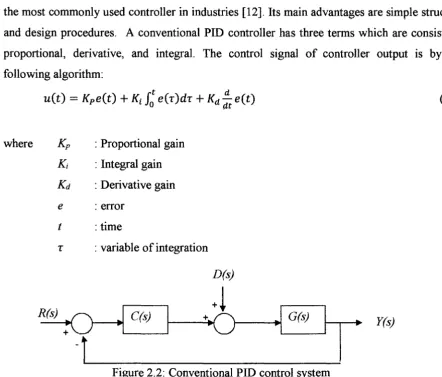
Since introduction of PID controller in 1911 by Elmer Sperry, PID controller has been the most commonly used controller in industries [12]. Its main advantages are simple structure and design procedures. A conventional PID controller has three terms which are consists of proportional, derivative, and integral. The control signal of controller output is by the following algorithm:
where
u(t)
=
Kpe(t)+
Kd;0t e(r)dr
+
Kd .!!... dt e(t)Kp : Proportional gain
Ki : Integral gain
Kd : Derivative gain e : error
t : time
T : variable of integration
D(s)
+!
R(s)
~I
C(s):0
+·o
-r
~I
G(s) [image:23.598.43.485.321.697.2]I
Figure 2.2: Conventional PID control system
(2.1)
I
9
Considering Figure 2.2, it is found that this structure has one-degree-of-freedom structure. The degree-of-freedom of a control system refers to how many of the closed-loop transfer functions are independent. The closed-loop transfer function of Figure 2.2 is derived as the following:
G l(s) _ C(s)G(s)
yr - l+C(s)G(s) (2.2)
G dl(s)
=
G(s)Y l+C(s)G(s) (2.3)
Combining these two equations, it is found that:
G r(s) = G(s)-Gyd(s)
y G(s) (2.4)
Since Gyr 1 (s) and Gyd2(s) are dependent on each other, this control system has only one tunable element, that is C(s). They cannot be tuned independently. In this kind of system, when the tuning of controller parameters get optimal set-point response, the disturbance response is often poor, and vice-versa [10].
This tuning of controller parameters has simple theories but in real life, there are many limitations of PID control especially in nonlinear systems. Aside from nonlinearities, noises at high frequency usually causes problem with the derivative gain in PID. Kd will amplify these noises thus causes large amount of changes in output. In such cases, it is preferable to insert a low-pass filter to eliminate the noises [ 15].

![Figure 2.1: Proposed friction model at velocity reversal [ 19]](https://thumb-us.123doks.com/thumbv2/123dok_us/94150.8852/22.597.214.377.222.342/figure-proposed-friction-model-velocity-reversal.webp)