JE DES COMMUNAUTES EUROPEENNES STATISTICAL OFFICE OF THE EUROPEAN COMMUNITIES STATISTISCHES Alvi HEN GEMEINSCHAFTEN ISTITUTO STATISTICO DELLE COMUNITÀ EUROPEE BUREAU VOOR DE STATISTIEK DER EURO] 'ESE GEMEENSCHAPPEN DET STATISTISKE DEPARTEMENT FOR DE EUROPAEISKE FAELLESSKABER OFFICE STATISTIQUE DES C O M M J \IAUTES EUROPEENNES STATISTICAL OFFICE OF THE EUROPEAN COMMUNITIES STATISTISCHES AMT DER EUROPÄISCHEN GEMEINSCh \FTEN ISTITUTO STATISTICO DELLE COMUNITÀ EUROPEE BUREAU VOOR DE STATISTIEK DER EUROPESE GEMEENSCHAPPEN DET S i vriSTISKE DEPARTEMENT FOR DE EUROPAEISKE FAELLESSKABER OFFICE STATISTIQUE DES COMMUNAUTES EUROPEENNES S T A T I S T J C A L O F F I C E OF T H E EUROPEAN COMMUNITIES S T A T I S T I S C H E S A MT DER EUROPÄISCHEN GEMEINSCH AFTEN I S T I T U T O S T A T I S T I C O D E L
. E COMUNITÀ EUR OPEE BUREAU VOOR D E S T A T I S T I E K DER EUROPESE GEMEEN SCH APPEN DET S T A T I S T I S K E DEP ARTEME NT F O R D E | I U R O P A E I S K E FAELLESSKABER O F F I C E S T A T I S T I Q U E DES C OM MUN AU TES E UROPEENNES S T A T I S T I C A L O F F I C E OF THE EUROPEAN C C I M M U N I T I E S S T A T I S T I S C H E S A MT DER EUROPÄISCHEN GEMEINSCHAFTEN I S T I T U T O S T A T I S T I C O D E L L E C OMUNITÀ EUROPEE B U R E A L JVOOR D E S T A T I S T I E K DER EUR OPESE GEME ENSC HA PPEN DET S T A T I S T I S K E DEPA RTE ME NT FOR DE E U R O P A E I S K E FAELLESSKABER ■ O F F I C E S T A T I S T I Q U E D E S C O M M L L
I D E R E U R O P Ä I S C H E N G E M E I N S C ¡ E S E G E M E E N S C H A P P E N D E T S I N A U T E S EUROPEENNES STATI' HAFTEN ISTITUTO STATISTICO Ü FATISTISKE DEPARTEMENT FOR d ICAL OFFICE OF THE EUROPEAN (j LE COMUNITÀ EUROPEE BUREA EUROPAEISKE FAELLESSKABER MUNITIES STATISTISCHES AMT
DOR DE STATISTIEK DER EUROP
eurostat
Í A T ^ S ^ T J R Õ P E E N N È ^ STTTTTSTTC,
EUROPAEISKE FAELLESSKABER OFFICE STATISTIQUE DES COMML COMMUNITIES STATISTISCHES AMT DER EUROPÄISCHEN GEMEINSCl EAU VOOR DE STATISTIEK DER EUROPESE GEMEENSCHAPPEN DET :
OFFICE STATISTIQUE DES COMMUNAUTES EUROPEENNES STATISI Τ DER EUROPÄISCHEN GEMEINSCHAFTEN ISTITUTO STATISTICO DEl] PESE GEMEENSCHAPPEN DET STATISTISKE DEPARTEMENT FOR DE INAUTES EUROPEENNES STATISTICAL OFFICE OF THE EUROPEAN COI\
FTEN ISTITUTO STATISTICO DELLE COMUNITÀ EUROPEE BUREAU TISTISKE DEPARTEMENT FOR DE EUROPAEISKE FAELLESSKABER OF
AL OFFICE OF THE EUROPEAN COMMUNITIES STATISTISCHES AMT DE » O T I T I I T A Ρ Τ Α Τ Ι Ρ Τ Ι Λ Π H C l i n (ancrer ΙΓ\Γ>ίΠ r \ c Γ Α Τ ί Ο τ ι π / Γ Λ ί - η π i n r \ n r o r
-ICE STATISTIQUE DES COMMUNAt Ì EUROPAISCHEN GEMEINSCHAFT^ GEMEENSCHAPPEN DET STATIS
S EUROPEENNES STATISTICAL OFFICE ;HES AMT DER EUROPAISCHEN GEMEI
ISTITUTO STATISTICO DELLE COMUNITÀ EUROPEE BUREAU VOOR DE STATISTIEK DER EUROPESE GEMEENSCHAPPEN DET STATISTISKE DEPARTEMENT FOR DE EUROPAEISKE FAELLESSKABER OFFICE STATISTIQUE DES COMMUNAUTES EUROPEENNES STATISTICAL OFFICE DF THE EUROPEAN COMMUNITIES STATISTISCHES AMT DER EUROPÄISCHEN GEMEINSCHAFTEN ISTITUTO STATISTICO DELLE COMUNI! |À EUROPEE BUREAU VOOR DE STATISTIEK DER EUROPESE GEMEENSCHAPPEN DET STATISTISKE DEPARTEMENT FOR DE EUROPAEISK|
FAELLESSKABER OFFICE STATISTIQUE DES COMMUNAUTES EUROPEENNES STATISTICAL OFFICE OF THE EUROPEAN COMMUNITIES [STATISTISCHES AMT DER EUROPAISCHEN GEMEINSCHAFTEN ISTITUTO STATISTICO DELLE COMUNITÀ EUROPEE BUREAU VOOR DE ST/> ITISTIEK DER EUROPESE GEMEENSCHAPPEN DET STATISTISKE DEPARTEMENT FOR DE EUROPAEISKE FAELLESSKABER OFFICE STATIST llQUE DES COMMUNAUTES EUROPEENNES STATISTICAL OFFICE OF THE EUROPEAN COMMUNITIES STATISTISCHES AMT DER EUROPÄIS : H E N GEMEINSCHAFTEN ISTITUTO STATISTICO DELLE COMUNITÀ EUROPEE BUREAU VOOR DE STATISTIEK DER EUROPESE GEMEENSC HAPPEN DET STATISTISKE DEPARTEMENT FOR DE EUROPAEISKE FAELLESSKABER OFFICE STATISTIQUE DES COMMUNAUTES EUROPE
FORSYNINGSBALANCER
VERSORGUNGSBILANZEN
SUPPLY BALANCE SHEETS
BILANS D'APPROVISIONNEMENT
BILANCI D'APPROVVIGIONAMENTO
VOORZIENINGSBALANSEN
| ^ _ _ _ _ ^ ^ ^ ^ _ _ _ _ ^ ^ ^ ^ ^ _
1976
a
eurostat
DE EUROPÆISKE FÆLLESSKABERS STATISTISKE KONTOR STATISTISCHES AMT DER EUROPÄISCHEN GEMEINSCHAFTEN STATISTICAL OFFICE OF THE EUROPEAN COMMUNITIES OFFICE STATISTIQUE DES COMMUNAUTÉS EUROPÉENNES ISTITUTO STATISTICO DELLE COMUNITÀ EUROPEE
BUREAU VOOR DE STATISTIEK DER EUROPESE GEMEENSCHAPPEN
Luxembourg, Centre Européen, Boîte postale 1907 — Tél. 43011 Télex: Comeur Lu 3423 1049 Bruxelles, Bâtiment Berlaymont, Rue de la Loi 200 (Bureau de liaison) —Tél. 735 80 40
Denne publikation kan fås gennem de salgssteder, som er nævnt på omslagets tredje side i dette hæfte. Diese Veröffentlichung ist bei den auf der dritten Umschlagseite aufgeführten Vertriebsbüros erhältlich. This publication is obtainable from the sales offices mentioned on the inside back cover.
Pour obtenir cette publication, prière de s'adresser aux bureaux de vente dont les adresses sont indiquées à la page 3 de la couverture.
Per ottenere questa pubblicazione, si prega di rivolgersi agli uffici di vendita i cui indirizzi sono indicati nella 3a pagina della copertina.
FORSYNINGSBALANCER
VERSORGUNGSBILANZEN
SUPPLY BALANCE SHEETS
BILANS D'APPROVISIONNEMENT
BILANCI D'APPROVVIGIONAMENTO
VOORZIENINGSBALANSEN
1976
P A R T / P A R T I E
Β
SUPPLY BALANCE S H E E T S EUR-9 (SUMMARY)
BILANS D'APPROVISIONNEMENT EUR-9 (SOMMAIRE)
DEGRE OE S E L F - S U F F I C I E N C Y
DEGRE D'AUTO-APPROVISIONNEMENT
C PER CAPITA CONSUMPTION
CONSOMMATION PAR TETE
D DOMESTIC U S E S OF CEREALS
UTILISATION INTERIEURE DES CEREALES
S U P P L Y BALANCE S H E E T S BY PRODUCTS
BILANS D'APPROVISIONNEMENT PAR PRODUITS
Indholdsfortegnelse Inhaltsverzeichnis Table of c o n t e n t s
S i d e S e i t e P a g e
XXll I n d l e d e n d e b e m æ r k n i n g e r XVI B e m æ r k n i n g e r p e r p r o d u k t
XIX D i a g r a m o v e r f o r s y n i n g s b a l a n c e r n e
V o r b e m e r k u n g e n
A n m e r k u n g e n zu d e n E r z e u g n i s s e n
S c h e m a d e r V e r s o r g u n g s b i l a n z e n
P r e l i m i n a r y r e m a r k s R e m a r k s by p r o d u c t s
S c h e m e for t h e supply b a l a n c e s h e e t s XX B a l a n c e p o s t e r n e
XXII K i l d e r
XXIII S y m b o l e r og f o r k o r t e l s e r
B i l a n z p o s t e n Q u e l l e n a n g a b e n
V e r w e n d e t e Z e i c h e n und A b k ü r z u n g e n
I t e m s in the b a l a n c e s h e e t s S o u r c e s
S y m b o l s and a b b r e v i a t i o n s u s e d
1 15 16 18 22
D e ! A : F o r s y n i n g s b a l a n c e r E U R 9 '[Sammendrag)
Del Β : S e l v f o r s y n i n g s g r a d B e m æ r k n i n g e r
G r a f i k T a b e l l e r
Teil A : V e r s o r g u n g s b i l a n z e n E U R 9 ( Z u s a m m e n f a s s u n g ) Teil Β : G r a d d e r S e l b s t
v e r s o r g u n g A n m e r k u n g e n G r a p h i k e n T a b e l l e n
P a r t A : S u p p l y b a l a n c e s h e e t s E U R 9 ( S u m m a r y )
P a r t Β : D e g r e e of s e l f s u f f i c i e n c y
R e m a r k s G r a p h s T a b l e s 27 Del C : F ø d e v a r e f o r b r u g
28 B e m a e r k n i n g e r 29 G r a f i k
3 2 C l . T a b e l l e r
35 C . 2 . Anvendte f o l k e t a l
Tell C : P r o K o p f V e r b r a u c h Anme r k u n g e n
G r a p h i k e n T a b e l l e n
B e v ö l k e r u n g s z a h l e n
P a r t C : P °r c a p i t a c o n s u m p t i o n
R e m a r k s G r a p h s T a b l e s
P o p u l a t i o n d a t a u s e d
37 Del D : I n d e n l a n d s k a n v e n d e l s e af Korn
( g r a f i k og t a b e l l e r )
Teil D : I n l a n d s v e r w e n d u n g von G e t r e i d e
( G r a p h i k e n und T a b e l l e n )
P a r t D : Domestic u s e s of c e r e a l s ( G r a p h s and t a b l e s )
45 Del E ; F o r s y n i n g s b a l a n c e r e f t e r p r o d u k t e r
Tell E : V e r s o r g u n g s b i l a n z e n n a c h E r z e u g n i s s e n
P a r t E : S u p p l y b a l a n c e s h e e t s by p r o d u c t s
46 48 50 52 54 56 58 60 62 64 66
Κ 1 1 1 1 1 1 1 1 1 1
o r n 1 9 7 3 / 7 4 og 0
1 2 3 4 5 6 7 8 9
K o r n i a l t Hvede i a l t Blød h v e d e H a r d h v e d e
7 4 / 7 5
K o r n i a l t e k s k l . h v e d e Rug
Byg H a v r e M a j s
S o r g h u m 1.10 Andet K o r n
G e t r e i d e 1 9 7 3 / 7 4 und 7 4 / 7 5 1. 1.0 G e t r e i d e i n s g e s a m t
1.1 W e i z e n i n s g e s a m t 1.2 W e i c h w e i z e n 1.3 H a r t w e i z e n
1.4 A n d e r e s G e t r e i d e a l s W e i z . 1 · 5 Roggen
1.6 G e r s t e 1.7 H a f e r 1.8 K ö r n e r m a i s 1.9 S o r g h u m
1.10 A n d e r e s G e t r e i d e
C e r e a l s 1 9 7 3 / 7 4 and 7 4 / 7 5 1.0 T o t a l
1.1 Total w h e a t 1.2 Soft w h e a t 1 . 3 H a r d w h e a t
1 . 4 C e r e a l s o t h e r t h a n w h e a t 1.5 Rye
1.6 B a r l e y 1.7 O a t s 1.8 M a i z e 1.9 S o r g h u m 1.10 O t h e r c e r e a l s
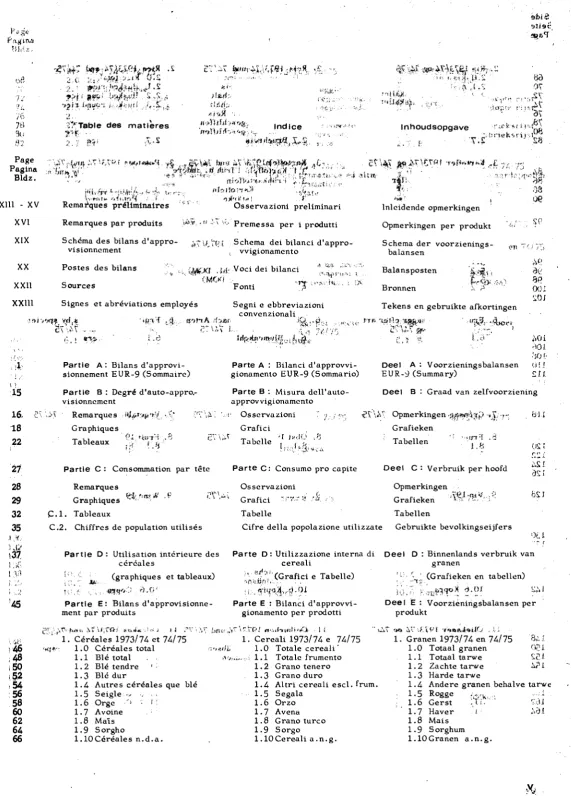
Table des matières Indice
P a g e P a g i n a
B l d z . Xlll XV
XVI XIX XX XXII XX111
R e m a r q u e s p r é l i m i n a i r e s R e m a r q u e s p a r p r o d u i t s
O s s e r v a z i o n i p r e l i m i n a r i
S c h é m a d e s b i l a n s d ' a p p r o v i s i o n n e m e n t
P r e m e s s a p e r i p r o d u t t i
P o s t e s d e s b i l a n s S o u r c e s
S i g n e s e t a b r é v i a t i o n s e m p l o y é s
S c h e m a d e i b i l a n c i d ' a p p r o v v i g i o n a m e n t o
Voci d e i b i l a n c i F o n t t
Inhoudsopgave
Inleidende opmerkingen Opmerkingen per produkt Schema der voorzienings
balansen Balansposten Bronnen
15
16
18
22
27
28
29
32
35
37
45
46
48
50
52
54
56
58
60
62
64
66
Segni e ebbreviazioni
convenzionali Tekens en gebruikte afkortingen
Partie A : Bilans d'approvi sionnement EUR9 (Sommaire) P a r t i e B : Degré d'autoappro. visionnement
Remarques Graphiques Tableaux
Parte A : Bilanci d'approvvi gionamento EUR9 (Sommario)
P a r t e B : Misura dell'auto approvvigionamento
Deel A : Voorzieningsbalansen EUR9 (Summary)
·■ Deel B : Graad van zelfvoorziening
P a r t i e C : Consommation par tête Remarques
Graphiques C . l . Tableaux
C.2. Chiffres de population utilisés
P a r t i e D : Utilisation intérieure des c é r é a l e s
Osservazioni Grafici
T 1 11
labelle
P a r t e C: Consumo pro capite Osservazioni
Grafici Tabelle
■ Opmerkingen
Grafieken Tabellen
Deel C : Verbruik per hoofd Opmerkingen
t- r ι
Grafieken Tabellen
Cifre della popolazione utilizzate Gebruikte bevolkingseijfers
P a r t e D : Utilizzazione interna di Deel D : Binnenlands verbruik van (graphiques et tableaux)
P a r t i e E: Bilans d'approvisionne ment par produits
1. Céréales 1973/74 et 74/75 1.0 Céréales total 1.1 Blé total 1.2 Blé tendre 1.3 Blé dur
1.4 Autres c é r é a l e s que blé 1.5 Seigle
1.6 Orge 1.7 Avoine 1.8 Maïs 1.9 Sorgho
1 . 1 0 C é r é a l e s n . d . a .
cereali
(Grafici e Tabelle)
P a r t e E : Bilanci d'approvvi gionamento per prodotti
1. Cereali 1973/74 e 74/75 1.0 Totale cereali" 1.1 Totale frumento 1.2 Grano tenero 1.3 Grano duro
1.4 Altri cereali e s c i . frum. 1.5 Segala
1.6 Orzo 1.7 Avena 1.8 Grano turco 1.9 S orgo
1.10 Cereali a . η . g.
granen
(Grafieken en tabellen)
Deel E : Voorzieningsbalansen per produkt
1. Granen 1973/74 en 74/75 1.0 Totaal granen 1.1 Totaal tarwe 1.2 Zachte tarwe 1.3 Harde tarwe
1.4 Andere granen behalve tarwe 1.5 Rogge
1.6 Gerst 1.7 Haver 1.8 Mais 1.9 S orghum 1.10Granen a . n . g .
[image:7.595.14.586.11.808.2]Side Seite Page
68 70 72 74 76 78 80 82
Ris 1973/74 og 74/75 2.0 Ris i alt
2.1 Afskallet ris 2.2 Lange r i s , afskallet 2.3 Runde r i s , afskallet 2.4 Sleben r i s
2.5 Lange r i s , sleben 2.6 Runde r i s , sleben 2.7 Brudris
Reis 1973/74 und 74/75 2.0 Reis insgesamt 2.1 Geschälter Reis 2.2 Langreis, geschält 2.3 Rundreis,g eschält 2.4 Geschliffener Reis 2.5 Langreis geschliffen 2.6 Rundreis geschliffen 2.7 Bruchreis
2. Rice 1973/74 and 74/75 2.0 Rice total
2.1 Husked rice 2.2 Husked long rice 2.3 Husked round rice 2.4 Milled rice 2.5 Milled long rice 2.6 Milled round rice 2.7 Broken rice
84 86 88 90
KartoHer 1973/74 og 74/75 3.1 Kartofler i alt
3.2 Tidlige Kartofler 3.3 Andre Kartofler 3.4 Kartoffelstivelse
3. Kartoffelnl973/74 und 74/75 3. 3.1 Kartoffeln : früh u. andere 3.2 Frühkartoffeln
3-3 Andere Kartoffeln 3.4 Kartoffelstärke
Potatoes 1973/74 and 74/75 3.1 Potatoes, early and maincrop 3.2 Potatoes early
3-3 Maincrop potatoes 3.4 Potato starch
92 4. Bælgsced 1973/74 og 74/75 4. Hülsenfrüchte 1973/74 u. 74/75 Dried pulses 1973/74 and 74/75
94 96 98 100 102
104 106 108 110 112 114 116
Sukker og honning 1973-/74 og 74/75
5.1 Sukkerroer 5.2 Sukker (inkl. ©OMi) 5.3 Sukker (ekskll- DOM') 5.4 Melasse
5.5 Honning
Frugt og grønsager efter art " 1973/74 og 74/75 6.1 Blomkål
6.2 Tomater 6.3 AÏ bier 6.4 P æ r e r 6.5 Ferskner 6.6 Appelsiner 6.7 Druer
Zucker und Honig 1973/74
und 74/75 5. Sugar and honey 1973/74 and 74/75 S.I Zuckerrüben
5.2 Zucker(einschl. DOM) 5.3 Zucker (ohne DOM) 5.4 Melasse
5.5 Honig
Obst und Gemüse nach Arten 1973/74 und 74/75 6.1 Blumenkohl 6.2 Tomaten 6.3 Aepfel 6.4 Birnen 6.5 Pfirsiche 6.6 Apfelsinen 6.7 Trauben
5.1 5-2 5 - 3 5-4 5 . 5
Sugar beet
Sugar (including DOM) Sugar (excluding DOM) Molasses
Honey
6. Fruit and vegetables by species
6 . 1 6 . 2 6 . 3 6 . 4 6 . 5 6 . 6 6 . 7
1973/74 and 74/75 Cauliflowers Tomatoes
Apples Pears Peaches Oranges Grapes
118 7. Grønsager 1973/74 og 74/75 7. Gemüse 1973/74 und 74/75 7. Vegetables 1973/74 and 74/75
120 122 124 126
Frugt 1973/74 og 74/75 8.1 Frisk frugt 8.2 Nødder 8.3 Tørrot frugt 8.4 Citrusfrugt
8. Obst 1973/74 und 74/75 8.1 Frischobst 8.2 Schalenobst 8.3 Trockenobst 8.4 Zitrusfrüchte
8. Fruit 1973/74 and 74/75 8.1 Fresh fruit 8.2 Nuts 8.3 Dried fruits 8.4 Citrus fruits
128 9. Vin 1973/74 og 74/75 9. Wein 1973/74 und 74/75 9. Wine 1973/74 and 74/75
130 132 134 136 138 140 142 144 146
148 150 152 154 156 158 160 162 164
10. Oliefrø- og frugter 1973/74 og 74/75 10.0 I alt
10.1 Raps og rybs 10.2 Solsikke 10.3 Soja 10.4 Hør IO.5 Jordnødder 10.6 Kopra 10.7 Palmekærne 10.8 Oliven
11. Oliekager 1973/74 og 74/75 11.0 1 alt
11.1 Raps og rybs 11.2 Solsikke 11.3 Soja 11.4 Hør 11.5 Majs 11.6 Jordnødder 11.7 Kopra 11.8 Oliven
10. Oelsaaten und- fruchte 10. 1973/74 und 74/75
10.0 Total
10.1 Raps und Rübsen 10.2 S onnenblumen 10.3 Soja
10.4 Flachs IO.5 Erdnüsse 10.6 Kopra 10.7 Palmkerne 10.8 Oliven
11. Oelkuchen 1973/74 und 74/75 1 1 . 11.0 Total
11.1 Raps und Rübsen 11.2 S onnenblumen 11.3 Soja 11.4 Flachs 11.5 Mais 11.6 Erdnüsse 11.7 Kopra 11.8 Oliven
Oleaginous seeds and fruit '1973/74 and 74/75 10.0 Total
10.1 Rape and turnip rape 10.2 Sunflower
10.3 Soya beans 10.4 Flax 10..5 Groundnut 10.6 Copra 10.7 Cabbage palm 10.8 Olives'
Oilcakes 1973/74 and 74/75 11.0 Total
11.1 Rape and turnip rape 11.2 Sunflower
11.3 Soya beans 11.4 Flax I I . 5 Maize 11.6 Groundnut I I . 7 Copra 11.8 Olives
Page Pagina
Bldz.
68 70 72 74 76 78 8() 82 84 86 88 90
2. Riz
2 . 0 2 . 1 2 . 2 2 . 3 2 . 4 2 . 5 2 . 6 2 . 7
3 . Pore
3 . 1 3 . 2 3 . 3 3 . 4
92
104 106 108 110 112 114 116
Riz total Riz décortiqué Riz long décortiqué Riz rond décortiqué Riz usiné
Riz long usiné Riz rond usiné Brisures de riz
3 . Pommes de t e r r e 1973/74 et 74/75 Pommes de t. hâtives et autres Pommes de t. hâtives
Autres pommes de t e r r e Fécule de pommes de t e r r e
Riso 1973/74 e 74/75 2.0 Riso (totale) 2.1 Riso semigreggio 2 . 2 Riso semigreggio lunghi 2 . 3 Riso semigreggio tondi 2.4 Riso lavorato
2 . 5 Riso lunghi lavorato 2.6 Riso tondi lavorato 2.7 Rotture di r i s o Patate 1973/74 e 74/75 3.1 Patate primaticce ed altrt 3.2 Patate primaticce
3 . 3 Altre patate 3 . 4 Fecole di patate
Rijst 1973/74 en 74/75 2.0 Rijst (globale) 2.1 Gedopte rijst
2.2 Langkorrelige gedopte rijst 2 . 3 Rondkorrelige gedopte rijst 2 . 4 Fabrieksrijst
'25 Langkorrelige fabrieksrijst 2.6 Rondkorrelige fabrieksrijst 2.7 Breukrijst
Aardappelen 1973/74 en 74/75
3-1 Vroege en andere aardappelen Vroege aardappelen
Andere aardappelen Aardappelzetmeel
3.2 3.3 3.4
4. Légumes secs 1973/74 et 74/75 4. Legumi secchi 1973/74 e 74/75 4 . Peulvruchten 1973/74 en 74/75
94 96 98 00 02
5.1 5.2 5.3 5.4 5.5
5 . Sucre et miel 1973/74 et 74/75 Betteraves s u c r i è r e s Sucre (y compris les DOM) Sucre (sans DOM)
Mélasse Miel
Fruits et légumes par espèces 1973/74 et 74/75
Chouxfleurs Tomates
6 . 7
Ρ omme s P o i r e s Pêches Orange s Raisins
Zucchero e miele 1973/74 e 5 74/75
5.1 Barbabietola da zucchero 5.2 Zucchero (compresi i DOM) 5 . 3 Zucchero (esclusi i DOM) 5 · 4 Melasso
55 Miele
Frutta e ortaggi per specie 6. 1973/74 e 74/75
6.1 Cavolfiore 6.2 Pomodoro 6 . 3 Mela 6 . 4 P e r a 6 . 5 Pesca 6.6 Arancia 6.7 Uva
Suiker en honing 1973/74 e 5.1 Suikerbieten
5.2 Suiker (met DOM) 5 . 3 Suiker (zonder DOM) 5 . 4 Melasse
5.5 Honing
Fruit en groenten per soort 1973/74 en 74/75 6.1 Bloemkool 6.2 Tomaten 6 . 3 Appelen 6 . 4 P e r e n 6 . 5 Verse
6.6 Sinaasappelen 6.7 Druiven
118 7. Légumes 1973/74 et 7 4 / 7 5 ' 7. Ortaggi 1973/74 e 74/75 7. Groenten 1973/74 en 74/75 8. F r u i t s 1973/74 et 74/75
120 8.1 F r u i t s frais 122 8.2 Fruits à coque 124 8.3 Fruits séchés 126 8.4 Agrumes
Frutta
8.1 Frutta fresca 8.2 Frutta in guscio 8 . 3 Frutta secca 8 . 4 Agrumi
8. Fruit
8.1 Vers fruit 8.2 Dopvruchten 8.3 Gedroogd fruit 8.4 Citru s vruchten
128 9 . Vin 1973/74 et 74/75 9. Vino 1973/74 e 74/75 9. Wijn 1973/74 en 74/75
1 3 0 132 134 136 138 140 1 4 2 144 146 148 150 152 154 156 158 160 162 164
10. Graines et fruits oléagineux 1973/74 et 74/75 10.0 Total
10.1 Colzanavette 1 0 . 2 Tournesol 1 0 . 3 Soja 10.4 Lin 10.5 Arachide 10.6 Coprah IO.7 Palmiste 10.8 Olives
11. Tourteaux 1973/74 et 74/75 11.0 Total
11.1 Col za navette 11.2 Tournesol 11.3 Soja 11.4 Lin 1 1 . 5 Mais 11.6 Arachide 11.7 Coprah 11.8 Olives
10. Semi e frutti oleosi 1973/74 e 74/75 10.0 Totale
10.1 Colza e ravizzone 1 0 . 2 Girasole
1 0 . 3 Soja
IO.4 Semi di lino 1 0 . 5 Arachide 10.6 Copra 10.7 Palmisti 10.8 Olive
1 1 . Panelli 1973/74 e 74/75 11.0 Totale
11.1 Colza e ravizzone 1 1 . 2 Girasole
I I . 3 Soja 11.4 S emi di lino 11.5 Granoturco 11.6 Arachide 11.7 Copra 11.8 Olive
10. Oliehoudende zaden en vruchten 1973/74 en 74/75
10.0 Totaal
10.1 Kool en raapzaad 10.2 Zonnebloempitten 1 0 . 3 Sojabonen 1 0 . 4 Lijnzaad 10.5 Grondnoten 10.6 Kopra 10.7 Palmnoten 10.8 Olijven
1 1 . Veekoeken 1973/74 en 74/75 11.0 Totaal
11.1 Koolen raapkoeken 11.2 Zonnebloemkoeken 1 1 . 3 S ojakoeken 1 1 . 4 Lijnkoeken 1 1 . 5 Maiskoeken 11.6 Grondnotenkoeken 11.7 K oprakoeken 11.8 Olijfkoeken
S i d e S e i t e P a g e
166 168 170 172 174 176 178 180 182
184 186 188 190 192 194 196 198 200 202
204 206 208 210 212 214 216 218
220 222
224 226 228
12. Vegetabilisk fedt og olie 1973/74 og 74/75
1 2 . 0 I alt
1 2 . 1 R a p s og r y b s 1 2 . 2 S o l s i k k e 1 2 . 3 Soja 1 2 . 4 Hør 1 2 . 5 J o r d n ø d d e r 1 2 . 6 Kopra 1 2 . 7 P a l m e k a e r n e 1 2 . 8 Oliven
12.
1 3 .
1 4 .
KØd 1974 og 1975 1 3 . 0 KØd i a l t
1 3 . 1 O k s e - og kalvekød i alt 1 3 . 2 Oksekød
1 3 . 3 Kalvekød 1 3 . 4 Svinekød 1 3 - 5 F a r e - og gedekød 1 3 . 6 Hestekød 1 3 . 7 Fjerkrcekød 1 3 . 8 Andet 1 3 . 9 Slagteaffald
M a c l k c p r o d u k t e r 1974 og 1975 1 4 . 1 F r i s k e p r o d u k t e r u.fløde 1 4 . 2 Fløde
1 4 . 3 K o n d e n s e r e t m æ l k 1 4 . 4 S ø d m æ l k s p u l v e r 1 4 . 5 S k u m m e t m æ l k s p u l v e r 1 4 . 6 S m ø r ( p r o d u k t v æ g t ) 1 4 . 7 S mør (fedtindhold) 1 4 . 8 Ost
1 5 . Aog 1974 og 1975 1 5 . 0 Aeg i alt 1 5 . 1 Konsumæg
16. F i s k 1974 og 1975 1 6 . 0 F i s k i alt 1 6 . 1 F r i s k e F i s k 1 6 . 2 F o r a r b e j d e d e F i s k
1 3 .
Pflanzliche F e t t e und Oele 1 9 7 3 / 7 4 und 7 4 / 7 5 1 2 . 0 Total
12.1 Raps und Rübsen 1 2 . 2 Sonnenblumen 1 2 . 3 Soja
1 2 . 4 F l a c h s I 2 . 5 E r d n ü s s e 1 2 . 6 Kopra I 2 . 7 P a l m k e r n e 1 2 . 8 Oliven
F l e i s c h 1974 und 1975 1 3 - 0 F l e i s c h i n s g e s a m t I 3 . I R i n d e r i n s g e s a m t 1 3 - 2 G r o s s r i n d e r I 3 . 3 K ä l b e r 1 3 · 4 S c h w e i n e
I 3 . 5 Schafe und Ziegen 1 3 - 6 Einhufer
I 3 . 7 Geflügel 1 3 . 8 S o n s t i g e 13-9 I n n e r e i e n
12. Vegetable fats and oils 1 9 7 3 / 7 4 and 7 4 / 7 5 1 2 . 0
12.1 1 2 . 2 1 2 . 3 1 2 . 4 1 2 . 5 1 2 . 6 1 2 . 7 1 2 . 8
1 3 . Meat 1 3 . 0 13.1 1 3 . 2 I 3 . 3 1 3 . 4 I 3 . 5 1 3 . 6 1 3 . 7 1 3 . 8 1 3 . 9
Total
Rape and t u r n i p r a p e SunJTower
Soja Flax Groundnut Copra
Cabbage palm Olives
1974 and 1975 Total meat
Total beef Beef Veal P o r k
L a m b , mutton and goat meat H o r s e meat
P o u l t r y O t h e r s Offal
1 4 . M i l c h e r z e u g n i s s e 1974 u. 1975 14. I 4 . I F r i s c h m i l c h e r z . ohne S a h n e I.4.2 Sahne
1 4 . 3 Kondensmilch 1 4 . 4 Volmilchpulver 1 4 . 5 M a g e r m i l c h p u l v e r 1 4 . 6 B u t t e r ( P r o d u k t g e w i c h t ) 1 4 . 7 B u t t e r ( R e i n i e n ) 1 4 . 8 Käse
1 5 . E i e r 1974 und 1975 1 5 . 0 E i e r insgesamt 1 5 . 1 Konsumeier
15.
16.
1 6 . F i s c h e 1974 und 1975 1 6 . 0 F i s c h e i n s g e s a m t 16.1 F r i s c h e F i s c h e
1 6 . 2 B e - und v e r a r b e i t e t e F i s c h e
Milk products 1974 and 1975 14.1 Fresh milk prod. ex. cream
1 4 . 2 C r e a m
1 4 . 3 C o n c e n t r a t e d milk 1 4 . 4 Whole milk powder 1 4 . 5 Skimmed milk powder 1 4 . 6 B u t t e r ( p r o d u c t weight) 1 4 . 7 B u t t e r (fat content) 1 4 . 8 C h e e s e
Eggs 1974 and 1975 15.0 Total eggs
15-1 Eggs for consumption
F i s h 1974 and 1975 1 6 . 0 F i s h total 1 6 . 1 F r e s h fish 1 6 . 2 P r o c e s s e d fish
230 '232 234
1 7 .
B10d-1 7 . 0
1 7 . 1
I 7 . 2
og K r e b s d y r 1974 og 1975 Blød og K r e b s d y r i a l t
F r i s k b l ø d - og k r e b s d y r
F o r a r b e j d e d e Blød - og K r e b s d y r
17. Weic
I 7 . O
1 7 . 1
I 7 . 2
1- und K r e b s t i e r e 17. 1974 und 1975
W e i c h - und K r e b s t i e r e i n s g e s a m t
F r i s c h w e i c h - und K r e b s t i e r e
B e und v e r a r b e i t e t e W e i c h -und K r e b s t i e r e
Shellfish 1974 and 1975
1 7 . 0 Shellfish total
1 7 . 1 F r e s h shellfish
1 7 . 2 P r o c e s s e d shellfish
18. 236 238 240
1 8 . 0 1 8 . 1 1 8 . 2
242
244 246 248
19.
F e d t og olie 1973 og 1974 F e d t og olie i a l t V e g e t a b i l s k olie
Fedt og olie fra l a n d d y r F e d t og olie fra h a v d y r
F o r a r b e j d e t fedt og olie 1973 og 1974 1 9 . 0 i a l t
18.
1 8 . 3
1 9 . 1 1 9 . 2
M a r g a r i n e Andet
1 9 .
F e t t e und Oele 1973 und 1974 1 8 . 1 8 . 0 F e t t e und Oele i n s g e s a m t 1 8 . 1 P f l a n z l i c h e Oele
1 8 . 2 F e t t e und Oele von L a n d t i e r e n
1 8 . 3 F e t t e und Oele von S e e t i e r e n
S p e i s e f e t t e und Oele 1973 und 1974 1 9 . 0 I n s g e s a m t 1 9 . 1 M a r g a r i n e 1 9 . 2 A n d e r e
19.
F a t s and oils 1973 and 1974 1 8 . 0 F a t s and oils total 1 8 . 1 Vegetable oils 1 8 . 2 F a t s and oils from
land animals 1 8 . 3 F a t s and oils from
m a r i n e animals
P r e p a r e d fats and oils 1973 and 1974 1 9 . 0 Total 1 9 . 1 M a r g a r i n e 1 9 . 2 O t h e r s
Page Paginu
Bldz.
166 168 170 172 174 176 178 180 182
184 186 188 190 192 194 196 198 200 202
13.
204 206 208 210 212 214 216 218
12. G r a i s s e s et huiles végétales 1973/74 et 74/75 12.0 Total
12.1 Colzanavette 12.2 Tournesol 12.3 Soja 12.4 Lin 12.5 Arachide 12.6 Coprah 12.7 Palmiste 12.8 Olives
12.
Viande 1974 et 1975 13.0 Viande total
Bovins total Gros bovins Veaux P o r c s
Moutons et chèvres Equidés
Volaille Autres Abats
1 3 13.1
13.2 13.3 13.4 13.5 13.6 13.7 13.8 13.9
220 222
14. Produits laitiers 1974 et 1975 14.1 Produits f r a i s , sauf crème 14.2 Crème
14.3 Lait concentré 14.4 Lait entier en poudre 14.5 Lait écrémé on poudre 146 Beurre (poids produit) 14.7 Beurre (matière g r a s s e ) 14.8 Fromage
15. Oeufs 1974 et 1975
1 4 .
15. I5.O
15.1
Oeufs total
Oeufs de consommation 16. Poissons 1974 et 1975 224 16.0 Poissons total 226 16.1 Poissons frais
228 16.2 Poissons transform.et p r c p a r . 1 6 .
G r a s s i ed olii vegetali 1973/74 e 74/75
1 2 . 12.0
12.1 12.2 1 2 . 3 12.4 12.5 12.6 12.7 12.8 Carne I3.O 13.1 13.2 1 3 . 3 13.4 13.5 I 3 . 6 I 3 . 7 I 3 . 8 I 3 . 9
Totale
Colza e ravizzone Girasole
Soja Semi di lino Arachide Copra Palmisti Olive
1974 e 1975 13. Carne totale
Bovini totale Bovini, salvo vitelli Vitelli
Suini
Ovini e caprini Equini
Volatili Altre carni Frattaglie
Prodotti lattiero 1974 e 1975 14. 14.1
14.2 1 4 . 3 14.4 1 4 . 5 14.6 14.7 14.8
12.0 12.1 12.2 1 2 . 3 12.4 12.5 12.6 12.7 12.8 Vlees
I3.O 13.1 13.2 1 3 . 3 13.4 13.5 13.6 I 3 . 7 13.8 13.9
Prodotti freschi, salvo crema 14.1 Crema
Latte concentrato Latte intero in polvere Latte scremato in polvere Burro (peso prodotto) Burro (materia g r a s s a )
Formaggio
14.2 14.3 1 4 . 4 14.5 I 4 . 6 14.7 14.8 Uova 1974 e 1975
15.0 Uova totale
15.1 Uova da consumo umano Pesci 1974 e 1975
16.0 P e s c i totale 16.1 Pesci freschi
16.2 Pesci preparati e trasform
Plantaardige vetten en oliën 1973/74 en 74/75 Totaal
K ooien raapolie Zonnebloemolie Sojaolie Lijnolie G r ondnotenolie Kokos vet Palmolie Olijfolie
1974 en 1975 Vlees totaal Runden kalfsvlees Rundvlees
Kalfsvlees Varkensvlees
S chapeen geitevlees Raa rdevlees
Vlees van gevogelte Ander vlees
Slachtafval
Verse melkprod. zonder roor Room
Gecondenseerde melk Volle melkpoeder Magere melkpoeder Β oter (produktgewicht) Boter (vetstof)
Kaas
1 5 .
1 6 .
Eieren 1974 en 1975 15.0 Totaal eieren 15.1 Consumptieeieren Vis 1974 en 1975
16.0 Vis totaal 16.1 Verse vis 16.2 Verwerkte vis 17. Mollusques et crustacés
1974 et 1975
230 I7.O Mollusques et c r u s t a c é s total
232 I 7 . I Mollusques et crustacés frais
234 I 7 . 2 Mollusques et crustacés p r é p a r é s et transformés
17. Molluschi e crostacei 1974 e 17· Schaal en weekdieren 1974 e 1975 1974 en 1975
17.0 Molluschi crostacei 17.0 Schaal en weekdieren totaal totale
17.1 Molluschi crostacei 17.1 Schaal en weekdieren, versi freschi
172 Molluschi crostacei 17.2 Verwerkte schaal en preparati e trasformati weekdieren
18. 236
238 240 242
244 246 248
19.
G r a i s s e s et huiles 1973 et 1974 18.0 G r a i s s e s et huiles total 18.1 Huiles végétales 18.2 G r a i s s e s et huiles
d'animaux t e r r e s t r e s 18.3 G r a i s s e s et huiles
d'animaux marins G r a i s s e s et huiles p r é p a r é e s
1973 et 1974 19.0 Total 19.1 Margarine 19.2 Autres
18. G r a s s i ed olij 1973 e 1974 18. Vetten en olien 1973 en 1974 18.0 G r a s s i ed olij totale
18.1 Olij vegetali 18.2 G r a s s i e d olij
animali t e r r e s t r i 18.3 G r a s s i ed olij
animali marini 19. G r a s s i ed oli preparati
1973 e 1974 19.0 Totale 19.1 Margarina 19.2 Altri
1 9 .
18.0 Vetten en olië'n totaal 18.1 Plantaardige oliën
18.2 Vetten en olië'n van landdiere1
18.3 Vetten en olien van zeedierer
S pij svetten en oliën 1973 en 1974 19.0 Totaal 19.1 Margarine 19.2 Andere
■
Indledende bemærkninger
Område a) P r o d u k t e r
Vegetabilske produkter:
Det drejer sig i almindelighed om globale balancer omfattende både en produktions og en markedsopgørelse. For balan cerne »Frugt og grønsager efter art« undtagen de 2 for forar bejdede produkter drejer det sig dog udelukkende om mar kedsbalancer, hvilket ikke tillader beregningen af forbrug til konsum.
Animalske produkter:
— Kød i alt omfatter kød fra hornkvæg, svin, får og geder, hovdyr, fjerkræ, samt andet kød og spiselige biprodukter fra slagtning.
— Mælk omfatter mælk fra køer, får, geder og bøfler. — Æg omfatter æg til konsum og rugeæg.
Fedt og olie:
Omfattende oliefrø og frugter, vegetabilsk fedt og olie, olie kager.
b) G e o g r a f i s k a f g r æ n s n i n g :
— De franske oversøiske amter er, når intet særligt er angivet, betragtet som tredjelande.
— Grønland er betragtet som tredjeland.
— U.K./Channel Islands: i almindelighed er oplysninger for Channel Islands ikke medtaget i oplysningerne for U.K., for enkelte produktgruppers vedkommende (frugt og grøn sager after art, grønsager og kartofler) er U.K.'s indførsel fra Channel Islands inkluderet i U.K.'s anvendelige produk tion.
Balanceposter
Anvendelig produktion: officiel produktion — svind ± statistisk korrektion.
»Frugt og grønsager efter art« undtagen forarbejdede pro dukter: produktion = salg af erhvervsmæssig produktion. Vin: anvendelig produktion = samlet produktion af most og vin — most bestemt for produktion af druesaft. Kød: nettoproduktion = (bruttoegenproduktion — eks port af levende dyr + import af levende dyr) = (slagte vægt af indenlandske slagtninger).
Udenrigshandel: balancebegrebet indebærer, at den sam lede udenrigshandel (med medlemslande og med tredje lande) er indeholdt i balancerne for hvert medlemsland, medens derimod balancerne for EUR6 og EUR9 kun med tager handel med tredjelande (ekstra EUR).
— Mængderne, omregnet til basisprodukt enheder, om fatter:
1) import eller eksport af basisproduktet som sådan, regnet i produktets vægt;
2) import eller eksport af forarbejdede produkter, om regnet til basisprodukt enheder (undtagen i tilfælde, hvor der ved siden af en opgørelse over basispro duktet findes en opgørelse over det forarbejdede produkt).
Intra EURhandel er beregnet ud fra medlemsstaternes im portoplysninger.
— Samlede ressourcer/anvendelse:
Ressourcer ( = anvendelig produktion + import) = anvendelse ( = eksport + lagerforskydning + samlede in denlandske forbrug).
— Lagerforskydninger: = slutlagre begyndelseslagre. En forøgelse af lagrene mellem årets begyndelse og slut ning er en anvendelse af disponible mængder og skal så ledes føjes til eksport og hjemmeforbrug; modsat skal en formindskelse fradrages for at nå til samlet anvendelse.
Som for udenrigshandelens vedkommende omfatter lag rene
1) mængderne af basisprodukter som sådan i produktets vægt;
2) mængderne af forarbejdede produkter omregnet til ba sisproduktenheder.
— Samlede indenlandske forbrug; omfatter blandt andet: — foderforbrug: anvendte mængder uafhængigt af anven
delsesform (direkte, blandet, sammensatte foderstof fer);
— industriel anvendelse: mængder benyttet til andet end foder eller fødevarer (undtagelse: inklusive mængder benyttet til fremstilling af alkohol og øl);
— forarbejdning: mængder beregnet på forarbejdning til brug som foder eller fødevarer.
De under denne balancepost angivne mængder danner basis for en særlig balance for det forarbejdede produkt, for eksempel kartoffelmel, hvidt sukker. . .
— Fødevareforbrug: bruttomængder, der står til rådighed for forbrugerne på en groshandelsstadiet, under alle former for konsum: direkte, konserves, forarbejdet; som følge heraf medregnes ikke tab, svind og lagerforskydninger på detailhandels og husholdningsstadiet.
Den almindelige enhed i balancerne er 1 000 tons (metrisk), af runding kan i enkelte balancer give uoverensstemmelser mel lem i altangivelser og summen af de enkelte balanceposter. For mere udførlige bemærkninger henvises til dette hæftes be mærkninger og tabelnoter, samt til diverse balancers metodik, således som denne er beskrevet i de enkelte hæfter af serien Landbrugsstatistik.
Afledede beregninger
De to afledede beregninger er mere indikationer af størrelses ordenen end nøjagtige angivelser.
Selvforsyning :
Selvforsyningsgraden udtrykker den procentdel, som inden landsk produktion (det vil sige »anvendelig produktion« af indenlandske oprindelse) udgør af indenlandsk forbrug.
Selvforsyningsgraden indenlandsk produktion χ 100 indenlandsk forbrug Fødevareforbrug pr. indbygger (kg/år) :
Vorbemerkungen
Bereich
a) E r z e u g n i s s e Pflanzliche Erzeugnisse:
Im allgemeinen handelt es sich um eine Gesamtbilanz, die so wohl die Erzeugungs als auch die Marktbilanz umfaßt. Bei den Bilanzen für „Obst und Gemüse nach A r t e n " handelt es sich jedoch — außer bei verarbeiteten Erzeugnissen — nur um Marktbilanzen, bei denen ein ProKopfVerbrauch nicht er rechnet werden kann.
Tierische Erzeugnisse:
— Das Fleisch insgesamt umfaßt das Fleisch von Rindern, Schweinen, Schafen, Ziegen, Einhufern, Geflügel und son stigen Fleischarten sowie Innereien.
— Die Milch umfaßt Kuh, Schafs, Ziegen und Büffelmilch. — Die Eier umfassen Konsumeier und Bruteier.
Fette und öle:
Umfassen Ölsaaten und fruchte, pflanzliche Fette und Öle und Ölkuchen.
b) G e o g r a f i s c h e A b g r e n z u n g e n
— Falls nicht anders angegeben, sind die französischen Über seedepartemente (DOM) als Drittländer anzusehen. — Grönland ist nicht in Dänemark enthalten, sondern als
Drittland anzusehen.
— Vereinigtes Königreich: im allgemeinen sind die Angaben der Channel Islands nicht in den Angaben des Vereinigten Königreiches enthalten. Für einige Erzeugnisse jedoch (Kartoffeln, Gemüse, Obst und Gemüse nach Arten) sind in der verwendbaren Erzeugung des Vereinigten König reiches die Einfuhren aus den Channel Islands enthalten. Posten
— Verwendbare Erzeugung = offizielle Erzeugung — Schwund ± statistische Berichtigungen.
Obst und Gemüse nach Arten (außer verarbeiteten Erzeug nissen): Erzeugung = Verkäufe der erwerbsmäßigen Er zeuger.
Wein: Verwendbare Erzeugung = Erzeugung an Most und Wein insgesamt — Most der zur Erzeugung von Trauben saft bestimmt ist.
Fleisch: Nettoerzeugung + (Bruttoeigenerzeugung — Ausfuhr lebender Tiere + Einfuhr lebender Tiere) = A n zahl der Schlachtungen χ mittleres Schlachtgewicht. — Außenhandel: Im Konzept der Bilanzen ist für jedes Mit
gliedsland der gesamte Außenhandel (mit den Mitglieds ländern und den Drittländern) enthalten, während für EUR6 und EUR9 nur der Handel mit Drittländern enthal ten ist (Extra EUR).
— Mengen, die im Wert des Grunderzeugnisses ausgedrückt sind, enthalten:
1. die Ein oder Ausfuhren des Grunderzeugnisses als solche, in Produktgewicht;
2. die Ein oder Ausfuhren der verarbeiteten Erzeugnisse, ausgedrückt im Wert des Grunderzeugnisses (außer wenn neben der Bilanz des Grunderzeugnisses eine Bi lanz des verarbeiteten Erzeugnisses besteht).
Der EURBinnenhandel ist nach der Einfuhrstatistik der Emp fangsländer berechnet.
— Aufkommen/Verwendung insgesamt:
Aufkommen ( = Verwendbare Erzeugung + Einfuhren) = Verwendung ( Ausfuhren ± Bestandsveränderungen + Inlandsverwendung insgesamt).
— Bestandsveränderungen = Endbestand — Anfangsbe stand.
Eine Zunahme der Bestände zwischen Beginn und Ende des Jahres bedeutet eine Verwendung der verfügbaren Mengen und wird somit den Ausfuhren und der Inlands verwendung hinzugefügt; umgekehrt wird eine Verminde rung von den Ausfuhren und der Inlandsverwendung in Abzug gebracht.
Wie beim Außenhandel umfassen die Bestände:
1. die Mengen des Grunderzeugnisses als solches, in Pro duktgewicht;
2. die Mengen der verarbeiteten Erzeugnisse, ausgedrückt im Wert des Grunderzeugnisses.
— Inlandsverwendung:
— Futter: Mengen der verschiedensten Verwendungsarten (direkt, Mengfutter, Mischfutter usw.).
— Industrielle Verwertung: Mengen, die für Nichtnah rungszwecke verwendet werden (ausgenommen die Mengen, die zur Herstellung von Alkohol und Bier ver wendet werden).
— Verarbeitung: Mengen, die zur Verarbeitung von Nah rungsmitteln bestimmt sind.
Die unter dieser Rubrik aufgeführten Mengen dienen der Erstellung eigener Bilanzen (Bilanzen verarbeiteter Erzeugnisse), ζ. B. bei Kartoffeln die Bilanz der Kartof felstärke, bei Zuckerrüben die Bilanz des Weißzuk kers . . .
— Nahrungsverbrauch: Bruttomengen, die dem Verbraucher beim Großhandel in jeglicher Form zum Nahrungsver brauch zur Verfügung stehen (direkt, Konserven, verarbei tete Erzeugnisse). Es handelt sich also um einen Verbrauch, bei dem die Verluste und Bestandsveränderungen des Ein zelhandels und der Haushaltungen nicht berücksichtigt sind und der deshalb größer ¡st als der wirkliche Verbrauch. Die im allgemeinen verwendete Einheit in den Versorgungsbi lanzen ist „1 000 t " . Die Differenzen in einigen Tabellen sind auf Rundungen der Angaben zurückzuführen.
Nähere Erläuterungen sind den Anmerkungen und den Fuß noten dieses Heftes sowie der Methodik der verschiedenen Bi lanzen zu entnehmen, die in den Heften der Reihe „Agrar statistik" enthalten sind.
Abgeleitete Berechnungen
Die Ergebnisse dieser Berechnungen geben nur ein Größen verhältnis wieder.
Selbstversorgung
Der Grad der Selbstversorgung wird in Prozenten ausgedrückt und gibt die Inlandserzeugung, d. h. die verwendbare Erzeu gung inländischer Herkunft im Verhältnis zu der Inlandsver wendung wieder.
Selbstversorgungsgrad = Inlandserzeugung χ 100 Inlandsverwendung Nahrungsverbrauch pro Kopf (kg, pro Kopf, pro Jahr): Es handelt sich hier um den Verbrauch pro Kopf, der sich aus dem Posten „Nahrungsverbrauch" der Bilanz errechnet, wo bei Angaben zur „Wohnbevölkerung" zugrunde gelegt wer den.
Preliminary remarks
Coverage
a) P r o d u c t s
Crop products:
Generally a global balance sheet incorporating the balance in production and on the market. However for the fruit and vegetables by species, the balance sheets for those in a fresh state comprise only the market balance sheets, from which per capita human consumption is not calculable.
Livestock products:
— total meat comprises meat from cattle, pigs, sheep and goats, equines, poultry, other meat and edible offal;
— milk comprises cow, sheep, goat and buffalo milk;
— eggs comprise eggs for consumption and hatching.
Oils and fats:
Comprise oleaginous seeds and fruit, vegetable fats and oils and oilcakes.
b) G e o g r a p h i c l i m i t a t i o n s
— Unless otherwise indicated the French Overseas Depart ments are excluded.
— Greenland is not included in the data for Denmark but is considered as a third country.
— In general the data for the United Kingdom does not in clude data for the Channel Islands. However for certain groups of products (fruit and vegetables by species, vege tables and potatoes) the usable production of the U.K. includes importations from the Channel Islands.
Items in the balance sheets
official production — waste ± statis-— Usable production
tical adjustment.
Fruit and Vegetables by species (except for the processed products): production = sales by commercial growers.
Wine: usable production = total production of must and wine — must intended for grape juice production.
Meat: net production = (gross domestic production — exports of live animals + imports of live animals) = carcase weight of domestic slaughterings.
— External trade — Under the balance sheet concept, the total external trade (with member countries and third countries) is reported for each individual Member State, whilst only trade with third countries (extra-EUR) is reported for EUR-6 and EUR-9.
— Quantities, expressed in basic product equivalents, com prise:
(Dimports or exports of the basic product as such, in product weight;
(2) imports or exports of processed products, expressed in basic product equivalent (unless there is a balance sheet of the processed product as well as one of the basic product).
The intra-EUR trade has been calculated from the data for the imports of Member States.
— Total Resources/Uses:
Resources ( = usable production + imports) = Uses ( = exports ± stock variation + total domestic uses).
— Stock variation: = Closing stocks — opening stocks.
An increase in stocks between the beginning and the end of the year represents a usage of available resources and is therefore added to exports and domestic uses; con versely, a decrease is deducted from exports and domestic utilization.
As with external trade, stocks comprise:
(1) amounts of the basic product as such, in product weight;
(2) amounts of processed products, expressed in basic product equivalent.
— Total domestic uses: includes inter alia:
— Animal feeding stuffs: amounts used, irrespective of form (direct, mixed, compound animal feed etc.).
— Industrial use: amounts used for non-food purposes (in cludes, however, amounts used for the manufacture of alcohol and beer).
— Processing: amounts intended for processing into food.
The quantities indicated under this heading are made the subject of a separate balance sheet (balance sheet for processed products) for example potato starch, white sugar...
— Human consumption: gross amounts made available to consumers at the wholesale stage, in all forms of con sumption: direct, preserves, and processed products; con sequently no account is taken of losses or stock variations at the retail trade stage or at household level.
The unit generally used for the supply balance sheets is thousand metric tons: due to rounding the total may not correspond to the sum of individual items.
For greater detail concerning the products and the metho dology of the different balance sheets reference should be made to the Agricultural Statistics series.
Derived calculations
The data for the derived calculations are given to the nearest unit and give an indication of the magnitude rather than a precise value.
Self sufficiency:
The degree of self sufficiency is the usable production (or usable production from indigenous base material) expressed as a percentage of the domestic uses.
Degree of self sufficiency = Domestic production χ 100 Domestic uses
Consumption per head (kg/head/year):
This is in fact the apparent consumption per head calcu lated from the item 'Human consumption' of the balance sheets.
This calculation is based on the total resident population of the countries.
Remarques préliminaires
Champ a) P r o d u i t s Produits végétaux:
Il s'agit en général du bilan global englobant le bilan à la pro duction et le bilan de marché. Cependant, pour les fruits et légumes par espèces (sauf produits transformés), il s'agit uni quement des bilans de marché, ce qui ne permet pas de calcu ler la consommation humaine par tête.
Produits animaux:
— La viande totale comprend les viandes bovines, porcines, de moutons et chèvres, d'équidés, de volaille, les autres viandes (gibier) et les abats comestibles.
— Le lait comprend les laits de vache, de brebis, de chèvre et de bufflonnes;
— Les œufs comprennent les œufs de consommation et les œufs à couver.
Graisses et huiles:
Comprennent les graines et fruits oléagineux, les graisses et huiles végétales et les tourteaux.
b) D é l i m i t a t i o n g é o g r a p h i q u e
— Sauf mention particulière, les départements français d'OutreMer (D.O.M.) sont considérés comme Pays Tiers. — Le Groenland n'est pas compris sous Danemark, mais con
sidéré comme Pays Tiers.
— RoyaumeUni: en général les données concernant les Channel Islands sont exclues des données concernant le RoyaumeUni; cependant, pour certains groupes de pro duits (pommes de terre, légumes, fruits et légumes par espèces), la production utilisable du RoyaumeUni com prend les importations en provenance des Channel Islands.
Postes
— Production utilisable = ajustement statistique.
production officielle — freintes ±
Fruits et légumes par espèces (sauf produits transformés): production = vente par les producteurs professionnels. Vin: production utilisable = production de moûts et de vin totale — moûts destinés à la production de jus de raisin. Viande: production nette = (production intérieure brute — exportation d'animaux vivants + importations d'animaux vivants) = (nombre d'abattages χ poids moyen car casse).
Commerce extérieur: Dans le concept des bilans, le com merce extérieur total (avec les pays membres et les pays tiers) est retenu pour chaque pays membre, alors que pour EUR6 et EUR9 est retenu uniquement le commerce avec les pays tiers (extraEUR).
— Les quantités exprimées en équivalent du produit de base, comprennent:
(1) les importations ou exportations du produit de base tel quel, en poids de produit;
(2) les importations ou exportations des produits trans formés, exprimées en équivalent du produit de base (sauf s'il existe, à côté du bilan du produit de base, un bilan du produit transformé).
Les échanges intraEUR sont calculés à partir des données d'importations des Pays membres.
— Total des Ressources, Total des Emplois:
Ressources ( = production utilisable + importations) = Emplois ( = exportations + variation des stocks + utilisa tion intérieure totale).
— Variation des stocks = stocks finals — stocks de début. Un accroissement des stocks entre le début et la fin de l'année constitue un emploi des quantités disponibles et vient donc s'ajouter aux exportations et à l'utilisation inté rieure; inversement une diminution vient en déduction des exportations et de l'utilisation intérieure.
Comme pour le commerce extérieur les stocks compren nent:
(1) les quantités du produit de base, tel quel, en poids de produit;
(2) les quantités des produits transformés exprimées en équivalent du produit de base.
— Utilisation intérieure:
— Alimentation animale: quantités utilisées quelle que soit la forme d'utilisation (directe, en mélange, sous forme d'aliment composé, etc.).
— Usages industriels: quantités utilisées pour des usages non alimentaires (par exception, comprend les quantités utilisées pour la fabrication de l'alcool et de la bière). — Transformation: quantités destinées à la transformation
pour un usage alimentaire.
Les quantités indiquées sous cette rubrique font l'objet d'un bilan séparé (bilan de produits transformés), par exemple la fécule de pomme de terre, le sucre blanc... — Consommation humaine: quantités brutes disponibles pour
la consommation humaine au stade du marché de gros, sous toutes les formes de consommation (directe, conser ves, produits transformés); par conséquent il s'agit d'une consommation apparente (comprenant les pertes et les variations de stocks au niveau du marché de détail et au niveau des ménages), qui est supérieure à la consomma tion effective.
L'unité généralement utilisée pour les bilans d'approvisionne ment est: «1 000 t». Les différences qui se trouvent parfois dans les tableaux proviennent de l'arrondi des données. Pour de plus amples détails, se reporter aux remarques et notes du présent fascicule et à la méthodologie des divers bilans, exposée dans les divers numéros de la Série Statistique Agricole.
Calculs dérivés
Les résultats de ces calculs ne donnent qu'un ordre de gran deur.
Auto -appro visionnement
Le degré d'autoapprovisionnement exprime le pourcentage que représente la production intérieure, c'estàdire la produc tion utilisable d'origine intérieure par rapport à l'utilisation intérieure.
Degré
d'autoapprovisionnement=
Production intérieure χ 100 Utilisation intérieure Consommation par tête (kg/tête/an):
Il s'agit en réalité de la consommation apparente par tête, calculée à partir du poste «Consommation humaine» du bilan. Ce calcul est basé sur les données de la population totale rési dente des pays.
Premessa
Campo d'indagine a) P r o d o t t i Prodotti vegetali:
Per la maggior parte dei prodotti vegetali esistono un bilancio alla produzione e un bilancio di mercato, che sono riuniti in un bilancio globale. Tuttavia per «frutta e ortaggi per specie (esclusi i prodotti trasformati)» si tratta unicamente di bilancio di mercato, per cui non può essere calcolato il consumo umano pro capite.
Prodotti zootecnici:
— Il bilancio totale della carne comprende la carne bovina, suina, caprina e equina, pollame e le altre carni (caccia gione) e frattaglie commestibili.
— Il latte comprende il latte di vacca, di pecora, di capra e di bufala.
— Le uova comprendono le uova da consumo e le uova da cova.
Grassi e oli: Comprendono panelli.
semi e frutti oleosi, grassi e oli vegetali e
b) L i m i t i g e o g r a f i c i
— Salvo menzione specifica, i dipartimenti francesi d'Oltre mare sono considerati paesi terzi.
— La Groenlandia non è inclusa nei dati relativi alia Dani marca ma considerata paese terzo.
— Regno Unito: in generale i dati relativi alle ¡sole della Manica non sono considerati nei dati relativi al Regno Unito; ciononostante per alcuni gruppi di prodotti (patate, ortaggi, frutta e ortaggi per specie) la produzione utilizza bile del Regno Unito comprende le importazioni dalle ¡sole della Manica.
Rubriche
— Produzione utilizzabile = produzione ufficiale cali ± aggiustamento statistico.
Frutta e ortaggi per specie (esclusi i prodotti trasformati): produzione = vendite da parte di produttori professionali. Vino: produzione utilizzabile = produzione totale di mosti
— mosti destinati alla produzione di succo d'uva.
Carne: produzione netta = (produzione indigena lorda — esportazione di animali vivi + importazioni di animali vivi)
= numero delle macellazioni χ peso morto medio). — Commercio estero: Nel concetto di bilancio, il commercio
estero totale (con i paesi membri e i paesi terzi) è preso in considerazione per ciascun paese membro, mentre per EUR6 è preso in considerazione unicamente il commercio con i paesi terzi (extraEUR).
— Le quantità, espresse in equivalente del prodotto di base, comprendono:
(1) le importazioni o esportazioni del prodotto di base non trasformato, espresse in peso del prodotto; (2) le importazioni o esportazioni dei prodotti trasfor
mati, espresse in equivalente del prodotto di base (a meno che vi sia, accanto al bilancio del prodotto di base, anche un bilancio del prodotto trasformato). Gli scambi intraEUR sono calcolati sulla base dei dati rela tivi alle importazioni dei paesi membri.
— Totale risorse, totale utilizzazioni:
Risorse ( = produzione utilizzabile + importazioni) = Im pieghi ( = esportazioni + variazione delle scorte + totale impieghi interni).
— Variazione delle scorte = scorte finali — scorte iniziali. Un aumento delle scorte tra l'inizio e la fine dell'anno costituisce un impiego delle quantità disponibili e viene quindi ad aggiungersi alle esportazioni e agli impieghi interni; inversamente una diminuzione viene detratta dalle esportazioni e dagli impieghi interni.
Come per il commercio estero le scorte comprendono: ( D i e quantità del prodotto di base, non trasformato,
espresse in peso del prodotto;
(2) le quantità dei prodotti trasformati, espresse in equiva lente del prodotto di base.
— Totale impieghi interni:
— Alimentazione animale: quantità impiegate come man gime, in qualsiasi forma (direttamente in miscuglio, sotto forma d'alimento composto).
— Usi industriali: quantità impiegate per usi non alimentari (comprese peraltro le quantità impiegate per la fabbri cazione dell'alcool e della birra).
— Trasformazione: quantità destinate alla trasformazione per uso alimentare.
Le quantità indicate in questa rubrica sono prese in considerazione in un bilancio separato (bilancio dei pro dotti trasformati), per esempio la fecola di patata, lo zucchero raffinato...
— Consumo umano: quantità lorde disponibili al consumo umano allo stadio del mercato all'ingrosso indipendente mente dalla forma di consumo (diretto, del prodotto con servato o trasformato); di conseguenza si tratta di un con sumo apparente (incluse le perdite e le variazioni delle scorte allo stadio del commercio al dettaglio e delle famiglie) che è superiore al consumo effettivo.
L'unità di misura generalmente utilizzata è: 1 000 t. Le diffe renze che si riscontrano talvolta nelle tabelle sono dovute all'arrotondamento.
Per ulteriori dettagli si considerino le osservazioni sui prodotti, le note delle tabelle e la metodologia dei diversi bilanci, conte nuta nei diversi numeri della serie Statistica Agraria.
Calcoli diversi
I risultati di questi calcoli non forniscono che un ordine di grandezza.
A utoappro vvigionamento
II grado di autoapprovvigionamento esprime la percentuale della produzione interna (cioè, o la produzione utilizzabile, o la produzione a partire dalle materie prime indigene) in rapporto agli impieghi interni.
Grado di
autoapprovvigionamento =
Produzione interna χ 100 Impieghi interni
Consumo pro capite (kg/testa/anno):
Si tratta in realtà del consumo apparente pro capite, calco lato partendo dalla rubrica «Consumo umano» del bilancio. Tale calcolo è basato sui dati relativi alla popolazione totale residente del paese.
Inleidende opmerkingen
Gebied
a) P r o d u k t e n Plantaardige produkten:
Gewoonlijk bestaande uit één balans die de produktie en de marktbalans omvat. Voor fruit en groenten per soort (niet de verwerkte produkten) bestaan evenwel alleen marktbalansen, die het niet mogelijk maken het verbruik per hoofd te bereke nen.
Dierlijke produkten:
— Vleestotaal omvat rund en kalfsvlees, varkensvlees, schape en geitevlees, vlees van pluimvee, andere vlees soorten (wild) en eetbare slachtafvallen.
— Melk omvat koemelk, schape, geite en buffelmelk. — Eieren omvat consumptieeieren en broedeieren. Vetten en oliën:
Omvatten oliehoudende zaden en vruchten, plantaardige vet ten en oliën en veekoeken.
b) G e o g r a f i s c h e a f b a k e n i n g
— Indien niet uitdrukkelijk vermeld, omvatten de Franse cijfers geen gegevens van hun overzeese departementen, die bij de derde landen gerekend worden.
— Groenland is niet in de gegevens van Denemarken inbegre pen en wordt eveneens als derde land aangezien.
— Verenigd Koninkrijk: In het algemeen bevatten de balansen van het Verenigd Koninkrijk geen gegevens der Kanaal eilanden. Voor enkele groepen van produkten echter (aard appelen, groenten, fruit en groenten per soort) omvat de bruikbare produktie van het Verenigd Koninkrijk ook de invoer uit deze eilanden.
Posten
— Bruikbare produktie = officiële produktie — verliezen ± statistische correctie.
Fruit en groenten per soort (niet de verwerkte produkten): produktie = verkoop door beroepsproducenten.
Wijn: bruikbare produktie = totale produktie van most en wijn — voor de bereiding van druivesap bestemde most. Vlees: nettoproduktie = (binnenlandse brutoproduktie — uitvoer levende dieren + invoer levende dieren) = (aantal slachtingen χ gemiddeld karkasgewicht).
— Buitenlandse handel: In de balansen is het totaal van de buitenlandse handel (met LidStaten en derde landen) weerhouden voor elke LidStaat; daarentegen is voor EUR6 en EUR9 alleen de handel met derde landen (extra EUR) berekend.
— De hoeveelheden, uitgedrukt in equivalenten van het basisprodukt, omvatten:
( D d e in of uitvoer van het basisprodukt in de oor spronkelijke toestand, uitgedrukt in gewicht van het produkt;
(2) de in of uitvoer van de verwerkte produkten, uit gedrukt in equivalenten van het basisprodukt (be halve wanneer er naast de balans van het basispro dukt een balans van het verwerkte produkt bestaat). In intraEUR handel wordt berekend uit de invoergegevens van de LidStaten.
— Totaal beschikbare hoeveelheden. Totaal gebruik:
Beschikbare hoeveelheden ( = bruikbare produktie + in voer) =
Gebruik ( = uitvoer + schommelingen in de voorraden + totaal binnenlands verbruik).
— Voorraadmutatie = eindvoorraden — beginvoorraden. Toename van de voorraden tussen het begin en het einde van het jaar vormt een gebruik van beschikbare hoeveel heden en wordt dus toegevoegd aan de uitvoer en het bin nenlands verbruik; omgekeerd wordt een voorraadvermin dering afgetrokken van de uitvoer en het binnenlands verbruik.
Evenals bij de buitenlandse handel omvatten de voorraden: (1) de hoeveelheden van het basisprodukt in de oorspron
kelijke toestand uitgedrukt in gewicht van het produkt; (2) de hoeveelheden verwerkte produkten, uitgedrukt in
equivalenten van het basisprodukt. — Binnenlands verbruik:
— Veevoeder: verbruikte hoeveelheden ongeacht de vorm van verbruik (rechtstreeks, losse mengsels, onder vorm van mengvoeders, enz.).
— Industrieel gebruik: voor andere doeleinden dan voor voedingsmiddelenindustrie gebruikte hoeveelheden (hieronder zijn bij wijze van uitzondering de voor de be reiding van alcohol en bier gebruikte hoeveelheden be grepen).
— Venwerking: hoeveelheden bestemd voor de verwerking tot voedingsmiddelen.
De in deze rubriek vermelde hoeveelheden vormen het onderwerp van een afzonderlijke balans (balans van verwerkte produkten) b. v. balans van aardappelzet meel, balans van witsuiker...
— Menselijke consumptie: Brutohoeveelheden, in het stadium van de groothandel ter beschikking van de verbruikers gesteld, in alle vormen van consumptie: rechtstreeks, ver duurzaamd, verwerkte produkten; hierbij is derhalve geen rekening gehouden met verliezen en voorraadmutaties in het stadium van de kleinhandel en evenmin met de ver liezen en voorraadmutaties op het niveau van de huishou dens.
De in het algemeen gebruikte eenheid in de Voorzieningsba lansen is „ 1 000 t". De mogelijke verschillen in de tabellen ont staan uit het afronden der gegevens.
Voor verdere bijzonderheden zij verwezen naar de opmerkin gen van de onderscheidene produkten, de nota's op de ta bellen en de methode van de verschillende balansen uiteenge zet in de overeenstemmende nummers van de reeks „Land bouwstatistiek".
Afgeleide berekeningen
De resultaten van deze berekeningen geven slechts de ver houding tussen grootheden weer.
Zelfvoorziening
De graad van zelfvoorziening drukt in procenten de verhou ding van binnenlandse produktie (dat wil zeggen: de „bruik bare produktie" afkomstig uit inlandse grondstoffen) tot bin nenlands verbruik uit.
Graad van zelfvoorziening = binnenlandse produktie χ 100 binnenlands verbruik Verbruik per hoofd (kg/hoofd/jaar):
In werkelijkheid gaat het hier om de schijnbare consumptie berekend uit de post „Menselijke consumptie" der balans. Deze berekening berust op de verblijfhoudende bevolking der landen.
REMARKS BY PRODUCT
REMARQUES PAR PRODUIT
E . l . Cereals - These balance sheets are global in that they include the base product and the pro-ducts of processing (flour, bread, biscuits). They are expressed in grain, but the consumption figu-r e s afigu-re also expfigu-ressed in floufigu-r equivalent.
Crop year : 1 . 8 - 3 1 - 7
E . l . Céréales - Ces bilans sont globaux dans le sens qu'ils comprennent le produit de base et les produits transformés (farine, pain, biscuits). Ils sont exprimés en équivalent de grain, les données de consommation humaine étant de plus exprimées en équivalent farine.
Année campagne : 1.8 - 31.7
E . 2 . Rice - The total rice balance sheet (expressed in husked rice) is global in that it takes account of the products of processing. The separate balance sheets for husked, milled and broken rice are expressed in weight of those products respectively. Crop year : 1.8 - 31-7
E . 2 . Riz - Le bilan riz total (exprimé en riz décor-tiqué) est global dans le sens qu'il comprend les pro-duits transformés. Les bilans séparés pour riz dé-cortiqué, riz usiné et brisures de riz sont exprimés en poids de produit.
Année campagne : 1.8. - 31.7
E . 3 . Potatoes - The balance sheets for potatoes are not global in that they exclude the processed product, potato starch, for which there is a sepa-rate balance sheet.
Crop year : 1.7 - 30.6
E . 3 . Pommes de terre - Les bilans pommes de terre ne sont pas globaux dans le sens qu'ils ne comprennent pas le produit transformé, fécule de pommes de t e r r e , pour lequel il y a un bilan séparé. Année campagne : 1.7 - 30.6
E . 4 . Dried pulses - Includes conserves. Expressed in weight of dried pulses. Crop year : 1.7 - 30.6
E . 4 . Légumes secs - Y compris conserves. Exprimé en poids de légumes secs.
Année campagne : 1.7 - 30.6
E . 5 . Sugar
-E . 5 . 1 . Sugar beet
Includes only fresh sugar beet. Excludes sugar beet grown for the seed.
Crop year : 1.7 - 30.6
E . 5 · Sucre
-E . 5 . 1 . - Betteraves sucrières
Uniquement Tes Betteraves sucrières frafehes, à l'exception des betteraves cultivées pour la semence.
Année campagne : 1.7 - 30.6
E.5-2-3 - Sugar.
These balance sheets include cane and beet sugar (raw and white) and the sugar contained in sugar products.
Two balance sheets are established : 1) French overseas departments (DOM)
considered as part of the Community, 2) DOM considered as third countries.
Expressed in white sugar equivalents. Crop year : 1.7 - 30.6
E . 5 . 2 - 3 - Sucre_
Comprend Te sucre tel quel de betterave et de canne (brut et blanc) et le sucre contenu dans les produits sucrés.
Deux bilans sont établis :
1) DOM Français considérés comme faisant partie de la Communauté
2) DOM Français considérés comme Pays Tiers.
Exprimés en équivalent do sucre blanc. Année campagne : 1.7 - 30.6
E . 5 . 4 . - Molasses
Contains molasses from sugar beet and cane. A by-product of sugar manufacture containing a large proportion of saccharose (which may be extracted in sugar refineries).
Crop year : 1.7 - 30.6
E . 5 . 4 . - Melasse
Comprend la mélasse de betterave et de canne. Sous-produit de la fabrication du sucre qui contient encore une forte proportion de saccha-rose (extraction éventuelle en sucrateries). Année campagne : 1.7 - 30.6
E . 5 . 5 . - Honey
Natural bees honey only. Crop year : 1.7 - 30.6
E . 5 . 5 . - M i e l
Miel naturel d'abeilles uniquement. Année campagne : 1.7 - 30.6
E . 6 . Fruit and vegetables by species - Market balance sheets in which cauliflowers, apples, p e a r s , grapes and oranges include conserves and juices. For tomatoes and peaches separate balance sheets are established for the processed products. Expressed in fresh product equivalents.
Crop year : 1.4 - 31 · 3
E . 6 . Fruits et légumes par espèces - Bilans du marché des choux-fleurs, pommes, poires, raisins et oranges : comprennent les conserves et les jus. Pour les tomates et les pêches, des bilans séparés sont également établis pour les produits transformés. Exprimés en équivalent de produit frais.
Année campagne : 1 . 4 - 31.3
E.7· Vegetables (total) - A global balance sheet which includes conserves. Expressed in fresh product equivalents.
Crop year : 1.7 - 30.6
E . 7 . Légumes (total) - Bilan global, y compris les conserves. Exprimé en poids de produit frais. Année campagne : 1.7 - 30.6