R E S E A R C H A R T I C L E
Open Access
Where there is no evidence: implementing
family interventions from recommendations
in the NICE guideline 11 on challenging
behaviour in a South African health service
for adults with intellectual disability
Ockert Coetzee
1, Leslie Swartz
2*, Charlotte Capri
1and Colleen Adnams
1Abstract
Background:
Low- and middle-income countries often lack the fiscal, infrastructural and human resources to conduct
evidence-based research; similar constraints may also hinder the application of good clinical practice guidelines based
on research findings from high-income countries. While the context of health organizations is increasingly recognized
as an important consideration when such guidelines are implemented, there is a paucity of studies that have
considered local contexts of resource-scarcity against recommended clinical guidelines.
Methods:
This paper sets out to explore the implementation of the NICE Guideline 11 on family interventions
when working with persons with intellectual disability and challenging behavior by a group of psychologists
employed in a government health facility in Cape Town, South Africa.
Results:
In the absence of evidence-based South African research, we argue that aspects of the guidelines, in
particular those that informed our ethos and conceptual thinking, could be applied by clinical psychologists
in a meaningful manner notwithstanding the relative scarcity of resources.
Conclusion:
We have argued that where guidelines such as the NICE Guidelines do not apply contextually
throughout, it remains important to retain the principles behind these guidelines in local contexts. Limitations
of this study exist in that the data were drawn only from the clinical experience of authors. Some of the implications
for future research in resource-constrained contexts such as ours are discussed. Smaller descriptive, qualitative studies
are necessary to explore the contextual limitations and resource strengths that exist in low- and middle-income
settings, and these studies should be more systematic than drawing only on the clinical experience of authors, as
has been done in this study.
Keywords:
Intellectual disability, Challenging behaviour, NICE guidelines, Low-income contexts
© The Author(s). 2019Open AccessThis article is distributed under the terms of the Creative Commons Attribution 4.0 International License (http://creativecommons.org/licenses/by/4.0/), which permits unrestricted use, distribution, and reproduction in any medium, provided you give appropriate credit to the original author(s) and the source, provide a link to the Creative Commons license, and indicate if changes were made. The Creative Commons Public Domain Dedication waiver (http://creativecommons.org/publicdomain/zero/1.0/) applies to the data made available in this article, unless otherwise stated.
* Correspondence:[email protected]
Background
The importance of providing good standards of care for
persons with intellectual disability (ID) is increasingly
recognized [
1
,
2
]. The publication of a growing number
of evidence-based studies and recommendations of good
practice, such as the guidelines of the National Institute
for Clinical Excellence (NICE), when working with
fam-ilies of people with ID and behavior that challenges,
marks the maturity of family and caregiving research in
the field of ID. The NICE system is used in the United
Kingdom, and guidelines are drawn up using the best
available evidence for what has been shown to work in a
range of health-related fields [
3
]. The National Institute
for Clinical Excellence has also published guidelines on
the prevention, assessment and management of mental
health problems among those with ID [
4
]. Both these
guidelines highlight the need to provide family
interven-tions if a person presents with behavior that challenges
[
3
,
4
]; in the field of ID in general, best practice suggests
involving families and community resources in all
as-pects of care [
5
]. The NICE system is not the only set of
guidelines available. For example, the Health Equalities
Framework is based on an understanding of the
inequal-ity of health care access for populations with ID, and
measures outcomes across different health indicators
which include behaviors that place a person or their
carers at risk [
6
]. A comprehensive analysis of available
research on intellectual disability and behavior that
chal-lenges has recently been published, specifically insofar as
the research findings inform good social work practice
[
7
]. In this article, we focus on the NICE Guideline 11
on behavior that challenges as an example of good
clin-ical practice, firstly because they are comprehensive and
well-regarded, and secondly, because these guidelines
are widely read and referred to in health service practice
in South Africa, where we work.
Ideally, all guidelines should be applied contextually,
and it is well established that there may be barriers to
the full application of guidelines even in well-resourced
contexts [
2
,
8
]. The NICE guideline on the management
of behavior that challenges is explicit in its requirements
of a contextual understanding of the organizational
design and family environments of service-users before
individualized interventions are implemented [
3
]. In
clinical practice, it does not make sense to apply
guide-lines which depend on evidence that does not apply in a
particular context. For example, it is incongruent to
rec-ommend MRI as a diagnostic tool in countries where
there are no MRI machines. The NICE Guidelines are
designed for use in the UK, a country in which there are
certain standards of care within the health system, as
well as expectations regarding how the country context
operates. The UK is a stable, industrialized country with
a health system which, despite shortcomings, functions
efficiently. Were social and economic conditions in the
UK greatly different, the NICE Guidelines would reflect
that contextual difference in the scope and range of
response.
Most families of persons with ID live in low- and
middle-income countries, commonly in conditions of
poverty [
9
]. Social and health systems in these countries
may vary considerably from highly resources countries,
such as the UK or Australia, for a wide range of reasons,
including a lack of resources [
8
,
10
]. Ideally, guidelines
should be developed for care in poorly resourced
con-texts, and there have been developments in the global
health field which have taken these inequities into
ac-count. There is an expanding literature on the use of
community health workers in low-income contexts, and
in what has been called task shifting or task sharing
–
some care tasks and interventions which would usually
be undertaken by relatively highly paid specialist
personnel have been shown to be effectively delivered by
less qualified personnel and family members [
11
,
12
].
These interventions may include supporting families of
people with ID and linking these families to available
community supports outside the formal health system.
Countries which cannot afford high-cost care are
gener-ally not in a position to fund the research from which to
develop optimal local practice guidelines.
The scarcity of well-designed studies which measure the
efficacy and contextual-embeddedness of evidence-based
treatments in low- and middle-income countries is
well-documented [
13
]. A recent scoping review by the
au-thors likewise pointed to a paucity of rigorous South
African research to measure the effectiveness of mental
health interventions for children and adults who have ID
[
14
]. In the context of ID research, recent literature
re-views have likewise found a paucity of strong evidence in
family research that has focused on the delivery of
inter-ventions for children and adolescents in low- and
middle-income countries [
9
,
11
,
15
].
countries, in lower income contexts. Given these
consid-erations, the aim of this article is to explore the contextual
application of an established set of guidelines
–
in this
case the NICE Guideline 11 as discussed above
–
in a
much lower-resourced context.
Methods
In order to provide a first step in what we believe needs
to be a larger conversation about the application of
re-search evidence to clinical practice in majority world
contexts, we report here on local South African practice
which we have built up in relation to the NICE
Guide-lines on family support in the context of persons who
have ID and behavior that challenges. The practice on
which we report has been built by a team of
psycholo-gists in Cape Town, the capital of the Western Cape
Province of South Africa, which is a relatively
well-resourced context for low- and middle-income
coun-tries. The Western Cape Province has a population of
approximately 6,510,300 [
16
,
17
]. There are no good
es-timates of rates of ID in this province based in robust
epidemiological data [
10
]. Assuming a population rate of
ID at approximately 3%, a figure cited by Kleintjes et al.
[
18
], we might expect the population of people in the
province with ID to be approximately 195,000. There are
six psychologists employed in state ID mental health
ser-vices in the province, as we discuss below. This yields a
ratio of psychologist to ID population of approximately
1:33,000.
However, we believe that the principles we use are
transferrable to even less resourced contexts (including
contexts in which there is no dedicated psychological
service). Two of the authors (OC and CC) are members
of that team, and another of the authors (CA) was, until
recently, tasked with providing specialist oversight of the
services. Both OC and CA have been employed in the
service for 10 years, and CC for 3 years. OC serves as
head of state clinical psychology services in ID in the
Western Metropole of the Cape Town region; in terms
of administrative hierarchies, there is another ID service
in Cape Town. OC meets regularly with the psychologist
in charge of that service, during which meetings clinical
issues are discussed in detail, and LS is the research
supervisor of that same psychologist. The authors of this
article, therefore, are familiar with the practice trends in
our context.
The NICE guideline 11 of 2015 and behavior that challenges
Behavior that challenges has been cited as one of the
most common reasons why people with ID are referred
to mental health professionals at dedicated ID services
[
19
]. Behavior that challenges refers to a set of discrete
and observable behaviors that include verbal and
physical aggression, self-injurious behavior, destructive
behavior, overactivity, sexualized behavior, and night-time
disturbance [
20
]. Behavior that challenges therefore
en-compasses descriptions of different behaviors with varying
etiological bases and maintaining conditions. The
follow-ing definition of behavior that challenges emphasizes the
need to assess the impact of such behaviors on the person
and their environment:
Behaviour of such an intensity, frequency or duration
as to threaten the quality of life and/or the physical
safety of the individual or others and is likely to lead to
responses that are restrictive, aversive or result in
ex-clusion. [
21
]
The NICE Guideline 11 of 2015 cites research, mostly
controlled and uncontrolled comparative intervention
studies, to provide low to medium quality evidence that
cognitive behavior therapy (CBT), parental skills training
and mindfulness therapy have led to significant
reduc-tions in parental stress and depressive symptoms among
families of persons with ID [
3
]. The document
recom-mends that caregivers should receive the following forms
of intervention from services for persons with ID:
Assistance and information that would allow caregivers
access to relevant health services to obtain support for
their own physical and psychological needs.
The provision of respite services.
Interventions aimed at providing families with
easy-to-understand information about family advocacy;
group interventions for families; formal evaluation of
the perceived impact on families of the family member
’
s
behavior that challenges; parental skills training to manage
such behaviors; and an inclusive approach to ensure that
family members are active role players in the
decision-making process and implementation of
strategies to manage behavior that challenges.
If the caregiver presents with a mental health
problem, services for persons with ID should either
refer the carer for psychological and/or psychiatric
intervention or render such services through their
own organization. Psychotherapeutic family support
should be evidence-based in accordance with
exist-ing NICE Guidelines [
3
].
Results
Applying the NICE guideline 11 of 2015 to the work of
psychologists in a South African clinic for adults with ID
and behavior that challenges: family interventions
the City of Cape Town. Both health facilities are affiliated
to local universities for teaching and training purposes
and together provide the only dedicated ID tertiary level
mental health services in South Africa. The clinical
cap-acity of the two clinics for children and adults with ID is
limited by inadequate skilled resources and services for
families of persons with ID in the primary health sector.
Ideally, families should have primary access to mental
health service provision for the person with ID, via the
community clinics and district and other regional level
health facilities. The under-resourcing of mental health
services in general in South Africa results in many of
those who could be served at a district and regional level,
attending services at centrally based tertiary facilities. In
recognition of the aforementioned service-delivery
chal-lenges, the Western Cape Department of Health is
cur-rently in the process of reconfiguring mental health
services by re-allocating resources to community and
dis-trict health services [
22
]. In addition, due to inequities in
the South African health care system, those from rural
areas with ID and mental health problems are
under-rep-resented in the specialized services here [
10
]. Referrals to
the two clinics are therefore not representative of the
en-tire group of persons with ID and behavior that challenges
in the Western Cape Province.
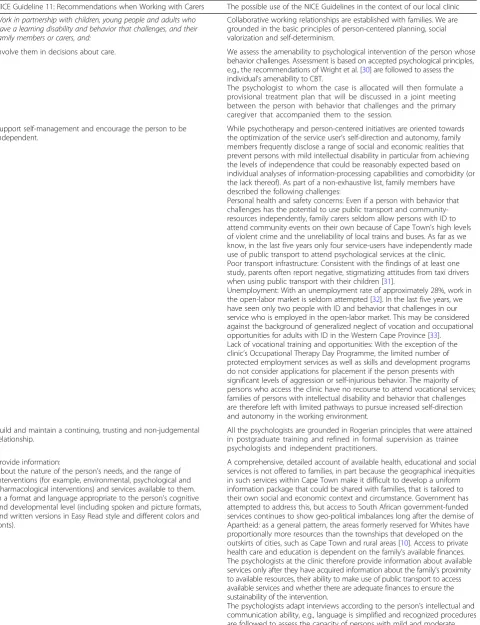
Table
1
describes the implementation of the NICE
Guideline 11 of 2015 by three psychologists within the
context of local considerations in one of the two
Out-Patient Clinics. The overall multidisciplinary mental
health service consults with approximately 150
–
200
adult attendees per month.
Discussion
It is important to stress that the approach discussed in
this article is based largely on the authors
’
own extensive
clinical experience and is not based on, for example, a
research study where participants are asked to respond
to specific questions. This is a limitation of our work,
but it is also important to point out that in terms of
ded-icated ID mental health services in the province in which
we work, there are only six psychologists, and we work
closely with all of these practitioners and act as clinical
supervisors to all but one of these six psychologists. This
last psychologist is supervised by a practitioner who in
turn is supervised by OC.
The emerging field of global mental health makes it
clear that though there are many features of
evidence-based treatments which are transferable in a range of
contexts, careful attention to local norms, contexts and
resources are important [
23
–
28
].
The implementation of many of the NICE Guideline
11
’
s recommendations for carer support and family
in-terventions is feasible in a South African context,
par-ticularly those recommendations which deal with an
explicit
conceptual
recognition of collaboration, social
valorization, individualization, social inclusivity and a
clinical understanding of behavior that challenges as
in-volving interactive processes between the person and his
environment. We believe that the ethos of the NICE
Guidelines could be applied in all settings: a
collabora-tive working relationship, respect and treating all
per-sons with dignity enables a level of therapist and
psychologist responsivity that is independent of fiscal
and human resources.
Economically South Africa is positioned between
low-income and high-income countries and has been
des-ignated by the World Bank as a
“
higher middle-income
country
”
[
29
]. The psychologists in the clinic described
having access to contemporary electronic journals and
re-search findings; we have a well-stocked psychometric test
library; and it is possible to obtain funding to attend
inter-national scientific conferences. There are limited training
opportunities, but internationally-accredited courses are
available in some of the interventions that are
recom-mended in the NICE Guideline 11, for example,
cognitive-behavior therapy, low-arousal approaches in the
management of behavior that challenges, and recognized
assessment instruments such as the Autism Diagnostic
Observation Schedules (ADOS). Our local clinic context
is in stark contrast to services in most rural areas in
low-income countries, particularly those that lack
coordi-nated mental health care services. While we are able to
successfully implement many of the NICE Guideline
rec-ommendations with regard to family interventions, a
major problem is that we can only offer these services to a
select few families
–
the majority of families in need of
similar services do not have access to them because of a
lack of primary health care capacity and geographical
in-equities in accessing health care, especially in rural areas.
The effectiveness of behavioral interventions is also
ham-pered by environmental and social factors such as
pov-erty/low socio-economic status and unemployment. South
Africa
’
s prevailing social inequalities and other societal
is-sues, such as high levels of aggression and crime in
com-munities, continue to cause family distress and, inasmuch,
expressions of behavior that challenges need to be firmly
contextualized within the broader socio-political context.
Conclusions
Table 1
NICE Guideline 11
–
Recommendations when working with carers
NICE Guideline 11: Recommendations when Working with Carers The possible use of the NICE Guidelines in the context of our local clinic
Work in partnership with children, young people and adults who have a learning disability and behavior that challenges, and their family members or carers, and:
Collaborative working relationships are established with families. We are grounded in the basic principles of person-centered planning, social valorization and self-determinism.
Involve them in decisions about care. We assess the amenability to psychological intervention of the person whose behavior challenges. Assessment is based on accepted psychological principles, e.g., the recommendations of Wright et al. [30] are followed to assess the individual’s amenability to CBT.
The psychologist to whom the case is allocated will then formulate a provisional treatment plan that will be discussed in a joint meeting between the person with behavior that challenges and the primary caregiver that accompanied them to the session.
Support self-management and encourage the person to be independent.
While psychotherapy and person-centered initiatives are oriented towards the optimization of the service user’s self-direction and autonomy, family members frequently disclose a range of social and economic realities that prevent persons with mild intellectual disability in particular from achieving the levels of independence that could be reasonably expected based on individual analyses of information-processing capabilities and comorbidity (or the lack thereof). As part of a non-exhaustive list, family members have described the following challenges:
Personal health and safety concerns: Even if a person with behavior that challenges has the potential to use public transport and community-resources independently, family carers seldom allow persons with ID to attend community events on their own because of Cape Town’s high levels of violent crime and the unreliability of local trains and buses. As far as we know, in the last five years only four service-users have independently made use of public transport to attend psychological services at the clinic. Poor transport infrastructure: Consistent with the findings of at least one study, parents often report negative, stigmatizing attitudes from taxi drivers when using public transport with their children [31].
Unemployment: With an unemployment rate of approximately 28%, work in the open-labor market is seldom attempted [32]. In the last five years, we have seen only two people with ID and behavior that challenges in our service who is employed in the open-labor market. This may be considered against the background of generalized neglect of vocation and occupational opportunities for adults with ID in the Western Cape Province [33]. Lack of vocational training and opportunities: With the exception of the clinic’s Occupational Therapy Day Programme, the limited number of protected employment services as well as skills and development programs do not consider applications for placement if the person presents with significant levels of aggression or self-injurious behavior. The majority of persons who access the clinic have no recourse to attend vocational services; families of persons with intellectual disability and behavior that challenges are therefore left with limited pathways to pursue increased self-direction and autonomy in the working environment.
Build and maintain a continuing, trusting and non-judgemental relationship.
All the psychologists are grounded in Rogerian principles that were attained in postgraduate training and refined in formal supervision as trainee psychologists and independent practitioners.
Provide information:
About the nature of the person’s needs, and the range of interventions (for example, environmental, psychological and pharmacological interventions) and services available to them. In a format and language appropriate to the person’s cognitive and developmental level (including spoken and picture formats, and written versions in Easy Read style and different colors and fonts).
A comprehensive, detailed account of available health, educational and social services is not offered to families, in part because the geographical inequities in such services within Cape Town make it difficult to develop a uniform information package that could be shared with families, that is tailored to their own social and economic context and circumstance. Government has attempted to address this, but access to South African government-funded services continues to show geo-political imbalances long after the demise of Apartheid: as a general pattern, the areas formerly reserved for Whites have proportionally more resources than the townships that developed on the outskirts of cities, such as Cape Town and rural areas [10]. Access to private health care and education is dependent on the family’s available finances. The psychologists at the clinic therefore provide information about available services only after they have acquired information about the family’s proximity to available resources, their ability to make use of public transport to access available services and whether there are adequate finances to ensure the sustainability of the intervention.
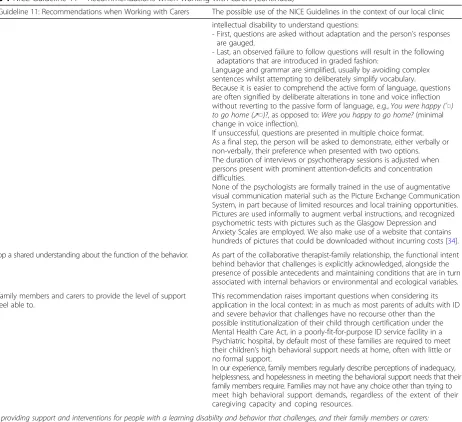
Table 1
NICE Guideline 11
–
Recommendations when working with carers
(Continued)
NICE Guideline 11: Recommendations when Working with Carers The possible use of the NICE Guidelines in the context of our local clinic
intellectual disability to understand questions:
- First, questions are asked without adaptation and the person’s responses are gauged.
- Last, an observed failure to follow questions will result in the following adaptations that are introduced in graded fashion:
Language and grammar are simplified, usually by avoiding complex sentences whilst attempting to deliberately simplify vocabulary.
Because it is easier to comprehend the active form of language, questions are often signified by deliberate alterations in tone and voice inflection without reverting to the passive form of language, e.g.,You were happy (ˈ◌) to go home (↗◌)?, as opposed to:Were you happy to go home?(minimal change in voice inflection).
If unsuccessful, questions are presented in multiple choice format. As a final step, the person will be asked to demonstrate, either verbally or non-verbally, their preference when presented with two options. The duration of interviews or psychotherapy sessions is adjusted when persons present with prominent attention-deficits and concentration difficulties.
None of the psychologists are formally trained in the use of augmentative visual communication material such as the Picture Exchange Communication System, in part because of limited resources and local training opportunities. Pictures are used informally to augment verbal instructions, and recognized psychometric tests with pictures such as the Glasgow Depression and Anxiety Scales are employed. We also make use of a website that contains hundreds of pictures that could be downloaded without incurring costs [34].
Develop a shared understanding about the function of the behavior. As part of the collaborative therapist-family relationship, the functional intent behind behavior that challenges is explicitly acknowledged, alongside the presence of possible antecedents and maintaining conditions that are in turn associated with internal behaviors or environmental and ecological variables.
Help family members and carers to provide the level of support they feel able to.
This recommendation raises important questions when considering its application in the local context: in as much as most parents of adults with ID and severe behavior that challenges have no recourse other than the possible institutionalization of their child through certification under the Mental Health Care Act, in a poorly-fit-for-purpose ID service facility in a Psychiatric hospital, by default most of these families are required to meet their children’s high behavioral support needs at home, often with little or no formal support.
In our experience, family members regularly describe perceptions of inadequacy, helplessness, and hopelessness in meeting the behavioral support needs that their family members require. Families may not have any choice other than trying to meet high behavioral support demands, regardless of the extent of their caregiving capacity and coping resources.
When providing support and interventions for people with a learning disability and behavior that challenges, and their family members or carers:
Take into account the severity of the person’s learning disability, their developmental stage, and any communication difficulties or physical or mental health problems.
The Diagnostic Criteria for Learning Disabilities are used to systematically assess behavior that challenges [20]. We do not have the capacity to individually assess each referral in terms of the person’s level of intellectual disability, and some of the persons referred to us have never been psychometrically assessed. At times, the severity of intellectual disability is therefore based on clinical observation in the absence of rigorous psychometric assessment and a more comprehensive and formalized analysis of adaptive abilities and support needs. This approach is in line with the definition of ID in the Diagnostic and Statistical Manual of Mental Disorders (5th ed.) [35], in which greater diagnostic value is placed on adaptive function than previously.
Aim to provide support and interventions:
In the least restrictive setting, such as the person’s home, or as close to their home as possible, and
In other places where the person regularly spends time (for example, school or residential care).
Aim to prevent, reduce or stop the development of future episodes of behavior that challenges.
Aim to improve quality of life.
Offer support and interventions respectfully.
Ensure that the focus is on improving the person’s support and increasing their skills rather than changing the person. Ensure that they know who to contact if they are concerned
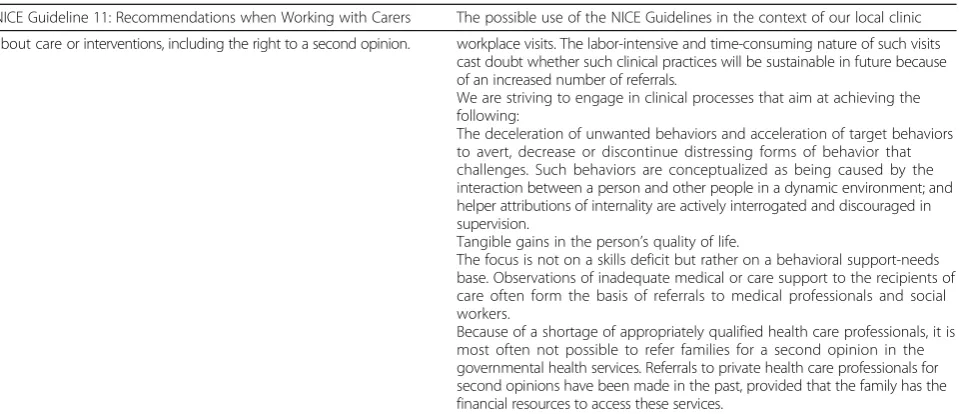
Table 1
NICE Guideline 11
–
Recommendations when working with carers
(Continued)
NICE Guideline 11: Recommendations when Working with Carers The possible use of the NICE Guidelines in the context of our local clinic
about care or interventions, including the right to a second opinion. workplace visits. The labor-intensive and time-consuming nature of such visits cast doubt whether such clinical practices will be sustainable in future because of an increased number of referrals.
We are striving to engage in clinical processes that aim at achieving the following:
The deceleration of unwanted behaviors and acceleration of target behaviors to avert, decrease or discontinue distressing forms of behavior that challenges. Such behaviors are conceptualized as being caused by the interaction between a person and other people in a dynamic environment; and helper attributions of internality are actively interrogated and discouraged in supervision.
Tangible gains in the person’s quality of life.
The focus is not on a skills deficit but rather on a behavioral support-needs base. Observations of inadequate medical or care support to the recipients of care often form the basis of referrals to medical professionals and social workers.
Because of a shortage of appropriately qualified health care professionals, it is most often not possible to refer families for a second opinion in the governmental health services. Referrals to private health care professionals for second opinions have been made in the past, provided that the family has the financial resources to access these services.
Advise family members or carers about their right to, and explain how to get:
A formal carer’s assessment of their own needs (including their physical and mental health).
A comprehensive battery of tests is available to assess aspects of parenting that include caregiving stress, depressive symptoms, coping, relationships within family context, and quality of life. While our clinic has adequate funding to purchase tests and top-up answer sheets, some of the instruments are available in the public domain and could be downloaded from the internet without additional cost implications. We believe that it is possible to conduct a formal assessment, even in settings with poorer resources, provided that there is access to the internet to download recognized assessments scales. The available assessment instruments include the following:
The Beck Depression Inventory, Second Edition. Family Community Participation Survey. Family Quality of Life Survey.
The OK Health Check.
The Parental Locus of Control Test. The Parenting Stress Index, Short Form. The Ways of Coping Questionnaire. The Parenting Sense of Competence Test. Patient Health Questionnaire.
The Self-Reporting Questionnaire. The Bene Anthony Family Relations Test.
The small clinical component of psychologists implies that assessments can only be considered when parents present with severe levels of distress, helplessness and depressive symptoms. In most instances, a degree of task-shifting is manageable: parents are referred to community clinics if there are reports of physical or mental health problems; a significant minority of parents are also able to afford private health care. In both instances, we will attempt to either contact the other health care professional or compile a short written report when referring family members for assessment in the community.
Short breaks and other respite care. Until recently the Western Cape Government Department of Health allocated 20 placements for community-based adults with ID, often with behavior that challenges, in ID Hospitals. Members of the multidisciplinary team referred to these brief admissions into hospital as“respite beds”, and the rationale of the service was to offer family brief respite from caregiving. The service in one of the two settings has since been discontinued and less than 10 placements are now available.
temporary caregivers in the home environment of the
person with ID and behavior that challenges. However,
this does not exclude recruitment of wider community
[image:8.595.58.539.99.641.2]resources and development of focused non-profit
orga-nizations to meet the need for respite care. It would also
be important to identify how the principle of respite care
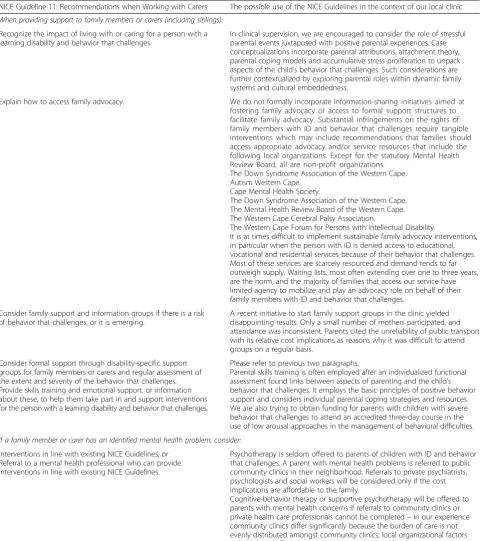
Table 1
NICE Guideline 11
–
Recommendations when working with carers
(Continued)
NICE Guideline 11: Recommendations when Working with Carers The possible use of the NICE Guidelines in the context of our local clinic
When providing support to family members or carers (including siblings):
Recognize the impact of living with or caring for a person with a learning disability and behavior that challenges.
In clinical supervision, we are encouraged to consider the role of stressful parental events juxtaposed with positive parental experiences. Case conceptualizations incorporate parental attributions, attachment theory, parental coping models and accumulative stress proliferation to unpack aspects of the child’s behavior that challenges. Such considerations are further contextualized by exploring parental roles within dynamic family systems and cultural embeddedness.
Explain how to access family advocacy. We do not formally incorporate information-sharing initiatives aimed at fostering family advocacy or access to formal support structures to facilitate family advocacy. Substantial infringements on the rights of family members with ID and behavior that challenges require tangible interventions which may include recommendations that families should access appropriate advocacy and/or service resources that include the following local organizations. Except for the statutory Mental Health Review Board, all are non-profit organizations.
The Down Syndrome Association of the Western Cape. Autism Western Cape.
Cape Mental Health Society.
The Down Syndrome Association of the Western Cape. The Mental Health Review Board of the Western Cape. The Western Cape Cerebral Palsy Association.
The Western Cape Forum for Persons with Intellectual Disability.
It is at times difficult to implement sustainable family advocacy interventions, in particular when the person with ID is denied access to educational, vocational and residential services because of their behavior that challenges. Most of these services are scarcely resourced and demand tends to far outweigh supply. Waiting lists, most often extending over one to three years, are the norm, and the majority of families that access our service have limited agency to mobilize and play an advocacy role on behalf of their family members with ID and behavior that challenges.
Consider family support and information groups if there is a risk of behavior that challenges, or it is emerging.
A recent initiative to start family support groups in the clinic yielded disappointing results. Only a small number of mothers participated, and attendance was inconsistent. Parents cited the unreliability of public transport with its relative cost implications as reasons why it was difficult to attend groups on a regular basis.
Consider formal support through disability-specific support groups for family members or carers and regular assessment of the extent and severity of the behavior that challenges. Provide skills training and emotional support, or information about these, to help them take part in and support interventions for the person with a learning disability and behavior that challenges.
Please refer to previous two paragraphs.
Parental skills training is often employed after an individualized functional assessment found links between aspects of parenting and the child’s behavior that challenges. It employs the basic principles of positive behavior support and considers individual parental coping strategies and resources. We are also trying to obtain funding for parents with children with severe behavior that challenges to attend an accredited three-day course in the use of low arousal approaches in the management of behavioral difficulties.
If a family member or carer has an identified mental health problem, consider:
Interventions in line with existing NICE Guidelines, or Referral to a mental health professional who can provide interventions in line with existing NICE Guidelines.
Psychotherapy is seldom offered to parents of children with ID and behavior that challenges. A parent with mental health problems is referred to public community clinics in their neighborhood. Referrals to private psychiatrists, psychologists and social workers will be considered only if the cost implications are affordable to the family.
Cognitive-behavior therapy or supportive psychotherapy will be offered to parents with mental health concerns if referrals to community clinics or private health care professionals cannot be completed–in our experience community clinics differ significantly because the burden of care is not evenly distributed amongst community clinics; local organizational factors such as low staff morale could also protract the referral process.
is, or could be, applied in more poorly resourced contexts
and countries, although this is an under-researched area.
In order to address the transferability of the NICE 11
Guidelines into different contextual situations, and
tak-ing the considerations discussed into account, we
sug-gest that smaller descriptive, qualitative studies are
necessary to explore the contextual limitations and
re-source strengths that exist in low- and middle-income
settings. It will also be helpful to study these issues more
systematically than to draw only on the clinical experience
of authors, as we have done. In the absence of
evidence-based research, smaller research initiatives could
set the agenda by plotting ways to strengthen existing
clin-ical, family, and community interventions whilst
simultan-eously building an informed foundation for future
research. Of course, the need for rigorous evidence-based
treatments and interventions in low-income and
middle-income countries remains a priority.
Abbreviation
ID:Intellectual disability
Acknowledgements
Not applicable.
Funding
Not applicable.
Availability of data and materials
Not applicable.
Authors’contributions
OC and LS conceptualized the article. CA provided supervisory input, and CC provided clinical and background clinical expertise. All authors contributed to the final write-up of the article. All authors read and approved the final manuscript.
Ethics approval and consent to participate
Not applicable.
Consent for publication
Not applicable.
Competing interests
The authors declare that they have no competing interests.
Publisher
’
s Note
Springer Nature remains neutral with regard to jurisdictional claims in published maps and institutional affiliations.
Author details
1Department of Psychiatry and Mental Health, University of Cape Town, J-Block, Groote Schuur Hospital, Observatory, Cape Town 7925, South Africa. 2Alan J Flisher Centre for Public Mental Health, Department of Psychology, Stellenbosch University, Private Bag X1, Matieland 7602, South Africa.
Received: 23 August 2017 Accepted: 7 March 2019
References
1. McGill P, Papachristoforou E, Cooper V. Support for family carers of children and young people with developmental disabilities and challenging behaviour. Child Care Health Dev. 2006;32:159–65.
2. Man J, Kangas M, Trollor J, Sweller N. Clinical practices and barriers to best practice implementation of psychologists working with adults with intellectual
disability and comorbid mental ill health. J Policy Pract Intellect Disabil. 2018. https://doi.org/10.1111/jppi.12256.
3. NICE. Challenging behaviour and learning disabilities: Prevention and
interventions for people with learning disabilities whose behaviour challenges. 2015.http://www.nice.org.uk/guidance/ng11. Accessed 8 July 2017. 4. NICE. Mental health problems in people with learning disabilities: Prevention,
assessment and management. 2016.http://www.nice.org.uk/guidance/ng54. Accessed 8 July 2017.
5. Crnic K, Neece CL, McIntyre LL, Blacher J, Baker BL. Intellectual disability and developmental risk: promoting intervention to improve child and family well-being. Child Dev. 2017;88(2):436–45https://doi.org/10.1111/cdev.12740.
6. National Development Team for Inclusion. The Health Equalities Framework
(HEF): An outcomes framework based on the determinants of health inequalities. 2013.https://www.ndti.org.uk/uploads/files/The_Health_ Equality_Framework.pdf. Accessed 8 July 2017.
7. Tilley E, Ledger S, Bardsley J. A review of the literature concerning learning disability, challenging behaviour and social work: Open University; 2015. http://cdn.basw.co.uk/upload/basw_111416-3.pdf. Accessed 8 July 2017 8. Man J, Kangas M, Trollor J, Sweller N. Clinical competencies and training
needs of psychologists working with adults with intellectual disability and comorbid mental ill health. Clin Psychol. 2017;21:206–14 Received in PDF form from author and not electronically downloaded from website. 9. Emerson E, Yasamy MT, Saxena S. Scaling up support for children with
developmental disabilities in low- and middle-income countries. J Appl Res Intellect Disabil. 2012;25:96–8.
10. Adnams CM. Perspectives of intellectual disability in South Africa: epidemiology, policy, services for children and adults. Curr Opin Psychiatry. 2010;23(5):436–40. 11. Einfeld SL, Stancliffe RJ, Gray KM, Sofronoff K, Rice L, Emerson E, et al.
Interventions provided by parents for children with intellectual disabilities in low and middle income countries. J Appl Res Intellect Disabil. 2012;25:135–42. 12. Swartz L, Kilian S, Twesigye J, Attah D, Chiliza B. Language, culture, and task
shifting–an emerging challenge for global mental health. Glob Health Action. 2014;7(1):–4.
13. Baingana F, al'Absi M, Becker AE, Pringle B. Global research challenges and opportunities for mental health and substance-use disorders. Nature. 2015; 527:S172–7.
14. Capri C, Abrahams L, McKenzie J, Coetzee O, Mkabile S, Saptouw M, et al. Intellectual disability rights and inclusive citizenship in South Africa: what can a scoping review tell us? Afr J Disabil (AJOD). 2018;7:a396https://doi. org/10.4102/ajod.v7i0.396. Accessed 22 Jan 2019.
15. Hastings RP, Robertson J, Yasamy MT. Interventions for children with
pervasive developmental disorders in low and middle income countries. J Appl Res Intellect Disabil. 2012;25:119–34.
16. Statistics South Africa. Statistical release P0302: mid-year population estimates 2011. 2013.http://beta2.statssa.gov.za/publications/P0302/P03022013.pdf. Accessed 13 Feb 2019.
17. Statistics South Africa. Census 2011: Profile of people with disability in South Africa. 2014.https://www.statssa.gov.za/publications/P0302/P03022017.pdf. Accessed 13 Feb 2019.
18. Kleintjes S, Flisher A, Fick M, Railoun A, Lund C, Molteno C, et al. The prevalence of mental disorders among children, adolescents and adults in the Western cape, South Africa. South African Psychiatry Review. 2006;9:157–60.
19. Nunkoosing K, Haydon-Laurelut M. Discoursing challenging behaviour: an analysis of referral documents sent to a learning disability team. International Association for the Scientific study of intellectual disability (IASSID) 13th world congress. Cape Town, south Africa; 2008.
20. Royal College of Psychiatrists. DC-LD: diagnostic criteria for psychiatric disorder for use with adults with learning disabilities/mental retardation, (occasional paper OP48). London: Gaskell; 2001.
21. Royal College of Psychiatrists. Challenging behaviour: a unified approach. Clinical and service guidelines for supporting people with learning disabilities who are at risk of receiving abusive or restrictive practices (college report CR144). 2007.http://www.rcpsych.ac.uk/usefulresources/ publications/collegereports/cr/cr144.aspx. Accessed 8 July 2017. 22. Western Cape Government Health. Healthcare 2030: The road to wellness. 2014.
https://www.westerncape.gov.za/assets/departments/health/healthcare2030.pdf. Accessed 13 Feb 2019.
24. Singla DR, Kohrt BA, Murray LK, Anand A, Chorpita BF, Patel V. Psychological treatments for the world: lessons from low- and middle-income countries. Annu Rev Clin Psychol. 2017;13:149–81.
25. Kohrt B, Asher L, Bhardwaj A, Fazel M, Jordans MJD, Mutamba BB, et al. The role of communities in mental health care in low- and middle-income countries: a meta-review of components and competencies. Int J Environ Res Public Health. 2018;15(6):1279.
26. Kazdin AE. Innovations in psychosocial interventions and their delivery: leveraging cutting-edge science to improve the world’s mental health. New York, NY: Oxford University Press; 2018.
27. Patel V, Hanlon C. Where there is no psychiatrist: a mental health care manual. New York: Cambridge University Press; 2018.
28. Munetsi E, Simms V, Dzapasi L, Chapoterera G, Goba N, Gumunyu T, et al. Trained lay health workers reduce common mental disorder symptoms of adults with suicidal ideation in Zimbabwe: a cohort study. BMC Public Health. 2018;18(1):227.
29. World Bank. South Africa economic update: focus on inequality of opportunity. Washington, DC: Communications Development Incorporated; 2012. 30. Wright JH, Basco MR, Thase ME. Learning cognitive-behaviour therapy: an
illustrated guide. Washington DC: American Psychiatric Publishing, Incorporated; 2006.
31. Masasa T, Irwin-Carruthers S. Knowledge of, beliefs about and attitudes to disability: implications for health professionals. S Afr Fam Pract. 2005;47(7):40–4. 32. Statistics South Africa. Quarterly labour force survey: First quarter 2017. 2017.
http://www.statssa.gov.za/?p=9960. Accessed 16 June 2017.
33. Mckenzie JA, McConkey R, Adnams CM. Health conditions and support
needs of persons living in residential facilities for adults with intellectual disability in Western Cape Province. S Afr Med J. 2013;103(7):481–4.
34. Van der Kooij MC. Picto-selector. n.d.https://www.pictoselector.eu/home-2/ download/. Accessed 8 July 2017.