R E S E A R C H A R T I C L E
Open Access
“
Sometimes it is difficult for us to stand up
and change this
”
: an analysis of power
within priority-setting for health following
devolution in Kenya
Rosalind McCollum
1*, Miriam Taegtmeyer
1, Lilian Otiso
2, Nelly Muturi
2, Edwine Barasa
3,4, Sassy Molyneux
5,6,
Tim Martineau
1and Sally Theobald
1Abstract
Background:Practices of power lie at the heart of policy processes. In both devolution and priority-setting, actors seek to exert power through influence and control over material, human, intellectual and financial resources. Priority-setting arises as a consequence of the needs and demand exceeding the resources available, requiring some means of choosing between competing demands. This paper examines the use of power within priority-setting processes for healthcare resources at sub-national level, following devolution in Kenya.
Methods:We interviewed 14 national level key informants and 255 purposively selected respondents from across the health system in ten counties. These qualitative data were supplemented by 14 focus group discussions (FGD) involving 146 community members in two counties. We conducted a power analysis using Gaventa’s power cube and Veneklasen’s expressions of power to interpret our findings.
Results:We found Kenya’s transition towards devolution is transforming the former centralised balance of power, leading to greater ability for influence at the county level, reduced power at national and sub-county (district) levels, and limited change at community level. Within these changing power structures, politicians are felt to play a greater role in priority-setting for health. The interfaces and tensions between politicians, health service providers and the community has at times been felt to undermine health related technical priorities. Underlying social structures and discriminatory practices generally continue unchanged, leading to the continued exclusion of the most vulnerable from priority-setting processes.
Conclusions:Power analysis of priority-setting at county level after devolution in Kenya highlights the need for stronger institutional structures, processes and norms to reduce the power imbalances between decision-making actors and to enable community participation.
Keywords:Power, Priority-setting, Kenya, Devolution
* Correspondence:[email protected]
1Department of International Public Health, Liverpool School of Tropical
Medicine, Liverpool, UK
Full list of author information is available at the end of the article
Background
Practices of power lie at the heart of policy processes [1]. In both devolution and priority-setting, actors seek to exert power through influence and control over ma-terial, human, intellectual and financial resources [2,3]. In both processes, a range of actors, each with their own values, needs and interests must make judgements and decisions about the selection of priorities contained within plans and budgets. Priority-setting and devolution can be viewed as two sides to the same coin. Potential threats to priority-setting will also threaten the potential success of devolution.
Priority-setting, the distribution of resources among competing healthcare services, patients or patient groups, arises as a consequence of the needs and de-mand for healthcare resources (such as budget, staff time, equipment and facilities) exceeding the resources available [4–6]. As a result, some means of choosing be-tween competing demands is required [6]. Ideally, priority-setting is explicit, seeking to set clear priorities, with a transparent rationale and resource allocation based on agreed upon criteria [7]. Some of these criteria include“benefit, evidence, cost, efficiency, equity, equal-ity, benefit to a country’s economy, severity of disease, prevalence of disease, solidarity, protection of the vul-nerable, and more” (p21 [8]). While sometimes viewed as a purely technical process, priority setting is typically a complex, value laden process where actor’s values and interests are brought to bear, negotiating decisions about which values or principles should dominate as political, institutional and managerial factors come into play [9].
Decentralisation is a dynamic process which transfers authorities or powers for decision-making, planning and management of public services from national to sub-national levels [10]. Decentralisation reforms may be classified as four main types: de-concentration occurs when authority for administrative functions shifts to sub-national offices within the Ministry of Health; dele-gation occurs when semi-autonomous agencies are granted new powers (typically still administrative); devo-lution occurs when administrative, political and fiscal re-sponsibilities shift to the sub-national level of locally elected government, and privatisation when ownership is granted to private bodies [11,12].
Devolution reforms most accurately describe the transition which began in 2013 in Kenya. Devolution ought to transform authority, power and responsibility for implementation between actors. Despite their popu-larity, devolution reforms have a mixed record in terms of realising their many objectives, such as improving national unity, equity, efficiency, responsiveness, ac-countability and community participation [11,12]. This is often due to difference between the official public policy goals for health and the goals of individuals,
including local politicians and other decision-making actors [13].
The success (or failure) of both priority-setting and devolution are heavily dependent on how actors respond to changing distributions of power. Power is“the degree of control over material, human, intellectual and finan-cial resources exercised by different sections of society” (page41 [2]). Power is both dynamic and relational, ra-ther than absolute and is exercised through the social, economic and political relations between individuals and groups [2]. The distribution of power can change with the context, circumstances and interest of actors and can be expressed in a range of forms from domination and resistance to collaboration and transformation [2].
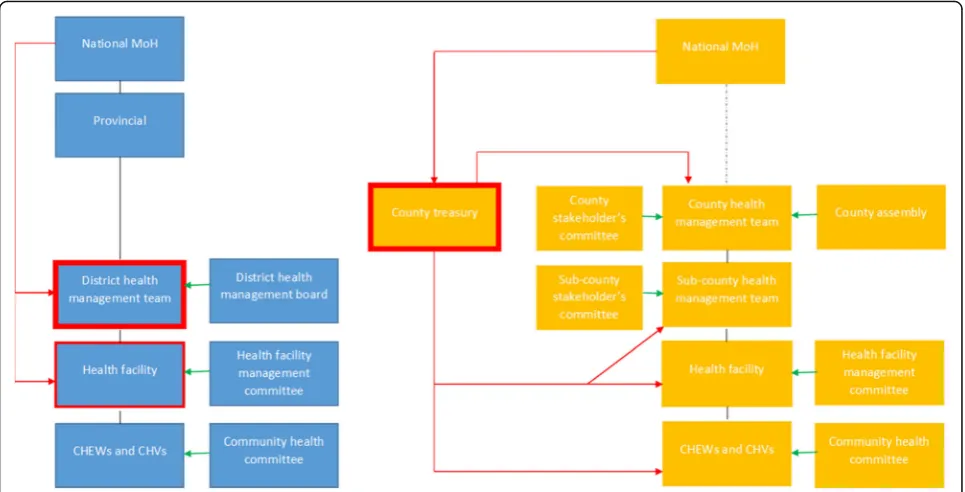
In 2013 Kenya’s governance system was transformed, following the ambitious devolution of political, fiscal and administrative functions to 47 new sub-national county governments [14]. This led to revised roles for national Ministry of Health and increasing responsibilities now held at the newly formed County government level. De-volution reform objectives in Kenya seek to“tackle long-term, deeply entrenched disparities between regions; in-crease the responsiveness and accountability of govern-ment to citizens; allow greater autonomy to different regions and groups, and re-balance power away from a historically strong central government” (page2 [15]). This led to changing roles and power for actors across the health system (see Table2 [16]). Roles were reduced for national level in coordinating partners, recruitment and management of health workers and planning for budget allocation. National level actors have retained re-sponsibility for policy development, quality assurance and provision of national referral (level four) services. The former district level (now largely considered similar to the sub-county level) continues to hold responsibility to implement and deliver health services, but no longer has control over budget allocation (compared with prior to devolution when annual planning and budget allocation responsibilities for management of user fees had been decentralised to this level [17,18]) (see Fig.1). Prior to the introduction of devolution reforms in 2013 Kenya had a
‘highly decentralised form of de-concentration’ with hos-pitals experiencing some degree of autonomy over man-agement functions [19]. Following devolution, previous studies have found a recentralisation of management (in-cluding financial management) from health facility to county level, particularly within county hospitals [17, 19]. The changing roles and responsibilities for national, county, district/sub-county and community level before and after devolution have been summarised elsewhere (see Table2[16]).
funding; National Hospital Insurance Fund member con-tributions; private health insurance member contribu-tions, and out of pocket spending at point of care [20]. This paper will examine the power dynamics relating to budget allocation and annual planning responsibilities for actors at the county level, who also hold responsibil-ity for developing the five year county integrated devel-opment plan, for health service delivery for level one to four services (community, primary and county referral services), for recruitment and management of health workers and for coordination of partners. Funds avail-able at county level come from three possible sources; 1) transfers from central government which comprise an equitable share allocated to all the 47 counties from na-tional general revenue collections using a revenue allo-cation formula, conditional grants ring fenced for specific functions, and an equalization fund for the 14 previously marginalized counties, 2) locally generated revenue, and 3) donor funding (see Table 1 [21]). The annual planning and budgeting cycle has been described elsewhere (Fig. 2 [16]). In summary, national circulars are issued, which prompt the development of the annual plan and budgeting process. As part of this process, the county budget steering committee and county executive committee set budget ceilings and develop the county fiscal strategy paper; public participation meetings should be held for the identification and validation of priorities set, with the health department working to align their plan and budget to meet budget ceilings
assigned, under the oversight of the county assembly prior to finalisation and approval from both the county assembly and the county executive committee [16]. County level actors engaged in the priority-setting process for the annual budget planning cycle (see Fig.2, [16])include:
State actors, including governor and members of
county executive committee (CEC) (representatives appointed by the governor for ten service
departments within the county, including the county executive member for health, who may or may not have health experience) and members of county assembly (elected local ward representatives)
Health service providers, including county level
technical decision makers (e.g. members of county health management team) and health actors at other levels, including sub-county health management team and health workers at facility and community levels
Community members, including selected
community representatives who sit on specific quarterly health planning and review committees along with the general community, who should be engaged in priority-setting through public participa-tion forums.
[image:3.595.57.540.88.334.2]Table 1Dimensions of Gaventa’s power cube (Barasa et al. 2016; Rowlands 1997; Veneklasen et al. 2002)
Spaces for power
Closed spaces Elites make decisions behind closed doors, which in Kenya include discussions between county executive committee members and the governor or among members of county assembly;
Invited spaces Citizens are invited to participate by authorities, which in Kenya includes the public participation forums;
Claimed spaces Less powerful actors claim spaces from the power holders, which in Kenya includes the use of social media platforms by citizens to raise awareness about poor quality services.
Places for power
Global Globalisation shifts traditional understandings of the location and exercise of power. Global actors, forces and structures in turn influence and shape national and local level power relationships. In Kenya this includes international pressure for devolution.
National County Health worker
The role of the national level in power dynamics, influences the legitimacy and power dynamics at other (sub-national) and local levels. Decentralisation, transforms national and local power relationships.
In Kenya, this has contributed to reduced power for national level to identify, plan and budget for health priorities and actions at sub-national levels, with greater power now held at county level and lower levels of power held by health workers at sub-county and health facility level compared with prior to devolution.
Local Local levels may be dependent on other levels for the extent to which power is legitimated. In Kenya, community level actors may be involved with priority-setting through public participation forums, or through community representation in other existing committees at community and facility levels.
Forms and visibility of power
Visible power’ Observable decision making. This includes the visible and definable rules, structures, authorities, institutions and procedures for decision-making. Strategies targeting this level seek to change the‘who, how and what’to increase accountability of priority-setting processes.
‘Hidden power’ Setting the political agenda, is less obvious. Certain powerful people and institutions maintain their influence by controlling who is involved with decision-making and what is on the agenda. Actions to address this level include empowering advocacy strategies that seek to strengthen organisations of poor and marginalised people to influence the way in which political agenda is shaped.
‘Invisible power’ Shaping meaning and what is important. Problems and issues are kept from the minds of the actors involved, by influencing how they think about their place in the world and controlling access to information, so that people are unable to make informed choices. In this dimension power operates at a deeper‘invisible’level, so that actors may unwittingly follow against their own best interests, thereby avoiding conflict by making it impossible for people to imagine anything different to the status quo. Power is closely associated with ideology. Beliefs, values, attitudes and ways of analysing life, enforced by structures such as family, education system, religion, the media, the economy and the state, tend to reinforce the dominant ideology and power of the dominant groups within it. Change strategies at this level target social and political culture and individual consciousness.
[image:4.595.63.541.492.711.2]vary across counties? Who benefits from this re-distribution? How are the new powers used? Do new priorities lead to improved health equity? We aim to provide a power analysis of priority-setting at the new county level, to understand how power influences priority-setting in Kenya.
Methods
Theory and practice
This paper presents the analysis of data collected as part of a wider study which sought to explore priority-setting for community health and equity since devolution. We used a naturalistic approach to unpack power in its fluid and multiple forms and to observe the changes for priority-setting following devolution as they occurred [22,23]. We used multiple qualitative methods including key informant interviews, in-depth interviews and focus group discussions, including a range of perspectives from national to community level.
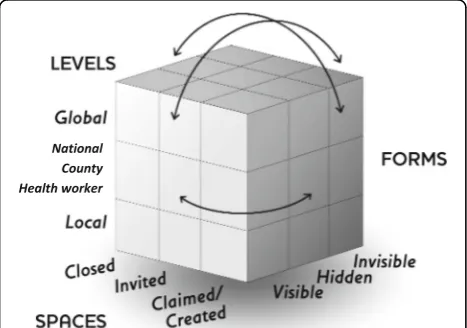
To explore power dynamics within priority-setting for health, we adopted two complementary frameworks as the basis for a power analysis - Gaventa’s power cube (2006) [24] (see Fig. 3), incorporating aspects of Venek-lasen’s expressions of power (2002) [2] to more fully ex-plore power and the complexity of the social, political and economic factors (among others) which influence it. The power cube considers the spaces, places and forms of power (see Table 1). Spaces for power include oppor-tunities and channels where actors can potentially influ-ence policy and decisions [24]. Naturally, these are shaped by power relations surrounding who can partici-pate within them. Power relations adapt and change as these spaces are realised, with power gained from one space through skills, capacity and experience, used to enter and affect other spaces [24]. Places for power in-clude household, local, national and global arenas. Venek-lasen’s expressions of power (2002) [2] was helpful in
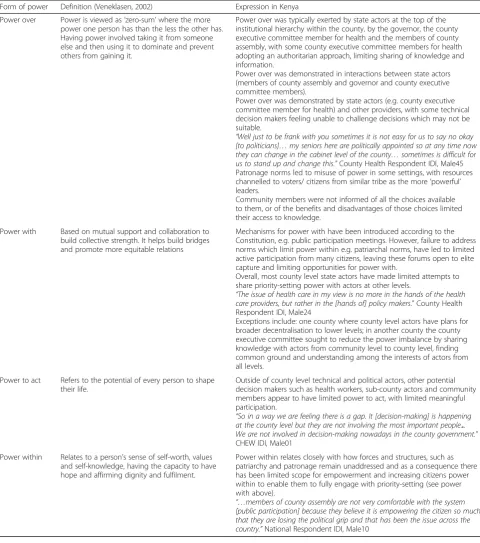
identifying the four main expressions of power demon-strated within these places since devolution: power over; power to; power with and power within (see Table2). The final aspect of power considered in the power cube is forms of power. This builds on ‘three dimensions of power’work by Steven Lukes (1974) [25], and subsequent expansion by Veneklasen et al. (2002) to identify three main forms–visible, hidden and invisible [2]. Underlying the interfaces between actors, the dynamics at work within the power cube and the expressions of power lie individ-uals’experiences of power and privilege, which shape their social exclusion (or inclusion) and access to the decision-making table [26].
Methods, participants and process
[image:5.595.57.291.551.715.2]low- and middle-income countries in rural and urban areas in Africa and Asia, including Kenya.
A primary point of contact (usually the county executive committee member for health) in each of the ten counties was approached to introduce the study, either through email or face-to-face introduction. This point of contact then typically provided introduction of the interviewer to
[image:6.595.57.538.99.643.2]other study participants. Participants were interviewed at a location convenient to them which afforded privacy, typically at their place of work. Qualitative data were re-corded with participant’s consent and transcribed verba-tim by research assistants with extensive transcription experience, supplemented by note taking by the researcher who conducted the interviews. Interviews typically lasted
Table 2Forms of power and their expression in Kenya
Form of power Definition (Veneklasen, 2002) Expression in Kenya
Power over Power is viewed as‘zero-sum’where the more power one person has than the less the other has. Having power involved taking it from someone else and then using it to dominate and prevent others from gaining it.
Power over was typically exerted by state actors at the top of the institutional hierarchy within the county, by the governor, the county executive committee member for health and the members of county assembly, with some county executive committee members for health adopting an authoritarian approach, limiting sharing of knowledge and information.
Power over was demonstrated in interactions between state actors (members of county assembly and governor and county executive committee members).
Power over was demonstrated by state actors (e.g. county executive committee member for health) and other providers, with some technical decision makers feeling unable to challenge decisions which may not be suitable.
“Well just to be frank with you sometimes it is not easy for us to say no okay
[to politicians]…my seniors here are politically appointed so at any time now
they can change in the cabinet level of the county…sometimes is difficult for
us to stand up and change this.”County Health Respondent IDI, Male45
Patronage norms led to misuse of power in some settings, with resources channelled to voters/ citizens from similar tribe as the more‘powerful’ leaders.
Community members were not informed of all the choices available to them, or of the benefits and disadvantages of those choices limited their access to knowledge.
Power with Based on mutual support and collaboration to build collective strength. It helps build bridges and promote more equitable relations
Mechanisms for power with have been introduced according to the Constitution, e.g. public participation meetings. However, failure to address norms which limit power within e.g. patriarchal norms, have led to limited active participation from many citizens, leaving these forums open to elite capture and limiting opportunities for power with.
Overall, most county level state actors have made limited attempts to share priority-setting power with actors at other levels.
“The issue of health care in my view is no more in the hands of the health
care providers, but rather in the [hands of] policy makers.”County Health
Respondent IDI, Male24
Exceptions include: one county where county level actors have plans for broader decentralisation to lower levels; in another county the county executive committee sought to reduce the power imbalance by sharing knowledge with actors from community level to county level, finding common ground and understanding among the interests of actors from all levels.
Power to act Refers to the potential of every person to shape their life.
Outside of county level technical and political actors, other potential decision makers such as health workers, sub-county actors and community members appear to have limited power to act, with limited meaningful participation.
“So in a way we are feeling there is a gap. It [decision-making] is happening
at the county level but they are not involving the most important people...
We are not involved in decision-making nowadays in the county government.”
CHEW IDI, Male01
Power within Relates to a person’s sense of self-worth, values and self-knowledge, having the capacity to have hope and affirming dignity and fulfilment.
Power within relates closely with how forces and structures, such as patriarchy and patronage remain unaddressed and as a consequence there has been limited scope for empowerment and increasing citizens power within to enable them to fully engage with priority-setting (see power with above).
“…members of county assembly are not very comfortable with the system
[public participation] because they believe it is empowering the citizen so much that they are losing the political grip and that has been the issue across the
40 to 60 min. We used topic guides, with questions which explored the actors and priority-setting processes for health following devolution; participants understanding of the implications of priorities set, particularly for access, use and effective coverage of health services. The topic guides were developed through an iterative process fol-lowing informal discussions with national key informants and colleagues and a period of reflection and revision after data collection in one county to ensure questions elicited the responses sought.
National, county and some health worker level in-terviews were carried out by a foreign researcher in English language (RM), who completed the research as part of doctoral studies and who has received training in qualitative data collection and analysis. RM had no prior relationship with any of the re-search participants. Community and some health fa-cility level respondents were interviewed by trained research assistants in Kiswahili or Kamba (depending on respondents’ preference).
Analytical process
We adopted a framework approach to analysis in order to classify and organise data according to the key themes, concepts and emerging categories [27]. This in-cluded an inductive aspect, which allowed meaning to emerge from the data [28] through familiarisation with the data by reading and re-reading transcripts. Following this a coding framework was developed which drew on understanding of the literature, the objectives of the interview, the themes within the data collection tool and issues raised by the respondents themselves during inter-views. Nvivo 10 software was utilised to manage and code data. Following coding, data was charted in order to summarise data while still retaining its context and essence [27], based on data from all ten counties. Data coding and preliminary analysis was carried out by RM, with regular discussions with LO, MT, TM and ST through the data collection and analysis process. Pre-liminary findings were presented to fellow researchers (including SM) engaged in health systems research in Kenya at an early stage in the data collection process, allowing the opportunity to develop data collection and analysis plans. Further presentation of findings with NM, LO, MT, TM, ST provided opportunities to critique and refine the analysis. SM and EB participate in a health systems governance learning site, conducting re-lated research within Kilifi county in Kenya. Findings were then analysed collectively, highlighting differences between counties or types of respondent where appro-priate. Given the nature of the themes which emerged from the findings, there was a strong fit between these themes and with Gaventa’s power cube and Veneklas-sen’s expressions of power (2002). We therefore carried
out a re-analysis in light of these themes, given the simi-larity between our findings and these frameworks, in order to further the nuance of the analysis and to enable a deeper look at power in all its manifestations. Final analysis and manuscript development were finalised with inputs from all authors.
Trustworthiness and ethics
Discussions and interviews conducted in Kiswahili or Kamba were translated to English, with a selection back-translated for quality checking. Data was triangulated between sources to minimise bias. We reflected on our position as UK and Kenyan researchers and adopted re-flexivity and positionality lenses within the analysis ap-proach. Regular discussions and presentations with colleagues and other researchers within and outside Kenya were an important part of maintaining validity throughout the research process. All participants were provided with information about the nature of the study and it’s objec-tives and gave informed written consent. Ethical approval was received from Kenya Medical Research Institute (KEMRI) and Liverpool School of Tropical Medicine, with research permit from National Commission for Science Technology and Innovation (NACOSTI).
Results
Our results relating to power are presented in line with Gaventa’s power cube and Veneklassen’s expressions of power, as these are a natural fit according to the power-related findings arising from the data.
1. Place and expression of power
Global - Literature describes that devolution in Kenya was influenced by international pressure placed on the Kenyan government to finalise a new Constitution and introduce devolution reforms, as part of the National Peace Accord (2008) in the wake of 2007’s politically in-stigated violence following the controversial general elections [29].
National and sub-national - Since devolution, power dynamics and relationships have changed dramatically following the creation of the 47 new county govern-ments (see Table 2 [16]). Nationwide restructuring re-sulted in the establishment of two levels of government (national and county). The former provincial level was removed, a new county level was created and authorities and responsibilities for the national and district (sub--county) levels have changed.
National - Respondents described how those working at the national level saw a decline in their power to determine priorities or assign budget at sub-national levels, compared with prior to devolution (see Table2[16]).
Sub-national - County level governments took on re-sponsibility and power for planning, budgeting and implementing health services from community to county referral hospital level. The ability to influence health pri-orities within the county was typically viewed as primar-ily remaining in the grasp of state actors (the governor, the county executive committee members and members of the county assembly). Health managers were involved to varying degrees within the process, but were not typ-ically viewed as key decision-makers.
“The issue of health care in my view is no more in the hands of the health care providers, but rather in the [hands of] policy makers.”County Health Respondent IDI, Male24
Health worker – Health workers, particularly at
sub-county, health facility and community levels often de-scribed feeling excluded from both county and commu-nity decision-making structures.
“So in a way we are feeling there is a gap. It [decision-making] is happening at the county level but they are not involving the most important people... We are not involved in decision-making nowadays in the name of system of the county government.”Kitui County CHEW, Male01
Local – Pre-existing avenues for community
participa-tion exist, including community representaparticipa-tion within quarterly meetings, health facility management commit-tees, participation during community dialogue days. In addition, new avenues such as public participation meetings, where community members including repre-sentatives for women, youth and people with disabilities
[14], have been introduced to provide a forum for
com-munity to participate in selecting priorities for health (and other sectors). However, community members who participated in our study did not describe partici-pation in decision-making as one of their roles regard-ing health. In part this may be due to limited efforts from county actors to encourage attendance and active
involvement of community members, including‘
vulner-able groups’ (see [21]). In addition, the education of community members to understand their role in decision-making was a positive exception, rather than the norm (see box 2 [16]).
The key actors are largely operating in new territory (see introduction). To further complicate this there is lack of formal guidance and clarity about roles and
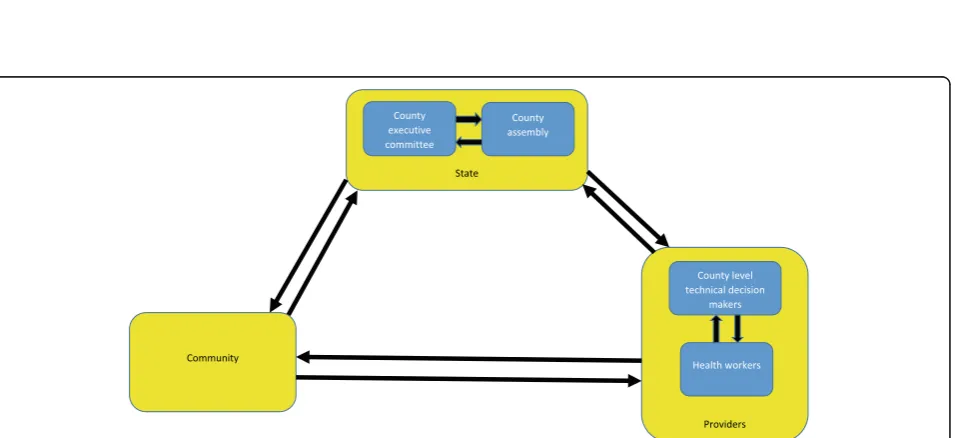
responsibilities for priority-setting. Leaders therefore need to negotiate for power alongside the roll-out and enforcement of priority-setting and service implementa-tion. Political influence, control of resources and know-ledge were viewed as important sources of power and are used by key decision-makers to exert and extend their‘power over’other actors (see Table2).‘Power over’ was by far the most common expression of power de-scribed by respondents within priority-setting for health at county level, although all four forms are present to varying degrees (see Table 2). Our study identified that negotiations surrounding power has created five main interfaces between actors within each county (see Fig.2, modified [30]). These are explained more in the follow-ing section.
1) Between state actors (CEC and county assembly)–
these negotiations tended to demonstrate attempts to exert‘power over’the other state actor for reasons of political gain.
2) Between state actors (CEC and county assembly) and providers (county level technical decision makers and health workers) - providers often felt that following devolution, power for priority-setting had relocated from health service providers to state actors.
3) Between providers (county level technical decision makers, subcounty managers and health workers) -providers working at levels below county level (sub-county, health facility and community level) often felt excluded from the priority-setting process, with limited scope for‘power with’other decision-making actors. 4) Between state actors (CEC and county assembly)
and the community - negotiations between state actors and the community ought to be stronger following devolution, with the introduction of public participation meetings. Challenges exist however, with these mechanisms failing to address
underlying norms or promote‘power within’,
thereby creating a barrier to empowering the whole
community with‘power to’identify priorities (see
section 3 community accountability and
empowerment [21]).
Between providers (health workers) and the commu-nity - health workers at times felt excluded from county level decision-making structures as well as community level public participation meetings.
2. Spaces of power
includes discussions between CEC members and the governor or among members of county assembly. We found that the degree to which decisions made occurred in closed spaces appeared to be influenced by the leader-ship style of those leading the priority-setting process. The CEC member for health was most frequently described as leading the priority-setting process for health and playing a key role in negotiating between decision-making actors when priorities differed. As a re-sult, in a county where the CEC member for health has an authoritarian leadership style, it is likely that the priority-setting process will be less participatory, com-pared with a leader who recognises the value of other actors’ contributions. In our study, respondents from three out of ten counties described a CEC member for health (either present or recent past) who adopted an authoritarian or dictatorial approach to decision-making, with staff feeling disrespected and demotivated as a con-sequence. In these counties other members of the county health management team had limited knowledge about what, how or why decisions were made. Within counties with a leader who adopted an authoritarian leadership style, even those involved with discussions at times felt unable to question or challenge priorities with-out fear of reprisal.
“I also think there is the power balance. There [are] also some powerful positions…yet the decisions you (the person in power) make are not good, and I am below you and I know, we are supposed to do Y, yet you are saying we should do X and because of that power relations there is no way I am communicating with you without the fear of losing my job, then we make the wrong decisions.”County Health Respondent IDI, Female69
Respondents from three counties did not describe particu-larly strong examples of either authoritarian or participa-tory leadership approaches. Meanwhile, respondents from four counties described the use of participatory approaches to priority-setting, opening up the priority-setting space to include other stakeholders across the health system. In the clearest example of this within a positive deviant county which demonstrated strong participatory decision-making approaches, a CEC member sought to ensure that other actors within the county health management team, the county assembly, health workers, administrators, commu-nity health workers and commucommu-nity members were all empowered with knowledge about health and health prior-ities and were actively involved in identifying priorprior-ities, in-formed by this knowledge.
“The process of making decisions is not a one man show. I would like to say that first of all, even the strategies
that we have developed, there is what we call public participation every year we ask the public what are priorities they have? What do they need?…and we do also have community representatives during the budgeting process so that it is all inclusive so that whatever we are doing is what the people want.”County Health Respondent IDI, Male 50
Invited space: Citizens are invited to participate in priority-setting by authorities, which in Kenya includes the public participation forums (see [16] for more details about the public participation forums, barriers to mean-ingful engagement and examples of best practices). These public meetings have been introduced since devo-lution as a forum for accountability, with the objective of ensuring community needs and priorities are reflected in county government plans and budgets. Ideally, the
meetings should promote a ‘power with’ approach to
priority-setting, providing a range of actors with the knowledge and opportunity to take part in actively selecting priorities and monitoring progress towards their attainment. However, failure to address under-lying social norms and structures contribute to lim-ited ‘power within’ by ‘ordinary’ citizens, including
those most marginalised (see Table 2). Community
members from formerly marginalised counties in Northern Kenya are reluctant to participate in meet-ings held by government actors to identify their needs and priorities, due to their perception of unchanged historic norms arising from colonisation which led to decades of neglect within their region.
“…they (community) still have the perception that this is the government that has neglected them for all those years …actually a lot civic education needs to be done if you want actually effective participation.” County Health Respondent IDI, Male48
As the quote indicates, for these populations and other marginalised groups (such as women, youth, street dwellers), historic, social, cultural norms and discriminations continue to persist (despite legisla-tion which provides scope for their participalegisla-tion). As
a consequence these norms impose limits to citizens’
sense of self-worth, self-knowledge and ‘power
within’, thereby limiting their agency to take up their
‘power to act’ now made available according to
pol-icy in the invited space of public participation
for-ums (see Table 2). In general, there have been
genuine community empowerment and participation within priority-setting processes. This is further
ex-plored through the ‘invisible’ forms of power
operat-ing, which influence an individual’s agency to move
into invited spaces (see Table 2).
In fact, not only are marginalised community mem-bers reluctant to participate due to limited ‘power within’, but there was suggestion by a minority of na-tional level respondents that there may be reluctance on the part of county leaders to share power with the community in general, due to the perception that by empowering the community they would themselves lose power. As a consequence these invited spaces be-came tokenistic, failing to promote the ‘power with’ approach to priority-setting between county level and community actors as intended.
“A lot of other counties are actually hesitant to implement public participation models because they want to have all the power, not to give the
communities power.”National Respondent IDI, Male10
Claimed spaces: These are spaces claimed by less power-ful actors from existing power holders. These were infre-quently described by respondents in our study. There was little discussion about how health workers can engage and re-claim power from politicians to ensure their involve-ment and technical appropriateness of priorities set. Al-though the recurring health worker strikes following devolution may be considered to indicate their efforts to re-claim power, as they pressed for re-centralisation of health service delivery to national government [31]. A mi-nority of respondents acknowledged a gap for citizens to hold their service providers to account. In response to this gap, there were some early examples of social media plat-forms being established by citizens to raise awareness about poor quality services.
“…currently sometimes even in the internet [like] facebook, what you usually see [is] people writing things. So you realize that sometimes, something that should have been solved earlier, blows up into a political matter…It should have been very simple, because if you had gotten in touch with the person who was
complaining…But we don’t have a system even of measuring the satisfaction of the people.”County Health Respondent IDI, Male09
Other respondents, particularly county level technical respondents, highlighted the need for citizens to hold leaders to account for providing (or not) health services. However, some citizens themselves highlighted their confusion surrounding how this could be done.
3. Forms and visibility of power
‘Visible power’- Within Kenya there is a clear general process for how priorities should be set, which is out-lined within the new Constitution, although it contains limited specific guidance for how the process should be implemented. In many instances respondents described examples where visible power was used to tackle inequi-ties, with county governments seeking to address in-equitable availability and access to health services, through investment in infrastructure and recruitment of additional human resources for health. In general this process was followed across the study counties. How-ever, while the process was followed, some of the steps were merely perfunctory in nature – fulfilling the re-quirements but not striving towards attaining the objec-tives specified in the Constitution.
“It [decision-making process] is just but it is not fair (laughter)…It is just because the process is followed and people are involved in the decision-making. But it is not fair, because you go through that process and at the end of the day, you don’t achieve anything.”
County Non-Health Respondent IDI, Female34
‘Hidden power’ –As a consequence of the rapid roll-out of devolution, additional guidance surrounding priority-setting processes and structures (including accountabil-ity mechanisms), county laws and policies and recruit-ment of needed staff had not yet been put in place when the reforms started. This created a vacuum at county level, which allowed ‘hidden power’ to have a dispropor-tionate effect, with certain powerful actors able to control the extent to which other actors are included (or not) in identifying priorities, the content of the priority-setting agenda and ultimately the priorities set. In our study many community members and providers (including technical health systems decision-makers from county, sub-county and health facility level) highlighted that tribalism and pa-tronage norms (which were common within the former centralised government), have continued in some counties under the devolved government.
“So as a governor, if these are my voters in terms of my investment I would rather focus on these pockets that give me votes, rather than these ones who still need a lot of support in health.”National respondent IDI, Male05
‘Invisible power’ – In our study, community members
themselves did not generally consider priority-setting as one of their health-related roles. Underlying norms and discriminations such as tribalism, sexism, classism or ableism have not been adequately addressed since devo-lution, with inadequate actions to accommodate
attend-ance at community meetings by ‘marginalised’ groups.
This is despite measures having been introduced in pol-icy including guidance specifying that no more than two thirds of membership of county assembly are of the same gender, 5 % of community representatives appointed or elected to public bodies are persons with disability, and that the state should put in place af-firmative action programmes to ensure minorities and marginalised groups participate and are represented in
governance [14]. According to the Constitution, those
identified as marginalised include women, persons with disabilities, youth, ethnic and other minorities and mar-ginalised communities (small/ traditional/ indigenous
community, pastoralists) [14]. Even more worrying is
the absence of any guidance within the Constitution for other marginalised groups, including gay and lesbian persons, street dwellers, drug and alcohol users or ex-treme poor. All these groups were identified (to varying degrees) as‘vulnerable’ by study respondents, yet there is no clear legislation to promote their participation in decision-making. Unsurprisingly, power differentials between marginalised groups, other community mem-bers, politicians and actors facilitating meetings
per-sists. Our findings reveal that in patriarchal
communities many women may have too many respon-sibilities at home to be able to attend public participa-tion meetings or do not have the confidence to speak out even if they do attend. Those who were illiterate, poor, have a disability, live far from the meeting
loca-tion or don’t read English (the language meetings are
advertised in) experienced barriers to attending and/or participating. For such reasons, power imbalances per-mit the views of more powerful actors to dominate leaving priority-setting open to manipulation by local elites, which can lead to selection of inappropriate pri-orities.
“…some of the challenges are political because you realise politics plays in almost everything so if a person wants something you just go to the community and pressure them and these people the community come up with a wrong decision on health because of
politics…based on someone else’s interest which is not good.”County Non-Health Respondent IDI, Male33
Discussion
We found Kenya’s transition towards devolution is trans-forming the former centralised balance of power, leading to greater ability for influence at the county level, with redu-cing power at national and sub-county (district) levels and limited change at community level. Within these changing power structures, politicians are felt to play a greater role in priority-setting for health. The interfaces and tensions be-tween state politicians, technical health service providers and the community has at times been felt to undermine technical priorities. While power has changed drastically at the higher levels, there has been varied and typically lim-ited consistent change at community level. Underlying so-cial structures and discriminations generally continue unchanged, leading to the continued exclusion of those most vulnerable from priority-setting processes. Through application of Gaventa’s power cube framework and Veneklasen’s expressions of power, we systematically iden-tified the changing power distribution since Kenya de-volved services in 2013 and the influence of social norms, structures and discriminations on the distribution of power, the space of power and the visibility of power.
available to them [18]. At community level, mechanisms to engage citizens within priority-setting have been estab-lished, but as the Additional file 1 by McCollum et al. (2018) highlights, these mechanisms face major con-straints to facilitating the meaningful participation of ‘ or-dinary’citizens [16]. These constraints largely reflect those identified by Cleary et al.(2013) [35] and include limited respect from certain actors, limited investment and alloca-tion of resources to facilitate involvement of marginalised groups and failure to address underlying values, beliefs and cultures which act to exclude certain actors from the decision-making table.
Objectives for devolution in Kenya (such as citizens’ empowerment, promotion of national unity and eradica-tion of inequalities [14]) are in part an effort to alleviate the effects of structural forces such as colonisation, which had led to the ethnocentrism fuelled violence dur-ing 2007 elections and long-standdur-ing inequities based on geographic location or tribe [29]. Local, regional, na-tional and internana-tional norms, forces and systems form a complex web that combines to create and sustain so-cial and health inequities [36]. In keeping with aspects of two recent Kenyan studies [37, 38] our findings reveal that patronage norms, including former politicians’ en-couragement of citizens to evaluate their leader based on his/her ability to fund projects for certain groups in local communities [38] have not yet been eradicated. In-stead, in a minority of counties these norms have found ways to flourish within the devolved governance system, leading to nepotism and service distribution which aligns with patronage networks rather than need. This has con-tributed to over-emphasis on visible curative services, to the neglect of less tangible but often more equitable and cost-effective public health services, such as community health. This exploitation of the priority-setting process to secure votes is in keeping with the ‘majority voting model’outlined by Goddard et al. (2006) [32] and previ-ously observed in Tanzania [39]. Respondents from formerly marginalised counties spoke about the reluc-tance of citizens to engage with community governance mechanisms, highlighting the need to first address the political and historical legacies before citizens will par-ticipate [40]. In general, community members do not seem to have been adequately informed about their role within priority-setting, the choice of interventions avail-able to them or provided with the data which would allow them to make informed decisions. This is similar to other contexts where governments obstruct or resist community participation, which raises concerns about living conditions or proposes solutions [39,40].
In Kenya, and other contexts undergoing health sys-tems change there is need to strengthen meaningful community empowerment, by addressing underlying norms and structures which create a barrier to the
expression of ‘power within’ by disadvantaged commu-nity members and which encourages ‘power with’ and
‘power to’ expressions of power [2]. This will need spe-cific actions to ensure inclusion of ‘disadvantaged groups’, standards placed on local governments and cre-ation of conditions for delibercre-ation within public partici-pation forums [41]. Properly functioning accountability mechanisms should support governance and ensure an-swerability between actors [35] involved with setting pri-orities, providing services and their recipients within communities.
Limitations
The diversity between Kenya’s 47 counties may limit generalizability of findings. The selection of ten study counties tried to ensure diversity in demographic, geo-graphic, social, cultural and economic differences. Inter-views were conducted with county leaders across ten counties, and with health workers in three and community members in two counties due to time and resource con-straints, and so findings are not necessarily generalisable across the country. The restructuring and implications for power within priority-setting and at community level will adapt over time. As such, we can only ever present a snap-shot of this in a particular time and place. However, we have tried to consider how historical factors have changed over time leading up to devolution and their impact for its implications. Positionality of the main interviewer as a for-eign researcher may have inhibited some respondents from openly sharing their opinions. Conversely, some re-spondents may have felt less threatened and discussed more. Inclusion of experienced Kenyan co-authors in study design and analysis sought to bring‘insider’ perspec-tives to the study.
Recommendations
Power analysis of priority-setting at county level, after de-volution in Kenya highlights the need for stronger institu-tional structures, processes and norms to reduce the power imbalances between decision-making actors. Poten-tial opportunities to address these imbalances include:
1. Promote transparency and accountability between political and technical actors, by involving
politicians (e.g. representative for health for county assembly) within routine quarterly planning meetings, allowing opportunity for technical actors to share routine monitoring, progress, challenges faced and to respond to any questions or concerns from politicians.
politicians so as to enable them to present
politicians with easy to interpret information about cost-effectiveness, effectiveness and equity aspects of various health interventions. Provide opportun-ities for politicians to interact with and hear from community health volunteers to understand more about their work.
3. Build stronger platforms to engage health workers at different levels (community and health facility
level) in priority-setting, in order to build‘power
within’and encourage their participation and
shar-ing of‘power with’other actors in priority-setting.
Along with promoting transparency between health service providers and state actors.
4. Ensure governance and accountability measures, such as public participation are meaningful, by reducing the knowledge imbalance (between the community and other technical and political actors) to develop ‘power within’and encourage‘power to’participate in priority-setting by different community members. Provide community members with easily understood information about the range of choices available to them, the reasoning behind those choices and the process for filtering choices. Create innovative ap-proaches to ensure participation from those consid-ered‘marginalised’in priority-setting, such as women only meetings in certain contexts or use of social media platforms with youth.
Additional file
Additional file 1:Appendix 1.Topic guides. (DOCX 21 kb)
Abbreviations
CEC:County Executive Committee; CTC: Close-to-community; FGD: Focus Groups Discussion; IDI: In Depth Interview
Acknowledgements
The authors gratefully acknowledge the policymakers, county health
management team and sub-county health management team members, facility managers, community health extension workers, community health volunteers and community members who gave of their time to be interviewed and the qualitative research team, including Robinson Karuga and Maryline Mireku.
Funding
This work was supported by co-funding from the European Union Seventh Framework Programme ([FP7/2007–2013] [FP7/2007–2011]) under grant agreement number 306090 and was conducted in collaboration with the REACHOUT consortium. REACHOUT is an ambitious 5-year international re-search consortium aiming to generate knowledge to strengthen the per-formance of CHWs and other close-to-community providers in promotional, preventive and curative primary health services in low- and middle-income countries in rural and urban areas in Africa and Asia. The contents are the re-sponsibility of the authors and do not necessarily reflect the views of the European Union Seventh Framework Programme.
Availability of data and materials
The data supporting our findings are contained within the manuscript.
Authors’contributions
The idea for the study and it’s design was conceived by RM, MT, ST, TM and LO. Data coding and preliminary analysis was carried out by RM, with regular discussions with LO, NM, MT, TM and ST through the data collection and analysis process. SM and EB participate in a health systems governance learning site, conducting related research within Kilifi county in Kenya. RM prepared the initial draft of this paper. All authors reviewed the draft manuscript and provided input to preparation of and approval for the final version of the report.
Ethics approval and consent to participate
Ethical approval was received from Kenya Medical Research Institute (KEMRI) and Liverpool School of Tropical Medicine, with research permit from National Commission for Science Technology and Innovation (NACOSTI). Written informed consent was sought from and signed by all interviewed respondents.
Consent for publication
The manuscript has anonymised information to ensure confidentiality.
Competing interests
The authors declare that they have no competing interests.
Publisher’s Note
Springer Nature remains neutral with regard to jurisdictional claims in published maps and institutional affiliations.
Author details
1Department of International Public Health, Liverpool School of Tropical
Medicine, Liverpool, UK.2LVCT Health, Nairobi, Kenya.3Health Economics Research Unit, KEMRI-Wellcome Trust Research Programme, P.O. Box 43640-00100, Nairobi, Kenya.4Nuffield Department of Medicine, University of Oxford, Oxford, UK.5KEMRI Centre for Geographic Medicine Research– Coast, and Wellcome Trust Research Programme, Nairobi, Kenya.6Centre for Tropical Medicine, University of Oxford, Oxford, UK.
Received: 13 March 2018 Accepted: 12 November 2018
References
1. Erasmus E, Gilson L. How to start thinking about investigating power in the organizational settings of policy implementation. Health Policy Plan. 2008; 23(5):361–8.
2. L. VeneKlasen, V. Miller, D. Budlender, and C. Clark,“power and empowerment,”inA New Weave of Power, People and Politics: The Action Guide for Advocacy and Citizen Participation, vol. 43, 2002, pp. 39–41. 3. Barasa EW, Cleary S, English M, Molyneux S. The influence of power and
actor relations on priority setting and resource allocation practices at the hospital level in Kenya: a case study. BMC Health Serv Res. 2016;16(1):536. 4. Hipgrave DB, Alderman KB, Anderson I, Soto EJ. Health sector priority setting at
meso-level in lower and middle income countries: lessons learned, available options and suggested steps. Soc Sci Med. 2014;102:190–200.
5. Confederation TNHS. Priority setting : an overview the voice of NHS leadership. In: London, UK; 2007.
6. Mitton CR. Priority setting for decision makers: using health economics in practice. Eur J Health Econ. 2002;3(4):240–3.
7. Kenny N, Joffres C. An ethical analysis of international health priority-setting. Heal Care Anal. 2008;16(2):145–60.
8. Tomlinson M, Chopra M, Hoosain N, Rudan I. A review of selected research priority setting processes at national level in low and middle income countries: towards fair and legitimate priority setting.Heal. Res. Policy Syst. 2011;9(1):19.
9. Sibbald SL, Singer PA, Upshur R, Martin DK. Priority setting: what constitutes success? A conceptual framework for successful priority setting. BMC Health Serv Res. 2009;9(1):43.
10. Mills A, Vaughan JP, Smith DL, Tabibzadeh I. Health system
decentralization: concepts, issues and country experience.World Health Organisationp. 1990;151.
12. Mitchell A, Bossert TJ. Decentralisation, governance and health-system performance:‘where you stand depends on where you sit. Dev Policy Rev. 2010;28(6):669–91.
13. Eaton K, Kaiser K, Smoke P. The political economy of decentralization reforms - implications for aid effectiveness: Washington DC; 2010. 14. National Council for Law Reporting with the Authority of the
Attorney-General. The constitution of Kenya. In: Nairobi, Kenya; 2010. 15. Kenya School of Government and The World Bank,“Kenya devolution.
Working paper 1-. Building Public Particpation in Kenya’s devolved government,”Nairobi, Kenya, 2015.
16. McCollum R, et al. Priority setting for health in the context of devolution in Kenya: implications for health equity and community-based primary care. Health Policy Plan. 2018;14:1.
17. B. Tsofa, S. Molyneux, L. Gilson, and C. Goodman,“How does
decentralisation affect health sector planning and financial management? A case study of early effects of devolution in Kilifi County, Kenya,”Int J Equity Health, vol. 16, no. 1, p. 151, 2017.
18. Nyikuri MM, Tsofa B, Okoth P, Barasa EW, Molyneux S. We are toothless and hanging, but optimistic’: sub county managers’experiences of rapid devolution in coastal Kenya. Int J Equity Health. 2017;16(1):113. 19. Barasa EW, Manyara AM, Molyneux S, Tsofa B. Recentralization within
decentralization: county hospital autonomy under devolution in Kenya. PLoS One. 2017;12(8):1–18.
20. Barasa E, Nguhiu P, McIntyre D. Measuring progress towards sustainable development goal 3.8 on universal health coverage in Kenya. BMJ Glob Heal. 2018;3(3):e000904.
21. McCollum R, Limato R, Otiso L, Theobald S, Taegtmeyer M. Health system governance following devolution: comparing experiences of
decentralisation in Kenya and Indonesia. BMJ Glob. Heal. 2018. 22. Pope C, Mays N. Reaching the parts other methods cannot reach: an
introduction to qualitative methods in health and health services research. BMJ. 1995;311(6996):42–5.
23. Guba EG. Criteria for assessing the trustworthiness of naturalistic inquiries. Educ Commun Technol. 1981;29(2):75–91.
24. Gaventa J. Finding the spaces for changes: a power analysis. IDS Bull. 2006; 37(6):23–33.
25. Lukes S. Power a radical view. London: Macmillan Press Ltd; 1974. 26. Simpson J. Everyone belongs: a toolkit for applying intersectionality.
Canada: Ottawa; 2009.
27. Ritchie J, Lewis J. The foundations of qualitative research. Qual Res Pract A Guid Soc Sci students Res. 2003:2–10.
28. Kuper A, Reeves S, Levinson W. An introduction to reading and appraising qualitative research. BMJ Br Med J. 2008:404–9.
29. S. O. Akoth,“Challenges of Nationhood : Identities , citizenship and belonging under Kenya’s new Constitution,”Nairobi, Kenya, 2011. 30. Brinkerhoff DW, Bossert TJ. Health governance: concepts, experience. and
Programming Options. 2008.
31. B. Tsofa, C. Goodman, L. Gilson, and S. Molyneux,“Devolution and its effects on health workforce and commodities management - early implementation experiences in Kilifi County, Kenya Lucy Gilson,”Int J Equity Health, vol. 16, no. 1, pp. 1–13, 2017.
32. Goddard M, Hauck K, Smith PC. Priority setting in health - a political economy perspective. Health Econ Policy Law. 2006;1(Pt 1):79–90. 33. Pisani E, Kok MO, Nugroho K. Indonesia’s road to universal health
coverage : a political journey. Heal Policy &Planning Adv Access. 2016:1–10. 34. Purwaningrum F, Yoganingrum A, McDonald F, Short SD, Ariani D. Health
governance in the local level: the case of decentralization, planning and accesibility in Gunung Kidul, Indonesia: Copenhagen; 2010.
35. Cleary SM, Molyneux S, Gilson L. Resources, attitudes and culture: an understanding of the factors that influence the functioning of
accountability mechanisms in primary health care settings. BMC Health Serv Res. 2013;13(1):320.
36. E. McGibbon and M. C,“Applying Intersectionality & Complexity Theory to Address the Social Determinants of Women’s Health,”Nova Scotia, Canada, 2013. 37. Cornell A, D’Arcy M. Plus ça change ? County-level politics in Kenya after
devolution. J East African Stud. 2014;8(1):173–91.
38. D’Arcy M, Cornell A. Devolution and corruption in Kenya: everyone’s turn to eat? Afr Aff (Lond). 2016;115(459):246–73.
39. Frumence G, Nyamhanga T, Mwangu M, Hurtig A-K. Challenges to the implementation of health sector decentralization in Tanzania: experiences from Kongwa district council. Glob Health Action. Jan. 2012;6(14):1–11. 40. World Health Organization (WHO). Closing the gap: policy into practice on
social determinants of health: discussion paper: Rio De Janeiro; 2011. 41. Lakin J, Nyagaka M. Deliberating budgets. How public deliberation can