R E S E A R C H A R T I C L E
Open Access
Local-regional control according to surrogate
markers of breast cancer subtypes and response
to neoadjuvant chemotherapy in breast cancer
patients undergoing breast conserving therapy
Abigail S Caudle
1, Tse-Kuan Yu
2, Susan L Tucker
3, Isabelle Bedrosian
1, Jennifer K Litton
4, Ana M Gonzalez-Angulo
4,
Karen Hoffman
2, Funda Meric-Bernstam
1, Kelly K Hunt
1, Thomas A Buchholz
2and Elizabeth A Mittendorf
1*Abstract
Introduction:Breast cancers of different molecular subtypes have different survival rates. The goal of this study was to identify patients at high risk for local-regional recurrence according to response to neoadjuvant
chemotherapy and surrogate markers of molecular subtypes in patients undergoing breast conserving therapy (BCT).
Methods:Clinicopathologic data from 595 breast cancer patients who received neoadjuvant chemotherapy and BCT from 1997 to 2005 were identified. Estrogen receptor (ER), progesterone receptor (PR) and human epidermal growth factor receptor 2 (HER2) expression determined by immunohistochemistry were used to construct the following subtypes: ER+ or PR+ and HER2- (hormone receptor (HR)+/HER2-; 52%), ER+ or PR+ and HER2+ (HR +/HER2+; 9%), ER- and PR- and HER2+ (HR-/HER2+; 7%) and ER- and PR- and HER2- (HR-/HER2-; 32%). Actuarial rates were calculated using the Kaplan-Meier method and compared using the log-rank test. Cox proportional hazards models were used for multivariate analysis (MVA).
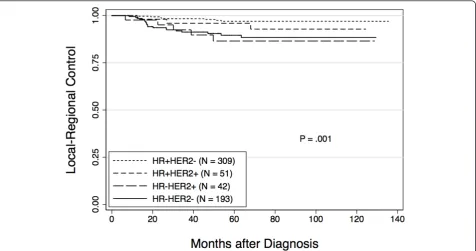
Results:After a median follow-up of 64 months, the five-year local-regional recurrence (LRR)-free survival rate for all patients was 93.8%. The five-year LRR-free survival rates varied by subtype: HR+/HER2- 97.0%, HR+/HER2+ 95.9%, HR-/HER2+ 86.5% and HR-/HER2- 89.5% (P= 0.001). In addition to subtype, clinical stage III disease (90% vs. 95% for I/II,P= 0.05), high nuclear grade (92% vs. 97% with low/intermediate grade,P= 0.03), presence of lymphovascular invasion (LVI) (89% vs. 95% in those without LVI,P= 0.02) and four or more positive lymph nodes on pathologic examination (87% vs. 95% with zero to three positive lymph nodes,P= 0.03) were associated with lower five-year LRR-free survival on univariate analysis. On MVA, HR-/HER2+ and HR-/HER2- subtypes and disease in four or more lymph nodes were associated with decreased LRR-free survival. A pathologic complete response (pCR) was associated with improved LRR-free survival.
Conclusions:Patients with HR+/HER2- and HR+/HER2+ subtypes had excellent LRR-free survival regardless of tumor response to neoadjuvant chemotherapy. Patients with HR-/HER2+ and HR-/HER2- subtypes with poor response to neoadjuvant chemotherapy had worse LRR-free survival after BCT. Additional study is needed to determine the impact of trastuzumab on local-regional control in HER2+ tumors. Our data suggest that patients with HR-/HER2- subtype tumors not achieving pCR may benefit from novel strategies to improve local-regional control.
* Correspondence: [email protected]
1Department of Surgical Oncology, The University of Texas MD Anderson
Cancer Center, 1400 Hermann Pressler Drive, Unit 1484, Houston, TX 77030, USA
Full list of author information is available at the end of the article
Introduction
The local-regional management of breast cancer has evolved significantly over the past several decades. Based on data from prospective studies, breast conservation therapy (BCT), defined as lumpectomy with whole breast irradiation, is now accepted as oncologically equivalent to mastectomy in terms of overall survival (OS) [1-6]. The number of patients who are candidates for BCT has increased with the use of neoadjuvant che-motherapy, which has been shown to downsize tumors, facilitating BCT in patients that would otherwise require mastectomy if surgery were performed first [7-9]. Numerous clinical trials have investigated the impact of neoadjuvant versus adjuvant chemotherapy on survival and two meta-analyses have reported equivalent out-comes [10,11]. The use of neoadjuvant chemotherapy has also allowed insight into tumor biology and differen-tial response to treatment. Studies have shown that estrogen receptor (ER)-negative and high-grade tumors are more likely to respond to neoadjuvant chemotherapy [12-14]. In addition, multiple previous reports have demonstrated that achieving a pCR with neoadjuvant chemotherapy is associated with improved overall survi-val (OS) [9,15-17]. The effects of response to neoadju-vant chemotherapy on local-regional control are less well studied.
The importance of the underlying biology of breast tumors in predicting outcomes has been demonstrated by microarray analyses that identified molecular sub-types. The subtypes were initially defined by gene expression profiles that broadly divided breast tumors into subgroups, including: ER positive/luminal-like, basal-like, HER2 positive and normal breast [18]. Subse-quent studies demonstrated that the ER positive/lumi-nal-like group could be further refined into two subgroups; luminal A and luminal B with luminal A having greater expression of ER-related genes and lumi-nal B having higher expression of proliferative genes [19,20]. These classifications were determined to be clinically relevant when it was demonstrated that there were significant differences in survival based on the sub-type. ER/luminal tumors had longer disease-free and OS while basal-like and HER2 subtypes had worse outcomes [19].
Although determination of molecular subtype may be the most accurate way to evaluate breast cancers, such molecular profiling is currently not feasible for routine clinical care due to the time, cost and resources required to perform the analysis. In addition, it has not yet been demonstrated that decisions regarding local-regional or systemic treatment options should be made based on molecular subtyping. Therefore, clinicians have used hormone receptor and HER2 status, which are
routinely provided in a patient’s pathology report, to group tumors into constructed subtypes [21,22]. These constructed subtypes, which have been approximated as luminal A (ER+ or progesterone receptor (PR)+, HER2-), luminal B (ER+ or PR+, HER2+HER2-), HER2 (ER-, PR-, HER2+) and basal (ER-, PR-, HER2-), have been shown to approximate the molecular subtype signatures [23]. In a study evaluating almost 800 patients, Nguyenet al. reported that local recurrence rates following BCT in patients undergoing surgery as a first intervention varied according to subtype approximated using ER, PR and HER2 status [24]. Because neoadjuvant chemotherapy is increasingly used in breast cancer patients to facilitate BCT and because response to neoadjuvant chemother-apy has been shown to provide prognostic information, we undertook the current study to determine if categor-izing patients into subgroups using ER, PR and HER2 status could predict response to neoadjuvant che-motherapy and identify patients at high risk for local-regional recurrence (LRR) following neoadjuvant che-motherapy and BCT.
Materials and methods Patient population
A prospectively maintained database was used to iden-tify patients with non-metastatic breast cancer who received neoadjuvant chemotherapy followed by BCT from 1997 to 2005. The study was approved by the Uni-versity of Texas MD Anderson Cancer Center Institu-tional Review Board. Clinicopathologic data were recorded, including: clinical T and N stage according to the sixth edition of the American Joint Committee on Cancer staging guidelines, pathologic tumor size, num-ber of lymph nodes identified pathologically, Black’s modified nuclear grade, presence of lymphovascular invasion (LVI), ER, PR and HER2 status. Clinical T and N stage were determined at presentation by physical examination, mammography and ultrasound (US) of the breast and regional nodal basins. Lymph nodes appear-ing abnormal on US were routinely evaluated by fine needle aspiration biopsy [25]. For hormone receptor sta-tus, > 10% staining of cells by immunohistochemistry (IHC) was considered positive. Tumors were considered HER2-positive if they were 3+ by IHC or demonstrated gene amplification by fluorescencein situhybridization. A pCR was defined as no residual invasive disease in the breast or axilla.
constructed subtype as follows: HR+/HER2- (ER+ or PR + and HER2-), HR+/HER2+ (ER+ or PR+ and HER2+), HR-/HER2+ (ER- and PR- and HER2+) and HR-/HER2-(ER- and PR- and HER2-).
Treatment
All patients received neoadjuvant chemotherapy consist-ing of an anthracycline (98%), taxane (84%) or a combi-nation of the two. Because this study predated the routine use of neoadjuvant trastuzumab therapy, patients receiving neoadjuvant trastuzumab were excluded. Following neoadjuvant chemotherapy, all patients underwent BCT, including lumpectomy, axillary node evaluation and whole breast irradiation. At MD Anderson we have developed a standard approach whereby all patients undergo imaging before and after chemotherapy (diagnostic mammography and ultra-sound). The ultrasound evaluation includes the breast and regional nodal basins. Any suspicious appearing lymph nodes are confirmed to be positive for metastasis by fine needle aspiration biopsy. A marking clip is placed at the tumor site early in the treatment course to facilitate resection of the primary tumor bed in case of complete radiographic response. Following neoadjuvant chemotherapy, any residual radiographic abnormality and the clip are targeted for resection along with at least a 2 mm margin of normal tissue. In most cases, we do not attempt to excise the entire pre-chemotherapy tumor volume [26-28]. Patients with positive margins at initial attempt at BCT who were then converted to mas-tectomy were excluded from this study. For patients presenting with clinically node negative disease, axillary evaluation consisted of sentinel lymph node (SLN) dis-section with completion axillary lymph node disdis-section (ALND) performed when the SLN showed metastatic disease. Patients presenting with clinically node positive disease underwent ALND. Radiation included external-beam therapy to the whole breast with tangential fields. Standard treatment included a 50 Gy median dose to the breast delivered over five weeks in 25 fractions fol-lowed by a boost to the tumor bed (10 Gy median dose). Regional nodal irradiation (RNI) was administered at the discretion of the radiation oncologist and was generally considered for patients with clinical stage III disease, those with residual positive lymph nodes identi-fied pathologically and selectively for other indications to include young age, residual tumor > 2 cm, LVI and pretreatment extent of disease on US. Patients with hor-mone receptor positive disease were routinely offered adjuvant endocrine therapy.
Endpoints and statistical methods
The primary endpoint was LRR defined as disease recur-rence in the ipsilateral breast or the axillary,
supraclavicular, infraclavicular or internal mammary lymph nodes. All LRRs were considered events regard-less of whether they were the first site of failure or occurred with or after distant metastasis. Patients who did not experience a LRR were censored at last follow-up or at the time of death.
Distributions of clinical factors between groups were compared using the Kruskal-Wallis test for continuous variables and chi-squared test for categorical variables. Actuarial rates of LRR were calculated using the Kaplan-Meier method and differences between groups were compared using the log-rank test. Multivariate analyses were performed using a Cox proportional hazards model. All calculations were performed with Stata software (Stata/SE 11; Stata Corp., College Station, TX, USA). Two-tailed P-values ≤ 0.05 were considered statistically significant.
Results
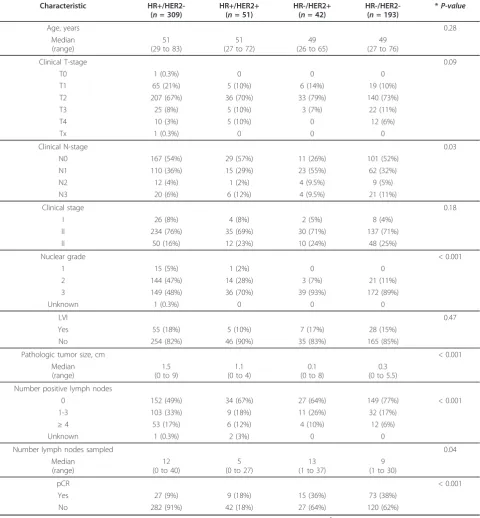
The study population consisted of 595 patients who received neoadjuvant chemotherapy and then under-went BCT; 309 (52%) categorized as HR+/HER2-, 51 (9%) HR+/HER2+, 42 (7%) HR-/HER2+, and 193 (32%) HR-/HER2-. Table 1 lists clinicopathologic characteris-tics by constructed subtype. There were significant dif-ferences in the distribution of clinical N stage (P = 0.04) between the subtypes, driven largely by HR-/ HER2+ patients being less likely to have clinical N0 disease. There was also a significant difference (P < 0.001) with respect to nuclear grade with patients in the HR-/HER2+ and HR-/HER2- groups having a higher percentage of patients with grade 3 disease. When evaluating response to neoadjuvant chemother-apy, we noted a difference (P < 0.001) in pCR rates with a lower percentage of patients in the HR+/HER2-(9%) and HR+/HER2+ (18%) subgroups achieving a pCR compared with patients in the HR-/HER2+ (36%) and HR-/HER2- (38%) subgroups. Patients with HR-/ HER2+ and HR-/HER2-tumors had smaller pathologic tumor sizes and a greater proportion had fewer than four positive lymph nodes identified at pathologic eva-luation after surgery.
+/HER2- 92.5%, HR+/HER2+ 85.8%, HR-/HER2+ 84.4%, and HR-/HER2- 83.0% (P= 0.008).
In addition to constructed subtype, we also evaluated the effect of other clinical and pathologic features on LRR-free survival rates. As shown in Table 3 clinical stage III disease, four or more positive lymph nodes,
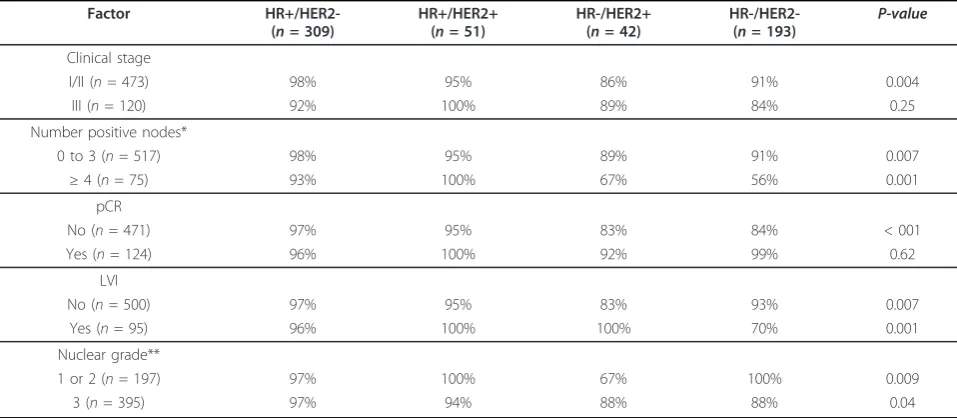
[image:4.595.58.539.101.620.2]presence of LVI and high nuclear grade were all signifi-cantly associated with lower LRR-free survival rates on univariate analysis. In order to determine the impact of these factors based on subtype, analyses were repeated with patients divided by constructed subtype (Table 4). Among patients who did not achieve a pCR or who had Table 1 Clinicopathologic characteristics by constructed molecular subtype
Characteristic HR+/HER2-(n= 309)
HR+/HER2+ (n= 51)
HR-/HER2+ (n= 42)
HR-/HER2-(n= 193)
*P-value
Age, years 0.28
Median (range)
51 (29 to 83)
51 (27 to 72)
49 (26 to 65)
49 (27 to 76)
Clinical T-stage 0.09
T0 1 (0.3%) 0 0 0
T1 65 (21%) 5 (10%) 6 (14%) 19 (10%)
T2 207 (67%) 36 (70%) 33 (79%) 140 (73%)
T3 25 (8%) 5 (10%) 3 (7%) 22 (11%)
T4 10 (3%) 5 (10%) 0 12 (6%)
Tx 1 (0.3%) 0 0 0
Clinical N-stage 0.03
N0 167 (54%) 29 (57%) 11 (26%) 101 (52%)
N1 110 (36%) 15 (29%) 23 (55%) 62 (32%)
N2 12 (4%) 1 (2%) 4 (9.5%) 9 (5%)
N3 20 (6%) 6 (12%) 4 (9.5%) 21 (11%)
Clinical stage 0.18
I 26 (8%) 4 (8%) 2 (5%) 8 (4%)
II 234 (76%) 35 (69%) 30 (71%) 137 (71%)
II 50 (16%) 12 (23%) 10 (24%) 48 (25%)
Nuclear grade < 0.001
1 15 (5%) 1 (2%) 0 0
2 144 (47%) 14 (28%) 3 (7%) 21 (11%)
3 149 (48%) 36 (70%) 39 (93%) 172 (89%)
Unknown 1 (0.3%) 0 0 0
LVI 0.47
Yes 55 (18%) 5 (10%) 7 (17%) 28 (15%)
No 254 (82%) 46 (90%) 35 (83%) 165 (85%)
Pathologic tumor size, cm < 0.001
Median (range)
1.5 (0 to 9)
1.1 (0 to 4)
0.1 (0 to 8)
0.3 (0 to 5.5)
Number positive lymph nodes
0 152 (49%) 34 (67%) 27 (64%) 149 (77%) < 0.001
1-3 103 (33%) 9 (18%) 11 (26%) 32 (17%)
≥4 53 (17%) 6 (12%) 4 (10%) 12 (6%)
Unknown 1 (0.3%) 2 (3%) 0 0
Number lymph nodes sampled 0.04
Median (range)
12 (0 to 40)
5 (0 to 27)
13 (1 to 37)
9 (1 to 30)
pCR < 0.001
Yes 27 (9%) 9 (18%) 15 (36%) 73 (38%)
No 282 (91%) 42 (18%) 27 (64%) 120 (62%)
*The Kruskal-Wallis test was used for age (continuous variable). All otherP-values were determined using thec2
four or more positive lymph nodes, those who were HR-/HER2+ and HR-/HER2- had decreased five-year LRR-free survival, while HR+/HER2-and HR+/HER2+ patients continued to have high rates of LRR-free survi-val. For example, the five-year LRR-free survival rate for patients categorized as HR-/HER2-that achieved a pCR was 99%, whereas in those who did not achieve a pCR, the five-year LRR-free survival rate was 84%. In contrast, for patients with HR+/HER2-disease, the five-year LRR-free survival rate was 96% for those who achieved a pCR and 97% for those who did not. Similarly, for patients that had four or more positive lymph nodes, the five-year LRR-free survival rate for patients with HR-/HER2-tumors was 56%, versus 91% if they had zero to three positive lymph nodes. For patients with HR+/HER2- dis-ease, the five-year LRR-free survival rates were 93% and 98%, respectively, for those who had four or more posi-tive lymph nodes versus those who had zero to three positive nodes.
A multivariate analysis was performed that included constructed subtype, clinical stage, grade, presence or
[image:5.595.62.539.89.340.2]absence of LVI, pCR versus no pCR and number of positive lymph nodes dichotomized as zero to three ver-sus four or more. Using HR+/HER2- as the referent, HR-/HER2+ (Hazard ratio 5.7, 95% CI: 2.0 to 16.3, P= 0.001) and HR-/HER2- (Hazard ratio 5.7, 95% CI: 2.6 to 112.3,P < 0.001) subtypes were associated with reduced LRR-free survival. Disease in four or more lymph nodes
Figure 1Local-regional recurrence free survival by constructed subtype. Actuarial rates of local-regional recurrence were calculated using the Kaplan-Meier method and differences between groups were compared using the log-rank test.
Table 2 Distribution of local-regional recurrences by constructed molecular subtype
HR+/HER2-N= 309
HR+/HER2+
N= 51
HR-/HER2+
N= 42
HR-/HER2-N= 193
Local 4 2 4 14
[image:5.595.305.539.505.704.2]Regional 4 1 1 5
Table 3 Five-year actuarial rates of local-regional control according to clinical and pathological disease status
Factor 5-year LRC rate P-value
Clinical Stage
I/II (n= 475) 95% 0.05
III (n= 120) 90%
Number positive nodes*
0 to 3 (n= 517) 95% 0.03
≥4 (n= 75) 87%
pCR
No (n= 471) 93% 0.06
Yes (n= 124) 97%
LVI
No (n= 500) 95% 0.02
Yes (n= 95) 89%
Nuclear grade**
1 or 2 (n= 198) 97% 0.03
3 (n= 396) 92%
[image:5.595.56.290.681.731.2](Hazard ratio 2.9, 95% CI: 1.3 to 6.6,P = 0.01) was also independently associated with decreased LRR-free survi-val. Achieving a pCR (Hazard ratio 0.22 (0.07 to 0.74, P = 0.014) was associated with improved LRR-free survival (Table 5).
Discussion
The recognition that breast cancer is a heterogeneous disease with tumors of different molecular subtypes being driven by different biologic pathways, having dif-ferent response to therapy and difdif-ferent survival rates, has been an important advance [18,19,29]. These sub-types, including luminal A, luminal B, HER2 and basal, were initially identified using cDNA microarray analysis. Subsequently, investigators have demonstrated that con-structed molecular subtypes determined using ER, PR and HER2 status corresponds with these molecular sub-types thus allowing clinicians to apply this concept to patient care and decision making [30]. In the current study, we have determined the constructed subtype for a
large population of patients that received neoadjuvant chemotherapy and then underwent BCT. We found that the constructed subtype correlated both with response to neoadjuvant chemotherapy as well as LRR-free survi-val. Importantly, patients with HR+/HER2- and HR +/HER2+ subtypes had excellent rates of LRR-free survi-val regardless of tumor response to neoadjuvant che-motherapy. In contrast, in patients with HR-/HER2-subtypes, the response to neoadjuvant chemotherapy was more likely to predict LRR-free survival, with those who responded poorly to neoadjuvant chemotherapy, having worse local-regional control after BCT.
[image:6.595.57.291.636.713.2]Other groups have evaluated the impact of con-structed subtypes on local-regional control in different patient populations. An early study addressing this ques-tion by Nguyen et al., evaluated 793 patients treated with BCT as a first intervention between 1998 and 2001 [24]. Ninety percent of patients in their series received systemic therapy. After a median follow-up of 70 months, the five-year incidence of LRR was 0.8% for what these investigators referred to as luminal A (HR +/HER2-), 1.5% for luminal B (HR+/HER2+), 8.4% for HER2 (HR-/HER2+) and 7.1% for basal (HR-/HER2-) tumors. Similar to the findings from the current study, on multivariate analysis using HR+/HER2- as the refer-ent, the HR-/HER2+ and HR-/HER2- subtypes were associated with higher rates of LRR. A recent publica-tion from Arvoldet al.also evaluated differences in LRR based on constructed subtypes in a population of patients undergoing BCT [31]. In contrast to the study by Nguyen et al., which was limited to patients under-going initial surgery, and to our study, which was Table 4 Five-year actuarial rates of local-regional control according to clinical and pathologic disease status by molecular subtype
Factor HR+/HER2-(n= 309)
HR+/HER2+ (n= 51)
HR-/HER2+ (n= 42)
HR-/HER2-(n= 193) P-value
Clinical stage
I/II (n= 473) 98% 95% 86% 91% 0.004
III (n= 120) 92% 100% 89% 84% 0.25
Number positive nodes*
0 to 3 (n= 517) 98% 95% 89% 91% 0.007
≥4 (n= 75) 93% 100% 67% 56% 0.001
pCR
No (n= 471) 97% 95% 83% 84% < 001
Yes (n= 124) 96% 100% 92% 99% 0.62
LVI
No (n= 500) 97% 95% 83% 93% 0.007
Yes (n= 95) 96% 100% 100% 70% 0.001
Nuclear grade**
1 or 2 (n= 197) 97% 100% 67% 100% 0.009
3 (n= 395) 97% 94% 88% 88% 0.04
* In three patients the number of lymph nodes was unknown. ** In one patient, the nuclear grade was unknown. LRC, local-regional control; LVI, lymphovascular invasion; pCR, pathologic complete response
Table 5 Multivariate analysis of factors associated with local-regional control
Factor Hazard Ratio (95% CI) P-value
Subtype*
HR-/HER2- 5.7 (2.6 to 12.3) < 0.001
HR-/HER2+ 5.7 (2.0 to 16.3) 0.001
≥4 positive lymph nodes 2.9 (1.3 to 6.6) 0.01
pCR 0.22 (0.07 to 0.74) 0.01
limited to patients receiving neoadjuvant chemotherapy, the Arvold study included BCT patients regardless of whether they received neoadjuvant chemotherapy, adju-vant chemotherapy or no chemotherapy (46% of patients did receive systemic treatment). These investigators clas-sified patients based on receptor status as well as nuclear grade with subgroups defined as luminal A (ER or PR+, HER2 -, grade 1 to 2), luminal B (ER or PR+, HER2 -, grade 3), luminal HER2 (ER or PR+, HER2+), HER2 (ER/PR-, HER2+), and triple negative (ER/PR-, HER2-). The five-year LRR rates were 0.8% for luminal A, 2.3% for luminal B, 1.1% for luminal HER2, 10.8% for HER2 and 6.7% for triple negative [32]. In this case, using constructed molecular subtypes, in addition to grade, they were able to classify patients based on rates of local-regional control. Investigators from the Univer-sity of North Carolina used constructed molecular sub-types to predict local-regional control in 149 patients treated between 1991 and 2005 [33]. Similar to our study, they included only patients who received neoadju-vant chemotherapy; however, patients could undergo BCT or mastectomy. After a median follow-up of 55 months, they reported a higher rate of LRR in patients with HR-/HER2- tumors (14%) versus HR+/HER2- (4%), HR+/HER2+ (4%), or HR-/HER2+ (5%) (P = 0.03). This study also predated the routine use of trastuzumab in patients with HER2-overexpressing disease. Evaluating just those patients who underwent BCT (n= 49), they noted that there were no LRR events in the HR+/HER2-, HR+/HER2+HR+/HER2-, or HR-/HER2+ groups while 8% of the HR-/HER2- group developed LRR (P = 0.99) [33]. These data are limited by the small number of patients but their findings are consistent with the current study showing excellent rates of local-regional control for patients with HR+ breast cancer.
The current study represents the largest series evaluat-ing the effect of subtype on response to neoadjuvant chemotherapy and LRR-free survival in patients under-going BCT. We found that patients with HR+/HER2-and HR+/HER2+ tumors had significantly lower rates of pCR (9% and 18%, respectively) compared with patients with HR-/HER2+ or HR-/HER2- tumors (36% and 38%, respectively). This is consistent with recently published data from the I-SPY 1 TRIAL, a multicenter study eval-uating patients with tumors≥3 cm using molecular sig-natures and early imaging with outcomes of pCR and recurrence free survival (RFS) [34]. In the I-SPY trial, the pCR rate was 9% in patients with HR positive tumors, which is identical to our rate for HR+/HER2-tumors. For patients with HR-/HER2- tumors, the pCR rate was 35%, comparable to our 38% rate. One differ-ence between these studies was the pCR rate of 54% in HR-/HER2+ patients in the I-SPY 1 trial; higher than our rate of 36% but based on only 13 patients.
Guarneri et al.previously reported that patients with ER-negative tumors were more likely to achieve a pCR after neoadjuvant chemotherapy [14]. The study by Guarneri and the current study do have some overlap in the population of patients reported; however, the previous report included patients that underwent mas-tectomy as well as BCT. Guarneri noted that patients with ER-positive tumors, despite having lower rates of pCR, had better five-year overall and progression-free survival rates. We found similar results in patients with HR+/HER2- and HR+/HER2+ disease, regardless of whether they responded to neoadjuvant chemother-apy. For patients with HR+/HER2- disease who achieved a pCR, the five-year LRR-free survival rate was 96% versus 97% for those who did not have a pCR. Similarly, for patients with HR+/HER2+ disease, the five-year LRR-free survival rates were 100% and 95%, respectively for those who did and did not have a pCR. These data likely reflect both the overall favor-able biology of the HR+ subtypes as well as the effec-tiveness of hormonal therapy in these patients. In contrast, for patients with HR-/HER2- tumors, we found a high rate of pCR (38%) and whether or not a patient achieved a pCR had significant implications for LRR-free survival rates. Patients who achieved a pCR had a five-year LRR-free survival rate of 99% versus 84% in those who did not achieve a pCR. Our data are again consistent with recently published data from the I-SPY 1 TRIAL, where they found that the association between RFS and pCR was greatest for patients who did not have HR+/HER2- tumors [34]. The use of neoadjuvant chemotherapy in patients with HR-/ HER2- tumors could, therefore, be useful in helping to identify patients at higher risk of LRR. For patients with HR-/HER2- tumors who fail to achieve a pCR, particularly those with four or more positive lymph nodes identified at the time of surgery, strategies to improve local-regional control should be explored including mastectomy or the use of radio-sensitizers to enhance the effects of radiation in BCT patients. The identification and evaluation of radio-sensitizers is a relevant consideration as data from the Danish Breast Cancer Cooperative Group suggests that this pheno-type may be less responsive to radiotherapy [35].
to neoadjuvant chemotherapy regimens has had a signif-icant impact as well. Studies looking at anthracycline-based neoadjuvant chemotherapy that would have included patients with HER2-positive tumors showed pCR rates of approximately 13% [39]. The addition of taxanes to anthracyclines improved pCR rates to 26 to 28% [39,40]. The addition of trastuzumab to neoadju-vant chemotherapy regimens for patients with HER2-positive disease has increased pCR rates to as high as 67% [41]. None of the patients with HER2+ tumors in the current study received trastuzumab as part of their neoadjuvant chemotherapy regimen and the pCR rate was 18% for the HR+/HER2+ subgroup and 36% in the HR-/HER2+ subgroup. We did not see significant differ-ences in five-year LRR-free survival rates for patients with HER2+ tumors based on whether they achieved a pCR or not. This is likely attributable to the small num-ber of patients. We did, however, note a difference in local-regional control in the HR-/HER2+ group based on the number of positive lymph nodes identified at the time of surgery with patients with zero to three positive lymph nodes having an 89% five-year LRR-free survival rate versus 67% for those with four or more positive nodes. Trastuzumab containing neoadjuvant chemother-apy regimens have been shown to eradicate clinically node positive disease in 74% of patients [42]. Taken together, this suggests that the use of trastuzumab-con-taining neoadjuvant chemotherapy regimens for patients presenting with clinically node positive, HER2-overex-pressing breast cancer could provide important informa-tion regarding prognosis based on the extent of residual disease. In addition, similar to patients with HR-/HER2-tumors, failing to eradicate nodal disease with the use of trastuzumab-based neoadjuvant chemotherapy could identify a population who may benefit from radio-sensi-tizers to enhance the response to therapy. Future stu-dies with a larger cohort of patients treated with more contemporary chemotherapy regimens incorporating trastuzumab will be required to better determine the effects of pCR on LRC in patients with HER2-positive disease.
Conclusions
In summary, we have shown that constructed subtypes can predict response to neoadjuvant chemotherapy as well as LRR-free survival rates. Patients with HR positive tumors have a low risk of local-regional failure regard-less of tumor response to neoadjuvant chemotherapy. In contrast, in patients with HR-/HER2- tumors, the response to therapy has important implications for the risk of LRR and may help to identify patients who may benefit from novel strategies to improve local-regional control.
Abbreviations
ALND: axillary lymph node dissection; BCT: breast conserving therapy; ER: estrogen therapy; HER2: human epidermal growth factor receptor 2; HR: hormone receptor; IHC: immunohistochemistry; LRR: local-regional recurrence; LVI: lymphovascular invasion; MVA: multivariate analysis; OS: overall survival; pCR: pathologic complete response; PR: progesterone receptor; RFS: recurrence free survival; RNI: regional nodal irradiation; SLN: sentinel lymph node; US: ultrasound.
Author details
1Department of Surgical Oncology, The University of Texas MD Anderson
Cancer Center, 1400 Hermann Pressler Drive, Unit 1484, Houston, TX 77030, USA.2Department of Radiation Oncology, The University of Texas MD Anderson Cancer Center, 1515 Holcombe Blvd, Unit 0097, Houston, TX 77030, USA.3Department of Bioinformatics and Computational Biology, The University of Texas MD Anderson Cancer Center, 1515 Holcombe Blvd, Unit 1410, Houston, TX 77030, USA.4Department of Breast Medical Oncology, The University of Texas MD Anderson Cancer Center, 1155 Hermann Pressler Drive, Unit 1354, Houston, TX 77030, USA.
Authors’contributions
ASC participated in the drafting of the manuscript. TKY conceived of the study, and participated in data collection and analysis. SLT participated in data analysis and drafting of the manuscript. IB, FMB, KH, KKH and TAB participated in data interpretation and critical revision of the manuscript. JKL and AMG participated in data collection and critical revision of the manuscript. EAM conceived of the study, participated in data collection and analysis, and drafting of the manuscript. All authors read and approved the final manuscript.
Competing interests
The authors declare that they have no competing interests.
Received: 7 February 2012 Revised: 17 April 2012 Accepted: 23 May 2012 Published: 23 May 2012
References
1. Arriagada R, Le MG, Rochard F, Contesso G:Conservative treatment versus mastectomy in early breast cancer: patterns of failure with 15 years of follow-up data. Institut Gustave-Roussy Breast Cancer Group.J Clin Oncol
1996,14:1558-1564.
2. Blichert-Toft M, Rose C, Andersen JA, Overgaard M, Axelsson CK, Andersen KW, Mouridsen HT:Danish randomized trial comparing breast conservation therapy with mastectomy: six years of life-table analysis. Danish Breast Cancer Cooperative Group.J Natl Cancer Inst Monogr1992, 19-25.
3. Fisher B, Anderson S, Bryant J, Margolese RG, Deutsch M, Fisher ER, Jeong JH, Wolmark N:Twenty-year follow-up of a randomized trial comparing total mastectomy, lumpectomy, and lumpectomy plus irradiation for the treatment of invasive breast cancer.N Engl J Med
2002,347:1233-1241.
4. Poggi MM, Danforth DN, Sciuto LC, Smith SL, Steinberg SM, Liewehr DJ, Menard C, Lippman ME, Lichter AS, Altemus RM:Eighteen-year results in the treatment of early breast carcinoma with mastectomy versus breast conservation therapy: the National Cancer Institute Randomized Trial.
Cancer2003,98:697-702.
5. van Dongen JA, Voogd AC, Fentiman IS, Legrand C, Sylvester RJ, Tong D, van der Schueren E, Helle PA, van Zijl K, Bartelink H:Long-term results of a randomized trial comparing breast-conserving therapy with
mastectomy: European Organization for Research and Treatment of Cancer 10801 trial.J Natl Cancer Inst2000,92:1143-1150.
6. Veronesi U, Cascinelli N, Mariani L, Greco M, Saccozzi R, Luini A, Aguilar M, Marubini E:Twenty-year follow-up of a randomized study comparing breast-conserving surgery with radical mastectomy for early breast cancer.The N Engl J Med2002,347:1227-1232.
8. Fisher B, Brown A, Mamounas E, Wieand S, Robidoux A, Margolese RG, Cruz AB Jr, Fisher ER, Wickerham DL, Wolmark N, DeCillis A, Hoehn JL, Lees AW, Dimitrov NV:Effect of preoperative chemotherapy on local-regional disease in women with operable breast cancer: findings from National Surgical Adjuvant Breast and Bowel Project B-18.J Clin Oncol
1997,15:2483-2493.
9. Fisher B, Bryant J, Wolmark N, Mamounas E, Brown A, Fisher ER, Wickerham DL, Begovic M, DeCillis A, Robidoux A, Margolese RG, Cruz AB Jr, Hoehn JL, Lees AW, Dimitrov NV, Bear HD:Effect of preoperative chemotherapy on the outcome of women with operable breast cancer.
J Clin Oncol1998,16:2672-2685.
10. Mauri D, Pavlidis N, Ioannidis JP:Neoadjuvant versus adjuvant systemic treatment in breast cancer: a meta-analysis.J Natl Cancer Inst2005, 97:188-194.
11. Mieog JS, van der Hage JA, van de Velde CJ:Neoadjuvant chemotherapy for operable breast cancer.Br J Surg2007,94:1189-1200.
12. Dowsett M, Dunbier AK:Emerging biomarkers and new understanding of traditional markers in personalized therapy for breast cancer.Clin Cancer Res2008,14:8019-8026.
13. Faneyte IF, Schrama JG, Peterse JL, Remijnse PL, Rodenhuis S, van de Vijver MJ:Breast cancer response to neoadjuvant chemotherapy: predictive markers and relation with outcome.Br J Cancer2003, 88:406-412.
14. Guarneri V, Broglio K, Kau SW, Cristofanilli M, Buzdar AU, Valero V, Buchholz T, Meric F, Middleton L, Hortobagyi GN, Gonzalez-Angulo AM: Prognostic value of pathologic complete response after primary chemotherapy in relation to hormone receptor status and other factors.
J Clin Oncol2006,24:1037-1044.
15. Bonadonna G, Valagussa P, Brambilla C, Ferrari L, Moliterni A, Terenziani M, Zambetti M:Primary chemotherapy in operable breast cancer: eight-year experience at the Milan Cancer Institute.J Clin Oncol1998,16:93-100. 16. Kong X, Moran MS, Zhang N, Haffty B, Yang Q:Meta-analysis confirms
achieving pathological complete response after neoadjuvant chemotherapy predicts favourable prognosis for breast cancer patients.
Eur J Cancer47:2084-2090.
17. Kuerer HM, Newman LA, Smith TL, Ames FC, Hunt KK, Dhingra K, Theriault RL, Singh G, Binkley SM, Sneige N, Buchholz TA, Ross MI, McNeese MD, Buzdar AU, Hortobagyi GN, Singletary SE:Clinical course of breast cancer patients with complete pathologic primary tumor and axillary lymph node response to doxorubicin-based neoadjuvant chemotherapy.J Clin Oncol1999,17:460-469.
18. Perou CM, Sørlie T, Eisen MB, van de Rijn M, Jeffrey SS, Rees CA, Pollack JR, Ross DT, Johnsen H, Akslen LA, Fluge O, Pergamenschikov A, Williams C, Zhu SX, Lønning PE, Børresen-Dale AL, Brown PO, Botstein D:Molecular portraits of human breast tumours.Nature2000,406:747-752. 19. Sorlie T, Perou CM, Tibshirani R, Aas T, Geisler S, Johnsen H, Hastie T,
Eisen MB, van de Rijn M, Jeffrey SS, Thorsen T, Quist H, Matese JC, Brown PO, Botstein D, Lønning PE, Børresen-Dale AL:Gene expression patterns of breast carcinomas distinguish tumor subclasses with clinical implications.Proc Natl Acad Sci USA2001,98:10869-10874.
20. Sorlie T, Tibshirani R, Parker J, Hastie T, Marron JS, Nobel A, Deng S, Johnsen H, Pesich R, Geisler S, Demeter J, Perou CM, Lønning PE, Brown PO, Børresen-Dale AL, Botstein D:Repeated observation of breast tumor subtypes in independent gene expression data sets.Proc Natl Acad Sci USA2003,100:8418-8423.
21. Brenton JD, Carey LA, Ahmed AA, Caldas C:Molecular classification and molecular forecasting of breast cancer: ready for clinical application?J Clin Oncol2005,23:7350-7360.
22. Carey LA, Perou CM, Livasy CA, Dressler LG, Cowan D, Conway K, Karaca G, Troester MA, Tse CK, Edmiston S, Deming SL, Geradts J, Cheang MC, Nielsen TO, Moorman PG, Earp HS, Millikan RC:Race, breast cancer subtypes, and survival in the Carolina Breast Cancer Study.JAMA2006, 295:2492-2502.
23. Livasy CA, Karaca G, Nanda R, Tretiakova MS, Olopade OI, Moore DT, Perou CM:Phenotypic evaluation of the basal-like subtype of invasive breast carcinoma.Mod Pathol2006,19:264-271.
24. Nguyen PL, Taghian AG, Katz MS, Niemierko A, Abi Raad RF, Boon WL, Bellon JR, Wong JS, Smith BL, Harris JR:Breast cancer subtype approximated by estrogen receptor, progesterone receptor, and HER-2 is associated with local and distant recurrence after breast-conserving therapy.J Clin Oncol2008,26:2373-2378.
25. Krishnamurthy S, Sneige N, Bedi DG, Edieken BS, Fornage BD, Kuerer HM, Singletary SE, Hunt KK:Role of ultrasound-guided fine-needle aspiration of indeterminate and suspicious axillary lymph nodes in the initial staging of breast carcinoma.Cancer2002,95:982-988.
26. Krishnamurthy S, Sneige N, Bedi D, Edieken B, Fornage B, Kuerer H, Singletary S, Hunt K:Role of ultrasound-guided fine-needle aspiration of indeterminate and suspicious axillary lymph nodes in the initial staging of breast carcinoma.Cancer2002,95:982-988.
27. Boughey JC, Peintinger F, Meric-Bernstam F, Perry AC, Hunt KK, Babiera GV, Singletary SE, Bedrosian I, Lucci A, Buzdar AU, Pusztai L, Kuerer HM:Impact of preoperative versus postoperative chemotherapy on the extent and number of surgical procedures in patients treated in randomized clinical trials for breast cancer.Ann Surg2006,244:464-470.
28. Mittendorf EA, Buchholz TA, Tucker SL, Meric-Bernstam F, Kuerer HM, Gonzalez-Angulo AM, Bedrosian I, Babiera GV, Hoffman K, Yi M, Ross MI, Hortobagyi GN, Hunt KK:Impact of chemotherapy sequencing on local-regional failure risk in breast cancer patients undergoing breast conserving therapy.Ann Surg2012.
29. Rouzier R, Perou CM, Symmans WF, Ibrahim N, Cristofanilli M, Anderson K, Hess KR, Stec J, Ayers M, Wagner P, Morandi P, Fan C, Rabiul I, Ross JS, Hortobagyi GN, Pusztai L:Breast cancer molecular subtypes respond differently to preoperative chemotherapy.Clin Cancer Res2005, 11:5678-5685.
30. Nielsen TO, Hsu FD, Jensen K, Cheang M, Karaca G, Hu Z, Hernandez-Boussard T, Livasy C, Cowan D, Dressler L, Akslen LA, Ragaz J, Gown AM, Gilks CB, van de Rijn M, Perou CM:Immunohistochemical and clinical characterization of the basal-like subtype of invasive breast carcinoma.
Clin Cancer Res2004,10:5367-5374.
31. Arvold ND, Taghian AG, Niemierko A, Abi Raad RF, Sreedhara M, Nguyen PL, Bellon JR, Wong JS, Smith BL, Harris JR:Age, breast cancer subtype approximation, and local recurrence after breast-conserving therapy.J Clin Oncol2011,29:3885-3891.
32. Arvold N, Taghian A, Niemierko A, Abi Raad R, Sreedhara M, Nguyen P, Bellon J, Wong J, Smith B, Harris J:Age, breast cancer subtype approximation, and local recurrence after breast-conserving therapy.J Clin Oncol2011,29:3885-3891.
33. Meyers MO, Klauber-Demore N, Ollila DW, Amos KD, Moore DT, Drobish AA, Burrows EM, Dees EC, Carey LA:Impact of breast cancer molecular subtypes on locoregional recurrence in patients treated with
neoadjuvant chemotherapy for locally advanced breast cancer.Ann Surg Oncol2011,18:2851-2857.
34. Esserman LJ, Berry DA, Cheang MC, Yau C, Perou CM, Carey L, Demichele A, Gray JW, Conway-Dorsey K, Lenburg ME, Buxton MB, Davis SE, Van’t Veer LJ, Hudis C, Chin K, Wolf D, Krontiras H, Montgomery L, Tripathy D, Lehman C, Liu MC, Olopade OI, Rugo HS, Carpenter JT, Livasy C, Dressler L, Chhieng D, Singh B, Mies C, Rabban J,et al:Chemotherapy response and recurrence-free survival in neoadjuvant breast cancer depends on biomarker profiles: results from the I-SPY 1 TRIAL (CALGB 150007/150012; ACRIN 6657).Breast Cancer Res Treat2011,132:1049-1062.
35. Kyndi M, Sorensen FB, Knudsen H, Overgaard M, Nielsen HM, Overgaard J: Estrogen receptor, progesterone receptor, HER-2, and response to postmastectomy radiotherapy in high-risk breast cancer: the Danish Breast Cancer Cooperative Group.J Clin Oncol2008,26:1419-1426. 36. Piccart-Gebhart MJ, Procter M, Leyland-Jones B, Goldhirsch A, Untch M,
Smith I, Gianni L, Baselga J, Bell R, Jackisch C, Cameron D, Dowsett M, Barrios CH, Steger G, Huang CS, Andersson M, Inbar M, Lichinitser M, Láng I, Nitz U, Iwata H, Thomssen C, Lohrisch C, Suter TM, Rüschoff J, Suto T, Greatorex V, Ward C, Straehle C, McFadden E,et al:Trastuzumab after adjuvant chemotherapy in HER2-positive breast cancer.N Engl J Med
2005,353:1659-1672.
37. Romond EH, Perez EA, Bryant J, Suman VJ, Geyer CE Jr, Davidson NE, Tan-Chiu E, Martino S, Paik S, Kaufman PA, Swain SM, Pisansky TM,
Fehrenbacher L, Kutteh LA, Vogel VG, Visscher DW, Yothers G, Jenkins RB, Brown AM, Dakhil SR, Mamounas EP, Lingle WL, Klein PM, Ingle JN, Wolmark N:Trastuzumab plus adjuvant chemotherapy for operable HER2-positive breast cancer.N Engl J Med2005,353:1673-1684. 38. Slamon D, Eiermann W, Robert N, Pienkowski T, Martin M, Press M,
Adjuvant trastuzumab in HER2-positive breast cancer.N Engl J Med2011, 365:1273-1283.
39. Rastogi P, Anderson SJ, Bear HD, Geyer CE, Kahlenberg MS, Robidoux A, Margolese RG, Hoehn JL, Vogel VG, Dakhil SR, Tamkus D, King KM, Pajon ER, Wright MJ, Robert J, Paik S, Mamounas EP, Wolmark N:Preoperative chemotherapy: updates of National Surgical Adjuvant Breast and Bowel Project Protocols B-18 and B-27.J Clin Oncol2008,26:778-785. 40. Green MC, Buzdar AU, Smith T, Ibrahim NK, Valero V, Rosales MF,
Cristofanilli M, Booser DJ, Pusztai L, Rivera E, Theriault RL, Carter C, Frye D, Hunt KK, Symmans WF, Strom EA, Sahin AA, Sikov W, Hortobagyi GN: Weekly paclitaxel improves pathologic complete remission in operable breast cancer when compared with paclitaxel once every 3 weeks.J Clin Oncol2005,23:5983-5992.
41. Buzdar AU, Ibrahim NK, Francis D, Booser DJ, Thomas ES, Theriault RL, Pusztai L, Green MC, Arun BK, Giordano SH, Cristofanilli M, Frye DK, Smith TL, Hunt KK, Singletary SE, Sahin AA, Ewer MS, Buchholz TA, Berry D, Hortobagyi GN:Significantly higher pathologic complete remission rate after neoadjuvant therapy with trastuzumab, paclitaxel, and epirubicin chemotherapy: results of a randomized trial in human epidermal growth factor receptor 2-positive operable breast cancer.J Clin Oncol2005, 23:3676-3685.
42. Dominici LS, Negron Gonzalez VM, Buzdar AU, Lucci A, Mittendorf EA, Le-Petross HT, Babiera GV, Meric-Bernstam F, Hunt KK, Kuerer HM: Cytologically proven axillary lymph node metastases are eradicated in patients receiving preoperative chemotherapy with concurrent trastuzumab for HER2-positive breast cancer.Cancer2010,116:2884-2889.
doi:10.1186/bcr3198
Cite this article as:Caudleet al.:Local-regional control according to surrogate markers of breast cancer subtypes and response to neoadjuvant chemotherapy in breast cancer patients undergoing breast conserving therapy.Breast Cancer Research201214:R83.
Submit your next manuscript to BioMed Central and take full advantage of:
• Convenient online submission
• Thorough peer review
• No space constraints or color figure charges
• Immediate publication on acceptance
• Inclusion in PubMed, CAS, Scopus and Google Scholar
• Research which is freely available for redistribution