Iowa State University Patents
Iowa State University Research Foundation, Inc.
5-19-1998
Sequencing of oligosaccharides: the reagent
array-electrochemical detection method
Cheng S. Lee
Iowa State University, [email protected]
Follow this and additional works at:
http://lib.dr.iastate.edu/patents
Part of the
Chemistry Commons
This Patent is brought to you for free and open access by the Iowa State University Research Foundation, Inc. at Iowa State University Digital Repository. It has been accepted for inclusion in Iowa State University Patents by an authorized administrator of Iowa State University Digital Repository. For more information, please [email protected].
Recommended Citation
Lee, Cheng S., "Sequencing of oligosaccharides: the reagent array-electrochemical detection method" (1998).Iowa State University Patents. 125.
Sequencing of oligosaccharides: the reagent array-electrochemical
detection method
Abstract
Oligosaccharides are structurally characterized utilizing enzymatic digestion with an array of highly specific
exoglycosidases followed by electrochemical detection and measurement of the molar quantity of cleaved
monosaccharides in each enzymatic digest.
Keywords
chemistry
Disciplines
Chemistry | Physical Sciences and Mathematics
United States Patent [19]
Lee
[54] SEQUENCING OF OLIGOSACCHARIDES:
THE REAGENT ARRAY
ELECTROCHEMICAL DETECTION METHOD
[75] Inventor: Cheng S. Lee. Ames. Iowa
[73] Assigncc: Iowa State University Research
Foundation, Inc.. Ames. Iowa
[21] Appl. 140.; 527,032
[22] Filed: Sep. 12, 1995
[51] Int. Cl." ... .. C12Q 1/34; C12Q 1/54;
c12Q 1/00 [52] us. Cl. ... .. 435118; 435114; 435/4; 435/25; 435/817; 435/72; 205/81; 204/29803
[58] Field ofSearch ... .. 435/18. 14.817.
435/4. 25. 72; 205/81; 204129803
[56] References Cited
U.S. PATENT DOCUMENTS
5,100,778 3/1992 Rademacheretal. ... .. 435/18 5,284,558 2/1994 Linhardtet a]. ... .. 204/1828
FOREIGN PATENT DOCUMENTS
0 421972A2 10/1991 WO 92/02816 211992
WO 92/19768 11/1992 WIPO.
WO 92/19974 11/1992 WIPO .
OTHER PUBLICATIONS
J.R. Barr et al.. “Structural Classi?cation of Carbohydrates
in Glycoproteins by Mass Spectrometry and High-Perfor
mance Anion-Exchange Chromatography ‘ .” Analytical Bio chemistry, 192. pp. 181-192. (1991). Month Not Available. C.J. Edge et al.. “Fast Sequencing of Oligosaochan'des: The Reagent-Array Analysis Method.” Proc. Nat’l. Acad. Sci. USA, 89, pp. 6338-6342. (1992). Month Not Available.
European Pat. Off. .
WIPO .
1150057534542. ‘ ‘
5,753,454
May 19, 1998
[11] Patent Number:
[45] Date of Patent:
Mike Geisow. “Shifting Gear in Carbohydrate Analysis."
Bio/Technology; 10, pp. 227-280. (1992). Month Not Avail
able.
Glyko. Inc.. “FACE© Electrophoresis Products; FACE©
Technology Description:.” 4 pages. Month Not Available.
Peter Jackson. "The use of polyacrylarnide-gel electro
phoresis for the high-resolution separation of reducing
saccharides labelled with the ?uorophore 8-aminonophtha lene-1.3.6-trisulphonic acid." Biochem. J., 270, pp.
705-713. (1990). Month Not Available.
D.C. Johnson et al.. “Liquid Chromatography with Pulsed
Electrochemical Detection at Gold and Platinum Elec
trodes.” Analytical Chemistry, 62, pp. 589A-597A. (1990).
Month Not Available.
Alcira Kobata. in Biology of Carbohydrates, vol. 2, V.
Ginsburg et al.. ed.. John Wiley & Sons. New York. pp. 87-161. (1984). Month Not Available.
Akira Kobata. “Use of Endo- and Exoglycosidases for
Structural Studies of Glycoconjugates‘." Anal. Biochem,
100, pp. 1-14. (1979). Month Not Available.
James C. Paulson. “Glycoproteins: what are the sugar chains
for?.” Trends Biochem. Sci., 14, pp. 272-276. (1989). Month
Not Available.
Michael W. Spellman. “Carbohydrate Characterization of Recombinant Glycoproteins of Pharmaceutical Interest.” Anal. Chem, 62, pp. 1714-1722. (1990). Month Not Avail
able.
Primary Examiner-Louise Leary
Attorney, Agent, or Firm—Schwegrnan. Lundberg.
Woessner & Kluth. PA.
[57] ABSTRACT
Oligosaccharidcs are structurally characterized utilizing enzymatic digestion with an array of highly speci?c exogly
cosidases followed by electrochemical detection and mea surement of the molar quantity of cleaved monosaccharides
in each enzymatic digest.
20 Claims, 4 Drawing Sheets
40 Illjllllllllllllllillll
35
30
I I | I I I I I I I I25
20
l5
l0
Arbitrary PAD Response
0
I I I l | I I I I I I I I I I I l I I | I I I I I I I
0 l l I | 1 l | I l I | 1 l l I l L I i I I | l r
+
I I I I I l I I I I I I I l l I I I I II I I I I I I I I I I I I I I I I
c
50
100
150
200
250
US. Patent
May 19, 1998
Sheet 1 0f 4
5,753,454
IIIIIIIII‘IIIIIIIIIIIIII
llllllllllljllllllljllll
um?ommum gm humbm?a
150
200
Total Monosaccharide Conccntmtion, pM
[image:4.557.111.432.201.563.2]100
US. Patent
May 19, 1998
Sheet 2 0f 4
5,753,454
ARBITRARY PAD RESPONSE
l...lllll...l..
. . . I . . . I .
0.20
0.40
0.60
0.80
1.0
L2
1.4
1.6
[image:5.557.101.439.189.501.2]FLOW RATE (ml/min)
US. Patent
May 19, 1998
Sheet 3 of 4
5,753,454
I I
ALIQUOT NUMBER
T1.0T2.o 3.0 4.0 5.0 6.0 7.0 8.0
O.
7
0
a
o.
m
5
B
I M
o
U
A“
N
1 TI
0.
O
-3
w
o.
m
2
0.
2 - _ — u
m
w
w
w
w
w
0.
@228“
95
£592
3 20
m
m
m
7w
2o
. 4
2
0
G
1
1| 1|.
H wmzommwm 9E Eétmwz
[image:6.557.105.447.332.715.2]US. Patent
May 19, 1998
Sheet 4 of 4
5,753,454
T I
80—
60
- _
O
O
4
2
14 102
1.2 102
10 102.
1.0 2.0 3.0 4.0 5.0 6.0 7.0 8.0
0.0
[image:7.557.103.446.232.569.2]5,753,454
1
SEQUENCING OF OLIGOSACCHARIDES:
THE REAGENT ARRAY
ELECTROCHEMICAL DETECTION METHOD
This invention was made with government support under
grant BCS-9258652 (National Science Foundation). The
Government has certain rights in this invention. BACKGROUND OF THE INVENTION Numerous research problems of modem biochemistry are
associated with complex glycoproteins. The importance of
various carbohydrate moieties. also known as sugar
moieties. in glycoproteins is wide~ranging. They are known generally to be involved in protein targeting. cell-cell
recognition. and antigen-antibody reaction (I. C. Paulson.
Trends Biochem. Sci.. 14. 272 (1989)).
Major pharmaceutical companies and many startup bio
technology ?rms have initiated intense research efforts
directed toward the discovery and production of carbohydrate-based drugs. The number of startup biotech
nology companies capitalizing on new discoveries of
carbohydrate-based drugs for cardiovascular. infectious. and autoimmune diseases is growing rapidly. Fueling these
efforts has been the development and application of large scale mammalian cell culture for protein expression.
Mammalian-cell-expressed recombinant glycoproteins that
are approved or under development as pharmaceutical
agents include. for example. tissue plasminogen activator. erythropoietin. soluble CD4. factor VIII. and ?-interferon. The carbohydrate moieties of recombinant glycoproteins of
pharmaceutical interest are known to in?uence protein activity. a?ect the solubility and stability of the protein. and possibly be involved in removal of the protein from circu lation and targeting to a particular tissue (M. W. Spellman. Anal. Chem. 62. 1714 (1990)). The need for simple and reliable methods of carbohydrate structural analysis is thus
increasingly important (M. Geisow. Bio/Technology. 10. 277 (1992)). However. bioanalytical methodologies for carbo
hydrate structural analysis appear to be lagging behind
similar capabilities that are being rapidly developed for proteins and genes.
Current techniques for carbohydrate structural character
ization as commercialized by Oxford Glycosystems (C. T.
Edge et al.. Proc. Nar’l. Acad. Sci, U.S.A.. 89. 6338 (1992))
and Glyko (P. Jackson. Biochem. J.. 270. 705 (1990))
involve the collection of enzymatic digestions and the
separation of remaining uncleaved oligosaccharides by gel
permeation chromatography and gel electrophoresis. respec
tively. These techniques require prior labelling of oligosac
charides at the reducing terminus using a ?uorescent or radioactive label.
One of the most commonly used approaches for carbo
hydrate sequencing is sequential digestion of an oligosac
charide with exoglycosidases of known and well-de?ned
speci?cities (A. Kobata. in Biology of Carbohydrates, Vol
ume2. V. Ginsburg et al.. ed. John Wiley & Sons. New York. pp. 88 ff. (1984); A. Kobata. Anal. Biochem. 100. 1 (1979)).
Typically. tritiated sodium borohydride (NaB[3H]4) is used
to reduce and label an oligosaccharide of interest. The
tritium-labelled sample is subjected to enzymatic digestion
by bringing it into contact with an exoglycosidase. The
presence of a particular monosaccharide unit at a non reducing terminus. and perhaps also linkage information
relative to that monosaccharide unit (e.g.. linkage at a
speci?ed hydroxyl site on the ring. and/or in a speci?ed otor
15 20 25 35 45 50 55 65
2
?con?guration). is detected by the ability of a given enzyme
to cleave the disaccharide linkage connecting the terminal
monosaccharide unit to the oligosaccharide chain.
The relative size of the labelled oligosaccharide fragment
remaining in the reaction mixture after enzymatic digestion
can be determined by measuring the hydrodynamic volume of the oligosaccharide fragment. Hydrodynamic volume is a
parameter that re?ects the ?ow speed of a solvated molecule. such as an oligosaccharide. through a porous material. The elution time is related to size of the molecule. Paper
chromatography. gel electrophoresis. and gel permeation
chromatography are typically used to measure hydrody
namic volume. A cleavage event causes a reduction in
molecule size by reducing chain length. Cleavage can thus
be detected indirectly by comparing the hydrodynamic vol
ume of the remaining oligosaccharide fragment to the hydro dynamic volume observed for the uncleaved oligosaccha~
ride. Because the tritium label in a tritium-labelled sample is
located at the reducing terminus of the carbohydrate chain.
the digestion product recovered from paper chromatography
can be used for the next enzyme digestion in the sequential
digestion protocol. Gel electrophoresis or gel permeation
chromatography are now more commonly used in place of
paper chromatography.
A major disadvantage of sequential digestion is that it
requires the repeated isolation and determination of the
oligosaccharide hydrodynamic volume (e.g.. by paper
chromatography. gel permeation chromatography. or gel
electrophoresis) before and after each enzyme incubation. In
addition to the time and effort necessary to carry out these
separations. a further disadvantage is that the amount of
starting material must be large to accommodate the unavoid
able separation losses that accompany the repeated
separations. dilutions. and concentrations.
An enzyme array method (C. T. Edge et al.. Proc. Nat’l. Acad. Sci. U.S.A.. 89. 6338 (1992); R. A. Dwek et al.. US. Pat. No. 5.100.778. issued Mar. 31. 1992)). also known more broadly as a reagent array analysis method. was developed to reduce the number of measurements of hydrodynamic volume needed to sequence an oligosaccharide. In the enzyme array method. a sample of a labelled oligosaccharide
is divided into a number of aliquots. and each aliquot is incubated with a precisely de?ned mixture of structurally
speci?c exoglycosidases. The exoglycosidases cleave
monosaccharides from the nonreducing terminus of the
oligosaccharide until a glycosidic linkage is reached that cannot be cleaved by any of the exoglycosidases present in
that mixture. The uncleaved oligosaccharide fragment
remaining in an aliquot is thus identi?ed by the inability of
an enzyme mixture lacking a given enzyme to cleave that
linkage (a stop point) and the ability of the other enzymes to
cleave the linkages up to that point. The typical result is an
enzymatic digest containing a mixture of cleaved monosac charide units and an uncleaved oligosaccharide fragment. Each digest will contain a different uncleaved oligosaccha
ride fragment depending on the enzyme mixture it contains.
These fragments are then analyzed for their hydrodynamic
volumes by gel permeation chromatography (C. T. Edge et
al.. Pmc. Nat’l. Acad. Sci, U.S.A.. 89. 6338 (1992)) or gel
electrophoresis (P. Jackson. Biochem. J.. 270. 705 (1990)).
Taken together. a knowledge of the speci?city of the exogly
cosidases in each mixture and the hydrodynamic volume of
the uncleaved oligosaccharide fragments ideally allows an identi?cation of the sequence of the original oligosaccha
ride.
5 ,753.454
3
ing schemes based on. sequential digestions. is still a com
plicated and cumbersome procedure. Hydrodynamic volume
of the uncleaved oligosaccharide fragment must still be
determined. and the oligosaccharide must initially be
labelled in order to subsequently detect the uncleaved frag
ment. What is needed is an enzyme-based carbohydrate sequencing method that can be carried out without the need to label the oligosaccharide or measure the hydrodynamic
volume of the uncleaved oligosaccharide fragment.
SUMMARY OF THE INVENTION
The present invention provides a method for structurally
characterizing oligosaccharides. An oligosaccharide is
reacted with an array of reagents. preferably
exoglycosidases. to produce cleaved products characterized
by one or more monosaccharides and a remaining oligosac
charide fragment. The reagents used in the array contain at
least one cleaving agent having a cleavage speci?city for a
disaccharide linkage present in the oligosaccharide. In a
preferred embodiment. the reagents in the array contain one or more exoglycosidases. One reagent. the positive control. contains a mixture of all the exoglycosidases used Each remaining reagent contains a mixture of all but one of the
exoglycosidases. which excluded exoglycosidase is
included in all the other remaining reagents. A negative control. containing none of the exoglycosidases. is also provided. The missing exoglycosidase in each reagent deter mines the “stop point” for the enzymatic cleavage of the oligosaccharide in a given reaction mixture. The “stop
point” determines the identity of the remaining. uncleaved
oligosaccharide fragment.
The molar quantity of the cleaved products is determined
by contacting each reaction mixture with an electrode to elicit an electrochemical response. then comparing the elec trochemical responses elicited from each reaction mixture.
Preferably. the electrochemical responses are elicited using
pulsed amperometric detection (PAD). The molar quantity
of cleaved products. preferably the total molar quantity of monosacchan'des. is correlated with the cleavage speci?ci ties of the cleaving agents in order to structurally charac~ terize the oligosaccharide.
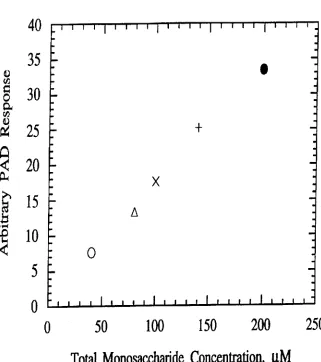
BRIEF DESCRIPTION OF THE FIGURES FIG. 1. Pulsed amperometric detection (PAD) response to total monosaccharide concentration.
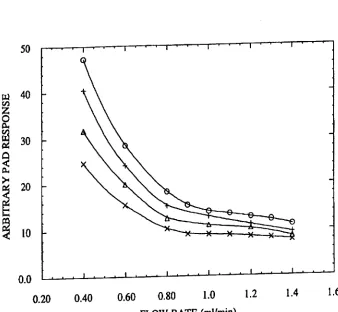
FIG. 2. E?’ect of NaOH flow rate on PAD response of
monosacchan'des and oligosaccharides.
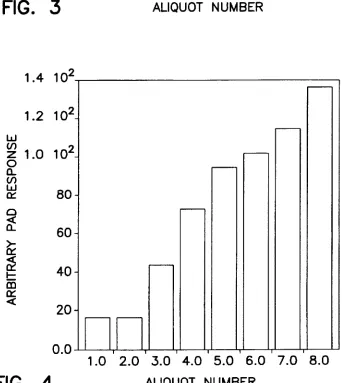
FIG. 3. Experimental PAD responses for digestion of 15 pM oligosaccharide 1 using the enzyme array set forth in
Table L
FIG. 4. Experimental PAD responses for digestion of 15 nM oligosaccharide 2 using the enzyme array set forth in
Table 111.
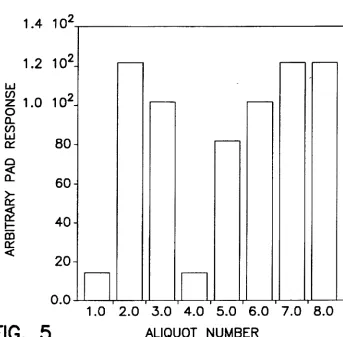
FIG. 5. Experimental PAD responses for digestion of 15 pM oligosaccharide 3 using the enzyme array set forth in
Table 111.
DETAILED DESCRIPTION OF THE INVENTION
The present invention provides a rapid and sensitive reagent array-electrochemical detection method for structur ally characterizing oligosaccharides. The method uses an
array of cleaving agents. preferably exoglycosidases. to
cleave speci?ed disaccharide linkages present in an
oligosaccharide. followed by electrochemical detection and
10 20 25 35 SCI 55 65
4
quanti?cation of cleaved products. preferably released
monosaccharide units. to obtain structural information about
the oligosaccharide. Structural information includes infor mation about any of the following attributes of the primary
structure of an oligosaccharide: the monomeric
(monosaccharide) composition of the oligosaccharide and
the order in which the monosaccharide units are linked.
including the presence of any branched (e.g.. biantennary or
triantennary) structures; the linkage positions of the glyco
sidic (disaccharide) bonds that join together the monosac charide units to form the polymer; and the linkage con?gu
ration (otor [5) at the anomeric carbon involved in a
glycosidic bond. The anomeric carbon is that carbon which
contains the reactive carbonyl of a monosaccharide that can be involved in intramolecular hemiacetal formation or inter
molecular glycosidic bond formation. The method of the
invention can be conveniently used to either partially or fully characterize an oligosaccharide structure. For ease of
reference and in accordance with general usage in the ?eld of carbohydrate research. the terms “sequence" or “sequenc ing” as used herein in connection with carbohydrates refer generally to structural characterization of oligosaccharides
as described in this paragraph. unless otherwise speci?ed The method of the invention has several practical advan tages over current enzyme array based carbohydrate
sequencing methods. including simplicity. speed. and the
ability to use small amounts of starting material. Aparticular advantage of the invention is that carbohydrate sequencing
is accomplished in situ without the need to separate the
remaining oligosaccharide fragment from the released monosaccharide units. The remaining oligosaccharide frag ment may contain two or more monosaccharide units. and
thus includes disaccharides. Moreover. the sequencing can
be perfonned without prior labelling of oligosaccharides
and/or monosaccharides. Other lmown sequencing protocols
(e.g.. R. A. Dwek et al.. U.S. Pat. No. 5.100.778. issued Mar. 31. 1992; A-H. Ali et al.. U.S. Pat. No. 5.284.558. issued
Feb. 8. 1994) require the incorporation a label. typically a
?uorescent or radioactive label. at the reducing terminus
prior to sequencing.
oligosaccharides are polymeric carbohydrates composed
of monosaccharide units linked together via glycosidic
bonds. They occur naturally as covalent modi?cations to
glycomolecules such as glycolipids and glycoproteins. as
described in more detail below. Because each monosaccha
ride unit in an oligosaccharide has several reactive hydroxyl
groups. oligosaccharides can exhibit complex branching
motifs in addition to a simple linear con?guration. Each oligosaccharide typically has one reducing terminus. also
known as the free reducing terminus. and one or more
non-reducing termini. depending on whether or not the
oligosaccharide is branched The reducing terminus is typi
cally characterized by an aldehyde functional group at the
C1 carbon in the open ring form of the terminal monosac charide unit. A nonreducing terminus is located at the opposite end or ends of the polymeric chain. Thus. an
unbranched (linear) oligosaccharide chain contains one reducing terminus and one nonreducing terminus. whereas a branched oligosaccharide chain has one reducing terminus
and two or more nonreducing termini. The presence of a free
(i.e.. underivatized) reducing terminus on the oligosaccha ride to be sequenced is preferred. but not required by the invention. Thus. the reducing terminus associated with an
oligosaccharide chain may be oxidized. labelled. or other
wise derivatized prior to sequencing if desired.
A glycosidic bond or linkage is the covalent linkage
5.753.454
5
(typically at C1) of a monosaccharide unit and a hydroxyl group on the ring of a second monosaccharide unit. Where two sugar monomers are thus joined in a glycosidic linkage. the linkage is termed a disaccharide bond. The terms “dis
accharide linkage” or “disaccharide bond" are used herein to
describe each successive glycosidic linkage in an oligosac
charide.
An oligosaccharide sequenced according to the method of the invention can be natural or synthetic. and may or may not
be derivatized. Derivatization may occur naturally. e. g. via enzymatic phosphorylation. or can be accomplished syn
thetically. The oligosaccharide preferably contains about
5-30 monosaccharide units. but may contain about 2-100 or
more monosaccharide units. Preferably. the oligosaccharide sample contains only one oligosaccharide. but the invention
may be performed using an oligosaccharide sample contain
ing a plurality of oligosaccharides as well. In the event the
sample contains a plurality of oligosaccharides. a plurality of oligosaccharide fragments may remain after contact with
one or more cleaving agents.
A natural oligosaccharide particularly well suited to
sequencing using the method of the invention is one that is
derived from a glycooonjugate such as a glycoprotein or
glycolipid. Preferably the oligosaccharide is an N-linked or
an O-linked oligosaccharide released from a glycoprotein. or
a synthetic equivalent thereof. An N-linked oligosaccharide
is typically covalently attached to a protein at an asparagine
residue. and an O-linked oligosaccharide is typically covalently attached at scrine. threonine or hydroxylysine.
Release of an oligosaccharide from a glycoconjugate may be
accomplished enzymatically or nonenzymatically. For example. N-glycosidic linkages of N-glycosylpeptides and
N-glycosylproteins can be cleaved by hydrazine or tri?uo
roacetic acid. O-linked oligosaccharides can be cleaved
from glycoconjugates using dilute alkali solution via a beta elimination mechanism. Alternatively. an appropriate
endoglycosidase. such as glycopeptidase or endo-ot-N
acetylgalactosaminidase. may be used. Glycoproteins can be
puri?ed using techniques known in the art.
N-linked oligosaccharides are typically branched and
share some structural similarity. They are divided into three
groups: high mannose. complex. and hybrid. All three
groups share a common Man3GlcNAc2 core sequence. High mannose structures contain only mannose residues in the
branches. while the branches of complex oligosaccharides contain GlcNAc. galactose and sialic acid (most often
N-aoetylneuraminic acid). Hybrid oligosaccharides have
structural features common to both high mannose and com plex oligosaccharides. In contrast. O-linked oligosaccha
rides exhibit much greater variability. The only common
structural element in all known O-linked sugar chains is a
GalNAc attached to the p'otein hydroxyl group. Five dif
ferent core structures have been identi?ed for O-linked
oligosaccharides. as described in .l. D. Paulson. Trends in
BioL Sci.. 14. 272-276 (1989). incorporated herein by
reference. The main source of structural diversity for both N-linked and O-linked oligosaccharide chains comes from
variation in the attachment of the terminal sugars (typically oL-linked sialic acid. fucose. galactose. N-aoetylgalactosamine or N-acetylglucosamine). attached
either singly or in combination to one or more hydroxyl
groups of the extension or core structures. Over 20 different
terminal glycosylation sequences have been identi?ed.
The sequencing method of the invention is useful for oligosaccharides of either known or unknown structure. In the case of a known or putative structure. as where synthetic oligosaccharides are obtained from a commercial supplier or
20 25 35 45 50 55 65
6
isolated from a glycoprotein of known or suspected structure. the enzyme array can be designed to verify or con?rm the putative sequence. as described in more detail
below and in Examples I and II. In the case of an unknown
structure. an enzyme array containing a representative set of
exoglycosidases. as described in Example 111. may be employed to identify the sequence of the carbohydrate. If the
oligosaccharide of unknown structure is known to be an N-linked oligosaccharide. knowledge of the common core structure of N-linked oligosaccharides. as described above.
can be used to design a suitable enzyme array.
In a preferred embodiment of the invention. a plurality of
aliquots is prepared from a sample containing an oligosac
charide to be sequenced. The oligosaccharide is chemically or enzymatically digested by reacting the aliquots with an
array of reagents to produce a set of reaction mixtures. Each
“reagent” contains at least one cleaving agent having a
cleavage speci?city for a disaccharide linkage present in the oligosaccharide. The cleaving agent is provided in an
amount. and for a time. effective to cleave the oligosaccha
ride and thereby produce a plurality of cleaved products. The term “array of reagents" is used to convey the underlying
principle of the cleavage protocol utilized in the present
invention and further described as “Reagent Array Analysis"
in Rademacher et al.. US. Pat. No. 5.100.778 (Mar. 31.
1992). incorporated herein by reference. Essentially. two or
more suitable cleaving agents are selected. and an array of
reagents is prepared such that each reagent lacks one of the
selected cleaving agents. In a variation of the invention. one
or more reagents can lack two of the selected cleaving
agents. Each aliquot is then reacted with a different reagent to cleave the oligosaccharide and produce a plurality of
cleaved products. The reaction is typically carried out for a
predetermined amount of time. or to a predetermined end
point. such that the reaction is carried to completion. It is to
be understood that in practicing the invention. particularly
when sequencing an oligosaccharide of unknown structure.
the array will sometimes contain reagents composed of cleaving agents having a cleavage speci?city for a disac charide linkage that is not present in a particular oligosac chan'de being sequenced. Inclusion of such chemical or
enzymatic cleaving agents cannot systematically be avoided
when sequencing an oligosaccharide of unknown structure.
and negative information may be gained by their inclusion.
However. as will be understood by one skilled in the art. the
invention is most e?iciently practiced when only those
agents that will cleave a disaccharide linkage present in the oligosaccharide are included in the array.
The invention can also include a negative control aliquot
prepared from the oligosaccharide sample in addition to the aliquots reacted with the array of reagents. As disclosed
more fully below. an electrochemical response is elicited
from the negative control aliquot in addition to the reaction
mixtures. and the molar quantity of a cleaved product in a reaction mixture is determined from the electrochemical responses of the reaction mixtures and the negative control
aliquot.
Exoglycosidases are the preferred cleaving agents. They are enzymes that cleave monosacchan'des from the non
reducing terminus of an oligosaccharide hydrolytically at a
disaccharide linkage according to their individual enzymatic
speci?cities (Kobata. A.. in Biology of Carbohydrates,
Volume2. V. Ginsburg et al.. ed.. John Wiley & Sons. New York. pp. 88 if. (1984)). Exoglycosidases useful in the
invention are those that have known and preferably well
de?ned cleavage speci?cities. Nonenzymatic cleaving
5.753.454
7
terminus of an oligosaccharide may also be used in the
invention. provided that the monosaccharides released in the cleavage reaction retain their characteristic free reducing
terminus.
The cleavage speci?city of an exoglycosidase is de?ned in terms of its glyoon speci?city (the type of terminal
monosaccharide unit it cleaves from an oligosaccharide
chain. e.g.. glucose. mannose. etc.). and its aglycon speci ?city (i.e.. the type of monosaocharide unit or other func
tional group linked to the terminal monosaccharide unit. and
the ring position of that linkage in cases where the aglycon is a monosaccharide unit). The glycon speci?city of an
exoglycosidase typically extends to the anomeric con?gu ration of the glycosidic linkage (otor B) that it cleaves.
Representative lists of useful exoglycosidases are found
inA. Kobata. Anal. Biochem. 100. 1 (1979). R. Parekh et al..
PCI‘ Application No. WO 92119768 (Nov. 12. 1992). T. W. Rademacher et al.. US. Pat. No. 5.100.778 (Mar. 31. 1992). and R. J. Linhardt et al.. US. Pat. 5.284.558 (Feb. 8. 1994).
all of which are incorporated herein by reference. It is to be understood that these lists are illustrative only and in no way
limit the selection of exoglycosidases used in the reagent
array digestion according to the invention. Exoglycosidases are typically highly speci?c. having a glycon speci?city
directed to a speci?ed terminal monosaccaride in a disac
charide linkage characterized by a speci?ed (otor B) ano meric con?guration. Some exoglycosidases. however. are
less speci?c with respect to the monosaccharide moiety that
they cleave. For example. certain B-N
acetylhexosaminidases do not distinguish the epirneric con ?gurations (i.e.. the di?erent con?gurations about a particu lar carbon atom) of the C-4 hydroxyl group of [iv-N
acetylglucosamine and B-N-acetylgalactosamine. and will
cleave both B-glycosyl and B-galactosyl linkages. Aglycon
speci?city is generally also high. but again. some exogly cosidases show lower speci?city. For example. Diplococcus
pneumoniae [S-galactosidase cleaves GalBl—->4GlcNAc but
not Gall31—)3GlcNAc and not GalBl—>6GlcNAc. Common
useful exoglycosidases include. but are not limited to.
galactosidases. mannosidases . fucosidases.
acetylhexosaminidases. neurarninidases. sialidases and
xylosidases.
The exoglycosidases or other chemical cleaving agents used to digest the oligosaocharide according to the invention thus sequentially cleave monosaccharides from the oligosac charide according to their individual speci?cities until a
linkage is reached that cannot be cleaved by any of the
cleaving agents present in the mixture (a stop point). When digestion is complete the reaction mixture typically contains both monomeric (monosaccharide) and oligomeric
(oligosaccharide) carbohydrate fragments. If. however. the
reaction mixture contains no cleaving agents having a speci ?city for the disaccharide linkage(s) characterizing the non
reducing terminus (or termini) of the original carbohydrate
sample. then the oligosaccharide will remain intact after
digestion. The inclusion of negative control aliquot contain
ing the oligosaccharide but none of the cleaving agents in the array is especially advantageous in that it is designed to yield an oligosaccharide fragment equivalent to the original oli
gosaccharide. On the other hand. if a reaction mixture
contains cleaving agents having a speci?city for each of the
disaccharide linkages present in the oligosaccharide. the
oligosaocharide contains no stop points and only monosac charides will remain in the reaction mixture following enzymatic digestion. This is known as a positive control.
Thus. in a particularly preferred embodiment of the invention. the sample aliquots are reacted with an array of
20 25 35 45 50 55 65
8
reagents that includes a control reagent and a plurality of
enzyme reagents. The total number of reagents is equal to the number of sample aliquots. The enzyme reagents each
diifer from one another and contain one or more exogly
cosidases. The exoglycosidases included in a reagent array are chosen to create a pattern of stop points that allow the
oligosaocharide to be sequenced. The exoglycosidases pref
erably each have a cleavage speci?city for a disaccharide
linkage present in the oligosaccharide. They are provided in an amount. and for a time. elfective to cleave the disaccha ride linkage and produce a plurality of cleaved products.
One enzyme reagent (the positive control) contains a mix
ture of all the exoglycosidases. Preferably. the exoglycosi
dases are chosen such that the positive control completely
cleaves the oligosaocharide. leaving only monosaocharide cleaved products. The remaining enzyme reagents prefer
ably each contain a mixture of all the exoglycosidases
excluding one. which excluded exoglycosidase is included in each of the other remaining enzyme reagents. That is.
each enzyme reagent (other than the positive control) is
distinct from the others and contains all but one of the chosen exoglycosidases. In an alternative embodiment.
more than one exoglycosidase is excluded from one or more
enzyme reagents. The control reagent is a negative control containing none of the exoglycosidases.
Each reaction mixture produced by reaction of a sample
aliquot with an enzyme reagent contains a plurality of
cleaved products. Preferably. the total number of aliquots.
including the aliquots used for the positive and negative
controls. is two more than the number of di?’erent disaccha
ride linkages to be cleaved. and each disaccharide linkage is cleaved by only one of the exoglycosidases. Alternatively.
the number of aliquots is at least two more than the number of different disaccharide linkages to be cleaved. each disac
charide linkage is cleaved by at least one exoglycosidase.
and one or more of the disaccharide linkages is cleaved by more than one of the exoglycosidases (causing a degeneracy
that may complicate interpretation of sequencing results). In
this case. the enzyme reagents must be sut‘n'cient in number
to compensate for the degeneracy caused by disaccharide
linkages that are cleaved by more than one of the exogly cosidase. Degeneracies may be unavoidable. and even
desirable. when the chosen exoglycosidases have overlap
ping but not coextensive speci?cities.
More than one reagent array can be used sequentially in
order to obtain additional information about the oligosac
charide structure. For example. greater speci?city can be
achieved by repeating or expanding the reagent array using exoglycosidases with higher sensitivity. It can be advanta
geous to use a series of reagent arrays for an oligosaocharide
sample of unknown structure to provide experimental direc tion and thereby minimize the overall number of exogly
cosidases needed to characterize the structure. For example.
the exoglycosidic composition of successive enzyme arrays can be selected using the results obtained in preceding
enzyme array digestions.
The reaction mixtures produced from reaction of the sample aliquots with the array of reagents are subjected to electrochemical detection and quanti?cation according to the invention. Speci?cally. each reaction mixture. including
any positive or negative controls. is contacted with an electrode to elicit an electrochemical response. The electro chemical responses of the reaction mixtures are quanti?ed and compared among each other to determine the molar
quantity of a cleaved product. if any. present in a reaction
5.75 3.454
from the non-reducing terminus of the oligosaccharide.
which released monosaccharide is also known as a monomer. monosaccharide cleaved product. or a monosac
charide unit. In that case. the total molar quantity of the
monosaccharide cleaved products in each reaction mixture is
preferably determined.
The elicitation of electrochemical response. and subse
quent quanti?cation of cleaved products. in particular released monosaccharides. is preferably accomplished using
pulsed ampcrometric detection (PAD) (W. R. LaCourse et al.. Anal. Chem. 62. 589A (1990)). Aldehyde moieties in oligosaccharides and monosaccharides. which characterize the free reducing terminus. can be detected with high
sensitivity by oxidation at gold (Au) electrodes in alkaline
media and at platinum (Pt) electrodes under a broad range of
pH conditions. Sensitivity of PAD at Au electrodes is
maximized under conditions of high alkalinity. and pH
greater than 12 is commonly recommended. The need for pH
control in PAD at a Au electrode is achieved by the con tinuous addition of 0.1 N NaOH solution into a ?ow cell
housing all the electrodes.
Ordinarily. the PAD signal observed for an oligosaccha
ride is a function of its chain length (number of monosac charide units). This is because an electrochemical signal is
produced by oxidation of the hydroxyl groups. and the number of hydroxyl groups on an oligosaccharide is directly related to its chain length. The aldehyde group of a reducing carbohydrate. however. is more easily oxidized. The present
invention takes advantage of this feature to create a PAD
response that re?ects the molar quantity of aldehydes rather than the molar quantity of hydroxyl groups. The molar
quantity of aldehydes is a good measure of the molar
quantity of carbohydrates. because each carbohydrate mol
ecule generally contains only one aldehyde. In contrast. the
molar quantity of hydroxyl groups is more re?ective of a measure of the total mass of carbohydrates rather than the
molar quantity of carbohydrates. since carbohydrates are generally hydroxylated on the ring carbons that are not involved in polymeric chain formation.
The PAD signal produced by an enzymatic digest is
enriched for the aldehyde response by a judicious choice of detection potential within PAD waveforms (W. R. LaCourse et al.. Anal. Chem. 62. 589A (1990)) and by controlling the
?ow rate of the NaOH solution. preferably 0.1 N NaOH.
used to bring the reaction mixtures and control portions in
contact with the electrode. Afaster ?ow rate reduces the time
a sample component spends in contact with the electrode.
favoring the aldehyde signal because the aldehyde is oxi
dized faster than the hydroxyl group. Furthermore. the effect
of ?ow rate on PAD response is also a function of the
diffusion coe?icient of an analyte. The diffusion coe?icient of an analyte decreases with increased molecular weight. Monosaccharides will be less atfected by an increase in ?ow
rate than oligosaccharides because their higher diffusion
coe?icients translate into greater contact with the electrode due to Brownian motion. Thus. an increase in NaOH ?ow
rate brings the PAD signal of oligosaccharides closer to that
observed for monosaccharides in two ways: it minimizes the
mass-dependent component of the observed PAD signal
(i.e.. that portion contributed by oxidation of hydroxyl
groups) and it reduces the intensity of the signal attributable
to an oligosaccharide relative to a monosaccharide by dis
proportionately reducing the amount of time the oligosac
charide is in contact with the electrode at the higher ?ow rate. due to its lower diffusion coe?icient. Preferably. the
PAD signal produced by a remaining oligosaccharide frag
ment is less than twice the signal produced by a monosac
20 25 30 35 45 50 55 65
10
charide unit. so that the signal level of the oligosaccharide
does not imply the existence of an additional monosaccha
n'de unit. More preferably. the PAD signal produced by a
remaining oligosaccharide fragment is about 100-150% of
the signal produced by a monosaccharide. most preferably it is about l00—130%.
Sensitivity decreases with too fast a flow rate. however. because the aldehyde group is not in contact with the
electrode long enough to be consistently oxidized and pro
duce a strong signal. The invention thus makes use of an
optimized ?ow rate. which is one that is fast enough to prevent most of the hydroxyl groups on a carbohydrate from
oxidizing and producing an electrochemical signal. yet slow enough to permit consistent oxidation of the aldehyde group on the carbohydrate. Preferably. the NaOH ?ow rate within
the PAD cell is about 0.5—3 ml/minute. more preferably
about 0.8-2 rnllminute. most preferably about 1.0-1.6
rnllminute. The PAD response of an oligosaccharide in a
mixture containing no exoglycosidases can be used as a background signal against which the other monosaccharide measurements in the enzyme array analysis can be com
pared. When the oligosaccharide PAD signal has been subtracted from the observed PAD signal for an enzymatic digest. the remaining PAD signal is attributable to the monosaccharides in solution. The total monosaccharide_ concentration in each aliquot can thus be directly and rapidly quanti?ed by PA without any sample pretreatment or car
bohydrate derivatization. because individual monosaccha rides (e.g.. glucose. galactose. etc.) typically show essen
tially identical molar concentration response in PAD (see
FIG. 1 and Example I). Preferably. the carbohydrate sample
analyzed according to the method of the invention has a
concentration of about 0.1-100 pM. more preferably about
5-50 pM. most preferably about 5-15 M. For an N-linked
oligosaccharide sample. which typically contains from about
5 to 20 monosaccharide units. the released monosaccharide
concentrations in an enzymatic digest of a 10 M solution of
oligosaccharide are in the range of 50 to 200 M. and can be measured by PAD in a matter of seconds.
PAD was previously employed to simply detect the pres
ence of monosaccharides and oligosaccharides after separa
tion using high performance anion-exchange chromatogra
phy (e.g.. J. R. Barr et al.. Anal. Biochem.. 192. 181-192 (1991); M. W. Spellrnan. Anal. Chem. 62. 1714 (1990)).
Quanti?cation was problematic because of the di?erent molar response factors attributable to monosaccharides elut
ing at diiferent salt concentrations provided by a typical elution gradient (R. R. Townsend et al.. Anal. Biochem. 174.
459 (1988). And until now. PAD had not been used to quantify the total molar amount of monosaccharides in an
unseparated mixture of oligosaccharides and
monosaccharides. as is produced in an enzyme array diges tion.
Once determined. the molar quanti?es of the cleaved products are correlated with the cleavage speci?cities of the cleaving agents. such as exoglycosidases. present in each reagent. in order to structurally characterize the oligosac
charide. The structural information so obtained for each reaction mixture can include the identi?cation of the
uncleaved linkage (the stop point) and its position in the oligosaccharide chain. The stop point for each cleavage
reaction is associated with a glycosidic linkage that cannot
be cleaved by the exoglycosidases present in that digest. The
identity of that linkage is inferred from the speci?city of the omitted exoglycosidase. The location of that linkage within
the carbohydrate chain is determined by evaluating the
5.753.454
monosaccharide content of other digests in the array and the
linkages inferred from their stop points. as described for
speci?c experiments in the Examples. Taken in combination.
the reaction mixtures can thereby provide a detailed char
acterization of the oligosaccharide with respect to its
monosaccharide composition. sequence. branching
structure. and linkage con?gurations. Reconstruction of the starting oligosaccharide can be carried out by direct inter pretation of the analysis results or by comparison of the analysis with a computer generated data base. based on
either theoretical or experimental data. or both.
It will be appreciated that there is no need to separate any
remaining oligosaccharide fragment from the released
monosaccharides present in an enzymatic digest when the
method of the present invention is used. Neither identifica tion of the released monosaccharides. nor determination of
the length of. or identity of. the remaining oligosaccharide
fragment. is necessary. There have been other sequencing
methods using sequential enzymatic digestion that relied
upon detection of released monosaccharides rather than a
determination involving the remaining oligosaccharide frag
ment. However. these sequencing protocols relied on chro
matographic separation of the released monosaccharides (either by gas or liquid chromatography) from the remaining
oligosaccharide fragment and the use of standards to identify
the monosaccharides (J. S. Sawardeker et al.. Anal. Chem.
37. 1602 (1965); Y. C. Lee. Meth. EnzymoL. 28. 63 (1973)); they were not in situ techniques as provided by the present
invention. That is. in these conventional methods sequenc ing information cannot be obtained directly from the reac tion mixture without additional preparative steps. such as
desalting the enzymatic reaction mixture using ion exchange chromatography or organic solvent extraction. followed by
chromatographic separation of oligosaccharides from
monosaccharides.
The method of the invention thus represents an elegant
approach to carbohydrate sequencing without the need for oligosaccharide labelling or the use of separation techniques. such as gel permeation chromatography or gel
electrophoresis. to identify remaining uncleaved oligosac charide fragments.
Advantages of the invention are illustrated by the follow
ing examples. However. the particular materials and amounts thereof recited in these examples. as well as other
conditions and details. are to be interpreted to apply broadly
in the art of carbohydrate structural analysis and should not
be construed to unduly limit the invention.
Example I. Sequencing of a Complex N-linked
Oligosaccharide
The complex N-linked oligosaccharide 1 was purchased
from Oxford Glycosystems (Rosedale. N.Y.). The abbrevia tions used are galactose (Gal). N-acetylglucosamine
(GlcNAc). and mannose (Man).
01,151 %4o1cnace1 %2Mm1\
1
6
ManBl —>
/s
GalBl -% 4GlclNAcBl -% ZManotl
4G1cNAcBl —> 4GlcNAc
Exoglycosidases. including jack bean IS-galactosidase.
jack bean B-N-acetylhexosaminidase. diplococcus pneumo
20
25
35
45
55
65
12
niae B-N-acetylhexosaminidase. jack bean ot-mannosidase. achatina fulica ?-mannosidase. bovine epididymal
ot-fucosidase. and almond meal (1-3/4-fUC0Sid3SC were
obtained from Sigma Chemical Company (St. Louis. Mo.) and Oxford Glycosystems (Rosedale. N.Y.). Monosaccha
rides were obtained from Sigma Chemical Company (St. Louis. Mo.). The speci?cities of these enzymes is set forth in A. Kobata. Anal. Biochem. 100. 1 (1979). incorporated herein by reference. The enzyme array used to analyze the oligosaccharide 1. designed on the basis of the known
sequence of oligosaccharide 1 and containing various
exoglycosidases at different concentrations. is set forth in
Table I. Numbers refer to various enzyme mixtures
(aliquots); the designation (0) refers to the absence of an
enzyme. and (+) indicates the presence of an enzyme. Each
enzyme unit is de?ned as the amount of enzyme that hydrolyzes one pmol of p-nitrophenyl glycoside per minute
at 37° C. (A. Kobata. Anal. Biochem.. 100. 1 (1979)).
TABLEI
Enzyme Array Used for Diggstion of Oligosaccbaride l
___E%MLXM=—
Exoglyoosidase 1 2 3 4 5 6 7
JackbeanB-galactosidase (8.2 unit) 0 o + + + + +
Pneumoniae B-N-acetylhexosaminidase 0 + o + + + +
(0.25 unit)
Jackbeana-rrmnrnsidase?GArmit) o + + o + + + Ac‘hatina?llic‘a B-mannosidase 0 + + + s + +
(1.6 unit)
Jack bean B-N-acetylhexosaminidase a + 0 + + o +
(8.2 unit)
The enzyme mixtures were prepared in 0.1 M citric
acid/0.2 M disodium phosphate/0.001% sodium azide (Sigma Chemical Company. St. Louis. Mo.) at pH 5.3 for the optimization of enzyme activities. The oligosaccharide 1
was divided into seven aliquots and digested with the
exoglycosidase mixtures. Each aliquot was 100 pi and
contained 15 M of oligosaccharide 1. Enzymatic digestion
of oligosaccharide was carried out at 37° C. for 24 hours and
terminated by increasing solution pH to 12.
Pulsed arnperometric detection (PAD) was performed at a
gold (Au) electrode using a pulsed amperometric detector
(Model PAD-2. Dionex Corporation. Sunnyvale. Calif).
Samples (1-50 pl volumes) were injected manually into the
?ow cell. A three-step waveform was used with detection at
a constant potential (detection potential EM=+0.05 V. detec
tion time tM=400 milliseconds (ms). integration time tW= 200 ms) followed by oxidative cleaning (oxidation potential E,,,,d=+0.80 V. oxidation time toM=360 ms) and reductive reactivation (reduction potential EMF-0.60 V. reduction
time toM=54O ms) of the electrode. The response time was 3 seconds. Continuous addition of a 0.1 N NaOH solution was used to carrying oligosaccharides and monosaccharides over the electrode and keep the pH above 12. The flow rate was controlled by a HPLC pump (Hewlett Packard.
Wilmington. De.).
The volume of the injection and the ?ow rate of NaOH
carrying analytes over the Au electrode determine the detec
tion limit and the dynamic range of monosaccharide con
centration as measured by PAD. Using a 50 pl sample
injection volume and 0.2 mllminute NaOH ?ow rate. a
detection limit of 1 nM monosaccharide (galactose) with a
linear response time of more than three decades was estab lished.
5 .75 3.454
13
in mixtures of monosaccharides. FIG. 1 shows a linear response of PAD to total monosaccharide concentration
regardless of the monosaccharide composition of the mix
ture. The monosaccharide compositions evaluated were (0).
40 M galactose; (A). a mixture of 40 uM galactose and 40
pM N-acetylglucosamine (80 M
total monosaccharide);
(x). a mixture of 20 uM galactose. 20 uM
N-aeetylglucosamine. and 60 pM mannose (100 M total
monosaccharide); (+). a mixture of 40 M galactose. 40 pM N-aoetylglucosamine. and 60 uM mannose (140 uM total monosaccharide); and (O). a mixture of 40 M galactose. 4O
1.1M N-acetylglucosamine. 40 pM N-acetylgalactosamine.
and 80 pM mannose (200 pM total monosaccharide). The
detection limit for monosaccharides is in picomoles and the
response is linear over more than three decades in concen
tration. It was concluded that these three monosaocharides
commonly found in N-linked oligosaccharides (galactose.
N-acetylglucosamine. and mannose) all exhibit similar
molar response as measured by PAD.
Next. the PAD response for remaining uncleaved oli
gosaccharides was evaluated and standardized. FIG. 2.
shows PAD responses to solutions containing (0) l5 1.1M
oligosaccharide 1. (+) 15 |.|M ManB1-4GlcNAcB l
4GlcNAc. (A) 15 pM GlcNAc?l-4GlcNAc and (x) 15 M
galactose as a function of NaOH ?ow rate over a range of 0.4
to 1.4 ml/minute. The observed ratio of PAD response of
oligosaccharide 1 (o) to monosaccharide (galactose) (x) was
2.1 at the slowest ?ow rate of 0.4 rnl/minute. decreasing to
1.3 at the fastest ?ow rate of 1.4 ml/minute. Because it is a
multimeric polymer. oligosaccharide 1 has a smaller diffu
sion coe?icient than the monosaccharide galactose. The
PAD response to the oligosaccharide is thus expected to be
more strongly a?’ected by changes in the ?ow rate. As anticipated. the relative decrease in the PAD response of
oligosaccharide as the ?ow rate was increased was greater
than that observed for the monosaccharide.
At all ?ow rates studied. the PAD response of oligosac
charide l (symbolized by (e) in FIG. 2) was greater than that of the monosaccharide (symbolized by (x) in FIG. 2).
Oligomen'c constituents of oligosaccharide 1. namely the
trisaccharide ManBl-4GlcNAcB1-4GlcNAc (symbolized by
(+) in FIG. 2) and the disaocharide GlcNAcB1-4GlcNAc (symbolized by (A) in FIG. 2) exhibited PAD responses
intermediate between the responses observed for oligosac
charide 1 and the monosaccharide. Thus. the PAD responses of the remaining uncleaved oligosaccharides in an enzy
matic digestion of oligosaccharide 1 were expected decrease as the enzymatic digestion progresses and those fragments
become shorter. It was found. however. that at the ?ow rate
of about 1.4 ml/minute the variation in the PAD response of
oligomeric fragments during enzymatic digestion of oli
gosaccharide 1 could be con?ned within about 25% of the
original signal exhibited by oligosaccharide 1 (see FIG. 2).
With careful measurements at this ?ow rate. the background signal of an oligosaccharide was found to still be numeri
cally distinguishable from the PAD signal attributable to monosacchan'des. and integer molar quantities of monosac charides could be calculated for each enzymatic digestion. as
described below. For example. in FIG. 2. at a ?ow rate of 1.0
ml/minute. the arbitrary PAD signal of a monosaccharide is about 10. whereas the arbitrary PAD signal of an oligosac
charide is between about 12 and 15. Furthermore. the last enzyme mixture of a properly designed enzyme array con
tains all required exoglycosidases for the complete digestion
of oligosaccharide. The number of total monosaccharides
measured from complete digestion can be used as a ?nal
check for the interpretation of results in carbohydrate
sequencing.
20 30 35 45 55 6514
Based upon the above-described evaluation of the PAD response for oligosaccharides. a ?ow rate of 1.0 ml/minute was chosen to carry out a PAD analysis of the enzymatic
digests of oligosaccharide l (15 M) as speci?ed in array
shown in Table 1. FIG. 3 reports the total PAD response
observed for each enzymatic digest (20 pl sample injection
volumes) in the array. By comparing these results to the
expected monosaccharide and oligosaccharide PAD
responses at the chosen ?ow rate (1.0 ml/rninute) as shown
in FIG. 2. the molar quantity (number) and the concentration of monosaocharides released in each digestion aliquot were
quantitatively determined These results are summarized in Table IL
TABLE 11
Concentrations of Uncleaved Oligosaecharide l and
Released Monosacchatide as Measured by PAD
Oligosaccharide Released Monosaccharide
Aliquot Concentration. Concentration,
Number 1.1M Number $1M
1 l5 0 0
2 l5 0 O
3 l5 2 30
5 l5 6 90
6 15 7 105
7 0 9 135
None of the exoglycosidases was present in aliquot 1. thus
the remaining uncleaved oligosaccharide is oligosaccharide
1 (see FIG. 3 for the PAD signals actually observed for each
aliquot). This aliquot provided the background signal attrib
utable to the remaining uncleaved oligosaccharide which
was subtracted from the PAD responses for the other mix
tures (see FIG. 3). Jack bean B-galactosidase was the only
exoglycosidase missing from aliquot 2. but as it was needed
to initiate cleavage from the nonreducing terminus. the
remaining uncleaved oligosaccharide was still equivalent
oligosaccharide 1. Both hexosarninidases were missing from aliquot 3. thus the stop point was the GlcNAclil-?Man
linkage on each of the two branches. resulting two mono
meric (galactose) cleaved products. Aliquot 4 was missing
the ot-mannosidase. thus the stop points were the two
otmannose linkages to the mannose at the branch point. resulting in 4 monomeric cleaved products (2 galactose and 2 N-acetylglucosamine). The [S-mannosidase was missing
from aliquot 5. thus the stop point was the
Man[51-—)4GlcNAc linkage. Six monomeric cleaved prod ucts (2 galactose. 2 N-acetylglucosamine. and 2 mannose)
were observed. Aliquot 6 was missing jack bean B-N
acetylhexosaminidase. Pneumoniae B-N
acetylhexosaminidase. which was present. cleaved the GlcNAcli 1—>2Man linkage but not the
GlcNAcBl-MGlcNAc linkage. Thus. the remaining oli gosaccharide fragment was GlcNAc?l—>4GlcNAc. and
seven monomeric cleaved products (2 galactose. 3 N-acetylglucosamine. and 2 mannose) were observed. In aliquot 7. all the exoglycosidases were present. and the
oligosaccharide was completely digested into nine mono
meric cleaved products.
Thus. the measured monosaccharide numbers. in combi
nation with the known speci?cities of the chosen
exoglycosidases. provided a detailed characterization of oligosaccharide l in terms of its carbohydrate composition.
linkage con?guration (otor [5). and glycosidic linkage posi
5,753,454
15
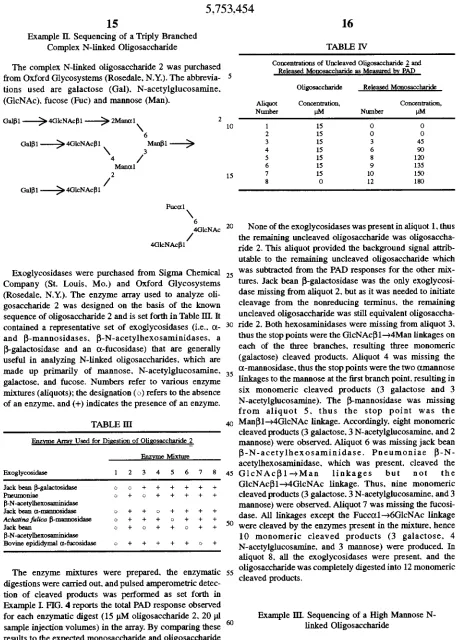
Example 11. Sequencing of a Triply Branched
Complex N-linked Oligosaccharide
The complex N-linked oligosaccharide 2 was purchased
from Oxford Glycosystems (Rosedale. N.Y.). The abbrevia tions used are galactose (Gal). N-acetylglucosamine.
(GlcNAc). fucose (Fuc) and rnannose (Man).
Gali31% 4G1CNACB1 -+
2Mariu1\
2
6
Ga1B1—-9¢GlcNAcBl \
Man?l -%
3 4
Manul 2
/
03151 -%
4GlcNAcB1
Fucul
s 4GlcNAc
4GlcNAcB1
Exoglycosidases were purchased from Sigma Chemical Company (St. Louis. Mo.) and Oxford Glycosystems
(Rosedale. N.Y.). The enzyme array used to analyze oli
gosaccharide 2 was designed on the basis of the known sequence of oligosaccharide 2 and is set forth in Table III. It
contained a representative set of exoglycosidases (i.e.. oz
and B-mannosidases. B-N-acetylhexosaminidases. a
B-galactosidase and an ot-fucosidase) that are generally useful in analyzing N-linked oligosaccharides. which are made up primarily of mannose. N-acetylglucosarnine.
galactose. and fucose. Numbers refer to various enzyme
mixtures (aliquots); the designation (0) refers to the absence
of an enzyme. and (+) indicates the presence of an enzyme. TABLE HI
Flume Array Used for Digestion of Oliggsaccharide 2
Mm.
Exoglycosidnse 1 2 3 4 5 6 '7 8
Jack bean B-galaetosidase o o + + + + + +
Pneumoniae o + 0 + + + + +
B-N-aeetylhexosaminidase
Jack bean u-rnannosidase o + + o + + + +
Achatina ?dica B-marmosidase o + + + o + + +
Jack been 0 + o + + o + +
B-N-acetylhexosaminidase
Bovine epididyrnala-hieosidase o + + + + + C) +
The enzyme mixtures were prepared. the enzymatic digestions were carried out. and pulsed amperometric detec
tion of cleaved products was performed as set forth in
Example L FIG. 4 reports the total PAD response observed
for each enzymatic digest (15 M
oligosaccharide 2. 20 pl
sample injection volumes) in the array. By comparing these
results to the expected monosaccharide and oligosaccharide
PAD responses at the chosen ?ow rate (1.0 ml/rninute) as
shown in FIG. 2. the molar quantity (number) and the concentration of monosaccharides released in each digestion
aliquot were quantitatively determined. These results are summarized in Table IV.
10
15
25
35
45
50
55
65
[image:15.557.45.505.54.694.2]16
TABLE IV
Concentrations of Uncleaved Oligosaccharide Z and
Released Monosaccharide as Measured kg PAD
Oligosaccharide Released Monosaccharide
Aliquot Concentration, Concentration,
Number pM Number PM
1 15 O O
2 15 0 0
3 l5 3 45
5 15 8 l 20
6 l5 9 135
7 15 10 l 50
3 O l 2 l 80
None of the exoglycosidases was present in aliquot 1. thus the remaining uncleaved oligosaccharide was oligosaccha
ride 2. This aliquot provided the background signal attrib
utable to the remaining uncleaved oligosaccharide which
was subtracted from the PAD responses for the other mix
tures. Jack bean [i-galactosidase was the only exoglycosi
dase missing from aliquot 2. but as it was needed to initiate
cleavage from the nonreducing terminus. the remaining
uncleaved oligosaocharide was still equivalent oligosaccha
ride 2. Both hexosarninidases were missing from aliquot 3.
thus the stop points were the GlcNAcBl-MMan linkages on each of the three branches. resulting three monomeric
(galactose) cleaved products. Aliquot 4 was missing the
ot-mannosidase. thus the stop points were the two otmannose linkages to the mannose at the ?rst branch point. resulting in
six monomeric cleaved products (3 galactose and 3 N-acetylglucosamine). The B-mannosidase was missing
from aliquot 5. thus the stop point was the
ManB1—>4GlcNAc linkage. Accordingly. eight monomeric
cleaved products (3 galactose. 3 N-acetylglucosamine. and 2
mannose) were observed. Aliquot 6 was missing jack bean
?-N-acetylhexosaminidase. Pneumoniae B-N
acetylhexosarninidase. which was present. cleaved the GlcNAclil-aMan linkages but not the
GlcNAc?l-MGlcNAc linkage. Thus. nine monomeric cleaved products (3 galactose. 3 N-acetylglucosarnine. and 3
mannose) were observed. Aliquot 7 was missing the fucosi
dase. All linkages except the Fuccotl —->6G1cNAc linkage
were cleaved by the enzymes present in the mixture. hence
l0 monomeric cleaved products (3 galactose. 4
N-aoetylglucosamine. and 3 mannose) were produced. In aliquot 8. all the exoglycosidases were present. and the oligosaocharide was completely digested into 12 monomeric
cleaved products.
Example 1]]. Sequencing of a High Mannose N
linked Oligosaccharide
The high mannose N-linked oligosaccharide 3 was pur
chased from Oxford Glycosystems (Rosedale. N.Y.). The
abbreviations u sed are galactose (Gal).
5.753.454
l7
Manal % ZManal 3
\
6
ManBl
a
/ 6
Manul —> ZManotl Man?l —>
/3
Manal —> ZManul % ZManotl
4GlcNAcBl % 461mm
Exoglycosidases were purchased from Sigma Chemical
Company (St. Louis. Mo.) and Oxford Glycosystems
(Rosedale. N.Y.). The enzyme array used to analyze oli
gosaccharide 3 was the same as that used in Example 11 and is set forth in Table III. This array is not speci?cally designed
with reference to the known sequence of oligosaccharide 3;
instead it used to illustrate the sequencing of an N-linked oligosaccharide of unknown sequence. Numbers refer to
various enzyme mixtures (aliquots); the designation (0)
refers to the absence of an enzyme. and (+) indicates the
presence of an enzyme.
The enzyme mixtures were prepared. the enzymatic digestions were carried out. and pulsed amperometric detec
tion of cleaved products was performed as set forth in
Example I. FIG. 5 reports the total PAD response observed
for each enzymatic digest (15 uM oligosaccharide 3. 20 1.11 sample injection volumes) in the array. By comparing these
results to the expected monosaccharide and oligosaccharide
PAD responses at the chosen ?ow rate (1.0 ml/minute) as
shown in FIG. 2. the molar quantity (number) and the
concentration of monosaccharides released in each digestion aliquot were quantitatively determined These results are summarized in Table V.
TABLE V
Concentrations of Uneleaved oligosaccharide 1 and
Released Monosaccharide as Measured by PAD
oligosaccharide Released Monosaccharide
Aliquot Concentration, Concentration,
Number and Number M
1 l5 0 0
2 0 11 165
3 l5 9 135
4 l5 0 0
5 l5 7 105
6 l5 9 135
7 O 11 165
8 0 11 165
The only enzymes in the array that were capable of
cleaving at sites present in oligosaccharide 3 were jack bean
ot-mannosidase. achatina fulica B-mannosidase. and jack
bean B-N-acetylhexosaminidase. Thus. in any mixture where all three of these exoglycosidases were present. complete digestion occurred and 11 monomeric cleaved
products were observed. Aliquots 2. 7 and 8 each showed
complete digestion (11 monomeric cleaved products). None
of the exoglycosidases was present in aliquot 1. thus the
remaining uncleaved oligosaccharide was oligosaccharide 3. This aliquot provided the background signal atlributablc to
the remaining uncleaved oligosaccharide which was sub
tracted from the PAD responses for the other mixtures. Both
hexosarm'nidases were missing from aliquot 3. thus the stop
15 25 35 45 50 55 65
18
point of that mixture was the GlcNAc[$l—>GlcNAc linkage.
resulting in nine monomeric (all mannose) cleaved products.
Aliquot 4 was missing the ot-mannosidase. thus cleavage
from the nonreducing termini was not initiated and the
remaining oligosaccharide fragment was equivalent to oli
gosaccharide 3. The B-rnannosidase was missing from ali quot 5. therefore the ot-mannosidase present in the mixture cleaved until the two Man?l linkages were reached. result ing in seven monomeric cleaved products (all mannose).
Aliquot 6 was missing jack bean B~N~acetylhexosaminidase
making the stop point the GlcNAcB1—>4GlcNAc linkage.
There. nine monomeric cleaved products (3 galactose. 3
N-acetylglucosamine. and 3 mannose) were observed.
The foregoing detailed descriptions and examples have been given for clarity of understanding only. No unnecessary
limitations are to be understood therefrom. The invention is not limited to the exact details shown and described. for
variations obvious to one skilled in the art will be included
within the invention de?ned by the claims. What is claimed is:
l. A method for structurally characterizing an oligosac
charide comprising:
(a) reacting a plurality of aliquots prepared from an oligosaccharide sample with an array of reagents to
produce a set of reaction mixtures. each reagent com
prising at least one cleaving agent having a cleavage speci?city for a disaccharide linkage present in the oligosaccharide. wherein each reagent is provided in an
amount and for a time e?°ective to produce a plurality
of cleaved products;
(b) contacting each reaction mixture with an electrode to
elicit an electrochemical response;
(c) determining the molar quantity of a cleaved product in a reaction mixture by comparing the electrochemical
responses elicited from each reaction mixture; and
(d) correlating the molar quantity of a cleaved product in a reaction mixture with the cleavage speci?cities of the cleaving agents in each reagent to structurally charac
terize the oligosaccharide.
2. The method of claim 1 wherein the oligosaccharide has a reducing terminus.
3. The method of claim 1 wherein the concentration of
oligosaccharide in the sample is about 5-50 |.1M.
4. The method of claim 1 wherein the oligosaccharide is an N-linked oligosaccharide.
5. The method of claim 1 wherein the oligosaccharide contains about 5-20 monosaccharide units.
6. The method of claim 1 wherein at least one cleaving
agent comprises an exoglycosidase.
7. The method of claim 6 wherein the exoglycosidase is selected from a group consisting of a galactosidase. a
mannosidase. a fucosidase. a acetylhexosaminidase. a
neuraminidase. a sialidase and a xylosidase.
8. The method of claim 1 wherein pulsed amperometric
detection (PAD) is used to elicit the electrochemical response.
9. The method of claim 8 wherein pulsed amperometric
detection is accomplished at a gold electrode at a pH greater than about 12.
10. The method of claim 9 wherein a ?ow of about 0.1 N NaOH is used to bring the reaction mixtures into contact with the electrode.
11. The method of claim 10 wherein the NaOH ?ow rate is about 0.5-3 ml/minute.
12. The method of claim 11 wherein the NaOH ?ow rate is about 1—l.6 ml/minute.
13. The method of claim 1 wherein the sample comprises
5,753,454
19
14. The method of claim 1 wherein the total molar
quantity of monosaccharide cleaved products in each reac
tion mixture is determined.
15. The method of claim 1 further comprising providing