JOURNAL OF VIROLOGY, May1989,p. 2036-2047 0022-538X/89/052036-12$02.00/0
Copyright ©1989, AmericanSocietyforMicrobiology
Herpes
Simplex Virus
Type
2 Mutants
with
Deletions in the
Intergenic Region between ICP4 and ICP22/47: Identification of
Nonessential
cis-Acting Elements
in
the Context
of the
Viral Genome
COLTON A. SMITH, MICHAEL E. MARCHETTI, PAUL EDMONSON, ANDPRISCILLA A. SCHAFFER* Laboratory ofTumor VirusGenetics, Dana-FarberCancer Institute, andDepartment ofMicrobiology and Molecular
Genetics, Harvard MedicalSchool, Boston, Massachusetts 02115 Received5December1988/Accepted 27 January 1989
Inherpes simplex virus type2, the mRNAs of ICP4 and ICP22/47 are divergently transcribed and their
transcriptioninitiation sitesareseparated by750 base pairs(L. J.Whitton andJ.B. Clements,Nucleic Acids
Res. 12:2061-2078, 1984). This750-base-pair region containsmany recognized cis-acting elements, including
twoTATA boxes,numerousSpl-binding sites, four TAATGARAT motifs,atleastoneICP4-binding site, and twoorigins of replication(oriS) linked in tandem. Inthisreport,wedescribetheconstructionofmutantviruses withdefineddeletions thateliminatethese elementseither singlyorincombination.Thephenotypic properties
of thesemutantsindicatethat (i)theTAATGARAT motifs andtheirneighboringelementsaffectthelevels of transcription of bothICP4andICP22/47 similarly, (ii) the TATA boxserving ICP4 isrequired for efficient ICP4 mRNAsynthesisandfordetermining theinitiationsite oftranscription, (iii)theICP4-binding sitelocated at the start of ICP4 transcription is at least partially responsible for the decreased levels of ICP4 mRNA observed in thepresenceofimmediate-early andearly geneproducts, and(iv) mutantsbearing deletionsthat eliminate the entire conventionally recognized ICP4 promoter generate sufficient ICP4 mRNA to maintain viabilityin cellsnotexpressingICP4. Additionally,ourinabilitytogenerateviable deletionmutantslackingall copies of oriSsuggeststhatatleast onecopy of oriSmaybe essential for virusreplication.
Theimmediate-earlygenesof herpes simplex virustypes1 and 2(HSV-1 and HSV-2, respectively)encode phosphopro-teins ICPO, ICP4, ICP22, ICP27, and ICP47. Immediate-earlygenes are the first viral genes tobetranscribedduring
the course of infection and are maximally expressed in the
absence ofpriorviralprotein synthesis. Of the five immedi-ate-early proteins, only ICP4 and ICP27 are essential for virus replication in cell culture (13, 47, 50). Expression of immediate-early proteins is required for expression ofthe early and late classes of proteins which function in viral DNA replication and are virion structural components, respectively.
ICP4 isaregulatory proteinthatacts torepress
transcrip-tion ofimmediate-early genes and activatetranscription of
early and late genes (9, 12-14, 47, 48, 52). ICP4 binds
specifically to sequences in the promoters of immediate-early, immediate-early, and late genes (12, 15, 16, 24, 25, 36, 37; N. DeLuca, personal communication), suggesting that DNA bindingmaybe necessaryforICP4tomediate itsregulatory effects. In support of this suggestion, DeLucaand Schaffer (12) have shown that truncated ICP4 proteins which failto
bind the ICP4 promoter also fail to down regulate ICP4
transcription.
Like ICP4, ICP27 isanessential regulatory protein. ICP27
deletion mutants are characterized by overexpression of
earlygenes,less thanwild-type levels of late-gene transcrip-tion,anddeficiencies in viral DNA synthesis(34). The role ofICP27 in viral DNA synthesis is apparently distinct from its role in late-gene expression, as demonstrated by the
existenceofan ICP27 temperature-sensitive mutant (tsY46)
* Correspondingauthor.
that fails to induce wild-type levels oflate-gene expression butpermits synthesisofwild-type levels of viral DNA(50). ICPO is a potent transcriptional activator of all three classes of HSVgenes,asdemonstrated in transient
expres-sion assays (2, 10, 18, 33, 39, 48, 51, 52). Interestingly, however,phenotypic analysisofdeletionmutantshas shown that ICPO isnot absolutelyrequired for virus replication in vitroorin vivo(51, 54). Moreover, despiteitsdemonstrated
transactivating ability, ICPO isapparentlyunableto transac-tivategenesinthecontextof the viralgenomeinthe absence of ICP4. This was shown by the demonstration that HSV
mutants with deletions ofboth copies of the ICP4gene do
not express early or lategenes, despite the fact that these mutants retain both intact copies of the ICPO gene (9). At presentit is unclear whether ICPO and ICP27 mediate their regulatory activities directly through binding to cis-acting elements in viral promoters as ICP4 does or indirectly through bindingtoother viral andcellularproteins.The roles of the othertwoimmediate-earlyproteins, ICP22andICP47, have notyet beendetermined, althoughdeletion mutantsin
bothgenes are replicationcompetentin cell culture (28, 32,
42;C. Bogard, personal communication).
Althoughmuch has been learnedabout the roles of imme-diate-early trans-acting proteins in the regulation of HSV
gene expression, much remains to be established about the functions of individual cis-acting elements in immediate-early promoters in this process. To assess the roles of
specificDNA sequences inregulation in the backgroundof the viral genome, we have undertaken deletion analysis of
the intergenic region betweenICP4 andICP22/47 of HSV-2 (Fig. 1). The analogous region of the HSV-1 genome is organized in a similar manner (61), and much of what we
know about HSVcis-acting elementscomesfromstudies of
2036
Vol. 63, No. 5
on November 10, 2019 by guest
http://jvi.asm.org/
HSV-2 ICP24 PROMOTER MUTANTS 2037 HSV-1. The region analyzed contains several cis-acting
elements which have been identified and characterized by using transient expression assays. First, the regioncontains
two tandem copies of an origin of viral DNA replication, designated oriS. oriS drives the replication of viral DNA in cis when theappropriateHSV-encoded trans-acting proteins are present (62). Second, this region contains four homologs of the consensus sequence TAATGARAT (R=purine).One or more copies of this sequence are found exclusively in the promoters of all immediate-early genes (61). They function to upregulate transcription in response to aconstituent of the virus particle variously designated VP16, ICP25,Vmw65, or
ox-TIF
(35, 41, 61). The TAATGARAT elements bind VP16in association with host proteins and thus mediate a stimu-latory effect on transcription in a distance- and orientation-independent manner (6, 8, 17, 23, 26, 30, 31, 38, 40, 44-46, 55, 56). Third, Spl-binding GC boxes (4, 21, 61) are also found throughout this region. In addition to their ability to confer higher levels ofconstitutive transcription, these GC boxes appear to augment the ability of certain TAATGA RAT elements to respond to VP16 (44, 56). Fourth, the ICP4 protein itself binds strongly to the initiation site of ICP4 transcription (12, 16, 24, 25, 37). It also binds upstream sequences but with less affinity (16, 24, 25).
Because the roles of these cis-acting elements have been investigated primarily in transient expression assays, we undertook the task ofassessing their functions in the context of the viralchromosome. We were motivated by the concern that transient expression assays have several shortcomings, especially when used to study complex cis-acting regulatory units in viruses. First, they do not tell us whether a particular element is essential for virus replication. Second, it is often difficult to determine physiologically relevant ratios of the effectormolecule to target gene when using transient expres-sion assays. This issue was of special concern in the study of VP16-mediated induction of immediate-early genes. Thus, Gelman and Silverstein (19) noted that aTAATGARAT-less test gene was trans-activated in the presence of high intra-cellularconcentrations of VP16. It is important to determine whether such asubstrate istrans-activated in the context of the viral genome during natural infection, i.e., under condi-tions where the stoichiometry of template to VP16 is phys-iological. Third, transient assays do not reflect gene expres-sion in the presence of the full complement of viral trans-activating factors which likely modify both the viral genome and the intracellular environment. Finally, viral chromo-somes exhibit unique features not characteristic of DNA introduced into cells bytransfection. For instance, although transfected plasmid DNA is assembled into nucleosomes, HSV chromosomes are not (7, 27).
Accordingly, we have generated HSV-2 deletion mutant viruseswhich lack specific cis-acting landmarks in the inter-genic regionbetween ICP4 and ICP22/47. We constructed a series ofdeletions in a cloned copy of this region as the first step ingenerating these mutants. We next determined which of these deletions could be transferred correctly into the HSV-2genome without abrogating ICP4 expression or other aspects of the viral replicative cycle essential for viability. Mutants that had correctly acquired the intended deletion were then characterized with respect to the levels of ICP4 andICP47 mRNAs they induced. In addition, the 5' ends of the ICP4 mRNAs generated by the mutants were mapped to determine whether the deletions affected the site of tran-scription initiation.
MATERIALS AND METHODS
Viruses and cells. Thewild-type strain of HSV-2 used in thisstudywasstrain 186(49).Mutanthr259isanHSV-2 host range mutant containing a 0.6-kilobase deletion in both
copies of the ICP4 gene (53). hr259 was propagated and
assayed in ICP4-expressing n-33 cells (53). Vero cells and
n-33 cells were grown and maintained as previously de-scribed (58).
Plasmids.Theplasmids used in this study are illustrated in Fig. 1. Plasmids pAl through pAll were generated by BAL 31 nuclease digestion. pBal4 (53; Fig. 1) was cleaved with
HindIII, digested with BAL 31nuclease, andligated with the
HindIll linker5'-CCAAGCTTGG-3'. pBal2-BglII, a
deriva-tive of pPst (53) whose HindIll site was modified to forma BglII site, was cleaved with NruI, digested with BAL 31 nuclease, and ligated with the HindIll linker described above. Sequencing was then carried out on the resulting products to determine their associated deletion endpoints. To generate pAl, pA2, pA3, pA4, pA6, pA7, and pAll, appropriate HindIII-PstI fragments from derivatives of the two BAL 31digestions wereligated together. For pA5, pA8,
pA9,andpAl10, this could not beaccomplished because BAL
31 nuclease digestion had removed the PstI site in the pBal2-BglII derivatives with the desired right-hand
end-points (relative to the expanded portion of Fig. 1). In these cases, the pBal2-BglII derivatives were cleaved with BglII
and HindIll, and the desired BglII-HindIII fragments were ligated to pUC8 that had beendigested with BamHI and PstI together with the indicated HindIII-PstI fragments taken from pBal4 derivatives.
To generate pA12, the 730-base-pair (bp) PstI-BamHI fragment of BamHI a' (60) was modified to generate a HindIII-BamHI fragment which was ligated to the indicated HindIII-PstI fragment of pA8 together with pUC8 which had been digested with BamHI and PstI.
pAl13 was generated in the following way. The 670-bp
BstEII fragment of BamHI a' (60) was modified with PstI linkers and cloned into the PstI site of pUC8 in the appro-priate orientation. The fragment was then excised as a BamHI-HindIII piece and ligated, together with the indi-cated HindIII-PstI fragment of pA8, to pUC8 which had been doubly digested with BamHI and PstI.
Sequencing. DNA sequencing was carried out by the Sequenase system (United States Biochemical Corpora-tion, Cleveland, Ohio). To sequence the right-hand deletion endpoints of the pBal2-BglII derivatives, the appropriate HindIII-BglII fragments were cloned into M13mpl8 and sequenced starting from the HindIll site. To sequence the left-hand deletion endpoints of the pBal4 derivatives, the appropriate HindIII-BamHI fragments were cloned into M13mpl8 and sequenced starting from the HindIll site. To sequence the right-hand deletion endpoint of hr259, the appropriate BglII-HindIII fragment from pdlBal-4 (53) was cloned into M13mpl9 and sequenced starting from theBglII site.
The clones used in this study were derived from HSV-2 strain 186 DNA. These clones exhibited only minor strain-specific sequence polymorphisms relative to HSV-2 strain HG52 DNA (61). These differences were detected primarily in sequences specifying the 5'-untranslated leader of the ICP4mRNA and consist exclusively of minor deletions and insertions.
Marker transfer. hr259 lacks the transcriptional start site and 5'-coding sequences of both copies of ICP4 and synthe-sizes nodetectable ICP4 (53). Introduction of plasmid-borne VOL.63,1989
on November 10, 2019 by guest
http://jvi.asm.org/
2038 SMITH ET AL.
K L M Hsndfm
0 27 :224
0 447
zm'BomHI
cr < ct < _ BomHlm'a'
-N/tf--Cl; 1- i-- CZ P
CD~ DD(
BOMHI Nrul ICP4 ICP22/47 BstEll,, BstEll
ICPO 452
hr259
~-pAI
p42 pA3
p,4 pud5 p46 p,7
332 358 310 328
144
p10o 116
147
pu11
144144
p4l3 - 144
291
343 407
466 655 B9131, '042
715 996 BglII,1042
452 655 Bgl11,1042
Bg9l ,1042
1042,EcoRI
581 655 Bgl ,1042
624 655 BgI,1042
1042,EcoRI
1042,EcoRI 1042, EcoRI
655 B9gI1,1042 Hind]
Hindm, 715
pBO/4
p6o/2-BgIlffI B9111.1042
FIG. 1. Intergenic region between ICP4andICP22/47 of HSV-2.Adiagramofthe structuralorganizationof HSV-2 DNA is shownatthe
topofthe figure. The locations of the transcripts specifying the five immediate-early proteins (ICPO, ICP4, ICP22, ICP27, and ICP47)are
shown inthis diagram,asarethe limits of the HindlllK, L, andMfragmentsandthe BaimHI m', a',andzfragments. Beneath thediagram
ofthegenomeis anexpanded diagramof theintergenic regionunderstudy showingthe locations ofpertinentrestrictionsites, Spl-binding
sites(61), the ICP4 in-phasestartcodons(ATG),TATAboxes, TAATGARATelements, andtwocopiesof oriS. The elementsdesignated oriSinthisfigure correspondtothe directrepeats,DR1andDR2,of Whitton and Clements(61).The locations of the startsites for the ICP4 andICP22/47transcriptsarealsoshown. The HSVDNAsequencesineachplasmid usedin these studiesareshown in the lowerportionof
thefigure. The numbersrepresent nucleotide positions relativetotheBaniHI sitecommontotheBainHI m' anda'fragments (61)shownon the farleft of the diagram. Althoughnotshown,notethataHindlIl linkerexists between the deletionendpointsofplasmidspA3throughpA13.
mutations into the viral genome was accomplished by a
procedure involving simultaneous rescue of the host range
phenotype of hr-259 and transfer ofthe engineered deletion into the viral chromosome. This procedure was performed
essentially asdescribed by DeLuca and Schaffer(11).
Plas-mids pA1 through pA13 were linearized with PstI and
indi-vidually coprecipitated with infectious /ihr259 DNA. The coprecipitate was added to n-33 cells, and the monolayers
werethentreated withglycerol(10)and harvested when high
levels of cytopathic effect were observed. Recombinant
viruses able to produce plaques in Vero cells were picked
and amplified.
Southern blot analysis. Southern blot hybridization was
carriedoutasdescribedpreviously (53). Theprobesused in these studies aredescribed inthe figure legends.
SI analysis. S1 analysis was carried out essentially as
describedbyWhittonand Clements(61).Tomapthe 5'ends
of the ICP4 mRNAsproduced bythe deletion mutants, the correspondingdeletionplasmidswerecleaved withBamHl,
end labeled with T4 polynucleotide kinaseand [y-32P]ATP, and digested with either BgII or EcoRI, depending on the
manner in which theplasmid was constructed. The
appro-p-iate BamnHI-BglII or BanHI-EcoRI fragments were then
isolated and usedasprobes. Tomapthe5'ends of the ICP4
mRNAsproduced by wild-type HSV-2, the 715-bp BamnHI-HindIII fragment of pBal4 was used (53). To generate a
probe for the quantitation of ICP4 mRNA, the 330-bp
BamouHI-BglII fragment ofpdlBal4 (53)was modifiedtoform
a BainHI-HinidIII fragment and cloned into pUC18. This
fragment lies within BainHI m' on the viral genome and therefore lies totally within the coding sequences of ICP4. This construct was cleaved with BamHI, end labeled, and digested with PillII, which cleaves outside HSV DNA
sequences. The resulting 420-bp BanmHI-PiiuII fragment,
containing both HSV and vector sequences was used as
probe (see Fig. 3A).
TogenerateaprobeforquantitationofICP27mRNA, the 280-bp AvII-AvaI fragment from a plasmid analogous to
pGZ72 (59) was modified toform a HindIII-AvaI fragment
such that the original Avall site was reconstructed. This
fragment, which lies entirely within the first 50% of the coding sequences of ICP27, was then ligated into pUC18
whichhad beendoubly digestedwithHindlll and Aval. This
construct was digested with Avall, end labeled, and then
cleaved withPvullII, which cleaves exclusivelyoutsideHSV
sequences. The resulting 461-bpAvalII-Pi'llI fragment was
usedas a probe.
Togenerate aprobeforquantitationofICP47mRNA,the
450-bp BacnHI-EcoRI fragment ofpB6 (53) wasligated into pUC18, which had been doubly digested with BarnHI and EcoRl. Thisfragment liescompletelywithin
Us
andencom-passes sequences entirely within the coding sequences for ICP47.ThisconstructwasdigestedwithEcoRI, endlabeled, and then cleaved with PvuII, which cuts outside the HSV
lm BomHI
Hindm BomHl
J. VIROL.
on November 10, 2019 by guest
http://jvi.asm.org/
[image:3.612.140.502.74.350.2]HSV-2 ICP24 PROMOTER MUTANTS 2039
fragment. Theresulting 540-bpfragment was used as probe
(seeFig. 3A).
RESULTS
cis-acting elements deleted in mutant plasmids. In this study, it was our ultimate goal to generate HSV-2 mutant viruses with deletions that eliminate specific cis-acting ele-mentsin the intergenic region between ICP4 and ICP22/47. As thefirststepin this process, we constructed the
plasmid-bornedeletionsin HSV DNA sequencesdiagrammedin Fig.
1. The endpoints of the deletions were confirmed by DNA sequence analysis. Plasmids pA7, pA6, pAl, and pA3 lack one, two, three, and four of the TAATGARAT motifs, respectively. PlasmidpA2 lacks bothcopies of oriS, plasmid pA4 lacks the ICP4 TATA box, and plasmid pA5 lacks the sequencesintheimmediate vicinityof the ICP4 mRNA start site. This is the region to which HSV-1 ICP4 specifically
binds (12, 16, 24, 25, 37). Although not tested directly, it is
likelythat theanalogous site in the HSV-2 ICP4 gene binds
HSV-2 ICP4, as evidenced by the fact that the region
surrounding the HSV-2 ICP4 mRNA start site is nearly
identical to its HSV-1 counterpart (61). The deletion in
plasmid pA8 eliminates most of the DNA encoding the
5'-untranslated leader of the ICP4 mRNA,
pA&9
lacks theICP4 TATA box as well as flanking sequences that
puta-tively bind Spl, pAlO lacks the first in-phasestartcodon of
the ICP4 open reading frame, and pAll lacks sequences
located between the firstICP4 start codon and a site
imme-diatelytotheright of themostdistal
TAATGARAT
element.Plasmids pA12 and pA13 lack the entire recognized ICP4 promoter, both copies of oriS, the TATA box, and
Spl-binding sites within the ICP22/47 promoter, as well as
various amounts of the 5'-untranslated region of the ICP22/ 47 genes.
Isolation of mutant viruses. Afterwegenerated the desired mutant plasmids, we attempted to introduce the deletion
mutations into the viral chromosome. To accomplish this,
the deletion plasmids were used individually to rescue the
host range phenotype of hr259 via homologous
recombina-tion. We reasoned that for each plasmid, recombinant
vi-ruses bearing'the corresponding engineered deletion would berecovered, providedincorporation ofthedeletiondid not
abrogate ICP4 expression or adversely affect some other
elementessential for virus replication. Wefurtherreasoned thatifaparticulardeletiondid interfere withthefunction of an essential cis- ortrans-acting
element,
the correspondingplasmid would fail to rescue the host range phenotype of
hr259 or it would do so at a low frequency. Briefly, the rescue procedure involved (i) transfecting the
ICP4-ex-pressingcell line,n-33, with infectious hr259 DNA together
with individual deletion plasmids linearized with PstI to
allow for homologous recombination, (ii) harvesting the
resulting
viral progeny, (iii) determining the titer of theprogenyonn-33cellsand Verocells,(iv)pickingthe rescued
recombinants fromVerocells, and (v)determiningwhether
these recombinants hadacquired theengineered deletion in theplasmid.
All 13 deletionplasmids
(pAl
through pAl3) rescued the host range phenotype of hr259. It was observed that pAlthroughpAll yielded recombinaqtsat frequencies between
0.2to
7.2%,
arangequitesimilartothatobserved in markerrescue experiments involving a single defined mutation in HSV-2 (53). In contrast, rescue frequencies with plasmids
pA12
and pA13 were 10 to 100 times lower (0.01%, pA12;0.002%,
pA13),
suggesting that the deletions in theseplas-0'
inb
in V _- to K g
FIG. 2. Restriction patterns of deletion mutant DNAs cleaved withHindIll.Ethidium bromidewasusedtostainan agarosegel of theindicatedmutantviralDNAsdigested withHindlIl. The BamHI mfragment(m)ofthe host rangemutant,hr259(53), isshown.Note that thedeletionmutant DNAslack the mfragment and instead each contains threefragmentsnotfound in hr259DNA.
mids affected eitherviabilityortherecombination process in somemanner.
Analysis ofmutant viral DNAs. Restriction enzyme
analy-sis was conducted on the isolated DNAs of recombinant
viruses generated with plasmids pAl, pA2, pA3, pA4, pA5, pA6, pA7, pA8, pAll, pA12, and pAl13. The recombinants generated with pAl, pA3, pA4, pA5, pA6, pA7, pA8, and pAll hadacquired the engineered deletions in both copiesof
theintergenic regionbetween ICP4 andICP22/47(Fig.2 and
3).Figure 2 isanethidiumbromide-stainedagarosegelof the indicated viral DNAsdigestedwithHindlIl. As shown, the recombinant DNAs lacked the Hindlllterminalfragmentm
(andpresumably k[Fig. 1],although itcannotbe discerned
in thisgel) and instead exhibited three novelfragments not seeninhr259. Since k andmeachcontainedonecopyof the ICP4 gene and since thedeletionplasmidseach containeda
unique HindlIl site, it is reasonable to conclude that the
recombinants containthe constructeddeletions in both
IRS
and
TRs.
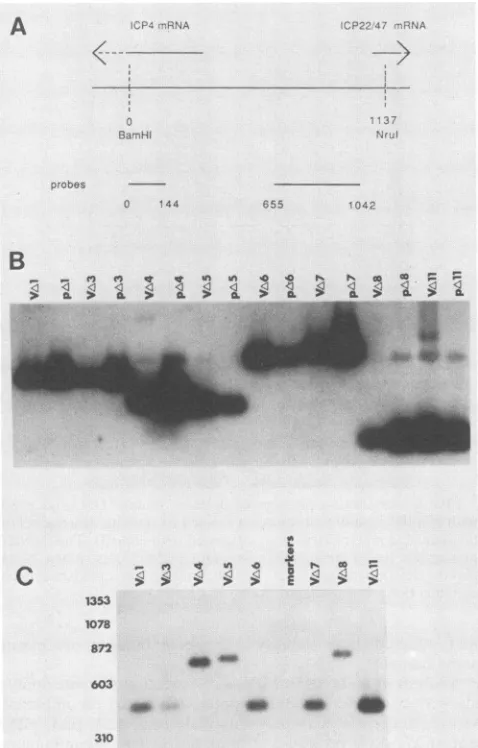
Results of restriction analysis with VAll are not shown but indicate that this mutant, like the othersjust mentioned,possessesauniqueHindlIl site in bothcopiesof the ICP4 gene.Southern blot hybridizationofmutantviral DNAs and of the mutant plasmids from which they were derived are shown in Fig. 3B and C. The indicated viral and plasmid
DNAs were first cleaved with BamHI and HindlIl and probed with an isolated fragment spanningnucleotides 0to 144(Fig. 3B)(numbersarerelativetotheBamHI site shared by BamHI a' and BamHI m'; see Fig. 1). As shown, the BamHI-HindIIIfragments detected in the viral DNAs comi-grated with the corresponding fragmentsfrom the parental
plasmidDNAs,indicatingthatthedeletion
plasmids
and thecorresponding viruses share the same left-hand endpoints
(relative to the expanded portion ofFig. 1). Theindicated
VOL.63, 1989
on November 10, 2019 by guest
http://jvi.asm.org/
[image:4.612.343.522.75.316.2]2040 SMITH ET AL.
A
!;'Cr1 FiNA 'P2C'-.' ''IA...I.. .-- ---..
Ba rrHlS
Drobes
0 144 655 1042
on in e0.0 1 1 Go
2 a; <2 < '2 > .> >& IL>
C
1353 1078 872
603
_e,*I>0 ,-. e
~
_--WA
4a
us
*
310
FIG. 3. Southern blot analysis ofVA1, VA3, VA4, VA5, VA6, VA7,VA8, andVAlland the mutantplasmids from which they were derived. (A) Locations ofthe probes used in the Southern blots presented in panels B and C. The pertinent BarnHI and NrlI restriction sites are shown. RelevantHindlIl sites are shown in Fig. 1.The numbers beneath the probes indicate nucleotide numbers to the right oftheleftmostBamHlsite andcorrespond to the nucleo-tide numbers that mark thelimits of deletionsshown inFig. 1.(B) The indicatedplasmids and viral DNAs werecleaved with BarmHl
and Hindlll and probed with a fragment spanning nucleotides 0 through 144. (C) Viral DNAs were cleaved withHindIll andNrlI andprobedwith afragmentspanning nucleotides655through 1042. HaeIII-digested 4X174DNAwasusedasmarkers(numbersonthe left).
viral DNAswere cleaved withHindIll andNruI and probed with an
isolated
fragment spanning nucleotides 655 to 1042(Fig. 3C).Asshown, theHindIII-NruIfragments detected in
the viral DNAs were the sizes expected if the viruses had acquired the engineered deletions. This result suggests that theindicated viral and plasmid DNAs share the same right-hand endpoints. Therefore, as determined by restriction enzyme analysis, the recombinant viruses generated with pAl, pA3, pA4,pA5, pA6, pA7, pA8, and pAllhadcorrectly
acquired the intendeddeletions. Confirmation that the dele-tionscontained in mutant viruses are identical to those found in plasmids will necessitate recloning and resequencing of the mutated genesfrom mutant viruses. Considering the high
FIG. 4. Southern blot analysis of
VA12
and VA13 DNAs. The indicatedviral DNAswerecleaved withBamHIandblottedwith an isolatedfragmentspanning nucleotides928 to1042, a sequencelying totally withthedeletions inpA12 and pA13 (seeFig. 1).BamHI zand BamHI a' refer to the bands in the lane in which wild-type HSV-2 strain 186 DNA was run.
frequency withwhich these viruses were derived, however (seeabove), it isunlikelythatthey have suffered secondary
mutations.
In contrast to these recombinants, those generated with
pzA2,
pA12, and pA13 did not contain the intended deletions.Asdeterminedby Southern blot analysis, the pA2 recombi-nants were either wild type or exhibited gross rearrange-ments or deletions in this region (data not shown). The wild-type recombinants probably arose from crossovers in the 263-bp sequence between the hr259 deletion at nucleo-tide 452 and the deletion in pA2 at nucleotide 715 (Fig. 1).
Theoriginof recombinants exhibitinggross rearrangements
ordeletions is unclear but may reflect theneed forat least one copyofHSV DNA sequences between nucleotides 715 and 996toensureviability.Asfor thepA2recombinants, the
pA12 and
pM13
recombinants did not contain the intended deletions. These recombinants all contained deletionssmaller than those intended and their DNAshybridizedtoan isolated fragment spanning nucleotides 928 to 1042, a se-quence
lying
totally within the deletions in pA12 andpA13
(Fig. 4).The results obtained with pA2,
pA12,
and pA13 suggest several possibilities, the most straightforward of which is that they lack a sequence(s) required for virus replication.These plasmids all have in common the fact that the se-quence fromnucleotides715 to996 has beendeleted.
There-fore,itis reasonabletoconcludethatthis sequencecontains
one or moreelementsessential for virus replication. Inthis regard, it should be noted that oriS is located within this sequence and thatoriS-associated sequences may comprise
part of the open reading frame of a newly identified viral gene (22). Alternatively however, pA2has only 46 nucleo-tides flanking itsright-hand deletion endpoint. Sucha short
regionofhomology mayhavedecreased theprobabilityofa
second crossover event during recombination with hr259 DNA, resulting in ourinability togenerate viruses
contain-ing the
A2
deletion. In contrastto pA2, plasmidspA12
andpA13 contain hundreds of homologous nucleotides flanking
B
BamHI z
BamHI a
do _- _
e
; a
... il.
w.
*T:..p.
J. VIROL.
C4 Clp)
2
on November 10, 2019 by guest
http://jvi.asm.org/
[image:5.612.67.306.72.446.2] [image:5.612.375.511.73.280.2]HSV-2 ICP24 PROMOTER MUTANTS 2041 TABLE 1. Growthproperties ofmutantviruses
Virus
Titer"
on TiteronEO"Yield"
on Yieldon ERVero cells n-33 cells EOP"Verocells n-33 cells
186 6.2 x 10⁸ 6.5 x 10⁸ 0.95 1.0 x 10⁸ 1.2 x 10⁸ 0.83
hr259 <1.0 x 10³ 1.0 x 10⁸ <1.0 x 10⁻⁵ <1.0 x 10⁴ 2.4 x 10⁷ <4.2 x 10⁻⁴
VAl 9.0 x 10⁷ 1.0 X 10⁸ 0.90 5.3 x 10⁷ 2.8 x 10⁷ 1.90
VA3 3.1 x 10⁸ 5.0 x 10⁸ 0.62 2.1 x 10⁷ 3.2 x 10⁷ 0.66
VA4 2.0 x 10⁸ 3.8 x 10⁸ 0.53 6.5 x 10⁶ 1.2 x 10⁸ 0.05
VA5 2.6 x 10⁸ 3.6 x 10⁸ 0.72 6.3 x 10⁷ 4.8 x 10⁷ 1.31
VA6 2.8 x 10⁸ 2.1 x 10⁸ 1.33 8.7 x 10⁷ 1.56 x 10⁸ 0.56
VA7 3.5 x 10⁸ 2.7 x 10⁸ 1.30 5.7 x 10⁷ 7.8 x 10⁷ 0.73
VA8 1.0 x 10⁸ 1.1 x 10⁸ 0.91 5.0 x 10⁷ 1.7 x 10⁸ 0.29
VAll 1.7 x 10⁷ 1.6 x 10⁸ 0.11 5.8 x 10⁶ 5.8 x 10⁷ 0.10
aTiter=PFU of mutant virusstockspermilliliter.
6EOP,Efficiency of plating=titeron Verocells/titeron n-33cells, with virus titermeasured byPFUpermilliliter.
cYield= PFU/milliliter;cells wereinfectedat amultiplicity of infection of2.5 PFU percellandharvestedat 18 hpostinfection. dEOR, Efficiency ofreplication= yield on Vero cells/yield on n-33 cells.
their right-hand deletion endpoints. Consequently, it is un-likely that our inability to generate viruses with the A12 or A13 deletions reflects infrequent crossover events.
Growth properties of mutants. Although we had selected ourmutantsfor viability, we assessedtheirgrowth proper-ties and plating efficiencies in Vero cells relative to those in n-33cells to determine whether any of the deletions affected theefficiencyof virus replication. As expected, none of the mutants exhibited the dramatic host range phenotype of hr259 (Table 1; 53). With regard to plating efficiency, mu-tants VA4andVAll plated least well on Vero cells relative
to
iI-33
cellsof the eightdeletionmutantstested. This patternwas also evident in one-step growth curves in which VA4,
VAll, and VA8, in that order, replicated less efficiently in Verocells relative to n-33 cells than the otherfive mutants. These observations suggest that sequences deleted in VA4 and VAll (and perhaps inVA8) affect the replication com-petence of the virus.
Characterization of ICP4 mRNAs generated by mutants.
The 5' ends of the ICP4 mRNAs generated by the mutant viruses were then mapped to assess the effects of the deletions on the site of ICP4 mRNA initiation. Vero cells were infected at a multiplicity of 20 PFU per cell, and
cytoplasmic RNA was harvested at 6 h postinfection.
Cy-cloheximide(75 ,ug/ml) was used to preventprotein synthe-sis and to augment the accumulation of immediate-early transcripts (29).
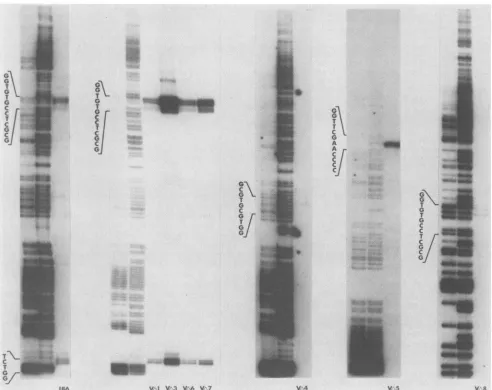
HSV-2 strain 186 generated transcripts whose 5' ends clustered within a region
of
about 10 nucleotides between 310 and 320relative to theBamHI site inFig. 1(Fig.5). It is unclearwhetherthis heterogeneity results froma technical artifactor trulyrepresents individual initiation sites. Strain 186also appearstogenerate5' endswhichmay mapbetween nucleotides70 to73 (Fig. 5). Many of themutantsgenerate these endsaswell. Webelieve thistobeanartifact, since the region immediately surrounding this area is unusuallyAT-rich (61), a characteristic which may result in transient
melting ofDNA-RNA hybrids.
The ICP4mRNAsgenerated by mutantsVA1,VA3, VA6,
VA7, andVA8 produced essentially the same S1 pattern as did thewild-typemessage.Thiswas notthecaseformutants VASorVA4,however. The ICP4 mRNAofVA5initiates just inside theHindIll linkerat position316, and thatofmutant VA4lies well downstreamof the beginning of the wild-type message,initiatingatpositions242 and 244. The result with
VA4 was predictable in that the deletion in this mutant
eliminates the TATA box, a cis-acting element which in
many systemsappearstodeterminethelocation of transcrip-tional initiation (3).
Byusing the531-bp BamHI-Bg/II fragment ofpA11 (Fig.
1)as theprobe, no 5' ends were detected in RNA prepara-tions from cells infected with VAll, the mutantlacking the entire conventionally recognized ICP4 promoter (data not shown). Iftranscription of ICP4 initiates within the region
tested in
VA11,
itdoessobelow ourlimits of detection.This mutant is nonetheless viable, implying that some ICP4 mRNA andproteinmust be synthesized.Quantitation of ICP4andICP47mRNAsinduced bymutant viruses. The mutant viruses were then characterized with respect to the amounts of ICP4 and ICP47 mRNAs they
induce by S1 analysis. It should be noted that the ICP4,
ICP47, and controlICP27 probesused in these experiments
contain HSV DNA sequences lying totally within the open reading frames of their respective genes. One consequence of the use ofthe 330-bp ICP4-specific probe is that it is unabletodifferentiatebetween ICP4 mRNAs thatinitiate in
theconventionally recognized ICP4 promoteras opposedto
those that may initiate upstream of this site. Despite this disadvantage, this probe and the ICP47 and ICP27 probes
were chosen because their HSV DNA sequences do not overlap any of the deletions in the mutant viruses.
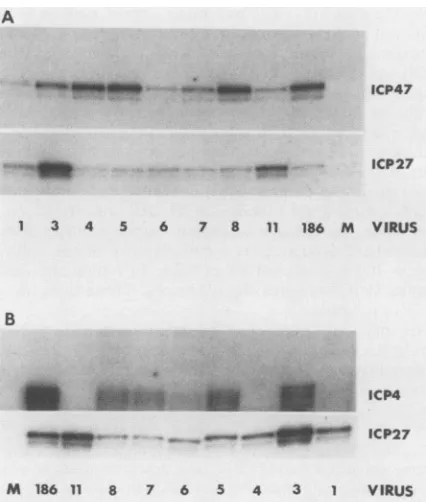
Results ofatypical assayareshowninFig.6, and Table2 shows the amounts of ICP4 mRNA the mutants induced relative towild-typevirus in the presence ofcycloheximide.
These results indicate that all of the mutants induced re-ducedamountsof ICP4 mRNA relative towild-typevirus in the presence ofcycloheximide. VAll and VA4 showed the greatestreduction. Since thedeletion inVAlleliminated the entire conventionally recognized ICP4 promoter, it is
per-haps not surprising that this mutant was deficient in ICP4
mRNA synthesis. The deletion in VA4 eliminated the ICP4
TATA box and resulted in a translocated ICP4
transcrip-tional startsite(Fig. 5). At thistime, it is uncertain whether
thedeficiencyinICP4 mRNA in VA4-infected cells is due to
areduction in transcriptional initiation or toaltered mRNA stability caused by the truncation of the 5'-untranslated leader. Mutants VAl and
VA&3
generated approximatelyequal amountsof ICP4 mRNA, about30% ofthewild-type
level. The deletions in these two mutants were nearly
identical, the only difference being that VAl retained the TAATGARAT element most proximal to the ICP4 mRNA startsitewhereasVA3 lacked it(Fig. 1).Since both VAl and
VA3 specify ICP4 mRNAs with wild-type 5'
termini,
it islikely that their reduced ability to generate ICP4 mRNA is
VOL.63,1989
on November 10, 2019 by guest
http://jvi.asm.org/
2042 SMITH ET AL.
G
G
T :
G c
t
I
:T G
TI
G
I
CI
GG
C GJ
G\
T T c A
A
cJf
GE £
G
TI
G
G
GT
G
c
0
C
C
GY
Gr
T
186 VerI V-3 VYi6 V 7 VU4 V.5 v 8
FIG. 5. Mapping the5' endsof the ICP4mRNAsgenerated by HSV-2, strain 186, andmutant viruses. S1analysis was conductedas
described in Materials andMethods, and protected fragments were run ongelsas described previously (61). G and G+A ladders of the corresponding end-labeled probeswereusedtosizethe protectedfragments.
causedby decreasedtranscriptional initiation. VA6 and VzA7 lacked two and one of the four TAATGARAT elements,
respectively (Fig. 1). VA6 consistently generated slightly
more ICP4 mRNA than did either VA1 orVzA3. Although it didnotachievewild-type levels, VA7 generatedsignificantly
moreICP4 mRNA than VA6. Like VA\1 and VA3, VA6 and
VA7 ICP4 mRNAs exhibited wild-type 5' termini (Fig. 5).
Thus,it islikelythat the decreased levels ofICP4mRNA are a consequence of a reduction in transcriptional initiation.
VzA8
and VA5 exhibited only moderately reduced levels of ICP4 mRNA. The deletion in VA8 eliminates the majority of the 5'-untranslated leader of the ICP4 mRNA, and thusitis uncertain whether the reduced ability of this virus to accu-mulate ICP4 mRNA is a consequence of altered mRNA stability or a decrease in transcriptional initiation. The deletion harbored byVzX5
did not produce a pronounced change in the 5' terminus of the ICP4 mRNA (Fig. 5), and thus, its reduced ability to generate wild-type levels of ICP4 mRNA probablyreflects a reduction in transcriptional initi-ation.The results presented in Table 3 indicate that ICP47
mRNAaccumulationin thepresence ofcycloheximideis not affectedby thedeletions inVA4,VA5,orVA8which lackthe TATA box, ICP4 transcriptional start site, and 5'-untrans-lated leader sequences of the ICP4 gene, respectively. In contrast, the other deletions exert asignificanteffect. Inter-estingly, the effects of the deletions in the latter group of mutants on ICP47 mRNA levels (Table 3) paralleled those foundwithrespectto ICP4mRNA(Table 2). Withregardto the levels ofexpressionof both ICP47 and ICP4,theviruses canbe placedin thefollowingorder:VA7 > VA6 - VA3 =
VAl. This indicates that theexpression of ICP4 and1CP22/ 47 is coordinately regulated, at least in the presence of cycloheximide and that this coordinate regulation is medi-ated by the same elements deleted in VA1, VA3, VA6,and VA7.
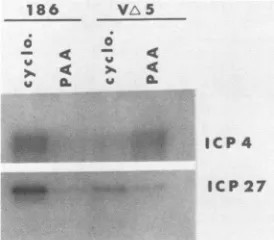
The deletion in VA5 eliminates the ICP4-binding site located at the ICP4 mRNA start site. The representative experiment showninFig.7 andTable4 wasdesignedto test whetherdeletionof this site alleviates therepression exerted onICP4transcriptionwhenviralprotein synthesisisallowed to occur (12, 20, 57). Table 4 shows the amounts of ICP4 J. VIROL.
jo.-;:!. r,
V.
A4
am" 1"Ma"
'I,
NW-"-,
--in
'14
-.
on November 10, 2019 by guest
http://jvi.asm.org/
[image:7.612.71.563.65.455.2]HSV-' ICP24 PROMOTER MUTANTS 2043
A
ICP47
.._w;i U~~~~~~CP27
1 3 4 5 6 7 8 11 186 M VIRUS
B
_CP4
ICP27
[image:8.612.65.278.68.319.2]M186 11 8 7 6 5 4 3 1 VIRUS
FIG. 6. Quantitative Si analysis of ICP4 and ICP47 mRNAs
generated by the mutant viruses. Verocellswereincubated in the presence of 75 p.g ofcycloheximide per ml beginning 1 h before infection and maintained in this concentration ofdrug until
har-vested. Cellswereinfected ata multiplicity of infection of20PFU
percell, andcytoplasmicRNAwasharvestedat6 hpostinfection. S1 analysis was conductedas previously described (61). (A) RNA
was probed simultaneously for ICP47 and ICP27 messages.
Pro-tectedfragmentsareshown.The ICP27 signalwasusedtonormalize the datatocontrol for experimental variation in infectionefficiency
and RNArecovery. (B) RNAwas probed simultaneously forICP4 and ICP27 messages. The protected fragments are shown. The
ICP27signalwasusedtonormalize ICP4signals. The results shown
herewerequantifiedto generatethe datapresentedinexperiment2
ofTable 1 and inTable 2. LaneM. Mock infected.
mRNA induced by VA5 relative to HSV-2 strain 186 in the
presence ofcycloheximide orphosphonoacetic acid (PAA).
an inhibitor of HSV DNA synthesis. PAA was added to
ensureequalgenomecopynumbersof thetwoviruses andto
allow forimmediate-earlyandearly protein synthesis. Asfor the wild-type virus, the ratio of ICP4 mRNA to ICP27 mRNAdid notchange regardlessof whichdrugwaspresent.
For VA5 in the presence of PAA, however, the ratio
in-creased at least threefold. This result indicates that in the absence of theICP4-binding site at the ICP4 transcriptional
start site, ICP4 and ICP27 mRNA levels are no longer
coordinately regulatedbut rather, ICP4 mRNA accumulates
tohigher levels.
DISCUSSION
Thisstudyhadseveralprimary objectives. The firstwasto
generate aseriesofmutant plasmids lacking one ormoreof
the recognized (is-acting elements located in the intergenic
regulatory region between the immediate-early genes
speci-fying ICP4 and ICP22/47. The second was to determine whetherthe absence ofany oftheseelements in thecontext
of the viral genome affected the ability of the virus to
replicate. Presumably. the virus would not replicate if a
deletion destroyed the activity of any essential (7is- or
TABLE 2. Quantitation of ICP4 mRNA generated by mutantviruses
Ratio" of mutantICP4 mRNA towild-type ICP4mRNA Virus
Expt 1 Expt 2 Expt3
186 1.00 1.00 1.00
VAl 0.28 0.16 0.29
VA3 0.28 0.29 0.32
VA4 <0.28 <0.16 <0.16
VA5 0.71 0.61 0.65
VA6 0.34 0.34 0.51
VA7 0.79 0.74 0.66
VA8 ND" 0.58 0.76
VA11 <0.28 <0.16 <0.16
"Autoradiogramslikethoseshown inFig.6 werescannedbyusinganLKB densitometer(Pharmacia. Inc.. Piscataway. N.J.), and peakswerequantified byweighing. For mutantsVA4 andVAll,ICP4 mRNA was not detected.In experiments2and3.the ICP4probedescribed in Materials and Methods was used. Inexperiment 1. aprobe containingthe144-bpBamzHI-HindIII
frag-mentofpA8(Fig. 1) was used. The ratio of mutant ICP4 mRNA towild-type ICP4mRNA wascalculatedbyusingthefollowing formula: [(weight ofICP4
mRNApeak/weight of 1CP27 mRNA peak)for agivenmutant]/[(weightof ICP4mRNA peak/weightofICP27 mRNApeak)forwild-type virus].This
ratio is equal to 1.00 when wild-type values are used in the denominator as well as the numerator.
" ND. Notdetermined.
tranis-acting element. The third objective was to determine which (is-acting elements affect the levelof ICP4 transcrip-tionand which affect the location of thetranscriptional start site.
Littledifficultywas encountered ingeneratingthedesired deletions in the cloned intergenic region between ICP4 and ICP22/47.DNAsequenceanalysis confirmed that each ofthe plasmids lacked the intended cis-acting element(s).
The absolute requirement for each of these elements in virus replication first became apparent in efforts to isolate viable deletion mutant viruses by marker transfer. Our ability to generate mutantslackingone orall four TAATGA RAT elements (VAI, VA3, VA6, and VA7), the ICP4 tran-scriptional start site (VA5). the ICP45'-untranslated leader (VA8), as wellassequenceslying between the first ATG and asite immediately to the right of the most upstreamTAAT GARAT element (VAil), indicate that none of these se-quences contains an essential cis- or trilas-acting element. Theviability ofVAll in cellsthat do notexpress ICP4was especiallysurprising, given that this mutantlacks the entire recognized ICP4 promoter. In view of the demonstration thatICP4 isessential for thegrowth of HSV-2(53), itisclear that VAll must somehow generate mRNA containing the
TABLE 3. Quantitation of 1CP47 mRNAgenerated
bY the mutant viruses
Ratio"ofmutant ICP47
Virus mRNA towild-type
ICP47 mRNA
186... 1.00
VAl... 0.13
VA3... ... 0.17
VA4... 0.97
VAS... 0.90
VA6... 0.23
VA7... 0.46
VA8... 0.94
VAl1... 0.12
"Thepr-ocedur-esoutlined infootnoteaof Table2wereusedtogeneratethe datapresentedhere.
VOL. 63, 1989
M-101.111-1 lei 1.1..
.7.r.-;r--? -..-IFIRW" ,iillllllipllpm V,WV,,
on November 10, 2019 by guest
http://jvi.asm.org/
[image:8.612.307.549.88.204.2] [image:8.612.309.549.588.703.2]2044 SMITH ET AL.
1861 VS
~~~ICP4
..
I C P 2 7
FIG. 7. S1 analysis of ICP4 and ICP27 mRNAs generated by HSV-2 wild-type strains 186 andVAS.Verocells wereinfectedwith 20 PFU ofeither virusper cell. Where indicated, 75 ,ugof cyclo-heximide (cyclo.) per ml or 300 mg of PAA per ml was present throughoutthecourse ofinfection.PAA wasadded to ensureequal genome copy numbersof the twovirusesand toallow for immedi-ate-early and early protein synthesis. Cells were harvested and processedforSi analysis at 6 hpostinfection. The420-bp BamHI-PvuII ICP4 probe described in Materialsand Methods was used in thesetests.
coding sequences for ICP4. Relevant to this point is the
existence ofan HSV-1 mRNA (oriSmRNA2) that beginsin
thenoncoding sequences of the ICP22/47 gene and contains the entire ICP4 openreading frame (22). Conceivably, such an mRNA, if one exists in HSV-2, could provide sufficient ICP4 tomaintain viability ofVAll. Alternatively, the
dele-tion in VAll may eliminate a transcriptional termination
signalfrom yet anothertranscript thatinitiatestotheright of
ICP4. Eliminationof thissignal could allow the synthesisof
an mRNA containing the ICP4 open reading frame under
control ofadistant rightward promoter. It should be noted that we were unable to demonstrate any ICP4 mRNA in
VAll-infected cells in the presenceofcycloheximide (Table
2). This would argue either that the putative alternative
rightwardpromoteris not of theimmediate-earlyclass(since earlyand latetranscriptsare notsynthesizedin the presence of cycloheximide and hence we would not detect them) or that verylittle ICP4-specific mRNA wassynthesized.
Our inability to transfer the desired deletions in pA2,
pA12, andpA13correctly into the viral genome is of interest. All threeplasmids lacked the sequence 715 through 996, a fact which may or may not be coincidental. However, all
plasmids thatcontain these sequences
(pAl,
pA3, pA4, pA5,pA6, pA7, pA8, pA9, pA10, and pAll) were transferred
correctly into the viral genome. Although, as mentioned
above, the short rightmost flanking sequence in pA2 may
[image:9.612.122.259.70.190.2]havediscouraged crossover eventsin this region,this isnot
TABLE 4. Quantitation of ICP4 mRNA generatedbyVAS and HSV-2 strain 186 in the presence of twodrugs
Ratio" ofICP4mRNAto
Virus Drug ICP27 mRNA
Expt1 Expt2
186 Cycloheximide 0.25 0.24
186 PAA 0.27 0.28
VA5 Cycloheximide 0.19 0.15
VA5 PAA 0.58 0.41
'Autoradiogramslike the one shown in Fig. 7 were scanned and the peaks werequantified by weighing. The ratio was calculated by using the following
formula:(weightofICP4peak)/(weightof ICP27 mRNA peak).
likely the case for pA12 and pA13, which contain lengthy rightward flankingsequences.Ofspecialnoteis thefact that recombinant viruses generated with VA12 and VA13 con-tained specifically those sequences whose deletion was
sought(Fig. 4). (TheVA2 recombinants havenotbeen tested
for the presence of these sequences.) We conclude from these experiments that sequences lying roughly between nucleotides 715 and 996 containoneor moreessentialcis-or trans-acting elements. Whether the essential element is the cis-acting oriSorcoding sequences for an as yet unidentified essential viral gene remains to be determined. If, on the other hand, the failure to obtain viable deletion mutants lacking these sequences is a consequence of the failure to express ICP4, it should be possible to obtain the desired mutants in ICP4-expressing n-33 cells. These tests are cur-rently in progress.
The successful transfer of the deletions in pAl, pA3, pA4,
pA5, pA6, pA7, pA8, and pAll afforded us the
unique
opportunitytostudy the effects of the corresponding deleted elements on transcription of ICP4 and ICP22/47 in the context ofthe viral chromosome. The absence of one, two, three, and all four TAATGARAT elements in VA7, VA6,
VA1, and VA3, respectively, had similar effects on the expression of ICP4 and ICP47. The deletions in these viruses however, also eliminate other cis-acting sites such as
Spl-binding motifs. Consequently, it is uncertain as to which
deleted elements are responsible for the observed bidirec-tional effects. It should be noted that transient expression experiments involving plasmid-borne substrates have shown that Spl sites and TAATGARAT elements affect transcrip-tion additively and in an orientation-independent manner (26, 30, 31, 40, 46). Confirmation of the roles of specific elements and sequences in the context of the viral genome will require the construction of mutants containing much smaller deletions than those harbored by VA1, VA3, VA6, and VA7. Despite this caveat, onefurtherconclusion regard-ing VAl and VA3 can be made. This concerns the fact that these two mutants shared the same right-hand deletion endpoints and differed byonly 14nucleotides with respect to their left-hand deletion endpoints (Fig. 1). The deletion in VA3 eliminated all four TAATGARAT motifs, whereas the deletion in VAl retained the TAATGARAT most proximal to the start of ICP4 transcription (Fig. 1). Despite this difference, transcription driven by these two promoters in the presence of cycloheximide did not differ significantly
(Tables 2 and 3). This result suggests either that the TAAT GARAT element located between nucleotides 450 and 460 does notcontribute toexpression or that thedeletionin VAl eliminates some other cis-acting element which acts in conjunction with TAATGARAT to confer VP16inducibility. The latter possibility appears more likely in that recent studies have shown that the TAATGARAT consensus is necessarybutnot sufficientfor induction by VP16 (5, 23, 56). The sequence GCGGAA is also apparently critical (5, 23, 55). Both VA3 and VAl lack two such elements located between the second and third TAATGARAT motifs (61). Theabsence of this sequence maythereforeexplain why the single TAATGARAT element retained by VAl has no ap-parent activity.
In contrast to VA1, VA3, VA6, and VA7, the deletions in VA4, VA5 and VA8 did not appreciably affect ICP47 expres-sion (Table 3), although they did reduce ICP4 expression (Table 2). This result was notunexpected, considering that thedeletions inVA4,VA5,andVA8eliminatewhatappearto be ICP4-specific landmarks: i.e., the ICP4 TATA box, the endogenous ICP4 mRNAstart site, and the sequence encod-J. VIROL.
on November 10, 2019 by guest
http://jvi.asm.org/
[image:9.612.71.310.617.692.2]HSV-2 ICP24 PROMOTER MUTANTS 2045
ing most of the untranslated leader of the ICP4 mRNA, respectively.
Asaconsequenceof the A4deletion, ICP4 mRNA expres-sion was reduced by 5- to 10-fold and the 5' end of ICP4 mRNA was translocated downstream of the normal site of initiation by approximately 80 nucleotides (Table 2 and Fig. 5). These results arein agreement with those ofCordingley et al. (8), who characterized a plasmid-borne HSV-1 ICP4
gene specifically lackingthe TATA element. They found in
transient expression assays that elimination of the TATA box caused a two- to threefold reduction in expression as well as atranslocation of the ICP4 transcriptional start site. As stated earlier, the deletion in VA5 eliminates the ICP4-binding site located at the start site of ICP4 transcrip-tion. VA5 generated modestly reduced levels of ICP4 mRNA in the presence ofcycloheximide (Tables 2 and 4). However, the results shown in Table4demonstrate thatVzA5 generated
relatively more ICP4 mRNA than wild-type virus when
immediate-early and early protein synthesis was permitted
to occur (i.e., in the presence of PAA but not
cyclohexi-mide). The moststraightforward interpretation of this latter result is that the lack of ICP4 binding at the start of ICP4
transcription results in higher levels of expression. While
reproducible, these effects are not as dramatic as those obtained with ICP4 deletion or temperature-sensitive mu-tants under nonpermissive conditions (13, 43; N. DeLuca,
personal communication). Therefore, it is reasonable to
suggest that repression of ICP4 expression is mediated by
more thanone cis-actingsignal.
Thedeletion in VA8 eliminatedmostof theDNAencoding
the 5'-untranslated leader of ICP4 mRNA. VA8 exhibited a 20to40%decrease in ICP4mRNAlevels(Table2). Whether
this deficiency is caused by altered mRNA stability or
reduced transcriptional efficiency is unclear from the data obtained in thisstudy. Pertinenttothisquestionisthe report
by Blair et al. (1) indicating that deletions in the sequence
encodingthe 5'-untranslated leaderof VP16 cause not only
reduced message stability but also lowered transcriptional
efficiency duringlyticinfection. The ICP4mRNAof A8 may
provetohave similartranscriptionalandposttranscriptional properties.
This report describes preliminary studies designed to address the in vitro consequences of alterations in the
intergenic region between ICP4 and 1CP22/47; it does not,
however, address the consequences of these alterations in
the animal host. Forthis purpose, we arecurrently assaying
the pathogenicity of our series of HSV-2 ICP4 promoter
mutants as well as their ability to establish, maintain, and reactivate from latency in the mouse eye model.
ACKNOWLEDGMENTS
We thank Neal DeLuca for technical advice and valuable com-ments onthemanuscriptandMeg Kaveny for manuscript prepara-tion.
This investigation was supported by Public Health Servicegrant CA20260 from the National Cancer Institute.C.A.S.wassupported byNational Science FoundationgraduatefellowshipRCD-84-50074.
LITERATURE CITED
1. Blair, E. D., C. C. Blair, and E. K. Wagner. 1987. Herpes simplexvirus virionstimulatory proteinmRNAleadercontains sequence elements which increase both virus-induced transcrip-tion and mRNAstability. J.Virol. 61:2499-2508.
2. Blair,E.D.,and E. K.Wagner. 1986.Asingle regulatory region modulates both cis-activation andtr-ans-activationof theherpes simplex virus VP5 promoterin transient expression assays in
vivo. J.Virol. 60:460-469.
3. Breathnatch, R., and P. Chambon. 1981. Organization and expressionofeukaryotic splitgenescodingforproteins. Annu. Rev. Biochem. 50:349-383.
4. Briggs,M. R., J.T. Kadonaga, S.P. Bell,and R. Tjian. 1986.
Purification andbiochemical characterization of the promoter-specific transcriptionfactor. Spl. Science 234:47-52.
5. Bzik, D.,andC.M.Preston. 1986.Analysisof DNA sequences which regulate thetranscription of herpes simplex virus imme-diateearly gene 3: DNA sequences requiredfor enhancer-like activity and response to trans-activation by a virion polypep-tide. Nucleic Acids. Res. 14:929-943.
6. Campbell, M. E. M., J. W. Palfreyman, and C. M. Preston.
1984. Identification of herpes simplex virus DNA sequences which encodeatrans-acting polypeptide responsible for stimu-lation ofimmediate earlytranscription. J. Mol.Biol. 180:1-19. 7. Cereghini, S., and M. Yaniv. 1984. Assembly of transfected DNAinto chromatin: structuralchangesin the origin-promoter-enhancerregionuponreplication. EMBO J. 3:1243-1253. 8. Cordingley, M. G., M. E. M. Campbell, and C. M. Preston.
1983. Functional analysis of a herpes simplex virus type 1 promoter: identification offar-upstream regulatory sequences. Nucleic Acids Res. 11:2347-2365.
9. DeLuca,N.A.,A.McCarthy,and P. A.Schaffer. 1985.Isolation andcharacterization of deletionmutantsofherpessimplexvirus type 1 in the geneencodingimmediate-early regulatoryprotein ICP4. J. Virol. 56:558-570.
10. DeLuca,N.A.,and P. A. Schaffer. 1985. Activationof immedi-ate-early, early, and late promoters by temperature-sensitive and wild-type forms of herpes simplex virus type 1 protein ICP4. Mol. Cell. Biol. 5:1997-2008.
11. DeLuca, N. A., and P. A. Schaffer. 1987. Activities ofherpes simplexvirus type 1 ICP4 genes specifyingnonsense peptides. Nucleic Acids Res. 15:4491-4511.
12. DeLuca,N.A.,andP.A.Schaffer. 1988.Physicalandfunctional domains of theherpes simplex virus transcriptional regulatory proteinICP4. J. Virol. 62:732-743.
13. Dixon, R. A. F., and P. A. Schaffer. 1980. Fine structure
mapping and functional analysis oftemperature-sensitive mu-tants in the gene encoding the herpes simplex virus type 1
immediate-early proteinVP175. J. Virol. 36:189-203.
14. Everett, R. D.1984. Transactivation oftranscription by herpes products:requirementfortwoHSV-1immediate-early polypep-tides for maximum activity. EMBO J. 3:3135-3141.
15. Faber,S.W.,and K. W.Wilcox.1986.Association of theherpes simplex virus regulatory protein ICP4 with specific nucleotide sequencesinDNA. Nucleic Acids Res. 14:6067-6083. 16. Faber,W. W.,and K. W. Wilcox. 1988. Association ofherpes
simplexvirusregulatoryprotein ICP4 withsequences spanning the ICP4 gene transcription initiation site. Nucleic AcidsRes. 16:555-567.
17. Gaffney, D. F., J. McLauchlan, J. L. Whitton, and J. B.
Clements.1985. A modular systemfor the assay oftranscription regulatory signals: the sequence of TAATGARAT is required for herpes simplex virus immediate-early activation. Nucleic Acids. Res. 13:7847-7863.
18. Gelman, I.H., and S. Silverstein. 1985. Identification of imme-diate-early genes from herpes simplex virus that transactivate the virus thymidine kinase gene. Proc. Nat]. Acad. Sci. USA 82:5265-5269.
19. Gelman, I.H.,andS. Silverstein. 1987.Dissection of immediate-earlygene promotersfromherpessimplexvirus: sequences that respond to the virus transcriptional activators. J. Virol. 61: 3167-3172.
20. Harris-Hamilton, E.,andS. L. Bachenheimer. 1985. Accumula-tion of herpes simplex virus type RNAs of different kinetic classes in thecytoplasmof infected cells. J. Virol. 53:144-151. 21. Jones, K. A., and R. Tjian. 1985. Spl binds to promoter sequences and activates herpes simplex virusimmediate-early genetranscription in vitro. Nature(London)317:179-192. 22. Hubenthal-Voss, J., and B. Roizman. 1988. Properties oftwo
5'-coterminal RNAs transcribed part way and across the S component originof DNAsynthesisof theherpessimplexvirus VOL.63, 1989
on November 10, 2019 by guest
http://jvi.asm.org/
2046 SMITH ET AL.
1 genome. Proc. Nati. Acad. Sci. USA 85:8454-8458. 23. Kristie, T. M., and B.Roizman. 1984. Separation of sequences
defining basal expression from those conferring alpha gene recognition within the regulatory domains of herpes simplex virus 1 alphagenes. Proc.Natl.Acad. Sci. USA81:4065-4069. 24. Kristie, T. M., and B. Roizman. 1986. Alpha 4, the major regulatoryprotein of herpes simplex virus type 1, is stably and specificallyassociatedwith thepromoter-regulatorydomains of alpha genes and of selected other viral genes.Proc. Natl. Acad. Sci. USA83:3218-3222.
25. Kristie, T. M., and B. Roizman. 1986. DNA-binding site of major regulatory protein alpha 4 specifically associated with promoter-regulatory domains of alpha genes of herpes simplex virus type 1. Proc. Nati. Acad. Sci. USA83:4700-4704. 26. Lang, J. C., D. A. Spandidos, and N. M. Wilkie. 1984.
Tran-scriptional regulation ofherpes simplex virus immediate-early gene ismediated through anenhancer-typesequence. EMBO J. 3:389-395.
27. Leinbach, S. S., and W. C. Summers. 1980. The structure of herpes simplex virus type 1 DNA as probed by micrococcal nuclease digestion. J. Gen. Virol. 51:45-59.
28. Longnecker, R., and B. Roizman. 1986. Generation of an invert-ing herpes simplex virus 1 mutant lacking the L-S junction cl sequences, an origin of DNA synthesis, and several genes including those specifying glycoprotein E and the (47 gene. J. Virol. 58:583-591.
29. Mackem, S., and B. Roizman. 1981. Regulation of herpesvirus macromolecular synthesis: temporal order of transcription of alpha genes is not dependent on thestringency of inhibition of protein synthesis. J. Virol. 40:319-322.
30. Mackem, S., and B. Roizman. 1982. Differentiation between alphapromoter and regulator regions of herpes simplex virus 1: thefunctional domains and sequence of a movable alpha regu-lator. Proc. Natl. Acad. Sci. USA79:4917-4921.
31. Mackem, S., and B. Roizman. 1982. Structural features of the herpes simplex virus alpha gene 4, 0, and 27 promoter-regula-tory sequences which confer alpha regulation on chimeric thymidine kinase genes. J. Virol. 44:939-949.
32. Mavromara-Nazos, P., M. Ackerman, and B. Roizman. 1986. Construction and properties of a viable herpes simplex virus 1 recombinant lacking coding sequences of the alpha 47 gene. J. Virol. 60:807-812.
33. Mavromara-Nazos, P., S. Silver, J. Hubenthal-Voss, J. C. Mc-Knight, and B. Roizman. 1986. Regulation of herpes simplex virus 1 genes: alpha gene sequence requirements for transient induction of indicator genes regulated by beta or late promoters. Virology 149:152-164.
34. McCarthy, A. M., L. McMahan, and P. A. Schaffer. 1988. Herpes simplex virus type 1 ICP27 deletion mutants exhibit altered patterns oftranscription and are DNA deficient. J. Virol. 63:18-27.
35. McKnight, J. L. C., T. M. Kristie, and B. Roizman. 1987. Binding of the virion protein mediating a gene induction in herpes simplexvirus-infected cells to its cis site requires cellular proteins. Proc. Natl. Acad. Sci. USA 84:7061-7065.
36. Michael, N., D. Spector, P. Mavromara-Nazos, T. M. Kristie, and B.Roizman. 1988. TheDNA-binding properties of the major regulatory protein alpha 4 of herpes simplex viruses. Science 454:1531-1533.
37. Muller, M. 1987. Binding of the herpes simplex virus immediate-early geneproduct ICP4 to itstranscriptional start site. J. Virol. 61:858-865.
38. O'Hare, P., and C. R. Goding. 1988. Herpes simplex virus regulatory elements andimmunoglobulinoctamer domain bind a common factor and are both targets for virion transactivation. Cell52:435-445.
39. O'Hare, P., and G. S. Hayward. 1985. Evidence for a direct role of both 175K and 110K immediate-early proteins of herpes simplex virus in thetransactivation ofdelayed-early promoters. J. Virol. 53:751-760.
40. O'Hare, P., and G. S. Hayward. 1987. Comparison ofupstream sequence requirements for positive and negative regulation of herpes simplex virus immediate-early gene by three virus
en-codedtr-als-acting factors. J. Virol.61:190-199.
41. Post, L. E., S. Mackem, and B. Roizman. 1981. Regulation of alpha genes of herpes simplex virus: expression of chimeric genesproduced byfusions ofthymidinekinase withalphagene promoters. Cell 24:555-565.
42. Post,L. E.,and B. Roizman. 1981. Ageneralized techniquefor deletion of specific genes in large genomes: alpha gene 22 of herpes simplex virus 1 is not essential for growth. Cell 25: 227-232.
43. Preston, C. M. 1979. Control ofherpes simplex virus type 1 mRNA synthesis in cells infected with wild-type virus or the temperature-sensitive mutanttsK. J.Virol. 29:275-284. 44. Preston, C. M., M. G. Cordingley, and N. D. Stow. 1984.
Analysisof DNA sequences whichregulatethetranscriptionof
a herpes simplex virus immediate-early gene. J. Virol. 50: 708-716.
45. Preston,C.M.,M.C.Frame,andM.E. M.Campbell. 1988. A complex formed between cell components and anHSV
struc-tural polypeptide bindsto aviral immediate-early gene regula-tory DNA sequence. Cell 52:425-434.
46. Preston, C. M., and D. Tannahill. 1984. Effects oforientation andpositionontheactivityofaherpessimplexvirus immediate-earlygenefar-upstream region. Virology 137:439-444. 47. Preston, V. G. 1981. Finestructure mappingofherpessimplex
virus type 1 temperature-sensitive mutations within the short repeat region of the genome. J. Virol. 39:150-161.
48. Quinlan,M. P., and D. M.Knipe. 1985. Stimulation of expres-sion ofherpes simplex virus DNA-binding protein bytwoviral functions. Mol. Cell. Biol. 5:957-963.
49. Rawls, W. E., D. Laurel, J. L. Melnick, J. M Glicksman, and
R. H. Kaufman. 1968. A search for viruses in smegma, prema-lignant and early malignant cervical tissues. The isolation of herpesviruses with distinct antigenic properties. Am. J. Epide-miol. 87:647-655.
50. Sacks,W.R., C. C. Greene,D.P.Aschman, and P.A.Schaffer. 1985. Herpes simplex virus type 1 ICP27 isan essential regula-tory protein. J. Virol. 55:796-805.
51. Sacks, W.R.,and P. A. Schaffer. 1987. Deletionmutants in the geneencodingthe herpes simplex virus type 1 immediate-early protein ICPO exhibit impaired growth in cell culture. J. Virol. 61:829-839.
52. Shapira, M., F. L. Homa, J. C. Glorioso, and M. Levine. 1987. Regulationof the herpes simplexvirus type 1 lateglycoprotein C gene: sequences between base pairs -34 to +29 control transient expression and responsiveness to transactivation by the products of the immediate-early 4 and 0 genes. Nucleic Acids Res. 15:3097-3111.
53. Smith, C. A., and P. A. Schaffer. 1987. Mutants defective in herpes simplex virus type 2 ICP4: isolation and preliminary characterization. J. Virol. 61:1092-1097.
54. Stow, N. D., andE.Stow. 1986. Isolation and characterization of
a herpes simplex virus type 1 mutant containing a deletion within the gene encoding the immediate-early polypeptide VmwllO. J. Gen. Virol. 67:2571-2585.
55. Triezenberg, S. J., R. Kingsbury, and S. L. McKnight. 1988. Functional dissection of VP16, the transactivator of herpes simplex virus immediate-early gene expression. Gene & Dev. 2:718-729.
56. Triezenberg, S. J., K. L. LaMarco, and S. L. McKnight. 1988. Evidence of DNA-protein interactions that mediate HSV-1 immediate-early gene activation by VP16. Genes & Dev. 2: 730-742.
57. Weinheimer, S. P., andS. L. McKnight. 1987. Transcriptional and post-transcriptional controls establish thecascade ofherpes simplex virus protein synthesis. J. Mol. Biol. 195:819-833.
58. Weller, S. K., K. J. Lee, D. J. Sabourin, and P. A. Schaffer.
1983. Genetic analysis oftemperature-sensitive mutants which define the gene for the major herpes simplex virus type 1 DNA-binding protein. J. Virol. 45:354-366.
59. Whitton, L. J., and J. B. Clements. 1983. Immediate-early mRNA-2 ofherpes simplex virus types 1 and 2 is unspliced: conserved sequences around the5'and 3'terminicorrespondto
transcriptional regulatory signals. Nucleic Acids Res. 11:6247-J.VIROL.
on November 10, 2019 by guest
http://jvi.asm.org/
HSV-2 ICP24 PROMOTER MUTANTS 6287.
60. Whitton, L. J., and J. B. Clements. 1984.Thejunctions between the repetitive and the short unique sequences of the herpes
simplex virusgenome aredetermined by the polypeptide-coding
regions oftwo splicedimmediate-early mRNAs. J. Gen. Virol. 65:451-466.
61. Whitton, L.J.,and J. B.Clements. 1984.Replication originsand
a sequenceinvolved incoordinateinduction of the
immediate-earlygenefamilyareconserved inanintergenic region ofherpes
simplex virus. Nucleic Acids Res. 12:2061-2079.
62. Wu, C. A.,N. J. Nelson, D. J. McGeoch, and M.D.Challberg. 1988. Identification of herpes simplex virus type 1 genes
re-quired for origin-dependent DNA synthesis. J. Virol. 62:435-443.
VOL. 63, 1989 2047