City, University of London Institutional Repository
Citation
:
Amato, R., Lacasa, L., Díaz-Guilera, A. and Baronchelli, A. ORCID:
0000-0002-0255-0829 (2018). The dynamics of norm change in the cultural evolution of language.
Proceedings of the National Academy of Sciences, 115(33), pp. 8260-8265. doi:
10.1073/pnas.1721059115
This is the accepted version of the paper.
This version of the publication may differ from the final published
version.
Permanent repository link:
http://openaccess.city.ac.uk/20390/
Link to published version
:
http://dx.doi.org/10.1073/pnas.1721059115
Copyright and reuse:
City Research Online aims to make research
outputs of City, University of London available to a wider audience.
Copyright and Moral Rights remain with the author(s) and/or copyright
holders. URLs from City Research Online may be freely distributed and
linked to.
City Research Online: http://openaccess.city.ac.uk/ [email protected]
The Dynamics of Norm Change in the Cultural
Evolution of Language
Roberta Amato
a,b, Lucas Lacasa
c, Albert D´ıaz-Guilera
a,b, and Andrea Baronchelli
d,∗aDepartament de F´ısica de la Mat`eria Condensada, Universitat de Barcelona, Barcelona (Spain)
b
Universitat de Barcelona Institute of Complex Systems (UBICS), Barcelona (Spain)
c
School of Mathematical Sciences, Queen Mary University of London, London E1 4NS (UK)
d
Department of Mathematics, City, University of London, London EC1V 0HB (UK)
Abstract
What happens when a new social convention replaces an old one? While the possible forces favoring norm change - such as institutions or committed activists - have been identified since a long time, little is known about how a population adopts a new convention, due to the difficulties of finding representative data. Here we address this issue by looking at changes occurred to 2,541 orthographic and lexical norms in English and Spanish through the analysis of a large corpora of books published between the years 1800 and 2008. We detect three markedly distinct patterns in the data, depending on whether the behavioral change results from the action of a formal institution, an informal authority or a spontaneous process of unregulated evolution. We propose a simple evolutionary model able to capture all the observed behaviors and we show that it reproduces quantitatively the empirical data. This work identifies general mechanisms of norm change and we anticipate that it will be of interest to researchers investigating the cultural evolution of language and, more broadly, human collective behavior.
Introduction
Social conventions are the basis for social and economic relations [1–4]. Examples range from driving
on the right side of the street, to language, rules of politeness or moral judgments. Broadly speaking, a
convention is a pattern of behavior shared throughout a community, and can be defined as the outcome
that everyone expects in interactions that allow two or more equivalent actions (e.g., shaking hands
or bowing to greet someone) [5, 6]. Conventions emerge either thanks to the action of some formal or
informal institution, or through a self-organized process in which group level consensus is the unintended
consequence of individual efforts to coordinate locally with one another [2,6]. Crucially, since conforming
to a convention is in everyone’s best interest when everyone else is conforming too, social conventions
are self-enforcing [5]. Yet behaviors change all the time and old conventions are constantly replaced by
new ones: words acquire new meanings [7], orthography evolves [8], rules of politeness are updated [9],
and so on. In isolated groups, shifts in conventions may be driven by the same forces that determine the
emergence of a consensus from a disordered state, i.e., institutions or self-organization [6, 7]. However,
a quantitative understanding of the processes of norm change has remained elusive so far, probably
hindered by the difficulty of accessing adequate empirical data [10].
Here, we address this issue by focusing on shifts in orthographic and linguistic norms through the
lenses of about 5 million written texts covering the period from 1800 to 2008 from the digitized corpus
of Google Ngram [9] dataset. Following the same approach that has allowed quantification of processes
such as the regularization of English verbs [12] or the role of random drift in language evolution [13], we
analyze the statistics of word occurrences for a set of specific linguistic forms that have been historically
modified either by language authorities or spontaneously by language speakers in English or Spanish.
These include words that have changed their spelling in time and competition between variants of the
same word or expression. To explore the mechanisms of norm change we consider three separate cases:
1. Regulation by a formal institution. We analyze the effect of the deliberations of the Royal Spanish Academy, Real Academia Espa˜nola (RAE), the official royal institution responsible for overseeing the Spanish language, on the spelling of 23 Spanish words (complete list in SI Sec.
3) [2–8].
2. Intervention of informal institutions. We investigate the effect of dictionary publishing in the US on the updating of American spelling for 900 words [21, 22] (complete list in SI Sec. 10.A).
3. Unregulated (or ‘spontaneous’) evolution. We consider the alternation between forms that are either unregulated or described as equivalent by an institution but have nonetheless exhibited
a clear evolutionary trajectory in time (i.e., we do not consider the case of random drift as primary
evolutionary force [13]). In particular, we examine (i) the evolution over time of the use of two
equivalent forms for the construction of imperfect subjunctive verbal time in Spanish, for 1,571
verbs (complete list in SI Sec. 10.C; verbs and declination for each form in [23, 24]), (ii) the
alternation of two written forms of the Spanish adverb solo/s´olo(‘only’) [25], and (iii) 46 cases of substitution of British forms (e.g., words) with American ones in the US [26] (complete list in SI
Sec. 10.B).
We show that these mechanisms leave robust and markedly distinct stylized signatures in the data, and
we propose a simple evolutionary model able to reproduce quantitatively all of the empirical observations.
When a formal institution drives the norm change, the old convention is rapidly abandoned in favor of
the new one [7, 27–30]. This determines a universal process of norm adoption which is independent of
both word frequency and corpus size. A qualitatively similar pattern is also observed for norm adoption
driven by an informal institution, although in this case the adoption of the new form is smoother and
word dependent. In the case of unregulated norm change, the transition from the old to the new norm is
slower, potentially occurring over the course of decades, and is often driven by some asymmetry between
the two forms, such as the presence of a small fraction of individuals committed to one of the two
alternatives [31–33].
Data and historical background
Spanish
Founded in 1713, theReal Academia Espa˜nola (Royal Spanish Academy, RAE) is the official institution responsible for overseeing the Spanish language. Its mission is to plan language by applying linguistic
a common standard in accordance with Article 1 of its founding charter: “... to ensure the changes that
the Spanish language undergoes [...] do not break the essential unity it enjoys throughout the
Spanish-speaking world.” [34–36]. Its main publications are the Dictionary of Spanish Language (23 editions between 1780 and today) and its Grammar, last edited in 2014. Particularly interesting for our study is the standardization process that the RAE carried out during the 19th century, which enforced the
official spelling of a number of linguistic forms [3, 37].
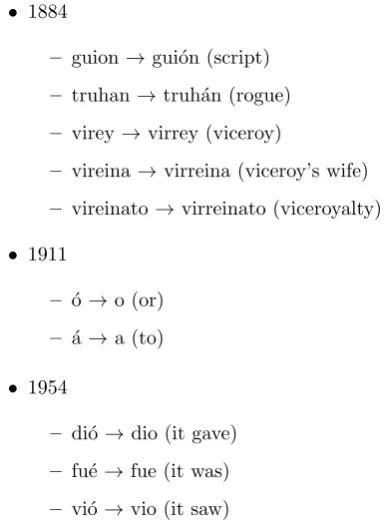
Our data set contains 23 spelling changes that occurred in four different reforms, in 1815, 1884, 1911
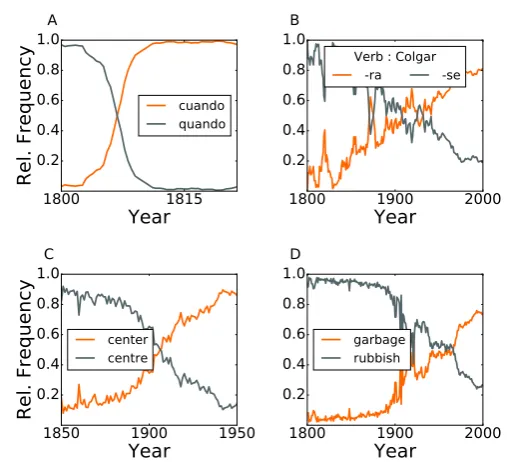
and 1954 (additional details are in the SI Sec. 3) [2–8]. To illustrate this, Fig. 1A shows the temporal
evolution of the spelling change of the wordquando(‘when’) intocuando –regulated in the 1815 reform– in the Spanish corpus, showing a sharp transition (or “S-shaped” behavior [27–29]). Different is the case
of the adverbsolo (‘only’), whose spelling variants´olowas added to the RAE dictionary in 1956 after a long unofficial existence supported by a number of academics [25,33,38]. We will consider the coexistence
of these latter two forms as an example of unregulated evolution (since 2010, the RAE discontinued the
s´olo variant again [25], but our dataset does not include such recent data).
A major example of unregulated norm change is offered by the Spanish past subjunctive, which can be
constructed in two - equivalent [39, 40] - ways by modifying the verbal root with the (conjugated) ending
-raor -se(additional details are in SI Sec. 3). For example, the first person of the past subjunctive of the verb colgar (‘to hang’) could be indistinctly colga-ra or colga-se. Fig. 1B shows the growth of the
-ravariant, for all verbal persons, over two centuries. A similar behavior is found in most Spanish verbs, the form-sebeing the most used at the beginning of XIX century (preferred≈80% of the times) to the less used at the beginning of the XXI century (chosen≈20% of the times). This peculiar phenomenon
has attracted the attention of researchers for the last 150 years and has not been entirely clarified [39].
Recent results suggest that, whereas individuals typically use only one of the two forms, the
alter-nation between the two variants tends to be found only in speakers who prefer the-se form [40, 41], as also confirmed by a recent analysis of written texts [42]. Thus, the users of−raappear to be effectively
committed to this unique form. As we will see below, the possibility of such asymmetries of behavior
have been incorporated into our model.
British English vs. American English
The emergence of American English was encouraged by the initiative of academics, newspapers and
politicians – e.g., US President Theodore Roosevelt [31] – who over time introduced and supported new
reforms [43]. The process gained momentum in the 19th century, when a debate on how to simplify
English spelling began in the United States [32, 44–46], which was also influenced by the development of
phonetics as a science [47]. As a result, in 1828 Noah Webster published the firstAmerican Dictionary of the English Language, beginning the Merriam-Webster series of Dictionaries that is still in use nowadays [32, 48]. Some changes, such ascolor instead ofcolour orcenterforcentre, would become the distinctive features of American English. Fig. 1C shows the transition from the British spelling centre to the Americancenter. The complete list of the 900 words examined is reported in SI Sec. 10.A.
The phenomenon of ‘Americanization’ of English [26] is not limited to spelling but includes also
the introduction of different words or expression which over time replaced the British ones. Recent
works [26, 49] report how the globalization of American culture might be favoring the affirmation of their
specific form of English. We will consider a list of 46 American-specific expressions in relation to their
1800
1815
Year
0.2
0.4
0.6
0.8
1.0
Rel. Frequency
A
cuando quando1800
1900
2000
Year
0.2
0.4
0.6
0.8
1.0
B
Verb : Colgar
-ra -se
1850
1900
1950
Year
0.2
0.4
0.6
0.8
1.0
Rel. Frequency
C
center centre1800
1900
2000
[image:5.595.164.418.76.307.2]Year
0.2
0.4
0.6
0.8
1.0
D
garbage rubbishFigure 1: Illustrative examples of competing conventions in our dataset (relative frequencies). (A) Formal institution: the spelling of the Spanish word ”quando” (when) was changed into ”cuando” by a RAE reform in 1811. (B) Unregulated evolution of two equivalent forms for the past subjunctive,-raand-se, for the verb “colgar” (to hang). (C) Informal institution: the American Spelling ”center” versus the British spelling ”centre”. (D) Unregulated evolution of “garbage”, the American variant of the British “rubbish”.
Google Ngram.
Model
We introduce a simple model that describes the evolution in time of two alternative forms of a word (i.e.,
two alternative conventions). For example, the two norms may represent two spelling alternatives (-or
vs-our as incolor/colour), two ways to form a verbal tense (-ra vs-se) or two different words to refer to the same concept (biscuit vscookie).
The model describes a system of books where instances of the two conventions are added by authors
through the publication of books. Authors select which convention to use (i.e., which form to introduce
in the system) either by following the indications of an institution or considering the current state of
language. In the first case, authors simply adopt the recommended norm (or ‘new norm’, for simplicity,
as we focus on cases of norm change). In the latter case, the convention to be used is selected with a
probability proportional to its current frequency, as in the neutral model for evolution [50]. Additionally,
some authors can be committed to one specific form, thus being indifferent to any external influence,
as suggested by the literature on the study of orthographic norm change in both English [31, 32] and
Spanish [33]. When an authority is present, the presence of commitment is revealed by the (empirically
verified, see SI Sec. 4 and Fig S1) persistence in time of the old norm, and translates into the model
such phenomena as, for example, the re-editions of past books whose orthography is not updated [15].
In the case of unregulated evolution, committed authors privilege the initially less popular new norm,
-100 -50
0
50
100 150
t
∗(Year)
0.0
0.2
0.4
0.6
0.8
1.0
n(
t
∗
)
Model
Data
0.0 0.2 0.4 0.6 0.8 1.0
Rel. Frequency
10% 30% 50% 70%
Distribution
[image:6.595.192.395.80.256.2]-120 - -80 -80 - -40 -40 - 0 0 - 40 40 - 80
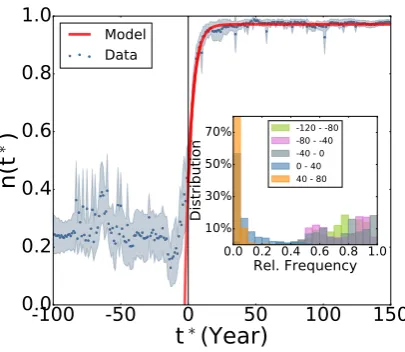
Figure 2: Regulation by a formal institution (Spanish, RAE). Main panel: Relative frequency of the new spelling form as a function of the rescaled time t∗. Blue points represent the average over all the considered pairs of words and the gray area the standard deviation of the data. The solid line is the prediction of the model outcome (eq. (4)) after parameter fit (χ2= 6·10−5,p= 0.99). The black vertical line denotes the rescaled regulation yeart∗= 0. Inset: Frequency histogram of the old spelling form for all pair of word forms, for different time periods (negative time refers to periods before the regulation).
The two different conventions are labeled as ‘new’ and ‘old’, and their number isN andOrespectively
and the total number of conventions at timetis given byW(t) =N(t) +O(t). For a more transparent
comparison with the data, aggregated on a yearly basis, we adopt a discrete-time formulation of the
model where one time step corresponds to one year. The evolution of the densities n(t) =N(t)/W(t)
ando(t) =O(t)/W(t) = 1−n(t) is described by the following equations
n(t+ 1) = (1−c) (1−γ)n(t) + (1−c)γEN+c ,
o(t+ 1) = (1−c) (1−γ)o(t) + (1−c)γEO. (1)
New words are inserted by writers (authors). A writer is committed to the use of one specific
convention, with probabilityc, or neutral, with probability 1−c. Neutral writers follow the institutional
enforcement, with probability γ, or sample the current distribution of norms, with probability 1−γ.
For simplicity, we assume that each writer inserts just one convention and that the probabilities c and
γ are constant. When an institution promotes the norm N, it makes an effort EN = 1 and EO = 0
otherwise. If the institution is impartial, both forms are a priori equivalent andEN =EO = 12. Again for simplicity, in the equations all committed writers privilege the same convention [31–33].This is the
new norm in the above equations, while expressions for the symmetric case of committed agents that
support the old form are reported in SI Sec. 1. The general solution of the system of equations (1) is:
n(t) = B
(1−A) 1−A
t
+n0At, (2)
whereA= (1−c) (1−γ),B = (1−c)γEN+c andn0=n(t= 0) (see SI Sec. 2). It is worth noticing
that, when EN = 1, for γ = 1 eq. (4) describes an instantaneous transition in which the new norm
-30
0
30 60 90 120 150
t
∗(Year)
0.0
0.2
0.4
0.6
0.8
1.0
n(
t
∗
)
Model
Data
1800 1900 2000
Year
τ
10% 20%
P(
τ
[image:7.595.195.388.81.253.2])
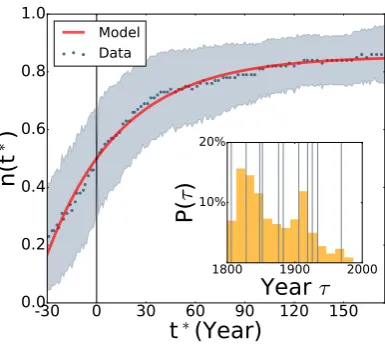
Figure 3: Regulation by informal institutions. Main panel: Relative frequency of the American spelling for 900 English words as a function of the rescaled timet∗ (t∗ = 0, denotes the surpassing year, for all pairs of words considered). Blue dots represent the average over all the pairs of words and the gray area the standard deviation of the data. The solid line is the model outcome, eq. (4), after parameter fit (χ2= 8·10−4,p= 0.97). Inset: DistributionP(τ) of the yearsτ in which the American form overcame the British variant for each word. Vertical lines denote important moments of informal regulations of the US spelling such as dictionary editions or spelling updates (additional details are in SI Sec. 5).
here, orB/(1−A) = 1−c if it supports the old norm, see SI). In this sense, values γ <1 correspond
to a situation in which the response of the system to an institutional intervention is not immediate. In
the following sections we show that, by appropriately varying the parameter values, the analytic solution
Eq. (4) reproduces all the empirical observations.
Results
Regulation by a formal institution
In the main panel of Fig. 2 we consider the relative frequency,n(t), of appearance of the new spelling
for the 23 words in our dataset affected by RAE reforms [2–8] (See SI Sec. 4). By a simple rescaling
(translation) of the time axis as t∗ = t−tr (where tr is the regulation year for each specific pair of
conventions), we find that all the experimental curves collapse. The regulatory intervention (t∗ = 0)
determines an abrupt transition towards the adoption of the new norm. This discontinuity is captured
by the distribution of the old spelling among the words before and after the regulation in the inset panel
of Fig. 2. Importantly, such rescaling indicates that the transition is size-independent. For example, for
the 1815 regulation, our dataset consists of B1815 = 59 books and S1815 = 4,149,151 words, whereas
for the regulation enforced in 1954 we have B1954 = 2774 books and S1954 = 244,138,299 words, but
transition between the old and new form occurs over approximately the same amount of time in the two
cases. Model parameters for the case of formal regulation areEN = 1 and commitment supporting the
old convention for which B = (1−c)γ (eq. (1) of SI Sec. 1). The main panel of Fig. 2 shows that
the fit of eq. (4) matches the empirical data (γ = 0.2,c= 0.006 and n0= 0.42 from the data). As we
1800 1900 2000
t (Year)
0.2 0.4 0.6 0.8 1.0
n(
t)
A
1956Model Data
1800 1900 2000
t (Year)
0.20.4 0.6 0.8 1.0
B
1800 1900 2000
t (Year)
0.2 [image:8.595.93.486.79.177.2]0.4 0.6 0.8 1.0
C
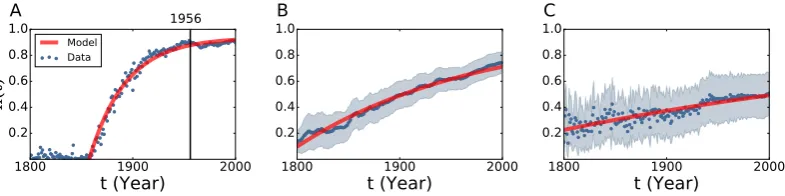
Figure 4: Unregulated norm change. (A) Cases´oloversussolo. Blue dots represent the relative frequency of the Spanish adverb s´olo (increasing in detriment of the alternative formsolo). The solid line is the prediction of eq. (4) for this case, after parameter fit (χ2 = 4·10−4, p = 0.98). The vertical line
signs the year 1956 when RAE intervened explicitly on the case [25, 33, 38]. The curve saturates to a value smaller than 1 probably due the presence of a percentage of adjectives, indistinguishable from the adverb in the data. (B) Case of ’-ra’ versus ’-se’ in Spanish subjunctive. Blue dots represent the relative frequency of the form -ra(increasing in detriment of the alternative but equivalent form -se) in Spanish past subjunctive conjugation of verbs, averaged over all verbs considered. Solid line is the specific prediction of eq. (4) for this case, after parameter fit (χ2 = 2·10−3, p= 0.96). (C) Case of
Americanization of English in US. Blue dots represent the relative frequency of the American variant (with respect to the British variant) in US corpus, averaged over all the expressions examined. Solid line is the specific prediction of eq. (4) for this case, after parameter fit (χ2= 6·10−3,p= 0.93). For all the
cases the grey area identifies the standard deviation of the data.
norm change (see SI Sec. 7, Fig. S3A and Fig S4Afor the behavior of individual curves, and SI Sec. 8
Fig.S4B for the corresponding distribution of γ).
Intervention of informal institutions
We now focus on the dynamics occurring between American and British spelling through the analysis
of 900 words as they appear in our US corpus (complete list in SI Sec. 10.A). As in the case of formal
institution, we haveEN = 1 and the commitment supporting the old (i.e., the British, here) spelling.
For each pair of conventions we identify the yearτ in which the British form was surpassed in popularity
by the American one (the inset panel of Fig. 3 shows the empirical frequency distribution of these
surpassing times P(τ)). The main panel of Fig. 3 shows that by rescaling time via simple translation
t∗=t−τ all experimental curves collapse, similarly to the above case of formal institution. The model
eq. (4) reproduces the data. The value of γ= 0.02 obtained in this case is much smaller than the one
relative to the above case of formal institution (γ= 0.2), quantifying the weaker role played by informal
institutions (other parametersc= 0.003 obtained by the fit, andn0=n(t∗= 0) = 0.5 by construction).
This result is confirmed by analyzing each pair of competing conventions in isolation (see SI Sec. 7, Fig.
S3B and Sec. 8, Fig.S4).
Unregulated evolution
As a third case we explore the process of unregulated norm change by considering the relative frequency
of appearance of the form s´olo (vs solo) (Spanish for ‘only’) [25] in the Spanish corpus, the relative frequency of appearance in the Spanish corpus of the past subjunctive form ending in−raand the one
ending in −sefor 1,571 verbs (See SI Sec. 10.C), and the relative frequency of appearance in the US
0.0 0.2 0.4 0.6 0.8 1.0
−
se
vs
−ra
5%
15%
25%
35%
Distribution
A
Simulations
0.0 0.2 0.4 0.6 0.8 1.0
−
se
vs
−ra
5%
15%
25%
35%
B
Data
1800 - 1840 1840 - 1880 1880 - 1920 1920 - 1960 1960 - 20000.0 0.2 0.4 0.6 0.8 1.0
UK vs US form
5%
15%
25%
35%
Distribution
C
0.0 0.2 0.4 0.6 0.8 1.0
UK vs US form
5%
15%
25%
[image:9.595.163.413.76.295.2]35%
D
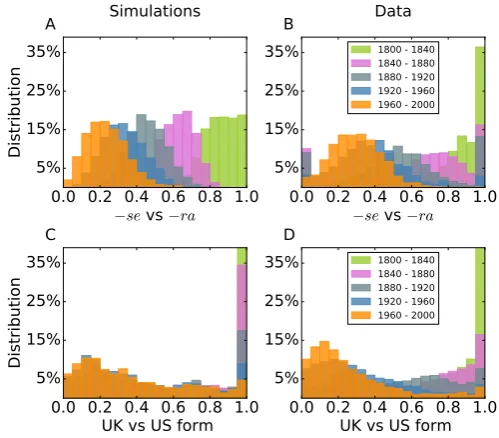
1800 - 1840 1840 - 1880 1880 - 1920 1920 - 1960 1960 - 2000Figure 5: Empirical and simulated distributions for the relative frequencies of a given form. Top: Spanish subjunctive case, -se vs-ra. Simulation reported in (A) reproduced the empirical observation of the equivalent distributions (B). Bottom: Intervention of informal institution case, UK vs US variant. Simulations reported in (C) can be compared with the actual empirical distribution (D). Simulated distributions from 200 simulation runs with parameters informed by the fitting procedure andW= 2000.
SI Sec. 10.B). Since the institution is impartial, we haveEN =EO =12. Figs. 4A,B andC show that the solution Eq. (4) describes well the data relative to growth of the form s´olo(γ= 3.10−3, c= 0.02),
the growing of the−raform for the subjunctive of Spanish verbs (γ= 10−17,c= 0.005) and the growth
of American forms (γ= 10−14,c= 0.002), respectively (solid lines correspond to the model predictions after parameter fitting). The values ofγ obtained here are significantly smaller than the ones observed
for the cases of formal and informal institutions, and corroborate the fact that centralized authorities
played essentially no role in this case (see also Fig. S4 in the SI Sec. 8 for the analysis of individual
curves). It is worth noting thatsolo (without accent) can be also used as adjective and that, while the competition solo/s´olo concerns only the adverb, the data do not allow us to distinguish between the adverb or adjective use. Our analysis shows that the adverb is dominant, as the adverb-specifics´olo is nowadays the most used form, but the non-saturation of the curve in Fig. 4A can be interpreted as a
signature of the presence of a percentage of adjectives in our dataset.
Microscopic dynamics
As a further assessment, we ran stochastic simulations of the model to reproduce the microscopic
evolu-tion of each pair of convenevolu-tions for the case of spontaneous transievolu-tion and for the case of the intervenevolu-tion
of informal institution. In each numerical experiment we impose the parameters recovered through the
fitting procedure described above. We initially consider the case of unregulated (spontaneous) norm
adoption. In Fig. 5A and B we report probability distribution of observing a relative frequency n(t)
for the verbal form-se, estimated by simulating the evolution of all verbs for which we have empirical record. The simulation results suggest that our model captures well the ensemble evolution over time
the class of norm adoption via informal authority, in the case of American spelling change. To account
for multiple interventions of informal institutions, numerical experiments were run by ‘switching on’ the
parameterγat different, randomly chosen, times. Moreover, the American case consists of conventions
that manifest themselves through specific set of words, i.e. the use oforinstead ofourinbehavio(u)r or
colo(u)r or-izeinstead of-isein verbs. Thus, for each simulation we extractγfrom a Gauss distribution centered in γ= 0.02 (as informed by the data, andσ= 0.005) to reproduce the fact that, in this case,
the transition from the old to the new convention is word-dependent.
By visually comparing empirical distributions of conventions over time for each norm adoption class
(inset panel of Fig. 2, Fig. 5B, and Fig. 5D for formal authority, spontaneous and informal authority
respectively) it is evident that, microscopically, the transition from the old to the new convention is
governed by different dynamics. For enforcements by formal authorities (inset panel of Fig. 2), when the
norm is regulated the system simply switches to the new convention. On the other hand, for unregulated
(spontaneous) norm change (Fig. 5B) the distribution essentially remains unaltered but for a translation
of its mean value which gradually shifts from 1 to 0. Finally, the word dependent transition of the informal
institution case yields a broadening of the shape of the distribution over time (Fig. 5D).
Conclusion
In this work we have capitalized on a recently digitized corpus to analyze the process of norm change
in the context of the cultural evolution of written English and Spanish. Through the analysis of 2,541
cases of convention shifts occurring over the past two centuries, we identified three distinct mechanisms
of norm change corresponding to the presence of an authority enforcing the adoption of a new norm, an
informal institution recommending the normative update and a bottom-up process by which language
speakers select a new norm. Each of these mechanisms displayed different stylized patterns in the data.
We rationalized these findings by proposing a simple evolutionary model that describes the actions of
the drivers of norm change previously identified in the literature, namely institutions and language
users committed to the use of one of the two competing conventions. We showed that this single
model captures the dynamics of norm change in each of the three cases described above, quantitatively
matching the empirical data in all circumstances. In doing so, it differentiates the empirical curves in
three classes according to the measured strength of the institutional intervention (fitted values ofγ and
single curve evaluation, see SI Sec. 8), thus confirming a posteriori the validity of our approach. Finally,
through numerical simulations we were also able to reproduce the observed microscopic dynamics of
norm adoption.
When a formal institution is present, the transition is sharp and does not depend either on the
properties of the considered system (e.g., year or number of published books) or the relative importance
of the linguistic convention subject to the norm change. The effect of informal institutions is weaker,
resulting in a slower reaction of the system and a smoother transition. Finally, in the bottom-up process
of spontaneous change the mechanisms of imitation and reproduction are key in bringing about the
relatively slower onset of the new norm, catalyzed by the presence of ‘committed activists’ [31–33].
It is important to delimit the scope of our findings. First, we only considered cases for which historical
records show that a norm change did occur and we did not attempt to predict whether a specific form
is at risk of being substituted or not [12]. Second, we considered that the new convention had an
advantage over the old one, represented either by the intervention of an institution or by the presence
evolutionary force [13]. In this respect, it is worth mentioning that the role of a committed minority
has been investigated in the context of various multi agent models where it has been shown to play
an important role on the final consensus provided its size exceeds a certain threshold [6, 52–54], as
observed also in recent laboratory experiments [55]. Third, we focused on the case where the competition
takes place between two alternative norms, but more complex cases where more conventions concur to
the process of norm change could exist [26]. Fourth, the model we introduced describes the process
of norm change for an isolated linguistic group and does not address the important case of language
change resulting from the contact between two linguistically independent populations or conflict between
different languages [7]. Finally, our analysis did not consider regional differences or any geographical
factors. All these points represent directions for future work.
Taking a broader perspective, our results shed new light on the dynamics leading to the adoption of
new linguistic conventions and have implications on the more general process of norm change. Today’s
technology, and in particular online social networks, are reportedly speeding up the process of collective
behavioral change [56,57] through the adoption of new norms [55,58–60]. Understanding the microscopic
mechanisms driving this process and the signature that it may leave in the data will lead to a better
understanding of our society as well as to possible interventions aimed at contrasting undesired effects.
In this perspective, we anticipate that our work will be of interest also to researchers investigating the
emergence of new political, social, and economic behaviors [10, 61].
1
Methods
Google Ngram data set provides about 4% of the total number of books ever printed [9]. We analyzed the
following data. Regulation by a formal institution: 23 Spanish words that change their spelling recovered
in [2–8] (See SI Sec. 3). Intervention of informal institutions: 900 words with the double American and
British spelling as reported in SI Sec. 10.A. The list is extracted from [22] and the double spelling verified
with the Merriam-Webster dictionary [21]. Unregulated evolution: (i) Case of Spanish past subjunctive,
1571 Spanish verbs, 325 of which irregular. All the verbs, together with their declination, are listed
in [23, 24]. (ii) Case of Americanization of English, 46 among words and expressions (the complete list
is provided in SI Sec. 10.C).
For the microscopic dynamics, we performed numerical simulations of the model. At the beginning,
we setW0 conventions in the stateO. At each time authors extract and replace the conventions of the
previous time with the following rules. With probabilitycthe author is committed. If the commitments
support the new conventions, a convention in the stateN is added, otherwise a convention in the state
O is added; with probability (1−c) (1−γ) the author reproduce the convention extracted; and with probability (1−c)γthe author follows the institution effort: with probability (1−c)γEN a convention
in the stateN is added while with probability (1−c)γEO a convention in the state O is added. We
impose the values recovered by the fitting procedure to set the parametersc andγin the simulations.
2
Acknowledgements
We are very grateful to JMR Parrondo and J. Cuesta, who contributed with ideas and discussions to
earlier stages of this work. RA and AD-G acknowledge support from Ministerio de Economia y
Competi-tividad of Spain project no. FIS2012-38266-C02-02 and no. FIS2015-71582-C2-2-P (MINECO/FEDER)
Career Fellowship EP/P01660X/1.
References
[1] Young HP (2015) The evolution of social norms. Annual Reviews of Economics 7(1):359–387.
[2] Ehrlich PR, Levin SA (2005) The evolution of norms. PLoS Biol3(6):e194.
[3] Bicchieri C (2005)The grammar of society: The nature and dynamics of social norms. (Cambridge Univ Press).
[4] Marmor A (2009)Social conventions: From language to law. (Princeton Univ Press).
[5] Lewis D (1969)Convention: A philosophical study. (Blackwell).
[6] Baronchelli A (2018) The emergence of consensus: a primer. Royal Society Open Science5:172189.
[7] Croft W (2000)Explaining language change: An evolutionary approach. (Pearson Education).
[8] Andersen H (1989) Understanding linguistic innovations. Language Change: Contributions to the study of its causes43:5.
[9] Watts RJ (2005) Politeness in language: Studies in its history, theory and practice. (Walter de Gruyter).
[10] Nyborg K, et al. (2016) Social norms as solutions. Science354(6308):42–43.
[11] Jean-Baptiste M, et al. (2011) Quantitative analysis of culture using millions of digitized books.
science331(6014):176–182.
[12] Lieberman E, Michel JB, Jackson J, Tang T, Nowak MA (2007) Quantifying the evolutionary
dynamics of language. Nature449(7163):713–716.
[13] Newberry MG, Ahern CA, Clark R, Plotkin JB (2017) Detecting evolutionary forces in language
change. Nature551(7679):223.
[14] Vaquera MLC, de Molina Redondo JA (1986)Historia de la gram´atica espa˜nola:(1847-1920). (Gre-dos).
[15] B PO (1992) Rendimiento funcional de las nuevas normas de prosodia y ortografia de la real academia
espa˜nola de la lengua (1959). Cauce, 1992,(14-15): 171-219.
[16] Wagner C (2016) Andr´es bello y la gram´atica castellana latinoamericana. Revista Documentos Ling¨u´ısticos y Literarios UACh(29).
[17] Mer´ın MQ (2014) La academia literaria i zient´ıfica de instruczion primaria: defensa razonada (y
apasionada) de su ortograf´ıa filos´ofica en 1844.
[18] Alcoba S (2007) Ortograf´ıa y DRAE. algunos hitos en la fijaci´on l´exica y ortogr´afica de las palabras.
Espa˜nol Actual88:11–42.
[20] Casares J (1954) La academia y las nuevas normas. BRAE XXXIV.
[21] Merriam-Webster I (2017) Merriam-webster.com. https://www.merriam-webster.com.
[22] www.tysto.com/uk-us-spelling list.html (2017) Comprehensive* list of american and british spelling
differences.
[23] List of Spanish irregular verbs. Available at:
https://gist.github.com/robertaamato/99f646670e9f8d0f261807a0185503be.
[24] List of Spanish regular verbs Available at:
https://gist.github.com/robertaamato/4cd3682cdab72bce0019c0e5b356f121.
[25] RAE (2017) El adverbio solo y los pronombres demostrativos, sin tilde. Consultas lingsticas. Avail-able at: http://www.rae.es.
[26] Gon¸calves B, Loureiro-Porto L, Ramasco JJ, S´anchez D (2018) Mapping the Americanization of
English in space and time. PLoS ONE 13(5): e0197741.
[27] Osgood CE, et al. (1954) Psycholinguistics: a survey of theory and research problems. The Journal of Abnormal and Social Psychology49(4p2):i.
[28] Blythe RA, Croft W (2012) S-curves and the mechanisms of propagation in language change. Lan-guage88(2):269–304.
[29] Ghanbarnejad F, Gerlach M, Miotto JM, Altmann EG (2014) Extracting information from s-curves
of language change. Journal of The Royal Society Interface11(101):20141044.
[30] Lass R (1997)Historical linguistics and language change. (Cambridge Univ Press) Vol. 81.
[31] Vivian JH (1979) Spelling an end to orthographical reforms: Newspaper response to the 1906
Roosevelt simplifications. American Speech54(3):163–174.
[32] Scragg DG (1974)A history of English spelling. (Manchester Univ Press) Vol. 3.
[33] Martin Rodrigo I, Moran D, De la Fuente M, Doria S (2014) S´olo/solo: la tilde que enfrenta a la
RAE con los escritores. ABC Cultura.
[34] RAE (2017) Orgenes y fines de la rae. Available at: http://www.rae.es/la-institucion/historia/origenes.
[35] RAE (2017) Estatutos y reglamento de la real academia espa˜nola. Available at: http://www.rae.es/la-institucion/organizacion/estatutos.
[36] Pochat MT (2001) Historia de la real academia espa˜nola. Olivar2(2):249–253.
[37] Espa˜nola RRA (2010)Ortograf´ıa de la lengua espa˜nola. (Espasa).
[38] Alvarez Mellado E (2017) S´olo y la tilde de la nostalgia. eldiario.
[40] Kempas I (2011) Sobre la variaci´on en el marco de la libre elecci´on entre cantara y cantase en el
espa˜nol peninsular. Moenia17:243–264.
[41] G´omez AB, Co GVE (2002)Corpus de conversaciones coloquiales, Oralia (Madrid). (Arco).
[42] Rosemeyer M, Schwenter SA (2017) Entrenchment and persistence in language change: the spanish
past subjunctive. Corpus Linguistics and Linguistic Theory.
[43] Weinstein B (1982) Noah webster and the diffusion of linguistic innovations for political purposes.
International Journal of the Sociology of Language1982(38):85–108.
[44] Venezky RL (1999)The American way of spelling: The structure and origins of American English orthography. (Guilford Press).
[45] Hodges RE (1964) A short history of spelling reform in the united states. The Phi Delta Kappan
45(7):330–332.
[46] Zachrisson RE (1931) Four hundred years of english spelling reform.Studia neophilologica4(1):1–69.
[47] Wijk A (1961) Regularized english. Educational Research3(2):157–159.
[48] Micklethwait D (2005)Noah Webster and the American dictionary. (McFarland).
[49] Leech G (2009)Change in contemporary English: A grammatical study. (Cambridge Uni.).
[50] Kimura M (1983)The neutral theory of molecular evolution. (Cambridge Univ Press).
[51] Pechenick EA, Danforth CM, Dodds PS (2015) Characterizing the google books corpus: Strong
limits to inferences of socio-cultural and linguistic evolution. PloS one10(10):e0137041.
[52] Xie J, et al. (2011) Social consensus through the influence of committed minorities. Physical Review E84(1):011130.
[53] Mistry D, Zhang Q, Perra N, Baronchelli A (2015) Committed activists and the reshaping of
status-quo social consensus. Physical Review E92(4):042805.
[54] Niu X, Doyle C, Korniss G, Szymanski BK (2017) The impact of variable commitment in the naming
game on consensus formation. Scientific Reports7.
[55] Centola S, Becker J, Brackbill D, Baronchelli A (2018) Experimental evidence for tipping points in
social convention Science360(6393):1116–1119.
[56] Kooti F, Yang H, Cha M, Gummadi PK, Mason WA (2012) The emergence of conventions in online
social networks. inICWSM.
[57] Centola D, Baronchelli A (2015) The spontaneous emergence of conventions: An experimental study
of cultural evolution. Proceedings of the National Academy of Sciences112(7):1989.
[58] Becker B, Mark G (1999) Constructing social systems through computer-mediated communication.
Virtual reality4(1):60–73.
[59] Bicchieri C, Fukui Y (1999) The great illusion: Ignorance, informational cascades, and the
[60] Del Vicario M, et al. (2016) The spreading of misinformation online. Proceedings of the National Academy of Sciences113(3):554–559.
[61] Valenzuela S, Arriagada A, Scherman A (2014) Facebook, twitter, and youth engagement: A
Supporting Information
Symmetric case for eq. (1)
When the commitment supports the old conventionO, eq. (1) takes the form:
n(t+ 1) = (1−c) (1−γ)n(t) + (1−c)γEN
o(t+ 1) = (1−c) (1−γ)o(t) + (1−c)γEO+c . (3)
The general solution of the system of equations 3 is:
n(t) = B
(1−A) 1−A
t
+n0At
o(t) = 1−n(t), (4)
whereA= (1−c) (1−γ),B= (1−c)γEN andn0=n(t= 0).
Spanish past subjunctive
In Spanish two equivalent forms exist to construct the past subjunctive : the one ending in −ra and
the one ending in−se(as inpensa-raandpensa-sehad thought). The form−seevolved from the Latin plusquamperfect subjunctive, while the form−raevolved from the Latin plusquamperfect indicative [1].
Spanish spelling reforms
We present the complete list of the 23 words examined in the Spanish spelling change case, grouped into
their respective reforms [2–8].
• 1815 :
– antiquario →anticuario (antiquarian)
– quaderno→cuaderno (notebook)
– quadro →cuadro (picture)
– quando→cuando (when)
– quanto→cuanto (how much)
– quarto→cuarto (fourth)
– quatro→cuatro (four)
– quociente→cociente (quotient)
– quota→cuota (quote)
– quotidiano →cotidiano (daily)
– Equador →Ecuador (Ecuador)
– obliquo→oblicuo (oblique)
• 1884
– guion→gui´on (script)
– truhan→truh´an (rogue)
– virey →virrey (viceroy)
– vireina →virreina (viceroy’s wife)
– vireinato→virreinato (viceroyalty)
• 1911
– ´o →o (or)
– ´a →a (to)
• 1954
– di´o→dio (it gave)
– fu´e→fue (it was)
– vi´o →vio (it saw)
[image:17.595.83.276.96.361.2]Persistence in time of the old norm
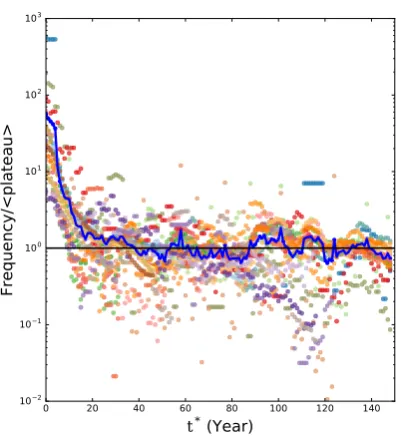
Fig. 6 shows that typically the frequency of appearance of the old spelling in the case of formal regulation
does not go to zero but rather, after a sudden drop, stabilizes on a plateau as if a small number of writers
ignored the intervention of the institution (i.e., as if they were committed against the new norm). This
is mainly due to the presence of historical books, compendiums of the language as well as re-editions
of past books (see Supporting Online Material of [9]). For example the list of Spanish books still
containing the word ”quando” after regulation is composed of texts such as ”Biblioteca hist´orica de la
filolog´ıa castellana” (”Historical library of Castillan filology”), published in 1893, ”Documentos para la
historia de la Revoluci´on de 1809” (”Documents for the history of 1809 revolution”) published in 1954
or ”Manuscritos lit´urgicos de las bibliotecas de Espa˜na” (”Liturgical manuscripts of Spanish libraries”)
published in 1977, which clearly refer to its historical use.
American Spelling: Important Moments
Important moments in the history of American vs British spelling:
• 1806 - Noah Webster published’A Compendious Dictionary of the English Language’
• 1828 - First American Dictionary’An American Dictionary of the English Language’
• 1848 - Alexander John Ellis published’A Plea for Phonetic Spelling’
• 1876 - American Spelling Reform Association were founded and start to adopt the reforms
0 20 40 60 80 100 120 140
t
*(Year)
102 101 100 101 102 103
[image:18.595.190.391.74.293.2]Frequency/<plateau>
Figure 6: Frequency of appearance of the old spelling form as a function of the rescaled timet∗for the case of formal regulation. Colored dots represent all the considered words and the blue solid line is the average. The frequency of appearance of each word is divided by the average made on the respective plateau.
• 1906 - The Simplified Spelling Board was founded and President of the United States Theodore Roosevelt signed an executive order imposing the use of reformed spelling in the official
communi-cations of the Congress.
• 1919 - H.L. Mencken published the first edition ofThe American Language
• 1926 - Henry Fowler published the first edition of Dictionary of Modern English Usage
• 1969 - Harry Lindgren publishedSpelling Reform: A New Approach
British and American spelling conflict
In our analysis of the case of spelling conflicts, the various inflections of a term, such as singular or plural,
or, for a verb, present, past, etc, were considered separately because they do behave differently. As en
example, we report in Fig. 7 the evolution of the singular and the plural of the word “behavior/behavior”
(American/British spelling). The American spelling of the singular exceeds that of the British almost
a century before the plural one. As mentioned in the Main Text, investigating the reasons of this
phenomenon is beyond the scope of our analysis, and an interesting starting point for future work.
Individual variations beyond the average
For the case of formal institution, time is rescaled according to the regulation year (i.e., 1815, 1884, 1911
or 1954, in our dataset, see Sec. 2 above), which in all cases mark the sudden adoption of new norm.
1800 1850 1900 1950 Year 0.0 0.2 0.4 0.6 0.8 1.0 Rel. Frequency A Singular behavior behaviour
1800 1850 1900 1950
Year 0.0 0.2 0.4 0.6 0.8 1.0 Rel. Frequency B Plural behaviors behaviours
Figure 7: (A) Evolution ofbehavior, the American form andbehaviour, the Bristish form. (B) Evolution of the pluralbehaviors andbehaviours.
-50 0 50 100 150
t* (Year)
0.0 0.2 0.4 0.6 0.8 1.0
n(
t)
A Spanish 1815-Ecuador 1815-anticuario 1815-cociente 1815-cotidiano 1815-cuaderno 1815-cuadro 1815-cuando 1815-cuanto 1815-cuarto 1815-cuatro 1815-cuota 1815-inicuo 1815-oblicuo 1884-guión 1884-truhán 1884-vireina 1884-vireinato 1884-virrey 1911-a 1911-o 1954-dio 1954-fue 1954-vioAverage -50 0 t* (Year)50 100 150
0.0 0.2 0.4 0.6 0.8 1.0
Data Density
C-50 0 50 100 150
t* (Year)
0.0 0.2 0.4 0.6 0.8
1.0B 1801 - 1813US
1813 - 1815 1815 - 1818 1818 - 1822 1822 - 1828 1828 - 1832 1832 - 1837 1837 - 1843 1843 - 1848 1848 - 1854 1854 - 1863 1863 - 1872 1872 - 1882 1882 - 1894 1894 - 1903 1903 - 1908 1908 - 1914 1914 - 1920 1920 - 1935 1935 - 1967 1967 - 1982 Average
-50 0 50 100 150
t* (Year)
[image:19.595.197.389.78.253.2]0.0 0.2 0.4 0.6 0.8 1.0D
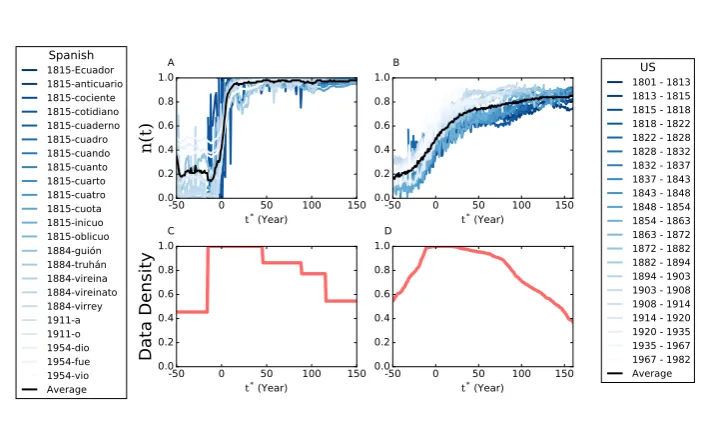
Figure 8: A, C Formal Regulation Case. A Relative frequency of the new spelling form as a function of the rescaled timet∗. Colored lines represent all the considered pairs of words, while the black line is the average. C shows the density of data that contribute to the average for each year. B, D Informal Regulation Case. B Relative frequency of the new spelling form as a function of the rescaled time t∗. The words are grouped so that each time interval contains 5% of the curves. D shows the density of data that contribute to the average for each year. Colored lines represent the average in these intervals and the black line is the total average.
For the case of informal regulation, a first dictionary proposing the considered spelling reforms was
edited in the 1828 following two decades of discussions (Sec. 2). The moment in which each American
form surpassed in popularity the corresponding British one is distributed over 1800 and 2000. Fig. 8
[image:19.595.119.470.325.537.2]average. For the sake of clarity, individual curves were grouped so that each time window contains 5%
of the data. Thus, for example, the curve labeled as 1837-1843 represents the average over the words for
which the American spelling surpassed the British one in that time interval.
Figs. 8 C andD report the density of data contributing to the total average for the corresponding
year for the Formal and Informal Regulation cases, respectively.
Comparison of the three classes
To further assess the contribution of the individual pairs of conventions to the three classes we identified in
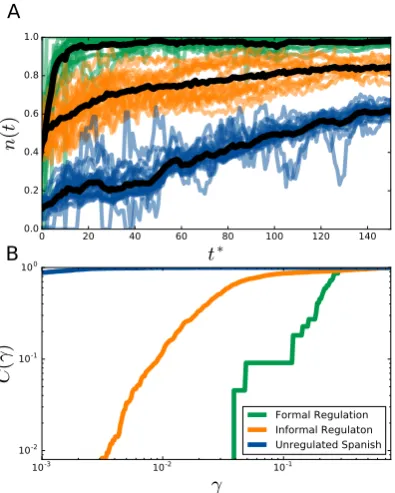
the paper (formal institution, informal institution, and unregulated change), Fig. 9Ashows the temporal
evolution of the relative frequency of the new forms,n(t), confirming that the time scales involved in the
process of norm change are different for the three cases.
We further investigated the variability between cases by using the model discussed in the Main Text
as an inspecting tool. Fig. 9B reports the cumulative distributions of the parameterγ,C(γ), obtained
by fitting individual curves for the three cases. The Kolmogorov-Smirnov returnsp= 10−12,p= 10−20
and p= 0.0, for the first with the second, the first with the third and the second with the third curve
respectively. We therefore reject the hypothesis that the three empirical distributions are instances of
the same probability distribution.
0 20 40 60 80 100 120 140
t
∗ 0.00.2 0.4 0.6 0.8 1.0
n
(
t
)
A
10-3 10-2 10-1
γ
10-2 10-1 100
C
(
γ
)
B
[image:20.595.192.390.376.623.2]Formal Regulation Informal Regulaton Unregulated Spanish
Figure 9: ARelative frequency of the new forms as a function of the rescaled timet∗=t−τ. For the case of formal regulation,τ is the year of regulation, for the case of informal regulation is the year in which the new norm becomes more frequent than the old one, while for the unregulated caseτ = 0 as the curves are not rescaled. Black lines represent the average. BCumulative distribution ofγ,C(γ), for each pair of curves for the Formal Regulation, Informal Regulation and Unregulated (Spanish) cases. By comparing the three distributions with the KS test we recover p= 10−12,p= 10−20 andp= 0.0, respectively for
Google Books Corpus
Google Ngram Corpora offers an unprecedented opportunity to analyze linguistic and cultural change
in a quantitative way [9–14]. The dataset is the product of a massive effort in text digitization, in
collaboration with thousands of the world’s libraries [9]. The resulting 5 million books contain over half
a trillion words, 361 billion of which are in English [9, 15].
Although Google Ngram can serve as a useful barometer of lexical change [14] it is important to
mention some of its limitations. To avoid breaking any copyright laws, the datasets are not accompanied
by any metadata regarding the texts the corpora consist of [12] and it does not account for the popularity
of a text, namely each text contributes with equal weight to token counts [14,15]. Furthermore, as recently
pointed out, the inclusion of scientific texts, which have become an increasingly substantive portion of
the corpus after the 1900s risks to artificially skew the statistical composition of the dataset [15].
As far as our analysis is concerned, the problem of increasing scientific publications would affect
mainly the American English dataset after the 1900s. However, the fact that (i) 71% of the norm-change
events we observe in the American English corpus date before 1900, and (ii) we find no significant change
in behavior between the transitions observed before and after 1900s or (iii) between the transitions
occurring in American English and Spanish (in the case of unregulated change, where we can compare
them) are all indications in favor of the robustness of our results. Moreover, it is reasonable to assume
that our American English dataset, thanks to its size (946 cases of norm change, in total), includes words
whose frequency of use in the scientific literature vary considerably. Thus, the homogeneity of behavior
revealed by the curve-by-curve analysis reported in Figs. 8 and 9 further confirms the validity of our
findings.
References
[1] J M Wilson. The-ra and-se verb forms in Mexico: a diachronic examination from non-literary
sources. 1983.
[2] M L C Vaquera and J A de Molina Redondo.Historia de la gram´atica espa˜nola:(1847-1920). Gredos, 1986.
[3] Palomo Olmos B. Rendimiento funcional de las nuevas normas de prosodia y ortografia de la real
academia espa˜nola de la lengua (1959). Cauce, 1992,(14-15): 171-219, 1992.
[4] C Wagner. Andr´es bello y la gram´atica castellana latinoamericana.Revista Documentos Ling¨u´ısticos y Literarios UACh, (29), 2016.
[5] Mercedes Quilis Mer´ın. La academia literaria i zient´ıfica de instruczion primaria: defensa razonada
(y apasionada) de su ortograf´ıa filos´ofica en 1844. 2014.
[6] Santiago Alcoba. Ortograf´ıa y DRAE. algunos hitos en la fijaci´on l´exica y ortogr´afica de las palabras.
Espa˜nol Actual, 88:11–42, 2007.
[7] RAE. Nuevo tesoro lexicogrfico de la lengua espaola (NTLLE). Espa˜nola (NTLLE):¡ http://ntlle. rae. es/ntlle, 2017.
[9] M Jean-Baptiste, Y K Shen, A P Aiden, A Veres, M K Gray, J P Pickett, D Hoiberg, D Clancy,
P Norvig, J Orwant, et al. Quantitative analysis of culture using millions of digitized books.science, 331(6014):176–182, 2011.
[10] Peter Sheridan Dodds, Kameron Decker Harris, Isabel M Kloumann, Catherine A Bliss, and
Christo-pher M Danforth. Temporal patterns of happiness and information in a global social network:
Hedonometrics and twitter. PloS one, 6(12):e26752, 2011.
[11] Peter Sheridan Dodds, Eric M Clark, Suma Desu, Morgan R Frank, Andrew J Reagan, Jake Ryland
Williams, Lewis Mitchell, Kameron Decker Harris, Isabel M Kloumann, James P Bagrow, et al.
Human language reveals a universal positivity bias.Proceedings of the National Academy of Sciences, 112(8):2389–2394, 2015.
[12] Alexander Koplenig. The impact of lacking metadata for the measurement of cultural and linguistic
change using the google ngram data setsreconstructing the composition of the german corpus in
times of wwii. Digital Scholarship in the Humanities, 32(1):169–188, 2017.
[13] Marcelo A Montemurro and Dami´an H Zanette. Coherent oscillations in word-use data from 1700
to 2008. Palgrave Communications, 2:16084, 2016.
[14] Tyler J Gray, Andrew J Reagan, Peter Sheridan Dodds, and Christopher M Danforth. English verb
regularization in books and tweets. arXiv preprint arXiv:1803.09745, 2018.
[15] Eitan Adam Pechenick, Christopher M Danforth, and Peter Sheridan Dodds. Characterizing the
google books corpus: Strong limits to inferences of socio-cultural and linguistic evolution.PloS one, 10(10):e0137041, 2015.