IAC-18,D5,2,5,x42686
Towards an Artificial Intelligence based Design Engineering Assistant for the Early Design of Space Missions
Audrey Berquanda*, Francesco Murdacaa, Dr. Annalisa Riccardia, Tiago Soaresb, Sam Gerenéc, Norbert Brauerd, Kartik Kumare
a
Intelligent Computational Engineering Lab, University of Strathclyde, 75 Montrose St., G11XQ Glasgow, UK [email protected], [email protected], [email protected]
b ESA, Noordwijk, the Netherlands, [email protected]
c RHEA group, Leiden, the Netherlands, [email protected] d
AIRBUS, Bremen, Germany, [email protected]
e Spacejunkies V.O.F (satsearch), Noordwijk, the Netherlands, [email protected] * Corresponding Author
Abstract
This paper describes a solution to enhance Knowledge Management (KM) and Reuse at the early stages of space mission design in the frame of Concurrent Engineering (CE) studies via the implementation of an Expert System (ES). CE is a centralized engineering approach which significantly accelerates and increases the reliability of space mission feasibility assessment by having experts work concurrently, thus enhancing the communication flow. An ES is an AI-based agent capturing Human expertise in a computer program. There are many examples of ES being successfully implemented in the aeronautical, agricultural, legal or medical fields. To assess the feasibility of a mission, experts rely both on their implicit knowledge (i.e., past experiences, network, etc.) and on available explicit knowledge (i.e., past reports, publications, datasheets, books, etc.). This latter type of knowledge represents a substantial amount of unstructured data, continuously increasing over the past decades. The amount of information has become highly time consuming to search through within the limited timeframe of a feasibility study and is therefore often underutilised. A solution is to convert this data into structured data and store them into a Knowledge Graph (KG) that can be traversed through an inference engine to provide reasoning and deductions. Information is extracted from the KG via a querying module from a User Interface (UI) supporting the Human-Machine Interaction (HMI). The Design Engineering Assistant (DEA), the ES for space mission design, aims to enhance the productivity of experts by providing them with new insights on large amount of data accumulated in the field of space mission design. Not only will it act as a Knowledge Engine (KE) but, integrated to the design environment, it could play a much more active part into the design process, advising the Human experts on design iterations. This paper introduces the proposed integration of an Artificial Intelligence (AI) agent into the CE process, the preliminary architecture of the tool and identified challenges. The study will also present the outcomes of a set of experts interviews carried out at the European Space Research and Technology Center (ESTEC) of ESA in July-August 2018, to define the DEA requirements following a User-centred approach.
Keywords: Expert System, Space Mission Design, Concurrent Engineering, Artificial Intelligence, Knowledge Graph
Acronyms/Abbreviations AI Artificial Intelligence
API Application Programming Interface CDF Concurrent Design Facility
CE Concurrent Engineering DEA Design Engineering Assistant ES Expert System
ESTEC European Space Research and Technology Center
HMI Human Machine Interaction KG Knowledge Graph
KM Knowledge Management
ICE Intelligent Computational Engineering IE Information Extraction
JPL Jet Propulsion Laboratory
OCDT Open Concurrent Design Tool RT Round Table
UI User Interface 1. Introduction
The amount of data generated every day in the space field is continuously increasing. All this knowledge is becoming more and more difficult to handle by Humans. Artificial Intelligence (AI) tools such as Expert Systems can greatly facilitate Knowledge Management (KM), Knowledge Reuse and Knowledge Discovery. This article focuses on the field of AI of Knowledge Representation and Reasoning.
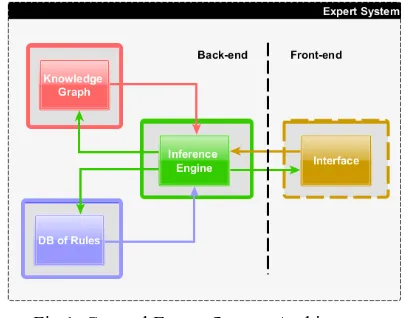
applications of expert systems will fall into one of following categories: interpreting and identifying, predicting, diagnosing, designing, planning, monitoring, debugging and testing, instructing and training, controlling [20]. The general definition of an ES includes three components: the Knowledge Base or the Knowledge Graph (KG), the inference engine and the User Interface (UI) [21]. The Knowledge Base in literature includes the knowledge about the domain and the rules stated for the particular tasks to be accomplished by the ES in that domain. The creation of the Knowledge Base is usually performed manually. In the frame of this study, the requirement of the automation for the creation of the KG led the team to the decision to separate explicitly the Knowledge Graph and the Database of Rules as shown in Figure 1.
Fig.1. General Expert System Architecture As displayed in Figure 1, the back-end is usually composed of the KG, containing the structured knowledge from the specific domain, of an inference engine reasoning on the information found in the KG, and of the rules defined in the Database of Rules. The front-end of the ES is mainly the UI, which allows extracting information from the KG and supports the Human-Machine Interaction (HMI).
This paper focuses on the preliminary work done to develop an ES in the field of space mission design to assist experts during feasibility studies in the context of concurrent engineering (CE) sessions. The ES is called Design Engineering Assistant (DEA).
2. The Design Engineering Assistant Project The DEA is an ES meant to support Human experts for the assessment of space mission feasibility. In that sense, the DEA will act as a knowledge engine, providing a fast and reliable access to previous design decisions and as a design engineering assistant plugged-in plugged-into the design environment. The DEA project started in January 2018 and involves two PhD students from the Intelligent Computational Engineering (ICE) Lab of
the University of Strathclyde. They work on two complementary parts of the project and are supported by the ESA Concurrent Design Facility (CDF) and industrial partners: AIRBUS, RHEA and satsearch. This chapter will give an overview of the project, its status and finally the main challenges identified by the team. 2.1. Incentives for integrating an AI-agent into the
Concurrent Engineering process 2.1.1. Concurrent Engineering methodology
As defined by ESA: “Concurrent Engineering is a systematic approach to integrated product development that emphasises the response to customer expectations. It embodies team values of cooperation, trust and sharing in such a manner that decision making is by consensus, involving all perspectives in parallel, from the beginning of the product life-cycle.” [1]. CE involves the simultaneous participation of all main disciplines required to assess the space mission feasibility. The multidisciplinary team usually works concurrently during live study sessions and preferably physically located in the same facility (e.g., the CDF, in the case of ESA). A study is typically divided in three main parts: the preparation, the study sessions and the post-study. The preparation phase usually starts one month prior to the study and involves the core team (i.e., the team leader, system engineer and assistant system engineer) with the client and potentially a few critical subsystems experts. This restricted team discusses the mission background, objectives, requirements and initial design inputs. The bulk of the work is done within the following months during the study phase, with the complete team studying different design options and selecting a design baseline. Finally, the outputs of the study is transposed into a final report (usually in pdf format).
CE methods were introduced at NASA and ESA in the 90s, to accelerate the processes of mission definition and preliminary conceptions for new mission proposals with growing complexity [2]. This engineering approach has proven to enhance communication and data sharing, leading to high reduction of study durations and, consequently, of cost. The number of studies performed per year also increased. [3]. With the expected future growth of systems complexity and amount of data generated [4], new methods and tools (e.g., wikis, expert systems, tool integrations) are needed to relieve the Human experts’ workload and furthermore improve their work process and contribution to CE studies.
2.1.2. Artificial Intelligence for space mission design in the literature
design study. This is an idea put forward at least by Team X from NASA Jet Propulsion Lab (JPL) in [5]. Another analysis from [2] also underlines that smart application and re-use of accumulated knowledge from previous designs can speed up the whole study process by avoiding to “reinvent the wheel” and improve the output quality. An ES could provide quick, easy and reliable access to all this knowledge.
Integrating expert systems into the design process of space missions is an idea already formulated by [6] in a paper describing the early beginning of concurrent engineering at NASA JPL. At the time however, in the late 90s, expert systems were only at the beginnings of their development. Although we still cannot expect today that an expert system could replace the judgement of a Human expert, the potential implementation of
powerful expert systems now appears more doable considering recent AI progress. Today, algorithms can more effectively and efficiently process information including taking into account uncertainties (e.g., fuzziness, vagueness) into the decision making process. There are many examples of ES being successfully implemented in the agricultural [16], astronomical [17], medical [18] or legal [19] fields.
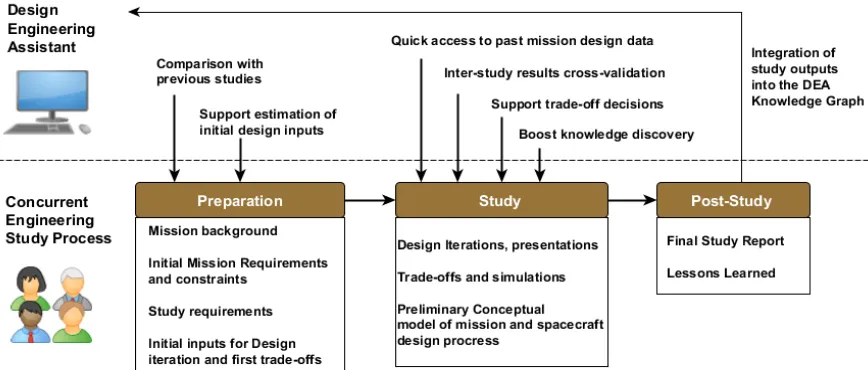
[image:3.612.89.523.276.461.2]Figure 2 displays a potential integration of the AI-agent DEA into the CE study process. The classical process of a study (below) is put in parallel with the potential entry points of the DEA to support the Human experts (above). More details on the integration of the DEA into the CE process can be found in [7].
Fig. 2. A potential CE process taking advantage of an AI agent interaction 2.2. Design Engineering Assistant Goals
Due to the complexity of the work and the timeline (i.e., 3 years) two main development stages have been set:
Stage 1 - a Knowledge Engine for Space Mission Design: Developing and populating a KG that can be queried by the User is the first development stage of the DEA. The queries will be entered via a natural language interface. The UI will extract information from the KG in order to provide knowledge summary and data analytics including traceability and recommendations. It will also include an active user feedback loop in order to acquire the tacit knowledge of the experts.
Stage 2 - a Space Mission Design Active Assistant: The integration in a modelling environment tool (e.g., the Open Concurrent Design Tool (OCDT) [15] used at ESA and based on the European standard ECSS-E-TM-10-25A Annex A&C [22]) will transform the DEA into an actual ES. This is the ultimate goal of the project. As
an active assistant, it will monitor in the background the case study, anticipate the User needs, and actively provide design suggestions in a non-invasive manner. 2.3. Design Engineering Assistant preliminary architecture
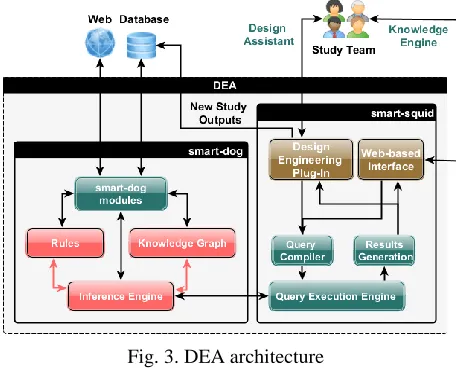
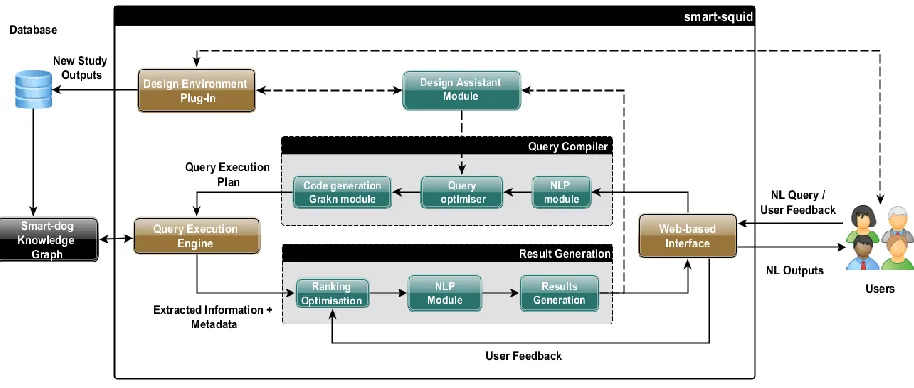
Figure 3 displays a preliminary architecture of the DEA. The architecture also illustrates the tasks separation between the two PhDs via the development of two complementary tools: smartdog and smart -squid
2.3.1. smart-dog: Framework for Development and Validation of a KG
the knowledge accumulated, together with the provided rules.
Fig. 3. DEA architecture
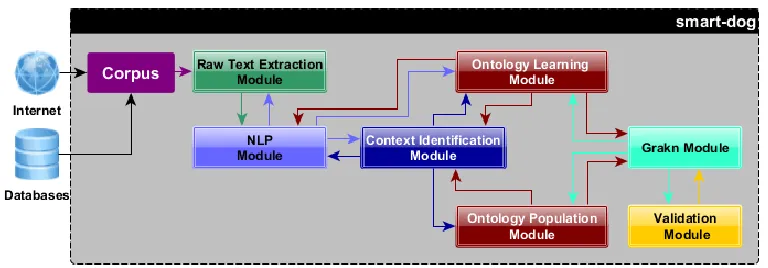
[image:4.612.75.303.100.284.2]smart-dog is a framework that can be used for the semi-automatic generation of a KG. It allows its development and validation. Figure 4 shows the general use of the tool as a complementary part of intelligent systems. The entire framework is built on top of Grakn (http://grakn.ai), the intelligent database, which provides the interface for the creation of the KG, thanks to its Application Programming Interface (API), using Graql syntax and Grakn data model, and the possibility to validate the KG with the Graql reasoner.
Fig. 4. General use of smart-dog
In the frame of the DEA project, the factors to be considered for the back-end part are:
● Source of data and user requirements ● Data modelling
● Rules
● Inference engine
The lifecycle for the development of the back-end part consists of 3 high-level phases:
Phase I DEFINITION: Statement of the requirements coming from data source and User, selection of the technologies and language for the data modelling. Phase II IMPLEMENTATION: once the sources have been identified, the generation and population of the
knowledge graph can be started. Verification of each stage shall be performed because the process is iterative. In this phase the rules will be introduced and tested. Phase III VALIDATION: for the final integration of the system.
Once the definition phase is concluded the data modelling construction starts. This is the most critical and time-consuming task. This is where smart-dog comes into play.
The generation and population of the KG are two separated tasks. Before populating the KG with data, it is important to select a model for the structure and a language that allows reasoning on it. When the structure is ready, the population task can take place. In both tasks, uncertainty needs to be taken into account.
The generation of the ontology is an iterative process. It is important to have a good amount of data source because of Machine Learning algorithms used in the modules, but at the same time it is also important to have a complete reliable source of data able to give the correct semantic and notions of the space mission design. In the frame of the DEA, the users will benefit from using the ES if several reliable sources are inserted.
smart-dog architecture is modular due to the different algorithms adopted and the main modules can be listed below:
● Raw Text Extraction Module, it will extract the raw text from several formats (e.g., .pdf, .html, .docx, pptx).
● Natural Language Processing (NLP) Module, it will perform NLP techniques on the raw text.
● Context Identification Module, it is used for two purposes mainly, to understand the domain context of the documents, but also to avoid the introduction of sources out of the domain.
● Ontology Learning (OL) Module, it applies OL techniques for the generation of the Knowledge Graph Structure.
● Ontology Population Module, it performs Knowledge Graph Information Extraction to populate the Knowledge Graph.
● Grakn Interface Module, it is the API with Grakn.
Fig. 5. smart-dog modular architecture 2.3.2. Smart-squid: Front-end of Expert System,
Design Environment Integration and Tacit Knowledge Elicitation
The smart-squid is not only the front end of the ES, it also encompasses the extraction of structured data from the design environment and the elicitation of the users tacit knowledge via a feedback loop.
The front-end of the DEA consists of a web-based UI, the main pillar of the DEA-User HMI. Via this UI, the User will enter a request in natural language. The range of requests accepted by the tool has been refined after a set of experts interviews described in chap 3. The complex Human request has to be decomposed into basic machine-understandable ones by the query compiler. The role of the query compiler is also to grasp the real intent behind the User query (i.e., perform semantic search). An optimised decomposition of the User query into basics ones will allow to more efficiently extract knowledge from the KG. The queries will be translated into the Graql query language, as the KG will have been coded with the Grakn data model.
Once the candidate facts have been extracted from the KG, the “result generation” module of the smart-squid will have to rank the facts and transform the “raw” information into the most useful format (e.g., comparison tables, text summaries, etc.) to be made available to the User via the UI. The ranking of the candidate facts is based on weights depending on the source fidelity, relevance, and User feedback parameters. It is also foreseen that basic analytics capacities will need to be implemented into the “answer generation” module to answer the users’ need (see section 3). The role of the UI will also be to boost knowledge discovery via the implementation of a recommender system pushing the experts to explore alternative design options.
There are two different kind of knowledge: tacit (e.g., unspoken rules of know-hows, “rule of thumb”, etc.) and explicit (e.g., reports, presentations, etc.) [6]. The manual elicitation of tacit knowledge is a time-consuming process and would require in itself another
full-time project. On the other hand, ignoring this source of knowledge would be missing out on the opportunity to enrich the DEA with precious expert knowledge that is not found in explicit sources. The solution proposed would therefore be to capture some of the experts tacit knowledge via a feedback loop embedded into the UI. At the stage of the project, the exact process of this feedback loop is not defined yet. As a preliminary option, it is considered that the User feedback could be collected by ranking an output content or format as well as provide more detailed comments in natural language. However, this automatized feedback process must be considered with care to avoid the injection of uncertainties and disequilibrium (i.e., unreliable and/or too subjective feedback) into the KG. The uncertainty challenges are discussed in more details in 2.4.
Finally, while the smart-dog focuses on unstructured data, the smart-squid will study the possibility to integrate structured data into the KG, for instance, from the mission model generated with the design environment (e.g., the OCDT model). To become an active assistant, the DEA needs to access the design environment used by the experts. This way the DEA will be able to follow the design iteration as an observer, running in the background, and potentially step in if it notices a model inconsistency or an outlier value. The DEA could indeed be able to “understand” the type of mission the experts are studying and identify an outlier value based on its knowledge of previous similar missions. The DEA intends to be a non-invasive assistant and therefore will only provide suggestions of modifications to the experts.
The smart-squid development is at the stage of requirement definition. Its preliminary architecture, at the time of this paper writing is summarised in Figure 6. 2.4. Main challenges
Fig. 6. smart-squid architecture 2.4.1. Subdomains and continuous learning
DEA source data will be different in formats, length and context. To understand the different sources, it is necessary to know the general vocabulary of the language, the space mission design vocabulary and all the subset of vocabularies related to each discipline in the context of spacecraft design. Many concepts and terms are used differently in different sources, it is important to create a map-ability between these concepts across the different source of information. When we focus on a specific discipline, the ES has to be able to recognize accurately that discipline in order to provide reliable information related to a specific context. Human brain can deal with a wide range of domains and every time recognizes the context automatically. In order to try to emulate the behaviour of the mind, first of all the vocabularies of the different domains shall be defined. The different sub-domains in the case of space mission design are related to the different disciplines considered during the space mission design. It is necessary to emulate this behaviour analysing the vocabularies of the different sub-domains, so of the different disciplines. This is also fundamental because same nomenclature for a technical term is referred in several domains and this requires context identification of the term in order to avoid the extraction of wrong information for the wrong subdomain. At the same time the context identification act as filter to avoid the introduction of information related to other domains not relevant for DEA.
The DEA performs continuous learning indirectly through the new source of data added and directly with the User feedback. The complexity of this task is related to the different formats from which the DEA could learn.
2.4.2. KG data modelling
The data modelling is a fundamental task for the success of the project because this choice will affect the use of the inference engine end therefore the possibility to retrieve the information requested. This specific task is highly time-consuming and requires several iterations. Moreover the requirements for the data modelling arise not only for the data but also from the users, as it is critical to understand what they expect to find inside the KG. The big challenge is to make the generation of the model semi-automatic. This task has mostly previously been done manually but it is too time-consuming, prone-error and subjective. The space mission design KG will rely on Ontology Learning techniques following the Ontology Layer Cake model [8] [9] [10].
2.4.3. Uncertainty and Validation
The uncertainty deriving from processing textual information can be of several types according to [13]:
● Uncertainty, because it is not possible to determine whether an assertion in the model is true or false (e.g., the height of the battery is 38 cm);
● Imprecision, because the information available in the model is not as specific as it should be (e.g., the height of the battery is between 32 and 38 cm);
● Vagueness, because the model includes elements that are inherently vague (e.g., predicated or quantifiers, for example the plant is early middle age);
● Inconsistency, because the model contains two or more assertions that cannot be true at the same time;
possible interpretations.
2.4.3.1. from the back-end perspective
All the information used to generate and populate the KG are affected by uncertainty. KG Population is performed through a Knowledge Base Information Extraction (IE) algorithm. General issues of this process have been already addressed in [14]. The difficulty of extraction of precise data is related to the uncertainty in the natural language, described above, to the structure of the documents, and to the variety of sources. Two main effects from the use of an algorithm to automatically extract the information shall be taken into account due to their impact on the outputs for the application:
● incompleteness, because the patterns inserted could not cover all the available cases.
● redundancy, the elimination of redundancy in the instance set requires entity disambiguation, which is the process of identifying instances that refer to the same real object or event. If an ontology is populated with an instance without checking if the real object or event represented by the instance already exists in the ontology, then redundant instances will be inserted. A worst case scenario is that redundant instances contain contradicting information, which may lead to an inconsistent ontology [10]. This problem has to be taken into account by the inconsistency resolution engine.
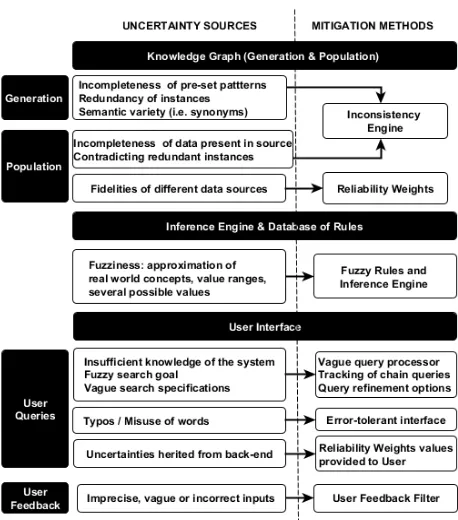
One countermeasure is the implementation of an inconsistency resolution engine to guarantee the consistency of the data inserted, to check the lack of information and solve redundancies issues. This step is fundamental because the main sources are unstructured data. There are several techniques adopted in order to deal with uncertainty in expert system [13]. One approach considered for the engine could be to rely on fuzzy approach. Fuzziness is a way to represent uncertainty, possibility and approximation.[13]
The corpus used to extract the data will be composed by different types of sources (e.g., data provided by the partners, data extracted from the web, data found in conference proceedings, etc.). A web page would for instance be a less reliable source of information than a peer-reviewed paper. The DEA also needs to be able to assess the fidelity of all the information source. A factor of reliability could be associated to the element of the KG depending on its source. This information would be transmitted to the extraction module which would then rank the facts accordingly.
The validation of the KG can be performed with different methodologies. [10] The one applicable in this case is the application-based approach, in which the KG is validated iteratively relying on the application for which it is developed (e.g., expert system). Our approach foresees the use of potential queries, to validate the information inserted inside the knowledge graph. In other words this solution can be compared to
the use of integration test, to validate the outputs from the KG and eventually take actions for the mission information. The issues could come from the extraction of process or from the type of data modelling adopted. In other words, it will be performed creating integration test derived from the range of queries elicited during expert interviews. This task is fundamental to obtaining a consistent and reliable KG.
2.4.3.2. from the front-end perspective
The uncertainty from the DEA back-end will be inherited by the front-end and could affect the reliability and accuracy of the answers provided. In addition, new uncertainties will be injected into the ES UI via the User queries and the feedback loop.
The uncertainty injected at the level of the KG and the inference engine will be reflected into the outputs generation. It will be necessary for the front-end to perform uncertainty quantification and management in addition to the ones performed by the back-end. It will be critical to ensure that information on the level of fidelity of the elaborated answer is transmitted to the User (e.g., via for instance a percentage of reliability displayed with the output).
The Human request entered in natural language via the UI will most likely be vague or incomplete due to, for instance, an initial insufficient knowledge of the tool capabilities, to a fuzzy search goal of the User or simply related to the difficulty of expressing a Human thought into a written question. In addition, the query might include some typos or misuse of words, concepts. To increase the flexibility of the UI with regard to the User query vagueness or mistakes, the interface could include some error-tolerant features, the chain queries could be tracked [11] or a vague-query processor could be chosen [12]. Furthermore, the UI will include filters to refine the search.
The Feedback loop represents an even more complex case of uncertainty quantification and management. As presented in 2.3.2, the Feedback loop will allow to capture part of the tacit knowledge from the DEA users by allowing them to comment or add information to the KG via the UI. By doing so the KG could be exposed to imprecise, vague or wrong inputs. For these reasons, it is critical to integrate into this User feedback process a resilient uncertainty quantification and management strategy to filter feedback and to avoid compromising the KG data population. For instance, specific users could be identified as space mission design experts and be allowed to provide new documents, while other Users might have access to more restricted feedback options.
Fig.7. Overview of uncertainty sources and potential mitigation methods for the DEA project.
2.4.4. Ensuring Data Security
Ensuring the data security of the information provided to the project by the partners to populate the KG is a priority for the DEA. Users with different affiliations might not be allowed to access sensitive information provided by another partner but enclosed in a part of the KG. A similar issue was encountered by the NASA JPL foundry as described in [5]. In that case, a Security layer was implemented to ensure the safety of all the data. A single sign-on was used to access all the applications, reinforced by role-based control of access to the data. In the case of the DEA, different levels of accessibility to the knowledge graph will be devised (i.e., a login could be implemented on the User interface to identify the User affiliation and to which part of the KG the User can have access).
3. Requirements definition based on User-centred approach
A User-centred approach holds the needs of the User at the center of each design decision throughout the project lifecycle. In the frame of the DEA project, the academic team chose to include the users as early as possible in the project, i.e., at the stage of the requirements definition. To do so, the team could rely on their partner, ESA, to provide a pool of experts with CDF experience. A set of interviews and a Round Table (RT) were organised in July-August 2018 involving a total of 48 experts. This last chapter will present the
main outcomes of the interaction with the ESA experts that will be used to define the tool requirements. 3.1. Discussions goals
Interacting with the DEA target users was a unique opportunity to orientate the tool requirements definition to match the users expectations and needs. The goals of the discussions were numerous:
(1) Raise awareness on the potential of AI-agents to support space mission design
(2) Understand the concurrent engineering process in practice (during the first six months the team studied the CE process in the literature, comparing with “field” information allowed the team to better understand how to integrate the DEA into the process as shown in Figure 2)
(3) Define the preliminary range of queries: a critical point to anticipate the level of complexity the UI will have to handle and the data to integrate into the KG
(4) Discuss the UI preferences including the output formats (e.g., comparison tables, reports extracts, etc.)
(5) Identify more material to feed to the KG by directly asking the users which data they usually rely on (e.g., standards, textbooks, etc.)
(6) Generate the tool requirements 3.2. Discussions Organisation
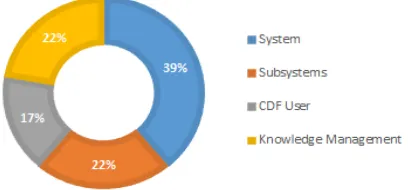
The experts pool included system and subsystems engineers but also CDF users and experts from the KM team. The experts were all affiliated to ESA.
A few Round Tables on “AI for Space Mission Design” were originally planned to take place at ESTEC, ESA throughout the summer. However, after the first round table end of July, the DEA team realised that collecting specific User needs was too complex with a large audience from various backgrounds. The elicitation process was then reviewed to focus on face-to-face interviews. In total, 18 experts attended the expert round table and 29 experts were interviewed in a face-to-face meetings.
3.2.1. Round Table elicitation process
[image:8.612.72.301.70.330.2]they would rely on and if they were open to the use of an AI-agent to support them. The second part, “HMI with the DEA”, aimed to discuss about the Users preferences for some of the UI features (i.e., output formats and content, query inputs types, feedback loop).
The elicitation process was tested with a pool of 13 trainees and Young Graduate Trainees (YGTs) from ESA end of July. The following day, the expert RT took place and the outcomes are presented in 3.3, merged with the rest of the interviews outcomes.
[image:9.612.83.288.242.337.2]The background distribution of the experts involved in the RT is illustrated by Figure 8. The participating subsystems were cost, chemical propulsion, thermal and risk.
Fig. 8 Expert background for RT 3.2.2. Face-to-face interviews elicitation process
The face-to-face interviews usually lasted around 1h and followed a similar process as for the RT (i.e., a similar set of questions were used). The format of the interview (i.e., discussing with only 1 or 2 experts at a time) allowed to pinpoint more accurately the User’s needs w.r.t his/her background or field of work. The subsystems involved in the interviews were AOCS/GNC, configuration, electric propulsion, mechanisms, mission analysis, thermal, TT&C, operations and ground segment, power and programmatic. Figure 9 displays the background distribution of all experts interviewed.
Fig. 9. Expert background for interviews 3.3. Interview and Round Table main outcomes 3.3.1. DEA outputs
The goal of the DEA as a knowledge engine is to facilitate the access and reuse of accumulated knowledge. Discussions with experts have confirmed
that they currently need to have a quicker access to reliable and synthesized information concerning previous missions. When experts start to design a new mission, their first step is usually to look into the heritage from similar missions to get a rough idea of values range and architecture options judged valid and feasible in the past. The system engineers often rely on colleagues and on internal database to identify similar missions. Subsystems experts are made aware of similar past missions by the system team and can mine for additional information within their sections. Discussion with colleagues frequently appear as a primary source of information. Human colleagues might however not be aware of all past missions, or have a more biased point of view. Experts underlined that the DEA could be especially be useful for newcomers to get up to pace with the support of an easily accessible source of reliable information.
Targeting information extraction of similar missions raises the fundamental question of how to define “similar”, taking into account different parameters and users’ perspectives. A starting point could be to compare the mission requirements and executive summaries present in all feasibility reports. During the interviews, the DEA team asked the experts to identify key comparison parameters that could be used both by the querying module of the UI to define the query execution plan and to structure the KG model.
In conclusion, the experts seemed mainly interested to use the DEA knowledge engine to access or generate: ● comparison tables of previous similar missions ● comparison of available components and their performance
● heritage information (e.g., for which mission has a specific platform been selected)
● trade-off information (e.g., criteria to select the design baseline and disregard other design options) ● trend analysis (e.g., see if the current study fits in the mass trend of all previous similar missions) Experts underlined that they would often prefer to have access to the original document to better grasp the context of a decision or of a computation output. Only providing an extract of the document might not be enough to reflect the information context. The DEA should therefore connect the User to the original format of the source to ensure full transparency and justify the tool outputs. Transparency and justification of the DEA reasoning are keys to build a trust relationship with the User. Trust is a vital element for the success of the HMI and the adoption of the tool into the Users’ work process.
asked the question “would you rely on an AI-agent to mine information for you” during the Round Table, 70% of the experts answered that they were unsure. Once again being able to establish a trust relationship with the User is a key element for the tool successful integration and will be a focus of the design process.
Finally, it has to be noted that the outputs of the DEA can only be as complete and as reliable as the information contained into the KG.
3.3.2. Data sources for the DEA KG
A primary source of explicit data to populate the DEA KG are feasibility studies reports. Via the partnership with ESA, the team can access ESA CDF reports to perform a few case studies in the next development phases of the DEA.
During discussions with experts, the team realised that there is also a high demand from experts to have access to a wider set of sources: CE sessions presentations after each iterations, reports from later phases of design, technology development updates, lessons learned, and anomaly investigation reports. It would indeed be highly relevant to loop back information from more developed or even flown missions to the early design phases. This could highly contribute to generate more feasible and reliable design solutions or avoid repeating similar mistakes. However, due to the limited timeframe of the DEA project and to access restriction to data, the team will firstly focus on the population of the feasibility studies reports into the KG.
To generate reliable outputs, the different sources of the DEA need to undergo an uncertainty evaluation. This process will evaluate not only the degree of reliability of the DEA outputs but could apparently also be useful to the User. A few experts have indeed underlined that validating the reliability of an information source is a common issue, an issue that the expert system could contribute to solving.
3.3.3. User Interface - Query range
A first approach assumed that the DEA would have to be able to answer a range of queries as large as possible. Interacting with the experts was a unique opportunity to refine the set of queries that the users are most likely to be interested in.
The User queries are submitted to the DEA via the UI in natural language format. Understanding which type of queries the users are interested into provides an insight into the necessary answer content and therefore the information that should be included into the DEA KG. It also contributes to evaluating the level of details and complexity both query manager and KG model will have to handle to successfully answer the request.
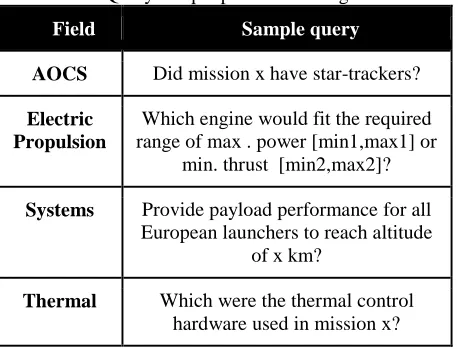
[image:10.612.310.539.126.303.2]Although the query list cannot be exhaustive, and should not restrict the DEA, the following table displays a few examples of requests collected from experts.
Table 1. Query sample provided during interviews
Field Sample query
AOCS Did mission x have star-trackers? Electric
Propulsion
Which engine would fit the required range of max . power [min1,max1] or
min. thrust [min2,max2]? Systems Provide payload performance for all
European launchers to reach altitude of x km?
Thermal Which were the thermal control hardware used in mission x?
3.3.3. User Interface - HMI
A feature of the interface questioned by some experts during the interviews was the adaptation of the query answer based on the User background. The original intention was for the DEA to adapt its answer based on the User field of work and to target more specific areas of the KG to decrease the computation time. However, it was argued that doing so could contribute to limit the scope of answers made available to the User and narrow down his/her view. Under the shape of refinement checkboxes available on the UI, the User will him/herself indicate to the DEA if there is a need to narrow down the research scope (e.g., by specifying the type of program, mission, payload, etc.). Knowledge Discovery will be boosted both by the wider range of answers generated and via a recommender system suggesting similar request or answers based on the connections in the KG.
3.3.4. Integration of the DEA to the CE process Discussing with experienced CDF experts was the best occasion to compare the theory of CE with its practice, at least in the context of ESA activities. The latest version of the integration of the DEA into the CE process is presented in subchapter 2.1. The DEA will support the system and subsystems experts throughout the whole study (including preparation, study and post-study phases).
While some fields can begin their simulations from the first study session (e.g., power), other fields have to wait until the later study sessions for other fields’ inputs (e.g., programmatic). These fields have then a lot less flexibility in the architecture or component choices, and therefore need more targeted answers from the DEA.
In some cases, it appears that reusing a similar previous architecture is simply impossible, as each new mission needs a tailored made answer. The discussions have therefore outlined that there are different levels of knowledge reuse depending on the subsystems.
In conclusion, the different experts involved in concurrent engineering studies might all find a different use for the DEA (e.g., scout for similar previous missions, generate trend analyses or compare two equipment performances) and use it at different stages of the study.
4. Conclusions
The present paper is a continuity of the DEA project overview presented in [7]. The present paper however includes significant updates in the tool architecture and challenges. The paper also presented the outcomes of discussions with experts involved in feasibility studies at the ESA concurrent engineering facility, CDF. The interviews outcomes were used to refine the DEA objectives and requirements.
The interaction with the experts, potential end users of the DEA, confirmed the interest for a tool facilitating knowledge management and reuse at the early stages of space mission design. Experts also welcomed the idea of integrating an AI-agent into their work habit and the design environment after testing and validation.
Acknowledgements
The DEA team would like to warmly thank the ESA CDF team for their extremely valuable help with the organisation of the interviews. The team also thanks the ESA experts for their time and interest into the DEA project. Finally, the team thanks their industrial partners: Airbus, RHEA and satsearch for their support. References
[1] M. Bandecchi, B. Melton, B. Gardini & F. Ongaro, The ESA/ESTEC Concurrent Design Facility, 2nd Concurrent Engineering Conference (EuSEC), 2000. [2] J.L. Smith, Concurrent Engineering in the Jet
Propulsion Laboratory Project Design Center (1997) [3] A. Pickering, ESA Concurrent Design Facility
Infopack (2017)
[4] W. J. C Verhagen, J. Stjepandić & N. Wognu, Chapter 28 - Challenges of CE. In: Concurrent Engineering in the 21st Century, Springer, 2015. [5] J. Blossom, G. Johnson, M. Kolar, J. Chase & K.
Case, JPL’s Foundry Furnace: Web-based Concurrent Engineering for Formulation (2016).
[6] K. Dalkir, Knowledge Management in
Theory and Practice, 3rd ed. The MIT Press, 2017. [7] F. Murdaca, A. Berquand, A. Riccardi, T. Soares, S.
Gerené,N. Brauer, K. Kumar, Artificial Intelligence for Early Design of Space Mission in support if Concurrent Engineering Sessions,SECESA 2018, Glasgow, UK, September 2018.
[8] K. Baclawski, M. Bennett, G. Berg-Cross, D. Fritzsche, T. Schneider, R. Sharma., R.D. Sriram, & A. Westerinen, (2017). Ontology Summit 2017 Communiqué – AI, Learning, Reasoning and Ontologies.
[9] Staab, S. & Studer. Handbooks on Ontologies, 2007
[10] G. Petasis, V. Karkaletsis, G. Palioura, A. Krithara & E. Zavitsanos (2011). Ontology Population and Enrichment: State of the Arts. [11] F. Radlinski & T. Joachims, Query Chains:
Learning to Rank from Implicit Feedback. Retrieved, 2005.
[12]A. Motro, Sources of Uncertainty in Information Systems. Proceedings of the Workshop on Uncertainty, 1992.
[13] S. Dubey, R. Pandey K. and Gautam S. S., Dealing with Uncertainty in Expert Systems, 2014.
[14] F. Murdaca, A. Berquand, K. Kumar, A. Riccardi, T. Soares, S. Gerené,N. Brauer, Knowledge-based Information Extraction from Datasheets of Space Parts,SECESA 2018, Glasgow, UK, September 2018.
[15] ESA OCDT community Portal Login https://ocdt.esa.int/ (accessed 17.09.18).
[16] S. Marwaha, Agridaksh—A Tool for Developing Online Expert System,
T
hird National Conference on Agro-Informatics and Precision Agriculture (AIPA), 2012, 01-03 August.[17] N. Mukund & all. , Information Retrieval and Recommendation System for Astronomical Observatories (2017).
[18] Y.-L. Chi, T.-Y Chen and W.-T. Tsai, A chronic disease dietary consultation system using OWL-based ontologies and semantic rules, Journal of Biomedical Informatics, 53, pp. 208–219 (2014). [19] A. Arruda, An Ethical Obligation to Use Artificial
Intelligence ? An Examination of the Use of Artificial Intelligence in Law and the Model Rules of Professional Responsibility, American Journal of Trial Advocacy, 40(3), pp. 443–458 (2017)
[20] Swati Gupta1 , Ritika Singhal (2013) Fundamentals and Characteristics of an Expert System.
[21] Peter J.F. Lucas & Linda C. van der Gaag. Principle of Expert Systems, 1991