Vol. 5 Issue 11, November - 2018
Analysing The Effect Of Strain Rate And
Temperature On The Flow Stress In AA1050
Sheet Using E-2448 Standard
M. R. Allazadeh[email protected], Advanced Forming Research Centre 85 Inchinnan Dr, Inchinnan, Renfrew PA4 9LJ
Abstract—Uniaxial tests were performed to investigate the stress-strain relationship of aluminum alloy 1050 (AA1050) at different strain rates and forming temperatures. To this purpose, several coupons were cut from AA1050-H14 sheet with 2 mm thickness according to E-2448 standard in 0, 45, and 90 degrees with respect to the sheet`s rolling direction. The uniaxial tests were carried out in air and in argon gas at 100 oC, 200
o
C, 300 oC, 400 oC, and 500 oC. The strain rates of the uniaxial tests were set for 0.001, 0.005, 0.0001, and 0.0005 s-1. The results show that altering the strain rate affects more the strength than the ductility attribute of AA1050 sheet. Moreover, the results reveal that ductility of AA1050 alloy has direct relationship with loading temperature, while AA1050 alloy’s strength has inverse relationship with the uniaxial testing temperature. The results were also investigated for the flow stress variation due to the loading direction and testing atmosphere. Laboratory test results suggested optimum parameters for forming part from AA1050-H14 alloy sheets of about 2 mm thickness at elevated temperature.
Keywords— AA1050, Al1050, Uniaxial test, Strain rate, Stress-strain relationship, Flow stress
I. INTRODUCTION
One of the most popular aluminum grade is aluminum alloy 1050 with standard designated of AA1050, or commercial identification of Al1050. It has many applications in sheet metal work because of its excellent corrosion resistance, high ductility as well as highly reflective finish [1]; but it has poor machinability due to its strength [2]. Typical industrial applications of AA1050 are in chemical process plant equipment, food industry containers, lamp reflectors, architectural flashings. Ramaswamy et al. [3] claimed AA1050 has potential application in vehicle industry for its better corrosion resistance in acidic environment in compare to aluminum alloys 5xxx, 6xxx. Wang et al. [4] has studied the application of AA1050 for micro-electro-mechanical system devices. H14 temper is the typical tempering process for commercial AA1050 sheets with AA1050-H14 identification.
The temper H14 indicates that work hardening, via rolling process, instead of annealing process was implemented to increase the hardness of rolled aluminum sheets by the half of sheets` initial hardness [1]. The work hardening modifies the strain history of
the material, and thereof, results in altering thermo-mechanical properties of the material. AA1050-H14 has very good cold workability attribute but it has breaking elongation not more than 12% which is low for many industrial demands [5].
In general, strain rate and temperature are two main parameters controlling the production rate and formability of the metal product, respectively. In case of the sheet forming, combination of these parameters contribute to the ability of the sheet to stretch. Therefore, it is an industrial interest to investigate the optimum temperature and strain rate for forming the AA1050 sheet. However, hot forming may be associated with several metallurgical phenomena, such as phase transformation, recrystallizations, recovery, and grain growth. These metallurgical phenomena may alter the stress-strain relationship at elevated temperature, which in turn, they can change the mechanical properties of the material. Strain rate and loading temperature are among the important factors in imposing the metallurgical phenomena in the microstructure during deformation process.
It is reported that AA1050 has discontinuous recrystallization at 465 oC during the thermomechanical processing [6]. Therefore, the analysis up to 500 oC should be considered to have proper conclusion on the variation of the flow stress due to temperature effect. High stretching can be occurred using super plastic forming methods, e.g. hot metal gas forming (HMGF) and hydroforming (HF).
E-2448 standard defines the geometry of the specimen for uniaxial test designed for high stretch forming of the sheets. The main purpose of uniaxial test is to generate stress versus strain graphs which can be employed to predict the deformation of the sheet material. There are number of publications on the investigation of mechanical properties of AA1050 alloy and AA1050-H14 for cold and hot forming [7-14], however, they have not discussed the effect of the forming strain rate and temperature for wide range.
Vol. 5 Issue 11, November - 2018
were performed in air and in argon gas to study the variation of the flow stress for AA1050 sheet forming under controlled testing environment with argon gas in compare to air testing atmosphere.
II. EXPERIMENTAL SET UP
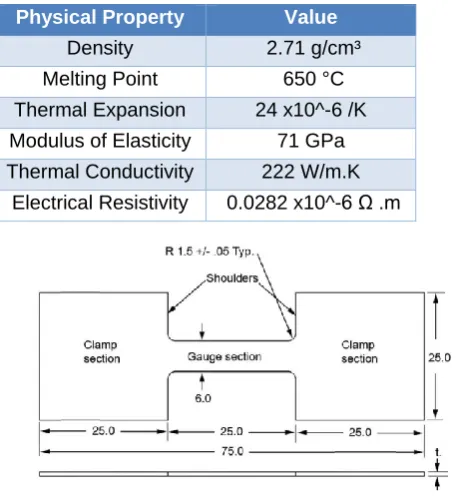
[image:2.595.340.521.65.374.2]The uniaxial test coupons were prepared from commercial aluminum alloy sheet AA1050-H14 with specification of BS EN 573-3:2009 and thickness of 2±0.1 mm. The selected sheet to manufacture the coupons was inspected to be without even minor damage or scratch on its surfaces. Tables 1 and 2 are the list of the typical chemical composition and material properties of the sheet, respectively [15]. The coupons were cut in 0, 45, and 90 degrees with respect to rolling directions according to the standard designation E 2448-06.
TABLE I. CHEMICAL COMPOSITION OF ALUMINIUM ALLOY
AA1050-H14 WITH SPECIFICATION BSEN573-3:2009[15].
Chemical Element Value [%]
Manganese (Mn) 0.0 - 0.05
Iron (Fe) 0.0 - 0.40
Copper (Cu) 0.0 - 0.05
Magnesium (Mg) 0.0 - 0.05
Zinc (Zn) 0.0 - 0.07
Titanium (Ti) 0.0 - 0.05
Other (Each) 0.0 - 0.03
[image:2.595.50.277.280.390.2] [image:2.595.40.269.417.668.2]Aluminium (Al) Balance
TABLE II. MATERIAL PROPERTIES OF ALUMINIUM ALLOY
AA1050-H14 WITH SPECIFICATION BSEN573-3:2009[15].
Physical Property Value
Density 2.71 g/cm³
Melting Point 650 °C
Thermal Expansion 24 x10^-6 /K Modulus of Elasticity 71 GPa
Thermal Conductivity 222 W/m.K Electrical Resistivity 0.0282 x10^-6 Ω .m
Fig. 1. Dimension of the 2448 standard test coupon [16]
Figure 1 shows the geometry of the test coupons for the uniaxial tests. Uniaxial tests were performed with Zwick/Roell Z250 strength testing device shown in Fig. 2. TestXpert II software package collects the data recorded from Z250 strength testing machine. The software interface was set to produce two data files for each uniaxial test.
Fig. 2. Zwick/Roell Z250 strength testing used for the uniaxial tests
TABLE III. UNIAXIAL TESTS` SPECIFICATIONS FOR THE EXPERIMENTS
Uniaxial test coupon
ID
Testing Temperature
[oC]
Strain Rate [s-1]
Rolling Direction [degree]
J 100 0.005 90
I 200 0.001 90
H 200 0.0005 90
E 200 0.0001 90
K 300 0.001 90
L 300 0.0005 0
O 300 0.0005 45
G 300 0.0005 90
M 300 0.0001 0
N 300 0.0001 45
F 300 0.0001 90
T 400 0.0001 90
S 500 0.001 90
D 500 0.005 90
Q 500 0.0005 90
R 500 0.0001 90
P* 500 0.005 90
C* 200 0.0001 90
Uniaxial tests with “*” were performed under argon environment
One data file is the variation of temperature during the uniaxial test at two ends of the specimen.
[image:2.595.305.560.421.695.2] [image:2.595.306.560.421.693.2]Vol. 5 Issue 11, November - 2018
crosshead during the testing time, along with the geometrical input parameters of the coupon. The later data files were used to compute true stress and true strain for each test.
The uniaxial tests were designed for different strain rates and temperatures. The test temperatures of the uniaxial tests were decided to be at 100 oC, 200 oC, 300 oC, 400 oC, and 500 oC.
The strain rates of the tests were set to be 0.0001, 0.005, 0.001, and 0.005 s-1. Table 3 provides the detail of the uniaxial test parameters for each specimen labelled with an identification letter.
All the uniaxial tests were performed in air except P and C specimens whose uniaxial tests were done within argon gas atmosphere.
III. RESULT AND DISCUSSION
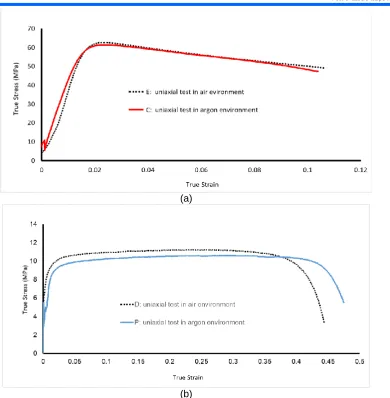
The gas pressure forming of the sheets is usually utilised with argon gas while most of the uniaxial tests results are obtained in air environment. However, additional alumina formation during uniaxial tests in air may shift the flow stress curve with respect to the one in argon. Therefore, two specimens were devoted to study the effect of the forming atmosphere on AA1050 flow stress.
The influence of the environment in shifting the flow stress curve was analysed in Fig.3. The results revealed that the testing environment has not significant effect on the flow stress curve. So the uniaxial test results in air can be adapted to predict the forming AA1050 alloy sheet using argon gas.
The effect of the anisotropic material properties was verified using the stress-strain relationship built during the uniaxial test at different rolling direction for specific testing temperatures and strain rates. Due to the rolling process of the sheets, it is expected to have highest strength in the rolling direction and more ductile behaviour in the transversal direction.
Fig. 4 is the comparison of the stress-strain curves at 0o, 45o, and 90o with respect to the rolling direction at 300 oC and strain rate 0.0005 s-1. It can be observed from Fig. 4 that strain and ductility behaviour increase as rolling direction angle becomes larger.
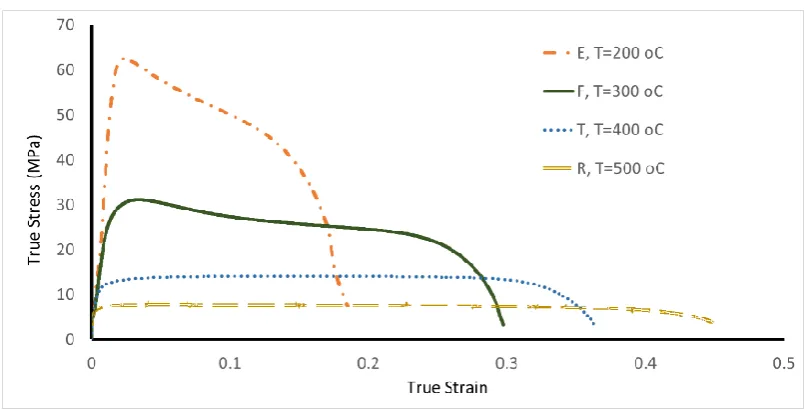
Previous publication reported that forming of aluminium alloys are a function of temperature [17]. This fact can be observed in Figures 5, 6 and 7 for the uniaxial test with the same strain rate but different testing temperature.
Fig. 5 compares the variation of flow stress of AA1050 at 100 oC and 500 oC for loading with strain rate of 5 x 10⁻³ s-1. The graphs in Figure 5 depict very clearly that higher deformation temperature enhances the ductility property but suppresses the strength of AA1050 specimen. Fig.6 presents the differences between the stress-strain curves at three test set temperatures for strain rate of 5x10⁻⁴ s-1.
Fig.7 is the graphs for the uniaxial tests at strain rate 1 x 10⁻⁴ s-1, at 200 oC, 300 oC, 400 oC, and 500
o
C. It can be concluded from the graphs in Figures 5, 6 and 7 that the ductility of the material has direct relationship with temperature, whereas the material strength has inverse relationship with the testing temperature. It has been suggested that the strength of AA1050 is more related to dislocation density than that of grain size [18].
Hence thermal energy could be the source of lowering the strength of the material by introducing motion, and subsequence, annihilation of some dislocations. Different deformation mechanisms have been postulated to determine the influence of the strain rate on the grain size through various empirical theories, such as Nabarro--Herring, Coble-Jones creep, and grain boundary sliding [19].
Important conclusion of the aforementioned empirical formulas is that strain rate has inverse relationship with the grain size [20]. Since the grain size has tied relationship with the formability of the metallic material, consequently, the strain rate plays dominating role in the strength of metallic material.
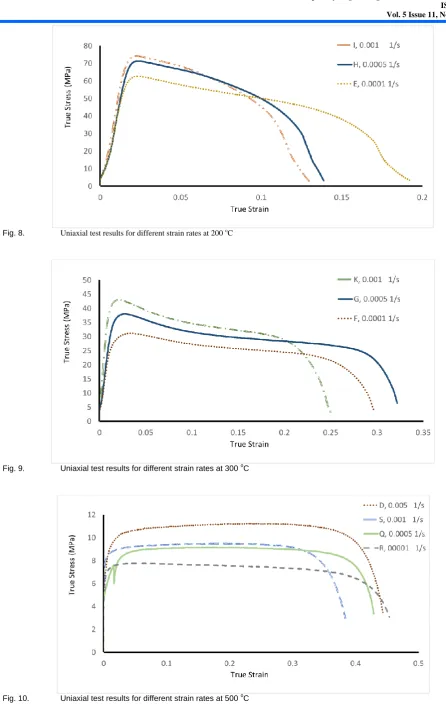
Effect of the strain rate on the material`s strength is more traceable at higher temperature which it may be related to higher energy of metallic atoms to rearrange themselves in the crystal lattices. This fact can be noticed for uniaxial test results with different strain rates at 200 oC, 300 oC, and 500 oC testing temperature in Figures 8, 9, and 10, respectively. It can be seen in Fig.8 that the strength of the material varies slightly by changing the strain rate at 200 oC, while the ductility attribute holds inverse relationship with the forming strain rate.
Fig.9 furnishes the evidence of the direct relationship between the strength and the strain rate, although the ductility does not improve for the strain rate slower than 5 x10⁻⁴ s-1.
The effect of the strain rate at 500 oC in Fig.10 is more readable on the strength of the material than the ductility behaviour of the material. Both Figures 9 and 10 suggest the optimum ductility of AA1050 could be achieved for strain rate 5 x10⁻⁴ s-1 for uniaxial testing of 300 oC or above. Nevertheless, the ductility of AA1050 coupons could reach to 45% at 500 oC with 5 x10⁻⁴ s-1 strain rate, which is the highest elongation for this set of experiments.
Overall, it is fair to conclude that higher strain rate shifts up the stress-strain curve, i.e. AA1050 exhibits stronger behaviour, for any given testing temperature. Another noticeable outcome from the graphs in Figures 5 to 10 is changing the behaviour of the material from softening to near steady stress level up to necking for uniaxial tests above 300 oC.
Vol. 5 Issue 11, November - 2018
(a)
[image:4.595.111.502.54.453.2](b)
Fig. 3. Comparison of uniaxial test results in air with argon gas for AA1050 specimens at (a) 200 oC with strain rate of 0.0001 s-1, and (b) 500 oC with strain rate of 0.005 s-1
[image:4.595.109.488.494.688.2]Vol. 5 Issue 11, November - 2018
[image:5.595.98.501.285.492.2]Fig. 5. Shifting of the flow stress curves for different testing temperature at strain rate of 5 x 10⁻³ s-1
Fig. 6. Shifting of the flow stress curves for different testing temperature at strain rate of 5 x10⁻⁴ s-1.
[image:5.595.103.506.519.724.2]Vol. 5 Issue 11, November - 2018
[image:6.595.105.487.61.267.2]Fig. 8. Uniaxial test results for different strain rates at 200 oC
Fig. 9. Uniaxial test results for different strain rates at 300 oC
Vol. 5 Issue 11, November - 2018 IV. CONCLUSIONS
Number of coupons were cut at different rolling direction according to E 2448-06 standard to study the stress-strain relationship of AA1050 H14 aluminium alloy sheet. Several uniaxial tensile test experiments were conducted in air and in argon gas atmospheres. The results were scrutinised for forming AA1050 aluminium alloy sheet at different temperature and at various strain rates. It was concluded form the resultant flow stress curves that increasing uniaxial testing temperature at given strain rate enhances the ductility of the material but decreases the material`s strength. It was also deduced from the uniaxial test outcomes that increasing strain rate at given temperature results in shifting the stress flow curve upward, i.e. higher strength attribute. It was found that the highest elongation could be achieved at 500 oC with 5 x10⁻⁴ s-1 strain rate, which may suggest the optimum parameters for formation part from AA1050-H14 alloy sheets of about 2 mm thickness at elevated temperature. The stress versus strain curves exhibit less softening behaviour for tests at temperature higher than 300 oC which could be related to the recrystallization during material flow at elevated temperature. In addition, the results were discussed for the effect of loading direction and testing environment. It was observed that changing the testing environment from air to argon has not appreciable effect on shifting the flow stress curve, and therefore, the uniaxial tests in air are valid for the aluminium alloy AA1050 sheet forming under argon gas pressure as well. The results showed that the strain and the ductility behaviour of the material increase as loading direction angle gets larger with respect to the rolling direction of the sheet. The presented flow stress curves offer useful material data for further studies on forming parts from AA1050-H14 sheets.
ACKNOWLEDGEMENT
This research has been financially supported by the
High Value Manufacturing (HVM) Catapult undertaken
at the Advanced Forming Research Centre (AFRC) of the University of Strathclyde.
REFERENCES
[1] V and F Sheet Metal, “Aalco-Metals-Ltd_Aluminium-Alloy_1050-H14_57”, (2011).
[2] Atlas Steels, Aluminium alloy datasheet,
http://www.atlassteels.com.au/
[3] V. Ramaswamya, R.Pareeka, A. Girib, G. Anugulab, V. Srivastavab, S. Adhikar,Corrosion performance evaluation of aluminum alloys for automotive applications, Presented at 16th National Congress on Corrosion Control : 23 – 25 (2012), Kolkata.
[4] C.T. Wang, N. Gao, R.J.K.K. Wood, T.G. Langdon, Wear behaviour of Al-1050 alloy processed by severe plastic deformation, Mater. Sci. Forum, 667-669 (2010), pp. 1101-1106.
[5] http://www.righton.co.uk/PDF/Aluminium/Sheet%20Stucc o%20-%20Aluminium%20-%201050%20H14.pdf
[6] C.M. Cepeda-Jimé Nez, P. Hidalgo, M. Pozuelo, O.A. Ruano, and F. Carren , Influence of Constituent Materials on the
Impact Toughness and Fracture Mechanisms of Hot-Roll-Bonded Aluminium Multilayer Laminates, metallurgical and materials transactions A volume 41A, (2010)61.
[7] Y.H. Moon, Y.K. Kang, J.W. Park, S.R. Gong, Tool temperature control to increase the deep drawability of aluminium 1050 sheet, International Journal of Machine Tools & Manufacture 41 (2001) 1283–1294
[8] M. Gavas, Increasing the deep drawability of Al-1050 aluminium sheet using multi-point blank holder, METABK 45 (2) 109-113 (2006).
[9] H. Güler, R. Özcan, Effects of the Rotary Embossing Process on Mechanical Properties in Aluminum Alloy 1050 Sheet, Met. Mater. Int., Vol. 18, No. 2 (2012), pp. 225-230.
[10] E. Gomaa, N. Mostafa, M. Mohsen, and A.S. Taha, A Study on Commercial Pure Al (1050) After Cold Rolling at Room
Temperature With Various Deformations Using Positron
Annihilation, JMEPEG (2003) 12:190-195
[11] F. F. Damborg and M. R. Jensen, Hydromechanical deep drawing, Scandinavian Journal of Metallurgy 2000; 29: 63–70
[12] Mahmoud E. Abdullah, Ragab K. Abdel-Magied, Mohamed N. Elsheikh, Experimental investigation of formability of Al-1050 tailor-welded blanks, Int J Adv Manuf Technol (2017) 89:791–801.
[13] João Miguel Silva Morais, Mechanical Behavior of AA1050 at High Strain Rates, dissertation, Department of Mechanical Engineering, Instituto Superior Técnico, Lisbon, Portugal, (2014).
[14] W.M. Van Haaften, B. Magin, W.H. Kool, and L. Katgerman, Constitutive Behavior of As-Cast AA1050, AA3104, and AA5182, metallurgical and materials transactions A, volume 33A, (2002)197.
[15] Aalco Metals Limited,
http://www.aalco.co.uk/datasheets/Aluminium-Alloy-5083-0-H111-Sheet-and-Plate_149.ashx, Aluminium Alloy - Commercial Alloy - 5083 - '0' - H111 Sheet and Plate.
[16] ASTM E2448-11, Standard Test Method for Determining the Superplastic Properties of Metallic Sheet Materials, ASTM International, West Conshohocken, PA, 2011, www.astm.org.
[17] M. K. Mohd Nor, I. Mohamad Suhaimi, Effects of Temperature and Strain Rate on Commercial Aluminium Alloy AA5083, Applied Mechanics and Materials, ISSN: 1662-7482, Vol. 660, pp 332-336, (2014).
[18] X. G. Qiao, M.J. Starink, N. Gao, Hardness inhomogeneity and local strengthening mechanisms of an Al1050 aluminium alloy after one pass of equal channel angular pressing, Materials Science and Engineering A 513–514 (2009) 52–58.
[19] A. K. Mukherjee, Annu. Rev. Mater. Sci., 9 (1979) 191.
[20] Adeniyi A. Afonja, Materials Science and Engineering, 54 (1982) 257 - 263