City, University of London Institutional Repository
Citation
: Bateman, N., Chester Buxton, R. and Radnor, Z. J. ORCID:
0000-0002-1624-5729 (2017). The status of continuous improvement in ICiPS members in 2015. ICiPS and Loughborough University.This is the published version of the paper.
This version of the publication may differ from the final published
version.
Permanent repository link:
http://openaccess.city.ac.uk/20682/Link to published version
:
Copyright and reuse:
City Research Online aims to make research
outputs of City, University of London available to a wider audience.
Copyright and Moral Rights remain with the author(s) and/or copyright
holders. URLs from City Research Online may be freely distributed and
linked to.
City Research Online: http://openaccess.city.ac.uk/ [email protected]
The status of continuous
improvement in ICiPS
members in 2015
Nicola Bateman, Rosamund Chester Buxton, and Zoe Radnor
Version 2
August 2017
Acknowledgments
The authors would like to thank members of ICiPS and affiliates who contributed to the visualisation exercise and the ICiPS members survey, and also the staff members at each of the case study organisations, who gave up their time to talk to the research team about continuous improvement within their organisation.
Dr Nicola Bateman is a Senior Lecturer in Operations Management and Acting Co-director of the Centre for Service Management (http://lboro.ac.uk/csm) at the School of Business and Economics, Loughborough University. Contact details: School of Business and Economics, Loughborough University, LE11 3TU, UK, Tel: +44 (0)1509 223102, Email: [email protected]
Rosamund Chester Buxton is a Doctoral Researcher in the Centre for Service Management
(http://lboro.ac.uk/csm) at the School of Business and Economics, Loughborough University. Contact details: School of Business and Economics, Loughborough University, LE11 3TU, UK, Email:
Professor Zoe Radnor is Dean of the School of Business
(http://www2.le.ac.uk/departments/business) at the University of Leicester and is a Professor of Service Operations Management. Contact details: School of Business, University of Leicester, Leicester, UK, LE1 7RH, Tel: +44 (0)116 229 7590, Email: [email protected]
Contents
1. Introduction ... 1
CI visualisation exercise ... 1
Online survey of ICiPS members ... 2
Case studies with ICiPS member organisations ... 2
2. CI Strategy ... 3
2.1 Organisations with CI strategy at a departmental level ... 3
2.2 Cases with CI strategy for whole organisation ... 4
3. Structure of CI within the Organisation ... 5
3.1 Government Information Provider (GIP) ... 5
3.2 South Yorkshire Police (SYP) ... 7
3.3 Community Services Provider (CSP) ... 8
3.3 The University of Sheffield (US) ... 8
3.4 Scottish Government (SG) ... 9
3.5 NHS Blood and Transplant (NHSBT) ... 9
4. Tools, Techniques, and Training ... 11
4.1 Training providers ... 11
4.2 Training structure and delivery ... 11
Training style ... 13
4.3 CI Tools provided in Training ... 14
4.4 Profile of trained people ... 14
5. CI Tools ... 14
6. Successful CI Projects ... 17
6.1 Increasing visibility of processes ... 18
6.2 Improved working relationships ... 19
6.3 Financial savings ... 19
7. Factors contributing to problems and issues ... 20
7.1 Staff resistance ... 20
7.2 Problems quantifying benefits ... 21
7.3 Lack of understanding and organisational mistrust... 21
7.4 Lack of cohesion ... 21
8. Maturing level of CI ... 22
8.1 Variance of CI maturity: ... 22
9.1 Spreading CI through the Organisation ... 23
9.2 Evidence based approaches ... 24
9.3 Tools selection ... 24
9.4 Financial and Resource Constraints ... 25
10. Reflections and Status of CI in Public Services ... 25
References ... 27
Appendix 1 Case organisations details ... 28
Appendix 2 – Semi-structured interview – interviewee consent form ... 29
1
1.
Introduction
This report was commissioned following discussions in 2014, between the authors of this report and staff members from ICiPS about the paucity of relevant research about the current status of
continuous (CI) in the UK. The purpose of this report is therefore, to examine the status of CI in ICiPS
members in 2015, with a view to helping ICiPS serve the needs of its members, and also to provide an agenda for research organisations such as the Centre for Service Management (CSM) at
Loughborough University. This report covers seven case studies and draws out common themes. In this report, CI is understood to mean: ‘where all members of the organisation work together on an
ongoing basis improving processes and reducing errors to improve overall performance for the
customer’ (Fryer, Antony, and Douglas, 2007, p. 498). This report is required, because although CI has been on the agenda for many years for Public Services Organisations there has not been a review as to how this has progressed recently.
The particular challenges to public service in areas allied to CI, such as Operations Management are well documented (Radnor, Bateman, Esain, Kumar, and Williams, 2015), but the particular needs and challenges of ICiPS members required more focused research. Many of these challenges and themes are well known amongst practitioners and researchers as widely occurring in organisations
undertaking CI. This includes, the success of CI projects and the resistance or lack of support at top and middle management level, as well as some sections of staff. Other themes are particular to Public Sector organisations, for example, the major motivation for CI is driven by a desire to maintain quality of service in an environment of budgetary constraint. In addition, more emerging themes are substantiated by the case studies in this report. This includes an awareness of where the
organisation is in terms of CI maturity, allied to this are changes to organisational structure, and strategy to accommodate CI, and the ability to deliver in-house training.
Section 1 of this report addresses CI strategy, and section 2 considers how CI sits within the organisation. Section 3 addresses CI training, and section 4 reflects the specific techniques used in our cases. Sections 5, 6, 7, and 8consider overall implementation looking at successful projects, problems and issues with implementation, and the overall maturity of the organisation in terms of CI. The final sections explore the future of CI from the case organisations view and insights from the authors.
An initial workshop at the ICiPS conference took place in September 2014. This workshop summarised member organisations’ issues. This was followed up by an online survey to ICiPS members in March 2015. There were not enough replies from the survey to provide statistical data, but the survey did guide the themes for the cases interviews. From these two sources themes for interviews for the seven case studies were compiled and the analytical framework for the findings from the case studies.
CI visualisation exercise
2 their CI journey. A member from each group was then asked to feedback to all the attendees, what their drawing represented. The project team digitally recorded each group’s discussion and
transcribed each recording. The project team also photographed each drawing. From the recording transcriptions and the photographs of each drawing, the team were able to develop themes to inform the online survey of ICiPS members and the seven case study sites with ICiPS members.
Online survey of ICiPS members
In March 2015, an online survey (using Bristol Online Survey) was sent to all ICiPS members to understand their views about the current and future state of CI within UK public services. Only 28 ICiPS responded to the survey. This was not enough to provide statistical data but did help the project team to develop the semi-structured interview questions for the case study interviews.
Case studies with ICiPS member organisations
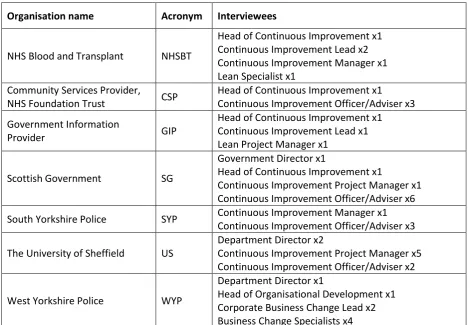
The project team conducted case study site visits with six ICiPS members plus one affiliate organisation shown in Table 1 (see Appendix 1 for details of each organisation). Each site visit involved the project team visiting each organisation for a day and conducting 4 to 6 semi-structured interviews with staff involved with CI (see Appendix 2 for a schedule of the interview questions). During each case study organisation site visit, the semi-structured interview questions focused upon: the back ground to CI within the organisation; the CI training and support staff received; CI projects undertaken within the organisation; and what staff felt was the future for CI within their
3
Table 1: Summary of cases
Organisation name Acronym Interviewees
NHS Blood and Transplant NHSBT
Head of Continuous Improvement x1 Continuous Improvement Lead x2 Continuous Improvement Manager x1 Lean Specialist x1
Community Services Provider,
NHS Foundation Trust CSP
Head of Continuous Improvement x1 Continuous Improvement Officer/Adviser x3 Government Information
Provider GIP
Head of Continuous Improvement x1 Continuous Improvement Lead x1 Lean Project Manager x1
Scottish Government SG
Government Director x1
Head of Continuous Improvement x1
Continuous Improvement Project Manager x1 Continuous Improvement Officer/Adviser x6 South Yorkshire Police SYP Continuous Improvement Manager x1
Continuous Improvement Officer/Adviser x3 The University of Sheffield US
Department Director x2
Continuous Improvement Project Manager x5 Continuous Improvement Officer/Adviser x2
West Yorkshire Police WYP
Department Director x1
Head of Organisational Development x1 Corporate Business Change Lead x2 Business Change Specialists x4
The sections below present the findings for each of the main themes covered in the data gathering. Section 10 will provide some reflections and frameworks in order support thecontinuing
development of CI in public services.
2.
CI Strategy
The increasing importance of CI within an organisation is reflected in the growing strategic role being placed on CI. In 2015, three of the sites already had an explicit organisation-wide CI Strategy [SYP, WYP, SG], whilst one organisation [US] had an implicit CI strategy for across the organisation, only two of the organisations had CI strategies that were confined to specific departments [CSP, NHSBT], and these were both in the process of being re-written so they could be adopted across the organisation.
2.1
Organisations with CI strategy at a departmental level
4 There is a CI strategy for CSP, but not for the whole of the Trust. The continuous improvement strategy (CSP CI strategy) was developed by the manager of the service improvement team (SI Team), to provide a focus for process and service improvement work within CSP and thus the work of the team. The CSP CI strategy is set within the 7 strategic objectives of the Trust, where objective 4: ‘We will develop regional healthcare through world class research, development, innovation, and
excellence in education’, could encompass CI but is not directly referred to or as implied as by GIP. The CSP CI strategy describes five ‘practice drivers’ which underpin the work of the SI Team. However, following the case study site visit in April 2015, the SI Team manager was charged with the task of developing a CI strategy for the whole of the Trust (similar to NHSBT).
2.2 Cases with CI strategy for whole organisation
[image:9.595.82.550.392.597.2]SYP, NHSBT and WYP had an explicit CI strategy for the whole organisation whereas GIP’s was implicit. At SYP in June 2014, the CI Manager developed a continuous improvement strategy to deliver the organisation’s overall strategy (Table 2). The CI Manager is currently working with the Police and Crime Commissioner on a Partnership Assurance Framework, which is intended to ensure that the contributions and potential contributions of partners’ agencies are aligned with the Commissioner's priorities. When the framework is complete, the CI Manager intends to use the framework to identify areas of common interest across partner agencies, which would benefit from a partnership application of CI principles.
Table 2: SYP organisational strategy and CI strategy
Strategic principles CI strategy
• Leadership – commitment to continuous improvement from managers at all levels in SYP and a centrally coordinated continuous improvement governance structure;
• Systematic Analysis and Evaluation – clear identification of outcomes and benefits and a focus on systems methodology;
• Engagement – with the public and with employees about continuous improvement; and
• Resourcing and Sustainability – incremental change and evaluating the impact of
continuous improvement training
(SYP Continuous Improvement Strategy, pp. 8-10).
• Ensure that improvement efforts are aligned to the needs of the public.
• Create the conditions that encourage an integral culture of continuous improvement to flourish within SYP.
• Raise awareness of the purpose of the continuous improvement approach and of the skills available across the force and outside of the force to assist in its application.
• Increase the use of ongoing systematic evaluation in order to increase the effectiveness of
organisational change initiatives.
• Develop the central co-ordination and
dissemination of effective practice and clarify the interdependencies between change initiatives
(SYP Continuous Improvement Strategy, pp. 11-13).
5 NHSBT announced in February 2015, that it would develop a corporate strategy for CI for the whole of the organisation. This has been driven by increasing regulation (there are 12-14 regulators, the main being the Good Manufacturing Pharmaceutical Practice). This strategy will also include a central, corporate CI team to oversee the strategy and how it is implemented across the whole of the organisation as expressed by a member of NHBST staff. “There wasn’t a joined up strategy
before. Currently developing a joined-up strategy. Blood manufacturing and supply and specialist services had very clear targets on what they wanted to achieve with CI. Trying to encourage the rest of the organisation to embrace CI and [Interviewee X’s] team role [is] to move forward with CI and sell CI. Centralise CI more in NHSBT. Emerging strategy around CI, want CI to [be] part of everyday work” (Paraphrased from interview with Continuous Improvement Lead, NHSBT, February 2015). Although the CI strategy has been introduced at a corporate level, a member of the CI team has indicated that implementing CI processes may still be an up-hill struggle.
At WYP, CI is a key part of the Business Change Team, who are helping to drive the ‘Programme of
Change (PoC)’, which is looking to help police officers and support staff within WYP identify and implement £154 million of efficiency savings by 2016/17 (West Yorkshire Police, 2014a, p. 2). Each part of the organisation which is being reviewed as part of the PoC is assessed as either a ‘re -engineer, adapt or manage’ project and the end outcome of each project must include CI (West Yorkshire Police, 2014a, p.2). CI is also reflected in the Police Crime Commissioner for West Yorkshire’s 2013-2018 community outcome for West Yorkshire of ‘an efficient and effective Criminal Justice system’ (West Yorkshire Police, 2015a), and the Force Strategy.
SG’s CI strategy comes under the auspices of SG’s 3-Step Improvement Framework; a project-based, organisation-wide programme of improvement activity addressing key organisational and policy challenges (Leading Improvement Team, 2015a, p.1). The work of the LI Team also supports the four ‘One Scotland’ pillars of public sector reform, as set out by the SG: partnership, prevention, people, and performance (The SG, 2014, p.16).
CI was not explicitly stated in the GIP strategy, but rather implicitly stated through the GIP core values, for example ‘Our objective is to discover and reveal the potential for our customers and
partners to take new and more rewarding journeys’.
3.
Structure of CI within the Organisation
This section records how each case organisation allocates and organises its CI resources such as CI experts, training materials and shared knowledge. Most organisations have a tension between a centralised resource - where best practise, link to strategy can be maintained along with a esprit de corps - against the need to have localised ownership of CI throughout the organisation which points towards a more distributed approach to CI. Along with this allocation of CI resources runs a narrative of organisational maturity. This tension and evolution of CI along with CI organisational maturity is well illustrated by GIP.
3.1 Government Information Provider (GIP)
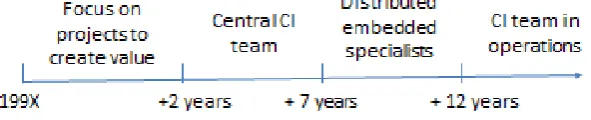
6 a central CI team was established to implement technology change within the organisation.
However, the implementation of CI was not necessarily successful as many staff within GIP felt that CI was forced upon them.
‘We then [in 2002] had a central team and it [continuous improvement] was very much driven by the fact that there was a big technology change. The way
that we look after our data and stuff was … changing. So, there was a big, big
push, a big surge up, it was enforced, “You have to do it this way, otherwise
you’re out”, some people did’. (GIP Staff Member, speaking during the continuous improvement visual management exercise at the ICiPS Networking Event, September 2014)
In 2005, GIP moved away from the CI central team and trained 50 Lean specialists in the principles of Lean. These ‘embedded specialists’ were placed in teams across the organisation to back changes to end-to-end processes using the Lean principles they were trained in. However, the training many of the embedded specialists was not renewed and CI was not a success in some parts of the
organisation.
From 2005 to 2011, the focus of CI at GIP was on the improvement of end-to-end processes, alongside the implementation of new technology and the design and development of a new
headquarters for the organisation. In 2011, the organisation established a continuous improvement team in the Operations department. The main objective of the team was to use CI to improve the end-to-end processes of new and existing products within the Operations department.
In 2014, the team was rebranded as a team providing CI support across the whole organisation. The new team CI was led by a Senior Continuous Improvement Consultant, who managed three
[image:11.595.113.409.636.696.2]Continuous Improvement Consultants and a CI training team. Members of the team facilitated CI team events in the departments of GIP, provided CI reviews of teams, made recommendations for improvements, and provided CI training to staff. Figure 1 shows how GIP has evolved from initial experimentation to a centralised team, to a distributed team, and then back to a centralized team albeit located in operations.
Figure 1: Evolution of the structure of continuous improvement at Government Information Provider
7
3.2 South Yorkshire Police (SYP)
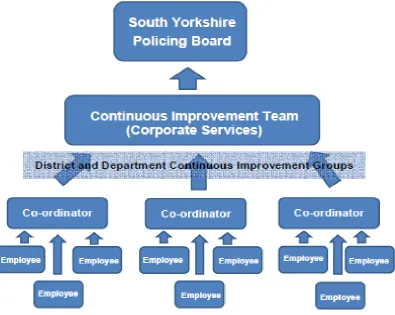
SYP have a centralized team with a Continuous Improvement Manager who manages a team of five full-time equivalent members of staff in the Continuous Improvement Team (the CI Team). The CI Team provides expertise and guidance on end-to-end process change to staff within SYP; and support to continuous improvement groups (CI groups) within the districts and departments of SYP. Thus, providing a service to distributed CI groups throughout SYP (Figure 2).
[image:12.595.99.495.341.656.2]Each district and department within SYP has a CI group consisting of frontline police staff, police officers, and managers, with a senior manager as the coordinator of the group. Each group meets on a monthly to six-week basis to discuss issues regarding end-to-end processes, how to implement process improvements, and any other issues with regard to continuous improvement within that particular department or district. Some CI groups within SYP are well established while other groups are new.
Figure 2: The structure of continuous improvement at South Yorkshire Police
Source: Adapted from SYP Continuous Improvement Strategy, p. 18 and discussions with SYP staff members, November 2014
Each member of the CI Team is a nominated point of contact for each CI group and feeds ideas and issues back to the CI Manager. The CI Manager then feeds these ideas and issues to the South
8
‘In our liaison roles [as nominated CI group point of contact], [it] is [our role to] say
to them [the CI groups] we’ve been allocated to yourselves as the department … [to]
start the long journey to embedding continuous improvement, it’s nothing new, … It’s just to, maybe add it a bit more structure to it [continuous improvement in SYP].’
(Continuous Improvement Officer, SYP, November 2014)
“There is a need for CI within SYP because you can’t keep on the top-down, quite strategic approach, you need the people doing to work to come up with the change
themselves…to get people willing to change, they’ve got to be engaged in change.
The amount of support that districts and departments need as the years progress, that may change as they become more self-sufficient, but they will need some central support as well to drive through change. Central support is in-house and is cheaper than consultancy. CI team knows the history of SYP and members of the
team have ownership of projects to ensure that they work and keep them going”
(Paraphrased from interview with Continuous Improvement Officer, SYP, November 2014)
Since the original research for this paper, SYP has faced significant financial and organisational challenges. SYP no longer has a team specifically designated as continuous improvement, but the organisation remains committed to continuous improvement through its recently restructured Business Change and Innovation function. All members of the new department are involved in projects designed to improve the organisation using continuous improvement methodologies.
3.3 Community Services Provider (CSP)
CSP established the service improvement team (SI Team) in 2009, with a remit to make process and service improvements across the whole of CSP. In the 2015, the team consisted of five members, including the Continuous Improvement Lead (who manages the team, known as the SI team manager), three CI facilitators (who come from a clinical back ground within the Trust), and an administrator who provided support to the team 1½ days a week. Members of the SI Team work with specific services to identify and make process and service improvements.
The aims and objectives of the CSP continuous improvement strategy are overseen by a divisional Operating Steering Group, which monitors and evaluates the work of the SI team. The SI Team has different skills that they bring to the team, for example: information management, leadership and coaching, improvement science, facilitation, coaching ‘lots of different bits’ (Paraphrased from interview with Head of Continuous Improvement, CSP, April 2015). Despite this quite formalised approach the SI Team only focuses on CI in CSP, there is other fragmented support across the rest of the Trust.
3.3 The University of Sheffield (US)
In US, they have a PIU (Process Improvement Unit) that feeds into the Director of IT and the Unit received funding from the IT department after May 2016. In 2015, staff at US noted that having a PIU makes statement of the organisations commitment to CI.
9
3.4 Scottish Government (SG)
The Leading Improvement Team (LI Team) was established by the Scottish Government
Improvement Board in late 2012, to generate the conditions for quality improvement (QI) and help staff within the Scottish Government to implement the 3-Step Improvement Framework through QI. In 2015, the LI Team was managed by the Head of the Improvement Team and the team consisted of 10 Leading Improvement Advisers and administrative staff
The role of the LI Team was to deliver on the following objectives:
1. A capability and capacity building programme to facilitate improvement at all levels of the organisation.
2. A project-based, organisation-wide programme of improvement activity addressing key organisational and policy challenges (Leading Improvement Team, 2015a, p. 1).
Trained improvement advisers who had 8 months of QI training – went out and worked with agencies to build QI capacity and capability and then got momentum underway. The work of the LI Team also supports the four ‘One Scotland’ pillars of public sector reform, as set out by the Scottish Government: partnership, prevention, people, and performance (The Scottish Government, 2014, p. 16).
In SG, most cases seem to need to reorganise over time and use different ways to subdivide the whole organisation. For example, in 2016 since the research for this report was undertaken, the Children and Young People Improvement Collaborative (CYPIC) was formed to include the national programmes supporting early years and education. Working geographically this national QI
programme works to ensure that all babies, children, young people, and families have access to the right support and services with a focus on closing the poverty related gap, and ensuring that all children and young people have equal opportunities for the future. Agencies involved in the programme, known as ‘Community Planning Partners (CPPs), include: social services, health authorities, education services, police, prison service, and third sector organisations in each of the 32 local authority areas in Scotland. In addition, these individuals work together to support improvement across the organisation. A team of Improvement Advisors work directly with local partnership teams to identify areas of improvement priority aligned with the current national focus for improvement. Together the national improvement team and local leaders build and deliver local improvement programmes to increase improvement capacity and take forward improvement activity that can be spread to achieve results at scale. In 2016, the first QI awards were awarded for this focus on improving outcomes for children, young people, and families, providing evidence on the impact of this collaborative approach to drive improvement at scale.
3.5 NHS Blood and Transplant (NHSBT)
Some case study sites take a much more decentralised approach. At the time of the case study site visit in February 2015, continuous improvement (CI) in NHSBT was structured at the directorate level, rather than at a corporate level (Figure 3). Dedicated teams of CI staff were assigned to particular directorates, including the Blood Supply and Diagnostic and Therapeutic Services
10 staff within departments were also trained in CI tools and techniques to provide day to day CI support to teams.
A good example of how CI works in NHSBT at the directorate level is in the Blood Supply Directorate. In September 2009, when three Operations Lead Specialists were appointed to provide dedicated CI support to staff in the five blood manufacturing and testing sites, as part of the Operational
Improvement Programme. From September 2009 to July 2014, the three Operations Lead
[image:15.595.184.429.290.582.2]Specialists, ran 250 CI events with staff, helped to implement a leaner blood manufacturing process called ‘pod manufacturing’, and helped to train seven members of staff as CI facilitators across the five blood manufacturing and testing sites. The work of the specialists was so successful that the team was awarded the HSJ Quality and Productivity Award in 2012.
Figure 3: Organisational structure of NHS Blood and Transplant NHSBT
Source: Interviews with NHSBT staff members, February 2015
11
4.
Tools, Techniques, and Training
This section looks at the extent to which the case organisations deliver their own training or use external trainers. In addition, the methods by which it is delivered for example e-learning, formal teaching, workshops, or games is explored. The content of the training in terms of CI tools and techniques such as mapping and 5S summarised along with who has received this training.
4.1 Training providers
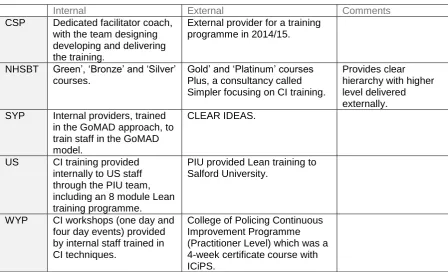
In 2015, the majority of CI training was being undertaken in-house but more than half of the organisations also used, to some extent external training providers [CSP, NHSBT, SYP, WYP & US]. GIP and SG just used in-house training. For example, at SG the LI team provided the CI training and have developed materials, courses, and workshops designed to increase awareness, knowledge, skills, and competencies of staff.
[image:16.595.67.516.360.632.2]The organisations who use a mix of internal and external providers are summarised in Table 3. Some organisations use external providers to deliver higher level course as part of a bespoke structured approach (NHSBT) others have used existing external courses to supplement their own internal material, for example, WYP with the College of Policing Continuous Improvement Programme.
Table 3: Summary of training providers
Internal External Comments
CSP Dedicated facilitator coach, with the team designing developing and delivering the training.
External provider for a training programme in 2014/15.
NHSBT Green’, ‘Bronze’ and ‘Silver’ courses.
Gold’ and ‘Platinum’ courses Plus, a consultancy called Simpler focusing on CI training.
Provides clear hierarchy with higher level delivered externally. SYP Internal providers, trained
in the GoMAD approach, to train staff in the GoMAD model.
CLEAR IDEAS.
US CI training provided internally to US staff through the PIU team, including an 8 module Lean training programme.
PIU provided Lean training to Salford University.
WYP CI workshops (one day and four day events) provided by internal staff trained in CI techniques.
College of Policing Continuous Improvement Programme (Practitioner Level) which was a 4-week certificate course with ICiPS.
Source: Interviews with staff members during case study site visits, November 2014 to April 2015
4.2 Training structure and delivery
12 In terms of structure NHSBT offer a modular course which has been designed to be fit for purpose and have developed an online CI awareness course. This is similar to US, who have an extensive training process is offered over eight modules; Lean overview; Leaning Thinking; Voice of the Customer; Process Mapping, Value and Waste, Workflow; Problem Definition and problem solving; and, Workplace organisation. The US modular course is assessed by a three-month Lean project; and there are 5-6 members of staff on each training course.
Training at SYP is set out and defined and is referred to in their CI Strategy. The training programme is specified and includes GoMad Thinking and CLEAR IDEAS. CLEAR IDEAS has been devised by Dr Kamal Birdy of the University of Sheffield as a methodology for generating and implementing innovative solutions for issues facing the Force. GoMad Thinking is a workshop designed by Andy Gilbert for senior managers to help them enhance their thinking skills through techniques such as clear goal-setting, rapid generation of ideas and development of strong cases for change.
At SG, Objective 1 of the LI Team is to build ‘a capability and capacity building programme to
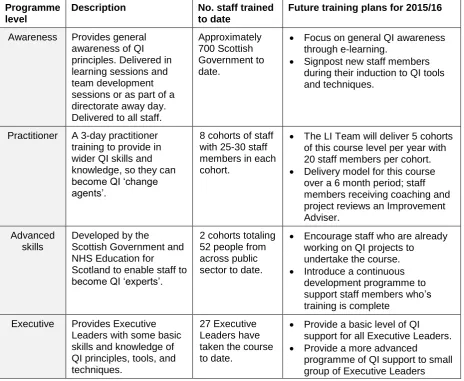
[image:17.595.67.532.390.771.2]facilitate improvement at all levels of the organisation’ (Leading Improvement Team, 2015a, p. 1). To this end, the LI Team has developed a structured training programme for Scottish Government staff who are working on QI projects. The structured training programme is offered to staff at four different levels of QI expertise: awareness, practitioner, advanced skills and executive (Table 4).
Table 4: Quality improvement training delivered by the Leading Improvement Team at SG to 2015
Programme level
Description No. staff trained to date
Future training plans for 2015/16
Awareness Provides general awareness of QI principles. Delivered in learning sessions and team development sessions or as part of a directorate away day. Delivered to all staff.
Approximately 700 Scottish Government to date.
• Focus on general QI awareness through e-learning.
• Signpost new staff members during their induction to QI tools and techniques.
Practitioner A 3-day practitioner training to provide in wider QI skills and knowledge, so they can become QI ‘change agents’.
8 cohorts of staff with 25-30 staff members in each cohort.
• The LI Team will deliver 5 cohorts of this course level per year with 20 staff members per cohort.
• Delivery model for this course over a 6 month period; staff members receiving coaching and project reviews an Improvement Adviser.
Advanced skills
Developed by the
Scottish Government and NHS Education for Scotland to enable staff to become QI ‘experts’.
2 cohorts totaling 52 people from across public sector to date.
• Encourage staff who are already working on QI projects to undertake the course.
• Introduce a continuous development programme to support staff members who’s training is complete
Executive Provides Executive Leaders with some basic skills and knowledge of QI principles, tools, and techniques.
27 Executive Leaders have taken the course to date.
• Provide a basic level of QI support for all Executive Leaders.
• Provide a more advanced
13
• Provide this level of training to 25 Executive Leaders in 2015/16.
Source: Interviews with LI Team staff members during site visit in March 2015, and Leading Improvement Team, 2015a, pp. 1-3
At WYP, the Business Change Team have constructed a framework to identify a variety of capabilities required to successfully deliver improvement initiatives. The capability requirement is split into three expertise levels:
• bronze - providing police officers and support staff with a ‘practical’ awareness of CI tools and techniques.
• silver - providing police officers and support officers with a ‘practical’ capability in the use of CI tools and techniques;
• gold – to ensure principle leaders in change have ‘specialist’ capability in the use of CI tools and techniques.
The principle leaders in change within the BCT have developed their range of capabilities through a variety of formal training, education, and practical application, including training from on the Continuous Improvement Learning Programme, which used to be provided by the College of Policing. The training involved four weeks of practical training in Lean tools and techniques which were particularly applicable in a police environment.
Training style
In addition to formal class-room teaching and on-line learning training is also delivered in other ways mainly games, CI events, coaching, and projects. Such as the Lego games and the beer game are often used as CI. CSP use these types of games and US use a Lego game. The advantages of using these games that simulate CI environments are that they can be designed to emulate real life situations but take less time and have lower risk to allow people to try out ideas. Games do not have a direct impact of the work environment unlike events and projects which usually overlap real implementation.
The use of events such as Kaizen Blitz (also known as PIA, RIA, PI events etc.) is often associated with CI. CSP, SG, US, WYP and NHSBT ran events, often numerous, for example NHSBT ran 250 events from September 2009 to July 2014. The main focus of such events is to make real improvements to existing processes but often they include a training element too (Bateman and Industry Forum 2001).
Most projects in training terms are used at the proof of competency at the conclusion of a training scheme for example by US. SG have a RAFA (Raising Attainment for All Programme) programme team who work with teams in each school to develop their QI skills.
14
4.3 CI Tools provided in Training
[image:19.595.72.520.167.318.2]A myriad of training methods are employed at the sites including general awareness training to give an overview to specific tools and techniques (Table 5). Some are specific to CI and lean such as 5S others are drawing on a wider approach but considered useful such as Theory of Constraints (TOC).
Table 5: Tools and techniques delivered in training
Case study org.
PDCA/ PDSA
A3 How to use data Mapping and process diagrams Waste and value
Flow 5S Visual manage-ment Problem definition and solving Lean training (e.g. black belts) TOC
CSP • • • •
NHSBT • • •
GIP • • • •
SG • • • • • •
SYP • •
US • • • • • • • • • • •
WYP • • • • • • •
Source: Interviews with case study organisations, November 2014 to April 2015
In addition, NHSBT – Operations and Lead Specialists helped to train seven members of staff as CI facilitators across the 5 blood manufacturing and testing sites. At SG, staff were trained through the LI Team as Improvement Advisors as part of the Early Years Collaborative Programme.
4.4 Profile of trained people
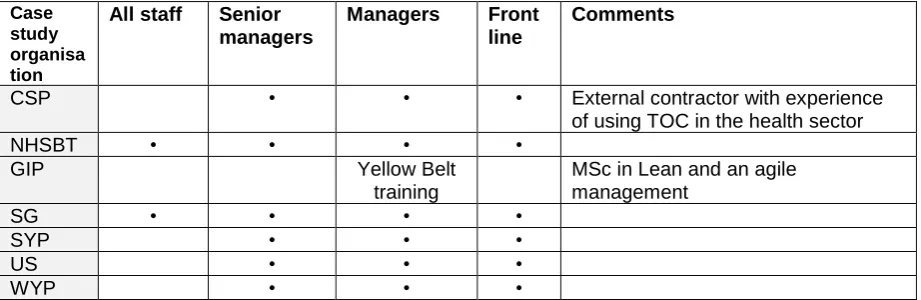
As seen in the training structure section different types of training is delivered to people in different roles (Table 6). Categories of roles are typically denoted as; all staff, senior managers, managers, frontline staff, and CI specialists.
Table 6: Summary of who is trained
Case study organisa tion
All staff Senior managers
Managers Front line
Comments
CSP • • • External contractor with experience of using TOC in the health sector
NHSBT • • • •
GIP Yellow Belt
training
MSc in Lean and an agile management
SG • • • •
SYP • • •
US • • •
WYP • • •
Source: Interviews with case study organisations, November 2014 to April 2015
5.
CI Tools
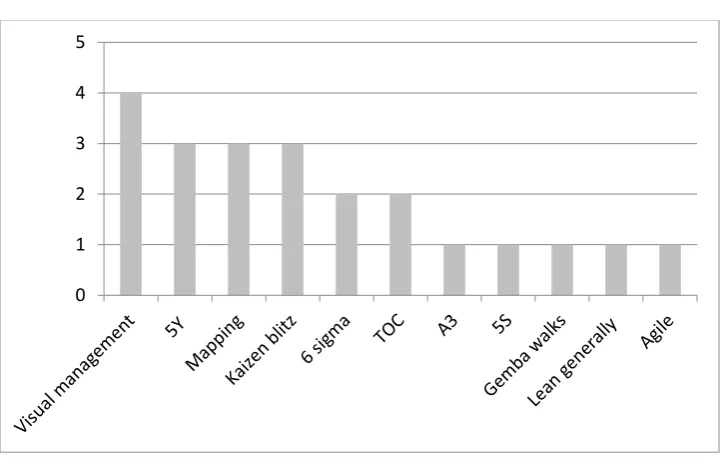
[image:19.595.67.528.486.636.2]15 organisations themselves. For example, one organisation mentioned Kamishibai boards which are a form of visual management so these have been logged as in the visual management category. It is interesting to note that all these tools and techniques apart from 6 sigma, Theory of Constraints (TOC) and agile are associated with a lean approach. There are some tools which are trained but not mentioned in use specially: PDCA, ‘How to use data’, Waste and value, flow, and Problem definition and solving.
Figure 4: Frequency of use of tools mentioned in interviews
Source: Interviews with case study organisations, November 2014 to April 2015
An overarching approach such as Lean, TOC, or Agile is mentioned by some organisations, for example, the main approach used in GIP is Lean, and US embed Lean in the divisions is part of the CI Strategy. Although GIP also report using 6 sigma and Agile too.
Other organisations take their own systematic approach for example SG use a 3-Step Improvement Framework to make QI changes. The 3-Steps are:
1. Change the world;
2. Create the conditions; and, 3. Make the improvement.
Staff need to use these in any QI project. Step 1 provides staff with a set of seven action points to enable them to understand what they want to achieve from the QI project and how they might achieve the aims of the project. Step 2 provides staff with six questions to help them identify if ‘true’ QI change can be made through the proposed project. Step 3 provides staff with a model to test and implement QI change at the local level and that the improvement is sustainable.
QI project work is also underpinned by the Scottish Approach Government Model (the Approach Model). The Approach Model enables staff to assess the possibilities for Scottish Government customers and services users to actively participate in the planning of a QI project. Participation is assessed using three categories: assets, co-production, and improvement. Staff can then use the ‘Ladder for Participation in Planning’ (this ranges from information dissemination to citizen control)
16 to see the level of active participation they feel is appropriate for customers and services users to be involved in.
At WYP, CI projects which form part of the PoC are currently managed using a defined project management methodology. This project management methodology is based upon PRINCE 2 principles. There are three distinct stages to the PoC project methodology: formulation,
implementation and evaluation. At each stage of the project management methodology there are defined phases and key members of staff involved. For example, in the ‘Start up’ phase of the formulation stage, the Programme of Change Board (PoCB) and the Chief Officer Team need to initially approve the project. Within this context WYP a wide range of other tools are used on an ad hoc basis appropriate to the issue at hand.
‘[There are] lots of tools and techniques mixed into one. Need to understand the strengths of different models and decide on the best combination of
tools’. (Paraphrased from interview with Corporate Business Change Lead, WYP, April 2015)
CSP use the Theory of Constraints (TOC) to refocus the work of the team and identify ways to make service improvements across CSP).
‘We looked at the Theory of Constraints, we thought it made a lot of sense, we knew there was so much to go at, that where do you start? And there is this sort of elephant in the room that was the timeliness of services had a big impact on quality [of service]’. (Head of Continuous Improvement, CSP, April 2015)
US also use TOC and one of the objectives of the CSP QI Strategy is “[t]o work with staff in using the Theory of Constraints to identify the system constraints in effective, efficient service delivery, and to then employ appropriate [continuous] improvement approaches to diminish or overcome these constraints.”
Other organisations have taken their own approach to how to select which tool to use - SYP use a programme called CLEAR IDEAS as a way of using lots of techniques. Whereas others rely on staff selecting appropriate tools, at NHSBT, they use a variety of techniques (with staff being encouraged to use these tools and techniques to find the right solution for the problem, rather than trying to get the problem to fit the tool).
‘Not getting hung-up on one methodology, which a few people like to do.
But making it right for the problem … rather than trying to get the problem to fit the tool’. (Continuous Improvement Lead, NHSBT, February 2015)
17 At CSP, information from the performance buffer management system was fed into a performance measurement dashboard in MS Excel to understand where staff had capacity for patient
appointments, where staff resources were overstretched, and the causes for delays to patient care. Within the MS Excel dashboard, a traffic light monitoring system of black (outside the range of the tolerance of timeliness of care), red (just within the range of tolerance of timeliness of care), amber (partly within the tolerance of timeliness of care) and green (within the tolerance of timeliness of care) is helping the SI Team and staff to identify were services are working well and not so well.
‘Looking at timeliness of care – a single list, clinically appropriate dates, blurring the edges on flexibility of resource, being able to see the resource,
having some nominal timelines … and this kind of buffer management – that is effectively if it comes to a staging post and its [timeliness of care] is behind time, it’s going to change the end time, and capturing the reasons,
so we can then say what are our top reasons for delay. Because they are our
bottlenecks’. (Head of Continuous Improvement, CSP, April 2015)
WYP developed their own value-stream mapping tool (online tool). They use the tool in different areas, for example, the local policing review. However, this review applied a myriad of specialist tools and techniques including demand/resource modelling, e.g. incident management. The goal of the tool was to understand resource usage, and to inform local operational managers, so that they can make more effective use of resources. Other types of maps such as empathy maps are used by US to understand the customers’ perspective. They also identify the process waste and value.
6.
Successful CI Projects
18
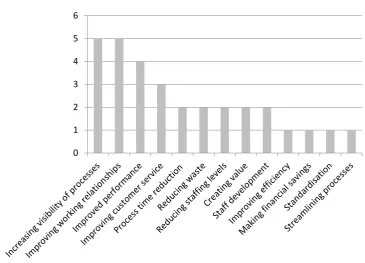
Figure 5: Summary of CI project benefits mentioned in interviews
Source: Interviews with case study organisations, November 2014 to April 2015
6.1 Increasing visibility of processes
Increasing visibility of processes was identified as one of the most common benefits from doing CI projects, this reflects the frequent use of visual management tools in Figure 4. Increasing visibility enables better decision making (Bateman, and Lethbridge 2013).
At US, the visa project (CI project looking at how the university manages the visa requirements for students that need visas) proved useful to see what the issues were across the departments. It enabled them to identify staff difficulties and to work out the best way forward for the University. In addition, they successfully completed a review of the one-off payments system to see where processes could be improved. This system was employed to pay individuals or one-off organisations, which fell between accounts payable and payroll, through a system called 'One time vendor'. The CI team looked at what the system was being used for and looked at whether needed to do things differently e.g. overseas students hosted with local houses and families were managed through English Language Teaching Centre, who made payments to people offering home stay for foreign students. The CI team found that the process was bureaucratic and that there was an excess of administrative capability.
At CSP, the SI Team worked with staff in the Children’s Speech and Language Service (CSLS) to undertake the first service-wide review using TOC. The aim of the review was to use TOC to provide a visible performance mechanism, to enable staff to track a patient’s progress through the service This involved members of the SI Team working with CSLS service staff to understand a patient’s journey through the healthcare system, identify the main causes of delay and target service improvements to increase timeliness of care for patients (CSP, 2015). The CSLS service review provides a good example of how the SI Team are helping staff within CSP to identify quality and service improvements across the whole of the division.
19
‘Looking at timeliness of care – a single list, clinically appropriate dates, … being able to see the resource, having some nominal timelines … and [being able to see if] it is behind time, …. we can then say what are our top reasons
for delay. Because they are our bottlenecks’. (Head of Continuous Improvement, CSP, April 2015)
During the site visit to GIP, the staff from the CIS team discussed how the team has had issues identifying and measuring the impact of the work it does. One way the team has tried to solve this problem, is through the recent development of a visual management board for the team. The visual management board has enabled staff within the team to understand what projects they are working on and what the intended impacts and benefits of each project will be.
6.2 Improved working relationships
Improved working relationships were also identified as one of the most frequent benefits from CI projects
At US, a project looking at casual workers recruitment and pay brought together representatives of different academic departments to find better ways of working together. Similarly, another project brought together HR, finance, academic departments and CiCS to roll out staff expenses online according to the Director of Finance:
‘Putting people into a room, not losing the end site of what need to achieve while looking at the process’. (Paraphrased from interview with Department Director, US, April 2015)
At NHSBT, members of the Operational Improvement team in the Blood Supply directorate worked with members of the HR department to run a CI event to look at the staff absence process. During the event, members of staff from both teams worked together to looked at steps and rework the staff absence process.
At SG, the Permanence and Care Excellence (PACE) programme was a collaboration between Scottish Government policy team and SG LIT, to look at the length of time it takes a looked after child to achieve the stability of a legally secured permanent home (Kinship care, foster care or adoption). This was a whole system approach, owned by a whole range of partners and agencies (e.g. Courts, Social Care, children’s hearings, health, education). Working in partnership with Centre of Excellence for Looked after children in Scotland (CELCIS) based at Strathclyde University, they looked at how improvements could be made by looking at the interconnections between the legislation and the professionals involved.
In addition, their ‘Raising Attainment for All’ programme, which built on the work of the EYC (supporting consistent improvement in attainment and achievement through the development of collaborative learning system) necessitated a number of groups to work together, such as schools, partner agencies, and parents and children.
6.3 Financial savings
20 improved performance or efficiency would tend to imply financial savings - or could be because financial savings were hard to assess. The causes of this later possibility may be lack of suitable financial instruments to assess CI improvements or the process of financial assessment was seen as a lower priority than putting resource into conducting the improvements.
7.
Factors contributing to problems and issues
A number of barriers to implementing successful CI projects were identified from the sites. The main reasons highlighted were:
• Lack of leadership (US, NHSBT, GIP, SYP);
• Staff resistance (GIP, CSP, NHSBT, SG, SYP, WYP);
• Problems quantifying benefits (SYP, GIP, NHSBT, SG, WYP);
• Lack of understanding and organisational mistrust (CSP, SYP, NHSBT); • Lack of resources (SG, WYP); and,
• Lack of cohesion (CSP, SYP, SG, WYP, NHSBT, US).
Many of these barriers are well known in the CI community and so this report will focus on staff resistance, problems with quantifying benefits lack of understanding and organisational mistrust and lack of cohesion.
7.1 Staff resistance
Many organisations face the challenge of sustaining CI with a reduced workforce as a result of public sector cuts. Staff often saw CI as a mechanism for negative change rather than a change for good. At CSP, a number of issues relating to staff resistance were identified: (i) staff likened the
implementation of processes to the idea of big brother watching; (ii) the CI team were only engaged with pockets of the organisation; and (iii) there were problems with finding the right staff.
Issues of gaining and keeping control were identified as an issue by the CI teams at SG and WYP. In addition, WYP also identified there was also a lack of staff engagement because there was also a fear of CI in terms of job losses along with constant change fatigue. Also, that staff often ‘reverted back to type’.
At SYP, staff felt pressured to take time out of their day to attend CI groups at a time when staff cuts led to increased workload to the extent that in some areas, and there has been variable support for CI groups
“The starting point was that we had a CI strategy and there was an
21
7.2 Problems quantifying benefits
The lack of financial benefits identified in the benefits is reflected here as a barrier and staff at SYP and SG
‘People don’t seem to value QI. QI [should be] part of [the] civil service competency framework. A lot of people not willing to sign up to QI until they can see how it works’. (Paraphrased from interview with Head of Continuous Improvement, SG, March 2015)
7.3
Lack of understanding and organisational mistrust
At CSP, it seems that there is a lack of understanding of the core principles of CI by frontline staff, senior management, and clinicians (clinicians referred to CI as being ‘dehumanised’).
‘Some of the problem is its [continuous improvement] almost dehumanised to
clinicians. Clinicians have to…make that [continuous improvement] relevant
[to the patient], what we [the SI Team] are doing is actually making it better for the patient, otherwise it [continuous improvement] gets lost’. (Continuous Improvement Officer/Adviser, CSP, April 2015).
There is also organisational mistrust about what is done with the information gathered during these exercises. Some of the problems at the SYP sites were caused because the CI team were not involved in some of the changes. The teams implementing the changes did not have formal experience of organisational change methodologies and so were unable to implement CI changes successfully. This would have had a negative impact on staff watching to see how these projects panned out. NHSBT, there was also confusion amongst frontline staff due to the myriad of quality and service improvements and at SG, there were issues about pace. The LI Team staff felt that where individual QI projects had not been a success, this was due to the Improvement Framework being applied incorrectly and that projects “[moved] too fast and expect too much, too soon [from the Improvement Framework model]“. (Paraphrased from interview with Continuous Improvement Project Manager, SG, March 2015). Staff expected to be able to ‘retro-fit’ a QI framework to a project too late in the day.
7.4 Lack of cohesion
Cohesion of implementation is clearly linked to effective CI strategy but also from the cases
demonstrate how this is understood by everyone is also important. There also seem to be issues of competing between elements of organisations.
At CSP, the SI Team are only engaged with pockets of the organisation and support is fragmented. There is a CI strategy for CSPs but not for the whole of the Trust. There is a lot of different work going on in terms of different NHS quality and service improvements. At SYP, the team have
22
8.
Maturing level of CI
The maturity of CI ranges from those organisations that are at the early stages of their CI journey to those that are more embedded. None of the organisations self-identified as “mature”, rather they described themselves as either at an early stage or with patchy maturity.
SYP, WYP and SG described themselves as immature. At SYP, staff felt that the organisation was very much at the start of CI journey. According to the CI self-assessment scale from the College of Policing (derived from NAT process improvement maturity), SYP were at level 2 (with level 1 indicating no maturity and level 5 full maturity). SG described themselves as:
‘[Early], but not as early as it was before…[the] last 4 years [there has been]
greater buy-in from the senior levels, genuine resource and senior managers
are ‘talking the talk’ in terms of QI’ (Paraphrased from interview with Continuous Improvement Officer/Adviser, SG, March 2015).
8.1 Variance of CI maturity:
Across the case organisations there was an acknowledgement that the maturity levels varied more than preferred across different departments
In 2015, at SYP, CI was devolved to districts and departments and staff report that in some areas there has been a complete lack of buy-in. During the site visit staff discussed how some staff members understood continuous improvement well and made successful changes to end-to-end processes, where as other staff not did understand how to implement continuous improvement changes successfully. They also felt that that police staff and police officers needed to work together more on continuous improvement projects.
Staff also felt that some managers within SYP were advocates of continuous improvement and supported their staff to make change process changes; while other managers were wary of continuous improvement and the affects it can have on staff and their day to day work.
At NHSBT, CI was well established and embedded in certain parts of NHSBT, including the Blood Supply Directorate, but is at an early stage in departments such as Logistics. Where CI was firmly embedded at the directorate level, the organisation has a well-established directorate-level CI strategy, dedicated CI staff support and CI made a real difference to services within the organisation. Staff felt that where CI was embedded, they were able to make improvements on a day to day basis.
‘I always say to people, that doing Lean, continuous improvement, is fifty
percent science, you’ve got the toolbox; and fifty percent art. … So, I think there is an element of the organisational capability and capacity to deal with
the more complex elements, grows overtime, it’s not something you that tend to go straight in and be able to do, because you don’t have that training and experience’. (Interview with Continuous Improvement Lead, NHSBT, February 2015)
In addition, NHSBT’s CI strategy refers directly to embedding a culture of CI:
“The culture of an organisation is the emergent product of the typical
23 the force progresses towards an embedded culture of continuous improvement,
it must focus on creating the conditions that enable a culture of continuous improvement to flourish through incremental changes in the conditions of its
employees” (CI Strategy, 2014-2016, p.5)
Patchiness in maturity was also found at CSP where staff felt the culture and maturity of CI was more embedded in certain parts of the division, such as the Children’s Speech and Language Service, where the service review had been undertaken, but it was not so embedded in other parts of the division where service reviews had yet to be undertaken. One member of the SI Team believes that overall, progress has been made:
‘Certain elements have stuck, things about seepage. … Talking about CI with
staff, CI wasn’t embedded, not understood, or acknowledged at any level. Level of normalisation to service improvement has increased. CI [is] now more embedded’ (Paraphrased from interview with Head of Continuous Improvement, CSP, April 2015).
9.
Case organisations future of CI in 2015
In 2015, the case organisations generally had confidence and an optimistic outlook at to the
relevance and impact of CI on their organisations. Their plans for the future generally fell into three categories: spreading CI throughout the organisation, evidence based approaches and tool selection, and how to deal with financial and resource constraints.
9.1 Spreading CI through the Organisation
Variance in the maturity of CI across organisations was identified as an issue in section 8. Maturing level of CI, and spread of CI approaches was identified as a way to address this. However different approaches on how to spread CI were planned.
In 2015, SG planned to offer a comprehensive learning package for all levels of employees shown in Table . During the site visit in 2015, interview participants, hoped to build capacity and capability in QI, developing advanced level training in QI across public services in Scotland, and continuing improvement boot-camps and local coaching mechanisms. In particular, it was hope this would deliver:
• Coaching and mentorship for team of improvement advisors; • Expert strategic guidance for key projects and populations; • Development of the EYC learning system; and,
• Leadership engagement and development. It was hoped that this would result in;
‘Organic spreading out of [quality improvement across the Scottish Government]’ (Continuous Improvement Officer/Adviser, SG, February 2015)
24 develop the framework and the proper structure for CI across all directorates. The Team were also aiming to work towards embedding CI in each directorate.
In SYP, there was a desire for spread to come from individuals by embed CI further through the CI groups and their training programmes.
‘There is a need for CI within SYP because you can’t keep on the top-down, quite strategic approach, you need the people doing the work to come up with the change themselves, one person could come up with something quite revolutionary or minor. To get more people willing to change,
they’ve got to be engaged in change’. (Paraphrased from interview with Continuous Improvement Officer/Adviser, SYP, November 2014)
In 2015 at GIP, the continuous improvement team planned to offer teams workshops to look at their processes. The team also intended to keep things low-key, with their yellow belt training. The team hoped this would give staff the basics of CI, to enable CI to ‘stick with staff,’ and the expectation was that CI would spread to the regions and field staff.
‘[Embed] CI with more people, to engage staff more in CI, [and] spread to the regional areas that GIP operate in’ (Paraphrased from interview with Continuous Improvement Lead, GIP, December 2014).
9.2 Evidence based approaches
Section 7 Factors contributing to problems and issues identified assessing the benefits of CI was a problem, so some of the case organisations planned a more evidence based approach in 2015. Staff at SYP planned to use more evidence-based analysis of programmes and to assess the impact and benefits of CI within the organisation. They also planned to produce a log of CI initiatives, and to review the log and look at the lessons learned. They also planned using formal reviews and closure reports to look at financial, customer and performance outcomes.
At SG, monitoring was considered by interview participants to future CI initiatives from 2015 onwards. For example, the next steps of the EYC programme, included the development of data collection protocols and performance measures to assess the improvements being made against the Key Change Themes and EYC Stretch Aims.
9.3 Tools selection
Section 5 - CI Tools identified different approaches to how to select tools and some of the case organisations plan to take a more structured approach to this.
At NHSBT, the CI Team decided to take an eclectic approach to the tools they used. One member of the team emphasised that they should:
‘[Not to be] getting hung-up on one methodology, which a few people like
25 With this in mind, part of the CI Team’s remit from 2015 onwards, was to look at the CI tools that were available and how the CI tools might have been used as part of a corporate strategy (CI was elevated to corporate level – see below).
9.4 Financial and Resource Constraints
The tight budgetary environment has been a theme throughout the report and the case organisations reflected that in their future plans from 2015 onwards, particular emphasis upon tightening budgets would force people to look at CI as a way to deliver services with limited resources.
At US, it was considered budgetary constraints would force people to do CI. At WYP, it was likely the role of the BCT would become increasingly important in the future as WYP sought to meet the challenges of reducing its current budget by 36% by 2016/7, while ensuring the organisation could still deliver the services local communities need and require.
At SYP with the number of staff shrinking in 2015, and those remaining being under considerable pressure, the ‘role of [the] CI team is to help staff, to look at ways of making their working days better’ (Paraphrased from interview with Continuous Improvement Officer/Adviser, SYP, November 2014).
Members of the SI Team at CSP, felt that the team’s role would get busier and busier, from 2015 onwards, as financial constraints placed more pressure on the NHS to find financial savings and better ways of working and that CI initiatives are also driven by financial constraints.
Despite these pressures there was still an aspiration to maintain service levels. At SG, the LI team hoped to provide sustained improvements to services and provide value for money to customers and service users, on a day-to-day basis. The focus would be on high impact interventions. At WYP, the Business Change Team’s priority was to ensure that the organisation could still deliver the services local communities needed and required whilst at the same time looking at how processes could be made more efficient.
‘I think [continuous improvement] is really important because of the
situation we find ourselves in. I think historically we always had mobile resources to throw at a crisis allowing us to handle peaks in demand. We are now trying to smooth the curve so that we can deal with spikes more
effectively’ (Pararphrased from interview with the Director of PoC, WYP, April 2015)
10.
Reflections and Status of CI in Public Services
In 2015, at the time when the research for this report was undertaken, staff within the case
26 between CI delivered at the centre, where staff and resources are often specifically set aside for CI; and more localised CI which is often done on an adhoc basis by staff. This creates a different story or journey for CI within each public service organisations (again this is reflected in the case study organisations). There is no consensus as where CI expertise should be housed either among the cases, wider practitioners, and the academic literature. But the tension caused by this is
acknowledged in other countries, for example Norwegian public services (Holmemo and Ingvaldsen, 2017).
Public service organisations carry out CI training and have the skills and capacity to deliver in-house (formal and in-formal). When outside provides are used this is often a provider with specialist CI skills, brought in to train staff in certain CI techniques; to then enable these members of staff to become CI champions or facilitators, who can then train other members of staff in these techniques. The case study organisations used a wide range of CI tools and techniques. The most popular was Visual Management (VM) which has been receiving more attention from researchers recently for example Bateman, Philp and Warrender (2016) or Beynon-Davies and Lederman (2016). Given VM’s success rate, popularity, and wide applicability ICiPS members would benefit from the latest thinking in this field.
In terms of other tools and techniques there was a frustration among the case organisations, that benefits were hard to quantify. This is not peculiar to public sector organisations as accounting practices in this area have not been formally codified (Maskell and Kenned, 2007). However, given the heavy financial pressures and public accountability on ICiPS members, development in this area, perhaps in association with the accounting professional bodies such CIMA, might be valuable. This would support a more evidence-based approaches to CI in the future.
27
References
Bateman, N. A. and Industry Forum, SMMT (2001) Sustainability: A Guide to Process Improvement, Lean Enterprise Research Centre, ISBN: 0-9537982-2-4.
Bateman, N. A and Lethbridge, S (2013) Managing operations and teams visually. In Bell, E, Schroeder, J., Warren, S (ed) The Routledge Companion to Visual Organisation, pp.289-305, ISBN: 9780415783675.
Bateman, N. A., Philp, L, Warrender, H (2016) Visual management and shop floor teams –
development, implementation and use, International Journal of Production Research, 54(24), pp.7345-7358, ISSN: 1366-588X.
Beynon-Davies, P. and Lederman, R. (2016) Making sense of visual management through affordance theory. Production Planning and Control (10.1080/09537287.2016.1243267).
Fryer, K. J., Antony, J., & Douglas, A. (2007) Critical success factors of continuous improvement in the public sector: A literature review and some key findings. The TQM Magazine, 19(5), 497–517. https://doi.org/10.1108/09544780710817900.
Holmemo and Ingvaldsen (2017) ‘Local adaption – central confusion. Challenges of decentralized strategies for public service sector lean implementation.’ Public Money & Management Nov 2017.
Maskell, B.H. and Kennedy, F.A., (2007) Why do we need lean accounting and how does it work?. Journal of Corporate Accounting & Finance, 18(3), pp.59-73.
28
Appendix 1 Case organisations details
Organisation Acronym Number of
employees (approximately)
Started CI (approximately)
NHS Blood and
Transplant NHSBT
6,000 in 2015 2009
Community Services Provider, NHS Foundation Trust
CSP
Information not available
2009
Government Information Provider
GIP
Information not available
Late 1990s
Scottish
Government SG
Information not available
2013
South Yorkshire
Police SYP
5,000 in 2015 2013
The University of
Sheffield US
7,423 staff members and 26,309 students in 2015
2012
West Yorkshire
Police WYP
5,000 Police Officers and 3,800 support staff in 2015