Rochester Institute of Technology
RIT Scholar Works
Theses
Thesis/Dissertation Collections
5-15-2014
Intimate Sensibility
Aya Oki
Follow this and additional works at:
http://scholarworks.rit.edu/theses
This Thesis is brought to you for free and open access by the Thesis/Dissertation Collections at RIT Scholar Works. It has been accepted for inclusion in Theses by an authorized administrator of RIT Scholar Works. For more information, please [email protected].
Recommended Citation
Rochester Institute of Technology
A Thesis Submitted to the Faculty of
The College of Imaging Arts and Sciences
School for American Crafts
In Candidacy for the Degree of
Master of Fine Arts
Intimate Sensibility
by Aya Oki
2
Thesis Title: Intimate Sensibility
Student Name: Aya Oki
Thesis Committee Final Approvals
Chief Advisor: Michael Rogers _______________________________
Print name Signature
Date: ____________________________
Associate Advisor: Robin Cass _______________________________
Print name Signature
Date: ____________________________
Associate Advisor: Andy Buck _______________________________
Print name Signature
Date: ____________________________
Chairperson: Carlos Caballero-Perez _______________________________
Print name Signature
3 Abstract:
In my thesis body of work, I propose to create glass sculpture and express the nature of glass using the sensuality that comes from my personal process and interaction with the medium. I am stimulated by my five senses, they create a sensorial experience that brings out the lifelike qualities I see in glass. These senses and experiences reveal the glass qualities: puffy, stretchy and squishy. These characteristics of glass are the focus of my thesis exploration and revealed through an intuitive approach.
For me, the sensuality of glass is revealed through an intuitive approach which is stimulated by my personal experience and environment that I have lived in. This process helps to manifest my ideas; sensuality comes forth through the act of making. My interest in glass derives from its lifelike qualities, unique properties and essential materiality. These are the qualities that appeal to me. For me, glass has a corporeal quality that is sensual and that imbues it with a relationship to the living and natural world.
As a result, my work is very organic and natural; I allow glass to respond to the gentle opposition that I apply to it. I set up a situation for the glass to respond to, and let it go. By actions such as pushing glass through created structures, I achieve a moment when the glass responds to my creativity. My intentional control of glass and its physical
4
Ⅰ
My thesis investigates the nature of glass through exploring interactions between the material and various processes. In the same way people are impressed by natural phenomena, I want my audience to be impressed by the interaction between the material of glass and particular processes. When developing aesthetic responses, people use all five of their senses. In the same way, I let glass stimulate all five of my senses and awaken my emotions.
Everyday we see glass objects, glassware, vases, and windows. In these ordinary objects the characteristics in glass are unnoticed, but when used in art, these qualities become impressive and full of possibilities. Glass has always responded well to my creativity. Each time I work with glass it is like having an exciting conversation with a good friend and I aim to share that with my audience.
Glass is a traditional craft material like clay, wood or metal. Just as some artists in these traditional media are trying to elevate the potential of the material to an art form, I am also trying to transform glass into art. At the same time I want to show people the compelling expressive potential of glass. What I get from glass is that it has a corporeal quality which is organic; it is a very sensual material that stimulates my sight, hearing, taste, smell and touch. The glass eventually reveals its character: puffy, stretchy and squishy. Because of the lifelike qualities of glass, what exists is a relationship to the living and natural world. Moreover, glass has those qualities, they give me sensorial experiences. Glass speaks to me when I work and the more I have a conversation with glass, the more the glass responds to me.
5 In my thesis show I wanted my audience to see those interactions and understand the uniqueness of the glass and express the sensuality in the glass sculpture that is revealed from an intuitive approach that stimulated my five senses. The process of work develops my intuition so my act of making reveals the sensuality. When intuition and sensuality merge it is at that moment that I express my individuality in glass. I believe my artistic intuition consists of my own life, experience and environmental, that I have lived. The work is about me and my identity. The process and intuition have an important relationship.
In the end, my intention is to mix traditional and experimental glass methods to push the materiality of glass and show it in a new and different light. Everytime I work with glass, it pushes me to further explore its materiality based on the test results. Capturing the materiality is not a traditional approach to working with glass, but it is a profound experience between glass and me.
Ⅱ
When I started working with glass, I focused on the process of glassblowing. I made functional glass objects such as plates, cups, vases and so on, because the process that makes those objects was very intriguing to me and I wanted to learn the techniques. When I think back now, I was beginning to understand the materiality of glass through those functional objects. Technique is necessary to make functional pieces. In other words, it is action that captures the materiality of glass. As a result, every time I learn new techniques, I understand and learn more about the materiality of glass. Even now, I am still learning about glass to create my abstract work. The more I learned about glass the more it made me want to focus on abstract work that expresses the characteristics of it.
6 that sensibility. I play with the material using my five senses and whatever speaks to me I pursue until I feel it is completed. The passion I had when I was a child is the same as the passion I have for glass. I hope to always have the same urge to play and sense of humor and curiosity that I had as a child when exploring the material of glass in my current work. This is the origin of my work and this sensibility has not changed. Therefore, the way that I express my glass work is first to explore the material and then develop a concept. What I do in the beginning is to learn about the materiality, to think about how I can innovate with the material. That is the reason I have so many test pieces in my studio. They lead me to discover the idea that I wish to explore further.
I remember when I was in preschool, I really enjoyed making balls of mud. I found clay to make the balls, then I made very fine sand by rubbing my own shoes on an earthen pipe. I put the sand around the mud ball so that it made a smooth surface and became much stronger. The more I rubbed the sand, the smoother the ball of clay became. Through this process, playing with the mud ball and touching it everyday, I learned the techniques to make the form, surface and strength of the mud ball. This is what is
happening to me now. I am always in the glass studio playing with the glass, observing my work and aiming to acquire a sensuous piece.
Glass is a very entertaining material because it does not have many limitations. Every time I work with it and think of a new idea it is like having a conversation. In a Japanese book called White, Kenya Hara, there is an expression, “a-un-no-kokyu” which can be explained “as a process of sending and receiving” [Hara 2010]. When this
communication occurs simultaneously that is the moment that understanding between the glass and I occurs. This “a-un” moment can happen at any time during the process. I introduce my idea or feeling and the glass then responds to me. After several conversations with the medium, various test pieces are made. Eventually, I can create a test piece which I use to better understand how the glass will respond and how far I can push it. I want to challenge my medium to find its limitations and expand upon what we already perceive its limitations to be.
7 It is an organic shape and I look for the moment when attitude become form. Glass is similar to the human body in its ability to be constricted. It can be puffy, stretchy and squishy. It can shrink and droop. Those characteristics touch my five senses and sensibility and enable me to have ideas for my work.
My research centers around various contemporary artists and how they make their medium interesting by using it in unique ways or by pushing their medium to its limit. By seeing how other artists challenge their medium in new and interesting ways I am inspired to do the same with glass. Artists that inspire me are Andrew Kudless, Tara Donovan, Ernesto Neto, Erwin Wurm and Daniel Arsham.
Andrew Kudless is an architect and designer and is interested in the conflicting interaction between materials. His work explores material processes and systems of life and it reminds me of my own intention. Particularly, I am impressed with his work called “P_Wall”. It shows the potential of cast material to be sensual, and demonstrate corporeal quality and human flesh (Figure 1) [MATSYS 2013].
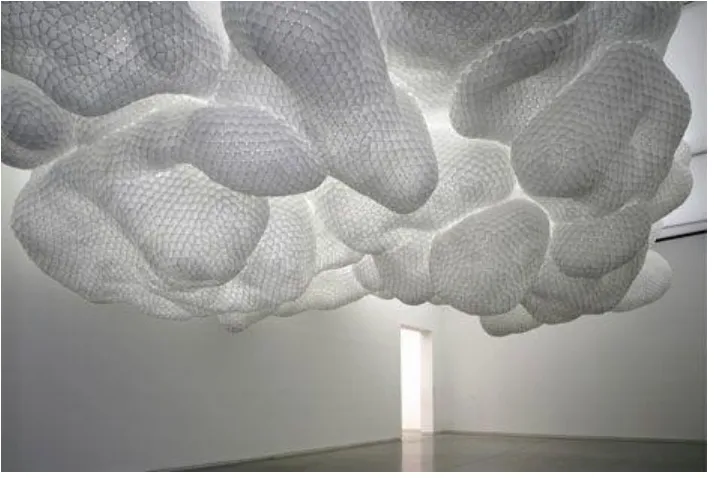
Tara Donovan is an American sculptor who makes installations using common materials. She turns things such as straws, cups, paper clips, and even rolls of tape into amazing installations. I was really interested in her use of assembly to create larger works. Gathering pieces makes the object have a totally different feeling and different quality to the work than if it were made of just one piece. Also, it talks to what the meaning of work is (Figure 2) [Price 2012].
Ernest Neto is known for his work with abstract minimalism. He uses installation to create abstract works. One interesting thing about Neto's art is that he sometimes allows the audience to interact with his work. This interaction allows for his work to reach a higher level of meaning for his audience. His work inspires me to focus on how the material relates to our senses. Not only using a brain to enjoy the art but also using the senses to feel the art (Figure 3) [Kittle 2014].
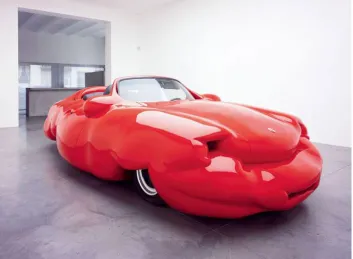
8 really having a lot of fun making his art, and in turn, makes it that much more fun to see (Figure 4) [Zuspan 2008].
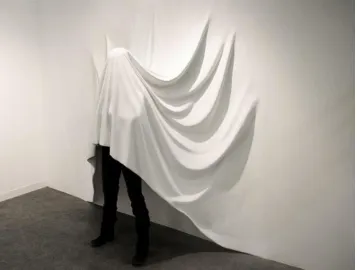
Daniel Arsham is an artist known for taking the familiar and mixing it with the surreal. He considers his work both as art and as architecture. What I find most
interesting about this artist is that his art changes our perception of what we think we are familiar with or at least adds new meaning to what we think we know (Figure 5) [BAYNE 2011].
I am inspired by these artists but also, I was influenced by a Japanese concept. I learned about it when I was at the Aichi University of Education, Japan. In the book, Modern Craft Art Japan:works from the Crafts Gallery, the National Museum of Modern Art, Tokyo, Kenji Kaneko stated:
To fully grasp the term “contemporary crafts,” one should not only examine the external, but should understand the internal elements within a work, as well as understanding how the artist expresses one’s self through his or her craft. This comprehension requires the amalgamation of [material plus technique], combined with the process behind the end product, as well as the understanding of how the artist’s own self has fused with the work. Therefore, the present state of Japanese contemporary craft can be called the concept of “craft-esque formation [Kaneko 2005].
What he says is that there are two ways of formation in the extreme way. The one is the formation that starts from the idea then comes with the material. The other is the formation that starts from the material then fits the idea. The first one is called
contemporary art and the last one is called craft-esque formation. The idea is restricting the material to only one and then come up with the formation from it. My work puts emphasis on the potential of materials and techniques. They harmonize with my mental and physical movements and I attempted to express individuality through my work. My goal was to explore and understand the material so that I can capture the materiality that I want and proceed from there to create the finished piece.
Also, Kenya Hara illustrates the Japanese sensory aesthetic. He explores theme, “White as Sensory Experience”. He says that White does not exist. There is a sensibility that feels white. He stated that “We must not attempt to search for “white.” Instead, we must search for a way to feel the whiteness” [Hara 2010]. Glass gives me sensorial
9 Also, my thesis title is “Intimate Sensibility”. My artistic intuition comes from this type of Japanese aesthetic and influences my work. I want people to find “white” in my work.
Ⅲ
My sensibility is about my sensuality that comes from my personal process and interaction with the medium of glass. To feel a material is to use all of the five senses. Using those senses, I see that glass is puffy, fleshy and squishy; that it shrinks and is droopy. Also, I frame my gentle opposition to elicit those characteristics and create the focus. So my work is very organic and talks about the materiality of the glass and its process. It is how I show the materiality of glass. Abstract work lets me express myself as only glass can.
One of my thesis pieces, “Plump” explores the expansion of glass. I used the wire cage to set up the conditions that the glass can go through. I also used the square steel blow mold to make the glass square for display but also to make the expanding part have more pressure to make a puffier form. This work is inspired by a Japanese joke, Takoyaki. Takoyaki is a Japanese food which is very famous in Osaka. It is a mouse sized ball that has a small cut piece of octopus inside. When I was a little, I made my cheek look like Takoyaki by squeezing my fingers around it. “Plump” is from this joke so each of the fifty pieces is very puffy looking. It is not only the interaction between the wire cage and the glass but also the interaction between each piece. I wanted to make works that interacted with each other, so I put them in the grid and made them square so that they look like they are pushing each other. In other words, they are having a conversation. This is the
moment that I see a lifelike quality in these works.
10 this work right next to the entrance. In addition, the space of the gallery where I had my thesis show has many glass walls. I really wanted to use those glass walls for my
installation because it was a chance for me to use huge glass pieces in the gallery and also I wanted to make a site specific installation. This work is perfect for this glass wall because I wanted to make the glass pressed into the glass wall.
One of the challenges that I always have in the glass studio is the scale of glass. Even though blowing glass is very exciting, I can not gather glass ten times on the end of the blow pipe or blow glass bigger than the annealer because I do not have that strength to hold it, and also the glass needs to be annealed in the end. However, the scale makes the piece very different. I wanted to express the dynamicity of the glass using its inherent characteristics. Therefore, I needed to make this work huge, as much material as I could manage. In this process, I gathered the molten glass four times on a “post gather” then blew into the mold that I set up in the big kiln and broke the glass off from the pipe as soon as I got the shape without a final flash in the glory hole because the piece was too big to fit. The process is simple but the glass is very heavy and I could not blow glass using a blow hose by myself since I needed to wear the suit and helmet. I was lacking the oxygen to blow inside of the helmet and it was too much to do that at the same time by myself so I asked my assistant to hold the glass and I blew from the side of the kiln so that I could see and control the glass. This allowed me to have control of the heavy glass and not suffer the heat and deficiency of oxygen. As a result, the possibility of blowing glass widened because of the assistant and it was the real pleasure of blowing glass. I really like team work. Union of strength is exactly what we need in the hot shop. It is like a team sports that need the harmonious combination. It reminds me of the days I was on the volleyball team when I was in junior high school, when, I learned how wonderful and important the team work is.
There are two more pieces called “Gyu-Gyu Ⅱ” and “Gyu-Gyu Ⅲ” which are similar
11 heating just one part where I wanted the bubble using an oxygen torch and put the fresh bit from furnace. Once I got the bit, I sucked glass using a blow hose which made the bubble inside and I repeated the process until many bubbles were packed inside. The bubbles were expanded inside of the “frame” that I made. Moreover, each of the bubbles also became part of the frame because once I made the bubble, this cool bubble did not move so the new hot bubble could expand alongside the cool bubble. Therefore, the bubbles interacted with each other very well. I used the acid etch only inside of the bubble so that it was easy to see the bubbles and their interactions. Also, I put the water inside of the base vase so that the bubbles looked much puffier.
I also constructed a piece called “Usuhari” in which I showed the inside of blown glass using my gentle opposition, the wire cage. This piece came from a happy accident when I was sandblasting a glass piece within a wire cage. The glass separated along the wire line because the glass became very thin and broke. However, the inside where the glass and the wire fused together and against each other and made the glass very thin was really beautiful and had a lot of tension in a different way than could be seen from the outside. The effect was that I could see the outside and inside tension because from the outside I can not see the part of the glass that actually touches the line of the wire but I can see that from the inside. I became aware of a different sense of tension inside because I could see the glass pushed into the line of the wire and that force made the glass very thin and changed the color of the wire to red. Moreover, I sandblasted only the outside so that the inside looked dignified and simple. I didn’t see any reflection from the outside and just saw the glass and the wire pushing each other with a lot of pressure. So I left this piece open on the top to see the inside process.
12 became translucent since the bubbles were very hot. So the interaction between the bubble and panel creates a very soft and moist look. This is the part that I strongly feel the
sensuality of glass for this work, “Embrace”. When the heated bubbles were stucked into the sandblasted panel, the bubbles make the sandblasted part a little bit melted which is firepolished and they fused into it. The melted and fused aspects are the parts that I want to show my audience the most. Each of the fifteen pieces of work look different depending on the temperature of the bubbles and it is the important for the appearance of this work. I feel like the glass is actually coming to the life and having a life like quality. The panels were shaped square so they are a geometric shape which emphasizes the organic shape of the bubbles. I made fifteen pieces and put them in the one long line. I usually assemble many different shapes in the grid or geometric line together. I think these also emphasized the organic shape but also, assembling many pieces tells you what I want to show. I used inorganic panels for this work because I want to create a contrast between organic and inorganic to emphasize the difference of shape.
Another work, “Surfacing” expresses the moment that the glass is pushed and is stretchy. I was intrigued by not only by blown glass but also by pushing glass with my hand. I could see the stretchy glass in blown glass but it had very different features when I pushed the part of glass that is heated by a hot torch. I could almost hear the sound of the glass as it was pushed. The process is simple. I kept the cane sheet in the kiln and made a small sphere in blown glass to push into the cane sheet. Then I heated the part by the hot torch where I wanted to push. After heating the sheet a few times, I pushed the sphere into the part that was heated. I liked that part that was heated because it was fire polished and became translucent like my piece, “Embrace” but in a different way so I could see the life like quality and sensuality of glass. It appears the glass is living and shows the interaction between the sheet and sphere I pushed. I used a sheet of fused cane because the fused cane made the pushed part more visible and created more movement in the piece where I pushed the sphere. In addition, I made the sheet a little bit curved to give the entire piece more movement.
13 as many canes as I wanted. Also, in my first attempt to create “Surfacing”, I discovered that I needed to make the sheet bigger. In my initial work, the space of the sheet was small compared to the sphere so I could not really focus on the movement of the sphere and I realized that the negative or empty space is very important to see the sphere that is
orchestrated with the rhythm of the piece when people see it. Therefore, the negative space evokes the imagination of the audience.
Kenya Hara talked about Japanese paint and he stated that “An unpainted space should not be seen as an information-free area: the foundation of Japanese aesthetics lies in that empty space and a host of meanings have been built upon it. An important level of communication thus exists within the dimension we call “white” [Hara 2010]. The negative space of my work, “Surfacing” has a lot of potential energy and communicates to the people by changing emptiness to something with meaning and pulls them into the empty space and awakens their imagination.
I do not know what I make until I happen on something that works but I already know what I want to make so I just keep going until I get there. It might take a short time or a long time to find what I want to make or to accomplish the work. So presentation is discovered after I make work. I sometimes deal with a happy accident. A lot of times, things are discovered in accidental ways. Sometimes I have a happy accident because my idea is not projected in advance. The happy accident is in the process and it can be a failure which means I learn something from it. I spend hours and hours experimenting with glass until my intuitive approach works. I spend more hours coming up with a system for
creating the overall piece that show the interaction between glass and process.
However, creating those works led me learn how to display huge installations and compose multiple pieces. Moreover, I could get to know about the materiality of the glass as I worked with it and look for how glass can be sensual and how the process reveals sensuality using my five senses. The answer was my gentle opposition for this time. It created the interaction between the glass and its process in the sensual way that has
14
Ⅳ
As an artist I always think how I can show what I am trying to convey in an interactive way. My work is about materiality and process but that isn’t all it is about. I choose glass to express myself using sensuality because I think glass is a very sensual material. I have had that feeling since I started making glass work. The sensuality of the glass stimulates my five senses and evokes emotions that call to my audience to come and play using their five senses. I want the lifelike qualities of glass to speak to the five senses, appealing to people’s sight, hearing, taste, smell and touch so that they can understand the lifelike qualities. For example, I want to make my work in very tactile way that makes people want to touch it. I always try to animate the glass so that it can be lifelike, which has movement that excite implied sounds associated with that movement. People can not smell or taste the glass but at least I do not want the glass to invoke bad smells, bad taste and bad feelings. It is possible that glass can illustrate vulgarity but that is not direction of my work. Once the art work has the quality of being alive, it can be smelled or tasted but I do not really want to make my work in the biomorphic way. I want my work to reflect the organic but not the organism. Because I use the grid and geometric shape with the organic, that may make the piece sometimes look biomorphic. This is the subject that I am careful to not portray. Also, if my audience sees my work in that way, they will have totally different concept. My work is not a creature, it is glass. I focus on the way organic shapes are affected by geometric shapes and the transition that occurs at the last moments of organic form. Materiality of glass is not a living thing but I like to bring out the lifelike qualities that are movement and texture. I am not interested in recreating a creature in glass but am interested in bringing glass to life and bringing out lifelike qualities to focus on the relationship between the senses and the material.
15 In the future, I would like to continue to explore about the materiality of glass and find more characteristics of it. The more I get to know about glass, the more I can have possibilities to show the work only glass can do. So I want to be in the environment where I can blow and research glass as an artist. I have not had the opportunities to research, question and pursue my work in Japan like I did in the States. I want to pursue the opportunities of artists such as fellowships, artists in residence and workshops. My upcoming opportunity as a fellow at Wheaton Arts will be the perfect time to research and work to develop my artistic aesthetic. I would like to keep creating sculptures and
installations that only glass can do and challenge the materiality of the glass. I believe there is no limitation for the material of glass and that glass can be seen in an
16
Bibliography
BAYNE, JEN. a blog about art. September 14, 2011.
http://intoform.wordpress.com/2011/09/14/elastic-walls-daniel-arsham/.
Hara, Kenya. "White." 2010.
Kaneko, Kenji. "Modern craft art Japan : works from the Crafts Gallery, the
National Museum of Modern Art, Tokyo." Tokyo : National Museum of
Modern Art , 2005.
Kittle, Alex. Alex Kittle art, film, and over- enthusiasm. March 25, 2014.
http://alexkittle.com/2014/03/25/art-ernesto-neto-and-the-legacy-of-the-neo-concrete-movement/.
MATSYS. MATSYS. 2013. http://matsysdesign.com/category/projects/p_wall2013/.
Price, Hillary. The Nature of Installation. May 10, 2012.
http://thenatureofinstallation.blogspot.com/2012/05/tara-donovan-untitled-styrofoam-cups.html.
Zuspan, Peter. MUSEO MAGAZINE. 2008.
17
Source Images
Figure 1 - Andrew Kudless, P_Wall (2013)
[image:18.612.129.486.472.711.2]18
Figure 3 - Ernesto Neto, Celula Nave (2004)
[image:19.612.130.483.422.681.2]20 Documentation of the Work
Plump
Glass, Rubber thread
H30×W54×D10
21
Gyu-Gyu
Ⅰ
Glass
H80×W75×D12
22
Gyu-Gyu
Ⅱ
Glass, Water
H10×W10×D2
23
Gyu-Gyu
Ⅲ
Glass, Water
H12×W9×D2
24
Usuhari
Glass, Wire
H6×W15×D25
25
Embrace
Glass, Wire
H35×W66×D120
26
Surfacing
Glass
H34×W55×D9