ScienceDirect
Available online at www.sciencedirect.com
Transportation Research Procedia 40 (2019) 1481–1488
2352-1465 2019 The Authors. Published by Elsevier B.V.
Peer-review under responsibility of the scientific committee of the 13th International Scientific Conference on Sustainable, Modern and Safe Transport (TRANSCOM 2019).
10.1016/j.trpro.2019.07.205
www.elsevier.com/locate/procedia
10.1016/j.trpro.2019.07.205 2352-1465
© 2019 The Authors. Published by Elsevier B.V.
Peer-review under responsibility of the scientific committee of the 13th International Scientific Conference on Sustainable, Modern and Safe Transport (TRANSCOM 2019).
ScienceDirect
Transportation Research Procedia 00 (2019) 000–000
www.elsevier.com/locate/procedia
2352-1465 © 2018 The Authors. Published by Elsevier B.V.
Peer-review under responsibility of the scientific committee of the 13th International Scientific Conference on Sustainable, Moder n and Safe Transport (TRANSCOM 2019).
13th International Scientific Conference on Sustainable, Modern and Safe Transport
(TRANSCOM 2019), ), High Tatras, Novy Smokovec – Grand Hotel Bellevue,
Slovak Republic, May 29-31, 2019
Energy Efficient Software Defined Networking Algorithm for
Wireless Sensor Networks
Mohsin Masood
a*, Mohamed Mostafa Fouad
b,
Saleh Seyedzadeh
a, Ivan Glesk
a aElectronics and Electrical Engineering Department, University of Strathclyde, G1 1XW Glasgow, UKbArab Academy for Science, Technology and Maritime transport, Cairo, Egypt
Abstract
The real-time properties and operational constraints of Wireless Sensor Networks (WSNs) have emerged the need for designing energy efficient routing protocols. Recently, software defined network based WSN (SDN-WSN) emerging technology has offered a significant development by untying control logic plane from the low power sensor nodes. This centralized programmable control still suffers from several configuration challenges in distributed sensors environment. Meta-heuristic based SDN approaches had been proposed for the efficient path selection in WSN but they still suffer from both, exploration and exploitation problems. Therefore, this paper addresses these shortcomings by proposing a meta-heuristic based dolphin echolocation algorithm (DEA) for optimizing route selection in WSNs. Objective function of the DEA algorithm is to consider the residual energy of the nodes for selecting energy efficient routes. The proposed algorithm performance is compared with several meta-heuristic algorithms in terms of energy-consumption, and network throughput parameters.
© 2019 The Authors. Published by Elsevier B.V.
Peer-review under responsibility of the scientific committee of the 13th International Scientific Conference on Sustainable, Modern and Safe Transport (TRANSCOM 2019).
Keywords: Software defined networks; energy efficient routing; wireless sensor networks; optimization techniques; adaptive dolphin echolocation algorithm;
* Corresponding author. Tel.: +4-755-739-9786. E-mail address: [email protected]
Available online at www.sciencedirect.com
ScienceDirect
Transportation Research Procedia 00 (2019) 000–000
www.elsevier.com/locate/procedia
2352-1465 © 2018 The Authors. Published by Elsevier B.V.
Peer-review under responsibility of the scientific committee of the 13th International Scientific Conference on Sustainable, Moder n and Safe Transport (TRANSCOM 2019).
13th International Scientific Conference on Sustainable, Modern and Safe Transport
(TRANSCOM 2019), ), High Tatras, Novy Smokovec – Grand Hotel Bellevue,
Slovak Republic, May 29-31, 2019
Energy Efficient Software Defined Networking Algorithm for
Wireless Sensor Networks
Mohsin Masood
a*, Mohamed Mostafa Fouad
b,
Saleh Seyedzadeh
a, Ivan Glesk
a aElectronics and Electrical Engineering Department, University of Strathclyde, G1 1XW Glasgow, UKbArab Academy for Science, Technology and Maritime transport, Cairo, Egypt
Abstract
The real-time properties and operational constraints of Wireless Sensor Networks (WSNs) have emerged the need for designing energy efficient routing protocols. Recently, software defined network based WSN (SDN-WSN) emerging technology has offered a significant development by untying control logic plane from the low power sensor nodes. This centralized programmable control still suffers from several configuration challenges in distributed sensors environment. Meta-heuristic based SDN approaches had been proposed for the efficient path selection in WSN but they still suffer from both, exploration and exploitation problems. Therefore, this paper addresses these shortcomings by proposing a meta-heuristic based dolphin echolocation algorithm (DEA) for optimizing route selection in WSNs. Objective function of the DEA algorithm is to consider the residual energy of the nodes for selecting energy efficient routes. The proposed algorithm performance is compared with several meta-heuristic algorithms in terms of energy-consumption, and network throughput parameters.
© 2019 The Authors. Published by Elsevier B.V.
Peer-review under responsibility of the scientific committee of the 13th International Scientific Conference on Sustainable, Modern and Safe Transport (TRANSCOM 2019).
Keywords: Software defined networks; energy efficient routing; wireless sensor networks; optimization techniques; adaptive dolphin echolocation algorithm;
1. Introduction
Wireless sensor network (WSN) refers to a set of well-organized dispersed sensors networks used for the monitoring and collection of real-time data from its surroundings. These data are aggregated to a predetermined base station. Therefore, routing protocols got significant importance in WSN to meet the new applications Quality of Services (QoS) requirements as described by Choi et al. and Akyildiz et al. Routing protocols differ according to the applications requirements and network architecture. Routing in WSN is always considered as thought-provoking due to its inherent properties that discern these networks from other wireless communication networks such as cellular networks Al-Karaki et al. and Singh et al. In WSN, a large number of sensors are usually deployed and this makes an impossible task to build a global addressing scheme due to the overhead of the ID maintenance. Thus, the traditional IP based protocols may not be applicable for WSN. Sensors used for WSN are tightly constrained in terms of energy, processing and storage capabilities and as such they consequently require cautious management of resources. Furthermore, there is high probability of redundant data to be exploited by routing protocols for the improvement of bandwidth and with it a related energy utilization. To minimize the energy ingesting in WSN, various routing techniques have been proposed that can be classified according to the network architecture. Moreover, these routing protocols can be categorized into multi-path based, quality-of-service (QoS), query-based, and negotiation-based depending on the protocol operation Heinzelman et al. and Silva et al.
Even though WSN is extensively used for diverse applications, yet there are numerous inadequacies in their structural characteristics. For example, due to lacking self-managed method, sensor nodes scheduling cannot be reconfigured. With the advent of software-defined-network (SDN) in combination with WSN major development has been introduced to resource scheduling methods. With the separation of data and control planes, SDN grasps the decoupling of data scheduling function and program management function. SDN helps to buffer the differences in devices and accomplish the reconstruction of hardware resources. Furthermore, with the help of Open Flow protocol extension, SDN controller embedded with WSN makes it possible to build the mapping of virtual physical resources. Routing requirements in WSN are not optimal in terms of “transporting (moving)” the needed information. In addition, related energy consumption also needs to be considered by the network management. To do that various approaches needs to be considered Ndiaye et al., Hu et al. and Lou et al.
2. Related Research Work
Object identification and positioning algorithms gained the significant role in WSN. Due to the failure of the traditional methods of identifying the moving targets, an Interaction Multiple Model based WSN target tracking method was introduced Vasuhi et al. Similarly, considering the energy consumption constraints in WSN, event-based information filtering method was presented Lu et al. For the realization of the bi-target tracking mobile sensor network, controlled strategies were projected by Su et al. To enhance the tracking quality and maintain network life goals, an idea has been presented based on the non-complete k-covering method Shi et al. A survey has been presented for targeting and tracking issues in heterogeneous environments Sleep et al. and Keskin et al. offered a mathematical model for WSN design decision, data routing, and activity arrangements, and provided two metaheuristic models. Enhanced cluster based multipath routing protocol algorithm in the mobile wireless sensor network (ECBR-WSN) was proposed by Anitha et al., which is dependent on a low energy clustering method. Maximum dump energy, minimum mobility and minimum distance from the base station are considered as the optimizing parameters or fitness functions for the given algorithm that helped to extend the life of wireless sensor network through load balancing node energy consumption. Recently, artificial intelligence-based optimization algorithms got noteworthy attention by scholars for optimizing WSN using various parameters including energy consumption Zhang et al. Han et al. proposed clustering mechanism based on the artificial bee colony algorithm.
3. Hierarchical Scheduling Based Proposed Algorithm in SDN-WSN
clusters. In the process of target tracking, all sensors in WSN are distributed into clusters Zhao et al. An optimal path between the nodes can be passed through the clusters, which can be computed by the optimization algorithm. In this study, the energy consumption (utilization) and throughput is considered as optimization parameters that prolong the lifetime of the proposed SDN-WSN. In SDN-WSN, the programmable SDN controller is responsible for the scheduling optimization algorithm that cuts the operational load over WSN. Although there are many optimization algorithms that are developed for both global and local optimization in SDN-WSN, most of these algorithms pose an exploration/exploitation problem, which generates sub-optimal solutions in the present setup. To address the aforementioned issue, this paper proposes the application specific Dolphin Echolocation Algorithm (DEA) for the optimization of SDN-WSN with respect to the local and global path optimization.
3.1.Problem Formulation in SDN-WSN
For the target-tracking model in SDN-WSN, two parameters (i.e. energy consumption and throughput) will be monitored, where the algorithm will be simultaneously used for both local path and global path optimization. WSN is generally dependent on multi-hop routing technique and is required to construct local routing (𝐿𝐿𝐿𝐿) between the adjacent clusters. Whereas, starting node 𝑁𝑁𝑠𝑠 in the present cluster 𝐶𝐶𝑠𝑠transmits data through the adjacent clusters 𝐶𝐶𝑡𝑡 to
the destination node 𝑁𝑁𝑡𝑡 by using the routing technique. Local routing set as 𝐿𝐿𝐿𝐿 ( 𝑓𝑓𝑓𝑓𝑓𝑓𝑓𝑓 𝐶𝐶𝑠𝑠 𝑡𝑡𝑓𝑓 𝐶𝐶𝑡𝑡) can be the optimal
path (s) computed by optimization algorithm Zhaoet al. As per transmission requirements in WSN, this paper focuses on multi-objective functions with the aim of maximizing throughput and energy consumption efficiency. This consequently results in an increased lifetime of SDN-WSN. For 𝐿𝐿𝐿𝐿 the objective function can be formulated as
𝐿𝐿𝑓𝑓𝐿𝐿𝐿𝐿𝐿𝐿 𝐿𝐿𝑓𝑓𝑅𝑅𝑡𝑡𝑅𝑅𝑅𝑅𝑅𝑅 𝑂𝑂𝑂𝑂𝑂𝑂𝑂𝑂𝐿𝐿𝑡𝑡𝑅𝑅𝑂𝑂𝑂𝑂 𝐹𝐹𝑅𝑅𝑅𝑅𝐿𝐿𝑡𝑡𝑅𝑅𝑓𝑓𝑅𝑅:
𝐿𝐿𝐿𝐿 = 𝑓𝑓𝐿𝐿𝑚𝑚 {𝛼𝛼. 𝑓𝑓𝑅𝑅𝑅𝑅 𝑇𝑇(𝑁𝑁𝑠𝑠, … 𝑁𝑁𝑡𝑡) + (1 − 𝛼𝛼) 𝑓𝑓𝑅𝑅𝑅𝑅 𝐸𝐸 (𝑁𝑁𝑠𝑠… 𝑁𝑁𝑡𝑡)} (1)
Where 𝑇𝑇 stands for throughput and 𝐸𝐸 for energy while 𝛼𝛼 is a plenty constant.
At the global level, the routing will involve several clusters. Based on 𝐿𝐿𝐿𝐿, global routing (𝐺𝐺𝐿𝐿) implements end-to-end routing optimization depend-to-endent on service requirements. All computed local paths are segmented into sets such as 𝑃𝑃𝑖𝑖… 𝑃𝑃𝑘𝑘. When the optimization algorithm fulfils the constraint linked with each path; then optimal path(s) is
selected for 𝐺𝐺𝐿𝐿. For 𝐺𝐺𝐿𝐿 optimization, the objective function can be formulated as
𝐺𝐺𝐿𝐿𝑓𝑓𝑂𝑂𝐿𝐿𝐿𝐿 𝐿𝐿𝑓𝑓𝑅𝑅𝑡𝑡𝑅𝑅𝑅𝑅𝑅𝑅 𝑂𝑂𝑂𝑂𝑂𝑂𝑂𝑂𝐿𝐿𝑡𝑡𝑅𝑅𝑂𝑂𝑂𝑂 𝐹𝐹𝑅𝑅𝑅𝑅𝐿𝐿𝑡𝑡𝑅𝑅𝑓𝑓𝑅𝑅: 𝑓𝑓𝐿𝐿𝑚𝑚 ∑ ∑ 𝑉𝑉𝑃𝑃𝑃𝑃𝑘𝑘𝑖𝑖 𝑃𝑃𝑃𝑃𝑝𝑝 𝑃𝑃𝑃𝑃 (2)
Wherein 𝑄𝑄 is for each path, 𝑄𝑄𝑝𝑝 is the total number of paths in the 𝑃𝑃𝑡𝑡ℎ set, and 𝑃𝑃𝑖𝑖 is each path set in the total number
of path sets 𝑃𝑃𝑘𝑘. 𝑉𝑉𝑃𝑃𝑃𝑃is the function value of 𝑄𝑄. 𝐺𝐺𝐿𝐿 objective function is to compute the maximum number of optimal
paths having maximum throughput and minimum energy utilization. Two constraints are considered here: First is to select the local path from each path set while the other constraint requires that the local paths must be selected from clusters that are either directly or indirectly interconnected.
3.2.Proposed Adaptive Dolphin Echolocation Algorithm for SDN-WSN Optimization
Dolphin Echolocation Algorithm (DEA) is bio-inspired algorithm that mimics the echolocation characteristics of dolphin for prey searching Mosood et al. and Kaveh et al. For the optimization problem described in SDN-WSN in previous sections, the proposed pseudo-code for the proposed algorithm is as follow:
Algorithm. Proposed DEA for SDN-WSN Optimization 1.
2. 3. 4.
𝒇𝒇𝒇𝒇𝒇𝒇 𝑅𝑅𝑅𝑅𝑓𝑓𝑂𝑂𝑂𝑂𝑓𝑓 𝑓𝑓𝑓𝑓 𝑅𝑅𝑡𝑡𝑂𝑂𝑓𝑓𝐿𝐿𝑡𝑡𝑅𝑅𝑓𝑓𝑅𝑅𝑖𝑖 𝑑𝑑𝑂𝑂𝑓𝑓𝑅𝑅𝑅𝑅𝑂𝑂𝑑𝑑 𝑓𝑓𝑓𝑓𝑓𝑓 𝑡𝑡ℎ𝑂𝑂 𝐿𝐿𝐿𝐿𝑅𝑅𝑓𝑓𝑓𝑓𝑅𝑅𝑡𝑡ℎ𝑓𝑓
𝒇𝒇𝒇𝒇𝒇𝒇 𝑂𝑂𝐿𝐿𝐿𝐿ℎ 𝑂𝑂𝐿𝐿ℎ𝑓𝑓𝐿𝐿𝑓𝑓𝐿𝐿𝐿𝐿𝑡𝑡𝑅𝑅𝑓𝑓𝑅𝑅 − 𝑂𝑂𝐿𝐿𝑖𝑖𝑂𝑂𝑑𝑑 𝑖𝑖𝑅𝑅𝑅𝑅𝑅𝑅𝐿𝐿𝐿𝐿 (𝐿𝐿𝑓𝑓𝐿𝐿𝐿𝐿𝑡𝑡𝑅𝑅𝑓𝑓𝑅𝑅𝑖𝑖) 𝐿𝐿𝑖𝑖 𝑂𝑂𝐿𝐿𝑓𝑓𝑅𝑅𝐿𝐿𝑂𝑂𝐿𝐿𝑂𝑂𝑖𝑖 𝑁𝑁𝑉𝑉 𝒇𝒇𝒇𝒇𝒇𝒇 𝑂𝑂𝐿𝐿𝐿𝐿ℎ 𝑑𝑑𝑅𝑅𝑓𝑓𝑂𝑂𝑅𝑅𝑖𝑖𝑅𝑅𝑓𝑓𝑅𝑅 𝐿𝐿𝑖𝑖 𝑅𝑅𝑅𝑅𝑓𝑓𝑂𝑂𝑂𝑂𝑓𝑓 𝑓𝑓𝑓𝑓 𝐿𝐿𝑓𝑓𝐿𝐿𝐿𝐿𝑡𝑡𝑅𝑅𝑓𝑓𝑅𝑅𝑖𝑖 𝑁𝑁𝐿𝐿
5. 6. 7. 8. 9. 10. 11. 12. 13. 14. 15. 16. 17. 18. 19. 20. 21. 22. 23. 24. 25. 26. 27. 28. 29. 30. 31. 32. 33. 34. 35. 36. 37. 38. 39. 40. 41. 42. 43. 44. 45. 46. 47. 48. 49. 50. 51.
𝑃𝑃𝑃𝑃(𝑙𝑙𝑙𝑙𝑙𝑙𝑙𝑙𝑖𝑖) = 𝑃𝑃𝑃𝑃1+ (1 − 𝑃𝑃𝑃𝑃1) 𝑙𝑙𝑙𝑙𝑙𝑙𝑙𝑙𝑖𝑖
𝑝𝑝𝑝𝑝𝑝𝑝𝑝𝑝𝑝𝑝− 1
(𝑡𝑡𝑙𝑙𝑡𝑡𝑡𝑡𝑙𝑙 𝑛𝑛𝑛𝑛𝑛𝑛𝑛𝑛𝑛𝑛𝑛𝑛 𝑙𝑙𝑜𝑜𝑙𝑙𝑙𝑙𝑙𝑙𝑙𝑙𝑜𝑜)𝑝𝑝𝑝𝑝𝑝𝑝𝑝𝑝𝑝𝑝− 1
𝒆𝒆𝒆𝒆𝒆𝒆
𝒆𝒆𝒆𝒆𝒆𝒆
𝒇𝒇𝒇𝒇𝒇𝒇 𝑐𝑐𝑙𝑙𝑛𝑛𝑙𝑙𝑛𝑛𝑡𝑡𝑛𝑛 𝒍𝒍𝒇𝒇𝒍𝒍𝒍𝒍𝒍𝒍 𝒇𝒇𝒇𝒇𝒓𝒓𝒓𝒓𝒓𝒓𝒆𝒆𝒓𝒓 (𝑳𝑳𝑳𝑳) 𝑜𝑜𝑓𝑓𝑡𝑡𝑛𝑛𝑛𝑛𝑜𝑜𝑜𝑜 𝑜𝑜𝑛𝑛𝑛𝑛𝑐𝑐𝑡𝑡𝑓𝑓𝑙𝑙𝑛𝑛 𝑤𝑤. 𝑛𝑛. 𝑡𝑡 𝑁𝑁𝑁𝑁𝑖𝑖 𝑁𝑁𝐿𝐿 = max {𝛼𝛼. min 𝑇𝑇(𝑁𝑁𝑁𝑁𝑖𝑖, … 𝑁𝑁𝑁𝑁𝑚𝑚) + (1 − 𝛼𝛼) min 𝐸𝐸 (𝑁𝑁𝑁𝑁𝑖𝑖… 𝑁𝑁𝑁𝑁𝑚𝑚)}
𝒓𝒓𝒇𝒇
𝒇𝒇𝒇𝒇𝒇𝒇 𝑛𝑛𝑡𝑡𝑐𝑐ℎ𝑳𝑳𝑳𝑳𝒓𝒓
𝑳𝑳𝑳𝑳𝒓𝒓𝒑𝒑𝒇𝒇𝒆𝒆𝒑𝒑𝒆𝒆𝒆𝒆𝒓𝒓≥ 𝑳𝑳𝑳𝑳𝒓𝒓𝒑𝒑𝒇𝒇𝒆𝒆𝒑𝒑𝒑𝒑𝒓𝒓𝒇𝒇𝒓𝒓𝒑𝒑
𝑈𝑈𝑙𝑙𝑈𝑈𝑡𝑡𝑡𝑡𝑛𝑛𝑁𝑁𝐿𝐿𝑖𝑖
𝒆𝒆𝒆𝒆𝒆𝒆 𝒆𝒆𝒆𝒆𝒆𝒆
𝒆𝒆𝒆𝒆𝒆𝒆
𝒇𝒇𝒇𝒇𝒇𝒇 𝑐𝑐𝑙𝑙𝑛𝑛𝑙𝑙𝑛𝑛𝑡𝑡𝑛𝑛 𝒓𝒓𝒍𝒍𝒇𝒇𝒈𝒈𝒍𝒍𝒍𝒍 𝒇𝒇𝒇𝒇𝒓𝒓𝒓𝒓𝒓𝒓𝒆𝒆𝒓𝒓 (𝑮𝑮𝑳𝑳) 𝑜𝑜𝑓𝑓𝑡𝑡𝑛𝑛𝑛𝑛𝑜𝑜𝑜𝑜 𝑜𝑜𝑛𝑛𝑛𝑛𝑐𝑐𝑡𝑡𝑓𝑓𝑙𝑙𝑛𝑛 𝑤𝑤. 𝑛𝑛. 𝑡𝑡 𝑁𝑁𝑁𝑁𝑖𝑖 𝑛𝑛𝑡𝑡𝑚𝑚 ∑ ∑ 𝑉𝑉𝑃𝑃𝑃𝑃𝑘𝑘𝑖𝑖 𝑃𝑃𝑃𝑃𝑝𝑝 𝑃𝑃𝑃𝑃
𝒆𝒆𝒆𝒆𝒆𝒆
𝑐𝑐𝑙𝑙𝑛𝑛𝑙𝑙𝑛𝑛𝑡𝑡𝑛𝑛 𝑡𝑡𝑐𝑐𝑐𝑐𝑛𝑛𝑛𝑛𝑛𝑛𝑙𝑙𝑡𝑡𝑡𝑡𝑓𝑓𝑎𝑎𝑛𝑛 𝑜𝑜𝑓𝑓𝑡𝑡𝑛𝑛𝑛𝑛𝑜𝑜𝑜𝑜 𝑡𝑡𝑙𝑙 𝑈𝑈𝑙𝑙𝑙𝑙𝑙𝑙ℎ𝑓𝑓𝑛𝑛 𝑛𝑛𝑛𝑛𝑙𝑙𝑛𝑛𝑜𝑜 𝑤𝑤. 𝑛𝑛. 𝑡𝑡 𝒓𝒓𝒍𝒍𝒇𝒇𝒈𝒈𝒍𝒍𝒍𝒍 𝒇𝒇𝒇𝒇𝒓𝒓𝒓𝒓𝒓𝒓𝒆𝒆𝒓𝒓 (𝑮𝑮𝑳𝑳 − 𝑳𝑳(𝒓𝒓,𝒋𝒋) )
𝒇𝒇𝒇𝒇𝒇𝒇 𝑓𝑓 = 1: 𝑁𝑁𝑁𝑁
𝒇𝒇𝒇𝒇𝒇𝒇 𝑗𝑗 = 1: 𝑁𝑁𝑉𝑉
𝑜𝑜𝑓𝑓𝑛𝑛𝑈𝑈 𝑡𝑡ℎ𝑛𝑛 𝑙𝑙𝑙𝑙𝑡𝑡𝑓𝑓𝑛𝑛𝑡𝑡𝑙𝑙 𝑙𝑙𝑙𝑙𝑐𝑐𝑡𝑡𝑡𝑡𝑓𝑓𝑙𝑙𝑛𝑛𝑜𝑜 𝑮𝑮𝑳𝑳 − 𝑳𝑳(𝒓𝒓,𝒋𝒋) 𝑓𝑓𝑛𝑛 𝑡𝑡ℎ𝑛𝑛 𝑛𝑛𝑡𝑡𝑡𝑡𝑛𝑛𝑓𝑓𝑚𝑚 𝑙𝑙𝑜𝑜 𝑡𝑡𝑛𝑛𝑈𝑈 𝑜𝑜𝑙𝑙𝑛𝑛𝑐𝑐𝑓𝑓𝑜𝑜𝑠𝑠 𝑓𝑓𝑡𝑡𝑜𝑜 𝑛𝑛𝑡𝑡𝑛𝑛𝑛𝑛 𝑡𝑡𝑜𝑜 𝑨𝑨 𝑡𝑡𝑡𝑡𝑡𝑡𝑛𝑛 𝑛𝑛𝑡𝑡𝑛𝑛𝑟𝑟𝑛𝑛 𝑙𝑙𝑜𝑜 − 𝑳𝑳𝒆𝒆 𝒍𝒍𝒆𝒆𝒆𝒆 𝑳𝑳𝒆𝒆 𝑛𝑛𝑚𝑚𝑙𝑙𝑙𝑙𝑙𝑙𝑛𝑛𝑡𝑡𝑡𝑡𝑓𝑓𝑙𝑙𝑛𝑛 𝑜𝑜𝑙𝑙𝑡𝑡𝑛𝑛 𝑡𝑡𝑐𝑐𝑛𝑛𝑙𝑙𝑜𝑜𝑜𝑜 𝑨𝑨
𝒇𝒇𝒇𝒇𝒇𝒇 𝑡𝑡 = −𝐿𝐿𝑛𝑛 𝑡𝑡𝑙𝑙 𝐿𝐿𝑛𝑛 𝑛𝑛𝑎𝑎𝑡𝑡𝑙𝑙𝑛𝑛𝑡𝑡𝑡𝑡𝑛𝑛 𝐴𝐴𝑐𝑐𝑐𝑐𝑛𝑛𝑛𝑛𝑛𝑛𝑙𝑙𝑡𝑡𝑡𝑡𝑓𝑓𝑎𝑎𝑛𝑛 𝐹𝐹𝑓𝑓𝑡𝑡𝑛𝑛𝑛𝑛𝑜𝑜𝑜𝑜 (𝐴𝐴𝐹𝐹) = 1/ 𝐿𝐿𝑛𝑛 ∗ (𝐿𝐿𝑛𝑛 − |𝑡𝑡|) ∗ 𝑙𝑙𝑙𝑙𝑡𝑡𝑓𝑓𝑛𝑛𝑡𝑡𝑙𝑙 𝐺𝐺𝐿𝐿𝑖𝑖 + 𝐴𝐴 𝒆𝒆𝒆𝒆𝒆𝒆
𝒆𝒆𝒆𝒆𝒆𝒆 𝒆𝒆𝒆𝒆𝒆𝒆
𝒇𝒇𝒇𝒇𝒇𝒇 𝑛𝑛𝑡𝑡𝑐𝑐ℎ 𝑁𝑁𝑁𝑁𝑖𝑖 𝑛𝑛𝑡𝑡𝑜𝑜𝑛𝑛𝑈𝑈 𝑙𝑙𝑛𝑛 𝑙𝑙𝑙𝑙𝑡𝑡𝑓𝑓𝑛𝑛𝑡𝑡𝑙𝑙 𝑙𝑙𝑙𝑙𝑐𝑐𝑡𝑡𝑡𝑡𝑓𝑓𝑙𝑙𝑛𝑛𝑜𝑜 𝑮𝑮𝑳𝑳 − 𝑳𝑳(𝒓𝒓,𝒋𝒋):
𝑐𝑐𝑙𝑙𝑛𝑛𝑙𝑙𝑛𝑛𝑡𝑡𝑛𝑛 𝑙𝑙𝑙𝑙𝑡𝑡𝑓𝑓𝑛𝑛𝑡𝑡𝑙𝑙 𝑜𝑜𝑙𝑙𝑙𝑙𝑛𝑛𝑡𝑡𝑓𝑓𝑙𝑙𝑛𝑛 𝑤𝑤𝑓𝑓𝑡𝑡ℎ 𝑛𝑛𝑓𝑓𝑛𝑛𝑓𝑓𝑛𝑛𝑛𝑛𝑛𝑛 𝒆𝒆𝒆𝒆𝒆𝒆𝒇𝒇𝒓𝒓𝒆𝒆 𝒍𝒍𝒇𝒇𝒆𝒆𝒑𝒑𝒓𝒓𝒄𝒄𝒑𝒑𝒓𝒓𝒓𝒓𝒇𝒇𝒆𝒆 𝑡𝑡𝑛𝑛𝑈𝑈 𝑛𝑛𝑡𝑡𝑚𝑚𝑓𝑓𝑛𝑛𝑛𝑛𝑛𝑛 𝒓𝒓𝒕𝒕𝒇𝒇𝒇𝒇𝒓𝒓𝒓𝒓𝒕𝒕𝒑𝒑𝒓𝒓𝒓𝒓
𝑛𝑛𝑛𝑛𝑎𝑎𝑓𝑓𝑜𝑜𝑓𝑓𝑡𝑡 𝑡𝑡ℎ𝑛𝑛 𝑛𝑛𝑛𝑛𝑜𝑜𝑡𝑡 𝑙𝑙𝑜𝑜 𝑡𝑡ℎ𝑛𝑛 𝑎𝑎𝑡𝑡𝑛𝑛𝑓𝑓𝑡𝑡𝑛𝑛𝑙𝑙𝑛𝑛𝑜𝑜(𝑁𝑁𝑉𝑉𝑖𝑖) 𝑓𝑓𝑛𝑛 𝐴𝐴𝑐𝑐𝑐𝑐𝑛𝑛𝑛𝑛𝑛𝑛𝑙𝑙𝑡𝑡𝑡𝑡𝑓𝑓𝑎𝑎𝑛𝑛 𝑜𝑜𝑓𝑓𝑡𝑡𝑛𝑛𝑛𝑛𝑜𝑜𝑜𝑜 (𝐴𝐴𝐹𝐹) = 0
𝒇𝒇𝒇𝒇𝒇𝒇𝑛𝑛𝑡𝑡𝑐𝑐ℎ𝑮𝑮𝑳𝑳 − 𝑳𝑳(𝒓𝒓,𝒋𝒋)
𝒓𝒓𝒇𝒇
𝑮𝑮𝑳𝑳 − 𝑳𝑳(𝒓𝒓,𝒋𝒋)𝒍𝒍𝒓𝒓𝒇𝒇𝒇𝒇𝒆𝒆𝒆𝒆𝒓𝒓≥ 𝑮𝑮𝑳𝑳 − 𝑳𝑳(𝒓𝒓,𝒋𝒋)𝒑𝒑𝒇𝒇𝒆𝒆𝒑𝒑𝒑𝒑𝒓𝒓𝒇𝒇𝒓𝒓𝒑𝒑
𝑛𝑛𝑙𝑙𝑈𝑈𝑡𝑡𝑡𝑡𝑛𝑛𝑮𝑮𝑳𝑳 − 𝑳𝑳(𝒓𝒓,𝒋𝒋)
𝒆𝒆𝒍𝒍𝒑𝒑𝒆𝒆
𝑐𝑐𝑙𝑙𝑛𝑛𝑙𝑙𝑛𝑛𝑡𝑡𝑛𝑛 𝑡𝑡𝑐𝑐𝑐𝑐𝑛𝑛𝑛𝑛𝑛𝑛𝑙𝑙𝑡𝑡𝑡𝑡𝑓𝑓𝑎𝑎𝑛𝑛 𝑜𝑜𝑓𝑓𝑡𝑡𝑛𝑛𝑛𝑛𝑜𝑜𝑜𝑜 𝑡𝑡𝑙𝑙 𝑈𝑈𝑙𝑙𝑙𝑙𝑙𝑙ℎ𝑓𝑓𝑛𝑛 𝑛𝑛𝑛𝑛𝑙𝑙𝑛𝑛 𝑤𝑤. 𝑛𝑛. 𝑡𝑡 𝑮𝑮𝑳𝑳 − 𝑳𝑳(𝒓𝒓,𝒋𝒋)
𝒆𝒆𝒆𝒆𝒆𝒆 𝒆𝒆𝒆𝒆𝒆𝒆
𝒆𝒆𝒆𝒆𝒆𝒆
𝐹𝐹𝑙𝑙𝑛𝑛 𝑗𝑗 𝑎𝑎𝑡𝑡𝑛𝑛𝑓𝑓𝑡𝑡𝑛𝑛𝑙𝑙𝑛𝑛𝑜𝑜, 𝑐𝑐𝑙𝑙𝑛𝑛𝑙𝑙𝑛𝑛𝑡𝑡𝑛𝑛 𝑡𝑡ℎ𝑛𝑛 𝑙𝑙𝑛𝑛𝑙𝑙𝑛𝑛𝑡𝑡𝑛𝑛𝑓𝑓𝑙𝑙𝑓𝑓𝑡𝑡𝑠𝑠 𝑙𝑙𝑜𝑜 𝑐𝑐ℎ𝑙𝑙𝑙𝑙𝑜𝑜𝑓𝑓𝑛𝑛𝑟𝑟 𝑙𝑙𝑡𝑡ℎ𝑛𝑛𝑛𝑛𝑜𝑜 𝑛𝑛𝑠𝑠 𝑛𝑛𝑜𝑜𝑓𝑓𝑛𝑛𝑟𝑟 𝑜𝑜𝑙𝑙𝑙𝑙𝑙𝑙𝑙𝑙𝑤𝑤𝑓𝑓𝑛𝑛𝑟𝑟 𝑛𝑛𝑚𝑚𝑙𝑙𝑛𝑛𝑛𝑛𝑜𝑜𝑜𝑜𝑓𝑓𝑙𝑙𝑛𝑛;
𝒇𝒇𝒇𝒇𝒇𝒇 𝑓𝑓 = 1: 𝑁𝑁𝑁𝑁 𝒇𝒇𝒇𝒇𝒇𝒇 𝑗𝑗 = 1: 𝑁𝑁𝑉𝑉
𝑃𝑃𝑓𝑓𝑗𝑗=
𝐴𝐴𝐹𝐹𝑓𝑓𝑗𝑗 ∑𝑁𝑁𝑁𝑁𝑓𝑓=1𝐴𝐴𝐹𝐹𝑓𝑓𝑗𝑗
𝒆𝒆𝒆𝒆𝒆𝒆
𝒆𝒆𝒆𝒆𝒆𝒆
𝑛𝑛𝑙𝑙𝑈𝑈𝑡𝑡𝑡𝑡𝑛𝑛 𝑃𝑃𝑃𝑃 𝑡𝑡𝑜𝑜;
52. 53. 54. 55. 56. 57. 58.
𝒊𝒊𝒊𝒊 𝑖𝑖 = 𝑇𝑇ℎ𝑒𝑒 𝑏𝑏𝑒𝑒𝑏𝑏𝑏𝑏 𝑙𝑙𝑙𝑙𝑙𝑙𝑙𝑙𝑏𝑏𝑖𝑖𝑙𝑙𝑙𝑙(𝑗𝑗)
𝑃𝑃𝑖𝑖𝑖𝑖 = 𝑃𝑃𝑃𝑃
𝒆𝒆𝒆𝒆𝒆𝒆𝒆𝒆
𝑃𝑃𝑖𝑖𝑖𝑖 = (1 − 𝑃𝑃𝑃𝑃)𝑃𝑃𝑖𝑖𝑖𝑖 𝒆𝒆𝒆𝒆𝒆𝒆
𝒆𝒆𝒆𝒆𝒆𝒆 𝒆𝒆𝒆𝒆𝒆𝒆
𝒆𝒆𝒆𝒆𝒆𝒆 (𝑟𝑟𝑒𝑒𝑟𝑟𝑒𝑒𝑙𝑙𝑏𝑏 𝑏𝑏ℎ𝑒𝑒 𝑙𝑙𝑙𝑙𝑎𝑎𝑙𝑙𝑟𝑟𝑖𝑖𝑏𝑏ℎ𝑚𝑚 𝑏𝑏𝑖𝑖𝑙𝑙𝑙𝑙 𝑏𝑏ℎ𝑒𝑒 𝑏𝑏𝑏𝑏𝑙𝑙𝑟𝑟𝑟𝑟𝑖𝑖𝑙𝑙𝑎𝑎 𝑙𝑙𝑟𝑟𝑖𝑖𝑏𝑏𝑒𝑒𝑟𝑟𝑖𝑖𝑙𝑙 𝑖𝑖𝑏𝑏 𝑚𝑚𝑒𝑒𝑏𝑏)
4. Results and Discussion
[image:5.544.45.334.72.159.2]For experimental setup, MATLAB version R2016a was used for the formulation of introduced mathematical expressions and implementation of the projected algorithm for SDN-WSN optimization. DEA algorithm was then compared with well-known metaheuristic algorithms such as Bat, Ant-colony (ACO) and Grey-Wolf optimization techniques in terms of described optimization problem Masood et al., Kashef et al. and Saxena et al. Results were evaluated into two phases: former part discusses the simulations captured from the MATLAB tool in the form of graphs, while the second part investigates the tables that represent the concise arrangement of additional phases of experiments. The parameters consider for the given experimental setup are shown in Table 1.
Table 1. Parameters in Experiments
𝑃𝑃𝑙𝑙𝑟𝑟𝑙𝑙𝑚𝑚𝑒𝑒𝑏𝑏𝑒𝑒𝑟𝑟 𝑉𝑉𝑙𝑙𝑙𝑙𝑉𝑉𝑒𝑒
𝐷𝐷𝑒𝑒𝑟𝑟𝑙𝑙𝑙𝑙𝐷𝐷𝑚𝑚𝑒𝑒𝑙𝑙𝑏𝑏 𝑙𝑙𝑟𝑟𝑒𝑒𝑙𝑙 650𝑚𝑚 ∗ 650𝑚𝑚
𝑆𝑆𝑒𝑒𝑙𝑙𝑏𝑏𝑙𝑙𝑟𝑟 𝑙𝑙𝑙𝑙𝑛𝑛𝑒𝑒 𝑚𝑚𝑙𝑙𝑛𝑛𝑒𝑒𝑙𝑙 𝑀𝑀𝑖𝑖𝑙𝑙𝑙𝑙 𝑀𝑀𝑙𝑙𝑏𝑏𝑒𝑒
𝑁𝑁𝑙𝑙𝑛𝑛𝑒𝑒 𝑙𝑙𝑙𝑙𝑚𝑚𝑚𝑚𝑉𝑉𝑙𝑙𝑖𝑖𝑙𝑙𝑙𝑙𝑏𝑏𝑖𝑖𝑙𝑙𝑙𝑙 𝑟𝑟𝑙𝑙𝑙𝑙𝑎𝑎𝑒𝑒 120𝑚𝑚
𝑁𝑁𝑙𝑙𝑛𝑛𝑒𝑒 𝑙𝑙𝑙𝑙𝑙𝑙𝑙𝑙𝑏𝑏𝑖𝑖𝑙𝑙𝑙𝑙 𝑛𝑛𝑖𝑖𝑏𝑏𝑏𝑏𝑟𝑟𝑖𝑖𝑏𝑏𝑉𝑉𝑏𝑏𝑖𝑖𝑙𝑙𝑙𝑙 𝑉𝑉𝑙𝑙𝑖𝑖𝑢𝑢𝑙𝑙𝑟𝑟𝑚𝑚
4.1.MATLAB Simulation Results
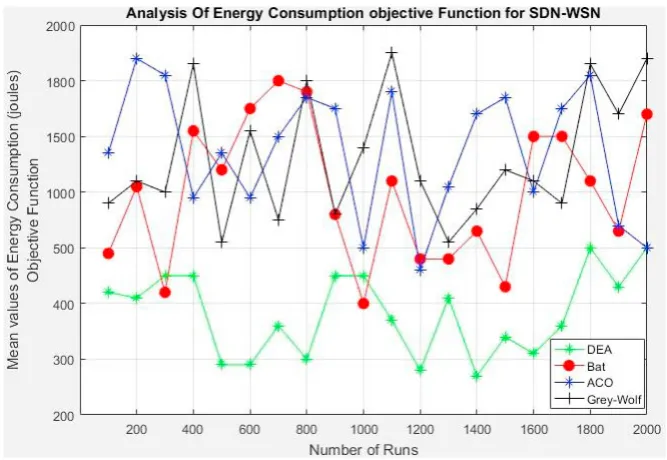
In the first experimental phase, 45 sensors and 9 clusters are considered; as each cluster has 5 sensors, whereas the algorithms are applied at 𝐿𝐿𝐿𝐿 and 𝐺𝐺𝐿𝐿 level. The DEA is scrutinized in comparison to notified algorithms (Bat, ACO and Grey-Wolf ) for the given optimization problem. Fig. 1 and Fig. 2 portrays the results obtained for the optimization of SDN-WSN with respect to throughput and energy utilization objective functions. As DEA, Bat, ACO and Grey-Wolf are stochastic nature algorithms. For this reason, the experiments are executed with a method of applying simulations several times, so that each algorithm having 100 iterations will produce an optimal value in one 𝐿𝐿𝑉𝑉𝑙𝑙. In other words, the algorithms are simulated on MATLAB tool with various number of times, acknowledged as 𝐿𝐿𝑉𝑉𝑙𝑙, where as the 𝑀𝑀𝑒𝑒𝑙𝑙𝑙𝑙 optimal values are computed, based on 𝑀𝑀𝑒𝑒𝑙𝑙𝑙𝑙 formula, as shown in Table 2.
In Fig.1 and Fig. 2, the proposed DEA algorithm distinguish itself with better results compared to other stated algorithms in terms of accomplishing maximum throughput and minimum energy utilization. In Fig. 1, DEA produced
𝑀𝑀𝑒𝑒𝑙𝑙𝑙𝑙 optimal solutions during each 𝐿𝐿𝑉𝑉𝑙𝑙 interval (from 100 to 2000). The analogous tendency can be monitored in Fig. 2. Consequently, DEA algorithm showed better convergence while successfully engendered optimal solutions of both described objective functions in the given experimental scenario.
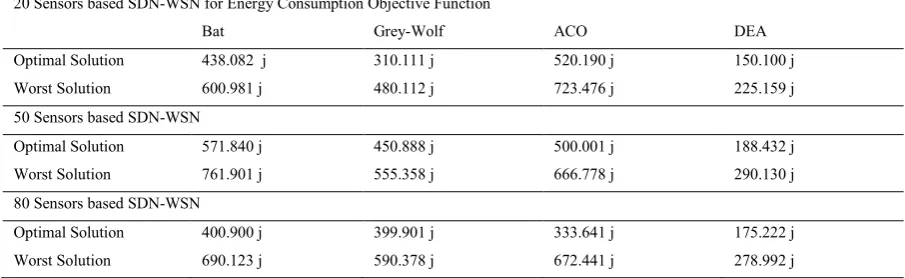
In the subsequent phase of the experiment, the proposed DEA and Bat, ACO and Grey-Wolf algorithms are applied on various SDN-WSN network sizes; such as 20, 50 and 80 sensors, along with 4, 10 and 16 clusters, for exploring optimal and worst solutions with respect to throughput and energy consumption objective functions. For throughput, the optimal solutions are maximum values and the worst are minimum throughput values. While, in the case of energy consumption objective function, minimum values are optimal and maximum value is the worst solution, as shown in Tables 3 and 4.
[image:5.544.35.507.320.392.2]sensors networks, DEA has the optimal solution of 101.200 bps as maximum throughput; whereas, other algorithms generate sub-optimal solutions, which show sub-standard convergence performance of the said techniques. Similarly, in table 4, DEA energy consumptions were the minimum for given network scales. Correspondingly, the DEA algorithm has minimum damage in SDN-WSN network throughput and energy consumption criteria.
Fig. 1. Analysis of 𝑀𝑀𝑀𝑀𝑀𝑀𝑀𝑀 Throughput Objective Function.
[image:6.544.105.439.393.623.2]Table 2. Experimental Setup
Algorithm Number of iterations Number of 𝑅𝑅𝑅𝑅𝑅𝑅(𝑠𝑠) 𝑀𝑀𝑀𝑀𝑀𝑀𝑅𝑅 Optimal Values 𝐷𝐷𝐷𝐷𝐷𝐷
100 100, 200, 400, 600, 800, 1000, 1200, 1400, 1600, 1800, 2000, 2000
∑ 𝑜𝑜𝑜𝑜𝑜𝑜𝑜𝑜𝑜𝑜𝑀𝑀𝑜𝑜 𝑣𝑣𝑀𝑀𝑜𝑜𝑅𝑅𝑀𝑀𝑠𝑠 𝑜𝑜𝑅𝑅 𝑀𝑀𝑀𝑀𝑒𝑒ℎ 𝑅𝑅𝑅𝑅𝑅𝑅 𝑇𝑇𝑜𝑜𝑜𝑜𝑀𝑀𝑜𝑜 𝑅𝑅𝑅𝑅𝑜𝑜𝑛𝑛𝑀𝑀𝑛𝑛 𝑜𝑜𝑜𝑜 𝑅𝑅𝑅𝑅𝑅𝑅𝑠𝑠 𝐵𝐵𝑀𝑀𝑜𝑜
[image:7.544.39.491.200.343.2]𝐷𝐷𝐴𝐴𝐴𝐴 𝑊𝑊𝑜𝑜𝑜𝑜𝑜𝑜 − 𝐺𝐺𝑛𝑛𝑀𝑀𝐺𝐺
Table 3. Throughput objective function for SDN-WSN Network
20 Sensors based SDN-WSN for Throughput Objective Function
Bat Grey- Wolf ACO DEA
Optimal Solution 263.234 bps 380.112 bps 310.356 bps 956.900 bps
Worst Solution 80.800 bps 220.133 bps 100.313 bps 680.444 bps
50 Sensors based SDN-WSN
Optimal Solution 381.321 bps 540.200 bps 400.001 bps 901.200 bps Worst Solution 200.400 bps 320.000 bps 200.300 bps 780.122 bps
80 Sensors based SDN-WSN
Optimal Solution 450.500 bps 299.810 bps 290.800 bps 899.999 bps
Worst Solution 99.200 bps 110.111 bps 140.300 bps 630.010 bps
Table 4. Energy Consumption objective function for SDN-WSN Network
20 Sensors based SDN-WSN for Energy Consumption Objective Function
Bat Grey-Wolf ACO DEA
Optimal Solution 438.082 j 310.111 j 520.190 j 150.100 j
Worst Solution 600.981 j 480.112 j 723.476 j 225.159 j
50 Sensors based SDN-WSN
Optimal Solution 571.840 j 450.888 j 500.001 j 188.432 j
Worst Solution 761.901 j 555.358 j 666.778 j 290.130 j
80 Sensors based SDN-WSN
Optimal Solution 400.900 j 399.901 j 333.641 j 175.222 j
Worst Solution 690.123 j 590.378 j 672.441 j 278.992 j
5. Conclusion
[image:7.544.45.498.379.518.2]produced optimal solutions for various SDN-WSN scales but also showed its performance superiority against Bat, ACO and Grey-Wolf algorithms for both objective functions. In other words, for the given scenario, these algorithms had limitations to discover the optimal solution within SDN-WSN. They had generated sub-optimal solutions in both experimental stages. Furthermore, it is also discovered that the network size of SDN-WSN does not disturb the DEA, Bat, ACO and Grey-Wolf algorithm’s performance while addressing to the optimization problem.
Acknowledgements
This work was supported by the European Union’s Horizon 2020 Research and Innovation Program through the Marie Sklodowska-Curie under Grant 734331.
References
Choi Younghwan, Choi Yunchul., and Hong Y.-G., 2016. Study on coupling of software-defined networking and wireless sensor networks. Eighth International Conference on Ubiquitous and Future Networks (ICUFN).
Akyildiz, I., Su, W., Sankarasubramaniam, Y. and Cayirci, E., 2002. Wireless sensor networks: a survey. Computer Networks, 38(4), 393-422. Al-Karaki, J. and Kamal, A., 2004. Routing techniques in wireless sensor networks: a survey. IEEE Wireless Communications, 11(6), 6-28. Singh, S. and Sharma, S., 2015. A Survey on Cluster Based Routing Protocols in Wireless Sensor Networks. Procedia Computer Science, 45, 687
695.
Heinzelman, W., Chandrakasan, A. and Balakrishnan, H. (n.d.). Energy-efficient communication protocol for wireless microsensor networks. Proceedings of the 33rd Annual Hawaii International Conference on System Sciences.
Silva, B., Fisher, R., Kumar, A. and Hancke, G., 2015. Experimental Link Quality Characterization of Wireless Sensor Networks for Underground Monitoring. IEEE Transactions on Industrial Informatics, 11(5), 1099-1110.
Ndiaye, M., Hancke, G. and Abu-Mahfouz, A., 2017. Software Defined Networking for Improved Wireless Sensor Network Management: A Survey. Sensors, 17(5), p.1031.
Hu, F., Hao, Q. and Bao, K., 2014. A Survey on Software-Defined Network and OpenFlow: From Concept to Implementation. IEEE Communications Surveys & Tutorials, 16(4), 2181-2206.
Luo, T., Tan, H. and Quek, T., 2012. Sensor OpenFlow: Enabling Software-Defined Wireless Sensor Networks. IEEE Communications Letters, 16(11), 1896-1899.
Vasuhi, S. and Vaidehi, V., 2016. Target tracking using Interactive Multiple Model for Wireless Sensor Network. Information Fusion, 27, 41-53. Lu, K., Zhou, R. and Li, H., 2016. Event-triggered cooperative target tracking in wireless sensor networks. Chinese Journal of Aeronautics, 29(5),
1326-1334.
Su, H., Li, Z. and Chen, M., 2017. Distributed estimation and control for two-target tracking mobile sensor networks. Journal of the Franklin Institute, 354(7), 2994-3007.
Shi, K., Chen, H. and Lin, Y., 2015. Probabilistic coverage-based sensor scheduling for target tracking sensor networks. Information Sciences, 292, 95-110.
Sleep, S., Dadej, A. and Lee, I., 2017. Representing arbitrary sensor observations for target tracking in wireless sensor networks. Computers & Electrical Engineering, 64, 354-364.
Keskin, M. E., Altınel, İ. K., Aras, N., and Ersoy, C., 2014. Wireless sensor network lifetime maximization by optimal sensor deployment, activity scheduling, data routing and sink mobility. Ad Hoc Networks, 17, 18-36.
Anitha, R.U. and Kamalakkannan, P., 2013. Enhanced cluster based routing protocol for mobile nodes in wireless sensor network. In 2013 International Conference on Pattern Recognition, Informatics and Mobile Engineering. IEEE, 187-193.
Zhang, H., Zhang, S., and Bu, W., 2014. A clustering routing protocol for energy balance of wireless sensor network based on simulated annealing and genetic algorithm. International Journal of Hybrid Information Technology, 7(2), 71-82.
Han, Z., Wu, J., Zhang, J., Liu, L. and Tian, K., 2014. A General Self-Organized Tree-Based Energy-Balance Routing Protocol for Wireless Sensor Network. IEEE Transactions on Nuclear Science, 61(2), 732-740.
Zhao, Z., Wang, J. and Guo, H., 2018. A hierarchical adaptive routing algorithm of wireless sensor network based on software-defined network. International Journal of Distributed Sensor Networks, 14(8), p.155014771879461.
Masood, M. and Fouad, M., Glesk, I. 2018. Analysis of Artificial Intelligence-Based Metaheuristic Algorithm for MPLS Network Optimization. 20th International Conference on Transparent Optical Networks (ICTON).
Kaveh, A. and Farhoudi, N. (2013). A new optimization method: Dolphin echolocation. Advances in Engineering Software, 59, 53-70.
Masood, M., Fouad, M. M., and Glesk, I. 2017. Proposing bat inspired heuristic algorithm for the optimization of GMPLS networks. In 2017 25th Telecommunication Forum (TELFOR), IEEE, 1-4.
Kashef, S. and Nezamabadi-Pour, H., 2015. An advanced ACO algorithm for feature subset selection. Neurocomputing, 147, 271-279. Saxena, A., Soni, B., Kumar, R. and Gupta, V., 2018. Intelligent Grey Wolf Optimizer – Development and application for strategic bidding in