0022-538X/91/095007-06$02.00/0
Copyright © 1991, American Society for Microbiology
Effects of
Changes
in
gpl20-CD4
Binding Affinity on Human
Immunodeficiency
Virus Type 1 Envelope
Glycoprotein
Function and Soluble CD4
Sensitivity
MARKUS THALI, UDYOLSHEVSKY, CRAIG FURMAN, DANA GABUZDA, JOHN LI, ANDJOSEPH
SODROSKI*
Division of Human Retrovirology, Dana-Farber Cancer Institute, and Department of Pathology, Harvard Medical
School, Boston,
Massachusetts 02115Received 15 March1991/Accepted 14June 1991
Mutant
gpl20
glycoproteins exhibiting a range of affinities for CD4 were tested for ability to form syncytia and to complement an env-defective provirus for replication. Surprisingly, gpl20 mutants that efficiently induced syncytiaand/or complemented virus replicationwereidentifiedthat exhibited marked (up to 50-fold) reductions in CD4-binding ability. Temperature-dependent changes in gpl20, which result in a seven- to ninefold increase in affinity for CD4, were shown not to be necessary for subsequentmembrane fusion orvirus entry events. Mutant glycoproteins demonstrating even relatively small decreases in CD4-binding ability exhibited reduced sensitivity to soluble CD4. The considerable range ofCD4-binding affinitiestolerated by replication-competent HIV-1 variants has important implications for antiviral strategies directed at the gpl20-CD4 interaction.Human
immunodeficiency
virus type 1 (HIV-1) is theetiologic
agentof AIDS, which is characterized by adeple-tion of CD4-positive
lymphocytes (3, 16, 17, 27, 35). HIV-1exhibits
atropism
forCD4-positive cells due to a high affinity (Kd = 4 x10'
M)interaction between the CD4glycopro-tein, which
serves asthe viral receptor, and the HIV-1gpl20
exterior envelope
glycoprotein
(13, 23, 24, 28, 30, 31).Following
CD4 binding, thegpl20
glycoprotein andgp4l,
the transmembrane envelope glycoprotein,
mediate thefu-sion of viral
and target cell membranes, which is pHinde-pendent
and necessary for virus entry (18, 25a, 40). Similar eventsmediated
by the envelope glycoproteins expressed on thesurfaceof
aninfected cell result in fusion of infected cells with CD4-positive cells to form syncytia (18, 25a, 29, 39).The
gpl20 molecule
bindstoaprotruding
ridgeof the CD4glycoprotein
analogous to the CDR2 loop of immunoglob-ulins (1, 2, 6-8, 21, 26, 32, 34, 36, 42). TheCD4-binding site ongpl20 is discontinuous,
and changes inspecific residueslocated in
thesecond, third,
and fourth conservedgpl20
regions affect CD4 binding without
grosslydisrupting
thegpl20
conformation
(10, 11, 18, 25a, 33). Here, weexamine
the
effects of
changes ingpl20-CD4 affinity
on envelopeglycoprotein functions involved
insyncytium formation
and virus entry. We alsoexamine
theeffect
of changes inCD4-binding affinity
on thesensitivity
of gpl20 variants
tosoluble
CD4,which
has been shown toexhibit antiviral
activity
invitro
(4, 14, 15, 19, 38, 41).MATERIALS ANDMETHODS
Envelope glycoprotein expressionand CD4-binding assays. For the
binding
assays, COS-1 cells were transfected withpSVIIIenv
DNAexpressing wild-type
or mutantenvelope
glycoproteins
aspreviously described (12, 18, 33).
For initialexperiments examining
theeffectof
temperatureonbinding
of
thewild-type gpl20,
supernatantsof transfected cells that wereradiolabeled
with[35S]cysteine
were incubated for*Correspondingauthor.
various lengths of time with 5 x 10⁷SupTl
lymphocytes
ateither
4 or37°C.
Thecells
were washed once withphos-phate-buffered
saline(PBS), lysed,
and thenprecipitated
with an excess of amixture
of sera derived fromAIDS
patients
(33). Theunbound
fraction of
thesupernatants
was alsoused for
immunoprecipitation.
The amountof
gpl20
precipitated from both bound and unbound fractions
wasmeasured
bydensitometry
ofsodium
dodecylsulfate-poly-acrylainide
gels. Previous studies indicated
that the ratioof
bound
tofreegp120
did
notvaryunder theseconditions
over a greater than20-fold
range ofwild-type
gp120
concentra-tions.
CD4-binding
abilitiesof
the mutantglycoproteins
were assessedasdescribed
above, byusing
a90-minincubation
ateither
4 or37°C
withSupTl
lymphocytes.
Syncytium-forming
ability of envelopeglycoproteins.
To assess thesyncytium-forming ability
of mutantenvelope
glycoproteins,
5 x10⁵ COS-1
cells in100-mm2
dishes were transfected with 10 ,ugof
the envelope expressorplasmid
(pSVIIIenv).
Forty-eight hours
aftertransfection,
thecells
wererinsedtwice
in PBSand
incubated with
50 mMEDTA,
pH7.5,
at37°C for
approximately
40 min.Cells
wereremoved
from theplate by
trituration,
centrifuged, washed
in 5 mlof
PBS,
andsuspended
in 5 ml of Dulbeccomodified
Eagle
inedium-10%
fetalcalf
serum(DMEM-10%
FCS).
To thesecells
wasadded
2 x10⁷ SupTl
lymphocytes
suspended
in 5 ml ofDMEM-10%
FCS. Thecells
weretransferred
to a T25 flaskandreturned
to37°C
ina5%
CO2
incubator,
andsyncytia
werescored
in 6 to8 h.Replication
complementation
assays.Complementation
of
thesingle-step
replication
of theHXBAenvCAT
provirus
into differentlymphocytes
wasperformed
aspreviously
described(18).
Equivalent
amounts ofreversetranscriptase
activity
representing recombinant
virions in COS-1superna-tants were addedto
Jurkat, H9,
orSupTl
lymphocytes,
and
chlorainphenicol
acetyltransferase (CAT)
activity
wasmea-suredat72h
following
infection.Soluble
CD4 inhibition ofsyncytium
formation and virusreplication. To
examine soluble
CD4inhibition of
syncytium
formation,
transfected COS-1
cellsdetached
from tissue5007
on November 10, 2019 by guest
http://jvi.asm.org/
A
1 2 3 4 5 6
i.
. 4a 5
,.
1
..
B
-gpl20
B F B F B F
L4-1--J 37°
pSVIIIenv
LMOCKi0 N
CD
cm
5H
4 /
h~~~~~~~~~~
3 -@
2[
-I~~~~~~~
0 ( 3 . -, 1.__
60 120 60 120
4 37
Time(min)
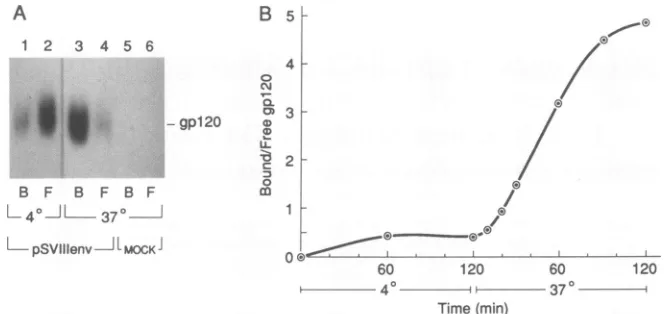
FIG. 1. Effects of temperature on relative CD4 binding. (A) Autoradiogram ofwild-type gp120
glycoprotein (lanes
1through 4)
orsupernatantsfrom mock-transfectedCOS-1 cells(lanes5and6) either bound(lanesB:1, 3,and5)orunbound
(lanes
F:2, 4,
and6)
toSupTl
lymphocytes.Experimentswereconductedateither4°C (lanes1and2)or37°C (lanes3through 6). (B)Graphshowingtheratioof theamount of wild-typegpl20glycoprotein boundtoCD4-positive SupTllymphocytestotheamountof unboundgp120forvarious times ofincubation ateither4 or37°C. The datumpoints represent themeanvaluesof datafromtwoindependent
experiments.
culture dishes
asdescribed above
wereincubated with
different concentrations of
solubleCD4
(American
BioTech-nologies,
Inc.)in
2.5 mlof
DMEM-10% FCS for
1 h at37°C.
Tothis mixture
was added 2 x10⁷
SupTl lymphocytes
suspended in
1 mlof
DMEM-10%
FCS. Cells
weretrans-ferred
to a T25flask,
andsyncytia
werescored
in 8 h.For
inhibition of virus replication, recombinant
HXBAenvCAT virus
produced
inCOS-1
cells(18)
wasincubated with
different concentrations of
soluble CD4 for
1 h at37°C. The
virus
preparations were then incubatedwith
Jurkat
lympho-cytes, andCAT
activity
was measured 48 hlater
asprevi-ously described
(18).RESULTS
Temperature
effects
on CD4 binding. The effect of temper-ature on theability of radiolabeled soluble
gp120 derived
from
the HXBc2 HIV-1 virus to bind toCD4-positive
SupTllymphocytes
is shown in Fig. 1.Binding
equilibrium
wasachieved by approximately
2h
ateither
4or37°C.
A seven-toninefold increase
in theratio of
bound tofree
gpl20
wasobserved
at 37°C relative to that observed at 4°C. Thisobserved
increase at 37°C was only marginallyaffected
byfixing the SupTl
lymphocytesin
methanolprior
to use (data notshown).Effect
of changes ingpl20
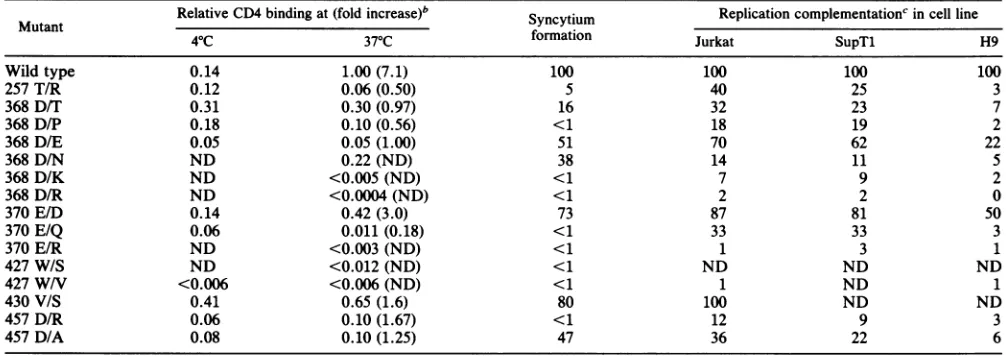
on CD4 binding at different temperatures. Toexamine
whether changes in the HIV-1gpl20 glycoprotein
previously shown to alter its affinity forCD4 (33)
affected the temperature-dependent
componentof
thebinding
process, the binding ofgpl20
mutants to SupTllymphocytes
was examined at both 4 and 37°C, using a 90-minutebinding
assay. The results presented in Table 1 andFig.
2demonstrate that although several of the mutantsexhibited
CD4-binding abilities comparable with or evenbetter
than that of the wild-type envelope glycoprotein at4°C, significant
increases in binding at 37°C were not ob-servedfor thesemutants (e.g., 257 T/R, 368 D/T, 368D/P,
368
D/E, 370 E/Q,
430V/S,
457D/R,
and 457D/A).
Therelative
CD4-binding abilities of the mutants at 37°C, from a 90-min assay, were similar to those previously reported byusing
a60-min binding assay (33).Function ofthe envelope glycoprotein mutants. The
ability
of the envelope glycoprotein
mutants toinduce theforma-tion
of
syncytia
wasexamined
(Table 1).
For
allof the
mutantsexhibiting
less than one percentof
wild-type
CD4-binding
ability, syncytium-forming ability
wasundetectable (e.g., 368D/K,
368D/R,
370E/R,
427W/S,
and 427WIV).
Several
of
the mutants that exhibited smaller decreases inCD4
binding
werecapable
of
forming syncytia, although
this
occurred
at a lowerefficiency
than that observed for thewild-type
glycoproteins (e.g.,
257T/R, 368 D/T, 368
D/E,
368
D/N, 370
E/D,
430V/S,
and 457D/A).
The
ability of
the mutantenvelope
glycoproteins
tocom-plement
the entryof
anenv-defective virus into
Jurkat,
SupTl, and
H9lymphocytes
wasassessed. For themutantsexhibiting less
than1% of
thewild-type
CD4-binding
ability,
the
ability
tocomplement
virus entrywasless than10%
thatof
thewild-type
envelope
glycoprotein
in all the
targetcell
types examined(e.g.,
368D/K,
368D/R,
370E/R,
and 427W/V).
The other mutants,which
exhibited
CD4-binding
ability
at37°C of
greater than1% of the
wild-type value,
wereable
tocomplement virus
entryinto the
targetcells
examined
tovarious
degrees. The
368D/T, 368
D/E,
and370E/Q
mutants allallowed
efficient
entryinto Jurkat and
SupTl
lymphocytes
despite approximately 3-, 20-, and 90-fold
reductions,
respectively,
in
relative
CD4-binding
ability.
Several of
the mutantsthat did
notexhibit
temperature-related affinity increases
werecapable
ofcomplementing
virus entry into someof
the targetcell
types(257
T/R, 368
D/T,
368D/P, 368 D/E,
370E/Q,
430V/S,
and 457D/A).
For
these and for other
mutantsretaining
somedegree
of
repli-cationcompetence, theefficiency
of entryinto
the various target cells utilized in these studies exhibited the patternJurkat
>SupTl
2 H9lymphocytes.
Soluble CD4
sensitivity
of mutant envelopeglycoproteins.
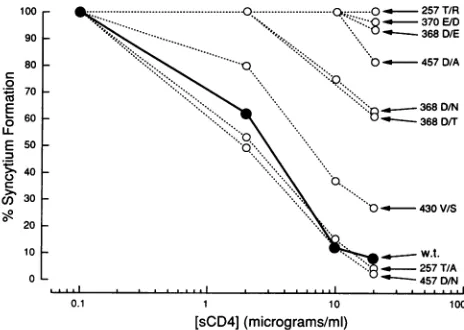
The
ability of syncytium induction and of virus
replication
to be inhibitedby soluble CD4
was assessedfor those
mutantglycoproteins
competentfor
thesefunctions
(Table
2and
Fig.
3and 4). Some
mutants(120/121 VK/LE,
269E/L,
and 485K/V)
thatexhibited mild
(less than twofold) reductions
inCD4-binding
ability
wereinhibited
by soluble CD4
to the same extent as wasthe
wild-type glycoprotein.
Thefunc-tional
mutantsthatexhibited
greater than twofold decreases inrelative
CD4-binding ability
wereless
sensitive
thanthe
wild-type
glycoprotein
to solubleCD4
inhibition of
on November 10, 2019 by guest
http://jvi.asm.org/
[image:2.612.138.470.77.234.2]TABLE 1. Phenotypes of gpl20 mutantsa
Relative CD4binding at (foldincrease)b Syncytium Replicationcomplementationcin cell line
4°C 370C formation Jurkat SupTl H9
Wild type 0.14 1.00(7.1) 100 100 100 100
257T/R 0.12 0.06(0.50) 5 40 25 3
368DAT 0.31 0.30(0.97) 16 32 23 7
368D1P 0.18 0.10(0.56) <1 18 19 2
368D/E 0.05 0.05(1.00) 51 70 62 22
368 D/N ND 0.22(ND) 38 14 11 5
368D/K ND <0.005 (ND) <1 7 9 2
368D/R ND <0.0004 (ND) <1 2 2 0
370 E/D 0.14 0.42(3.0) 73 87 81 50
370E/Q 0.06 0.011(0.18) <1 33 33 3
370 E/R ND <0.003(ND) <1 1 3 1
427W/S ND <0.012 (ND) <1 ND ND ND
427WN <0.006 <0.006 (ND) <1 1 ND 1
430V/S 0.41 0.65(1.6) 80 100 ND ND
457DIR 0.06 0.10(1.67) <1 12 9 3
457D/A 0.08 0.10(1.25) 47 36 22 6
a Data reported represent the means of at least twoindependent experiments.
b The relativeCD4-binding
ability,
determined by using a90-minbinding assayasdescribedinMaterials andMethods, is shown. The relativeCD4-binding
ability was calculated according to the following formula:[(boundmutantgpl2O)tempx [(freewild-typegpl2O)3rc
[(free mutantgpl2O)tempx x (bound wild-typegpl2O)37C
The fold increase shown in parentheses represents the ratio of the relative
CD4-binding
ability ofagivenmutant at37°Ctothat observedat4°C.cSyncytium formation and replication complementationarerepresentedasthe percentage ofwild-typevalues observed foragiven target cell.Thepercent activity observed for a control plasmid not expressing the HIV-1 envelope glycoproteinswaslessthan1% forsyncytium formationand less than2% forreplication
complementation inallthreetarget cell lines.
tium formation or virus entry (e.g., 257
T/R,
368 D/T, 368 D/E, 368 D/N, 370 E/D, 370E/Q,
457 D/A, and 457 D/N). The 430 V/S and 457D/E
mutants exhibited soluble CD4 sensitivities intermediate between that of the wild-type gly-coproteins and those of mutants with larger decreases in CD4-binding ability. Mutations affecting the threonine 257 or aspartic acid 457 residues (257T/A,
457 D/N) that did not decrease CD4-binding ability did not result in soluble CD4 resistance, whereas other changes in these residues (257T/R,
457DIA,
457D/G,
and457 D/E) yielded mutants that exhibited decreased CD4 binding and resistance to soluble CD4.DISCUSSION
The interaction of
gpl20 with
CD4 was reduced tounde-tectable
levelsby
some changesin
gpl20 residues 368, 370,
A
12 3 4B
12 3 4or 427.These
changes
dramatically
reduced theability
oftheenvelope
glycoproteins
toformsyncytia
or tocomplement
an env-defective virus forreplication,
consistent with the majorcontribution of
CD4binding
tothese processes.While the
gpl20 changes
that reducedCD4-binding ability
by 100-fold
or moreuniformly abrogated
syncytium-forming
and/orreplicative
functions,
amino acidchanges
resulting
in lessdramatic effects
onCD4
binding
exerted morevariable effects on theseenvelope
glycoprotein
functions.
Theability
of
the368
D/E, 370
E/Q,
370E/D,
and 457D/A
mutants tocomplement
thereplication of
the env-defective virus and theability of
the 368D/T,
368D/E,
368DIN,
370E/D,
430V/S,
and 457D/A
mutants toform
syncytia
indicate
that even20- to50-fold decreases in
CD4-binding ability
are notnecessarily
accompanied
by abrogation
of these functions.
These results areconsistent with
reports that replication-competent HIV-1isolates
can exhibit a broad range ofc D
1 2 3 4 1 2 3 4
i:i
B F B F
346 37D
368DJT
*
4f1-gpl
20
B F B F
4°"
37°'
J 457 D/AFIG. 2. Effectsof aminoacid changes ongpl20bindingtoSupTl
lymphocytes
ateither4or37°C.
Thegpl20
glycoprotein
eitherbound (lanesB: 1and 3) orunbound(lanes F:2 and4)followinga90-minincubation withSupTl
lymphocytes
ateither4°C
(lanes
1and2)or37°C
(lanes 3 and 4) is shown. The experiments utilized eitherwild-type gpl20 (A)orthe 257
T/R,
368D/T,
or457 D/Amutants(B, C,
andD, respectively).:*% 's
B F B F
1 40 L--
337°--wild-type
B F B F
.4°-
- 37°257 T/R
on November 10, 2019 by guest
http://jvi.asm.org/
[image:3.612.62.565.89.268.2]TABLE 2. Soluble CD4inhibition ofenvelope glycoprotein function
Relative ID50syncytium ID50 virus
Mutant CD4-binding formation replication
abilitya (qg/ml)b (pg/ml)b
Wild type 1.00 1.5 0.4
113D/A 1.1 1.5 ND
120/121 VK/LE 0.51 0.9 0.4
257T/R 0.16 >20 >20
257T/A 1.1 1.7 0.6
269E/L 0.61 1.1 0.4
368D/T 0.33 >20 1.3
368D/E 0.09 >20 7.5
368D/N 0.19 >20 ND
370E/D 0.45 >20 2.5
370E/Q 0.018 ND >20
430V/S 0.39 5.1 1.3
457D/A 0.09 >20 >20
457D/N 1.1 1.5 0.4
457D/G 0.23 ND >5
457D/E 0.38 6.5 1.2
485K/V 0.79 1.0 ND
a RelativeCD4-binding abilitiesarederivedfromexperiments in whicha
60-minbinding assay was used (33).
b Values shown are the averages of the results of three independent experiments. Values represent the concentrationofsolubleCD4requiredto
inhibitsyncytium formation or virus entry by50%.ND, notdetermined.
CD4-binding
abilities (20). The decreases insyncytium-forming
orreplicative abilities for some of the mutants (e.g., 257T/R,
368D/P,
and 457D/R)
that exhibit less than50-foldreductions
inCD4-binding ability are likely to result from the effectof
the changes on envelope glycoprotein functions other than receptorbinding.
Forsome of the mutants (257T/R, 368 D/P, 370 E/Q, and 457
D/R),
syncytium formation is affected more dramatically than is the ability to complement virus replication in the sametarget cells. Asimilar
result has been seen for amino acidchanges
in the HIV-1gp4l amino terminus
thataffect
the membrane fusion
process (25). Theseresults probably
reflect
therequirement for
a greater numberof successful
100
90
80
c 0 *0 70
E
60
U-E 50
50 40
CD 30 20
10
0
w.t. 257 T/A 457D/N
0.1 1 10 100
[image:4.612.57.298.95.286.2][sCD4] (micrograms/ml)
FIG. 3. Effects of amino acid changes in gpl20oninhibition of
syncytiumformation by soluble CD4. Thepercentageofthe number
of syncytia scored in the absence of soluble CD4 is shown for
increasing concentrations of soluble CD4. Values areshown fora
typical experiment with the wild-type (w.t.) or mutant envelope
glycoproteins.
100
80
?-II
w
co
LL ._
0
370E/Q 257T/R
457 D/A
o 368 D/E <0 368 D/T O 370 E/D
257T/A
wild-type
0.001 0.1 1.0 2.0 20
[sCD4] 'Y/ml
FIG. 4. Effects of gp120 amino acid changes on sensitivity to solubleCD4 inhibition ofreplicationcomplementation.Theeffectof different soluble CD4 concentrations on the CAT activity
trans-ferredtoJurkat lymphocytes by recombinant virionscarryingthe wild-type or mutantenvelope glycoproteinsis shown. Eachvalue represents the percentage of CAT activity observed for a given mutant in the presence of soluble CD4 relative to the activity observed for themutantintheabsenceof soluble CD4.
envelope
glycoprotein-receptor interactions
in the process of cell-cell fusion than in the process of virus entry.Decreases in
CD4-binding
ability exerted
greater effects onvirus
entryinto
some targetcells
thanthey did
in othercell
types. For all of the mutantsexamined, however,
therelative
efficiency of
entryinto various
targetcells
followed the patternJurkat
2SupTl
: H9lymphocytes.
Thus,
theefficiency of
entryof
the mutantvirus
into
these cell types appears to begoverned
by
quantitative
factors,
oneof which
may be the levelof
targetcell
CD4
expression.
At
4°C,
the HIV-1gpl20
glycoprotein bound
toCD4-positive cells with
anaffinity
that
wasapproximately
seven-toninefold lower
thanis
seen at37°C.
Following
ashift
to37°C,
agradual increase in
theassociation of
thewild-type
gp120
glycoprotein with CD4-positive cells
wasobserved.
Thisphenomenon
cannotbesimply explained by
endocyto-sis of
cellsurface
gpl2O-CD4 complexes, since methanol
fixation
of the target cells did not eliminate theobserved
increase. If
theeffect of
low temperatureis
tolimit
confor-mationaichanges
ingpl20
orCD4,
theresults would
suggest thatinduced changes
ingpl20 and/or CD4 contribute
to ahigher
affinity interaction
at37°C. Mutations affecting
sev-eralgp120 residues (Thr-257,
Asp-368,Glu-370,
orAsp-457)
decreased theefficiency of these induced changes,
suggest-ing
that multiple elements in the protein-protein interfacecontribute
to theaffinity increase.
Thegpl2O-CD4
interac-tion,
as is truefor
binding of
someantibodies
totheir
antigens
(5, 9,37),
might be
moreappropriately describedby
aninduced
fit rather thanby
astatic
"lock-and-key"
model. Severalenvelope
glycoprotein mutants that did not undergo thistemperature-dependent change exhibited significant lev-els ofsyncytium-forming
or replicative ability, indicating thatthis
conformationalalteration is
not a necessary step in the membranefusion
process.Relatively
smalldecreases
inCD4-binding ability
were associated withenvelope glycoprotein
mutantsresistant
to inhibitionby
soluble CD4. Agood
correlation was observed betweenmutantsthatexhibited alower
affinity for CD4 and
on November 10, 2019 by guest
http://jvi.asm.org/
[image:4.612.62.294.502.667.2]resistance to soluble CD4. This correlation was also ob-served for mutations affecting the samegpl20amino acid but resulting in different effects on CD4 binding. For example, the 257
T/R,
457D/A,
457D/G,
and 457D/E
mutants exhibited decreased CD4 binding and were resistant to soluble CD4, whereas the 257T/A
and 457D/N
mutants exhibited approximately wild-type CD4-binding abilities and remained sensitive to soluble CD4. While these results do notrule out other mechanisms for the generation of soluble CD4-resistant HIV-1 variants, they strongly imply that changes in affinity for CD4 represent one such mechanism. Since fresh patient isolates ofHIV-1 areoftenlesssensitive tosoluble CD4 than are HIV-1 isolates passaged extensively in T-lymphocyte cell lines (12a), some of these primary isolates might exhibit small but consequential decreases in binding affinity for CD4. The sixfold-lower CD4-binding affinity reported for the primarymonocyte-propagated Ba-L isolate compared with the T-cell-passaged BH10 isolate might contribute to soluble CD4 resistance (20). HIV-2, which is less sensitive to soluble CD4 than is HIV-1, has been reported to have a 25-fold-lower affinityfor CD4 (32a). Suchchanges inaffinityapparently result in majoreffects on soluble CD4 sensitivity, while exerting only minor effects on virus entry or syncytium formation. This difference may result from the higher cooperativity of envelope glycopro-tein-receptor interactions during the latter processes com-pared with the interaction of soluble CD4 and the envelope glycoproteins. Similar results have recently been reported forthe inhibition of polio virus replication by soluble recep-tor molecules, in whichreplication-competent viruses resis-tant to soluble receptor resulted from altered receptor af-finity (22).For some of the mutants exhibiting small changes in relative CD4-bindingability(e.g., 368
D/T
and 370E/D), the 50% inhibitory dose (ID50) for soluble CD4 inhibition of syncytium formation is affected more than thecorresponding ID50 for virus replication. Soluble CD4hasbeenreportedto act both as a competitive inhibitor and as an irreversible inhibitor, the latter activity resulting fromdissociation ofthe gp120andgp4l
subunits (22a, 32b). Since the soluble CD4-induced subunit dissociation is more efficient for envelope glycoproteins on the virions than on thecell surface (32b), the observations for themutantscould be accountedfor by differences in the contributions ofreversibleandirreversible inhibitory activities ofsoluble CD4in the syncytium forma-tion or virus entry process.Our results have implications for antiviral therapies di-rected at the
gpl20-CD4
interaction. The netresult ofeither a reduction ingp120-CD4
affinity or the presence of a competitive inhibitor of thegpl20-CD4
interaction is to decrease the ratioofgp120b.undlgP120fee-
Onewouldexpect that the effects of an identical reduction inthis ratioon virus replication wouldbeless for acompetitive inhibitorthanfor a mutant exhibiting decreased affinity, since in the former case,theboundgp120 retains wild-type function. Thus, our results imply that competitive inhibitors ofthegp120-CD4
interaction willneed tobeextremelyeffective tosignificantly abrogate virus replication, especially intarget cells express-ing highlevels ofCD4.
ACKNOWLEDGMENTS
We thank Robert Gallo, Flossie Wong-Staal, Max Essex, and Bruce Walker for reagents; Ginny Nixon formanuscript prepara-tion; and Amy Emmert for artwork. We thank American BioTech-nologies, Inc., for supplying soluble CD4. Markus Thali was sup-ported by the Swiss NationalScienceFoundation. UdyOlshevsky
performedthis work whileonsabbatical from the Israel Institutefor BiologicalResearch,Nes-Ziona, Israel.
This work wassupported by grants from the LeukemiaSocietyof America, theAaronDiamondFoundation, and theNational Insti-tutesof Health(Al24755).
REFERENCES
1. Arthos, J.,K. C.Deen, M.Chaikin, J.Fornwald, G.Sathe,Q. Sattentau,P.Clapham, R.Weiss, J.McDougal,C.Pietropaolo, R.Axel,A.Truneh,P.Maddon,and R.Sweet. 1989. Identifica-tionof the residues in human CD4critical forbindingof HIV. Cell57:469-481.
2. Ashkenazi, A., L. Presta, S. Marsters, T. Camerato, K. Rosenthal,B. Fendly, and D. Capon. 1990. Mapping the CD4 binding site for HIV by alanine-scanning mutagenesis. Proc. Natl.Acad. Sci. USA 87:7150-7154.
3. Barre-Sinoussi, F., J. C. Chermann,F.Rey,M. T.Nugeyre,S. Chamaret, J. Gruest, C. Dauguet, C. Axler-Blin, F. Vezinet-Brun, C.Rouzioux, W.Rozenbaum, and L. Montagnier. 1983. IsolationofaT-lymphocyte retrovirus fromapatientatriskfor acquired immunodeficiency syndrome (AIDS). Science 220: 868-871.
4. Berger, E.,T.Fuerst,and B. Moss.1988. Asolublerecombinant polypeptidecomprisingtheamino-terminal half of the extracel-lularregion of the CD4 molecule containsanactivebindingsite for humanimmunodeficiencyvirus.Proc.Natl. Acad. Sci.USA 85:2357-2361.
5. Bhat, T., G. Bentley,T. Fischmann,G. Boulot, and R.Polak. 1990. Small rearrangements in structuresofFv and Fab frag-ments ofantibody D1.3 on antigen binding. Nature (London) 347:483-485.
6. Bowman, M., K. MacFerrin, S. Schreiber, and S. Burakoff. 1990.Identification andstructuralanalysisof residues in theVl region of CD4 involved in interaction with human immunodefi-ciency virus envelope glycoprotein gpl20 and class II
major
histocompatibility complex molecules. Proc. Natl. Acad. Sci. USA 87:9052-9056.7. Brodsky, M., M. Wharton, R. Myers, and D. Littman. 1990. Analysis ofthe site in CD4 that binds to the HIV envelope glycoprotein. J. Immunol. 144:3078-3086.
8. Clayton, L., R. Hussey, R. Steinbrich, H. Ramachandran, Y. Husain, and E. Reinherz. 1988. Substitution of murine for human CD4 residues identifies amino acids critical for HIV gpl20 binding. Nature(London) 335:363-366.
9. Colman, P., W. Laver, J. Varghese, A. Baker, P.
Tullock,
G. Air, and R. Webster. 1987. Three dimensional structure ofacomplex ofantibodywithinfluenza virus neuraminidase.Nature (London) 326:358-363.
10. Cordonnier, A.,L. Montagnier,and M. Emerman. 1989.
Single
amino acid changes in HIV envelope affect viral
tropism
and receptorbinding. Nature (London)340:571-574.11. Cordonnier, A., Y.Riviere, L.Montagnier, and M. Emerman. 1989. Effects of mutations in hyperconserved
regions
of the extracellular glycoprotein of humanimmunodeficiency
virus type 1 onreceptor binding. J. Virol. 63:44644468.12. Cullen,B. R. 1987. Useof
eukaryotic
expression
technology
in the functional analysis of cloned genes. MethodsEnzymol.
152:664-703.
12a.Daar, E.,X. L.Li, T.Moudgil,and D. Ho. 1990.
High
concen-trationsof recombinant soluble CD4 are
required
to neutralize primary human immunodeficiency virus type 1 isolates. Proc. Natl. Acad. Sci. USA 87:6574-6578.13. Dalgleish, A. G., P. C. L. Beverley, P. R.
Clapham,
D. H. Crawford,M. F. Greaves,and R.A. Weiss. 1984. TheCD4(T4)
antigen isan essential componentofthereceptorforthe AIDS retrovirus. Nature (London)312:763-767.
14. Deen, K.,J.S.McDougal,R.Inacker,G.Folena-Wasserman,J. Arthos, J.Rosenberg,P. Maddon,R. Axel,and R. Sweet. 1988. A soluble form of CD4 (T4)
protein
inhibits AIDS virus infec-tion. Nature(London) 331:82-84.15. Fisher,R., J. Bertonis, W. Meier, V. Johnson, D.
Costopoulos,
T. Liu, R. Tizard, B. Walker, M.
Hirsch,
R.Schooley,
and R. Flavell. 1988. HIV infectionis blockedin vitroby
on November 10, 2019 by guest
http://jvi.asm.org/
nantsolubleCD4. Nature(London)331:76-78.
16. Gallo, R. C., S. Z. Salahuddin, M. Popovic, G. M. Shearer, M. Kaplan, B. F. Hayer, T. J. Palker, R.Redfield, J. Oleske, B. Safai, G. White, P. Foster, and P. D. Markham. 1984.Frequent detection andisolation of cytopathic retroviruses (HTLV-III) from patientswith AIDS andatrisk for AIDS. Science 224:500-503.
17. Gottlieb, M. S. 1986. Immunologic aspects of the acquired immunodeficiency syndrome and male homosexuality. Med. Clin. North Am. 70:651-654.
18. Helseth, E., M. Kowalski, D. Gabuzda, U. Olshevsky, W. Hasel-tine, and J. Sodroski. 1990. Rapid complementation assays measuring replicative potential of human immunodeficiency virus type 1 envelopeglycoproteinmutants. J. Virol. 64:2416-2420.
19. Hussey, R., N.Richardson, M. Kowalski, N. Brown, H.Change, R. Siliciano, T. Dorfman, B. Walker, J. Sodroski, and E. Reinherz. 1988. Asoluble CD4protein selectively inhibitsHIV replication andsyncytium formation. Nature(London) 331:78-81.
20. Ivey-Hoyle, M., J. Culp, M. Chaikin, B. Helling, T.Matthews, R.Sweet,and M. Rosenberg. 1991.Envelope glycoproteins from biologically diverse isolates ofimmunodeficiency viruses have widely different affinities for CD4. Proc. Natl. Acad.Sci. USA 88:512-516.
21. Jameson, B., P. Rao, L. Kong, B. Hahn, G. Shaw, L. Hood, and S. Kent.1988.Location and chemicalsynthesis ofabinding site forHIV-1 onthe CD4protein. Science240:1335-1338. 22. Kaplan, G., D. Peters, and V. Racaniello. 1990. Poliovirus
mutants resistanttoneutralization with soluble cellreceptors. Science 250:1596-1599.
22a.Kirsh, R., T. Hart, H. Ellens, J.Miller,S. Petteway, D.Lambert, B. Leary, and P. Bugelski. 1990. Morphometric analysis of recombinant soluble CD4-mediated release of the envelope glycoprotein gpl20 fromHIV-1.AIDSRes. Hum.Retroviruses 6:1209-1212.
23. Klatzmann, D., F. Barre-Sinoussi, T. Nugeyre, C. Dauguet, E. Vilmer, C.Griscelli,F.Brun-Vezinet, C. Rouzioux, J. C. Gluck-man, J. C. Chermann, and L. Montagnier. 1984. Selective tropism of lymphadenopathy-associated virus(LAV)for helper-inducerTlymphocytes. Science 225:59-63.
24. Klatzmann, D., E. Champagne, S. Chamaret, J. Gruest, D. Guetard,T.Hercend,J. C.Gluckman,and L.Montagnier.1984. T-lymphocyte T4molecule behavesasthereceptorforhuman retrovirus LAV. Nature(London)312:767-768.
25. Kowalski, M., L. Bergeron, T. Dorfman, W. Haseltine, and J. Sodroski. 1991. Attenuation of human immunodeficiency virus type 1cytopathiceffect byamutation affectingthe transmem-braneenvelopeglycoprotein. J. Virol. 65:281-291.
25a.Kowalski,M.,J. Potz, L. Basiripour, T. Dorfman, W. C. Goh, E. Terwilliger, A. Dayton, C. Rosen, W. A. Haseltine, and J. Sodroski. 1987. Functional regions of the human immunodefi-ciency virus envelope glycoprotein. Science237:1351-1355. 26. Landau, N. R., M. Warton, and D. R. Littman. 1988. The
envelope glycoprotein of the human immunodeficiency virus bindstotheimmunoglobulin-like domainof CD4. Nature (Lon-don) 334:159-161.
27. Lane, M. C., J. L. Depper, W. C. Greene, G. Whalen, T. Waldmann, and A. S. Fauci. 1985. Qualitative analysis of immune function in patients with the acquired immunodefi-ciency syndrome. N. Engl. J. Med. 313:79-84.
28. Lasky, L. A., G. M. Nakamura, D. H. Smith, C. Fennie, C. Shimasaki,E.Patzer,0.Berman, T. Gregory, and D. J.Capon. 1987. Delineation of a region of the humanimmunodeficiency
virus type 1gpl20 glycoprotein critical for interaction with the CD4receptor. Cell 50:975-985.
29. Lifson, J., M. Feinberg, G. Reyes, L. Rabin, B. Banapour, S. Chakrabarti, B. Moss, F. Wong-Staal, K. Steimer, and E. Engleman. 1986. Induction of CD4-dependent cell fusionby the HTLV-III/LAVenvelope glycoprotein. Nature (London) 323: 725-728.
30. Maddon, P., A. Daigleish, J. S. McDougal, P. Clapham, R. Weiss, and R. Axel.1986. The T4geneencodes the AIDSvirus receptorandisexpressed in the immunesystemand thebrain. Cell 47:333-348.
31. McDougal, J.S., M. Kennedy, J.Sligh,S.Cort,A.Mowle,and J. Nicholson.1986.Binding of the HTLV-III/LAVtoT4+ T cells byacomplex of the 100 K viral protein and the T4 molecule. Science 231:382-385.
32. Mizukami,T., T. Fuerst, E.Berger,and B. Moss.1988.Binding region for human immunodeficiency virus (HIV) and epitopes forHIV-blocking monoclonal antibodies of the CD4molecule defined by site-directed mutagenesis. Proc. Natl. Acad. Sci. USA 85:9273-9277.
32a.Moore, J. 1990. Simple methods for monitoring HIV-1 and HIV-2gpl20 binding to soluble CD4 by enzyme-linked immuno-sorbent assay: HIV-2 hasa25-fold loweraffinitythan HIV-1 for soluble CD4. AIDS4:297-305.
32b.Moore, J., J. McKeating, R. Weiss, and Q. Sattentau. 1990. Dissociation ofgpl20 from HIV-1 virions induced by soluble CD4. Science 250:1139-1142.
33. Olshevsky, U.,E.Helseth,C.Furman,J. Li,W.Haseltine,and J. Sodroski. 1990. Identification of individual human immuno-deficiency virus type 1gpl20 amino acids important for CD4 receptorbinding. J.Virol. 64:5701-5707.
34. Peterson,A., and B.Seed. 1988.Geneticanalysis of monoclonal antibodies and HIV binding sites on the human lymphocyte antigen CD4. Cell54:65-72.
35. Popovic, M., M. G. Sarngadharan, E. Read, and R.C. Gallo. 1984. Detection, isolation, andcontinuous productionof cyto-pathic retroviruses (HTLV-III) from patients with AIDS and pre-AIDS. Science 224:497-500.
36. Ryu, S.-E., P. Kwong, A. Truneh, T. Porter, J. Arthos, M. Rosenberg, X. Dai, N. Xuong, R. Axel, R. Sweet, and W. Hendrickson.1990.CrystalstructureofanHIV-binding
recom-binantfragment ofhumanCD4.Nature(London) 348:419-425. 37. Sheriff, S.,E.Silverton, E.Padlan, G.Cohen, S.Smith-Gill,B. Finzel,and D.Davies. 1987. Three-dimensionalstructureofan
antibody-antigen complex. Proc. Natl. Acad. Sci. USA 84: 8075-8079.
38. Smith,D., R. Byrn, S.Marsters, T. Gregory, J. Groopman, and
D. Capon. 1987. Blocking ofHIV-1 infectivity by a soluble secretedform of the CD4antigen. Science 238:1704-1707. 39. Sodroski, J., W. C. Goh, C. A. Rosen, K. Campbell, and W.
Haseltine. 1986. Role of the HTLV-III envelope in syncytium formationandcytopathicity.Nature(London) 321:412-417. 40. Stein,B.S.,S. D.Gouda, J. D.Lifson,R.C. Penhallow, K. G.
Bensch,and E.G.Engleman. 1987.pH-independentHIV entry intoCD4-positiveTcellsviavirusenvelope fusiontotheplasma membrane. Cell49:659-668.
41. Traunecker, A., W. Luke, and K. Karjalainen. 1988. Soluble CD4 molecules neutralize humanimmunodeficiencyvirus type 1. Nature(London) 331:84-86.
42. Wang, J., Y. Yan, T.Garrett,J.Liu, D. Rodgers, R. Garlick, G. Tarr, Y. Husain, E.Reinherz, and S. Harrison. 1990. Atomic
structureofafragment of human CD4containingtwo immuno-globulin-like domains. Nature(London)348:411-418.