Final version published as: Cooper, M., Messow, C-M., McConnachie, A., Freire, E., Elliott, R., Heard, D., Williams, C, & Morrison, J. (2017). Patient preference as a predictor of outcomes in a pilot trial of person-centered counselling versus low-intensity cognitive behavioral therapy for persistent sub-threshold and mild depression. Counselling Psychology Quarterly. Advance online publication: doi: 10.1080/09515070.2017.1329708 ©2017, Routledge. This is an author final version and does not exactly replicate the final version. It is not the copy of record.
Patient preference as a predictor of outcomes in a pilot trial of person-centered counselling versus low-intensity cognitive behavioral therapy for persistent
sub-threshold and mild depression
Brief Report
Mick Cooper University of Roehampton
Claudia-Martina Messow Alex McConnachie University of Glasgow
Elizabeth Freire Robert Elliott Deborah Heard University of Strathclyde
Christopher Williams Jill Morrison University of Glasgow
Author note:
Mick Cooper, Professor of Counselling Psychology, Department of Psychology, University of Roehampton, Holybourne Avenue, London SW15 4JD,
[email protected]; Alex McConnachie, Assistant Director of Biostatistics, Robertson Centre for Biostatistics, University of Glasgow, Boyd Orr Building, University Avenue, Glasgow G12 8QQ, [email protected]; Claudia-Martina Messow, Consultant Statistician, Robertson Centre for Biostatistics, University of Glasgow, Boyd Orr Building, University Avenue, Glasgow G12 8QQ, [email protected];
Elizabeth Freire, Mosteiro da Santa Cruz, [email protected]; Robert Elliott, Professor of Counselling, Counselling Unit, School of Psychological Sciences & Health, University of Strathclyde, GH507 Graham Hills Building, 40 George Street, Glasgow G1 1QE, [email protected]; Deborah Heard, 52 Cardigan Terrace, Heaton,
Correspondence concerning this article should be sent to Mick Cooper, Professor of Counselling Psychology, Department of Psychology, University of Roehampton, Holybourne Avenue, London SW15 4JD, [email protected]
Trial registration: Current Controlled Trials ISRCTN60972025.
Funding: This work was supported by the Chief Scientist Office of the Scottish Government under Grant CZH/4/723.
Abstract
The aim of this analysis was to explore whether pre-treatment intervention preferences were related to outcomes for patients with persistent sub-threshold and mild depression who received one of two treatment types. Thirty-six patients took part in a two-arm, parallel group, pilot randomized controlled trial that compared short term (3 month and 6 month) outcomes of person-centered counselling (PCC) compared with low intensity, CBT-based guided self-help (LICBT). Patient preferences for the two interventions were assessed at baseline assessment, and analyzed as two independent linear variables (PCC, pro-LICBT). Eight out of 30 interactions between baseline treatment preferences and treatment type were found to be significant at the p < 0.05 level. All were in the predicted direction, with patients who showed a stronger preference for a treatment achieving better outcomes in that treatment compared with the alternative. However, pro-LICBT was a stronger predictor of outcomes than pro-PCC. The findings provide preliminary support that treatment
preferences should be taken into account when providing interventions for patients with persistent sub-threshold and mild depression. It is recommended that further research analyzes preferences for different treatment types as independent variables, and examines preferences for format of treatment (e.g., guided self-help vs. face-to-face).
Keywords: Aptitude-treatment interaction research, Cognitive Behavior Therapy, Depression, Experiential/Existential/Humanistic Psychotherapy, Treatment preferences, Guided self-help
Patient preference as a predictor of outcomes in a pilot trial of person-centered counselling versus low-intensity cognitive behavioral therapy for persistent
sub-threshold and mild depression
Depression refers to a wide range of mental health problems characterized by the absence of a positive affect and low mood and is the most common mental disorder in community settings (National Collaborating Centre for Mental Health, 2010). It is the fourth most common cause of disability-adjusted life years (World Health Organization, 2001). Having persistent depressive symptoms below the threshold criteria for major depression is a chronic and disabling condition with a high risk of progression (Goldberg & Huxley, 1992; Klein, Schwartz, Rose, & Leader, 2000).
intervention), role preferences (for specific therapist behaviors and activities), and therapist preferences (for particular therapist characteristics).
Swift, Callahan and Vollmer (2011) identified 33 studies which examined the relationship between patient preferences and treatment outcomes. They found an overall effect size (Cohen’s d) of 0.31 (95% CI: 0.20 to 0.43), indicating that patients who received their preferred intervention had a small but significant advantage over those who did not. The effect size for patients with depression was of a similar magnitude (d = 0.35, 95% CI: 0.13 to 0.57, k = 12). Swift et al. (2012) also found that patient preferences, across studies, were a significant moderator of dropout (Odds Ratio = 0.59, 95% CI: 0.44 to 0.78), with patients who received their preferred condition between one half and one third less likely to prematurely terminate treatment. These effects did not significantly vary across treatment preferences, role preferences and therapist preferences. In an independent meta-analysis of 32 clinical trials by Lindheim, Bennett, Trentacosta and McLear (2014) (just five of which were included in the meta-analysis by Swift et al., 2011), patient preferences were again significantly associated with superior clinical outcomes (d = 0.15 for all studies), increased completion rates (Odds ratio = 1.37 for all studies) and higher treatment satisfaction (d = 0.34). For studies specifically of depression, the effect size (d) on clinical outcomes was 0.17 (k = 12) and for completion rates the odds ratio was 1.42 (k = 9).
Although these findings provide support for the clinical recommendation to take patient preferences into account when identifying appropriate intervention strategies, they are limited in several ways. First, preference effects have not been demonstrated for many groups of patients, including those with persistent sub-threshold or mild depression. Second, there is a need for studies that consider preference effects across format of treatment (Berger et al., 2011), such as face-to-face therapy versus guided self-help, and individual versus group treatment format. Investigating this former dimension may be particularly important given the rise to prominence of internet-based treatments (Barak, Hen, Boniel-Nissim, & Shapira, 2008); as well as the finding that computerized forms of intervention may, initially, be
perceived as having poor credibility and be expected to have low impact (Mitchell & Gordon, 2007). Third, as Swift et al. (2012) point out, nearly all of the studies to date have failed to take into account variations in the strength of patients’ preferences in their analyses. Instead, they have tended to elicit, or analyze, preferences as a categorical variable (e.g., Adamson, Sellman, & Dore, 2005; King et al., 2000). This is problematic as patients who strongly prefer one treatment to another may show more marked preference effects compared with patients who have only marginal preferences. Moreover, such “head-to-head” comparisons do not allow for the possibility that patients’ preferences for one treatment may be
independent of their preferences for another treatment, and that these two preferences may have independent effects. That is, patients who show a strong preference for Treatment A, as compared with patients who show a weak preference for Treatment A, may do much better in Treatment A than Treatment B; but levels of preference for Treatment B may be unrelated to outcomes across treatments.
The aim of the present analysis, therefore, was to look at the relationship between
outcomes and preferences for person-centered counselling (PCC) and a guided self-help CBT intervention (Low-intensity CBT, LICBT) for patients with persistent sub-threshold and/or mild depression, using a more differentiated and sensitive approach to assessing patient preferences.
Method
The data for this study came from a two-arm, parallel group, pilot randomized trial
preference for PCC, Strength of preference for LICBT). For details of the original study protocol see [reference deleted to preserve anonymity of review process].
The study was approved by the [details of ethics committee and references omitted in this version to preserve anonymity of review process]
Participants
Inclusion criteria were that participants were: 1. More than 15 years old; 2. Experiencing mild or moderate low mood, as indicated by a score of 5-18 on the Patient Health
Questionnaire at screening (PHQ-9, Spitzer, Kroenke, & Williams, 1999); and 3. Experiencing persistent (i.e. > 6 months) sub-threshold depressive symptoms or mild
depression, as indicated by the Structured Clinical Interview for DSM-IV-TR axis I disorders (SCID, First, Spitzer, Gibbon, & Williams, 2007) at assessment. Principal exclusion criteria were substance dependency, involvement in another psychological intervention, or
bereavement as the presenting issue.
In total, 1964 screening packs were handed out, 378 patients took part in an initial screening, and 58 patients took part in baseline assessments [reference deleted to preserve anonymity of review process]. Of these, 22 did not meet criteria for inclusion in the study. This gave 36 eligible and consenting participants who were randomized to one of the two conditions. Six of the participants were male and 30 were female [reference deleted to preserve anonymity of review process]. The average age was 44.0 (SD = 17.8). The
participants were predominantly white (n = 35), with one from an Asian ethnic background. Participants were predominantly in paid or self-employment (n = 20), with five retired, four unemployed, two exempt through disability, and one a housewife/househusband. In terms of education, 25 had higher or further education with six educated to secondary level and three to other education levels.
Two of the participants (one in each condition) withdrew from the study before receiving any treatment. In the person-centered arm, participants attended an average of 5.4 (SD = 3.0) sessions of counselling, and participants in the low intensity CBT arm engaged in an average of 5.5 (SD = 1.7) telephone support sessions. Twenty participants completed the assessments at 3-month follow-up and 26 participants at 6-months.
Measures
Therapy Attitude Form.
At baseline interview, participants were asked to complete a Therapy Attitude Form. This was an adaptation of a therapy descriptor rating form developed by Li (2011), which
provided participants with paragraph-long descriptions of PCC and LICBT (see below), and asked them to rate their preferences for each of these therapies on four 5-point items (two items for PCC, two items for CBT). Li’s scales showed adequate levels of internal
consistency, with large positive correlations between the two PCC items, and the two CBT items (.73 and .76, respectively).
In the present Therapy Attitude Form, patients were first asked to read through descriptors of the two interventions. These were as follows (UK spelling as per original):
Person-centred counseling:
yourself and more confident of your own capacities and strengths. The counsellor’s job is not to give you advice or to tell you what to do.
Low intensity cognitive behaviour therapy self-help:
Cognitive behavioural therapy (CBT) teaches practical life skills that address many of the common problems faced during times of low mood or stress. It aims to help you identify any unhelpful patterns of thinking and responding that are worsening how you feel. The form of CBT offered here uses either an online course or short, practical books that teach these skills. You will also receive regular telephone support calls from an experienced support worker from the charity Action on Depression. The aim of the telephone support calls is to help you to apply what you are learning and make changes in your life that will help you to boost how you feel.
Participants were then presented with four statements and asked to rate their agreement with each one on a 1-5 scale (1 = Strongly Disagree, 2 = Disagree, 3 = Neither agree or disagree, 4 = Agree, 5 = Strongly agree). The four statements were:
1. I would like to have person-centered counselling
2. I would like to have guided cognitive behavioural therapy self-help 3. I think person-centered counselling would be helpful for me
4. I think guided cognitive behavioural therapy self-help would be helpful for me.
Participants’ ratings of how much they would like to have PCC (item 1) showed a large, significant correlation with how much they thought PCC would be helpful to them (item 3) (Spearman’s rho, rs = 0.91, p<0.001). Scores on these two items were therefore combined
into a single “pro-PCC” variable.
Similarly, participants’ ratings of how much they would like to have LICBT (item 2) showed a large, significant correlation with how much they thought LICBT would be helpful to them (item 4) (rs = 0.88, p<0.001). Scores on these two items were therefore combined
into a single “pro-LICBT” variable.
The mean pro-PCC score (range 2-10) was 8.2 (SD = 1.4, n = 36), with a median of 8 (range 6-10). The mean pro-LICBT score was 7.9 (SD = 1.5, n = 36), with a median of 8 (range 4-10). The correlation between pro-PCC and pro-LICBT scores was not significant (rs
= -0.05, p = 0.75). Therefore, we did not combine these two scores into a single PCC-LICBT preference variable, but retained them for the analysis as independent scores.
Outcome measures.
Participants attended face-to-face assessments with a researcher at baseline, 3- and 6- month follow-up and completed seven outcome measures at these points, as well as the Client Satisfaction Questionnaire at 3-month follow-up.
The GRID-Hamilton Depression Rating Scale (GRID-HAMD, Williams et al., 2008) is a modified version of the Hamilton Rating Scale for Depression (HRSD), the most widely used clinician-administered depression rating scale. The GRID-HAMD consists of 17 semi-structured interview items rated for symptom intensity and symptom frequency, with good interrater reliability, internal consistency, sensitivity to change and concurrent validity.
The PHQ-9 is a brief, 9-item self-report measure for detecting severity of depression symptoms in a general population. Respondents are asked to rate how bothered they have been by a range of problems over the last two weeks, such as ”Feeling down, depressed, or hopeless.” The PHQ-9 has good internal consistency, test-retest reliability (r = .84)
The Work and Social Adjustment Scale (WSAS) (Mundt, Marks, Shear, & Greist, 2002) is a brief, 5-item self-report measure of functional impairment in relation to an identified
problem. Respondents are asked to rate how much their problems impair their ability to carry out specific activities, such as working and close relationships. The measure shows good internal consistency, test-retest reliability, convergent validity with the HRSD, and clinical predictive validity.
The EQ-5D-5L, developed by the The EuroQol Group (1990), is a brief self-report
measure of health-related quality of life. It asks respondents to indicate their levels of quality of life on five items, such as mobility and pain/discomfort. The measure shows good
acceptability to patients, convergent validity with the WHO-5 Well-Being Index, and convergent validity against age (Janssen et al., 2013). In addition, we used the EQ VAS, which asks respondents to rate how good or bad their health is on a 0 to 100 visual analogue scale.
The SF-12v2 MH enhanced is a modified version of the 12-item Short Form Health Survey (SF-12v2) that contains three additional mental health questions (Maruish & Turner-Bowker, 2009). This brief self-report measure has items giving summary scores for both physical (SF-12 Phys) and mental (SF-12 Men) components. These component scales show good internal consistency, test-retest reliability and convergent validity against the EQ-5D (Cheak-Zamora, Wyrwich, & McBride, 2009).
The Client Satisfaction Questionnaire (CSQ-8) is an 8-item, self-report scale standardized to assess client satisfaction across health and other services (Attkisson & Zwick, 1982). An example item is “How would you rate the quality of service you received?” which is rated from Excellent to Poor. The measure has high internal consistency, and good construct validity against other satisfaction measures.
Higher scores indicate poorer outcomes on the GRID-HAMD, PHQ-9, and WSAS; and better outcomes on the EQ-5D-5L, EQ-5D-5L VAS, SF-12 Phys, SF-12 Men, and CSQ-8.
Procedure
Patients at five general medical practices in [details of city deleted to preserve anonymity of review process] were handed packs by reception staff with study information and a
screening questionnaire. Participants who indicated an interest in taking part in the study and scored 5-18 on the PHQ-9, and whose GP did not believe they met exclusion criteria for the study, were invited for a baseline assessment interview. Eligibility to enter the trial was assessed using the SCID.
At the end of the baseline assessment, all eligible and consenting participants were
randomly allocated by the researcher to one of the two treatments through a remote telephone randomization system. The randomization schedule was produced by a computer program. Participants were randomized individually in blocks of four, stratified by medical practice to balance practice level effects. The Participation Information Sheet informed participants that their allocation to treatment group would be by chance, and that they would not be able to choose the treatment that they received.
Interventions
Person-centered counselling
successfully completed a diploma level program in this orientation (one year full time or two years part time, typically at graduate or postgraduate level). Counsellors were asked to practice according to a therapy manual designed specifically for this trial based on the Skills for Health competence framework for Humanistic Psychological Therapies (Roth, Hill, & Pilling, 2009).
Two independent raters analyzed segments of recordings of counselling sessions using the Person-Centred & Experiential Psychotherapy Scale (PCEPS) (Freire, Elliott, & Westwell, 2014). This is a 10-item, 6-point scale, ranging from “1” to “6”, where “3.5” corresponds to the minimum acceptable level of competence/adherence. One counsellor, who delivered PCC to three clients, obtained a mean score of 2.9, and hence fell below the minimal level of competence/adherence. The mean score for the rated sessions of the other counsellors was 4.2 (SD = 0.41).
Low-intensity CBT
Low-intensity Cognitive Behavioral Therapy (LICBT) is a guided self-help form of CBT. It is a low intensity intervention because the amount of practitioner time is limited compared to traditional high intensity expert-led treatments. Low intensity treatments can be delivered through books, classes, computers and online resources (Bennett-Levy et al 2010). Expert delivered CBT and guided self-help CBT showed equivalent outcomes for depression in a recent meta-analysis (Cuijpers, Donken, Van Straten, Li, & Andersson, 2010).
Patients randomized to LICBT received a range of written CBT self-help booklets and worksheets from the Living Life to the Full course), supported by the optional linked online modules at (www.livinglifetothefull.com). Participants received telephone support over a series of up to eight support sessions lasting 20-40 minutes. Content was manualized and based on the “Plan, Do and Review” approach--encouraging patients to make specific plans, then reviewing progress (Williams & Chellingsworth, 2010). Guidance was delivered by eight trained support staff working with the charity organization Action on Depression, the largest charity supporting people with depression in Scotland.
Two independent raters analyzed recordings of the telephone support sessions using the Guided CBT Rating (Williams & Chellingsworth, 2010). This is a 3-point scale, ranging from “0” to “2”, where “1” corresponds to the minimum acceptable level of
competence/adherence. The mean score for all rated sessions was 1.5 (SD = 0.14), with all scores about the threshold of 1.
Analysis
Standard descriptive statistics are used to summarize continuous data. All statistical analyses were carried out using R for Windows v 3.0.0.
Our analysis of outcomes was conducted using linear regression modelling. The outcome variables were changes on the seven outcome measures from baseline to 3-month and 6-month follow-up, as well as scores on the Client Satisfaction Questionnaire at 3-6-month follow-up.
estimated associations between the preference variable and outcomes, separately for each treatment group, with 95% confidence intervals and p-values.
In total, we conducted 30 analyses (seven outcome measures, by 3- and 6-month
endpoints, by pro-LICBT and pro-PCC preference scores; plus 3-month CSQ scores by two preference scores ((7×2×2)+2). Since this is an exploratory analysis, we have not tried to account for multiple testing. Rather, we present all p-values unadjusted and draw
conclusions from the pattern of associations observed, bearing in mind that any nominally significant results may be due to chance variations in the data.
Results
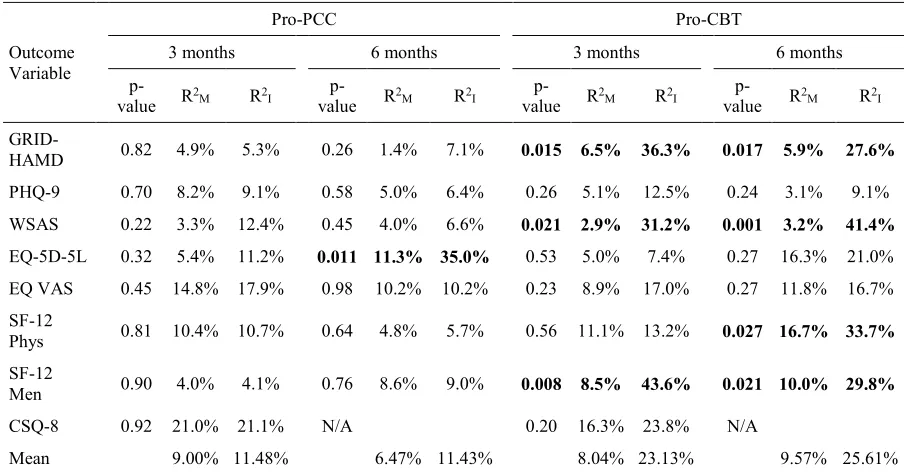
Eight of the 30 interactions between treatment preference and treatment were statistically significant at the p < .05 level (Table 1). Under the null hypothesis of no interactions between treatment preferences and treatment effect differences, and assuming independence between all of the interactions tested, the probability of observing eight or more p-values less than .05 would be < .0001. The interaction between pro-PCC scores and interventions was significant for one of the 15 outcome variables, and the interaction between pro-LICBT scores and intervention was significant for seven of the 15 outcome variables.
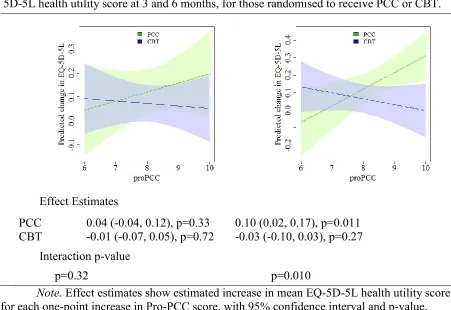
The one outcome for which a significant interaction was found between Pro-PCC scores and randomized treatment was the change in EQ-5D-5L health utility score from baseline to 6 months. Figure 1 shows the associations between Pro-PCC scores and changes in health utility scores at 3- and 6-months for each treatment group. At 3 months, there was no evidence that outcomes differed according to Pro-PCC scores in either treatment group, and outcomes in each treatment group were similar at all levels of Pro-PCC scores. At 6 months, however, there was evidence of an interaction (p = .010), accounting for an additional 23.7% of variance in the outcome. For those assigned to LICBT, outcomes varied little according to the strength of preference for PCC (p = .27). On the other hand, for those assigned to PCC, quality of life scores at 6 months tended to be higher (better) if Pro-PCC scores were higher (p = .011). As a result, for those individuals with Pro-PCC scores of 9 or 10, being assigned to the PCC intervention appears to offer some benefit.
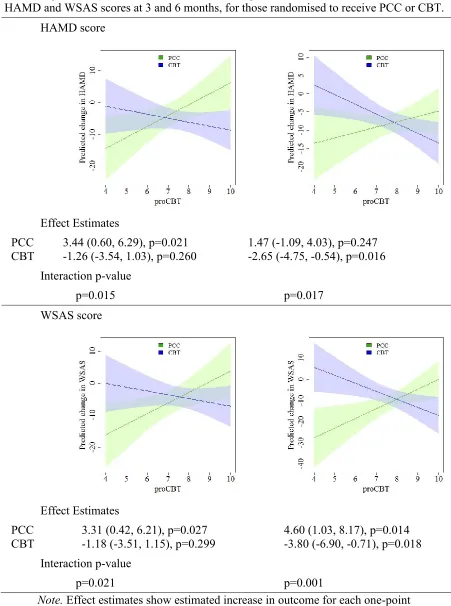
We found significant interactions between the randomly assigned treatment and preference scores in relation to CBT for HAMD and WSAS scores at both 3 months (ΔR2 = 29.8% and
28.3%, respectively, Figure 2) and 6 months (ΔR2 = 21.7% and 38.2%, respectively). For
those who were assigned to CBT, HAMD and WSAS scores at 3 months were similar across all levels of preference (p = .26 and p = .30), but at 6 months tended to be lower (better) for individuals with a preference for CBT (p = .016 and p = .018). For those assigned to PCC, those who scored highly on the Pro-CBT scale had higher (worse) scores at 3 months for both HAMD (p = .021) and WSAS scores (p = .027); this pattern was maintained at 6 months for changes in WSAS scores (p = .014), but was no longer significant for HAMD (p = .25). Overall, these results suggest that those who score highly on the Pro-CBT scale will do better if given CBT, whereas those who score low in this scale will do better if they receive PCC.
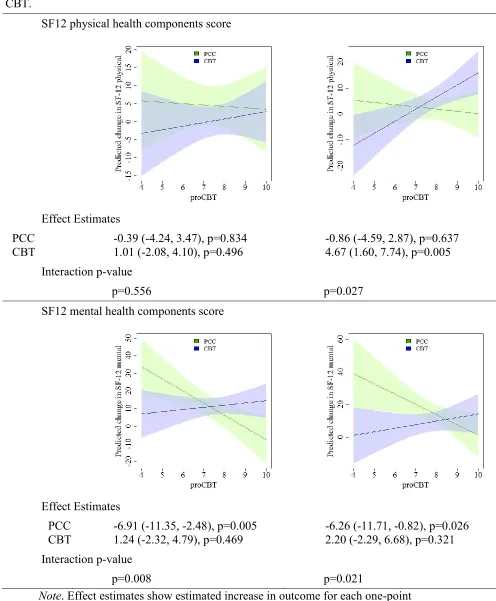
Interactions between Pro-CBT scores and randomized treatment were also found for the SF-12 mental health component scores at 3 months (ΔR2 = 35.1%) and for both mental and
physical health components at 6 months (ΔR2 = 19.8%, 17.0% respectively, Figure 3). For
For the physical domain, the interaction at 3 months was not significant (p= .56), with no evidence of a treatment effect difference at any level of the Pro-CBT scale. At 6 months, however, whilst those assigned to PCC had similar scores across the CBT preference scale (p = .64), those assigned to CBT achieved higher (better) physical health scores if they
expressed a preference for CBT (p = .005). Again, this indicates opposing treatment effect differences according to the strength of preference for CBT.
Discussion
In summary, eight out of 30 interactions between baseline intervention preferences and interventions were found to be significant, accounting for between 17.0% and 38.2% of additional outcome variance. All were in the predicted direction, with patients who showed a more positive attitude towards an intervention doing better in that intervention than in an alternative intervention. Overall, the incremental interaction effect for PCC preference across measures was 3.72% of the variance (see Note, Table 1), which is a small-to-medium effect, and consistent with findings from previous meta-analyses (Lindheim et al., 2014; Swift et al., 2011). However, the overall incremental interaction effect for CBT preference across
measures was 15.57%, which is in the medium-to-large effect size range, and considerably greater than the mean preference effect found in previous studies.
As an exploratory study with a small sample size, we were not expecting to find extensive preference effects. The finding of eight significant interactions out of 30 (26.7%), where one or two would have been expected by chance, suggests that the outcomes of patients with persistent sub-threshold and mild depression in different interventions may be moderated by their preferences. This finding is consistent with evidence from depressed clients more generally, as well as other clinical populations (Lindhiem et al., 2014; Swift et al., 2011).
Two findings of particular interest emerged from the present study. First, as hypothesized in our introduction, pre-treatment preferences for different treatments appeared to interact with treatment type in distinct ways. Second, preferences for a particular treatment seemed to be as good at predicting outcomes for an alternative treatment as they were for that
treatment, itself. One explanation for these findings may be that, in the present study, the two interventions varied by format (face-to-face vs guided self-help using text-based and online resources), as well as by theoretical orientation (CBT vs PCC); and the guided self-help nature of the LICBT intervention may have been particularly salient to clients on the Therapy Attitude Form. Hence, participants’ treatment preferences for LICBT may have been an indicator of a broader format preference: for text-based and online guided self-help support as opposed to face-to-face therapy. This could explain why patients who scored higher on this dimension tended to do poorer in PCC, a face-to-face intervention, as well as better in LICBT. This explanation is supported by our finding that participants, in the present study, tended to express a greater pre-treatment preference for PCC as opposed to LICBT. This is anomalous with previous findings, which show a greater preference for CBT over insight-based therapies (e.g., Bragesjo, Clinton, & Sandell, 2004; King et al., 2000); but consistent with literature that participants show a greater preference for face-to-face therapies over self-help interventions (Mitchell & Gordon, 2007). In other words, participants’ ratings of the present interventions may have been more of a reflection of their feelings towards the format of the therapies than their orientation.
seeing a demonstration of it in practice, Mitchell & Gordon, 2007), they may become more favorable towards it. Hence, further research will need to consider whether it is clients’ initial preferences for this format of treatment, or their ‘informed preferences’, that is most predictive of outcomes.
In addition, with respect to future research, the present findings provide support for the suggestion that preferences for different therapies should be treated as independent
dimensions, rather than being collapsed into a single dichotomous variable. The findings of this study also suggest that, for future research, it may be important to assess preferences for format of therapy more widely. Indeed, it may be that this should be added as a fourth form of patient preference, alongside treatments, roles, and therapists’ characteristics. More generally, the findings from this study suggest that, for future research, pre-treatment preferences should be assessed on a range of independent dimensions--orientation, format, and also other characteristics like treatment aims--rather than as a homogenous treatment package. This would help to establish the particular kinds of preferences that might interact with treatment types to determine outcomes. In addition, future research needs to disentangle the effects of receiving a treatment aligned to one’s preference with the effects of receiving a treatment that one has indicated a preference for. Research by Handelzalts and Keinan (2010), for instance, suggests that simply the act of receiving a chosen treatment--irrespective of the nature of that treatment--can have positive benefits. In terms of limitations, the
principal weakness of this study was the relatively small number of participants. This meant the study was underpowered, such that actual interactions between pre-treatment preferences and outcomes may not have been detected (Type II error). In addition, the small sample size and consequent lack of Bonferroni correction meant that the present results are prone to familywise error and must be treated with considerable caution. The small sample size also meant that a categorical analysis--comparing outcomes for patients who preferred PCC over LICBT against those who showed the reverse preference--was not undertaken; nor an analysis of moderating effects of treatment preferences on dropout. Another important limitation of this study was that, in the Therapy Attitude Form, only brief descriptions of each intervention were used, and more in-depth vignettes--for instance, showing patients videos of actual intervention sessions--may have provided a more accurate assessment of preference effects. The particular wording of the descriptions of the two approaches might also have affected the results. Different descriptions might be attractive to different people. This area needs further exploration, in particular the impact of different ways of describing
interventions and the support available. The reliance of the Therapy Attitude Form on 2-item scales, with limited evidence of reliability and validity, was also a drawback of the present study. Within the treatment preference literature, a reliance on one or two item indicators is not uncommon (Sidani, Epstein, Bootzin, Moritz, & Miranda, 2009), but future research would benefit from using more psychometrically sound indicators of treatment preferences (e.g., Sidani et al., 2009). Finally, as discussed above, our study confounds preference for orientation of therapy (person-centered vs. CBT) with preference for format of therapy (face-to-face vs. self-help), such that we were not able to identify the key preference dimensions that interact with outcomes.
equal benefits at a population level, there may be subgroups of the population who would obtain greater benefit (or no benefit) from one or other of the treatments, depending on their preferences. By not taking account of these preferences, we may be wasting time and resources delivering treatments to the wrong people.
References
Adamson, S. J., Sellman, J. D., & Dore, G. M. (2005). Therapy preference and treatment outcome in clients with mild to moderate alcohol dependence. Drug and Alcohol Review, 24(3), 209-216. doi: 10.1080/09595230500167502
Arnkoff, D. B., Glass, C. R., & Shapiro, D. (2002). Expectations and preferences. In J. C. Norcross (Ed.), Psychotherapy Relationships that Work: Therapist Contributions and Responsiveness to Patients (pp. 335-356). New York: Oxford University Press. Attkisson, C. C., & Zwick, R. (1982). The Client Satisfaction Questionnaire: Psychometric
properties and correlations with service utilization and psychotherapy outcome. Evaluation and program planning, 5(3), 233-237. doi:
10.1016/0149-7189(82)90074-X
Barak, A., Hen, L., Boniel-Nissim, M., & Shapira, N. a. (2008). A comprehensive review and a meta-analysis of the effectiveness of internet-based psychotherapeutic interventions. Journal of Technology in Human Services, 26(2-4), 109-160. doi:
10.1080/15228830802094429
Berger, T., Caspar, F., Richardson, R., Kneubühler, B., Sutter, D., & Andersson, G. (2011). Internet-based treatment of social phobia: a randomized controlled trial comparing unguided with two types of guided self-help. Behaviour research and therapy, 49(3), 158-169.
Bragesjo, M., Clinton, D., & Sandell, R. (2004). The credibility of psychodynamic, cognitive and cognitive-behavioural psychotherapy in a randomly selected sample of the general public. Psychology and Psychotherapy: Theory Research and Practice, 77, 297-307. doi: 10.1348/1476083041839358
Cheak-Zamora, N. C., Wyrwich, K. W., & McBride, T. D. (2009). Reliability and validity of the SF-12v2 in the medical expenditure panel survey. Quality of Life Research, 18(6), 727-735. 10.1007/s11136-009-9483-1
Cuijpers, P., Donken, T., Van Straten, A., Li, J., & Andersson, G. (2010). Is guided self-help as effective as face-to-face psychotherapy for depression and anxiety disorders? A systematic review and meta-analysis of comparative outcome studies. Psychological Medicine, 40, 1943 - 1957. doi: 10.1017/S0033291710000772
First, M. B., Spitzer, R. L., Gibbon, M., & Williams, J. B. W. (2007). Structured Clinical Interview for DSM-IV-TR Axis I Disorders, Clinical Trials Version (SCID-CT). New York: Biometric Research Department.
Freire, E., Elliott, R., & Westwell, G. (2014). Person-Centred and Experiential Psychotherapy Scale: Development and reliability of an adherence/competence measure for person-centred and experiential psychotherapies. Counselling and Psychotherapy Research, 14(3), 220 - 226. doi: 10.1080/14733145.2013.808682
Goldberg, D., & Huxley, P. (1992). Common Mental Disorders: a Bio-Social Model. London: Routledge.
Handelzalts, J. E., & Keinan, G. (2010). The effect of choice between test anxiety treatment options on treatment outcomes. Psychotherapy Research, 20(1), 100 - 112. doi: 10.1080/10503300903121106
Janssen, M., Pickard, A. S., Golicki, D., Gudex, C., Niewada, M., Scalone, L., . . .
EQ-5D-3L across eight patient groups: a multi-country study. Quality of Life Research, 22(7), 1717-1727. doi: 10.1007/s11136-012-0322-4
King, M., Sibbald, B., Ward, E., Bower, P., Lloyd, M., Gabbay, M., & Byford, S. (2000). Randomised controlled trial of non-directive counselling, cognitive-behaviour therapy and usual general practitioner care in the management of depression as well as mixed anxiety and depression in primary care. Health Technology Assessment, 4(19), 1-83. Klein, D., Schwartz, J., Rose, S., & Leader, J. (2000). Five-year course and outcome of
dysthymic disorder: A prospective naturalistic follow-up study. American Journal of Psychiatry, 157, 931-939.
Kroenke, K., Spitzer, R. L., & Williams, J. B. (2001). The Phq‐9. Journal of general internal medicine, 16(9), 606-613. doi: 10.1046/j.1525-1497.2001.016009606.x
Li, W. (2011). The Relationship Between Therapy Preference and Personality Traits. (PsychD), Glasgsow Caledonian University, Glasgow.
Lindhiem, O., Bennett, C. B., Trentacosta, C. J., & McLear, C. (2014). Client preferences affect treatment satisfaction, completion, and clinical outcome: A meta-analysis. Clinical psychology review, 34(6), 506-517. doi: 10.1016/j.cpr.2014.06.002 Maruish, M. E., & Turner-Bowker, D. M. (2009). A guide to the development of certified
modes of short form survey administration. QualityMetric Incorporated, Lincoln, RI. Mundt, J. C., Marks, I. M., Shear, M. K., & Greist, J. M. (2002). The Work and Social
Adjustment Scale: a simple measure of impairment in functioning. The British Journal of Psychiatry, 180(5), 461-464. doi: 10.1192/bjp.180.5.461
Mitchell, N., & Gordon, P. K. (2007). Attitudes towards computerized CBT for depression amongst a student population. Behavioural and Cognitive Psychotherapy, 35(04), 421-430.
National Collaborating Centre for Mental Health. (2010). Depression: The NICE guidelines on the treatment and management of depression in adults Clinical Guideline CG90 (Updated ed.). London: National Institute for Health and Clinical Excellence. Rogers, C. R. (1959). A theory of therapy, personality and interpersonal relationships as
developed in the client-centered framework. In S. Koch (Ed.), Psychology: A Study of Science (Vol. 3, pp. 184-256). New York: McGraw-Hill.
Roth, A., Hill, A., & Pilling, S. (2009). The competences required to deliver effective Humanistic Psychological Therapies. London: University College London.
Sidani, S., Epstein, D. R., Bootzin, R. R., Moritz, P., & Miranda, J. (2009). Assessment of preferences for treatment: Validation of a measure. Research in Nursing & Health, 32(4), 419-431. doi: 10.1002/nur.20329
Spitzer, R., Kroenke, K., & Williams, J. (1999). Validation and utility of a self-report version of the prime-MDD: the PHQ primary care study. Journal of the American Medical Association, 282, 1737-1744. doi:10.1001/jama.282.18.1737
Swift, J. K., Callahan, J. L., & Vollmer, B. M. (2011). Preferences. In J. C. Norcross (Ed.), Psychotherapy relationships that work (2nd ed., pp. 301-315). NY: Oxford
University.
The EuroQol Group. (1990). EuroQol-a new facility for the measurement of health-related quality of life. Health policy, 16(3), 199-208.
Williams, J. B., Kobak, K. A., Bech, P., Engelhardt, N., Evans, K., Lipsitz, J., . . . Kalali, A. (2008). The GRID-HAMD: standardization of the Hamilton depression rating scale. International clinical psychopharmacology, 23(3), 120-129. doi:
10.1097/YIC.0b013e3282f948f5
Table
Table 1. Tests of interaction between measures of preference towards each intervention (Pro-PCC and Pro-CBT) and the intervention effect difference.
Outcome Variable
Pro-PCC Pro-CBT
3 months 6 months 3 months 6 months
p-value R2M R2I value p- R2M R2I value p- R2M R2I value p- R2M R2I
GRID-HAMD 0.82 4.9% 5.3% 0.26 1.4% 7.1% 0.015 6.5% 36.3% 0.017 5.9% 27.6% PHQ-9 0.70 8.2% 9.1% 0.58 5.0% 6.4% 0.26 5.1% 12.5% 0.24 3.1% 9.1% WSAS 0.22 3.3% 12.4% 0.45 4.0% 6.6% 0.021 2.9% 31.2% 0.001 3.2% 41.4%
EQ-5D-5L 0.32 5.4% 11.2% 0.011 11.3% 35.0% 0.53 5.0% 7.4% 0.27 16.3% 21.0% EQ VAS 0.45 14.8% 17.9% 0.98 10.2% 10.2% 0.23 8.9% 17.0% 0.27 11.8% 16.7% SF-12
Phys 0.81 10.4% 10.7% 0.64 4.8% 5.7% 0.56 11.1% 13.2% 0.027 16.7% 33.7% SF-12
Men 0.90 4.0% 4.1% 0.76 8.6% 9.0% 0.008 8.5% 43.6% 0.021 10.0% 29.8%
CSQ-8 0.92 21.0% 21.1% N/A 0.20 16.3% 23.8% N/A
Mean 9.00% 11.48% 6.47% 11.43% 8.04% 23.13% 9.57% 25.61%
Note. GRID-HAMD = GRID Hamilton Depression Rating Scale. PHQ-9 = Patient Health Questionnaire-9 measure of depression; WSAS = Work and Social Adjustment Scale; EQ-5D-5L = Euroqol measure of quality of life, 5-items; EQ VAS = Euroqol measure of health status, visual analogue scale; SF-12 Phys = Physical component summary of Short-Form 12 Health Survey; SF-12 Men = Mental component summary of Short-Form 12 Health Survey; CSQ-8 = Client Satisfaction Questionnaire. For each possible interaction, we report the interaction p-value, the R2 value for the model without
interaction (main effects only, R2M) and for the model with an interaction (R2I). Significant interactions (bold) indicate
outcomes for which the effect of the intervention may vary according to the participant’s preference for the stated intervention. Mean Pro-PCC R2M = 7.74%, Mean Pro-PCC R2I = 11.48%, Mean Pro-PCC ΔR2= 3.72%; Mean Pro-LICBT
R2
Figures
Figure 1. Estimated associations between a preference for PCC (“ProPCC”) and EQ-5D-5L health utility score at 3 and 6 months, for those randomised to receive PCC or CBT.
Effect Estimates PCC
CBT 0.04 (-0.04, 0.12), p=0.33 -0.01 (-0.07, 0.05), p=0.72 0.10 (0.02, 0.17), p=0.011 -0.03 (-0.10, 0.03), p=0.27 Interaction p-value
p=0.32 p=0.010
Figure 2. Estimated associations between a preference for CBT (“ProCBT”) and HAMD and WSAS scores at 3 and 6 months, for those randomised to receive PCC or CBT.
HAMD score
Effect Estimates PCC
CBT
3.44 (0.60, 6.29), p=0.021 -1.26 (-3.54, 1.03), p=0.260
1.47 (-1.09, 4.03), p=0.247 -2.65 (-4.75, -0.54), p=0.016 Interaction p-value
p=0.015 p=0.017
WSAS score
Effect Estimates PCC
CBT
3.31 (0.42, 6.21), p=0.027 -1.18 (-3.51, 1.15), p=0.299
4.60 (1.03, 8.17), p=0.014 -3.80 (-6.90, -0.71), p=0.018 Interaction p-value
p=0.021 p=0.001
Note. Effect estimates show estimated increase in outcome for each one-point
Figure 3. Estimated associations between a preference for CBT (“ProCBT”) and SF12
physical and mental health domain scores at 3 and 6 months, for those randomised to receive PCC or CBT.
SF12 physical health components score
Effect Estimates PCC
CBT -0.39 (-4.24, 3.47), p=0.834 1.01 (-2.08, 4.10), p=0.496 -0.86 (-4.59, 2.87), p=0.637 4.67 (1.60, 7.74), p=0.005 Interaction p-value
p=0.556 p=0.027
SF12 mental health components score
Effect Estimates PCC
CBT
-6.91 (-11.35, -2.48), p=0.005 1.24 (-2.32, 4.79), p=0.469
-6.26 (-11.71, -0.82), p=0.026 2.20 (-2.29, 6.68), p=0.321 Interaction p-value
p=0.008 p=0.021