Blockage and relative velocity Morison forces on a
dynamically-responding jacket in large waves and current
H. Santoa,∗, P. H. Taylorb, A. H. Dayc, E. Nixonc, Y. S. Chood
a
Office of the Deputy President (Research and Technology), National University of Singapore, Singapore 119077, Singapore
b
Department of Engineering Science, University of Oxford, Oxford OX1 3PJ, United Kingdom c
Department of Naval Architecture, Ocean and Marine Engineering, University of Strathclyde, Glasgow G4 0LZ, United Kingdom
d
Centre for Offshore Research & Engineering, Department of Civil and Environmental Engineering, National University of Singapore, Singapore 117576, Singapore
Abstract
This paper documents large laboratory-scale measurements of hydrodynamic force time histories
on a realistic 1:80 scale space-frame jacket structure, which is allowed to respond dynamically
when exposed to combined waves and in-line current. This is a follow-on paper to Santo, Taylor,
Day, Nixon and Choo (2018a) which used the same jacket structure but very stiffly supported.
The aim is to investigate the validity of the Morison equation with a relative velocity formulation
when applied to a complete space-frame structure, and to examine the fluid flow (and the associated
hydrodynamic force) reduction relative to ambient flow due to the presence of the jacket structure as
an obstacle array as well as the dynamic structural motion, interpreted as wave-current-structure
blockage. Springs with different stiffness are used to allow the jacket to respond freely in the
incident wavefield, with the emphasis on high frequency modes of structural vibration relative to the
dominant wave frequency. Transient focussed wave groups, and embedded wave groups in a smaller
regular wave background are generated in a towing tank. The jacket is towed under different speeds
opposite to the wave direction to simulate wave loading with different in-line uniform currents.
The measurements are compared with numerical predictions using Computational Fluid Dynamics
(CFD), with the actual jacket represented in a three-dimensional numerical wave tank as a porous
tower and modelled as a uniformly distributed Morison stress field derived from the relative velocity
form. A time-domain ordinary differential equation solver is coupled internally with the CFD solver
∗Corresponding author. Tel: +65 6516 6853. Fax: +65 6779 1635
to account for feedback from the structural motion into the Morison distributed stress field. An
approximate expanded form of the Morison relative-velocity is also tested and is recommended
for practical industrial applications. Reasonably good agreement is achieved in terms of incident
surface elevation, dynamic model displacement as well as total hydrodynamic force time histories,
all using a single set of Morison drag (Cd) and inertia (Cm) coefficients, although the numerical
results tend to slightly overpredict the total forces. The good agreement between measurements
and numerical predictions and the generality of the results shows that the Morison relative-velocity
formulation is appropriate for a wide range of space-frame structures. In these tests, this gives rise
to additional damping of the dynamic system which is equivalent to 8% of critical damping. This is
significantly larger than both the structural and hydrodynamic damping combined (which is about
1%) as quantified through free vibration (push test) in otherwise stationary water.
Keywords: Morison fluid loading, relative velocity, wave-current-structure blockage, porous block
with embedded ODE simulation, spring-mass-damper system
1. Introduction
1
The standard model for the hydrodynamic force on a monopile dates back to Morison et al.
2
(1950) who proposed a decomposition of the total force into drag and inertia components, each with
3
an empirical coefficient to be determined from experiment. How the viscous drag and the inviscid
4
inertia forces operate effectively independently, such that the total force can be decomposed into
5
two distinct components, was subsequently discussed by Lighthill (1986). Since the introduction of
6
the so-called Morison equation, it has been extensively used to characterise hydrodynamic forces
7
on a single cylinder as well as multiple cylinders forming a space-frame offshore structure.
8
The applicability of the Morison equation for a statically-responding structure made of multiple
9
cylinders, such as an offshore jacket structure, has been investigated in the past in the context of
10
wave-current blockage. The first study dates back to Taylor (1991) who first reported the local
11
fluid velocity and associated hydrodynamic force (mainly drag) reduction on a structure due to the
12
presence of the structure as an obstacle array, which provides resistance to the incident wave and
13
current flow. Therefore, the use of the Morison equation with free-stream undisturbed kinematics
14
will tend to overpredict the actual hydrodynamic force experienced by the structure. Taylor (1991)
15
proposed an analytical blockage model accounting for blockage effect due to steady current flow
(hence the term ‘current blockage’) as an improvement to the Morison equation for multi component
17
space-frame structures. Subsequently, Taylor et al. (2013) and Santo et al. (2014b) extended the
18
analytical work to include regular waves with in-line current, and demonstrated the additional force
19
reduction due to the extra contribution from waves into the hydrodynamic loading and this was
20
coined as ‘wave-current blockage’. Their results have been extensively validated by experiments
21
from small lab-scale tests involving perforated flat plates to large-scale tests using a scaled jacket
22
model in a large towing tank, as well as numerical CFD simulations using a porous block as a proxy
23
for such structural models, see Santo et al. (2014a,b, 2015, 2017, 2018a). It is worth stressing that a
24
universal form of reduction factors to reduce the undisturbed flow kinematics to account for
wave-25
current blockage, similar to reduction factors for current blockage given in the design standard API
26
RP 2A (2000), cannot be obtained. Therefore, it is necessary to solve for the blocked (or disturbed)
27
kinematics accounting for the presence of the structure using numerical CFD simulations.
28
For dynamically-responding structure consisting of multiple cylinders, an extension of the
Mori-29
son equation, usually termed the Morison with relative-velocity formulation, includes interaction
30
terms that involve both fluid and structural velocities and accelerations. The validity of the Morison
31
relative-velocity form has been investigated in the past, although most of the studies primarily
con-32
sidered a single cylinder oscillated in otherwise still water, see for example Moe and Verley (1980);
33
Williamson (1985); Shafiee-Far et al. (1996); Burrows et al. (1997); Sumer and Fredsøe (2006). It
34
is thus of interest to investigate this experimentally using a full jacket model allowed to respond
35
dynamically when subjected to a range of waves with in-line current.
36
This paper serves as an extension to previous research on wave-current blockage on
statically-37
responding (fixed bottom-founded) space-frame offshore structures. Here we attempt to address
38
the following two questions: is the relative velocity version of the Morison equation adequate when
39
applied to a dynamically-responding space-frame structure? If so, can the problem be treated in a
40
similar way as the blockage effect on a statically-responding structure, with some modification to the
41
underlying Morison form? Examples of dynamically-responding structures in offshore engineering
42
include compliant towers, jack-ups and deepwater jackets. The aim of this paper is to investigate
43
whether the relative structural motion also contributes to any additional blockage effects, which
44
then provide additional fluid damping and cause the net dynamic motion of the structure to be
45
(much) smaller. We will describe this as ‘wave-current-structure blockage’.
46
Indeed there have been some evidence from the existing compliant towers reported by the
industry. For example, full-scale field measurements on the Exxon Lena guyed compliant tower, as
48
reported by Steele (1986), concluded that the response of the tower to Loop Current eddies was
49
overpredicted by a factor of five to six. Thus, the net current velocity within the tower must have
50
been only 40% of the far field velocity, a significant 60% flow reduction!
51
Previous work by Santo et al. (2018c) and Santo et al. (2018b), who looked at forced oscillations
52
on grids of perforated plates, provides an indication that Morison relative-velocity formulation can
53
adequately describe the complete measured force-time history after accounting for
wave-current-54
structure blockage. Although the small-scale experiments were conducted using idealised geometry
55
representing a space-frame structure at low Reynolds number, that study provides the motivation
56
for the present work to conduct a more realistic series of experiments at larger scale. In particular,
57
this paper focusses on a flow regime where the frequency of the primary structural resonance is
58
higher than the dominant wave frequency, thus representing either the second mode of a compliant
59
tower or the first mode of jack-up legs. The structural velocity in this flow regime is typically
60
smaller than the undisturbed wave kinematics, at least close to the free-surface.
61
The paper is arranged as follows. The definition of blockage will be further clarified in the
62
next section in view of potential confusion with ‘wind tunnel blockage’ and ‘wave-current blocking’.
63
The experimental modelling and data analysis will be described in Section 3, followed by the
64
numerical modelling and results in Section 4. The same section also contains an exploration of
65
a simplified version of the relative velocity formulation suitable for straightforward adoption by
66
industry. Section 5 contain some discussions such as additional damping and the scaling effects,
67
while Section 5 concludes the paper.
68
2. Definition
69
Our use of the term wave current structure blockage is consistent with our previous work,
70
starting with Taylor (1991). However, we stress that it is not directly related to two other uses
71
of the term ‘blockage’ in the fluid dynamics literature. We define current blockage as the effect
72
of flow resistance due to an array of closely spaced obstacles on the total force on the array.
73
Upstream, the approaching flow diverges away from the array because of the resistance within the
74
array. Downstream, the individual wakes of the obstacles merge and the local pressure rises back
75
to ambient as the bulk wake expands. The net effect of both the upstream irrotational divergence
76
and the downstream rotational wake relaxation is to reduce the average velocity within the obstacle
array to less than the speed of the approach flow far upstream. Other than by the ocean
free-78
surface, there is no other lateral constraint on the flow. This is simple current blockage and in
79
our more recent publications, we have explored the effects of a large in-line oscillation, to represent
80
wave kinematics superimposed on an ocean current, hencewave-current blockage. In this paper, the
81
structure is allowed to respond dynamically under the fluid loading, hence wave-current-structure 82
blockage.
83
In contrast, wind tunnel blockage refers to the effects of wind tunnel internal surfaces on the
84
performance of a model within, be this lift on a wing or drag on a bluff body. Any body within
85
the flow causes a disturbance to the incident flow and this flow will diverge outwards away from
86
the body. The bounding tunnel walls, floor and roof provide fixed boundaries that the flow cannot
87
pass through. Hence, there is an effect on the local flow at the body surface, both velocity and the
88
pressure, resulting from the finite size of the wind tunnel. The forces exerted on the body are then
89
different to what they would have been if the body had been in an effectively infinite flow. Thus,
90
wind tunnel blockage is a consequence of both changes to the essential inviscid bulk surrounding
91
flow and the local rotational wake. Early work on wind tunnel blockage can be found in Glauert
92
(1933) and Maskell (1963).
93
A second use of the term wave-current blocking refers to the inability of a wave to propagate
94
upstream against a fast flow, the current. This can be an entirely inviscid phenomenon. See the
95
extensive presentations by Peregrine (1976) and Jonsson (1990), and the recent paper by Das et al.
96
(2018). In our study, the characteristic speeds for free-surface waves, the group velocity and the
97
phase speed, are both much larger than the ocean current. Also, we have the wave and the current
98
inline through the space-frame, so the instantaneous fluid kinematics are maximized. Then, the
99
flow is far from any regime wherewave-current blocking can occur.
100
3. Experimental modelling and data analysis
101
3.1. Experimental setup 102
These experiments were conducted in the towing tank of the Kelvin Hydrodynamics Laboratory,
103
University of Strathclyde, Glasgow. The tank is 76 m long, 4.6 m wide and 2.5 m deep. Four paddles
104
of Edinburgh Design Limited (EDL) ‘flap-type’ wavemakers with force-feedback are located at one
105
end, while a sloping beach acting as a passive absorber is placed at the other end. In the experiments,
linear wave generation was used. A self-propelled carriage runs along the longitudinal direction of
107
the tank. Figure 1 shows a plan view as well as a photographs of the carriage.
108
4.6 m Wavemakers Carriage
Beach
[image:6.595.92.498.185.351.2]76 m
Figure 1: Left panel shows the plan view of the towing tank facility (not to scale). Right panel shows a photograph
of the carriage when viewed in a downstream direction along the tank. On the carriage, a parallel pendulum system
supports the jacket model below. Also shown is a wave gauge next to the jacket model.
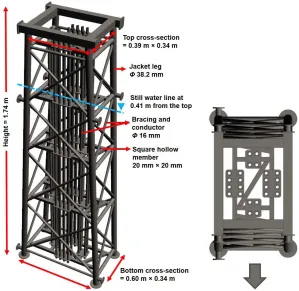
We use the same 1:80 jacket model as used previously in Santo et al. (2018a). The jacket model
109
was hung below the carriage, which was towed at constant speed along the tank to simulate uniform
110
current. Figure 2 shows a 3D CAD model of the jacket with relevant geometric information (left)
111
and a plan view of the jacket (right). In these experiments, only the end-on configuration was
112
tested, as this will provide more blockage and a more severe test of the modelling.
113
The jacket model was suspended by a mounting frame with a parallel pendulum arrangement
114
(or inverted table), such that the still water level is at 0.12 m below the centre of the top X-brace,
115
or a distance of 1.33 m up from the jacket base. The mounting frame was then hung below a rigid
116
frame attached on the towing carriage, see Figure 3. Such arrangement allows the total horizontal
117
hydrodynamic load to be measured directly by a force transducer. The force transducer was rated
118
at 50 kg (490 N) and sampled at 5555.6 Hz. A resistance-based wave probe, sampled at the same
119
rate as the force transducer, was mounted on the towing carriage midway between the jacket model
120
and the side of the tank to provide phase information of the incident waves. A Qualysis motion
121
tracking system is used to record the displacement of the jacket model during dynamic tests.
122
Previously in Santo et al. (2018a), the mounting frame was connected directly to a force
trans-123
ducer via a rigid link in order to measure the total horizontal hydrodynamic load during static
Figure 2: Left picture shows a 3D CAD model of the jacket with relevant geometric information. Right picture shows
the plan view of the jacket.
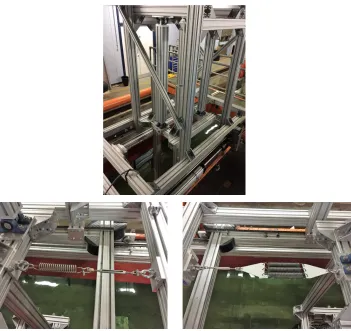
(very stiff) tests. In these new dynamic tests, one spring was attached in between the mounting
125
frame and a force transducer at the front of the setup, and another identical spring in between
126
the mounting frame and a rigid frame at the rear of the setup (without any force transducer), as
127
shown in Figure 3. The springs were pre-tensioned equally at each side at adequate extension to
128
prevent them from going completely slack or the spring helix making self-contact. This minimises
129
any nonlinearity in the behaviour of the spring at any point in the motion. It is worth remarking
130
that since the force measurement is only taken at one side of springs during the tests, the analysis
131
inevitably requires us to assume that both sides of springs are equally stiff and therefore identical.
132
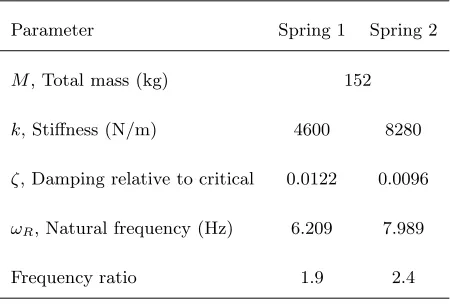
Two sets of springs with two different total stiffness (4600 N/m and 8280 N/m) were used
133
in parallel sets of experimental tests, hereafter denoted as spring 1 and spring 2 arrangement,
134
respectively. These are chosen to yield high frequency modes of structural vibration relative to the
Figure 3: Top panel shows a photograph of the double pendulum setup on the carriage to support the jacket model.
Also shown is the spring 1 arrangement being attached to the front and rear of the setup. Bottom panel shows
photographs of the spring 1 arrangement at the rear of the setup (left), and the spring 2 at the front of the setup
(right) which is then connected to a force transducer.
dominant wave frequency in order to represent both the second mode of compliant towers and the
136
first mode of a jack-up leg. During the dynamic tests, the weaker springs result in relative jacket
137
model displacement of ∼ ±1 main leg diameter. Because of the parallel pendulum system, the
138
jacket displacement is very close to uniform with water depth (horizontally) with negligible vertical
139
excursion for small displacements of the order of 1 main leg diameter, as considered in this paper.
140
The same set of regular waves and wave groups as in Santo et al. (2018a) is used in these
141
dynamic tests. To generate the localised wave groups, a set of 43 Fourier wave components was
142
generated at the paddles following a JONSWAP-shaped amplitude spectrum truncated at 1 Hz,
with the frequency of the peak spectral energy at 0.52 Hz and a linear crest amplitude of 0.22 m at
144
focus. The water depth is kept at 1.8 m. Downstream along the tank, all the wave components are
145
intended to come into focus which results in a perfectly focussed (defined as having a horizontal
146
symmetry between the adjacent troughs either side of the largest crest in time). The same focussed
147
wave group is also embedded into a set of regular wave backgrounds with wave heights of 0.1 m, 0.13
148
m and 0.15 m. It is worth noting, however, that in the tank the embedded focussed wave groups
149
interacted with the background wave and the actual focus location was shifted downstream. This
150
results in embedded wave groups being not perfectly focussed. This does not present significant
151
difficulties for the comparison between the physical experimental forces and the CFD predictions,
152
as iteration was used to ensure a good match between the measured and predicted incident waves
153
at the model.
154
All the dynamic tests were done with one of three different towing speeds, representing uniform
155
in-line (or following) current at the model: 0, 0.14 and 0.28 m/s, so the horizontal fluid velocity
156
in the wave crests adds to the current. The same synchronisation system between the wave paddle
157
and the carriage motion as previously used in the static tests as described by Santo et al. (2018a)
158
is used throughout the dynamic tests. The synchronisation system is required to ensure that the
159
jacket model towed under different speeds meets the same wave group at the right place and at the
160
right time.
161
Apart from the dynamic tests, a repeat of the static tests was also conducted to provide reference
162
data instead of re-using the previous results as described in Santo et al. (2018a). This is necessary
163
because of a slight modification to the wave paddle system in the tank which causes difficulties to
164
reproduce exactly the previous results of Santo et al. (2018a) (both in terms of surface elevation
165
and force time histories).
166
3.2. Data analysis 167
In a situation where a structure is compliant and its displacement (which is uniform with depth
168
and along the wave direction) is given byxs(t), the jacket motion can be assumed to satisfy the
169
equation of motion for a single-degree-of-freedom (SDOF) mechanical oscillator, given by:
170
mx¨s(t) +cx˙s(t) +kxs(t) =F(t) (1)
wherekis the spring stiffness,cis the damping,mis the mass of the system, andF(t) is the external
171
force acting on the jacket in time t. Here, we assume that the effective mechanical damping c is
linear, and that it can be estimated from a free vibration test in otherwise still water. Hence, this
173
damping contains both fluid and structural components.
174
Assuming the Morison equation with the relative-velocity formulation is adequate to describe
175
the hydrodynamic force, this can be expressed as (see e.g. Section 3.5 in Haritos (2007)):
176
F(t) =ρCmVu˙(t)−ρCaVx¨s(t) +
1
2ρCdA u(t)−x˙s(t)
u(t)−x˙s(t)
(2)
whereρis the water density,V is the displaced volume of the structure,uand ˙uare the undisturbed
177
flow velocity and acceleration, respectively,Ais the solid drag area,Cd is the drag coefficient,Cm
178
is the inertia coefficient, andCa =Cm−1 is the added mass coefficient.
179
Substituting Equation 2 into 3 and combining the ¨xs(t) term, the following form can be obtained:
180
Mx¨s(t) +cx˙s(t) +kxs(t) =FA(t)
FA(t) =FI(t) +FD(t)
FI(t) =ρCmVu˙(t)
FD(t) =
1
2ρCdA u(t)−x˙s(t)
u(t)−x˙s(t)
(3)
whereM =m+m′ is now the effective total mass of the system,m′ =ρC
aV is the added mass,
181
FA(t) is the applied hydrodynamic force, which according to the Morison equation consists of a
182
sum of the inertia force,FI(t) and the drag force,FD(t).
183
Equation 3 can be recast into the standard form:
184
¨
xs(t) + 2ωRζx˙s(t) +ωR2xs(t) =
FA(t)
M (4)
whereζ=c/(2M ωR) is now the ratio of the actual to critical damping for the jacket in otherwise
185
still water conditions, andωR=k/M is the natural (resonant) frequency of the whole system. This
186
equation can be solved using an ordinary differential equation (ODE) solver with appropriate initial
187
conditions.
188
In the physical tests, the measured force is obtained from a force transducer connected through
189
a spring arrangement at the front face of the double pendulum setup. Thus, the measured force
190
represents the horizontal reaction force to the ground (FG =kxs) or equivalently the base shear.
191
Since the actual model displacement (xs) is also measured using an optical tracking system, the
192
same FG can also be derived from that. The actual hydrodynamic force (FA) applied onto the
jacket model can be found by transforming Equation 3 into frequency domain as follows:
194
FA = kxs+cx˙s+Mx¨s
ˆ
fA(ω) = (k+icω−M ω2)ˆxs(ω)
=
1 +ic
kω−
M
k ω
2
kxˆs(ω)
ˆ
fA(ω) =
1 +ic
kω−
M
k ω
2
ˆ
fG(ω)
Further substitution usingζ andωR into above equation yields:
195
ˆ
fA(ω) =
"
1 +i2ζ
ω
ωR
−
ω
ωR
2#
ˆ
fG(ω) (5)
Equation 5 describes the transfer function (TF) between the measured force through the ground (or
196
spring),FG, and the applied force,FA, in frequency domain. It is this inferred applied hydrodynamic
197
force,FA, that will be compared with numerical predictions, together with model displacement.
198
To estimate the natural frequency of the whole system due to different set of spring arrangement
199
as well as damping rate important for dynamic analysis, a free vibration (push test) is conducted
200
for each spring arrangement and the measured force is recorded. The natural frequencies due to
201
spring 1 and 2 arrangement are found to be 0.988 Hz (6.209 rad/s) and 1.272 Hz (7.989 rad/s),
202
respectively. Thus, for an incident wavegroup with peak frequency at 0.526 Hz, the frequency ratio
203
between the structural mode and the incoming wave is ∼ 1.9× and ∼ 2.4× for spring 1 and 2
204
arrangement, respectively.
205
There are two elements involved in the transfer function: the mass in the spring and the
struc-206
tural damping. The total mass can be measured/inferred, while the structural damping is
funda-207
mentally unknown but it will later be shown to be small compared to damping from (nonlinear)
208
relative velocity contribution. What is left is the hydrodynamic damping, which consists of either
209
linear (resulting from wave radiation and Stokes laminar boundary layers) or non-linear damping
210
(vortex shedding, when the displacement is larger than the main cylinder diameter). Over the range
211
of cases tested in the dynamic tests, the largest model displacement is of the order of∼ ±1 main
212
leg diameter. Therefore, it is reasonable to assume a constant linear damping term as a model for
213
the hydrodynamic damping, with the damping rate obtained from free oscillation tests (or push
214
tests).
215
Figure 4 shows the envelopes of the recorded force time histories during free oscillations, which
216
have been multiplied by an exponential termexp[0.0122ωR1(t−9)] and exp[0.0096ωR2(t−9)] for
0 5 10 15 20 25 30 35 Time (s)
0 10 20 30 40 50 60 70
Total Force (N)
[image:12.595.168.446.142.326.2]Spring 1
Spring 2
Figure 4: Envelopes of the recorded total force time histories measured through two different sets of springs during
push test. These have been multiplied byexp[0.0122ωR1(t−9)] andexp[0.0096ωR2(t−9)] for spring 1 and spring 2
arrangement, respectively.
spring 1 and 2 arrangement, respectively. The oscillations at time∼6 sec are due to the starting
218
transients and wrap-around effects of the signal processing in MATLABR
. Most of the portions of
219
the envelopes are close to horizontal, showing that the decay of the free oscillations of the jacket
220
model in otherwise still water is close to linear with a non-dimensional damping coefficients of 0.0122
221
and 0.0096 for spring 1 and 2 arrangement, respectively. These structural damping rate values∼1%
222
will be used in the subsequent analysis, although they are lower than the API recommendation that
223
the structural damping should be taken as 2−3% of critical for extreme wave analyses (API RP
224
2A, 2000). Note that although the non-dimensional damping coefficients are different, the effective
225
mechanical damping coefficient, c = 0.0122ωR1 = 0.0096ωR2, is the same for both push tests,
226
as one might expect if the damping occurs mostly outside the springs. As we shall see, much
227
larger damping comes from the Morison relative-velocity term. Table 1 summarises the relevant
228
parameters of the dynamic system.
229
4. Numerical modelling and results
230
4.1. Numerical setup 231
The numerical setup is similar to that reported by Santo et al. (2015, 2017) and recently by
232
Santo et al. (2018a), using the same porous tower modelling approach with uniformly distributed
Table 1: Summary of the dynamic system.
Parameter Spring 1 Spring 2
M, Total mass (kg) 152
k, Stiffness (N/m) 4600 8280
ζ, Damping relative to critical 0.0122 0.0096
ωR, Natural frequency (Hz) 6.209 7.989
Frequency ratio 1.9 2.4
embedded Morison stresses. In essence, the stresses are distributed over the tower but expressed
234
using the local (disturbed) flow kinematics, thus accounting for the global presence of the structure.
235
The only difference is that in this paper the embedded Morison stresses are modified according to the
236
Morison relative velocity formulation to account for the structural dynamic motion, see Equation 8.
237
The simulations are performed in the open source CFD code OpenFOAMR
(http://www.openfoam.com)
238
using the numerical wave tank ‘waves2Foam’ developed by Jacobsen et al. (2012). All the
simu-239
lations are performed in two-phase flow (air and water) by solving the Reynolds-averaged
Navier-240
Stokes equations coupled with the continuity equation for incompressible flows, and with an
addi-241
tional momentum sink term to account for the effect of the porous tower in the numerical simulation.
242
The governing equations are written as:
243
∇ ·u= 0 (6)
244
∂ρu
∂t +∇ ·[ρuu
T] =−∇p∗+∇ ·[µ∇u+ρτ]−S+ [−(g·x)∇ρ+σ
Tκγ∇γ] (7)
whereρis the fluid density, gis the acceleration due to gravity,u= (u, v, w) is the fluid velocity
245
field in Cartesian coordinates,p∗ is the pressure in excess of hydrostatic pressure, defined asp∗ = 246
p−(g·x)ρ, µ is the dynamic viscosity, x = (x, y, z) is the local Cartesian coordinates, and τ is
247
the specific Reynolds stress tensor. The free surface (interface between air and water) is tracked
248
using Volume-of-Fluid (VOF) method. The last two terms in Equation 7 in square brackets are for
249
numerical convenience for the VOF method, and only active in the region where cell is partially
250
filled with air, elsewhere these terms are zero. The σTκγ∇γ term describes the surface tension
effect using the CSF (Continuum Surface Force) model of Brackbill et al. (1992), whereσT is the
252
surface tension coefficient, andκγ is the surface curvature. γ is a scalar field used to represent the
253
fraction of a cell volume filled with water (interface), with 0≤γ≤1; 0 for air, and 1 for water. In
254
the numerical simulation, the interface value of 0.5 and greater is treated as the water phase. For
255
more details of the interface treatment, see Berberovi´c et al. (2009).
256
A sink term is used to account for momentum lost from the flow, which in the case of a
sim-257
ple homogeneous porous tower modified according to the relative velocity version of the Morison
258
equation (see e.g. Section 3.5 in Haritos (2007)) is written as:
259
S= 1
2ρF(u−us)|u−us|+C
′
m
∂ρu
∂t (8)
whereusis the structural velocity (note that this is equal to ˙xs(t) in the structural dynamics
formu-260
lation, and is constant in space over the entire block),F is the Forchheimer resistance parameter,
261
andC′
mis the equivalent of the local Morison inertia coefficient,Cm, but here defined in the porous
262
tower context.
263
Although the jacket model is made to undergo free vibration in the actual dynamic tests, there
264
is no moving (or dynamic) mesh involved in the numerical modelling. Instead a time-varying
265
stress is implemented according to Equation 8 and the governing equation is solved with a static
266
computational mesh domain.
267
Three methods are available to solve for the modified flow field accounting for the structural
268
velocity (or motion), outlined as follows:
269
• Method 1. To couple an ODE solver (with initial conditions for displacement and velocity)
270
with CFD to solve internally (with a feedback loop) for the predicted total force and model
271
displacement (and velocity). The predicted force and displacement will be directly compared
272
with measurements. This is the most complete and integrated Method that solves the coupled
273
system with the least number of assumptions. However, we note that for a real structure,
274
Method 1 would require dynamic coupling between two complex computational codes, for
275
instance OpenFOAM and a structural dynamics code such as USFOSR
(www.usfos.no), such
276
that the information is continuously passed to and fro.
277
• Method 2. To use an approximate expanded form of the Morison relative-velocity following
278
Haritos (2007) and Merz et al. (2009) to solve for the model displacement (and velocity)
and subsequently the predicted total force. This will become our recommended Method for
280
practical industry applications. No dynamic coupling is required. The output of fluid loading
281
calculation from CFD can be stored and then read in as required by the structural code.
282
• Method 3. To read inusas an external input from the measurement (structural displacement
283
converted to velocity) into CFD to solve for the predicted total force, to be compared with
284
measured total force. The predicted force is then convoluted with the same transfer function
285
(TF) in the frequency domain to yield predicted model displacement, to be compared with
286
measured displacement. This Method serves as an internal check for consistency on Method
287
1.
288
The detailed approach of Method 2 is presented as follows. Referring back to Equation 3, in the
289
case when ˙xs(t) is small compared tou(t) which is true for all the practical cases, an approximation
290
for the Morison relative-velocity term in the drag force is possible as shown by Haritos (2007) and
291
Merz et al. (2009). This has the form:
292
FD(t) =
1
2ρCdA u(t)−x˙s(t)
u(t)−x˙s(t)
≈ 1
2ρCdA u(t)|u(t)| −2|u(t)|x˙s(t)
(9)
Figure 13 in Appendix illustrates the very small difference between the above two expressions for
293
realistic flow and structural velocities. The approximate form allows the structural velocity term
294
to be de-coupled from the hydrodynamic calculation. Under these circumstances, Equation 3 can
295
be simplified as shown by Haritos (2007) as:
296
¨
xs(t) + 2ωR ζ+ζH(t)
˙
xs(t) +ωR2xs(t) =
FI(t) +FD′ (t)
M (10)
where
297
FD′(t) =
1
2ρCdAu(t)
u(t)
which is simply the static drag force (in the case of rigid support conditions), and
298
ζH(t) =
1 2ρCdA
u(t)
M ωR
(11)
which is the contribution to damping from the hydrodynamic drag interaction term, or the Morison
299
wave-current blockage term. Therefore, Method 2 involves using just the information (disturbed
kinematics accounting for wave-current blockage) from the static structure simulations to solve (as
301
post-processing) for the model displacement (and velocity) via a time-domain ODE solver, and
302
subsequently the actual applied dynamic force, all accounting for wave-current-structure blockage.
303
Therefore, the need to run the CFD code simultaneously with dynamic transfer of information
304
in both directions with a sophisticated structural dynamics code such as USFOS can be avoided,
305
which from the practical application renders Method 2 rather attractive.
306
Results from the three methods will be presented in the next subsection. For comparison with
307
static tests, the same governing equation are solved but without theus contribution.
308
A porous tower having the same physical dimensions, the amount of resistance and the added
309
mass of the actual jacket is modelled. Following Santo et al. (2014a, 2015), the following relationship
310
holds for the calibration ofF andC′
m: CdA/Af =F L,Cm′ =CmV /VP and likewise forCa′, where
311
AandAf are the solid drag area and the frontal area of the actual jacket model, respectively,Lis
312
the downstream length of the jacket model as well as the porous block,V is the displaced volume
313
of the elements in the jacket model, andVP =Af×Lis the enclosed volume of the porous tower.
314
Cm is the Morison inertia coefficient, andCd is the drag coefficient. For our jacket model shown
315
in Figure 2, the actual total values ofA, Af and V compatible for use in the standard Morison
316
formulation are 1.17 m2, 0.57 m2, and 0.024 m3, respectively, all measured from the bottom of the
317
model up to 0.25 m above still water level. Hence, bothL and Vp of the porous tower are based
318
on the actual geometry of the jacket model. The sensitivity of the results to the precise geometric
319
arrangement of the tower has been assessed previously in Santo et al. (2018a). The same paper also
320
discusses the key similarities and differences between the physical experiments and the numerical
321
simulations.
322
The same numerical domain taking the advantage of one-way information transfer as described
323
previously in Santo et al. (2018a) is used throughout the analysis. On average, each 3D simulation
324
with 5.2 million cells took∼7 days for a 15 wave period run on 24 processors. All simulations were
325
run on the High Performance Computing (HPC) facilities of the National University of Singapore.
326
4.2. Results 327
Here we present selected results in terms of composite plots of surface elevation (measured),
328
hydrodynamic force from static test (measured), model displacement (measured), base shear
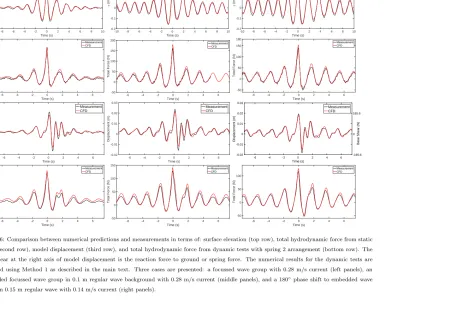
(mea-329
sured), to hydrodynamic force from dynamic test (inferred using the Transfer Function in
tion 5). We also present comparisons between measurements and numerical predictions for each
331
of the selected cases. The aim is to demonstrate that same approach works well for the different
332
cases, which justifies the robustness of our experimental and numerical modelling approach. We
333
emphasise that all the numerical results are obtained using Cd = 1.3 and Cm = 2.0, consistent
334
with the previous results of Santo et al. (2018a). Unless otherwise stated, the numerical results are
335
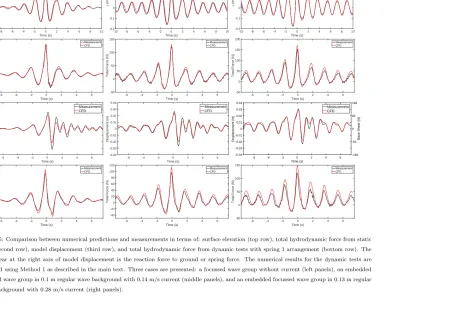
presented using Method 1 throughout the rest of the paper.
336
Figure 5 presents such comparisons with the spring 1 arrangement, and Figure 6 is for spring
337
2, for a range of cases from an isolated focussed wave group without current to an embedded wave
338
group in a regular wave background with a significant current. In general, good agrement in terms of
339
the incident surface elevations is obtained, showing that we have been able to reproduce numerically
340
the incident undisturbed wavefield from the experiments. Going from the kinematics to the applied
341
hydrodynamic force in the static tests, relatively good agreement is observed for the complete force
342
time history, consistent with the previous results of Santo et al. (2018a). Including now the effect
343
of structural motions, the comparison is such that the hydrodynamic forces from dynamic tests
344
are generally slightly over-predicted, which then result in a slight under-estimation of the model
345
displacements. In general, the peak-to-peak response (both in terms of model displacement and
346
applied force) is reasonably well captured numerically for each of the two different frequency ratios.
347
This demonstrates the validity of the Morison relative-velocity formulation, cast in terms of global
348
wave-current-structure blockage for dynamically-responding structures in a high frequency mode of
349
vibration. Given the slight conservatism of the numerical results, we view this level of agreement
350
as satisfactory.
351
The numerical modelling presented so far can adequately capture the complete hydrodynamic
352
force and model displacement time histories, although the model displacement is uniform with water
353
depth here for simplicity. For a practical application with a realistic space-frame structure having
354
a model displacement field which is varying with water depth, simultaneous modal decomposition
355
needs to be included in the time-domain ODE solver to allow for multiple modes of tower vibration.
356
Although this is perfectly possible, the detailed implementation could be slightly more complicated.
357
Also, to couple a CFD solver, such as OpenFOAM, with a full structural dynamics code, such as
358
USFOS, is definitely non-trivial. Hence, in terms of practical industry use, the application of Method
359
1 is perhaps rather limited. Therefore, it is of interest to investigate whether an approximation to
360
the Morison relative-velocity term is valid, which is the Method 2.
-10 -8 -6 -4 -2 0 2 4 6 8 10 Time (s) -0.2 -0.1 0 0.1 0.2 0.3 η (m) Measurement CFD
-10 -8 -6 -4 -2 0 2 4 6 8 10 Time (s) -0.2 -0.1 0 0.1 0.2 0.3 η (m) Measurement CFD
-10 -8 -6 -4 -2 0 2 4 6 8 10 Time (s) -0.2 -0.1 0 0.1 0.2 0.3 η (m) Measurement CFD
-6 -4 -2 0 2 4 6
Time (s) -40
0 50 100
Total Force (N)
Measurement CFD
-6 -4 -2 0 2 4 6
Time (s) -50 0 50 100 150
Total Force (N)
Measurement CFD
-6 -4 -2 0 2 4 6
Time (s) -50 0 50 100 150 200
Total Force (N)
Measurement CFD
-6 -4 -2 0 2 4 6
Time (s) -0.04 -0.03 -0.02 -0.01 0 0.01 0.02 0.03 0.04 Displacement (m) Measurement CFD
-6 -4 -2 0 2 4 6
Time (s) -0.04 -0.03 -0.02 -0.01 0 0.01 0.02 0.03 0.04 Displacement (m) Measurement CFD
-6 -4 -2 0 2 4 6
Time (s) -0.04 -0.03 -0.02 -0.01 0 0.01 0.02 0.03 0.04 Displacement (m) -184 -92 0 92 184
Base Shear (N)
Measurement CFD
-6 -4 -2 0 2 4 6
Time (s) -50
0 50 100
Total Force (N)
Measurement CFD
-6 -4 -2 0 2 4 6
Time (s) -40 -20 0 20 40 60 80 100 120
Total Force (N)
Measurement CFD
-6 -4 -2 0 2 4 6
Time (s) -50 0 50 100 150
Total Force (N)
[image:18.595.121.683.90.448.2]Measurement CFD
Figure 5: Comparison between numerical predictions and measurements in terms of: surface elevation (top row), total hydrodynamic force from static
tests (second row), model displacement (third row), and total hydrodynamic force from dynamic tests with spring 1 arrangement (bottom row). The
base shear at the right axis of model displacement is the reaction force to ground or spring force. The numerical results for the dynamic tests are
obtained using Method 1 as described in the main text. Three cases are presented: a focussed wave group without current (left panels), an embedded
focussed wave group in 0.1 m regular wave background with 0.14 m/s current (middle panels), and an embedded focussed wave group in 0.13 m regular
1
-10 -8 -6 -4 -2 0 2 4 6 8 10 Time (s) -0.2 -0.1 0 0.1 0.2 0.3 η (m) Measurement CFD
-10 -8 -6 -4 -2 0 2 4 6 8 10 Time (s) -0.2 -0.1 0 0.1 0.2 0.3 η (m) Measurement CFD
-10 -8 -6 -4 -2 0 2 4 6 8 10 Time (s) -0.2 -0.1 0 0.1 0.2 0.3 η (m) Measurement CFD
-6 -4 -2 0 2 4 6
Time (s) -50 0 50 100 150 200
Total Force (N)
Measurement CFD
-6 -4 -2 0 2 4 6
Time (s) -50 0 50 100 150 200
Total Force (N)
Measurement CFD
-6 -4 -2 0 2 4 6
Time (s) -50 0 50 100 150 180
Total Force (N)
Measurement CFD
-6 -4 -2 0 2 4 6
Time (s) -0.02 -0.01 0 0.01 0.02 0.03 Displacement (m) Measurement CFD
-6 -4 -2 0 2 4 6
Time (s) -0.02 -0.01 0 0.01 0.02 0.03 Displacement (m) Measurement CFD
-6 -4 -2 0 2 4 6
Time (s) -0.02 -0.01 0 0.01 0.02 0.03 Displacement (m) -165.6 0 165.6
Base Shear (N)
Measurement CFD
-6 -4 -2 0 2 4 6
Time (s) -50 0 50 100 150
Total Force (N)
Measurement CFD
-6 -4 -2 0 2 4 6
Time (s) -50 0 50 100 150
Total Force (N)
Measurement CFD
-6 -4 -2 0 2 4 6
Time (s) -50
0 50 100
Total Force (N)
[image:19.595.120.684.90.447.2]Measurement CFD
Figure 6: Comparison between numerical predictions and measurements in terms of: surface elevation (top row), total hydrodynamic force from static
tests (second row), model displacement (third row), and total hydrodynamic force from dynamic tests with spring 2 arrangement (bottom row). The
base shear at the right axis of model displacement is the reaction force to ground or spring force. The numerical results for the dynamic tests are
obtained using Method 1 as described in the main text. Three cases are presented: a focussed wave group with 0.28 m/s current (left panels), an
embedded focussed wave group in 0.1 m regular wave background with 0.28 m/s current (middle panels), and a 180◦phase shift to embedded wave
1
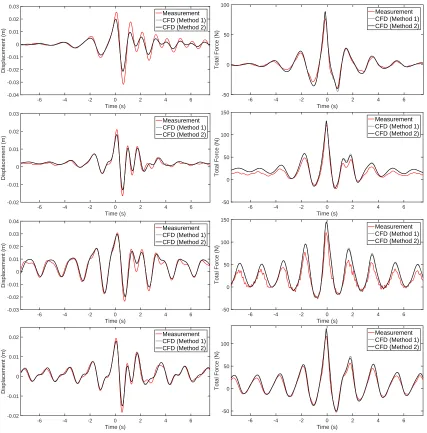
We examine the adequacy of the form by simply using the modified (or disturbed) kinematics
362
from numerical static structure runs to post-process the applied static force and the additional
363
damping from Morison relative-velocity following Equation 10 and 11. We then solve for the model
364
displacement (and velocity) by time-marching Equation 10 using a time-domain ODE solver (using a
365
ode45 solver in MATLAB). The applied dynamic force can then be predicted using Equation 9 once
366
the model velocity is obtained. We perform this for a range of cases as shown in Figure 7 together
367
with the numerical predictions obtained from Method 1. It is worth stressing that the approximate
368
form is valid so long as ˙xs(t) is small compared tou(t), however sinceu(t) crosses through zero over
369
time, there are parts of the load cycle where the condition is not strictly valid. Nevertheless, those
370
parts of the load cycle are dominated by inertia force instead, therefore overall the approximate
371
form works well. Good agreement between the two Methods can be seen in general in terms of both
372
the model displacement and the applied dynamic force time histories, which demonstrates that the
373
approximate form is valid for the practical range of high frequency mode of vibrations considered
374
in this paper. Although low frequency mode of vibration was not considered in this paper, the
375
structural velocity is also always smaller than the disturbed flow velocity. This generalises Method
376
2 to cover across both high and low frequency modes of compliant towers. From the practical
377
industry application, Method 2 is very useful since the need to dynamically couple the CFD code
378
with a structural dynamics model can be avoided.
379
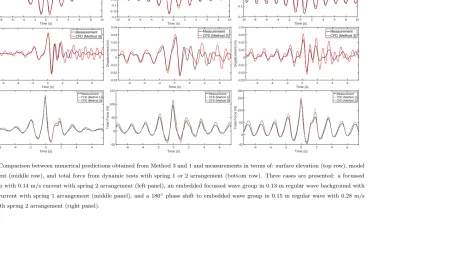
We now compare the numerical predictions obtained using Method 1 and 3 specifically in terms
380
of hydrodynamic forces, all relative to measurement, for a range of cases as shown in Figure 8.
381
Good agreement between numerical predictions and measurements in terms of surface elevations is
382
obtained. It is worth noting that Method 3 uses the measured structural velocity to solve for the
383
modified flow field accounting for blockage effect. Therefore, the underlying assumption is that the
384
applied hydrodynamic force on the jacket model can be reasonably well reproduced numerically,
385
which has been demonstrated from the static force comparison in the previous figures. The
pre-386
dicted model displacement from Method 3 can be solved by combining the predicted forces with
387
the same Transfer Function (Equation 5), hence requiring a two-step approach. The comparison
388
in terms of model displacement is reasonable, given that in general the displacement is slightly
389
over-estimated. The slight over-estimation and the high frequency oscillation away from the main
390
response is attributed to the finite length effect of the numerical results, which are in general of
391
shorter timescale than the measurements due to the use of limited simulation times and truncated
-6 -4 -2 0 2 4 6
Time (s)
-0.04 -0.03 -0.02 -0.01 0 0.01 0.02 0.03
Displacement (m)
Measurement CFD (Method 1) CFD (Method 2)
-6 -4 -2 0 2 4 6
Time (s)
-50 0 50 100
Total Force (N)
Measurement CFD (Method 1) CFD (Method 2)
-6 -4 -2 0 2 4 6
Time (s)
-0.02 -0.01 0 0.01 0.02 0.03
Displacement (m)
Measurement CFD (Method 1) CFD (Method 2)
-6 -4 -2 0 2 4 6
Time (s)
-50 0 50 100 150
Total Force (N)
Measurement CFD (Method 1) CFD (Method 2)
-6 -4 -2 0 2 4 6
Time (s)
-0.03 -0.02 -0.01 0 0.01 0.02 0.03 0.04
Displacement (m)
Measurement CFD (Method 1) CFD (Method 2)
-6 -4 -2 0 2 4 6
Time (s)
-50 0 50 100 150
Total Force (N)
Measurement CFD (Method 1) CFD (Method 2)
-6 -4 -2 0 2 4 6
Time (s)
-0.02 -0.01 0 0.01 0.02
Displacement (m)
Measurement CFD (Method 1) CFD (Method 2)
-6 -4 -2 0 2 4 6
Time (s)
-50 0 50 100
Total Force (N)
[image:21.595.94.521.142.575.2]Measurement CFD (Method 1) CFD (Method 2)
Figure 7: Comparison of model displacements (left) and applied hydrodynamic force time histories (right) between
numerical predictions obtained from Method 1 and 2, all relative to measurements. Four cases are presented: a
focussed wave group without current with spring 1 arrangement (top row), the same wave group with 0.28 m/s
current with spring 2 arrangement (second row), an embedded wave group in 0.13 m regular wave with 0.28 m/s
current with spring 1 arrangement (third row), and a 180◦ phase shift to embedded wave group in 0.15 m regular
-10 -8 -6 -4 -2 0 2 4 6 8 10 Time (s) -0.15 -0.1 -0.05 0 0.05 0.1 0.15 0.2 0.25 η (m) Measurement CFD
-10 -8 -6 -4 -2 0 2 4 6 8 10 Time (s) -0.2 -0.15 -0.1 -0.05 0 0.05 0.1 0.15 0.2 0.25 η (m) Measurement CFD
-10 -8 -6 -4 -2 0 2 4 6 8 10 Time (s) -0.2 -0.1 0 0.1 0.2 0.3 η (m) Measurement CFD
-6 -4 -2 0 2 4 6
Time (s) -0.02 -0.015 -0.01 -0.005 0 0.005 0.01 0.015 0.02 Displacement (m) Measurement CFD (Method 3)
-6 -4 -2 0 2 4 6
Time (s) -0.03 -0.02 -0.01 0 0.01 0.02 0.03 0.04 Displacement (m) Measurement CFD (Method 3)
-6 -4 -2 0 2 4 6
Time (s) -0.03 -0.02 -0.01 0 0.01 0.02 0.03 0.04 Displacement (m) Measurement CFD (Method 3)
-6 -4 -2 0 2 4 6
Time (s) -40 -20 0 20 40 60 80 100 120
Total Force (N)
Measurement CFD (Method 1) CFD (Method 3)
-6 -4 -2 0 2 4 6
Time (s) -50 0 50 100 150
Total Force (N)
Measurement CFD (Method 1) CFD (Method 3)
-6 -4 -2 0 2 4 6
Time (s) -40 0 50 100 150 180
Total Force (N)
[image:22.595.128.695.130.401.2]Measurement CFD (Method 1) CFD (Method 3)
Figure 8: Comparison between numerical predictions obtained from Method 3 and 1 and measurements in terms of: surface elevation (top row), model
displacement (middle row), and total force from dynamic tests with spring 1 or 2 arrangement (bottom row). Three cases are presented: a focussed
wave group with 0.14 m/s current with spring 2 arrangement (left panel), an embedded focussed wave group in 0.13 m regular wave background with
0.14 m/s current with spring 1 arrangement (middle panel), and a 180◦phase shift to embedded wave group in 0.15 m regular wave with 0.28 m/s
2
domains to reduce computational effort. In terms of hydrodynamic forces, relatively good agreement
393
between the two numerical methods demonstrate the robustness of the proposed fluid loading recipe
394
using CFD with porous tower modelling approach.
395
Overall, reasonably good agreement is obtained between numerical predictions and measurement
396
for a range of cases tested in the dynamic tests all using a single set of Morison coefficientsCd= 1.3
397
andCm = 2.0, with the numerical predictions resulting in slight over-estimation in the predicted
398
applied hydrodynamic forces. This is considered satisfactory as there is a degree of conservatism
399
built into the numerical modelling using the Morison with relative velocity formulation accounting
400
for wave-current-structure blockage effects.
401
5. Discussions
402
5.1. On the summary of the comparison 403
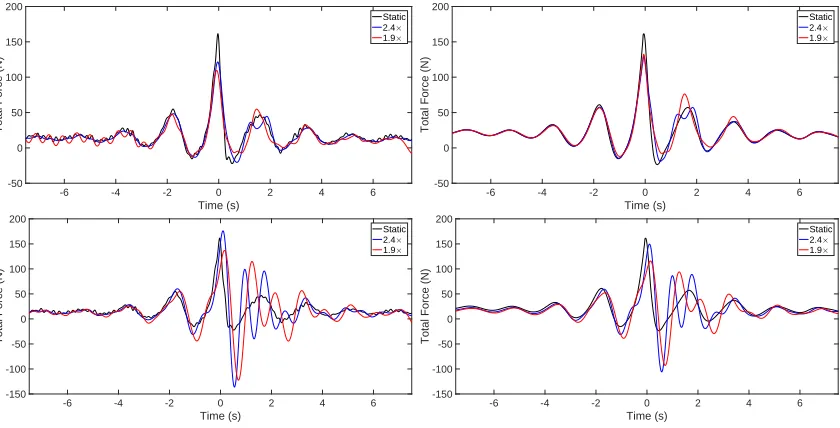
Figure 9 presents a composite plot summarising the comparison between measurements (left
404
column) and numerical predictions (right column) for the case of a focussed wave group with crest
405
height of 0.25 m and 0.28 m/s current with static, spring 1 and 2 arrangements. The top row shows
406
the comparison in terms of total applied hydrodynamic force. Going from statically-responding
407
to dynamically-responding cases, one can see the reduction in the peak hydrodynamic force as the
408
dynamic system experiences reduced drag due to the structure motion. The force difference relative
409
to the static case is the contribution from the relative velocity which can be viewed as an extra
410
damping term (see Equation 11). The bottom row shows the comparison in terms of force to the
411
ground, or base shear. The base shear of the dynamically-responding cases is observed to be larger
412
than that of the statically-responding case, a manifestation of a dynamic amplification factor as a
413
result of the structural dynamics. For all cases, the numerical predictions match reasonably well
414
with the measurements, demonstrating the adequacy and robustness of the proposed approach in
415
capturing the global hydrodynamic loading on both statically- and dynamically-responding
space-416
frame structures.
417
5.2. On the importance of additional damping from the relative velocity 418
An important question remains as to how much additional damping comes from the Morison
419
relative-velocity term relative to the existing structural and assumed linear hydrodynamic damping
420
estimated from the push tests. This can be assessed by using the hydrodynamic force from the
-6 -4 -2 0 2 4 6
Time (s)
-50 0 50 100 150 200
Total Force (N)
Static 2.4× 1.9×
-6 -4 -2 0 2 4 6
Time (s)
-50 0 50 100 150 200
Total Force (N)
Static 2.4× 1.9×
-6 -4 -2 0 2 4 6
Time (s)
-150 -100 -50 0 50 100 150 200
Total Force (N)
Static 2.4× 1.9×
-6 -4 -2 0 2 4 6
Time (s)
-150 -100 -50 0 50 100 150 200
Total Force (N)
[image:24.595.98.518.144.358.2]Static 2.4× 1.9×
Figure 9: Comparison between measurements (left column) and numerical predictions (right column) in terms of:
total applied hydrodynamic force (top row), and base shear or force to ground (bottom row) for the case of a focussed
wave group with 0.28 m/s current with static, spring 1 and 2 arrangement.
static tests to drive a time domain model using an ODE solver to establish the amount of damping
422
rate needed in order for the predicted displacement to reasonably fit well the entire measured
423
displacement from the dynamic tests. Figure 10 demonstrates such analysis using the predicted
424
(static) forces from CFD and an artificial damping rate of 7×ζ, which is equivalent to structural
425
damping of 8% of critical.
426
In general, good agreement between the measurements and the numerical predictions can be
427
obtained for a range of cases without and with different currents and regular wave backgrounds.
428
For an isolated wave group with no wave background and no current, eventually as the wave stops
429
the damping must look like the push-test behaviour, hence the slower decay of the actual measured
430
displacement relative to the predicted one as obvious from Figure 10 (top panel). With the
back-431
ground waves and/or a mean current present, the damping will remain much higher, demonstrated
432
by the good agreement even after the main wave group has passed by as shown in Figure 10
(mid-433
dle and bottom panel). The universality of the results, regardless of current and wave condition,
434
demonstrates that the Morison with relative velocity term, coupled with blockage effects to some
435
extent, contributes to significant additional damping into the dynamic system.
-10 -8 -6 -4 -2 0 2 4 6 8 10
Time (s)
-0.03 -0.02 -0.01 0 0.01 0.02 0.03
Displacement (m)
Measurement CFD + ODE with 7×ζ
-10 -8 -6 -4 -2 0 2 4 6 8 10
Time (s)
-0.03 -0.02 -0.01 0 0.01 0.02 0.03
Displacement (m)
Measurement CFD + ODE with 7×ζ
-10 -8 -6 -4 -2 0 2 4 6 8 10
Time (s)
-0.03 -0.02 -0.01 0 0.01 0.02 0.03 0.04
Displacement (m)
Measurement CFD + ODE with 7×ζ
-10 -8 -6 -4 -2 0 2 4 6 8 10
Time (s)
-0.03 -0.02 -0.01 0 0.01 0.02 0.03 0.04
Displacement (m)
Measurement CFD + ODE with 7×ζ
-10 -8 -6 -4 -2 0 2 4 6 8 10
Time (s)
-0.04 -0.03 -0.02 -0.01 0 0.01 0.02 0.03
Displacement (m)
Measurement CFD + ODE with 7×ζ
-10 -8 -6 -4 -2 0 2 4 6 8 10
Time (s)
-0.04 -0.03 -0.02 -0.01 0 0.01 0.02 0.03
Displacement (m)
[image:25.595.97.519.144.456.2]Measurement CFD + ODE with 7×ζ
Figure 10: Comparison of model displacement time histories between numerical predictions (red) and measurements
(black) from dynamic tests from dynamic tests with spring 1 (left) and spring 2 (right) arrangement for three cases.
The numerical results are obtained from applying the predicted static force from CFD into an external ODE model
(in MATLAB) with a damping rate of 7×ζ. Top row is for a focussed wave group without current. Middle row is
for the same focussed wave group with 0.28 m/s current. Bottom row is for a 180◦ phase shift to embedded wave
group in 0.15 m regular wave with 0.14 m/s current.
It is thus of interest to perform CFD simulations with the actual structural damping rate set to
437
zero (ζ= 0). Figure 11 presents the results obtained from either Method 1 or 2 in terms of model
438
displacement and hydrodynamic force time histories between ζ 6= 0 andζ = 0, all relative to the
439
measurements. It is obvious from the figure that the numerical results using the two different ζ 440
values for the structural damping are virtually indistinguishable, which supports the observation
441
that the additional damping from the relative velocity dominates completely the existing structural
442
and linear hydrodynamic damping estimated from the push tests. From the practical point of view,
-6 -4 -2 0 2 4 6
Time (s)
-0.04 -0.03 -0.02 -0.01 0 0.01 0.02 0.03
Displacement (m)
Measurement CFD (Method 2) CFD (Method 2, ζ = 0)
-6 -4 -2 0 2 4 6
Time (s)
-50 0 50 100
Total Force (N)
Measurement CFD (Method 2) CFD (Method 2, ζ = 0)
-6 -4 -2 0 2 4 6
Time (s)
-0.02 -0.01 0 0.01 0.02 0.03
Displacement (m)
Measurement CFD (Method 1) CFD (Method 1, ζ = 0)
-6 -4 -2 0 2 4 6
Time (s)
-50 0 50 100 150
Total Force (N)
Measurement CFD (Method 1) CFD (Method 1, ζ = 0)
-6 -4 -2 0 2 4 6
Time (s)
-0.03 -0.02 -0.01 0 0.01 0.02 0.03 0.04
Displacement (m)
Measurement CFD (Method 2) CFD (Method 2, ζ = 0)
-6 -4 -2 0 2 4 6
Time (s)
-50 0 50 100 150
Total Force (N)
Measurement CFD (Method 2) CFD (Method 2, ζ = 0)
-10 -8 -6 -4 -2 0 2 4 6 8 10
Time (s)
-0.04 -0.03 -0.02 -0.01 0 0.01 0.02 0.03
Displacement (m)
Measurement CFD (Method 1) CFD (Method 1, ζ = 0)
-6 -4 -2 0 2 4 6
Time (s)
-50 0 50 100
Total Force (N)
[image:26.595.95.521.142.575.2]Measurement CFD (Method 1) CFD (Method 1, ζ = 0)
Figure 11: Comparison between numerical predictions (obtained from either Method 1 or 2) using the actual measured
ζandζ= 0 relative to measurements in terms of: model displacement (left panel), and total force from dynamic tests with spring 1 or 2 arrangement (right panel). Three cases are presented: a focussed wave group without current with
spring 1 arrangement (top row), a focussed wave group with 0.28 m/s current with spring 2 arrangement (middle
row), and a 180◦phase shift to embedded wave group in 0.15 m regular wave with 0.14 m/s current with spring 1
-6 -4 -2 0 2 4 6
Time (s)
-0.06 -0.04 -0.02 0 0.02 0.04 0.06 0.08
Displacement (m)
Static 4.5× 2.4× 1× 0.4×
-6 -4 -2 0 2 4 6
Time (s)
-50 0 50 100 150
Total Force (N)
Static 4.5× 2.4× 1× 0.4×
-6 -4 -2 0 2 4 6
Time (s)
-0.06 -0.04 -0.02 0 0.02 0.04 0.06 0.08 0.1
Displacement (m)
Static 4.5× 2.4× 1.9× 1×
-6 -4 -2 0 2 4 6
Time (s)
-50 0 50 100 150 200
Total Force (N)
[image:27.595.93.520.145.358.2]Static 4.5× 2.4× 1× 0.4×
Figure 12: Comparison among numerical predictions with different spring arrangements producing high frequency
ratios approaching static (rigid) case in terms of model displacement (left panel), and total hydrodynamic force (right
panel). Two cases are presented: a focussed wave group with 0.14 m/s current (top row), and a 180◦phase shift to
embedded wave group in 0.15 m regular wave with 0.28 m/s current (bottom row).
this result is convenient because the uncertainty in the assessment of the structural damping term
444
can now be ignored.
445
5.3. On other frequency ratio cases, including a statically-responding (stiff ) structure 446
Given the validity of the numerical modelling, it is also of interest to numerically investigate
447
flow regimes with frequency ratios different to those tested in the physical experiments, since in
448
the higher frequency ratio limit the structural response and applied force should approach those of
449
a statically-responding (rigidly supported) structure. This is examined for two cases as shown in
450
Figure 12. Apart from the two frequency ratio cases of 1.9×and 2.4×actually tested in the towing
451
tank, additional frequency ratios of 0.4×, 1×, and 4.5×are included together with the static case
452
(where the frequency ratio→ ∞in principle).
453
It can be seen that as the frequency ratio increases approaching the static case limit, the model
454
response in terms of model displacement and applied force time histories also approach the response
455
of the static case. This demonstrates the consistency in our numerical modelling approach.
5.4. On the scaling effects 457
For a realistic jacket model geometry with a scale of 1:80 as considered in this paper, at field
458
scale the peak crest of a large wave becomes ∼ 20 m with an in-line current of 2.5 m/s using
459
Froude scaling. Also, the resultant total hydrodynamic force becomes ∼50−100 MN, and the
460
peak structural displacement is ∼ 3 m. The values of the peak displacement are plausible and
461
comparable to the second mode of an actual compliant tower, but it is larger than a typical first
462
mode of an actual jack-up legs (∼0.5−1 m). Even for a frequency ratio of 1×, the peak displacement
463
is∼7 m, which might not be catastrophic. The main question remains as to whether this increased
464
damping due to relative-velocity will be present in reality for the full-scale flow regime, and if so
465
whether it will scale appropriately. We believe the only change from lab to field scale would be
466
on the selection of suitable Morison coefficients, where guidance from API RP 2A (2000) is useful,
467
and the necessary inclusion of a full structural dynamics representation of the structure with a code
468
such as USFOS.
469
It is worth noting that the optimumCd which gives the best fit to the measured drag is found
470
to be∼1.3; high but reasonable since we do not account for local velocity amplification due to the
471
presence of other members, in particular due to the closely-spaced conductors. For field scale, the
472
recommended value ofCd is∼1. This is based on the early measurement wherebyCd = 0.9 was
473
obtained by Forristall (1996) to fit the measured current blockage on the Bullwinkle platform in a
474
high current associated with a Gulf of Mexico loop eddy.
475
6. Conclusions
476
This paper documents laboratory-scale experimental measurements on a scaled jacket model
477
responding dynamically in a large towing tank when subjected to a range of focussed waves and
478
embedded focussed wave in smaller regular wave background, all with steady current present (by
479
towing the jacket using a carriage). The surface elevation time history next to the jacket model
480
is measured for each test. For static tests where the jacket model is rigidly supported, the force
481
through the force transducer (ground) is measured, hence the applied force is directly measured.
482
For dynamic tests where the same jacket model is allowed to respond dynamically, the force through
483
the springs (ground) as well as model displacement are both measured. The applied force is thus
484
inferred using the transfer function derived from the equation of motion of a single degree-of-freedom