City, University of London Institutional Repository
Citation
: Lang, T., Millstone, E. and Marsden, T. (2017). A Food Brexit: time to get real – A
Brexit Briefing. Brighton, UK: University of Sussex Science Policy Research Unit.This is the published version of the paper.
This version of the publication may differ from the final published
version.
Permanent repository link:
http://openaccess.city.ac.uk/18655/Link to published version
:
Copyright and reuse:
City Research Online aims to make research
outputs of City, University of London available to a wider audience.
Copyright and Moral Rights remain with the author(s) and/or copyright
holders. URLs from City Research Online may be freely distributed and
linked to.
A Food Brexit: time to get real
A Brexit Briefing
A Food Brexit: time to get real
Tim Lang,a Erik Millstoneb & Terry Marsdenc
Contents
Summary ... 3
Introduction ... 6
Food Brexit politics: taking stock after the June Election ... 8
Ten reasons food and its future matter (with or without Brexit) ... 9
A better British food system: what taking back control really means ... 13
The EU and food: seeing through the rhetoric ... 15
What ought to happen, Brexit or no Brexit ... 17
Key Challenges and Policy Hotspots for Brexit Food Britain ... 19
1. New goals and outcomes for a more sustainable food system ... 19
2. New Food Act(s)... 21
3. Food security, resilience and sustainability ... 24
4. Deciding where UK food should come from ... 28
5. Aligning British aspirations for their food with the Food Brexit negotiations ... 32
6. Food quality and standards ... 36
7. Replacing the CAP is part of the picture ... 39
8. Fisheries: reclaiming control – can we catch the fish? ... 41
9. Facing the Food Labour crisis: wages, conditions, robots and seasonal employment .. 44
10. The subsidy question: who gets the money from food? ... 50
11. Deciding the overall framework: what are the options? ... 52
12. Keeping a close eye on our EU neighbours: it takes (at least) two to tango ... 54
13. Internal UK tensions: the food fragmentation in Britain? ... 56
14. Reforming UK Institutions for the 21st Century food system ... 58
15. The Brexit negotiations: due process rather than posturing ... 68
16. The role of Big Food ... 72
Conclusions: putting public interests first in Food Brexit ... 75
References ... 78
a Professor of Food Policy, Centre for Food Policy, City, University of London e: [email protected]
Summary
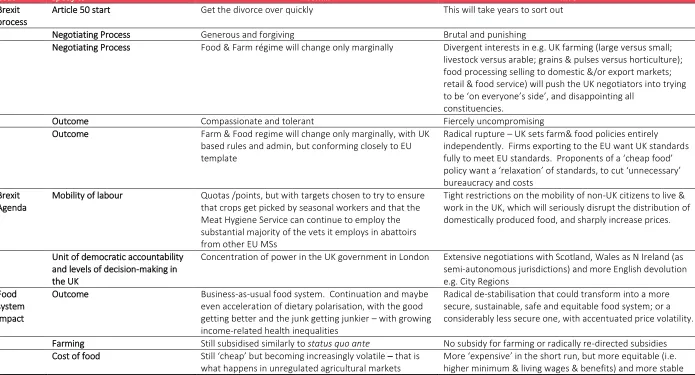
The implications of Brexit for food are potentially enormous. This verdict applies, whether there is a ‘hard’ or ‘soft’ Brexit. The UK food system, consumer tastes and prices have been thoroughly Europeanised. This will be impossible to cut out or back by March 2019 without enormous consequences. The UK food system faces real challenges on food security.
This paper summarises 16 major issues on which Food Brexit has the potential to threaten UK food resilience and security:
Vision. What goals would any new post-EU food system have? Will these address the looming sustainability challenge which is a mix of ecosystems, social and public health challenges?
New food legislation will be needed. Will this be a transfer of EU legislation followed by the Secretary of State sitting with his or her 'delete’ button?
Food security. The UK’s home production has been steadily declining. The UK food system ought to be improving its resilience. It isn’t. It’s like the rabbit caught in the headlights – with no goals, no leadership, and eviscerated key ministries.
Sourcing. The UK derives much of the food vital for health – fruit and veg – from within the EU. The pound sterling has been dropping. Food price inflation is rising.
Public support. Clarifying and then aligning what British consumers say they want with what is negotiated by March 2019.
Food quality and standards. Brexit campaigners ignored the inbuilt reliance the UK has on pan-European institutions, to which we contribute. A vast array of institutions and scientific infrastructure keeps UK food fit to eat. Brexit campaigners did not inform consumers/voters that US agribusiness is salivating at the prospect of selling foods which have weaker standards, nor that foods derived on world markets use standards which are weaker than the EU’s and those of the USA.
Replacing the Common Agricultural Policy and Common Fisheries Policy. The CAP and CFP are core and old EU policies. They have been much attacked in the UK, often for good reason. Leaving CAP and the CFP exposes a vast policy vacuum. The new Secretary of State has made a statement about even tearing up the CFP predecessor the London Fisheries Convention from 1964! The Coalition and subsequent Conservative
Governments provided no policy vision other than a belief that Agri-technology and an export drive will suffice for farming, and that reasserting a 200-mile exclusion will resolve unsustainable fish sourcing. They will not. What’s the point of farming and fishing? How can they mix food production and ecosystems services? These are vital issues for the era of climate change and ecosystem stresses.
Food labour. The entire UK food system is dependent on migrant labour. UK food manufacturing is our largest manufacturing sector but one third of its workforce is migrant. UK horticulture has massive dependency on migrants to pick ‘British’ food UK consumers say they want. Technology will not replace the vast army of migrant labour who work in food service.
exposes the shameful inequalities within the UK food system. Primary growers get a tiny percentage of what consumers spend on food.
National and regional food policy. The UK has no food policy. Scotland and Wales have been developing their own visions; England is the problem. Seen collectively, the UK will have a dwindling mishmash of policies, once EU frameworks are removed. The UK has fairly consistently failed to contribute positively in EU debates, playing to the corporate gallery at home, arguing for cutting subsidies, rather than working hard inside for
progressive policies. The world’s food system faces immense challenges. The drift in and after a Brexit is the worst policy situation imaginable. We have options. This paper
explores some options mooted within and beyond government circles: a new imperialism (expecting others to feed us); reinvigorating UK food systems; commitment to
sustainability; and more.
Relationships with neighbours. The wild talk before, during and since the Referendum ignores geography. The EU 27 member states are our neighbours. They are incredulous at the hostile, stupid talk from leading politicians. British negotiators must build bridges. Or does the UK really want hostility? This would be madness for a country which does not feed itself.
Divided Food Britain. The UK is a food divided country. The health gap between rich and poor is heavily associated with diet and food costs. Recent events underline how important it is to tackle these divisions. Merely promising ever cheaper prices or more food banks is not a reasoned policy response.
Institutions and infrastructure. The UK enters Brexit negotiations in a weak situation. The Food Standards Agency is a shadow of its former self. Defra has had years of cuts and suffers a serious staff shortage, just when the UK needs many of the best and brightest civil servants to negotiate the most important element of Europeanisation – our food. To leave the EU would sever the UK from many bodies which underpin food – from scientific advisory bodies to regulators, from research programmes to subsidies to regions. What is going to replace these? There is silence from Defra and the Government.
The negotiations. In 18 months or so, the most complex reconfiguration of the UK food system is to be completed. Analysts now realise that this is at best folly or at worst a recipe for chaos. Never has there been such a large body of thinking within the food system, from outside critics to inside track policy cognoscenti, that the UK ought to take a deep breath, reconsider and pursue a well-thought-out strategy.
The role of Big Food. The food system is already dominated by huge food companies. Brexit must not be an opportunity for further corporate capture of market power. The good news is that increasing numbers of food companies now recognise the seriousness of impending crises from health, ecosystems and social divisions. The UK public must ensure that what emerges ahead – whether the UK leaves or stays – the food system is more firmly shaped by values of justice and decency, as well as good quality.
The paper gives specific recommendations in each section, centred on how to enhance food security in the UK.
Our overall view is that this will require HM Government to:
give a policy commitment to a modern, low-impact, health-oriented UK food system, and set out how that will be achieved, with or without Food Brexit;
create a new statutory framework for UK food, which we term ‘One Nation Food’;
link this new statutory UK food framework to the UN Sustainable Development Goals and the 2015 Paris Climate Change agreements (known as COP21);
set new clear targets for UK food security (food supply, quality, health and consumption) which go beyond mere quantity of supply by addressing ecosystems and social systems resilience;
create a new National Commission on Food and Agricultural Policy to provide oversight and review, and to be a source of advice trusted by the public;
to make a clear and explicit commitment to address food matters in the Brexit negotiations which (bizarrely) has not been given;
include in the above a continued but reconstituted, co-operative set of arrangements with the EU food agencies with regard to regulatory synergies in food trade and standards;
Introduction
With the triggering of Article 50, the process of the UK leaving the EU began. The effects of the narrow Referendum majority in June 2016 started to emerge. Then, unexpectedly, the UK had an unanticipated and inconclusive General Election. These wider politics have exposed the weak state of thinking about the effect of variants of Brexit upon UK food. This paper sets out to fill that gap. There has been some slight discussion of Brexit’s impact on agriculture, mostly focused on farm subsidies. Subsidies are important but only a corner of the wider food picture the Referendum debate ought to have analysed. Worse, food has featured only marginally in public policy debates in the General Election. This weak recognition speaks volumes not only about political discourse but also about public pressure. What can be more important than our national food supply and food prices? There is a real danger of a fantasy that these new times will not affect UK food. They will. So the public must ramp up its interest. This briefing sets out why food – not just farming – deserves a high place on the public agenda, not least since the UK is heavily dependent on EU Member States for its food. One third, in terms of expenditure, comes from other EU Member States. Currency
fluctuations have already exposed upward price pressures in a food-importing country.
Brexit could, all too easily, diminish food security in the UK, where parts of our food system are already far too insecure; this rich country is pocketed with real food poverty, for example, and diet-related disease is part crippling the NHS. We understand food security to be the achievement of a system that provides food that is sufficient, sustainable, safe and equitable. Brexit could, however, undermine all four of those aspects, in what is an already insufficiently secure food system. Moreover, the UK food system should not only aim for domestic security, it should also not undermine food security in any of the countries from which we buy, or to which we sell, foodstuffs.
This briefing suggests changes that the UK food system should be undertaking if its long-term structural needs are to be addressed. Our case is that the UK food system is highly vulnerable to the rising costs of diet-related ill-health, ecosystems damage, economic dependency, and social reliance on migrant and relatively low-waged labour. With or without Brexit, if HM Government was to act responsibly, the UK food system should be embarking on a great Food Transformation to a more secure future. The uncertainties provoked by the outcome of the Brexit Referendum, coupled with the recent Election, could result in serious nutritional and political problems. Supplies could be reduced, prices could become increasingly volatile, environmental sustainability could be further diminished, safety could be imperilled,
inequalities could be amplified, and public trust be undermined. The just-in-time distribution systems, complex contracts, and labyrinthine supply chains cannot quickly or easily be
restructured. Scientists have already been concerned about their resilience – their capacity to withstand shocks.
Some of the major challenges in relation to food that have been provoked by Brexit are identified and summarised:
the requirement for new legislation to govern the UK’s food system, which will enhance our food security, without undermining food security in our trading partners;
the question of where the UK’s food supplies come from: i.e. sourcing; listening to and engaging with the British public as citizens and as consumers; the vital matter of threats from Brexit to food safety, standards and quality;
the politics of exiting from the Common Agricultural Policy, and what will replace it; agricultural subsidies: whether they are needed, if so for what, and how they should be
structured;
the issue of food labour, and the dependence of UK production, processing and food service on non-UK citizens;
how changes within the EU may affect the future of UK food security;
pressures within the UK from the devolved administrations (Scotland, Wales and Northern Ireland) and from city regions;
the need for official UK food institutions to be made fit for post-Brexit purposes; public accountability in the Food Brexit negotiations; and
how to ensure that the interests of Big Food corporations do not trump those of consumers, the environment or small-scale producers.
When we use the phrase ‘Food Brexit’ we are referring to both the process during the course of negotiations between the UK and the EU that will be related to issues of agriculture and food, as well as to the new policy regime that will cover the UK’s agricultural and food system post-Brexit.
Rather than providing one section of recommendations, this paper provides specific proposals throughout, and gives overall recommendations in the conclusions. The paper gives specific recommendations in each section, centred on how to enhance food security in the UK.
Our overall view is that this will require:
a policy commitment to a modern, low-impact, health-oriented UK food system; a new statutory framework for UK food, which we term ‘One Nation Food’;
this new statutory UK food framework to be linked to the UN Sustainable Development Goals and the 2015 Paris Climate Change agreements (known as COP21);
new clear targets for UK food security (food supply, quality, health and consumption) which go beyond mere quantity of supply by addressing ecosystems and social systems resilience;
the creation of a new National Commission on Food and Agricultural Policy to provide oversight and review, and to be a source of advice trusted by the public;
HM Government to make a clear and explicit commitment to ensuring a sustainable, safe and equitable supply of food, and to set out how that will be achieved, with or without Food Brexit;
a continued but reconstituted, co-operative set of arrangements with the EU food agencies with regard to regulatory synergies in food trade and standards;
Food Brexit politics: taking stock after the June Election
Food barely featured in the pre-Referendum debate about whether the UK should vote to leave or stay in the European Union (EU). Since the Referendum, and preparing for the marathon negotiations now starting, it began to emerge in the margins of policy discussions; not before time. As was argued before the vote, food will be a delicate and complex matter for any form of Brexit, because the EU is our major food trading partner and disrupting trade with EU Member States could seriously undermine food security in the UK.*1 2 And now we have extra uncertainties arising from the General Election.
Over the last half century, the UK’s food system has become closely entwined with our neighbours on the continent. British people often say they want to eat British, but in practice they do something rather different. About a third of UK’s food supply comes from EU
Member States. And over the last half century, tastes have changed dramatically. A return to a 1950s or 60’s pre-EU ‘British’ era of food is unlikely. Churchillian romantics who see Brexit as an opportunity to relive imperial or wartime days go silent if the culinary era of tinned peaches and spam are mentioned. It was Europeanisation which coincided with – and arguably facilitated – the flowering of modern UK culinary culture. That and continental holidays, as well as migration, brought new tastes, and a new labour force. Plus rising incomes and the supermarket revolution.
So what will happen to the UK food system when and if the UK Brexits? Will the UK government and food businesses recreate a World War II-type land-army to replace the ejected non-UK crop harvesters? Will the British public simply tighten its belt and eat less food? Will people be willing to pay higher food prices? Many of the UK’s international food contracts are denominated in Euros and Dollars, while the value of the pound has fallen sharply since the referendum and those price volatilities unnerve food traders. Or will nothing but good come from Brexit, as some Brexiters have claimed? Will British farmers receive higher prices for the food they produce and learn to end their reliance on subsidies (or accept subsidies only for ecosystems services)? Will UK horticulture experience a renaissance; if so how? Will new creative energies in healthy food processing and food service be unleashed?
The outcome will depend on the substance of the negotiations between the UK and its trading partners, and on what UK politicians set out to achieve. And that depends on what the public requires its politicians and negotiators to deliver. Unless there is a clear focus on these challenges and options, the risk is that food security in the UK will be seriously
undermined, as supplies narrow (or even dwindle) and prices fluctuate and/or rise. There are also serious risks that standards of food safety will decline if the UK ceases to adopt EU safety rules, and instead accepts free-trade agreements with countries with significantly weaker standards. There are weaker standards not only in China and many developing countries, but also in the USA, and under the Trump administration US standards are likely to decline
This paper outlines what is likely to lie ahead, and explores some options. It highlights key issues which politics will decide, but the consequences of which will affect the population. It begins by clarifying where we are, and why food matters in Brexit.
Ten reasons food and its future matter (with or without Brexit)
Most food analysts and commentators – whether based in Universities, think-tanks, government, industry or civil society - recognise a number of features about the food situation in the UK, both pre and post Brexit. The mood of analysts is sober; there is wide agreement serious times lie ahead for the food system. There is a real danger of
underestimating the enormity of the impact of food negotiations ahead. This section is written for any readers unaware of why the outcome and processes of Food Brexit matter.
Reason 1: Leaving the European Union (EU) entails significant changes to the structure and operations of the UK’s food system.Going it alone exposes how complex the processes are by which food reaches supermarket shelves or take-aways. As Professor Tim Benton, former Government Food Security champion, has explained “…a relatively simple food produced in the UK like a chocolate Kit Kat…contains cocoa from Africa, milk products from the UK, whey from New Zealand, palm oil from Asia, sugar from South America, wheat from Europe. So we simply can’t look at the supply chain in terms of the UK alone. Increasingly, perturbations elsewhere in the world will feed back into the availability and price of food the UK”.3 The UK’s food supply depends on hundreds of thousands of contracts, underpinned by thousands of standards and specifications, all of which collectively shape how this system operates and who does what. The food sector, taken as a whole, is the UK’s largest employer, and the UK’s food supply depends on a vast diversity of sources and processes.
The UK ‘food system’ operates as smoothly as it has because of the prevailing patterns of trade and ‘rules of engagement’. If those patterns and agreements are disrupted, the adverse impact on UK consumers could be marked, even severe. Supply chains could be disrupted, creating scarcities that will drive up prices, and food standards might well
deteriorate. When (perhaps if) the UK does leave the EU, whether the Brexit will be ‘hard’ or ‘soft’, we expect destabilisation and reduced food security. Technical managers within the UK food sectors all know this, and they are anxious about the disruptive consequences of an ill-thought-out Food Brexit. Almost all firms and trade associations in the food sector took an ‘arms-length’ approach to the referendum debate, and many are now ruing that decision. They wished they had expressed their concerns publically, rather than just sending discrete signals to government officials. They know, too, that the food system faces big stresses ahead anyway, with or without Brexit.
operation of the food system is taken for granted in the UK, at least by those who are not suffering food poverty with shops serving affluent areas which are overflowing with food. On the other hand, food is a highly sensitive commodity. People cease taking it for granted when prices rise abruptly or when the food supply is unsafe, adulterated or mis-labelled.
Reason 3: People think they are in control of their food choices, although social research suggests that food intake is strongly influenced by social factors such as advertising and marketing, income levels, culture and social backgrounds. Furthermore, over recent decades a very substantial body of evidence has accumulated showing how important food is for public health. In the UK, there is a complex mix of both obesity from over-consumption and under-consumption caused by poverty. Food production and consumption also have
considerable impacts on the environment; farming often pollutes; agriculture and food processing are major drivers of land-use changes, resource depletion, ecosystems loss and water use. Although food provides nutrients, it is also a key social signifier. The UK has changed, it used to be a country with a reputation for eating unwholesome and unhealthy meals at home. Currently about a third of all food expenditure in the UK is spent on food outside the home; although it pays for only some 17% of our food by volume. It is increasingly available 24 hours a day, and 12 months a year, but the quality of our food supplies are very uneven. Over time, the quality of the UK’s food supply has polarised. The good has got better, while the junk has become even junkier.
Reason 4: Unlike most other commodities, such as DVDs, foreign holidays or cars, food is a basic necessity for life for most people; there is little room for food as a luxury. If Brexit is supposed to improve Britain, then it must do so for food. Food is a bellwether of progress. If the supply or the quality of our food is damaged by Brexit, those responsible for those failures will deserve to pay a high price. The most immediate issue is food prices, which have direct impact on consumption, and are already rising.4 The British have become accustomed to cheap food. Since 1846, with the Repeal of the Corn Laws, Parliament took a momentous decision to begin to abandon a reliance on domestic farming, and instead to import food from whichever country offered it most cheaply. It was not until the two World Wars of the 20th century that UK governments saw a need to increase the UK’s reliance on
home-produced food. Following the end of World War II, food and agricultural policies in the UK and Continental European countries refocused on increasing domestic food production. But in exchange for more secure supplies, British and European consumers have seen food prices that have been significantly higher than those on world markets. Nonetheless, UK
governments have long favoured what are often termed ‘cheap food’ policies, because they have supposed that contributes to keeping UK labour costs low, and thereby help UK firms compete in export markets. It has long been known that British people on low incomes spend proportionately more of their disposable incomes on food than do the rich.5 The amount spent on food in the UK has grown in absolute terms, although in relative terms, food expenditure as a proportion of disposable incomes has fallen.6
policy has been delivered to the point that, for most people, food is now actually ‘too cheap’. Partly that is because food prices do not include the full costs of production, especially in terms of resource depletion and environmental pollution. Also, externalised costs to public health, from conditions such as obesity and diet-related heart disease and cancer, are not properly reflected in consumer prices. In particular, cheap food policies have depended on cheap labour, not just on farms but also in food processing, distribution, retail and food service.
Reason 6: Food Brexit will be a major disruptor of the current the food system, which has undergone a transformation since 1945, and has Europeanised for the last half century. Food is now plentiful in most shops, and patterns of supply have spread throughout the UK. To change all this in under two years is bringing most food analysts and food industries out in a cold sweat. The pace and scale of possible change is unprecedented for an advanced
economy, outside of wartime.
Reason 7: A crude and insensitive Food Brexit is likely to penalise those already most vulnerable within the UK food system – the food poor. The gaps between rich and poor are considerable, and the last seven years of austerity have increased food banks, which are little more than sticking plasters. Volatile and/or rising food prices from a botched Food Brexit will hit the vulnerable even more. One could just about imagine a world without cars but not without food. It is a basic need for all. The next two years will shape whether the UK builds a healthy and secure food supply for all.
Reason 8: The silence about the future of UK food since the Brexit referendum is an astonishing act of political irresponsibility and suggests chaos unless redressed. It is as though there has been a collective amnesia about how Brexit could seriously undermine food security in the UK. The country could sleep-walk into a food crisis, unless these problems are acknowledged and addressed.9. Food has accounted for some 40% of EU legislation during the last 50 years. The UK imports about 31% (by value) of all its food from other EU Member States. Not to talk about or plan openly for the disruption that Brexit will cause is bizarre and irresponsible. One thing that business likes is to be able to plan for eventualities. Because of the intrinsic
importance of food in Brexit and in the nation, the current UK political system is failing its citizens. That said, politics is not the preserve of elected representatives. It is up to British consumers to make their food concerns clear. Politicians will only look at food in the round during Food Brexit if there is concerted pressure from outside.
Reason 9: Policy debate about improving the UK food system has been frozen for 7 years. It is in a dire state at present. The Government since 2015 has kept its thinking under wraps. Two years ago, the British Government had developed, through Defra, a 25 year Food Plan
and at worst a potentially disastrous dereliction of duty. This is a bizarre state of affairs for the food industry, which DEFRA claims to champion.
Reason 10: UK food legislation is highly Europeanised after 50 years. Whether we like it or not, we are engaged. Food has been one of the most important areas of European legal
integration, Brexit entails serious and a highly complex renegotiation of half a century of agreed Europeanisation of standards, rules, regulations, modes of governance, and
contracts.12 To one wing of the Conservative Party, the neoliberals, this is precisely the point of Brexit. Many in the Conservative party want to abolish regulations governing the
agricultural and food industries as ‘unnecessary baggage’ by repatriating powers to the UK rather than sharing them with our Continental partners.1 They contend that ‘efficient farmers’ do not need subsidies, and they look forward to ‘a bonfire of regulations’.13 They also discount the repeated calls from the food industries to retain access to EU labour.14 15 This perspective represents not only a serious danger to food security in the UK, it also threatens UK food companies which would lose their ability to export to EU Member States, because their products would no longer comply with EU standards. The reported interest of one pro-Brexit Conservative MP to see UK environmental standards drop to those of India to facilitate trade is perhaps a harbinger of pressures ahead.16 d
To summarise this section, we see very solid grounds for food being a key element in Brexit and for food policy to have higher profile in national debate. This will not just ‘happen’. It will need to be made to happen, by public pressure, by concerted voices from science and academia, and by stronger engagement within formal political processes. Alas, at present, there is very little awareness or engagement about the enormous implications of Food Brexit - hence this paper. But before we outline what we think the agenda ought to include, it is worth considering the reasons for the current policy deficit.
The British state has form in taking food for granted, and the British public and academics also have form in pushing it up the agenda. After the 1846 Repeal of the Corn Laws had been legislated, UK farming and rural voices lost their dominance within Parliament, and UK farming was in a decline enduring much of the second half of the 19th century and until the start of the First World War.17 It took two World Wars to focus official minds on ensuring what we call ‘Food Security’: a commitment to ensure the UK population has access to a sufficient, sustainable and healthy diet at affordable prices. In 1939-45, drastic action had to be taken to feed the British population.18 19 Scientists were vociferous in making the case and showing where and how it could be done.20 Unless the implications of Brexit for UK food security are acknowledged and addressed, Food Brexit is likely eventually to end up with more crisis management. Change can be a long time coming. The 1947 Agriculture Act in effect repealed the 1846 Repeal of the Corn Laws, by committing the UK to taking measures to stabilise food supplies and prices.21 But that policy shift took a century, two world wars and a recession. We are today addressing 70 years of the frameworks put in and modified since then. The entry of the UK to the Common Market, two decades later, was one such
modification. It altered the mechanisms but not the objective.
If and when the UK leaves the EU, the EU will levy tariffs on imports from the UK, including agricultural and food products; which will harm British exporters. The UK will be
correspondingly obliged, under the rules of the World Trade Organisation, to impose similar tariffs on imports from the EU, which will abruptly drive up food prices in the UK. This is why studies are beginning to emerge suggesting where and how food prices will rise (e.g. KPMG’s July briefing,2 and the BRC’s in April.3 The BRC estimates tariffs raising commodity prices by 22%. KPMG estimated that a ‘Great British Breakfast’ (a fried breakfast) would rise in price by up to 12%. This is not what people voting for Brexit were warned might happen.
There will be more such calculations, we expect, as the enormity of Food Brexit seeps through the ideological shutters. The rules of the WTO stipulate that all Member States should treat each other on the same basis, except where they have reached a trade
agreement that satisfies the exacting requirements of the WTO rules. Therefore the UK will not be able to accept imports of food from the UK on a tariff-free basis, while imposing tariffs on imports from other parts of the world. The net result will therefore either be sharply rising food prices or the devastation of UK farming, or both!
This, we suggest, is a crucial time for public debate on the big picture for food. Amidst the Food Brexit processes which we hope emerge, a key recommendation from this paper is that:
HM Government should make a clear and explicit commitment to ensuring a sufficient, sustainable, safe and equitable supply of food, and it should set out how that will be achieved when and if the UK is no longer in the EU.
Unless some such broad commitment is made and delivered, we foresee a danger of the UK’s food supply becoming insufficient, increasingly unsustainable, unsafe and inequitable.
Moreover, the government should aspire to developing a food system for the UK that will be based on sustainable consumption and production, a ‘big idea’ anticipated and intellectually accepted by many sections of the UK food industries.4 5 There is a wealth of scientific evidence to show how far our current position and trends are away from achieving those goals.6 7 It is the Government which is lagging behind representatives of both producers and consumers. Ministers must fulfil their responsibilities for the future of the UK’s farming and food systems post-Brexit.
A better British food system: what taking back control really means
The policy direction that ought to emerge from Brexit negotiations, if it is genuinely to improve Britain’s food system and enhance food security for all UK residents, is quite clear. Even if Government is, so far silent – with both 25 Year Plans for food and environment delayed - the scientific evidence points to clear priorities for what the UK ought to be developing.
This new food policy should aim to:
provide good quality, sustainable diets which are affordable to all citizens, without undermining food security in countries with which we trade;
prioritise prevention of diet-related ill-health, emphasising both matters of immediate (microbiological) safety and longer-term non-communicable disease;
commit to high food standards across supply chains; prevent food fraud;
prevent ecosystems damage from resource depletion and pollution, such loss of biodiversity and greenhouse gas emissions;
reduce food waste from the food chain production to consumption, and recycle food waste efficiently;
support improved better-than-‘living’ wages and conditions for the some 3.9 million people who are employed in the UK’s food system;
protect and advance farm animal welfare;
protect and sustain health populations of fish, crustaceans and other forms of marine life in UK territorial waters;
establish, maintain and operate a system of governance for agriculture and food that has adequate rules and regulations to protect environmental and public health, using
decision-making processes that are open and democratically accountable;
be underpinned by institutions which are fit for purpose (e.g. safety bodies with sufficient powers and science expertise and authority);
ensure fair financial returns to all sectors of the food system, protecting small enterprises from predatory or discriminatory actions of large companies;
help consumers by providing national sustainable dietary guidelines, and healthy food supplies to match those guidelines;
protect consumers, especially young people, from undue and unhealthy influences from advertising, marketing and cultural media;
be trusted for prioritising consumers’ health and safety, and using relevant and reliable science, while also acknowledging scientific uncertainties and exercising precaution.
These aspirations and policy principles should be incorporated in the new food legislation, which Food Brexit will entail. An estimated 4,000+ pieces of regulation and law are EU based. Whatever replaces them – even if simply moved over into UK law - should focus on the overarching objective of delivering food security, understood in terms of sufficiency, sustainability, safety and equity. This is an approach which would achieve and reconcile scientific and democratic legitimacy.8 It would be in keeping with the best aspects of the British tradition. The 1860 Food Act, for instance, which emerged from decades of battles about food adulteration and safety, nailed its colours firmly to the mast.9 All food should be “…of the nature, substance and quality demanded”.
That phrase holds good today, but it is not on its own sufficient for a world in which:
o agriculture and food systems are major sources of environmental damage;10
o poor diets are the biggest factor in premature deaths from non-communicable diseases;11
o agriculture and food sectors are the biggest employers on the planet and in the UK;12 13
o new food products are ceaselessly proffered to consumers, intended to add economic rather than nutritional value and to compete in over-supplied markets; around 20,000 new food products a year come onto the US market;15
o food is wasted systemically - in the UK over 10 million tonnes of food are wasted annually, 60% of which could be avoided;16
o some foods such as milk are sold to consumers close to (and sometimes below) the cost of production, thus driving producers out of business;17 18
o young people’s food tastes are unduly distorted from an early age;19 20
o consumers are not adequately helped to know the impact of their food choices on their health or on the environment, or on the diets of the citizens from which foodstuffs are imported;21 22
o a divided food culture has been created and embedded, contributing to health inequalities, where children’s life-chances are shaped by the age of 5 years;23
o only one in three British citizens trust the Government to ensure that their food is safe to eat.24
The EU and food: seeing through the rhetoric
We, like many academics, are troubled by the contrast between what the evidence says should be corrected in the British, EU and global food systems and what is actually
happening. Gaps between what the evidence says should happen and what policy-makers actually do is often quite wide,25 26 and myths and rationalisations can fill the gap.27 Many Governments are reluctant to take the necessary steps to stop the serious threats to and from food listed above. If they took evidence seriously, issues such as climate change, obesity, diet-related inequalities and ecosystems damage would be prominent in any UK Brexit discussions. In particular, there would be strenuous efforts not to allow Food Brexit to deviate policy attention on addressing these challenges.
Few food systems analysts take the view that being a member of the EU has been consistently beneficial or without frustrations. EU processes can be slow; its approach to modern understandings of the 21st century drivers of food security can be tortuous. Making progress, when 28 nations negotiate all details of all policies, requires serious diplomacy. No wonder the Referendum appeal to ‘take back control’ had such resonance. But what is the UK leaving to join? The World Trade Organisation has over 160 member countries, and its
decisions, and those of the Codex Alimentarius Commission that sets minimum standards for internationally-traded foodstuffs, make their decisions only by unanimity. UK ministers have failed to explain from where they expect the UK to import its food, and at which costs; nor have they explained how food safety standards will be set and enforced after Brexit.
security in the sense of absolute amounts of food – sufficient quantity was the goal. CAP provided subsidies for each unit of production of selected commodities, and without any limitation on the amounts produced. Within about 12 years of its creation, CAP was
delivering secure quantities of food supplies for its member states. But once large surpluses began to accumulate, including the notorious 1980s butter mountains and wine lakes, the CAP came into disrepute, at any rate with finance ministries and many citizens, though not with the most productive farmers. The main criticisms of CAP were that, firstly, consumers were subsidising over-production ;29 secondly that subsidies supported the dumping of surpluses onto the markets of developing countries in ways that undermined their local producers;30 31 and thirdly, that CAP caused environmental damage through agricultural intensification.32 33 By 1992 these criticisms had their cumulative effect, winning political support to reform and redirect the CAP.34 Direct subsidies for production were progressively reduced; instead farmers received so-called area-based payments and money for
environmental benefits. These are the so-called Pillar 1 and Pillar 2 system. CAP today is rather different to its public image and reputation, especially in the UK. Another round of reform is in preparation by the 27 member states.
An appeal of Brexit is that, once the UK is no longer an EU Member State, it will be able to decide for itself whether or not to subsidise farmers, and if so for what and how. The Government quickly said after the June 2016 Referendum that it will maintain the current CAP regime in the UK until 2020, and in the June 2017 election, the Tories promised them until 2022. But no clarity has been provided about what regime, if any, will then be adopted. The Queen’s Speech was vague, promising only legislation on farming and fishing, as though that deals with the entire food system and food supply.35 Maintenance of existing subsidies for five years might seem a long time but how are these to be paid for post Brexit? Farmers, the food industry and consumers also need to know now which agricultural activities will be expected and incentivised by the government, and which others will be left to the individual commercial judgement of individual farm managers, businesses or shoppers.
The EU’s food-related role is concerned with much more than just farming and CAP. The EU’s approach to climate change, for example, and many aspects of EU environmental protection, have been far less problematic or controversial. Neoliberals may not like environmental standards on principle, but they have considerable public support. The EU was a leader, for instance, in pushing for the 2015 Paris Climate Change Accord,36 37 and has slowly over decades built a formidable array of environmental protection measures, such as for drinking water,38 air pollution,39 rivers,40 and wildlife habitats.41 It has pioneered controls of industrial chemicals, most recently through a system known as REACH, which stands for the
Registration, Evaluation, Authorisation & Restriction of CHemicals.42 On public health,
Member States insisted on retaining control over national healthcare systems, but in the late 1990s after years of food scandals, culminating with Mad Cow Disease (or BSE), the EU developed in 2000 an EU-wide food safety régime,43 with the establishment of the European Food Safety Authority (EFSA) in 2002. It also began a modest programme of health
about what its loss entails.
Following the 1992 UN Rio Conference on Environment and Development, the EU offered to lead in policy development on ‘sustainable consumption and production’, the so-called SCP agenda. In reality, more attention has been given by the European Commission and Member State Governments to sustainability aspects of production, rather than to consumption. This was a missed opportunity, as research showed there was considerable consumer appetite for engagement.45 46 In 2007-08, emboldened by the banking and commodity crises, the
European Commission began to develop a policy approach to sustainable consumption. This could have been a world-leading signal of the urgent need to recalibrate consumer diets to reduce both adverse environmental and health impacts.47 With a Sustainable Food
Communiqué fully prepared, with considerable food industry support,48 the new policy framework was jettisoned by the incoming EU President Juncker. In our view, this was and remains a mistake. In its place, the Commission has nominally committed itself to supporting a potentially useful, but consumer-blind, Circular Economy approach.49 50 That approach sees food just as a set of material commodities, not as a cultural or public-health issue, which can be addressed using engineering and technology rather than active public policy interventions or consumer engagement.
Clearly the UK’s experience of being in a European Union of now 28 countries is not without its frustrations. But the EU has, at least, been more open and clear about its processes, than has the UK government; and the EU has a core commitment to maintain food security. Leaving the EU means the UK must replace much that the EU has achieved, rather than leaving us with nothing to fill a policy vacuum.
What ought to happen, Brexit or no Brexit
Brexit or no Brexit, like many rich societies, the UK food faces multiple challenges that it cannot ignore even if it wants to. A sensible food policy would begin a process of change on multiple fronts. That is why many analysts now talk of food illustrating the case for ‘systems change’. Even if a Government decided solely to focus on carbon reduction in the food
system, believing this was just an ‘environmental’ task, it would actually have to begin to alter consumption and production of less meat and dairy products, because these are big factors in the UK’s carbon footprint. Government would thus enter into public health policy. That in turn would quickly mean having to address the case for growing and consuming far more horticultural produce than is currently the case - a good idea anyway. The UK should be pioneering better, simpler, healthier diets, and giving clearer direction for land use to that effect. And this, in turn, would require Government to face a coming crisis over food labour, skills, training and pay, because horticulture is held back by decades of failing to invest in these. That is a big political challenge, not least since it implies cultural change, too. Systems change cannot be left to individual choice. Or if it is, it’s an excuse for inaction. The
population needs help to eat better and more responsibly, if we want to cut the cost of diet-related ill-health to the NHS. If so, more needs to be done to tame the marketing of
unhealthy foods, drinks and diets.
We ought, too, to be prepared to pay above what is misleading called ‘the living wage’ for food work. We should shorten food supply chains, wherever appropriate, and cut down on their wasteful logistics – fewer producers means longer trucking routes. Governments also should be tackling runaway market concentration. They should also be narrowing the gap between highest and lowest paid employees to build responsible corporate cultures; supposedly we are ‘all in this together’. The government should rebuild public sector scientific and technological capacities ranging from veterinarian science to waiters and
baristas. The government ought to promote green procurement not just in public sector but also private sector food service contracts. We ought to teach all children how to cook and to know the rudiments of gardening, to understand where food comes from.
So what started as simply as an ‘environmental’ strategy quickly has to adopt a multi-criteria approach.
Besides the scope and range of change the UK must now begin, there is the challenge of the pace of change needed. Some see this as a confounding factor. The June election and political splits mean already one sixth of the ‘negotiation’ time is gone. The hope of a smoother, more orderly Food Brexit is fading. Some are not unhappy; it makes ‘no deal’ more likely, i.e. the UK crashing out of the EU. A House of Lords Committee has already cautioned that there might need to be a long (perhaps even 10 year) period of transitional arrangements.55 What is clear is that we need immediate debate and government actions which begin to set out a clear and long-term framework for dealing with these public needs. This cannot wait until 2019, nor must it assume such short-termism.
the short-term. We are less sanguine. Attention must be given to democracy. Powerful interests are actively arguing in favour of their interests, but behind closed doors. The public must be made aware of the manoeuvring. The Government's Food Brexit negotiations must be carefully scrutinised. Consortia of food industries already meet at Defra regularly, as they are entitled to do. But are there equally regular meetings for the food poor, or for civil society, or with those championing public health or the environment? Alas no. Political inter-mediation is extraordinarily lop-sided.
Key Challenges and Policy Hotspots for Brexit Food Britain
Although there is great frustration at the UK Government’s poor engagement with Brexit’s impact on the UK food system, a rare point of agreement across the food sectors, civil society and academia (and indeed within Parliament and the civil service too) is that the coming period will be one of unprecedented complexity and novelty. This will require the
government, amongst others, to pay considerable attention to the details whilst also retaining sight of the big policy picture. That mix is so far lamentably lacking. In this section, we outline some of the specific challenges ahead, which we believe will determine whether the UK food system becomes better or worse – more sustainable or less, more food secure or less, more unjust and distorted or less so. This is where we apply the criteria we raised at the beginning of this paper. Other hotspots will undoubtedly emerge during the UK-EU
negotiations. And we look forward to more being raised by outside voices over coming months.
Our central case is those in the UK government with responsibility for food and agricultural policies should be focussed on enhancing UK food security by creating an effective food system that delivers ecological public health, consumer satisfaction and trust, high quality food economy and products, employing people with decent jobs. This task is also the responsibility of governments in other countries. Doctrinaire Brexiters may think the UK is going it alone when exiting the EU, but its responsibilities are not in fact singular but shared. There is a serious risk, in particular, that the rhetoric of ‘taking back control’ will be used as an excuse for abandoning the EU’s high EU food safety and quality standards in favour of lower standards such as those the prevail under the rules of the World Trade Organisation (WTO). When the UK is no longer a member of the EU, it will still need to deal with, for example, the ways in which the food system currently contributes to climate change and the epidemic of obesity, and all the other respects in which our food system is insecure and unsustainable.56
1.
New goals and outcomes for a more sustainable food system
Good governance requires clear goals and robust performance measures which are transparent and, importantly, outcome–based.e A sustainable food system, which delivers
sustainable diets, needs to be understood and managed by reference to multiple criteria rather than any one single criterion. Although prices, for example, are important, it would be foolish to assume that everything important about food can be reduced to its price. Equally, although food is a key determinant of public health and the environment, it would be simplistic to say that only those two considerations matter. As was argued above, food is a classic example of why multi-criteria approaches often have to be adopted in public policy. Food Brexit is an opportunity for the British public to ask basic questions about whether the criteria being applied by the politicians are right. British consumers need to ask: ‘what do we want?’ And to receive sound replies rather than rhetoric from the Government to that question!
How can we take proper account of all the different issues that matter to us in food policy-making? Since Brexit requires the British government to make choices and take decisions about the future of food and farming in the UK, this is a key moment when the British public should ensure that food and agricultural policy choices are taken in an open and accountable manner; leaving them fragmented, unspoken and unexamined would be a one-way ticket to disaster. Brexit must not be a moment when standards slip back.
In the early years of the EEC, from 1958 onwards, much of its policy focussed on the
agricultural sector. Today, EU regulations and directives cover almost all aspects of the food chain. EU regulations, communiqués and directives govern not just farming, but also the agricultural supply industries, but they also cover transportation, processing, retail, food service, health and safety for farm workers and consumers, communications along the food chain and information to consumers (e.g. labelling). This is why there is growing pressure within the EU to shift from CAP to a more openly comprehensive food policy.57
Any post-Brexit UK food policy regime system will have to replace that legislative array with another system of statutory regulation, which will need to be set by reference to a clear vision of the government’s chosen policy goals. The UK will need new criteria and metrics by which the public, industry and government will be able to judge the performance of the food system. Our argument is that, given the fact that the current UK food system is insecure and unsustainable in too many respects, the goals of the UK’s post Brexit food and agricultural policy regime should be focussed on enhancing food security not just by ensuring sufficiency, but by enhancing sustainability, improving food safety and diminishing socio-economic inequities.
Two recent studies provide powerful evidence. The first found that the global footprint (land use) associated with UK’s food and feed supply increased by 2022 kilohectares (kha) from 1986 to 2009, a rise of 28%.59 De Ruiter and colleagues calculated that the UK is currently importing over 50% of its food and feed, whereas 70% and 64% of the associated cropland and greenhouse gas emission impacts were located abroad. Feeding the UK, in other words, is increasingly using more of other people’s land. The second study showed that 85% of the UK’s total land footprint is associated with meat and dairy production, but only 48% of total protein and 32% of total calories derive from livestock. 60 If ruminant use decreased, more land would be freed for other uses such as horticulture and/or biodiversity – thus resolving the supposed conflict between land-sharing and land-sparing.61 62 It could well give room for re-wilding, too.63
From a food perspective, it’s certain that more UK land could and should be used to produce crops for direct human use. Rather than some 40% of grain produced being fed to animals, the UK should begin a transition towards a more ecologically efficient food system, while rebuilding food security and supply. This requires a stronger focus on plants rather than animals. This would also help meet health guidelines, which recommend more plant-based diets rather than a reliance on meat and dairy products.64 A recent meta-analysis even suggested that the optimal health advice might not be 5 portions of fruit and vegetables a day, which the UK currently fails to reach,65 but nearer ten a day.66
Enhanced UK food security will require:
An open and accountable process for debating what the goals and performance measures of the UK’s post-Brexit food systems should be, and setting interim ones by March 2019 when Brexit is set to be over; even if Brexit does not happen, this process will be
invaluable for a reinvigorated approach to UK food policy;
A clear and usable set of criteria and metrics by which to appraise a post-Brexit UK food system should be created; this should be subject to review and updating by existing scientific advisory committees, co-ordinated we suggest by our proposed new National Commission on Food and Agricultural Policy;
sets of Key Performance Indicators ( KPIs) for each of the sectors across the UK’s food chain; these should include logistics, ecological impacts, social and economic effects, i.e. be multi-criteria KPIs.
2.
New Food Act(s)
New food legislation is inevitable and its planning should be an urgent priority.f HM Government’s June 2017 Queen’s Speech talked only of agricultural and fisheries
legislation.35 This is important but by no means the sum of what has to be enacted. Laws and regulations are all contingent on wider Brexit politics, we recognise, not least due to the
realities of the hung Parliament. Our concern, however, is that, if some protagonists have their way, any new legislation may be ‘lite’, barely scratching the surface of what is needed. There are powerful forces within HM Government and the Conservative Party who want this. They want the legislation to adopt a laissez faire attitude to commerce and industry, rather than one that focuses on the non-commercial consequences of the production and
consumption of food. What will be needed will be a comprehensive set of provisions, providing a new direction for the UK food system which addresses the real challenges of enhancing food security.
The Great Repeal Bill White Paper offered little guidance as to what legal framework might emerge from Food Brexit.67 The Great Repeal Act transfers EU legislation into UK law, but with no indication of how it might change in the aftermath. Optimists might argue that this means improvements can subsequently be introduced. Eurosceptic neoliberals have other ideas. They anticipate, in effect having their fingers on a ‘delete’ button to abolish the many laws and provisions that they dislike and perceive as burdens on producers and food
businesses. We recommend caution. To abolish controls on pesticide residues and the REACH framework,42 for example, might please a few farmers and agrichemical companies, but would not be appreciated by the British public, nor would it improve public or environmental health. The British public wants food standards to rise not fall. Hence this needs to be ‘a race to the top’, not to 'the bottom'.
No food safety regulations should be modified without Parliamentary and public scrutiny. Ideologically-dominated lobbies such as the Adam Smith Institute and the Institute of Economic Affairs might think food regulations are ‘burdensome’, but the Faculty of Public Health (which represents public health doctors and specialists) and the Chartered Institute of Environmental Health (the professional body of national food inspectors) see those
regulations as providing indispensable protections. The clash between these perspectives is important.
We want to see a new Food Act(s) set out a new framework for UK food, which will transform the UK food system into one that is substantially more secure than the one we currently have. The legislation should cover an interlocking set of considerations, and set corresponding requirements. The new Food Act(s) must facilitate a transition to a far better food system for the UK. Or else, the Referendum talk of ‘taking back control’ was hollow. Who wanted ‘control’ for a worse food system? The new Food Act(s) must be both practical and
aspirational, as the 2008 Climate Change Act was.68 A Food Brexit could conceivably provide an opportunity to clarify and re-set the UK food system, but at the same time it raise risks that the UK food system will become ever more insecure. And if the UK remains in the EU, or only the Single Market or Customs Union, such policy direction would be invaluable, too.
One significant source of risks to food safety in the UK post-Brexit comes from the imposition of a government policy that was initially called ‘One in, One out’. In 2005 the Better
By the phrase ‘One in, One out’ it did not mean that before a new regulation could be
introduced into the UK, another regulation on the same sector had to be rescinded. It meant that before a new regulation could be introduced, the costs of compliance with that new regulation had to be estimated, and that other prevailing regulations, with costs of at least the same magnitude, should be rescinded. Brushing aside that clarification, subsequently the regime shifted to ‘One-in, Two-out’, and in 2016 the Secretary of State for Business Industry and Skills proposed a shift to ‘One-in, Three-out’.70 Sajid Javid, the then Business Secretary, said:
“This government is delivering on its commitment to free firms from £10 billion of heavy-handed over-regulation and build a more productive Britain. [.…] Whenever we need to introduce new rules, we will consider their impact and make savings
elsewhere. Through the Enterprise Bill, we are extending the scope of our
deregulation target to cover the actions of regulators, going further than ever before to tackle troublesome red tape. […] The move to One-in, Three-out for new
government legislation raises the bar and will help drive delivery of the £10 billion target.” 70
An important feature of the policy which the Department for Business, Energy & Industrial Strategy (which replaced BIS cited above) refers to as ‘Regulatory Delivery’ is that it focuses solely on compliance costs for industry, and entirely neglects the full value of the benefits that regulations can entail, such as improved public and environmental health. It completely fails to take account of the costs that could be anticipated as a consequence of failing to regulate, or of dismantling regulations that protect public and/or environmental health. The core foci are familiar but overshadowed by Brexit: competitiveness, trade facilitation, pursuit of ‘excellence’.71
It is important to appreciate that the In-Out rule could not lawfully apply to EU Regulations or Directives, such as those that cover the agricultural and food system. As an EU Member State, the UK had to adopt and apply those statutes and provisions. Once the UK is no longer a member of the EU, that limitation will no longer apply. That could mean that, for instance, in order to have less campylobacter contamination of UK food we will need to accept more
Salmonella. Or it could mean that tighter standards to avoid bacterial food poisoning will be off-set with weaker controls on, say pesticides, additives or contaminants. The UK
government has provided no indication whatsoever that the ‘One-in, Three-out’ rule will not be applied to British regulations covering the UK food system. Unless and until that omission has been corrected, UK government policy will represent a severe threat to the regulatory standards that are needed to protect public and environmental health. One only needs to consider that standards need to be toughened up - one thinks of matters such as
Enhanced UK food security will require:
new legislation which puts human and environmental health at the heart of the UK’s 21st century food system;
a legal commitment, embodied in legislation, to ensure that the UK food system is secure in the sense of providing sufficiency, sustainability, safety and equity.
A guarantee that regulations of the agricultural and food sectors are exempted from the provisions of the ‘One-in, Three-out’ rule.
3.
Food security, resilience and sustainability
Some argue that, as a rich country, the UK does not need to grow food or to use its land for sustainable food production. It could simply buy much more of its food on world markets. It could be fed by others, who would benefit from the export markets and income.g This is a modern version of the argument which seduced a powerful section of the British in the early to mid 19thcentury, and was enshrined by the 1846 Repeal of the Corn Laws. Some caution is in order today. Firstly, world commodity and food markets are not controlled by dynamics that ensure good supplies, let alone price stability.h Over the last two decades, and
particularly since the 2007-08 banking crisis and ensuing recession, rich countries have been reminded that world markets and food prices can be unstable. Food prices no longer decline steadily over time. Indeed, the OECD, FAO and others now judge that volatility and
uncertainties are the ‘new normal’.74 Secondly, it assumes the UK has some right to take primacy in market purchases, when it is no longer an imperial power, nor does it have military might to control supply chains. And thirdly, power has changed; today other countries have equally deep (and some deeper) pockets than Britain in markets. And fourthly, locking low income countries into export dependency can distort their internal markets, and local food needs.
Concerns about food security have already been articulated to the UK government by the powerful British farm lobby.75 Self-sufficiency is not the same thing as food security. The UK could deliver to its consumers the same amount of, say, all-year-round tomatoes from a new generation of energy-guzzling poly-tunnels, or it could import them from afar or it could shift its culinary culture to eat them only seasonally. In each case, it will still be relevant to ask, by whom they will be grown and harvested, and what standards of production and hygiene will be achieved? And to ask: what is the most secure and sustainable vision? This is an example of where being open about adopting a multi-criteria approach to food becomes
indispensable. Does the British public want British food at all costs, or to give equal
importance to other issues such as carbon emissions or water use or labour conditions or to
g A Cabinet Office specialist once told one of the authors “we don’t need farmers, we can buy on open
markets”; this may be true, but it displays astonishing policy arrogance about national rights in global markets, and some faith in the UK’s capacity to out-bid countries which now have deeper coffers!
h The initiatives were summarised by the FSA:
https://www.food.gov.uk/sites/default/files/multimedia/pdfs/saltreductioninitiatives.pdf ; and by Consensus Action on Salt and Health:
prices? The decision is not just one for individual consumers, it is one for the entire food system, and one over which the UK government should have considerable influence in coming months of trade negotiations. Here the adoption of explicit ‘full cost accounting methods’ in assessing food production and its trade will be critical.76
At present, the UK’s aggregate food supply is currently sufficient. But questions do need to asked about what a sustainable version of food security would translate as for a country such as the UK.77 78 At present, food flows into Britain from many countries. The UK produces 61% of its current food usage.13 79 Defra’s default line has been that a diversity of suppliers is what matters for food security.80 81 As along as the British are fed, it does not matter much to the government whence or how. We think this is short-sighted. There is much scientific
evidence that land use needs to be rethought. Carbon dioxide emissions from the agricultural and food system need to be substantially reduced, as do levels of water use.
Following the 2007-08 banking and commodity crises of 2007-08, a rethink of UK food policy along such lines began. This emerged first as the Cabinet Office Food Matters report,51 then spawned new UK Food Security thinking,8082 and culminated in the Government’s Food 2030 strategy paper.83 A comprehensive food policy was emerging, developed in collaboration with the UK's devolved administrations. Alas, the Coalition dropped it, but it is now ripe for
resurrection. A recent report led by the former UK Research Council’s global food security champion, and requested by Morrisons supermarket, summarised how the UK food system cannot ignore global pressures on the food system, and made the case for increasing UK food production within a multi-criteria approach to food and farming sustainability.8483
Figure 1. Value of UK trade in food, feed and drink, 1984-2014, at 2015 £ prices
source: Defra 2016, page 8513
Figure 2. Imports of food, feed and drink, by country of dispatch, 2015, by £ million
source: Defra 2016, page 8513
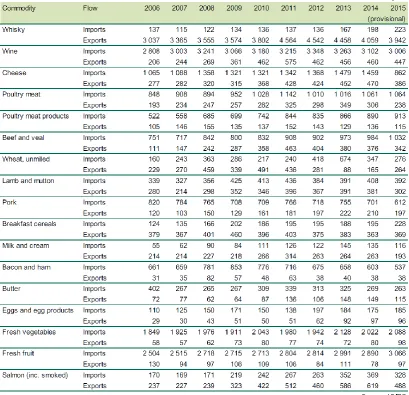
The UK exports mostly highly processed products. Whisky is the UK's most commercially valuable export. And the UK imports more primary food produce than it exports across the main commodities. Even milk and cream imports have doubled since 2006 whilst exports have declined. Food trade figures contain some surprises. The UK – which often likes to think of itself as a meat producer – actually imports more beef, poultry, pork and lamb than it exports. Table 1 gives the figures from HM Revenue and Customs (HMRC) for 2015.
Enhanced food security in the UK will require:
a commitment to rethinking UK food security, in part by producing more food, sustainably in the UK;
a comprehensive review of food security at present, looking at different sectors and consumption patterns to consider where land use, healthy diets and production capacity could be improved.
new goals and criteria for enhanced food security. These should be drawn up for
application to the UK, building on the preparatory work conducted by Defra in 2008-11. These should incorporate the thinking articulated by the former Global Food Security Champion.
Table 1. Trade in Key Agricultural Commodities, at 2015 prices
source: Defra 2016, page 8913
4.
Deciding where UK food should come from
The June 2016 Referendum brought to a head years of tension over EU membership, notably within the Conservative Party – hence Prime Minister David Cameron’s promise to hold a referendum. Retrospectively, he has said it was necessary to end the ‘poison’ of populism, a rather strange verdict since it merely set up new tensions.85 The June 2017 General Election showed these have not been dissipated. There are many positions jostling for influence within and beyond HM Government. These different political traditions become very real over food. Some have already surfaced as:
o economic nationalists who want to build UK food sourcing, almost at whatever cost;