City, University of London Institutional Repository
Citation
:
Nickels, M., Aitken, L. M., Walsham, J., Watson, L. and McPhail, S. (2017). Clinicians' perceptions of rationales for rehabilitative exercise in a critical care setting: A cross-sectional study. Australian Critical Care, 30(2), pp. 79-84. doi:10.1016/j.aucc.2016.03.003
This is the accepted version of the paper.
This version of the publication may differ from the final published
version.
Permanent repository link:
http://openaccess.city.ac.uk/14630/Link to published version
:
http://dx.doi.org/10.1016/j.aucc.2016.03.003Copyright and reuse:
City Research Online aims to make research
outputs of City, University of London available to a wider audience.
Copyright and Moral Rights remain with the author(s) and/or copyright
holders. URLs from City Research Online may be freely distributed and
linked to.
City Research Online: http://openaccess.city.ac.uk/ [email protected]
Page | 1
Clinicians’ perceptions of rationales for rehabilitative exercise in a critical care setting: A
1cross-sectional study
2Australian Critical Care, in press 3
Publication History
4
Published Online: April 19, 2016 5
Accepted: March 9, 2016 6
Received in revised form: March 7, 2016 7
Received: December 7, 2015 8
9
Authors:
10
Mr. Marc Nickels, PT.
11
Intensive Care Unit and Physiotherapy Department, Princess Alexandra Hospital, Brisbane, Australia. 12
School of Public Health & Social Work and Institute of Health and Biomedical Innovation, 13
Queensland University of Technology, Brisbane, Australia. 14
Prof. Leanne M. Aitken, RN, PhD.
15
Intensive Care Unit, Princess Alexandra Hospital, Brisbane, Australia. 16
NHMRC Centre of Research Excellence in Nursing Interventions for Hospitalised Patients, Menzies 17
Health Institute Queensland, Griffith University, Brisbane, Australia. 18
School of Health Sciences, City University London, London, United Kingdom. 19
Dr. James Walsham, MB ChB, MRCP, FCICM.
20
Intensive Care Unit, Princess Alexandra Hospital, Brisbane, Australia. 21
University of Queensland, Brisbane, Australia. 22
Ms. Lisa Watson, PT, M (Anim St).
23
Intensive Care Unit and Physiotherapy Department, Princess Alexandra Hospital, Brisbane, Australia. 24
Assoc Prof. Steven McPhail, PT, PhD.
Page | 2
School of Public Health & Social Work and Institute of Health and Biomedical Innovation, 26
Queensland University of Technology, Brisbane, Australia. 27
Centre for Functioning and Health Research, Metro South, Brisbane, Australia. 28
Page | 3
Abstract:
30
Background: 31
Rehabilitative exercise for critically ill patients may have many benefits; however, it is unknown what 32
intensive care unit (ICU) clinicians perceive to be important rationale for the implementation of 33
rehabilitative exercise in critical care settings. 34
Objective: 35
To identify which rationales for rehabilitative exercise interventions were perceived by ICU clinicians 36
to be important and determine whether perceptions were consistent across nursing, medical and 37
physiotherapy clinicians. 38
Methods: 39
A cross-sectional study was undertaken among clinicians (nursing, medical, physiotherapy) working 40
in a mixed medical surgical ICU in an Australian metropolitan tertiary hospital. Participants 41
completed a customised web-based questionnaire developed by a clinician working-group. The 42
questionnaire consisted of 11 plausible rationales for commencing rehabilitative exercise in ICUs 43
based on prior literature and their own clinical experiences grouped into 4 over-arching categories 44
(musculoskeletal, respiratory, psychological and facilitation of discharge). Participants rated their 45
perceived importance for each potential rationale on a 5-point Likert scale. 46
Results: 47
Participants (n=76) with a median (interquartile range) 4.8 (1.5, 15.5) years of experience working in 48
ICUs completed the questionnaire. Responses were consistent across professional disciplines. 49
Clinicians rated rehabilitative exercise as either ‘very much’ or ‘somewhat’ important for facilitating 50
discharge (n=76, 100%), reducing muscle atrophy (n=76, 100%), increasing muscle strength (n=76, 51
Page | 4
(n=62, 82%), increasing oxygenation (n=71, 93%), facilitating weaning (n=72, 97%), reducing anxiety 53
(n=60, 80%), reducing depression (n=64, 84%), reducing delirium (n=53, 70%), and increasing mental 54
alertness (n = 65, 87%). 55
Conclusions: 56
Any shortcoming in implementation of rehabilitation exercise is unlikely attributable to a lack of 57
perceived importance by nursing, medical or physiotherapy clinicians who are the most likely 58
clinicians to influence rehabilitation practices in ICUs. It is noteworthy that this study examined self-59
reported perceptions, not physiological or scientific legitimacy of rationales, or clinician behaviours 60
in practice. 61
62
Keywords:
63
Critical Care 64
Critical Illness 65
Exercise 66
Exercise Therapy 67
Intensive Care 68
Intensive Care Units 69
Length of Stay 70
Questionnaires 71
Rehabilitation 72
73
74
Page | 5
Introduction:
76
Survivors of critical illness experience prolonged deficits in physical and psychological function that 77
negatively impact on health-related quality of life that can persist for over 5 years.1-3 Clinicians
78
working within intensive care units (ICUs) are responsible for implementing interventions that are 79
targeted to assisting critically ill patients to not only survive but to also optimise function and health-80
related quality of life post hospital discharge. Rehabilitative exercise introduced early in the ICU stay 81
is one strategy that has been shown to improve patients’ physical and psychological outcomes and 82
reduce hospital length of stay.4, 5 Rehabilitative exercises include but are not limited to range of
83
motion exercises, resistance exercises, cycle ergometry, sitting balance, transferring from bed to 84
chair, standing balance, marching on the spot and mobilising away from the bedside.5-8 Studies that
85
have reported clinician perceptions on rehabilitative exercise have focused on barriers and 86
strategies to the implementation of exercise interventions.9-12 Currently there is no literature that
87
describes what ICU clinicians believe to be the rationales underpinning implementation of 88
rehabilitative exercise with critically ill patients. 89
Clinicians working in a mixed ICU in an Australian tertiary hospital in a metropolitan setting were 90
invited to complete a customised questionnaire with the purpose of identifying which rationales for 91
rehabilitative exercise interventions were perceived to be important. In addition, this study aimed to 92
determine if clinicians from different professional backgrounds share the same views regarding the 93
relative importance of rationales for rehabilitative exercise. By identifying what ICU clinicians 94
perceive to be important rationales for rehabilitative exercise, targeted quality improvement 95
strategies that optimise the use of exercise interventions may be developed. 96
97
Methods:
98
Design
Page | 6
A questionnaire was administered to a cross-section of clinicians using a web-based survey platform. 100
Questionnaire Development
101
The questionnaire was developed by a clinician working group which included clinical 102
physiotherapists, an intensive care consultant and a health services researcher experienced in the 103
design of web-based questionnaires for clinical analysis. The purpose of the questionnaire was to 104
ascertain current intensive care clinicians’ perspectives with regard to the rationale of incorporating 105
rehabilitative exercise with critically ill patients. The clinician working group compiled a list of 106
plausible rationales for commencing rehabilitative exercise with critically ill patients from the 107
literature and their prior experiences working with clinicians in critical care settings.5, 13, 14 For each of
108
these rationale a 5-point Likert rating scale was provided for participants to rate their perceived 109
importance of each rationale, with 1 and 5 representing the least and greatest importance ratings on 110
this scale respectively. The 11 rationales to be rated in this study were grouped into 4 categories; 111
musculoskeletal, respiratory, psychological and facilitation of discharge (see Figures 1-4 for specific 112
rationales). Participants were invited to nominate any additional rationales, but none were 113
identified. Demographic data regarding the participants were also collected and included: clinical 114
discipline, years of experience working in current ICU, and years of experience working at other ICUs. 115
116
Setting, participants and procedure
117
The target sample were clinicians currently working in a 30 bed mixed medical surgical ICU in a 118
tertiary hospital in Brisbane, Australia. The participants were from either a medical, nursing or 119
physiotherapy discipline. For analysis the nursing cohort was divided into two groups: registered 120
nurses and clinical nurses. Clinical nurses are senior nurses staff who have: completed a post 121
graduate qualification in critical care nursing, a minimum of four years’ experience, completed 122
Page | 7
roles including; unit co-ordination, quality improvement activities and supervision of junior staff. 124
Potential participants were invited to participate via the hospital email system. The invitation email 125
provided a brief description of the study and a hyperlink to the web-based platform. Three email 126
reminders were sent out over a 3 month period to encourage staff to complete the questionnaire. 127
The questionnaire was promoted in the departmental electronic newsletter, and with promotional 128
posters placed in the staff dining room. 129
Ethical approval for the study was obtained for the Metro South Human Research Ethics Committee 130
(HREC/12/QPAH/009) and from the Queensland University of Technology University Human 131
Research Ethics Committee (1400000587). Participants provided informed consent on the web-132
based survey platform prior to their participation. 133
134
Analysis
135
Descriptive statistics were used to summarize the sample characteristics and perceived importance 136
ratings. Distribution of responses were examined using frequency histograms. Mean and standard 137
deviation (SD) were calculated for normally distributed data and median and interquartile range 138
(IQR) presented for non-normally distributed data. 139
140
Results:
141
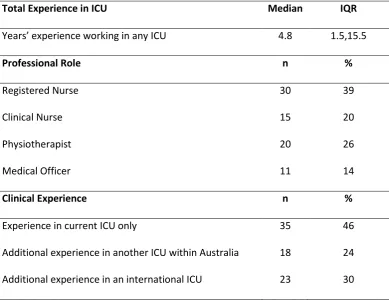
A total of n = 76 participants completed the questionnaire (82% completion rate among those 142
confirmed to have received the invitation to participate). The nursing discipline had the greatest 143
representation in the questionnaire (n = 45, 59% of participants). Overall, the sample had a range of 144
experience levels working in ICU settings (from < 1 year to 36 years). More than half (n = 41, 54%) of 145
the participants had gained experience working in different intensive care settings to where this 146
Page | 8
Table 1 Participant role and experience working in intensive care settings (n = 76)
148
Total Experience in ICU Median IQR
Years’ experience working in any ICU 4.8 1.5,15.5
Professional Role n %
Registered Nurse 30 39
Clinical Nurse 15 20
Physiotherapist 20 26
Medical Officer 11 14
Clinical Experience n %
Experience in current ICU only 35 46
Additional experience in another ICU within Australia 18 24
Additional experience in an international ICU 23 30
149
150
Figure 1: Perceptions of importance of Facilitate Discharge rationale
151
All questionnaire participants considered rehabilitative exercise as either ‘very much’ or ‘somewhat’ 152
important for facilitating discharge (Figure 1). There was a strong perception of support for the 153
musculoskeletal rationales for rehabilitative exercise by clinicians from all professions (Figure 2). All 154
clinicians considered rehabilitative exercise important for preventing muscle atrophy and increasing 155
Page | 9
important, (n=73, 96%) for prevention of contractures. Fewer clinicians (n=62, 82%) rated 157
rehabilitative exercise as either ‘very much’ or ‘somewhat’ important for reducing the incidence of 158
ICU acquired weakness. 159
Participants from all professions considered the two respiratory rationales for rehabilitative exercise 160
to be important (Figure 3). The majority of clinicians rated the rationale increasing oxygenation 161
(n=71, 93%) and facilitating weaning (n=72, 97%) as either ‘very much’ or ‘somewhat’ important. 162
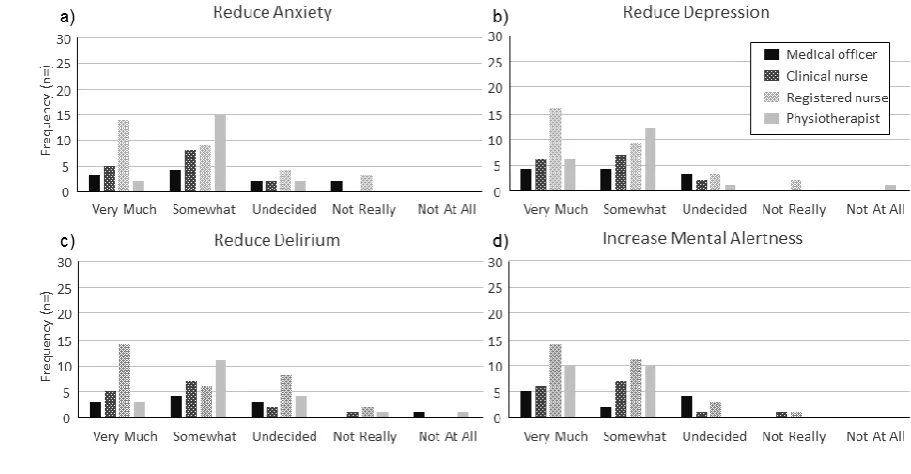
Regardless of professional background, clinicians’ perceptions of the importance of psychological 163
rationales had a broader distribution in comparison to the importance of musculoskeletal and 164
respiratory rationale. A large percentage of clinicians (n=60, 80%) rated the perceived importance of 165
the psychological rationale of rehabilitative exercise to ‘reduce anxiety’ as either ‘very much’ or 166
‘somewhat’ important (Figure 4). The majority, (n=64, 84%) and (n=53, 70%) rated rehabilitative 167
exercise as either ‘very much’ or ‘somewhat’ important for reducing depression and delirium, 168
respectively. Nearly all clinicians (n = 65, 87%) perceive the importance of increasing mental 169
alertness as either ‘very much’ or ‘somewhat’ important for rehabilitative exercise interventions 170
with critically ill patients (Figure 4). 171
Page | 10
Figure 2: Perceptions of importance of musculoskeletal rationales; (a) prevent atrophy, (b)
173
increase strength, (c) prevent contractures, (d) reduce ICU acquired weakness
174
[image:11.595.77.517.150.266.2]175
Figure 3: Perceptions of importance of respiratory rationales; (a) increase oxygenation, (b)
176
facilitate weaning
177
[image:11.595.59.515.370.607.2]178
Figure 4: Perceptions of importance of psychological rationales; (a) reduce anxiety, (b) reduce
179
depression, (c) reduce delirium, (d) increase mental alertness
180
181
Discussion:
Page | 11
This is the first paper, to the authors’ knowledge, to describe what ICU clinicians from different 183
professional backgrounds perceive to be important rationales for rehabilitative exercise 184
interventions for critically ill patients. Perhaps the most notable finding was that participants in this 185
study shared very similar perceptions regardless of their professional background. This may be, at 186
least in part, due to participants having worked in the same clinical facility. However, more than half 187
of the participants had previously worked in ICUs at other facilities, with 30% of participants having 188
worked in ICUs in other countries adding to the likelihood that this finding could be generalised 189
beyond this particular clinical setting. 190
The rationale that had the highest rating across all the clinician groups was that early rehabilitation 191
may facilitate discharge from ICU. The very strong ratings for this rationale by clinicians are 192
supported by empirical research in the field. A recent meta-analysis concluded that rehabilitative 193
exercise with critically ill patients does reduce intensive care length of stay.14 In addition to stability
194
in physiological systems, the achievement of functional tasks such as walking and sitting out of bed 195
are likely to be seen as a factor influencing the timing of a decision to discharge patients from ICUs. 196
This is despite ability to perform functional tasks such as walking and sitting out of bed not 197
necessarily being recognised as formal discharge criterion. 198
Musculoskeletal rationales for rehabilitative exercise including preventing muscle atrophy, 199
increasing strength, and preventing contractures were consistently rated very highly by ICU clinicians 200
regardless of their professional background (Figure 2). These perceptions are consistent with 201
findings from a meta-analysis of systematic reviews examining the benefits of rehabilitative 202
exercises with critically ill patients which reported that rehabilitative exercises improved physical 203
outcomes including functional independence and peripheral muscle strength.14-16 This perception is
204
also consistent with clinical guidelines in the field. The NHS National Institute for Health and Clinical 205
Excellence, Rehabilitation after Critical Illness guideline recommends that for patients at risk, start 206
rehabilitation as early as clinically possible.17
Page | 12
In addition the European Respiratory Society and European Society of Intensive Care Medicine 208
advises that critically ill patients should start active and passive exercise as early as possible.18 It
209
appears the ICU clinicians from different clinical backgrounds were likely to be aware of and in 210
agreement with these current international guidelines, familiar with the literature in the field on 211
which the guidelines were based, or were able to reach this conclusion based on their own clinical 212
knowledge and experiences. 213
214
There was a relative lower rating by ICU clinicians of the perceived importance of the rationale 215
underpinning rehabilitative exercise to reduce the incidence of ICU acquired weakness. This mixed 216
opinion may reflect the knowledge of some ICU clinicians that the development of ICU acquired 217
weakness is multi-factorial. Multiple factors that have been associated with increased incidence for 218
ICU acquired weakness include severe systemic inflammation, multiple organ failure, elevated blood 219
glucose levels, immobility and specific medications (corticosteroids and neuromuscular blocking 220
agents).19, 20 The multi-dimensional nature of ICU acquired weakness may contribute to the lack of
221
clear evidence in regard to whether rehabilitative exercise interventions improve outcomes in 222
patients with ICU acquired weakness.21 This lack of clarity has been articulated in the American
223
Thoracic Society ICU acquired weakness clinical practice guidelines and may contribute to clinicians’ 224
variable opinion about its efficacy. Consequently more research is required to investigate the effects 225
of rehabilitative exercise interventions on the incidence, severity, duration on ICU acquired 226
weakness and long-term patient outcomes. 227
228
There was consistency in positive ratings of importance for the respiratory rationale for 229
rehabilitative exercise. Clinicians generally considered rehabilitative exercise as beneficial for 230
weaning and increasing oxygenation. Rehabilitative exercise has been demonstrated to be beneficial 231
to facilitate weaning and increase ventilator free days for critically ill patients whose ICU length of 232
stay was greater than 48 hours. 5, 22 When considering respiratory function in the short term there is
Page | 13
limited evidence regarding the effect of rehabilitative exercise on acute blood oxygenation levels of 234
critically ill patients. Studies have noted that individuals have had acute desaturation to less than 235
80% during exercise interventions.5, 6, 23 However, these acute desaturations are not common and
236
are usually transient and reversible by temporarily increasing the fraction of inspired oxygen. Given 237
that rehabilitative exercise is associated with an improvement in ventilator free days it is reasonable 238
to conclude that exercise leads to an improvement in respiratory function for most critically ill 239
patients.5, 6, 22
240
241
A lower number of ICU clinicians considered rehabilitative exercise as being important for 242
psychological benefits in comparison to musculoskeletal or respiratory benefits. These lower 243
importance ratings may be due to the multi-factorial nature of psychological compromise. It has 244
been reported that depression with critically ill patients is not correlated with severity of illness or 245
age.24 In addition delirium has been shown to be associated with medications given during an ICU
246
admission and sleep disturbances.25 It has been reported that survivors of critical illness suffer
247
deficits in physical function that persist for several years after a period of critical illness.26, 27
248
However, evidence of negative consequences of critical illness on long-term cognitive function has 249
only been brought to the fore in more recent times.28 There is emerging evidence that physical
250
activity and associated decrease in sedation medication has a positive effect on psychological health 251
for survivors of critical illness.5, 29 An early screening instrument that was developed for predicting
252
psychological morbidity after critical illness identified 21 potential risk factors.30 However, inactivity
253
during critical illness was not identified as a potential contributor to the development of 254
psychological problems. In comparison with physical function, the lack of evidence regarding 255
rehabilitation exercise intervention and psychological problems may be contributing to ICU clinicians 256
placing less importance on utilising rehabilitative exercise to improve psychological outcomes of 257
Page | 14
259
Implications for Practice 260
Results of this questionnaire show that ICU clinicians perceive rehabilitative exercise to be important 261
to achieve a number of different outcomes including facilitation of discharge from ICU, improved 262
oxygenation, facilitation of weaning from mechanical ventilation and improved physical and 263
psychological outcomes. However, there is evidence in other ICU settings that rehabilitative exercise 264
does not occur routinely.31, 32 Workplace cultural barriers have been identified as inhibiting
265
rehabilitative exercise within ICU’s.12, 33-35 A challenge to the implementation of rehabilitative
266
exercise interventions is that ICU clinicians may not see the immediate benefits, therefore the need 267
for these interventions to be prioritised may not be recognised.5, 14 Practice change strategies such
268
as the development of an exercise protocol or the introduction of a rehabilitation team may be 269
beneficial for improving rates of implementation of rehabilitative exercise interventions.7, 35-38
270
271
Limitations 272
Perceptions of ICU clinicians regarding rehabilitative exercise may differ across hospital facilities. 273
This study was conducted in a single centre and may limit the ability to generalise results to other 274
ICUs, although it should be noted that over half of the participants had experience working in other 275
ICUs. It is plausible that individuals have generated their perceptions based on their experiences at 276
multiple ICUs, and consequently improve the likelihood of the generalisability of results. 277
Unfortunately, it was not possible to determine from the available data whether there was any self-278
selection bias with clinicians most interested in rehabilitation exercises choosing to complete the 279
questionnaire. Clinicians who valued rehabilitation exercise the least may have chosen not to 280
participate in this study. Further, clinicians may have answered questions in what they considered to 281
be a socially acceptable manner. However, as the study was conducted using an online 282
Page | 15
any direct social incentive that influenced participants. A final limitation was that this study focused 284
on clinical rationales for outcomes that could be observed within a patient’s admission and 285
potentially attributed (at least in part) to rehabilitation exercises in ICU. Other potential long term 286
benefits that may be difficult to attribute to rehabilitation exercise practices in ICU were considered 287
beyond the scope of the present investigation.26
288
Areas for further research 289
Uncertainty remains regarding the effect of rehabilitative exercise interventions on the incidence, 290
severity or duration of ICU acquired weakness.21 Consequently, further investigations are warranted
291
to evaluate if rehabilitative exercise interventions are able to reduce the incidence, duration and 292
severity of ICU acquired weakness. Additional studies that include clinicians from other facilities 293
internationally would be valuable to confirm or refute whether findings from the present study are 294
consistent across geographical regions. Further research is also required to determine if the 295
perceptions reported in the present study are congruent with clinician behaviours regarding their 296
prioritisation and engagement with rehabilitation exercise practices during their clinical practices. 297
This may also assist to determine what practice change strategies are likely to result in an increased 298
implementation of effective rehabilitative models of care within ICUs. The effectiveness of 299
rehabilitative exercise at facilitating ICU discharge, and improving physical, respiratory and 300
psychological outcomes also requires further investigation. 301
302
Conclusion:
303
Despite an expanding evidence base that rehabilitative exercise with critically ill patients is safe and 304
beneficial 15, 16, 39, 40, there is evidence that rehabilitative exercise does not occur routinely 31, 32. This
305
study has identified that in a single centre ICU clinicians perceive the importance of various 306
Page | 16
background. Consequently, quality improvement activities that aim to increase the occurrence of 308
rehabilitative exercise interventions should focus on the other aspects of successful implementation 309
including overcoming cultural or resourcing barriers. 310
Page | 17
References:
312
1. Oeyen SG, Vandijck DM, Benoit DD, Annemans L, Decruyenaere JM. Quality of life after intensive 313
care: a systematic review of the literature. Crit Care Med. 2010;38:2386-400. 314
2. Skinner EH, Warrillow S, Denehy L. Health-related quality of life in Australian survivors of critical 315
illness. Crit Care Med. 2011;39:1896-905. 316
3. Herridge MS, Tansey CM, Matte A, Tomlinson G, Diaz-Granados N, Cooper A, et al. Functional 317
disability 5 years after acute respiratory distress syndrome. N Engl J Med. 2011;364:1293-304. 318
4. Kayambu G, Boots R, Paratz J. Early physical rehabilitation in intensive care patients with sepsis 319
syndromes: a pilot randomised controlled trial. Intensive Care Med. 2015;41:865-74. 320
5. Schweickert WD, Pohlman MC, Pohlman AS, Nigos C, Pawlik AJ, Esbrook CL, et al. Early physical 321
and occupational therapy in mechanically ventilated, critically ill patients: a randomised controlled 322
trial. Lancet. 2009;373:1874-82. 323
6. Burtin C, Clerckx B, Robbeets C, Ferdinande P, Langer D, Troosters T, et al. Early exercise in 324
critically ill patients enhances short-term functional recovery. Crit Care Med. 2009;37:2499-505. 325
7. Morris PE, Goad A, Thompson C, Taylor K, Harry B, Passmore L, et al. Early intensive care unit 326
mobility therapy in the treatment of acute respiratory failure. Crit Care Med. 2008;36:2238-43. 327
8. Stiller K, Phillips A, Lambert P. The safety of mobilisation and its effect on haemodynamic and 328
respiratory status of intensive care patients. Physiother Theory Pract. 2004;20:175-85. 329
9. Barber EA, Everard T, Holland AE, Tipping C, Bradley SJ, Hodgson CL. Research paper: Barriers and 330
facilitators to early mobilisation in Intensive Care: A qualitative study. Aust Crit Care. 2014. 331
10. Leditschke IA, Green M, Irvine J, Bissett B, Mitchell IA. What are the barriers to mobilizing 332
intensive care patients? Cardiopulm Phys Ther J. 2012;23:26-9. 333
11. Morris PE. Moving our critically ill patients: mobility barriers and benefits. Crit Care Clin. 334
Page | 18
12. Winkelman C, Peereboom K. Staff-perceived barriers and facilitators. Crit Care Nurse. 336
2010;30:S13-S6. 337
13. Chiang L-L, Wang L-Y, Wu C-P, Wu H-D, Wu Y-T. Effects of physical training on functional status in 338
patients with prolonged mechanical ventilation. Phys Ther. 2006;86:1271-81. 339
14. Kayambu G, Boots R, Paratz J. Physical Therapy for the Critically Ill in the ICU: A Systematic 340
Review and Meta-Analysis. Crit Care Med. 2013. 341
15. Adler J, Malone D. Early mobilization in the intensive care unit: a systematic review. Cardiopulm 342
Phys Ther J. 2012;23:5-13. 343
16. Li Z, Peng X, Zhu B, Zhang Y, Xi X. Active Mobilization for Mechanically Ventilated Patients: A 344
Systematic Review. Arch Phys Med Rehabil. 2012. 345
17. NICE. Rehabilitaiton after Critical Illness NICE Clinical Guideline 83. London, UK: National Institute 346
for Health and Clinical Excellence; 2009. 347
18. Gosselink R, Bott J, Johnson M, Dean E, Nava S, Norrenberg M, et al. Physiotherapy for adult 348
patients with critical illness: recommendations of the European Respiratory Society and European 349
Society of Intensive Care Medicine Task Force on Physiotherapy for Critically Ill Patients. Intensive 350
Care Med. 2008;34:1188-99. 351
19. Schweickert WD, Hall J. ICU-acquired weakness. Chest. 2007;131:1541-9. 352
20. Lacomis D, Terry Petrella J, Giuliani MJ. Causes of neuromuscular weakness in the intensive care 353
unit: A study of ninety-two patients. Muscle Nerve. 1998;21:610-7. 354
21. Fan E, Cheek F, Chlan L, Gosselink R, Hart N, Herridge MS, et al. An Official American Thoracic 355
Society Clinical Practice Guideline: The Diagnosis of Intensive Care Unit-acquired Weakness in Adults. 356
Am J Respir Crit Care Med. 2014;190:1437-46. 357
22. Routsi C, Gerovasili V, Vasileiadis I, Karatzanos E, Pitsolis T, Tripodaki E, et al. Electrical muscle 358
stimulation prevents critical illness polyneuromyopathy: a randomized parallel intervention trial. Crit 359
Page | 19
23. Bailey P, Thomsen GE, Spuhler VJ, Blair R, Jewkes J, Bezdjian L, et al. Early activity is feasible and 361
safe in respiratory failure patients. Crit Care Med. 2007;35:139-45. 362
24. Davydow DS, Gifford JM, Desai SV, Bienvenu OJ, Needham DM. Depression in general intensive 363
care unit survivors: a systematic review. Intensive Care Med. 2009;35:796-809. 364
25. Banerjee A, Girard TD, Pandharipande PP. The complex interplay between delirium, sedation, 365
and early mobility during critical illness: applications in the trauma unit. Curr Opin Anaesthesiol. 366
2011;24:195-201. 367
26. Herridge MS. Legacy of intensive care unit-acquired weakness. Crit Care Med. 2009;37:S457-61. 368
27. Herridge MS, Cheung AM, Tansey CM, Matte-Martyn A, Diaz-Granados N, Al-Saidi F, et al. One-369
year outcomes in survivors of the acute respiratory distress syndrome. N Engl J Med. 2003;348:683-370
93. 371
28. Needham DM, Davidson J, Cohen H, Hopkins RO, Weinert C, Wunsch H, et al. Improving long-372
term outcomes after discharge from intensive care unit: report from a stakeholders' conference. Crit 373
Care Med. 2012;40:502-9. 374
29. Needham DM, Korupolu R, Zanni JM, Pradhan P, Colantuoni E, Palmer JB, et al. Early physical 375
medicine and rehabilitation for patients with acute respiratory failure: a quality improvement 376
project. Arch Phys Med Rehabil. 2010;91:536-42. 377
30. Schandl A, Bottai M, Hellgren E, Sundin O, Sackey PV, Avdelningen för p, et al. Developing an 378
early screening instrument for predicting psychological morbidity after critical illness. Crit Care. 379
2013;17:R210-R. 380
31. Nydahl P, Ruhl AP, Bartoszek G, Dubb R, Filipovic S, Flohr HJ, et al. Early mobilization of 381
mechanically ventilated patients: A 1-day point-prevalence study in Germany. Crit Care Med. 382
2014;42:1178-86. 383
32. Berney SC, Harrold M, Webb SA, Seppelt I, Patman S, Thomas PJ, et al. Intensive care unit 384
mobility practices in Australia and New Zealand: a point prevalence study. Crit Care Resusc. 385
Page | 20
33. Thomsen GE, Snow GL, Rodriguez L, Hopkins RO. Patients with respiratory failure increase 387
ambulation after transfer to an intensive care unit where early activity is a priority. Crit Care Med. 388
2008;36:1119-24. 389
34. Hopkins RO, Spuhler VJ, Thomsen GE. Transforming ICU culture to facilitate early mobility. Crit 390
Care Clin. 2007;23:81-96. 391
35. Hopkins RO, Spuhler VJ. Strategies for promoting early activity in critically ill mechanically 392
ventilated patients. AACN Adv Crit Care. 2009;20:277-89. 393
36. Hanekom S, Gosselink R, Dean E, van Aswegen H, Roos R, Ambrosino N, et al. The development 394
of a clinical management algorithm for early physical activity and mobilization of critically ill patients: 395
synthesis of evidence and expert opinion and its translation into practice. Clin Rehabil. 2011;25:771-396
87. 397
37. McWilliams D, Weblin J, Atkins G, Bion J, Williams J, Elliott C, et al. Enhancing rehabilitation of 398
mechanically ventilated patients in the intensive care unit: A quality improvement project. J Crit 399
Care. 2014. 400
38. Perme C, Chandrashekar R. Early mobility and walking program for patients in intensive care 401
units: creating a standard of care. Am J Crit Care. 2009;18:212-21. 402
39. Stiller K. Physiotherapy in intensive care: an updated systematic review. Chest. 2013;144:825-47. 403
40. Thomas AJ. Exercise intervention in the critical care unit – what is the evidence? Phys Ther Rev. 404
2009;14:50-9. 405
406