This is a repository copy of The effects of gas-phase and in-depth radiation absorption on ignition and steady burning rate of PMMA.
White Rose Research Online URL for this paper: http://eprints.whiterose.ac.uk/90515/
Article:
Staggs, J (2014) The effects of gas-phase and in-depth radiation absorption on ignition and steady burning rate of PMMA. Combustion and Flame, 161 (12). 3229 - 3236. ISSN 0010-2180
https://doi.org/10.1016/j.combustflame.2014.06.007
© 2014. This manuscript version is made available under the CC-BY-NC-ND 4.0 license http://creativecommons.org/licenses/by-nc-nd/4.0/
[email protected] https://eprints.whiterose.ac.uk/
Reuse
Unless indicated otherwise, fulltext items are protected by copyright with all rights reserved. The copyright exception in section 29 of the Copyright, Designs and Patents Act 1988 allows the making of a single copy solely for the purpose of non-commercial research or private study within the limits of fair dealing. The publisher or other rights-holder may allow further reproduction and re-use of this version - refer to the White Rose Research Online record for this item. Where records identify the publisher as the copyright holder, users can verify any specific terms of use on the publisher’s website.
Takedown
If you consider content in White Rose Research Online to be in breach of UK law, please notify us by
The Effects of Gas-Phase and In-Depth Radiation Absorption on
Ignition and Steady Burning Rate of PMMA
J. E. J. Staggs
Energy Research Institute
University of Leeds
Leeds LS2 9JT
United Kingdom
Keywords: PMMA; in-depth absorption; ignition; pyrolysis.
Abstract
Although well studied, there are still interesting features about the ignition and steady
burning rate behaviour of PMMA when heated by thermal radiation. In this
contribution, the dependence on external heat flux of ignition delay time and steady
mass flux of PMMA are investigated numerically. Ignition is modelled by the critical
mass flux criterion. The heat transfer model includes effects of heat lost by out
gassing, change of volume during degradation and absorption of radiation in both
condensed and gaseous phases. Model results are compared to experimental data for
both ignition delay time and quasi-steady mass flux across a range of heat fluxes from
20 to 210 kWm-2 and the importance of both gas-phase and condensed-phase radiation
absorption effects are discussed.
Nomenclature
Roman Symbols
c Specific heat capacity / Jkg-1K-1
D Thermal diffusivity / m2s-1
h Convection heat transfer coefficient / Wm-2K-1
k Arrhenius reaction rate / s-1
l Sample thickness / m
m Mass flux / kgs-1m-2
m Mass production rate per unit volume / kgs-1m-3 q Heat flux / Wm-2
s Location of exposed surface of sample / m
t Time / s
T Temperature / K
y Distance into sample normal to exposed surface / m
z Distance above sample normal to exposed surface / m
Greek Symbols
Absorptivity
Characteristic thermal penetration depth / m
Emissivity
Absorption coefficient
Thermal conductivity / Wm-1K-1
Gas-phase absorption parameter / sm2kg-1
Density / kgm-3
Stefan-Boltzmann constant / Wm-2K-4
Important Subscripts
a Ambient conditions
ig A quantity at ignition
0 A quantity at the initial location of the exposed surface (y = 0)
s A quantity at the moving exposed surface (y = s)
A steady-state value
1. Introduction
For high heating rates, heat loss mechanisms are insignificant for short exposures and
so one might expect that ignition behaviour of simple solids under such conditions
simplification of ignition at a critical surface temperature is adopted, it follows that
the reciprocal of the square root of ignition time should be proportional to external
heat flux. Interestingly, this turns out not to be the case [1] - [5]. After a thorough
analysis of a one-dimensional mathematical model for ignition (including an
alternative criterion for ignition) Bal & Rein [5] concluded that the observed variation
of ignition time from the inverse square root correlation at high external heat flux
could not be explained by:
o Taking heat losses into account at the exposed surface.
o Using a critical mass flux rather than a critical surface temperature ignition
criterion.
o Using a more detailed reaction scheme for condensed phase degradation.
o Incorporation of temperature dependent thermal properties.
They went on to demonstrate that the deviation of ignition delay time from the inverse
square root correlation could be explained by in-depth absorption of radiation in the
condensed phase.
Measurements of the transmissivity of black PMMA (Polycast) [4] suggest that the
absorption coefficient is approximately 960m-1, indicating a characteristic
absorption depth of ~1mm. If the external heat flux is qat the exposed surface, T is
temperature and is thermal conductivity then ignoring in-depth absorption, the
characteristic thermal penetration depth assuming conduction heat transfer is
q
T
/
~
, where T is a physically significant temperature interval. For ignition
it is sensible to take T as the characteristic kinetic temperature range [6], which corresponds approximately to the temperature range over which the material
pyrolyses at constant heating rate. Thus it seems reasonable that in-depth absorption
of radiation becomes important when 1, i.e. when qT. For PMMA with as above, = 0.2 Wm-1K-1 and T ~ 150 K (see Figure 4 below), T is approximately 30 kWm-2 and so it is likely that in-depth absorption should be
In-depth absorption of radiation in the condensed phase is only part of the problem,
however. Kashiwagi’s observations of ignition of PMMA by CO2 laser [1] show that
there is significant absorption of radiation by gaseous MMA in the plume above the
degrading sample and the role of gas-phase absorption in ignition and steady burning
rate is unclear. Measurements of quasi-steady mass flux (the approximately steady
mass loss rate per unit surface area due to out-gassing of volatiles for an initially thick
sample, also referred to as “burning rate”) as external heat flux is varied indicate a
nonlinear trend at high heat flux [2] - [4]. This is unexpected from simple ablation
theory, which predicts that steady mass flux should be proportional to the ratio of net
heat flux at the exposed surface to heat of gasification [7] - [11]. If radiation
absorption in the condensed phase provides an explanation for the observed variation
of ignition delay time, then does it also account for the observed trend in mass flux?
In this paper, a mathematical model of ignition and pyrolysis of PMMA is carefully
investigated. Naturally in-depth absorption of radiation is included, but other features
not considered in Bal & Rein’s model [5] are also included such as heat lost by out-gassing and change of volume during degradation. Change of volume occurs as the
sample pyrolyses. It is unlikely that this will have much effect on ignition behaviour,
especially at high heat flux, but an early paper by the author [12] demonstrates that it
can have a significant effect on mass flux at moderate heat flux. Bal & Rein
accounted for gas-phase absorption using the device of a gas-phase absorption
coefficient, assuming that a constant fraction of the incident radiation is absorbed by
the pyrolyzate above the exposed surface. In this approach a more involved model of
gas-phase absorption is developed, where the amount of absorption depends on the
mass flux of pyrolyzate. We begin with a brief discussion of the expected, order of
magnitude, effect of condensed phase absorption on ignition. We then go on to
consider a more detailed model of pyrolysis and ignition together with a simplified
model for gas phase absorption of radiation. Where possible parameter values for the
model are chosen based on either literature values or experimental data and, prior to
the main analysis, results are compared with experimental cone calorimeter data for
mass flux. The roles of condensed- and gas-phase absorption of radiation in ignition
2. Ignition at a Critical Temperature
2.1 The General Problem
The simplest possible model of ignition is the critical surface temperature
approximation, where ignition is assumed to occur as soon as the exposed surface
reaches a characteristic temperature T . Bal & Rein [5] concluded that ignition ig
behaviour at high heat flux was not greatly affected by the choice of ignition criterion
(critical temperature or critical mass flux) and so for convenience we shall adopt the
simpler approach for this order of magnitude analysis. Coincident with this
approximation of ignition is the additional assumption that the solid remains inert for
temperatures below Tig.
When in-depth absorption of radiation occurs in a 1-D translucent solid, the total heat
flux q consists of two components: qT/yqR. Here the first part is
conducted heat flux, where y is distance below the exposed surface, and qR is
transmitted radiation flux. Thus for an inert solid with constant thermal properties,
conservation of energy implies that
R
q y T y t T
c
. (1)
Here is density and c is specific heat capacity. Usually, the in-depth radiation term
is modelled by Beer’s law: qR
1R
q0exp(y). Here is the absorptioncoefficient already defined above.
At the exposed surface (y0) of the solid there are three possibilities for the fate of
incident radiation: it can be absorbed, reflected or transmitted. For simplicity it shall
be assumed that there is no reflected radiation. The unexposed surface (yl) is assumed to be well insulated and opaque, so the net heat flux there is zero. Under
4 4
0 hT T T T
q y T
a a
R
at y0, (2)
0
qR
y T
at yl. (3)
Here R is absorptivity, q0 is incident radiation, h is the convection heat transfer
coefficient, T is ambient temperature, a is emissivity and is the Stefan-Boltzmann
constant. When Kirchoff's law applies, the emissivity and absorptivity are equal,
however there is no guarantee that this is always true.
Applying the boundary conditions at the exposed and unexposed surfaces, it follows
that the steady-state temperature distribution T( y) is given by
y
Rdy
q T
y T
0 0
1 )
(
, (4)
where T (the temperature at y = 0) satisfies 0 q0h
Ta T0
Ta4T04
0.The solution of the transient inert problem presents no particular difficulties.
Delichatsios and Zhang present an approximate solution in [13]. However for what
follows below it is worth considering the high heat flux limit in some detail.
2.2 High Heat Flux Limit
Here we note that if the external heat flux is sufficiently high, so that
4 4
0 ig a ig a
RqhT T T T
, where T is the temperature at ignition, then heat ig
losses are negligible1 up to ignition. This is illustrated in Figure 1, where the regions
1 Note that this is equivalent to the external heat flux being very much greater than the critical heat flux
above the curves correspond to high external heat fluxes for different values of the
radiation parameter Tig3/h.
0.0 0.2 0.4 0.6 0.8 1.0
[image:8.595.113.491.147.449.2]0.0 0.5 1.0 1.5 2.0 0 / 3 h Tig 25 . 0 / 3 h Tig 5 . 0 / 3 h Tig 75 . 0 / 3 h Tig ig R hT q0 ig a T T / 1 / 3 h Tig
Figure 1. High heat flux limits.
When this is the case, setting
y Ra q dy
l y y q t c l q T T T 0 0 0 1 1 2 1
, (5)
and substituting this expression into (1) it follows that T must satisfy the standard 1
diffusion equation T1/tD2T1/y2, where D/
c is the thermal diffusivity.Furthermore, application of the boundary conditions (2) and (3) without surface heat
losses implies that T1/y0 at both bounding surfaces. Since the initial
temperature is assumed to be ambient throughout, the initial temperature distribution
y Rdy q l y y q y T 0 0 1 1 2 1 ) , 0 ( . (6)
If Beer's law is assumed, it is immediately apparent from Eqn. (5) that for ignition at a
critical temperature T , the ignition time ig t will be of the form ig
l T q l T T f D l t R a a ig
ig , , ,
0
2
. (7)
Alternatively, in the high heat flux limit (HHFL) for a thick solid, the temperature
profile may be approximated by
), ( , ), ( 0 ), ( / ) ( ) (~ 0 0
t y T t y t y t T T t T T a a (8)
where T0(t) is again the temperature at the exposed surface y = 0 and (t) is the
thermal penetration depth (now a function of time). Integrating the temperature
equation (1) over the thermal penetration depth, we find that
T tdy q ec / 01 1 R
0
. Now using the facts that
0 0 //dt T tdy
d T Tdy dt
d
a ,
Tdy
T0Ta
0 2
~
and d/dtd/dtd/d it follows that
e q d dT T T dt d c R sa ~ 1 1
2 0 0 . (9)
The boundary condition on the exposed surface means that T0 Ta Rq0/ and so
when the external heat flux is sufficiently high, such that q0
Tig Ta
/R, it follows that will always be small. Therefore d
2 /dt~2D, in the HHFL and soDt 2 ~
related by Tig ~Ta Rq0 2Dtig / and consequently in terms of the parameter groupings given in Eqn. (7) above,
2 0 2 2 2 . 1 . 2 1 . ~ q l T T T D l t a a ig R ig
. (10)
In particular, it follows that
ig a
R
ig T T
D q t 2 ~
1 0
(11)
and so we see that 1/ tig will reduce in direct proportion to R.
3. Ignition at a Critical Mass Flux: Reactive Solid
3.1 Energy Equation
Consider for simplicity a solid that on heating undergoes a single-step first-order
degradation reaction of the form dm/dtk(T)m, where m is the ratio of sample
mass to initial mass, k(T)exp(J TA/T), J is the natural logarithm of the
pre-exponential factor and T is the activation temperature. Bal & Rein [5] showed that A
ignition behaviour was not greatly affected by inclusion of a more sophisticated
pyrolysis model, so only this simple first-order single-step approach will be
investigated. Also, as above, heat transfer in one direction only (normal to the
exposed surface) is modelled. Now consider a thick sample of solid where
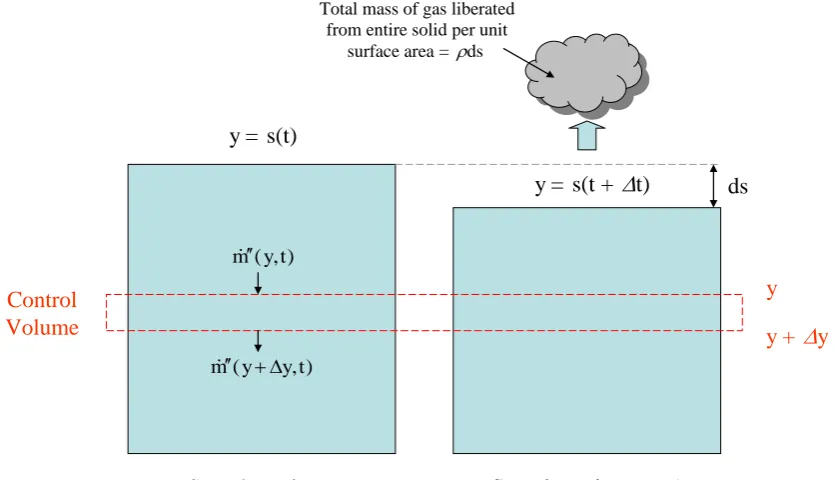
temperature gradients are not negligible. As the solid is heated gas is generated,
which we assume escapes as soon as it forms (so that the local density remains
constant). This implies that there will be a reduction in sample volume as gasification
Sample at time t Sample at time t + t
y y + y
y = s(t)
y = s(t + t)
) , (yt m
) , (y yt m
Total mass of gas liberated from entire solid per unit
surface area = ds
Control Volume
[image:11.595.102.520.73.313.2]ds
Figure 2. Definition of control volume.
The degradation reaction implies that the generation rate of gas per unit sample
volume will be given by mgk. Let the location of the exposed surface be given
by ys(t), where s(0)0. Now consider a control volume fixed in space, located between y and yy, and let m(y,t) denote the mass flux of solid that flows past
point y at time t due to the reduction of volume.
Conservation of mass then implies that m/ymg and integrating this, we find
that the local mass flux is given by
l
y
kdy
m . Since the remaining solid mass per
unit area is s, it follows that the location of the exposed surface will be given by the
solution of the integro-differential equation
l
s
kdy dt
ds
, s(0)0. (12)
g gg c T H
m y q cT m t
cT
, (13)
where, as above, the total heat flux qT/yqR, H is the heat of the g
gasification reaction and mgcgT is the rate of outflow of heat per unit sample volume
due to out-gassing, c being the specific heat capacity of the gas. g
Using the expressions for m and mg, the energy equation may be rewritten in more convenient form
g g Rl y q y T y H T c c k kdy y T c t T
c
. (14)
Note that this equation must be solved throughout the volume of remaining solid
l y t
s( ) .
3.2 Gas-Phase Attenuation of Incident Radiation
It is possible that radiation incident on the exposed surface may be attenuated by
gas-phase absorption above the sample. Beaulieu [2], [3], was unable to estimate
attenuation for a pyrolysing PMMA sample but instead used a propylene burner with
an embedded heat flux gauge. She first measured the heat flux from the propylene
flame only and then varied the output from the apparatus' external source and noted
the new heat flux readings. She concluded that there was no attenuation by either the
flame or the propylene gas. Earlier, Kashiwagi [1] conducted an elegant series of
experiments on PMMA (and red oak) using a CO2 laser as the radiation source. In his
experiments, a small hole was cut in the samples and a heat flux gauge was placed
directly beneath them so that he could measure attenuation through the pyrolyzate
prior to ignition. He concluded that there was significant attenuation prior to ignition
and that the ratio of incident heat flux to initial heat flux, i.e. 1 - attenuation,
between these observations: Kashiwagi measured attenuation of the radiation by
gaseous MMA and Beaulieu measured combined attenuation by propylene and a
flame. There is no reason why these effects should be the same.
To estimate the effect of gas-phase attenuation, consider a column of pyrolyzate
above the sample surface being advected upwards with speed v. In an instrument
such as an oxygen consumption calorimeter, the mass flow rate of air is always much
greater than mass flow rate of pyrolyzate, so to leading order we may assume that v is
constant. Furthermore, consider a layer at height z above the sample surface at time t.
The layer has taken time z /v to reach height z, and so the mass flux of pyrolyzate at
the sample surface when the layer first formed was mg
tz/v
. Assuming there tobe no mixing between layers in the column, in time step t it follows that the thickness of the layer will be zvt and the mass of pyrolyzate in the layer will be
t z v
t mA
mp c g
/ , where A is the cross-sectional area of the column. It is c
reasonable to suppose that attenuation of radiation through the layer will be directly
proportional to the mass of pyrolyzate in the layer, since each particle has the
potential to absorb radiation. In other words, we would expect that
qi(z,t)qi(zz,t)
/qi(z,t)mg(tz/v)t, where qi( tz, ) is the magnitude of radiation at height z and time t. It therefore follows that qi( tz, ) satisfies
t z v
m q v z q g i i /
, (15)
where is a constant of proportionality with dimensions m2kg-1 that will depend on
the absorbing properties of the pyrolyzate. Now, if the height of the column of
pyrolyzate is zmax and the radiation at z = zmax has magnitude qext , then the magnitude
at the sample surface will be qs, where
v z g exts q m t d
q
/
0 max
exp
Physically zmax /v is the time taken for the pyrolyzate to advect through the column
and if this is small compared to the timescale on which out-gassing from the sample
occurs, then
m t
q
qs ext exp g , (17)
where zmax/v is an alternative constant with dimensions of sm2kg-1, which we
shall refer to as the gas-phase absorption parameter. Physically, if one were able to
measure the radiation flux at the exposed surface during pyrolysis, then would
correspond to the gradient of the graph of ln
qext /qs
plotted against the mass flux ofescaping pyrolyzate.
It must be appreciated that the model set out above will be a gross oversimplification
of the actual physical situation and serves only as a first-order approximation to
quantify the effect of gas phase absorption. The flow field above the sample surface
during out-gassing of volatile species will be complex and it is likely that this will
have a large effect of the local density of pyrolyzate and hence attenuation.
Furthermore, it should be noted that the nature of the experimental setup, including its
physical dimensions, the wavelength of incident radiation and the total flow rate of
gases, will also affect the value of .
3.3 Post Ignition Behaviour and Numerical Solution
In order to model post-ignition behaviour, an ignition criterion is required together
with an additional term in the boundary condition at the exposed surface to account
for heat flux from a flame. Here the device of critical mass flux [14] is used to
determine ignition and following earlier observations [9], [10] it is assumed that the
heat flux from a flame is constant. From the discussion above, we take
4 4
exp m t hT T T T
q y T
a a
g ext
R
, , , , 0 0 ign g f ign g ext m m q q m m q q
(19)
at the exposed surface, where mign is the critical mass flux at ignition and qf is the
flame heat flux.
We shall assume that Beer's law applies and so the in-depth radiation flux is now
q
y s
qR 1R ext exp .
Due to the nonlinearity of the temperature equation, recourse to numerical methods is
inevitable. The method adopted here is a fully-implicit finite difference scheme with
a non-uniform grid. In the numerical solution, the node density is greatest at the
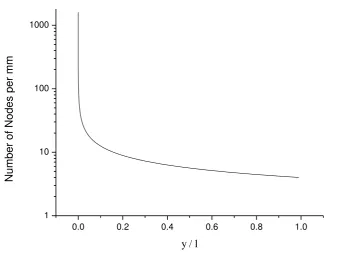
exposed surface so that temperature variation and the in-depth radiation term qR are
adequately resolved2. The node density used in the calculations is shown in Figure 3.
0.0 0.2 0.4 0.6 0.8 1.0
1 10 100 1000 Numb er of Nod es p er mm
[image:15.595.114.455.425.683.2]y / l
Figure 3. Node density (in number of nodes per mm) used in numerical calculations.
2 The in-depth radiation flux at the exposed surface varies on a length scale of 1/, so the node spacing
4. Parameter Values
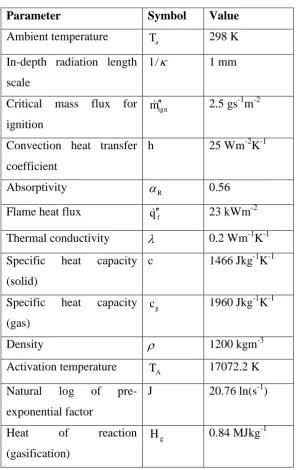
For convenience it will be assumed that Kirchoff's law is valid, i.e. R. The
model parameters used in the numerical simulations, with the exception of the
Parameter Symbol Value
Ambient temperature T a 298 K
In-depth radiation length
scale
/
1 1 mm
Critical mass flux for
ignition
ign
m 2.5 gs-1m-2
Convection heat transfer
coefficient
h 25 Wm-2K-1
Absorptivity R 0.56
Flame heat flux qf 23 kWm-2
Thermal conductivity 0.2 Wm-1K-1
Specific heat capacity
(solid)
c 1466 Jkg-1K-1
Specific heat capacity
(gas)
g
c 1960 Jkg-1K-1
Density 1200 kgm-3
Activation temperature T A 17072.2 K
Natural log of
pre-exponential factor
J 20.76 ln(s-1)
Heat of reaction
(gasification)
g
[image:17.595.150.447.85.556.2]H 0.84 MJkg-1
Table 1. Model parameter values.
The in-depth length scale for radiation, thermal conductivity, critical ignition mass
flux and density were taken in-line with other values used in the literature [5], [14].
The convection heat transfer coefficient was taken as a representative value from a
recent detailed experimental investigation [15]. The flame heat flux was taken from
other studies [9], [10] and the heat of the gasification reaction was calculated from
representative value for PMMA and the specific heat capacity of the gas as a
representative value for MMA (both obtained from WWW-based data tables).
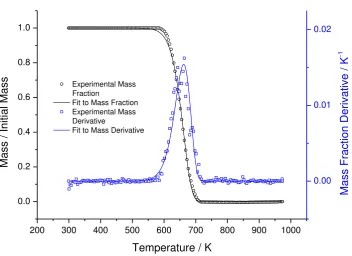
The Arrhenius parameters A and T for the reaction rate are obtained from constant A
heating rate thermogravimetric (TG) experiments for standard PMMA samples in
nitrogen, previously published in an earlier study [17]. It was felt important to
estimate these parameters from an experiment in an inert atmosphere since the oxygen
concentration at the exposed surface is likely to be significantly below normal
atmospheric levels due to out-gassing of MMA. There is a problem with using TG
data at standard heating rates such as 10 - 50 K/min in that in practice, the heating
rates at the exposed surface of the sample will greatly exceed these values. For
example, at 50 KWm-2, the ignition time of black PMMA is ~30 s, indicating a
heating rate at the exposed surface of ~600 K/min. At 100 kWm-2, the corresponding
heating rate is ~1800 K/min. Without specialised equipment it is impossible to
investigate thermal degradation at such high heating rates and so data from our
analyser's maximum heating rate of 50 K/min was used. Naturally, if one were
concerned with a detailed examination of the kinetic mechanism then this heating rate
would be too high. However, in this application heating rates are so high that it is
likely that many of the individual nuances of the degradation mechanism will be
smeared together. This perhaps may account for the reason why more detailed kinetic
mechanisms do not explain the observed ignition trend at high heat flux as noted by
Bal & Rein [5].
In order to obtain estimates of the Arrhenius parameters, model fits were compared to
both experimental mass loss and mass derivative curves. Residuals for the fits to each
curve were calculated and the sum of residuals was minimised in order to obtain the
200 300 400 500 600 700 800 900 1000 0.0
0.2 0.4 0.6 0.8 1.0
Experimental Mass Fraction
Fit to Mass Fraction Experimental Mass Derivative
Fit to Mass Derivative
Temperature / K
Ma
ss / I
nitial M
ass
0.00 0.01 0.02
Ma
ss F
ra
ction
Der
ivative
/ K
[image:19.595.132.485.95.351.2]-1
Figure 4. Constant heating rate TG data and optimal fits for PMMA at 50 K/min.
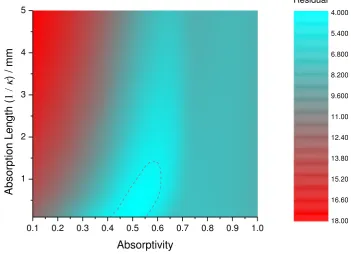
The absorptivity R and absorption coefficient were estimated by comparing
model predictions for mass flux to experimental cone calorimeter results at an
external heat flux of 50 kWm-2, using a PMMA sample of initial thickness 12 mm.
Figure 5 shows a contour plot of the residual, defined by
Residual =
2 / 1
0
2 model exp
1
sto p tstop
dt m
m
t , (20)
where mexp is the experimental mass flux from the cone calorimeter and mmodel is the
0.1 0.2 0.3 0.4 0.5 0.6 0.7 0.8 0.9 1.0 1
2 3 4 5
Absor
ptio
n L
en
gth
(
1 /
) /
mm
Absorptivity
4.000
5.400
6.800
8.200
9.600
11.00
12.40
13.80
15.20
16.60
18.00
[image:20.595.122.474.94.348.2]Residual
Figure 5. Contour plot of mass flux residual.
It is apparent from Figure 5 that the residual has an approximately flat basin (shown
by the dashed curve) in the neighbourhood of the minimum. This unfortunately
means that there is no clearly defined optimum and any values within the dashed
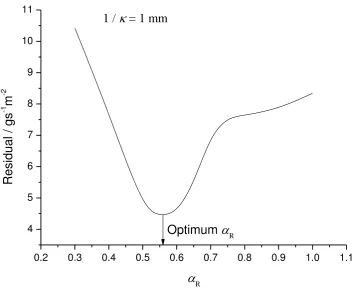
region will produce good fits to the experimental data. Therefore, broadly in line with
other observations [4], [5] it was decided to take 1/ as 1 mm and seek the optimum
R
that minimised the residual. This process gives the best value of R as 0.56, as
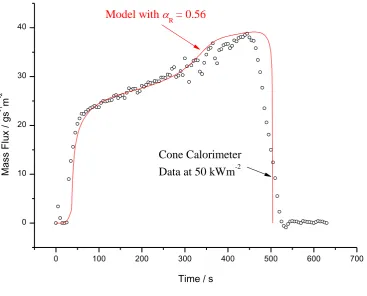
Figure 6 confirms. Figure 7 shows the optimum fit together with the experimental
0.2 0.3 0.4 0.5 0.6 0.7 0.8 0.9 1.0 1.1 4
5 6 7 8 9 10 11
Residu
al /
gs
-1 m
-2
R
1 / = 1 mm
[image:21.595.122.475.100.393.2]Optimum R
0 100 200 300 400 500 600 700 0
10 20 30 40
Model with R = 0.56
M
a
ss
F
lu
x
/
g
s
-1 m
-2
Time / s
[image:22.595.112.480.116.412.2]Cone Calorimeter Data at 50 kWm-2
Figure 7. Comparison of model with cone calorimeter results for standard parameter values
shown in Table 1.
Unfortunately there is a lack of information to quantify the gas-phase absorption
parameter. Kashiwagi’s earlier work [1] suggests that there was significant gas-phase absorption in his experiments. However, the apparatus used in his work and the
spectral characteristics of the heat source are significantly different to an oxygen
consumption calorimeter and the discussion in §3.2 suggests that there is every reason
to suppose that the gas phase absorption parameter is sensitively dependent on
experimental apparatus. Given that ignition occurs at a relatively low mass flux, in a
well-ventilated experiment such as a cone calorimeter it is reasonable to suppose that
gas-phase absorption plays little part in ignition. However, in the quasi-steady region
where mass flux is significantly higher than at ignition, it is possible that gas-phase
5. Results
Beaulieu [2], [3], presented empirical ignition results that are representative of a
broader super-set discussed by Bal & Rein [5]. Beaulieu's results were obtained using
25 mm thick specimens in the AFM apparatus where an infra-red lamp is used as the
heat source. Neither Beaulieu or Bal & Rein make mention of the earlier work of
Kashiwagi [1], where a CO2 laser was the primary heat source used and delivered
similar levels of heat flux at the exposed surface.
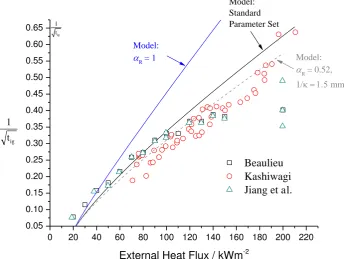
Figure 8 shows results from the model with the parameter set given in Table 1 with
the experimental data of Beaulieu [2], [3], Kashiwagi [1] and the coated PMMA data
of Jiang et al. [4]. Also shown in the figure are model results obtained with slightly
different values for and R, corresponding to the upper region of the dashed area
shown in Figure 5. As suggested above, it was found that the gas-phase absorption
parameter had little discernible effect on ignition behaviour for values in the range 0
– 10 m2skg-1 and so no results are explicitly included in Figure 8.
0 20 40 60 80 100 120 140 160 180 200 220
0.05 0.10 0.15 0.20 0.25 0.30 0.35 0.40 0.45 0.50 0.55 0.60 0.65
ig
t 1
Model:
R = 0.52,
1/ mm
Model: Standard Parameter Set
Beaulieu Kashiwagi Jiang et al.
External Heat Flux / kWm-2
ig
t 1
[image:23.595.120.469.492.751.2]Figure 8. Comparison between model and experimental data for ignition time (in seconds).
The obvious point to note is the model confirms that in-depth absorption plays an
important role in ignition at high heat flux. Also, the scaling given by Eqn. (11) is
preserved, i.e. 1/ tig reduces approximately in direct proportion to R at high heat
flux.
Naturally, an optimum choice for R could be found by computing the best fit of
model predictions directly with the experimental data in Figure 8. However, the
author felt that a stronger case for the validity of the model could be promoted if a
value for R was found at a single heat flux and then used for model predictions
across the heat flux spectrum.
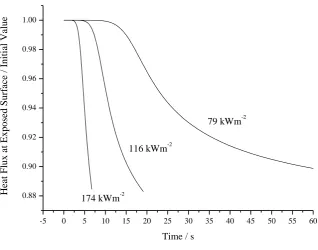
The graph in Figure 9 shows the effect of varying the gas-phase absorption parameter
without ignition when the external heat flux is set to 100 kWm-2. The dependent axis
corresponds to the ratio of heat flux at the sample surface to qext , i.e. 1 – attenuation,
and the dependent axis is time. The graph in Figure 10 shows the same heat flux
ratio, but with fixed at 5.0 m2skg-1 for the three heat fluxes that Kashiwagi used in
his experiments [1]. Although the magnitude of attenuation at this value of is much
0 5 10 15 20 25 30 35 40 45 50 55 60 0.7
0.8 0.9 1.0
10.0 m2skg-1 7.5 m2skg-1 5.0 m2skg-1
2.5 m2skg-1
H ea t Flu x at Ex p o sed Su rf ac e / I n it ial V al u e
[image:25.595.130.447.101.346.2]Time / s 0 m2skg-1
Figure 9. Effect of gas-phase absorption parameter on attenuation
-5 0 5 10 15 20 25 30 35 40 45 50 55 60 0.88 0.90 0.92 0.94 0.96 0.98 1.00
174 kWm-2
116 kWm-2
H ea t Flu x at Ex p o sed Su rf ac e / I n it ial V al u e
Time / s
79 kWm-2
Figure 10. Effect of external heat flux on attenuation.
Beaulieu [3] reported interesting behaviour for the steady-state sample mass flux at
[image:25.595.127.446.431.681.2]variation in steady mass flux with external heat flux at odds with the prediction from
simple ablation theory that steady mass flux is proportional to the ratio of external
heat flux to heat of gasification. Results from the model proposed here suggest that
this variation can be explained, at least in part, by gas-phase absorption of radiation.
The graph in Figure 11 shows Beaulieu’s data for steady mass flux together with
model predictions for various values of the gas-phase absorption parameter. We note
that for external heat fluxes below 70 kWm-2, the empirical values agree with model
predictions for zero gas-phase absorption ( = 0). However for heat fluxes above this
value agreement only improves when is increased. Analysis of the total
sum-of-squares residual3 (Figure 12) indicates that ~6.1m2skg-1 provides the best overall
fit.
0 20 40 60 80 100 120 140 160 180 200 220
10 20 30 40 50 60 70
Beaulieu Model
= 10.0 m2skg-1 = 7.5 m2skg-1
= 5.0 m2skg-1
= 2.5 m2skg-1
Ma
ss
Flux /
gs
-1 m
-2
External Heat Flux / kWm-2
[image:26.595.131.482.324.583.2] = 0 m2skg-1
Figure 11. Comparison between model results for various values of the gas-phase absorption parameter and Beaulieu's AFM data for mass flux [3].
y = 0.4631x2 - 5.6523x + 20.886
0 5 10 15 20 25
0 2 4 6 8 10 12
/ m2skg-1
R
es
id
u
al
/
g
s
-1 m
[image:27.595.113.486.76.351.2]-2
Figure 12. Goodness of fit of numerical results to observed mass flux.
Of course, a major assumption in the model is that flame heat flux is invariant to
changes in external heat flux. In all likelihood this assumption is faulty, but is
probably not responsible for the observed behaviour for the following reason. As
external heat flux increases mass flux will also increase, which implies that if
combustion conditions remain broadly similar in the flame, then more heat should be
released. In other words, if anything we should expect the flame heat flux to increase
with external heat flux, which would have the effect of increasing mass flux above
the expected value. In reality, as Figure 11 shows, the observed mass flux increases
with external heat flux more slowly than expected.
It is also unlikely that the kinetic mechanism can explain the deviation as increasing
external heat flux serves only to increase the temperature in the degrading solid.
Consequently since most degradation reaction rates are known to increase with
6. Discussion and Conclusion
The analysis above lends further support to the suggestion that in-depth absorption of
radiation plays an increasingly important role in the ignition behaviour of PMMA as
external heat flux increases. The effect of in-depth absorption is to extend the ignition
delay time above what might be expected when it is ignored. Furthermore, it is also
likely that the quasi-steady mass flux (or burning rate) is strongly influenced by
absorption of external radiation by the pyrolyzate in the gas phase above the sample at
high external heat flux. Experimental results from external heating by CO2 laser
confirm that absorption by the pyrolyzate is significant (although there are no
simultaneous measurements of mass flux). Experiments using cone calorimeter type
apparatus show that burning rate is lower than expected at high heat flux (although
there are no simultaneous measurements of phase attenuation). A model of
gas-phase absorption was developed that predicted radiation attenuation to vary
exponentially with mass flux. Results from the model suggest that gas phase
absorption has little effect on ignition, but supports the hypothesis that there may be a
significant effect on mass flux. Unfortunately it is not yet possible to make a firm
statement about this effect due to the lack of experimental data correlating attenuation
with mass flux.
A further complication that is difficult to address fully is the amount of energy that is
actually absorbed by a solid or gas from a radiant heat source. The quantity of energy
absorbed is strongly dictated by the wavelength of the incident radiation. The solid or
gas absorbs radiation mainly in discrete bands of the infra-red spectrum, implying that
the absorption coefficients will depend on wavelength. In other words, if the
wavelength of the incident radiation changes, then the relative amount of energy
absorbed is likely to change. It is for this reason that Kashiwagi chose to use a CO2
laser for his study [1] - it is, to a good degree of approximation, essentially
monochromatic. The emmision spectra of other heat sources used in the ignition
studies cited in this paper will be different, and may well vary with heat flux, and this
might play a significant part in some of the discrepancies noted above in empirical
appeared to be little gas-phase absorption of radiation for propene is at odds with
Kashiwagi's observations of attenuation by PMMA pyrolyzate using the CO2 laser
and wavelength dependence of absorption could well be at the heart of this
inconsistency. The model used in the analysis above makes no allowance for
wavelength dependent effects and it may be for this reason that the agreement
between numerical results and ignition delay time is better for the monochromatic
CO2 laser source than the heat source used in the AFM apparatus used by Beaulieu.
Another consideration to keep in mind when weighing the results reported here is the
relative importance of the thermal degradation mechanism of the solid fuel. PMMA
is typically chosen for study because it undergoes depolymerisation on heating. As
soon as radical fragments form by random cleavage, they rapidly unzip to produce
MMA monomer. If the unzipping process is much faster than the random cleavage
process (which is typically the case) then the rate-determining step for monomer
production will be determined by the rate of random cleavage. A more detailed study
of modelling the degradation mechanism of PMMA was undertaken by the author
using population balance methods [17]. In that work the author was able to
demonstrate that for an initial population of molecules with high degree of
polymerisation, when unzipping is much faster than initiation by random scission, it is
possible to show that the production rate of monomer is well modelled by a process
that is essentially similar to a one-step Arrhenius process. The model above uses a
simple one-step degradation process, which is a gross oversimplification of the true
mechanism, but at high heating rates may not be too limiting for PMMA. The
References
[1] Kashiwagi T. Experimental observation of radiative ignition mechanisms.
Combustion & Flame 1979; 34: 231-244.
[2] Beaulieu P. A. Flammability Characteristics at Heat Flux Levels up to 200
kW/m2 and the Effect of Oxygen on Flame Heat Flux, PhD Dissertation, Worcester
Polytechnic Institute, 2005.
<http://www.wpi.edu/Pubs/ETD/Available/etd-121905-082146/unrestricted/beaulieu.pdf> (accessed 3rd July 2012).
[3] Beaulieu P. A. , Dembsey N. Flammability characteristics at applied heat flux
levels up to 200 kW/m2. Fire & Materials 2008; 32: 61–86.
[4] Fenghui Jiang, de Ris J. L. & Khan M. M. Absorption of thermal energy in
PMMA by in-depth radiation. Fire Safety Journal 2009; 44: 106-112.
[5] Bal N., Rein G. Numerical investigation of the ignition delay time of a
translucent solid at high radiant heat fluxes. Combustion & Flame 2011; 158:
1109-1116.
[6] Staggs J. E. J. Thermal degradation of solids using single-step first-order
kinetics. Fire Safety Journal 1999; 32: 17-34.
[7] Kindelan M. & Williams F. A. Theory for endothermic gasification of a solid
by a constant energy flux. Combustion Science and Technology 1975; 10: 1-19.
[8] Tewarson A. & Pion R. F. Flammability of plastics I- Burning intensity.
Combustion & Flame 1977; 26: 85-103.
[9] B. T. Rhodes & J. G. Quintiere. Burning rate and flame heat flux for PMMA
in a cone calorimeter. Fire Safety Journal 1996; 26: 221-240.
[10] Hopkins Jr. & J. G. Quintiere. Material fire properties and predictions for
thermoplastics. Fire Safety Journal 1996; 26: 241-268.
[11] Staggs J. E. J. A Theory For Quasi-Steady Single-Step Thermal Degradation
of Polymers. Fire and Materials 1998; 22: 109-118.
[12] Staggs J. E. J. A theoretical investigation into modelling thermal degradation
of solids incorporating finite-rate kinetics. Comb. Sci. & Tech. 1997; 123: 261
[13] Delichatsios M. A., Zhang J. An alternative way for the ignition times for
solids with radiation absorption in-depth by simple asymptotic solutions. Fire &
[14] Staggs J. E. J., Nelson M. I. A critical mass flux model for the flammability of
thermoplastics. Combustion Theory & Modelling 2001; 5: 399-427.
[15] Staggs J. E. J. A Reappraisal of Convection Heat Transfer in the Cone
Calorimeter. Fire Safety Journal 2011; 46: 125-131.
[16] Staggs J. E. J. The heat of gasification of polymers. Fire Safety Journal
2004; 39: 711-720.
[17] Staggs J. E. J. Population balance models for the thermal degradation of