promoting access to White Rose research papers
White Rose Research Online [email protected]
Universities of Leeds, Sheffield and York
http://eprints.whiterose.ac.uk/
This is the author’s version of a chapter published inFinancial crisis, labour market and institutions
White Rose Research Online URL for this paper:
http://eprints.whiterose.ac.uk/id/eprint/77129
Published chapter:
Sawyer, MC (2013)The problematic nature of the Economic and Monetary Union. In: Financial crisis, labour market and institutions. Routledge , 79 - 97. ISBN 978-0-415-53860-2
The problematic nature of the Economic and Monetary Union
Malcolm Sawyer
University of Leeds
Abstract
The on-going crisis of the eurozone is calling its continued existence into doubt, and raising questions on whether it can function effectively. The view of the nature of the eurozone crisis as arising from ‘design faults’ of the Economic and Monetary Union and a balance of payments crisis with large current account imbalances between countries is developed. The policy remedies (in the form of the ‘fiscal compact’) which are being put into place will not work in their own terms and will make the economic performance of the eurozone countries worse. Some Keynesian remedies for the crisis in terms of alternative policy proposals for the operation of the Economic and Monetary Union are outlined.
Key words:Economic and Monetary Union, fiscal compact, budget deficits, structural reforms
Journal of Economic Literature classification codes: E62, F32
Address: Economics Division, Leeds University Business School, University of Leeds,
Leeds LS2 9JT, UK
Remedies for the eurozone crisis: quack and otherwise
Malcolm Sawyer
1. Introduction
It is widely acknowledged that there is a crisis of the eurozone with its continued existence called into doubt, and questions raised on whether it can function effectively. In this paper we outline a view of the nature of the eurozone crisis which can be summarised as arising from ‘design faults’ of the Economic and Monetary Union and a balance of payments crisis with large current account imbalances between countries. In section 3 we argue that the policy remedies (in the form of the ‘fiscal compact’) which are being put into place will not work in their own terms and will make the economic performance of the eurozone countries worse. In section 4, we sketch some Keynesian remedies for the crisis in terms of alternative policy proposals for the operation of the Economic and Monetary Union.
2. The nature of the eurozone crisis
literature pointed to alternative adjustment processes such as price flexibility and factor mobility, and doubt was cast on the scale of labour mobility in the Eurozone (apart from any issue over the desirability of large scale migration). The lack of an EMU level fiscal policy and transfers was also noted by many, which could have acted to cushion the impact of downswings in individual countries and also served to redistribute income between countries. The role of the central bank (European Central Bank, ECB) was a matter of concern in at least two ways (leaving aside issues over ‘independence’ of central bank – see Arestis and Sawyer, 2010a). First, the operation of monetary policy in the form of the setting of a policy interest rate raised concerns over the ‘one size fits all’ problem. This is an inevitable issue relating to monetary policy in that monetary policy involves the setting of an interest rate which applies across the whole of the currency area, and in diverse economy the interest rate appropriate for the conditions in one part of the area may not be appropriate for other parts. The extent of the problem depends on matters such as the degree of convergence of the business cycle and of inflationary conditions, and the similarities between the regions of the currency area in the workings of their economies and the transmission of monetary policy. Second, the ECB was an EMU-level body, whereas fiscal policy was operated by national governments (subject in principle to the constraints of the Stability and Growth Pact, SGP, on the size of budget deficits, which were in the outturn frequently broken). Within a national state, there is usually a close relationship between the fiscal authority (central government) and the monetary authority (central bank). The monetary authority will always accept central government (and other levels of government) debt as collateral in exchange for currency, and central government debt is underpinned by its acceptance by the central bank. Further, directly or indirectly, the central bank will always monetise a budget deficit if required, and the central government will always be able to finance its deficit and its debt position through the central bank’s willingness to supply currency to the central government. In this position, the central government can always meet its debt obligations and need never default, provided that the debt is denominated in the national currency. In the EMU, the ECB is not obligated to accept the debt of member national governments as collateral, and is explicitly prohibited from monetising national government deficits.
fickleness of capital inflows, there is the problem of financing rising current account deficits. A fixed exchange rate regime (which a single currency is par excellence) does not permit the use of the exchange rate changes to respond to a current account deficit. At some stage, a country with a large trade deficit is likely to encounter difficulties in financing the current account deficit, and yet in the absence of the ability to change the nominal exchange rate will be pushed towards deflation to lower income and imports and to lower domestic prices (to change the real exchange rate).
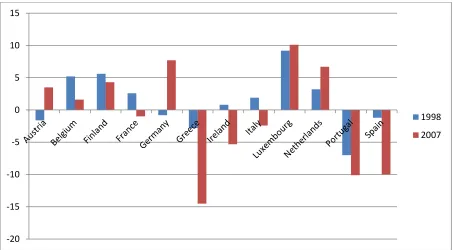
The pattern of current account deficits and surpluses also involved, of course, a pattern of capital account surpluses and deficits. Given the pattern of current account deficits and surpluses, this implied as a broad generalisation lending by Northern European countries and borrowing by Southern European countries. The imbalances of current account positions and their development prior to the financial crisis is illustrated in Figure 1 where the current account position relative to GDP (in per cent) for the original 12 eurozone members are given. The creation of the Eurozone facilitated that pattern of lending and borrowing in that within a single currency area neither the lenders nor the borrowers faced exchange rate risks. Further, for the lending countries interest rates (particularly in nominal terms) were significantly lower than previously experienced. There appeared to be little difficulty in the deficit countries borrowing to cover their current account deficits.
Figure 1 near here
industrial structures (e.g. with regard to export performance and competitiveness), and institutional arrangements (e.g. with regard to operation of labour markets).
The Economic and Monetary Union was formed without sufficient consideration being given to whether there was sufficient convergence amongst the member countries to warrant the operation of a single currency. There were many dimensions of convergence/divergence,
which were over-looked: we have pointed here to lack of attention to convergence of business cycle and economic conditions, to inflationary mechanisms and to political, social and institutional perspectives. There was also a lack of concern over current account imbalances and their correction, and a major problem which the EMU now faces is how to correct those imbalances without resort to long periods of austerity.
We now turn to the policy remedies which are currently under discussion, which we argue will be ineffectual and indeed likely to be damaging. This is followed by an outline of some alternative policy proposals.
3. The quack remedies
The remedy to the Eurozone crisis which is currently being brought into force is embodied in the Treaty on Stability, Coordination and Governance in the Economic and Monetary Union (European Union, 2012) (hereafter referred to as the Treaty) of which the ‘fiscal compact’ is the central part, and the associated so-called ‘six pack’ of policy measures.1The argument here is that the fiscal compact is no more than a quack remedy which cannot work in its own terms and will bring considerable economic damage, and could be more accurately labelled a ‘fiscal suicide pact’.
The essential features of the ‘fiscal compact’ for the discussion here are:
(i) The imposition of a ‘structural budget deficit’ rule such that that notion of budget deficit does not exceed 0.5 per cent of GDP. Under Article 1 ‘the budgetary position of the general government of a Contracting Party shall be balanced or in surplus’ and this is interpreted as ‘the annual structural balance of the general government is at its country-specific medium-term objective, as defined in the revised Stability and Growth Pact, with a lower limit of a structural deficit of 0.5 % of the gross domestic product at market prices. The Contracting Parties shall ensure rapid convergence towards their respective medium-term objective. The time-frame for such convergence will be proposed by the European Commission taking into consideration country-specific sustainability risks.’
excess of 60% of GDP should reduce this ratio in line with a numerical benchmark, which implies a decline of the amount by which their debt exceeds the threshold at a rate in the order of 1/20th per year over three years. If they do not, they could be placed in EDP depending on the assessment of all relevant factors and taking in particular into account the influence of the cycle on the pace of debt reduction.’ (Article 4). The precise impact of this would depend on the rate of nominal growth, and the imposition of the EDP is possible rather than mandatory. However, in a slow growth economy with a debt ratio of say 120 per cent of GDP, this approach would involve a budget surplus of the order of 3 per cent of GDP (and a primary surplus which was substantial greater when interest payments on debt considered).
(iii) The deficit requirement is to be written into a country’s national constitution or equivalent. ‘The rules set out … shall take effect in the national law of the Contracting Parties at the latest one year after the entry into force of this Treaty through provisions of binding force and permanent character, preferably constitutional, or otherwise guaranteed to be fully respected and adhered to throughout the national budgetary processes. The Contracting Parties shall put in place at national level the correction mechanism … on the basis of common principles to be proposed by the European Commission, concerning in particular the nature, size and time-frame of the corrective action to be undertaken, also in the case of exceptional circumstances, and the role and independence of the institutions responsible at national level for monitoring compliance with the rules set out … Such correction mechanism shall fully respect the prerogatives of national Parliaments.’ (Article 3.2).
medium-term’ (Article 3.3). But ‘exceptional circumstances’, whether an event such as financial crisis which drastically depresses demand or a major natural disaster that requires large public expenditure to deal with the disaster, does not change the ‘structural’ levels of public expenditure nor the ‘structural’ tax revenues (based on the level of potential output, as indicated below), and hence would not change the structural budget position.
The writing of requirements on the achievement of a structural balanced budget into the national constitution or equivalent has two points of significance. First, it embeds economic policy into the constitution whereas ideas on appropriate economic policy are not unchanging over time. It seems a folly to incorporate ideas what some, but no means all, think are appropriate policies into a document which is difficult to change, especially when those ideas are mistaken. It can also be seen as an attempt to tie the hands of the electorate and future governments on economic policies – what is the point of a party presenting a manifesto committed to raising public expenditure when the constitutional court would rule the implementation of such a commitment illegal.
Second, the implementation of a balanced structural budget requirement will be made difficult by disputes over the measurement of the structural budget position. The implementation of a requirement that there be a balanced annual budget (as is the case with the European Union itself) does not face such difficulty as the annual budget outcome can be readily measured, though it is the ex post annual budget,which can be measured but not the ex ante budget. The structural budget is ‘structural’ public expenditure (that is some ‘normal’ level of expenditure excluding any one-off forms of expenditure) less the tax revenues,which would be generated from the ‘normal’ set of tax rates when the economy operates at some ‘average’ level (which will be described as ‘potential output’ in line with the literature). Each of the elements of the structural budget is a matter of estimates and dispute, and notably what constitutes ‘potential output’.
Within the Treaty, ‘structural reforms’ are not defined. But there can be little doubt as to what is in mind. In an interview with the Wall Street Journal, Mario Draghi, President of the ECB stated that the most important structural reforms were ‘first is the product and services markets reform. And the second is the labour market reform which takes different shapes in different countries. In some of them one has to make labour markets more flexible and also fairer than they are today. In these countries there is a dual labour market: highly flexible for the young part of the population where labour contracts are three-month, six-month contracts that may be renewed for years. The same labour market is highly inflexible for the protected part of the population where salaries follow seniority rather than productivity’.2This echoes the sentiments,which have been repeatedly expressed by the European Central Bank in their Monthly Bulletin. For example, writing in December 2009, ECB (2009) argued that “With regard to structural reforms, most estimates indicate that the financial crisis has reduced the productive capacity of the euro area economies, and will continue to do so for some time to come. In order to support sustainable growth and employment, labour market flexibility and more effective incentives to work will be needed. Furthermore, policies that enhance competition and innovation are also urgently needed to speed up restructuring and investment and to create new business opportunities” (p. 7). The nature of the intended ‘structural reforms’ can be also seen by reference to those imposed on Greece in terms of privatisation and labour market ‘reforms’ (notably drastic reduction of minimum wage)3.
Anti-democratic
It must be questioned whether economic policies should be embedded into constitutions or quasi-constitutional legislation, which limit the necessary flexibility to change economic policies as conditions and ideas on policies change. The ideas of ‘independent central banks’ and of ‘balanced structural budgets’ are not universal panaceas and indeed many of us would argue that the idea of ‘independent central banks’ is highly problematic. It is also an idea,
which could be viewed as a current fashion whose attraction is fading. If an economic policy is to be given the force of law, it should be capable of precise definition such that whether the policy has been implemented can be accurately judged. Further, it should be a policy which is capable of being achieved. In the following two sections it is first argued that the idea of ‘structural budget’ is ambiguous and correspondingly a ‘structural budget position’ cannot be exactly measured. Second, it is argued that a balanced structural budget is often not achievable – that is a budget which is balanced when the economy is operating at potential output.
The ambiguity of the structural budget
A structural budget deficit (which appears to be left without a precise definition in the ‘fiscal compact’, and lacking any clear indication of the methodology to be used in its estimation) can be viewed as the deficit which would result from the application of current tax rates (where here transfer payments are treated as negative taxes) and prevailing public expenditure levels if the economy were operating at some ‘normal’ level of output, which has come to be linked with the level of ‘potential output’. We put inverted commas around ‘potential output’ to signify that this term is used in a specific way in this literature as explained below, and does not correspond to the everyday usage of the term potential which would signify capability and capacity. We use the term structural budget deficit (SBD) below though cyclically adjusted budget deficit is also used in the ‘fiscal compact’ and elsewhere, and the two are treated as synonymous. Thus the structural budget deficit (SBD) is given by:
(1) SBD=G* –t(Y*)
inflation and changing aggregate income levels. Here we leave those issues on one side to focus on the more major issues.
There are two key major measurement issues here, and the interaction of them (combined with measurement issues over ‘potential output’) generate considerable ambiguity over the measurement of structural budget deficit such that it is not a suitable concept to embed in law.
The first is that a structural budget deficit is a hypothetical calculation and the question as to whether a consistent estimate of the SBD can be made (for some measure of potential output). The difficulty here can be readily seen by reference to the national accounts relationship which is here written as:
(2) G–T=S–I+M–X
WhereGis government expenditure,Ttax revenue,Sprivate savings,Iprivate investment,M
imports and X exports (including net income). In terms of outturns, a balanced budget with the left hand side equal to zero would require the right hand side to be similarly equal to zero. Suppose the SBD in conditions appertaining at time t was calculated as equal to α. For
reasons of consistency and sustainability this would mean that: (3) S1* -I1* +M1* -X1* = α
Where a * after variable signifies the level of the variable which would correspond to ‘potential output’, e.g. S* is intended level of savings which would be forthcoming at potential output.
Now consider the case where the policy intention is to change the SBD through changes in
tax rates and levels of public expenditure, and the target is β. Then it not only would SBD =
β, but the following equation would also need to hold:
(4) S2* -I2* +M2* -X2* = β
This would be possible if there were relevant changes in ‘structural’ savings, investment, imports and exports, e.g. if for example intentions to save diminished between (3) and (4) (in
the case of α > β). This could arise with a strong form of Ricardian equivalence – the
intention to reduce a structural budget deficit would be exactly matched by corresponding changes in private expenditure.
inevitably backward looking in the sense of using past data, but the measure of ‘potential output’ which is relevant for policy is the current and future levels.
The term ‘potential output’ is generally linked with the supply-side of the economy. In common usage the term potential would suggest some form of maximum output. When we speak of someone’s potential we are thinking of the most they could achieve or be capable of. In economic terms ‘potential output’ can be linked with productive capacity. As such ‘potential output’ could be interpreted as the (sustainable) physical capacity output, though more usually some notion of costs would be involved such as the level of production at which costs would start to rise ‘sharply’. This approach to ‘potential output’ is closely related to some upper limit to the level of output. However, the notion of ‘potential output’ which is common in the current dominant paradigm in macroeconomics, that is the ‘new consensus in macroeconomics’ is more akin to some average level of output around which the economy fluctuates, and more recently has tended to be aligned with the level of output at which inflation would be constant.
It is also apparent that the estimation of ‘potential output’ requires data – that is the estimation can only be conducted after the event. It is only if past estimates of potential output can be used to project forward future potential output can estimates of potential output be derived. As output tends to grow over time, this would clearly involve not only scaling potential output against actual output, but also deriving estimates of the growth of potential output. This can only be highly speculative in a world of uncertainty where the future cannot be readily foretold from the past.
The more general theoretical framework within which ‘potential output’ is cast is one of the independence of demand and supply factors. The actual level of output is viewed as determined in the short run by the level of aggregate demand, whereas potential output is set on the supply side of the economy, and in general that the growth of ‘potential output’ is unaffected by what happens on the demand side, and that the level of demand fluctuates around potential output (and hence output gap tends to average out as zero).
The zero output gap (actual equals potential output) does not in general correspond to full employment of labour. There are two distinct reasons here. First, potential output is often taken as akin to the average level of output (trend adjusted), and hence sometimes actual output is above and sometimes below potential output. Full employment of labour is more akin to a ceiling for employment and thereby economic activity: we do not see full employment as the average level of employment (unfortunately). Second, potential output can be taken to be the level of output,which would correspond to the employment rate that can be deduced from the accelerating inflation rate of unemployment (NAIRU) or non-accelerating wage rate of unemployment (NAWRU). The NAIRU is simply the rate of unemployment which is deemed to be consistent with constant rate of inflation, and should not carry with it any connotation of full employment, and similarly for the NAWRU. The estimates of the NAWRU produced by the OECD (and also labelled ‘structural unemployment’ in OECD Economic Outlook): for example, the figures for 2007 (used to avoid influence of financial crisis) were: France 8.4 per cent, Germany 8.4 per cent, Italy 6.3 per cent, United Kingdom 5.3 per cent and the euroarea average 7.6 per cent4, and such figures cannot be taken to signify full employment.
The impossibility of balanced structural budget
The question here can be simply posed in terms of the conditions for a structural balanced budget (the argument would apply with minimal adjustment to conditions for a structural budget deficit of say 0.5 per cent of GDP). Drawing on the national accounts equations above, the condition for a structural balanced budget would be:
(5) G–t(Y*) =S* -I* +M* -X* = 0
In other words, the savings, investment, net exports which would be forthcoming at ‘normal’ savings, investment rates and when output is at the potential level are consistent with this equation. The ‘fiscal compact’ asserts in effect that condition is always fulfilled – at each point in time and for every country (at least those within the Economic and Monetary Union). The actual budget deficit could diverge from this balanced position as private aggregate demand fluctuates – for example, through a change in the propensity to invest, leading to change in level of output, and thereby in tax receipts. But it is asserted that if investment demand were at some ‘normal’ level (along with savings and net export behaviour correspondingly) then equation (5) would be satisfied.
countries without clear evidence of ‘overheating’ and the average budget has been in deficit – indeed government debt levels of the order of 40 to 80 per cent of GDP would not have been the norm within EMU countries without a history of budget deficits. Another part of the argument is the absence of forces which would equate savings and investment at a high level of economic activity. The pace of investment is closely linked with the pace of growth of the economy: in the simple case the net investment ratio to GDP will be around the capital-output ratio times the growth rate. Savings depends on the desire of households to save, often linked with pension provision, and the saving by corporations. The forces at work on investment and those on savings are rather different, and there is little reason to think that there will be factors bringing savings and investment into line.
Structural reforms and labour market ‘flexibility’
A full evaluation of the imperatives for structural reforms,which are advocated in the Treaty would be well beyond the length of this paper, but in any case it would require a rather more precise definition than is currently available. Here we make three general points.
Second, there is an underlying neo-liberal assumption that ‘structural reforms’, which are directed towards labour market de-regulation, reduction of employment and wage protection measures, privatisation and product market de-regulation, will have beneficial effects on the economy concerned (and on the size of budget deficits which is the centre of policy attention). However, that case is far from being established. For example, Glyn, Howell and Schmitt (2006) found the evidence linking ‘various indicators of the implementation of labor market reforms and unemployment’ (p.20) to be unconvincing. This was following up on Baker et alia (2004, 2005) which have challenged the robustness of the findings that ‘rigidity effects of labor market institutions explain the pattern of unemployment across developed countries’ (p. 20-1). They conclude that ‘proponents of labor market deregulation have not produced robust evidence of systematic positive effects of their proposed reforms on cross-country employment performance, though this result has evidently not dimmed the confidence with which such reforms are promoted…. Deregulationists often argue that demonstrating any negative effect of labor market institutions on the unemployment rate is sufficient to pare back or eliminate those institutions. In fact, since these institutions typically provide substantial economic and social benefits, the burden of proof should be set much higher.’
A recent OECD study (OECD, 2012) is, not surprisingly, more sympathetic to a structural reform agenda, but concludes that ‘the benefits from reforms often take time to materialise’ though ‘concerns about possible negative short-term effects of structural reforms seem exaggerated’. However, ‘cyclical conditions matter for the short-term effects of reforms. There is some evidence that in “bad times”, certain labour market reforms (of unemployment benefit systems and job protection in particular) can make the economic situation temporarily worse. In still depressed economies, such reforms would therefore be more quickly beneficial if carried out only once the labour market shows clear signs of recovery’. ‘In view of wide remaining spare capacity, constrained macroeconomic policies and impaired fiscal positions in most OECD countries, policy priority should be given to reforms that offer comparatively strong short-term gains, especially in terms of strengthening the jobs recovery’ (OECD, 2012, p.166)with the promotion of active labour market policies.
market capitalist economies. Amable (2003), for example, provides a five-way classification, of which the first four are relevant for EMU: market based, Continental European capitalism, Social Democratic economics, Southern European capitalism and Asian capitalism. The Treaty threatens to pose ‘structural reforms’ whether or not they are appropriate to the institutional, social and political arrangements of the country concerned. It has yet to be established that a neo-liberal agenda is the appropriate one for all countries (and whether it would be acceptable to the peoples of the countries).
4. The Keynesian medicine
In this section we outline what we will term as Keynesian medicine for the ills of the eurozone – the term Keynesian is used in order to have some label and to signify that the medicine pays much attention to the conditions of aggregate demand, to the use of budget deficits (or surpluses) as a policy instrument to secure high employment and to avoid using deflation as a means of resolving current account imbalances. In doing so we have to recognize that the ideological ‘climate’ within the policy makers of the Economic and Monetary Union is virulently anti-Keynesian (which helps explain the current predicament of the Eurozone) and that the policies sketched below would face enormous ideological resistance from those policy-makers, substantial political resistance because of the implied transfer of resources and funding of national budget deficits and legal constraints arising from the application of the Treaty of Lisbon and the German constitutional court and interpretation of the German constitution (specifically the debt brake).
Current account imbalances
The scale of the current account imbalances has been illustrated in Figure 1. The EMU as a whole has run a current account position close to balance. The accounting relationship which comes from that is that broadly the surplus countries within EMU are directly or indirectly lending to the deficit countries. This though implies that without major changes in the current account position of EMU as a whole, reductions of the current account deficit in deficit countries will have to be accompanied by reductions of an equivalent amount in current account surplus of surplus countries.
exchange rate of a member country (viz-a-viz other member countries) is not possible, though changes in the real exchange rate are through changes in domestic prices and costs relative to prices and costs in other member countries. The possible responses to a current account deficit imbalance can be easily summarised in terms of find ways to carry on borrowing, change real exchange rate through price adjustments, change real exchange rate through improving (non-price) competitiveness, change imports through domestic deflation. These responses are not mutually exclusive. What is required is an agreed EMU set of policies which enable countries to continue to finance their trade deficit over say a five year time horizon, with the promotion of industrial and regional policies to improve their competitiveness and abilities to export. There would need to be a recognition for the need for a change in relative prices between deficit countries and surplus countries, and that while prices may need to be lower in the deficit countries, the counterpart is for prices to be higher in surplus countries.
The challenge presently facing the EMU countries is how to resolve the present set of current account imbalances without resorting to deflation, and then to avoid the re-occurrence of the imbalances. It should be stressed that imbalances are a relative matter in the sense that reducing one country’s current account deficit involves reducing another country’s surplus, and within the context of the EMU it is likely (though not certain) that the reduction of the surplus involved will be that of fellow EMU members. It is then likely that one EMU country’s attempt to reduce their deficit would be frustrated if other EMU countries respond in ways which prevents their surplus being reduced. For example, if a country with deficit lowers domestic prices and hence their real exchange rate, but other countries respond by similarly lowering their prices the change in the real exchange rate will be frustrated.
Fiscal policy and sectoral imbalances
Second, there should not be any attempt to impose a ‘one size fits all’ fiscal policy on national government in the sense of imposing the same numerical limits on the scale of budget deficits (where a zero limit or any other). The fiscal policy and resulting budget position should be tailored to the requirements of the country concerned: some countries will require budget deficits whereas others may be able to operate successfully with budget surpluses. It is also evident from above that the current account positions vary substantially across countries, and the accounting identity in equation (2) above indicates the likelihood that differences in current account positions will to some degree be reflected in differences in the budget position.
There has long been the need for the development of an EMU-level fiscal policy with the scale of the EMU budget very much larger than the current EU budget (of just over 1 per cent of EU GDP, and with a requirement to be balanced). A significant question here is whether the EU itself would operate the larger scale budget. The EMU would be able to run budget deficits (or surpluses) to support the level of economic activity within the EMU. Others who have argued for a EMU-level fiscal policy which would serve to help stabilise economic activity across EMU have put the necessary scale of such a policy at 7½ per cent of GDP (Commission of the European Communities, 1977), 5 per cent (Huffschmid, 2005, Chapter 16), 2 to 3 per cent of GDP (Currie, 1997; Goodhart and Smith, 1993).
An EMU-level fiscal policy should be used for stabilisation purposes for the euroarea as a whole. A progressive tax system applied across the euroarea would serve to operate as an automatic stabiliser. Further, an EMU-level fiscal policy would also cushion a region (or country) against economic shocks which hit the region (or country). An income tax system,
which is proportional or progressive (or even mildly regressive) will involve more tax revenue (per capita) being raised in higher income regions than would be raised in lower income regions. The degree to which fiscal transfers between countries are involved would depend on the progressivity of the tax system and the structure of public expenditure undertaken from the EMU-level budget. These fiscal transfers would serve to re-distribute spending power, and could go somewhere to easing current account imbalances. An EMU-level fiscal policy must involve the ability of EMU to levy taxes in its own right to help underpin borrowing by EMU. The relationship between EMU as a fiscal authority and the ECB as the central bank would be comparable to that between a national government and its central bank in terms of the support which the central bank can provide to fiscal policy and the ability of government to borrow.
We have argued elsewhere (Arestis and Sawyer, 2006) that the policy arrangements for the ECB currently have a range of drawbacks and problems. There is an urgent need to reformulate the position and role of the ECB in a manner which promotes employment and economic activity. Here we advocate three major elements of such a reformulation.
The first is to end the independence of the ECB and to integrate the ECB into a set of democratic policy making procedures. The ECB would retain charge of operational matters such as the implementation of interest rate decisions but would co-ordinate its decisions with other monetary and fiscal authorities. Whilst the ECB has been independent in the sense of a political independence, it has not been independent from a neo-liberal policy agenda, and it has frequently advocated (in terms of fiscal constraints and the promotion of more ‘flexible’ labour markets and pension ‘reforms’) a neo-liberal policy agenda. The integration of ECB into the policy-making arrangements would enable policy co-ordination which should lead to more effective policy making. The ‘independence’ of the ECB would appear to preclude co-operation and co-ordination between the different bodies responsible for aspects of macroeconomic policies. Yet, in a world of multiple objectives (including high levels of economic activity and employment, financial stability, inflation etc.) there is a need for multiple instruments, which are operated by different authorities, and where there should be some co-ordination.
The second arises from the dominance of inflation targeting as the prime policy objective. We have pointed elsewhere (Arestis and Sawyer, 2008, 2010c) to the general failures of inflation targeting, and also that the ECB has not in generally achieved the price stability target (interpreted as inflation between 0 and 2 per cent) albeit that the inflation rate has tended to be just over 2 per cent. A more significant issue has been the differential inflation rates between countries and the inability of monetary policy to address those differences in inflation rate. Further, monetary policy has had a perverse effect in that with a single policy nominal interest rate leads to lower real interest rates in higher inflation countries – exactly the reverse of the way in which inflation targeting is intended to work whereby real interest rate is high when inflation is high with the intention of damping down demand.
Third, the relationships between the ECB and national governments (and other fiscal authorities which may be developed) have to become akin to that between national central banks and the central government in most countries. The ECB should on all occasions stand ready to operate as ‘lender of last resort’ (which at present is allowable for the ECB but not compulsory. It should always accept the bonds and bills issued by national governments (within EMU) as part of open market operations in the way in which a national central bank would always accept the bonds of its government. It should also stand ready to directly lend to national governments (in exchange for bonds in euros of that government) if required. The general proposition is that the ECB should support the fiscal policies determined by EMU national governments, whether or not those policies involve deficits of which the ECB disapproves.
Inflation and competitiveness policies
Finding a way of effectively constraining inflation without resorting to deflationary measures has been a recurring issue throughout the post war period. It has been indicated above and more extensively argued elsewhere (Arestis and Sawyer, 2008, 2012) that inflation targeting in ineffectual and alternatives have to be developed. However, as noted above, within the EMU there had been relatively low inflation but the inflation target of 0 to 2 per cent was frequently missed albeit by a small margin, and more significantly for EMU there were persistent differences of inflation between member countries. Within EMU it is argued here that mechanisms have to be developed, which will in effect co-ordinate wage developments and prices across EMU countries. A key aspect here is that the evolution of competitiveness between EMU member countries. It is clear that monetary policy cannot address differential inflation problems.
There is then the need to develop wage and price co-ordination mechanisms at the EMU level through which not only the general pace of inflation can be addressed but more significantly the similarity of the pace of inflation across countries be ensured.
5. Concluding remarks
attempts to reach the conditions will impose continent wide austerity. The final section has outlined the elements of a Keynesian alternative which can restore prosperity to the EMU.
Endnotes
1The ‘six pack’ entered into force on 13 December 2011, and involved five Regulations and one Directive (hence ‘six pack’) which constitutes EU secondary law. It applies to all 27 member states, with some specific rules for EMU members. The six-pack covers not only fiscal surveillance, but also macroeconomic surveillance under the new Macroeconomic Imbalance Procedure. The crucial aspects of the ‘six pack’ appear in the Treaty and are discussed under that head. For further information see
http://ec.europa.eu/economy_finance/articles/governance/2012-03-14_six_pack_en.htm
2 http://www.ecb.europa.eu/press/key/date/2012/html/sp120224.en.html, accessed 20th March 2012.
References
Amable B., (2003).The Diversity of Modern Capitalism,Oxford: Oxford University Press Arestis, P. and Sawyer, M. (2006), ‘Macroeconomic policy and the European constitution’ in
P. Arestis and M. Sawyer (eds),Alternative Perspectives on Economic Policies in the European Union, Basingstoke: Palgrave Macmillan, pp. 1-36
Arestis, P. and Sawyer, M. (2008), ‘New consensus macroeconomics and inflation targeting: Keynesian critique, Economia e Sociedade, Campinas, 17, Número especial, pp. 629– 654.
Arestis, P. and Sawyer, M. (2010a), ‘The Design Faults of the Economic and Monetary Union’,Journal of Contemporary European Studies, vol. 19(1), pp. 19-30
Arestis, P. and Sawyer, M. (2010b), ‘The problems of the Economic and Monetary Union: is there any escape?’,The Journal of Economic Analysis, vol. 1 no. 1 pp. 1-14
Arestis, P. and Sawyer, M. (2010c), ‘What Monetary Policy After the Crisis?’, Review of Political Economy, (2010) vol 22: 4, 499 -515
Arestis, P. and Sawyer, M. (2012), ‘Moving from Inflation Targeting to Prices and Incomes Policy’, revised version of paper presented at Cambridge Journal of Economics conference on The Future of Capitalism 25-26 June2011
Baker, D., Glyn, A., Howell, D and Schmitt, J. (2004), ‘Unemployment and labor market institutions: the failure of the empirical case for deregulation’, Report to the International Labour Organization.
Baker, D., Glyn, A., Howell, D and Schmitt, J. (2005), ‘Labor market institutions and unemployment: a critical assessment of the cross-country evidence’ in David Howell (ed.),Fighting Unemployment: the Limits of Free Market Orthodoxy, New York: Oxford University Press
Commission of the European Communities (1977),Report of the Study Group on the Role of Public Finances in European Integration, chaired by Sir Donald MacDougall, Economic and Financial Series No. A13, Brussels: Belgium.
Currie, D. (1997),The Pros and Cons of EMU, London: HM Treasury (Published originally by the Economist Intelligence Unit, January 1997).
European Central Bank (ECB) (2009), Monthly Bulletin, December 2009, Frankfurt: European Central Bank.
European Commission (2012), ‘The Second Economic Adjustment Programme for Greece’,
European Union (2012), Treaty on Stability, Coordination and Governance in the Economic and Monetary Union, Brussels: European Union
Glyn, A., Howell, D. and Schmitt (2006), ‘Labor Market Reforms: the evidence does not tell the orthodox tale’,Challenge, vol. 49, no. 2, pp.5-22
Goodhart, C.A.E. and Smith, S. (1993), “Stabilization”,The Economics of Community Public Finance, European Economy: Reports and Studies No.5/1993, Brussels: Belgium.
Huffschmid, J. (ed) (2005), Economic Policy for a Social Europe A Critique of Neo-Liberalism and Proposals for Alternatives, Basingstoke: Palgrave Macmillan.
OECD (2012), Economic Policy Reforms 2012: Going for Growth, OECD Publishing.
http://dx.doi.org/10.1787/growth-2012-en
Sawyer, M. (2012), ‘The contradictions of balanced structural government budgets’ in H. Herr, T. Niechoj, C. Thomasberger, A Truger, and T.l van Treeck (eds), From crisis to growth? The challenge of imbalances and debt, Metropolis Verlag, Marburg, forthcoming Tridico, P. (2012), ‘Financial crisis and global imbalances: its labour market origins and the
Figure 1 Current account position as per cent of GDP for eurozone countries (original 12 members)
Source:Figures derived fromOECD,Economic Outlook, December 2011
-20 -15 -10 -5 0 5 10 15