This is a repository copy of The identification and review of cost effectiveness model
parameters: a qualitative study.
White Rose Research Online URL for this paper:
http://eprints.whiterose.ac.uk/75426/
Article:
Kaltenthaler, Eva, Essat, Munira , Tappenden, Paul et al. (1 more author) (2013) The
identification and review of cost effectiveness model parameters: a qualitative study. HEDS
Discussion Paper 13/08. (Unpublished)
[email protected] https://eprints.whiterose.ac.uk/ Reuse
Unless indicated otherwise, fulltext items are protected by copyright with all rights reserved. The copyright exception in section 29 of the Copyright, Designs and Patents Act 1988 allows the making of a single copy solely for the purpose of non-commercial research or private study within the limits of fair dealing. The publisher or other rights-holder may allow further reproduction and re-use of this version - refer to the White Rose Research Online record for this item. Where records identify the publisher as the copyright holder, users can verify any specific terms of use on the publisher’s website.
Takedown
If you consider content in White Rose Research Online to be in breach of UK law, please notify us by
of DPof DP
Health Economics and
Decision Science
(HEDS)
School Of
Health
And
Related
Research.
Discussion Paper
The identification and review
of cost effectiveness model
parameters: a qualitative study
Eva Kaltenthaler
1Munira
Essat
1Paul Tappenden
1Suzy
Paisley
1DP 13/08
HEDS Discussion Paper
No. 13.08
The identification and review of cost effectiveness model parameters: a qualitative
study
Eva Kaltenthaler1, Munira Essat1, Paul Tappenden1, Suzy Paisley1
1
School of Health and Related Research (ScHARR), University of Sheffield, Regent Court, 30
Regent Street, Sheffield S1 4DA, UK
Disclaimer:
This series is intended to promote discussion and to provide information about work in progress. The views expressed in this series are those of the authors, and should not be quoted without their permission. Comments are welcome, and should be sent to the corresponding author.
This paper is also hosted on the White Rose Repository:
http://eprints.whiterose.ac.uk/
1 The identification and review of cost effectiveness model parameters: a qualitative
study
Authors: Eva Kaltenthaler1
Munira Essat1
Paul Tappenden1
Suzy Paisley1
1School of Health and Related Research (ScHARR), University of Sheffield, Regent Court,
30 Regent Street, Sheffield S1 4DA, UK
Author for correspondence: Dr Eva Kaltenthaler, Reader in Heath Technology
Assessment, ScHARR, University of Sheffield, Regent Court, 30 Regent Street, Sheffield S1
4DA, UK, Telephone +44 114 2220810; Fax: +44 114 2724095; E-mail:
2 Abstract
Objectives: Health economic models are developed as part of the health technology
assessment process in order to determine whether health interventions represent good
value for money. These models are often used to directly inform health care
decision-making and policy. The information needs for the model require the use of other types of
information beyond clinical effectiveness evidence in order to populate the model
parameters. The purpose of this research study was to explore issues concerned with the
identification and use of information for the development of such models.
Methods: Three focus groups were held in February 2011 at the University of Sheffield with
13 UK HTA experts. Attendees included health economic modellers, information specialists
and systematic reviewers. Qualitative framework analysis was used to analyse the focus
group data.
Results: Six key themes, with related sub themes, were identified. The themes were model
development, searching issues, reviewing issues, communication, knowledge and
experience and reporting issues. There was considerable overlap between themes.
Conclusions: Key issues raised by the respondents included the need for effective
communication and teamwork throughout the model development process, the importance
of using clinical experts as well as the need for transparent reporting of methods and
decisions.
Keywords: qualitative-research, model-parameters; cost-effectiveness-modelling;
3 Acknowledgements/conflicts of interest
This project was funded by the Decision Support Unit of the National Institute for Health and
Clinical Excellence (NICE). The funder had no involvement in the conduct of the study. The
authors would like to thank the focus group participants for taking part in this study. The
4 Introduction
The development of a health economic model typically forms part of the health technology
assessment (HTA) process together with the development of a systematic review of the
clinical effectiveness of the intervention being assessed. Health economic models require
information in addition to clinical efficacy data and this includes evidence relating to relevant
comparators, health utilities, resource use and costs, among others. Sources of evidence
may include: randomised controlled trials (RCTs), observational evidence and other clinical
studies, disease registers, elicitation of expert clinical judgement, existing cost-effectiveness
models, routine data sources and health valuation studies. The way in which these
information needs are identified and used can have a fundamental impact on the results of
the model (1) and therefore on health care decisions and resulting policies. There is often a
lack of transparency associated with how information needs are met in the development of
cost effectiveness models. Drummond et al (2) found that much of the relevant data for
estimating quality adjusted life years (QALYs) were not contained in the systematic review
for the HTA, and that the chosen method for summarising the clinical data can inhibit the
assessment of economic benefit.
Although some of the issues around the identification and reviewing of evidence for models
have been discussed previously (1, 3-8) there remains very little formal guidance with
respect to best practice in this area. This is an important consideration as it is not possible
to review all evidence systematically to inform a health economic model and choices need to
be made in terms of how evidence is synthesised and used. In their ISPOR-SMDM
Modelling Good Research Practice Report (9), Briggs et al recommend that analysts should
conform to the broad principles of evidence-based medicine and avoid “cherry picking” the
best single source of evidence. While there is a need for transparent and reproducible
5
development process operates. Chilcott et al (10) suggest that a potential source of errors in
health technology assessment models is the separation of the information gathering,
reviewing and modelling functions while Drummond et al (2) also suggest that some of the
problems associated with model development could be reduced if evidence requirements
were discussed at an early stage.
Kaltenthaler, Tappenden and Paisley (11, 12) have investigated issues relating to the
conceptualisation of cost effectiveness models and the identification and review of evidence
to inform models. Shared and explicit decision-making and transparent reporting of the
choices and judgements that underpin model development were seen as being of key
importance in the development of acceptable methods that take into account the specific
requirements of the model development process. This research has gone some way
forward in highlighting the key issues and offering suggestions for improving the model
development process and the way in which it is reported. These are important issues that
need to be considered by those involved in health technology assessments, including both
researchers and decision makers.
The aim of this paper is to presents the findings from a series of focus groups held with UK
HTA experts to explore some of the issues and concerns associated with the identification
and review of evidence used in the development of cost effectiveness models. These
findings are part of the evidence used to inform a recent NICE Technical Support Document
(TSD) (13) and the issues specifically related to the selection and review of evidence are
6 Materials and methods
Three focus groups were held as part of a workshop with 13 HTA experts from UK
universities in February 2011. The participants were a purposive sample, chosen to
represent a variety of specialisms and included seven modellers, one health economist, one
statistician, two information specialists and two systematic reviewers. Ethical approval for
the focus groups was obtained from the University of Sheffield Research Ethics Committee.
The focus groups were facilitator led (EK) and were recorded using digital media with the
recordings transcribed verbatim. Standard qualitative research methods were used to
conduct the focus groups and analyse the data (14). Framework analysis (14) was used to
develop a thematic framework and the qualitative data were classified and organised into
key themes and subthemes. The initial step was familiarisation with the transcribed data.
Data were then coded and the conceptual framework was developed. Coding was checked
by a second reviewer. Some of the themes were pre-identified and some were emergent.
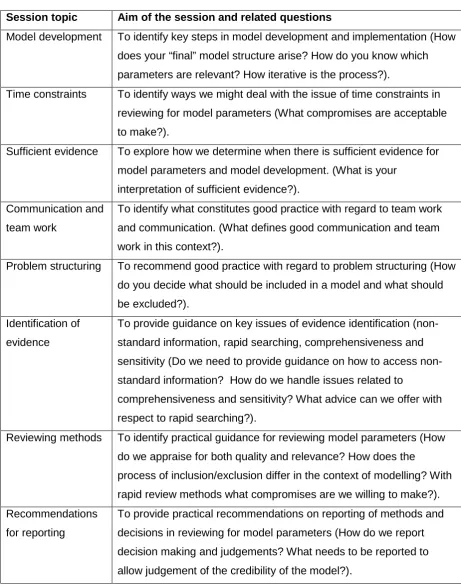
The topic guide for the focus groups is shown in Table 1. The discussions were open and
participants were invited to discuss other points they felt were relevant but had not been
7 Table 1. Focus group topic guide
Session topic Aim of the session and related questions
Model development To identify key steps in model development and implementation (How
does your “final” model structure arise? How do you know which
parameters are relevant? How iterative is the process?).
Time constraints To identify ways we might deal with the issue of time constraints in
reviewing for model parameters (What compromises are acceptable
to make?).
Sufficient evidence To explore how we determine when there is sufficient evidence for
model parameters and model development. (What is your
interpretation of sufficient evidence?).
Communication and
team work
To identify what constitutes good practice with regard to team work
and communication. (What defines good communication and team
work in this context?).
Problem structuring To recommend good practice with regard to problem structuring (How
do you decide what should be included in a model and what should
be excluded?).
Identification of
evidence
To provide guidance on key issues of evidence identification
(non-standard information, rapid searching, comprehensiveness and
sensitivity (Do we need to provide guidance on how to access
non-standard information? How do we handle issues related to
comprehensiveness and sensitivity? What advice can we offer with
respect to rapid searching?).
Reviewing methods To identify practical guidance for reviewing model parameters (How
do we appraise for both quality and relevance? How does the
process of inclusion/exclusion differ in the context of modelling? With
rapid review methods what compromises are we willing to make?).
Recommendations
for reporting
To provide practical recommendations on reporting of methods and
decisions in reviewing for model parameters (How do we report
decision making and judgements? What needs to be reported to
8 Results
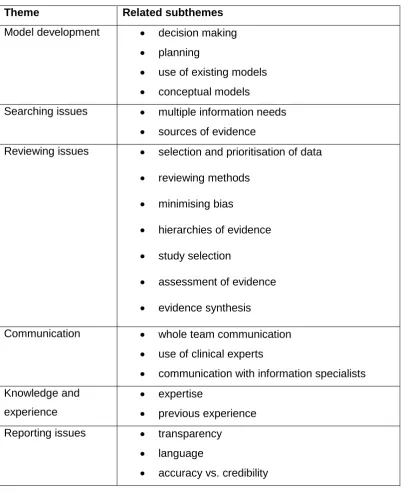
From the focus group transcripts the following six themes were identified: model
development; searching issues; reviewing issues; communication; knowledge and
experience and reporting issues. There was overlap between the themes as many of the
[image:11.595.68.472.242.736.2]issues raised were interrelated. The themes and related subthemes are shown in Table 2.
Table 2. Focus group themes and related subthemes
Theme Related subthemes
Model development • decision making
• planning
• use of existing models
• conceptual models
Searching issues • multiple information needs
• sources of evidence
Reviewing issues • selection and prioritisation of data
• reviewing methods
• minimising bias
• hierarchies of evidence
• study selection
• assessment of evidence
• evidence synthesis
Communication • whole team communication
• use of clinical experts
• communication with information specialists
Knowledge and
experience
• expertise
• previous experience
Reporting issues • transparency
• language
9 Theme 1 Model development
It was highlighted during the focus groups that a large number of decisions and judgements
are made by modellers during the process of model development especially on aspects of
relevance and appropriateness to the decision problem.
“So if you set up five criteria and then you end up judging what you choose on the
basis of six criteria, only two of which were of the five you started out with, then I
think it tells you something about how much judgement is required in the process..”
However, the participants expressed concerns regarding the difference in judgements made
by different modellers to represent the same part of reality. Hence the participants would
feel more comfortable if the judgement to a particular decision problem did not rest solely
with the individual developing the model but rather as a joint task between modellers,
decision-makers, health professionals and other stakeholders who impact upon or are
impacted upon by the decision problem under consideration. Failure to reflect conflicting
views between alternative stakeholders may lead to the development of models which
represent a contextually naïve and uninformed basis for decision-making.
“There is also an issue of whose judgement it is - is it down to the modeller to make
that judgement or should it be in conjunction with other people in the team or a
clinical expert? I don’t feel comfortable about the modeller making all these
judgements.”
Planning was regarded as a key element for model development. This could be in the form
of a protocol or project plans that clearly state the project timelines, methodology for the
model, information needs and key roles and responsibilities for all team members. Having
the evidence requirements set prior to model implementation may allow the whole team to
identify potentially useful information and may also help to keep track of changes made
during the process.
“I think that it would be useful for us to map out a list of things that you might
10 structuring methods may have some role in identifying what should be included in a
model and you could even suggest how that should be done.”
“Knowing in advance the key pieces of information you’re likely to need so that
whoever is doing your title and abstract screening at the very beginning has enough
codes for flagging things that may be of interest to the modellers.”
The use of existing cost effectiveness models was discussed and the modellers’ at the focus
groups indicated that the main reason they used existing models to inform model
development was to critique them from various angles so that they can avoid repeating the
same mistakes and in turn produce a better model.
“I don’t review models for their results, I don’t review them to find things that I like – I
review them to find things to avoid”
Whilst the use of existing models was considered to be potentially useful, it was suggested
that they should be used with caution and should not be relied upon without considerable
scrutiny, as the appropriateness or credibility of an existing model may be questionable or
there may be a gap between the decision problem that the model was developed to address
and the current decision problem under consideration.
“Well, you have to be a bit careful with that, don’t you? Sometimes you trace it back
and you find somebody just thought that number up about twenty years ago, and
everyone’s used it and they’ve all done that since.”
Conceptual model development was an area where there was variability between
participants concerning their approaches. Respondents discussed the use of several
approaches including documenting proposed model structures, developing mock-up models
in Microsoft Excel, developing sketches of potential structures, and producing written
interpretations of the evidence. However the participants did all agree that having a draft
11
requirements amongst those involved in the model development. This would help to ensure
that health professionals understood how the model would capture the impact of the
interventions under consideration on costs and health outcomes, that the proposed model
was clinically relevant and met the needs of the decision-maker, and provide an explicit
platform for considering and debating alternative model structures and other model
development decisions prior to implementation.
“You’ve got to sort of get a feel of what the model is doing, not just looking at a whole
lot of numbers on the spread sheet. So that’s why I’m a big believer in a
back-of-an-envelope version of the model, which, .. forces you to really understand what’s going
on in the model.”
“start with a conceptual model … you can start with where you think the model
should be, and then when you reach the point where you haven’t got the data to put
in the model and you have to simplify it.”
Furthermore, the interviewees expressed that where possible, alternative model
development choices should be tested to assess their impact upon the model results.
“I guess my view of structural uncertainty is it’s where you’re equivocal about whether
one set of assumptions is superior to another and it could be an entire
characterisation of a disease process, which could have a flag which switches on and
off, but you’d have to have built that model as well. And I think it’s quite closely
related to how formal the conceptual modelling is in identifying what those
alternatives could be. I wouldn’t expect someone to build 10 different models, but I’d
expect them to consider what else they could have done and I’d like to know what
else they could have done.”
Theme 2 Searching issues
One common concern raised amongst the interviewees in the focus groups was the need for
12
As cost effectiveness models have multiple information needs which require different types
of evidence drawn from a variety of information sources, it was considered difficult to capture
the information needs in a single search query. Therefore, exhaustive search methods such
as those used in systematic reviews may not be feasible.
“…it’s relatively easy to find cost studies, it’s relatively easy to find RCTs, it’s not so
easy to find adverse events because they’re hidden, they’re not described in the
records, so I think maybe hints about how difficult it is to search for something like
this in Medline ..might be helpful.”
During the interviews, respondents discussed the difficulties in finding evidence and the
different approaches used for seeking information, including formal Medline and other
database searching, contacting experts in the field, searching registries and administrative or
routine data sources, snowballing references, following leads, semantic technology, text
databases and focused searching. However, the majority of the information retrieval
processes are not explicit.
“In terms of parameters, we frequently have parameters that are only ever reported
incidentally and are not included in any keywords, any titles or anything, things like
unusual or irregular adverse events, for example, that turn up in a table, over a wide
range of trials and non-trial (evidence), - how do you find them? I don’t know any
systematic way that could do that. It’s pot luck really, you suddenly come across one
and then a few more, and they may be different indications even and it’s difficult to
find a realistic range.”
“… I’m sure that some of the things I’ve had to resort to to obtain particular estimates
much more resemble investigative journalism than having anything to do with what
I’m trained to do”
“…picking up the phone to lots of people to find out (what) is there .. an individual
patient dataset for this class of people? .. it’s not all about reviewing, it’s not all about
13
The need for guidance and advice was expressed regarding factors that impact on the way
evidence is identified e.g. what search techniques might be used to maximise the rate of
return of potentially relevant evidence and to ensure appropriate steps have been taken to
make the process systematic, reproducible and transparent.
“It’s any information whatsoever, and the identification of evidence is any information
seeking process, which includes searching on Medline formally or phoning people up
or having a group of clinicians who advise your project, you draw information from all
of them and you use that information as evidence to support or justify or make
decisions about the model to give it credibility. And as soon as you start to say, well
yes there is a difference and we just need guidance on searching, it suddenly
excludes a lot of information seeking processes that are absolutely knitted in to the
model development process and.... includes clinicians, they have a role in modelling
.. it’s that idea of credibility I think, that they give such a lot to”
Theme 3 Reviewing issues
Reviewing issues identified by the participants included: selection and prioritisation of data,
methods for reviewing, the importance of minimising bias, the use of hierarchies of evidence,
issues around study selection, assessment of evidence and evidence synthesis. These are
covered in considerably more detail elsewhere (12).
The processes of selecting and prioritising evidence used to inform parameter estimates
were considered to be important. It was suggested that additional attention should be given
to the reporting of parameters which are deemed to be more important to the model or to
instances in which the preferred decision regarding the choice of evidence is equivocal. The
participants felt that it was important to prioritise parameters and focus reviewing resources
on those most likely to impact on model outputs, bearing in mind that the importance of
14
Due to the time and resource constraints within the HTA process it was felt that rapid review
methods might be necessary to identify and select evidence. As the use of rapid review
methods risk missing relevant information it was considered essential that methods were
reported transparently, including the potential limitations of the chosen methods.
A variety of potential biases may be introduced through the process of rapidly reviewing
evidence to inform model parameters estimates. Bias may also be introduced through the
purposive selection of evidence to create more or less favourable results. One suggested
option to reduce such bias was to ensure and to demonstrate that more than one member of
the team was involved with making decisions where choices about parameter values and
distributions need to be made.
“…when somebody is making a decision it isn’t just one person it’s a team, because
… most of the methods within systematic reviewing are double checking what
everybody has done. So maybe … for the modellers to use the systematic reviewers
and a range of clinical advisors to make sure that no one person makes the decision
about these without consulting.”
There is a wide range of types of evidence used to populate models and hierarchies of
evidence sources, as suggested by Coyle et al(15), were felt to be useful as a means of
judging the quality of individual parameter estimates and aid the study selection process. In
order to incorporate the quality of individual studies into the selection process, the Grading of
Recommendations Assessment, Development and Evaluation (GRADE) (16) system was
suggested as potentially providing a framework for rating the quality of evidence from all
15 “…using the GRADE system… fairly early as soon as you had your conceptual
model you might take that to your decision-makers and say which are the critical and
important clinical outcomes which can extend to all the different parameters as well.”
With regard to study selection and assessment of evidence, it was suggested that relevance
or applicability could be assessed first in order to speed up the evidence selection process.
“Normally you go through a full gamut of analysing threats to internal validity first but
actually if you look at applicability or relevance first, in a time constrained scenario,
often that fatally rules out a huge bunch of stuff that you don’t need to look at.”
The participants felt that after appraising studies for relevance, quality, should be assessed
preferably using standardised quality assessment tools. In this context, quality assessment
may be difficult due to the absence of standardised methods for all types of information used
to populate the model. Also, some studies may be poorly reported. Establishing quality
assessment criteria a priori was a recommended option.
In many situations, the issue of synthesis was not considered relevant due to study
heterogeneity and the case that often only one or two values are appropriate for use in
populating a model parameter. However, where there are more than one or two potentially
relevant studies the participants stressed the importance of appropriate synthesis methods.
Theme 4 Communication
Focus group participants agreed that in order to have a credible and robust model effective
communication across the whole project team was crucial. This might include modellers,
clinical experts, decision-makers, information specialists, systematic reviewers of
effectiveness studies and other researchers. The group agreed that all parties involved
should have a common understanding of the model development process which could be
16
development of the conceptual model, writing protocols, highlighting evidence needs, and
having regular meetings with the whole team, presenting and discussing the model. These
meetings should use non-technical language easily understood by clinical experts and other
team members. Also considered important was the sharing of internal draft reports.
“…always having clinical experts, and not just one who is local and face-to-face, but
a panel who are available for sort of correspondence by e-mail, very early. You
recruit them early and involve them in the model development process, which again
will also be a fairly whole-team endeavour initially, so that the people who are doing
the systematic review of effectiveness studies will be party to most of those
conversations about the conceptual modelling of what the model structure might
eventually look like.”
Engaging with experts and other researchers can serve as a face validity check to ensure
that important information has not been missed, that the most appropriate parameter
estimates are used and the opportunity for errors is reduced.
“this is another reason why it’s important to have, as well as clinical experts, .. other
people who are researchers or have worked in the area, so at least after you’ve
made some of these choices, then you can do .. reality checks and say, .. is there
anything we’ve missed, are there any other recent or grey literature studies that
might provide an alternative estimate …..?”
An issue raised during the focus groups was the lack of communication and understanding
between modellers and information specialists. This inadvertently led to the development of
ineffective search strategies. It was felt important that modellers engage with the information
specialist and keep them updated with the process of model development and information
needs so that an effective and focused search strategy can be developed.
“the ..ability to go back to the information scientists and say this is more specifically
17 back, that that should feedback as well to say we don’t need to do this search
anymore because the parameter that we thought it was going to inform is not going
to affect the way this particular model works ...”
Theme 5 Knowledge and experience
Expert opinion was considered to be crucial in developing the model structure especially that
of clinical experts, as this was felt to help to develop an understanding of the decision
problem.
“When we are presented with a new disease area, often the first time …. You are
missing things all the way down the line. If you had...somebody else’s expertise in
the modelling field to draw on, you could make a much better job of it.”
In addition, opinions of clinicians and a wider group of people who are involved in caring for
patients are essential, as they can help provide parameter estimates or identify alternative
sources of evidence (including unpublished literature). Hence, this information forms the
cornerstone of a model’s contextual relevance.
“….but also expert opinion. It just seemed to be one of the main adverse events of
the use of cochlear implants in children that the clinical community had very high on
going concerns about, so I think we had early feedback that the model could or
should try to include it, even though our early pilot model had shown it was negative.”
Furthermore clinical experts and other researchers can serve as a reality check to ensure
that important information has not been missed and that the values used are appropriate.
“one of our … clinical experts... pointed out that viral resistance was not included in
our model. And we’d reviewed every single model of prophylaxis – none of those
included it, and we’d reviewed the clinical evidence base, and that wasn’t there ..and
18
The modeller’s previous knowledge and experience of the disease area was also considered
to be extremely important, particularly in a time and resource constrained scenario.
“If you’ve been working in that field, and built up a network in it, then you are a long
way ahead, and you have what you need.”
“…you’ve got some ideas about what’s going to be potentially reliable information
that could also inform the search and make the search results a bit briefer.”
“I think there’s something else also about the historical, and, perhaps, the individual
experience of what has tended to drive the results of models. So I think utility
weights of key health states would be a key thing that past experience would have
shown often ends up being one of the most important drivers of results”
Theme 6 Reporting issues
Transparency was considered to be an important issue by the focus group participants. It
was also felt that there often was not enough time to ensure that the methods used were
reported adequately.
“I think transparency is one of the big things that is missing, isn’t it? In the whole of
modelling, anyway, there’s the transparency issue.”
“...even if you have enough time to do that as an analyst you might not have enough
time to write it up in a way that would make it more transparent.”
A comprehensive account of every evidence source used in the modelling process was
considered to be very time consuming and potentially difficult to read. Suggested
alternatives included the use of a brief summary table of the main inputs and sources of
information in the main report with the possibility of more detailed information presented in
appendices.
As highlighted in Theme 1, model development involves making a large number of decisions
19
clearly documented and reported to ensure the credibility of the model. Key aspects include
the following: search strategies, selection and justification of studies and model parameters;
structural assumptions, decisions relating to the prioritisation of key information needs,
acknowledgment of limitations and potential biases and documentation of any deviations
from the study protocol.
“you would want to explain your choice. You would want to, because that would
support the credibility, wouldn’t it?”
“It’s more like the thought process you went through to get there, and what did you,
you decide not to do, and why did you not go that way, or why did you choose this
way?”
“As long as you make the choice explicit …, give an indication where the selection
came from and what other possibilities there were, that would .. be uncertainty rather
than bias that if we had chosen this one, this would have happened.”
Several participants believed that the language used in reporting model development and
results should be clearly understood by health professionals and other individuals involved in
the process. The model could be represented in both diagrammatic and textual forms using
non-technical, non-mathematical language.
“Again the language to describe that sort of thing would have to be very careful
because I think, the way I would write it, would almost always imply it’s going to be a
Markov model which may not be the best way of modelling something, so I think
however it’s expressed, it needs to be more in terms of principles and things to
consider than anything too prescriptive.”
In terms of model credibility it was emphasised that the modeller needs to cater for the target
audience and there is a tension between accuracy and credibility.
“..but you know that the clinical audience … will expect to see that factor, because
20 cochlear implants, ….. It’s important for people to see the Markov state for it, even if
it’s functionally going to be useless. So I think we are playing lots of tensions to do
21 Discussion
This research highlights some important issues in the identification and review of evidence
for model parameters as identified by the focus group participants who are all experts in the
field of health technology assessment. Six key themes were identified by the participants:
model development, searching issues, reviewing issues, communication, knowledge and
experience and reporting issues. The respondents thought that the model development
process requires a large number of decisions and judgement and several approaches to
conceptual modelling were suggested. The types of information needed and the sources of
this information were issues felt by the respondents to warrant different approaches to
searching than those found within the field of systematic reviewing. Reviewing efforts should
be focused on those parameters deemed to be more important to the model and
transparency in the reporting of review methods was considered essential. Effective
communication with all members of the modelling team throughout the process was
considered important. The use of clinical experts was deemed to be essential and the
modeller’s and other team members experience in a specific disease area were both thought
to be useful for development of models. Transparency was considered crucial in the
reporting of methods and results and documentation of decisions made throughout the
process was thought to be important to ensure the model’s credibility. There was
considerable overlap between themes. For example, reviewing of previous models was
suggested as useful for informing searching approaches.
The participants in these focus groups have several years of experience in the field of
cost-effectiveness modelling of health technologies. The findings from these focus groups helped
to inform the development of a NICE Technical Support Document providing guidance on
the identification and review of evidence for cost effectiveness model (13). This goes some
way forward in suggesting options for good practice in identifying and reviewing evidence for
22
technology assessment internationally, including researchers and policy makers as how
evidence is identified and reviewed for used in cost effectiveness models can have a big
impact on health technology assessments and subsequent health care policy decisions.
There were some limitations with this research. Only UK participants were included in the
focus groups. Researchers from other countries may have different views. Only one
method (focus groups) was used to collect data. There may have been different results if
interviews, questionnaires or other qualitative research methods were used. Only academic
researchers participated in the focus groups and it would therefore be useful to determine
the views from industry, health outcomes and research agencies and policy making
agencies such as NICE in subsequent research.
There are many unanswered questions with respect to how to identify, review and select
evidence to inform model parameters, hence a number of areas warrant further research.
There is a need for accepted standards for documentation of decisions and the use of
sources of evidence such as expert clinical opinion. There is also a need for the
development of appropriate search methods and rapid review methods for the identification
and review of evidence used in cost effectiveness models.
Conclusions
The findings of this research highlight some of the important issues in the use of evidence in
cost effectiveness models. Effective communication and team work throughout the model
development process was considered important was transparent reporting of decisions
made throughout the process. These issues are of importance to policy makers and those
involved in making decisions regarding the use of health technologies. Consideration of
these issues helps to make the model development process more transparent and easier to
23 References
1. Coyle D & Lee K Evidence-based economic evaluation: how the use of different data
sources can impact results. In Donaldson C, Mugford M and Vale L, eds. In
Evidence-based Health Economics. London: BMJ Books, 2002.
2. Drummond MF, Iglesias CP, Cooper NJ. Systematic reviews and economic
evaluations conducted for the National Institute for Health and Clinical Excellence in
the United Kingdom: A game of two Halves? International Journal of Technology
Assessment in Health Care 2008; 24 (2): 146-150.
3. Cooper N, Sutton AJ, Ades AE , Paisley S, Jones DR et al. Use of evidence in
economic decision models: practical issues and methodological challenges. Health
Economics 2007; 16: 1277-1286.
4. Cooper, N., Coyle, D., Abrams, K., Mugford, M., Sutton, A. Use of evidence in
decision models: An appraisal of health technology assessments in the UK to date.
Journal of Health Services Research and Policy 2005; 10(4):245-250.
5. Philips Z , Ginnelly L, Schulpher M, Claxton K, Golder S, Riemsma R, Woolacott N,
Glanville J. Review of guidelines for good practice in decision-analytic modelling in
health technology assessment. Health Technology Assessment 2004; 8(36):1-179.
6. Shemilt I, Mugford M, Byford S, Drummond M, Eisenstein E, Knapp M, Mallender J,
McDaid D, Vale L, Walker D. Chapter 15. Incorporating economics evidence, In:
Higgins JPT, Green S (editors) Cochrane Handbook for systematic reviews of
interventions. Chichester (UK): John Wiley and Sons, 2008:
7. Marsh K Chapter 2: The role of review and synthesis methods in decision models.
In:Shemilt I, Mugford M, Vale L, Marsh K, Donaldson C, eds., In Evidence-based
decisions and economics: health care, social welfare, education and criminal justice.
24
8. Paisley S. Classification of evidence used in decision-analytic models of cost
effectiveness: a content analysis of published reports. International Journal of
Technology Assessment in Health Care. 2010; 26(4):458-462.
9. Briggs A, Fenwick E, Karnon J, Paltiel AD, Schulpher, M, Weinstein M.2012 Model
Parameter Estimation and Uncertainty Analysis: A Report of the ISPOR-SMDM
Modeling Good Research Practices Task Force-6 (DRAFT)
http://www.ispor.org/workpaper/modeling_methods/model-parameter-estimation-uncertainty.asp (accessed 10.07.12).
10. Chilcott JB, Tappenden P, Rawdin A, Johnson M, Kaltenthaler E, Paisley S,
Papaioannou D, Shippam A. Avoiding and identifying errors in health technology
assessment models: qualitative study and methodological review. Health Technology
Assessment 2010; 14 (25):1-152.
11. Kaltenthaler E, Tappenden P, Paisley S. Reviewing the evidence used in
cost-effectiveness models in health technology assessment: a qualitative investigation of
current concerns and future research priorities. HEDS Discussion Paper number
12/01, 2012a; http://www.shef.ac.uk/polopoly_fs/1.165496!/file/12.01.pdf
12. Kaltenthaler E, Tappenden P, Paisley S. Reviewing the evidence to inform the
population of cost-effectiveness models within health technology assessments. HEDS
Discussion Paper 12/07, 2012b;
http://www.shef.ac.uk/polopoly_fs/1.184203!/file/HEDSDP12.07Final.pdf
13. Kaltenthaler E, Tappenden P, Paisley S, Squires H. NICE DSU Technical Support
Document 13: Identifying and reviewing evidence to inform the conceptualisation and
population of cost-effectiveness models. Report by the NICE Decision Support Unit,
May 2011. http://www.nicedsu.org.uk/TSD%2013%20model%20parameters.pdf
(accessed 10.07.12).
14. Ritchie J, Spencer L, O’Connor W. Carrying out Qualitative Analysis, In: Ritchie J and
Lewis J., eds., Qualitative Research Practice. A Guide for Social Science Students
25
15. . Coyle, D., Lee, K., Cooper, N. Use of evidence in decision models. In: Shemilt
I.,Mugford M., Vale L., Marsh K., Donaldson C., eds. Evidence-based decisions and
economics: health care, social welfare, education and criminal justice. Oxford:
Wiley-Blackwell, 2010.
16. Shemilt, I., Mugford, M., Vale, L., Marsh, K., Donaldson, C., Drummond, M. Evidence
synthesis, economics and public policy. Research Synthesis Methods 2010;