promoting access to White Rose research papers
White Rose Research Online
[email protected]
Universities of Leeds, Sheffield and York
http://eprints.whiterose.ac.uk/
This is an author produced version of a paper published in
arXiv
White Rose Research Online URL for this paper:
http://eprints.whiterose.ac.uk/77842/
Paper:
Alnahdi, AS, Niesen, J, Rucklidge, AM and Wagenknecht, T (2013)
Localized
patterns in periodically forced systems.
A S ALNAHDI∗, J NIESEN, A M RUCKLIDGE AND T WAGENKNECHT†
Abstract. Spatially localized, time-periodic structures are common in pattern-forming systems, appearing in fluid mechanics, chemical reactions, and granular media. We examine the existence of oscillatory localized states in a PDE model with single frequency time dependent forcing, introduced in [20] as phenomenological model of the Faraday wave experiment. In this study, we reduce the PDE model to the forced complex Ginzburg–Landau equation in the limit of weak forcing and weak damping. This allows us to use the known localized solutions found in [7]. We reduce the forced complex Ginzburg–Landau equation to the Allen–Cahn equation near onset, obtaining an asymptotically exact expression for localized solutions. We also extend this analysis to the strong forcing case recovering Allen–Cahn equation directly without the intermediate step. We find excellent agreement between numerical localized solutions of the PDE, localized solutions of the forced complex Ginzburg-Landau equation, and the Allen–Cahn equation. This is the first time that a PDE with time dependent forcing has been reduced to the Allen–Cahn equation, and its localized oscillatory solutions quantitatively studied.
This paper is dedicated to the memory of Thomas Wagenknecht.
Key words. Pattern formation, oscillons, localized states, forced complex Ginzburg-Landau equation.
AMS subject classifications.
1. Introduction. Localized patterns arise in a wide range of interesting pattern-forming problems. Much progress has been made on steady problems, where bistabil-ity between a steady pattern and the zero state leads to localized patterns bounded by stationary fronts between these two states [6, 12]. In contrast, oscillons, which are oscillating localized structures in a stationary background, are relatively less well un-derstood [17, 23]. Fluid [3], chemical reaction [19], and granular media [23] problems have been studied experimentally. When the surface of the excited system becomes unstable (the Faraday instability), standing waves are found on the surface of the medium. Oscillons have been found where this primary bifurcation is subcritical [11], and these take the form of alternating conical peaks and craters against a stationary background.
Previous studies have averaged over the fast timescale of the oscillation and have focused on PDE models where the localized solution is effectively steady [2, 7, 11]. Here we will seek localized oscillatory states in a PDE with time dependent paramet-ric forcing. We find excellent agreement between oscillons in this PDE and steady structures found in appropriate amplitude equations; this the first complete study of oscillatory localized solutions in a PDE with explicit time dependent forcing.
The complex Ginzburg–Landau (CGL) equation is the normal form description of pattern forming systems close to a Hopf bifurcation with preferred wavenumber zero [8]. Adding time dependent forcing to the original problem results in a forcing term in the CGL equation, the form of which depends on the ratio between the Hopf and driving frequencies. When the Hopf frequency is half the driving frequency (the usual subharmonic parametric resonance), the resulting PDE is known as the forced
∗DEPARTMENT OF APPLIED MATHEMATICS, UNIVERSITY OF LEEDS, LEEDS LS2
9JT, UK ([email protected]). QUESTIONS, COMMENTS, OR CORRECTIONS TO THIS DOCUMENT MAY BE DIRECTED TO THAT EMAIL ADDRESS
†Deceased.
1
complex Ginzburg–Landau (FCGL) equation:
AT = (˜µ+iν)A+ (1 +iκ)AXX−(1 +iρ)|A|2A+ Γ ¯A, (1.1) where all parameters are real, and ˜µ is the distance from the onset of the oscillatory instability,ν is the detuning between the Hopf frequency and the driving frequency,
κ represents the dispersion, ρ is the nonlinear frequency correction, and Γ is the forcing amplitude. The complex amplitude, A(X, T), represents the oscillation in a continuous system near a Hopf bifurcation point in one spatial dimension. In the absence of forcing, the stateA= 0 is stable, so ˜µ <0. The amplitude of the response is|A|,and arg(A) represents the phase difference between the response and the forcing. The FCGL equation is a valid description of the full system in the limit of weak forcing, weak damping, small amplitude oscillations and near resonance [9, 14]. This model is known to produce localized solutions in 1D [7] and in 2D [18]. It should be noted that these localized solutions have large spatial extent (in the limits mentioned above) and so are different from the oscillons observed in fluid and granular experi-ments. In spite of the cubic coefficient in (1.1) having negative real part, the initial bifurcation at Γ = Γ0is subcritical, the unstable branch turns around in a saddle-node
bifurcation, and so there is a nonzero stable solution (the flat state) close to Γ0. The
localized solution is a homoclinic connection from the zero state back to itself (Figure 1.1). Further from Γ0, there are fronts (heteroclinic connections) between the zero
and the flat state and back.
0 10 20 30 40 50 60
−0.2 0 0.2 0.4 0.6 0.8 1
X
A
[image:3.612.150.363.364.514.2]Re A Im A
Fig. 1.1. Localized solutions of the FCGL equation (1.1) with µ˜ = −0.5, ρ = 2.5, ν = 2,
κ=−2, andΓ = 1.496; the bifurcation point is atΓ0= 2.06, following [7].
The aim of this article is to investigate localized solutions in a PDE with para-metric forcing, introduced in [20] as a generic model of parapara-metrically forced systems such as the Faraday wave experiment. We simplify the PDE by removing quadratic terms, by taking the parametric forcing to be cos(2t), wheret is the fast time scale, by working in one rather than two spatial dimensions, and by removing fourth-order spatial derivatives. The resulting model PDE is:
nonlinear theory and numerical solutions can be computed easily, and the dispersion relation can be readily controlled. The model shares some important features with the Faraday wave experiment but does not have a clear physical interpretation. The linearized problem reduces to the damped Mathieu equation in the same way that hydrodynamic models of the Faraday instability reduce to this equation in the inviscid limit [5].
We first seek oscillon solutions of (1.2) by choosing parameter values where (1.2) can be reduced to the FCGL equation (1.1). In particular, the preferred wavenumber will be zero, and we will take F to be small, µ <0 to be small, and ω will be close to 1. We will also consider strong forcing and damping. In the Faraday wave exper-iment the k = 0 mode is neutral and cannot be excited, which means experimental oscillons can only be seen with non-zero wavenumbers. This indicates a qualitative difference between this choice of parameters for the PDE model and the Faraday wave experiment.
Here we study equation (1.2) in two ways. First, in Section 2 we reduce the model PDE asymptotically to an amplitude equation of the form of the FCGL equation (1.1) by introducing a multiple scales expansion. The numerically computed localized solu-tions of the FCGL equation (e.g., Figure 1.1) will then be a guide to finding localized solutions in the model PDE. Second, we solve the model PDE itself numerically using Fourier spectral methods and Exponential Time Differencing (ETD2) [10]. We are able to continue the localized solutions using AUTO [4], and we make quantitative comparisons between localized solutions of the model PDE and the FCGL equation. In Sections 3 and 5 we will do reductions of the FCGL equation and the PDE to the Allen–Cahn equation [1, 15] in the weak and strong damping cases respectively; the Allen–Cahn equation has exact localized sech solutions. We give numerical results in Section 4 and conclude in Section 6.
2. Derivation of the amplitude equation: weak damping case. In this section we will take the weak forcing, weak damping, weak detuning and small am-plitude limit of the model PDE (1.2), and derive the FCGL equation (1.1). Before taking any limits and in the absence of forcing, let us start by linearizing (1.2) about
U = 0, and consider solutions of the form U(x, t) = exp(σt+ikx), where σ is the complex growth rate of a mode with wave numberk. The growth rateσis given by
σ=µ−αk2+i(ω−βk2). (2.1)
The forcingFcos(2t) will drive a subharmonic response with frequency 1; by choosing
α >0 andω close to 1, we can arrange that a mode withkclose to zero will have the largest growth rate. With weak forcing we also needµ, which is negative, to be close to zero, otherwise all modes would be damped. In this case, we are close to the Hopf bifurcation that occurs atµ= 0.
We now consider the linear theory of the forced model PDE:
Ut= (µ+iω)U+ (α+iβ)Uxx+iRe(U)Fcos(2t), (2.2)
This can be transformed to a Mathieu-like equation [20]. The normal expectation would be that cos(2t) would drive a response at frequencies +1 and −1. However, becauseω is close to 1, the leading behavior of (2.2) is
∂
∂tU =iU, or `1U =
∂ ∂t−i
The component ofU at frequency−1 cancels at leading order, while the component at frequency +1 dominates. Furthermore, sinceω= 1 +ν withν small, and since the strongest response is at or close to wavenumber k where ω−βk2 = 1, modes with
wavenumberk = 0 will be preferred. Therefore, the leading solution is proportional toeit, and so we will seek solutions of the formU(x, t) =Aeit, whereAis a complex constant. The argument ofArelates to the phase difference between the driving force and the response, and is not arbitrary. Later, we will allowAto depend on space and time.
To apply standard weakly nonlinear theory, we need the adjoint linear operator`†1.
First we define an inner product between two functionsf(t) andg(t) by
f(t), g(t)
= 1 2π
Z 2π
0
¯
f(t)g(t)dt, (2.3)
where ¯f is the complex conjugate off. With this inner product, the adjoint operator
`†1, defined by
f, `1g=`†1f, g
, is given by
`†1=i−
d dt.
The adjoint eigenfunction is then U† =eit.We take the inner product of (2.2) with this adjoint eigenfunction:
0 =
U†, `1U
+
U†,(µ+iν)U+iRe(U)Fcos(2t)
= 0 + 1 2π
Z 2π
0
(µ+iν)U e−it+iF
4 (U+ ¯U)(e it
+e−3it)dt.
We writeU =P+∞
j=−∞Ujeijt, and ¯U =P
+∞
j=−∞U¯je−ijt, so
0 = (µ+iν)U1+
iF
4 (U−1+U3+ ¯U1+ ¯U−3).
Since the frequency +1 component ofU dominates at onset, as discussed above, we retain onlyU1 and ¯U1, which satisfy
µ+iν iF
4
−iF
4 µ−iν
U1
¯
U1
=
0 0
This system has a nonzero solution when its determinant is zero; this gives the critical forcing amplitudeF0= 4
p
µ2+ν2. This equation also fixes the phase ofU 1.
To perform the weakly nonlinear calculation, we introduce a small parameter and make the substitutions: ω= 1 +2ν,F −→2F,µ−→2µ, and expand the solution
U in powers ofas
U =U1+2U2+3U3+..., (2.4)
whereU1,U2,U3,....areO(1) complex functions.
AtO(), we get`1U1= (∂t∂ −i)U1= 0,which has solutions of the form
where the amplitude A is O(1), and X and T are slow space and time variables:
T = 2t, and X =x. At O(2), we have U
2(x, t) = 0. At O(3), equation (1.2) is
reduced to
`1U3+
∂U1
∂T = (µ+iν)U1+ (α+iβ) ∂2U
1
∂X2 +C|U1| 2U
1+iFcos(2t)Re(U1),
We take the inner product with U1†, and use
U1†, `1U3
= 0 to find the amplitude equation for a long-scale modulation:
AT = (µ+iν)A+ (α+iβ)AXX+C|A|2A+
iF
4 A.¯ (2.5)
We can do a rescaling of the equation (2.5) in order to bring it to the standard FCGL form by rotatingA−→Aeiπ
4, which removes theiin front of the ¯Aterm but
does not affect any other term. With this, the amplitude equation of the model PDE reads
AT = (µ+iν)A+ (α+iβ)AXX +C|A|2A+ Γ ¯A, (2.6) where Γ = F
4. A similar calculation in two dimensions yields the same equation but
withAXX replaced byAXX+AY Y.
One can see that the amplitude equation (2.6) takes the form of the FCGL equation (1.1). We are now in a position to use the results from [7], where they find localized solutions of (1.1), to look for localized solutions of the model PDE (1.2).
The stationary homogeneous solutions of (2.6), which we call the flat states, can easily be computed. These satisfy:
0 = (µ+iν)A+C|A|2A+ Γ ¯A.
To solve this steady problem we look for solutions of the formA=Reiφ, whereRis real andφis the phase. Dividing byReiφ results in:
0 = (µ+iν) +CR2+ Γe−2iφ. (2.7) We can then separate the real and imaginary parts and eliminateφby using sin2φ+
cos2φ= 1 to get a fourth order polynomial:
(C2
r+C
2
i)R
4+ 2(µC
r+νCi)R2−Γ2+µ2+ν2= 0, (2.8) where C = Cr+iCi. This can be solved for R2, from which φcan be determined using (2.7).
Examination of the polynomial (2.8) shows that when the forcing amplitude Γ reaches Γ0=
p
µ2+ν2, a subcritical bifurcation occurs provided thatµC
r+νCi<0. A flat stateA−uniis created, which turns into theA
+
unistate at Γd=
q
−(µCr+νCi)2
(C2
r+Ci2) +µ
2+ν2,
when a saddle-node bifurcation occurs. We will reduce (2.6) further in Section 3 by assuming we are close to onset, and finding explicit expressions for localized solutions.
3. Reduction to the Allen–Cahn equation: weak damping case. The FCGL equation (2.6) can be reduced to the Allen–Cahn equation [7, Appendix A] by setting Γ = Γ0+21λ,where Γ0=
p
µ2+ν2is the critical forcing amplitude,λis the
bifurcation parameter, and1 is a new small parameter that controls the distance to
onset. We expandAin powers of1as
whereA1, A2,A3 areO(1) complex functions. We further scale ∂T∂ to beO(21) and
∂
∂X to beO(1). AtO(1) we get
0 = (µ+iν)A1+
p
µ2+ν2A¯ 1,
which defines a linear operator
µ+iν p
µ2+ν2
p
µ2+ν2 µ−iν
A1 ¯ A1 = 0 0
The solution is A1 = B(X, T)eiφ1, where B is real, and the phase φ1 is fixed by
e−2iφ1=−√µ+iν
µ2+ν2. This gives
φ1= tan−1
µ+pµ2−ν2
ν
!
,
AtO(3
1), we have
BTeiφ1= (µ+iν)A3+ (α+iβ)BXXeiφ1+CB3eiφ1+λBe−iφ1+ Γ0A¯3. (3.1)
We take the complex conjugate of (3.1) and multiply this by e−iφ1, and then add
(3.1) multiplied by eiφ1 to eliminate A
3. With this, equation (2.6) reduces to the
Allen–Cahn equation
BT =
−λpµ2+ν2
µ B+
(αµ+βν)
µ BXX+
µCr+νCi
µ B
3. (3.2)
We can readily find localized solutions of (3.2) in terms of hyperbolic functions. This leads to an approximate oscillon solution of (2.6) of the form
A=
s
2(Γ−Γ0)
p
µ2+ν2
µCr+νCi
sech
s
(Γ−Γ0)
p
µ2+ν2
(αµ+βν) X
e
iφ1, (3.3)
provided Γ<Γ0, µ < 0,µCr+νCi <0, and αµ+βν <0. Note that in the PDE (1.2) we have the assumptionU1 =Aeit, therefore the spatially localized oscillon is
given approximately by
Uloc=
s
(F−F0)
p
µ2+ν2
2(µCr+νCi) sech
s
(F−F0)
p
µ2+ν2
4(αµ+βν) x
e
i(t+φ1), (3.4)
again providedF < F0. We compare the approximate solutionUloc with a numerical solution of the PDE below, as a dotted line in Figure 4.5(a).
4. Numerical results: weak damping case. In this section, we present nu-merical solutions of (1.1) (in the form written in (2.6)) and (1.2), using the known [7] localized solutions of (1.1) to help find similar solutions of (1.2), and comparing the bifurcation diagrams of the two cases.
and the exponential time differencing method ETD2 [10], which has the advantage of solving the non-time dependent linear parts of the PDEs exactly. We treat the forcing term (Γ ¯AandRe(U) cos(2t)) with the nonlinear terms.
For continuation, we use AUTO [4], treatingxas the time-like independent vari-able, to find steady solutions of the FCGL (2.6). For the PDE (1.2), we represent solutions with a truncated Fourier series in time with the frequencies −3,−1, 1 and 3. The choice of these frequencies comes from the forcingRe(eit) cos(2t) in the PDE, takingU =eitas the basic solution, as described above.
Following [7] we will take illustrative parameter values for the amplitude equation (2.6): µ = −0.5, α = 1, β = −2, and C = −1−2.5i, and solve the equation on domains of size LX = 20π. For (1.2), we use = 0.1, which implies µ = −0.005,
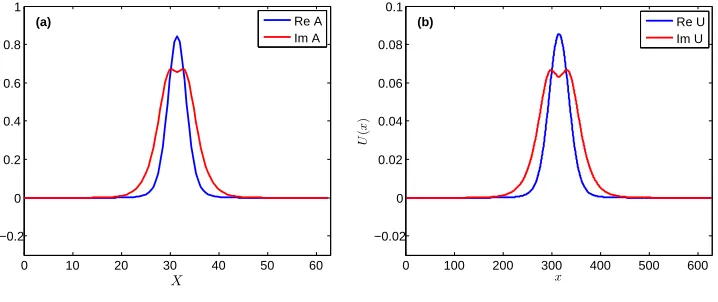
F = 0.04Γ,ω = 1.02, Lx= 200π, and use the sameα,β, and C. We show examples of localized solutions in the FCGL equation and the PDE (1.2) in Figure 4.1, demon-strating the quantitative agreement as expected between the two.
0 10 20 30 40 50 60
−0.2 0 0.2 0.4 0.6 0.8 1
X
A
Re A Im A (a)
0 100 200 300 400 500 600
−0.02 0 0.02 0.04 0.06 0.08 0.1
x
U
(
x
)
[image:8.612.79.438.297.448.2]Re U Im U (b)
Fig. 4.1. (a) Example of a localized solution to the FCGL equation (2.5) withµ=−0.5, and
F = 5.984. (b) Example of a localized solution to the PDE model (1.2) withµ = −0.52, and
F = 5.9842, where= 0.1. In both modelsα= 1,β=−2, and ν= 2, andC=−1−2.5i. Note the factor ofin the scalings of the two axes.
In all bifurcation diagrams we present solutions in terms of their norms
N =
s
2
Lx
Z Lx
0
|U|2dx,
We computed (following [7]) the location of these stable localized solutions in the (ν,Γ) parameter plane, shown in green in Figure 4.2. In this figure one can see that the region of localized solutions starts whereµCr+νCi= 0, when the primary bifurcation changes from supercritical to subcritical [13, 16], and gets wider as ν increases. We also show the bistability region of the amplitude equation between the primary (Γ0)
and the saddle-node (Γd) bifurcations.
Fig. 4.2.The(ν,Γ)-parameter plane for FCGL equation (2.6),µ=−0.5,α= 1,β=−2, and C=−1−2.5i, recomputed following [7]. Stable localized solutions exist in the shaded green region. The dashed red line is the primary pitchfork bifurcation atΓ0=
p
µ2+ν2, and the solid black line is the saddle-node bifurcation atΓd.
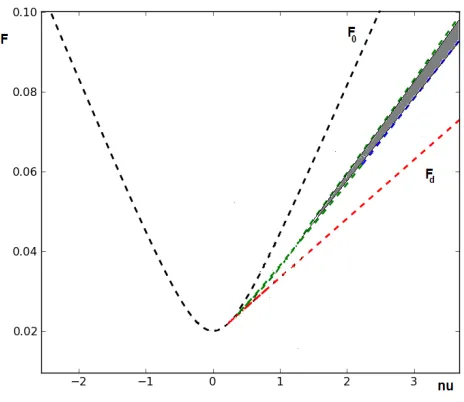
Fig. 4.3.The(ν, F)-parameter plane of the PDE model (1.2) withµ=−0.005,α= 1,β=−2, andC=−1−2.5i. Stable localized solutions exist in the shaded grey region. The dashed black line is the primary pitchfork bifurcation and the dashed red line is the saddle-node bifurcation atFd.
2, stable localized solutions occur between Γ∗
1 = 1.4272 and Γ∗2 = 1.5069. In the
PDE with parameter values as above, we therefore estimate that the stable localized solutions should exist between F1∗ = 0.04Γ∗1 = 0.0573 and F2∗ = 0.0600. We found
by time-stepping a stable oscillatory spatially localized solution in the PDE model (1.2) atF = 0.058 and used this as a starting point for continuation with AUTO. We found stable localized solutions between saddle-node bifurcations, at F∗
[image:9.612.144.376.354.555.2]andF∗
2 = 0.06001, which compares well with the prediction from the FCGL equation.
In addition, the bistability region was determined by time-stepping to be between
Fd= 0.04817 andF0= 0.08165. Asν is varied, the grey shaded region in Figure 4.3
shows the region where stable localized solutions exist in the PDE.
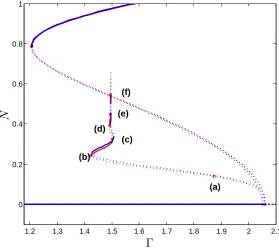
The snaking regions of the PDE model and the FCGL equation are presented in Figure 4.4. In this figure we rescale the PDE, so we can plot the bifurcation diagrams of the amplitude equation and the PDE model in top of each other. The agreement is excellent. Examples of localized solutions are given in Figure 4.5 (a)-(f) as we go along the localization curve. Our comparison between results from the FCGL equation (2.6) in Figure 4.2 and results from the model PDE (1.2) in Figure 4.3 shows excellent agreement.
Note the decaying spatial oscillations close to the flat state in Figure 4.5 (c)-(f): it is these that provide the pinning necessary to have parameter intervals of localized solutions. These parameter intervals become narrower as the localized flat state becomes wider (see Figure 4.4) since the oscillations decay in space, in contrast with the localized solutions found in the subcritical Swift–Hohenberg equation [6].
In this study so far our calculations have been based on assuming weak damping and weak forcing. Next, we study the PDE in the strong forcing case.
1.2 1.3 1.4 1.5 1.6 1.7 1.8 1.9 2 2.1
0 0.2 0.4 0.6 0.8 1
Γ
N
(f)
(a) (b)
(d) (e)
[image:10.612.100.379.353.603.2](c)
0 0.2 0.4 0.6 0.8 1 −0.02 0 0.02 0.04 0.06 0.08 0.1 U ( x ) x Re(U) Im(U) (a)
0 0.2 0.4 0.6 0.8 1
−0.02 0 0.02 0.04 0.06 0.08 0.1 x U ( x ) (b)
0 0.2 0.4 0.6 0.8 1
−0.02 0 0.02 0.04 0.06 0.08 0.1 U ( x ) x (c)
0 0.2 0.4 0.6 0.8 1
−0.02 0 0.02 0.04 0.06 0.08 0.1 U ( x ) x (d)
0 0.2 0.4 0.6 0.8 1
−0.02 0 0.02 0.04 0.06 0.08 0.1 x U ( x ) (e)
0 0.2 0.4 0.6 0.8 1
[image:11.612.102.428.115.533.2]−0.02 0 0.02 0.04 0.06 0.08 0.1 U ( x ) x (f)
Fig. 4.5. Examples of solutions to (1.2) equation along the localized branch withµ=−0.005,
α = 1, β = −2, ν = 2, and C = −1−2.5i. Bistability region is between F0 = 0.08165 and
Fd = 0.048173, and localized oscillons branch is betweenF1∗= 0.05688and F2∗= 0.06001. (a)
F = 0.07499. (b) F = 0.05699. (c)F = 0.06015. (d) F = 0.05961. (e) F = 0.05976. (f )
F= 0.05975. Dot lines represent the real (blue) and imaginary (red) parts ofUloc.
5. Reduction of the PDE to the Allen–Cahn equation: strong damping case. In the strong damping, strong forcing case, the linear part of the PDE is not solved approximately by U1 =eit. Rather, a Mathieu equation must be solved
Cahn equation are that localized solutions in this equation are known analytically, and that demonstrates directly the existence of localized solutions in the PDE model. We write the solution asU =u+iv, whereu(x, t) andv(x, t) are real functions. Thus, equation (1.2) is written in terms of real and imaginary parts ofU as
∂u
∂t = (µ+α∇
2)u−(ω+β∇2)v+Cr(u2+v2)u−Ci(u2+v2)v,
∂v
∂t = (ω+β∇
2)u+ (µ+α∇2)v+Cr(u2+v2)v+Ci(u2+v2)u+f(t)u.
(5.1)
We begin our analysis by linearizing (5.1) about u = 0 and v = 0. We write the periodic forcing function asf(t) =fc(t)(1 +2
1λ), wherefc(t) =Fccos(2t). Here,Fc is the critical forcing amplitude, which must be determined numerically, and is where the trivial solution loses stability. We seek a critical eigenfunction of the form
U =p1(t) +iq1(t), (5.2)
where p1(t) and q1(t) are real 2π-periodic functions. Note that in writing u+iv in
this form, we are taking the critical wavenumber to be zero. The analysis follows that presented in [20], but in the current work the spatial scaling and the chosen solution are different, again because the critical wavenumber is zero. Substituting into (5.1) at onset leads to
∂ ∂t −µ
p1=−ωq1,
∂
∂t −µ
q1=ωp1+fc(t)p1,
(5.3)
which can be combined to give a damped Mathieu equation
d
dt−µ
2
p1+ ω2+fc(t)ω
p1= 0,
or
¨
p1−2µp˙1+ µ2+ω2+fc(t)ω
p1=Lp= 0, (5.4)
defining a linear operator
L= ∂
2
∂t2 −2µ
∂ ∂t+ (µ
2+ω2+ωfc(t))
The critical forcing function fc(t) = Fccos(2t) is determined by the condition that (5.4) should have a non-zero solutionp1(t), from whichq1(t) is found by solving the
top line in (5.3). Using the inner product (2.3), we have the adjoint linear operator, given by
L†= ∂
2
∂t2 + 2µ
∂ ∂t+ (µ
2+ω2+ωfc(t)).
The adjoint equation is L†p†
1 = 0, where p
†
1 is the adjoint eigenfunction, which is
In order to reduce the model PDE (1.2) to the Allen–Cahn equation, we expand solutions in powers of1 as
u=1u1+21u2+31u3+...,
v=1v1+21v2+31v3+...,
(5.5)
where1 1 andu1,u2,u3, ...,v1, v2,v3,... areO(1) real functions. We introduce
the slow time variable T =2
1t and the slow space variable X = 1x. Substituting
equation (5.5) into (5.1), the associated equations at each power of1 are as follows.
AtO(1), the linear argument above arises, and we haveu1+iv1=B(X, T)(p1+iq1),
wherep1+iq1is the critical eigenfunction, normalized so thathp1+iq1, p1+iq1i= 1,
andBis a real function ofXandT. Note that the phase of the response is determined by the critical eigenfunction. AtO(3
1), the problem is written as
∂
∂t −µ
u3+
∂u1
∂T =−ωv3+α ∂2u
1
∂X2 −β
∂2v 1
∂X2 +Cr(u 2 1+v
2
1)u1−Ci(u21+v 2 1)v1,
∂ ∂t−µ
v3+
∂v1
∂T =ωu3+fc(t)u3+λfc(t)u1+α ∂2v
1
∂X2 +β
∂2u 1
∂X2 +Cr(u 2 1+v
2 1)v1
+Ci(u2 1+v
2 1)u1.
Eliminatingv3, we find
Lu3=−
∂
∂t−µ
∂u
1
∂T +ω ∂v1
∂T
+
∂
∂t −µ α ∂2u
1
∂X2 −β
∂2v 1 ∂X2 −ω α∂ 2v 1
∂X2 +β
∂2u 1
∂X2
−ωλfc(t)u1
−ω Cr u21+v 2 1
v1+Ci u21+v 2 1 u1 + ∂
∂t −µ
Cr u21+v 2 1
u1−Ci u21+v 2 1
v1.
(5.6)
We apply the solvability condition to equation (5.6)hp†1, Lu3i= 0. We substitute the
solution u1 = Bp1, and v1 = Bq1 into equation (5.6), and then we take the inner
product betweenp†1 and this equation. Note that we use
∂ ∂t−µ
p1=−ωq1, so the
equation can be then written as
p†1,2
∂
∂t−µ
p1
∂B
∂T =−
D
p†1, ωfc(t)p1
E
λB
+
p†1,
∂ ∂t−µ
(αp1−βq1)−ω(αq1+βp1)
∂2B
∂X2
+
p†1,−ω Cr p21+q 2 1
q1+Ci p21+q 2 1 p1 + ∂
∂t−µ
Cr p21+q 2 1
p1−Ci p21+q 2 1 q1
B3,
We find coefficients of the above equation by computing the inner products numeri-cally. Therefore, the PDE is reduced to the Allen–Cahn equation as
BT = 1.5687λB+ 11.1591BXX+ 9.4717B3, (5.8)
for the parameter values in Figure 5.1 (a). Note that U = 1U1, X = 1x, and
2
1λ=FF0 −1,so that the spatially localized solution takes the form
Uloc=
s
−3.1374(F F0 −1)
9.4717 sech
s
−1.5687(F F0 −1)
11.1591 x
(p1(t) +iq1(t)). (5.9)
1 1.5 2 2.5 3 −0.1
0 0.1 0.2 0.3 0.4 0.5 0.6
F
N
(b) (c)
(d)
(a)
0 0.2 0.4 0.6 0.8 1
−0.1 0 0.1 0.2 0.3 0.4
x
U
(
x
)
Re(U) Im(U) (a)
0 0.2 0.4 0.6 0.8 1
−0.05 0 0.05 0.1 0.15 0.2 0.25 0.3 0.35 0.4
x
U
(
x
)
(c)
0 0.2 0.4 0.6 0.8 1
−0.05 0 0.05 0.1 0.15 0.2 0.25 0.3 0.35 0.4
x
U
(
x
)
(b)
0 0.2 0.4 0.6 0.8 1
−0.1 0 0.1 0.2 0.3 0.4
x
U
(
x
)
[image:15.612.121.410.101.490.2](d)
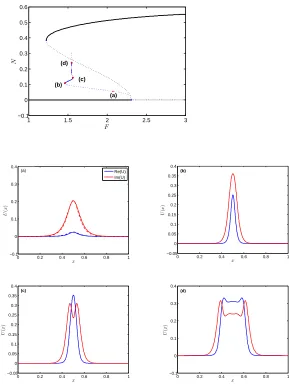
Fig. 5.1. Examples of solutions to (1.2) in the strong damping limit with= 0.5,F = 2.304,
µ=−0.125,α = 1, β=−2,ν = 2,ω = 1 +ν2, andC =−1−2.5i. The bistability region is
betweenF0= 2.3083 andFd= 1.2228. Dotted lines in (a) represent the real (blue) and imaginary (red) parts ofUloc.
By continuing the numerical solution of the PDE model (1.2) that we take from time-stepping as an initial condition, we found the branch of localized states. The stability of this branch was determined by time-stepping, and the region where stable localized solutions occur was found. The saddle-node bifurcations on the snaking curve arise from pinning associated with the decaying spatial oscillations on either edge of the flat state.
The numerical examples we give in this paper indicate how localized solutions exist in 1D, and show excellent agreement between the PDE model and the FCGL equa-tion. The agreement remains qualitatively good even with strong damping and strong forcing. In strong damping limit, we reduce the PDE directly to the Allen–Cahn equa-tion analytically, close to onset. By continuing the approximate soluequa-tion, examples of localized oscillons are observed numerically.
In the current work the preferred wave number is zero, so our results are directly relevant to localized pattern found in Turing systems, such as those found in [22, 24]. In contrast, in the Faraday wave experiment, the preferred wavenumber is non-zero, and so this work is not directly relevant to the oscillons that are observed there. Our interest next is to find and analyze spatially localized oscillons with non-zero wave number in the PDE model, both in 1D and in 2D. This will indicate how localized solutions might be studied in (for example) the Zhang–Vinals model [25], and how the weakly nonlinear calculations of [21] might be extended to the oscillons observed in the Faraday wave experiment.
Acknowledgments. We are grateful for interesting discussions with A.D. Dean, E. Knobloch, K. McQuighan, and B. Sandstede. We also acknowledge financial sup-port from King Abdullah Foreign Scholarship Program.
REFERENCES
[1] S.M. Allen and J.W. Cahn, A microscopic theory for antiphase boundary motion and its application to antiphase domain coarsening, Acta. Metall,27:1084-1095 (1978)
[2] I.S. Aranson and L.S. Tisimring,Formation of periodic and localized patterns in an oscillating granular layer, Physica A 249, 103-110 (1998).
[3] H. Arbell and J. Fineberg,Temporally harmonic oscillons in Newtonian fluids, Phys. Lett. 85, 756-759 (2000).
[4] AUTO, 1995-2010 Corporation on National Research Initiatives and 2001 Python Software Foundation.
[5] T.B. Benjamin and F. Ursell,The stability of the plane free surface of a liquid in vertical periodic motion,Proc. R. Soc. Lond. A 225, pp. 505-515 (1954).
[6] J. Burke and E. Knobloch,Snakes and ladders: Localized states in the Swift-Hohenberg
equa-tion, Phys. Lett. A, 360, pp. 681688 (2007).
[7] J. Burke, A. Yochelis, and E. Knobloch,Classification of spatially localized oscillations in periodically forced dissipative systems, SIAM J. Appl. Math. 7, pp. 651-711 (2008). [8] P. Coullet,Commensurate-Incommensurate transition in nonequilibrium systems, Phys. Rev.
Lett. 56, 724-727 (1986).
[9] P. Coullet and K. Emilsson,Strong resonances of spatially distributed oscillators: a laboratory
to study patterns and defects, Phys. Lett. D 61, pp. 119131 (1992).
[10] S.M. Cox and P.C. Matthews,Exponential Time Differencing for Stiff Systems, Journal of Computational Physics 176, 430-455 (2002).
[11] C. Crawford and H. Riecke, Oscillon-type structures and their interaction in a Swift-Hohenberg model, Physica D 129, 83-92 (1999).
[12] J.H.P. Dawes,Localized pattern formation with a large-scale mode: Slanted snaking, SIAM J. APPLIED DYNAMICAL SYSTEMS, Vol. 7, No. 1, pp. 186206 (2008).
[14] C. Elphick, G. Iooss, and E. Tirapegui,Normal form reduction for time-periodically driven differential equations, Phys. Lett. A 120, pp. 459463 (1987).
[15] Y. Fukao, Y. Morita and H. Ninomiya,Some entire solutions of the Allen–Cahn equation, Taiwanese Journal of Mathematics Vol. 8, No. 1, pp. 15-32 (2004).
[16] G. Kozyreff and S.J. Chapman, Asymptotics of large bound states of localized structures, Phys. Rev. Lett. 97, 044502 (2006).
[17] O. Lioubashevski, H. Arbell, and J. Fineberg, Dissipative solitary states in driven surface waves, Phys. Rev. Lett. 76, 3959-3962 (1996).
[18] K. McQuighan and B. Sandstede,Oscillons in the planar Ginzburg-Landau equation with 2:1 forcing, (2013).
[19] V. Petrov, Q. Ouyang and H. Swinney,Resonant pattern formation in a chemical system, Nature 388, pp. 655-657 (1997).
[20] A.M. Rucklidge and M. Silber,Design of parametrically forced patterns and quasipatterns, SIAM J. Appl. Math. 8, pp. 298-347 (2009).
[21] A.C. Skeldon and G. Guidoboni,Pattern selection for Faraday waves in an incompressible viscous fluid, SIAM J. Appl. Math. 67, pp. 1064-1100 (2007).
[22] C.M. Topaz and A.J. Catll,Forced patterns near a Turing-Hopf bifurcation, Phys. Rev. E 81, 026213 (2010).
[23] P.B Umbanhowar, F. Melo, and H.L. Swinney,Localized excitations in a vertically vibrated granular layer, Nature 382, 793 (1996).
[24] V.K. Vanag and I.R. Epstein,Resonance-induced oscillons in a reaction-diffusion system, Phys. Rev. E 73 016201 (2006).
![Fig. 1.1.κ = −Localized solutions of the FCGL equation (1.1) with ˜µ = −0.5, ρ = 2.5, ν = 2,2, and Γ = 1.496; the bifurcation point is at Γ0 = 2.06, following [7].](https://thumb-us.123doks.com/thumbv2/123dok_us/7970781.200097/3.612.150.363.364.514/fig-localized-solutions-fcgl-equation-bifurcation-point-following.webp)