Air pollution exposure and lung function
in highly exposed subjects in Beijing,
China: a repeated-measure study
The Harvard community has made this
article openly available. Please share how
this access benefits you. Your story matters
Citation
Baccarelli, A. A., Y. Zheng, X. Zhang, D. Chang, L. Liu, K. R. Wolf,
Z. Zhang, et al. 2014. “Air pollution exposure and lung function in
highly exposed subjects in Beijing, China: a repeated-measure
study.” Particle and Fibre Toxicology 11 (1): 51. doi:10.1186/
s12989-014-0051-7. http://dx.doi.org/10.1186/s12989-014-0051-7.
Published Version
doi:10.1186/s12989-014-0051-7
Citable link
http://nrs.harvard.edu/urn-3:HUL.InstRepos:13347421
Terms of Use
This article was downloaded from Harvard University’s DASH
repository, and is made available under the terms and conditions
applicable to Other Posted Material, as set forth at
http://
R E S E A R C H
Open Access
Air pollution exposure and lung function in
highly exposed subjects in Beijing, China:
a repeated-measure study
Andrea A Baccarelli
1, Yinan Zheng
2, Xiao Zhang
3, Dou Chang
4, Lei Liu
3, Katherine Rose Wolf
3, Zhou Zhang
5,
John P McCracken
1, Anaité Díaz
6, Pier Alberto Bertazzi
7, Joel Schwartz
1, Sheng Wang
8*, Choong-Min Kang
1,
Petros Koutrakis
1and Lifang Hou
3,9*Abstract
Background:Exposure to ambient particulate matter (PM) has been associated with reduced lung function. Elemental components of PM have been suggested to have critical roles in PM toxicity, but their contribution to respiratory effects remains under-investigated. We evaluated the effects of traffic-related PM2.5and its elemental
components on lung function in two highly exposed groups of healthy adults in Beijing, China.
Methods:The Beijing Truck Driver Air Pollution Study (BTDAS) included 60 truck drivers and 60 office workers evaluated in 2008. On two days separated by 1-2 weeks, we measured lung function at the end of the work day, personal PM2.5, and nine elemental components of PM2.5during eight hours of work, i.e., elemental carbon (EC),
potassium (K), sulfur (S), iron (Fe), silicon (Si), aluminum (Al), zinc (Zn), calcium (Ca), and titanium (Ti). We used covariate-adjusted mixed-effects models including PM2.5as a covariate to estimate the percentage change in lung
function associated with an inter-quartile range (IQR) exposure increase.
Results:The two groups had high and overlapping exposure distributions with mean personal PM2.5of 94.6μg/m 3
(IQR: 48.5-126.6) in office workers and 126.8μg/m3(IQR: 73.9-160.5) in truck drivers. The distributions of the nine elements showed group-specific profiles and generally higher levels in truck drivers. In all subjects combined, forced expiratory volume in 1 second (FEV1) and forced vital capacity (FVC) did not significantly correlate with PM2.5.
However, FEV1 showed negative associations with concentrations of four elements: Si (-3.07%, 95% CI: -5.00; -1.11, IQR: 1.54), Al (-2.88%, 95% CI: -4.91; -0.81, IQR: 0.86), Ca (-1.86%, 95% CI: -2.95; -0.76, IQR: 1.33), and Ti (-2.58%, 95% CI: -4.44; -0.68, IQR: 0.03), and FVC showed negative associations with concentrations of three elements: Si (-3.23%, 95% CI: -5.61; -0.79), Al (-3.26%, 95% CI: -5.73; -0.72), and Ca (-1.86%, 95% CI: -3.23; -0.47). In stratified analysis, Si, Al, Ca, and Ti showed associations with lung function only among truck drivers, and no significant association among office workers.
Conclusion:Selected elemental components of PM2.5showed effects on lung function that were not found in
analyses of particle levels alone.
Keywords:Lung function, Metals, Particulate matter, Traffic exposure, FEV1, FVC
* Correspondence:[email protected];[email protected] 8Department of Occupational and Environmental Health, Peking University
Health Science Center, No. 38 Xueyuan Road, Haidian District, Beijing 100191, China
3
Department of Preventive Medicine, Feinberg School of Medicine, Northwestern University, Chicago, IL, USA
Full list of author information is available at the end of the article
© 2014 Baccarelli et al.; licensee BioMed Central Ltd. This is an Open Access article distributed under the terms of the Creative Commons Attribution License (http://creativecommons.org/licenses/by/4.0), which permits unrestricted use, distribution, and reproduction in any medium, provided the original work is properly credited. The Creative Commons Public Domain Dedication waiver (http://creativecommons.org/publicdomain/zero/1.0/) applies to the data made available in this article, unless otherwise stated.
Introduction
Epidemiological studies have consistently linked short-term exposure to gaseous air pollution and ambient par-ticulate matter (PM) with increased hospitalization and mortality from respiratory disease [1-4]. Short-term ex-posure to PM has been repeatedly associated with de-creased forced expiratory volume in 1 second (FEV1) in human studies in Boston [5], Salt Lake City [6], Italy [7], and The Netherlands [8]. In a human controlled-exposure experiment including current smokers and ex-smokers, a 2-hour exposure to concentrated ambient fine particles was sufficient to determine a significant decrease in FEV1 compared to clean air experiments [9]. Elemental compo-nents of PM have been suggested to play critical roles in determining PM toxicity [10-12]. Previous studies have ex-amined the association of lung function with occupational exposure to metals and other toxic components, showing decreased lung function indicators in workers exposed to aluminum (Al), iron (Fe), calcium (Ca), and silicon (Si) [13-21]. However, the contribution of elemental compo-nents of PM to respiratory effects remains largely under-investigated. Decreased forced vital capacity (FVC) and FEV1have also been associated with increasing
concentra-tions of PM2.5(PM with aerodynamic diameter < 2.5μm),
diesel exhaust particles, zinc (Zn), and Fe in chronic ob-structive pulmonary disease (COPD) patients who are ex-smokers or sustained quitters [7,22]. Nonetheless, the effects of elemental components of PM, among indi-viduals not selected on the basis of respiratory disease, are under-investigated.
Beijing has been ranked among the 15 cities with the highest levels of air particles worldwide, as indicated by comparisons of ambient annual PM10levels [23].
Traffic-derived PM and elemental components play important roles in air pollution in Beijing due to its very high popula-tion density, rapid increase in vehicular traffic, and energy combustion with inefficient pollution control [24]. Trans-ported particles from industrial sources and windblown dust are also major sources of pollution [24]. Examining the effects of high levels of PM and its elemental compo-nents in a highly exposed population such as the Beijing population may provide a highly effective approach to characterizing changes in lung function.
In this study of truck drivers and office workers in Beijing, China, we evaluated the effects of traffic-related PM2.5 and elemental components, including elemental
carbon (EC), potassium (K), sulfur (S), Fe, Si, Al, Zn, Ca, and titanium (Ti) on lung function. The two groups both had high exposure levels and were selected as samples with different occupational exposures: truck drivers are directly exposed to traffic emissions, particularly from diesel exhausts; office workers were included to represent the highly exposed residential population of Beijing. To enhance the power to identify effects on lung function, we
studied each participant on two different examination days 1-2 weeks apart and assessed each participant’s ex-posure on the days of the exam using personal measures of PM2.5and the nine elemental components.
Material and methods
Study population and design
The Beijing Truck Driver Air Pollution Study (BTDAS), conducted between June 15 and July 27, 2008, included 60 truck drivers and 60 indoor office workers. All study participants worked and lived in the Beijing metropol-itan area and had held their current jobs for at least two years. Office workers worked in buildings that did not have central air conditioning and were given the choice to use air conditioning units available in individual office rooms during the study days. Because several of the common spaces, e.g., hallways and atria, had windows that were usually left open in the summer, office workers were exposed to high levels of indoor PM due to high penetration of ambient particles from the outdoors. In-person interviews using a detailed questionnaire were conducted to collect information on demographics, life-style, and other exposures. Information on time-varying factors, including tea, alcohol, and smoking, was ob-tained for past usual exposure as well as for each exam-ination day. Because PM levels are highly variable on a day-to-day basis, we examined all participants on two work days separated by a 1-2 week period. Individual written informed consent was obtained from all partici-pants prior to enrollment in the study. Institutional Review Board or equivalent approval at the participating institu-tion (i.e., Harvard School of Public Health, Northwestern University, and Peking University Health Science Center) was obtained prior to study participant recruitment.
Personal PM2.5and elemental component measurements We measured average personal PM2.5 on both
examin-ation days using personal samplers worn by the study participants during eight hours of work. The personal sampler was carried in a belt pack with the inlet clipped near the breathing zone. Each sampler setup included an Apex pump (Casella Inc., Bedford, UK), a Triplex Sharp-Cut Cyclone (BGI Inc., Waltham, MA, USA), and a 37-mm Teflon filter placed on top of a drain disc and inside a filter holder made of aluminum coated in Teflon to prevent contamination. Blank filter samples were included in the analysis and showed no contamination. The filters were kept under atmosphere-controlled con-ditions before and after sampling and were weighed with a microbalance (Mettler-Toledo Inc., Columbus, OH, USA). A time-weighted average of PM2.5 concentrations
in replicate samples on a subset of 24 participants who wore two monitors at the same time (see Additional file 1: Figure S1). The blackness of the same filters used to meas-ure PM2.5was assessed using an EEL Model M43D smoke
stain reflectometer, applying the standard black-smoke index calculations of the absorption coefficients based on reflectance [25]. We assumed a factor of 1.0 for converting the absorption coefficient to EC mass [26,27], which was then divided by the sampled air volume to calculate aver-age EC concentration [25]. EC is a combustion by-product contained in PM2.5 that has been used as a surrogate
measure for PM2.5 from gasoline- and especially
diesel-powered motor vehicles [26].
Elemental components of PM2.5 were analyzed after
the gravimetric mass measurement using a XRF PANa-nalytical Epsilon 5 analyzer (Almelo, The Netherlands), as described previously [28,29]. We selected from this analysis the eight elements, i.e., K, S, Fe, Si, Al, Zn, Ca, and Ti, that showed the highest reproducibility (r > 0.75) in replicate samples from the subset of 24 participants who wore two monitors at the same time (see Additional file 1: Figure S2).
Lung function measurement
Lung function testing was performed using the EasyOne ultrasonic flow-sensing spirometer (NDD Medical Tech-nologies, Zurich, Switzerland). The EasyOne spirometer has high validity and reproducibility [30-32]. Independ-ent testing of the device has shown it to exceed standard thresholds for acceptability with American Thoracic So-ciety (ATS) waveforms [30] and to have both high cali-bration stability [31,32] and excellent agreement with standard laboratory-based spirometers [33]. All lung function measures were performed at the end of the work day (between 4-6 pm) according to ATS guidelines [34] by a research assistant trained specifically for this study. We retained completed spirometry sessions con-sisting of three of six best maneuvers. Five indicators were included in our study: FEV1, FVC, FEV1/FVC ra-tio, forced expiratory flow 25%-75% (FEF25-75%), and peak expiratory flow (PEF).
Statistical analysis
Standard descriptive statistics were used to present the characteristics of truck drivers and office workers. Pre-liminary to the analysis presented in this manuscript, we performed statistical analysis to confirm that there were no differences in lung function levels between office workers and truck drivers. We used mixed-effects re-gression models to test the differences in lung functions between groups and to estimate group-specific means and 95% confidence intervals (CIs). We fitted models ad-justed for variables either not matched or incompletely matched by design between the two groups, i.e., age, sex,
body mass index (BMI) (continuous), cigarettes smoked during the examination time (continuous), day of the week (one indicator variable per day), time spent commuting to work (continuous), work hours per week, temperature (continuous), and dew point (continuous). The mixed-effects models were based on the following equation:
Yij¼ β0þ β1ðGroupÞijþ β2X2ijþ…þ βnXnij
þ α1X1jþ…þ αnXmj þξjþeij
ð1Þ
where β0 is the overall intercept; β1 is the regression
coefficient for the group;β2…βn are the regression
coef-ficients for the time-dependent covariates; α1…αn are
the regression coefficients for the time-independent co-variates included in the multivariate models; ξj is the
random effect for the subject; jrepresents the subject; i identifies the workday, andeijis the residual error term. Based on these models, we found no statistically signifi-cant differences in any of the lung function indicators between office workers and truck drivers (data not shown). We then used mixed-effects models adjusted for age, sex, BMI, cigarettes smoked during the examination time, day of the week, time spent commuting to work, work hours per week, temperature, and dew point to evaluate the association of personal PM2.5 with each of
the lung function indicators (i.e., FEV1, FVC, FEF25%-75%, FEV1/FVC ratio, and PEF). The mixed-effects models used the following structure based on Model 1, with an additional exposure variable term for PM2.5, EC,
or one of the elemental components of PM2.5:
Yij¼ β0þ β1ðExposureÞijþ β2ðGroupÞijþβ3X3ij þ…þ βnXnijþ α1X1jþ…þ αnXmj þ ξjþeij
ð2Þ
Note that PM2.5 was fitted as a covariate in Model 2
when evaluating the effects of personal EC or elemental components of PM2.5on lung function [35]. The Benjamini
and Hochberg (BH) procedure to control the false dis-covery rate (FDR) for multiple comparisons [36] was ap-plied for multiple tests of significance. A two-sided BH FDR of less than 0.05 was considered noteworthy. Stat-istical significance for interaction was assessed by the likelihood-ratio test comparing the models with and without the interaction term [37]. All analyses were per-formed in SAS 9.2 (SAS Institute Inc., Cary, NC).
Results
Characteristics of study subjects
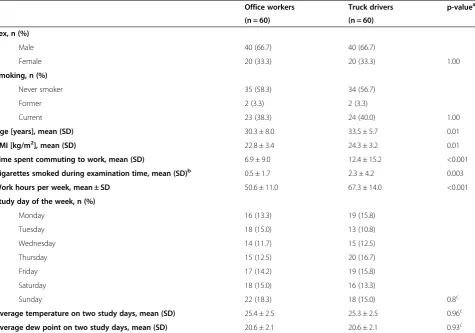
The characteristics of the 60 office workers and 60 truck drivers are presented in Table 1. Briefly, truck drivers were moderately but significantly older than office workers. Truck drivers had higher BMI, reported more pack-years of smoking, smoked more cigarettes during
the examination time, and included a higher proportion of usual alcohol drinkers and tea consumers.
Personal PM2.5and elemental component levels
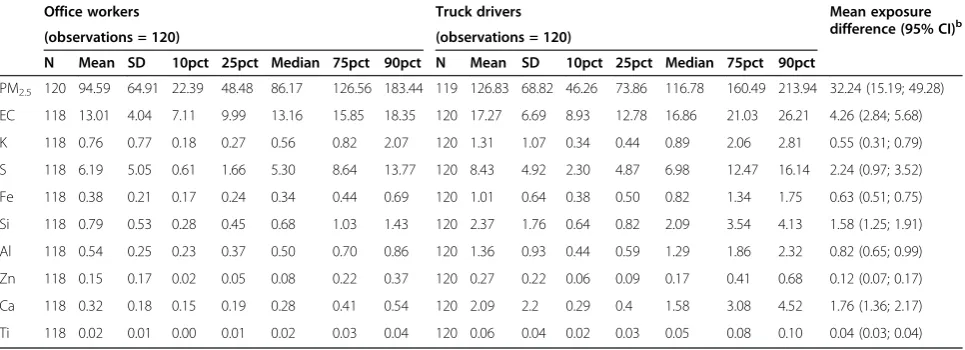
The levels and distribution of personal time-weighted average exposure to PM2.5 and nine elemental
compo-nents were estimated during 8 work hours (Table 2). Average personal PM2.5was 94.59μg/m3for office workers
and 126.83μg/m3for truck drivers. Average personal EC was 13.01 μg/m3 for office workers and 17.27μg/m3 for truck drivers. For the elemental components, the mea-sured levels for truck drivers were significantly higher than those for office workers.
Association of lung function with PM2.5and elemental
components
To optimize power, we conducted primary analyses on the associations between exposure measures and lung function by fitting models in all participants combined (Table 3). Secondly, we evaluated associations in
office workers or truck drivers separately (Table 4). The lung function indicators were highly skewed and were log-transformed to approximate normality. In re-gression models, rere-gression coefficients for log-trans-formed dependent variables can be rescaled to express the proportion of change associated with the exposure. Here, all results are expressed as the percent change in lung function associated with an increase equal to the inter-quartile range (p75 - p25) of the exposure variable. All results are covariate-adjusted and considered note-worthy at FDR < 0.05. PM2.5showed no significant
[image:5.595.62.538.100.433.2]asso-ciation with any of the five lung function indicators. Analysis of the elemental components showed that in all subjects combined, FEV1 decreased in relation to higher concentrations of four of the elements: Si (-3.07%, 95% CI: -5.00; -1.11, IQR: 1.54), Al (-2.88%, 95% CI: -4.91; -0.81, IQR: 0.86), Ca (-1.86%, 95% CI: -2.95; -0.76, IQR: 1.33), and Ti (-2.58%, 95% CI: -4.44; -0.68, IQR: 0.003), and FEV1 decreased in relation to higher concentrations of three of the elements: Si (-3.23%, 95% CI: -5.61; -0.79), Al Table 1 Characteristics of the study participants
Office workers Truck drivers p-valuea (n = 60) (n = 60)
Sex, n (%)
Male 40 (66.7) 40 (66.7)
Female 20 (33.3) 20 (33.3) 1.00
Smoking, n (%)
Never smoker 35 (58.3) 34 (56.7)
Former 2 (3.3) 2 (3.3)
Current 23 (38.3) 24 (40.0) 1.00
Age [years], mean (SD) 30.3 ± 8.0 33.5 ± 5.7 0.01
BMI [kg/m2], mean (SD) 22.8 ± 3.4 24.3 ± 3.2 0.01
Time spent commuting to work, mean (SD) 6.9 ± 9.0 12.4 ± 15.2 <0.001
Cigarettes smoked during examination time, mean (SD)b 0.5 ± 1.7 2.3 ± 4.2 0.003
Work hours per week, mean ± SD 50.6 ± 11.0 67.3 ± 14.0 <0.001
Study day of the week, n (%)
Monday 16 (13.3) 19 (15.8)
Tuesday 18 (15.0) 13 (10.8)
Wednesday 14 (11.7) 15 (12.5)
Thursday 15 (12.5) 20 (16.7)
Friday 17 (14.2) 19 (15.8)
Saturday 18 (15.0) 16 (13.3)
Sunday 22 (18.3) 18 (15.0) 0.8c
Average temperature on two study days, mean (SD) 25.4 ± 2.5 25.3 ± 2.5 0.96c
Average dew point on two study days, mean (SD) 20.6 ± 2.1 20.6 ± 2.1 0.93c a
P-values were calculated using Student’s t-test and Fisher’s exact test for continuous and categorical variables, respectively. b
Only current or former smokers. c
Cumulative of the two study days. Based on 240 total observations (120 study days for office workers and 120 study days for truck drivers). P-values were obtained from mixed-effects regression models.
(-3.26%, 95% CI: -5.73; -0.72), and Ca (-1.86%, 95% CI: -3.23; -0.47). The remaining three lung function indicators did not show any noteworthy associations with the elements (Table 3).
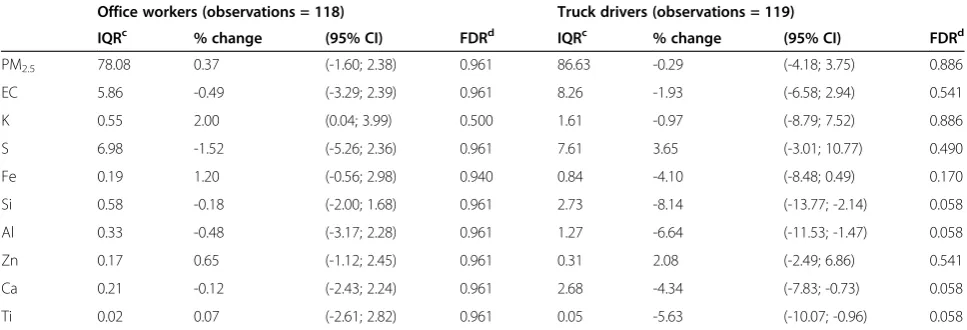
Stratified analyses in office workers and truck drivers showed similar associations between elemental compo-nents and FEV1 in truck drivers, but not in office workers. In addition to the four components that showed significant associations in all participants combined, Fe was also negatively associated with FEV1 among truck drivers: FEV1 was negatively associated with concentrations of Fe (-4.24%, 95% CI: -7.55; -0.8), Si (-8.13%, 95% CI: -12.3; -3.76), Al (-6.46%, 95% CI: -10.18; -2.59), Ca (-4.40%, 95% CI: -6.97; -1.77), and Ti (-5.18%, 95% CI: -8.53; -1.71). However, FEV1 was positively associ-ated with the concentration of S (6.16%, 95% CI: 1.06; 11.51) in truck drivers (Table 4). Stratified analyses also showed similar associations between elemental compo-nents and FVC in truck drivers but not in office workers. In addition to the three components that showed signifi-cant associations in all participants combined, Ti was also marginally negatively associated with FVC among truck drivers: FVC was marginally negatively associated with concentrations of Si (-8.14%, 95% CI: -13.77; -2.14), Al (-6.46%, 95% CI: -11.53; -1.47), Ca (-4.34%, 95% CI: -7.83; -0.73), and Ti (-5.63%, 95% CI: -10.07; -0.96) (Table 5). None of the exposure variables showed asso-ciations with the other lung function indicators in ana-lyses restricted to truck drivers or office workers (data not shown). However, although the effects of the expos-ure appeared stronger among drivers, formal testing showed that they were not different between the two groups at FDR < 0.05. We further examined the inter-action effects between sex and exposures to PM2.5and
elemental components of PM on lung function by
introducing an interaction term with sex into Model 2. We did not observe significant interactions between ex-posures and sex (see Additional file 1: Table S2).
Stratified analyses in non-smokers and smokers showed stronger negative associations of FEV1 and FVC with con-centrations of Fe, Si, Al, Ca, and Ti (see Additional file 1: Table S4), but no significant associations in smokers (see Additional file 1: Table S3). Stratified analysis by median BMI (23 kg/m2) showed strong negative associations of FEVI and FVC with concentrations of Fe, Si, Al, Ca, and Ti among participants with BMI below the median (see Additional file 1: Table S6), but no significant asso-ciations among participants with BMI above the median (see Additional file 1: Table S5).
Discussion
In this study of truck drivers and office workers in Beijing, China, we found that higher concentrations of Si, Al, Ca, and Ti in PM2.5particles were associated with
decreased lung function as assessed by FEV1. Si, Al, and Ca were also negatively associated with FVC. These as-sociations were stronger in truck drivers relative to office workers. Si, Al, Ca, and Ti are crustal elements that are common in road dust [38], which may explain why ex-posure to these elements was higher in truck drivers, and suggests that road dust may be implicated in these results.
[image:6.595.57.540.112.287.2]Our findings are in line with previous studies on the effect of these elements on lung function in occupational settings. The observed association of FEV1 with Al is consistent with previous studies showing an association between lower FEV1 or FVC and exposure to Al in pot-room workers [13], cast-house workers [14], and smelters [15], although the Al concentrations in these occupational studies exceeded the concentrations measured in the
Table 2 Level of personal PM2.5, elemental carbon (EC), and elemental components of PM2.5during work hours on the
examination daysa
Office workers Truck drivers Mean exposure
difference (95% CI)b
(observations = 120) (observations = 120)
N Mean SD 10pct 25pct Median 75pct 90pct N Mean SD 10pct 25pct Median 75pct 90pct
PM2.5 120 94.59 64.91 22.39 48.48 86.17 126.56 183.44 119 126.83 68.82 46.26 73.86 116.78 160.49 213.94 32.24 (15.19; 49.28)
EC 118 13.01 4.04 7.11 9.99 13.16 15.85 18.35 120 17.27 6.69 8.93 12.78 16.86 21.03 26.21 4.26 (2.84; 5.68)
K 118 0.76 0.77 0.18 0.27 0.56 0.82 2.07 120 1.31 1.07 0.34 0.44 0.89 2.06 2.81 0.55 (0.31; 0.79)
S 118 6.19 5.05 0.61 1.66 5.30 8.64 13.77 120 8.43 4.92 2.30 4.87 6.98 12.47 16.14 2.24 (0.97; 3.52)
Fe 118 0.38 0.21 0.17 0.24 0.34 0.44 0.69 120 1.01 0.64 0.38 0.50 0.82 1.34 1.75 0.63 (0.51; 0.75)
Si 118 0.79 0.53 0.28 0.45 0.68 1.03 1.43 120 2.37 1.76 0.64 0.82 2.09 3.54 4.13 1.58 (1.25; 1.91)
Al 118 0.54 0.25 0.23 0.37 0.50 0.70 0.86 120 1.36 0.93 0.44 0.59 1.29 1.86 2.32 0.82 (0.65; 0.99)
Zn 118 0.15 0.17 0.02 0.05 0.08 0.22 0.37 120 0.27 0.22 0.06 0.09 0.17 0.41 0.68 0.12 (0.07; 0.17)
Ca 118 0.32 0.18 0.15 0.19 0.28 0.41 0.54 120 2.09 2.2 0.29 0.4 1.58 3.08 4.52 1.76 (1.36; 2.17)
Ti 118 0.02 0.01 0.00 0.01 0.02 0.03 0.04 120 0.06 0.04 0.02 0.03 0.05 0.08 0.10 0.04 (0.03; 0.04)
a
Measured during the work hours of examination days using light-weight personal monitors. b
Mean exposure levels of truck drivers–mean exposure levels of office workers.
Table 3 Percent changeain lung function indicators associated with an interquartile-range increase in personal levels of PM2.5, elemental carbon (EC), or elemental components of PM2.5
b
FEV1 (observations = 237)c FVC (observations = 237)c FEV1/FVC ratio (observations = 237)c FEF 25%-75% (observations = 235)c PEF (observations = 237)c IQRd % change (95% CI) FDRe % change (95% CI) FDR % change (95% CI) FDR % change (95% CI) FDR % change (95% CI) FDR
PM2.5 83.87 1.11 (-1.31; 3.59) 0.466 0.12 (-2.79; 3.11) 0.938 1.27 (-0.91; 3.50) 0.952 8.18 (-3.01; 20.67) 0.490 3.09 (-0.47; 6.77) 0.574
EC 7.36 0.37 (-1.94; 2.74) 0.755 -1.39 (-4.14; 1.43) 0.415 0.69 (-1.47; 2.89) 0.952 7.72 (-3.09; 19.73) 0.490 0.66 (-2.65; 4.09) 0.700
K 0.91 0.51 (-1.75; 2.82) 0.734 0.72 (-2.01; 3.52) 0.680 0.51 (-1.58; 2.65) 0.952 7.07 (-3.39; 18.67) 0.490 0.66 (-2.6; 4.03) 0.700
S 6.67 1.94 (-1.07; 5.04) 0.301 1.93 (-1.82; 5.81) 0.415 0.71 (-2.23; 3.74) 0.952 9.71 (-4.89; 26.54) 0.490 1.67 (-2.68; 6.22) 0.574
Fe 0.55 -1.95 (-3.75; -0.11) 0.080 -1.76 (-3.96; 0.49) 0.252 -0.06 (-1.79; 1.70) 0.952 -2.79 (-10.77; 5.90) 0.576 -1.24 (-3.86; 1.46) 0.574
Si 1.54 -3.07 (-5.00; -1.11) 0.015 -3.23 (-5.61; -0.79) 0.043 -0.12 (-2.00; 1.79) 0.952 -3.24 (-11.96; 6.34) 0.576 -1.97 (-4.86; 1.00) 0.574
Al 0.86 -2.88 (-4.91; -0.81) 0.023 -3.26 (-5.73; -0.72) 0.043 0.30 (-1.67; 2.30) 0.952 -1.88 (-11.05; 8.25) 0.706 -1.87 (-4.86; 1.21) 0.574
Zn 0.24 1.55 (-0.44; 3.57) 0.217 1.72 (-0.75; 4.24) 0.293 0.30 (-1.71; 2.35) 0.952 5.86 (-3.78; 16.48) 0.490 1.28 (-1.58; 4.23) 0.574
Ca 1.33 -1.86 (-2.95; -0.76) 0.010 -1.86 (-3.23; -0.47) 0.043 -0.15 (-1.22; 0.94) 0.952 -2.42 (-7.50; 2.93) 0.576 -0.96 (-2.60; 0.71) 0.574
Ti 0.03 -2.58 (-4.44; -0.68) 0.023 -2.69 (-4.99; -0.34) 0.068 0.06 (-1.77; 1.91) 0.952 -3.32 (-11.68; 5.84) 0.576 -1.08 (-3.86; 1.77) 0.574
a
Adjusted for group, age, sex, BMI, number of cigarettes smoked during examination time, day of the week, time used for commuting to work, work hours per week, temperature, and dew point values. For exposures other than PM2.5, PM2.5was also included in the model as an independent variable.
b
Measured during work hours of the examination days using light-weight personal monitors.
c
Observations vary across different lung function indicators due to missing values.
d
Percent changes and 95% confidence intervals are scaled to the interquartile range (IQR) of the exposures.
e
FDR: Benjamini and Hochberg false discovery rate.
Baccarelli
et
al.
Particle
and
Fibre
Toxicology
2014,
11
:51
Page
6
o
f
1
0
http://ww
w.particleand
fibretoxicolo
gy.com/cont
BTDAS. An experimental study suggested that Al induces oxidative and inflammatory stress, leading to damage of the lung epithelium [39]. In Al-exposed workers, Elserougy et al. reported an elevated level of C-reactive protein (CRP) [40], an inflammatory marker that has been associated with reduced FEV1 and FVC [41-45]. Although the reason underlying the inverse association is unclear, it is hypothe-sized that persistent systemic inflammation and pulmonary micro-filtration may result in damage to the airways, lead-ing to a decline in FEV1 and FVC [41,46]. Si and Ca in truck drivers may represent exposure to either asphalt- or cement-paved road dusts related to traffic emissions during
[image:8.595.57.539.112.278.2]driving [47]. Recently, Johncy et al. found a statistically significant decrease in lung function indicators, including FEV1 and FVC, in sweepers exposed to road dust as com-pared to controls [48]. Therefore, road dust containing a wide range of organic compounds may have an effect on lung function. Cement factory workers are also exposed to a mixture of components, including Ca, Si, and Al, which have been linked to respiratory function deficits [49]. Sili-con dioxide, an ubiquitous substance in cement factories, can be inhaled and become embedded deep into the alveo-lar sacs to start an inflammatory reaction releasing chemo-kine [50]. Such persistent chronic irritation caused by
Table 4 Percent changeain FEV1 associated with an interquartile-range increase in personal levels of PM2.5, elemental
carbon (EC), or elemental components of PM2.5,bstratified by group
Office workers (observations = 118) Truck drivers (observations = 119)
IQRc % change (95% CI) FDRd IQRc % change (95% CI) FDRd
PM2.5 78.08 0.37 (-1.60; 2.38) 0.961 86.63 -0.29 (-4.18; 3.75) 0.886
EC 5.86 -0.49 (-3.29; 2.39) 0.961 8.26 -1.93 (-6.58; 2.94) 0.541
K 0.55 2.00 (0.04; 3.99) 0.500 1.61 -0.97 (-8.79; 7.52) 0.886
S 6.98 -1.52 (-5.26; 2.36) 0.961 7.61 3.65 (-3.01; 10.77) 0.490
Fe 0.19 1.20 (-0.56; 2.98) 0.940 0.84 -4.10 (-8.48; 0.49) 0.170
Si 0.58 -0.18 (-2.00; 1.68) 0.961 2.73 -8.14 (-13.77; -2.14) 0.058
Al 0.33 -0.48 (-3.17; 2.28) 0.961 1.27 -6.64 (-11.53; -1.47) 0.058
Zn 0.17 0.65 (-1.12; 2.45) 0.961 0.31 2.08 (-2.49; 6.86) 0.541
Ca 0.21 -0.12 (-2.43; 2.24) 0.961 2.68 -4.34 (-7.83; -0.73) 0.058
Ti 0.02 0.07 (-2.61; 2.82) 0.961 0.05 -5.63 (-10.07; -0.96) 0.058
a
Adjusted for age, sex, BMI, number of cigarettes smoked during examination time, day of the week, time spent commuting to work, work hours per week, temperature, and dew point values. For exposures other than PM2.5, PM2.5was also adjusted.
b
Measured during work hours of the examination days using light-weight personal monitors. c
Percent changes and 95% confidence intervals are scaled to the interquartile range (IQR) of the exposures. d
FDR: Benjamini and Hochberg false discovery rate.
Table 5 Percent changeain FVC associated with an interquartile-range increase in personal levels of PM2.5, elemental
carbon (EC), or elemental components of PM2.5b , stratified by group
Office workers (observations = 118) Truck drivers (observations = 119)
IQRc % change (95% CI) FDRd IQRc % change (95% CI) FDRd
PM2.5 78.08 0.37 (-1.60; 2.38) 0.961 86.63 -0.29 (-4.18; 3.75) 0.886
EC 5.86 -0.49 (-3.29; 2.39) 0.961 8.26 -1.93 (-6.58; 2.94) 0.541
K 0.55 2.00 (0.04; 3.99) 0.500 1.61 -0.97 (-8.79; 7.52) 0.886
S 6.98 -1.52 (-5.26; 2.36) 0.961 7.61 3.65 (-3.01; 10.77) 0.490
Fe 0.19 1.20 (-0.56; 2.98) 0.940 0.84 -4.10 (-8.48; 0.49) 0.170
Si 0.58 -0.18 (-2.00; 1.68) 0.961 2.73 -8.14 (-13.77; -2.14) 0.058
Al 0.33 -0.48 (-3.17; 2.28) 0.961 1.27 -6.64 (-11.53; -1.47) 0.058
Zn 0.17 0.65 (-1.12; 2.45) 0.961 0.31 2.08 (-2.49; 6.86) 0.541
Ca 0.21 -0.12 (-2.43; 2.24) 0.961 2.68 -4.34 (-7.83; -0.73) 0.058
Ti 0.02 0.07 (-2.61; 2.82) 0.961 0.05 -5.63 (-10.07; -0.96) 0.058
a
Adjusted for age, sex, BMI, number of cigarettes smoked during examination time, day of the week, time spent commuting to work, work hours per week, temperature, and dew point values. For exposures other than PM2.5, PM2.5was also adjusted.
b
Measured during the work hours of examination days using light-weight personal monitors. c
Percent changes and 95% confidence intervals are scaled to the interquartile range (IQR) of the exposures. d
FDR: Benjamini and Hochberg false discovery rate.
[image:8.595.56.540.524.689.2]cement could induce inflammatory responses, which have been repeatedly associated with reduced lung function [51,52]. Several human studies have found decreased lung function in cement factory workers [17-21].
Our study had the advantage of having personal mea-sures of PM2.5, EC, and elemental components of PM2.5.
All participants were evaluated with standard validated protocols for PM2.5 assessment and measurement of
lung function indicators. We conducted technical valid-ation of personal PM2.5 (r = 0.944) and eight elemental
component (r > 0.75) measures and observed high meas-urement reproducibility. By measuring EC, a tracer of traf-fic particles, as well as by evaluating a group, i.e., truck drivers with direct exposure to traffic, we had the oppor-tunity to distinguish the effects of traffic pollution from those of the general levels of ambient PM2.5in Beijing.
We also recognize that our study is subject to a num-ber of limitations. For example, we cannot exclude that other unexamined exposures may have also affected FEV1 or FVC levels. We also cannot exclude false nega-tive findings or chance findings due to the relanega-tively small sample size, such as the positive association be-tween S and FEV1 in truck drivers; however, all our find-ings were noteworthy using a stringent cutoff of 0.05 for FDR, limiting the chance of false positive results. Be-cause the four elemental components with significant as-sociations with lung function were highly correlated with each other (r > 0.88), we may not be able to separate the individual effects of each specific element. Moreover, whether our findings can be extended to the winter season in Beijing in this group of healthy individuals remains to be determined, as our study was conducted only during the warm season. In a study of 76 COPD patients living in East London, Donaldson et al. showed that FEV1 and FVC fell markedly between the warmest and the coolest week of the study, suggesting a temperature-related reduc-tion in lung funcreduc-tion [53]. Differences in sources of air pollutants, PM chemical composition, and daily behavior by season may all lead to seasonal variation in the effects of PM on lung function [54]. We could not examine the temporal scale of effects, i.e., the latency time from expos-ure to respiratory effects in our study, which was designed to investigate short-term exposure. Further studies are needed to generalize the results of our study to other settings with lower or long-term exposure, different cli-mates, and/or different sources of pollution. Various cy-tokines, such as IL2, IL4, IL6, IL8, and TNFα, and other inflammatory markers, such as intercellular adhesion molecule (ICAM) 1, soluble P-selectin, and CRP, have previously been associated with metal exposure or re-spiratory diseases [40,55,56]. Therefore, further studies examining these markers are needed to better clarify the role of inflammation in the relation of lung function to PM and elemental component exposure.
Overall, our investigation provides evidence that ex-posure to elemental components of PM2.5, such as Si, Al,
Ca, and Ti, is associated with reduced lung function. The lack of associations with personal PM2.5and EC measured
during work hours indicates that measured elemental components of PM2.5may provide valuable information to
determine the effects of PM2.5 on lung function. Our
re-sults further support the urgent implementation of expos-ure reduction measexpos-ures in the Beijing metropolitan area as well as in areas with similarly high levels of potentially toxic components worldwide.
Additional file
Additional file 1:Figure S1.Measures of PM2.5from two independent
personal monitors worn at the same time by a subset of 12 study subjects to test the accuracy of the measurements.Figure S2.Measures of top 8 inhaled toxic metals from two independent personal monitors.
Table S1.Pearson correlation coefficients table for the eight selected metals, PM2.5, and EC.Table S2.Interactions between air particle
exposures and sex on lung function.Table S3.Percent change in lung function indicators associated with an interquartile-range increase in personal levels of PM2.5, elemental carbon (EC), or elemental components
of PM2.5in smokers.Table S4.Percent change in lung function indicators
associated with an interquartile-range increase in personal levels of PM2.5, elemental carbon (EC), or elemental components of PM2.5in
non-smokers.Table S5.Percent change in lung function indicators associated with an interquartile-range increase in personal levels of PM2.5,
elemental carbon (EC), or elemental components of PM2.5in participants
with high BMI (above the median).Table S6.Percent change in lung function indicators associated with an interquartile-range increase in personal levels of PM2.5, elemental carbon (EC), or elemental components
of PM2.5in participants with low BMI (below the median).
Abbreviations
Al:Aluminum; BH: Benjamini and Hochberg; BMI: body mass index; BTDAS: Beijing Truck Driver Air Pollution Study; Ca: calcium; CI: confidence interval; COPD: chronic obstructive pulmonary disease; CRP: C-reactive protein; EC: elemental carbon; FDR: false discovery rate; FEV1: forced expiratory volume in 1 second; FVC: forced vital capacity; Fe: iron; FEF25-75%: forced expiratory flow 25%-75%; ICAM: intercellular adhesion molecule; IQR: inter-quartile range; K: potassium; PEF: peak expiratory flow; PM: particulate matter; PM2.5: particulate
matter≤2.5μm; S: sulfur; SD: standard deviation; Si: silicon; Ti: titanium; Zn: zinc.
Competing interests
The authors declare that they have no competing interests.
Authors’contributions
Hou, Schwartz, Wang, and Baccarelli designed the study and supervised the study operations. Hou, Wolf, and Zhang contributed to data interpretation and manuscript writing. Zheng, Zhou, Bertazzi, and Liu performed the statistical analysis. McCracken, Díaz, and Kang conducted the study subject’s recruitment, exposure assessment, and lung function measurement. Wang and Dou were involved in study conduction. All authors read and approved the final manuscript.
Acknowledgments
This work was supported by National Institute of Environmental Health Sciences awards, ES000002, 1R21ES020010, R21ES020984, and R01ES021733. The XRF laboratory at the Harvard School of Public Health (HSPH) has been supported by the Harvard EPA Center (RD 83479801).
Author details 1
Department of Environmental Health, Harvard School of Public Health, Boston, MA, USA.2Institute for Public Health and Medicine, Feinberg School
of Medicine, Northwestern University, Chicago, IL, USA.3Department of
Preventive Medicine, Feinberg School of Medicine, Northwestern University, Chicago, IL, USA.4Department of Safety Engineering, China Institute of
Industrial Health, Beijing, China.5Driskill Graduate Program in Life Sciences, Feinberg School of Medicine, Northwestern University, Chicago, IL, USA.
6
Center for Health Studies, Universidad del Valle de Guatemala, Guatemala City, Guatemala.7Center of Molecular and Genetic Epidemiology,
Department of Clinical Sciences and Community Health, University of Milan and IRCCS Foundation Ca’Granda, Ospedale Maggiore Policlinico, Italy.
8
Department of Occupational and Environmental Health, Peking University Health Science Center, No. 38 Xueyuan Road, Haidian District, Beijing 100191, China.9Robert H. Lurie Comprehensive Cancer Center, Feinberg School of Medicine, Northwestern University, Chicago, IL, USA.
Received: 3 March 2014 Accepted: 15 September 2014
References
1. Biggeri A, Bellini P, Terracini B:[Meta-analysis of the Italian studies on short-term effects of air pollution–MISA 1996–2002].Epidemiol Prev2004,
28:4–100.
2. Katsouyanni K, Touloumi G, Samoli E, Gryparis A, Le Tertre A, Monopolis Y, Rossi G, Zmirou D, Ballester F, Boumghar A, Anderson HR, Wojtyniak B, Paldy A, Braunstein R, Pekkanen J, Schindler C, Schwartz J:Confounding and effect modification in the short-term effects of ambient particles on total mortality: results from 29 European cities within the APHEA2 project.Epidemiology2001,12:521–531.
3. Atkinson RW, Anderson HR, Sunyer J, Ayres J, Baccini M, Vonk JM, Boumghar A, Forastiere F, Forsberg B, Touloumi G, Schwartz J, Katsouyanni K:Acute effects of particulate air pollution on respiratory admissions: results from APHEA 2 project. Air Pollution and Health: a European Approach.Am J Respir Crit Care Med2001,164:1860–1866.
4. Weinmayr G, Romeo E, De Sario M, Weiland SK, Forastiere F:Short-term effects of PM10 and NO2 on respiratory health among children with asthma or asthma-like symptoms: a systematic review and meta-analysis.Environ Health Perspect2010,118:449–457.
5. Rice MB, Ljungman PL, Wilker EH, Gold DR, Schwartz JD, Koutrakis P, Washko GR, O’Connor GT, Mittleman MA:Short-term exposure to air pollution and lung function in the Framingham Heart Study.Am J Respir Crit Care Med2013,188:1351–1357.
6. Pope CA 3rd, Kanner RE:Acute effects of PM10 pollution on pulmonary function of smokers with mild to moderate chronic obstructive pulmonary disease.Am Rev Respir Dis1993,147:1336–1340.
7. Lagorio S, Forastiere F, Pistelli R, Iavarone I, Michelozzi P, Fano V, Marconi A, Ziemacki G, Ostro BD:Air pollution and lung function among susceptible adult subjects: a panel study.Environ Health2006,5:11.
8. Strak M, Janssen NA, Godri KJ, Gosens I, Mudway IS, Cassee FR, Lebret E, Kelly FJ, Harrison RM, Brunekreef B, Steenhof M, Hoek G:Respiratory health effects of airborne particulate matter: the role of particle size, composition, and oxidative potential-the RAPTES project.Environ Health Perspect2012,120:1183–1189.
9. Hazucha MJ, Bromberg PA, Lay JC, Bennett W, Zeman K, Alexis NE, Kehrl H, Rappold AG, Cascio WE, Devlin RB:Pulmonary responses in current smokers and ex-smokers following a two hour exposure at rest to clean air and fine ambient air particles.Part Fibre Toxicol2013,10:58. 10. Oeder S, Dietrich S, Weichenmeier I, Schober W, Pusch G, Jorres RA, Schierl
R, Nowak D, Fromme H, Behrendt H, Buters JT:Toxicity and elemental composition of particulate matter from outdoor and indoor air of elementary schools in Munich, Germany.Indoor Air2012,22:148–158. 11. Steenhof M, Gosens I, Strak M, Godri KJ, Hoek G, Cassee FR, Mudway IS,
Kelly FJ, Harrison RM, Lebret E, Brunekreef B, Janssen NA, Pieters RH:In vitro toxicity of particulate matter (PM) collected at different sites in the Netherlands is associated with PM composition, size fraction and oxidative potential–the RAPTES project.Part Fibre Toxicol2011,8:26. 12. Kleinman MT, Bufalino C, Rasmussen R, Hyde D, Bhalla DK, Mautz WJ:
Toxicity of chemical components of ambient fine particulate matter (PM 2.5) inhaled by aged rats.J Appl Toxicol2000,20:357–364. 13. Soyseth V, Boe J, Kongerud J:Relation between decline in FEV1 and
exposure to dust and tobacco smoke in aluminium potroom workers.
Occup Environ Med1997,54:27–31.
14. van Rooy FG, Houba R, Stigter H, Zaat VA, Zengeni MM, Rooyackers JM, Boers HE, Heederik DJ:A cross-sectional study of exposures, lung function and respiratory symptoms among aluminium cast-house workers.Occup Environ Med2011,68:876–882.
15. Dennekamp M, Benke G, Cui J, DelMonaco A, Musk AW, Klerk N, Fritschi L, Sim MR, Abramson MJ:Respiratory symptoms and statistical methods.
Occup Environ Med2007,64:e41.
16. Gomes J, Lloyd OL, Norman NJ, Pahwa P:Dust exposure and impairment of lung function at a small iron foundry in a rapidly developing country.
Occup Environ Med2001,58:656–662.
17. Al-Neaimi YI, Gomes J, Lloyd OL:Respiratory illnesses and ventilatory function among workers at a cement factory in a rapidly developing country.Occup Med (Lond)2001,51:367–373.
18. Meo SA, Azeem MA, Ghori MG, Subhan MM:Lung function and surface electromyography of intercostal muscles in cement mill workers.Int J Occup Med Environ Health2002,15:279–287.
19. Mwaiselage J, Bratveit M, Moen B, Mashalla Y:Cement dust exposure and ventilatory function impairment: an exposure-response study.J Occup Environ Medicine2004,46:658–667.
20. Nordby KC, Fell AK, Noto H, Eduard W, Skogstad M, Thomassen Y, Bergamaschi A, Kongerud J, Kjuus H:Exposure to thoracic dust, airway symptoms and lung function in cement production workers.Eur Respir J 2011,38:1278–1286.
21. Zeleke ZK, Moen BE, Bratveit M:Cement dust exposure and acute lung function: a cross shift study.BMC Pulm Med2010,10:19.
22. Londahl J, Swietlicki E, Rissler J, Bengtsson A, Boman C, Blomberg A, Sandstrom T:Experimental determination of the respiratory tract deposition of diesel combustion particles in patients with chronic obstructive pulmonary disease.Part Fibre Toxicol2012,9:30.
23. World Development Indicators.In http://data.worldbank.org/data-catalog/ world-development-indicators.
24. Yu Y, Schleicher N, Norra S, Fricker M, Dietze V, Kaminski U, Cen K, Stuben D:
Dynamics and origin of PM2.5 during a three-year sampling period in Beijing, China.J Environ Monit2011,13:334–346.
25. ISO: ISO 9835:Ambient air–Determination of a black smoke index.Geneva: International Organization for Standardization; 1993.
26. Kinney PL, Aggarwal M, Northridge ME, Janssen NA, Shepard P:Airborne concentrations of PM(2.5) and diesel exhaust particles on Harlem sidewalks: a community-based pilot study.Environ Health Perspect2000,
108:213–218.
27. Janssen NA vVP, Aarts F, Harssema H, Brunekree B:Assessment of exposure to traffic related air pollution of children attending schools near motorways.Atmos Environ2001,35:9.
28. Watson GJ, Chow JC, Frazier CA:X-Ray Fluorescence Analysis Of Ambient Air Samples.InElemental Analysis Of Airborne Particles.Edited by Landsberger SC M. Amsterdam: The Netherlands Gordon and Breach Science Publishers; 1999:67–96.
29. Chow JC, Watson JG:Guideline On Speciated Particulate Monitoring.In Book Guideline On Speciated Particulate Monitoring.Reno, NV: Desert Research Institute; 1998.
30. Barr RG, Stemple KJ, Mesia-Vela S, Basner RC, Derk SJ, Henneberger PK, Milton DK, Taveras B:Reproducibility and validity of a handheld spirometer.Respir Care2008,53:433–441.
31. Walters JA, Wood-Baker R, Walls J, Johns DP:Stability of the EasyOne ultrasonic spirometer for use in general practice.Respirology2006,11:306–310. 32. Skloot GS, Edwards NT, Enright PL:Four-year calibration stability of the
EasyOne portable spirometer.Respir Care2010,55:873–877.
33. Mortimer KM, Fallot A, Balmes JR, Tager IB:Evaluating the use of a portable spirometer in a study of pediatric asthma.Chest2003,123:1899–1907. 34. American Thoracic Society:Standardization of Spirometry, 1994 Update.
Am J Respir Crit Care Med1995,152:1107–1136.
35. Mostofsky E, Schwartz J, Coull BA, Koutrakis P, Wellenius GA, Suh HH, Gold DR, Mittleman MA:Modeling the association between particle constituents of air pollution and health outcomes.Am J Epidemiol2012,
176:317–326.
36. Benjamini Y, Hochberg Y:Controlling the false discovery rate: a practical and powerful approach to multiple testing.J Roy Stat Soc Series B (Methodological)1995,57:289–300.
37. Hosmer DW, Lemeshow S, Sturdivant R:Introduction To The Logistic Regression Model: Testing For The Significance Of The Coefficients.In Book Applied logistic Regression.New York: Wiley; 2000.
38. Jancsek-Turóczia B, Hofferb A, Nyírő-Kósab I, Gelencséra A:Sampling and characterization of resuspended and respirable road dust.J Aerosol Sci 2013,65:69.
39. Mazzoli-Rocha F, Dos Santos AN, Fernandes S, Ferreira Normando VM, Malm O, Nascimento Saldiva PH, Wanderley Picanco-Diniz DL, Faffe DS, Zin WA:
Pulmonary function and histological impairment in mice after acute exposure to aluminum dust.Inhal Toxicol2010,22:861–867. 40. Elserougy S, Mahdy-Abdallah H, Hafez SF, Beshir S:Impact of aluminum
exposure on lung.Toxicol Ind Health2012, doi:10.1177/0748233712468021. [Epub ahead of print].
41. Shaaban R, Kony S, Driss F, Leynaert B, Soussan D, Pin I, Neukirch F, Zureik M:Change in C-reactive protein levels and FEV1 decline: a longitudinal population-based study.Respir Med2006,100:2112–2120.
42. Kony S, Zureik M, Driss F, Neukirch C, Leynaert B, Neukirch F:Association of bronchial hyperresponsiveness and lung function with C-reactive protein (CRP): a population based study.Thorax2004,59:892–896.
43. Mendall MA, Patel P, Ballam L, Strachan D, Northfield TC:C reactive protein and its relation to cardiovascular risk factors: a population based cross sectional study.BMJ1996,312:1061–1065.
44. Lee HM, Le TV, Lopez VA, Wong ND:Association of C-reactive protein with reduced forced vital capacity in a nonsmoking U.S. population with metabolic syndrome and diabetes.Diabetes Care2008,31:2000–2002. 45. Bolton CE, Schumacher W, Cockcroft JR, Timpson NJ, Smith GD, Gallacher J,
Rumley A, Lowe GD, Ebrahim S, Shale DJ, Ben-Shlomo Y:The CRP genotype, serum levels and lung function in men: the Caerphilly Prospective Study.Clin Sci2011,120:347–355.
46. Ahmadi-Abhari S, Kaptoge S, Luben RN, Wareham NJ, Khaw KT:
Longitudinal association of C-reactive protein and lung function over 13 years: The EPIC-Norfolk study.Am J Epidemiol2014,179:48–56. 47. EPA:Technology Transfer Network Clearinghouse for Inventories &
Emissions Factors, SPECIATE Version 4.3.InBook Technology Transfer Network Clearinghouse for Inventories & Emissions Factors, SPECIATE Version 4.3.; 2011.
48. Johncy SS,GD, Samuel TV KTA, Bondade SY:Acute lung function response to dust in street sweepers.J Clin Diagn Res2013,7:2126–2129. 49. AbuDhaise BA, Rabi AZ, al Zwairy MA, el Hader AF, el Qaderi S:Pulmonary
manifestations in cement workers in Jordan.Int J Occup Med Environ Health1997,10:417–428.
50. Deb U, Lomash V, Raghuvanshi S, Pant SC, Vijayaraghavan R:Effects of 28 days silicon dioxide aerosol exposure on respiratory parameters, blood biochemical variables and lung histopathology in rats.Environ Toxicol Pharmacol2012,34:977–984.
51. Aronson D, Roterman I, Yigla M, Kerner A, Avizohar O, Sella R, Bartha P, Levy Y, Markiewicz W:Inverse association between pulmonary function and C-reactive protein in apparently healthy subjects.Am J Respir Crit Care Med2006,174:626–632.
52. Hancox RJ, Poulton R, Greene JM, Filsell S, McLachlan CR, Rasmussen F, Taylor DR, Williams MJ, Williamson A, Sears MR:Systemic inflammation and lung function in young adults.Thorax2007,62:1064–1068.
53. Donaldson GC, Seemungal T, Jeffries DJ, Wedzicha JA:Effect of temperature on lung function and symptoms in chronic obstructive pulmonary disease.Eur Respir J1999,13:844–849.
54. Horak F Jr, Studnicka M, Gartner C, Spengler JD, Tauber E, Urbanek R, Veiter A, Frischer T:Particulate matter and lung function growth in children: a 3-yr follow-up study in Austrian schoolchildren.Eur Respir J 2002,19:838–845.
55. Klein R, Schwenk M, Templeton DM:Cytokine profiles in human exposure to metals - (IUPAC technical report).Pure Appl Chem2006,78:2155–2168. 56. Thyagarajan B, Smith LJ, Barr RG, Gross MD, Sood A, Kalhan R, Jacobs DR Jr:
Association of circulating adhesion molecules with lung function. The CARDIA study.Chest2009,135:1481–1487.
doi:10.1186/s12989-014-0051-7
Cite this article as:Baccarelliet al.:Air pollution exposure and lung function in highly exposed subjects in Beijing, China: a repeated-measure study.Particle and Fibre Toxicology201411:51.
Submit your next manuscript to BioMed Central and take full advantage of:
• Convenient online submission
• Thorough peer review
• No space constraints or color figure charges
• Immediate publication on acceptance
• Inclusion in PubMed, CAS, Scopus and Google Scholar
• Research which is freely available for redistribution
Submit your manuscript at www.biomedcentral.com/submit