BEHAVIORAL PATTERN OF SINGLE CHILD AND
CHILD WITH SIBLING BETWEEN THE AGE GROUP
OF 6-12 YRS IN SELECTED AREAS AT
MANAMADURAI.
A DISSERTATION SUBMITTED TO THE TAMILNADU
DR. M.G.R MEDICAL UNIVERSITY, CHENNAI IN
PARTIAL FULFILMENT OF THE REQUIREMENT FOR
THE DEGREE OF MASTER OF SCIENCE IN NURSING
BEHAVIORAL PATTERN OF SINGLE CHILD AND
CHILD WITH SIBLING BETWEEN THE AGE GROUP
OF 6-12 YRS IN SELECTED AREAS AT
MANAMADURAI.
By
Reg. No. 30105414
A DISSERTATION SUBMITTED TO THE TAMILNADU
DR. M. G. R MEDICAL UNIVERSITY, CHENNAI IN
PARTIAL FULFILMENT OF THE REQUIREMENT FOR
THE DEGREE OF MASTER OF SCIENCE IN NURSING
(Affiliated to the TN Dr. M.G. R. Medical University), VAANPURAM, MANAMADURAI – 630 606,
SIVAGANGAI DISTRICT, TAMILNADU.
CERTIFICATE
This is the bonafide work of MS.KALAIVANI .C M.Sc., Nursing (2010 – 2012 Batch) II year student from Matha College Of Nursing, (Matha Memorial Education Trust) Manamadruai – 630 606, submitted in partial fulfillment for the Degree of Master of Science in Nursing, under the Tamilnadu Dr. M. G. R. Medical University, Chennai.
SIGNATURE : ……….. Prof. Mrs. SHABERA BANU, M.Sc., (N), (PhD)
Principal,
Matha College of Nursing, Manamadruai.
COLLEGE SEAL
:
BEHAVIORAL PATTERN OF SINGLE CHILD AND
CHILD WITH SIBLING BETWEEN THE AGE GROUP
OF 6-12 YRS IN SELECTED AREAS AT
MANAMADURAI.
Approved by the dissertation committee on : ………
PROFESSOR IN NURSING
RESEARCH ………
Prof. Mrs. SHABERA BANU, M.Sc., (N), PhD
Principal cum HOD, Maternity Nursing,
Matha College Of Nursing, Manamadruai. CLINICAL SPECIALITY
EXPERT ……… Prof. Mrs. KALAIKURUSELVI, M.Sc., (N), PhD,
Vice Principal cum HOD, Pediatric nursing, Matha College Of Nursing, Manamadruai. MEDICAL EXPERT ………
Dr. PRABHAKAR NAVAMANI, MD., DCH,
Navamani child specialty hospital, Madurai.
A DISSERTATION SUBMITTED TO THE TAMILNADU
DR. M. G. R MEDICAL UNIVERSITY, CHENNAI IN
PARTIAL FULFILMENT OF THE REQUIREMENT FOR
I wish to cherish my heartfelt gratitude to God almighty for his abundant grace, love, wisdom, knowledge, strength and blessing in making this study successful and fruitful.
I wish to express my sincere thanks to Mr. Jeyakumar, M. A, B.L., founder chairman and Mrs. Jeyapackiam Jeyakumar , M.A., Bursar of matha memorial educational trust, Manamadruai for their unstinted support, encouragement and providing the required facilities for the successful completion of this study.
I am extremely grateful to Professor Mrs. Jebamani Augustine M.Sc., (N), Dean, Head of the department of Medical Surgical Nursing, Matha college of Nursing, Manamadruai, for her erudition elegant pointed direction and valuable suggestion in completing this study.
It is my pleasure and privilege to express my sincere thanks to Professor. Mrs. Shabera Banu, M.SC.,(N),(PhD) principal and Head of the Department of Obstetrics and Gynecological Nursing, Matha College of Nursing for her valuable guidance and support throughout this study.
I extend my special thanks to Professor Mrs. Kalaikuru Selvi M.Sc (N), (PhD) Vice principal, Head of the department of Pediatric Nursing, Matha college of Nursing, Manamadruai, for her valuable suggestions and advice given throughout this study.
M.SC.(N), (PhD) Associate professor, department of Child health Nursing, Matha college of Nursing, for her constant guidance, great concern, immense help and support without which the study would never have taken this commendable shape and form.
I express my special thanks to Dr. prabhakar navamani, MD., DCH, Navamani child specialty hospital for his valuable suggestions and guidance.
I acknowledge my thanks to Professor. Mrs. Agnes merin M.Sc (N) lecturer in child health nursing for her valuable support, unending words and guidance to carry out this dissertation and being my inspiration.
I extend my sincere thanks to all the panel members of judges in the dissertation committee and all my respectful Professors, Associate Professors, Lecturers of Matha College of nursing for their valuable suggestions and guidance during proposal and throughout my study which were very valuable for successful completion of this study.
I also express my thanks to the editor Mrs. M.Sandhiya, M.A., B.Ed., M.Phil., for editing and their valuable suggestions.
I also thankful to the Librarians of Matha college of Nursing, Manamadruai for their help with literature work and for extending library facilities throughout the study.
process of data collection and interaction with them. I always cherish those moments with them.
I have no words to pen down to express the affection and inspiration given by my father, Mr. C.P. Chitrarasu, M.A, D. Cop, my mother Mrs. Valarmathi, my sister Mrs. Durga Thirugnanam, B.E and my lovable brother Mr. Ranjith, B.E,. They have expressed a true display of devotion. I owe a great deal of them.
I am very thankful to Sai communications, Manamadruai for their sincere effort, patience, and fullest cooperation and help to bring this study into printed form.
This would have not been possible to complete the study without the cooperation of my friends and special thanks to all my batch mates.
CHAPTERS CONTENT PAGE NO
CHAPTER I INTRODUCTION 1
Need for the study 5
Statement of the problem 8
Objectives 8
Hypotheses 9
Operational definitions 9
Assumptions 10
Limitations 10
Projected outcomes 10
Conceptual Framework 11
CHAPTER II REVIEW OF LITERATURE 14-26 CHAPTER III RESEARCH METHODOLOGY 27
Research approach 27
Research design 27
Setting of the study 27
Population 28
Sample size and sampling technique 28
Criteria for Sample Selection 28
Description of the tool 29
Scoring procedure 30
Pilot study 31
Procedure for data collection 31
Data analysis 32
Protection of Human subject 33
CHAPTER IV ANALYSIS AND
INTERPRETATION OF DATA
34-58
CHAPTER V DISCUSSION 59-63
CHAPTER VI SUMMARY, IMPLICATIONS, RECOMMENDATIONS AND CONCLUSIONS
64
Summary 64
Major findings of the study 65
Implications for nursing practice 67
Implications for nursing education 68
Implications for nursing administration 68
Implications for nursing research 69
Recommendations 70
Conclusion 71
REFERENCES 72
TABLE NO
TITLE PAGE NO
1 Frequency and percentage distribution of samples according to selected demographic variables
36
2 Level of behavior pattern of single child and child with siblings
48
3 Compare the behavior pattern of single child and sibling child
50
4 Association of single child behavior with demographic variables.
51
5 Association of child with siblings behavior with demographic variables.
FIGURE NO
TITLE PAGE NO
1 Conceptual framework based on Becker. M. Health belief model.
13
2 Distribution of samples according to mother’s age. 42
3 Distribution of samples according to educational status. 42
4 Distribution of samples according to occupation. 43
5 Distribution of samples according to income. 43
6 Distribution of samples according to religion. 44
7 Distribution of samples according to type of family 44
8 Distribution of samples according to parenting style. 45
9 Distribution of samples according to child age. 45
10 Distribution of samples according to sex. 46
11 Distribution of samples according to birth order. 46
12 Distribution of samples according to educational status. 47
13 Distributions of samples according to no of children in the family.
47
14 Distributions of samples according to level of behavior pattern of single child.
49
15 Distributions of samples according to level of behavior pattern of sibling child.
APPENDIX NO
LIST OF APPENDIX
I Letter seeking permission to conduct study
II Letter seeking experts opinion for content validity
III Certificate for validation
IV List of experts opinion for content validity
V Demographic data
• Mother
• Child
VI Behavioral check list.
VII Self instructional module on improve the behavior of children.
VIII Visual aids.
INTRODUCTION
Behavior it includes not only the conscious behavior and activities of the human mind but also the subconscious and unconscious. Consequently it covers not only the overt behavior but also the covert behavior involving the inner experiences and mental processes. Only children have poorer interpersonal skills, results in less effective or fulfilling relationships. The behavioral pattern of a child can be affected by physical illness, changes at school, with the family unit, peer group pressure and simply growing up and finding their feet.
STATEMENT OF THE PROBLEM
A comparative study to assess the behavioral pattern of single child and a child with siblings between the age group of 6-12 yrs in selected areas at Manamadurai.
METHODOLOGY
The quantitative research approach was adopted for this study. A comparative research design was used in this study. This study was conducted at Manamadurai, Sivagangai district. Convenience sampling technique was used for sample selection. The samples consist of 100 children in the age group of 6-12 years. Among them 50 samples were single child and 50 samples were a child with siblings who fulfilled the inclusion criteria.
OBJECTIVES
child with siblings between the age group between 6-12 yrs. ¾ To find out the association between the behavioral pattern of
a single child and their selected demographic variables such as mother’s age, educational status, occupation, income, parenting style, and child age, sex, type of family, birth order and educational status.
¾ To find out the association between the behavioral pattern of
children with siblings and their selected demographic variables such as mother’s age, educational status, occupation, income, parenting style, and child age, sex, type of family, birth order and educational status.
HYPOTHESES
There was a significant difference between the single child and the child with siblings in behavioral pattern.
There was a significant association between the behavioral pattern of a single child and their selected demographic variable
such as mother’s age, educational status, and occupation, parenting style, and child age, sex, type of family, birth order and educational status.
There was a significant association between the behavioral Pattern of children with siblings and their selected demographic variables such as mother’s age, educational status, and occupation
A majority of 22 (44%) mothers were between the age group of
28-31 yrs.
A majority of 18 (36%) mothers was having higher secondary
education.
The majority of single child mothers 21 (42%) were
professionals, Sibling child mothers 20 (40%) were cooly workers.
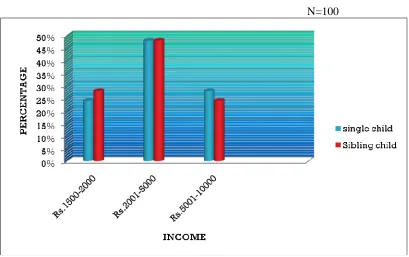
The majority of the children‘s mother monthly income was
about 24 (48%) 2001-5000 .
The majority of samples were Muslim 24 (48%).
Single child 21 (42%) was nuclear family. Sibling child 19
(38%) were joint family.
Single child 19 (38%) parents were uninvolved. Sibling child
21(42%) parents were permissive.
Single child 22 (44%) falls between the age of 9-10 yrs. Sibling
child 25 (50%) falls between the age of 9-10 yrs.
Sibling child 32 (64%) were female.
Sibling child 33 (66%) were second child.
Single child 14 (28%) was V STD. Sibling child 14 (28%)
where IV STD.
majority of single child 33 (66%) had an average behavior pattern. Sibling child 35 (70%) good behavior pattern.
There was a significant association between the behavior
pattern of a single child and selected demographic variables such as type of family, parenting style and number of children. There was no significant association between the behavior pattern of the single child and demographic variables such as age, educational status, occupation, income, religion and birth order.
There was a significant association between the behavior
pattern of sibling child and selected demographic variables mothers income. There was no significant association between the behavior pattern of sibling child and demographic variables such as age, type of family, parenting style, educational status, occupation, number of children, religion & birth order.
RECOMMENDATIONS
The following recommendations are made based on the findings of the study.
¾ A similar study can be done on a large sample.
¾ A study can be done to find out the behavior problem of the
single child family.
¾ A study can be done to find out the risk for altered growth and
children.
¾ A study can be conducted to identify the effectiveness of a
structured teaching program in modification of children’s behavior.
¾ A comparative study can be done to find out the behavior
problem of pre term and term children.
CONCLUSION
Childhood period is important in the life. During this period , the
child undergoes a remarkable change in the life. Parents and school
teachers have to understand the child problem and to solve them. Many of
single child having poor interpersonal skills, it results from the less
effective relationship. The parents must realize their problem and mingle
with them. In order to help and guide the children to lead their life in a
healthy manner both physically and mentally.
As a part of the curriculum, the researcher has taken to comparing
the s behavior pattern of a single child and sibling child as my
dissertation work. When the researcher collected the data many of the
only children having psychological problems. Each child has different
level of behavior pattern. Proper counseling is necessary to treat and
evaluate the behavioral problem. Mothers can spend as much time as
CHAPTER-I
INTRODUCTION
“If children live with security, They learn to have faith”
“If children live with acceptance & friendship, They learn to find love in the world”
“Behavior is any manifestation of life is activity” [Wood worth (1984)] and behavior is a collection name for these activities. The term behavior includes the motor (or) Cognitive activities [Like walking, Swimming, Dancing etc.], Cognitive activities [Like thinking, Reasoning, Imagining etc] and effective activities [Like feeling, happy, Sad & angry etc.]
Behavior includes not only the conscious behavior and activities of the human mind but also the sub-Conscious and unconscious. Consequently it covers not only the overt behavior but also the covert behavior involving the inner experiences and mental processes.
The growing years of a child are perhaps the most difficult a family has ever had. It is during these years that a child comes to terms with various concepts of life, like belonging, discipline Social norms etc.
The environment that a child is raised place a big part in their personal development. Consequently many children will exhibit different character traits and characteristics depending on their birth order or if they are the only child.
Birth order characteristics are most often explained by relationships with parents. Only children can be of particular interest and extreme case of first born. Later born only ever have divided attention. Twins are an extreme case of late born, no child rearing interval between them. Twins are singletons are not differed by their biological aspect but through their personality development.
First born children desire control and they will typically become a complaint nurturer or a more aggressive mover and shaker. They are usually high achievers (or) over achievers because of parental pressure and expectations and a desire to win back. Parental approval if they fail, they are being replaced by younger siblings.
The middle child will demonstrate the great variety of character traits but opposite of their older sibling. They learn to be independent and adventurous. Some as a result of greater freedom, having fewer responsibilities that first born which they often, interpret as inferiority. This often discourages the development of leadership qualities.
relationships outside the home and generally popular but infrequently have leadership qualities.
Only children have traits similar two older children but usually to a great degree. Only children need to be given plenty of opportunities to socialize with children at their own age. Although only children often mature beyond their age, do not burden your child with adult information. Remember they are still a child.
Only children have poorer interpersonal skills, results in less effective or fulfilling relationships. Only children may have to reconcile dealing with loneliness and intrusion. There is some evidence that children’s are actually under –represented among other children.
Birth of siblings results in significant changes in the family environment. Positive interactions with an older child may diminish, especially if the birth interval is short and mother adopts a more controlling and parenting style (Baydar1997).
Siblings of children with disabilities have been found to perceive that their mothers were more partial to their disabled siblings, than without disabled children. They experience more stress and have a higher risk of developing behavioral problem (Bischoff & Tingstrom 1991).
Research suggests that many popular beliefs about only child are unfounded; they are intelligent, affiliate and achieve.
Children can be confused and frustrated by the changes in their behavioural patterns as parents. It is important for parents to try and identify significant changes and deal with them appropriately.
NEED OF THE STUDY
In the medieval times childhood was not regarded as a psychologically distinct period. Children were merely viewed as under developed adults. Sigmund Freud states the world with the suggestion that experiences of the childhood account for unusual behaviors of the individual.
The child behavioral pattern will inevitably change over time and even on a daily or hourly basis at times, and it is important to recognize that is completely normal and can be a result of a wide range of events and situations.
Health information about India (1991) states that one third of the population in India is school age children, out of this 14% belongs to the age group of 6-12years. The crucial pre adolescence is a period of dynamic growth and development.
According to Erikson the development needs of children between 6-12 years is stated as Industry Vs Inferiority. Mobility and active participation in the daily activities help the child to fulfill the developmental task (Health information of India).
India’s various studies reveal that 5-25% of children suffer from some kind of psychiatric disorder or maladjustment. Maladjustment can be evidenced by deviation in behavior (Julia & Murthy RS).
World around 13-14% of all school children had behavioral problem. A cross sectional study was conducted in the urban squatter settlements. Behavioral problems of these children were estimated by using the self reported under a version of the strengths and difficulties questionnaires.
The prevalence of behavioural problems among working children was found to be 9.8%. Peer problems were most prevalent 16.9% seconded by conduct problem 16.7%.
The prevalence of the behavioral pattern of school children identified that overall prevalence was 20.11% among boys and 19.67% among girls. Total prevalence was 19.89% as per parents report. As per teacher report total prevalence was 17.3% as per Fernades (2005)
Developing country the prevalence of behavioural problem
Age Group Prevalence of Behavioural Problem
10-13 Yrs 242
14-17 Yrs 196
Reported 5.8 million (15%)of all children between the ages of 5-14 years have a behavioral problem . Average 65% of children spent time between 2-9 hrs home alone as per census survey about United States (2002)
10% of children extremely suffer the alter behavioral pattern that put a strain on their family situation.BBC reported in 2003 about 70% children with ADHD in the children’s are living in a single child. About 18% American families had only children, as compared with21% in1981. Some parents are selecting single child because of reduced conflict in dividing time and attention among children, greater financial flexibility as per National statistics (2004)
3% of children are dangerously violent towards a sibling This excludes slaps, pushes, kicks, bites, and punches, which are more prevalent. 36 million individual acts of sibling’s aggression as per State university (1994)
During the researcher’s clinical experience she had come across many children with altered behavioral pattern. And she he interacted with them she found that the children were very depressed and had the feeling of separation, not mingling with others loneliness, not sharing the feelings and not interested to go to school. So the researcher decided to choose this topic to compare the behavior pattern of a single child and the child with siblings.
“As the only son of prosperous parents is adopted to be split especially so in India”.
STATEMENT OF THE PROBLEM
A comparative study to assess the behavioral pattern of a single child and the child with sibling between the age group of 6-12 yrs in selected areas at Manamadurai.
OBJECTIVES
¾ To assess the behavioral pattern of a single child.
¾ To assess the behavioral pattern of children with siblings.
¾ To compare the behavioral pattern of a single child and the
child with sibling between the age group between 6-12 yrs.
¾ To find out the association between the behavioral pattern of
a single child and their selected demographic variables such as mother’s age, educational status, occupation, income, parenting style, and child age, sex, type of family, birth order and educational status.
¾ To find out the association between the behavioral pattern of
HYPOTHESES
There will be a significant difference between the single
child and the child with siblings in behavioral pattern.
There will be a significant association between the
behavioral pattern of a single child and their selected demographic variable such as mother’s age, educational status, and occupation, parenting style, and child age, sex, type of family, birth order & educational status.
There will be a significant association between the
behavioral Pattern of children with siblings and their selected demographic variables such as mother’s age, educational status, and occupation income, parenting style, and child age, sex, type of family, birth order & educational status.
OPERATIONAL DEFINITION 1. Behavioral Pattern
Behavioral pattern refers to the activities of children such as obedience, friendliness, mingling with others, punctuality, proper schooling, absenteeism, adamant, helping others, exploring, independent
making choice arts as measured by behavioral check list.
2. Single Child
3. Child with siblings
It refers to children those who are living with brothers and Sisters in their family between the age group of 6-12years.
ASSUMPTIONS
Behavioral patterns of single child will differ from child with
siblings.
LIMITATIONS
The study was limited to children between the age group of 6-12years.
The study was limited to school children studying in selected area at Manamadurai.
The study was limited to 6 weeks of data collection.
PROJECTED OUTCOME
¾ The findings of the study will help the researcher to determine the
behavioral pattern of a single child and the child with siblings.
¾ The study will help the health professional especially nurses to
make measures to improve the child’s behavior.
¾ The experiences would be a stepping stone to conduct more
CONCEPTUAL FRAME WORK
A conceptual framework is an interrelated concept or abstractions that are assembled together in some rational scheme by virtue of their relevance to a common theme (polite and hunger, 1995)
A conceptual framework for a particular study is the abstract and logical structure that enables researchers to link findings to the body of knowledge in nursing. It is developed from the existing theory and helps in identifying and defining the concept and interest and proposing relationship among them. The models give direction for planning research design, data collection and interpreting the findings. The present study is based on Rosen stock’s and Becker and Health Belief Model (1974).
Rosen stock’s and Becker and Health Belief Model (1974) addresses the relationship between a person’s belief and behavior. It provides a way of behavior in relation to their health and how they will comply with health care therapies.
Individual perception
The first component of this model involves the individual perception. In this individual perception it consists of behavioral pattern like obedience, friendliness, mingling with others, punctuality, proper schooling, absenteeism, adamant, helping others, exploring, independent making a choice. They are thought to be influenced by certain demographic variables such as mother’s age, educational status, and occupation, parenting style, and child age, sex, type of family, birth order & educational status. Individual perception may vary with these systems.
The second component of this model consists of modifying factors. Modifying factors are the knowledge level of behavioral pattern. These factors can be modified through education. Behavioral pattern assessed through behavioral checklist. Behavioral pattern was graded as good, normal, poor.
Likelihood of action
CHAPTER-II
REVIEW OF LITERATURE
A literature review involves a systematic, identification, location, scrutiny and summary of written material that contains information on research problems.
-Polite and beck (2009) Review of literature serves as evidence and essential background for any research. It is an important step in the development of a research project. The review is broad, systematic and critical collection and evaluation of the important, published scholarly literature and unpublished research findings.
The development of each individual child follows a unique path, yet there are common identifiable and predictable patterns of change that occur with age (Springer –Verlag 1992).
When children reach the age of six they learn to trust others and develop a sense of autonomy. The stage that the children pass through before they reach 6 years are probably the most important for healthy personality development. Children who do not achieve the expected level of each stage are likely to remain handicapped, unless help is given to them.
norm and as a result of his difference the child, is either suffering or development is being affected significantly’’.
Cottrell (2000) describes that the behavior problems are more prevalent among school children. Children in the age group of 4-6 years have 7% of prevalence rate. Children in the age group of 7-12 years have 27% of prevalence rate.
LITERATURE RELATED TO BEHAVIOUR PROBLEM OF SCHOOL AGE
World health organization (WHO) statistics (2006) report on Aboriginal and Torres strait IS lender children aged 4-14 years were more likely to have a behavioral problem as long term condition than other non indigenous children.
¾ 14% Australian children and adolescents have behavioral
problems. Boys are more likely to experience behavioral problem than girls.
National statistics (2004) reported on 10 % of children in the UK suffer extreme behavioral or emotional problems that put a strain on their family.
¾ British Medical Association (BBA) 2006 reported in Million
children encountering behavioral problems including depression, violence. Self harm.
International statistics (2009) reported on over1000 members had been receiving end of physical violence by a student .
Review of literature deals with related literature that was reviewed to broader the understanding and to gain insight into the selected area under study. Therefore literature was reviewed and relevant extract pertaining to present study was presented under the following area.
• Studies related to behavior problem to 6-12 yrs children.
• Studies related to single child.
• Studies related to children with siblings.
STUDIES RELATED TO BEHAVIOUR PROBLEM OF 6-12 YRS CHILDREN;
Averdijk M., Et al (2011) assessed the relationship between parental separation and aggressive and internalizing behaviors. Parents retrospectively reported life events and problem behavior for first 10 years of the child’s life on a quarterly basis using an event history calendar. The time sequences of separation and child problem behavior were analyzed .Parental separation affected both aggressive and internalizing behaviors even maternal depression, financial difficulties, parental conflict were included. Parental separation exerted a differ effected on child problem behavior as well as maternal depression.
Feldman HM et al., (2011) Assessed the risk for behavior problems in preterm children. Studies examining contributions of intellectual and environmental factors to behavioral outcomes. Using the child behavior checklist. Parents' reports for 63 preterm children were compared to 29 full term children of similar age, gender and intellectual ability to behavioral symptom scores. It shows preterm children had higher total and internalizing scores compared to a full term child. And had lower IQ. Conclude as preterm children had increased behavioral problem.
Garner RE.,Et al (2010) held a study on the parenting behaviors influence child well-being and development. Parenting behaviors (positive interactions, consistency and ineffective parenting) among caregivers of children with neurodevelopment disorders and/or externalizing behavior problems. These associations largely remained after accounting for child and family social-demographic characteristics. He concludes as children with multiple health conditions can be associated with less positive, less consistent and more ineffective parenting.
Concluded as adverse events, these medications have to be used with caution.
Luangrath A., et al(2008) Conducted a study of Australian children aged 4-12 years experience externalizing behavioural problems such as aggression and hyperactivity. Similarly, around 12% experience internalizing problems such as anxiety and depression. Another common behavior problems, such as temper tantrums, arise as the child strives to achieve developmental milestones. He concludes as behavioral difficulties arise as a result of an interaction between biological vulnerabilities and environmental stresses. In most cases, behavioral difficulties are temporary, and occur as children.
Sophia (2008) conducted a study on behavioral problem among 60 school children. The stratified random sampling technique was used . Behavioral problem was measured by modifying Reutter scale. The mean behavioral problem was average 21.53 (SD=5. 40) among school children’s.
more effective. Individual competence was independently associated with decreased internalizing
Aalsma MC et al., (2006) Surveyed parental practices on problem behavior based on gender and age effects with urban child. Participants were 8-13 years old (N = 3,658; 66%) and logistic regression models were conducted. Females, decreased friend monitoring was related to high problem behavior, maternal support and decreased home monitoring were significant. And where males are lack of home monitoring. Strategies for preventing problem behavior within urban communities will be more effective if they are tailored to gender and development factors.
Catrin (2005) studied on parenting behavior and school children behavioral and emotional problems among 1359 boys and girls aged 10-14 years in the Netherlands, to investigate their parenting are directly or indirectly associated with the emotional (depression , stress , low self esteem) and behavioral (delinquency, aggression) problems . Self reported questionnaire was used to assess parenting behavior. Descriptive analysis and multiple regression analysis were used . The value of delinquency M (428), S.D (39) in boys (1.08) S.D (0.20) in girls value (11.22). Aggression M (1.31), S.D (. 29) for boys M (1.20), S.D (0.22) at (7.53) . The analysis yielded a comparable patters for the relations between parenting and stress and self esteem.
Co relational analysis and hierarchical regression and analysis was used. The results provided strong support for the cross cultural validity of parenting styles.
STUDIES RELATED TO SINGLE CHILD
Guest (2009) analyzed on the personality characteristics of only children. It provides a baseline, archival resource on 16 different personality domains and personality development. Results found that only children scored significantly better than another group achievement motivation and personal development. Achievement motivation especially reliable, persisting several groups conclude as only children were comparable in most respects to their sibling counterparts.
the child, and that maturation and family size have an interacting influences on social development. 3 recent studies have shown that only children in the US are advantaged in terms of educational attainment. 4 recent literature reviews have concluded that only children are no different from others in personality characteristics. They appear from research results to be no more lonely or maladjusted than other children, although they may be less sociable. The concept of selfishness is difficult to operationalize and measure objectively the flawed studies attempting to do so have yielded mixed evidence regarding the selfishness of an only child
Hesketh T., Et al (2007) conducted a study to determine levels of behavior problem in primary school children, and to explore key determinants relevant to the Chinese context being an only child, urban living, school stresses, being bullied and physical punishment. Scores showed that 13.2% of the children had a behavior problem. Girls manifest more emotional problems (2.3%) and boys more conduct problems. Emotional problems were most strongly associated with being an only child was not associated with behavior problems.
used to be considered uninformative under the assumption of linkage equilibrium.
Alexandria VA (2006) conducted a negative stereotype of only children are pervasive despite a growing trend towards single child families and evidenced of the only child’s strengths. People maintain definite beliefs about the characteristics of each ordinal position in a family, typically viewing only children as lonely, spoiled, and maladjusted. Literature provided an accurate understanding of stereotype of only children, their assets, and the challenges they face.
Baraka S (2006) China has an increasing number of households with only one child. Most experts on child rearing, that children from one-child families are cause for public concern. The main problem is with parents' attitudes, prejudices, and perceptions about the kind of education they think should be provided to their children. Parents' education directly influences children. 70% of parents want their children to go to college, while more than 90% are most concerned with their children's academic performance. These parental preoccupations and attendant demands weigh heavily upon children. Teenagers from one-child families responding to a survey of Sister Zhixin's hotline complained that parents regard them as slaves instead of as independent human beings and that they are lonely at home. While it may be true that parents of single children in China regard their children as property, anecdotal evidence suggests that this perspective on parenthood is changing for the better.
years. The proportion of the population over 60 years of age should increase from 7.6% to a peak of 25.3% by 2040. As a result, by the mid-21st century, a labor force comprised of half the population will be supporting equal numbers of young and aged people. Although political and economic utility factors make it unlikely that China's fertility rate will ever fall below 2.0, the steady aging of society will have long-term social as well as demographic consequences. Increased material and emotional investment in children, brought about by the one-child policy, may compete with investments in the needs of the aged. Recommended is a consolidation of a three-generation family system in which grandparents help to maintain family interdependence and provide child care in exchange for support from their adult children.
STUDIES RELATED TO CHILD WITH SIBLINGS;
Richmond MK, Stocker CM (2008) conducted a longitudinal association between parents hostility and siblings externalizing behavior in the context of marital discord. The sample included 116 families (mothers , fathers & siblings) assessed in middle childhood, when siblings on average 8 & 10yrs .Results indicated both within the family and between family effects specifically the child .Who received more parental hostility than his or her siblings showed greater increases in externalizing problems than his or siblings.
socioeconomic status and a positive effect is small. Negative families with a higher socioeconomic status compared to single child families with the same background. The hypothesis is that parents of larger families spend on average less time with their children is also tested and shows that expected negative effect of the sibling size.
Gas’s K et al (2007) conducted a longitudinal study on sibling relationships protective. Although the protective effects of family and parental support have been studied extensively in the child psychopathology literature, few studies have explored the protective quality of positive sibling relationships on the child adjustment for children experiencing stressful life event and child adjustments. Older siblings assessed the quality of relationships between stressful events. The protective effect of positive sibling was evident regardless of mother-child relationship quality. Positive sibling relationship is the important source of support for children experiencing stressful life events.
Julia et al (2007) conducted a study into sibling rivalry and birth order. In the research how birth order influences an individual’s personality and the way react academic sibling rivalry. She found that last born siblings are more likely to feel academic rivalry . She found that last born sibling are more likely to feel academic rivalry compared to first born. She noted distinct variation of the first born to last. First born were also shown to be more dutiful.
education, development, psychotherapy and health. She also tested to see whether there was any evidence that first born are less agreeable than last born to which there seemed to be no difference between two. The research also revealed that last born more open to experiences just not statistically so.
Kim JY et al (2007) conducted a study on longitudinal linkages between sibling relationships and adjustment from middle childhood to adolescence. The links between changes in sibling conflict and intimacy and changes in perceived peer social competence and depression symptoms were examined from middle childhood through adolescence. Participants were mother, father and first and second born siblings. Sibling relationship, sibling and parent adjustment, increase in sibling conflict were linked to increases in sibling intimacy were linked to increases in peer competence and for first girls decrease in depression symptoms.
relationship was more strongly linked with child adjustment than sibling conflict.
Sunder DK (2005) conducted studies on the consequences of antisocial behavior older male siblings for younger brothers and sisters. The siblings adolescent adjustment problems were examined in the context of parenting. Ineffective parenting during younger siblings' childhood had no direct effect on adjustment was mediated by siblings copartcipation in deviant activities with their older brothers during adolescence. Early siblings conflict and Co participation in deviant activities increased the risk for younger siblings adolescence. Early sibling conflict and Co participation in deviant activities increased the risk for younger siblings adolescent adjustment problems.
Brandie SJ (2004) Conducted a study on perceived support in sibling relationships and adolescent adjustment. Siblings may support each other, but also reveal fierce rivalry and mutual aggression. Supportive sibling relationships have been linked to the development of psychological competence of children. The relation of sibling problem was examined while controlling support from parents and friends and over time controlling for the aggressive effects of the problem. A sibling is most negatively related to externalizing the problem. Siblings problem behavior is strongly related to internalizing problems. The result indicates that adolescent's relationships with both older and younger siblings are characterized by modeling process.
CHAPTER-III
RESEARCH METHODOLOGY
The methodology of research indicates the general pattern to gather empirical data for the problem under investigation.
This chapter comprises the methodology for the study, research approach, research design, setting of the study, population, sample and sample size, sampling technique, criteria for selection of samples, selection of tooling, description of tool, testing of tools, pilot study, data collection procedure, plan for data analysis and protection of human rights. The present study aimed at assessing the behavioral pattern of a single child and sibling child between the age group of 6-12 yrs in selected areas at Manamadurai.
RESEARCH APPROACH
The quantitative research approach was adopted for this study. The purpose of the study was to assess the behavioral pattern among single child and children with siblings in the selected area at Manamadurai.
RESEARCH DESIGN
A comparative research design was used in this study. It comes under descriptive study.
SETTING OF THE STUDY
and kizhakarai and is located about 7kms away from Matha college of nursing, vannapuram, Manamadurai. The samples were taken under convenient sampling technique.
POPULATION
The target population of the study was a single child and the child with siblings in the age group of 6-12 years.
SAMPLE
The samples consisted of children those who were in the age group of 6-12years residing at Manamadurai.
SAMPLE SIZE
The samples consisted of 100 children in the age group of 6-12 years. Among them 50 samples were single child and 50 samples were child with siblings.
SAMPLING TECHNIQUE
The data were collected through a door to door survey method to identify the family with single child and the child with a sibling. After identifying the children Convenient sampling technique was used to select the samples.
CRITERIA FOR SELECTION OF SAMPLE INCLUSION CRITERIA
9 Single child in the family was included.
9 Children living with one or more siblings was included.
9 Children between the age group of 6-12 years
EXCLUSION CRITERIA
• Children with long term illness.
• Children who were not willing to participate.
• Child those who lost their siblings in their recent time.
DESCRIPTION OF TOOL
Tools were prepared based on the related literature. SECTION- A-
Demographic data such as mother’s age, educational status, occupation , income, parenting style, and child age, sex, type of family, birth order, educational status and health status.
SECTION-B
SCORING PROCEDURE SECTION B
A modified behavioral checklist was used to assess the behavior pattern of children in the age group of 6-12 yrs. There were totally 50 items. Each item had three options. A score of 2 was fixed for the very truth. A score of 1 was fixed for some time true and score of 0 for not true. The maximum possible score was 100, according to the total score they were categorized as follows.
CATEGORY SCORE • Good behavior pattern - 0 to 54
• Average behavior pattern - 55 to 77
• Poor behavior pattern - 78 to 100.
TESTING OF THE TOOL VALIDITY
The validity of the tool to assess the behavioral pattern of a single child and the child with sibling was established .To evaluate the content validity the tool was given to 5 experts in the field of nursing.
RELIABILITY
PILOT STUDY
A pilot study was conducted with10 children who fulfilled the inclusion criteria. Among them 5 children were a child with siblings and 5 children were a single child .It was conducted in the manner of which the real study was done .Those subjects were excluded from the final study.
DATA COLLECTION PROCEDURE
The data were collected from the samples using the behavioral check list to assess the behavior pattern of a single child and sibling child between the age group of 6-12years at Manamadurai.
The data collection was scheduled in the month of August 2011. Before the data collection researcher got formal permission from the Manamadurai Panchayat office. The house was visited on the first week of the data collection period.
minutes were spent. The investigator collected data from 4 – 5 samples per day. The data collection procedure was terminated by giving thanks to the respondents. The investigator found no difficulties during the data collection period. Confidentiality of the data was maintained.
PLAN FOR DATA ANALYSIS
S. No
Data
analysis Methods Remarks
1. Descriptive statistics
Frequency and percentage
Used to identify the behavior pattern of a single child.
Used to identify the behavior pattern of sibling child.
2. Inferential
statistics Independent ‘t’ test
Used to compare the behavior pattern of a single child and sibling child.
Chi-square
Used to associate the behavior of a single child and selected demographic variables.
Used to associate the behavior pattern of sibling child and selected demographic variables.
PROTECTION AND SUBJECT RIGHTS
CHAPTER-IV
DATA ANALYSIS AND INTERPRETATION
Data analysis is the systematic organization and synthesis of research data and testing of research hypothesis using those data. Interpretation is the process of making sense of the result and examining their implication. Analysis is the method of rendering qualitative data meaningful and providing intelligible information, so that the research problem can be studied and tested, including the relationship between the variables.
According to Denis polite (2005) Analysis is the method of organizing, sorting, and scrutinizing data in such a way that the research question can be answered.
The analysis and interpretation of the study were based on the data collected through a modified behavioral checklist to assess the behavioral pattern of a single child and a child with siblings. The result was computed by using descriptive and inferential statistics based on the objectives of the study.
THE OBJECTIVES OF THE STUDY
¾ To assess the behavioral pattern of a single child.
¾ To assess the behavioral pattern of child with siblings.
¾ To compare the behavioral pattern of a single child and the child
with siblings between the age group between 6-12 yrs.
¾ To find out the association between the behavioral pattern of a
¾ To find out the association between the behavioral pattern of
children with siblings and their selected demographic variables such as mother’s age, educational status, occupation, income, parenting style, and child age, sex, type of family, birth order and educational status.
ORGANIZATION OF THE STUDY FINDINGS
Section I- Distribution of samples on selected Demographic variables. Section II- Level of behavioral pattern of single child &child with
siblings.
Section III- Compare the behavioral pattern of a single child and the child with siblings.
Section IV- Association between the behavioral pattern of single child and the selected demographic variables.
Section V- Association between the behavioral pattern of child with siblings and selected demographic variables.
SECTION 1
Table 1: Distribution of samples on selected demographic variables of single child and child with siblings.
S.
No Demographic variables
Single child N=50
Child with siblings
N=50
F % F %
1.
MOTHER Age
a) 20- 23 yrs b) 24-27 yrs c) 28-31 yrs d) Above 32 yrs
11 5 22 12 22 10 44 24 8 8 21 13 16 16 42 26 2. Educational status
a) Illiterate b) Primary c) Secondary
d) Higher secondary e) Graduate 7 9 18 11 5 14 18 36 22 10 6 12 18 8 6 12 24 36 16 12 3. Occupation a) Home maker b) Cooly worker c) Professional d) Any other
4. Monthly income a) Rs. 1500-2000 b) Rs. 2001-5000 c) Rs. 5001-10000
12 24 14 24 48 28 14 24 12 28 48 24 5. Religion a) Hindu b) Muslim c) Christian 12 24 14 24 48 28 14 24 12 28 48 24 6. Type of family
a) Nuclear family b) Joint family c) Extended family
21 16 13 42 32 26 21 23 6 42 46 12 7. Parenting style
a) Authoritarian b) Permissive c) Uninvolved 13 18 19 26 36 38 14 21 15 28 42 30 1. CHILD Age
a) 6-8 yrs b) 9-10 yrs c) 11-12 yrs
3. Birth order a) First child b) Second child c) Third child
50 - - 100 - - 14 33 3 28 66 6 4. Educational status
a) I std b) II std c) III std d) IV std e) V std
6 9 10 11 14 12 18 20 22 28 2 11 13 14 10 4 22 26 28 20 5. Number of children in the
family
a) One child b) Two child c) Three child
d) Four child & above
Table -1 Shows on selected demographic variables of a single child and sibling child:
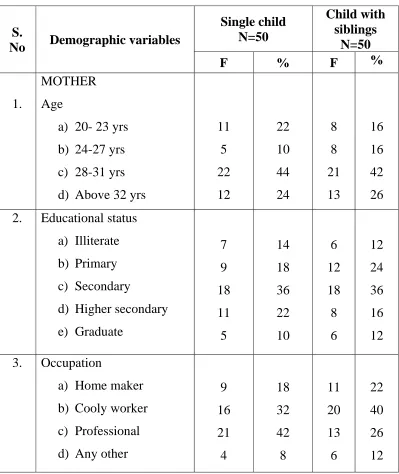
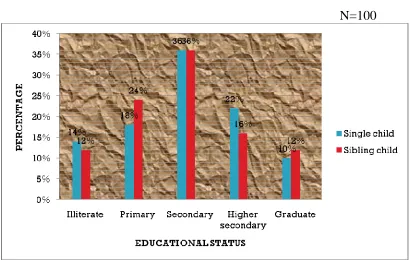
About the mother of single child 11 (22%) were in the age group of 20- 23 yrs, 5 (10%) were in the age group of 24-27 yrs, 22 (44%) were in the age group of 28-31 yrs 12 (24%) were in the age group of above 32 yrs. Among educational status 7 (14%) were illiterate, 9 (18%) were primary, 18 (36%) were secondary, 11 (22%) were higher secondary and 5 (10%) were graduates.
Among the mothers with sibling child 8 (16%) were in the age group of 20- 23 yrs, 8 (16%) were in the age group of 24-27 yrs, 21 (42%) were in the age group of 28-31 yrs 13 (26%) were in the age group of above 32 yrs. Their educational status 6 (12%) was illiterate, 12 (24%) were primary, 18 (36%) were secondary, 8 (16%) were higher secondary and 6 (12%) had graduated.
Regarding the occupation of single child mothers, home maker were 9 (18%), cooly worker were16 (32%), professional were 21 (42%), any other 4 (8%) and sibling child mothers, home maker were 11 (22%), cooly worker was20 (40%), professional were 13 (26%), any other 6 (12%).
As for the religion of single child mothers 12 (24%) were Hindu, 24 (48%) were Muslim, 14 (28%) belong to Christian and sibling child mothers 14 (28%) belong to Hindu, 24 (48%) belong to Muslim, 12 (24%) belong to Christian.
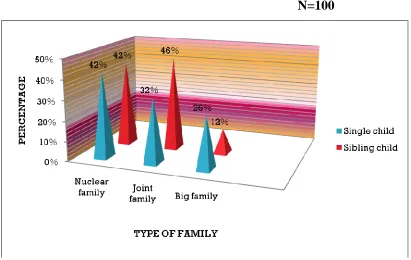
Maximum number of single child mothers 21(42%) were belongs to the nuclear family, 16(32%) were joint family, 13(26%) were extended family and the sibling child mother were maximum 23(46%) were in the joint family, 21(42%) were nuclear family,6(12%) were in the extended family.
About the parenting style of single child mothers, majority 19(38%) were uninvolved, 18(36%) were permissive, 13(26%) were authoritarian and parenting style of sibling child mothers majority 21(42%) were permissive, 15(30%) were uninvolved, 14(28%) were authoritarian.
Regarding the child; the single child 16 (32%) was between the age group of 6-8 yrs, 22 (44%) were between the age group of 9-10 yrs, 12 (24%) were between the age group of 11-12 yrs between them 25 (50%) male children, 25 (50%) were female children. And the sibling child16 (32%) were between the age group of 6-8 yrs, 25 (50%) were between the age group of 9-10 yrs, 9 (18%) were between the age group of 11-12 yrs between them 18 (36%) were male and 32 (64%) were female.
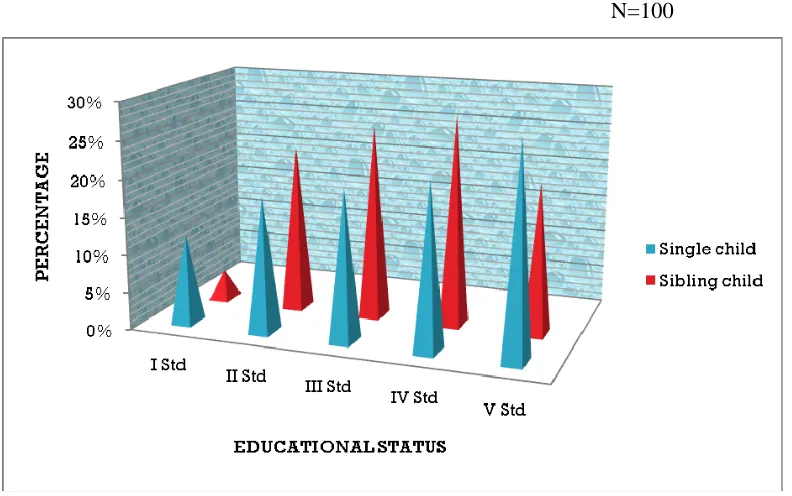
Regarding the educational status of single child, 6(12%) were in I std,9(18%) were in II std, 10(20%) were in III std , 11(22%) were in IV std ,14(28%) V std and the educational status of sibling child, 2(4%) were in I std, 11(22%) were in II std, 13(26%) were in III std , 14(28%) were IV std ,10(20%) V std.
Fig.2 Distribution of samples according to mother’s age.
N=100
[image:59.612.127.537.394.654.2]Fig. 4Distribution of samples according to educational status. N=100
Fig.5 Distribution of samples according to educational status.
[image:60.612.128.537.397.654.2]Fig.6 Distribution of samples according to religion.
N=100
[image:61.612.127.538.418.678.2]Fig.8 Distribution of samples according to parenting style.
[image:62.612.129.541.396.661.2]N=100
Fig.9 Distribution of samples according to child age.
Fig.10 Distribution of samples according to sex. N=100
Fig.11Distribution of samples according to birth order.
[image:63.612.124.538.416.672.2]Fig.12 Distribution of samples according to educational status.
N=100
Fig.13 Distributions of samples according to no of children in the family.
[image:64.612.127.523.424.672.2]SECTION II
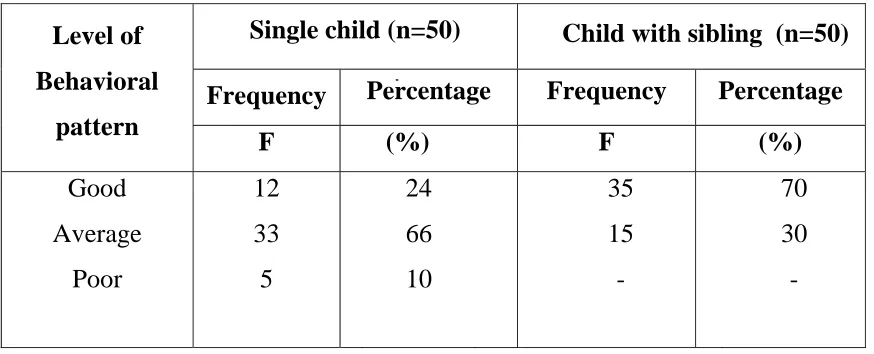
Table 2; Level of behavioral pattern of single child & child with siblings.
Level of Behavioral
pattern
Single child (n=50) Child with sibling (n=50) Frequency Percentage Frequency Percentage
F (%) F (%)
Good Average
Poor
12 33 5
24 66 10
35 15 -
70 30 -
Based on the score obtained, the behavior pattern was divided into three categories that were Good behavior, Average behavior and Poor behavior.
The data presented that among the 50 subject of single child, 12 (24%) had good behavior, 33 (66%) had average behavior, 5 (10%) of the subjects had poor behavior, and among 50 subject of sibling child, 35 (70%) had good behavior, 15 (30%) had average behavior, no subject had poor behavior.
Fig.14
Distributions of samples according to level of behavior pattern Of single child.
N = 50
24%
66% 10%
Single
child
Good Average Poor
Fig.15
Distributions of samples according to level of behaviorr pattern of child with siblings
N = 50
70% 30%
[image:66.612.130.507.473.700.2]SECTION III
Table 3: Compare the behavior pattern of a single child and the child with siblings.
S. No Group N Mean SD
Independent ‘ t’value Calculated
value
Table value 1 Single child
behavior 50 63.04 10.66
6.444*
(0.001) 3.39 2 Child with
siblings behavior
50 49.56 10.27
*Significant at 1%level
The table shows that independent ‘t’ test was used to find out the difference in the behavior pattern of a single child and sibling child. The mean score of single child behavior was 63.04 and SD was10. 66 and the mean score sibling child behavior was 49.56 and SD 10.27 was found. The observed ‘t’ value was 6.444.This calculated value was greater than the table value at 1% level of significance, which showed that it was highly significant. So the researcher accepted the research hypothesis and concluded that there was a significant difference in behavior pattern between single child and sibling child.
SECTION IV
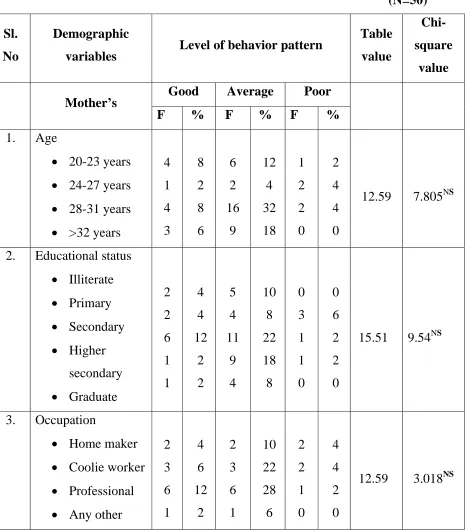
Table 4: associations between single child behavior pattern and selected demographic variables.
(N=50) Sl.
No
Demographic
variables Level of behavior pattern
Table value
Chi-square
value
Mother’s Good Average Poor
F % F % F %
1. Age
• 20-23 years • 24-27 years • 28-31 years • >32 years
4 1 4 3 8 2 8 6 6 2 16 9 12 4 32 18 1 2 2 0 2 4 4 0
12.59 7.805NS
2. Educational status • Illiterate • Primary • Secondary • Higher secondary • Graduate 2 2 6 1 1 4 4 12 2 2 5 4 11 9 4 10 8 22 18 8 0 3 1 1 0 0 6 2 2 0
15.51 9.54NS
3. Occupation • Home maker • Coolie worker • Professional • Any other
2 3 6 1 4 6 12 2 2 3 6 1 10 22 28 6 2 2 1 0 4 4 2 0
[image:68.612.91.556.144.674.2]4. Income • Rs.1500-2000 • Rs.2001-5000 Rs.5000-10000 2 3 1 4 6 2 7 16 10 14 32 20 1 2 2 2 4 4
9.49 1.524 NS
5. Religion • Hindu • Muslim • Christian 4 4 4 8 8 8 12 3 8 24 6 16 0 0 5 0 0 10 9.49 9.185NS
6. Type of family • Nuclear
family • Joint family
• Extended family 8 3 1 16 6 2 13 9 11 26 18 22 0 4 1 0 8 2
9.49 10.098S
7. Parenting style • Authoritarian • Permissive • Uninvolved 1 9 2 2 18 4 12 7 14 24 14 28 0 2 3 0 4 6
9.49 13.446S
1. CHILD 5 5 2 10 10 4 11 13 9 22 26 18 0 4 1 0 8 2
9.49 4.065NS Age
S= Significant at 0.05 level
NS= Non - significant at 0.05 level 2. Sex • Male • Female 7 5 14 10 15 18 30 36 3 2 6 4
5.99 1.17NS
3. Birth order • First • Second • Third 12 - - 24 - - 33 - - 66 - - 5 - - 10 - -
9.49 0NS
4. Educational status • 1st std
• 2nd std • 3rd std • 4th std • 5th std
2 2 4 2 2 4 4 8 4 4 4 7 5 8 9 8 14 10 16 18 0 0 1 1 3 0 0 2 2 6
15.51 5.998NS
5. No. of children in family
The data presented in the table showed that the chi-square test was carried out to find out the association between the single child behavior pattern and selected demographic variables.
The result showed that there was a significant association between the behavior pattern of a single child and selected demographic variables such as type of family & parenting style. There was no significant association between demographic variables and the behavior pattern such as age, educational status, occupation, income, religion and birth order of a single child.
SECTION - V
Table 5; associations between child with siblings behavior pattern and demographic variables [N=50]
Sl. No
Demographic
variables Level of behavior pattern
Table value
Chi-square
value
Mother’s Good Average
F % F %
1 Age
• 20-23 years • 24-27 years • 28-31 years • >32 years
7 6 15 7 14 12 30 14 1 2 6 6 2 4 12 12
7.82 2.898NS
2 Educational status • Illiterate • Primary • Secondary • Higher secondary • Graduate 6 9 13 5 2 12 18 26 10 4 - 3 5 3 4 - 6 10 6 8 9.49
6.812NS
3. Occupation
• Home maker • Coolie worker • Professional • Any other
11 14 7 3 22 28 14 6 - 6 6 3 - 12 12 6
4. Income • Rs.1500-2000 • Rs.2001-5000 • Rs.5000-10000 14 14 7 28 28 14 - 10 5 - 20 10
5.99 8.33 S
5. Religion • Hindu • Muslim • Christian 19 7 9 38 14 18 4 4 7 8 8 14
5.99 3.39NS
6.
Type of family
• Nuclear family • Joint family • Extended family 18 13 4 36 26 8 3 10 2 6 20 4
5.99 4.491NS
7. Parenting style • Authoritarian • Permissive • Uninvolved 11 13 11 22 26 22 3 10 2 6 20 4
5.99 1.225NS
1. CHILD 13 15 7 26 30 14 3 10 2 6 20 4
5.99 2.414NS Age
S= Significant at 0.05 level
NS= Non - significant at 0.05 level
2. Sex
• Male • Female 14 21 28 42 4 11 8
22 3.84 0.81NS
3. Birth order • First • Second • Third 9 23 3 18 46 6 5 10 - 10 20 -
5.99 1.505NS
4.
Educational status • 1st std • 2nd std • 3rd std • 4th std • 5th std
1 8 10 7 9 2 16 20 14 18 1 3 3 7 1 2 6 6 14 2
9.49 5.288NS
5.
No. of children in family
• One • Two • Three
• Four & above
1 22 10 2 2 44 20 4 - 12 - 3 - 24 - 6
The data presented in the table showed that the chi-square test was carried out to find out the association between the child with siblings behavior pattern and selected demographic variables.
The result showed that there was a significant association between the behavior pattern of sibling child and selected demographic variables of mother’s income. There was no significant association between the behavior pattern of sibling child such as age, type of family, parenting style, educational status, occupation, number of children, religion & birth order and the selected demographic variables.
CHAPTER-V
DISCUSSION
This chapter presents the interpretation of the statistical findings. It has been discussed based on the objectives of the study.
The aim of this study was to assess the behavior pattern of a single child and the child with siblings between the age group of 6-12 years in selected areas at Manamadurai.
The research design used in this study was comparative research design. The study population was between the age group of 6-12 years. The sample size was 100. A convenient sampling technique was used to collect the data.
The findings of the study had been discussed in terms of the Objectives and hypotheses of the study.
Objectives
¾ To assess the behavioral pattern of a single child.
¾ To assess the behavioral pattern of child with siblings.
¾ To compare the behavioral pattern of a single child and child with
a sibling's child between the age group between 6-12 yrs.
¾ To find out the association between the behavioral pattern of a
¾ To find out the association between the behavioral pattern of
children with siblings and their selected demographic variables such as mother’s age, educational status, occupation, income, parenting style, and child age, sex, type of family, birth order and educational status.
The results of the study are discussed below
Objective 1 To assess the behavioral pattern of a single child.
Table 2 showed the single child behavior 12 (24%) children had good behavior pattern, 33 (66%) had an average behavior pattern, and 5 (10%) had poor behavior pattern.
Guest (2009) analyzed on the personality characteristics of only children. It provides a baseline, archival resource on 16 different personality domains and personality development. Results found that only children scored significantly better than another group achievement, motivation and personal development. Achievement motivation especially reliable, persisting several groups, conclude as only children were comparable in most respects to their sibling counterparts.
Hence the researcher concluded that the majority of single child had an average behavior pattern and some of children had poor behavior pattern. So the researcher gave guidance to the mother to provide psychological support for the child in order to modify the child’s behavior.
Objective2 To assess the behavioral pattern of children with siblings
Table 2 showed the child with sibling behavior 35 (70%) children had good behavior pattern, 15 (30%) had an average behavior pattern, and no poor behavior pattern.
Richmond MK, Stocker CM (2008) conducted a longitudinal association between parents hostility and siblings externalizing behavior in the context of marital discord. The sample included 116 families (mothers , fathers & siblings) assessed in middle childhood, when siblings on average 8 & 10yrs .Results indicated both within the family and between family effects specifically the child .Who received more parental hostility than his or her siblings showed greater increases in externalizing problems than his or sibling.
the same background. The hypothesis is that parents of larger families spend on average less time with their children is also tested and shows that expected negative effect of the sibling size.
Hence the researcher concluded that the majority of sibling children had good behavior pattern. Since children are mingling with others and sharing their feelings they have good behavior pattern.
Objective3 To compare the behavioral pattern of a single child and the child with siblings
The hypothesis stated was, there will be a significant difference between the behavior of pattern single child and children with siblings. The mean score of single child behavior was 63.04 and SD was 10.66 and the mean score of sibling child behavior was 49.56 and SD was 10.27. The observed ‘t’ value was 6.444.this calculated value is greater than the table value at 1% level of signi