0022-538X/97/$04.0010
Copyright © 1997, American Society for Microbiology
The Epstein-Barr Virus-Induced Ca
2
1
/Calmodulin-Dependent Kinase
Type IV/Gr Promotes a Ca
2
1
-Dependent Switch
from Latency to Viral Replication
TALAL CHATILA,1* NGA HO,1PINGTAN LIU,2SHAOFAN LIU,2GEORGE MOSIALOS,3
ELLIOTT KIEFF,3ANDSAMUEL H. SPECK2
Department of Pediatrics1and Department of Pathology,2Center for Immunology, Washington University
School of Medicine, St. Louis, Missouri 63110, and Departments of Medicine and Microbiology and Molecular Genetics, Harvard Medical School, Boston, Massachusetts 021153
Received 27 February 1997/Accepted 5 June 1997
The switch from latency to viral replication in Epstein-Barr virus (EBV)-transformed human B cells is mediated by Zta, the protein product of immediate-early EBV gene BZLF1. BZLF1 transcription is normally suppressed in EBV-transformed B cells but can be induced in some cell lines upon ligation of surface immu-noglobulin by mechanisms that include the activation of Ca21
-dependent signaling pathways. The multifunc-tional Ca21
/calmodulin-dependent kinase type IV/Gr (CaMKIV/Gr) is normally absent in primary human B cells, but its expression is induced by the EBV oncoprotein LMP1 in the course of B-cell growth transformation by EBV. In this study, we demonstrate that activated CaMKIV/Gr induces transcription from the BZLF1 promoter and upregulates the expression of Zta in permissive cells. Transcriptional activation of the BZLF1 promoter by CaMKIV/Gr is dependent on the CREB/AP1 binding element ZII and is greatly augmented by the Ca21
/calmodulin-dependent phosphatase calcineurin. These results outline a virus-regulated mechanism involving CaMKIV/Gr which promotes transition from latency to productive viral replication in response to Ca21
-mobilizing extracellular signals.
Epstein-Barr virus (EBV) is a lymphotropic human herpes-virus that latently infects B lymphocytes, resulting in a con-comitant growth transformation of the infected cells. Infection is closely associated with several human cancers, including nasopharyngeal carcinoma and African Burkitt’s lymphoma, and also plays a role in several lymphoproliferative diseases in immunocompromised individuals (for a review, see reference 30). Propagation of virus from host to host is dependent upon the activation of an estimated 100 or more viral genes, culmi-nating in the production of infectious virions (1, 2, 6, 27). During latency, little or no viral replication takes place. Rather, immortalization is achieved through the expression of a small subset of viral genes which serve to establish and maintain cellular transformation (for a review, see reference 28). However, a switch in the genetic program leading to the expression of viral replication-associated genes can be accom-plished in vitro by treatment of latently infected cells with various activating agents, including phorbol esters, Ca21
iono-phores, and anti-immunoglobulin (anti-Ig) antibodies (14, 50, 52, 57).
Activation of the viral lytic cascade by cross-linking surface Ig results in the initial expression of two viral genes, BZLF1 and BRLF1, which exhibit similar induction kinetics (peak mRNA levels occur at 2 to 4 h postinduction) (19, 50). The protein products of both the BZLF1 gene (referred to here as Zta, but also known as ZEBRA and EB1) and the BRLF1 gene (referred to as Rta) are transcriptional activators (5, 8, 15, 22, 25, 51). Expression of Zta and Rta leads to the activation of early genes and ultimately viral replication. Of all the viral transactivators examined, Zta is unique in that its expression
alone can initiate the lytic cascade (7, 8, 41), and regulation of Zta expression appears to be central to regulating entry into the lytic cycle. Zta shares structural similarities with transcrip-tion factors of the basic leucine zipper family of proteins (bZIP). It is most closely related to proteins of the fos/jun
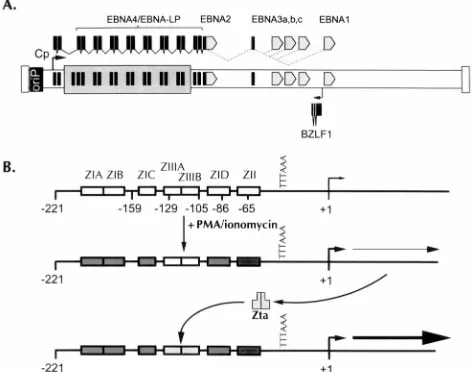
extended family, particularly Fos, with which it has strong homology in the DNA binding domain (4, 15, 17, 31, 32). Zta dimers bind to and activate transcription from AP1 sites (15, 55), as well as from specialized Z response elements present in the lytic origin of DNA replication in the EBV genome (33). The BZLF1 promoter (Zp) exhibits a very low level of basal activity, which is potently upregulated by inducers of the viral lytic cycle (3, 10, 18, 48). The region from2221 to112 bp of Zp harbors the necessary ciselements for maintaining a low level of basal activity and for transcriptional activation by lytic-cycle-inducing agents. Within this sequence, three distinct types of response elements have been defined (see Fig. 1) (16, 18). The first are A1T-rich sequences termed ZI domains, four related copies of which are interspersed in the promoter (ZIA-D). The second is represented by a unique element, ZII, which has homology with consensus CREB/AP1 binding sites (3, 18, 46). The third is composed of two sites, termed ZIIIA and ZIIIB, which bind the BZLF1 gene product, Zta, and mediate autoactivation of the BZLF1 promoter by the gene product (16). Induction of the BZLF1 gene appears to involve two steps: (i) initial activation of the promoter by inducers of the lytic cycle, mediated through the ZI and ZII domains, which results in low-level transcription of the BZLF1 gene, followed by (ii) autoactivation of the BZLF1 promoter by Zta upon binding to the ZIIIA and ZIIIB domains (Fig. 1). The duration and magnitude of the initial signal may determine whether enough Zta is generated in an appropriate time inter-val to trigger the entire lytic cascade.
Previously, we have described the induction by the EBV oncoprotein LMP1 of Ca21/calmodulin-dependent protein
ki-* Corresponding author. Mailing address: Division of Immunology/ Rheumatology, Department of Pediatrics, Washington University School of Medicine, 1 Children’s Pl., St. Louis, MO 63110. Phone: (314) 454-6124. Fax: (314) 454-4542.
6560
on November 9, 2019 by guest
http://jvi.asm.org/
nase type IV/Gr (CaMKIV/Gr) expression in B lymphocytes (43). This protein kinase is highly expressed in T lymphocytes and has been demonstrated to mediate Ca21-dependent
pro-tein phosphorylation and gene transcription following signal-ing via the T-cell receptor (20, 23, 35, 37). CaMKIV/Gr is not expressed in primary B cells; hence, its induction by EBV suggested that CaMKIV/Gr may mediate Ca21-dependent
ac-tivation events relevant to B-cell infection and transformation by EBV. This is supported by the observation that CaMKIV/ Gr induced by LMP1 is fully functional and is activated upon ligation of surface Ig molecules on B cells (43). In this study, we demonstrate that CaMKIV/Gr is a potent inducer of Zta expression by a mechanism which involves transcriptional ac-tivation of the BZLF1 promoter.
MATERIALS AND METHODS
Cells.The human Burkitt’s lymphoma cell lines DG75 (EBV negative) and Akata (EBV positive) were grown in RPMI 1640 medium supplemented with 10% fetal calf serum (FCS). EBV-positive marmoset B-cell line B95-8 was grown in Dulbecco modified Eagle medium supplemented with 10% FCS. All cultures were maintained in a 5% CO2atmosphere at 37°C.
Plasmids.cDNA encoding FLAG epitope-tagged human CaMKIV/Gr was derived and subcloned into the pSG5 vector to generate pHGR-FLAG, as de-scribed previously (43). The constitutively active CaMKIV/Gr mutantDCaMKIV (c) was prepared from pHGR-FLAG by replacing the Gln-318 codon of CaMKIV/Gr cDNA with a stop codon. cDNA encoding the constitutively active human CaMKII-gBmutant [CaMKII(c)] was a kind gift from Howard Schulman
(Stanford University, Stanford, Calif.). FLAG epitope-tagged CaMKII(c) was derived from the parent cDNA by PCR and was subcloned into theEcoRI site of pSG5 for use in our studies (44). Plasmid pBJ5-CNMUT2B.19 encodes a constitutively active mutant (designated CNM) spanning amino acids 1 to 394 of the murine calcineurina1 subunit (29) and was kindly provided by Gerald Crabtree (Stanford University).
Plasmids2221ZpCAT and2221ZpLuc contain BZLF1 promoter sequences from2221 to112 bp relative to the BZLF1 gene transcription initiation site which were cloned upstream of the chloramphenicol acetyltransferase (CAT)
and luciferase (Luc) genes, respectively, in a modified pGL2 vector (Promega) (3). Plasmid2221ZpMII was generated by site-directed mutagenesis of the BZLF1 promoter, which introduced a 6-bp mutation into the CREB/AP1 site within the ZII domain (18). Heterologous promoter constructs containing spe-cificciselements from the BZLF1 promoter were derived by cloning the indi-cated Z element(s) into thebGCAT vector which contains theb-globin TATA box upstream of the Luc reporter gene in a modified pGL2 vector (3). Three copies of the ZIB elements were cloned into the AvaI-XbaI restriction sites upstream of theb-globin TATA box, and the 13ZII element was cloned into the
XbaI-BamHI sites. The sequences of the sense strand oligonucleotides employed for cloning were as follows: 33Z1B(1), 59-CCGGGCACCAGCTTATTTTA GACACTTCCACCAGCTTATTTTAGACACTTCCACCAGCTTATTTTAG ACACTTCT-39; 13ZII, 59-CATAGACGTCCCAAACCATGACATCACAGA GGAG-39.
Transfections and reporter assays.B95-8 and Akata cells were suspended at a concentration of 107
cells in 0.4 ml of RPMI medium supplemented with 10% FCS and mixed with 30mg of empty pSG5 vector or pSG5 vector containing the indicated kinase construct and, where applicable, 2mg of the appropriate re-porter construct. Transfection was carried out by electroporation at a setting of 200 V and 960mF for B95-8 cells and 250 V and 960mF for Akata cells with a Bio-Rad Gene Pulsar apparatus. Following transfection, cells were handled as detailed in the figure legends.
DG75 cells were transfected with DEAE-dextran as described previously (3), with the following modifications. First, 107cells/transfection were spun down,
washed, and resuspended in 500ml of RPMI 1640 medium. Next, 2mg of the appropriate reporter construct, 4 mg of the indicated effector construct (CaMKIV/Gr, CaMKII, and/or CNM), and 500ml of a 1-mg/ml solution of DEAE-dextran were added, and the mixture was incubated at 37°C for 30 min. The cells were then subjected to a dimethyl sulfoxide shock for 2 min at a final concentration of 7%, washed in RPMI 1640 medium, and resuspended in RPMI 1640 supplemented with 10% FCS and cultured. For CAT assays, DG75 cells were harvested 48 h posttransfection, resuspended in 100ml of 0.25 M Tris-chloride (pH 7.5), and lysed by three consecutive rounds of freezing and thawing. The cellular debris were cleared, and 80% of the supernatant was used to run CAT assays as described elsewhere (18). The level of CAT activity was deter-mined by quantitating the acetylated species of chloramphenicol with a Phos-phorImager (Molecular Dynamics). For Luc assays, DG75 cells were harvested 18 to 24 h posttransfection, resuspended in 100ml of 0.25 M Tris-chloride (pH 7.8), and lysed by freezing and thawing. The lysates were cleared of debris and then assayed for Luc activity as previously described (11).
Immunoblotting.For Western blot analysis, cells were lysed on ice for 15 min in a cell lysis buffer (25 mM HEPES [pH 7.5], 0.5% Nonidet P-40, 50 mM NaCl, 25 mM NaH2PO4, 25 mM NaF, 12.5 mM Na4P2O7, 2 mM EDTA, 2 mM EGTA,
1 mM Na3VO4, 100mg of phenylmethylsulfonyl fluoride per ml, and 1mg each
of the protease inhibitors leupeptin, pepstatin, chymostatin, and antipain per ml). The lysates were then cleared of nuclei and other insoluble material by centrifugation at 16,0003gfor 30 min at 4°C. Supernatant samples containing 200mg of protein were boiled in sodium dodecyl sulfate-containing sample buffer, subjected to denaturing polyacrylamide gel electrophoresis, and then electroblotted onto nitrocellulose membranes. The filters were blocked for 1 h at 23°C in blotting buffer (10 mM Tris-HCl [pH 7.5], 150 mM NaCl, 2 mM EDTA, 0.05% Tween 20) containing 5% nonfat milk and then incubated for 1 h at 23°C with the appropriate primary antibody solution at a 1-mg/ml antibody concen-tration. FLAG epitope-tagged kinase proteins were detected with the M2 murine monoclonal anti-FLAG antibody (Eastman Kodak Company). Zta was detected with murine monoclonal antibody BZ.1 (kind gift from Martin Rowe, University of Wales College of Medicine), and the early antigen-diffuse protein (EAD), the product of the BMRF1 gene, was detected with murine monoclonal antibody 48180 (Capricorn). Following incubation with the indicated primary antibody, the filters were washed and then incubated for 45 min with horseradish peroxi-dase-conjugated secondary reagent (goat anti-mouse IgG antibodies [Amer-sham]). The blots were washed and developed with an enhanced chemilumines-cence system for peroxidase-based detection (Amersham).
Immunofluorescence microscopy.A total of 107
[image:2.612.60.296.73.259.2]B95-8 cells were transfected with 30mg of either empty pSG5 vector orDCaMKIV(c) in pSG5. Transfected cells were collected 44 h later, washed in phosphate-buffered saline (PBS), and attached to slides with a cytospin centrifuge. The cells were fixed with 4% paraformaldehyde in PBS and then washed twice in PBS. Free reactive aldehyde groups were quenched by washing the cells twice in 0.1 M ethanolamine, pH 8. The cells were permeabilized by being washed for 10 min in a PBS solution containing 1% Nonidet P-40 nonionic detergent, and then were blocked in a PBS solution containing 1% bovine serum albumin and 0.1% Tween 80 (blocking solution). After being washed twice, the cells were incubated for 30 min at 37°C in a blocking solution containing 2mg of a murine anti-EBV viral capsid antigen (VCA) monoclonal antibody (no. 48184; Capricorn) per ml. Following incuba-tion the cells were washed twice in PBS and then incubated in a blocking buffer solution containing fluorescein isothiocyanate-conjugated goat anti-mouse sec-ondary antibody. The cells were then washed five times in PBS, mounted, and examined with an Olympus BX50 fluorescence microscope.
FIG. 1. Schematic illustration of the BZLF1 gene and its promoter. (A) Position of the BZLF1 gene relative to the ca. 100-kb-long primary transcrip-tional unit encoding the various Epstein-Barr nuclear antigens (EBNAs) ex-pressed during viral latency in EBV-immortalized B cells. The positions of the various EBNA coding sequences are indicated, as well as the alternative splicing pattern observed. (B) Two-step induction model of the BZLF1 promoter. The minimalciselements present in the BZLF1 promoter which are required for low-level basal activity and responsiveness to known inducers of the lytic cycle are shown (3, 18). Initial activation of the promoter is mediated through multiple homologousciselements, referred to as the ZI domains, in conjunction with the ZII domain, which contains a CREB/AP1 binding site. This leads to low-level transcription from the BZLF1 promoter followed by production of Zta and autoactivation of the BZLF1 promoter mediated through Zta binding to ZIIIA and ZIIIB sites. PMA, phorbol myristate acetate.
on November 9, 2019 by guest
http://jvi.asm.org/
RESULTS
CaMKIV/Gr upregulates Zta expression in EBV-infected cells.EBV-immortalized marmoset B-cell line B95-8 expresses CaMKIV/Gr and exhibits constitutive, low-level viral replica-tion which is markedly upregulated by Ca21-mobilizing agents
such as ionophores (14). Since ionophore treatment activates multiple Ca21signaling pathways, we utilized a FLAG
epitope-tagged, constitutively active mutant of CaMKIV/Gr [DCaMKIV (c)] to determine the contribution of CaMKIV/Gr to the acti-vation of the EBV lytic cycle by Ca21in the absence of the
activation of other Ca21signaling pathways. Figure 2A
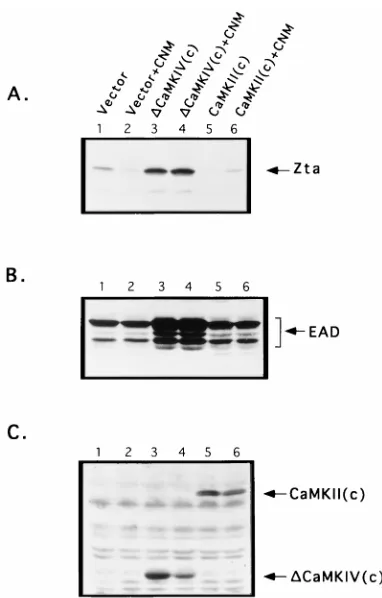
dem-onstrates that constitutively active mutant DCaMKIV(c) po-tently upregulated the expression of the lytic cycle switch pro-tein Zta in transiently transfected B95-8 cells. Figure 2B demonstrates thatDCaMKIV(c) also upregulated the expres-sion of the protein product of the viral early-activation gene BMRF1 (also known as early antigen-diffuse protein or EAD), whose expression correlates with progression into the lytic cycle. Induction of Zta and EAD expression byDCaMKIV(c) was modestly upregulated upon the cotransfection of a
consti-tutively active mutant of the Ca21/calmodulin-dependent
phosphatase calcineurin (CNM), an enzyme which has been previously implicated in the induction of Zta expression by Ca21-mobilizing agents (21). Figure 2C shows the expression
of DCaMKIV(c) in transfected B95-8 cells, as revealed by immunoblotting with an anti-FLAG epitope antibody.
The multifunctional CaMKII is similar to CaMKIV/Gr in that both are homologous, Ca21/calmodulin-dependent
pro-tein kinases that exhibit broad substrate specificities and which phosphorylate the same minimal consensus substrate se-quence (RXXS/T) (24). We therefore examined the capacity of CaMKII(c), a FLAG epitope-tagged, constitutively active mutant of thegBisoform of CaMKII (44), to induce Zta and
EAD expression in B95-8 cells. Figure 2 demonstrates that despite being well expressed in transfected B95-8 cells, CaMKII (c) failed to upregulate Zta or EAD expression either alone or in synergy with CNM. This indicated that the capacity to up-regulate Zta and EAD expression is an attribute specific to CaMKIV/Gr.
In addition to promoting expression of products of immedi-ate-early-activation and early-activation viral genes, CaMKIV/Gr also induced the expression of late-activation genes such as that of VCA. Figure 3A demonstrates that B95-8 cells which have been transfected with empty vector exhibited either no or dull im-munofluorescence when stained with an anti-VCA antibody. The dull fluorescence may reflect basal, low-level VCA expres-sion in some cells. In contrast, transfection of DCaMKIV(c) resulted in the appearance of cells that stained brightly with the anti-VCA antibody (Fig. 3B). The frequency of these cells closely approximated the frequency of B95-8 cells shown to expressDCaMKIV(c), as detected by staining with anti-FLAG epitope antibody (data not shown). Overall, these results indi-cate that DCaMKIV(c) induced the full range of lytic viral genes (immediate early, early, and late) in B95-8 cells, consis-tent with productive lytic infection.
The capacity of CaMKIV/Gr to induce Zta expression and lytic cycle progression was also examined in the EBV-positive human Burkitt’s lymphoma cell line Akata. Akata cells are latently infected with EBV but, unlike B95-8 cells, they do not basally express either Zta or EAD. However, expression of both proteins is readily induced upon stimulation with Ca21
-mobilizing agents such as anti-Ig antibodies. Figure 4 demon-strates that DCaMKIV(c), but not CaMKII(c), potently in-duced the expression of both Zta and EAD when cotransfected into Akata cells together with CNM. In contrast, neither con-struct was effective in inducing protein expression when trans-fected alone (Fig. 4). The enhanced induction in Akata cells of Zta and EAD upon cotransfection ofDCaMKIV(c) and CNM was not due to increased expression ofDCaMKIV(c), as dem-onstrated by immunoblotting with an anti-FLAG antibody (Fig. 4). The differential requirement for CNM in the induc-tion byDCaMKIV(c) of Zta and EAD in Akata versus B95-8 cells may be due to constitutive activation of calcineurin-de-pendent signaling pathways in B95-8 cells. This is supported by the observation that the nuclear factor of activated T cells (NFAT), a transcription factor whose translocation from cy-tosol to the nucleus is activated by calcineurin, was found to be constitutively expressed in the nuclei of B95-8 cells (data not shown). Overall, these results indicate thatDCaMKIV(c) acts together with calcineurin to activate Zta expression and EBV lytic cycle progression.
The contribution of CaMKIV/Gr and calcineurin to the in-duction by Ca21of Zta expression was further assessed with
[image:3.612.81.272.66.365.2]pharmacologic inhibitors. To that end, we examined the ca-pacity of KN62 (Calbiochem), a pharmacologic inhibitor of multifunctional CaMK including CaMKIV/Gr (Ki50.9mM)
FIG. 2. CaMKIV/Gr induces Zta and upregulates EAD expression in B95-8 cells. (A) Induction of Zta expression by CaMKIV/Gr. Cells were transiently transfected with either control vectors (Vector), with individual constructs en-coding constitutively active mutants of CaMKIV/Gr [DCaMKIV(c)], CaMKII [CaMKII(c)], or CNM, or with CNM together withDCaMKIV(c) or CaMKII(c). The cells were cultured for 18 h, following which cell lysates were derived. One hundred micrograms of protein of the respective cell lysates was resolved on 10% denaturing polyacrylamide gels, transferred to nitrocellulose membranes, and probed for Zta expression as detailed in Materials and Methods. (B) Upregula-tion of EAD expression byDCaMKIV(c). Aliquots of cell extracts from the transiently transfected B95-8 cells described in panel A were assayed for EAD protein expression by immunoblotting, as detailed in Materials and Methods. (C) Expression of recombinant kinase molecules in transfected B95-8 cells. Expres-sion was detected by employing a murine monoclonal antibody against the FLAG epitope, which was engineered into the kinase expression vectors as described in Materials and Methods.
on November 9, 2019 by guest
http://jvi.asm.org/
(12), and the calcineurin inhibitor cyclosporin A (CsA) (Ki5
10 nM) to inhibit the induction by Ca21-mobilizing agents of
Zta expression. Figure 5A demonstrates that KN62 inhibited by an average of 60% (n 5 3) the induction by the Ca21
ionophore of Zta expression in B95-8 cells. This inhibition was specific to Ca21signaling pathways, as evidenced by the failure
of KN-62 to affect the induction of Zta expression by protein kinase C activator phorbol 12-myristate-13-acetate (TPA) (Fig. 5B). KN62 also inhibited by an average of 70% (n5 3) the induction by anti-IgG antibodies of Zta expression in Akata cells (Fig. 5C). The presence of residual Zta expression in KN62-treated cells may be due to either partial inhibition of CaMKIV/Gr activity or to the participation of another, KN62-insensitive Ca21signaling pathway(s) in Zta induction. CsA
completely inhibited the induction of Zta by anti-IgG in Akata cells but had a negligible effect on the induction of Zta by the Ca21ionophore in B95-8 cells. This is consistent with
consti-tutive activation of calcineurin-dependent pathways in B95-8 cells but not in Akata cells. Overall, these results are consistent with an important role for multifunctional CaMKIV/Gr in mediating Zta induction and lytic cycle progression in latently infected EBV cells.
CaMKIV/Gr induces transcription from the BZLF1 pro-moter. We next investigated the capacity of CaMKIV/Gr to activate transcription from the BZLF1 promoter. Accordingly, Akata cells were cotransfected withDCaMKIV(c), alone or in combination with CNM, together with the reporter construct
2221ZpLuc, which contains the Luc reporter gene under the regulation of BZLF1 promoter sequences extending from2221 to112 bp relative to the site of transcription initiation (2221Zp). Figure 6 demonstrates that on their own, DCaMKIV(c) and CNM could only modestly activate expression of the2221ZpLuc reporter construct in transiently transfected Akata cells. In con-trast,DCaMKIV(c) and CNM acted synergistically in activat-ing2221ZpLuc expression to levels 15- to 20-fold higher than those achieved with either agent alone. Significantly, CaMKII(c), alone or in combination with CNM, failed to activate transcrip-tion from a2221ZpLuc reporter construct. The latter finding is in agreement with the failure of CaMKII(c) to induce Zta or EAD expression in B95-8 or Akata cells.
[image:4.612.75.545.72.254.2]To rule out a contribution by viral gene products to the activation of the BZLF1 promoter by CaMKIV/Gr, we utilized
[image:4.612.336.527.312.611.2]FIG. 3. Induction of VCA expression byDCaMKIV(c) in B95-8 cells. B95-8 cells were transfected with either control vector alone (A) or withDCaMKIV(c) (B). Forty-four hours later, the cells were analyzed for VCA expression by fluorescence microscopy (magnification,350) as detailed in Materials and Methods.
FIG. 4. CaMKIV/Gr and calcineurin synergistically induce Zta and EAD ex-pression in Akata cells. (A) Induction of Zta exex-pression. Cells were transiently trans-fected with either control vectors (Vector), with individual constructs encoding constitutively active mutants of CaMKIV/Gr [DCaMKIV(c)], CaMKII [CaMKII(c)], or CNM, or with CNM together withDCaMKIV(c) or CaMKII(c). The cells were cultured for 18 h, following which cell lysates were derived. One hundred mi-crograms of protein of the respective cell lysates was resolved on 10% denaturing polyacrylamide gels, transferred to nitrocellulose membranes, and probed for Zta expression as detailed in Materials and Methods. (B) Induction of EAD expression. Aliquots of cell extracts from the transiently transfected Akata cells described in panel A were assayed for EAD protein expression by immunoblot-ting, as detailed in Materials and Methods. (C) Expression of recombinant kinase molecules in transfected Akata cells, as detected by immunoblotting with anti-FLAG epitope monoclonal antibodies.
on November 9, 2019 by guest
http://jvi.asm.org/
EBV-negative Burkitt’s lymphoma cell line DG75. This cell line expresses CaMKIV/Gr (4a) and has previously proven use-ful in studying transcriptional activation of the BZLF1 promot-er by Ca21signaling (34). Figure 6 demonstrates thatDCaMKIV
(c) and CNM acted synergistically in activating2221ZpLuc ex-pression in DG75 cells in a manner similar to that observed in Akata cells. Modest activation was achieved with either expres-sion construct alone, while CaMKII(c) was ineffective. Overall, these results are in agreement with the synergistic induction of Zta expression by CaMKIV/Gr and calcineruin (Fig. 4) and support transcriptional activation of the BZLF1 promoter as an underlying mechanism for induction of the EBV lytic cycle by CaMKIV/Gr.
CaMKIV/Gr induction of the BZLF1 promoter is dependent on the CREB/AP1 site, but efficient induction also requires multiple copies of a ZI domain.As noted in the introduction, the region between 2212 and 112 of the BZLF1 promoter harbors three distinct types of response elements: ZIA to -D, ZII, and ZIIIA and -B, which have been implicated in medi-ating transcriptional activation (16, 18). It has been previously shown that CaMKIV/Gr activates the transcription of target genes through CREB/AP1 sites, suggesting that the ZII do-main in the BZLF1 promoter may be involved in mediating Zp activation by CaMKIV/Gr (13, 26, 36, 49). To assess this
pos-sibility, DCaMKIV(c) activation of a reporter construct har-boring the BZLF1 promoter with a 4-bp mutation that ablates the CREB/AP1 site within the ZII domain (2221ZpMII) was determined. Accordingly, reporter constructs carrying wild-type or mutant ZII elements were transiently transfected into DG75 cells together with DCaMKIV(c). The cells were next treated with ionomycin (to activate endogenous calcineurin) and then harvested and tested for reporter activity. Figure 7 demonstrates that while CaMKIV/Gr plus ionomycin potently activated transcription of the2221ZpCAT reporter construct, they failed to activate transcription of the 2221ZpMIICAT reporter construct which carries the mutant ZII element. The specificity of these findings was established by showing that
DCaMKIV(c) plus an ionophore potently induced a reporter construct driven by the BZLF1 promoter in which the ZIIIA and -B elements had been inactivated by targeted mutagenesis FIG. 5. The multifunctional CaMK antagonist KN62 inhibits induction of
Zta expression by Ca21-mobilizing agents. (A) KN-62, but not CsA, inhibits the
induction of Zta expression by the Ca21ionophore in B95-8 cells. (B) KN62 does
not affect the induction of Zta expression by TPA in B95-8 cells. (C) Both KN62 and CsA inhibit the induction by anti-IgG of Zta expression in Akata cells. For each panel, 53106
[image:5.612.97.264.71.354.2]cells were suspended in either 10% FCS-Dulbecco modified Eagle medium (B95-8) or 10% FCS-RPMI medium (Akata) and incubated at 37°C for 1 h in the absence or in the presence of either KN62 (10mM) or CsA (200 nM), as indicated. B95-8 cells were then stimulated with ionomycin (iono) at 2.5mM (A) or with TPA at 25 ng/ml (B), while Akata cells were stimulated with anti-Ig at 20mg/ml. The incubations were then continued for another 16 h, following which the cells were harvested and examined for Zta expression as detailed in Materials and Methods.
FIG. 6. CaMKIV/Gr and calcineurin synergistically activate transcription from the BZLF1 promoter. Akata or DG75 cells were transfected with the
2221Zpluciferase reporter construct in conjunction either with control vectors (vector), with individual constructs encoding constitutively active mutants of CaMKIV/Gr [DCaMKIV(c)], CaMKII [CaMKII(c)], or CNM, or with CNM together withDCaMKIV(c) or CaMKII(c). The cells were harvested 18 h later and assayed for Luc activity as detailed in Materials and Methods.
FIG. 7. Mutation of the CREB/AP1 site in Zp abrogates induction by CaMKIV/Gr. DG75 cells were transfected with either the wild type2221ZpCAT reporter construct or2221ZpMIICAT in which the CREB/AP1 site is mutated, either alone or in conjunction with the constitutively activeDCaMKIV(c) ex-pression vector. The transfected cells were cultured in the presence of 1mM ionomycin where indicated (1). Cells were harvested at 48 h posttransfection, and CAT activity was determined as described in Materials and Methods.
on November 9, 2019 by guest
http://jvi.asm.org/
(data not shown). The results indicated that Ca21-mediated
induction of Zp is dependent on a functional ZII element. We have recently shown that activation of the BZLF1 pro-moter by Ca21signaling pathways is also dependent on
func-tional ZI elements (34). To directly assess the involvement of the ZI and ZIIciselements in the BZLF1 promoter in induc-tion byDCaMKIV(c), we tested the activation byDCaMKIV(c), alone or in combination with CNM, of a Luc reporter gene driven by the minimalb-globin promoter in the presence of three copies of a ZI domain [(33Z1B)bGLuc], a single copy of the ZII domain [(13ZII)bGLuc], or both sets ofciselements. It should be noted that the architecture of the (33ZIB)(13ZII)bGLuc reporter construct is similar to that of the native promoter, which also contains multiple copies of the ZI domains and a single copy of the ZII domain (Fig. 1). Figure 8 demonstrates that a 33 multimer of the ZIB domain (33ZIB)bGLuc was modestly activated by the combination of DCaMKIV(c) and CNM but not by either construct alone. A heterologous promoter con-struct harboring a single copy of the CREB/AP1 site (13ZII)
bGLuc was weakly activated byDCaMKIV(c), and this induc-tion was further upregulated by CNM. In contrast,DCaMKIV (c) acted strongly synergistically with calcineurin in activating a heterologous promoter construct containing three copies of the ZIB element and a single copy of the ZII element (33ZIB) (13ZII)bGLuc. Only weak activation was observed with
DCaMKIV(c) alone, and none was observed with CNM. Impor-tantly, DCaMKIV(c) and CNM activated (33ZIB)(13 ZII)-driven transcription to levels closely approximating those not-ed with2221Zp (Fig. 6), consistent with the notion that the ZI and ZII elements are necessary and sufficient to mediate Ca21
responsiveness of2221Zp.
DISCUSSION
In this study, CaMKIV/Gr has been identified as a compo-nent of the Ca21signaling pathways implicated in the
disrup-tion of EBV latency and the initiadisrup-tion of viral replicadisrup-tion. We have directly demonstrated that CaMKIV/Gr induces the ex-pression of the lytic cycle switch gene product Zta by activating transcription from Zp, the promoter of Zta-encoding gene
BZLF1. Since the expression of CaMKIV/Gr in B cells is in-duced by the EBV oncoprotein LMP1, our results establish the presence of a virus-regulated mechanism involving CaMKIV/ Gr which promotes the transition from latency to the viral lytic cycle in response to Ca21-mobilizing extracellular signals.
The capacity of CaMKIV/Gr to activate transcription from the BZLF1 promoter is dependent on the integrity of both the ZII and the ZI elements. The ZII domain corresponds to a CREB/AP1 site, and recent evidence indicates that it binds members of the CREB/ATF family of transcription factors (33a). The capacity of CaMKIV/Gr, but not CaMKII(c), to activate transcription from the ZII element is consistent with differential activation by the respective kinases of CREB-de-pendent transcription. CaMKIV/Gr phosphorylates CREB on Ser-133, resulting in the activation of the CREB transcriptional function (9, 13, 36, 47, 49). However, while CaMKII also phos-phorylates CREB on Ser-133, it additionally phosphos-phorylates CREB on the autoinhibitory residue Ser-142 (49), leading to the abrogation of CREB activation. Hence, differential phos-phorylation and consequently activation of CREB and its re-lated family members may represent one mechanism by which CaMKIV/Gr selectively activates transcription from the ZII element.
Induction by CaMKIV/Gr of the BZLF1 promoter was also dependent on the ZI elements. We have demonstrated else-where that the ZI elements serve as Ca21-sensitive response
elements and that inactivating mutations affecting the ZI ele-ments abrogate Ca21inducibility of the BZLF1 promoter (34).
This is in agreement with a previous report by Shimizu and Takada, which demonstrated that a sequence of the BZLF1 promoter corresponding to the ZIA and ZIB elements is crit-ical for the induction of the BZLF1 promoter by anti-Ig (48). The ZI elements have been shown to bind transcription factor MEF2D (34). MEF2 proteins are members of the MADS family of transcriptional factors, members of which include among others the serum response factor (53). CaMKIV/Gr directly activates the SRF transcriptional function (42), sug-gesting that MEF2D may similarly be a target of CaMKIV/Gr activation.
Transcriptional activation of the BZLF1 promoter by CaMKIV/Gr was greatly augmented by calcineurin, but could otherwise proceed independent of viral gene products. It has been previously demonstrated (21) that induction of Zp tran-scription upon cross-linking surface Ig is significantly inhibited by CsA, indicating that the Ca21/calmodulin-dependent
phos-phatase calcineurin contributes to the induction of Zp. Re-markably, both the ZI elements and the ZII element have been identified to be responsive to both CaMKIV/Gr and cal-cineurin (reference 34 and this study), indicating that these elements may serve as points of convergence of two Ca21
-dependent pathways (see Fig. 9).
[image:6.612.59.301.72.230.2]The molecular basis of the synergy between CaMKIV/Gr and calcineurin in activating the BZLF1 promoter remains to be fully established. Members of the NFAT family of transcrip-tion factors have been shown to mediate calcineurin-depen-dent and CsA-sensitive transcriptional events. NFAT proteins can substitute for calcineurin in acting synergistically with CaMKIV/Gr to induce BZLF1 transcription (reference 34 and unpublished observations), thus confirming their role as medi-ators of the calcineurin function. In the case of the ZII ele-ment, its synergistic activation by CaMMKIV/Gr and cal-cineurin is likely to involve interaction between CREB/AP1 proteins activated by CaMKIV/Gr and NFAT proteins made available in the nucleus by calcineurin. This would be consis-tent with the well-established requirement for NFAT proteins to associate with bZIP proteins, especially those of the AP1 FIG. 8. CaMKIV/Gr activates heterologous promoters harboring a
combina-tion of individual ZI elements and ZII. Heterologous promoter constructs con-taining either three copies of the ZIB element, one copy of the ZII element, or combinations thereof were cloned upstream of a minimalb-globin promoter driving a Luc reporter gene (see inset). Reporter constructs were transiently transfected into DG75 cells in conjunction with the indicated effector constructs. Transfected cells were harvested 18 h later and assayed for Luc activity as described in Materials and Methods.
on November 9, 2019 by guest
http://jvi.asm.org/
family, for interaction with NFAT response elements (45). NFAT proteins have also been demonstrated to interact with bZIP complexes containing CREB family members, as is the case for the k3 site of the tumor necrosis factor alpha pro-moter, which binds a complex of NFATc2 and the ATF2/Jun dimer (54).
The BZLF1 promoter is not unique in possessing Ca21
-responsive, CsA-sensitive MEF2 sites. Rather, it is prototypic of a number of CsA-sensitive genes whose Ca21inducibility
has been mapped to MEF2 sites, including the steroid orphan receptor Nur77 (56) and the proto-oncogenec-jun(25a). Un-like the case of CREB/AP1 complexes, there is no precedent for direct interaction between NFAT and MFF2 proteins. An examination of MEF2 sites of the aforementioned promoters failed to reveal identifiable NFAT recognition sequences, rais-ing the possibility that MEF2 sites may support a novel path-way of NFAT-dependent transcription. However, it remains to be established whether MEF2 proteins directly interact with NFAT proteins or whether other intermediates such as CREB/ AP1 proteins are also involved.
The potent induction of the EBV lytic cycle by the Ca21
signaling intermediates CaMKIV/Gr and calcineurin highlights the role of this pathway in reactivating latent EBV infection. The importance of Ca21 signaling in the EBV life cycle is
further underscored by the regulation of Ca21signaling by at
least two latent viral proteins. In addition to LMP1, EBV pro-tein LMP2A is also involved in the regulation of Ca21signaling
in EBV-transformed cells. While LMP1 promotes a subset of Ca21-dependent activation events by virtue of its induction of
CaMKIV/Gr, LMP2A inhibits surface Ig-induced Ca21
mobi-lization and lytic cycle induction (39, 40) (Fig. 8). The cyto-plasmic tail of LMP2A contains the conserved (YXXL)2motif,
which is typically found in signal-transducing subunits of anti-gen receptors and which mediates interaction with the SH2 domains of protein tyrosine kinases and downstream signaling intermediates. However, while LMP2A associates with protein tyrosine kinases Syk and Lyn, it acts as a dominant negative
inhibitor of protein tyrosine kinase activation upon signaling via antigen receptors, leading to the abrogation of tyrosine kinase-dependent Ca21mobilization (38). The differential
reg-ulation of Ca21signaling pathways by LMP1 and LMP2A may
serve to direct the outcome of Ca21signaling in
EBV-trans-formed cells, depending on the pattern of LMP expression. Elucidation of the role played by Ca21signaling pathways at
different stages of EBV infection remains a long-term goal of these studies.
ACKNOWLEDGMENTS
This work was supported by a grant from the American Cancer Society to T.C. and by NIH grants CA43143 to S.H.S. and CA47006 to E.K. S.H.S. is a Scholar and G.M. is a Postdoctoral Fellow of the Leukemia Society of America.
REFERENCES
1.Baer, R., A. T. Bankier, M. D. Biggin, P. L. Deininger, P. J. Farrell, T. J. Gibson, G. Hatfull, G. S. Hudson, S. C. Satchwell, C. Seguin, P. S. Tuffnell, and B. G. Barrell.1984. DNA sequence and expression of the B95-8 Epstein-Barr virus genome. Nature310:207–209.
2.Bauer, G., P. Hofler, and H. Zur Hausen.1982. Epstein-Barr virus induction by a serum factor. I. Induction and cooperation with additional inducers. Virology121:184–194.
3.Borras, A. M., J. L. Strominger, and S. H. Speck.1996. Characterization of the ZI domains in the Epstein-Barr virus BZLF1 gene promoter: role in phorbol ester induction. J. Virol.70:3894–3901.
4.Chang, Y.-N., D. L.-Y. Dong, G. S. Hayward, and S. D. Hayward.1990. The Epstein-Barr virus Zta transactivator: a member of the bZIP family with unique DNA-binding specificity and dimerization domain that lacks the characteristic heptad leucine zipper motif. J. Virol.64:3358–3369. 4a.Chatila, T., and S. H. Speck.Unpublished data.
5.Chevalier-Greco, A., E. Manet, P. Chavrier, C. Mosnier, J. Daillie, and A. Sargeant.1986. Both Epstein-Barr virus (EBV)-encoded trans-acting fac-tors, EB1 and EB2, are required to activate transcription from an EBV early promoter. EMBO J.5:3243–3249.
6.Cohen, L. K., S. H. Speck, B. E. Roberts, and J. L. Strominger.1984. Identification and mapping of polypeptides encoded by the P3HR-1 strain of Epstein-Barr virus. Proc. Natl. Acad. Sci. USA81:4183–4187.
7.Countryman, J., H. Jenson, H. Seibel, H. Wolf, and G. Miller.1987. Poly-morphic proteins encoded within BZLF1 of defective and standard Epstein-Barr virus disrupt latency. J. Virol.61:3672–3679.
8.Countryman, J., and G. Miller.1985. Activation of expression of latent Epstein-Barr herpesvirus after gene transfer with a small subfragment of heterogenous viral DNA. Proc. Natl. Acad. Sci. USA82:4085–4089. 9.Cruzalegui, F. H., and A. R. Means.1993. Biochemical characterization of
the multifunctional Ca21/calmodulin-dependent protein kinase type IV
ex-pressed in insect cells. J. Biol. Chem.268:26171–26178.
10. Daibata, M., S. H. Speck, C. Mulder, and S. Takeshi.1994. Regulation of BZLF1 promoter of Epstein-Barr virus by second messengers in anti-immu-noglobulin-treated B cells. Virology198:446–454.
11. de Wet, J. R., K. V. Wodd, M. Deluca, D. R. Helinski, and S. Subramani.
1987. Firefly luciferase gene: structure and expression in mammalian cells. Mol. Cell. Biol.7:725–737.
12. Enslen, H., and T. R. Soderling.1994. Roles of calmodulin-dependent pro-tein kinases and phosphatases in calcium-dependent transcription of imme-diate early genes. J. Biol. Chem.269:20872–20877.
13. Enslen, H., P. Sun, D. Brickey, S. H. Soderling, E. Klamo, and T. R. Soder-ling.1994. Characterization of Ca21/calmodulin-dependent protein kinase
IV. Role in transcriptional regulation. J. Biol. Chem.269:15520–15527. 14. Faggioni, A., C. Zompetta, S. Grimaldi, G. Barile, L. Frati, and J. Lazdins.
1986. Calcium modulation activates Epstein-Barr virus genome in latently infected cells. Science232:1554–1556.
15. Farrell, P. J., D. T. Rowe, C. M. Rooney, and T. Kouzarides.1989. Epstein-Barr virus BZLF1 trans-activator specifically binds to a consensus AP-1 site and is related to c-fos. EMBO J.8:127–132.
16. Flemington, E., and S. H. Speck.1990. Autoregulation of Epstein-Barr virus putative lytic switch gene BZLF1. J. Virol.64:1227–1232.
17. Flemington, E., and S. H. Speck.1990. Evidence for coiled-coil dimer for-mation by an Epstein-Barr virus transactivator that lacks a heptad repeat of leucine residues. Proc. Natl. Acad. Sci. USA87:9459–9463.
18. Flemington, E., and S. H. Speck.1990. Identification of phorbol ester re-sponse elements in the promoter of Epstein-Barr virus putative lytic switch gene BZLF1. J. Virol.64:1217–1226.
19. Flemington, E. K., A. E. Goldfeld, and S. H. Speck.1991. Efficient transcrip-tion of the Epstein-Barr virus immediate-early BZLF1 and BRLF1 genes requires protein synthesis. J. Virol.65:7073–7077.
[image:7.612.77.276.68.240.2]20. Frangakis, M. V., T. Chatila, E. R. Wood, and N. Sahyoun.1991. Expression FIG. 9. Regulation of the BZLF1 promoter by Ca21signaling pathways. Two
Ca21/calmodulin-dependent enzymes, CaMKIV/Gr and calcineurin, mediate
Ca21-dependent activation of BZLF1 transcription. CaMKIV/Gr activates
low-level transcription from Zp, an effect which is greatly augmented by calcineurin. CaMKIV/Gr activates transcription from the ZII and ZI elements in synergy with calcineurin. The capacity of Ca21signaling pathways to activate BZLF1
gene transcription is regulated by latent EBV proteins LMP1 and LMP2 at two distinct sites. LMP1 positively regulates BZLF1 transcription by inducing CaMKIV/Gr expression. In contrast, LMP2A inhibits Ca21mobilization
trig-gered via surface Igs or via other related members of the Ig supergene family by interfering with the activation of receptor-coupled tyrosine kinases (40).
on November 9, 2019 by guest
http://jvi.asm.org/
of a neuronal Ca21/calmodulin-dependent protein kinase, CaM kinase-Gr,
in rat thymus. J. Biol. Chem.266:17592–17596.
21. Goldfeld, A. E., P. Liu, S. Liu, E. K. Flemington, J. L. Strominger, and S. H. Speck.1995. Cyclosporin A and FK506 block induction of the Epstein-Barr virus lytic cycle by anti-immunoglobulin. Virology209:225–229.
22. Gorgan, E., H. Jensen, J. Countryman, L. Heston, L. Gradoville, and G. Miller.1987. Transfection of a rearranged viral DNA fragment, WZhet, stably converts latent Epstein-Barr viral infection to productive infection in lymphoid cells. Proc. Natl. Acad. Sci. USA84:1332–1336.
23. Hanissian, S. H., M. Frangakis, M. M. Bland, S. Jawahar, and T. A. Chatila.
1993. Expression of a Ca21/calmodulin dependent protein kinase, CaM
kinase-Gr, in human T lymphocytes. Regulation of kinase activity by T cell receptor signalling. J. Biol. Chem.268:20055–20063.
24. Hanson, P. I., and H. Schulman.1992. Neuronal Ca21
/calmodulin-depen-dent protein kinases. Annu. Rev. Biochem.61:559–601.
25. Hardwick, J. M., P. M. Lieberman, and S. D. Hayward.1988. A new Epstein-Barr virus transactivator, R, induces expression of a cytoplasmic early anti-gen. J. Virol.62:2274–2284.
25a.Ho, N., and T. Chatila.Unpublished data.
26. Ho, N., M. Gulberg, and T. Chatila.1996. AP1-dependent transcriptional activation of the IL-2 gene by CaMKIV/Gr. J. Exp. Med.184:101–112. 27. Hummel, M., and E. Kieff.1982. Mapping of polypeptides encoded by the
Epstein-Barr virus genome in productive infection. Proc. Natl. Acad. Sci. USA79:5698–5702.
28. Kieff, E.1996. Epstein-Barr virus and its replication, p. 2343–2396.InB. Fields, D. Knipe and P. Howley (ed.), Fields virology. Lippincott-Raven, Philadelphia, Pa.
29. Kincaid, R. L., P. R. Giri, S. Higuchi, J. Tamura, S. C. Dixon, C. A. Marietta, D. A. Amorese, and B. M. Martin.1990. Cloning and characterization of molecular isoforms of the catalytic subunit of calcineurin using non isotopic methods. J. Biol. Chem.265:11312–11319.
30. Knuston, J. C., and B. Sugden.1989. Immortalization of B lymphocytes by Epstein-Barr virus: what does the virus contribute to the cell. Adv. Viral Oncol.8:151–172.
31. Kouzarides, T., G. Packham, A. Cook, and P. J. Farrell.1991. The BZLF1 protein of EBV has a coiled coil dimerization domain without heptad leucine repeat but with homology to the C/EPB leucine zipper. Oncogene6:195–204. 32. Lieberman, P., and A. Berk.1990. In vitro transcriptional activation, dimer-ization, and DNA-binding specificity of the Epstein-Barr virus Zta protein. J. Virol.64:2560–2568.
33. Lieberman, P. M., J. M. Hardwick, J. Sample, G. S. Hayward, and S. D. Hayward.1990. The Zta transactivator involved in induction of lytic cycle gene expression in Epstein-Barr virus-infected lymphocytes binds to both AP-1 and ZRE sites in target promoter and enhancer regions. J. Virol.
64:1143–1155.
33a.Liu, S., P. Liu, and S. Speck.Unpublished data.
34. Liu, S., P. Liu, A. Borras, T. Chatila, and S. H. Speck.1997. Cyclosporin A-sensitive induction of the Epstein-Barr virus lytic cycle switch is mediated via a novel pathway involving a MEF2 family member. EMBO J.16:143–153. 35. Marklund, U., N. Larson, G. Brattsand, O. Osterman, T. A. Chatila, and M. Gullberg.1994. Serine 16 of oncoprotein 18 is a major cytosolic target for the Ca21/calmodulin-dependent kinase-Gr. Eur. J. Biochem.225:53–60.
36. Matthews, R. P., C. R. Guthrie, L. M. Wailes, X. Zhao, A. R. Means, and G. S. McKnight.1994. Calcium/calmodulin-dependent protein kinase types II and IV differentially regulate CREB-dependent gene expression. Mol. Cell. Biol.14:6107–6116.
37. Means, A. R., F. Cruzalegui, B. LeMagueresse, D. S. Needleman, G. R. Slaughter, and T. Ono.1991. A novel Ca21/calmodulin-dependent protein
kinase and a male germ cell-specific calmodulin-binding protein are derived from the same gene. Mol. Cell. Biol.11:3960–3971.
38. Miller, C., A. L. Burkhardt, J. H. Lee, B. Stealy, R. Longnecker, J. B. Bolen, and E. Kieff.1995. Integral membrane protein 2 of Epstein-Barr virus reg-ulates reactivation from latency through dominant negative effects of pro-tein-tyrosine kinases. Immunity2:155–166.
39. Miller, C. L., J. H. Lee, E. Kieff, and R. Longnecker.1994. An integral membrane protein (LMP2) blocks reactivation of Epstein-Barr virus from latency following surface immunoglobulin crosslinking. Proc. Natl. Acad. Sci. USA91:772–776.
40. Miller, C. L., R. Longnecker, and E. Kieff.1993. Epstein-Barr virus latent membrane protein 2A blocks calcium mobilization in B lymphocytes. J. Vi-rol.67:3087–3094.
41. Miller, G., M. Rabson, and L. Heston.1984. Epstein-Barr virus with heter-ogeneous DNA disrupts latency. J. Virol.50:174–182.
42. Miranti, C. K., D. D. Ginty, G. Huang, T. Chatila, and M. E. Greenberg.
1995. Calcium activates serum response factor-dependent transcription by a Ras- and Elk-1-independent mechanism that involves a Ca21
/calmodulin-dependent kinase. Mol. Cell. Biol.15:3672–3684.
43. Mosialos, G., S. H. Hanissian, S. Jawahar, L. Vara, E. Kieff, and T. A. Chatila.1994. A Ca21/calmodulin-dependent protein kinase, CaM
kinase-Gr, expressed after transformation of primary human B lymphocytes by the Epstein-Barr virus (EBV) is induced by the EBV oncogene LMP1. J. Virol.
68:1697–1705.
44. Nghiem, P., S. M. Saati, C. L. Martens, P. Gardner, and H. Schulman.1993. Cloning and analysis of two new isoforms of multifunctional Ca21
/calmod-ulin-dependent protein kinase. J. Biol. Chem.268:5471–5479.
45. Nolan, G.1994. NF-AT-AP-1 and Rel-bZIP: hybrid vigor and binding under the influence. Cell77:795–798.
46. Ruf, I. K., and D. R. Rawlins.1995. Identification and characterization of ZIIBC, a complex formed by cellular factors and the ZII site of the Epstein-Barr virus BZLF1 promoter. J. Virol.69:7648–7657.
47. Sheng, M., M. A. Thompson, and M. E. Greenberg.1991. CREB: a Ca21
-regulated transcription factor phosphorylated by calmodulin-dependent ki-nases. Science252:1427–1430.
48. Shimizu, N., and K. Takada.1993. Analysis of the BZLF1 promoter of Epstein-Barr virus: identification of an anti-immunoglobulin response se-quence. J. Virol.67:3240–3245.
49. Sun, P., H. Enslen, P. S. Myung, and R. A. Maurer.1994. Differential activation of CREB by Ca21/calmodulin-dependent protein kinases type II
and type IV involves phosphorylation of a site that negatively regulates activity. Genes Dev.8:2527–2539.
50. Takada, K., and Y. Ono.1989. Synchronous and sequential activation of latently infected Epstein-Barr virus genomes. J. Virol.63:445–449. 51. Takada, K., N. Shimizu, S. Sakuma, and Y. Ono.1986.transactivation of the
latent Epstein-Barr virus (EBV) genome after transfection of the EBV DNA fragment. J. Virol.57:1016–1022.
52. Tovey, M., G. Lenoir, and J. Lours-Begon.1978. Activation of latent Epstein-Barr virus by antibody to human IgM. Nature272:373–375.
53. Treisman, R.1995. Journey to the surface of the cell: Fos regulation and the SRE. EMBO J.14:4905–4913.
54. Tsai, E. Y., J. Jain, P. A. Pesavento, A. Rao, and A. E. Goldfeld.1996. Tumor necrosis factor alpha gene regulation in activated T cells involves ATF-2/Jun and NFATp. Mol. Cell. Biol.16:459–467.
55. Urier, G., M. Buisson, P. Chambard, and A. Sergeant.1989. The Epstein-Barr virus early protein EB1 activates transcription from different responsive elements including AP-1 binding sites. EMBO J.8:1447–1453.
56. Woronicz, J. D., A. Lina, B. J. Calnan, S. Szychowski, L. Cheng, and A. Winoto.1995. Regulation of the Nur77 orphan steroid receptor in activation-induced apoptosis. Mol. Cell Biol.15:6364–6367.
57. zur Hausen, H., F. O’Neil, and U. Freese.1978. Persisting oncogenic herpes virus induced by the tumor promoter TPA. Nature272:373–375.