EVALUATION OF DIMENSIONAL STABILITY OF
FOUR COMMERCIALLY AVAILABLE ADDITION
SILICONE INTEROCCLUSAL RECORD
MATERIALS
-
IN VITRO STUDY
Dissertation submitted to
THE TAMILNADU DR.M.G.R MEDICAL UNIVERSITY
in the partial fulfillment for the degree of
MASTER OF DENTAL SURGERY
PART II – BRANCH I
CERTIFICATE
This is t o certi f y that this di ssert ati on tit led “EVALUATION
O F DI MENSIO NAL STABIL ITY O F FO UR CO MMERCIALL Y
AVAIL ABLE ADDITIO N SILICO NE INTE ROCCL USAL
RECO RD MATE RIALS - IN VIT RO STUDY ” is a bonafi de
record of work done by Dr. RASH MI KUMARI under m y guidance
duri ng her post graduat e peri od bet ween 2008 - 2011. This
Dissertation is s ubmitted to THE T AMILNADU Dr. M.G.R.
MEDICAL UNI VE RSITY, in P artial fulfilm ent of requi rem ents for
the Degree of Mas ter of Dental Surgery in Prosth odon ti cs and
Crown & B rid ge (B ran ch I ).
It has not been s ubm itted (parti al or full) for t he award of an y
other degree or diploma.
Guid e H ead of th e Department
PRI NCI PAL
Dr.K.S.G.A.NASSE R, M.D.S.
Tami lNadu Governm ent Dent al C oll ege & Hospit al
Chennai – 600 003
Dr A. MEENAKSHI , M.D.S.
Addit ional P rofess or
Departm ent of P rost hodonti cs Tami lnadu Governm ent
Dental Col lege & Hospit al, Chennai - 0 3
Dr. C. TH ULAS INGAM, M.D.S.
Professor & Head
Departm ent of P rost hodonti cs Tami lnadu Governm ent Dent al College & Hos pit al,
DECLARATION
I, Dr. Rash mi ku mari, do hereb y declare that the diss ertation
titled “Evaluation of dimensional stability of four
commerciall y avail able addi tion sili cone in terocclus al record
materi als - In vitro study” was done in the Departm ent of
Prost hodonti cs , Tam il Nadu Governm ent Dental Coll ege & Hospit al,
Chennai - 600 0 03. I have utiliz ed the faciliti es provided in the
Governm ent Dent al College for this stud y in partial ful fill ment o f
the requirem ent s for the degree of Master of Dental Su rgery in the
speci alit y of Pros thodonti cs and Crown & Brid ge (B ranch I )
duri ng the c ours e period 2008 -2011 under the concept ualizati on and
guidance of m y diss ertation guide, Dr. A . Meenakshi, M.D.S.
I decl are t hat no part of t he diss ertat ion will be utiliz ed for
gai ning fi nancial ass istance for research or other prom otions without
obt aining pri or perm ission from the Tam il Nadu Governm ent Dent al
College & Hos pit al.
I als o decl are, that no part of thi s work will be publis hed
either i n t he print or el ectroni c m edi a except wi th t hos e who have
been activel y involved i n t his diss ertat ion work, and I fi rml y affi rm
that t he ri ght to preserve or publish t his work rest s sol el y with the
permiss ion of the Princi pal , Tamil Nadu Governm ent Dent al College
& Hospital, Chennai 600 003, but wit h t he vest ed ri ght that I shall
be cit ed as t he author(s).
Signature of the P G Student Si gnat ure of the HOD
ACKNOWLE DGE MENT
I consider it m y ut most pri vil ege and honour to express m y
most sincere and heart felt gratitude to m y est eemed Chie f
Dr. C.TH ULAS INGAM, M.D.S., Profess or and Head, Depart ment of
Prost hodonti cs , Tam ilnadu Government Dental Coll ege and Hospital
for his whol eheart ed support , gui dance, hel p, encouragement and
never endi ng pati ence wi thout which thi s stud y would not have been
possi ble and als o for con st ant inspi ration throughout the period of
m y post graduat e cours e.
M y si ncere thanks to Dr. K .S.G.A. NASSER, M.D.S .,
Principal, Tamil Nadu Government Dent al Coll ege and Hospit al, for
his kind help, and for permi tting m e t o us e the faciliti es in the
institution.
I am extrem el y thankful to m y guide Dr . A. MEE NAKSHI, ,
M.DS., Addit ional Professor, Departm ent of Prosthodonti cs , Tami l
Nadu Governm ent Dental Coll ege and Hos pit al for the inval uable
suggesti ons and s upport that he has rendered at various st age s of the
diss ert ati on. Without his hel p this diss ert ation would not have come
out i n a befitting m anner.
I woul d li ke to express m y t hanks t o
Dr. C . SABARIGIR INATHA N M.D.S., and Additional Profess or,
College and Hos pit al, for all the inspi ration and gui dance s he has
provided throughout m y post graduat ion.
I am thankful to m y As sistant Profess ors ,
DR. K . VI NAYAGA VEL M.D.S ., Dr. V. SRIRAM PRABU M.D.S .,
Dr. T. JEYANTHIK UMARI M.D.S., Dr . K. RAMKUMAR M.D.S .,
Dr. G. GOMA THI, M.D.S., Dr. HARISHNATH , M.D.S.,
Dr. M . KANMA NI M .D.S ., and Dr. RUPK UMAR, M .D.S. for guiding
and helpi ng me at di fferent s tages of t his stud y.
I thank M r. RA VA NAN, R eader, Departm ent of Stat isti cs ,
Presidenc y C oll ege, and Chennai for hel ping m e with the st atistical
anal ys is for t his study.
I am t hankful to m y fell ow post graduat es Dr. P ratibha, Dr.
Nit ai, Dr.M . Lakshmi Devi for hel pi ng me ri ght through m y
1.
INTRODUCTION
1
2.
AIM AND OBJECTTIVES
5
3.
REVIEW OF LITERATURE
6
4.
MATERIALS AND METHODS
34
5.
RESULTS
41
6.
DISCUSSION
50
7.
SUMMARY AND CONCLUSION
61
Introduction
INTRODUCTION
Diagnosis and treatment of a patient for prosthetic
rehabilitation requires the clinician to fabricate diagnostic
casts, as well as master casts, and articulate them on an
articulator. For this reason it is necessar y to record
maxillomandibular relationship accuratel y and transfer it to the
articulator.1 An interocclusal record is a precise recording of a
maxillomandibular position.2
The interocclusal records used for the edentulous and
dentulous patients must be stable with good strength and able to
reproduce the same maxillomandibular relation in the
articulator.
Some clinical situation where the operator is not able to
provide adequate thickness to this interocclusal record due to
reduced inter ridge distance .These clini cal situation become a
challenging task to the operator and the technician. The need of
interocclusal recording material with good strength and
dimensional stabilit y will pla y a major role in these t ype of
Introduction
The ideal material -technique c ombination for making
interocclusal records would allow the placement of indirectl y
fabricated prostheses in the patient’s mouth without making any
major occlusal adjustment. However, errors are often induced
b y the biologic characteristics of the stomatog nathic s ystem and
b y the dentist. In addition, inaccuracies of the cast and the
properties of the interocclusal recording material ma y induce an
incorrect placement of the mandibular cast in relation to the
maxillar y cast on an articulator.3
Diagnosis and treatment planning procedures ma y be
impaired if casts are fixed in a malrelated position. To prevent
clinical error, the procedure used to record and fix interocclusal
relations should be performed with the utmost care and
understanding.4
It has been described in literature that the interocclusal
records should have minimum of 3 to 4mm thickness to resist
distortion and avoid breakage, but because of reduced inter
-ridge distance we were not able to provide 3 -4mm thickness. So
it becomes mandator y to iden tif y a suitable material to
Introduction
Plaster, Modeling compound, Waxes, Acr ylic resin and
Zinc oxide-eugenol Paste are the materials that have been in
use for recording maxillomandibular relations for several
years.1 The introduction of pol yether and pol yvin ylsiloxane
interocclusal recording media has made clinicians to think
about the choice which material to be used. These elastomeric
materials are chemicall y similar to the impression materials
that have been used successf ull y f or man y years.5 Modifications
have been made by adding plasticizers and catal ysts to the
impression materials in order to convert them as
interocclusal recording media. Recent years the Addition
silicone has gained a good popularit y because of it s good
dimensional stability and strength even in thin sections (i.e)less
than 3mm thickness.
On man y occasions the articulation of maxillar y
-mandibular casts ma y not be done immediatel y following the
clinical procedure. So, the interocclusal records must be
dimensionall y stable in those situation.
Moreover these records must be dimensionall y stable for
a given period of time before the y are used to mount the casts
Introduction
compressive force is also commonl y exerted on the recording
material during the articulation procedure which ma y cause
inaccuracies in relating the casts in centric and other excursive
position.
Each of these interocclusal recording materials exhibits a
degree of deformation when compr essed under a load. The
deformation ma y var y depends upon the hardness and the
properties of the recording materials used.7 At the same time
the degree of deformation of interocclusal record must be
minimal or negligible and should not affect the accurac y of
mounting the maxillar y- mandibular casts in the articulator.
The present study was undertaken to evaluate the
dimensional stabilit y and hardness of four commerciall y
available elastomeric interocclusal recording materials. The
null h ypothesis of this present stud y was ,there is no difference
in the dimensional stabilit y of all the four comme rciall y
Aims and Objectives
AIMS AND OBJECTIVES
AIM:
To evaluate the dimensional stability of four different
commerciall y available addition silicone interocclusal
recording materials
OBJECTIVES OF THIS STUDY :
1. To evaluate the dimensional stability of four different
commerciall y available pol yvin yl siloxane inter-occlusal
recording materials.
2. To compare the dimensional variations occurred in four
different commerciall y available pol yvin yl siloxane inter
-occlusal recording materials.
3. To evaluate the hardness of four different co mmerciall y
available pol yvinyl siloxane inter -occlusal recording
Review of Literature
REVIEW OF LITERATURE
Millstein PL, Kronman JH, Clark RE (1971)1 2
established a method whereb y various materials used to register
interocclusal recordings ma y be tested, measured and compared.
Two brands of wax (S.S White pink base plate wax and
H ygienic extra tough baseplate wax) were tested in storage
environments of air, tap water, and cold water at four storage
time intervals of 2, 6, 24 and 48 hours under seating pressures
ranging from no pressure to heav y pressure. Using a factorial
experimental des ign for the investigation of the main and
interactive effects of these variables, the y observed that
complete closure under a pressure comparable to those of a
clinical setting (172 p.s.i) was not achieved when wax was
present. Storage of the wax registrat ion in cold water showed
the greatest change, while air cooling showed the least change.
There was a considerable vertical and slight horizontal change
when the model was gentl y placed into a previousl y formed wax
registration.
Upon application of pressur e, there was a reduction of
vertical change followed b y a proportional increase in
Review of Literature
recording wax must be considered in terms of the man y
variables responsible for dimensional change. Even under the
highl y controlled conditions of the stud y, exact reproduction of
the original wax recordings was never achieved.
Wirth CG, Aplin AW (1971)1 3 described an improved
centric interocclusal record by using No. 7 Ash’s metal, a soft
pliable metal that can easil y be adapted to the wax reinforced
arch wafer (Aluwax cloth form). The desirable characteristics
found in this record were
The record had dimensional stabilit y at temperatures tolerated
in the mouth provided reasonable care in handling was used.
1. It was an accurate record of centric jaw relation.
2. The record had complete flexibilit y for modification,
verification and reuse as an expanding range of clinical
needs dictates.
3. It had the capacit y for careful, short term storage on an
accurate cast.
4. It had the capacit y to verif y the accurac y of casts.
The record had also few undesirable qualities such as,
restricting tongue pressure, which displaced the record into the
Review of Literature
stretched linguall y, making subseque nt interpretation of seating
on the teeth more difficult.
Millstein PL, Clark RE, Kronman JH (1973)1 1 described
the effects of initial heating temperatures, initial closing
pressures, storage environments, and storage time intervals on
the accurac y of recordings made with single and double -
thickness samples of S.S White pink base plate wax and
H ygienic extra tough base plate wax. A factorial experimental
design for the investigation of the main and interactive effects
of these variables were used and th ey observed that complete
closure into the waxes was not achievable under pressures
comparable to those of a clinical setting.
Storage of wax records in water produced the greatest
change while air cooling produced the least. Considerable
vertical and rotational changes occurred when the test model
was replaced in a previousl y forme d wax registration. Exact
reproduction of the original wax recordings was never
achieved.
Millstein PL, Clark RE, Myerson RL (1975)2 related the
Review of Literature
associated weight loss due to volatiles. The results showed that
a direct relationship existed between dimensional change and
percent of weight loss and minimizing the weight loss of
standing silicone impressions enhanced their accurac y.
Balthazar -Hart Y et al (1981)1 5 examined the accuracy
and dimensional stabilit y of four interocclusal recording
materials, zinc oxide - eugenol paste, eugenol - free - zinc
oxide paste, a silicone putt y and a pol yether jaw relation
registration material, in a controlled laborator y environment
over 1-week period. The results showed that the eugenol - free
zinc oxide paste was the onl y material which exhibited no
statisticall y significant difference between the die scribes and
those of the sample . The setting reaction of the eugenol - free -
zinc oxide paste was a saponification reaction, resulting in the
production of an insoluble soap. With pol yether, silicone
putt y and zinc oxide - eugenol paste, there was a statistical
difference between the die and the respective samples at the
immediate reading and throughout the experiment. Polyether
showed the least difference, and zinc oxide - eugenol paste the
Review of Literature
Millstein PL (1981)1 6 described a simplified method for
testing the accuracy of in terocclusal recording media that is
readil y accomplished in the dental office b y using a
semiadjustable articulator with a fixed hinge axis, mounting
stone, a set of stone casts, a split cast mounting s ystem, and
varied recording materials. It was recogniz ed that this
technique was qualitative and that, without the use of an
incubator, setting times for the materials ma y be altered.
Despite the limitations, the method offered the clinician an
inexpensive wa y to obtain information concerning the accurac y
and related handling properties of interocclusal recording
materials.
Sindledecker L (1981)1 7 measured the effect of three
different interocclusal centric relation records (wax, zinc oxide
- eugenol paste and acr ylic resin) on the pantographic
representation of centric relation. He found that centric relation
is recorded within an area, rather than as a precise point. The
range of this area depends on the materials used ; Wax 0.21
mm; zinc oxide - eugenol paste 0.12 mm, and acr ylic resin 0.11
mm. Wax was fou nd to be the least reliable material tested and
Review of Literature
Mullick SC, Stackhouse JA, Vincent GR (1981)1 8
determined the vertical assembl y error in mounting dentulous
casts on an articulator as affected b y three par ameters: the
materials, the distance between the prepared and the opposing
teeth, and the operator variabilit y. The results showed that
Aluwax was the most variable and least reliable of all
materials. Superbite (zinc oxide - eugenol pate) consistenl y
resulted in open cast relationships. The five elastomers (Input
silicone putt y, Coltoflax silicone putt y, Reprosil silicone putt y,
Flexane silicone putt y and Ramitec pol yether) resulted in the
least amount of errors. The two different thicknesses of
elastomeric records resulted in statisticall y significant different
mounting discrepancies. On an average, an inexperienced
student performed as well as the two experienced dentists.
Millstein PL, Clark RE (1981)1 9 tested the accurac y of
silicone bod y(Optosi l and Optosil Hard) and self curing resin
(M yoprint and Relate) interocclusal records to their respective
and associated weight loss due to volatiles. The y found that the
silicone bod y interocclusal records were shown to be more
reliable than self curing r esin records. However, all of the
materials tested exhibited some degree of weight loss and
Review of Literature
Millstein PL, Clark RE (1983)2 0 determined the effects
of initial heating, intraoral withdrawal, storage environments,
storage times, and seating forces on the accurac y of laminated
and nonlaminated, metalized and nonmetalized wax
interocclusal wafers. The results showed that laminated wax
interocclusal wafers were highl y technique sensitive and
variations in treatment and handling proc edures are important
factors in assessing their accurac y. Wafers that were both
laminated and metalized were found to the most accurate and
dimensionall y stable. However, exact reproductions of the
original wax recordings were unlikel y and was not achieved .
Christensen LC (1983)2 1 described a technique that used
an existing centric stop to relate the working casts for a fixed
prosthodontic unit. This technique reduced the possibilit y of
dimensional changes and inaccurate cast relationships often
observed with conventional materials.
Fattore L et al (1984)2 2 determined the clinical accuracy
of waxes, zinc oxide - eugenol paste, and pol yether materials
for recording interarch relationships. The results indicated that
pol yether interocclusal recording mediu m without a carrier was
Review of Literature
with carriers were the next most accurate recording mediums,
but the y required a disciplined technique. Recording waxes
were consistenl y unreliable. Distortion occurred mo re
frequentl y in a vertical direction, followed by an
anteroposterior direction.
Lassila V, McCabe JF (1985)2 3 studied the setting
characteristics, dimensional stability, compressibilit y and
elasticit y of pol yether (Ramitec), condensation silicone putt y
(Optosil plus), eugenol - free zinc oxide paste (Nogenol) and
zinc oxide and eugenol paste(Kerr bite registration paste)
interocclusal recording materials. The results indicated that the
elastomers and eugenol free zinc oxide paste had a brief
working time. The increase in viscosit y for zinc oxide and
eugenol paste was slower than that of other materials. The
temperature of the mouth markedl y accelerated setting.
Elastomers and eugenol - free zinc oxide material showed
marked shrinkage during setting. Dimens ional changes of
elastomers can be reduced b y storage in a sealed, dr y container.
Elastomeric materials acquired relativel y good elastic
Review of Literature
Millstein PL (1985)4 determined the effects on cast
position with the use of different t ypes of wax interocclusal
records (D.P metalized interocclusal wax and Kerr white
laminated interocclusal wafers) combined with the use of the
dental plaster to mount the casts. The results indicated that a
difference in the t ype of wax record w as not a significant factor
in cast fixation.
Hansen PA, Huff TL, Trebilcock CE (1985)2 4 described
a new device for anal yzing centric interocclusal records that is
easil y adapted to a Whip -Mix articulator using items available
in the dental suppl y catalo gs and flags readil y cast in an y
dental laborator y. This device determined the accurac y of
centric interocclusal records b y permitting evaluation of the
position of the mandible in relation to the maxilla in three
planes. The direction of the error in reco rd making can be
determined, the accurac y of the hinge axis location can be
evaluated, the changes in the hinge axis during
temporomandibular joint resolution can be recorded, and the
difference in materials used to make interocclusal records can
be evalua ted. In addition, the anal yzer can be used as a teaching
aid to anal yze operator variabilit y in making centric relation
Review of Literature
interocclusal records onl y, and this will not guarantee that the
same recordi ng was not duplicated. However the probabilit y of
making accurate records was vastly increased when this
procedure was followed.
Lassila V (1986)2 5 compared the clinicall y important
properties such as resistance to closure, thermal expansion,
setting, an d storage under various conditions of five t ypes of
recording materials, pol yether (Ramitec), zinc oxide and
eugenol paste (Kerr paste), eugenol - free zinc oxide paste
(Nogenol), acr ylic resin (Paladur) and baseplate wax (Astynax).
The results indicated t hat the initial resistance of interocclusal
recording materials to closure changed from 0.5 N to 13.8 N,
and a rapid rise in the working time was seen in all elastomers.
The resistance exhibited b y wax at 600C was about 7N. The
volumetric contraction of el astomers in pol ymerization was
clinicall y slight. The dimensional stabilit y of rigid materials,
acr ylic resin, and zinc oxide pastes was good. Elastomers
maintained their reliabilit y for a relativel y long time when
stored in tightl y sealed plastic bag.
Assif D, Himel R, Grajow er Y (1988)2 6 described the use
Review of Literature
vertical dimension and the accurac y of various materials during
the transfer of the interocclusal records to an articulator.
Pol yether (Ramitec) was the most precise material tested. Its
accuracy was in 20 to 30 μm range. The accuracy of the
remaining materials from displacement was, in descending
order, Dura - La y acr ylic resin, Basewax (Dental mo delling
wax) and Basewax plus zinc oxide (Temp -Bond). The
electromechanical s ystem was tested and verified as accurate,
reliable, convenient and eas y to use. This s ystem also possessed
the potential for laborator y use and simultaneous measurement
of deviations in all spatial dimensions, while overcoming
technical difficulties to perform direct, intraoral recordings.
Muller J et al (1990)2 7 determined the three –
dimensional errors in mounting dentulous casts on an
articulator, as affected b y the interocclusal record materials
[impression plaster, Palavit G self-curing resin, Palavit G resin
combined with Temp -Bond zinc oxide -eugenol paste, Beaut y
pink wax, Beaut y pink wax combined with Temp Bond material,
impression compound, impression compound combined with
Temp Bond material, and pol yether (Ramitec)], storage time of
the registrations (30min, 6hrs, 24hrs) and the precision of the
Review of Literature
recording materials induced as ymmetric three - dimensional
deviations of the cond yles because of different tooth
preparations on contra lateral sides of the test model. The least
three - dimensional changes after 30 minutes of storage were
recorded b y plaster, pol yether, and corrected beaut y pink wax.
The plaster was dimensionall y stable for more than 24 hours.
Registrations made with pol yether must be used within 6 hours
for reliabilit y. Beaut y pink wax wafers required correction with
zinc oxide - eugenol paste and usage within the first 30
minutes.
Muller J et al (1990)2 8 compared the three - dimensional
errors during the mounting of dentulous casts on an articulator
affected b y four parameters: the registration ma terials
[impression plaster, impression compound (Kerr), Kerr
compound combined with zinc oxide - eugenol paste (Temp
Bond) and Beaut y pink wax], acc urac y of the working casts,
storage time of the registrations (30 min 6 hrs, 24 hrs,) and the
precision of the teeth impressions. The results showed that the
accurac y of the transferred jaw relations was criticall y
influenced b y the derived casts. The grea test three dimensional
deviations were evident in plaster recordings. Impression
Review of Literature
deviations to 300 μm needed review. None of the materials
tested or combinations of two materials tested were consi stentl y
accurate even after limited storage of 30 minutes.
Muller J et al (1990)2 9 compared the three - dimensional
errors during the mounting of dentulous casts on an articulator
affected b y four parameters, the registration materials
[pol yether (Ramite c), self curing acr ylic resin (Palavit G),
Palavit G resin with zinc oxide -eugenol paste (Temp Bond) and
Beaut y pink wax with Temp Bond], accurac y of the working
casts, storage time of the registrations (30 min, 6 hrs, 24 hrs),
and the precision of the tee th impressions. The results showed
that all of the materials tested induced as ymmetric three
dimensional deviations for the simulated patient and the
derived stone casts. The deviations of the derived casts were
more pronounced than the deviations of the o riginal models.
The critical influence of the derived casts must be considered in
evaluating the accurac y of an y recording material. None of the
materials tested or combinations of two materials tested were
consistentl y accurate even after limited storage of 30 minutes.
The smallest deviations were recorded b y the polyether
Review of Literature
Warren K, Capp N (1990)3 0 reviewed the principles and
techniques for making interocclusal records for mounting
working casts. The y recommended that before undert aking
restorative therap y, an y d ysf unction should be eliminated. The
use of an anterior positioning device and recording at the
intended vertical dimension of occlusion was advised. A fluid
record medium and bimanual mandibular guidance with light
patient closure should be used. Shimstock should be used to
verif y cast mounting and, for complex therap y, a separate
interocclusal registration appointment was strongl y
recommended.
Muller J et al (1991)3 determined the vertical errors in
mounting dentulous cas ts on an articulator as affected b y three
parameters, the registration materials [impression plaster,
impression compound (Kerr), Kerr compound combined with
zinc oxide - eugenol paste (Temp Bond), pol yether (Ramitec),
Beaut y pink wax plus Temp Bond materi al], the storage time of
the records (30 min, 6 hrs and 24 hrs), and the points from
which the measurements were made (anterior, premolar, molar
and cond yle). The results indicated that measurements at the
cond yles cannot detect deviations in the vertical direction
Review of Literature
dimension should be done at more than one measuring point on
the occlusal surface .None of the materials tested gave reliable
results at all occlusal surfaces. The lowest vertical deviations at
the occlusal surfaces were induced b y the corrected wax wafer
after a short storage for 30 minutes. Pol yether was the second
most accurate material and the onl y one with clinicall y
sufficient dimensional stabilit y up to 24 hours.
Walls AWG, Wassell RW, Steele JG (1991)3 1 compared
the accurac y of mounting casts in the intercuspal position using
hand articulation, and using a low viscosit y polyether
registration material (Ramitec) b y emplo ying a single blind,
cross - over study design. The res ults showed that hand
articulation of casts was a more reliable method of obtaining
mounted casts in the intercuspal position than the use of a
pol yether registration material, provided that the anatomical
relationship of the teeth permit the location of i ntercuspal
position b y visual and tactile methods. In cases where the
anatomical relationship was difficult to locate b y these means,
an interocclusal registration is of some benefit. Neither method
was capable of producing 100% accurac y in the location of the
Review of Literature
Urstein M et al (1991)3 2 compared the accurac y of three
recording media (impression plaster, dental baseplate wax and
durala y acr ylic resin) used to relate artificial stone casts at the
maximum intercuspation (IC) and retruded contact (RC)
position with the use of the Lucia programming jig. The results
showed that, where a complete or nearl y complete dentition is
present and the occlusion is stable, the most accurate method of
articulating stud y casts at the IC position was b y hand
articulation. Plaster was a more accurate interarch recording
material at the IC and RC positions than either wax or durala y
resin. The wax record was slightl y more accurate than the
durala y resin record at IC and RC positions. It was not possible
to reproduce exactl y the same intercast relationship when
different materials were used to record interjaw relationship at
the IC and RC positions.
Freilich MA, Altieri JV, Wahle JJ (1992)3 2 defined and
reviewed principles such as the tripod of vertical support and
adequate horizontal stabilit y, which enabled opposing dental
casts to be held together in a stable and reproducible manner at
the time the mandibular cast is mounted to the articulator.
During the restoration of the dentate or partiall y dentate
Review of Literature
maximum intercuspation, the goal of the interocclusal record is
to provide stability or support for the casts. The t ypes of
interocclusal records were organized into two categories, a
record made in th e presence of an existing tripod and a record
that must create a tripod based upon the remaining vertical
support and horizontal stabilit y of the dentition.
Breeding LC, Dixon DL (1992)6 compared the
deformation of designated thicknesses (2mm, 5mm, 10mm and
20mm) of three vin yl pol ysiloxane interocclusal recording
materials (Blue- Mousse, Stat BR, Regisil) and one polyether
interocclusal recording material (Ramitec) when subjected to a
constant compressive load of 25N. Compressive distortions of
clinical significance were recorded for all the materials with
various thicknesses. The Blue -Mousse vin yl pol ysiloxane
registration material exhibited the greatest resistance to
compression for the designated thicknesses, and these
resistance values were significan tl y lower than those of the
other recording materials with thicknesses of 5, 10 and 20mm.
Breeding LC, Dixon DL, Kinderknecht KE (1994)3 4
developed a methodolog y to measure the three -dimensional
Review of Literature
tooth level, with a computerized recording device and used this
methodolog y to compare the accuracy of three interocclusal
recording materials (thermoplastic resin, acr ylic resin and vin yl
pol ysiloxane).The investigation showed that the axiotron
computer provided a simple and quick method to evaluate the
accurac y of mounted working casts. The thermoplastic resin
-generated mounting errors were significantl y greater than those
generated b y the acr ylic resin and vin yl pol ysiloxane materials.
Millstein PL, Hsu CC (1994)3 5 evaluated the dimensional
stabilit y and associated weight change of five pol yvin yl
siloxane interocclusal recording materials (Blue Velvet, Coe
Bite Crème, Blue -Mousse, Memosil CD, Correct Bite) and one
pol yether interocclusal recording m aterial (Ramitec). The
results showed that all brands were found to be accurate and
dimensionall y stable over a 48 -hr time period. Negligible
weight change did not affect dimensional stabilit y.
Pence BA, Baum L, Li T (1994)3 6 described the art of
utilizing impression plaster for bite registration and suggested
certain conditions where its use is indicated. In partiall y
edentulous mouths, however, where some anterior vertical stops
Review of Literature
impression plaster is t he material of choice. Edentulous areas
ma y be unilateral or bilateral or they ma y be opposing each
other or opposing natural teeth. The rationale in these instances
was to establish vertical dimension and anterior stops through
the natural dentition, then record with plaster the related ridge
areas.
Tripodakis AP, Vergos VK, Tsoutsos AG (1997)3 7
determined the accurac y of the fit of interocclusal records on
the working casts and compared the accurac y between a classic
and modified recording technique. A metallic apparatus was
used to represent the opposing arches, its epox y resin duplicate
represented the working casts and pol yether was used as the
recording material. In the modified recording technique, after
pol ymerization if the record material sta yed in contact with one
jaw, an irreversible h ydrocolloid impression was made that
incorporated the record. A cast in direct contact with the record
was then poured in this impression. The results showed that the
observed vertical discrepancies in recording ma xillomandibular
relations were caused b y the interference of the interocclusal
records and repositioning or transferring the records aggravated
Review of Literature
transferring of the record onl y on the working cast redu ced the
inaccuracies but did not completel y eliminate them.
Gregory G et al (1999)3 8 described the construction of a
nostril splint made from pol yvin yls iloxane bite registration
material (President Jet Bite). This bio -compatible material
supported a larg e chondrocutaneous auricular graft during earl y
healing. The splint immobilized and maintained the shape of the
alar rim and was further used nightl y during the expected
period of wound contraction.
Campos AA, Nathanson D (1999)8 examined the
compressibi lit y of 2 addition silicones (Blue -Mousse and 3M
Fast Set Bite Registration Material) as interocclusal record
materials, anal yzing the changes of maxillomandibular relations
at the cond yle region when different compressive forces were
used to stabilize art iculated casts. The y also anal yzed the
changes in recorded maxillomandibular relations during the
mounting procedure with pol yvin yl siloxane interocclusal
recording materials, as a consequence of the compressibilit y of
the material. The y concluded that Blu e-Mousse interocclusal
record material had a greater dimensional stabilit y when
Review of Literature
compared with 3M Fast Set Bite Registration material. There
was no significant difference in the maxillomandibular
positional changes when 1Kgf was used to stabilize casts
articulated with Blue -Mousse, 3M Fast Set Bite Registration
material, or without interocclusal recordings.
Ockert-Eriksson G et al (2000)3 9 examined if accuracy
and dimensional stabilit y of vin yl pol ysilox anes and
irreversible h ydrocolloids stabilized b y a tra y used for fixed
prosthodontics, removable partial, and complete denture cases
were comparable to those of waxes and record rims and if
storage periods of 24 hours or 6 da ys affected dimensional
stabilit y b y taking direct measurements in a controlled
laborator y environment. The results of the stud y showed that
the accurac y of vin yl pol ysiloxanes and irreversible
h ydrocolloids reinforced b y a tra y were superior to that of the
record rims for complete den tures and among the most accurate
for removable partial dentures. For fixed prosthodontics,
however, reinforcement was not necessar y.
Eriksson A et al (2002)4 0 assessed the reproducibilit y of
the interocclusal records in three dimensions using mounted
Review of Literature
recording materials, waxes and record rims with impression
materials stabilized b y a tra y. The y also examined how
mandibular positions (intercuspal position or retruded contact
position), materials u sed and clinical variation influenced the
precision regarding reproducibilit y, when mounting casts. The y
found that clinical variation seem to dominate the variation in
positions of mounting casts when making interocclusal records.
Concerning the reproduci bilit y, the results showed that
impression materials stabilized b y a tra y did not differ
significantl y f rom waxes and record rims. Therefore the
stabilized impression materials were an alternative that also
gave additional advantages like reduction of appo intments as
well as superior accurac y.
Vergos VK, Tripodokis AD (2003)4 1 evaluated four
recording materials (pol yether, polyvin yl siloxane, acr ylic
resin, and wax) for their abilit y to accuratel y record, maintain
and reproduce the vertical interocclusal relationship. A metallic
apparatus was used to represent the opposing arches; its epox y
resin duplicate represented the working casts. The vertical
discrepancies produced because of the presence of the records
were measured both after repositioning them o n the metal
Review of Literature
concluded that simple closure through an interocclusal record
produced vertical discrepancies in the procedure of recording
maxillomandibular relationships. These inaccuracies were
aggravated when transferring the record onto casts. The order
in producing minimum vertical errors during simple closure
related to different materials were PVS, pol yether, acr ylic
resin, and wax, in a magnitude of less than 0.1 mm, which was
estimated to be c linicall y insignificant. Record of all materials
tested, when transferred on casts, produced equal inaccuracies
of approximatel y 0.5 mm, which was estimated to be clinicall y
significant.
Curtis SR (2003)4 2 described the use of a vacuum -
formed matrix to make an interocclusal record. After tooth
preparation was complete, the matrix was seated onto the
opposing teeth and adjusted so that it was out of occlusion.
Then autopol ymerizing acr ylic resin was added to the surface of
the matrix to record a cusp of the preparation in maximum
intercuspation or centric occlusion. The advantage of this
technique was that the area recorded b y the acr ylic resin was
small, making it relativel y eas y to ensure an accurate and
Review of Literature
Michalakis KX et al (2004)1 evaluated the consistency
prior to the setting of one pol yet her (Ramitec) and four
pol yvin ylsiloxane interocclusal recording materials (3M, Stat -
BR, Blu - Mousse and Regisil 2X) in comparison with a wax
(Alminax) and a zinc oxide - eugenol paste (ZOE -SSW). This
propert y is related to the viscosit y, as well as to the working
and setting time. The result showed that zinc oxide - eugenol
paste exhibited the greatest flow characteristics of all materials
tested. Pol yether (Ramitec) exhibited gre ater flow
characteristics than the addition silicones. Regisil 2X and Stat
BR exhibited greater flow characteristics than the remainder of
the addition silicone materials. 3M exhibited the least flow
characteristics of all interocclusal recording media tes ted.
Hsu YT (2004)4 0 presented a simple technique utilizing
silicone occlusal registration material (Regisil) to evaluate
occlusal clearance. This technique ma y be used for evaluation
of a crown preparation, as well as rest seat preparation for a
removable partial denture.
Michalakis KX et al (2004)5 evaluated the linear
dimensional change and accompan yin g weight changes of one
Review of Literature
recording materials (3M, Stat -BR, Blu - Mousse and Regisil
2X) in c omparison with a wax (Alminax) and a zinc oxide
-eugenol paste (ZOE -SSW) at 0, 1, 24, 48, and 72 hours. The
results showed that Ramitec (pol yether) presented the smallest
linear changes of all materials tested, at all time intervals.
Addition reaction silic ones presented statisticall y significant
differences in recordings of linear changes among them, at the
1s t and 24t h hour. However, the y did not present statisticall y
significant differences after the 48t h hour. Addition silicones, as
a group, presented smaller linear changes when compared to
wax and zinc-oxide eugenol paste. Linear changes did not seem
to be correlated with weight changes.
Petridis HP (2004)4 3 described a technique that utilized
plastic burnout abutments for recording maxillomandibular
relationship with vin yl pol ysiloxane (President Jet Bite)
interocclusal recording material at the same appointment that
the definitive impression is made of the implants. This
technique provides stable interocclusal records for implant
patients who present with a unilateral or bilateral distal
Review of Literature
Michalakis KX et al (2004)5 evaluated the resistance to
compression after setting of one pol yether (Ramitec) and four
pol yvin ylsiloxane interocclusal recording materials (Blue -
Mousse, Stat - BR, 3M and Regisil 2X) in comparison with a
wax (Alminax) and a zinc oxide - eugenol pate (ZOE -SSW).
Testing of the resistance to compression after setting was
performed following a modification of the method described in
ADA specification No. 19 for the ela stomeric impression
materials-one c ylindrical stainless steel mold with an internal
diameter of 20 mm and a height of 20 mm was constructed for
the fabrication of the samples. Two subsequent loads, one of
100 g/cm2 and a second of 1000 g/cm2 were exerted o n each
sample.
The deformation of each sample was calculated using a
vertical traveling micrometer microscope. Pol yvin ylsiloxane
Blue Mousse displa yed the greatest resistance to compression,
when compared to other elastomers, a zinc oxide -eugenol paste,
and a wax. The material with the least resistance to
compression after setting was zinc oxide eugenol paste
Review of Literature
Savabi O, Nejatidanesh F (2004)4 4 described a method
for interocclusal registration with the impression copings for a
fixed implant - supported prosthesis using a putt y t ype vin yl
pol ysiloxane impression material (Speedex; Coltene AG).
Although this technique was presented using ITI Dental implant
s ystem, the technique ma y be modif ied and used with other
implant s ystems, when there are definitive occlusal contacts
between opposing teeth.
Maj P Dua,HS Sandhu[2007]7 Described the method of
the transfer of interocclusal records from patient’s mouth to
semiadjustablearticulators using different kinds of recordi ng
media. An y inaccurac y in these interocclusal records leads to
occlusal errors in the final prosthesis. This stud y was conducted
to evaluate the dimensional changes occurring in the
interocclusalrecording material over a given period of time and
the material’s resistance to compression during the cast
mounting on the articulator.
K.Karthikeyan,H.Annapurani[2008]4 5 evaluated and
compare the dimensional stabilit y of addition silicone, zinc
oxide eugenol, and wax at various time interval using a mold of
Review of Literature
oxideeugenol,wax are more dimensionall y stable respectivel y.
The y found dimensional stabilit y is influenced b y both material
and time factor.
Chun JH, Pae A, Kim SH.Dent Mater [2009]1 0
investigate the pol ymerization shrinkage behavior and to
measure the pol ymerization shrinkage -strain of interocclusal
recording materials. The materials investigated in this stud y
were five pol yvin ylsiloxane (Imprint Bite, Silagum Auto mix
Bite, OBiteBlu-Mousse Classic and Exabite II), one polyether
(Ramitec) and one dimethacr ylatebased (Luxabite) materials.
The pol ymerization shrinkage values of ten specimens for each
material were measured b y the Bonded -disk method at1, 3, 5, 7
and 10 min after mixing at 37°C. The amount of shrinkage
-strain (%) was derived and all data were statisticall y anal yzed
b y one-wa y ANOVA and the multiple comparison Scheffé test
-strain values (0.18 ± 0.03 –
0.16 ± 0.03%) of O -Bite at 5, 7 and 10 min were signif icantl y
lower than the other materials, but Luxabite exhibited the
Materials and Methods
MATERIALS AND METHODS
The present in vitro stud y was conducted to evaluate the
dimensional stabilit y and hardness of four t yp es of
commerciall y available addition silicone interocclussal
recording materials at various time intervals.
MATERIALS USED IN T HIS STUDY:
Four commercially available addition silicones bite
registration materials
Sl.no Materials Manufacture
1 O bite DMG chem. Pharm, German y
2 Jet bite Coltene whaledent Switzerland
3 CAD bite Virtual Ivoclar vivadent,USA
4 ExabiteII GC ,USA
EQUIPMENTS USED IN THIS STUDY:
1. Optical Microscope with Micrometer
2. Thermostat controlled water bath unit.
INSTRUMENTS USED IN THIS STUDY:
1. Stainless Steel Die.
Materials and Methods
3. Pol yeth ylene sheet.
4. Stop Clock.
5. 5ml Glass s yringe.
6. Auto mixing dispensing gun.
7. Scalpel and Blade.
8. 500 gm weighing stone.
9. Spatula and glass slab.
10. Digital VernierCaliper.
GROUPING OF SAMPLES
This stud y is categorized based on the different t ypes of
commerciall y available addition silicone inter -occlusal
recording materials. And classif ied into four groups of 5
specimens each. So, a total of 20 specimens were prepared.
Group A: 5 Samples of O bite addition silicone inter -occlusal
recording material
Group B: 5 Samples of Jet bite addition silicone inter -occlusal
recording material
Group C: 5 Samples of CAD bite addition silicone inter
-occlusal recording material
Group D: 5 Samples of Exabite II additionasilicone inter
Materials and Methods
FLOW CHART
GROUP A(n=5)
O BITE
GROUP B(n=5)
JET BITE
GROUP C(n=5)
CAD BITE
GROUP D(n=5)
EXABITE II
Dimensional change observed using optical
Microscope at 3, 24 and 48hrs
Results
Statistical Analysis
20 SAMPLES OF 4 COMMERCIALLY AVAILABLE ADDITION SILICONE INTER -OCCLUSAL
Materials and Methods
METHODOLOGY
1. Fabrication of metal master die
2. Fabrication of test specimens
3. Measurement of samples
4. Evaluation of dimensional changes
5. Statistical Anal ysis
1. FABRICATION OF THE METAL MASTER DIE
A stainless steel master die was fabricated similar to ADA
specification no 19. The maste r die consists of a ruled block
and a mold ring.
Dimension of the metal master die:
Ruled Block
Height –31mm
Width – 38mm
A 3mm height and 29.97 ± 0.01 mm diameter step has
been made on one side of the die to which the metallic mold
ring fits. The die consist of three parallel lines A, B, C which
Materials and Methods
Mold Ring
Outer ring diameter - 38mm
Inner ring diameter - 30mm
Height - 6mm
2. FABRICATION OF THE TEST SPECIMENS
The individual Materia ls were manipulated according to
manufacturer’s instructions. Materials that were supplied in
auto mixing cartridges were dispensed through the cartridges.
After homogenous mixing, the materials were carried to
the die. The die was inverted on to a 4X4 in ch square glass
plate covered with pol yeth ylene sheet. Hand pressure was
applied for 5seconds to initiall y express the materials; this was
followed b y application of a 500gm weight to further eliminate
excess materials.
The mold, the stainless steel die and the weight were
submerged in a 36+10C water bath to simulate oral condition.
Each assembl y remained in the bath for the
manufacturer’s suggested setting time plus an additional 3
Materials and Methods
from the wat er bath, the mold assembl y was removed from the
stainless steel die and all the excess material (Flash) was
trimmed b y using a Bard Parker knife. The material was
separated from the mold, the resulting specimens were in the
form of a disc measuring 3mm in thickness and 3 cm in
diameter with 3 parallel lines on the surface. Three lines were
named as A, B and C and these lines were 2.5mm apart from
each other.
3. MEASUREMENT OF THE TEST SAMPLES
The distance between the parallel lines A and C was
measured utilizing optical microscope with a provision of
micrometer. The magnification used for the measurement was
10 X.
The distance between the two parallel reference lines A
and C was measured at five fixed points. These reference points
were scribed in the met allic die and were copied in the samples
during its fabrication.
The mean of the five readings was used for calculation in
each sample. Readings was recorded for all the five samples of
Materials and Methods
The mean measurement of the distance AC in each sample
was compared to the corresponding measurement of 5000.200
micron meter in the standard stainless steel die measured under
the same optical microscope.
4. EVALUATION OF DIMENSIONAL CHANGE
The change in the Dimension is calculated b y using the
formula
Where, X is the standard measurement (μm) of AC in the Die.
Y is the observed measurement (μm) of AC in the sample.
5. ST ASTICAL ANALYSIS
Statist ical anal ysi s was performed using anal ysi s of variance
(ANOVA) with repeated m easures t est s f or compari sons among
Pol y vinyl sil oxan e Bite registr ation m ateri al
O bite
jet bite
Arm am entarium
Therm ost at an d cont roll ed w ater bath
Opti cal m icros cope
0.17
0.175
0.18
0.185
0.19
0.195
3 Hrs
24 Hrs
48 Hrs
Total
D
imen
ti
o
n
al
V
ar
iab
il
ity
Results
RESULTS
The following results were obtained from this study
which evaluated the dimensional stabilit y of four dif ferent
t ypes of commerciall y available addition Silicone interocclusal
recording materials. The materials were divided into four
Groups as Group A (O -bite), Group B (Jet Bite), Group C (CAD
Bite).and Group D (ExabiteII bite). Each Group had 5 samples.
Five readings were made per sample at each time interval of
3hrs, 24hrs, 48hrs, and the average obtained was taken for
calculating the Percenta ge Dimensional change at various time
intervals.
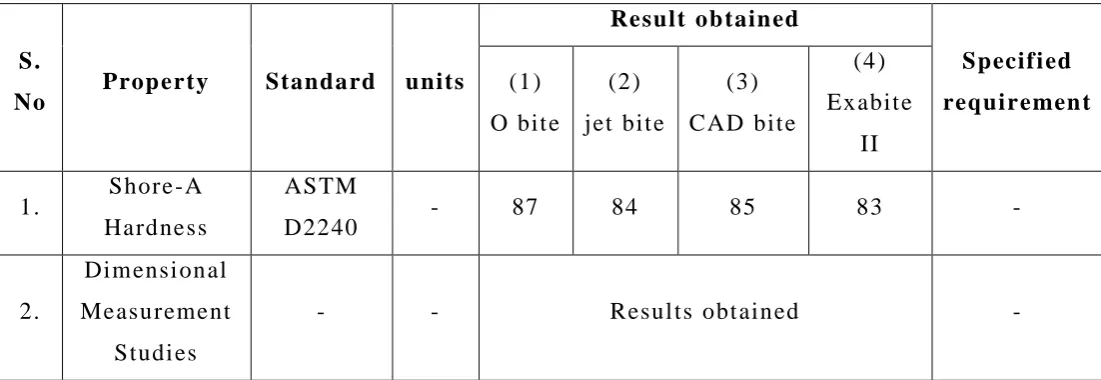
Hardness of material was measured with the help of durometer.
Statistical anal ysis was performed using anal ysis of
variance (ANOVA) with repeated measures for comparisons
among groups at t he .01 level of significance.
The Mean Percentage Dimensional changes for Group A,
Group B Group C and Group D at various time inter vals are
Results
TABLE I
Hardness Test results
S.
No Prop erty Standard units
Result ob tain ed
Specifi ed
requi remen t
(1)
O bit e
(2)
jet bit e
(3)
CAD bit e
(4)
Exabit e
II
1. Shore-A
Hardness
ASTM
D2240 - 87 84 85 83 -
2.
Dim ensi onal
Measurement
Studi es
- - Resul ts obt ained -
Sample Details:
1. O Bite
2. Jet Bite
3. CAD Bite
4. ExabiteII
INFERENCE
O –Bite showed highest hardness followed b y CAD Bite, JET
Results
TABLE II: Dim ensional change for Group A (O BITE) at
various tim e intervals
SAMPLE AFTE R 3 HRS AFTE R 24 H RS AFTE R 48 H RS
Li ne1 Li ne2 L1 - L2 LINE1 LINE2 L1 - L2 LINE1 LINE2 L1 - L2
O Bit e 7.995
[image:57.595.29.582.165.369.2]8.392 8.034 8.005 7.635 7.801 8.200 7.838 7.812 7.442 .194 .192 .196 .193 .195 7.599 7.147 7.257 7.541 7.485 7.410 6.961 7.069 7.354 7.299 .189 .186 .188 .187 .186 6.597 7.064 6.534 7.087 7.037 6.412 6.882 6.450 6.902. 6.853 .185 .182 .184 .185 .184
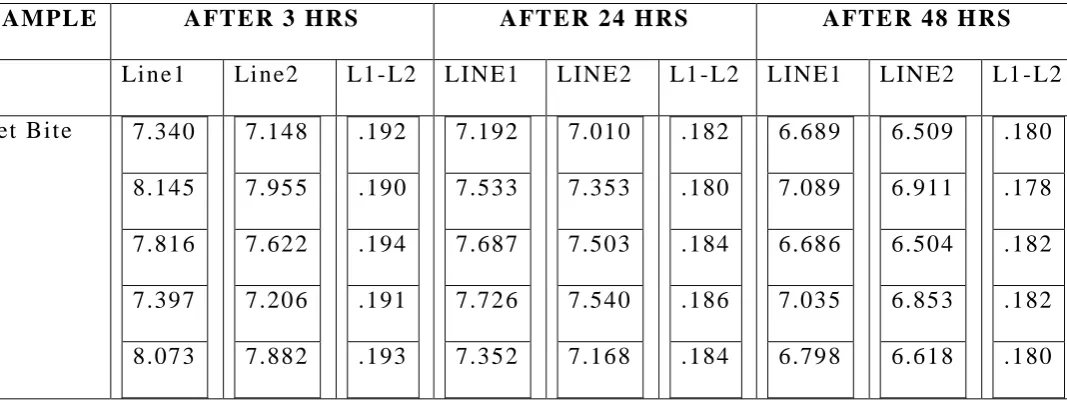
TABLE-III: Dim ensional change for Group B (JET bite) at
various tim e intervals
SAMPLE AFTE R 3 HRS AFTE R 24 H RS AFTE R 48 H RS
Li ne1 Li ne2 L1 - L2 LINE1 LINE2 L1- L2 LINE1 LINE2 L1 - L2
Jet Bite 7.340
[image:57.595.43.577.453.656.2]Results
Table-IV: Dim ensional change for Group C (CAD bite) at
various tim e intervals
SAMPLE AFTE R 3 HRS AFTE R 24 H RS AFTE R 48 H RS
Li ne1 Li ne2 L1- L2 LINE1 LINE2 L1- L2 LINE1 LINE2 L1 - L2
CAD Bit e 7.762 7.211 7.999 7.560 8.001 7.569 7.006 7.808 7.372 7.804 .193 .195 .191 .188 .197 7.626 7.173 7.397 7.042 7.678 7.442 6.987 7.215 6.855 7.497 .184 .186 .182 .187 .181 6.379 7.077 7.090 6.530 7.082 6.199 6.899 6.908 6.352 6.902 .180 .178 .182 .178 .180
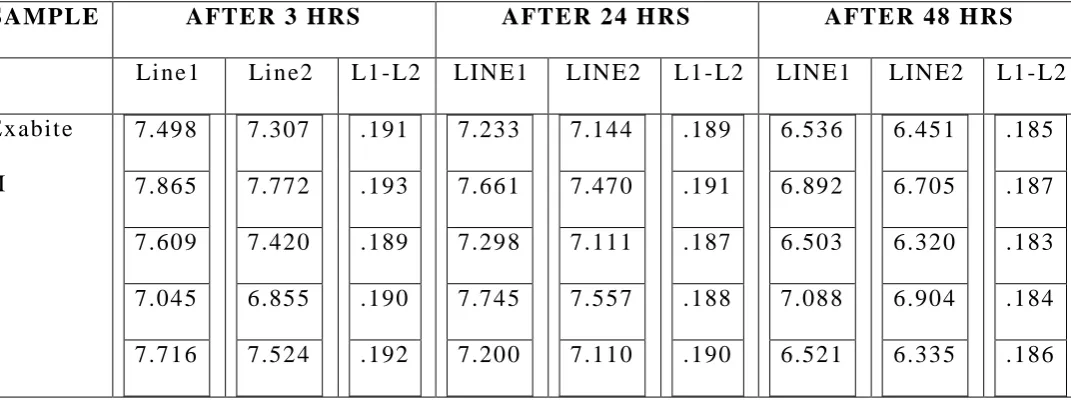
Table-V: Dim ensional change for Group D (Exabite II) at
various tim e intervals
SAMPLE AFTE R 3 HRS AFTE R 24 H RS AFTE R 48 H RS
Li ne1 Li ne2 L1- L2 LINE1 LINE2 L1- L2 LINE1 LINE2 L1 - L2
[image:58.595.42.578.424.626.2]Results
Statistical Analysis
All the data obtained were subjected to ANOVA with
repeated measures to find out the statistical significance
between groups and withi n groups.
Table-VI: Mean, Standard deviation between FOUR different
types of com m ercially available Addition silicone
Interocclussal recording m aterials at3 hours
mean Std. Deviation N
O bite .194000 .0015811 5
JET bite .192000 .0015811 5
CAD bite .192800 .0034928 5
ExabiteII .191000 .0015811 5
Total .192450 .0023278 20
INFERENCE
The statistical analysis for 3 hrs is as follows. Mean of
Group A (o bite) is .194, Group B, (jet bite).192, Group C(CAD
bite) .193, Group D (ExabiteII).191.
Standard d eviation of Group A is .0016, Group B .0016,
Group C .0035, Group 016. It is observed that all the standard
deviation is <.001. And it is found to be statisticall y significant
Results
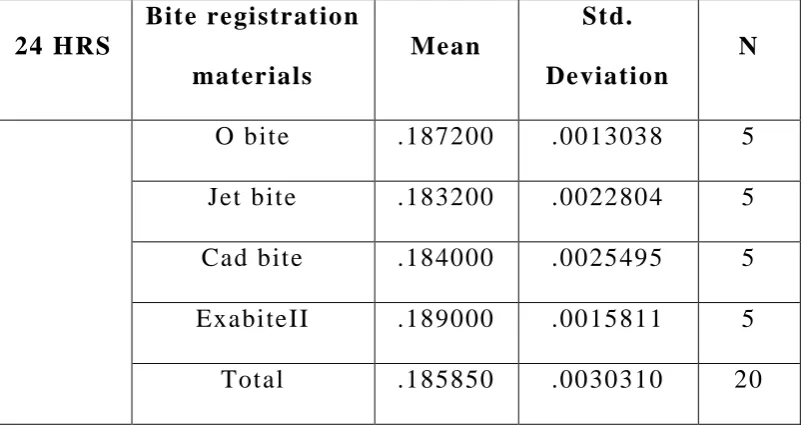
Table-VII: Mean, Standard deviation between FOUR different
types of comm ercially available Interocclussal recording
m aterials at 24 hour
24 HRS
Bite registration
materials
Mean
Std.
Deviation
N
O bite .187200 .0013038 5
Jet bite .183200 .0022804 5
Cad bite .184000 .0025495 5
ExabiteII .189000 .0015811 5
Total .185850 .0030310 20
INFERENCE
The statistical analysis for 24 hrs is as follows.
Mean of Group A (O bite) is .187, Group B(jet bite)
.183,GroupC (CAD Bite).184,GroupD.( ExabiteII ).189.
Standard deviation of Group A(O Bite) is .0013, Group B
(Jet Bite) .0022, Group C (CAD Bite) .0026, Group D (Exabite
II) .0016.It is observed all the standard deviation is <.001 and
Results
Table-VIII: Mean, Standard deviation between FOUR
different types of comm ercially available addition silicone
interocclussal recording m aterials at48 hours
Bite registration
materials
Mean
Std.
Deviation
N
48 hours
O BITE .184000 .0012247 5
Jet bite .180400 .0016733 5
Cad bite .179600 .0016733 5
Exabite II .185000 .0015811 5
Total .182250 .0027506 20
INFERENCE
The statistical analysis for 48 hrs is as follows.
Mean of Group A (O-Bite) is .180, Group B (Jet Bite)
.181, Group C (CAD Bite) .185, Group D (Exabite II).189.
Standard deviation of Group A (OBite) is .0012, Group B
(Jet Bite) .0016, Group C (CAD Bite) .0016, Group D (Exabite
II) .006.
It is observed all the standard deviation is <.001 and it is
Results
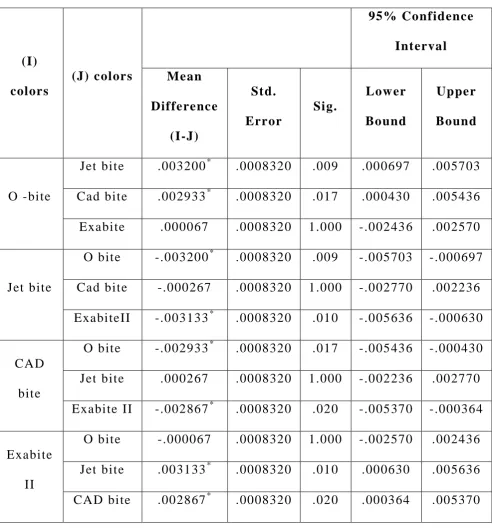
TABLE IX Statistical analysis betw een the groups
(I) colors (J) colors 95% Confidence Interval Mean Difference (I-J) Std. Error Sig. Low er Bound Upper Bound O -bite
Jet bite .003200* .0008320 .009 .000697 .005703
Cad bite .002933* .0008320 .017 .000430 .005436
Exabite .000067 .0008320 1.000 -.00243 6 .002570
Jet bite
O bite -.003200* .0008320 .009 -.005703 -.000697
Cad bite -.000267 .0008320 1.000 -.002770 .002236
ExabiteII -.003133* .0008320 .010 -.005636 -.000630
CAD
bite
O bite -.002933* .0008320 .017 -.005436 -.000430
Jet bite .000267 .0008320 1.000 -.002236 .002770
Exabite II -.002867* .0008320 .020 -.005370 -.000364
Exabite
II
O bite -.000067 .0008320 1.000 -.002570 .002436
Jet bite .003133* .0008320 .010 .000630 .005636
Results
INFERENCE OF THE RESULTS
1. On comparing Group A (O Bite) with Group B (JET Bite)
the mean difference was found to be significant at 1%
level.
2. On comparing Group A (O Bite) with Group C (CAD
Bite) the mean dif ference was found to be significant at
1% level.
3. On comparing Group A (O Bite) with Group D (EXABITE
II Bite) the mean difference was found to be
insignificant at 1% level .
4. On comparing Group B (JET Bite) with Group C (JET
Bite) the mean difference was found to be insignificant at
1% level.
5. On comparing Group B(JET Bite) with Group D
(EXABITE II Bite) the mean difference was found to be
significant at 1% level .
6. On comparing Group C (CAD Bite) with Group D
(EXABITE II Bite) the mean difference was found to be