S T U D Y P R O T O C O L
Open Access
Development and pilot test of a peer-support
based Cardiac-Diabetes Self-Management
Program: A study protocol
Chiung-Jung Jo Wu
1*, Anne M Chang
1,2, Mary Courtney
3, Lillie M Shortridge-Baggett
4and Karam Kostner
2,5Abstract
Background:People with cardiac disease and type 2 diabetes have higher hospital readmission rates (22%) compared to those without diabetes (6%). Self-management is an effective approach to achieve better health outcomes; however there is a lack of specifically designed programs for patients with these dual conditions. This project aims to extend the development and pilot test of a Cardiac-Diabetes Self-Management Program
incorporating user-friendly technologies and the preparation of lay personnel to provide follow-up support. Methods/Design:A randomised controlled trial will be used to explore the feasibility and acceptability of the Cardiac-Diabetes Self-Management Program incorporating DVD case studies and trained peers to provide follow-up support by telephone and text-messaging. A total of 30 cardiac patients with type 2 diabetes will be randomised, either to the usual care group, or to the intervention group. Participants in the intervention group will received the Cardiac-Diabetes Self-Management Program in addition to their usual care. The intervention consists of three face-to-face sessions as well as telephone and text-messaging follow up. The face-face-to-face sessions will be provided by a trained Research Nurse, commencing in the Coronary Care Unit, and continuing after discharge by trained peers. Peers will follow up patients for up to one month after discharge using text messages and telephone support. Data collection will be conducted at baseline (Time 1) and at one month (Time 2). The primary outcomes include self-efficacy, self-care behaviour and knowledge, measured by well established reliable tools.
Discussion:This paper presents the study protocol of a randomised controlled trial to pilot evaluates a Cardiac-Diabetes Self-Management program, and the feasibility of incorporating peers in the follow-ups. Results of this study will provide directions for using such mode in delivering a self-management program for patients with both cardiac condition and diabetes. Furthermore, it will provide valuable information of refinement of the intervention program.
Trial Registration NumberACTRN12611000086965
Background
Cardiac disease and diabetes are the most prevalent chronic diseases in the Australian population. The num-ber of people with diabetes is estimated to increase from 171 million in 2000 to 366 million by 2030 [1,2]. The prevalence of diabetes for Australians aged 25 or over in 1999-2000 was 7.4% (more than 1 in 14 people) and the average age of people with diabetes is getting
younger [3]. In 2000-2003, it is reported that 6.6% of Australians aged 18 years and over had diabetes [3]. Australia’s Health 2008 confirmed people diagnosed with type 2 diabetes are more vulnerable to cardiovascu-lar complications, and are at greater risk of further car-diac events, leading to poor health-related quality of life [3]. People with diabetes were reported to rate their health three times lower than those without diabetes [3,4]. The direct costs of treating type 2 diabetes and its related complications is estimated to reach between $213-396 billion a year globally by 2025, which is as high as 40 percent of some countries’health care bud-gets [5-9]. Therefore, reducing the risk of diabetes and
* Correspondence: [email protected]
1School of Nursing and Midwifery, Institute of Health and Biomedical Innovation, Queensland University of Technology, Victoria Park Road, Kelvin Grove, QLD 4059, Australia
Full list of author information is available at the end of the article
its associated cardiac complications is vitally important not only from a personal, but also an economic perspective.
Two previous studies undertaken by the first two authors provided the basis for developing the initial Car-diac-Diabetes Self-Management Program (CDSMP). An exploratory study of the demographic characteristics and incidence of critical cardiac admission for patients with type 2 diabetes over a four-year period indicated 15% of all Coronary Care Unit (CCU) patients had a previous diagnosis of type 2 diabetes, and 22% of these patients were readmitted to hospital within 28 days compared to only 6% of CCU patients without diabetes [10]. A second study using a qualitative interpretative approach to gain in-depth understanding of the needs and experiences of this at-risk group of patients, found four main themes of confidence in self, confidence in health professionals, feelings of hopelessness and fatigue were related to managing their conditions following dis-charge [11]. These findings highlighted the complexity for patients with these two conditions in undertaking self-management. Both studies were invaluable in the development of a new self-management program, the CDSMP, which was based on self-efficacy construct [12]. The self-efficacy construct is based on the effect of a person’s belief in their abilities to successfully follow through with planned actions and accomplish goals. Furthermore, a person with high self-efficacy will tend to set higher personal goals than someone with low self-efficacy, who will have very little faith in his/ her ability to achieve in the area in question [13].
Current literature supports the success of self-manage-ment programs based on improving self-efficacy levels in modifying lifestyles for different patient groups with chronic diseases such as type 2 diabetes [14,15] and car-diac disease [16]. Patients with type 2 diabetes who are admitted to CCU following a critical cardiac event are suddenly confronted with a number of life style rules and advice in order to deal with their illnesses. Often these rules and recommendations are presented sepa-rately for each disease and not tailored to the needs of patients with both diabetes and a cardiac condition. Furthermore, such guidance is given by professionals who might not have experienced any of the challenges these patients now face.
Having peer support during this initial period is very valuable. A recent World Health Organisation (WHO) consultation on peer support programs indicated these were promising and presented recommendations for developing and evaluating such programs [17]. A peer support person is someone who has experienced similar conditions, been successful in managing their conditions and is able to provide relevant and meaningful informa-tion [18].
Although the benefits of peer support for improving chronic illness self-management, including diabetes, to achieve better health outcomes has been demonstrated [18-22] there is limited evidence that self-management programs provided by or incorporating peers have improved psychological, or reduced health care utiliza-tion [22,23]. Furthermore, no research has yet been undertaken to evaluate the effectiveness of peer support for patients with both type 2 diabetes and cardiac condi-tions, nor has it been evaluated in different contexts (hospital and community).
Aim
To develop and pilot test a Cardiac-Diabetes Self-Man-agement Program (CDSMP) utilising peer support for improving self-management for patients with both dia-betes and cardiac conditions.
Objectives
•To further develop a CDSMP for patients with type 2 diabetes following a critical cardiac event, including the development of a DVD incorporating stories from a range of case studies, and use of for-mer patients (peers) to provide support in adopting self-management strategies.
•To evaluate the feasibility and applicability of the DVD and peer supported CDSMP.
Hypotheses
•Anticipated outcomes for the intervention group when compared to the control group receiving usual care will include:
•Higher self-management practice scores; •Higher self-efficacy levels;
•Higher knowledge scores.
Methods/Design
The pilot study using randomised controlled trial design (parallel-group trial) within the participants’usual health care environment will be conducted in three distinct but overlapping phases: (1) development of the training package including the CDSMP materials and Digital Video Disk (DVD), (2) peer selection and training, and (3) intervention phase. These will each be described below.
Phase 1: Development of the CDSMP
component; this will take the form of a DVD. The DVD will be provided to participants in the intervention group to assist them to apply strategies from the self-efficacy model; it will take the form of narrative“ real-life” stories of people managing both diabetes and car-diac conditions. A further addition to the program will be the use of peers to provide follow-up support to participants.
The CDSMP program consists of three face-to-face sessions and telephone and text-messaging follow-up. The face-to-face sessions will be provided by a trained Research Nurse, and be conducted while the patients are in CCU and continue as the patient makes the tran-sition home after discharge. The participants will be tel-ephoned 1 week after discharge home and 2 text-messages will be sent a week after telephone follow up. These will be conducted by the trained‘peers’.
Reference Group
A reference group will be formed for the purposes of informing and reviewing program materials. The panel will consist of experts in the field (e.g. cardiologists, dia-betes educators, cardiac rehabilitation coordinators) plus the researchers. After agreeing to participate, panellists will attend face-to-face meetings to establish the roles and responsibilities of the panel, such as reviewing and commenting on program development, including DVD production, and to agree on acceptable methods of com-munication. The panel will provide an important source of guidance in the production of all educational materi-als, in particular the DVD.
DVD Production
“Actors” in the DVD will be actual people dealing with diabetes and cardiac conditions and discussions will be held between these actors, the production team and Chief Investigator to ensure understanding of individual roles, as well as the DVD as a whole. Prior to produc-tion, reference group members will be given the oppor-tunity to review and comment on the DVD script. The resulting DVD will be presented to the reference group for final approval before its use within the CDSMP.
Phase 2: Peer Selection & Training
Selection and training of peer supporters is a crucial component to this project; a peer supporter is someone who has similar conditions, and can use their own experience to provide information to others. The peer support person can be very useful to others who are try-ing to work out the best ways of managtry-ing their health [18]. Potential peers, who are considered competent in the management of their conditions will be identified by the cardiologist and subsequently trained by the researchers. To facilitate the training process, a detailed peer training manual will be developed, also utilising self-efficacy principles.
Phase 3: Intervention
Control group (group 1): Participants will receive usual care, which consists of education provided in the CCU and referral as necessary to the diabetes educator.
Intervention group (group 2): Participants will receive usual care and a combination of CDSMP sessions in the CCU, plus peer telephone and text follow-ups.
The CDSMP is designed to be administered on a one-to-one basis and to commence in CCU by staff mem-bers, then be followed up by trained peers via a tele-phone call one week after discharge and text message reminders from peers in weeks three and four. If a patient is transferred to a ward before completing the program, the hospital-based section of the CDSMP will be continued on the ward by the trained research nurse.
As part of the program, the DVD based on incorpor-ating stories from a range of case studies is developed and will be provided to participants in the intervention group to assist them with the application of strategies from the Self-Efficacy Model.
Settings and locations
The study will be conducted in the Coronary Care Units (CCU) at Mater Health Services, and followed up by tel-ephone and text messages at participants’homes in Bris-bane, Australia.
Participants
Sample size
A total of 30 patients for 2 groups will be required. This sample size of 10-15 per group is suggested by Hertzog (2008) [19]. This number is calculated with an alpha of 0.05 and power of 0.9, thus 10 patients per group will be required to detect any statistical differences. Allowing 20% attrition rate, 13 patients per group will be required. Thus with an alpha of 0.05 and power of 0.9, 8 patients per group was required to detect any statisti-cal differences.
Inclusion criteria
Participants who will be included:
•are males and females aged over 18 years who have given their consent to participate in the study •have had type 2 diabetes for at least one year and have been admitted to the CCU with a critical car-diac event in the study hospitals
•can read and converse in English •are physically stabilised
•have a mobile phone
Exclusion criteria
•Potential participants will be excluded if they: •are unable to read and speak English
Minority groups or people from non-English speaking backgrounds (NESB) will be included unless they cannot read and speak English. English is needed, as the materi-als are in English. Programs for non-English speaking patients will be developed in future projects.
Randomisation
Simple randomisation using a randomisation table (computerised sequence generation) will be used. Allo-cation will be concealed by using sealed, numbered, opa-que envelopes to both control and intervention groups.
Data Collection
Primary and secondary outcomes: Primary outcomes include self-efficacy, self-care behaviour and knowledge. Secondary outcome is readmission rate within 28 days.
Baseline (Time 1): When patients’physical condition is stable they will be invited by a Research Assistant (RA) to participate in the study. Following explanation of the study, demographic and baseline data will be col-lected for those giving informed consent.
One month follow-up (Time 2): A questionnaire will be posted to participants at their discharge location, after which the RA will telephone the participant and collect data over the phone. Posting the questionnaire first will facilitate data collection in the telephone inter-view. This method has been used previously by a research team member [24], resulting in a high response rate (84%).
Measures
Data will be collected on primary outcomes of this study: self-management practice, self-efficacy, knowledge and secondary outcome: readmission rates.
Self-management practice
Data will be collected at Time 1 and Time 2, and will be measured using the Summary of Diabetes Self-Care Activities (SDSCA) [25]. The SDSCA comprises 11 items that measure patients’adherence to self-manage-ment activities such as diet, exercise, blood glucose test-ing, foot care, and smoking status. The respondents will be asked to rate each item using 0-7 scale, with 7 indi-cating most adherence to each aspect, and 0 for non-compliance. Permission to use this tool has been granted by the authors.
Self-efficacy
Data will be collected at Time 1 and Time 2, and will be measured using the Diabetes Management Self-Efficacy Scale (DMSES) (Australian-English version) [26]. The DMSES comprises 20 items that measure patients’ con-fidence levels (self-efficacy) in managing their diabetes. The respondents will be asked to rate each item using 0-10 scale, with 10 indicating the highest confidence level, and 0 the lowest. This scale is designed to
measure the self-efficacy levels of patients with type 2 diabetes. A high internal consistency was demonstrated by the Cronbach alpha coefficient of 0.9. Face validity was established through consultation with diabetes edu-cators and patients with type 2 diabetes, and convergent validity was demonstrated by the significant correlations between DMSES and the General Self-Efficacy Scale (GSE). Permission to use this tool has been granted.
Knowledge
Data will be collected at Time 1 and Time 2, and will be measured using Diabetes Knowledge Questions (DKQ) [27]. The DKQ measures patients’knowledge of diabetes and cardiac conditions. Each item with a correct answer scores one point; score ranges are therefore 0 to 8. Cronbach alpha for DKQ is 0.7, indicating good internal consistency [27]. In addition, this scale is brief and unli-kely to cause a‘response burden’; particularly as patients who have diabetes and have had a cardiac condition may become tired answering questions. Permission to use this tool has been granted.
Readmission rate
Readmission rate will be collected at Time 2, and will be ascertained from hospital records.
Procedure
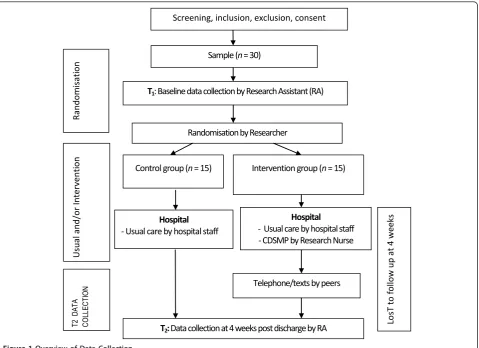
The nominated RA will liaise with the Nurse Unit Man-ager (NUM) of the CCU, to obtain a list of eligible par-ticipants from the CCU Admission Book. The RA will then approach the potential participants for their informed consent and to collect baseline data. After baseline data is collected, a computer-generated list of random numbers produced by the researcher will then be used to randomly assign participants to either the control group or the intervention group (See Figure 1: Overview of data collection). Patients are blinded to receive either usual care or usual care and CDSMP, however the RA who assisting with data analysis is not blinded.
Control group (group 1): Participants will receive usual care, which consists of education provided in the CCU and referral as necessary to the diabetes educator.
Intervention group (group 2): Participants will receive usual care and a combination of CDSMP sessions in the CCU, plus peer telephone and text follow-ups. The CDSMP was designed to be administered on a one-to-one basis and to commence in CCU by staff members, then be followed up by trained peers via a telephone call one week after discharge and text message remin-ders from peers in weeks three and four. If a patient is transferred to a ward before completing the program, the hospital-based section of the CDSMP will be contin-ued on the ward by the trained research nurse.
and will be provided to participants in the intervention group to assist them with the application of strategies from the Self-Efficacy Model.
Data Analysis
Prior to undertaking statistical tests, the homogeneity of the sample will be examined. Due to small samples size; non-parametric statistical tests will be used to determine the relationships and differences between disease and demographic variables: Chi-square for categorical ables and Mann-Whitney U test for continuous vari-ables. The Wilcoxon Signed Rank test will be used to determine whether any changes in outcome variables occurred within and between groups over time. Mann-Whitney U test will be used to confirm whether there is an interaction between time and group. All analyses will be conducted using SPSS version 18 with a pre-defined level of statistical significance at p < 0.05.
Ethical Considerations
Ethical approvals have been granted by the Mater Health Services Human Research Ethics Committee and
Queensland University of Technology Human Research Ethics Committee.
Informed consent: All participants will be volunteers who will provide written consent, and will be free to withdraw at any time. Confidentiality: No identifying information will be kept with the data, which will be analysed and stored on a secure network drive at the university, protected by password and used only for the purposes of this study. Only the researchers involved in this study will have access to the data. While no infor-mation about the project will be published in any form that will allow any individual to be recognised; non-identifiable results will be reported within the hospital and in the literature.
This study protocol is now registered with the Austra-lia and New Zealand Clinical Trials Registry (Trial Number: ACTRN12611000086965).
Discussion
This protocol has provided information on planning and pilot testing the feasibility of a peer-support based car-diac-diabetes self-management program. This project
T1: Baseline data collection by Research Assistant (RA)
Randomisation by Researcher
Control group (n = 15) Intervention group (n = 15)
Randomi
sati
on
Usual and/or Inter
venti
on
T2 D
ATA
COLLECT
ION
Hospital - Usual care by hospital staff
Hospital - Usual care by hospital staff - CDSMP by Research Nurse
Telephone/texts by peers
T2: Data collection at 4 weeks post discharge by RA
Lo
sT
t
o
f
o
llow up at 4 w
eeks
Sample (n = 30)
[image:5.595.60.540.88.436.2]Screening, inclusion, exclusion, consent
aims to compare and evaluate transitional care interven-tions in order to reduce readmission rates and emer-gency health service visits by patients with diabetes and a cardiac event, and to improve their health, and psy-chosocial well-being. Additionally, this project seeks to improve the uptake of appropriate self-management in people with both diabetes and a cardiac condition, and encourage maintenance of independence. The findings of this pilot study will provide baseline knowledge for undertaking a larger study to test the effectiveness of a self-management program, which incorporates text mes-saging and telephone follow-up by a peer support per-son for patients with both diabetes and a cardiac condition.
Limitations
The results of this pilot study will provide valuable information of the feasibility and acceptability of the peer-support based cardiac-diabetes self-management program, and direction of power analysis for required sample size for a larger study. However, staff variations and trend of patients within participating study sites may vary for a future full study. For example, patients’ self-care behaviour and self-efficacy levels may not be consistent with pilot study. The research nurse trained for this study is specialised in coronary care, which could possibly lead to contamination associated with delivering the program.
Conclusions
The proposed peer-support based self-management pro-gram uses self-efficacy construct of Bandura’s Social Cognitive Theory which is flexible and could potentially be adapted in other chronic diseases. This intervention, incorporating peers and telephone and text-messaging approach will provide important information for future research and care planning.
Acknowledgements & Funding
This Peer Support based Cardiac-Diabetes Self-Management Program is supported by funding from the Department of Health & Ageing through the ‘Sharing Health Care Initiative’Research Grant in Australia. The authors also would like to express special thanks to the reference group.
Author details
1
School of Nursing and Midwifery, Institute of Health and Biomedical Innovation, Queensland University of Technology, Victoria Park Road, Kelvin Grove, QLD 4059, Australia.2Mater Health Services, Brisbane, Australia. 3Health and Social Development, University of British Columbia Okanagan, Kelowna BC V1V 1V7, Canada.4Department of Graduate Studies, Lienhard School of Nursing, Lienhard Hall 309 Pace University, 861 Bedford Road, Pleasantville, New York 10570-2799, USA.5School of Medicine, University of Queensland, Australia.
Authors’contributions
CJW, the principal investigator of the study, conducted the data analysis with oversight of co-authors: AMC, MC, LMSB, and KK, drafted the initial manuscript. All co-authors reviewed and approved the final draft. KK
participated in preparation of selecting and training peers, and critically reviewed, edited and approved the final draft.
Competing interests
The authors declare that they have no competing interests.
Received: 12 December 2010 Accepted: 11 April 2011 Published: 11 April 2011
References
1. Wild S, Roglic G, Green A, Scicree R, King H:Global prevalence of diabetes: Estimates for the year 2000 and projections for 2030.2004,27:1045-53. 2. World Health Organisation:Country and regional data: Prevalence of
diabetes worldwide.2008 [http://www.who.int/diabetes/facts/ world_figures/en/print.html], Accessed August 15.
3. Australian Institute of Health and Welfare (AIHW):Diabetes: Australia Facts 2008.Canberra: Australian Institute of Health & Welfare; 2008.
4. Australian Bureau of Statistics (ABS):Diabetes in Australia: A snapshot, 2004-05.2006 [http://www.abs.gov.au/ausstats/[email protected]/mf/4820.0.55.001/]. 5. Diabetes Australia:Diabetes Facts.Canberra: Diabetes Austrlia; 2008. 6. International Diabetes Institute (IDI):Diabetes and associated disorders in
Australia.Melbourne: International Diabetes Institute; 2000.
7. Diabetes Australia - Queensland:Diabetes: The facts and figures.Brisbane: Diabetes Australia - Queensland; 2005.
8. International Diabetes Federation:Diabetes atlas - Estimates of costs of diabetes care.2008 [http://www.eatlas.idf.org/Costs_of_diabetes/ Calculated_cost_estimates/], Accessed August 20.
9. Diseases NIDDK:National diabetes statistics 2007.2008 [http://www. diabetes.niddk.nih.gov], Accessed August 15.
10. Wu CJJ, Chang AM:Audit of patients with type 2 diabetes following a critical cardiac event.2008,55:327-32.
11. Wu C-JJ, Chang AM, McDowell J:Perspectives of patients with type 2 diabetes following a critical cardiac event - an interpretative approach. 2008,17:16-24.
12. Wu CJJ, Chang AM, McDowell J:Innovative self-management programme for diabetics following coronary care unit admission.2009,56:396-9. 13. Bandura A:Swimming against the mainstream: the early years from
chilly tributary to transformative mainstream.2004,42:613-30. 14. Norris SL, Engelgau MM, Narayan KMV:Effectiveness of self-management
training in type 2 diabetes: a systematic review of randomize controlled trials.2001,24:561-87.
15. Vermeire EI, Wens J, Van Royen P, Biot Y, Hearnshaw H, Lindenmeyer A: Interventions for improving adherence to treatment recommendations in people with type 2 diabetes mellitus.Cochrane Database of Systematic Reviews2005, 37.
16. Beswick AD, Rees K, West RR, Taylor FC, Burke M, Griebsch I, Taylor RS, Victory J, Brown J, Ebrahim S:Improving uptake and adherence in cardiac rehabilitation: literature review.J Adv Nurs2005,49:538-55.
17. World Health Organisation:Peer support programmes in diabetes: Report of a WHO Consultation, 5-7 November 2007.Geneva: World Health Organisation; 2007.
18. Foster G, Taylor SJ, Eldridge S, Ramsay J, Griffiths CJ:Self-management education programmes by lay leaders for people with chronic conditions.Cochrane Database of Systematic Reviews2007, CD005108, Art No.
19. Hertzog MA:Considerations in determining sample size for pilot studies. Research in Nursing & Health2008,31:180-191.
20. Earp JA, Eng E, O’Malley MS, Altpeter M, Rauscher G, Mayne L, Mathews HF, Lynch KS, Qaqish B:Increasing Use of Mammography Among Older, Rural African American Women: Results From a Community Trial.Am J Pub Health2002,92:646-54.
21. Heisler M:From research to practice/DSME support. Overview of peer support models to improve diabetes self-management and clinical outcomes.Diabetes Spectrum2007,20:214-21.
22. Heisler M, Piette JD:“I help you, and you help me": facilitated telephone peer support among patients with diabetes.The Diabetes Educator2005, 31:869-79.
24. Courtney M, Edwards H, Chang AM, Parker A, Finlayson K, Hamilton K: Fewer emergency readmissions and better quality of life for older adults at risk of hospital readmission: A randomized controlled trial to determine the effetivess of a 24-week exercise and telephone follow-up program.Journal of the American Geriatrics Society (JAGS)57:395-402. 25. Toobert DJ, Hampson SE, Glasgow RE:The summary of Diabetes Self-Care
Activities measure: Results from 7 studies and a revised scale.Diabetes Care2000,23:943-50.
26. McDowell J, Courtney M, Edwards H, Shortridge-Baggett L:Validation of the Australian/English version of the Diabetes Management Self-Efficacy Scale.Int J Nurs Prac2005,11:177-84.
27. Persell SD, Keating NL, Landrum MB, Landon BE, Ayanian JZ, Borbas C, Guadagnoli E:Relationship of diabetes-specific knowledge to self-management activities, ambulatory preventive care, and metabolic outcomes.Prev Med2004,39:746-52.
Pre-publication history
The pre-publication history for this paper can be accessed here: http://www.biomedcentral.com/1472-6963/11/74/prepub
doi:10.1186/1472-6963-11-74
Cite this article as:Wuet al.:Development and pilot test of a
peer-support based Cardiac-Diabetes Self-Management Program: A study protocol.BMC Health Services Research201111:74.
Submit your next manuscript to BioMed Central and take full advantage of:
• Convenient online submission
• Thorough peer review
• No space constraints or color figure charges
• Immediate publication on acceptance
• Inclusion in PubMed, CAS, Scopus and Google Scholar
• Research which is freely available for redistribution